
Introduction
Console Table Dimensions Behind Sofa | A living room can have beautiful furniture, attractive wall colors, comfortable seating, and carefully selected decorations, yet something can still feel incomplete. One common reason is the empty space behind the sofa. It may look awkward, especially when the sofa sits away from the wall or divides an open-plan living area into separate sections. A console table can turn this overlooked area into a useful and attractive part of the room, but only when its dimensions are carefully selected.
Choosing the correct console table dimensions behind sofa is more important than many homeowners realize. A table that’s too tall can look disconnected from the sofa, excessive depth can reduce walking space, and an unsuitable width can make the entire furniture arrangement appear unbalanced. Even a stylish piece may become inconvenient when its proportions don’t match the surrounding furniture.
The right console table should complement the sofa, provide enough surface area for everyday accessories, and maintain comfortable movement throughout the living room. Its size should also reflect the room’s layout, the sofa’s design, and the purpose of the furniture.
Whether you’re furnishing a small apartment, decorating a spacious family room, or arranging a large sectional sofa, understanding furniture measurements can help you make a better decision.
In this complete guide, you’ll discover standard sofa console table measurements, recommended height, width, and depth, proper measuring techniques, clearance requirements, material choices, styling methods, and professional recommendations. You’ll also find practical examples, comparison tables, and common mistakes to avoid before purchasing your console table.
For more ideas about creating comfortable and attractive residential spaces, explore Design Mode 24 Interior Design.
1. What Are the Standard Console Table Dimensions Behind a Sofa?
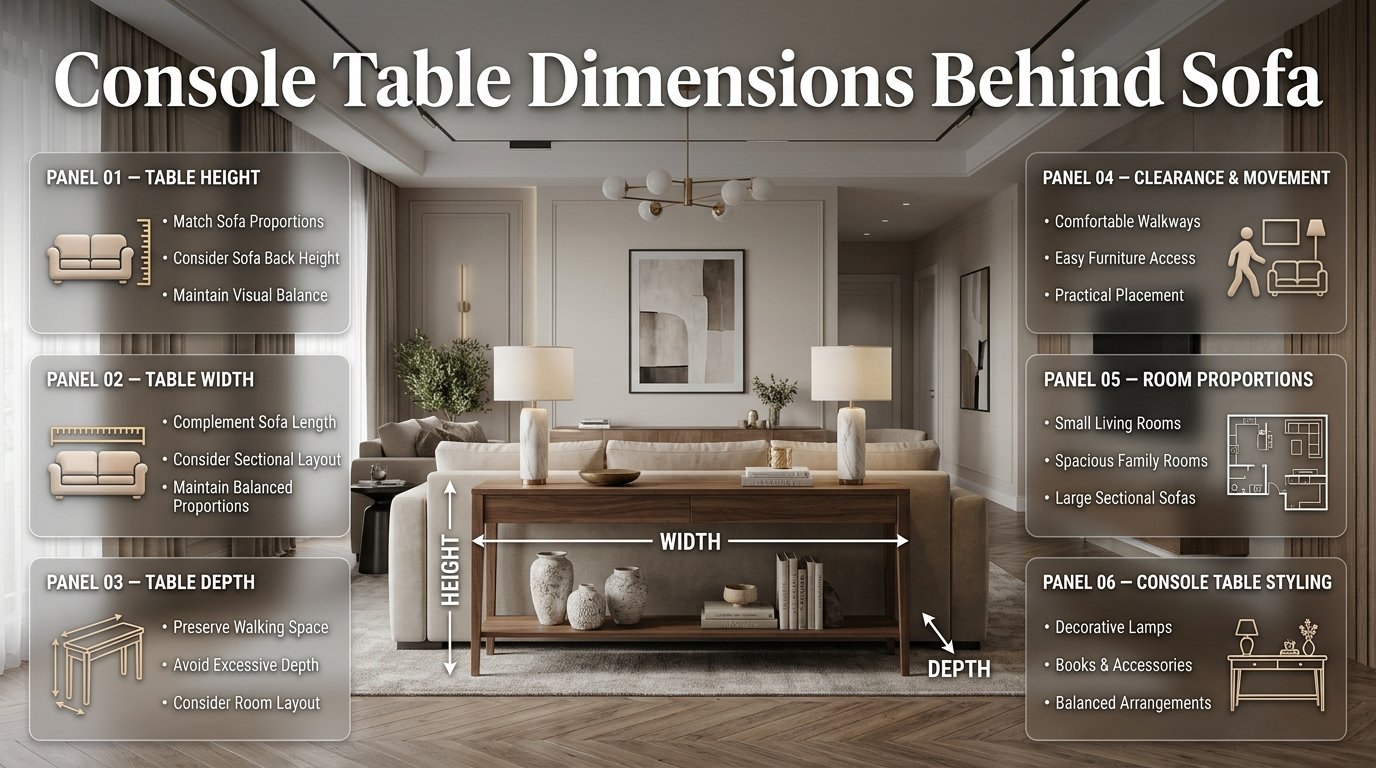
A standard console table behind a sofa generally measures 28–32 inches in height, 10–15 inches in depth, and approximately two-thirds to nearly the full width of the sofa. These measurements work well in many conventional living rooms, although the ideal dimensions depend on the furniture arrangement and available floor space.
A console table isn’t simply a narrow piece of furniture placed behind seating. It can provide decorative storage, additional lighting, convenient access to everyday items, and a visual connection between different areas of an open living space.
Before choosing a particular design, understand the three measurements that determine whether the table will fit properly.
Standard Console Table Measurement Guide
| Measurement | Recommended Range | Main Purpose |
|---|---|---|
| Height | 28–32 inches | Matches many standard sofa backs |
| Depth | 10–15 inches | Provides practical tabletop space |
| Width | ⅔ to nearly 100% of sofa width | Creates visual balance |
| Narrow-table depth | 8–10 inches | Supports compact arrangements |
| Wider-table depth | 15–18 inches | Provides additional surface space |
| Walking clearance | Around 30–36 inches where practical | Supports comfortable movement |
These figures are general furniture-planning recommendations, not fixed requirements. A low-profile sofa may need a shorter table, while a large sectional can accommodate a wider design.
Why Do Standard Dimensions Matter?
The dimensions influence three important aspects of your living room.
First, they determine visual proportion. A console table that’s too small may disappear behind a large sofa, while an oversized design can dominate the arrangement.
Second, they influence everyday functionality. You need enough tabletop space for the objects you plan to use without creating an obstacle.
Third, they affect circulation. A console table should not make it difficult for family members or visitors to walk through the living room.
For example, imagine a sofa measuring 90 inches wide. A console table measuring approximately 65–80 inches wide, 12 inches deep, and 29 inches high could provide an attractive starting point.
However, the final decision should account for the sofa’s back height and the clearance available behind it.
2. What Height Should a Console Table Be Behind a Sofa?
The ideal console table height is usually close to the sofa’s back height or slightly lower. Many standard living room arrangements work well with a console table between 28 and 32 inches high, but measuring the actual sofa is more reliable than following a general measurement.
Height is particularly important because the table sits directly behind the seating area. Even a small difference can change how the furniture arrangement looks.
A table that’s too tall may appear visually disconnected from the sofa. One that’s too short may look undersized or become difficult to use.
How to Match Console Table Height With Different Sofa Designs
Different sofa styles have different back heights.
| Sofa Design | Typical Back Height | Suggested Table Height |
|---|---|---|
| Low-profile modern sofa | 25–28 inches | 23–27 inches |
| Standard contemporary sofa | 28–31 inches | 26–30 inches |
| Traditional upholstered sofa | 30–34 inches | 28–32 inches |
| High-back sofa | 34–38 inches | 31–35 inches |
| Oversized sectional | 30–36 inches | 28–34 inches |
These ranges are starting points rather than strict specifications. Measure your own furniture before selecting a table.
Should a Console Table Be Higher Than the Sofa Back?
In most arrangements, a console table should not be dramatically higher than the sofa back.
A similar height or a slightly lower profile usually produces a more connected appearance.
However, the table doesn’t always need to disappear behind the sofa. Some homeowners prefer a slightly taller surface because they want decorative accessories or lighting to remain visible.
The important thing is to consider the complete arrangement rather than looking at the table height independently.
How Does Table Height Affect Decorative Accessories?
The table height also influences how accessories appear from different positions in the room.
For example, a lamp placed behind a low sofa may need a taller base to remain visible. On a high-back sofa, a large lamp could become unnecessarily dominant.
Consider the following:
- Measure the sofa back before choosing a lamp.
- Check the total height of the lamp and shade.
- Keep decorative objects proportionate to the tabletop.
- Avoid accessories that obstruct the room’s sightlines.
- Make sure frequently used items remain easy to reach.
Professional Tip: If you plan to use the console table primarily for lighting, choose the table and lamp together. This prevents the common problem of purchasing a beautiful lamp that becomes hidden behind the sofa.
3. How Wide Should a Console Table Be Behind a Sofa?
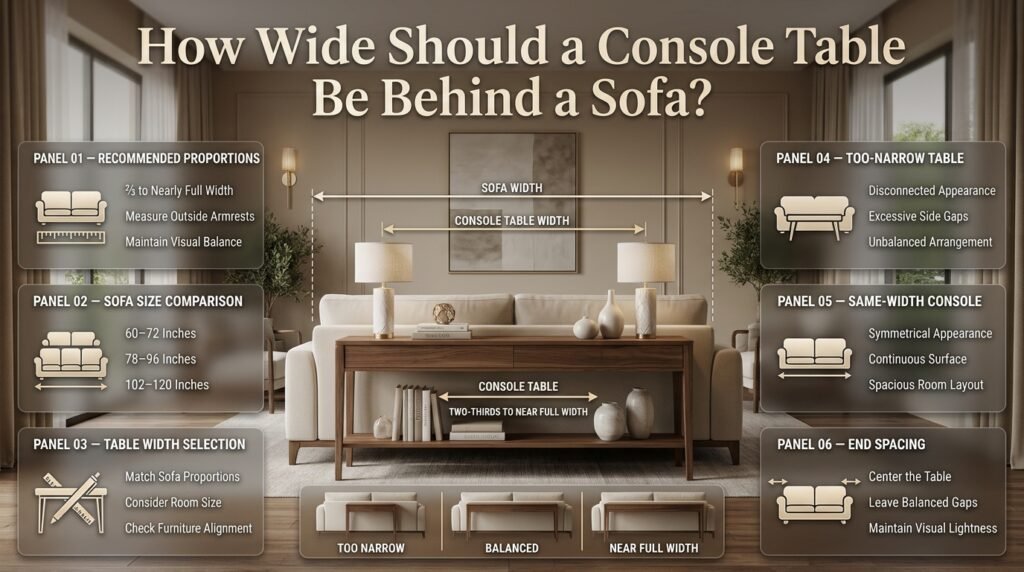
A console table should generally be around two-thirds to nearly the full width of the sofa. This creates a balanced arrangement while leaving some visible space around the edges.
Width is one of the easiest measurements to overlook because furniture photographs can make tables appear larger or smaller than they really are.
The best width depends on the sofa’s total outside measurement, including the armrests.
Recommended Console Table Width by Sofa Size
| Sofa Width | Suitable Console Table Width |
|---|---|
| 60 inches | 40–55 inches |
| 66 inches | 44–58 inches |
| 72 inches | 48–65 inches |
| 78 inches | 52–70 inches |
| 84 inches | 56–75 inches |
| 90 inches | 60–85 inches |
| 96 inches | 64–90 inches |
| 102 inches | 68–95 inches |
| 108 inches | 72–100 inches |
| 120 inches | 80–110 inches |
These recommendations allow flexibility for different interior styles.
What Happens When the Console Table Is Too Narrow?
A narrow table can work beautifully in a small room, but it may appear disconnected when positioned behind a large sofa.
For example, placing a 36-inch console table behind a 100-inch sofa may leave too much unused space at both ends.
This isn’t necessarily a functional problem, but it can make the furniture arrangement look unplanned.
If you prefer a smaller table, consider using a deliberate design approach. A centered decorative console can look intentional when paired with appropriately positioned lamps or artwork.
Can a Console Table Be the Same Width as the Sofa?
Yes. A console table can be almost the same width as the sofa, especially when the furniture arrangement is spacious and symmetrical.
This approach works well when:
- The sofa has a wide, straight back.
- The living room has sufficient circulation space.
- You want a continuous decorative surface.
- The table has a relatively simple design.
- The room benefits from a strong horizontal furniture line.
However, avoid choosing a table that extends significantly beyond the sofa unless the extra length serves a specific design purpose.
How Much Space Should Be Left at Both Ends?
Leaving some visible space at both ends can make the arrangement feel lighter.
For example, if your sofa is 90 inches wide and your console table is 72 inches wide, approximately 9 inches will remain at each end when centered.
This proportion can look particularly attractive in contemporary and transitional living rooms.
4. How Deep Should a Console Table Be Behind a Sofa?
A console table behind a sofa is commonly 10–15 inches deep. This provides enough room for small decorative objects, books, lamps, and everyday accessories without requiring the floor space of a full-sized cabinet.
Depth is especially important in apartments and narrow living rooms.
A table may have the perfect height and width but still create an uncomfortable arrangement if its depth reduces the available walking area.
Console Table Depth Comparison
| Table Depth | Suitable Application |
|---|---|
| 6–8 inches | Extremely narrow decorative spaces |
| 8–10 inches | Small apartments and compact layouts |
| 10–12 inches | Narrow living rooms |
| 12–15 inches | Standard sofa-back arrangements |
| 15–18 inches | Larger living rooms |
| 18–20 inches | Special multifunctional arrangements |
A deeper tabletop gives you more room to organize accessories, but it also occupies more floor space.
When Should You Choose a Narrow Console Table?
A narrow console table is particularly useful when the sofa sits close to a wall or when a main walkway passes behind the furniture.
Consider a slim design if:
- Your living room is relatively small.
- The sofa is positioned near an entrance.
- You want a decorative surface rather than substantial storage.
- You need to preserve circulation space.
- The room already contains several large furniture pieces.
A depth of approximately 8–12 inches is often worth considering in these situations.
When Is a Deeper Console Table Better?
A deeper console table may be suitable when you have enough floor space and need additional functionality.
For example, a 15-inch-deep design may provide a more practical surface for two lamps, a decorative tray, and a few books.
A deeper design can also accommodate certain storage arrangements, depending on the construction.
However, always calculate the remaining clearance before purchasing.
5. How Much Clearance Do You Need Behind a Sofa and Console Table?
The amount of clearance required depends on whether people need to walk behind the console table, whether the table sits against a wall, and how frequently the area is used.
A console table should improve the room rather than create an obstacle.
For comfortable circulation, approximately 30–36 inches is a useful planning target for many walkways. A passage of around 24 inches may work in a very tight secondary area, but it can feel restrictive.
Clearance Recommendations
| Space Type | Practical Clearance |
|---|---|
| Tight secondary passage | Around 24 inches |
| Regular secondary walkway | Around 30 inches |
| Comfortable main walkway | Around 36 inches |
| Spacious circulation area | 40–48 inches or more |
These are general planning guidelines. Accessibility requirements and the needs of people using the room may require additional space.
How to Calculate the Available Space
Use this simple formula:
Available walkway = Total available space − Console table depth − Required furniture gaps
For example:
- Available distance: 54 inches
- Console table depth: 12 inches
- Gap between sofa and table: 2 inches
- Remaining space: 40 inches
This arrangement leaves approximately 40 inches beyond the table, assuming the measurements represent the same available floor area.
The example demonstrates why measuring the complete arrangement is more useful than purchasing a table based only on its appearance.
Should There Be a Gap Between the Sofa and Console Table?
A small gap may be appropriate depending on the sofa’s construction and the table’s placement.
The table should not press against upholstery, interfere with reclining mechanisms, or prevent access to removable cushions.
If the sofa moves when people sit down, allow sufficient space to prevent contact.
For a fixed sofa, a smaller separation may work, provided both pieces remain easy to use.
Quick Tip: Use painter’s tape to mark the proposed table dimensions on the floor. This lets you test the walking area before spending money.
6. How to Measure Your Sofa Before Buying a Console Table
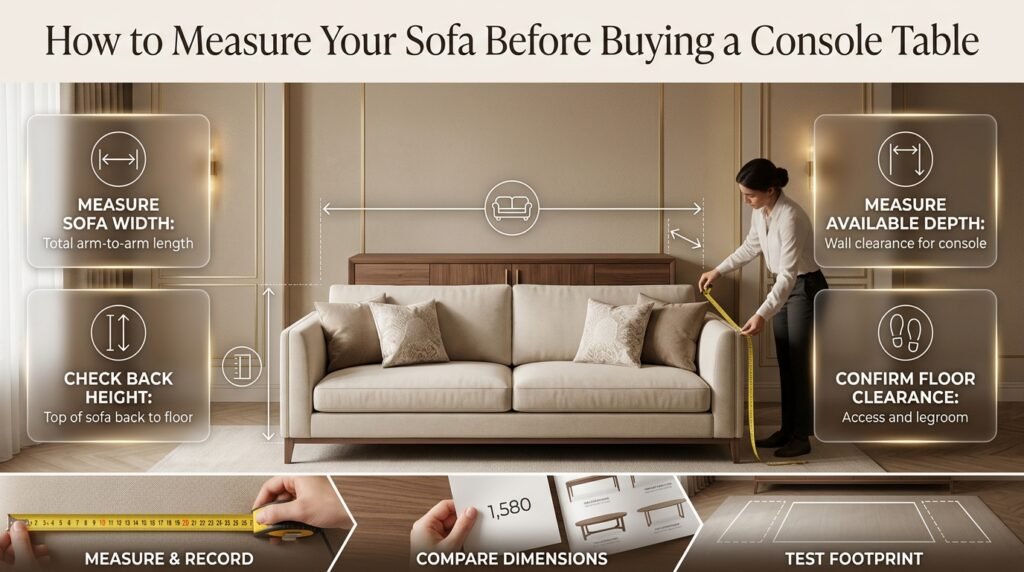
Measuring your sofa before shopping is the most reliable way to select suitable furniture.
Online product photographs don’t always provide an accurate sense of scale. A table may look compact on a large website photograph but become surprisingly bulky in your living room.
Follow these steps to collect the measurements you need.
Step 1: Measure the Total Sofa Width
Place your measuring tape across the sofa from the outer edge of one armrest to the outer edge of the other.
Don’t measure only the seating cushions.
The full outside width determines how long your console table can be without looking disproportionate.
Write the measurement down in inches.
Step 2: Measure the Sofa Back Height
Measure vertically from the floor to the highest permanent point of the sofa back.
If the back cushions are removable, consider how much their height changes during normal use.
This measurement will help you compare the sofa with potential console table heights.
Step 3: Measure the Available Depth
Measure the space between the back of the sofa and the nearest wall, furniture item, or obstruction.
If the sofa is floating in the middle of the room, measure the complete area behind it.
Don’t forget curtains, radiators, floor lamps, doors, and other objects that may affect the available space.
Step 4: Determine the Required Walking Clearance
Decide whether people need to walk behind the sofa and console table.
A decorative table against a wall requires a different arrangement from a console positioned between the sofa and a frequently used passage.
Plan for the actual movement of people rather than relying only on the room’s total dimensions.
Step 5: Decide What You Will Place on the Table
Think about its purpose.
Will it hold:
- One or two table lamps?
- Books and magazines?
- Small decorative objects?
- A tray for everyday essentials?
- Storage baskets underneath?
- Electronic accessories?
Your answer helps determine the required depth and surface area.
Step 6: Compare Your Measurements With Furniture Specifications
Check the manufacturer’s listed width, height, and depth.
Don’t assume that product dimensions are always displayed in the same order.
Look carefully for labels such as W × D × H.
If the product listing includes the height of the lower shelf, drawer measurements, or leg dimensions, check those details too.
Step 7: Test the Proposed Position
Before purchasing, mark the console table’s footprint on the floor.
Use tape to outline its length and depth.
Walk around the area, open nearby doors, and check whether the proposed location interferes with other furniture.
This simple test can prevent an expensive sizing mistake.
7. Best Console Table Dimensions for Different Living Room Sizes
The same console table won’t work equally well in every living room.
A small apartment may need a narrow design, while a large open-plan space can accommodate a longer and more substantial piece.
The following recommendations help you understand which proportions to consider.
Small Living Rooms
Small living rooms require careful furniture planning because every additional piece affects the available floor area.
A console table measuring approximately 8–12 inches deep can provide useful surface space without making the room feel overcrowded.
Consider these characteristics:
- Narrow tabletops.
- Open metal or wooden legs.
- Minimal decorative details.
- Lightweight visual profiles.
- Compact dimensions.
- Limited or concealed storage.
A slim table behind the sofa can provide a place for a small lamp, decorative bowl, or a few books.
Avoid choosing a large cabinet-style console when a narrow tabletop would perform the same function.
Medium-Sized Living Rooms
Medium-sized living rooms offer more flexibility.
A table measuring approximately 10–15 inches deep and 28–32 inches high may work well with many standard sofas.
You can also consider a design with a lower shelf or drawers.
For example, a 72-inch sofa paired with a 55-inch console table can create an attractive arrangement without taking up too much floor space.
The main priority should be maintaining a comfortable relationship between the sofa, table, rug, and surrounding furniture.
Large Living Rooms
Large living rooms can accommodate more substantial console tables.
A wider tabletop can help visually connect the sofa with the rest of the room, especially when the seating arrangement floats away from the wall.
Consider:
- Wider tabletops.
- Additional storage.
- Stronger wooden frames.
- Two decorative lamps.
- Larger accessories.
- A lower shelf for baskets or books.
A large console table can also help define a seating zone in an open-plan living room.
However, don’t fill the entire tabletop with decorations. Leaving some open surface creates a more refined appearance.
Open-Plan Living Areas
Open-plan rooms often combine the living room, dining area, and kitchen into one larger space.
A sofa positioned away from the wall can create a natural division between these areas.
A console table behind the sofa can strengthen that division without requiring a permanent wall or bulky partition.
Choose a table that complements the overall interior palette and doesn’t obstruct movement between different zones.
For more ideas about coordinating home layouts and improvements, visit the Home Improvement section.
8. What Console Table Dimensions Work Best Behind Sectional Sofas?
Sectional sofas require more careful measuring because their shape includes multiple seating sections, corners, and sometimes chaise extensions.
The correct console table should complement the specific back section where it will be positioned.
Using the entire sectional width can produce an unnecessarily long table.
Measuring an L-Shaped Sectional
Start by identifying the straight back section of the sectional.
Measure that section independently.
For example, imagine an L-shaped sectional with:
- Main back section: 100 inches.
- Return section: 65 inches.
- Back height: 32 inches.
- Available space behind the main section: 48 inches.
A console table approximately 70–90 inches wide may be worth considering, depending on the layout.
The shorter return section doesn’t automatically need to determine the table width.
Choosing a Table for a U-Shaped Sectional
U-shaped sofas are more complicated because they have several seating sections.
A long console table may work behind the central back section, but it should not interfere with the side seating areas.
Consider using:
- One long console behind the central section.
- A smaller table behind a separate straight section.
- A custom-sized design for unusual dimensions.
- A slim table when circulation space is limited.
Should a Console Table Extend Behind the Chaise?
Usually, it’s better to measure the straight sofa section rather than automatically extending the console behind the chaise.
A chaise often has a different shape and seating depth.
Extending the table behind it may create an awkward arrangement or interfere with access.
The best solution depends on the exact sectional design and available space.
9. Which Console Table Shape Is Best Behind a Sofa?
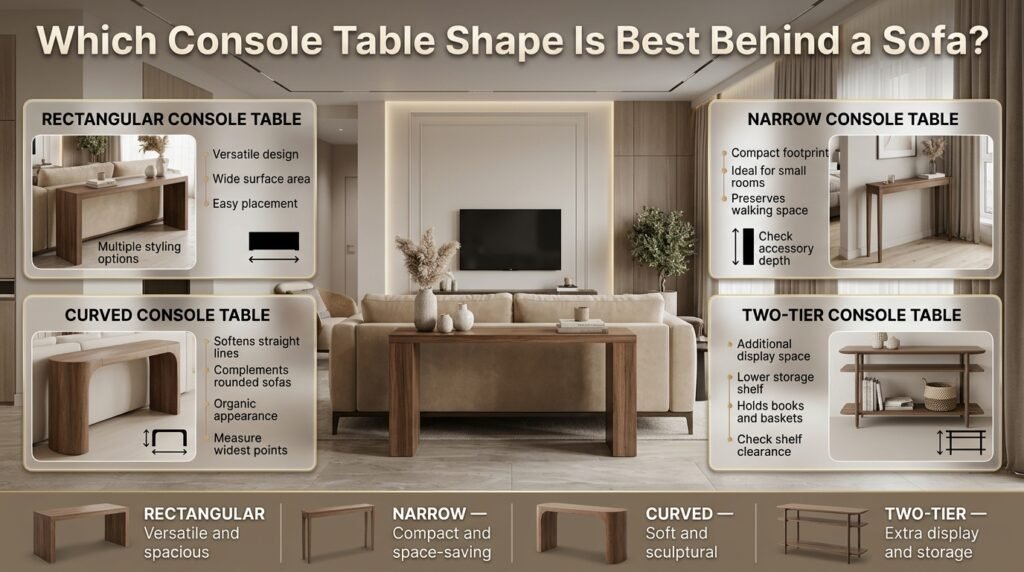
Console tables are available in several shapes, and each offers different advantages.
The shape should complement the sofa’s design and the overall layout of the living room.
Rectangular Console Tables
Rectangular tables are among the most versatile options.
They work well behind standard sofas because their long horizontal shape follows the sofa’s proportions.
Advantages include:
- Easy placement.
- Wide surface area.
- Multiple styling possibilities.
- Availability in different dimensions.
- Compatibility with many interior styles.
A rectangular console is a practical choice for most traditional and contemporary living rooms.
Narrow Console Tables
Narrow console tables are designed for areas where depth is limited.
They can be particularly useful in apartments and compact living rooms.
Their smaller footprint makes it easier to preserve circulation space.
However, check whether the surface is deep enough for your intended accessories.
Curved Console Tables
Curved designs can soften a living room with many straight furniture lines.
They may work particularly well with rounded sofas, organic shapes, and contemporary interiors.
However, measure the widest points of the table because the curved profile may occupy more space than expected.
Two-Tier Console Tables
Two-tier designs provide an additional storage or display surface.
The lower shelf can hold books, baskets, or decorative accessories.
Before purchasing, check the vertical clearance between the tabletop and lower shelf.
You should be able to use the lower area without interfering with the sofa or surrounding furniture.
10. Which Materials Are Best for a Sofa Console Table?
Material selection affects durability, maintenance, appearance, and the overall visual weight of the furniture.
A console table should complement the sofa rather than compete with it.
Solid Wood
Solid wood is a popular option because it provides durability and a natural appearance.
Oak, walnut, and other hardwood finishes work particularly well in traditional, transitional, and organic modern interiors.
Advantages:
- Natural texture.
- Long-lasting construction when properly maintained.
- Wide range of finishes.
- Suitable for different decorating styles.
Considerations:
- Can be relatively heavy.
- Quality wood may cost more.
- Some finishes require careful maintenance.
Engineered Wood
Engineered wood is often more affordable and available in many contemporary finishes.
It can be suitable for homeowners who want a specific appearance without investing in solid hardwood.
However, construction quality varies.
Check the frame, joints, surface finish, and manufacturer’s weight recommendations before purchasing.
Metal
Metal console tables can provide a modern and lightweight appearance.
Slim black frames are particularly useful in industrial and contemporary interiors.
Brass and brushed metal finishes can introduce warmth and decorative detail.
However, check the quality of the finish and the stability of the frame.
Glass
Glass tables can help a compact room feel visually open.
Their transparent surfaces reduce the visual weight of furniture and allow more of the surrounding room to remain visible.
However, glass requires regular cleaning and may show fingerprints or dust.
Check the glass specification and support construction before purchasing.
Marble and Stone
Marble and stone finishes can introduce a luxurious appearance.
They work particularly well in sophisticated living rooms with coordinated lighting and carefully selected materials.
However, natural stone can be heavy and may require additional care.
Make sure the frame is designed to support the tabletop’s weight.
Mixed-Material Designs
Mixed-material console tables combine different finishes, such as wood and metal or stone and glass.
They offer more flexibility when coordinating furniture with other interior elements.
For inspiration, explore Organic Modern Material Combinations.
11. How to Style a Console Table Behind a Sofa
Once you’ve selected the correct dimensions, the next step is creating an attractive arrangement.
A console table should provide visual interest without making the living room feel cluttered.
The best styling approach depends on the tabletop’s size, the sofa’s color, and the overall interior theme.
Create a Balanced Decorative Arrangement
Start with a few carefully selected accessories.
You might combine:
- A table lamp.
- A ceramic vase.
- A small decorative bowl.
- Two or three books.
- A framed photograph.
- A small plant.
Avoid placing every decorative object you own on the table.
A carefully edited arrangement often looks more professional than a crowded surface.
Use Different Heights
Accessories with different heights create visual interest.
For example, a lamp can provide the tallest element, while a decorative bowl provides a lower focal point.
A medium-height vase can connect the two.
This creates a natural arrangement without making the tabletop look overly organized or artificial.
Add Table Lamps
Table lamps are among the most useful accessories for a sofa console.
They can provide additional ambient lighting and help create a comfortable atmosphere in the evening.
When choosing lamps, consider:
- Table height.
- Lamp base width.
- Shade dimensions.
- Electrical outlet location.
- The sofa’s back height.
For a wide console, two lamps may create symmetry.
For a smaller table, one lamp may be sufficient.
Incorporate Books and Decorative Trays
Books can add color, texture, and visual interest.
A decorative tray can help organize smaller items such as keys, remotes, or everyday accessories.
Choose objects that complement the room’s materials and color palette.
Use Plants Carefully
Small plants can introduce natural texture and make the living room feel more welcoming.
Choose a plant according to the available light and maintenance requirements.
Avoid large arrangements that block views or make the table difficult to use.
Consider the Space Beneath the Table
The lower area can also contribute to the design.
Depending on the table’s construction, you might use:
- Woven storage baskets.
- Decorative boxes.
- Books.
- Small storage containers.
Keep the lower area organized so that the table doesn’t look visually heavy.
For more decorating approaches, explore Interior Design and DIY Home Projects.
12. How to Coordinate a Console Table With Your Living Room Style

The correct dimensions ensure that the table fits, but its design determines how naturally it belongs in the room.
A console table should work with the surrounding furniture, flooring, wall colors, and decorative accessories.
Modern Minimalist Living Rooms
Modern minimalist interiors benefit from simple shapes and uncluttered surfaces.
Choose a console table with:
- Clean horizontal lines.
- Slim legs.
- Neutral finishes.
- Minimal hardware.
- A simple tabletop.
Avoid excessively decorative designs when the rest of the room follows a minimalist approach.
Traditional Living Rooms
Traditional interiors can accommodate more detailed furniture.
Look for wooden finishes, decorative legs, subtle carvings, and classic proportions.
A console table with drawers may also provide useful storage.
Farmhouse Interiors
Farmhouse interiors often use natural wood, simple construction, and understated decorative elements.
A wooden console with an open lower shelf can complement this style.
Choose a finish that works with the sofa, flooring, and other wooden furniture.
Contemporary Luxury Interiors
Contemporary luxury spaces often combine elegant materials with simple forms.
Consider:
- Marble-effect surfaces.
- Brushed metal frames.
- Dark wood finishes.
- Glass details.
- Carefully selected lighting.
Avoid combining too many expensive-looking finishes in one small arrangement.
Organic Modern Interiors
Organic modern design combines natural materials, soft forms, and neutral colors.
A wooden console with a simple silhouette can work particularly well.
You can introduce texture through ceramic objects, natural fabrics, and carefully selected decorative accessories.
13. Common Mistakes When Choosing Console Table Dimensions Behind a Sofa
Many furniture problems begin before the purchase.
Homeowners sometimes focus on appearance, price, or online photographs without checking whether the console table will work in their actual living room.
Understanding these mistakes can save time and prevent unnecessary expenses.
Mistake 1: Choosing a Table Without Measuring the Sofa
Why it happens: People estimate furniture sizes visually or assume that a standard table will fit every sofa.
Why it’s harmful: The table may look too short, extend beyond the sofa, or appear disproportionate.
How to avoid it: Measure the full outside width of the sofa before shopping.
Mistake 2: Ignoring Table Depth
Why it happens: Buyers pay more attention to height and width.
Why it’s harmful: A deep table can reduce the walking area and make the room feel crowded.
How to avoid it: Measure the available floor space and calculate the remaining circulation area.
Mistake 3: Selecting an Uncomfortable Height
Why it happens: A table looks attractive in a showroom or product photograph.
Why it’s harmful: It may appear disconnected from the sofa or become difficult to use.
How to avoid it: Compare the proposed table height with the actual sofa back height.
Mistake 4: Choosing a Console Table That’s Too Wide
Why it happens: Buyers assume a wider tabletop will always provide a better appearance.
Why it’s harmful: Excessive width can make the furniture arrangement feel heavy and visually unbalanced.
How to avoid it: Compare the table width with the sofa’s outside measurement.
Mistake 5: Forgetting Walking Clearance
Why it happens: People concentrate on whether the table physically fits.
Why it’s harmful: The remaining passage may become uncomfortable.
How to avoid it: Include the table depth, sofa position, and walking requirements in your calculations.
Mistake 6: Ignoring Sectional Sofa Geometry
Why it happens: Buyers use the total sectional dimensions instead of measuring the actual back section.
Why it’s harmful: The console may extend into an awkward corner or interfere with circulation.
How to avoid it: Measure the straight section where the table will be positioned.
Mistake 7: Overdecorating the Table
Why it happens: Homeowners try to recreate elaborate furniture arrangements.
Why it’s harmful: The table becomes difficult to use and visually crowded.
How to avoid it: Select a few accessories with different heights and leave some open surface space.
Mistake 8: Ignoring Electrical Outlets
Why it happens: Furniture planning happens before lighting requirements are considered.
Why it’s harmful: Lamps may become difficult to connect, and cables can create an untidy appearance.
How to avoid it: Check nearby electrical outlets and plan cable placement before installation.
Mistake 9: Choosing Style Over Construction Quality
Why it happens: A visually attractive product receives more attention than its construction details.
Why it’s harmful: Poor-quality joints, unstable legs, and unsuitable materials can reduce the table’s useful life.
How to avoid it: Check the frame, material specifications, weight capacity, and product dimensions.
Mistake 10: Buying Without Testing the Layout
Why it happens: Buyers assume measurements alone guarantee a comfortable arrangement.
Why it’s harmful: The table may interfere with doors, rugs, nearby furniture, or movement.
How to avoid it: Use painter’s tape to outline the table footprint before purchasing.
14. Professional Advice for Choosing the Perfect Sofa Console Table
Professional furniture planning is about understanding how individual pieces work together.
A console table should look natural behind the sofa, support everyday activities, and maintain a comfortable living environment.
The following recommendations can help you make a more confident decision.
Consider the Sofa’s Visual Weight
A large upholstered sofa usually needs a console table with enough visual presence to complement it.
A very delicate table may look too small behind a substantial sectional.
Similarly, a heavy cabinet-style console may overpower a lightweight contemporary sofa.
Look at the sofa’s frame, armrests, cushions, and overall silhouette when selecting the table.
Match the Table to Its Intended Purpose
Before shopping, decide whether the table is primarily decorative or functional.
If you only need a place for a vase and small accessories, a slim tabletop may be sufficient.
If you plan to use it for lamps, books, storage baskets, and everyday items, additional surface area may be necessary.
The purpose should determine the dimensions rather than the other way around.
Pay Attention to Leg Design
Table legs affect the furniture’s visual weight.
Open metal legs create a lighter appearance and allow more of the floor to remain visible.
Solid wooden legs or cabinet-style bases can create a more substantial look.
In a small living room, an open design may help the arrangement feel less crowded.
Consider the Sofa’s Movement
Some sofas have reclining mechanisms, adjustable headrests, or removable cushions.
A console table should not interfere with these features.
Measure the sofa in its normal position and consider how far moving components extend during use.
Check Stability and Weight Capacity
A console table behind a sofa may hold lamps, books, and decorative accessories.
Choose a stable construction that can support the intended load.
Pay attention to the manufacturer’s weight recommendations and avoid placing heavy objects on unsuitable tabletops.
Think About Long-Term Maintenance
Different materials require different care.
Wood may need protection against moisture and scratches, while glass requires frequent cleaning.
Metal finishes may need protection against corrosion or surface damage.
Choose a material that suits your daily routine rather than selecting one based only on appearance.
Create Visual Consistency
The console table should relate to other furniture through color, material, texture, or shape.
For example, a walnut console can complement a wooden coffee table, while a black metal frame may connect with dark lighting fixtures.
You don’t need every piece to match exactly.
Repeating a few design elements is usually enough to create a cohesive interior.
For additional ideas, explore Rhythm and Repetition in Interiors.
Test the Layout Before Making a Final Decision
One of the most practical recommendations is to test the dimensions in the actual room.
Mark the table’s width and depth using painter’s tape.
Then check:
- Whether the sofa remains comfortable to use.
- Whether the walkway is wide enough.
- Whether nearby doors open properly.
- Whether the table interferes with rugs.
- Whether electrical outlets remain accessible.
- Whether the furniture looks balanced from different angles.
This approach is particularly helpful when ordering furniture online.
15. How to Choose a Console Table According to Your Budget

A suitable console table doesn’t have to be expensive.
The important thing is to balance dimensions, construction quality, material, and design.
Before comparing prices, establish the measurements your room requires.
Budget-Friendly Console Tables
Affordable options often include engineered wood, simple metal frames, and compact designs.
These can work well when the table is primarily decorative.
Check the frame stability and surface finish before purchasing.
Mid-Range Console Tables
Mid-range options may offer stronger construction, better finishes, additional storage, and more refined designs.
They can be a practical choice for frequently used living rooms.
Premium Console Tables
Premium console tables may feature solid hardwood, natural stone, custom dimensions, or distinctive craftsmanship.
These designs can provide long-term value when the materials and construction justify the price.
However, an expensive table isn’t automatically the right choice.
A correctly sized, well-made console table is more useful than an oversized designer piece that doesn’t fit the room.
16. Should You Buy a Ready-Made or Custom Console Table?
Both options can work well, but the decision depends on your room dimensions and furniture requirements.
Ready-Made Console Tables
Ready-made furniture is often more convenient because it is available in established sizes and finishes.
Advantages include:
- Easier price comparison.
- Faster purchasing.
- Multiple design options.
- Established product specifications.
- Less planning.
The main disadvantage is limited flexibility.
A standard table may not fit unusual sofa dimensions or narrow spaces.
Custom Console Tables
Custom furniture allows you to select the exact height, width, depth, material, and finish.
This is particularly useful when:
- The sofa has unusual dimensions.
- The room has limited clearance.
- You need a specific storage arrangement.
- You want the table to match existing furniture.
- Standard furniture doesn’t suit the layout.
However, custom furniture requires more planning and careful communication with the manufacturer.
Provide written measurements and confirm the finished dimensions before production.
17. Practical Console Table Sizing Examples
Realistic examples make it easier to understand how measurements work together.
The following scenarios demonstrate how different sofa dimensions can influence console table selection.
Example 1: Small Apartment Sofa
Suppose you have:
- Sofa width: 72 inches.
- Sofa back height: 29 inches.
- Available depth: 42 inches.
- Intended use: Decorative accessories and one small lamp.
A table measuring 50 inches wide, 10 inches deep, and 27 inches high may work well.
The narrower depth helps preserve space, while the table width creates a balanced appearance.
Example 2: Standard Family Living Room
Suppose your furniture measurements are:
- Sofa width: 90 inches.
- Sofa back height: 32 inches.
- Available space behind sofa: 60 inches.
- Intended use: Two lamps, books, and decorative accessories.
A 72-inch-wide, 12-inch-deep, 30-inch-high console table could be a practical option.
It provides sufficient surface space without requiring the full sofa width.
Example 3: Large Open-Plan Living Room
Imagine you have:
- Sofa width: 108 inches.
- Sofa back height: 34 inches.
- Available depth: 72 inches.
- Intended use: Lighting, accessories, and storage baskets.
A table measuring 90 inches wide, 15 inches deep, and 32 inches high may complement the arrangement.
Its wider surface can help define the seating zone in an open-plan room.
Example 4: Sectional Sofa in a Compact Room
Suppose you have:
- Main sectional back: 96 inches.
- Sofa back height: 31 inches.
- Available depth: 40 inches.
- Intended use: One lamp and a few accessories.
A narrow console measuring 65 inches wide, 9 inches deep, and 29 inches high may be worth considering.
The reduced depth helps preserve circulation space.
Example 5: Traditional High-Back Sofa
Suppose your sofa has:
- Width: 84 inches.
- Back height: 36 inches.
- Available depth: 58 inches.
- Intended use: Decorative lighting and books.
A console measuring 68 inches wide, 14 inches deep, and 33 inches high may provide a balanced starting point.
These examples demonstrate that standard measurements should guide your decision, not replace actual room measurements.
18. Final Checklist Before Purchasing a Console Table
Before placing an order, review the following checklist.
Furniture Measurements
- Have you measured the complete sofa width?
- Have you measured the sofa back height?
- Have you checked the available depth?
- Have you compared the table dimensions with the sofa?
- Have you checked the manufacturer’s product specifications?
Room Layout
- Is there enough walking clearance?
- Can nearby doors open completely?
- Are electrical outlets accessible?
- Will the table interfere with other furniture?
- Is there enough space for the intended accessories?
Design and Functionality
- Does the material complement the room?
- Is the construction stable?
- Does the table provide enough usable surface?
- Is the lower shelf or storage area practical?
- Will the table remain easy to maintain?
If you can answer these questions confidently, you’re much more likely to select a console table that works well in your living room.
For more practical home planning and improvement inspiration, explore How to Set Up My Home Decoradtech, LLBlogHome Upgrades by Lovelolablog, and Latest News DecoratorAdvice.
19. Additional Interior Design Resources for a Better Living Room
Choosing a console table is one part of creating a comfortable living room.
Other elements, including wall colors, furniture positioning, lighting, entrance design, and renovation decisions, also influence the final result.
When planning a complete interior improvement project, consider the following resources.
Coordinate Furniture With Your Home’s Overall Design
Furniture should complement the colors, textures, and architectural details already present in the room.
A console table with a warm wooden finish may work well with natural flooring, while a black metal design can complement contemporary details.
You can explore Upgrade Tip LLBlogHome for additional home improvement inspiration.
Consider Wall Colors and Decorative Finishes
Wall color can change how furniture appears.
Light neutral walls can make darker furniture stand out, while warmer tones can create a softer and more welcoming atmosphere.
When choosing a console table finish, consider the wall color, sofa upholstery, flooring, and nearby decorative elements.
For more ideas, visit the Paint Color section.
Plan Furniture Changes Before Renovating
If you’re changing the living room layout, consider documenting the work before beginning.
Furniture relocation, wall improvements, electrical changes, and flooring updates may need to be coordinated.
A written plan can help organize the project and reduce unnecessary adjustments.
Explore Renovation Work Order for Homeowners for useful planning guidance.
Improve the Entrance and Living Room Connection
In some homes, the living room connects directly with the entrance.
The furniture arrangement should maintain a comfortable transition between these areas.
Avoid positioning a console table where it blocks the entrance or makes the circulation route feel narrow.
For more information about proportion and layout, explore Outdoor Entrance Design Proportions.
Bring Indoor and Outdoor Design Together
If your living room opens toward a patio, garden, or outdoor seating area, consider how the interior furniture arrangement relates to the outside environment.
Natural materials, coordinated colors, and consistent decorative themes can create a more connected appearance.
You can find additional ideas in Decoradhouse Garden Tips by DecoratorAdvice.
These resources can help you approach interior improvements as a complete design process rather than treating each furniture purchase as an isolated decision.
What Is the Ideal Height, Width, and Depth of a Console Table Behind a Sofa?
The ideal console table behind a sofa should generally measure 28–32 inches high, 10–15 inches deep, and approximately two-thirds to nearly the full width of the sofa. These dimensions create a balanced appearance while providing enough surface space for lamps, books, decorative accessories, and everyday essentials. However, the correct measurements depend on the sofa’s back height, overall width, and available room space.
Before selecting a table, consider how its proportions relate to the sofa. A table that’s too tall can look disconnected, while excessive depth may make the living room feel crowded. Similarly, a very narrow table behind a large sofa may appear visually unbalanced.
Recommended measurements:
Height: 28–32 inches for many standard sofa arrangements.
Depth: 10–15 inches for practical everyday use.
Width: Approximately ⅔ to nearly 100% of the sofa’s total width.
Clearance: Around 30–36 inches for a comfortable walkway where space allows.
For example, if your sofa measures 90 inches wide and has a back height of 31 inches, a console table measuring 70 inches wide, 12 inches deep, and 29 inches high could be a suitable option.
The most reliable approach is to measure your actual sofa rather than purchasing furniture based only on standard dimensions.
Should a Console Table Be Higher or Lower Than the Back of a Sofa?
A console table behind a sofa generally looks best when its tabletop is approximately level with or slightly lower than the sofa’s back. This creates a natural visual connection between the two furniture pieces and prevents the table from appearing unnecessarily dominant. However, the ideal height also depends on the sofa’s design and whether you intend to use the table for decorative accessories or lighting.
For example, a low-profile contemporary sofa may look better with a shorter console table, while a traditional high-back sofa can accommodate a taller design.
A difference of a few inches can make the arrangement look more intentional. You should also consider the height of decorative objects, especially lamps and vases, because they influence the overall appearance.
Professional recommendations:
Measure the sofa from the floor to the highest point of its back.
Choose a table that complements the sofa’s proportions.
Avoid excessively tall tables that dominate the seating area.
Consider lamp height before selecting the final table.
Maintain a consistent visual balance with surrounding furniture.
A console table doesn’t need to match the sofa’s height exactly. The goal is to create a comfortable and coordinated arrangement that looks appropriate from different viewing angles.
How Much Space Should Be Between a Sofa and a Console Table?
The space between a sofa and a console table should allow comfortable movement, prevent furniture from rubbing against each other, and provide convenient access to the tabletop. In many arrangements, a small separation of approximately 2–4 inches can work when the table is directly behind the sofa, although the exact distance depends on the sofa’s construction and movement.
The more important measurement is the remaining space behind the console table. If people need to walk through that area regularly, the passage should not become unnecessarily narrow.
For practical living room planning, consider these clearance guidelines:
24 inches: A tight secondary passage.
30 inches: A more comfortable secondary walkway.
36 inches: A useful target for a frequently used passage.
40–48 inches: More spacious circulation where the room allows.
For example, if you have 50 inches between your sofa and the wall, a 12-inch-deep console table with a 3-inch sofa gap leaves approximately 35 inches behind the table.
Important planning tips:
Check whether doors can open completely.
Consider the movement of people around the sofa.
Keep electrical outlets accessible.
Account for curtains, radiators, and nearby furniture.
Avoid positioning the table where it blocks the main walking route.
Remember that a console table should improve the living room’s functionality, not make an existing circulation problem worse.
How Wide Should a Console Table Be for a 3-Seater or Sectional Sofa?
The console table should generally measure between two-thirds and three-quarters of the sofa’s width for a balanced, understated appearance. However, a table approaching the sofa’s full width can also work when the living room is spacious and the furniture arrangement benefits from a longer surface.
The most important thing is to measure the actual sofa section behind which the table will sit. This is particularly important for L-shaped and U-shaped sectional sofas.
Recommended console table widths:
Sofa Width
Suggested Table Width
72 inches
48–54 inches
84 inches
56–63 inches
90 inches
60–68 inches
96 inches
64–72 inches
108 inches
72–81 inches
120 inches
80–90 inches
For a sectional sofa, measure the straight back section rather than automatically using the entire sectional’s dimensions.
Professional sizing tips:
Include both armrests when measuring a standard sofa.
Keep the table shorter than the sofa when possible.
Center the table for a balanced arrangement.
Avoid excessive overhang at either end.
Consider custom furniture if standard sizes don’t fit.
For example, an 84-inch sofa paired with a 60-inch console table leaves approximately 12 inches of visible space on each side when centered. This can create a clean, intentional appearance without making the table look too small.
What Is the Best Console Table Depth for a Small Living Room or Narrow Space?
For a small living room, a console table approximately 8–12 inches deep is often a practical choice. It provides room for selected decorative accessories while preserving more floor space than a deeper design. If your living room has a wider layout, a 12–15-inch-deep table may offer greater everyday functionality.
Depth should be selected according to what you intend to place on the tabletop. A narrow surface may be sufficient for a small vase or decorative bowl, but a larger lamp base or multiple accessories may require additional room.
Before purchasing, consider the following:
8–10 inches: Suitable for very narrow spaces and simple decorative arrangements.
10–12 inches: Useful for compact living rooms and floating sofas.
12–15 inches: Suitable for standard arrangements with lamps and accessories.
15–18 inches: Better suited to larger rooms with additional clearance.
How to make the right decision:
Measure the available distance behind your sofa.
Decide whether people regularly walk through that area.
Measure the base of any lamp or accessories you intend to display.
Calculate the remaining walking clearance.
Test the proposed table dimensions using painter’s tape.
One important detail is stability. Extremely shallow freestanding tables may need additional support or wall anchoring, depending on their construction. Always follow the manufacturer’s installation instructions.
A well-sized narrow console table can make a small living room more functional without making it feel crowded. The objective is to use the available space intelligently rather than simply choosing the smallest furniture available.
Conclusion
Choosing the right console table dimensions behind a sofa is about more than finding a table that looks attractive. The correct height, width, and depth help create a balanced living room while maintaining comfort, accessibility, and enough space for everyday movement. A well-proportioned console table should complement the sofa’s dimensions, fit naturally into the available layout, and provide useful surface space without making the room feel crowded.
Before purchasing or building a console table, measure the sofa’s back height and width, check the available floor space, and consider how much walking clearance is needed behind it. For most living rooms, a table approximately 28–32 inches high, 10–15 inches deep, and around two-thirds to three-quarters of the sofa’s width can provide a practical starting point. However, the best dimensions will always depend on the furniture, room layout, and intended use.
Pay attention to material, leg design, stability, storage, and decorative accessories as well. A narrow table may be ideal for a compact living room, while a wider design can provide additional styling and storage opportunities in a spacious area.
Ultimately, the goal is to choose a console table that feels like a natural extension of the sofa rather than an extra piece of furniture squeezed into the room. With careful measurements and thoughtful design choices, you can create a functional, comfortable, and visually appealing living space.