
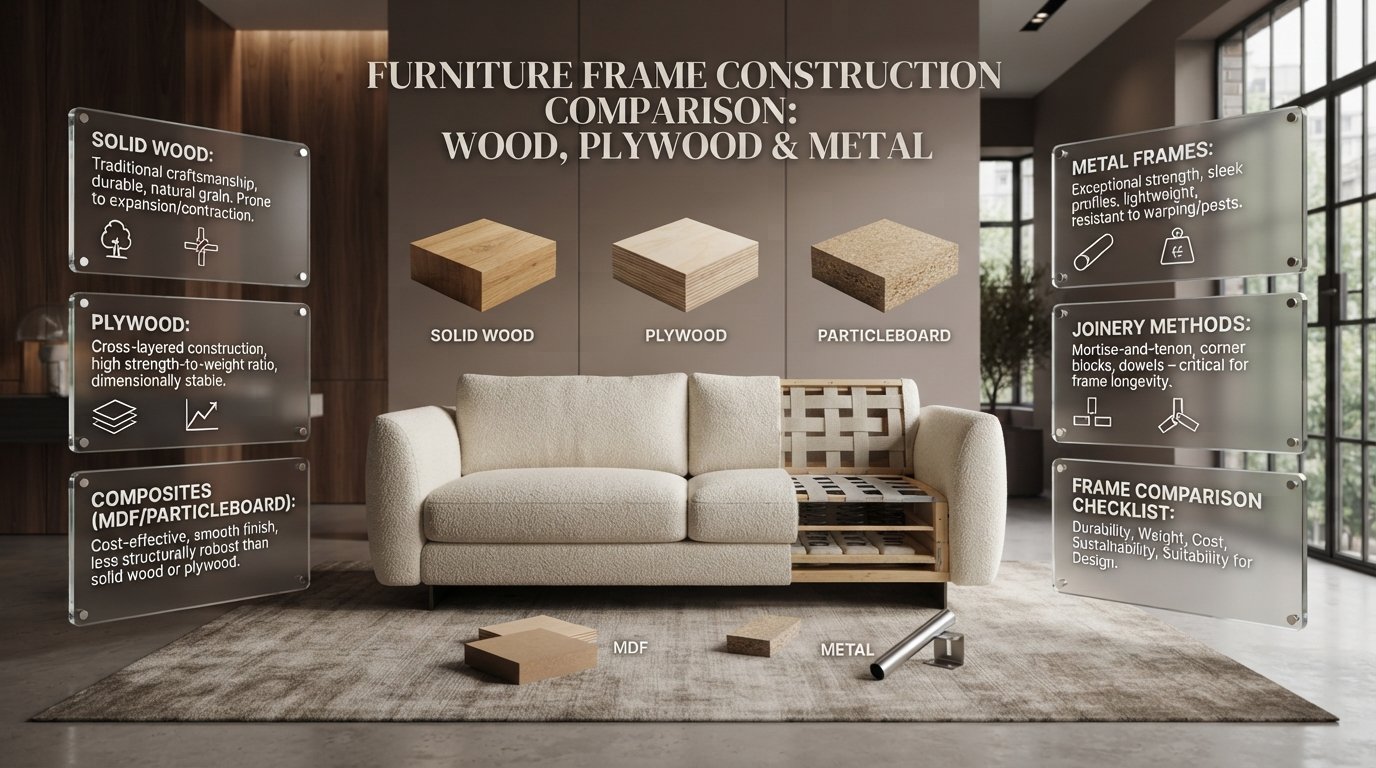
Introduction
Furniture Frame Construction Comparison | Choosing furniture is easy when you focus only on color, fabric, or design. The real challenge begins when two sofas look equally attractive, but one remains sturdy for years while the other develops loose joints, uncomfortable seats, or a damaged frame. The difference often comes down to construction quality and the materials hidden beneath the surface.
A detailed furniture frame construction comparison helps you understand what you’re paying for before investing in a sofa, bed, dining chair, wardrobe, or other household furniture. At DesignMode24 Interior Design, the goal is to help homeowners make practical design decisions that balance appearance, comfort, durability, and budget.
Solid wood, plywood, particleboard, MDF, and metal each have advantages. However, the best choice depends on how the furniture will be used, how its components are connected, and whether its construction can handle everyday demands.
This guide explains the differences between furniture frame materials, compares their strengths and limitations, identifies construction details worth checking, and shows you how to select furniture that offers lasting value without spending unnecessarily.
1. What Is Furniture Frame Construction, and Why Does It Matter?
Furniture frame construction describes the structural foundation that holds a piece of furniture together. It includes the materials used for the frame, the connections between components, the supporting rails, and the methods used to distribute weight.
In a sofa, the frame supports the seat, arms, and backrest. In a bed, it holds the mattress-support system and distributes weight through the side rails, center supports, and legs. In a wardrobe, the structure keeps the panels aligned and supports shelves, drawers, doors, and hanging rails.
Although these pieces serve different purposes, they share one important requirement: the structure must remain stable during normal use.
How does frame construction affect everyday furniture use?
Frame construction influences several aspects of performance:
- Stability: A well-designed frame helps prevent rocking, twisting, and excessive movement.
- Durability: Suitable materials and strong joints help furniture withstand repeated use.
- Comfort: The frame supports springs, webbing, cushions, and other seating components.
- Maintenance: Some materials and joints are easier to repair than others.
- Appearance over time: A stable frame helps doors, drawers, and upholstered sections maintain their alignment.
- Long-term value: Furniture that remains functional for longer may reduce replacement costs.
Consider two sofas with similar upholstery and dimensions. One uses appropriately sized rails, reinforced corners, and a well-supported seat. The other has weak connections and inadequate support. They may feel similar during a brief showroom visit, but their performance can differ substantially after years of daily use.
This is why furniture construction deserves as much attention as exterior design.
2. Which Materials Are Used in Furniture Frames?
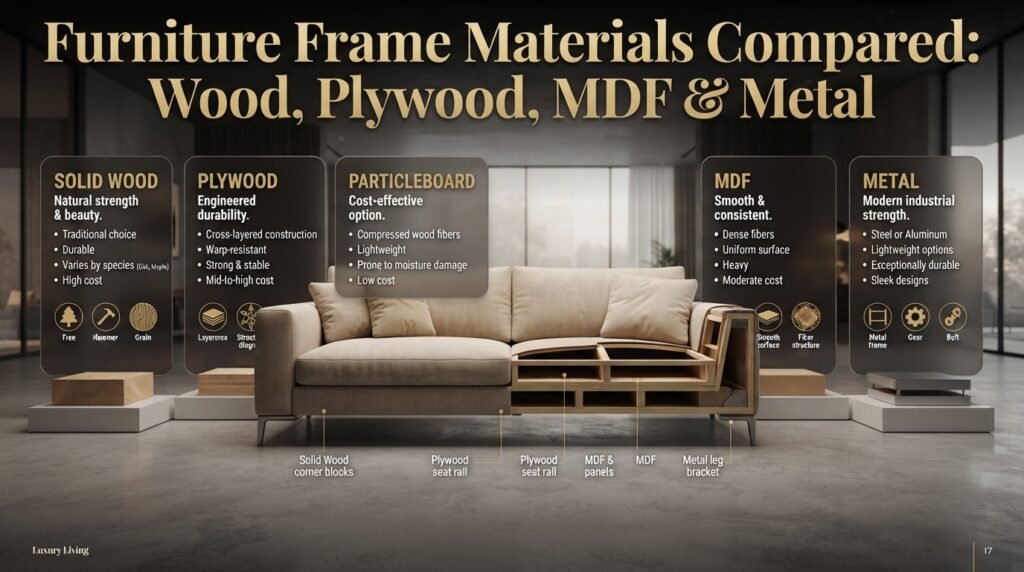
Furniture manufacturers use several materials, including solid timber, plywood, particleboard, medium-density fiberboard, and metal. Some products combine these materials to balance structural performance, manufacturing cost, weight, and appearance.
Understanding their differences is the first step toward making a confident purchase.
Solid wood frames
Solid wood is cut from natural timber rather than manufactured by bonding wood particles or fibers into panels. Oak, beech, maple, ash, and pine are among the species used in furniture construction.
Hardwoods are often selected for demanding structural applications because many species offer good strength and wear resistance. Softwoods can also be suitable when their dimensions, grade, preparation, and joinery are appropriate.
Advantages of solid wood
- Can provide strong, long-lasting structural support.
- Allows traditional woodworking joints and many repair methods.
- Can be refinished when the surface becomes worn.
- Offers a natural grain when exposed.
- May be suitable for furniture intended to remain in use for many years.
Limitations of solid wood
- Often costs more than basic engineered panels.
- Can be heavy, depending on the species and design.
- Changes in humidity can cause expansion or contraction.
- Poorly dried or inadequately prepared timber may warp or crack.
- Quality varies according to timber grade and workmanship.
Solid wood is commonly suitable for dining chairs, tables, bed frames, and quality upholstered furniture. Nevertheless, a solid-wood label does not automatically guarantee excellent construction.
For example, a chair made from poorly seasoned timber with weak connections may become unstable sooner than a well-engineered chair made from a different material.
Best buying approach: Ask which species is used, whether the timber is properly dried, and how the major joints are constructed.
Plywood frames
Plywood is manufactured by bonding thin wood veneers into layers, generally with the grain direction alternating between adjacent layers. This arrangement helps the panel resist movement and distribute loads.
Plywood is used in cabinet construction, furniture panels, selected upholstered frames, and other applications where predictable dimensions are important.
Advantages of plywood
- Good strength relative to weight when appropriately specified.
- Generally good dimensional stability.
- Available in different grades and thicknesses.
- Suitable for many panel-based furniture designs.
- Can provide a practical balance between performance and cost.
Limitations of plywood
- Quality varies by grade, veneer construction, and adhesive.
- Exposed edges may need suitable finishing.
- Poor-quality products can delaminate under unfavorable conditions.
- Thin panels may bend if spans are too long or support is inadequate.
Plywood can be an excellent choice when the manufacturer selects the right panel for the job. A properly supported plywood component may perform better than a solid-wood component with unsuitable dimensions or poor joints.
The key is to distinguish structural-grade construction from thin decorative panels.
Particleboard frames
Particleboard is made by bonding wood particles with adhesive and pressing them into panels. It is widely used in budget furniture, flat-pack wardrobes, desks, cabinets, and shelving systems.
Its affordability and relatively uniform surface make it useful for many indoor applications.
Advantages of particleboard
- Usually economical.
- Provides a consistent surface for decorative finishes.
- Can work well in appropriately supported cabinet components.
- Allows furniture manufacturers to produce standardized panels.
- Is suitable for many storage applications when correctly designed.
Limitations of particleboard
- Water can cause swelling and damage.
- Screw-holding performance may be limited, particularly near edges.
- Repeated assembly can weaken fixing points.
- Long, unsupported shelves may sag under sustained loads.
- Damaged edges can be difficult to repair invisibly.
Particleboard is not automatically a poor choice. A wardrobe designed around appropriate panel thicknesses, short shelf spans, and suitable hardware can serve a household effectively.
Problems often arise when manufacturers reduce material thickness excessively or homeowners overload shelves beyond their intended capacity.
Best use: Budget wardrobes, desks, and cabinet carcasses that remain in suitable indoor conditions.
Medium-density fiberboard (MDF)
MDF is manufactured from wood fibers bonded with resin under heat and pressure. Its smooth, consistent surface makes it particularly useful for painted furniture, decorative panels, and cabinet doors.
Unlike natural timber, MDF does not have visible wood grain or knots, making it convenient for contemporary furniture with a uniform finish.
Advantages of MDF
- Smooth surface for painting.
- Consistent texture.
- Suitable for decorative profiles and detailed designs.
- Often more economical than solid hardwood.
- Useful for cabinet fronts and interior furniture components.
Limitations of MDF
- Standard MDF can swell when exposed to moisture.
- It is relatively heavy for some applications.
- Edges require appropriate treatment and fastening methods.
- Repeated screw removal can damage fixing points.
- It should not automatically be treated as a replacement for structural timber.
MDF can perform well when used in suitable applications. However, a decorative cabinet door has different structural demands from a heavily loaded bed rail.
Choose materials according to the function of each component rather than assuming every panel product can perform the same job.
Metal furniture frames
Metal frames are commonly manufactured from steel or aluminum. Steel is frequently used where rigidity and substantial structural support are required, while aluminum can be useful when lower weight is a priority.
Metal appears in bed frames, office chairs, dining chairs, contemporary tables, and selected outdoor furniture.
Advantages of metal
- Can provide excellent strength and rigidity.
- Supports slim, modern profiles.
- Does not experience wood movement caused by changing humidity.
- Can be suitable for furniture that requires frequent assembly.
- Often allows efficient structural designs.
Limitations of metal
- Steel can corrode when its protective finish is damaged.
- Weak welds or poorly designed connections may fail.
- Some designs can feel cold or visually industrial.
- Thin sections may bend under excessive loads.
- Bolted joints may need maintenance over time.
The quality of a metal frame depends on the metal grade, section dimensions, welds, fasteners, protective coating, and overall design.
A substantial steel frame with properly engineered connections may perform extremely well. A lightweight frame made with inadequate sections or poor welds may not.
3. Furniture Frame Construction Comparison: Which Material Performs Best?
No single frame material is best for every furniture category. Solid wood may be suitable for repairable, traditional furniture, plywood can offer a strong panel-based solution, particleboard can reduce cost, MDF can provide a smooth decorative finish, and metal can support rigid contemporary designs.
The following table summarizes the most important differences.
| Material | Durability potential | Cost | Main concern | Suitable applications |
|---|---|---|---|---|
| Solid hardwood | High with good construction | Often high | Moisture movement and cost | Dining chairs, tables, quality frames |
| Softwood | Moderate to high, depending on grade | Low to moderate | Species and dimensions | Selected bed and sofa frames |
| Plywood | Moderate to high, depending on grade | Moderate | Panel quality and support | Cabinets, furniture panels, selected sofa frames |
| Particleboard | Suitable for appropriate applications | Low | Moisture and fixing points | Budget wardrobes and desks |
| MDF | Suitable for appropriate applications | Low to moderate | Moisture and structural limitations | Painted furniture and cabinet doors |
| Steel | High with suitable design | Varies | Corrosion and connection quality | Beds, office furniture, dining chairs |
| Aluminum | Good when correctly designed | Varies | Deformation under excessive loads | Lightweight furniture and selected outdoor pieces |
These descriptions are general comparisons rather than guarantees. Material grades, manufacturing standards, frame geometry, and usage conditions can significantly change the result.
Which material offers the best value?
The best value comes from matching construction quality to your needs.
If you want a dining table for daily family meals, a sturdy frame with repairable connections may justify a higher initial price. If you need an inexpensive wardrobe for a spare room, a well-designed engineered-panel product may be sufficient.
A useful purchasing formula is:
Long-term value = useful service life + repairability + practical performance relative to total ownership cost.
This is a decision-making framework, not a numerical calculation. Its purpose is to encourage you to consider more than the price tag.
For more guidance on selecting materials that complement your home’s style, explore the Home Improvement section.
4. How Important Are Furniture Frame Joints?

Frame materials receive considerable attention, but joints often determine whether those materials work together effectively. A strong component can still fail if its connections are poorly fitted, inadequately reinforced, or unsuitable for the expected load.
Furniture joints connect rails, legs, panels, arms, and other structural components.
Mortise-and-tenon joints
A tenon is a projecting piece that fits into a corresponding opening called a mortise. When accurately made and properly assembled, this traditional woodworking joint can provide strong mechanical engagement.
It is often used in wooden chairs, tables, and other furniture where joint integrity matters.
What to look for: Ask whether major joints are reinforced and whether the construction allows the connection to resist the forces created by everyday use.
Dowel joints
Dowel joints use small cylindrical wooden pins to align and connect components. They are common in manufactured furniture and can perform well when the holes are accurately positioned and the materials are suitable.
However, their strength depends on dowel dimensions, adhesive, insertion depth, spacing, and the material receiving the dowels.
Screwed and bolted connections
Screws and bolts attach furniture components directly or through brackets and fittings.
Bolted connections can be useful where furniture needs to be assembled, disassembled, or tightened later. Screws can also provide reliable connections when their size, position, and holding material are appropriate.
Repeatedly removing screws from damaged particleboard, however, can weaken the fixing point.
Welded metal joints
Welding joins metal components by fusing them together. A properly designed weld can provide a strong connection, but the quality of the weld and surrounding metal matters.
Inspect visible welds for obvious defects, sharp unfinished edges, or signs of damage. A visual inspection cannot confirm weld strength completely, so manufacturer specifications and appropriate testing remain important.
Why reinforcement matters
Furniture often experiences more than straight downward pressure. Chairs are pushed sideways, sofa arms receive leverage, and beds experience repeated movement.
Reinforced corners, crossbars, brackets, and correctly positioned supports help distribute these forces.
⚠ Common mistake: Choosing furniture because its legs or outer rails look thick while ignoring the connections between them.
Better approach: Evaluate the whole structure. Ask how the parts connect, where the load travels, and whether the frame is supported where it needs to be.
5. Which Frame Construction Is Best for Sofas?
A sofa needs to support body weight, repeated sitting, movement, and pressure on the arms and backrest. It must also work with the seat suspension, cushioning, and upholstery.
Solid hardwood, suitable softwood, plywood, and mixed-material frames can all be effective. The right choice depends on the sofa’s design and the quality of its construction.
What makes a sofa frame durable?
Several details deserve attention.
Frame rails: These components form important parts of the sofa’s structure. They should be appropriately sized and securely connected.
Corner reinforcement: Reinforced corners can improve stability where rails meet.
Seat support: Springs, webbing, or other suspension systems distribute weight and affect how the seat performs.
Arm and back connections: These areas experience leverage and repeated movement. Their attachment to the main structure matters.
Repair access: Replaceable support components and accessible fasteners may make future maintenance easier.
A sofa with an excellent frame but unsuitable seat suspension may still become uncomfortable. Likewise, premium cushions cannot compensate indefinitely for a weak or unstable structure.
How can you inspect a sofa in a showroom?
Follow these practical steps:
- Sit normally and shift your weight gently.
- Check whether the sofa rocks or twists excessively.
- Listen for unexplained cracking or persistent mechanical noises.
- Ask the seller about frame materials and corner reinforcement.
- Find out whether the seat suspension can be repaired.
- Review the warranty and any exclusions related to frame damage.
Do not jump on furniture or use extreme pressure to test it. A simple, sensible inspection is enough to identify obvious problems without damaging the product.
For a complete living room, also consider sofa dimensions, walking routes, side tables, and seating arrangements. Furniture that is durable but poorly positioned can still make the room uncomfortable.
6. What Is the Best Frame Material for Beds?
Bed frames need to support the mattress, occupants, and ordinary movement. The required construction depends on bed size, mattress type, support spacing, and the manufacturer’s load specifications.
Solid wood, metal, and appropriately engineered panel construction can all be suitable.
Wooden bed frames
Wooden frames offer a range of styles, from traditional solid-timber beds to contemporary designs using engineered panels.
Their performance depends on rail dimensions, joint quality, support legs, slats, and the design of the center structure.
Metal bed frames
Metal beds often use a framework of rails, crossbars, legs, and slats or another mattress-support system.
They can be practical for contemporary bedrooms and may allow easy disassembly. Nevertheless, the quality of fasteners, welds, and protective finishes remains important.
What should you inspect before buying?
- Side rails should be appropriate for the bed size and expected load.
- Corner connections should fit securely.
- Center supports should be provided where the design requires them.
- Slat spacing should match the mattress manufacturer’s recommendations.
- Legs and crossbars should distribute weight appropriately.
- Hardware should be accessible for maintenance when necessary.
A larger bed may require more substantial center support than a smaller one. Never assume that every frame labeled for the same mattress size offers identical structural performance.
For bedroom planning, the frame is only one consideration. Leave suitable circulation space, ensure drawers can open comfortably, and select a bed height that works for the occupants.
7. Is Engineered Wood Good for Wardrobes and Storage Furniture?
Engineered wood is widely used in wardrobes, cabinets, bookcases, and desks because it allows manufacturers to create consistent panels in a range of finishes.
However, plywood, MDF, and particleboard are different materials. Their suitability depends on the component and the expected load.
Wardrobe carcasses
The carcass forms the main body of a wardrobe. It supports the shelves, doors, drawers, and hanging sections.
Look for stable assembly, appropriately sized panels, secure back-panel attachment, and suitable hardware.
Shelves and hanging rails
Shelves can sag when their span is too long for the material and thickness. Hanging rails can bend or loosen when their supports are inadequate for the amount of clothing stored.
Check the manufacturer’s load guidance and avoid assuming that a thick-looking decorative finish indicates a strong underlying panel.
Drawer construction
Drawers experience repeated opening and closing. Their durability depends on the box material, joints, runners, and attachment points.
A wardrobe with attractive doors may still disappoint if the drawers bind or the hanging rail becomes loose.
Expert tip: Open every drawer and door during inspection. Look for smooth movement, even gaps, secure hinges, and panels that remain aligned.
Good storage planning also requires sensible dimensions and access. For additional household organization ideas, read bathroom linen closet planning.
8. How Does Furniture Frame Construction Affect Cost?
The price of furniture depends on more than its main structural material. Labor, joinery, hardware, upholstery, finishing, design complexity, transportation, and warranty support can all influence the final cost.
Solid hardwood furniture often costs more than basic engineered-panel furniture, but the difference does not automatically translate into a longer service life.
Compare the total cost of ownership
Consider the following example.
A lower-priced chair may be adequate for a rarely used guest room. A more expensive chair with stronger joints and replaceable components may be a better investment for a family dining area used several times a day.
Neither choice is universally correct. The appropriate purchase depends on the expected frequency of use and the cost of potential repairs or replacement.
Before deciding, ask:
- How frequently will the furniture be used?
- Does it need to support substantial or repeated loads?
- Can worn components be replaced?
- Are repairs practical?
- Does the warranty cover the structural parts?
- Will the furniture remain suitable if your needs change?
When is paying more worthwhile?
Spending more may be sensible when the furniture receives heavy everyday use, needs to remain functional for many years, or would be difficult to replace.
However, a higher price is less meaningful when it reflects appearance alone and the seller cannot explain the construction.
For budget purchases, prioritize appropriate materials, stable assembly, and a design suited to the intended load.
9. How Should You Choose Furniture Frames for Different Rooms?
Different rooms create different demands. A family living room, a home office, a bedroom, and a children’s play area do not require exactly the same construction priorities.
Living rooms
Sofas and armchairs often receive frequent use. Prioritize stable frames, sound connections, and suitable seat support.
If you have children or pets, consider the ease of cleaning the upholstery and accessing components for repairs.
Bedrooms
Beds need reliable mattress support, while wardrobes need strong shelf and hanging systems.
Look at the complete furniture layout, including access to drawers, walking space, and the ability to clean underneath the bed.
Dining areas
Dining chairs experience repeated loading and sideways movement. Strong joints, stable legs, and appropriate seat support are especially important.
Dining tables should remain stable without rocking, and their leg placement should allow comfortable seating.
Home offices
Office desks need to support computers, monitors, and other equipment. Metal frames and properly designed timber or engineered-panel structures can all work.
For shelves and desk accessories, consider the actual weight of equipment rather than choosing based on appearance alone.
Related planning ideas can be found in multipurpose room planning, especially if one room needs to support working, relaxing, and storage.
Children’s rooms
Furniture in children’s rooms should be stable, age-appropriate, and correctly installed. Tall storage units should be anchored to the wall using suitable hardware.
Beds, desks, and storage pieces should be selected according to the manufacturer’s intended use and safety guidance.
If a room needs to accommodate both play and storage, consider play zone floor space planning.
10. How Do Moisture, Climate, and Maintenance Affect Frame Durability?
Even well-made furniture can deteriorate when used in unsuitable conditions. Moisture is especially important for solid timber and wood-based panels, although metal furniture also requires appropriate care.
Solid wood maintenance
Wood naturally responds to changes in humidity. Depending on the species, construction, and environment, it may expand, contract, or develop cracks when moisture conditions fluctuate significantly.
Keep furniture in a suitable indoor environment and follow the manufacturer’s recommendations for cleaning and finishing.
Plywood, MDF, and particleboard maintenance
Many wood-based panels are vulnerable when water enters exposed edges or damaged finishes.
Clean spills promptly, avoid leaving damp items against vulnerable surfaces, and inspect areas near plumbing or windows for signs of moisture damage.
Moisture-resistant products may offer better performance in suitable conditions, but they should not be treated as waterproof unless the manufacturer explicitly establishes that capability.
Metal frame maintenance
Metal frames should be kept clean and dry according to their finish requirements. Inspect damaged coatings and address corrosion in accordance with the manufacturer’s instructions.
For outdoor furniture, verify that the entire design is intended for exterior conditions. Indoor metal furniture may not have the same corrosion protection.
What maintenance routine works best?
- Check accessible fasteners periodically.
- Follow assembly instructions and tighten hardware as recommended.
- Avoid overloading shelves, seats, and support rails.
- Keep furniture away from persistent dampness.
- Repair damaged finishes before the problem spreads.
- Investigate recurring noises or movement rather than ignoring them.
📌 Quick tip: A small amount of routine maintenance can help prevent minor problems from becoming structural ones. However, do not attempt a repair that compromises the furniture’s load-bearing components.
For additional ideas on selecting finishes with indoor environmental considerations in mind, see low-VOC interior finishes.
11. Common Furniture Frame Buying Mistakes and How to Avoid Them
A few common mistakes can lead to disappointing purchases even when the furniture looks impressive.
Mistake 1: Assuming solid wood always means superior quality
Solid wood offers useful benefits, but species, moisture content, dimensions, and joinery determine how well it performs.
Why it happens: Buyers often treat the material name as a complete measure of quality.
How to avoid it: Ask about the species, the construction method, and the parts that actually carry the load.
Mistake 2: Ignoring the difference between MDF, plywood, and particleboard
These materials have different manufacturing methods and performance characteristics.
Why it happens: Sellers may use broad terms such as engineered wood without explaining the specific panel.
How to avoid it: Ask which material is used for the frame, shelves, doors, and decorative panels. A product can use different materials in different locations.
Mistake 3: Judging quality by weight alone
Heavy furniture can still have weak joints or unsuitable construction.
Why it happens: Weight creates an impression of solidity.
How to avoid it: Inspect the structure, connections, and supports instead of relying on weight as a shortcut.
Mistake 4: Forgetting about moisture exposure
Furniture placed in damp areas may deteriorate faster than expected.
Why it happens: Buyers focus on the intended room’s appearance rather than its environmental conditions.
How to avoid it: Select suitable materials, protect vulnerable edges, and address moisture problems before placing furniture in the area.
Mistake 5: Overloading storage furniture
Shelves and hanging rails may fail when the load exceeds their intended capacity.
Why it happens: A shelf may appear strong even when its span or fixing method is unsuitable.
How to avoid it: Follow the manufacturer’s load limits and distribute stored items sensibly.
Mistake 6: Ignoring assembly quality
Even suitable materials can perform poorly if the furniture is assembled incorrectly.
Why it happens: Buyers sometimes assume that all flat-pack furniture is easy to assemble without careful alignment.
How to avoid it: Follow the instructions, use the correct hardware, avoid overtightening, and confirm that the frame is square and stable before loading it.
Mistake 7: Overlooking repair options
A minor problem can become expensive if the furniture cannot be serviced.
Why it happens: Buyers concentrate on the purchase and overlook the years that follow.
How to avoid it: Ask whether replacement slats, fittings, runners, cushions, or other components are available.
Mistake 8: Choosing style without considering proportions
A structurally sound piece can still make a room feel crowded if its dimensions are inappropriate.
Why it happens: Showrooms provide more space than many homes, making oversized furniture appear less imposing.
How to avoid it: Measure the room, doorways, access routes, and intended furniture position before buying.
For broader guidance on choosing designs that remain visually appealing over time, explore characteristics of timeless interiors.
12. Expert Tips for Comparing Furniture Frames Before Purchase
A practical comparison should combine construction details with the way you intend to use the furniture.
Step 1: Identify the main structural material
Ask the seller which materials are used in the frame and which are used only for decorative surfaces.
Why it matters: A furniture item may contain solid wood in some areas and engineered panels in others.
Professional advice: Request a written specification when material quality is a major factor in your decision.
Step 2: Check the joints and supports
Look at corners, legs, crossbars, rails, brackets, and accessible fasteners.
Why it matters: These areas help transfer loads between the furniture’s components.
Professional advice: Pay particular attention to connections that experience movement or leverage, such as chair legs and sofa arms.
Step 3: Consider the furniture’s actual purpose
A spare-room chair and a chair used daily at the dining table do not need identical purchasing priorities.
Why it matters: Expected use influences the value of stronger construction, repairability, and better support.
Professional advice: Spend your budget where the furniture experiences the greatest demands.
Step 4: Inspect the finish and exposed edges
Look for peeling laminate, damaged veneer, rough edges, poorly finished metal, or signs of swelling.
Why it matters: Surface defects can indicate poor finishing or exposure to unfavorable conditions, although they do not independently prove structural failure.
Professional advice: Treat visible damage as a reason to investigate further rather than making assumptions.
Step 5: Review warranty terms
Check what the manufacturer covers and whether there are restrictions relating to assembly, load, maintenance, or moisture.
Why it matters: Warranty terms can clarify the support available if a structural problem develops.
Professional advice: Compare the actual coverage rather than relying on the number of warranty years alone.
Step 6: Consider repairability and replacement parts
Find out whether common wear components can be replaced and whether repairs require specialist assistance.
Why it matters: Serviceable furniture may remain useful even when one component wears out.
Professional advice: Repairability is particularly valuable for furniture that is difficult to move or expensive to replace.
Step 7: Match the design to your interior
Furniture should work with the room’s dimensions, lighting, color palette, and circulation.
Why it matters: Good construction cannot compensate for an unsuitable layout.
Professional advice: Compare the frame’s practical qualities with the overall design plan, not in isolation.
For ideas about how residential interiors have evolved and how furniture choices influence a room’s character, read history of changing residential interiors.
13. How Can Furniture Construction Fit a Sustainable Interior?
Furniture longevity can contribute to more responsible household consumption. Keeping a well-made piece in use, repairing it when practical, and avoiding unnecessary replacement can reduce demand for new furniture.
However, sustainability depends on more than the frame material. Manufacturing practices, adhesives, coatings, transportation, repairability, and end-of-life options also matter.
Choose furniture that can be maintained
Furniture with accessible fasteners, replaceable components, and repairable surfaces may be easier to keep in use.
Solid wood can often be refinished, while some engineered-panel furniture can also be repaired successfully. Metal components may be serviceable when replacement fittings or compatible parts are available.
The right decision depends on the product’s design and the extent of the damage.
Consider material sourcing and finishes
Ask whether timber comes from responsibly managed sources and whether the manufacturer provides useful information about materials and coatings.
Low-emission finishes may be worth considering for indoor environments, but a low-VOC claim does not establish the environmental impact of the complete furniture product.
Avoid buying more than you need
A well-planned room can reduce unnecessary purchases. Before buying additional furniture, consider whether your existing pieces can be rearranged, repaired, or adapted to suit your needs.
This approach connects durability with practical interior design: furniture should serve a clear purpose rather than simply fill available floor space.
For further inspiration, explore DIY home projects that can help you improve and organize your home without automatically replacing existing items.
14. How Does Furniture Frame Quality Relate to the Rest of Your Home?
Furniture works best when its construction and placement support the way you use a room. A strong frame is valuable, but the overall result also depends on dimensions, storage needs, lighting, circulation, and maintenance.
Think about the complete room
A sofa should fit the available floor area and leave practical walking routes. A wardrobe should allow its doors and drawers to open without blocking other furniture. A dining table should provide enough space for chairs and comfortable movement.
These decisions are particularly important in small rooms and multifunctional spaces.
Coordinate materials and finishes
Wood tones, metal finishes, upholstery, and decorative surfaces should work together without making the room feel visually crowded.
Matching every material exactly is not necessary. A mixture of timber, metal, fabric, and painted finishes can look cohesive when their colors, proportions, and visual weight are balanced.
For advice on combining storage displays with a clean appearance, see styling open shelves without clutter.
Don’t ignore smaller household measurements
Furniture planning often depends on details that appear minor until daily use begins. Desk dimensions, laundry work surfaces, shelf loading, and access clearances can all influence comfort and usability.
For example, a laundry counter that is too low may cause unnecessary bending, while a shelf that is too long for its construction may sag under heavy items.
These concerns show why good interior design combines appearance with practical measurements. You can explore laundry folding counter height and floating shelf load capacity planning for related planning guidance.
Color and finish selection also contribute to the finished room. If you are updating painted furniture or coordinating a new frame with existing decor, the Paint Color section offers relevant inspiration.
Which Furniture Frame Material Is the Most Durable for Everyday Use?
The most durable furniture frame material depends on the type of furniture, the quality of construction, and how frequently it will be used. Solid hardwood, properly engineered steel, and high-quality plywood can all provide excellent performance when selected and assembled correctly. For example, a well-constructed hardwood dining chair can handle years of regular use, while a properly designed metal bed frame can provide stable mattress support. However, even premium materials can fail if the joints are weak or the frame is poorly designed.
When comparing furniture, look beyond the material name and examine the complete structure. A strong frame should distribute weight evenly, resist unnecessary movement, and maintain its shape under normal use. Moisture protection, appropriate fasteners, and the availability of replacement parts can also influence how long the furniture remains functional.
What to check before buying:
Material quality: Look for suitable hardwood, structural-grade plywood, or appropriately designed metal components.
Joint strength: Check corner connections, fasteners, welds, and supporting rails.
Intended use: Choose construction designed for the demands of everyday seating, sleeping, or storage.
Maintenance requirements: Consider whether the frame needs regular tightening, moisture protection, or occasional repairs.
The best choice is a frame that matches your daily needs and offers reliable construction, rather than simply the most expensive material.
Is Solid Wood Better Than Plywood for Furniture Frame Construction?
Solid wood and plywood offer different advantages, so neither is automatically better for every furniture application. Solid wood is made from natural timber and is valued for its traditional appearance, joinery options, and potential for refinishing. Plywood is manufactured from bonded layers of wood veneer, creating panels that can offer good strength and dimensional stability when the appropriate grade and thickness are used.
For dining chairs, tables, and some sofa frames, solid hardwood can be an excellent choice because it supports durable joints and many repair methods. Plywood can be particularly useful in cabinet construction, furniture panels, and selected upholstered frames where consistent dimensions and efficient material use are important.
The real difference comes down to the quality of the material and the way the furniture is constructed. Poorly dried timber with weak connections may perform worse than quality plywood with appropriate support. Likewise, low-grade plywood should not be assumed suitable for every load-bearing component.
How to choose between them:
Choose solid wood when you value natural grain, traditional craftsmanship, and potential refinishing.
Consider plywood when you need stable panels and a practical balance of strength and cost.
Inspect the construction: Check joints, panel thickness, reinforcement, and support spacing.
Ask about material specifications: Confirm whether the furniture uses solid timber, plywood, or a combination.
For most buyers, the smartest decision is to compare the complete frame design instead of judging quality by the material label alone.
Are Metal Furniture Frames Better Than Wooden Frames?
Metal furniture frames can provide excellent rigidity and strength, while wooden frames offer natural aesthetics, traditional joinery, and different repair possibilities. The better option depends on the furniture’s purpose, design, environment, and construction quality. Steel is commonly used in bed frames, office furniture, and contemporary seating because it can support substantial loads when appropriately designed. Wooden frames are popular for sofas, dining chairs, tables, and bedroom furniture because they suit a wide range of interior styles.
Metal frames generally resist the expansion and contraction associated with changes in wood moisture content, but they are not maintenance-free. Steel can corrode if its protective coating is damaged, and weak welds or loose fasteners can compromise stability. Wooden frames can also perform exceptionally well, provided the timber is suitable and the joints are properly assembled.
Rather than choosing one material for every room, compare the demands of each furniture piece.
Important factors to consider:
For beds: Examine the center support, crossbars, fasteners, and mattress-support system.
For sofas and chairs: Check the connection between the frame, seat support, arms, and legs.
For humid environments: Consider moisture protection for wood and corrosion resistance for metal.
For long-term maintenance: Ask whether the frame can be tightened, repaired, or supplied with replacement components.
A well-designed metal frame can outperform a poorly made wooden one, but the reverse is also true. Construction quality should always guide the final decision.
How Can You Tell If a Sofa or Bed Has a High-Quality Frame?
A high-quality furniture frame should feel stable, have secure connections, and provide appropriate support for its intended use. However, appearance alone cannot reveal everything about the internal structure, especially when the frame is covered by upholstery or decorative panels. Before buying a sofa or bed, ask the manufacturer or retailer about the frame material, joint construction, reinforcement, and warranty coverage.
For a sofa, check for excessive rocking, twisting, or unexplained cracking when sitting normally and shifting your weight gently. Ask about the seat suspension system, such as springs or webbing, because the frame and suspension work together to provide support. For a bed, inspect the side rails, corner connections, slats, center rail, and supporting legs. The design should be suitable for the mattress type and expected load.
A showroom inspection can reveal obvious problems, but it cannot guarantee a specific service life. Written product specifications and clear warranty terms provide additional information.
Use this practical inspection checklist:
Check stability: The furniture should not rock or twist excessively during normal use.
Inspect visible connections: Look for loose fittings, uneven joints, damaged welds, or poorly aligned components.
Ask about reinforcement: Find out how corners, rails, and other load-bearing sections are supported.
Review the warranty: Check whether structural defects are covered and what exclusions apply.
Consider repairability: Ask whether replacement slats, fittings, or other components are available.
These checks help you make a more informed purchase and reduce the risk of paying for furniture that looks impressive but performs poorly.
Is Engineered Wood Furniture Worth Buying, or Should You Always Choose Solid Wood?
Engineered wood furniture can be an excellent value when the material is appropriate for the intended use and the construction is well designed. Plywood, MDF, and particleboard are all engineered wood products, but they have different properties. Plywood is made from bonded wood veneers, MDF from compressed wood fibers, and particleboard from bonded wood particles. Their strength, moisture resistance, and fastening performance vary according to grade and manufacturing quality.
Solid wood may be preferable for certain structural components, particularly when repairability and refinishing are priorities. However, choosing solid wood for every part of a furniture piece is not always necessary. A well-designed wardrobe made with suitable engineered panels can provide practical storage at a lower price, while quality plywood may be appropriate for some structural applications. The important consideration is whether each material is being used correctly.
The main risk is purchasing a product without understanding its specifications. Thin panels, inadequate shelf support, poorly positioned fasteners, and exposure to moisture can shorten the useful life of engineered wood furniture.
Before making your decision:
Identify the exact material: Ask whether the product uses plywood, MDF, particleboard, solid timber, or a combination.
Check structural requirements: Confirm that panels and supports are suitable for the expected load.
Consider the environment: Standard MDF and particleboard can swell when exposed to moisture.
Compare long-term value: Review durability, warranty coverage, repair options, and replacement costs.
Match the material to the application: Decorative cabinet doors, wardrobe shelves, bed rails, and sofa frames have different requirements.
You do not need to avoid engineered wood entirely. Instead, choose furniture with suitable materials, sound construction, and clear specifications. That approach can help you achieve a practical balance between price, appearance, and long-term performance.
Conclusion: Choose Furniture Frames That Balance Strength, Quality, and Value
Choosing the right furniture frame is about more than appearance or price. The frame determines how well a sofa, bed, dining chair, or storage unit performs under everyday use. Understanding the differences between solid wood, engineered wood, plywood, and metal helps you make a more informed decision based on your room, lifestyle, budget, and long-term expectations.
Solid wood is a strong option for buyers who value natural character, repairability, and long-term use. Quality plywood offers a practical balance of stability and affordability, while engineered wood can work well for budget-friendly furniture when it is properly manufactured and protected from moisture. Metal frames are particularly useful when you need a sturdy structure with a modern appearance and relatively low maintenance.
Before buying furniture, look beyond the material name. Examine the joints, connections, frame thickness, support system, weight capacity, and overall construction. A well-designed frame made from suitable materials can provide better value than an expensive piece with weak joints or poor workmanship.
Use these practical guidelines when comparing furniture frames:
- Prioritize construction quality: Strong joints and reliable connections are just as important as the frame material.
- Match the frame to its purpose: Beds, sofas, dining chairs, and storage furniture have different structural requirements.
- Consider your environment: Moisture, humidity, heavy use, and frequent movement can affect durability.
- Compare long-term value: Evaluate expected lifespan, maintenance, repair options, and replacement costs rather than focusing only on the initial price.
- Check the complete product: Cushions, upholstery, fasteners, supports, and warranties can all influence overall performance.
For more ideas on creating a comfortable, functional, and well-designed home, explore DesignMode24 Interior Design. Ultimately, the best furniture frame is not necessarily the most expensive or the heaviest. It is the one that provides dependable support, suits your daily needs, and delivers lasting value while complementing your interior design.