
Introduction
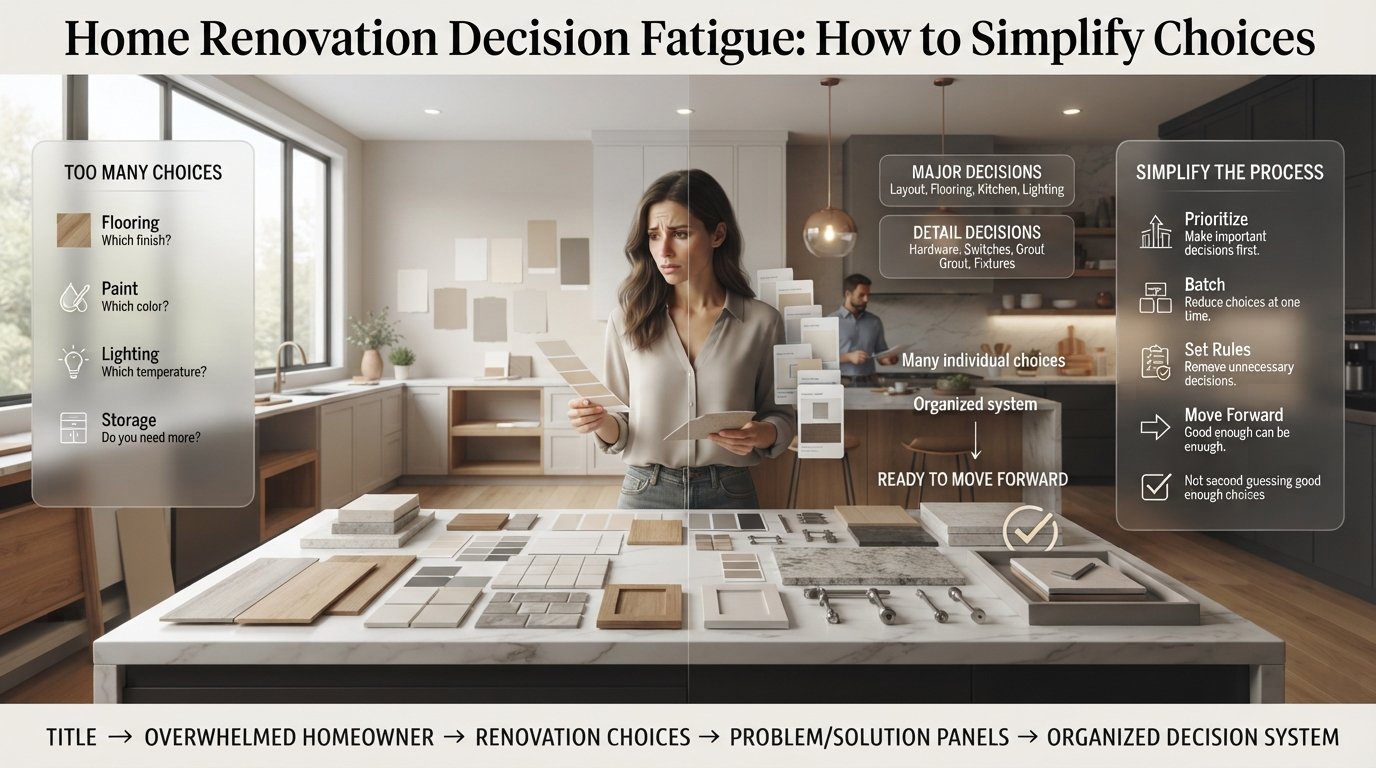
Home Renovation Decision Fatigue | Renovating a home sounds exciting until the questions start arriving faster than you can answer them.
Which flooring should you choose? What color should the walls be? Should the kitchen cabinets be matte or satin? Where should the sockets go? Which lighting temperature feels right? Do you need more storage? Should you replace the doors now or later? Which countertop works best with the floor?
At first, these choices feel enjoyable. Then they start piling up.
Before long, you may find yourself staring at two nearly identical paint samples for 20 minutes, changing your mind about a bathroom tile you already approved, or telling your contractor, “I’ll let you know tomorrow,” because you simply don’t have the energy to decide.
That is home renovation decision fatigue.
It isn’t necessarily caused by one difficult decision. It comes from the constant stream of decisions that renovation creates, especially when choices are made without a clear order or system. Recent renovation experts describe the same pattern: homeowners often cope well with the major early decisions but become overwhelmed when dozens of smaller specifications—hardware, switches, finishes, lighting, grout, storage, fixtures, and similar details—start arriving together.
The solution isn’t to become better at making hundreds of decisions.
The better solution is to make fewer decisions at once, make important decisions earlier, and create rules that make unnecessary choices disappear.
If you’re planning a renovation, DesignMode24 Interior Design can provide broader room-by-room inspiration, but the most important part of a successful renovation is learning how to filter ideas before they become more decisions.
This guide explains what causes renovation decision fatigue, how to recognize it, which choices deserve the most attention, how to build a renovation decision system, how to avoid expensive second-guessing, and how to know when a decision is simply good enough to move forward.
What Is Home Renovation Decision Fatigue?
Home renovation decision fatigue is the mental exhaustion that develops when a homeowner has to make a large number of renovation, design, purchasing, and planning decisions over an extended period.
The important point is that decision fatigue isn’t simply “being indecisive.”
You can be a confident person who makes quick decisions at work and still become overwhelmed during a renovation because the number of choices is unusually high.
A single kitchen renovation, for example, can involve decisions about:
- Layout
- Cabinets
- Countertops
- Appliances
- Flooring
- Backsplash
- Handles
- Sink
- Faucet
- Lighting
- Electrical outlets
- Storage
- Paint
- Window treatments
- Accessories
And many of these decisions depend on one another.
The cabinet layout affects the countertop. The countertop affects the backsplash. The cabinet layout affects lighting and sockets. The flooring influences the visual relationship between the kitchen and adjoining rooms.
So renovation decisions aren’t independent.
They form a chain.
Layout → systems → major finishes → furniture → lighting → decoration
When that chain isn’t managed properly, homeowners can feel as if they’re constantly making decisions without ever reaching the end.
Why Does Renovation Cause So Much Decision Fatigue?
The biggest problem is not simply the number of decisions. It’s the interconnection between them.
In ordinary shopping, you might choose a sofa and be finished.
During a renovation, the sofa may need to work with the floor, wall color, rug, curtains, coffee table, lighting, room dimensions, and circulation.
A decision that looks small can therefore create several additional questions.
Imagine you’re selecting a kitchen cabinet color.
You might initially think:
“I like this warm gray.”
Then you realize you need to ask:
- Does it work with the floor?
- Will it work with the countertop?
- Does it make the kitchen too dark?
- Does it coordinate with adjacent rooms?
- Will brass or black hardware work better?
- Will the color still look good in evening lighting?
- Will you regret choosing a trend?
Suddenly, one decision has become seven.
This is why renovation can feel mentally exhausting even when the physical work hasn’t started.
Research into homeowner renovation decision-making also shows that renovation choices are influenced by many different factors, including the home itself, the project, the decision-maker, available information, social influence, and beliefs about the consequences of the renovation.
When Does Renovation Decision Fatigue Usually Appear?
Decision fatigue can appear at different stages, but it often becomes noticeable when the project moves from broad planning into detailed specification.
The early questions may be exciting:
“Should we open the kitchen?”
“Should we add a bedroom?”
“Should we renovate the bathroom?”
Then the details arrive:
“Which grout?”
“Which switch plate?”
“Which cabinet handle?”
“Which hinge?”
“Which shade of white?”
Those smaller decisions may sound insignificant, but there can be dozens of them.
The problem is that your brain doesn’t experience each decision as completely separate. The cumulative workload keeps growing.
⚠ Common Mistake: Assuming that the biggest renovation decisions create the most mental pressure. In practice, the endless stream of small choices can be more exhausting because they arrive repeatedly and often require quick answers.
What Are the Signs of Home Renovation Decision Fatigue?
Renovation decision fatigue doesn’t always look like obvious stress.
Sometimes it looks like procrastination.
Sometimes it looks like suddenly becoming careless.
Sometimes it looks like constantly changing your mind.
Watch for these signs:
- You keep reopening decisions you’ve already made.
- You spend hours comparing nearly identical products.
- You ask too many people for opinions.
- You feel irritated when another contractor asks a question.
- You postpone decisions because you’re afraid of regret.
- You start accepting the first option just to finish the conversation.
- You repeatedly browse Pinterest or Instagram for “better ideas.”
- You can’t remember why you originally selected a material.
- You become less interested in details you previously cared about.
- You feel that every decision is urgent.
- You start saying, “Anything is fine,” even when it isn’t.
- You regret purchases immediately after making them.
One of the clearest signs is when you’re no longer evaluating the choice itself.
You’re evaluating how quickly you can stop thinking about it.
That is an important warning.
A recent renovation-focused discussion described this shift as moving from deliberate decisions toward reactive decisions as mental pressure accumulates.
How Do You Prevent Home Renovation Decision Fatigue?
The most effective approach is to create a decision system before the renovation becomes complicated.
Instead of asking yourself to remember everything, build a process that tells you:
- What needs to be decided.
- When it needs to be decided.
- How important it is.
- Which decisions depend on it.
- Who makes the final decision.
- When the decision is considered closed.
This immediately reduces mental clutter.
Start With a Renovation Brief
Before looking at products, write down what the renovation is actually supposed to accomplish.
Ask:
- What isn’t working in the current home?
- What do we need to improve?
- Who uses each room?
- What problems happen every day?
- What needs to change functionally?
- What would simply be nice to have?
- What is the realistic budget?
- What must be completed now?
- What can wait?
This becomes your reference point.
For example, suppose your bedroom feels cramped.
Your renovation brief might say:
“Improve storage, maintain a comfortable walking route, create a calmer visual environment, and improve lighting without making the room feel smaller.”
Now every decision has a test.
If a large decorative cabinet looks beautiful but reduces circulation, it fails the brief.
That is much easier than debating whether you “like” it.
Should You Make a Mood Board Before Renovating?
Yes, but the purpose of a mood board should be to reduce decisions, not create more of them.
A useful mood board should establish:
- General color direction
- Material preferences
- Furniture character
- Lighting mood
- Texture
- Overall atmosphere
It should not become an endless collection of beautiful rooms.
If you save 200 different rooms, you may end up with 200 different directions.
Instead, identify patterns.
Maybe you repeatedly choose:
- Warm wood
- Cream walls
- Soft black accents
- Natural textures
- Simple furniture
- Warm lighting
That tells you something useful about your preferences.
Then turn those patterns into a small design language.
A simple renovation design language
Base: warm neutral
Wood: natural oak
Metal: one consistent finish
Accent: muted green
Lighting: warm and layered
Furniture: simple, comfortable forms
Now when you encounter a new product, you can ask whether it belongs.
If it doesn’t, you don’t need to debate it for an hour.
How Should You Prioritize Renovation Decisions?
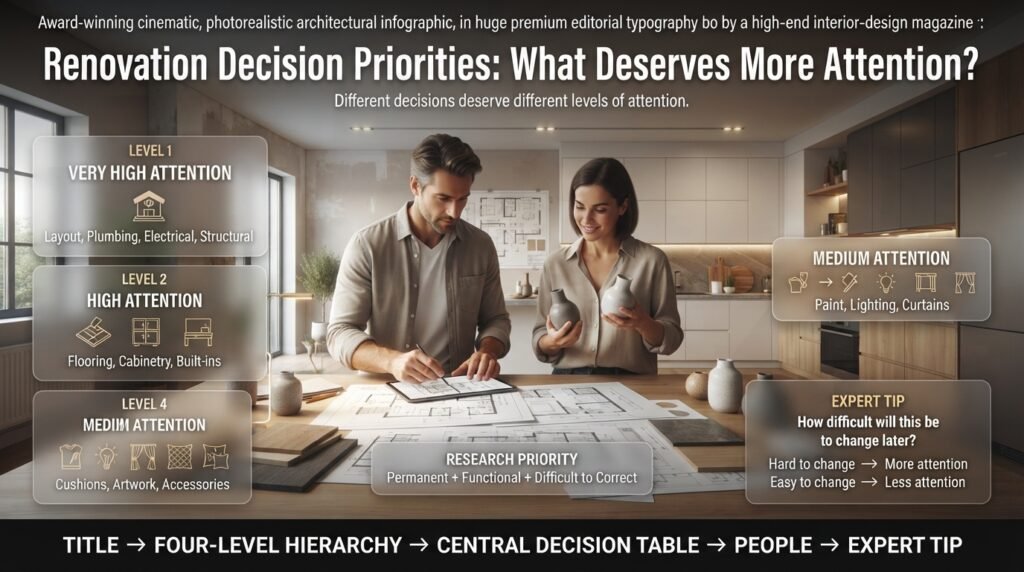
Not every decision deserves the same amount of research.
This is one of the most important ways to reduce renovation decision fatigue.
Think of decisions in four levels.
| Decision type | Examples | Attention required |
|---|---|---|
| Permanent/high-cost | Layout, plumbing, electrical, structural work | Very high |
| Difficult to replace | Flooring, cabinetry, built-ins | High |
| Important but changeable | Paint, lighting fixtures, curtains | Medium |
| Easy to replace | Cushions, artwork, accessories | Low |
A useful principle is:
Spend the most mental energy on decisions that are expensive, permanent, functional, or difficult to correct.
Don’t spend three hours deciding between two decorative vases while rushing an electrical layout that will be hidden behind finished walls.
⭐ Expert Tip: Before asking “Which option looks better?” ask “How difficult will this be to change later?” That single question helps determine how much decision-making effort the choice deserves.
What Renovation Decisions Should Be Made First?
A logical renovation sequence can prevent many later problems.
A practical order is:
1. Scope
What are you actually renovating?
2. Layout
How will the spaces work?
3. Structural changes
Which walls, doors, openings, or built-ins are changing?
4. Plumbing and electrical
Where will water, power, lighting, switches, and outlets go?
5. Major finishes
Flooring, cabinetry, countertops, large-format materials.
6. Paint and wall treatments
Choose them with the permanent materials in view.
7. Furniture
Fit furniture around the final room dimensions and circulation.
8. Lighting and window treatments
Coordinate these with furniture and architecture.
9. Accessories
Artwork, decorative objects, cushions, styling.
This order isn’t a rigid law for every project, but the underlying principle is important: make dependent decisions after the decisions they depend on.
Recent renovation guidance similarly recommends getting key design decisions and materials organized early, particularly because late choices can affect project schedules and lead times.
Why Layout Should Come Before Decoration
A beautiful room with a bad layout is still a bad room.
You can change a cushion in five minutes.
You can’t easily fix a doorway that opens into furniture, a kitchen work triangle that doesn’t work, or a wardrobe that blocks circulation after construction is complete.
This is why space planning should happen before decorative decisions.
Consider a bedroom.
Before choosing:
- Bedside lamps
- Artwork
- Bedding
- Decorative mirrors
You need to know:
- Bed position
- Door swing
- Wardrobe position
- Walking routes
- Window access
- Storage requirements
- Furniture clearances
If you’re working on bedroom planning specifically, Bedroom Circulation Planning is a natural reference because circulation is one of those functional decisions that can easily be overlooked when the focus shifts too quickly toward appearance.
How Can a Decision Matrix Make Renovation Easier?
When you’re stuck between several choices, stop comparing them emotionally.
Create a decision matrix.
Suppose you’re choosing between three flooring options.
Score each one for:
- Cost
- Durability
- Maintenance
- Appearance
- Comfort
- Compatibility
- Availability
| Factor | Flooring A | Flooring B | Flooring C |
|---|---|---|---|
| Budget | 5 | 3 | 4 |
| Durability | 4 | 5 | 3 |
| Maintenance | 5 | 4 | 3 |
| Style | 4 | 5 | 4 |
| Comfort | 3 | 4 | 5 |
| Availability | 5 | 3 | 4 |
The numbers don’t magically produce the correct answer.
They simply expose the trade-offs.
If one option is slightly prettier but significantly more difficult to maintain, you can see that clearly.
When Should You Use a Decision Matrix?
Use one when:
- The cost is significant.
- Several options are genuinely good.
- You keep changing your mind.
- Different people have different preferences.
- The decision affects later purchases.
Don’t use one for every tiny choice.
That would create another form of decision fatigue.
How Many Options Should You Compare?

For most home renovation decisions, three strong options are enough for a serious comparison.
Start broad during research.
Then narrow aggressively.
A useful process is:
Research → Filter → Shortlist → Compare → Decide → Close
Don’t do this:
Research → Compare → Research again → Find new option → Compare → Doubt → Research again
The second process has no natural stopping point.
Use the “Three Good Options” Rule
For a major purchase:
- One safe choice
- One preferred choice
- One alternative
For example:
Safe: neutral porcelain tile
Preferred: textured stone-look tile
Alternative: handmade-style ceramic tile
Once one option clearly meets your criteria, make the decision.
How Do You Know When a Renovation Decision Is Good Enough?
This is where many homeowners struggle.
They think:
“What if there’s something better?”
There probably is.
There is almost always another tile, another sofa, another paint shade, another faucet, another light fixture.
The existence of a different option doesn’t mean your current option is wrong.
A decision is good enough when it:
- Solves the intended problem.
- Fits the space.
- Fits the budget.
- Works with surrounding materials.
- Meets practical requirements.
- Has acceptable maintenance.
- Doesn’t create a major future problem.
If all of those conditions are satisfied, you can move forward.
📌 Quick Tip: Don’t ask whether your choice is the absolute best available product. Ask whether it is a strong choice for your home, your budget, your lifestyle, and your priorities.
How Can You Reduce the Number of Choices?
Create rules before shopping.
For example:
Paint: warm neutrals only.
Metal: brushed brass throughout the main living spaces.
Wood: medium natural oak.
Flooring: durable, low-maintenance surfaces.
Lighting: warm white and layered.
Now dozens of products automatically disappear.
This is not limiting your creativity.
It’s protecting your attention.
The same approach works with home improvement decisions. If you need practical project ideas rather than another large renovation choice, DIY Home Projects can be treated as a separate project category rather than mixing small DIY work into your major renovation decisions.
For quick, manageable improvements, Easy Weekend DIY Projects for Your Home can also help you identify tasks that can be completed independently after the major renovation decisions are finished.
Why Does Social Media Increase Renovation Decision Fatigue?
Instagram, Pinterest, TikTok, YouTube, and design websites can be excellent sources of inspiration.
But they can also keep your decision process permanently open.
You choose a kitchen.
Then you see another.
Then another.
Suddenly the kitchen you liked yesterday looks “boring.”
This is particularly dangerous because online inspiration is usually presented without the practical context of the actual room.
You don’t see:
- The homeowner’s budget.
- The room dimensions.
- The maintenance requirements.
- The installation difficulties.
- The climate.
- The lifestyle.
- The mistakes behind the photograph.
A polished image can therefore create unrealistic expectations.
Use inspiration intentionally
Instead of asking:
“What should my home look like?”
Ask:
“What specific element of this room do I like?”
Maybe it’s:
- The lighting.
- The wood tone.
- The proportions.
- The storage.
- The wall color.
- The texture.
Save the reason, not just the picture.
This transforms inspiration into useful design information.
How Do You Prevent Trend Chasing?
Trends are useful when they help you discover new ideas.
They become problematic when they dictate expensive permanent choices.
For long-term elements such as:
- Flooring
- Cabinetry
- Countertops
- Built-ins
- Doors
- Bathroom fixtures
choose based primarily on function, quality, proportion, and your genuine preferences.
Use trends more freely in:
- Cushions
- Artwork
- Accessories
- Small furniture
- Textiles
- Decorative paint
This gives you flexibility.
You can update a room without renovating it again.
What Role Does Color Play in Decision Fatigue?
Paint can be surprisingly difficult because color behaves differently depending on:
- Natural light
- Artificial lighting
- Room orientation
- Flooring
- Furniture
- Adjacent colors
- Time of day
This is why looking at a tiny online color square isn’t enough.
Order or paint physical samples where possible.
Test them on the actual wall.
Look at them:
- Morning
- Afternoon
- Evening
- Under artificial light
If you’re comparing several colors, narrow them down first rather than covering the entire room with 15 samples.
For additional color planning ideas, Paint Color provides a useful supporting resource without forcing you to make every color decision simultaneously.
How Can You Make Lighting Decisions Easier?
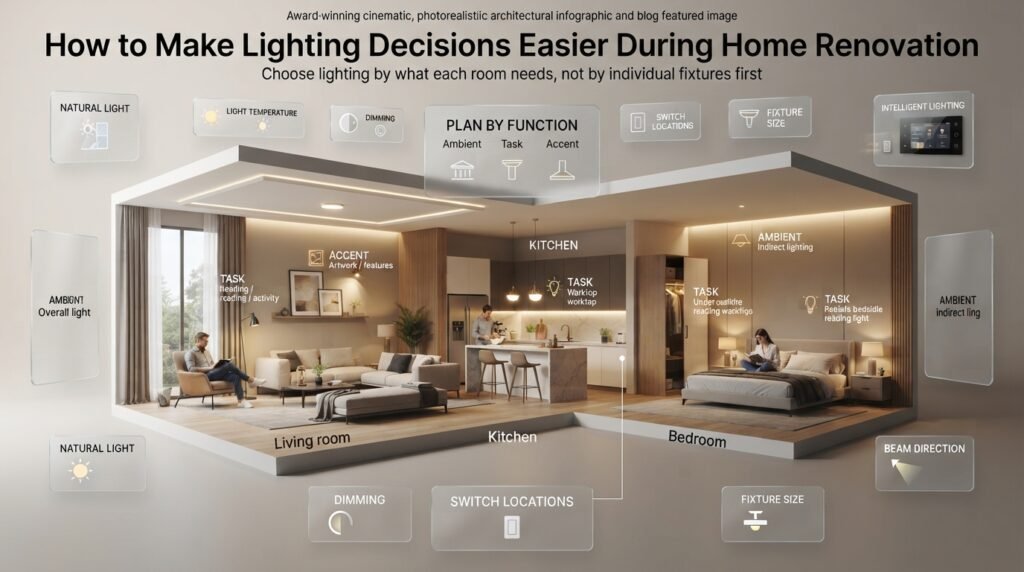
Lighting creates another common source of renovation decision fatigue because there isn’t just one lighting decision.
There are:
- Ambient lighting
- Task lighting
- Accent lighting
- Decorative lighting
- Natural light
- Light temperature
- Dimming
- Switch locations
- Fixture sizes
- Beam direction
Instead of selecting individual fixtures first, decide what each room needs.
For example:
Living room
Ambient: ceiling or architectural lighting
Task: reading or activity light
Accent: artwork, shelves, or architectural features
Kitchen
Ambient: general illumination
Task: worktop lighting
Accent: pendants or display lighting
Bedroom
Ambient: soft overall light
Task: bedside reading
Accent: wardrobe or architectural lighting
This makes lighting decisions functional instead of purely decorative.
For readers exploring technology-assisted lighting, the Modern Bedroom Design resource can be useful when considering how intelligent lighting can support a room rather than simply adding technology for its own sake.
How Can Storage Planning Reduce Renovation Stress?
Storage decisions are often postponed because homeowners think about them as furniture decisions.
They’re actually space-planning decisions.
Before choosing storage, determine:
- What needs to be stored?
- How frequently is it used?
- Where should it be accessed?
- How much vertical storage is available?
- Which items need drawers?
- Which need shelves?
- Which need hanging space?
- Which can be stored seasonally?
The same principle applies to entryways.
If an entryway constantly accumulates shoes, bags, coats, keys, and packages, simply adding a beautiful console may not solve the problem.
You need to understand the volume of items entering the space.
That’s why Entryway Storage Capacity Planning fits naturally into this topic: it shifts the question from “What furniture looks good here?” to “What storage capacity does this household actually require?”
That kind of functional thinking reduces unnecessary choices.
Can DIY Help or Increase Decision Fatigue?
DIY can reduce costs and create a sense of ownership, but it can also become another source of decisions.
Before starting a DIY project, ask:
- Do I have the tools?
- Do I have the skill?
- How much time will it take?
- What happens if I make a mistake?
- Is the work structural, electrical, plumbing, or cosmetic?
- Will doing it myself delay another trade?
For small decorative projects, DIY can be enjoyable.
For high-risk work, professional help is usually more sensible.
A renovation should not become a competition to do everything yourself.
What Should You Do With Decorative Decisions?
Decoration should generally come later.
Once the major renovation work is complete, you can see the actual room.
This is when you can decide:
- Artwork
- Mirrors
- Decorative shelving
- Cushions
- Plants
- Accessories
- Small tables
- Styling pieces
For example, don’t buy six decorative shelves before you know how much storage the room actually needs.
If open shelving genuinely suits the space, Wall Shelves Ideas can help you explore possibilities after the functional requirements are established.
Similarly, if you’re interested in handmade or creative finishing touches, DIY Home Decor Crafts can be treated as a finishing-stage resource rather than another item on the main renovation decision list.
How Do You Keep Different Rooms From Feeling Disconnected?
Another cause of decision fatigue is trying to make every room independently perfect.
A better approach is to create a few repeated elements.
For example:
- One dominant wood tone.
- One primary metal finish.
- A related neutral palette.
- Similar lighting temperature.
- Consistent door hardware.
- Repeated textures.
This creates cohesion without making every room identical.
You can still give bedrooms, bathrooms, kitchens, and living areas different personalities.
The goal is not uniformity.
It’s continuity.
What Should You Do When Two People Disagree?
Renovation disagreements are common because homes are personal.
One person may prioritize appearance.
The other may prioritize maintenance.
One wants the expensive countertop.
The other wants to protect the budget.
Instead of arguing about taste, separate the decision into categories.
Step 1: Agree on the non-negotiables
Examples:
- Budget
- Safety
- Space
- Durability
- Maintenance
Step 2: Identify personal preferences
Examples:
- Color
- Style
- Hardware
- Decorative details
Step 3: Compromise strategically
Don’t compromise on everything.
If one person cares deeply about the kitchen lighting and the other doesn’t, give the first person more influence there.
Then reverse the arrangement somewhere else.
The goal isn’t for both people to get exactly 50 percent of every decision.
The goal is for both people to feel the home reflects them.
How Can a Renovation Decision Schedule Help?
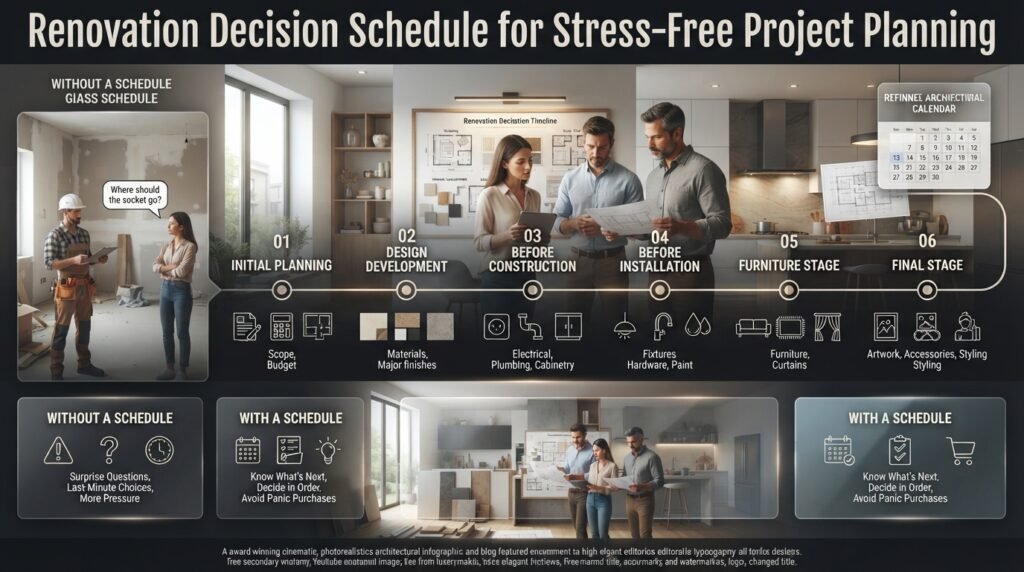
A decision schedule tells you when decisions need to happen.
Without one, homeowners often face surprise questions.
A contractor arrives and asks:
“Where should the socket go?”
The homeowner hasn’t thought about it.
Now the decision must be made immediately.
A better system identifies upcoming decisions in advance.
Example renovation decision schedule
| Stage | Decisions |
|---|---|
| Initial planning | Scope, budget, layout |
| Design development | Materials, major finishes |
| Before construction | Electrical, plumbing, cabinetry |
| Before installation | Fixtures, hardware, paint |
| Furniture stage | Furniture, rugs, curtains |
| Final stage | Artwork, accessories, styling |
A decision schedule also reduces the chance of panic purchases.
Recent professional guidance specifically recommends clear timelines and decision schedules because they allow choices to be made in logical order rather than under last-minute pressure.
How Do You Handle Last-Minute Contractor Questions?
This is where a prepared renovation decision file becomes extremely valuable.
Keep a document containing:
- Approved drawings
- Final material selections
- Product links
- Product codes
- Measurements
- Paint colors
- Lighting specifications
- Fixture selections
- Supplier information
- Installation notes
- Photos of samples
When someone asks a question, you can check the project information rather than reconstructing everything from memory.
If you’re managing a larger project, consider assigning one person as the final decision-maker.
Multiple people giving conflicting instructions can create confusion for both the homeowner and the contractor.
What Decisions Should You Delegate?
Delegation is one of the strongest tools against decision fatigue.
You don’t need to personally decide everything.
A contractor can handle certain technical construction questions.
An electrician can advise on electrical requirements.
A plumber can advise on technical plumbing constraints.
An interior designer can help with:
- Layout
- Materials
- Proportions
- Color coordination
- Furniture
- Lighting
- Overall design direction
The key is to distinguish between:
“What is technically possible?”
and
“What do I personally want?”
Professionals can often reduce the number of options by explaining which choices make sense for the project.
How Do You Avoid Making Expensive Decisions When You’re Tired?
Create a rule:
No major decisions when you’re mentally exhausted unless construction genuinely requires an immediate answer.
If something can wait until tomorrow, let it wait.
If it cannot wait, reduce the decision to the essential criteria.
For example:
“We need a bathroom tile today.”
Don’t browse 300 tiles.
Ask:
- Is it suitable for wet conditions?
- Is it safe?
- Is it within budget?
- Does it work with the selected vanity?
- Is it available on time?
Then choose from the remaining options.
The objective isn’t to make the decision emotionally perfect.
It’s to make a responsible decision with the information available.
What Are the Most Common Renovation Decision Mistakes?
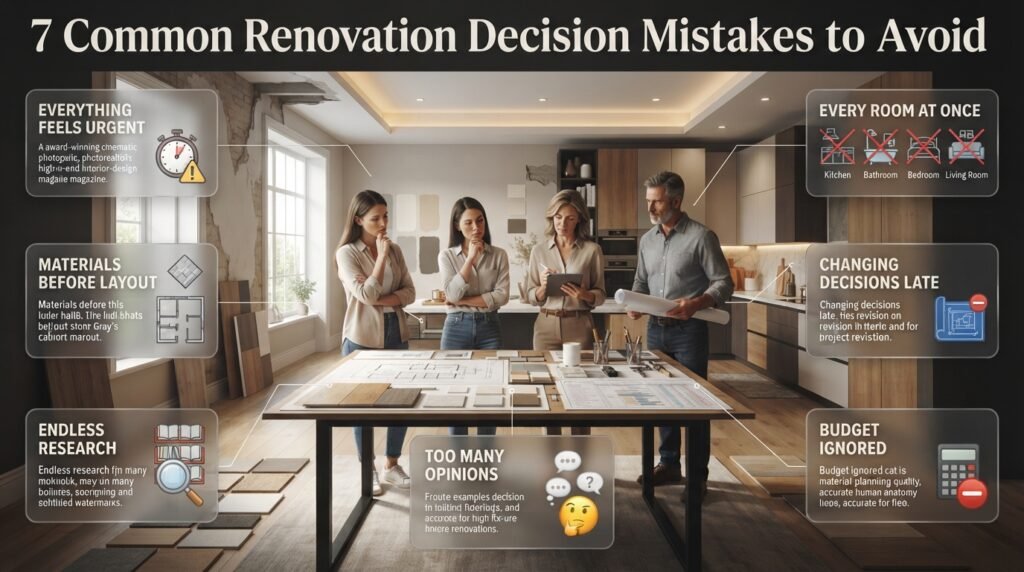
Mistake 1: Treating Every Decision as Urgent
Not every choice needs an immediate answer.
Why it happens: Renovation feels urgent.
Why it’s harmful: Everything starts competing for attention.
Better approach: Mark each decision as urgent, scheduled, flexible, or optional.
Mistake 2: Choosing Materials Before Understanding the Layout
Why it happens: Materials are visually exciting.
Why it’s harmful: You may select finishes that later conflict with the actual space.
Better approach: Establish layout and function first.
Mistake 3: Endless Research
Why it happens: Fear of regret.
Why it’s harmful: More information can create more possibilities.
Better approach: Define your criteria and stop when an option satisfies them.
Mistake 4: Asking Everyone for Advice
Why it happens: You want confidence.
Why it’s harmful: Conflicting opinions multiply uncertainty.
Better approach: Choose a small group of relevant decision-makers.
Mistake 5: Ignoring the Budget During Design
Why it happens: People fall in love with ideas before understanding total costs.
Why it’s harmful: Late budget changes force difficult compromises.
Better approach: Keep running costs visible while decisions are being made.
Mistake 6: Changing Major Decisions Late
Why it happens: Second-guessing.
Why it’s harmful: Late changes can affect materials, trades, schedules, and installation.
Better approach: Reopen decisions only when there is a substantial reason.
Mistake 7: Renovating Every Room at Once
Why it happens: It feels efficient.
Why it’s harmful: Financial, logistical, and mental pressure all increase.
Better approach: Phase the work when possible.
Should You Renovate Everything at Once?
Not necessarily.
Phased renovation can be particularly useful when:
- The budget is limited.
- You are living in the house during construction.
- The property has multiple functional problems.
- You haven’t lived in the space long enough to understand your needs.
- You want to reduce decision pressure.
A phased approach might look like:
Phase 1: Structural and infrastructure work
Phase 2: Kitchen and bathrooms
Phase 3: Flooring and painting
Phase 4: Furniture
Phase 5: Decoration
This also gives you an opportunity to learn from each stage.
You may discover that your actual needs differ from what you originally imagined.
How Can You Use the “Fixed vs Flexible” Method?
Divide every renovation decision into two categories.
Fixed
Decisions that need to be resolved before work continues.
Examples:
- Plumbing positions
- Electrical routes
- Cabinet dimensions
- Door openings
- Flooring transitions
Flexible
Decisions that can happen later.
Examples:
- Artwork
- Decorative objects
- Cushions
- Small furniture
- Plants
This prevents flexible decisions from competing with urgent ones.
A renovation becomes much easier when you know that you don’t actually need to decide everything today.
How Do You Deal With Regret After Making a Decision?
First, wait.
Immediate post-purchase doubt doesn’t always mean the decision was wrong.
You may simply be experiencing the emotional discomfort of committing.
Ask:
What specifically is wrong with this choice?
If you can identify a concrete issue—wrong dimensions, poor quality, incompatible material, excessive maintenance, major budget problem—then you have something actionable.
If your only thought is:
“Maybe another one would have been better,”
that’s not necessarily a reason to change it.
Renovation requires commitment.
You cannot keep every option open forever.
How Can You Make a Renovation Feel More Manageable?
Think in terms of decision batches.
Instead of answering renovation questions all day, create dedicated decision sessions.
For example:
Monday: Kitchen decisions
Wednesday: Bathroom decisions
Friday: Lighting and electrical
This reduces constant context switching.
During each session:
- Review the decisions.
- Identify missing information.
- Compare shortlisted options.
- Make the decisions.
- Record them.
- Close the session.
Then stop.
You don’t need to think about kitchen handles while trying to relax at night.
When Should You Get Professional Help?
Professional assistance becomes especially valuable when:
- The renovation changes the layout.
- Multiple rooms are being redesigned.
- The project involves custom cabinetry.
- Materials need extensive coordination.
- You are struggling to make decisions.
- The project has a tight timeline.
- Several contractors are involved.
- You and your partner cannot agree.
- You don’t understand technical implications.
A professional isn’t useful only because they have good taste.
A major benefit is decision reduction.
They can take 40 possible options and present three appropriate ones.
That alone can dramatically reduce mental workload.
How Can You Make Your Renovation More Sustainable?
Sustainability can also become overwhelming if treated as another enormous list of decisions.
You don’t need to research every environmental characteristic of every product.
Choose a few priorities.
For example:
- Durable materials
- Repairable products
- Low-emission finishes
- Efficient lighting
- Long-lasting furniture
- Reduced unnecessary replacement
If indoor air quality is one of your renovation priorities, you can explore Low VOC Finishes for Healthier Interiors as a focused resource rather than trying to evaluate every possible sustainability factor at once.
This illustrates an important principle:
Sustainability works best when it becomes a set of practical priorities rather than another source of perfectionism.
What About Outdoor and Garden Decisions?
Outdoor spaces can create the same decision problem as interiors.
You may need to decide:
- Furniture
- Lighting
- Storage
- Plants
- Paving
- Privacy
- Shade
- Materials
Don’t allow outdoor decisions to compete with urgent interior renovation decisions.
Treat them as a separate project category.
If you’re researching outdoor inspiration or related home projects, Robert MyGardenAndPatio can be kept as a dedicated resource for that side of the home.
The important thing is compartmentalization.
One project at a time.
What Is the Best Renovation Decision-Making System?
A simple five-stage system works for most homeowners.
Stage 1: Define
What problem are you solving?
Stage 2: Filter
What requirements must the solution meet?
Stage 3: Shortlist
Reduce the options to three realistic choices.
Stage 4: Decide
Choose the option with the best overall balance.
Stage 5: Close
Record the decision and stop reopening it without a genuine reason.
Think of it like this:
Problem → Criteria → Options → Decision → Move on
That final step is important.
Move on.
A renovation cannot progress if every decision remains permanently open.
A Practical Home Renovation Decision Checklist
Before making an important renovation choice, ask:
Function
- Does this solve the problem?
- Does it work for daily life?
Space
- Does it fit the dimensions?
- Does it preserve circulation?
Budget
- Is the total cost realistic?
- Are installation and accessories included?
Materials
- Does it coordinate with existing finishes?
- Is it durable enough?
Maintenance
- Is it easy enough to clean?
- Will it age reasonably well?
Timing
- Is it available when needed?
- Could it delay another trade?
Longevity
- Will I still be comfortable with this choice later?
- Is it difficult or expensive to replace?
Confidence
- Am I missing important information?
- Or am I simply afraid to commit?
If the answers are satisfactory, make the decision.
How Can You Tell If You’re Overthinking?
There’s a difference between careful consideration and overthinking.
Careful consideration asks:
- Does it fit?
- Does it work?
- Is it safe?
- Is it durable?
- Is it within budget?
- Does it coordinate with the design?
Overthinking asks:
- What if another option is better?
- What if I regret this?
- What if people don’t like it?
- What if this trend changes?
- What if I find something tomorrow?
The first group produces useful information.
The second group can continue forever.
Recent design commentary also highlights how constant exposure to trends and external opinions can cause homeowners to lose confidence in choices they previously liked.
How do I stop feeling overwhelmed by home renovation decisions?
The best way to reduce renovation overwhelm is to stop treating the entire project as one giant decision. Break it into stages and decide only what is necessary for the current stage. Start with the renovation scope and layout, then move to structural work, electrical and plumbing, major finishes, furniture, and finally decorative details. This gives your brain a clear sequence instead of asking it to solve everything at once.
A useful approach is to keep a renovation decision list with three categories: decide now, decide later, and optional. For example, electrical outlet positions may need an immediate answer, while artwork can wait until the room is finished.
Practical points:
Decide high-impact and difficult-to-change items first.
Limit yourself to a small shortlist instead of comparing everything available.
Give each decision a deadline.
Keep finished decisions closed unless new information creates a real problem.
Take breaks between major decision sessions instead of making choices continuously.
The goal isn’t to make every decision quickly. It’s to make the right decisions at the right time, which is one of the most effective ways to prevent renovation decision fatigue.
What renovation decisions should I make first?
Start with decisions that affect the structure, layout, services, and other future choices. In most projects, that means defining the scope first, confirming the room layout, resolving structural changes, and planning electrical and plumbing before choosing final decorative details. Major finishes and built-ins should then be selected before furniture and accessories.
This order matters because renovation decisions are connected. Changing a wall can affect electrical points; changing the kitchen layout can affect cabinetry, lighting, plumbing, and flooring. If you make decorative choices too early, you may eventually have to change them when the practical design changes.
A useful decision order is:
Scope — What are you actually renovating?
Layout — How should the space function?
Structure — What walls, openings, or built-ins change?
Services — Where do plumbing, electrical, lighting, and outlets go?
Major finishes — Flooring, cabinetry, countertops, tiles.
Furniture — What fits the finished space?
Decoration — Artwork, accessories, styling.
This sequence also reduces last-minute pressure because important materials and fixtures can be finalized early enough to account for availability and lead times.
How many options should I compare before making a renovation decision?
For most renovation decisions, comparing three strong options is usually more useful than examining dozens. Start with broader research, but once you understand the market, narrow your choices to a small shortlist based on your actual requirements.
For example, if you’re choosing flooring, you might compare three options based on durability, maintenance, price, appearance, availability, and compatibility with the rest of the home. You don’t need to compare 40 different floors simply because 40 are available.
The important distinction is between research and reassurance. Research gives you new information. Reassurance-seeking happens when you already have two suitable choices but keep searching because you’re afraid of making the wrong one.
Use this simple process:
Research: Understand what’s available.
Filter: Remove options that don’t meet your requirements.
Shortlist: Keep around three realistic choices.
Compare: Evaluate them using the same criteria.
Choose: Select the strongest overall option.
Close: Stop reopening the decision without a genuine reason.
This is especially important because 2026 renovation data shows homeowners are already dealing with financial pressure and scope changes; adding endless product comparison can make an already complicated project even harder to control.
Can renovation decision fatigue cause you to go over budget?
Yes. Decision fatigue can contribute to overspending because tired homeowners are more likely to make rushed upgrades, accept expensive alternatives, change previously approved materials, or expand the project scope without fully considering the financial effect.
The problem isn’t always one huge purchase. Small upgrades can accumulate. A slightly better countertop, upgraded handles, premium lighting, custom storage, and more expensive tiles may each seem reasonable individually. Together, they can move the renovation far beyond the original budget.
Current renovation research shows that budget overruns remain common. Houzz’s 2026 renovation data found that 37% of homeowners exceeded their initial renovation budget in 2025, with higher product or service costs, upgraded materials, project complexity, and scope or design changes among the reported factors.
To protect your budget:
Set a realistic budget before shopping.
Keep a contingency reserve for unexpected work.
Record the cost impact of every major change.
Don’t upgrade multiple categories at the same time.
Separate essential improvements from luxury upgrades.
Avoid making expensive decisions when you’re exhausted or under time pressure.
Finalize major materials before construction reaches the stage where delays become expensive.
A good rule is simple: if a change isn’t solving a genuine problem, pause before paying for it.
How do I know when to stop researching and just make the renovation decision?
Stop researching when you have enough reliable information to make a confident, reasonable choice—not when you’ve found a mythical “perfect” option.
For a major renovation decision, check whether the option meets your essential requirements for function, dimensions, quality, budget, maintenance, durability, availability, and overall design compatibility. If it passes those tests and there isn’t a significant unresolved concern, continuing to search may only create more doubt.
This is where experienced homeowners and designers differ from people who are constantly browsing. Professionals understand that almost every decision involves trade-offs. The objective isn’t to find an option with zero disadvantages; it’s to find an option whose disadvantages are acceptable for the project.
Before reopening a decision, ask yourself:
Did I discover new information?
Has the budget changed?
Has the layout changed?
Is the product unavailable?
Is there a genuine quality or performance concern?
Or am I simply wondering whether something else might be better?
If nothing important has changed, leave the decision closed.
That mindset is particularly valuable during long renovations because constant second-guessing can delay materials, create unnecessary changes, and increase mental and financial pressure. Current renovation guidance recommends making material and fixture decisions early and maintaining clear communication precisely to avoid these late-stage problems.
Conclusion
Home renovation decision fatigue doesn’t happen because you’re bad at making decisions. It happens because renovation asks you to make too many decisions, often at the same time, while money, deadlines, contractors, materials, and your personal taste are all competing for attention.
The solution isn’t to find the perfect product or research every available option. It’s to create a process that makes good decisions easier.
Start by defining what your renovation actually needs to achieve. Prioritize layout, functionality, structural work, electrical and plumbing decisions before moving into finishes, furniture, and decoration. Keep your options limited, use clear criteria, set realistic deadlines, and don’t reopen a decision simply because you found another attractive idea online.
Most importantly, learn to recognize the difference between useful research and endless reassurance-seeking. Once a choice fits your space, budget, lifestyle, design direction, and practical requirements, it may already be the right choice—even if another option exists.
A successful renovation isn’t about getting every detail absolutely perfect. It’s about creating a home that functions well, feels comfortable, reflects your priorities, and stays within a manageable budget.
When you stop treating renovation as one enormous list of choices and start handling it as a series of smaller, well-timed decisions, the process becomes clearer, calmer, and far more enjoyable.
You don’t need to make perfect decisions. You need to make informed decisions, close them when they’re good enough, and move forward with confidence.