
Introduction
How to Decorate a Long Hallway | A long hallway can be one of the most difficult spaces in a home to decorate. It may be narrow, poorly lit, unusually long, or filled with doors that leave very little room for furniture. When left undecorated, it can feel more like a passageway than a finished part of the home.
The good news is that you don’t need to rebuild the hallway to make it look better.
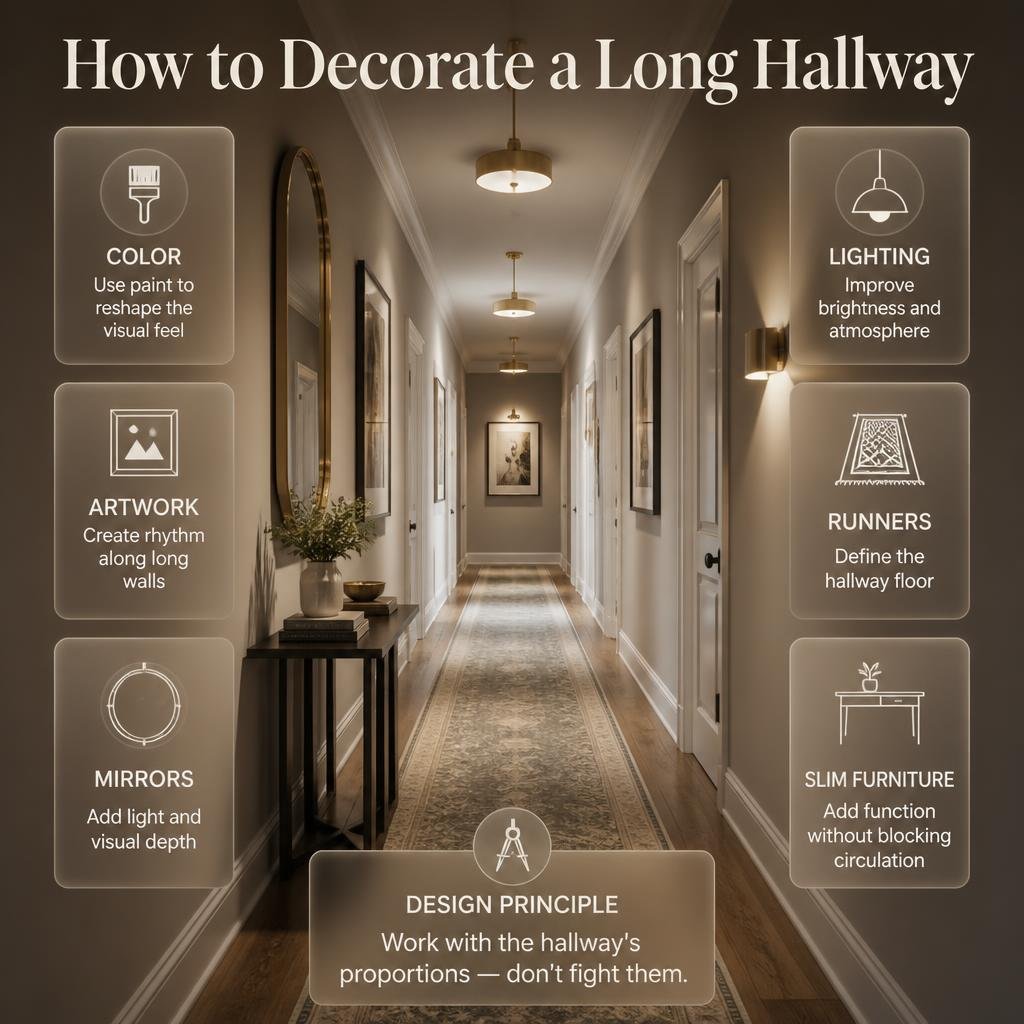
If you’re wondering how to decorate a long hallway, the most effective approach is to work with the hallway’s proportions instead of fighting them. Paint, lighting, artwork, mirrors, runners, wall treatments, and carefully selected furniture can completely change how the corridor feels.
In this guide, you’ll learn how to make a long hallway look less narrow and less empty, where to place artwork and mirrors, how to choose colors and runners, how to improve lighting, what furniture actually works, and which common mistakes can make the space feel even longer.
For more practical home styling, decorating, and improvement inspiration, DesignMode24 Interior Design also covers room layouts, color, lighting, storage, DIY projects, and other home design decisions.
How Should You Start Decorating a Long Hallway?
The best way to decorate a long hallway is to solve its functional problems before adding decorative accessories. Start by measuring the width, length, ceiling height, door positions, lighting, and available walking space. Then decide whether the main problem is darkness, narrowness, emptiness, poor storage, or a lack of visual character.
This first step matters because every hallway has different proportions.
A wide hallway may comfortably accommodate a console table or bench. A narrow corridor may need wall-mounted decoration instead. A hallway with natural light can handle deeper colors more easily than a dark interior corridor.
Before buying anything, walk from one end of the hallway to the other.
Look at the space from:
- The main entrance
- The living room
- The bedroom side
- The opposite end
- Standing inside nearby rooms
Notice what you see first.
If the first thing you notice is a blank wall, that wall may need a focal point. If you notice clutter, storage needs attention. If the hallway feels dark, lighting should be addressed before adding decorative objects.
A Simple Planning Formula
Think about your hallway in five layers:
1. Structure — walls, doors, ceiling, flooring
2. Light — natural and artificial lighting
3. Visual rhythm — artwork, molding, mirrors, repeated fixtures
4. Function — storage, seating, furniture
5. Personality — accessories, artwork, plants, decorative details
This prevents the common mistake of buying decorations first and trying to make them fit afterward.
How Do You Make a Long Hallway Look Less Long?
A long hallway looks less elongated when you introduce visual breaks along its length. Instead of leaving one uninterrupted wall from one end to the other, create several smaller points of interest using artwork, lighting, mirrors, wall molding, doors, rugs, or furniture.
You don’t necessarily need to make the hallway physically shorter.
You need to make it visually more interesting.
For example, imagine a corridor with completely empty walls:
ENTRY ───────────────────────────── ENDThe eye naturally follows the entire length.
Now imagine:
ENTRY
  ↓
[ART] ─ [LIGHT] ─ [MIRROR]
  ↓
     [RUNNER]
  ↓
[ART] ─ [LIGHT] ─ [CONSOLE]
  ↓
       [FEATURE WALL]
The hallway still has exactly the same dimensions, but the eye experiences several destinations.
Use Repetition Rather Than Random Decoration
Repeated elements create rhythm.
For example:
- Three matching wall lights
- A series of similarly framed photographs
- Repeated molding panels
- Consistent artwork spacing
- Repeated wood accents
The key is consistency.
Random objects placed at random distances can make a hallway look cluttered rather than designed.
⭐ Expert Tip: When decorating a long corridor, think about visual rhythm in the same way you would think about rhythm in music. Repetition creates continuity, while carefully placed changes create interest.
What Color Makes a Long Narrow Hallway Look Wider?
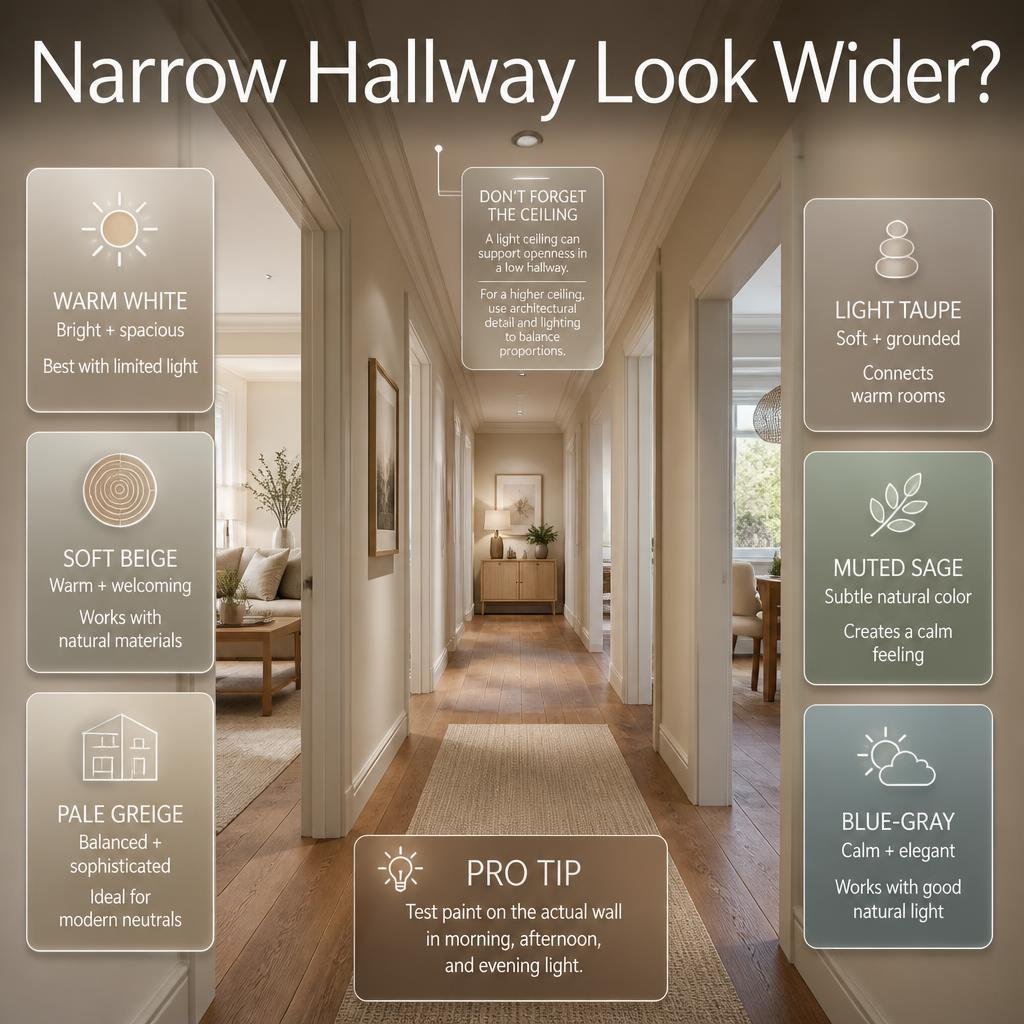
Light and moderately warm colors are often effective for making a narrow hallway feel more open. Warm white, soft beige, pale greige, light taupe, muted sage, and other restrained neutrals can reflect available light without making the corridor feel cold.
However, there’s no single universally correct hallway color.
The surrounding rooms matter.
If your home already has warm wood flooring, beige furniture, and cream walls, a cool gray hallway may feel disconnected. A warm neutral would create a smoother transition.
If the home is contemporary with cooler materials, a soft gray or muted blue-gray may work better.
Popular Long Hallway Color Approaches
| Color approach | Visual effect | Works particularly well when |
|---|---|---|
| Warm white | Bright and spacious | Hallway has limited light |
| Soft beige | Warm and welcoming | Home uses natural materials |
| Pale greige | Balanced and sophisticated | Modern neutral interiors |
| Light taupe | Soft and grounded | Hallway connects warm rooms |
| Muted sage | Subtle color | You want a natural feeling |
| Blue-gray | Calm and elegant | Hallway receives good light |
Don’t Forget the Ceiling
A hallway ceiling is easy to overlook.
If the ceiling is low, a light ceiling color can help maintain a sense of openness.
If the ceiling is unusually high, stronger architectural detailing or carefully selected lighting can make the proportions feel more balanced.
For more guidance on choosing and coordinating colors throughout your home, explore Paint Color ideas before finalizing your hallway palette.
💡 Pro Tip: Never choose hallway paint solely from a tiny color card. Test a sample on the actual wall and view it in morning, afternoon, and evening light.
Should You Paint the Whole Hallway One Color?
Yes. Painting a long hallway one consistent color can actually make it feel more cohesive and intentional. Instead of changing colors repeatedly, you can create visual variation through artwork, lighting, doors, trim, rugs, and texture.
A single wall color is particularly useful when several rooms open into the hallway.
It creates a neutral visual connection between those spaces.
When Should You Add a Second Color?
A second color can be useful when you want to create a focal point.
For example:
- Light walls + darker end wall
- Neutral walls + colored doors
- One paint color + contrasting trim
- Two-tone wall with wainscoting
- Neutral walls + patterned wallpaper on one section
The important thing is to have a reason for the change.
Changing colors simply because the hallway is long can make the space feel fragmented.
How Do You Decorate Long Hallway Walls?
Long hallway walls give you an opportunity to introduce personality without taking up valuable floor space. Artwork, family photographs, mirrors, wall molding, picture ledges, wallpaper, and other vertical treatments can transform empty walls into intentional design features.
The right choice depends on the width of the hallway.
Create a Gallery Wall
A gallery wall can work beautifully in a long hallway because the corridor naturally provides a long horizontal surface.
You could use:
- Family photographs
- Black-and-white photography
- Botanical prints
- Abstract artwork
- Architectural images
- Travel photographs
- Children’s artwork
- Minimalist illustrations
Try to establish a visual connection between the pieces.
This doesn’t mean every frame has to match.
Instead, repeat one or two characteristics such as:
- Frame finish
- Color palette
- Artwork theme
- Spacing
- Matting style
Don’t Make the Frames Too Small
Tiny pictures spread across a large wall can make the wall feel even longer.
If your hallway is spacious enough, several medium-sized pieces often create a stronger composition than dozens of tiny objects.
Try a Picture Ledge
A picture ledge is particularly useful if you enjoy changing artwork.
You can layer framed pieces instead of permanently mounting every picture.
This makes the hallway easier to refresh seasonally or whenever your decorating preferences change.
Can Wall Molding Make a Long Hallway Look Better?
Wall molding can add architectural rhythm to a long hallway without consuming floor space. Picture-frame molding, board-and-batten, wainscoting, and simple panel designs can visually divide a long wall into smaller sections.
This is particularly useful when the hallway has:
- High walls
- Very little furniture
- Plain architectural details
- A traditional or transitional interior style
The important thing is proportion.
If the hallway is very narrow, extremely heavy molding can make the walls feel visually crowded.
Simple paneling is often more effective.
If you’re specifically considering architectural wall features, Wall Treatments offers additional ideas that can complement this approach.
Keep the Pattern Consistent
For example:
| PANEL | PANEL | PANEL | PANEL |Repeated proportions create order.
Avoid making every panel a different size unless the architecture specifically calls for it.
Are Mirrors Good for a Long Narrow Hallway?
Mirrors can make a long hallway feel brighter and more spacious by reflecting light and nearby visual elements. They’re especially useful in narrow corridors where adding furniture would make the walkway feel cramped.
But a mirror should not be installed simply because someone said mirrors make rooms look bigger.
Placement matters.
Ask yourself:
What will the mirror reflect?
A mirror reflecting a window, attractive artwork, or a well-designed room can be useful.
A mirror reflecting shoes, storage clutter, or a messy room will simply make the clutter visually stronger.
Good Places for a Hallway Mirror
Consider:
- Near the entrance
- Opposite a window
- Above a slim console
- Between wall lights
- At the end of the hallway
A mirror at the end of a corridor can create an interesting visual effect, but it may also reinforce the length if the entire hallway is reflected directly.
Large or Small Mirror?
One properly proportioned mirror is usually more effective than several tiny decorative mirrors scattered randomly.
⭐ Expert Tip: Before drilling, hold the mirror in position and inspect its reflection from both ends of the hallway. The reflected view matters just as much as the mirror itself.
What Should You Put at the End of a Long Hallway?
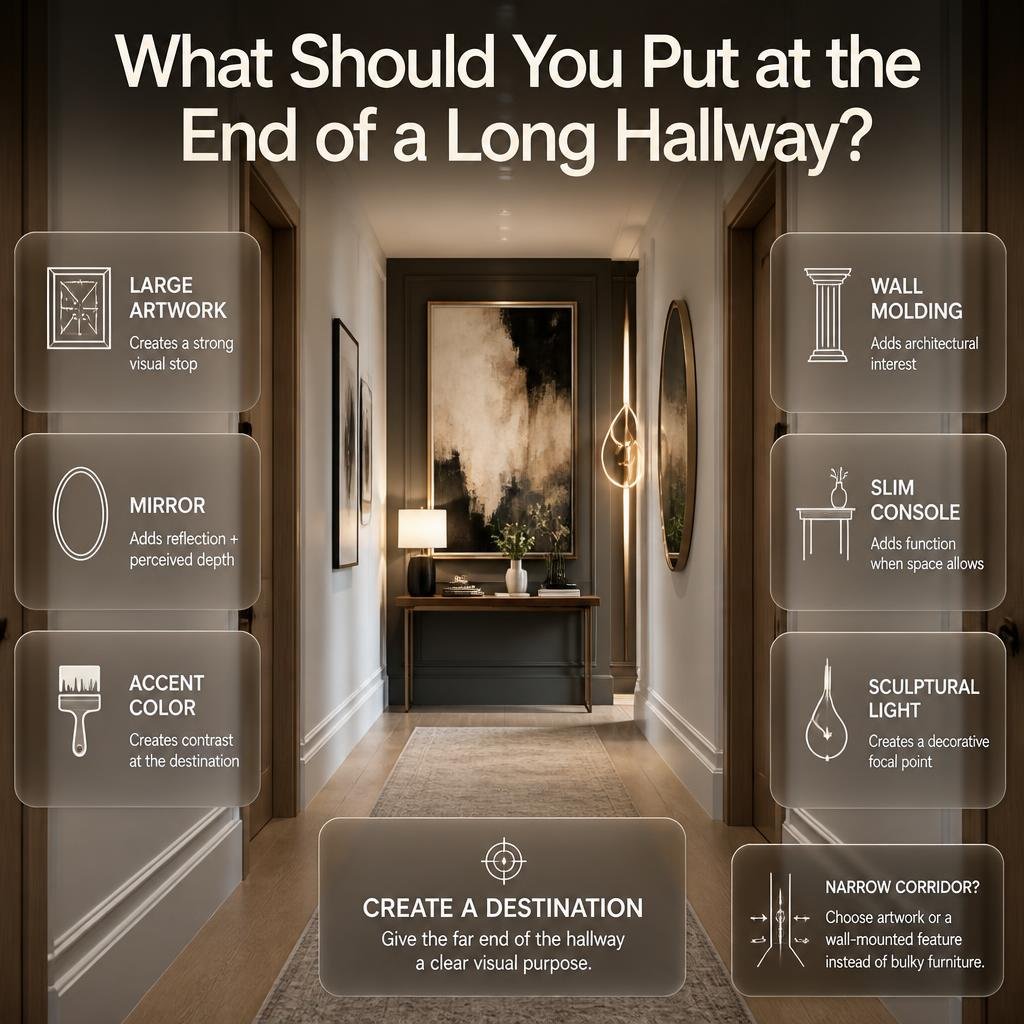
The end wall is naturally one of the strongest focal points in a long hallway. You can use artwork, a mirror, a textured wall, a darker paint color, a slim console, or an architectural feature to create a visual destination.
This is one of the most overlooked opportunities in hallway design.
When someone enters the corridor, their eye naturally moves toward the far end.
Give that destination some purpose.
End-Wall Ideas
Large artwork: Creates a strong visual stop.
Mirror: Adds reflection and can increase perceived depth.
Accent color: Creates contrast.
Wall molding: Adds architectural interest.
Console: Adds function if space allows.
Sculptural light: Creates a decorative focal point.
Don’t place furniture there just because the wall is empty.
If the corridor is narrow, an artwork or wall-mounted feature may be better.
How Do You Choose the Right Runner for a Long Hallway?
A hallway runner should fit the corridor without interfering with doors or making the walking path feel restricted. The right runner adds warmth, pattern, texture, and visual structure while still leaving some flooring visible around the edges.
Before buying one, measure:
- Hallway length
- Hallway width
- Door swing areas
- Distance between walls
- Furniture locations
- Thresholds between rooms
Should a Runner Cover the Entire Hallway?
Not necessarily.
A runner that is slightly shorter than the hallway can create a deliberate framed appearance.
However, a runner that is dramatically too short may make the empty sections at both ends more noticeable.
What Pattern Should You Choose?
| Runner style | Best effect |
|---|---|
| Solid neutral | Calm and minimal |
| Small pattern | Subtle visual texture |
| Geometric | Contemporary character |
| Vintage pattern | Traditional warmth |
| Bold pattern | Strong focal point |
| Striped design | Can emphasize direction |
If the hallway already contains strong artwork, choose a quieter runner.
If the walls are simple, the runner can carry more personality.
📌 Quick Tip: Choose a hallway runner after deciding on your wall art and major finishes, not before. The floor pattern should support the room rather than compete with it.
How Important Is Lighting in a Long Hallway?
Lighting is one of the most important parts of decorating a long hallway because a poorly lit corridor can feel darker, narrower, and longer than it actually is.
Avoid depending on a single light fixture positioned in one location.
Instead, distribute illumination.
Useful Hallway Lighting Options
- Recessed ceiling lights
- Flush-mount ceiling fixtures
- Wall sconces
- Picture lights
- Pendant fixtures where appropriate
- Cove or concealed lighting
- Accent lighting
Create a Repeated Lighting Pattern
A long hallway can benefit from repeated fixtures.
For example:
○       ○       ○       ○
LIGHT   LIGHT   LIGHT   LIGHT
The repeated elements help establish rhythm.
Wall sconces can be particularly attractive when they highlight artwork or architectural features.
Layer Your Lighting
A well-designed hallway can combine:
Ambient lighting for general visibility.
Accent lighting for artwork and architectural details.
Decorative lighting for character.
The result is much more interesting than a corridor illuminated by one harsh ceiling bulb.
For broader guidance on lighting systems and smart lighting concepts, see Intelligent Lighting.
How Can You Make a Dark Long Hallway Feel Brighter?
Start by addressing the light rather than immediately adding decorative objects. Use suitable wall colors, multiple light sources, mirrors, reflective surfaces, and a visually uncluttered layout to make the corridor feel brighter.
If the hallway has a window, avoid blocking it with heavy furniture or dark treatments.
Use Light Strategically
A bright hallway doesn’t have to be pure white.
Warm neutrals can feel more comfortable and still reflect plenty of light.
Mirrors can help reflect existing light.
Glass and lightly reflective surfaces can add brightness.
But don’t make every surface glossy.
Too much reflection can make a hallway feel cold rather than welcoming.
Can You Put Furniture in a Long Hallway?
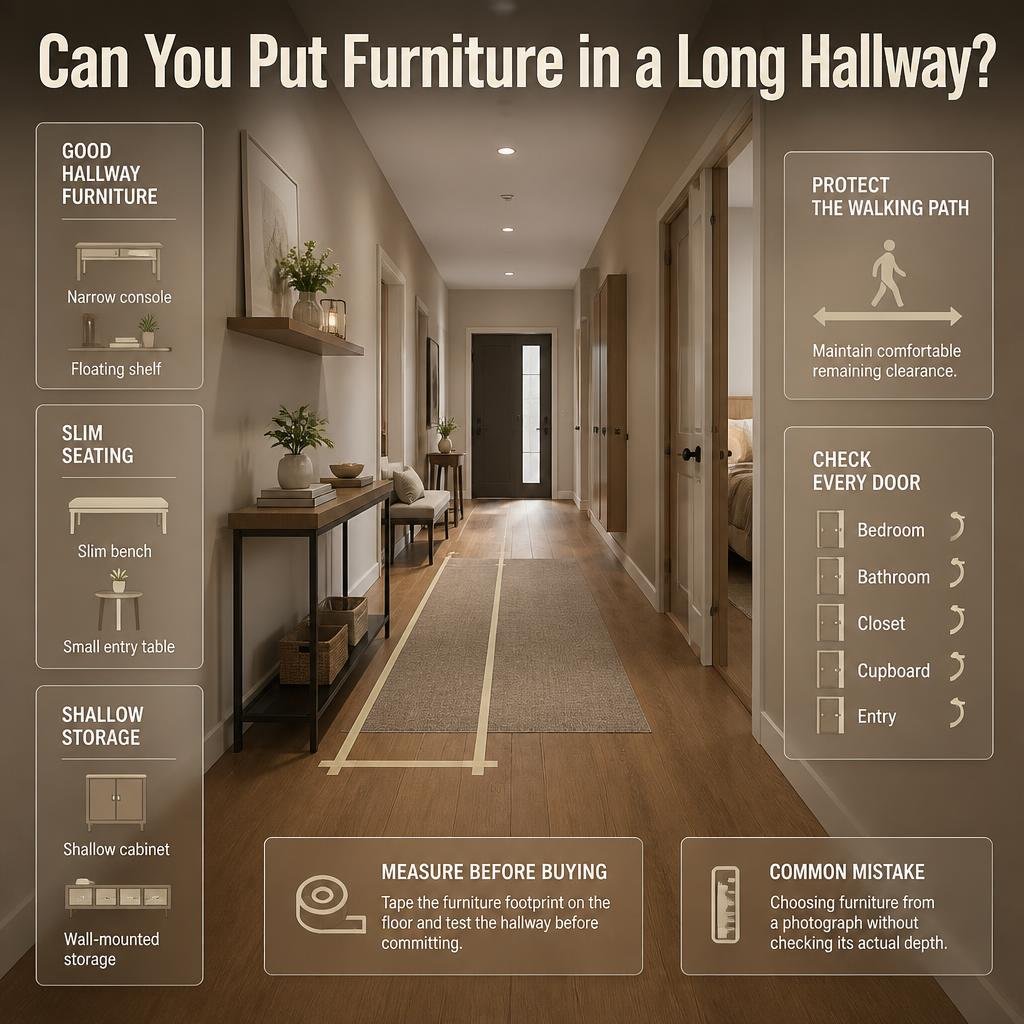
Furniture can work in a long hallway when the corridor is wide enough to preserve a comfortable walking path. Slim consoles, floating shelves, shallow cabinets, and narrow benches can provide function without overwhelming the space.
The most important measurement is not the furniture itself.
It’s the remaining clearance.
Before buying a piece, place masking tape on the floor to represent its footprint.
Then walk through the hallway.
Open every nearby door.
Imagine carrying laundry, luggage, groceries, or furniture through the corridor.
If the furniture makes normal movement uncomfortable, it’s too large.
Good Hallway Furniture
- Narrow console
- Floating shelf
- Slim bench
- Shallow cabinet
- Wall-mounted storage
- Small entry table
What Should You Avoid?
Avoid deep furniture in narrow corridors.
Also avoid furniture that interferes with:
- Bedroom doors
- Bathroom doors
- Closet doors
- Cupboard doors
- Main entry doors
⚠ Common Mistake: Choosing furniture because it looks attractive in a photograph without checking its actual depth. Hallway design is one area where measurements matter more than appearance.
How Can You Add Storage to a Long Hallway?
A long hallway can provide useful storage when the solution is shallow, organized, and visually controlled. Instead of filling the corridor with large cabinets, use vertical walls for hooks, shelves, shallow cupboards, or floating storage.
Useful options include:
- Key hooks
- Small floating shelves
- Closed shoe storage
- Wall-mounted cabinets
- Built-in shallow cupboards
- Baskets
- Coat hooks
- Small mail organizers
The most important principle is containment.
Open storage can quickly become visually messy.
If you need hallway storage for everyday objects, closed doors can create a cleaner appearance.
For broader home improvement and organization ideas, Home Improvement provides related guidance.
How Do You Connect a Long Hallway With the Rest of the Home?
A hallway should feel like part of the home, not like a separate decorative experiment. Repeat colors, materials, finishes, lighting details, or artwork styles from the surrounding rooms to create visual continuity.
For example, if your living room contains:
- Warm oak
- Cream upholstery
- Black metal lighting
You could repeat those elements in the hallway through:
- Oak picture frames
- Cream walls
- Black wall sconces
The hallway doesn’t need to match the living room exactly.
It simply needs to belong to the same visual family.
For broader interior planning ideas, Interior Design can help you think about the relationship between individual spaces and the home’s overall style.
Should You Add Plants to a Long Hallway?
Plants can add softness and natural character, but they should only be used where light and circulation allow them.
A plant placed in the middle of a narrow walkway quickly becomes an obstacle.
Instead, consider:
- One larger plant at a wider end
- A small plant on a console
- Wall-mounted greenery
- A plant near natural light
Don’t scatter many small plants throughout a narrow corridor.
One intentional plant usually creates a cleaner result.
If you’re interested in broader natural-home concepts and outdoor connections, Robert MyGardenAndPatio can provide additional inspiration beyond the hallway itself.
Can You Use an Accent Wall in a Long Hallway?
An accent wall can be particularly effective on the end wall because it creates a visual stopping point. You can use paint, wallpaper, wood, texture, molding, or artwork instead of applying the same treatment to the entire corridor.
Good Accent-Wall Choices
Paint: Easiest and most affordable.
Wallpaper: Adds pattern and personality.
Wood detailing: Adds warmth and texture.
Molding: Creates architectural character.
Large artwork: Adds a focal point without permanently changing the wall.
The key is restraint.
If the hallway already contains a strong runner, gallery wall, and decorative lighting, a dramatic accent wall may be unnecessary.
How Do You Decorate a Long Hallway on a Budget?
You don’t need an expensive renovation to make a hallway look finished. Start with changes that affect the largest visual surfaces: paint, lighting, flooring, and wall decoration.
1. Repaint the Walls
A fresh color can immediately change the atmosphere.
2. Rearrange Existing Artwork
You may already have enough artwork—it’s simply not arranged effectively.
3. Improve the Lighting
Changing poor-quality bulbs or adding additional fixtures can have a surprisingly large effect.
4. Declutter
Removing unnecessary items costs nothing.
5. Add One Mirror
One well-positioned mirror can be more effective than several small accessories.
6. Use a Runner
A reasonably priced runner can add softness and visual structure.
7. DIY a Wall Feature
Simple molding, painted panels, or a picture ledge can create architectural interest without a major renovation.
For more hands-on projects, DIY Home Projects is a useful related resource.
How Can Wall Treatments Change a Long Hallway?
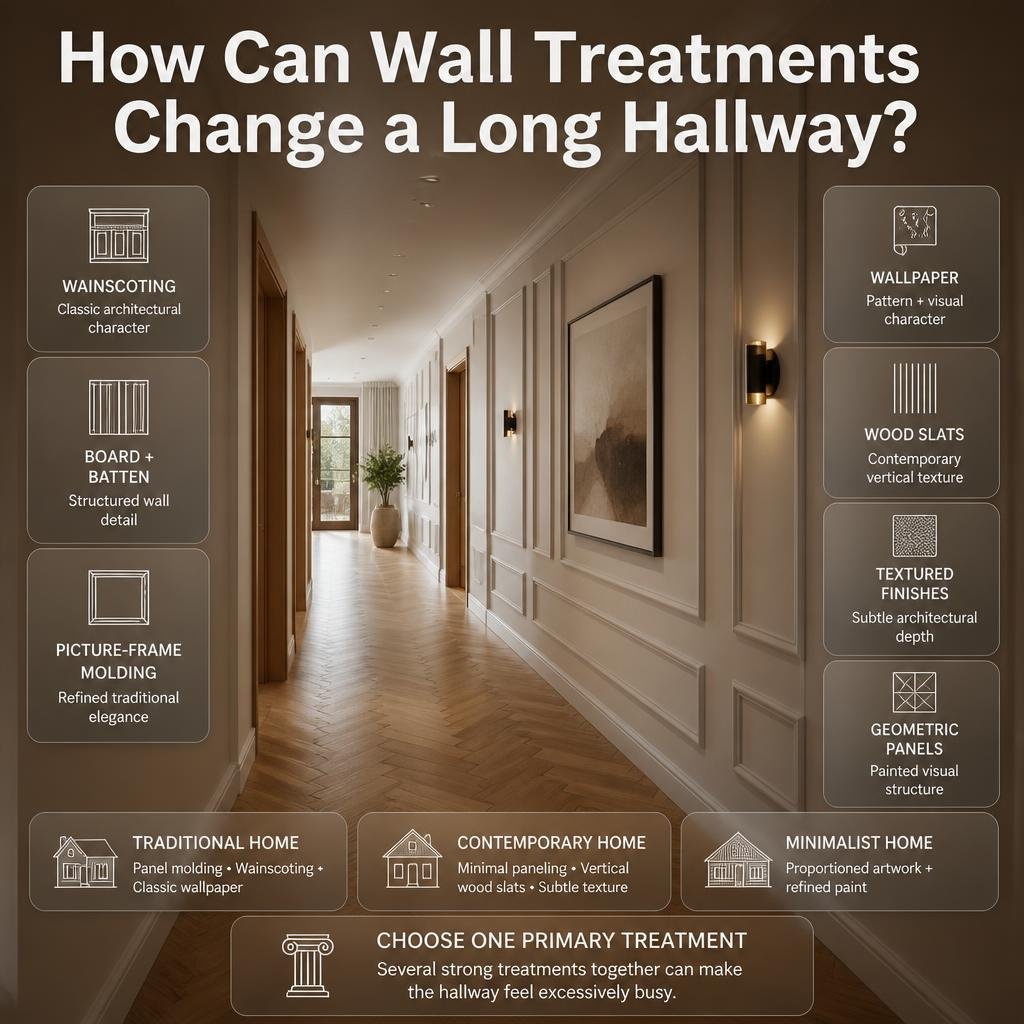
Wall treatments can give a plain corridor architectural character without taking up floor space. They’re especially useful when the hallway is structurally simple and has large blank walls.
Options include:
- Wainscoting
- Board and batten
- Picture-frame molding
- Wallpaper
- Wood slats
- Textured finishes
- Painted geometric panels
Choose one primary treatment.
Using several strong treatments together can make a hallway feel excessively busy.
Match the Treatment to the Home
A traditional home may suit:
- Panel molding
- Wainscoting
- Classic wallpaper
A contemporary home may suit:
- Minimal paneling
- Vertical wood slats
- Subtle textured finishes
A minimalist home may need nothing more than carefully proportioned artwork and paint.
How Can Sustainable Materials Work in Hallway Design?
A hallway doesn’t require excessive material use to make an impact. Durable finishes, responsibly sourced wood, long-lasting rugs, low-maintenance paint, and carefully selected furniture can help create a design that doesn’t need frequent replacement.
This is especially relevant for flooring and wall finishes because hallways experience heavy daily traffic.
When selecting materials, think about:
- Durability
- Maintenance
- Repairability
- Lifespan
- Cleaning requirements
- Visual compatibility
For readers interested in broader material decisions, How to Design a Home Using Low-Impact Materials provides a useful starting point.
The goal isn’t simply to choose the most environmentally marketed product.
A material that lasts longer and doesn’t need frequent replacement can also be a practical consideration.
How Do You Decorate a Long Hallway Without Making It Cluttered?
The easiest way to avoid clutter is to establish a hierarchy. Decide what should be noticed first, what should support it, and what can remain empty.
For example:
Main feature: Large artwork
Supporting elements: Two wall lights
Secondary detail: Runner
Empty space: Remaining wall area
This creates balance.
If every wall has artwork, every surface has accessories, and every section has furniture, nothing feels important.
Use the Editing Rule
After decorating, remove one or two things.
Then step back.
Ask:
- Does the hallway look cleaner?
- Is the focal point stronger?
- Is movement easier?
- Does the hallway feel calmer?
Often the answer is yes.
⭐ Expert Tip: Empty wall space isn’t wasted space. In a narrow hallway, breathing room can make the decorative elements that remain look more intentional.
What Are the Most Common Long Hallway Decorating Mistakes?
1. Filling Every Wall
Why it happens: The hallway looks empty.
Why it hurts: Too many objects create visual noise.
Better approach: Create a planned composition with empty space.
2. Using Furniture That’s Too Deep
Why it happens: A console looks good in a showroom.
Why it hurts: The hallway becomes difficult to navigate.
Better approach: Measure clearance first.
3. Installing Only One Light
Why it happens: The hallway is treated as a transitional space.
Why it hurts: Long areas develop dark sections.
Better approach: Distribute lighting.
4. Choosing a Runner Without Measuring
Why it happens: People focus on the appearance.
Why it hurts: Doors may catch the rug or the proportions may look wrong.
Better approach: Measure before shopping.
5. Hanging Artwork Too High
Why it happens: People try to fill vertical wall space.
Why it hurts: The artwork becomes disconnected from the viewer.
Better approach: Position artwork at a comfortable viewing level and consider the entire grouping.
6. Using Too Many Different Colors
Why it happens: The hallway seems like an opportunity to experiment.
Why it hurts: The corridor loses connection with nearby rooms.
Better approach: Build around a controlled palette.
7. Ignoring the End Wall
Why it happens: Attention goes to the side walls.
Why it hurts: The natural focal point remains unfinished.
Better approach: Give the end a deliberate visual destination.
8. Blocking Doors
Why it happens: Furniture placement is based only on available wall space.
Why it hurts: Doors and circulation become inconvenient.
Better approach: Test all door swings before installation.
9. Decorating Before Fixing Practical Problems
Why it happens: Accessories are more exciting than maintenance.
Why it hurts: Cracks, poor lighting, damaged trim, or wiring problems remain hidden beneath cosmetic work.
Better approach: Fix the structure first, then decorate.
The same principle applies throughout the home: solve the basic condition of the space before adding finishes. Mintpaldecor Home Repair Inspiration can be useful when your hallway project also involves repair or improvement work.
How Can You Plan a Long Hallway Like an Interior Designer?
A professional approach usually begins with observation rather than shopping.
Step 1: Measure Everything
Record:
- Total length
- Wall-to-wall width
- Ceiling height
- Door positions
- Door swing areas
- Existing lights
- Windows
- Electrical points
- Floor transitions
Step 2: Identify the Main Problem
Choose the biggest issue.
Is it:
Too dark?
Too narrow?
Too empty?
Too cluttered?
Too plain?
Poorly connected to the rest of the home?
Don’t try to solve six problems at once.
Step 3: Establish the Background
Choose:
- Wall color
- Trim
- Ceiling treatment
- Flooring or runner
- Lighting temperature and style
Step 4: Create the Visual Rhythm
Now introduce:
- Artwork
- Mirrors
- Molding
- Lighting
- Decorative features
Step 5: Add Function
Only add furniture or storage where it genuinely improves the space.
Step 6: Edit
Remove anything that doesn’t contribute.
This approach creates a hallway that feels designed rather than decorated.
How Can Smart Home Features Improve a Long Hallway?
Technology can be useful when it solves a practical problem rather than being added simply because it’s modern.
For example, hallway lighting can benefit from:
- Motion sensors
- Timers
- Dimmers
- Smart switches
- Scheduled lighting
- Scene controls
A motion sensor can be particularly practical at night when someone needs to move between rooms without turning on bright overhead lighting manually.
Technology should remain subtle.
The hallway still needs to look like part of the home rather than a demonstration of gadgets.
For broader home improvement planning and practical upgrades, Why Home Improvement Is Important provides useful context about approaching improvements systematically.
How Do You Make a Hallway Feel More Welcoming?
A welcoming hallway combines practical comfort with visual warmth. Color, lighting, artwork, flooring, texture, and the relationship with the entrance all contribute to that first impression.
If the hallway begins at your front door, think about the first five seconds.
What does a visitor see?
A dark corridor with shoes scattered around?
Or:
- Soft lighting
- A clean runner
- One attractive artwork
- A useful mirror
- Organized storage
- A cohesive color palette
You don’t need luxury materials to create a welcoming impression.
You need clarity and intention.
What Is the Best Long Hallway Style for a Modern Home?
Modern hallways generally benefit from clean lines, controlled colors, simple artwork, purposeful lighting, and minimal furniture.
You might combine:
- Warm white walls
- Natural wood
- Black or brushed-metal lighting
- One large artwork grouping
- A textured runner
- Minimal storage
Avoid adding too many decorative objects.
Modern design depends heavily on proportion and restraint.
If your overall home uses a more contemporary style, keep the hallway connected to that language rather than making it completely different.
What Is the Best Long Hallway Style for a Traditional Home?
Traditional hallways can benefit from panel molding, framed artwork, warm colors, classic lighting, patterned runners, and furniture with softer or more detailed profiles.
A gallery wall of family photographs can work especially well.
You could also use:
- Wainscoting
- Brass or aged-metal fixtures
- Traditional framed artwork
- Warm wood
- Patterned runners
The key is to avoid turning the corridor into a collection of unrelated traditional accessories.
Choose a clear visual direction.
How Can You Use Accessories Without Overdecorating?
Accessories should support the primary design rather than compete with it.
Good hallway accessories include:
- One vase
- A small sculpture
- A decorative bowl
- A framed photograph
- A plant
- A few books on a console
But a hallway isn’t the same as a living room.
There is usually less space for accessories, so every object becomes more noticeable.
If you have a console, don’t cover the entire surface.
Leave some empty space.
That makes the furniture feel intentional rather than overloaded.
Long Hallway Decorating Ideas at a Glance
| Hallway problem | Practical solution |
|---|---|
| Feels too long | Create visual zones |
| Feels narrow | Use controlled colors and shallow furniture |
| Feels dark | Layer lighting and use reflective surfaces |
| Looks empty | Artwork, molding, runner, or one focal feature |
| Looks cluttered | Remove objects and use closed storage |
| Lacks personality | Add artwork or architectural detailing |
| Feels disconnected | Repeat colors and materials |
| Has poor storage | Use vertical or shallow storage |
| End wall feels unfinished | Create a focal point |
| Floor feels cold | Add a suitable runner |
| Ceiling feels low | Use appropriate lighting and light ceiling colors |
| Too many doors | Use repeated artwork and consistent finishes |
How Can You Create a Cohesive Design Across the Entire Home?
The hallway can act as a transition between rooms.
Instead of treating each room as an isolated design project, choose a few recurring elements.
For example:
LIVING ROOM
Warm wood + cream + black metal
             ↓
        HALLWAY
Warm wood + cream + black metal
             ↓
BEDROOM
Warm wood + cream + black metal
The exact proportions can change from room to room.
The repeated elements create continuity.
This is particularly useful when the hallway connects rooms with different functions.
For broader ideas covering different spaces and home projects, the Room-by-Room Design Hub can help you think about the entire house as one connected design.
How do you make a long hallway look less narrow and more spacious?
The easiest way to make a long hallway feel more spacious is to improve the way light, color, and visual movement work together. Light or softly toned walls can help the corridor feel more open, while mirrors can reflect available light and create additional visual depth. Instead of filling the hallway with furniture, use the walls for artwork, molding, or other slim decorative features.
A long hallway also benefits from visual breaks. A gallery wall, repeated wall lights, a runner, or a feature at the far end gives the eye several points to stop rather than allowing it to travel through one uninterrupted tunnel.
Practical points to remember:
Use light or balanced wall colors when the hallway is dark.
Keep bulky furniture away from narrow walking areas.
Use mirrors where they reflect light or an attractive view.
Add artwork in a planned arrangement rather than randomly.
Keep the central walkway completely clear.
Use repeated lighting or decorative elements to create rhythm.
The important thing is not to make every surface brighter or add more decoration. A spacious hallway usually comes from better proportions and less visual clutter, not simply from adding more objects.
What is the best way to decorate a long hallway wall?
A long hallway wall works best when it has a deliberate visual arrangement rather than a collection of unrelated decorations. A gallery wall, a row of coordinated artwork, picture-frame molding, wainscoting, wallpaper, or a combination of artwork and wall lighting can give the wall structure without taking away floor space.
Gallery walls are particularly practical because hallways often have substantial unused wall area. A straight row or organized grid can create a clean appearance, while a more collected arrangement can give the hallway a relaxed character. Recent hallway makeovers also show how picture-frame molding can create a continuous architectural detail along a corridor.
For a professional-looking result:
Choose one overall theme or color relationship.
Keep frame spacing consistent.
Don’t make every artwork extremely small.
Align artwork around a comfortable viewing height.
Leave some empty wall space around the main composition.
Coordinate frames with finishes already used elsewhere in the home.
If the hallway is very narrow, remember that wall decoration should remain visually controlled. You don’t need to cover every inch of the wall. One strong gallery arrangement can look much better than several unrelated clusters.
A useful rule: decorate the wall as one composition, not as individual empty spots that need to be filled.
What paint colors make a long narrow hallway look bigger?
Light and softly toned colors are a reliable choice when you want a long narrow hallway to feel brighter and more open. Warm white, creamy neutrals, pale greige, light gray, soft beige, and muted colors can work particularly well when the corridor doesn’t receive much natural light. Light finishes can help reflect available illumination, while a deeper color on the far wall can visually bring that wall forward and reduce the tunnel effect.
That doesn’t mean a long hallway must always be white.
A darker or more saturated color can work when the hallway has good lighting and you’re intentionally creating a dramatic, enclosed atmosphere. It can also be effective on an end wall rather than throughout the entire corridor.
Before choosing your paint, consider:
How much natural light enters the hallway?
What color are the nearby rooms?
Is the ceiling high or low?
What color is the flooring?
Are the doors white, wood, or painted?
Will you use artwork or wall molding?
Does the hallway need warmth or a cooler appearance?
One mistake is choosing a paint color from a small sample and assuming it will look identical on a long wall. Hallway lighting changes throughout the day, so test the color in the actual space.
Professional approach: establish the hallway’s base color first, then use artwork, lighting, doors, and architectural details to create contrast. This generally produces a more cohesive result than using several strong paint colors simply because the hallway is long.
Should you use a runner in a long hallway, and how do you choose the right one?
A runner can be one of the most effective additions to a long hallway because it adds warmth, texture, color, and visual structure without taking up walking space. It also helps define the circulation path and can make an otherwise plain corridor feel finished. Current hallway design guidance commonly recommends leaving a visible border of flooring around the runner rather than pushing the rug against the walls.
The most important step is measuring before buying.
Measure the hallway from wall to wall and check every door that opens into the corridor. The runner shouldn’t interfere with door movement, curl against the walls, or create a tripping point.
When choosing a hallway runner, consider:
Hallway width
Runner width
Runner length
Door clearance
Pattern scale
Foot traffic
Cleaning requirements
Rug-pad or anti-slip requirements
A low-pile or flat-weave runner is often practical for a busy hallway because it is less likely to interfere with doors than a thick pile. An anti-slip pad can also help prevent movement in a high-traffic corridor.
Pattern choice matters too.
A subtle pattern can add interest without overwhelming the corridor. A bold design can become the main feature, but then the walls and accessories should usually be more restrained.
The professional rule is simple: let either the floor or the walls make the strongest statement. When both compete heavily, a narrow hallway can quickly feel busy.
How can you decorate a long hallway without making it cluttered?
The best way to avoid clutter is to decorate the hallway according to its actual width and function rather than trying to fill every empty surface. In a narrow corridor, walls should generally carry more of the decorative load while the floor remains clear for comfortable movement. Slim furniture, floating shelves, wall-mounted storage, mirrors, artwork, and layered lighting can add character without taking over the walkway.
Start by deciding what the hallway genuinely needs.
If it needs storage, use shallow or wall-mounted storage. If it feels dark, prioritize lighting. If it looks empty, use artwork or architectural detail. If it feels excessively long, create visual zones instead of adding random furniture.
Use this simple decorating hierarchy:
Solve the practical problem first.
Choose the main visual feature.
Add supporting details.
Leave intentional empty space.
Remove anything that doesn’t contribute.
For example, a narrow hallway might only need a coordinated gallery wall, several evenly distributed lights, and a runner. Adding a console, bench, plants, baskets, shelves, mirrors, and dozens of accessories could actually make the same hallway less attractive.
A useful professional test: stand at the entrance and look down the entire hallway. If your eye immediately jumps between too many unrelated objects, simplify the arrangement. If your eye naturally moves from one intentional feature to another, the design has better visual rhythm.
The goal isn’t to make the hallway look full.
The goal is to make it look finished, useful, and connected to the rest of the home.
Conclusion
Decorating a long hallway is not simply about filling an empty passage with furniture, artwork, or accessories. The real goal is to make the space feel wider, brighter, balanced, and connected to the rest of your home. With the right combination of paint color, lighting, wall treatments, mirrors, artwork, flooring, and carefully selected furniture, even a narrow hallway can become an attractive and useful part of the overall interior.
Start by understanding the proportions of your hallway and decide what you want to improve most. Light and warm colors can help create a more open feeling, while a carefully chosen darker feature wall can add depth and visually reduce the tunnel-like effect. Mirrors can reflect light and create the impression of additional space, while a properly sized runner can add warmth and guide the eye through the hallway.
The most important principle is balance. Avoid placing too many decorative pieces simply because the hallway has available wall space. Instead, choose a few elements that have a clear purpose and complement your home’s existing style. Slim furniture, simple artwork, wall-mounted storage, layered lighting, and thoughtfully selected accessories can provide personality without making the walkway feel crowded.
A well-decorated hallway should also feel connected to the rooms around it. Repeat colors, materials, textures, or design details from your living room, bedroom, entryway, or other spaces to create a natural visual flow. Whether your preference is modern, minimalist, traditional, contemporary, or more decorative, the hallway should feel like part of the home rather than an isolated corridor.
Ultimately, the best long hallway design is one that combines visual balance, practical movement, comfortable lighting, and personal style. You do not need an expensive renovation to achieve that result. Small, intentional changes can transform a forgotten passage into a welcoming transition between the important spaces of your home.