
Introduction
How to Design a Home Using Low-Impact Materials | A home can look beautiful and still create unnecessary waste. A floor may be replaced even though it is structurally sound, perfectly usable cabinets may be thrown away during a renovation, and decorative materials may be chosen simply because they are fashionable for the moment. Over time, these decisions add up.
That is why understanding how to design a home using low-impact materials is less about finding a single “perfect” eco-friendly product and more about changing the way you make design decisions.
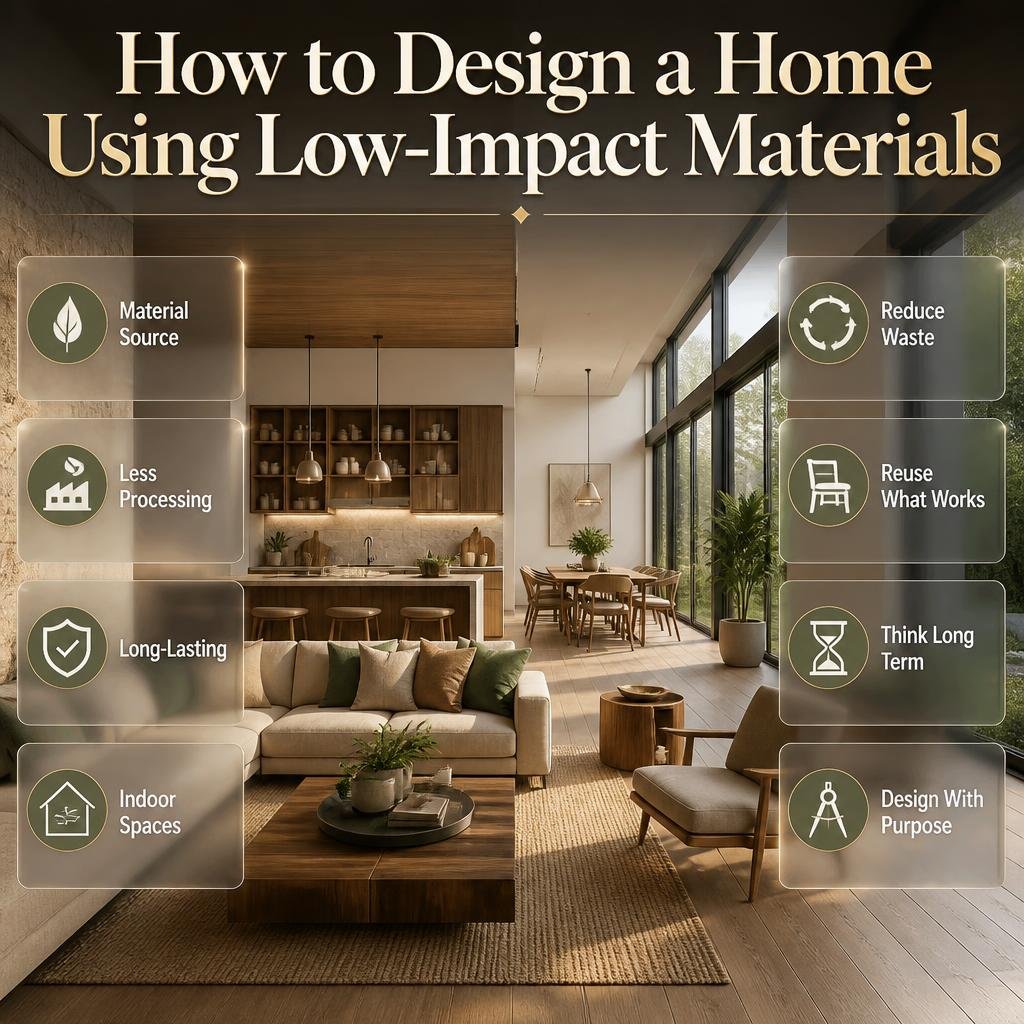
A low-impact home doesn’t have to look rustic, plain, or obviously “green.” It can be modern, luxurious, minimalist, traditional, colorful, or completely personal. The difference is in the thinking behind the materials: where they come from, how much processing they require, how long they are expected to last, how they affect indoor spaces, and what happens when they are eventually removed.
If you’re planning a new build, renovation, room makeover, or simply want to make better choices the next time you buy flooring, furniture, paint, lighting, or accessories, this guide will show you how to approach the process step by step.
You’ll learn which materials are worth considering, how to compare them, where people commonly make mistakes, how to stay within budget, and how to create a home that feels natural and sophisticated without buying unnecessary products.
For a broader starting point, DesignMode24 Interior Design offers a wider collection of interior and home-design ideas that can help connect individual material choices with the overall character of your home.
What Does Low-Impact Home Design Actually Mean?
Low-impact home design means making material and design choices that aim to reduce unnecessary environmental impact while still delivering the durability, comfort, safety, and appearance a home requires.
A material shouldn’t be considered low-impact simply because it is marketed as “natural” or “eco-friendly.” Its full lifecycle matters.
That includes:
- Where the raw material comes from
- How it is extracted or grown
- How much processing it requires
- How far it travels
- What adhesives, coatings, or finishes are added
- How long it will realistically last
- How much maintenance it needs
- Whether it can be repaired
- Whether it can be reused or recycled later
This lifecycle approach is important because a material with a positive feature in one area can have disadvantages somewhere else. For example, a rapidly renewable material may still involve energy-intensive manufacturing, while a very durable material may require significant extraction.
Current sustainable-material guidance increasingly emphasizes this whole-life approach rather than judging products simply by appearance or marketing labels.
Why Is Lifecycle Thinking Important?
Imagine two flooring products.
Product A costs less but needs replacement after several years.
Product B costs more but can remain useful for decades and can be repaired or refinished.
Looking only at the purchase price makes Product A appear attractive. Looking at the entire life of the floor gives you a much more useful comparison.
That is the basic principle behind low-impact design:
Buy less, waste less, maintain what you own, and choose materials that remain useful for longer.
Why Should You Use Low-Impact Materials in a Home?
The environmental argument is important, but there are practical reasons to consider these materials too.
Durable materials can reduce the need for repeated renovations. Repairable furniture can remain useful when individual components become damaged. Thoughtful finishes can make maintenance easier. And carefully selected materials can create interiors with more texture, warmth, and individuality.
The strongest benefits usually come from several decisions working together.
1. Less Unnecessary Waste
Keeping an existing floor, cabinet, door, or piece of furniture avoids the need to manufacture and transport a replacement.
2. Better Long-Term Durability
A material that performs well under the conditions where it is installed may stay attractive and functional for much longer.
3. More Flexible Interiors
Repairable and adaptable materials make it easier to change a room without completely rebuilding it.
4. More Natural Visual Character
Timber, stone, cork, clay, linen, wool, and other materials can introduce texture that synthetic decorative products sometimes struggle to replicate convincingly.
5. Better Attention to Indoor Materials
Paints, adhesives, flooring, furniture, and engineered wood products can contribute to indoor VOC emissions. Product selection and ventilation therefore matter when designing interiors.
How Do You Choose the Right Low-Impact Material?
Before selecting a material, don’t ask only:
“Is this sustainable?”
Ask a better set of questions.
Material Selection Checklist
Source: Where did it come from?
Manufacturing: How heavily was it processed?
Transportation: Does it need to travel a very long distance?
Durability: How long should it last in this particular room?
Maintenance: Does it require frequent sealing, refinishing, or replacement?
Health: What adhesives, coatings, finishes, or treatments are involved?
Repair: Can damaged sections be repaired rather than replaced?
End of life: Can the product be reused, separated, recycled, or responsibly disposed of?
Quantity: Do you actually need this much material?
This approach is much more useful than simply searching for “the most eco-friendly material.”
Which Low-Impact Materials Are Worth Considering?
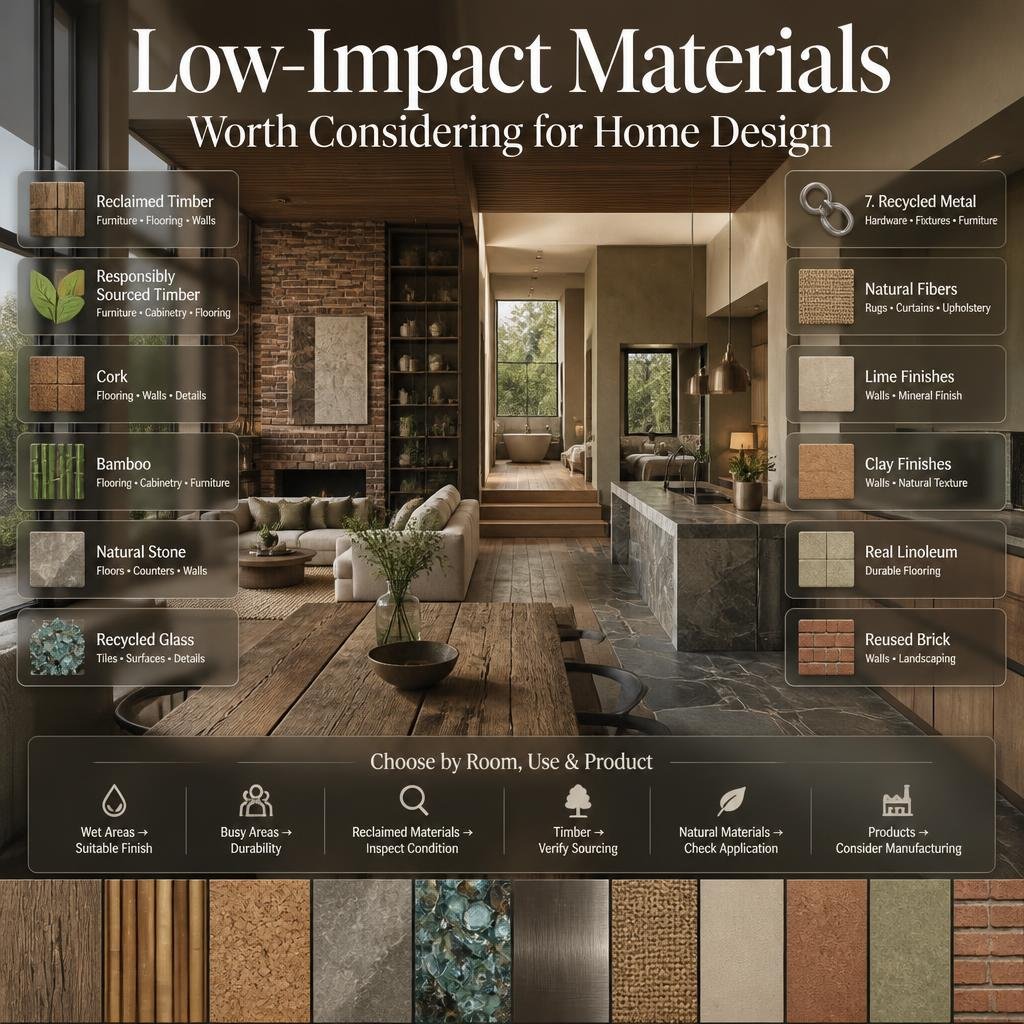
There isn’t one universal winner because different rooms have different requirements.
A material that works beautifully in a bedroom may be inappropriate for a wet bathroom. A soft material may be ideal for acoustic comfort but unsuitable for a busy entrance. A beautiful reclaimed timber may work wonderfully as furniture but require professional inspection before being used structurally.
Here are several material families worth investigating.
| Material | Common Applications | Potential Advantage | Important Consideration |
|---|---|---|---|
| Reclaimed timber | Furniture, flooring, walls | Reuses existing material | Inspect history and condition |
| Responsibly sourced timber | Furniture, cabinetry, flooring | Renewable and durable | Verify sourcing |
| Cork | Flooring, walls, furniture details | Renewable and comfortable | Needs appropriate finish |
| Bamboo | Flooring, cabinetry, furniture | Rapidly renewable | Adhesives and manufacturing matter |
| Natural stone | Flooring, counters, walls | Long service life | Extraction and transport |
| Recycled glass | Tiles, surfaces, details | Uses recovered material | Check manufacturing process |
| Recycled metal | Hardware, furniture, fixtures | Durable and recyclable | Source and production matter |
| Natural fibers | Rugs, curtains, upholstery | Renewable options | Dyes and treatments matter |
| Lime finishes | Walls | Traditional mineral finish | Requires suitable application |
| Clay finishes | Walls | Natural texture and breathability | Not appropriate for every environment |
| Real linoleum | Flooring | Durable bio-based composition | Distinguish it from vinyl |
| Reused brick | Walls, landscaping | Extends existing material life | Cleaning and structural condition |
The exact environmental performance varies by product, manufacturer, location, and installation method, so treat the table as a starting point rather than a universal ranking.
How Can Reclaimed Wood Transform a Home?
Reclaimed wood is one of the easiest ways to introduce character while reusing an existing resource.
Instead of looking perfectly uniform, reclaimed timber can contain knots, nail marks, subtle color variations, and natural aging. Those imperfections can become part of the design.
It can be used for:
- Dining tables
- Shelving
- Cabinet fronts
- Flooring
- Ceiling details
- Headboards
- Feature walls
- Console tables
- Doors
- Decorative beams
However, reclaimed doesn’t automatically mean ready to install.
The previous use of the timber matters. You need to know whether it has been exposed to chemicals, moisture, insects, or unsuitable coatings. Structural reclaimed timber also requires appropriate professional assessment.
Recent research continues to explore ways of using reclaimed timber in higher-value structural applications, showing how reuse can extend the service life of existing wood rather than treating it simply as waste.
⚠ Common Mistake: Buying reclaimed wood purely because it looks old.
The history and condition of the material matter more than the appearance.
Is Bamboo Always a Sustainable Choice?
Bamboo is frequently promoted as an environmentally friendly material because many bamboo species grow quickly and can regenerate after harvesting.
It can be useful for:
- Flooring
- Furniture
- Screens
- Cabinetry
- Decorative panels
- Accessories
But the word “bamboo” doesn’t tell you everything.
A finished bamboo product may contain adhesives, binders, coatings, or other materials that influence its overall environmental profile.
That’s why the finished product should be evaluated rather than assuming the raw plant automatically makes the final product low-impact.
The same principle applies to almost every sustainable material.
The raw material is only one part of the story.
Why Is Cork Interesting for Sustainable Interiors?
Cork is particularly useful when you want a material that combines comfort with natural texture.
It can work well for flooring because it has a softer feel underfoot than many hard surfaces. It can also contribute to acoustic comfort and create a warm visual effect.
Potential applications include:
- Bedroom floors
- Home offices
- Living rooms
- Wall panels
- Pinboards
- Furniture details
Cork is harvested from the bark of cork oak trees without cutting down the tree, and the bark regenerates over time. However, finished cork products still need to be evaluated for binders, coatings, transportation, and installation.
So again, look at the complete product rather than relying on one sustainability characteristic. Current sustainable-material guidance commonly identifies cork as a rapidly renewable option while still emphasizing product-specific considerations.
How Should You Choose Low-Impact Flooring?
Flooring deserves special attention because it covers a large area and can be expensive and disruptive to replace.
Before buying new flooring, ask one simple question:
Can the existing floor be repaired or refinished?
If the answer is yes, that option deserves serious consideration.
If replacement is necessary, compare:
- Expected lifespan
- Repairability
- Moisture resistance
- Installation requirements
- Maintenance
- Finish chemistry
- Material source
- End-of-life options
Potential options can include responsibly sourced timber, reclaimed wood, cork, real linoleum, selected ceramic or porcelain tile, and natural stone depending on the room.
However, don’t automatically assume that a heavy or natural-looking material is low-impact.
For example, natural stone can last a very long time, but extraction and transportation still matter. Similarly, a natural timber floor can have a different environmental profile depending on its finish and installation system.
Government building guidance also recommends considering durability and maintenance alongside embodied environmental impacts rather than evaluating materials on production alone.
A Simple Flooring Decision
Existing floor usable?
→ Keep or refinish it.
Existing floor damaged beyond practical repair?
→ Compare durable replacement options.
High-moisture area?
→ Prioritize moisture suitability.
High-traffic area?
→ Prioritize durability and repairability.
Bedroom or quiet room?
→ Consider comfort, acoustics, and indoor emissions.
How Can Walls Become More Sustainable?
Walls don’t always need multiple decorative layers to look interesting.
A well-finished wall with a beautiful paint color, natural plaster texture, carefully selected artwork, or one meaningful architectural detail can be more effective than covering every surface with decorative products.
Possible approaches include:
- Low-emission paint
- Lime finishes
- Clay finishes
- Reclaimed timber
- Reused brick
- Natural-fiber wallcoverings
- Durable ceramic tile where appropriate
- Recycled-content surfaces
The important question is:
What problem is this wall treatment solving?
If a tile protects a bathroom wall from moisture, it has a functional purpose.
If timber improves warmth and character in a living room, it can have a design purpose.
If a decorative panel is installed simply because a trend currently recommends it, consider whether you’ll still want it several years from now.
For additional ideas about making walls more intentional, explore Wall Treatments.
What Should You Know About Low-VOC Paints and Finishes?
Indoor materials deserve attention because your home is an enclosed environment.
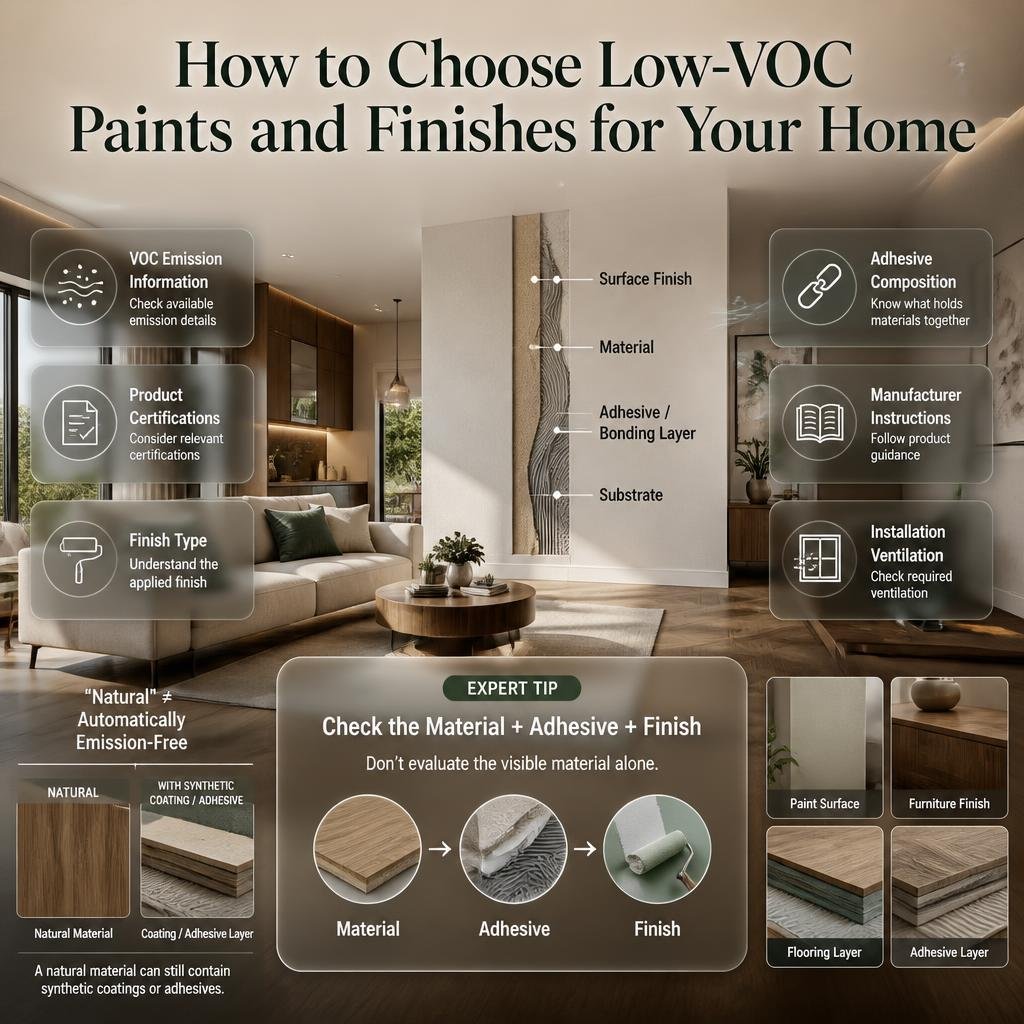
VOCs, or volatile organic compounds, can be emitted by certain paints, adhesives, flooring products, furniture materials, and finishes. Some VOCs can be harmful, so reducing unnecessary indoor emissions is a sensible consideration when selecting materials.
Look for product information rather than relying only on phrases such as “natural” or “eco.”
Consider:
- VOC emission information
- Product certifications where appropriate
- Finish type
- Adhesive composition
- Manufacturer instructions
- Required ventilation during installation
Also remember that “natural” does not automatically mean emission-free. A natural material can still have a synthetic coating or adhesive.
⭐ Expert Tip: When comparing two similar products, don’t stop at the material itself. Ask what is holding the material together and what finish has been applied to its surface.
How Can Furniture Reduce Material Waste?
Furniture can quietly become one of the largest sources of unnecessary household waste.
Think about a cheap cabinet that looks attractive today but has weak joints, difficult-to-repair hardware, and a short visual lifespan.
Now compare it with a well-made cabinet that can be repaired, repainted, reconfigured, or passed to another owner.
The second option may be more useful over time even if its initial purchase price is higher.
Look for:
- Replaceable hardware
- Strong joints
- Repairable components
- Durable upholstery
- Timeless proportions
- Materials that can be refinished
- Easy disassembly
Government guidance on sustainable furniture similarly recommends considering sustainable or recycled materials, non-toxic finishes, efficient transportation, disassembly, and the ability to reuse or dispose of components responsibly.
How Can Accent Pieces Be More Sustainable?
Sustainability doesn’t mean removing personality from your home.
In fact, carefully selected accent pieces can make a room feel more personal without requiring a large amount of material.
Instead of purchasing ten decorative objects every season, consider:
- One handmade ceramic piece
- A vintage mirror
- A restored wooden stool
- A locally made textile
- A second-hand artwork
- A family object
- A plant in a reused container
The goal is to give objects a reason to exist.
Your Accent Pieces resource can fit naturally into this part of the design process because the strongest accent strategy is usually selective rather than excessive.
How Do You Design a Low-Impact Kitchen?
Kitchens require careful material planning because they combine cabinetry, countertops, flooring, hardware, appliances, plumbing fixtures, and lighting.
Start by asking whether the existing kitchen can be partially retained.
Perhaps the cabinet boxes are sound but the doors are outdated.
Perhaps the countertop can remain while the hardware changes.
Perhaps only the damaged flooring needs replacement.
This approach can dramatically reduce the amount of material required.
For new cabinetry, investigate:
- Solid wood where appropriate
- Responsibly sourced timber
- Low-emission engineered boards
- Recycled-content materials
- Durable finishes
- Repairable hardware
Engineered wood products can contain adhesives and resins that affect indoor emissions, so product specifications and emissions information matter.
A low-impact kitchen isn’t necessarily one made entirely from natural materials.
It’s one designed to perform well for a long time without unnecessary replacement.
How Can Lighting Support Low-Impact Design?
Lighting is where environmental performance and interior atmosphere can work together.
Start with daylight.
A room that receives useful natural light during the day may require less artificial illumination.
Then build an efficient lighting system around actual activities.
A useful structure is:
Daylight → General Lighting → Task Lighting → Accent Lighting
This allows different parts of the room to be illuminated when needed instead of running every fixture simultaneously.
LED lighting can also reduce energy consumption compared with older lighting technologies, while intelligent controls can help manage when lights operate.
If you’re planning a smart lighting system, Intelligent Lighting can provide a useful design direction.
The key is not to install technology simply because it is available.
Use it where it makes the home easier to operate.
Can Bedroom Design Use Low-Impact Materials?
Bedrooms are particularly suitable for a restrained material palette.
You don’t need many finishes to create a comfortable bedroom.
Consider:
- Durable flooring
- Natural-fiber textiles
- Repairable furniture
- Low-emission finishes
- Simple lighting
- Long-lasting curtains
- Efficient storage
The bedroom is also a room where people spend long periods, so material emissions and ventilation deserve attention.
A simple palette of timber, linen, wool, cotton, natural paint, and carefully selected lighting can create warmth without filling the room with decorative products.
Storage deserves particular attention because poor planning often leads to future furniture purchases.
Good planning at the beginning can prevent this cycle.
For more detail, see Bedroom Planning and Layout.
How Can Outdoor Spaces Use Low-Impact Materials?
The same principles apply outside.
Outdoor materials face sunlight, rain, temperature changes, moisture, and regular use, so durability becomes particularly important.
Potential options include:
- Reclaimed timber
- Durable local stone
- Reused brick
- Recycled metal
- Long-lasting outdoor furniture
- Permeable surfaces
- Climate-appropriate planting
Garden design can also reduce the amount of water and maintenance required when plants are selected for local conditions.
Instead of choosing plants because they look good in a photograph, consider whether they can thrive where you live.
For additional garden planning inspiration, explore Can I Design My Own Garden Kdagardenation.
For broader patio and garden ideas, Robert MyGardenAndPatio can also support the outdoor design side of the project.
How Do You Create a Low-Impact Home Without Making It Look Rustic?
This is one of the biggest misconceptions about sustainable design.
Low-impact materials can work beautifully in contemporary interiors.
Imagine a modern living room with:
- Warm timber cabinetry
- A simple mineral wall finish
- Recycled metal lighting
- Natural-fiber upholstery
- A durable stone or linoleum floor
- Minimal accessories
- Soft indirect lighting
Nothing about that combination requires the room to look rustic.
The same principles can work with luxury interiors, Scandinavian rooms, minimalist spaces, traditional homes, or modern apartments.
The visual style comes from proportion, color, form, lighting, furniture, and composition.
The sustainability strategy sits underneath those choices.
For broader design direction, explore Interior Design.
How Can Home Improvement Become More Sustainable?
A sustainable renovation starts with a slightly different question.
Instead of asking:
“What can I replace?”
ask:
“What can I keep?”
This single change can completely alter a renovation.
Existing materials already have value. Removing them means creating demolition waste and purchasing new products.
That doesn’t mean old materials should always remain.
If a floor is unsafe, a window is failing, or a cabinet has reached the end of its useful life, replacement can be sensible.
But don’t demolish something functional simply because a new trend has appeared.
For a broader perspective on why thoughtful renovation matters, see Why Home Improvement Is Important Mintpalhouse.
How Can You Use Low-Impact Materials on a Small Budget?
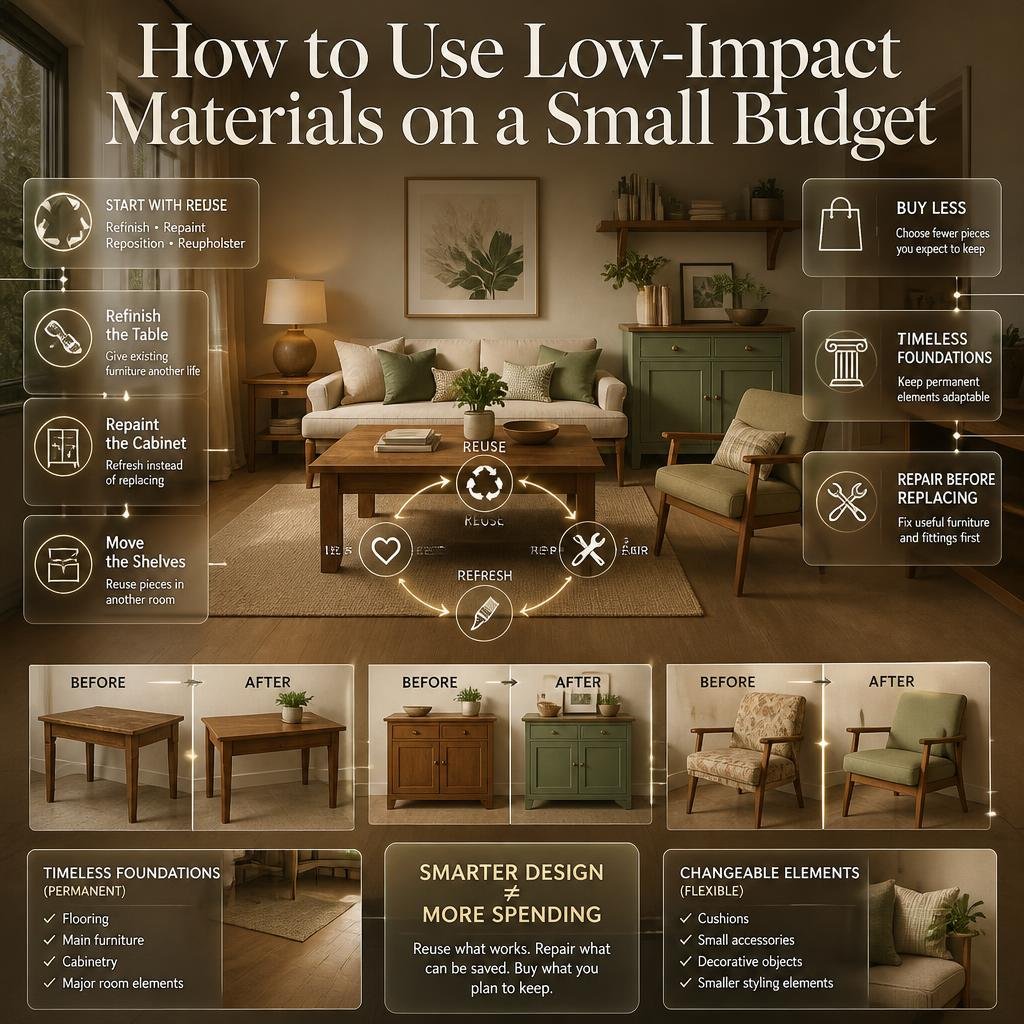
Sustainable design isn’t reserved for expensive custom homes.
Some of the most effective decisions can actually reduce spending.
Start With Reuse
Look around your home before visiting a store.
Can the table be refinished?
Can the cabinet be repainted?
Can the shelves move to another room?
Can an old chair be reupholstered?
Buy Less
Instead of purchasing many inexpensive decorative items, buy fewer pieces that you genuinely expect to keep.
Choose Timeless Foundations
Keep the permanent parts of the room relatively timeless.
Then use smaller, replaceable accessories to introduce changing styles.
Repair Before Replacing
Repairing a drawer, chair, table, cabinet, or door can be significantly less resource-intensive than replacing the entire item.
For practical repair and renovation inspiration, Mintpaldecor Home Repair Inspiration can complement the material-selection process.
How Do You Compare Two “Eco-Friendly” Materials?
This is where many homeowners become confused.
Suppose you’re comparing two flooring products.
| Question | Product A | Product B |
|---|---|---|
| Renewable content | High | Moderate |
| Durability | Moderate | High |
| Repairable | Limited | Yes |
| Transportation | Long distance | Regional |
| Finish | Synthetic | Low-emission |
| Expected replacement | Earlier | Later |
| Maintenance | High | Low |
Which is better?
There isn’t enough information to give a universal answer.
You need to understand the priorities of the specific room.
A wet room, bedroom, rental apartment, family home, and commercial space may require completely different solutions.
That’s why professional material selection isn’t about memorizing a list of “green products.”
It’s about matching the product to the job.
What Are the Biggest Mistakes People Make?
Mistake 1: Believing Every Natural Material Is Sustainable
Natural materials can still have environmental costs from extraction, manufacturing, transportation, and finishing.
Solution: Evaluate the complete product.
Mistake 2: Replacing Functional Materials
A perfectly usable cabinet or floor may be removed simply because the homeowner wants a different style.
Solution: Explore repair, refinishing, reuse, and adaptation first.
Mistake 3: Focusing Only on Recycled Content
Recycled content can be useful, but it doesn’t automatically make a short-lived product sustainable.
Solution: Consider durability and lifecycle alongside recycled content.
Mistake 4: Ignoring Adhesives and Finishes
The visible material isn’t necessarily the whole product.
Timber, bamboo, flooring, furniture, and wall products may involve adhesives, sealants, coatings, or backing materials.
Solution: Investigate the complete specification.
Mistake 5: Buying Too Much
People often purchase extra materials “just in case,” then end up with unused products.
Solution: Measure carefully and order according to the actual project.
Mistake 6: Designing Entirely Around Trends
A trendy room can become visually outdated long before its materials physically fail.
Solution: Keep the major surfaces durable and timeless, and use smaller elements for trends.
Mistake 7: Assuming Expensive Means Sustainable
A high price can reflect craftsmanship, branding, rarity, or marketing.
It doesn’t automatically prove lower environmental impact.
Solution: Evaluate evidence, not price.
Mistake 8: Forgetting Climate and Room Conditions
A material can perform brilliantly in one climate and poorly in another.
Moisture, sunlight, humidity, temperature, traffic, and maintenance all matter.
Solution: Choose according to actual conditions.
What Does an Expert Low-Impact Material Strategy Look Like?
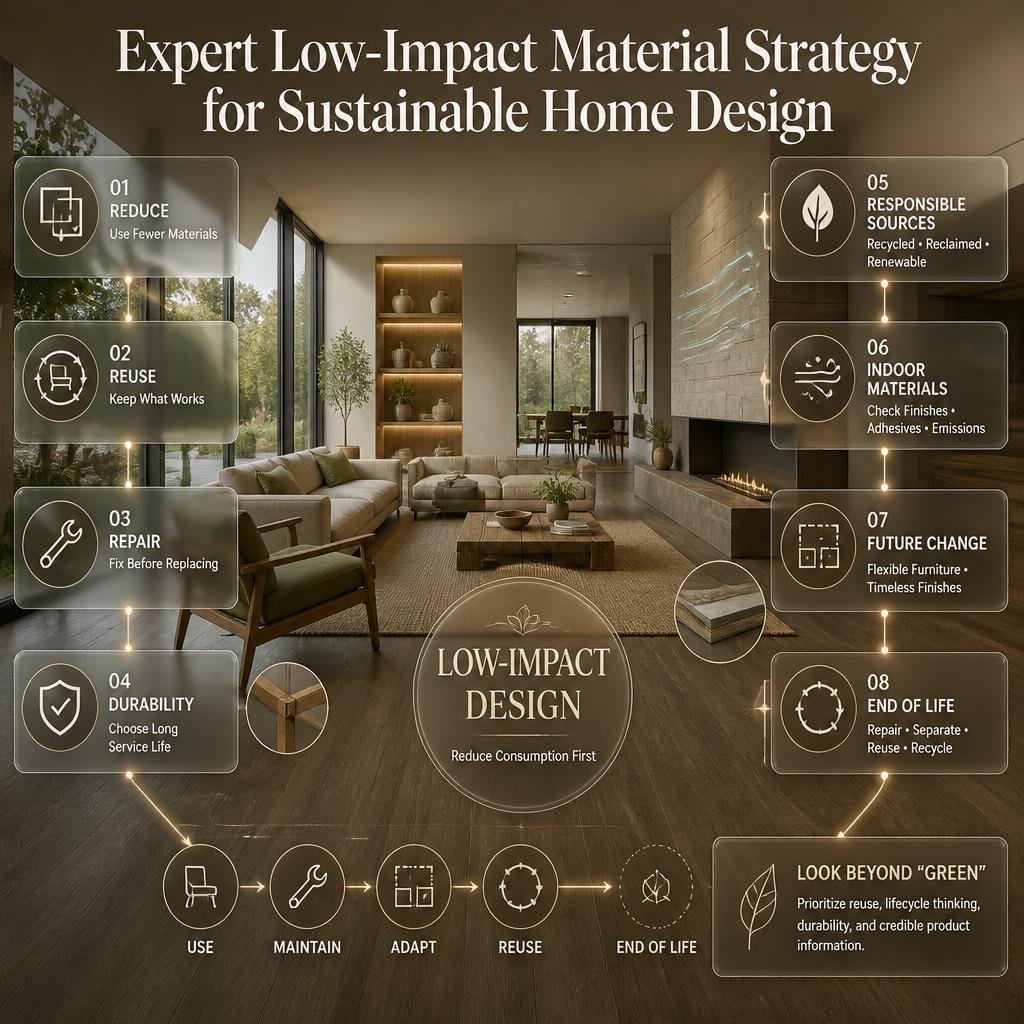
A practical strategy usually follows this order:
1. Reduce
Use fewer materials where possible.
2. Reuse
Keep existing materials and furniture when practical.
3. Repair
Fix damaged components rather than replacing complete products.
4. Choose Durable Materials
When replacement is necessary, prioritize long service life.
5. Choose Responsible Sources
Investigate recycled, reclaimed, renewable, or responsibly sourced options.
6. Consider Indoor Materials
Check finishes, adhesives, coatings, and emission information.
7. Design for Future Change
Use flexible furniture and timeless permanent finishes.
8. Plan End of Life
Choose products that can potentially be repaired, separated, reused, or responsibly recycled.
This hierarchy keeps the focus on reducing consumption rather than simply buying more “green” products.
Current sustainable-design resources increasingly emphasize reuse, lifecycle analysis, durability, and credible product information as more meaningful than vague environmental marketing.
How Can You Make Sustainable Design Feel Luxurious?
Luxury doesn’t require excessive materials.
It often comes from:
- Good proportions
- Excellent craftsmanship
- Comfortable furniture
- Beautiful natural texture
- Consistent colors
- Thoughtful lighting
- High-quality hardware
- Clean detailing
- Well-planned spaces
A room with five excellent materials can feel more sophisticated than a room with twenty average ones.
For example:
Warm timber + natural textile + mineral wall finish + stone + soft lighting
can create a rich atmosphere without covering every surface with decorative products.
This is an important design principle:
Luxury can come from restraint.
How Should You Plan a Low-Impact Home Room by Room?
A useful strategy is to assign each room a material priority.
Living Room
Focus on durable flooring, repairable furniture, natural textiles, efficient lighting, and flexible layouts.
Kitchen
Prioritize cabinetry durability, repairable hardware, countertop longevity, moisture resistance, and low-emission products where appropriate.
Bedroom
Focus on comfort, ventilation, low-emission finishes, natural or carefully selected textiles, and long-lasting furniture.
Bathroom
Prioritize moisture resistance, durability, easy maintenance, and long service life.
Home Office
Consider durable furniture, natural daylight, comfortable surfaces, and efficient task lighting.
Garden
Focus on weather-resistant materials, appropriate planting, water management, and reuse.
This room-by-room approach prevents you from applying the same material strategy blindly throughout the entire house.
How Can the Whole Home Work as One Design?
The best results happen when the materials don’t feel randomly selected.
Choose a limited palette.
For example:
Base: warm white mineral finish
Wood: medium natural timber
Floor: cork or durable natural-looking surface
Metal: one consistent hardware finish
Textiles: linen and wool
Accent: one restrained color
Now those materials can move between rooms.
The living room might use timber cabinetry.
The bedroom might repeat the same timber tone.
The kitchen might use matching hardware.
The hallway might repeat the wall finish.
This creates visual continuity while reducing the temptation to completely redesign every room independently.
For room-by-room inspiration and connected design ideas, Find Expert Ideas for Every Room in Your Home can help you develop that wider design system.
How Do You Avoid Greenwashing When Buying Materials?
Greenwashing becomes a problem when a product sounds environmentally responsible but provides little meaningful evidence.
Be cautious with vague claims such as:
- “Eco”
- “Green”
- “Natural”
- “Planet friendly”
- “Sustainable”
- “Non-toxic”
These phrases may have limited meaning without supporting information.
Instead, look for:
- Specific material composition
- Product emission information
- Recognized certifications where relevant
- Manufacturing information
- Recycled-content percentage
- Sourcing information
- Durability information
- Installation requirements
For example, “contains recycled material” is more useful when you know how much recycled content is actually present.
Similarly, “low VOC” should not automatically be interpreted as “zero emissions.”
The New Zealand Building Performance guidance specifically notes that natural-looking materials can still contain finishes or adhesives that emit VOCs, which is why the complete product specification matters.
What are the best low-impact materials to use when designing a home?
The best low-impact material depends on where it will be used, how long it needs to last, how it is manufactured, and what happens when it eventually needs replacing. There isn’t one material that is automatically the best for every room. Reclaimed wood, responsibly sourced timber, cork, bamboo, natural stone, recycled metal, recycled glass, natural-fiber textiles, clay or lime finishes, and durable flooring options can all have useful applications when selected carefully.
The important part is to evaluate the complete product, not just its raw material. For example, bamboo may be rapidly renewable, but the adhesives and finishes used to turn it into flooring or furniture still matter. The same applies to engineered wood, flooring, furniture, and wall products. Current building guidance recommends considering sourcing, durability, maintenance, environmental impact, and eventual disposal together rather than treating one characteristic as proof that a product is sustainable.
Practical points to consider:
Choose reclaimed materials when their condition and history are suitable.
Look for responsibly sourced timber and renewable materials.
Prioritize materials that can last for many years.
Check adhesives, coatings, sealants, and finishes.
Consider whether the material can be repaired or reused.
Don’t choose a material simply because its label says “eco-friendly.”
Professional approach: For every major material, compare durability + maintenance + sourcing + indoor emissions + end-of-life options. This gives you a much more realistic picture than simply searching for the “greenest” product.
How can I design a sustainable home without replacing everything?
One of the most effective ways to create a lower-impact home is to avoid unnecessary replacement in the first place. If a floor, cabinet, door, table, or other building element is still functional, consider whether it can be repaired, refinished, reused, or adapted before removing it.
This approach matters because a new product requires additional raw materials, manufacturing, transportation, installation, and eventually disposal. Reusing something already in the home can avoid many of those steps. Upcycling existing furniture, for example, can reduce waste while also avoiding the introduction of new materials and finishes into the home.
For example, an old wooden cabinet may not need to be thrown away simply because its finish looks dated. New hardware, careful refinishing, or a different paint can completely change its appearance while preserving the underlying structure.
Before replacing an existing item, ask:
Can it be repaired?
Can it be refinished?
Can it be used somewhere else?
Can only the damaged component be replaced?
Can the item be redesigned for a different purpose?
Is replacement actually necessary?
A useful renovation rule:
Keep → Repair → Refinish → Reuse → Replace
Replacement should come after the other practical options have been considered, not automatically become the first step.
This also makes sustainable design more accessible for homeowners with smaller budgets. You don’t need to rebuild the entire house to make better material decisions.
Are low-VOC materials important when designing a low-impact home?
Yes, indoor emissions should be considered alongside environmental impact. Some paints, adhesives, sealants, flooring products, engineered wood, furniture materials, and finishes can release volatile organic compounds (VOCs) into indoor air. Building guidance recommends considering low-emission products and appropriate ventilation as part of healthier interior design.
The important point is that choosing a natural-looking product doesn’t automatically mean it has low emissions. A product made from wood, bamboo, wool, or another natural material can still contain adhesives, coatings, treatments, or backing materials that affect its emissions.
When you’re comparing interior products, look for specific emissions information or credible third-party certifications rather than relying only on marketing phrases such as “natural,” “green,” or “eco-friendly.” USGBC guidance, for example, distinguishes low-emitting products and certifications from products that are inherently non-emitting under defined criteria.
Pay particular attention to:
Paints and coatings
Flooring adhesives
Sealants
Engineered wood
MDF and particleboard
Carpet backing and underlay
Furniture finishes
Wall coverings
Professional tip: Don’t evaluate the visible material alone. A beautiful timber floor may have a different indoor-air profile depending on the adhesive, underlay, coating, and installation system used with it.
And remember that material selection works best alongside adequate ventilation, particularly during installation and curing.
Is sustainable home design more expensive than conventional home design?
It can be more expensive initially, but it doesn’t have to be. The biggest mistake is assuming that sustainable design means buying premium “eco” products for every part of the house.
A more practical strategy is to focus your budget on durability, repairability, and long-term performance.
For example, a well-made piece of furniture may cost more than a cheap alternative, but if it can be repaired and remains useful for many years, you avoid repeated purchases. Similarly, retaining an existing floor or cabinet can eliminate the cost of buying and installing an entirely new product.
Lifecycle thinking is important here. Building guidance specifically recommends considering durability and maintenance alongside environmental impacts because a product with lower production impact may still have greater overall impact if it requires frequent maintenance or replacement.
If your budget is limited, prioritize:
Reusing existing materials
Repairing damaged items
Buying durable products
Selecting appropriate low-emission finishes
Improving lighting efficiency
Avoiding unnecessary decorative purchases
Choosing materials that can adapt to future needs
A useful budgeting formula is:
Initial Cost + Installation + Maintenance + Replacement = Real Cost
Don’t judge a material only by what you pay at the checkout.
A lower-cost product that needs to be replaced repeatedly can become more expensive over its useful life, while a durable product may cost more initially but remain functional much longer.
How do I know if a material is genuinely low-impact and not just greenwashing?
The safest approach is to stop relying on broad marketing claims and start asking for specific evidence. Words such as “eco-friendly,” “natural,” “sustainable,” or “green” don’t tell you enough about a product’s complete environmental performance.
Instead, investigate the material’s source, manufacturing process, durability, maintenance requirements, emissions, recycled or renewable content, and end-of-life options. For certain products, recognized third-party certifications or verified emissions information can make comparisons easier. Current green-building guidance recommends using documented standards and third-party verification where applicable rather than depending only on unsupported claims.
For example, if a flooring company says its product is sustainable, ask:
What percentage is recycled or renewable?
Where are the raw materials sourced?
How is the product manufactured?
What adhesives or finishes are included?
Is VOC emissions information available?
How long is the expected service life?
Can individual sections be repaired?
Can the product be reused or recycled?
Is there independent certification or testing?
Greenwashing warning signs include:
Vague environmental claims without evidence
“100% eco-friendly” with no supporting details
Focusing on one green feature while ignoring other impacts
Calling a product natural while hiding extensive synthetic coatings
Using sustainability imagery instead of measurable product information
Professional rule: Don’t ask only, “Is this material sustainable?”
Ask:
“Compared with the realistic alternatives for this particular application, what are the material’s environmental and indoor-performance trade-offs?”
That question leads to much better decisions because almost every material involves some kind of trade-off.
The goal isn’t to find a completely impact-free product—those are rarely realistic. The goal is to make a well-informed, durable, practical choice that uses fewer resources unnecessarily and performs well for the life of the home.
Conclusion
Designing a home with low-impact materials isn’t about making every decision perfectly sustainable. It’s about becoming more thoughtful about what you buy, what you keep, and what you replace.
Start with the materials already in your home. If a floor, cabinet, piece of furniture, door, or finish can be repaired or refreshed, give it another life before replacing it. When something genuinely needs to be replaced, look beyond appearance and price. Consider durability, sourcing, maintenance, indoor emissions, installation, and what will happen to the material at the end of its useful life.
The most effective low-impact home is often not the one filled with the most “eco-friendly” products. It’s the one where fewer materials are wasted, durable products are used for longer, and every major purchase has a clear purpose.
You can still create a home that feels luxurious, modern, warm, personal, and stylish. Use natural textures where they make sense, choose finishes that support the room’s function, invest in quality where longevity matters, and keep trend-driven changes to smaller, easier-to-replace elements.
Most importantly, don’t wait for a complete renovation to start. Choose one room, evaluate what you already have, identify what can be repaired or reused, and then make your next material purchase with a little more research.
Small decisions made consistently can shape a home that is not only beautiful today, but also durable, adaptable, comfortable, and more responsible for the years ahead.