
Introduction
Small Bedrooms | A small bedroom can become frustrating very quickly. The bed takes up most of the floor, clothes seem to have nowhere to go, the wardrobe feels oversized, and there may be barely enough space for a bedside table. Add poor lighting or too much furniture, and even a reasonably sized room can start feeling cramped.
But small bedrooms don’t have to feel uncomfortable.
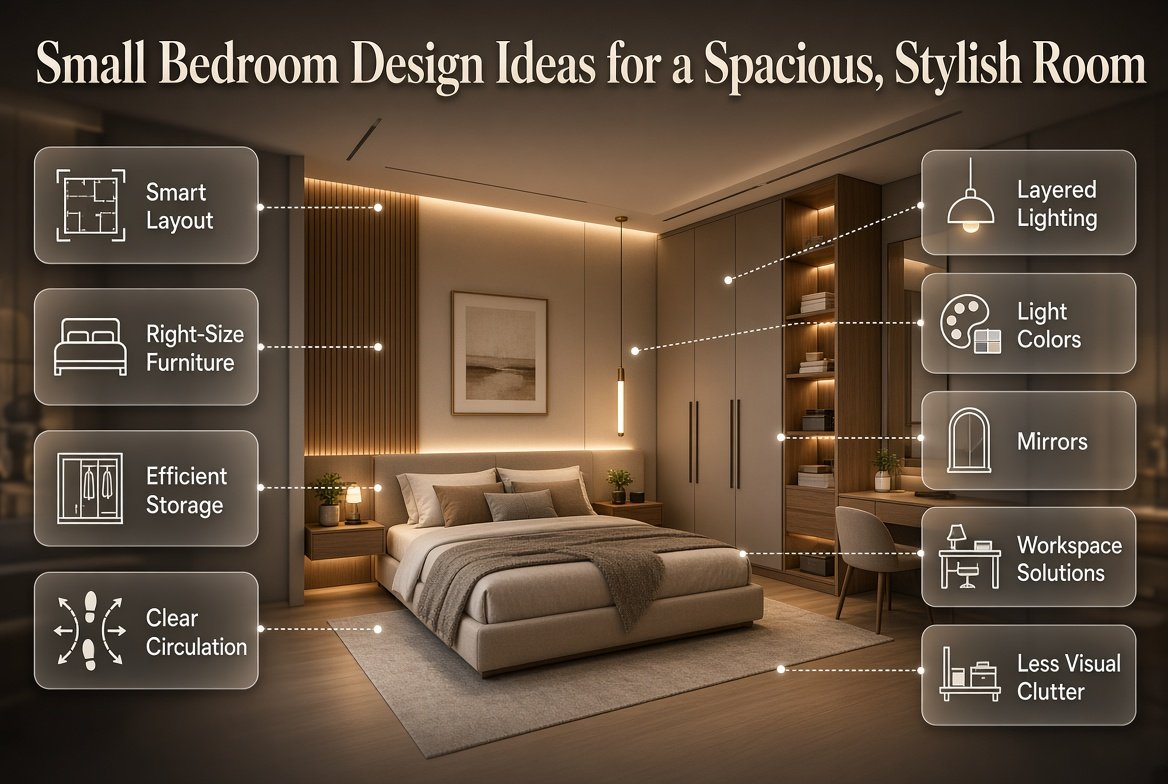
The trick isn’t to force more furniture into the room or make everything miniature. It’s about making better decisions about layout, furniture size, storage, lighting, color, circulation, and visual clutter.
A well-planned compact bedroom can feel calm, attractive, practical, and surprisingly spacious. You can create enough storage without filling every wall, make the ceiling feel higher, improve the amount of visible floor, and create a comfortable sleeping environment without undertaking an expensive renovation.
In this guide, you’ll learn how to design small bedrooms from the ground up. We’ll cover the best layouts, bed sizes, storage solutions, furniture choices, colors, mirrors, lighting, wardrobe ideas, workspace solutions, decorating techniques, common mistakes, budget-friendly improvements, and practical ways to make a small bedroom work for real everyday life.
If you’re looking for more inspiration before starting your bedroom project, you can also explore DesignMode24 Interior Design for broader home and interior design ideas.
How Do You Make a Small Bedroom Feel Bigger?
The most effective way to make a small bedroom feel bigger is to create clear circulation, reduce unnecessary visual clutter, use appropriately scaled furniture, maximize vertical storage, and make good use of natural and artificial light. Mirrors, lighter colors, floating furniture, and multifunctional pieces can also improve the feeling of openness.
The important point is that perceived space is different from physical space.
You can’t always increase the square footage of a bedroom, but you can make the existing space work better.
For example, a room containing a large bed, wide dresser, deep nightstands, chair, shelves, and several storage boxes may feel much smaller than the same room with a streamlined bed, tall wardrobe, floating shelf, and carefully organized storage.
The physical dimensions haven’t changed.
The experience has.
The Five Priorities for a Small Bedroom
When planning a compact bedroom, work through these priorities in order:
- Sleeping comfort
- Movement and circulation
- Clothing and essential storage
- Lighting
- Decoration and personality
This order matters.
A beautiful bedroom that is difficult to walk through isn’t successful design.
Why Do Small Bedrooms Feel So Cramped?
A bedroom can feel cramped because of more than its actual dimensions. Furniture scale, visual weight, poor organization, blocked windows, dark corners, and awkward circulation can all make a room feel considerably smaller.
Imagine two bedrooms with exactly the same floor area.
Bedroom A
- Oversized bed
- Large dresser
- Two deep nightstands
- Freestanding wardrobe
- Heavy curtains
- Chair covered with clothes
- Multiple decorative shelves
- Several baskets on the floor
Bedroom B
- Appropriately sized bed
- Tall wardrobe
- Floating bedside shelf
- Wall-mounted lighting
- Simple curtains
- One compact storage unit
- Limited decoration
Bedroom B will almost certainly feel more spacious.
Why?
Because more of the floor remains visible, the eye can travel through the room more easily, and there are fewer competing objects.
This is why decluttering and layout often produce a bigger improvement than buying new furniture.
How Should You Plan a Small Bedroom Layout?
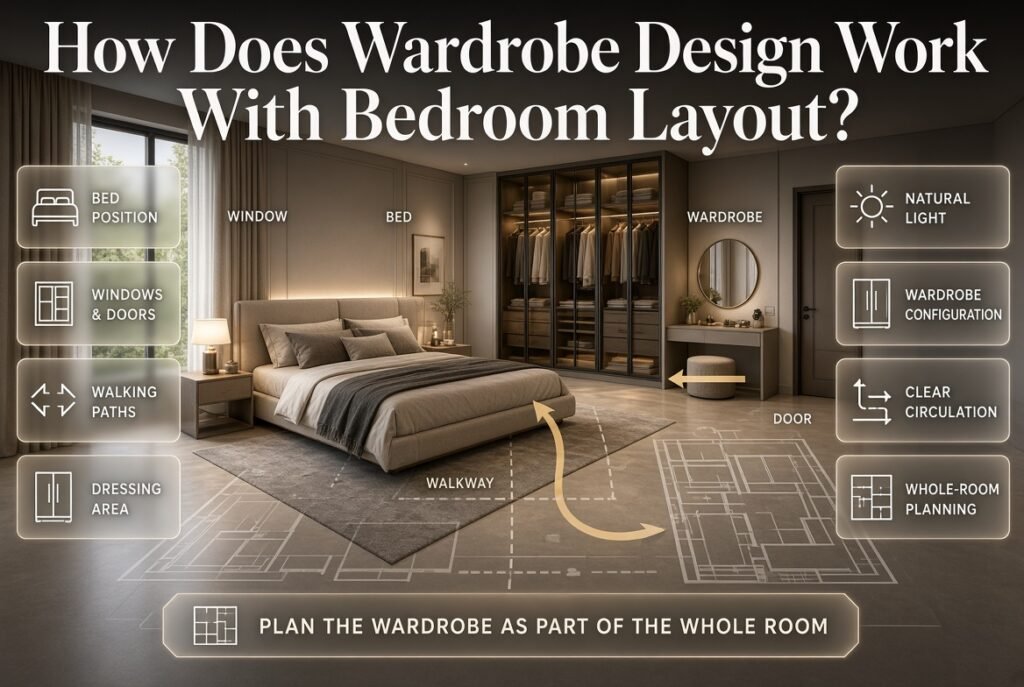
Start with the fixed features of the room and the largest piece of furniture—the bed. Measure the room, identify the door and window positions, consider wardrobe access, then establish a comfortable walking route before adding smaller furniture.
Don’t start by choosing decorative cushions or artwork.
Start with measurements.
Record:
- Room width
- Room length
- Ceiling height
- Door location
- Door swing
- Window location
- Radiator position
- Electrical outlets
- Existing storage
- Wall recesses
- Architectural projections
Then measure the furniture you’re considering.
This sounds basic, but it’s one of the most frequently skipped steps in small-space design.
A wardrobe that looks narrow in a showroom may be too deep for your room. A bed frame may have a larger footprint than the mattress. A dresser may prevent a wardrobe door from opening completely.
The Correct Planning Order
A simple planning sequence is:
Measure → Position the bed → Establish circulation → Add storage → Add essential furniture → Plan lighting → Decorate
This sequence prevents many expensive mistakes.
For more detailed bedroom arrangement ideas, see the Bedroom Layouts guide.
Where Should the Bed Go in a Small Bedroom?
The best bed position is the one that provides comfortable access while preserving the most useful circulation and storage space. The longest wall can often work well, but door position, windows, wardrobes, heating, and personal use should determine the final arrangement.
The bed is normally the largest object in the bedroom.
That means its location affects almost everything else.
Before deciding where it goes, ask:
- Can I comfortably enter the room?
- Can I reach the wardrobe?
- Can I open drawers?
- Can I access the window?
- Can I get around the bed?
- Is the bed blocking natural light?
- Does the position work for one or two occupants?
A Simple Layout Principle
Think of the bedroom as a movement system.
DOOR
  ↓
MAIN WALKING ROUTE
  ↓
WARDROBE / STORAGE
  ↓
BED
The exact arrangement will vary, but the principle is useful: your daily movement should feel natural.
A layout that looks perfect from above but forces you to squeeze sideways between the bed and wardrobe isn’t a good layout.
Should the Bed Be Against a Wall?
It can be.
For one person, placing one side of the bed against a wall can free valuable floor space.
For couples, however, this may be inconvenient because one person may have difficulty getting in and out of bed.
Function should always take priority over symmetry.
What Bed Size Is Best for Small Bedrooms?
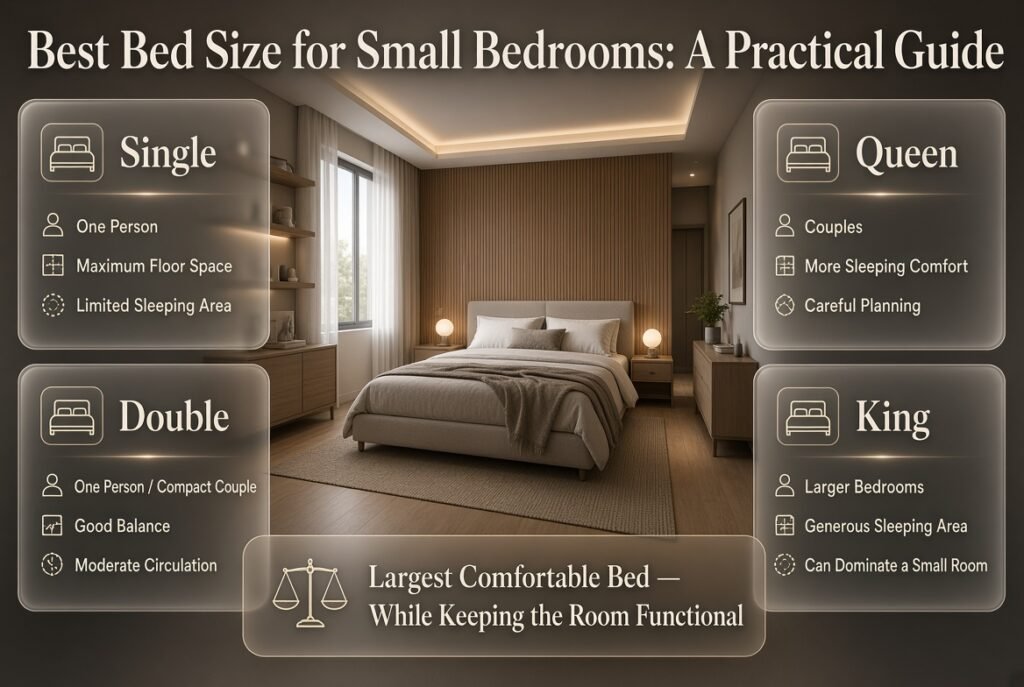
The best bed size is the largest size that meets your sleeping needs while still leaving adequate room for circulation, storage, and essential furniture. A larger bed provides comfort, but an oversized bed can make the rest of the bedroom difficult to use.
Consider the following:
| Bed Size | Best For | Advantage | Possible Problem |
|---|---|---|---|
| Single | One person | Maximum floor space | Limited sleeping area |
| Double | One person or compact couple’s room | Good balance | Moderate circulation |
| Queen | Couples with enough space | More sleeping comfort | Requires careful planning |
| King | Larger bedrooms | Generous sleeping area | Can dominate a small room |
Don’t automatically choose the biggest bed you can physically fit.
Instead ask:
What is the largest bed I can use comfortably while still maintaining a functional room?
That’s a much better question.
Are Storage Beds Good for Small Bedrooms?
Storage beds can be excellent for compact bedrooms because they use the otherwise wasted space beneath the mattress. Drawers or lift-up compartments can store bedding, seasonal clothing, luggage, shoes, and other items without requiring another large piece of furniture.
A storage bed can sometimes replace a separate dresser.
That’s a major advantage.
However, accessibility matters.
If drawers cannot open because they’re blocked by a wall or another piece of furniture, the theoretical storage capacity isn’t very useful.
What Should Go Under the Bed?
Good choices include:
- Seasonal clothing
- Spare blankets
- Guest bedding
- Luggage
- Shoes
- Occasional-use accessories
Use containers or dividers where appropriate so the space doesn’t become a hidden dumping ground.
⚠️ Common Mistake: Treating under-bed storage as permission to keep everything. Hidden clutter is still clutter. Store useful items and review them regularly.
How Can You Maximize Storage in a Small Bedroom?
The most effective approach is to combine vertical storage, under-bed storage, wall-mounted solutions, multifunctional furniture, and organized wardrobes. Instead of adding several low cabinets, use the height of the room and keep floor space available for movement.
1. Use Vertical Space
Install or choose:
- Tall wardrobes
- High shelving
- Wall-mounted cabinets
- Floating shelves
- Vertical organizers
- Tall bookcases
2. Use the Space Under the Bed
This is ideal for items you don’t need every day.
3. Use the Back of the Door
Door-mounted organizers can hold:
- Bags
- Belts
- Scarves
- Accessories
- Shoes
Don’t overload the door, though. Excess weight can make it difficult to operate.
4. Use Wardrobe Height
If your wardrobe stops far below the ceiling, the space above it may be wasted.
Use that area for:
- Luggage
- Seasonal bedding
- Rarely used clothing
- Storage boxes
For more ways to organize and maximize wardrobe space, explore Wardrobe Designs.
Why Is Vertical Storage So Important in Small Bedrooms?
Vertical storage increases capacity without consuming as much floor space. Tall wardrobes, shelving, wall-mounted cabinets, and high storage make use of the room’s height while keeping the floor available for movement.
Think of storage in two dimensions.
A wide, low cabinet may occupy a large section of the floor.
A tall, narrow cabinet can provide substantial storage while using less floor area.
LOW + WIDE

██████████████████
██████████████████


TALL + NARROW

██████
██████
██████
██████
██████
This doesn’t mean every bedroom should contain floor-to-ceiling cabinets.
It means unused vertical space deserves consideration.
💡 Pro Tip: Before buying another storage unit, look upward. The space above existing furniture may provide the storage you need without consuming additional floor area.
Should You Use a Built-In Wardrobe?
A built-in wardrobe can be one of the most efficient storage solutions for a small bedroom because it can be designed around the exact dimensions of the room. It can use full wall height, awkward corners, recesses, and areas where standard furniture would leave gaps.
Built-ins work especially well when:
- The room has unusual dimensions
- Standard wardrobes don’t fit
- You need significant storage
- The ceiling is high
- You’re staying in the property long term
The major disadvantage is cost.
Custom furniture is usually less flexible than freestanding pieces.
If you rent or expect to move soon, modular furniture may make more sense.
Are Sliding Wardrobe Doors Better for Small Bedrooms?
Sliding doors can be useful when traditional hinged doors interfere with the room’s circulation. Because sliding doors move along the wardrobe rather than opening outward, they require less clearance in front of the storage.
They’re especially useful when:
- The bed is close to the wardrobe
- The room is narrow
- A dresser sits opposite the wardrobe
- Door swing blocks a walking path
However, sliding wardrobes aren’t automatically better.
You typically can’t open the entire wardrobe at once, and quality sliding systems may cost more.
Choose them because they solve a real space problem, not simply because they look modern.
What Furniture Works Best in Small Bedrooms?

The best furniture for small bedrooms is appropriately scaled, multifunctional, visually light, and genuinely useful. Instead of trying to include every piece traditionally associated with a bedroom, choose furniture based on the functions you actually need.
Think about functions first.
You may need:
- Sleeping
- Clothing storage
- Bedside storage
- Working
- Dressing
- Seating
Now look for furniture that can combine functions.
Examples include:
| Furniture | Functions |
|---|---|
| Storage bed | Sleeping + storage |
| Ottoman | Seating + storage |
| Floating desk | Work + occasional vanity |
| Mirror wardrobe | Storage + mirror |
| Floating shelf | Bedside storage + display |
| Storage bench | Seating + storage |
⭐ Expert Tip: In a compact room, the best furniture purchase is often the one that eliminates another piece of furniture.
Do Small Bedrooms Need Nightstands?
No. A traditional nightstand isn’t essential if it compromises circulation.
Instead, consider:
- Floating shelves
- Narrow wall ledges
- Small stools
- Slim pedestals
- Headboard shelves
- Wall-mounted cabinets
A small floating shelf can hold:
- Phone
- Book
- Water
- Small lamp
- Alarm clock
That’s enough for many people.
If two people share the room, two narrow floating shelves can preserve symmetry without requiring two large bedside tables.
How Can You Make Small Bedrooms Look Bigger With Color?
Light and visually consistent colors can help a small bedroom feel brighter and more open. Soft white, cream, beige, greige, pale gray, and muted tones are common choices because they create a calm visual background.
But there is no rule saying small bedrooms must be white.
Dark colors can work too.
Can Dark Colors Work in Small Bedrooms?
Yes.
A deep blue, charcoal, olive, brown, or other darker shade can create an intimate and sophisticated atmosphere.
The important issue is balance.
For example:
Dark accent wall + light bedding + warm lighting
can create depth.
But:
Dark walls + dark furniture + heavy curtains + poor lighting
can make the room feel visually compressed.
The color should be considered together with lighting and furniture.
For more ideas about choosing colors for your home, explore the Paint Color section.
Should Everything in a Small Bedroom Be White?
Not at all.
An all-white room can feel bright, but without texture it may also feel flat or cold.
You can create an airy bedroom with:
- Warm white walls
- Natural wood
- Cream bedding
- Beige textiles
- Light curtains
- Warm lighting
- One muted accent color
The objective isn’t to remove color.
It’s to control visual competition.
A cohesive palette helps the eye move smoothly through the room.
How Can Mirrors Make a Small Bedroom Look Bigger?
A strategically placed mirror can reflect light and parts of the room, creating the impression of additional depth. The effect is strongest when the mirror reflects a window, light source, or attractive feature rather than clutter.
Good mirror locations include:
- Wardrobe doors
- Opposite windows
- Beside a dressing area
- Behind the bedroom door
- On a narrow wall
A full-length wardrobe mirror is especially useful because it performs two functions.
Should You Cover a Wall With Mirrors?
Usually, no.
One large mirror can often create a cleaner and more sophisticated effect than several unrelated mirrors.
The objective is visual depth, not reflective overload.
How Important Is Lighting in Small Bedrooms?
Lighting is one of the most important elements in a compact bedroom because it affects both functionality and perceived space. A single overhead light can create harsh shadows, while layered lighting gives the room more depth and allows different areas to be illuminated according to need.
Use three basic lighting layers.
Ambient Lighting
General illumination from:
- Ceiling fixtures
- Flush mounts
- Recessed lights
Task Lighting
Useful for:
- Reading
- Working
- Dressing
Examples include:
- Bedside sconces
- Desk lamps
- Dressing lights
Accent Lighting
Used to create atmosphere.
Examples include:
- Decorative wall lights
- LED strips
- Small lamps
Wall-mounted lights are particularly valuable because they don’t consume bedside-table space.
How Can Natural Light Improve Small Bedrooms?
Natural light can make a small bedroom feel brighter and more open. Keeping windows unobstructed allows daylight to reach more surfaces and reduces the feeling of dark, enclosed corners.
Try to:
- Keep tall furniture away from windows
- Avoid unnecessarily heavy curtains
- Keep window sills relatively clear
- Use curtains that allow useful daylight
- Position mirrors where they can reflect daylight
How Should Curtains Be Hung?
Hanging curtains higher and slightly wider than the window can make the window appear taller and broader.
The exact installation depends on the room, but avoid bulky curtain arrangements that visually overwhelm the wall.
Can Rugs Work in Small Bedrooms?
Yes, but rug scale and placement matter.
A tiny rug floating in the middle of the room can make the floor feel fragmented.
A larger rug positioned partly underneath the bed often creates a more unified appearance.
Before buying a rug, consider:
- Bed size
- Door clearance
- Available floor area
- Furniture placement
- Pattern size
If the room is extremely small, skipping the rug may actually be the better choice.
How Do You Make a Small Bedroom Cozy Without Creating Clutter?
Create coziness through texture, lighting, warmth, and softness rather than adding lots of decorative objects. Layered bedding, warm lamps, natural materials, curtains, and a few meaningful accessories can make a compact bedroom feel inviting without taking away valuable floor space.
Useful materials include:
- Linen
- Cotton
- Wool
- Wood
- Woven fibers
- Upholstery
- Soft rugs
A simple palette can become interesting through texture.
For example:
Cream walls + linen bedding + oak furniture + woven basket + warm lamp
can create a comfortable atmosphere without visual overload.
How Do You Decorate Small Bedrooms Without Overcrowding Them?
Decorate selectively.
A small bedroom doesn’t need something on every wall and surface.
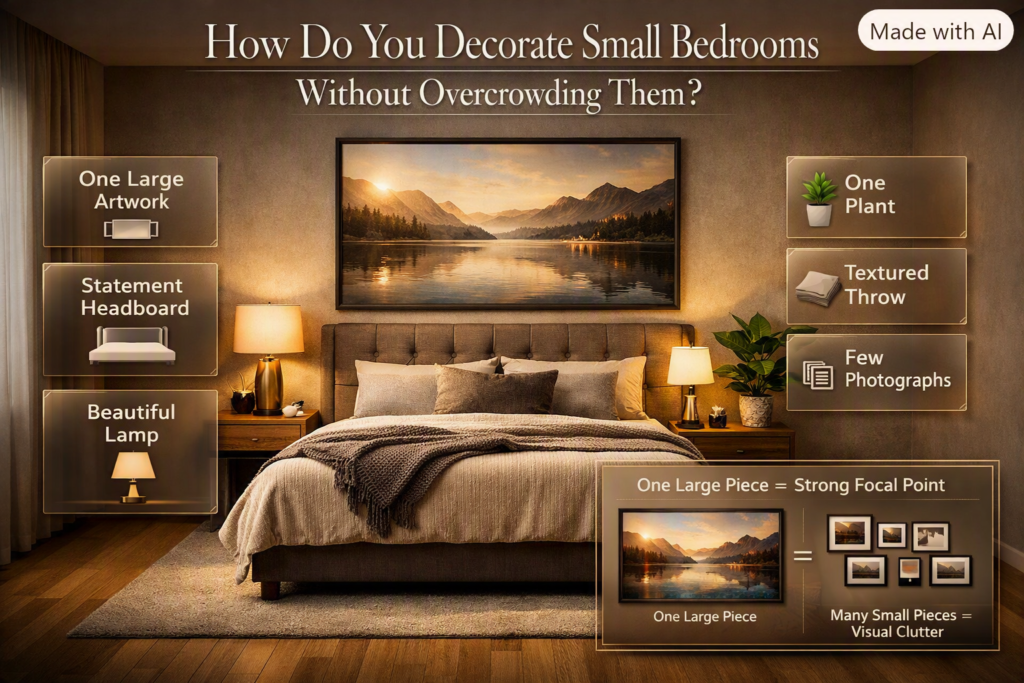
Instead, choose a few focal elements:
- One large artwork
- A statement headboard
- A beautiful lamp
- One plant
- A textured throw
- A few photographs
Is One Large Artwork Better Than Several Small Pieces?
Often, yes.
Several tiny pieces can create visual noise.
One appropriately scaled piece can create a strong focal point.
However, a small gallery wall can still work if the pieces share a consistent color palette, spacing, or subject.
The principle is intentional composition, not a strict number of objects.
How Can You Make a Small Bedroom Look Taller?
Use vertical visual elements to draw attention upward.
Good options include:
- Floor-to-ceiling curtains
- Tall wardrobes
- Tall mirrors
- Vertical wall panels
- Narrow artwork
- Vertical shelving
This is particularly useful in rooms with low or average ceilings.
You don’t necessarily need structural changes.
Even raising curtain hardware can create a stronger sense of height.
Can a Small Bedroom Have a Desk?
Yes. A small bedroom can accommodate a workspace when the desk is appropriately scaled and positioned.
Consider:
- Floating desks
- Narrow desks
- Fold-down desks
- Corner desks
- Wall-mounted work surfaces
If you only work occasionally, a fold-down desk can be particularly effective.
It provides a workspace when needed and disappears when you want the bedroom to feel like a bedroom again.
Where Should the Desk Go?
Near natural light can be pleasant, but don’t block the window.
Also consider:
- Power outlets
- Task lighting
- Chair movement
- Main walking route
A desk that forces you to move around it every time you enter the bedroom isn’t a successful solution.
How Should You Design a Small Bedroom for Two People?
Shared bedrooms require more careful planning because two people need access to the bed, clothing storage, and personal belongings.
Ideally, provide:
- Accessible sides of the bed
- Personal storage
- Individual lighting
- Organized wardrobe sections
If traditional nightstands don’t fit, use narrow floating shelves.
For wardrobes, dividing the internal storage can make the room easier to maintain.
For example:
Left wardrobe section → Person A
Right wardrobe section → Person B
This creates a clear organizational system.
How Should You Design a Small Child’s Bedroom?
Children’s bedrooms need flexible storage because their belongings and activities change over time.
Use:
- Low accessible storage
- Tall storage for occasional items
- Under-bed drawers
- Wall hooks
- Open bins
- Shelves
- Adaptable furniture
Keep frequently used objects where the child can reach them.
Store less frequently used items higher.
A flexible bedroom can grow with the child rather than requiring a complete redesign every few years.
What Are the Best Small Bedroom Ideas for Renters?
Renters can make major improvements without permanently changing the room.
Useful options include:
- Freestanding tall wardrobes
- Storage beds
- Removable hooks
- Lightweight curtains
- Floor lamps
- Freestanding mirrors
- Floating-look furniture
- Foldable desks
- Under-bed organizers
Before drilling into walls or making permanent changes, check your rental agreement.
You can often achieve a significant improvement through furniture placement and organization alone.
What Are the Most Common Small Bedroom Mistakes?
The biggest small-bedroom mistakes usually involve poor proportions, excessive furniture, blocked circulation, and treating storage as the only solution. Adding more cabinets doesn’t solve a room that already feels overcrowded.
Mistake 1: Buying Furniture Before Measuring
Why it happens:
A product looks perfect online.
Why it’s harmful:
The actual dimensions may overwhelm the room.
Better approach:
Measure both the room and furniture.
Mistake 2: Choosing an Oversized Bed
Why it happens:
People prioritize sleeping space.
Why it’s harmful:
The bed can eliminate useful circulation.
Better approach:
Choose the largest practical size.
Mistake 3: Using Too Many Small Furniture Pieces
Why it happens:
Small furniture appears to save space.
Why it’s harmful:
Several small pieces create visual clutter.
Better approach:
Use fewer, better-proportioned pieces.
Mistake 4: Ignoring Vertical Space
Why it happens:
People naturally focus on floor area.
Why it’s harmful:
Valuable storage remains unused.
Better approach:
Use tall and wall-mounted solutions.
Mistake 5: Blocking the Window
Why it happens:
The window wall appears convenient.
Why it’s harmful:
You reduce daylight and may interfere with ventilation.
Better approach:
Protect the window whenever possible.
Mistake 6: Using Only One Light
Why it happens:
A ceiling fixture seems sufficient.
Why it’s harmful:
It produces flat lighting.
Better approach:
Layer ambient, task, and accent lighting.
Mistake 7: Overdecorating
Why it happens:
Empty walls feel unfinished.
Why it’s harmful:
Too many objects make the room visually noisy.
Better approach:
Choose a few meaningful elements.
Mistake 8: Buying Everything in Miniature
Why it happens:
People assume small rooms require tiny furniture.
Why it’s harmful:
Too many undersized pieces can make the room feel fragmented.
Better approach:
Focus on proportion rather than simply choosing the smallest available items.
How Can You Make a Small Bedroom Feel Luxurious?
Luxury doesn’t require a large bedroom. In a compact space, luxury often comes from consistency, quality, proportion, and restraint.
Focus on:
- Good bedding
- Layered lighting
- Quality curtains
- Consistent hardware
- Natural materials
- Clean furniture lines
- One or two statement pieces
- Minimal clutter
Instead of adding ten decorative objects, invest in one attractive lamp.
Instead of filling the bed with cushions, choose a few comfortable, coordinated pieces.
Luxury is often about editing rather than adding.
What Is the Best Color Palette for Small Bedrooms?
A balanced palette usually contains one dominant color, a supporting neutral, and one restrained accent.
| Main Color | Supporting Color | Accent |
|---|---|---|
| Warm white | Natural wood | Sage |
| Cream | Beige | Terracotta |
| Greige | White | Charcoal |
| Pale gray | Oak | Dusty blue |
| Soft beige | Cream | Black |
You don’t need to follow these combinations exactly.
The important thing is visual continuity.
When every wall, furniture piece, and accessory has a completely different color, the room can feel fragmented.
A controlled palette allows the eye to move more smoothly.
How Can You Make a Small Bedroom More Functional?
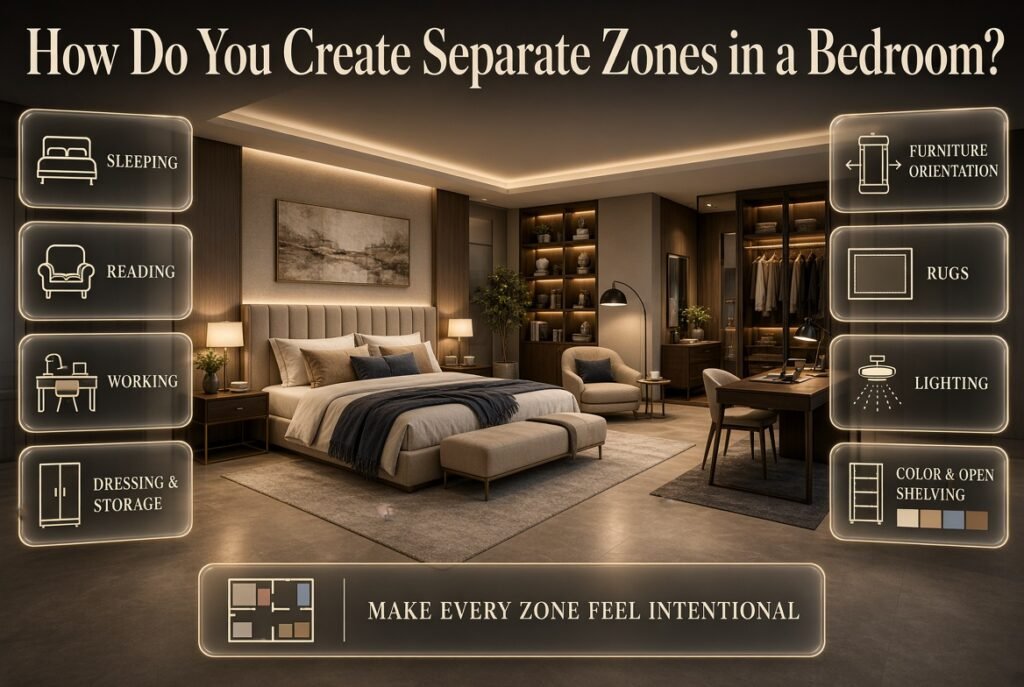
A functional bedroom allows daily activities to happen without constantly moving furniture or searching for belongings.
Ask yourself:
- Can I reach the wardrobe easily?
- Can wardrobe doors open completely?
- Can I make the bed comfortably?
- Can I access my bedside storage?
- Is the main walking route clear?
- Can I control the lighting easily?
- Does every major object have a purpose?
- Do everyday belongings have designated storage?
If the answer to several questions is no, the room needs better planning.
Adding decoration won’t solve a functional problem.
What Should You Display and What Should You Hide?
Not everything needs to be hidden.
A useful rule is:
Useful + attractive + frequently used = display
Messy + rarely used + visually distracting = hide
For example:
Display
- Lamp
- One plant
- Favorite book
- Small artwork
- Meaningful photograph
Hide
- Extra cables
- Seasonal clothing
- Luggage
- Spare bedding
- Miscellaneous accessories
This balance keeps the room visually calm while maintaining convenience.
How Can You Keep a Small Bedroom Organized?
Organization works best when it follows your actual habits.
If you always throw clothes onto a chair, buying another storage box won’t necessarily solve the problem.
Ask why the clothes end up there.
Maybe:
- The wardrobe is difficult to access.
- The clothes are worn frequently.
- You need a temporary hanging area.
- The laundry basket is too far away.
Good organization solves behavior problems rather than simply hiding them.
A Five-Minute Daily Reset
At the end of the day:
- Put clothes away.
- Clear bedside surfaces.
- Return objects to their storage location.
- Remove cups and rubbish.
- Straighten the bed.
Small daily actions prevent a compact room from becoming overwhelming.
When Should You Consider Custom Furniture?
Custom furniture makes sense when standard furniture leaves substantial unused space.
It can be useful around:
- Sloping ceilings
- Recesses
- Chimney breasts
- Narrow walls
- Awkward corners
- Very high ceilings
A custom wall might combine:
Wardrobe + drawers + desk + shelving
into one integrated system.
However, customization can be expensive.
If a standard wardrobe solves the problem effectively, there may be little reason to pay extra.
How Can You Make an Awkward Small Bedroom Work?
Awkward architectural features aren’t always disadvantages.
A recess can become shelving.
A window bay can become a reading area.
A shallow wall can hold a narrow wardrobe.
A low-ceiling section can accommodate low storage.
A structural projection may help define separate zones.
The key is to stop treating unusual space as wasted space.
Instead ask:
What function fits this shape naturally?
That question often reveals better solutions.
Should You Use Floating Furniture?
Floating furniture can make a small bedroom feel lighter because more of the floor remains visible.
Useful examples include:
- Floating nightstands
- Wall-mounted desks
- Floating cabinets
- Wall shelves
The visual effect comes from continuity.
When the floor continues beneath furniture, the room can feel less obstructed.
However, floating furniture must be securely installed and may not be suitable for every wall or rental property.
How Can You Make a Small Bedroom Cozy?
Comfort comes from more than square footage.
A small bedroom can feel extremely cozy when it has:
- Comfortable bedding
- Warm lighting
- Soft textures
- Good ventilation
- Appropriate temperature
- Organized storage
- Personal details
- A calm color palette
Avoid confusing cozy with cluttered.
A room full of cushions, baskets, blankets, decorations, and furniture isn’t necessarily cozy.
Sometimes a clean bed, warm lamp, textured throw, and one piece of artwork create a much stronger feeling.
How Can You Make Small Bedrooms Work on a Limited Budget?
Start with changes that cost nothing.
Free Improvements
- Declutter
- Rearrange furniture
- Clear the window
- Improve storage organization
- Remove unnecessary furniture
- Reorganize the wardrobe
- Hide visible cables
Low-Cost Improvements
- New bedding
- Better curtains
- Floating shelves
- Wall hooks
- Storage boxes
- Improved lamps
- A strategically placed mirror
Larger Investments
- Storage bed
- Built-in wardrobe
- Custom cabinetry
- Improved flooring
- Permanent lighting
Always test the layout before spending money.
A new bed won’t fix a fundamentally bad arrangement.
Can DIY Projects Help Small Bedrooms?
Yes, especially when the project solves a specific space problem.
Useful DIY projects can include:
- Floating shelves
- Picture ledges
- Under-bed organizers
- Wall hooks
- Pegboards
- Simple bedside ledges
- Painted furniture
- Closet organizers
The key is to avoid DIY for the sake of DIY.
A project should ideally improve:
- Storage
- Organization
- Function
- Appearance
- Flexibility
If you’re interested in practical projects for different areas of the home, explore DIY Home Projects.
How Can You Add Personality Without Creating Clutter?
Personality comes from meaningful choices.
You don’t need dozens of decorative objects.
Try:
- One favorite artwork
- Family photographs
- A travel memory
- A handmade object
- A favorite plant
- A special textile
- A statement lamp
Choose things you genuinely enjoy.
A bedroom should feel like someone’s home, not a showroom designed around a storage system.
What Interior Design Principles Matter Most in Small Bedrooms?
Several fundamental interior design principles are particularly useful in compact rooms.
Scale
Furniture should relate appropriately to the room.
Proportion
Large objects should not visually overpower everything else.
Balance
The room should feel visually stable rather than heavily weighted on one side.
Contrast
Contrast can create focal points, but too much can fragment the room.
Rhythm
Repeating colors, materials, or shapes creates continuity.
Negative Space
Empty space isn’t wasted space. It helps the eye rest.
Understanding these principles is more valuable than following every design trend.
For broader guidance on applying these principles throughout your home, see Interior Design.
How Can You Design Small Bedrooms for Different Needs?
Every compact bedroom has a different purpose.
Small Bedroom for One Person
Prioritize:
- Comfortable bed
- Efficient wardrobe
- Clear floor area
- Bedside storage
- Optional workspace
Don’t add seating unless you’ll actually use it.
Small Bedroom for Couples
Prioritize:
- Bedside access
- Shared storage
- Two lighting points
- Organized wardrobe zones
- Comfortable circulation
Small Bedroom With a Desk
Use a narrow or wall-mounted desk.
Keep cables organized.
Use wall-mounted lighting where possible.
Small Bedroom for a Child
Prioritize:
- Accessible storage
- Flexible furniture
- Safe circulation
- Toy organization
- Adaptable storage
Small Guest Bedroom
A guest room doesn’t necessarily need a large dresser.
A comfortable bed, compact wardrobe, bedside surface, and luggage space may be enough.
How Can You Use Bedroom Ideas Without Copying a Showroom?
Online bedroom photographs can provide inspiration, but don’t copy a room blindly.
A photograph may show:
- Different ceiling height
- Better natural light
- Larger dimensions
- Hidden storage
- Professional photography
- Furniture scaled specifically for the image
Instead, identify why the room works.
Maybe you like:
- The color palette
- The lighting
- The furniture proportions
- The storage
- The texture
- The layout
Then adapt the principle to your actual room.
You can find additional inspiration in the Bedroom Ideas section.
How Can a Small Bedroom Connect With the Rest of the Home?
A bedroom doesn’t have to look identical to other rooms, but some visual relationships can make the home feel more cohesive.
You can repeat:
- Wood tones
- Hardware finishes
- Accent colors
- Lighting styles
- Textile textures
- Architectural details
For example, if warm oak appears in your living room, a small oak bedside shelf can subtly connect the bedroom to the rest of the home.
The goal isn’t matching everything.
It’s creating a visual conversation between rooms.
When planning a wider home project, related spaces such as bathrooms can also benefit from the same principles of proportion, lighting, storage, and material coordination. For ideas beyond bedrooms, explore Bathroom Inspiration.
What Should You Buy First for a Small Bedroom?
If your budget is limited, prioritize functional essentials.
| Priority | Item | Why It Matters |
|---|---|---|
| 1 | Mattress | Directly affects sleep |
| 2 | Bed frame | Determines footprint |
| 3 | Wardrobe | Controls clothing storage |
| 4 | Lighting | Improves function and atmosphere |
| 5 | Curtains | Controls privacy and light |
| 6 | Bedding | Adds comfort |
| 7 | Rug | Optional warmth |
| 8 | Decoration | Adds personality |
Don’t spend heavily on decorative items while the room still has poor storage or uncomfortable circulation.
How Can You Make a Small Bedroom Feel More Expensive?
The most effective approach is restraint.
Use:
- Coordinated colors
- Good-quality bedding
- Warm lighting
- Simple hardware
- Natural materials
- Clean furniture
- Minimal clutter
- One or two strong focal points
For example, a simple cream bedroom with oak, linen, warm lighting, and black hardware can feel more sophisticated than a room filled with expensive but unrelated furniture.
The perception of quality comes from consistency.
How Can You Make a Small Bedroom More Comfortable?
Comfort should be considered before decoration.
Check:
Mattress
Is it actually comfortable?
Temperature
Is the room too warm or too cold?
Lighting
Can you read without turning on a harsh ceiling light?
Storage
Can you easily put clothes away?
Circulation
Can you walk around without bumping into furniture?
Bedding
Does it feel comfortable and appropriate for the season?
Noise
Are there unnecessary sources of disturbance?
A beautiful bedroom that doesn’t support good sleep isn’t successful.
How Can You Create a Small Bedroom That Feels Calm?
Calm usually comes from reducing visual competition.
Use:
- A restrained palette
- Consistent materials
- Closed storage
- Soft lighting
- Comfortable textiles
- Clear surfaces
- Limited decoration
You can still create interest through texture.
For example:
Warm white + natural oak + linen + wool + soft lighting
can feel rich without becoming visually busy.
Small Bedroom Makeover: Step-by-Step Process
If your bedroom currently feels crowded, don’t try to change everything simultaneously.
Step 1: Measure the Room
Record the room dimensions and fixed features.
Why it matters:
Accurate measurements prevent expensive furniture mistakes.
Step 2: Remove Unnecessary Furniture
Temporarily remove anything that isn’t essential.
Why it matters:
You can see the actual potential of the room.
Step 3: Test the Bed Position
Try the most practical arrangements.
Why it matters:
The bed determines most of the remaining circulation.
Step 4: Plan Storage
Decide where clothes, bedding, shoes, and other essentials will go.
Why it matters:
Storage prevents clutter from spreading onto surfaces and floors.
Step 5: Add Lighting
Create ambient and task lighting.
Why it matters:
Good lighting makes the room more functional and comfortable.
Step 6: Add Textiles
Choose bedding, curtains, and a rug if appropriate.
Why it matters:
Textiles add warmth without requiring significant floor space.
Step 7: Decorate Last
Add artwork, plants, photographs, and personal objects.
Why it matters:
Decoration should support the finished layout rather than interfere with it.
Small Bedroom Shopping Checklist
Before buying any new furniture, ask:
- Have I measured the room?
- Have I measured the furniture?
- Will the item block a walkway?
- Can its drawers or doors open fully?
- Does it perform a necessary function?
- Can another item perform the same function?
- Does it provide storage?
- Is the visual weight appropriate?
- Does the color work with the room?
- Will I still need it after decluttering?
- Can I maintain it easily?
- Does it make the bedroom easier to live in?
If you can’t clearly explain why you need a piece, don’t rush to buy it.
How can I make a small bedroom look bigger without renovating it?
You don’t need to knock down walls to make a small bedroom feel more spacious. The biggest improvement usually comes from changing the furniture arrangement, reducing visual clutter, using vertical space, and improving light. Start with the bed because it normally occupies more floor area than anything else. Once its position is right, build the rest of the room around clear walking paths rather than trying to fill every available corner.
Mirrors can help reflect daylight and create visual depth, while lighter curtains and a consistent wall-and-floor palette can reduce visual interruptions. Current small-bedroom guidance also emphasizes multipurpose furniture, vertical storage, wall-mounted lighting, and keeping unnecessary furniture out of the room.
Practical points:
Remove furniture you rarely use before buying new storage.
Keep the main walking route visually and physically clear.
Use tall wardrobes instead of several wide, low storage units.
Consider floating shelves or wall-mounted bedside storage.
Keep windows as unobstructed as practical to maximize daylight.
Use one or two strategically positioned mirrors rather than covering the room with them.
Choose curtains that don’t visually overwhelm the window.
Avoid filling every empty wall simply because it looks “unfinished.”
Professional advice: Don’t try to make the room look bigger by making everything tiny. A few properly scaled pieces usually look more sophisticated and create better visual flow than lots of miniature furniture.
What is the best way to add storage to a small bedroom?
The smartest storage strategy is to use space that isn’t already competing with your walking area. That means looking upward, underneath the bed, inside the wardrobe, behind doors, and into awkward corners before adding another floor-standing cabinet. Recent organizing guidance similarly emphasizes editing possessions first, then using built-in or double-duty storage rather than simply accumulating more containers.
A storage bed is particularly useful because the bed already occupies a large part of the room. Instead of allowing that space to remain unused, drawers or lift-up compartments can accommodate seasonal clothing, spare bedding, luggage, shoes, or other items you don’t need every day.
Vertical storage is equally important. A tall wardrobe can provide considerably more useful capacity than a short cabinet occupying a similar footprint. If the room has an awkward recess, a custom or built-in solution can sometimes turn otherwise wasted space into valuable storage.
Best storage options for compact bedrooms:
Storage beds with accessible compartments
Full-height wardrobes
Sliding-door wardrobes where door swing is a problem
Floating bedside shelves
Wall-mounted cabinets
Over-door organizers
High shelves for seasonal belongings
Built-in storage around awkward recesses
Multifunctional benches or ottomans
Properly divided wardrobe interiors
Common mistake: Buying storage boxes before deciding what actually needs to be stored. More containers don’t automatically create a better-organized bedroom. If possessions are excessive or poorly categorized, you can simply end up with a room full of storage products.
Better approach: Declutter first, categorize what remains, then design storage around those actual belongings.
What furniture should I choose for a small bedroom?
Choose furniture based on function, proportion, and footprint, not simply on whether the item looks attractive on its own. In a compact bedroom, every large piece should justify the floor space it occupies. Multifunctional furniture is particularly valuable because one item can solve two problems without requiring two separate pieces.
For example, a storage bed can handle sleeping and storage. A floating desk can provide a workspace without introducing a bulky cabinet underneath. A wall-mounted bedside shelf can replace a conventional nightstand while keeping more floor visible.
The goal isn’t to make every item multifunctional. That’s unnecessary. The goal is to avoid using valuable space for furniture that provides very little practical benefit.
Furniture worth considering:
Storage bed
Slim or tall wardrobe
Floating nightstand
Wall-mounted desk
Narrow dresser
Storage ottoman
Fold-down desk
Tall shelving
Mirror-front wardrobe
Furniture to question carefully:
Oversized dressers
Deep bedside tables
Large decorative chairs
Bulky desks
Wide bookcases
Furniture that blocks windows
Pieces used mainly as clothes-dumping surfaces
Expert rule: Before buying a piece, ask three questions:
What problem does it solve?
How often will I use it?
Could another piece already in the room perform the same function?
If you can’t answer those questions clearly, the furniture probably doesn’t deserve valuable space in a small bedroom.
What colors and design tricks make a small bedroom feel more spacious?
A small bedroom usually benefits from visual continuity rather than simply being painted white. Light neutrals such as warm white, cream, beige, greige, and soft gray can reflect light and create an airy background, but darker colors can also work when they’re balanced with appropriate lighting and lighter furnishings.
The more important principle is reducing unnecessary visual breaks. When walls, furniture, curtains, flooring, and accessories all compete with one another, the room can feel fragmented. A restrained palette allows the eye to move more smoothly around the space.
Lighting also matters enormously. A single bright ceiling fixture can create harsh shadows, while a combination of ambient lighting, bedside lighting, and softer accent illumination creates more depth. Current 2026 bedroom trends are also moving toward softer, layered lighting and more personalized spaces rather than purely uniform interiors.
Useful design techniques:
Use a restrained color palette.
Keep large furniture visually simple.
Choose curtains that don’t overpower the walls.
Position mirrors where they can reflect useful light or an attractive view.
Use vertical curtains to emphasize ceiling height.
Keep the floor visually continuous where practical.
Avoid excessive small patterns.
Use warm layered lighting instead of relying entirely on one ceiling fixture.
Keep decorative objects selective rather than covering every surface.
One important distinction: Making a room look bigger isn’t the same as making it work better. A mirror may improve visual depth, but it won’t fix a wardrobe that blocks the doorway. Solve the functional layout first, then use visual tricks to enhance it.
How do I arrange a very small bedroom with a bed, wardrobe, and desk?
Treat it as a space-planning problem rather than a furniture-shopping problem. Start by measuring the room, door swing, window position, wardrobe depth, and furniture dimensions. Then position the bed first, because it is normally the largest and least flexible piece. After that, establish the walking route and fit storage and workspace into the remaining areas.
For a narrow room, a bed placed against the appropriate long or dominant wall can sometimes free more usable floor area. A tall wardrobe can take advantage of ceiling height, while a compact floating desk can occupy a section of wall without introducing another bulky piece of furniture. Recent layout guidance consistently puts bed placement, clear walkways, vertical storage, and multifunctional furniture at the center of successful small-bedroom planning.
A simple planning sequence is:
Measure → Place Bed → Protect Walking Route → Add Wardrobe → Add Desk → Add Lighting → Decorate
For a very compact room:
Put the bed where it interferes least with the entrance and wardrobe.
Use a tall wardrobe rather than a wide low unit.
Choose sliding wardrobe doors if hinged doors create a clearance problem.
Use a floating or narrow desk instead of a full-size office desk.
Mount lighting on the wall to preserve desk and bedside surfaces.
Use shelves above the desk rather than another floor-standing cabinet.
Keep one section of floor deliberately open.
Professional recommendation: Don’t try to squeeze every desired function into the room at full size. Decide which activities genuinely happen there. If you work at the desk for only 20 minutes a week, a compact workstation may be smarter than sacrificing a large section of the bedroom to a permanent office.
Conclusion
Designing a small bedroom isn’t about making the room look empty or filling it with clever storage products. It’s about making every part of the space work for the way you actually live. A comfortable bed, clear walking space, practical storage, good lighting, and a controlled color palette will usually make a bigger difference than expensive decoration.
Start with the layout, not the accessories. Measure the room, position the bed carefully, protect the main circulation path, and then choose furniture that provides genuine value. Use vertical walls, under-bed areas, wardrobe height, and multifunctional furniture to increase storage without sacrificing valuable floor space.
Once the practical side is working, focus on the atmosphere. Layer warm lighting, introduce comfortable textures, choose colors that complement the available natural light, and add a few personal pieces that make the bedroom feel like your own. You don’t need to decorate every corner to create a beautiful space.
The best small bedrooms are not necessarily the ones with the most furniture or the most sophisticated products. They’re the ones where everything has a purpose, nothing feels unnecessarily crowded, and the room remains comfortable and easy to use every day.
So before buying another cabinet, changing the entire room, or starting an expensive renovation, step back and look at what you already have. Remove what isn’t useful, rearrange what is, make better use of overlooked space, and then invest only where it genuinely improves the room.
A small bedroom may have limited square footage, but with thoughtful planning, it doesn’t have to feel limited.

Leave a Reply