
Introduction
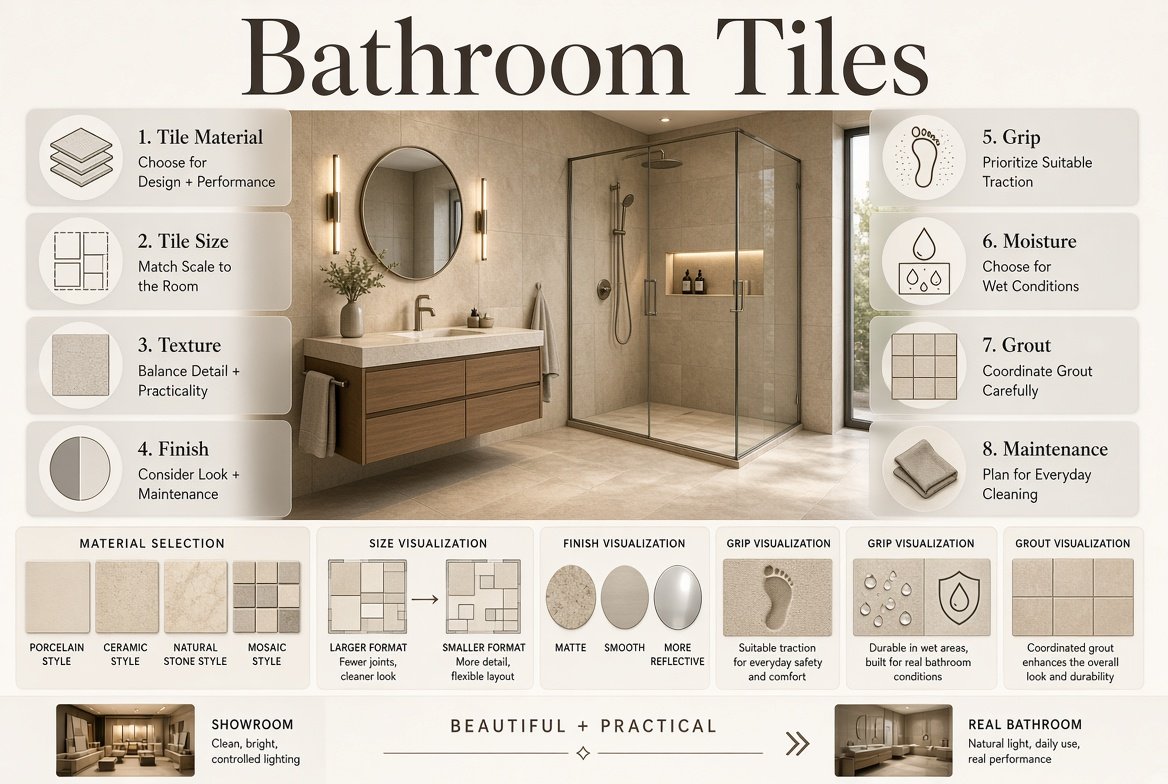
Bathroom Tiles | Choosing bathroom tiles sounds simple until you’re standing in a showroom surrounded by dozens of colors, sizes, textures, finishes, and materials. A tile may look perfect under bright showroom lighting but become slippery, difficult to clean, or visually overwhelming once it’s installed in your actual bathroom.
The right bathroom tiles need to do more than look attractive. They should handle moisture, suit the size of the room, provide enough grip, complement your fixtures, and remain practical to maintain for years. That’s why tile selection should be based on both design and performance.
If you’re planning a new bathroom or updating an existing one, DesignMode24 Interior Design can help you think about the bathroom as part of the home’s overall interior rather than treating tile selection as an isolated decision.
In this guide, you’ll learn how to choose bathroom floor and wall tiles, which materials work best, how tile size affects the room, what finishes to consider, how to match grout, which mistakes to avoid, and how to create a bathroom that looks polished without becoming difficult to live with.
What Are the Best Bathroom Tiles?
The best bathroom tiles are those that balance water resistance, slip resistance, durability, maintenance, and appearance. Porcelain is often an excellent choice for floors because it is dense and durable, while ceramic works well for many walls. Natural stone can create a premium appearance but usually requires more maintenance.
There isn’t one tile that is perfect for every bathroom. The best choice depends on where the tile will be installed and how the space is used.
For example, a busy family bathroom needs different priorities from a small guest bathroom. A shower floor needs better traction than a decorative wall, while a bathroom backsplash gives you more freedom with texture and finish.
Quick comparison of common bathroom tile materials
| Tile Material | Best Use | Main Advantage | Main Drawback |
|---|---|---|---|
| Porcelain | Floors, shower walls, high-use areas | Durable and low-maintenance | Usually more expensive |
| Ceramic | Walls and general bathroom surfaces | Affordable and versatile | Some products are less suitable for heavy floor use |
| Natural Stone | Feature walls and luxury bathrooms | Unique, premium appearance | Requires sealing and maintenance |
| Glass | Feature walls, niches, accents | Reflects light beautifully | Can show water spots |
| Mosaic | Shower floors, niches, decorative areas | Excellent design flexibility | More grout to clean |
| Terracotta | Character-focused interiors | Warm, natural appearance | Needs careful sealing and maintenance |
How Do You Choose Bathroom Floor Tiles?
Bathroom floor tiles should be selected primarily for safety, durability, water exposure, and maintenance. Choose a surface with adequate traction, particularly for areas that regularly become wet. Porcelain, textured ceramic, and suitable small-format mosaics can all work well when properly specified.
The floor is where tile performance matters most because water, soap, cleaning products, foot traffic, and temperature changes all affect the surface.
A beautiful polished tile may look luxurious, but a highly smooth finish can become uncomfortable or unsafe when wet. Before choosing a tile for the floor, check the manufacturer’s suitability recommendations rather than relying only on appearance.
What to consider for bathroom floors
- Slip resistance
- Water exposure
- Tile thickness and durability
- Ease of cleaning
- Surface texture
- Grout requirements
- Room size
- Underfloor heating compatibility, if applicable
- Compatibility with the existing or planned subfloor
Porcelain bathroom floor tiles
Porcelain is one of the most practical choices for bathroom floors because it is dense, durable, and available in an enormous range of colors and patterns.
You can find porcelain that resembles marble, limestone, concrete, wood, or natural stone without taking on all the maintenance requirements of the material it imitates.
For a busy household, this can be a major advantage.
💡 Pro Tip: Don’t choose a floor tile simply because it is labeled “porcelain.” Check the manufacturer’s technical specifications and confirm that the exact product is appropriate for your intended application.
Are Ceramic Tiles Good for Bathrooms?
Ceramic tiles are an excellent bathroom option when the specific product is suitable for the intended application. They’re available in many colors, shapes, patterns, and finishes, making them particularly useful for bathroom walls and decorative surfaces. Some ceramic products are also suitable for floors when properly rated.
Ceramic has remained popular because it provides a strong combination of affordability and design flexibility.
For example, a simple white ceramic wall tile can make a compact bathroom feel clean and bright without requiring an expensive material. Pairing it with darker floor tiles and warm wood tones can prevent the room from looking too sterile.
The important point is to distinguish between a wall tile and a floor-rated tile. Not every ceramic tile should be installed underfoot.
Porcelain vs. Ceramic Bathroom Tiles
Porcelain and ceramic tiles are related materials, but their characteristics can differ because of their composition, manufacturing process, density, and intended application.
| Feature | Porcelain | Ceramic |
| Durability | Generally very high | Good to very good |
| Water resistance | Excellent | Depends on product |
| Design options | Extensive | Extensive |
| Cost | Often higher | Often more affordable |
| Floor applications | Excellent when rated | Suitable when rated |
| Wall applications | Excellent | Excellent |
| Maintenance | Low | Low |
| Heavy-use areas | Very suitable | Product dependent |
For many homeowners, the decision doesn’t need to be complicated. Use the manufacturer’s specifications to determine whether the tile is appropriate for the location.
What Size Bathroom Tiles Should You Use?
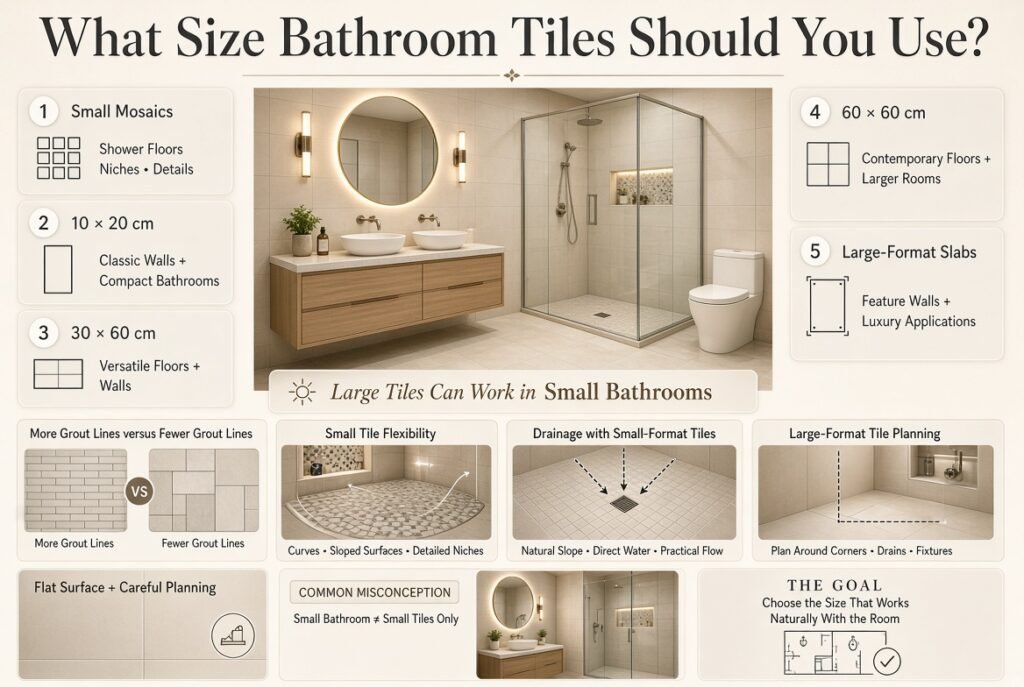
The best bathroom tile size depends on the room’s dimensions, layout, drainage requirements, and desired visual effect. Large-format tiles can create a cleaner, more spacious appearance with fewer grout lines, while smaller tiles can work particularly well on shower floors, curved surfaces, and detailed areas.
Tile size changes how the room feels.
A large-format tile can make a small bathroom look more continuous because fewer grout lines interrupt the visual field. However, large tiles require a sufficiently flat surface and careful planning around corners, drains, niches, and plumbing fixtures.
Smaller tiles offer greater flexibility.
They can follow curves and slopes more easily and are often practical for shower floors where the surface needs to direct water toward the drain.
Popular tile sizes and where they work
- Small mosaics: shower floors, niches, decorative borders
- 10 × 20 cm or similar formats: classic walls and compact bathrooms
- 30 × 60 cm: versatile floors and walls
- 60 × 60 cm: contemporary floors and larger bathrooms
- Large-format slabs: feature walls and luxury applications
Large tiles in small bathrooms
One common misconception is that small bathrooms always need tiny tiles.
That’s not necessarily true.
A compact bathroom can look excellent with medium or large-format tiles when the layout allows them to be installed properly. Fewer grout lines can make the space feel less visually fragmented.
However, forcing a large tile into a complicated room can create awkward cuts. The goal isn’t to use the largest tile possible. The goal is to use a size that works naturally with the room’s dimensions.
Should Bathroom Floor and Wall Tiles Match?
Bathroom floor and wall tiles don’t have to match exactly. A more sophisticated approach is often to coordinate them through color, undertone, texture, scale, or material appearance rather than using the same tile everywhere.
For example, you could use:
- Warm beige floor tiles
- Cream wall tiles
- Natural wood-look cabinetry
- Brushed metal fixtures
The room feels connected without looking repetitive.
Another option is to use one tile throughout the bathroom and create contrast through paint, cabinetry, lighting, hardware, or accessories.
This approach can be especially effective when the bathroom is small because fewer materials create a calmer visual environment.
For broader ideas about combining materials and rooms, explore Interior Design.
How Do You Choose Tile Colors for a Bathroom?
Bathroom tile colors should reflect the room’s natural light, size, fixtures, and overall design direction. Light neutral tiles can make a small bathroom feel brighter, while darker or richer colors can create depth and atmosphere. The safest approach is to coordinate the tile undertone with the rest of the room.
Light bathroom tiles
White, cream, soft beige, pale gray, and other light shades can reflect more light and create an airy feeling.
They’re particularly useful when:
- The bathroom has limited natural light
- The room is physically small
- You want a clean contemporary appearance
- The cabinetry is dark
- You want decorative elements to stand out
Dark bathroom tiles
Charcoal, deep gray, brown, navy, and black can create a dramatic bathroom.
However, darker surfaces can make a small room feel heavier if they are used everywhere.
A better strategy can be to use dark floor tiles with lighter walls or create one dark feature wall while keeping the remaining surfaces lighter.
Warm vs. cool undertones
This is one of the most overlooked parts of bathroom design.
A gray tile may have a blue undertone, while another gray may contain warm beige or brown undertones. Put them next to the wrong cabinet, countertop, or paint color and the room can feel disconnected.
⚠ Common Mistake: Choosing every material separately because each one looks attractive in isolation. Always view tile samples alongside your cabinet finish, countertop, paint, hardware, and lighting.
What Is the Best Tile Finish for a Bathroom?
The best tile finish depends on whether the tile is being used on the floor, wall, shower, or feature area. Matte and textured finishes are often practical for floors because they can provide a more forgiving surface, while glossy tiles can work beautifully on walls where their reflective quality helps bounce light around the room.
Matte tiles
Matte tiles have a softer appearance and generally hide small water marks and fingerprints better than highly reflective surfaces.
They’re a strong choice for:
- Bathroom floors
- Contemporary bathrooms
- Stone-look designs
- Minimalist interiors
Glossy tiles
Glossy tiles reflect light and can make walls appear brighter.
They’re particularly effective in:
- Small bathrooms
- Shower walls
- Feature walls
- Traditional bathrooms
- Bathrooms with limited daylight
The downside is that water spots can be more noticeable.
Textured tiles
Texture can add visual depth, but excessive texture can make cleaning more difficult.
Use heavily textured surfaces selectively rather than covering every wall with them.
Are Marble Bathroom Tiles a Good Choice?
Marble can create a sophisticated bathroom, but it requires more care than many porcelain or ceramic alternatives. Natural marble is porous and can be sensitive to staining, scratching, and certain cleaning products, so proper sealing and maintenance are essential.
If you love the appearance of marble but want easier maintenance, marble-look porcelain is worth considering.
Modern manufacturing can reproduce the veining and tonal variation of natural stone remarkably well.
This gives homeowners a way to achieve a luxury aesthetic while reducing some of the maintenance concerns associated with genuine marble.
Natural stone can still be an excellent choice when you’re comfortable with its care requirements.
How Many Tile Colors Should a Bathroom Have?
Most bathrooms look more balanced when they use a controlled material palette rather than several unrelated tile colors. A practical starting point is one dominant tile, one supporting material, and a smaller accent used strategically.
For example:
60%: warm neutral wall tile
30%: darker floor tile
10%: decorative mosaic or accent material
This isn’t a strict design rule. It’s simply a useful way to prevent the room from becoming visually chaotic.
You can also create contrast through fixtures and accessories instead of adding more tile colors.
For broader home styling ideas, Home Styling offers useful principles for creating a consistent visual language.
How Do You Make a Small Bathroom Look Bigger With Tiles?
To make a small bathroom feel larger, use visual continuity rather than filling the room with contrasting patterns. Large or medium-format tiles, light colors, consistent grout, and extending the same tile across connected surfaces can reduce visual interruptions and make the room feel more open.
Try these approaches:
- Use a light or mid-tone color.
- Keep the grout close to the tile color.
- Avoid too many competing patterns.
- Consider extending wall tile higher.
- Use large-format tiles where installation conditions allow.
- Keep the floor and walls visually coordinated.
- Use reflective surfaces strategically.
- Avoid unnecessary decorative borders.
Example
Imagine a 5 × 7-foot bathroom with limited natural light.
Instead of using three different patterned tiles, choose:
- Light warm-gray wall tile
- Slightly darker gray floor tile
- White vanity
- Frameless glass shower
- Brushed nickel hardware
The room can feel considerably calmer and more spacious.
For additional ideas, see Bathroom Inspiration.
What Tile Is Best for a Shower?
Shower tiles should be selected for water exposure, traction, maintenance, and proper installation. For shower floors, smaller tiles or mosaics can be practical because they provide more grout joints and can follow the slope toward the drain. Shower walls allow more freedom with format and finish.
The shower floor deserves special attention.
A tile that looks beautiful in a dry showroom may not provide the same confidence when covered with water and soap.
Don’t rely on appearance alone. Check the product’s technical information and follow appropriate installation requirements.
For shower walls, larger tiles can reduce grout lines and create a cleaner appearance, provided the wall is adequately prepared.
Why Is Grout Important When Choosing Bathroom Tiles?
Grout isn’t just a filler between tiles. Its color, width, quality, and maintenance requirements can significantly affect the appearance and long-term performance of a bathroom installation.
Matching grout
A grout color close to the tile creates a seamless appearance.
Contrasting grout
A darker or contrasting grout emphasizes the tile pattern and individual shapes.
For example, white subway tiles with dark grout create a strong graphic look, while white grout produces a softer appearance.
The downside of high-contrast grout is that it makes installation imperfections more visible.
⭐ Expert Tip: Before committing to a grout color, place a physical grout sample beside the actual tile. Online images and showroom lighting can be misleading.
How Wide Should Bathroom Tile Grout Lines Be?
Grout joint width depends on the tile, manufacturer’s recommendations, tile variation, installation requirements, and the desired appearance. There isn’t one universal joint size that works for every product.
Rectified large-format tiles can often be installed with narrower joints than irregular handmade tiles.
The installer should follow the tile manufacturer’s specifications rather than choosing a joint width purely for aesthetic reasons.
A tiny grout line won’t compensate for an uneven wall or poorly calibrated tile.
Should Bathroom Tiles Go to the Ceiling?
Extending tile to the ceiling can create a clean, finished appearance, especially in showers and wet areas. It can also make a bathroom appear taller because the eye isn’t interrupted by a horizontal stopping point.
Ceiling-height tile is particularly effective when:
- The shower has a tall ceiling
- You want a luxury appearance
- The bathroom uses large-format tiles
- The design is minimalist
- The shower is the main feature
However, full-height tile throughout the bathroom isn’t mandatory.
You can save material and installation costs by limiting tile to wet areas while using moisture-appropriate paint elsewhere.
How Do You Calculate How Many Bathroom Tiles You Need?
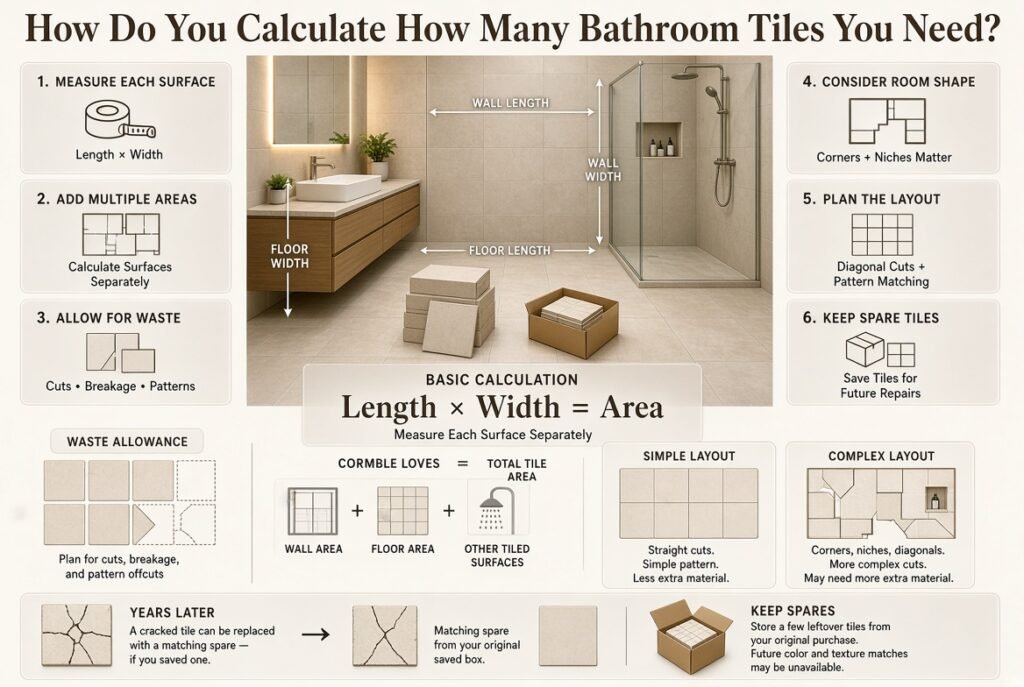
Measure each tiled surface, calculate its area, and then add an allowance for cuts, breakage, pattern matching, and future repairs. The amount of extra tile required depends on the room shape and tile layout, but ordering too little can create problems if the exact product later becomes unavailable.
Basic calculation
Wall or floor area = Length × Width
For multiple surfaces, calculate each area separately and add them together.
Then account for waste.
A simple rectangular bathroom with straight tile layouts may require less extra material than a room containing multiple corners, niches, diagonal cuts, or complicated patterns.
Keep a few spare tiles after installation.
That small box can become extremely valuable years later if a tile cracks and the original product has been discontinued.
How Should You Plan Bathroom Tile Layout?
Tile layout should be planned before installation begins. Decide where full tiles, cuts, borders, niches, and transitions will fall instead of allowing the installer to make all decisions during installation.
A good layout should avoid awkward slivers wherever possible.
For example, if a wall is almost exactly the width of several full tiles but leaves a tiny strip at one side, shifting the starting point can produce more balanced cuts on both sides.
The same principle applies around:
- Vanity units
- Doors
- Windows
- Niches
- Shower controls
- Drains
- Bathtubs
- Wall corners
📌 Quick Tip: Draw the tile layout on paper before purchasing the final quantity. Even a simple sketch can reveal problems that aren’t obvious from a sample board.
Bathroom Tile Patterns That Work Well
Tile pattern can change the personality of the entire bathroom.
Straight stack
Tiles line up vertically and horizontally.
Best for: modern minimalist bathrooms.
Running bond
Each row is offset from the previous one.
Best for: subway tiles and traditional designs.
Herringbone
Rectangular tiles are arranged in a zigzag pattern.
Best for: feature walls and decorative areas.
Basketweave
Small tiles create an interlocking pattern.
Best for: traditional or transitional bathrooms.
Large-format continuous layout
Large tiles create fewer visual breaks.
Best for: contemporary bathrooms and spacious walls.
Patterns should support the room rather than become the entire design.
How Do You Mix Different Bathroom Tile Styles?
The safest way to mix tile styles is to establish one clear connection between them. That connection might be color, undertone, material appearance, shape, or texture.
For example, you could combine:
- Concrete-look floor tile
- White rectangular wall tile
- Green accent mosaic
- Natural oak vanity
The colors can tie the materials together while each surface performs a different visual role.
If you’re also working on the wider home, Home Design Ideas can help you think about how individual rooms connect stylistically.
What Are the Most Common Bathroom Tile Mistakes?
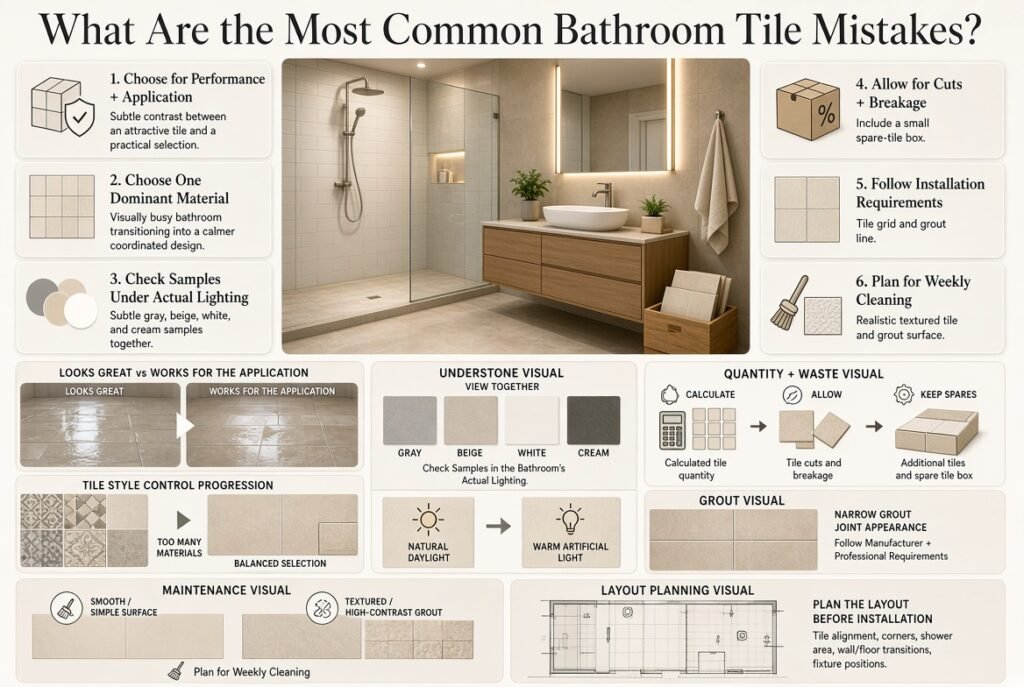
The most common mistakes include choosing tiles based only on appearance, ignoring slip resistance, using too many competing materials, underestimating grout maintenance, failing to order enough material, and starting installation without a complete layout plan.
Mistake 1: Choosing appearance over performance
A beautiful floor tile isn’t automatically a practical floor tile.
Why it happens: The homeowner focuses on color and pattern.
Why it’s harmful: The surface may not perform well in a wet environment.
Better approach: Confirm the product’s intended application and technical specifications.
Mistake 2: Using too many tile styles
Why it happens: Every tile sample looks attractive individually.
Why it’s harmful: The finished bathroom becomes visually busy.
Better approach: Choose a dominant material and use accents selectively.
Mistake 3: Ignoring undertones
Why it happens: Gray, beige, white, and cream appear neutral.
Why it’s harmful: Slight undertone differences can clash.
Better approach: View all samples together under the bathroom’s actual lighting.
Mistake 4: Buying the exact calculated quantity
Why it happens: Homeowners want to avoid waste.
Why it’s harmful: Cuts and breakage can leave you short.
Better approach: Include an appropriate installation allowance and keep spare tiles.
Mistake 5: Selecting tiny grout because it looks cleaner
Why it happens: Narrow joints look elegant in photographs.
Why it’s harmful: The tile may not support that installation method.
Better approach: Follow manufacturer and professional installation requirements.
Mistake 6: Forgetting maintenance
Why it happens: New tile looks perfect and effortless.
Why it’s harmful: Textured surfaces and high-contrast grout can require more cleaning.
Better approach: Think about how you’ll clean the bathroom every week, not just how it will look on installation day.
How Can You Make Bathroom Tile Maintenance Easier?
The easiest bathroom tile to maintain is generally one with a practical surface, appropriate grout, good ventilation, and a layout that doesn’t create unnecessary joints or hard-to-reach areas.
Maintenance becomes easier when you reduce the number of surfaces that collect soap residue and mineral deposits.
Helpful habits include:
- Wiping wet surfaces when practical
- Maintaining good bathroom ventilation
- Cleaning grout regularly
- Using suitable cleaning products
- Avoiding abrasive cleaners on delicate surfaces
- Following natural-stone maintenance instructions
- Repairing damaged grout or sealant promptly
A tile itself may be extremely durable, but the surrounding grout and sealants still need attention.
What Bathroom Tiles Are Best for a Luxury Bathroom?
Luxury doesn’t require the most expensive tile in the showroom. A premium bathroom usually looks expensive because the materials, proportions, lighting, grout, fixtures, and installation work together.
Good options include:
- Marble-look porcelain
- Large-format stone-look porcelain
- Natural marble
- Micro-mosaic accents
- Handmade-look ceramic
- Neutral textured tiles
- Carefully selected metallic or glass accents
The key is restraint.
A room covered in expensive materials can still look less sophisticated than a simple bathroom with excellent proportions and thoughtful detailing.
Can Bathroom Tiles Be Used on the Kitchen or Other Areas?
Some bathroom tile products can also be used in kitchens, entryways, laundry rooms, and other areas, but suitability must always be checked for the specific application. Flooring requirements can differ significantly from wall applications, especially in areas with heavier traffic.
For example, a durable porcelain tile might transition beautifully from a bathroom into a laundry room.
If you’re designing multiple rooms, Kitchen Design can help you maintain consistency between wet-area materials and the rest of the home.
Bathroom Tiles and Whole-Home Design
A bathroom doesn’t have to look identical to the living room or kitchen, but it should feel like it belongs to the same home.
You can create that connection through:
- Similar warm or cool undertones
- Repeated wood tones
- Consistent metal finishes
- Similar neutral colors
- Related stone appearances
- Repeated design shapes
For example, if the living room uses warm oak and cream tones, a bathroom with cool blue-gray tile and bright chrome everywhere may feel disconnected.
Instead, warm beige porcelain, oak cabinetry, and brushed brass could create a subtle relationship.
See Living Room Design for broader ideas about creating visual continuity across rooms.
How Bathroom Remodeling Affects Tile Selection
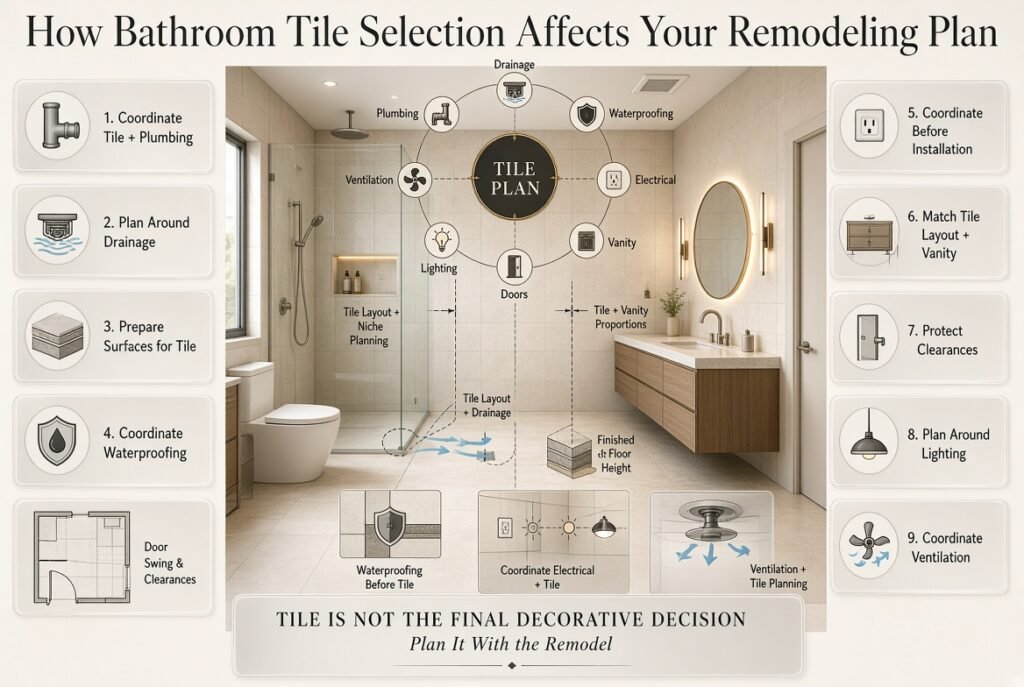
Tile decisions should be made before major bathroom remodeling work begins because tile dimensions can influence niches, plumbing locations, vanity proportions, shower layouts, and finished floor heights.
If you’re changing the bathroom layout, coordinate the tile plan with:
- Plumbing
- Shower drainage
- Wall preparation
- Waterproofing
- Electrical locations
- Vanity dimensions
- Door swings
- Lighting
- Ventilation
This is why tile shouldn’t be treated as the final decorative decision.
For a broader renovation strategy, see Bathroom Remodeling.
How Bathroom Storage and Tiles Work Together
Bathroom storage affects how much wall space remains visible, so tile selection should account for cabinets, niches, shelves, mirrors, and vanity units.
A highly patterned tile behind open shelving can create a completely different effect from the same tile behind a full-width mirror.
Plan storage and tile together when possible.
For practical ideas, explore Bathroom Storage.
A Practical Bathroom Tile Selection Process
If you’re overwhelmed by choices, use this simple sequence.
Step 1: Measure the room
Record floor dimensions, wall dimensions, shower dimensions, niches, windows, and doors.
Why it matters: You need to understand the available surface before selecting tile sizes.
Step 2: Decide where tile is required
Determine whether you need:
- Floor tile
- Shower wall tile
- Shower floor tile
- Vanity backsplash
- Full-height wall tile
- Feature tile
Common mistake: Buying tile before deciding how much of the room will actually be tiled.
Step 3: Choose the floor first
The floor often establishes the practical requirements and design direction.
Professional advice: Prioritize safety and maintenance before color.
Step 4: Choose wall tile
Select a wall tile that complements the floor rather than competing with it.
Step 5: Select the accent
Use decorative tile only where it improves the design.
Step 6: Choose grout
Consider both appearance and cleaning requirements.
Step 7: Plan the layout
Decide where cuts, corners, niches, and transitions will occur.
Step 8: Order material
Calculate the required quantity and include a reasonable allowance.
Step 9: Keep spare tiles
Store several pieces safely for future repairs.
What Tile Should You Choose for a Family Bathroom?
A family bathroom needs durability and easy maintenance because it experiences frequent use. Porcelain floor tile, practical wall tile, low-maintenance grout, and slip-conscious shower surfaces are generally strong choices.
Avoid making the entire room dependent on delicate materials simply because they look luxurious.
Children, wet towels, toiletries, cleaning products, and everyday traffic can quickly expose impractical choices.
A family bathroom should be attractive enough to enjoy but durable enough to tolerate real life.
What Tile Should You Choose for a Small Guest Bathroom?
A guest bathroom gives you more freedom to experiment because it usually experiences less daily wear. You can use a decorative wall, dramatic tile, patterned floor, or stronger color without worrying as much about long-term family traffic.
However, maintenance still matters.
A beautiful powder-room-style bathroom can be an excellent place to introduce personality through a feature tile, especially when the room has limited floor area.
What Tile Works Best With Wood Bathroom Cabinets?
Wood-look cabinetry pairs particularly well with neutral stone-look, concrete-look, cream, beige, gray, and softly textured tiles. The exact choice should depend on the wood’s undertone.
Warm wood usually works naturally with:
- Cream
- Beige
- Warm gray
- Terracotta
- Soft white
Cooler wood finishes may pair better with:
- Cool gray
- Muted blue
- Crisp white
- Charcoal
The important thing is to compare physical samples.
Lighting can dramatically change how both tile and wood appear.
Can You Use the Same Tile on the Floor and Walls?
Using the same tile on floors and walls can create a sophisticated, cohesive appearance, particularly with neutral large-format porcelain. However, the specific product must be suitable for each application, and the floor should meet the necessary performance requirements.
This approach works particularly well in minimalist bathrooms.
You can create variation by changing the tile orientation, grout color, fixture finish, cabinetry, or lighting.
The result is a room that feels calm rather than overloaded with different materials.
What Are the Best Bathroom Tiles for a Modern Bathroom?
For a modern bathroom, large-format porcelain, stone-look porcelain, matte tiles, handmade-look ceramics, and subtle textured tiles are among the strongest choices. Large-format porcelain is particularly practical because fewer grout lines create a cleaner appearance, while warm neutral colors such as beige, greige, taupe, soft cream, and muted green are becoming more popular than the cooler gray palettes that dominated bathroom design for years.
The important thing is not to choose a tile simply because it is currently fashionable. A modern bathroom should still feel comfortable and relevant several years from now. That’s why a neutral foundation with one carefully selected feature tile is often a better investment than covering the entire room in a strong trend.
What to consider:
Choose porcelain for demanding floor and wet-area applications when the specific product is appropriately rated.
Use large-format tiles when the room and installation conditions allow.
Consider matte or honed finishes for a softer, contemporary appearance.
Use textured or handmade-look tiles on selected walls rather than everywhere.
Coordinate tile colors with the vanity, countertop, lighting, and hardware.
💡 Pro Tip: If you want a modern bathroom that won’t look dated quickly, keep the main floor and wall tile relatively timeless and introduce personality through a niche, shower wall, backsplash, or decorative section.
Are Large-Format Tiles Better for Small Bathrooms?
Large-format tiles can be an excellent choice for a small bathroom because they reduce the number of visible grout lines. Fewer visual interruptions can make the walls and floor feel more continuous, which often creates a cleaner and more spacious impression. Large-format porcelain remains one of the strongest bathroom tile directions in 2026 for exactly this combination of appearance and practicality.
However, bigger isn’t automatically better. A large tile needs a properly prepared, sufficiently flat surface, and the room’s dimensions must allow for a sensible layout. If the installer has to make numerous awkward cuts around corners, drains, windows, niches, and plumbing fixtures, a slightly smaller tile may actually produce a better-looking result.
For a compact bathroom, the goal should be visual continuity rather than simply choosing the largest available tile.
Large-format tiles work particularly well when:
The bathroom has relatively straight walls.
You want fewer grout joints.
You prefer a minimalist appearance.
You want a stone or marble effect without excessive visual breaks.
The shower walls have enough space for larger pieces.
⚠ Common Mistake: Assuming large-format tile automatically makes every small bathroom look bigger. Poor layout can have the opposite effect. Always plan the tile cuts before installation.
A practical approach: Use a large or medium-format neutral porcelain on the main surfaces, then use a smaller mosaic or textured tile only where it has a specific purpose, such as a shower floor or niche.
What Bathroom Tile Colors Are Trending in 2026?
Bathroom tile colors in 2026 are moving toward warm, earthy, and nature-inspired shades, including beige, warm taupe, clay, terracotta, muted sage, olive, creamy white, and deeper greens. Richer colors such as forest green and navy are also being used as statement shades, while cool, flat gray is becoming less dominant.
This shift reflects a broader move toward bathrooms that feel warmer and more relaxing rather than purely clinical. Instead of the traditional bright-white bathroom, homeowners are increasingly combining natural-looking tile, warm wood cabinetry, soft lighting, and earthy colors to create a more comfortable atmosphere.
That doesn’t mean white or gray tiles are outdated. A well-chosen warm white or soft greige can remain extremely versatile. The key is the undertone.
For example, two tiles may both be labeled “gray,” but one might have a cool blue undertone while another has warm beige undertones. The difference becomes obvious when the tile is placed next to wood, stone, paint, or metal fixtures.
Popular directions to consider:
Warm beige and cream
Greige and soft taupe
Sage and olive green
Terracotta and clay
Deep forest green
Muted navy
Warm white
Natural stone-inspired shades
⭐ Expert Tip: Don’t select a bathroom tile color from a tiny online image. Get a physical sample and look at it during both daylight and artificial lighting. The same tile can appear noticeably different throughout the day.
Are Zellige and Textured Bathroom Tiles a Good Choice?
Zellige and other handmade or textured bathroom tiles are excellent choices when you want to add character, depth, and a more handcrafted appearance. In 2026, designers are increasingly using imperfect surfaces, hand-glazed finishes, textured ceramics, and artisanal-looking tiles to make bathrooms feel warmer and less mass-produced.
The appeal of Zellige-style tile comes from its variation. Individual pieces can have slightly different tones, irregular surfaces, and changing reflections. Instead of looking perfectly uniform, the finished wall has movement as light hits each tile differently.
But this style needs to be used intentionally.
A highly textured or irregular surface can require more attention during cleaning, and not every textured or glazed tile is appropriate for every wet application. Always check the manufacturer’s specifications before using a particular product on a shower floor or other demanding surface.
Best places to use textured or handmade-look tile:
Shower feature walls
Vanity walls
Backsplashes
Niches
Bathtub surrounds
Small accent areas
Use more caution with:
Shower floors
Areas exposed to heavy abrasion
Surfaces that are difficult to clean
Floors where the product’s slip characteristics aren’t suitable
📌 Quick Tip: If you love the handmade look but don’t want the entire bathroom to feel busy, use the tile on one feature wall and keep the remaining surfaces simple.
This gives you the character of an artisanal material without allowing the texture to dominate the entire room.
What Is the Best Bathroom Tile for Easy Cleaning and Maintenance?
For homeowners who want easier maintenance, low-porosity porcelain or ceramic tile with a practical surface and fewer grout joints is usually a strong starting point. Large-format tiles can reduce the amount of grout that needs regular cleaning, while matte or lightly textured surfaces can be more forgiving of everyday water marks than highly reflective finishes.
However, the tile itself isn’t the whole maintenance equation. Grout, ventilation, water exposure, cleaning habits, and installation quality all affect how easy the bathroom is to maintain.
For example, a bathroom covered in small mosaics may look beautiful, but it can contain substantially more grout than a large-format installation. That doesn’t make mosaics a bad choice; it simply means you should understand the maintenance trade-off before selecting them.
Natural stone also deserves additional consideration. Marble, limestone, and similar materials can create a beautiful premium appearance, but many require sealing and specific cleaning products. If you want the appearance of natural stone with less maintenance, stone-look porcelain is often worth considering.
For a lower-maintenance bathroom, consider:
Large-format porcelain
Low-porosity surfaces
A sensible number of grout joints
Easy-to-clean shower layouts
Proper bathroom ventilation
Appropriate grout and sealant
Simple, accessible surfaces
⚠ Professional Advice: Never choose a tile solely because someone describes it as “easy to clean.” Check the actual manufacturer’s care instructions. A tile’s finish and installation details can make a major difference in real-world maintenance.
The best bathroom is not simply the one that looks impressive immediately after installation. It’s the one that continues to look good after months and years of normal use.
Conclusion
Choosing the right bathroom tiles is about much more than finding a color or pattern you like. The best tile selection balances appearance, durability, safety, maintenance, room size, and the way the bathroom is actually used.
Porcelain and suitable ceramic tiles can provide practical everyday performance, while natural stone, handmade-look tiles, mosaics, and textured finishes can introduce personality and character. Large-format tiles can create a cleaner visual flow, while carefully selected patterns and warm, earthy colors can make the bathroom feel more welcoming and contemporary.
Before making your final decision, always consider the complete installation rather than judging a tile on its own. Look at physical samples beside your vanity, countertop, paint, lighting, hardware, and grout. Check that the specific product is appropriate for its intended location, particularly on wet floors and inside showers.
Most importantly, don’t let a trend make the decision for you. A bathroom should look good today, but it should also remain practical and attractive years from now.
Choose the tile for the way you live, plan the layout before installation, and prioritize quality over unnecessary complexity. When those decisions are made carefully, even a simple tile can create a bathroom that feels polished, comfortable, and genuinely well designed.
Leave a Reply