
Introduction
Luxury Contemporary Interiors | Luxury doesn’t always announce itself with crystal chandeliers, glossy marble, or furniture that costs a fortune. Sometimes you walk into a room and immediately notice that everything feels balanced. The furniture fits perfectly, the lighting is comfortable, the colors flow naturally, and there is just enough decoration to make the space interesting without making it feel crowded.
That is the beauty of luxury contemporary interiors.
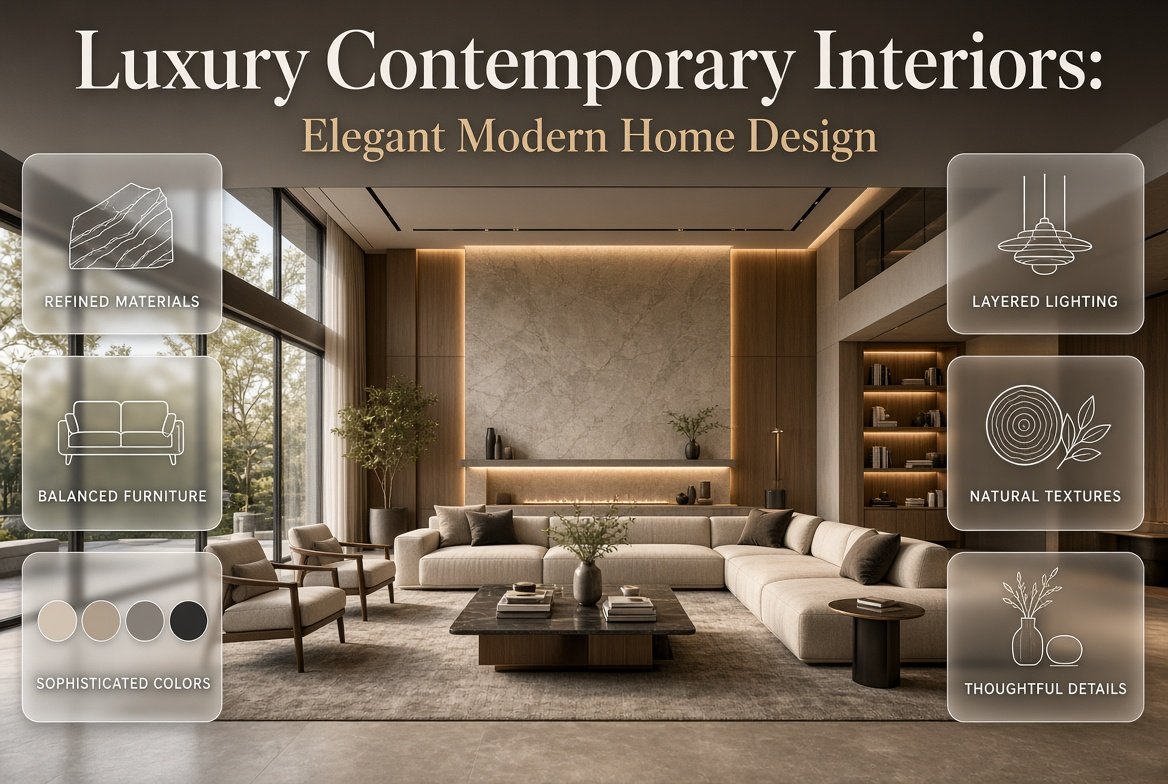
Contemporary luxury is less about showing how much you spent and more about showing how thoughtfully the space was designed. It combines modern architecture, refined materials, comfortable furniture, sophisticated colors, layered lighting, natural textures, and carefully selected details.
If you’re planning a new home, renovating an existing property, or simply trying to make your rooms feel more polished, understanding these principles can save you from expensive design mistakes.
This guide explains how to create a luxury contemporary interior from the ground up, including color palettes, furniture, materials, lighting, living rooms, bedrooms, kitchens, bathrooms, small spaces, storage, sustainability, and practical styling. You’ll also learn what commonly makes a luxury interior look cheap, how to spend your budget intelligently, and how to create a home that feels sophisticated without losing warmth or personality.
For broader inspiration before you begin, explore DesignMode24 Interior Design, where you can find ideas for different areas of home design and improvement.
What Are Luxury Contemporary Interiors?
Luxury contemporary interiors are spaces that combine the clean simplicity of contemporary design with refined materials, thoughtful proportions, sophisticated color palettes, comfortable furnishings, and carefully planned details.
The style focuses on how different elements work together rather than making one expensive object the center of attention.
A contemporary luxury living room, for example, might combine a warm neutral wall color, a large textured rug, a curved sofa, natural wood, a stone coffee table, soft curtains, and architectural lighting. None of these elements needs to be excessively decorative. Their relationship creates the luxurious effect.
The word contemporary also means the style is constantly evolving. Unlike a historical design movement with strict rules, contemporary interiors can change as lifestyles, materials, technology, and design preferences change.
That makes this style flexible.
You can create a contemporary luxury interior in a large villa, a family home, a townhouse, or a small apartment. The scale and budget may change, but the principles remain remarkably consistent.
What Actually Makes an Interior Feel Luxurious?
A luxury interior usually depends on several factors working together:
- Correct furniture proportions
- High-quality or convincing materials
- A controlled color palette
- Layered lighting
- Comfortable furniture
- Strong spatial planning
- Natural textures
- Good storage
- Carefully selected accessories
- Architectural details
- Visual balance
- Negative space
The important point is that luxury is cumulative.
One beautiful marble table won’t make a poorly planned room luxurious. But a well-proportioned room with good lighting, coordinated finishes, comfortable furniture, and controlled decoration can look highly sophisticated even without an enormous budget.
💡 Pro Tip: Before purchasing expensive furniture or decorative pieces, solve the room’s layout, lighting, and color palette. These three decisions have more influence on the final result than most accessories.
Why Are Contemporary Luxury Interiors So Popular?
Many homeowners want something more refined than basic modern design but less formal than traditional luxury.
Contemporary luxury sits comfortably between those two extremes.
It offers the clean appearance of modern design while introducing warmth through natural materials, textiles, organic shapes, artwork, and comfortable furniture.
Another reason for its popularity is flexibility.
A contemporary room can be:
- Minimal without feeling empty
- Elegant without feeling formal
- Comfortable without looking casual
- Dramatic without becoming excessive
- Modern without following every trend
This balance makes it suitable for people who want their homes to feel current but don’t want to redesign everything every few years.
Modern vs. Contemporary Luxury Interior Design
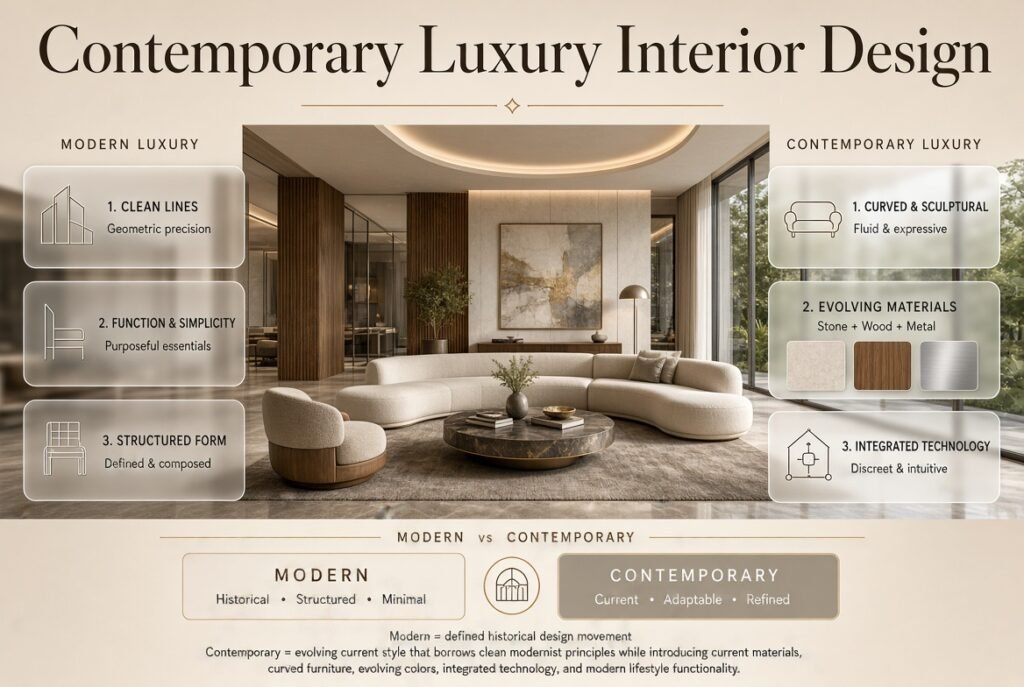
Modern and contemporary are related but aren’t exactly the same.
Modern design generally refers to a specific design movement associated with the 20th century. It emphasizes clean lines, function, simplicity, and reduced ornamentation.
Contemporary design describes what feels current and evolving.
A contemporary luxury interior can borrow ideas from modernism while incorporating today’s materials, technology, colors, curved furniture, and lifestyle needs.
| Feature | Modern Luxury | Contemporary Luxury |
|---|---|---|
| Definition | Historical design movement | Evolving current style |
| Furniture | Structured and clean | Clean, curved, sculptural, or mixed |
| Colors | Often neutral | Neutral plus evolving accent colors |
| Materials | Wood, steel, glass | Stone, wood, metal, glass, textiles |
| Technology | Limited historically | Often integrated |
| Decoration | Restrained | Selective and flexible |
| Overall feel | Structured | Refined and adaptable |
You don’t have to choose one style rigidly.
The best contemporary homes often borrow timeless ideas from several design approaches while maintaining one clear visual direction.
What Are the Main Elements of Luxury Contemporary Interiors?
Proportion Comes First
Proportion is one of the most important parts of interior design.
A beautiful sofa can still look wrong if it’s too large for the room. A stunning pendant can look awkward if it overwhelms a dining table. A small rug can make an otherwise expensive furniture arrangement feel disconnected.
Before buying anything, measure:
- Room length
- Room width
- Ceiling height
- Door openings
- Window locations
- Existing furniture
- Walking paths
Then consider how much physical and visual space each piece will occupy.
A professional-looking interior usually has enough breathing room around important objects.
Balance Creates Visual Harmony
Balance doesn’t mean every side of the room needs to be symmetrical.
Instead, visual weight should be distributed.
For example, a large dark sofa can be balanced with lighter chairs and a darker artwork on the opposite wall. A large stone island can be balanced with warm wood cabinetry.
Balance can come from:
- Size
- Color
- Shape
- Texture
- Height
- Material
- Visual density
This creates harmony without making the room look overly matched.
Negative Space Is Part of the Design
One of the easiest mistakes is trying to decorate every empty area.
Luxury contemporary interiors usually leave some space intentionally empty.
A clear wall gives artwork greater impact. An uncluttered countertop makes a kitchen feel more refined. Space around furniture makes the room easier to navigate.
Empty space isn’t wasted space when it improves the composition.
How Do You Choose a Luxury Contemporary Color Palette?
Color should create a foundation for the room rather than compete with furniture and materials.
Warm neutrals are particularly useful because they work with both natural and modern finishes.
Consider:
- Warm white
- Ivory
- Cream
- Beige
- Taupe
- Greige
- Mushroom
- Warm gray
- Brown
- Charcoal
- Muted green
- Soft black
A sophisticated room rarely depends on one completely flat color.
Instead, it uses different tones and textures within a related palette.
For example:
Warm white walls + beige upholstery + walnut wood + bronze lighting
can create a rich interior without using bright colors.
Should Luxury Contemporary Interiors Always Be Neutral?
No.
Neutral colors are popular because they create flexibility, but contemporary luxury can also use deeper colors.
Consider:
- Forest green
- Deep navy
- Chocolate brown
- Charcoal
- Burgundy
- Muted terracotta
The secret is proportion.
If you introduce a dramatic color, give it enough surrounding calmness to make the color feel intentional.
For homeowners working on paint selection, paint color ideas can provide additional inspiration when developing a cohesive palette.
Using the 60-30-10 Color Principle
The 60-30-10 rule is a useful starting framework.
Approximately:
- 60% dominant color
- 30% secondary color or material
- 10% accent color
For example:
60%: warm ivory
30%: beige and walnut
10%: black and bronze
You don’t need to follow the percentages literally.
The purpose is simply to prevent too many colors from competing for attention.
Which Materials Make a Home Look Luxurious?
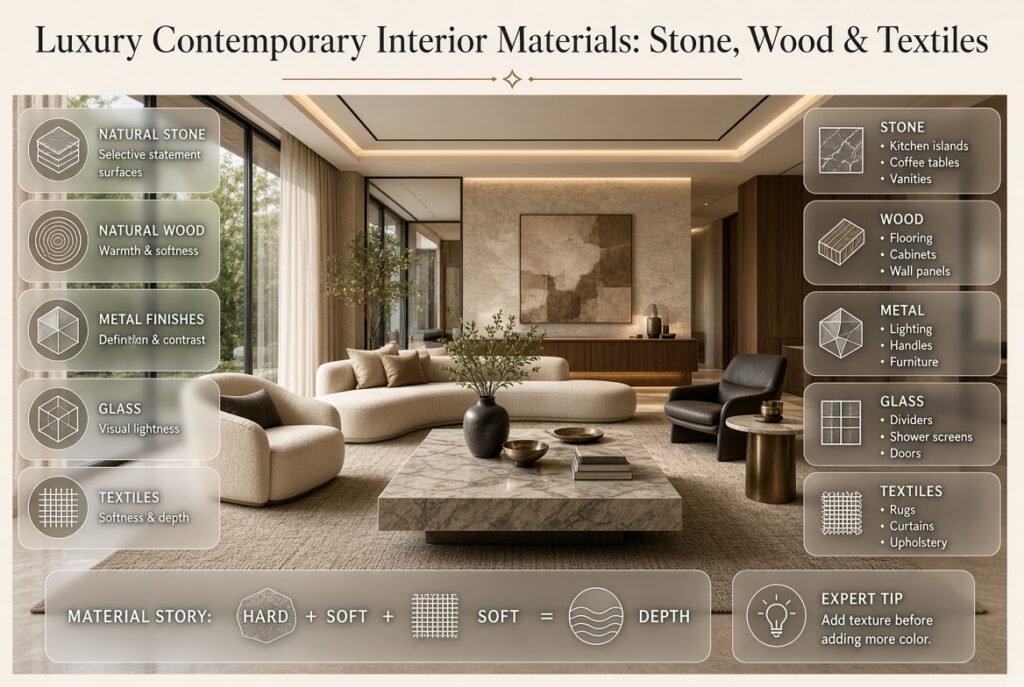
Material selection has a major influence on how an interior feels.
Luxury contemporary spaces usually mix several materials rather than using one expensive finish everywhere.
Natural Stone
Marble, travertine, limestone, and other stones introduce natural variation.
Instead of covering every surface with marble, consider using it selectively on:
- Kitchen islands
- Coffee tables
- Fireplace surrounds
- Bathroom vanities
- Feature walls
- Entry consoles
One strong stone feature can be more impressive than excessive stone throughout the house.
Natural Wood
Wood is essential when you want contemporary design to feel warm.
Walnut, oak, smoked wood, and other natural finishes can soften stone, glass, and metal.
Wood can appear in:
- Flooring
- Cabinets
- Wall panels
- Furniture
- Ceiling details
- Doors
Metal Finishes
Metal adds definition and contrast.
Popular options include:
- Brushed brass
- Bronze
- Black metal
- Stainless steel
- Darkened metal
Don’t introduce too many unrelated finishes.
Repeating one metal subtly across lighting, handles, and furniture can make the room feel more coordinated.
Glass
Glass keeps contemporary interiors visually light.
It can work well in:
- Coffee tables
- Shower screens
- Display cabinets
- Room dividers
- Internal doors
Textiles
Hard surfaces need softer materials around them.
Consider:
- Linen
- Wool
- Bouclé
- Velvet
- Leather
- Cotton
- Textured upholstery
The contrast between hard and soft surfaces makes the room more interesting.
⭐ Expert Tip: If a neutral room feels flat, add texture before adding more colors. A wool rug, linen curtain, wood surface, or textured chair may solve the problem immediately.
How Should You Choose Luxury Contemporary Furniture?
Furniture should be selected according to the room and lifestyle rather than purchased as isolated pieces.
Start with the largest item.
For example:
Living room → sofa
Bedroom → bed
Dining room → dining table
Once the anchor piece is selected, build the rest of the room around it.
What Furniture Shapes Work Best?
Contemporary interiors can use both structured and organic shapes.
Popular choices include:
- Low-profile sofas
- Curved sofas
- Sculptural chairs
- Rounded coffee tables
- Clean-lined consoles
- Minimal dining tables
- Upholstered beds
- Built-in cabinetry
Don’t make every piece a statement.
If every object is competing for attention, the room loses hierarchy.
One sculptural chair surrounded by quieter furniture can be much more effective.
Comfort Is Part of Luxury
A luxury interior should feel good to use.
When selecting seating, think about:
- Seat depth
- Cushion firmness
- Back support
- Fabric durability
- Maintenance
- Household lifestyle
A beautiful sofa isn’t a successful choice if nobody wants to sit on it.
How Do You Create a Luxury Contemporary Living Room?
The living room often becomes the main expression of the home’s design.
Start with furniture placement.
Instead of pushing everything against the walls, create a clear conversation zone.
A sophisticated contemporary living room might include:
- Large comfortable sofa
- One or two accent chairs
- Correctly sized coffee table
- Large area rug
- Layered lighting
- Full-height curtains
- One substantial artwork
- Natural wood or stone
- Limited accessories
The room should feel connected rather than fragmented.
Why Is the Rug Important?
A rug helps visually connect furniture.
A rug that’s too small can make the sofa, chairs, and table look like separate objects.
A sufficiently large rug can bring the entire arrangement together.
It also adds softness and improves acoustic comfort.
For more living-room-specific inspiration, explore elegant living room styling ideas.
How Should Curtains Be Used?
Curtains influence the perceived height and width of a room.
In many situations, mounting them higher and wider than the window can make the room feel taller and more generous.
Floor-length curtains usually create a more polished appearance than short curtains that stop awkwardly above the floor.
Neutral textured fabrics work especially well in contemporary interiors.
How Do You Design a Luxury Contemporary Bedroom?
A bedroom should feel peaceful rather than theatrical.
The bed is normally the visual anchor.
An upholstered headboard can create scale and softness, while layered bedding adds texture.
A refined bedroom might include:
- Upholstered bed
- Quality bedding
- Soft bedside lighting
- Minimal bedside tables
- Full-height curtains
- Comfortable rug
- Concealed storage
- Restrained artwork
Avoid turning the bedroom into a display area.
Sleep and comfort should remain the priority.
How Can You Make a Bedroom Feel More Expensive?
Start with simple improvements:
- Upgrade bedding layers.
- Improve lighting.
- Use full-height curtains.
- Reduce visible clutter.
- Add a substantial rug.
- Coordinate bedside lighting.
- Introduce natural textures.
- Choose one strong artwork.
If you’re planning a bedroom refresh, these cozy bedroom makeover ideas can provide useful direction.
What Does a Luxury Contemporary Kitchen Look Like?
A contemporary luxury kitchen combines visual simplicity with strong functionality.
Typical characteristics include:
- Clean cabinetry
- Integrated appliances
- Large islands
- Stone countertops
- Minimal hardware
- Full-height storage
- Under-cabinet lighting
- Wood accents
- Hidden storage
However, the kitchen shouldn’t be designed only for appearance.
Think about how you actually use it.
Where do groceries arrive? Where do you prepare food? Where are appliances stored? Is there enough countertop space? Can two people work comfortably at the same time?
These practical questions often have more impact than decorative details.
For further inspiration, explore modern kitchen design ideas.
Why Is Kitchen Storage So Important?
Visible clutter can quickly destroy a sophisticated appearance.
Use:
- Deep drawers
- Tall cabinets
- Appliance garages
- Pull-out storage
- Drawer organizers
- Integrated bins
- Hidden charging areas
A clean countertop can make the entire kitchen feel more luxurious.
How Can Small Homes Look Luxurious?
Small homes can absolutely have luxury contemporary interiors.
The key is visual continuity.
Use:
- Consistent flooring
- Similar wall tones
- Built-in storage
- Multifunctional furniture
- Vertical storage
- Reflective surfaces
- Correct furniture proportions
- Fewer decorative objects
Don’t assume that filling every corner makes a small room more useful.
Sometimes the most valuable design decision is leaving a small amount of space empty.
Common Small-Space Mistakes
Avoid:
- Oversized furniture
- Tiny rugs
- Too many decorative objects
- Too many colors
- Bulky storage
- Heavy curtains
- Poor lighting
- Excessive patterns
For practical ways to combine functionality and aesthetics, explore smart space-saving solutions.
How Important Is Lighting in Luxury Contemporary Interiors?
Lighting is one of the most powerful tools available to an interior designer.
Even a beautiful room can feel ordinary when it relies on one harsh ceiling fixture.
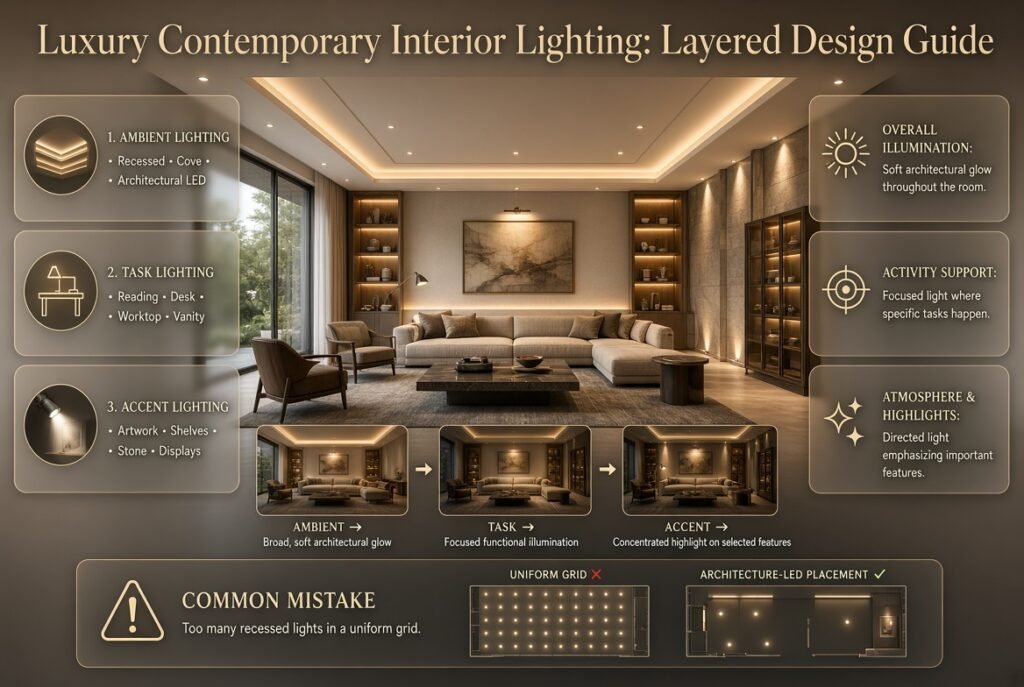
Luxury contemporary lighting should have layers.
Ambient Lighting
Ambient lighting provides overall illumination.
Examples include:
- Recessed lighting
- Ceiling fixtures
- Cove lighting
- Architectural LEDs
Task Lighting
Task lighting supports activities.
Examples include:
- Reading lamps
- Desk lamps
- Kitchen worktop lighting
- Vanity lighting
Accent Lighting
Accent lighting creates atmosphere and highlights important features.
It can illuminate:
- Artwork
- Shelves
- Stone walls
- Architectural details
- Display cabinets
Combining these layers gives you much more control over the room.
⚠ Common Mistake: Installing too many recessed lights in a perfectly uniform grid. Lighting should respond to the architecture and activities of the room rather than simply filling every part of the ceiling.
How Do You Use Architectural Details in Contemporary Luxury?
Luxury can come from architecture rather than decoration.
Consider:
- Wall paneling
- Built-in cabinetry
- Full-height doors
- Feature walls
- Fireplace surrounds
- Ceiling details
- Integrated lighting
- Large openings
- Custom storage
A plain wall doesn’t necessarily need artwork.
It might become more sophisticated through a carefully proportioned wall treatment or integrated lighting.
The important word is restraint.
One strong architectural feature often works better than several competing ones.
How Does Storage Create a Luxury Feel?
Storage is one of the hidden foundations of good interior design.
Clutter immediately changes the visual quality of a room.
Everyday items such as chargers, paperwork, bags, toys, remote controls, and small appliances should have designated storage wherever possible.
Consider:
- Full-height wardrobes
- Built-in cabinets
- Concealed drawers
- Storage benches
- Media units
- Integrated kitchen storage
- Hidden charging stations
Luxury isn’t simply about what you display.
It’s also about what you successfully hide.
Can Sustainable Design Be Luxurious?
Absolutely.
Sustainable design can actually strengthen the quality of a contemporary interior because it encourages durability and thoughtful purchasing.
Consider:
- Responsibly sourced wood
- Long-lasting furniture
- Durable upholstery
- Energy-efficient lighting
- Reclaimed materials
- Low-waste renovation
- Natural materials
- Repairable products
A beautiful piece that lasts for years can be more valuable than a fashionable piece that needs replacement quickly.
If sustainability is important to your project, explore sustainable home design for additional ideas.
Can Biophilic Design Work With Contemporary Luxury?
Yes.
Plants, daylight, natural textures, organic shapes, and views of nature can soften the sharper lines of contemporary architecture.
Imagine a room combining:
Travertine + walnut + linen + greenery + natural daylight
The result can feel sophisticated while remaining relaxed.
Biophilic elements are particularly useful when a contemporary room feels too hard or sterile.
You can explore more biophilic interior design ideas when introducing natural elements into your home.
How Do You Make a Home Office Feel Luxurious?
A luxury home office needs to support concentration as well as appearance.
Start with:
- Ergonomic chair
- Well-sized desk
- Proper task lighting
- Hidden cables
- Closed storage
- Organized shelves
- Comfortable proportions
Don’t sacrifice ergonomics to achieve a beautiful photograph.
A desk that’s too high or a chair that doesn’t provide adequate support will quickly become uncomfortable.
For practical workspace planning, explore functional home office ideas.
How Do You Add Personality Without Losing Sophistication?
A contemporary luxury home shouldn’t feel like a furniture showroom.
Personal objects make a home feel authentic.
Consider displaying:
- Artwork
- Books
- Family photographs
- Handmade ceramics
- Vintage pieces
- Travel objects
- Sculptures
- Plants
But edit carefully.
You don’t need to display everything you own.
One meaningful object can contribute more personality than a shelf full of random decorations.
How Do You Make Different Rooms Feel Connected?
Every room doesn’t need to look identical.
Instead, create visual relationships.
You might repeat:
- Wood tones
- Flooring
- Metal finishes
- Accent colors
- Lighting temperature
- Wall undertones
- Textures
For example, the living room could use beige and walnut while the bedroom uses cream and darker wood.
They don’t need to match exactly.
They simply need to feel like they belong to the same home.
How Do You Create Luxury Without Spending a Fortune?
Luxury design doesn’t require an unlimited budget.
The important thing is where you spend.
Spend More Carefully On:
- Main sofa
- Bed and mattress
- Lighting
- Flooring
- Curtains
- Countertops
- Built-in storage
- Major architectural details
Save More On:
- Small accessories
- Trend-based decorations
- Temporary artwork
- Cushions
- Small side tables
- Seasonal pieces
A strong foundation allows affordable accessories to look much better.
If your project involves broader renovation work as well as styling, the Home Improvement section can help you think about the physical condition and functionality of the home before focusing only on decoration.
How Can You Make Affordable Furniture Look More Expensive?
The surrounding environment has a huge effect on perception.
Consider a simple sofa.
If it’s sitting on a tiny rug under harsh lighting beside mismatched curtains, it won’t look premium.
Now place the same sofa in a room with:
- Properly fitted curtains
- Large textured rug
- Warm layered lighting
- Coordinated cushions
- Natural wood
- One strong artwork
- Clear surfaces
The entire perception changes.
This is why composition can sometimes matter more than price.
What Are the Biggest Luxury Contemporary Interior Mistakes?
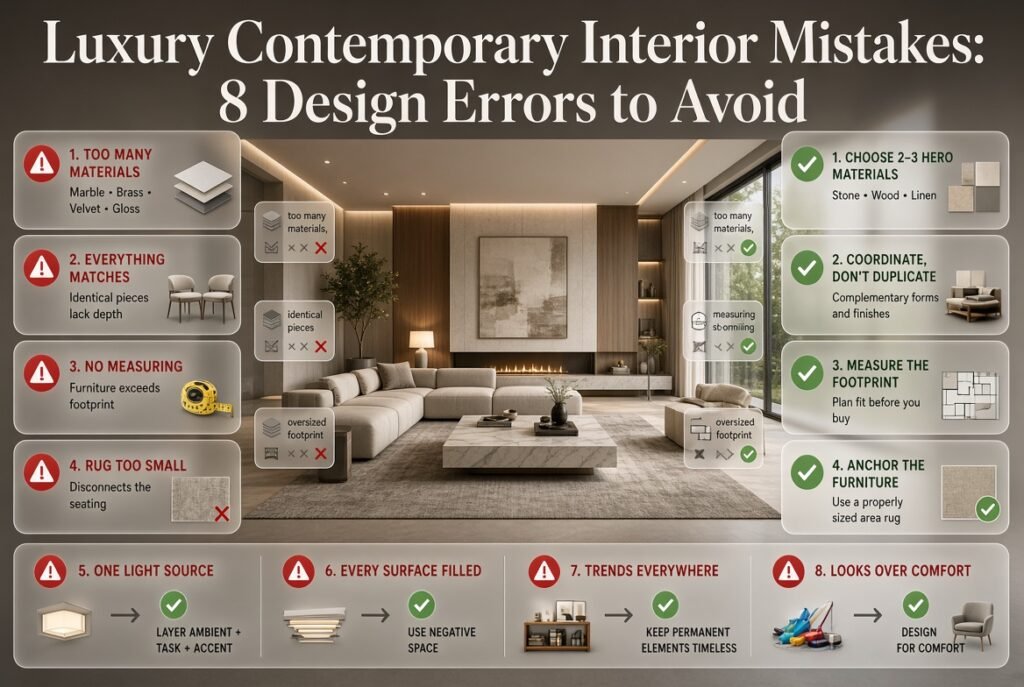
Using Too Many Expensive Materials
Marble, brass, velvet, mirrored surfaces, glossy finishes, crystal, and dramatic lighting can all be beautiful individually.
Together, they can become excessive.
Solution: Choose two or three hero materials and let the rest remain quiet.
Making Everything Match
Perfectly matching furniture sets can make a home look generic.
Solution: Coordinate colors and materials without duplicating every item.
Buying Furniture Without Measuring
A showroom can make furniture appear smaller than it will feel at home.
Solution: Measure and mark the furniture footprint on your floor.
Using Rugs That Are Too Small
Tiny rugs can visually disconnect furniture.
Solution: Select a rug that properly anchors the main furniture arrangement.
Using Only One Light Source
A single bright ceiling fixture creates flat illumination.
Solution: Layer ambient, task, and accent lighting.
Filling Every Surface
A room doesn’t become more luxurious because every shelf contains something.
Solution: Use negative space intentionally.
Following Trends Too Literally
A room built entirely around current trends can look dated quickly.
Solution: Keep permanent elements timeless and experiment with trends through replaceable pieces.
Choosing Appearance Over Comfort
A beautiful chair that nobody enjoys sitting in isn’t successful design.
Solution: Consider comfort before aesthetics alone.
How Do Professionals Approach Luxury Contemporary Design?
Professional-looking interiors generally begin with planning rather than shopping.
Step 1: Study the Space
Measure the room and identify windows, doors, ceiling height, natural light, and circulation.
Step 2: Understand the Lifestyle
Determine how people actually use the room.
A family living room has different requirements from a formal entertaining space.
Step 3: Establish the Design Direction
Decide on the overall visual language before purchasing individual items.
Step 4: Build the Palette
Choose dominant, secondary, and accent colors.
Step 5: Select Materials
Choose wood, stone, metal, glass, and textile finishes that work together.
Step 6: Place Major Furniture
Start with the largest pieces.
Step 7: Plan Lighting
Use ambient, task, and accent layers.
Step 8: Add Architectural Features
Introduce built-ins, paneling, integrated lighting, or custom details where useful.
Step 9: Add Artwork and Accessories
Only after the foundation is complete.
Step 10: Edit
Remove anything unnecessary.
This final step is often what separates a polished room from an overcrowded one.
How Can You Design a Luxury Contemporary Entryway?
The entrance creates the first impression of the home.
Even a small entryway can feel refined.
Consider:
- Slim console
- Mirror
- Artwork
- Soft lighting
- Small decorative object
- Practical storage
- Durable flooring
Don’t allow the entryway to become a dumping area for shoes, bags, keys, and mail.
Give everyday objects designated places.
A clean entrance makes the entire home feel more organized.
How Can You Create a Luxury Contemporary Dining Room?
The dining table should normally be the visual anchor.
Choose its shape based on the room.
A rectangular table can work well in a long dining area, while a round table can be useful in smaller rooms and encourage conversation.
Lighting should relate to the table.
A pendant or chandelier above the table can become a strong focal point, but its size should be proportional to the room and furniture.
Keep the centerpiece simple.
One beautiful arrangement often looks better than several small decorative objects.
How Should a Contemporary Luxury Bathroom Be Designed?
Bathrooms work naturally with contemporary luxury because clean surfaces and minimal details already support the style.
Consider:
- Large-format tiles
- Natural stone
- Wall-mounted vanity
- Frameless shower screen
- Integrated lighting
- Minimal hardware
- Warm wood
- Concealed storage
Avoid using a different finish on every wall.
One strong material repeated thoughtfully can look more expensive than multiple competing finishes.
How Do You Keep Contemporary Interiors Warm?
Contemporary spaces can sometimes feel cold when they contain too much glass, polished stone, gray, or metal.
Warmth can be introduced through:
- Natural wood
- Soft textiles
- Warm lighting
- Earthy colors
- Curved furniture
- Plants
- Handmade objects
- Layered rugs
You don’t need to abandon contemporary design.
Simply balance hard elements with softer ones.
Can You Mix Contemporary Luxury With Other Styles?
Yes, but establish a clear hierarchy.
You might combine contemporary design with:
- Japandi
- Scandinavian
- Organic modern
- Art Deco
- Minimalism
- Transitional design
For example, contemporary design with Japandi influences can introduce more natural wood, soft colors, and calm simplicity.
Contemporary design with Art Deco influences can introduce stronger geometry and glamorous details.
The mistake is giving every style equal attention.
Choose one dominant language and allow the secondary influence to remain subtle.
How Can You Create a More Cohesive Home?
Cohesion doesn’t mean every room needs the same furniture or colors.
Instead, repeat selected elements.
For example:
Entryway: Walnut + bronze
Living room: Walnut + bronze + cream
Bedroom: Dark wood + bronze + warm white
Kitchen: Walnut + stone + bronze
The rooms feel connected without becoming identical.
This approach is especially useful in open-plan homes where different zones need to feel related.
Practical Luxury Contemporary Interior Checklist
Before calling a room finished, ask:
- Is the furniture correctly scaled?
- Are walking paths comfortable?
- Does the color palette feel coordinated?
- Are materials varied enough?
- Are hard and soft textures balanced?
- Is lighting layered?
- Are curtains positioned correctly?
- Is the rug large enough?
- Is storage sufficient?
- Is artwork properly scaled?
- Are accessories intentional?
- Is there enough negative space?
- Does the room reflect real lifestyle needs?
- Are permanent finishes relatively timeless?
- Is technology visually controlled?
- Does the room feel comfortable?
What makes an interior look luxurious and contemporary?
A luxurious contemporary interior isn’t created by simply adding expensive furniture or glossy finishes. The real difference comes from proportion, material quality, lighting, color harmony, comfort, and visual restraint. A well-designed room feels intentional because every major element has a purpose and relates naturally to the others.
For example, a living room with a large well-proportioned sofa, warm wood, natural stone, layered lighting, textured curtains, and one strong artwork can feel far more luxurious than a room filled with expensive decorative objects.
Key points:
Focus on proportion before decoration.
Combine natural and refined materials.
Use layered lighting instead of one harsh ceiling light.
Keep clutter under control.
Choose fewer, better-quality statement pieces.
Make comfort part of the design.
What colors are best for luxury contemporary interiors in 2026?
Warm, sophisticated colors are becoming particularly important in 2026. Instead of relying entirely on cold whites and cool grays, contemporary luxury is moving toward warm neutrals, earthy tones, richer woods, and carefully controlled deeper colors. Current design coverage highlights shades and palettes involving warm whites, sand, stone, taupe, chocolate brown, burgundy, forest green, and other richer tones.
A practical approach is to use a warm neutral as the foundation and introduce stronger colors through furniture, artwork, curtains, or selected architectural details.
Good combinations include:
Warm white + walnut + bronze
Beige + chocolate brown + cream
Taupe + forest green + natural wood
Soft stone + burgundy + dark wood
Warm gray + charcoal + brushed metal
The goal isn’t to use every trending color. Choose a palette that works with your flooring, natural light, stone, and existing architecture.
What materials make a contemporary interior look more luxurious?
The most convincing luxury interiors usually rely on material contrast rather than excessive decoration. Natural stone, rich wood, linen, wool, leather, glass, brushed metals, textured plaster, and artisanal finishes can create depth without making the room feel overloaded.
Current 2026 trends are particularly interested in tactile materials, warmer woods, authentic stone, patinated or matte metals, and handcrafted details.
The important part is how materials are combined.
For example, polished stone can feel cold on its own, but pairing it with walnut cabinetry, linen upholstery, warm lighting, and textured rugs creates balance.
For a refined result:
Use stone as a focal material.
Introduce natural wood for warmth.
Add textiles for softness.
Use metal for small architectural accents.
Repeat important materials throughout the room.
Is contemporary luxury interior design still trending in 2026?
Yes, but the definition of luxury is changing. Contemporary luxury is moving away from extremely sterile, all-white spaces toward interiors that feel warmer, more tactile, personal, comfortable, and lived-in. Designers are also embracing sculptural furniture, darker woods, richer colors, craftsmanship, wellness-focused spaces, and more individual expressions of style.
This doesn’t mean minimalism has disappeared. Instead, minimalism is becoming more comfortable and layered.
A successful 2026 contemporary interior can still have clean architecture and uncluttered surfaces while incorporating:
Sculptural furniture
Darker timber
Natural stone
Rich textiles
Curved forms
Personal artwork
Handcrafted objects
Warmer colors
The important thing is not to copy a trend room by room. Use current ideas selectively so the home remains attractive after the trend cycle passes.
How can I make my home look luxurious without spending too much money?
The smartest way to create a luxury appearance on a limited budget is to prioritize high-impact elements instead of buying expensive accessories everywhere.
Start with the room’s layout, lighting, curtains, rug size, wall color, and furniture proportions. These elements influence the overall appearance much more than small decorative objects.
For example, replacing ten inexpensive accessories may have little impact, while improving the lighting and installing properly proportioned curtains can completely change how the room feels.
Spend strategically on:
Main sofa or bed
Quality curtains
Lighting
Flooring
A large, appropriate rug
Built-in storage
One strong artwork or focal piece
Save on:
Small accessories
Trend-based decorations
Seasonal cushions
Easily replaceable decorative items
Luxury is largely about editing and coordination, not simply price.
Conclusion
Luxury contemporary interiors aren’t really about filling a home with expensive furniture, marble surfaces, or eye-catching decorations. The real luxury comes from creating a space where design, comfort, functionality, and personality work together naturally.
Start with the fundamentals: get the proportions right, establish a calm and coordinated color palette, choose materials that add depth, and invest in lighting that changes the mood of the room. From there, introduce comfortable furniture, natural textures, thoughtful storage, artwork, and a few personal pieces that make the space feel genuinely yours.
Don’t feel pressured to follow every interior trend. The strongest contemporary homes use current ideas selectively while keeping their main elements timeless. Warm woods, tactile fabrics, natural stone, sculptural furniture, layered lighting, and carefully chosen accents can give a home a modern luxury feel without making it look cold or overly designed.
Most importantly, design the home around how you actually live. A beautiful room that is uncomfortable, difficult to maintain, or filled with unnecessary objects won’t feel luxurious for long.
When every choice has a reason and every element has enough space to breathe, the result is more than a stylish interior. It’s a home that feels refined, comfortable, personal, and effortlessly sophisticated—the qualities that truly define luxury contemporary interiors.
Leave a Reply