
Introduction
Japandi Interior Design for Small Apartments | A small apartment can look stylish in photographs but feel completely different when you actually live in it. The sofa blocks part of the walkway, the dining table takes over the living room, storage fills every available wall, and a few everyday belongings can quickly make the entire space feel crowded.
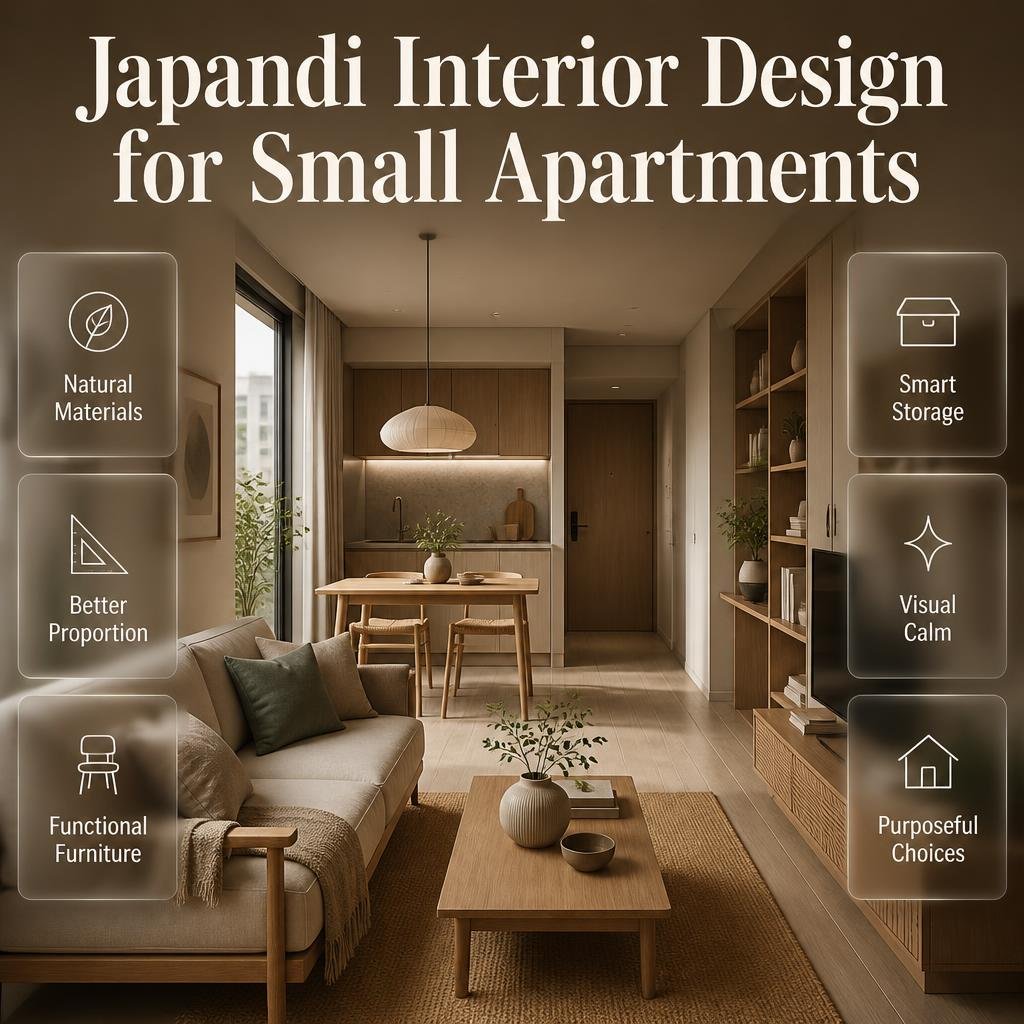
This is exactly why Japandi interior design for small apartments has become such a practical design approach. Instead of trying to squeeze more furniture and decoration into a limited floor plan, Japandi focuses on proportion, functionality, natural materials, visual calm, and purposeful choices.
If you’re designing a studio, compact apartment, rental, or small city home, you don’t need to make the space completely empty to make it feel larger.
You need to make better decisions about what stays visible, what gets stored away, how furniture is positioned, and how different areas connect visually.
For broader residential inspiration, DesignMode24 Interior Design explores practical ideas for creating thoughtful and functional interiors.
In this guide, we’ll cover everything from Japandi colors and furniture to storage, lighting, layouts, bedrooms, dining areas, decoration, mistakes, budgeting, and practical apartment makeover strategies.
What Is Japandi Interior Design?
Japandi interior design combines the simplicity and calmness associated with Japanese interiors with the warmth, comfort, and functionality associated with Scandinavian design.
The style doesn’t depend on a strict shopping list of furniture.
Instead, it is based on a design philosophy.
You generally see:
- Natural wood
- Warm neutral colors
- Simple furniture
- Clean architectural lines
- Soft textiles
- Handmade-looking ceramics
- Functional storage
- Minimal decorative clutter
- Natural light
- Warm layered lighting
- Comfortable but restrained interiors
The Japanese influence often brings a sense of balance, simplicity, natural materials, and appreciation for imperfect or organic details.
The Scandinavian influence brings practicality, comfort, warmth, and everyday livability.
The combination creates a home that feels simple without feeling empty.
That distinction is particularly important in a small apartment.
A room can be minimal but uncomfortable. It can also be beautifully decorated but impossible to move around in.
Japandi aims for a middle ground where the space looks calm while still supporting real daily life.
Why Is Japandi So Effective for Small Apartments?
Japandi works especially well in compact homes because it doesn’t encourage unnecessary visual competition.
When a small room contains too many colors, furniture shapes, patterns, decorations, and materials, the eye has nowhere to rest.
The room therefore feels smaller.
Japandi solves part of this problem by reducing visual noise.
Instead of asking:
“What else can I add?”
you start asking:
“What does this room actually need?”
That change makes a major difference.
A small living room might need:
- One comfortable sofa
- One compact coffee table
- One useful side table
- One light source
- One storage solution
- A rug
- A few meaningful decorative pieces
It doesn’t need ten accessories.
The Small-Apartment Principle
Think of your apartment as a collection of functional zones rather than a collection of furniture.
For example:
┌─────────────────────────────────┐
│          NATURAL LIGHT          │
│                                 │
│   LIVING ZONE       DINING      │
│   ┌───────────┐    ┌────────┐   │
│   │   SOFA    │    │ TABLE  │   │
│   └───────────┘    └────────┘   │
│                                 │
│        OPEN WALKWAY              │
│                                 │
│   STORAGE       KITCHEN         │
│                                 │
│             ENTRANCE             │
└─────────────────────────────────┘
The exact layout will vary, but the principle remains the same:
Every zone should have a clear purpose, and circulation should remain comfortable.
How Should You Choose a Japandi Color Palette for a Small Apartment?
Color is one of the easiest ways to control how spacious an apartment feels.
For a small Japandi home, start with a warm neutral base.
Good choices include:
- Warm white
- Cream
- Soft beige
- Greige
- Taupe
- Light warm gray
- Pale natural wood
Then introduce one or two darker accents.
For example:
| Main Color | Supporting Color | Accent |
|---|---|---|
| Warm white | Light oak | Charcoal |
| Cream | Beige | Deep brown |
| Greige | Natural wood | Muted green |
| Soft gray | Taupe | Soft black |
The purpose isn’t to create a completely beige apartment.
The purpose is to create visual continuity.
When walls, furniture, textiles, and flooring work within a related tonal family, the eye can move around the room more easily.
Should You Use White Walls?
White can work, but pure bright white isn’t always the best choice.
A warm white often feels more comfortable alongside natural wood and beige textiles.
If your apartment receives limited natural light, an overly cool white can sometimes make the space feel harder and less inviting.
Before choosing a wall color, consider:
- Natural daylight
- Flooring color
- Window direction
- Existing cabinetry
- Furniture finishes
- Artificial lighting
For additional ideas about choosing and coordinating colors, you can explore the Paint Color section.
💡 Pro Tip: Don’t choose your wall color in isolation. Place a sample next to your flooring, furniture, curtains, and wood finish. A color that looks warm on a screen can appear completely different beside cool flooring.
How Do You Choose Japandi Furniture for a Small Apartment?
Furniture selection is probably the most important decision you’ll make.
In a small apartment, the wrong sofa can create more problems than the wrong wall color.
Start with dimensions.
Measure:
- Room width
- Room length
- Door openings
- Window locations
- Walking routes
- Furniture depth
- Ceiling height
- Radiators
- Electrical outlets
Then determine how much furniture the room can realistically support.
Choose Proportion Over Tiny Furniture
Small doesn’t automatically mean better.
A tiny sofa surrounded by several unrelated small pieces can actually make the room feel visually fragmented.
Instead, choose fewer pieces with appropriate proportions.
Useful Japandi furniture choices include:
- Compact streamlined sofas
- Low-profile beds
- Slim dining chairs
- Round dining tables
- Narrow consoles
- Storage benches
- Simple wooden coffee tables
- Closed storage cabinets
- Nesting tables
Look for furniture with clean silhouettes rather than excessive ornamentation.
Multifunctional Furniture Is Especially Valuable
A small apartment benefits from furniture that performs more than one job.
Examples include:
- Ottoman with storage
- Sofa bed
- Extendable dining table
- Storage bench
- Bed with drawers
- Foldable dining furniture
- Nesting coffee tables
- Wall-mounted desks
The goal isn’t to turn your apartment into a collection of transforming furniture.
Choose multifunctional pieces only where they genuinely solve a problem.
How Should You Plan a Japandi Living Room?
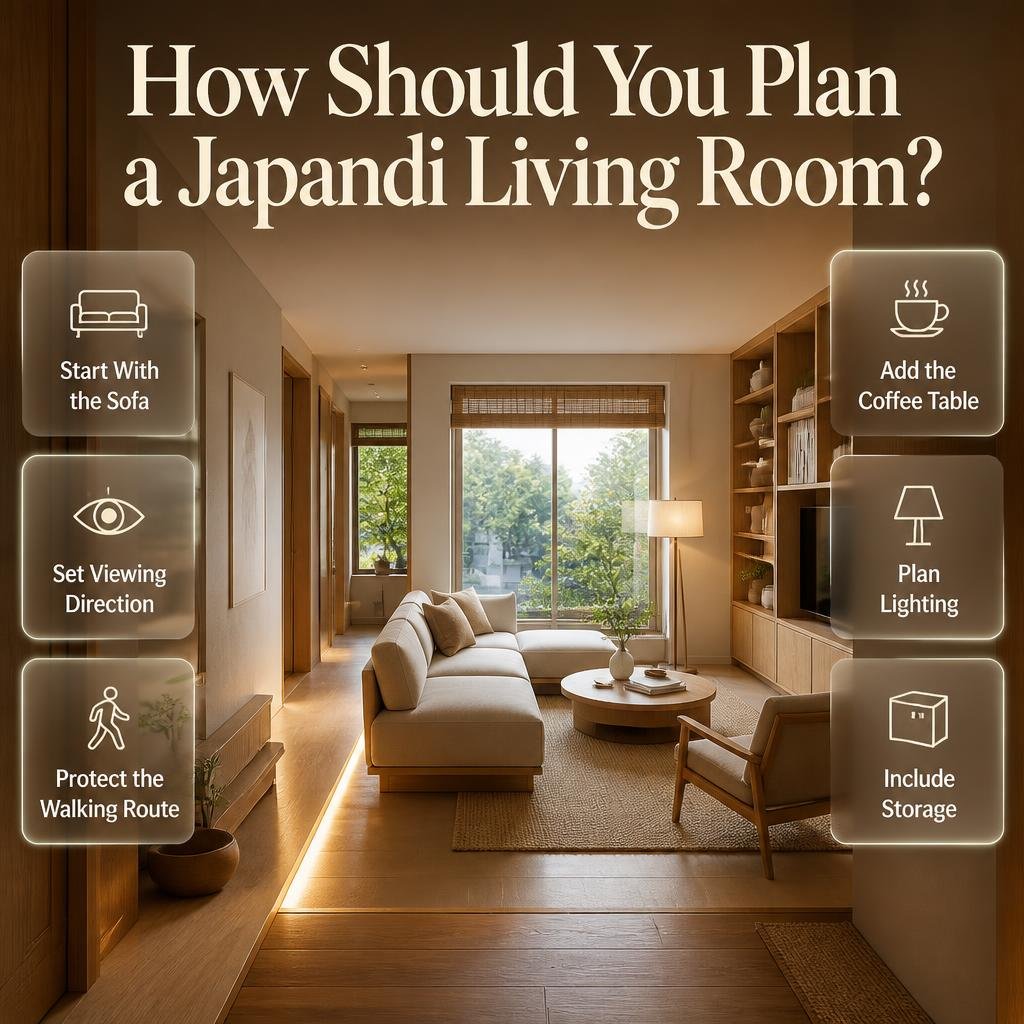
The living room is usually the visual center of a small apartment, so it needs careful planning.
Start with the sofa.
Then establish the primary viewing direction and walking route.
After that, introduce the coffee table, occasional chair, lighting, and storage.
A useful rule is to protect the main circulation route.
Don’t place furniture where you constantly need to squeeze through.
A Simple Layout Strategy
WINDOW
┌─────────────────────────────┐
│                             │
│        ┌───────────┐        │
│        │   SOFA    │        │
│        └───────────┘        │
│                             │
│          ┌─────┐            │
│          │TABLE│     LAMP   │
│          └─────┘            │
│                             │
│       OPEN WALKWAY           │
│                             │
│ STORAGE          ENTRANCE   │
└─────────────────────────────┘
This is only a conceptual example.
Your apartment may work better with furniture against different walls.
The important point is to think about movement first.
If you are interested in broader room-by-room planning, the Room-by-Room Design Hub can help you think about each space according to its function.
How Can You Create Storage Without Making the Apartment Feel Crowded?
Storage is one of the biggest challenges in small apartments.
The mistake is assuming that all storage should be visible.
Japandi works particularly well when everyday clutter has somewhere to disappear.
Use:
- Closed cabinets
- Built-in wardrobes
- Under-bed storage
- Storage benches
- Drawer units
- Concealed kitchen storage
- Baskets
- Wall-mounted cabinets
- Narrow vertical storage
Closed Storage vs Open Storage
| Storage Type | Best For | Potential Problem |
|---|---|---|
| Closed cabinet | Everyday clutter | Can feel bulky if oversized |
| Open shelf | Books and selected objects | Easily becomes messy |
| Basket | Soft accessories | Too many baskets can look repetitive |
| Built-in storage | Maximum organization | More expensive |
| Under-bed storage | Seasonal items | Harder to access |
Open shelving should be treated almost like decoration.
If every shelf is full, it stops creating an airy appearance.
⚠ Common Mistake: Buying several open shelves because they look clean in design photographs.
Real life is different.
Cables, paperwork, chargers, small appliances, and random household objects quickly occupy open shelves.
Use closed storage for things that don’t need to be displayed.
How Can You Make a Small Japandi Bedroom Feel Spacious?
The bedroom should be calm rather than overloaded.
Start with the bed because it is normally the largest piece.
A simple wooden or upholstered bed with a clean profile can establish the design direction.
Then keep bedside furniture compact.
Instead of large nightstands, consider:
- Small drawer tables
- Floating bedside shelves
- Wall-mounted lights
- Narrow cabinets
- Simple stools
A large bedroom wardrobe may need to occupy significant space, so choose one with a visually quiet finish.
For more detailed planning, see Bedroom Planning and Layout.
Use Vertical Space Carefully
When floor space is limited, the walls become valuable.
But don’t cover every wall with shelves.
Instead, use vertical space for functions such as:
- Tall wardrobes
- Wall-mounted lighting
- Narrow artwork
- High storage
- Curtains extending toward the ceiling
This draws the eye upward while preserving floor area.
How Should Lighting Work in a Japandi Small Apartment?
Lighting can completely change the perceived quality of a small interior.
A room with beautiful furniture can still feel cheap if it has one harsh overhead light.
Japandi lighting should generally feel warm, comfortable, and layered.
Think in three levels:
Ambient Lighting
This provides general illumination.
Examples:
- Ceiling fixture
- Recessed lighting
- Soft indirect lighting
Task Lighting
This supports specific activities.
Examples:
- Reading lamp
- Desk lamp
- Kitchen worktop lighting
- Bedside lamp
Accent Lighting
This highlights selected architectural or decorative elements.
Examples:
- Artwork lighting
- Shelf lighting
- Cabinet lighting
- Wall washing
The objective isn’t to make the room extremely bright.
The objective is to give yourself control over the atmosphere.
For a more technology-focused approach, Intelligent Lighting can provide additional ideas about using modern lighting systems within residential interiors.
⭐ Expert Tip: Use different lighting sources instead of trying to make one ceiling fixture do everything. A warm floor lamp beside the sofa can make a bigger difference to evening atmosphere than another decorative object.
What Materials Work Best in Japandi Interiors?
Materials are central to Japandi because the style doesn’t depend heavily on bold decoration.
Natural materials provide the visual interest.
Consider:
- Oak
- Ash
- Bamboo
- Linen
- Cotton
- Wool
- Stone
- Ceramic
- Rattan
- Woven fibers
- Matte metal
You don’t need all of them.
In fact, using too many materials in a small apartment can make the room feel confused.
A simple combination such as:
Oak + linen + ceramic + wool
can create considerable visual depth.
Why Texture Matters
Texture allows you to maintain a restrained color palette without making the room boring.
For example, imagine a living room with:
- Cream wall
- Beige sofa
- Light oak table
- Linen curtains
- Wool rug
- Ceramic vase
The colors are quiet, but the different textures keep the room interesting.
This is one of the strongest ways to create sophistication without visual overload.
How Can You Make Japandi Feel Warm Instead of Cold?
This is a common concern.
Minimal interiors sometimes become uncomfortable when every element is hard, smooth, and neutral.
To prevent that, introduce softness.
Use:
- Linen curtains
- Soft rugs
- Cushions
- Wool throws
- Upholstered seating
- Natural wood
- Warm lamps
- Plants
- Handmade ceramics
Warmth also comes from visual imperfection.
A handmade ceramic vase doesn’t need to look perfectly symmetrical.
A wooden surface with visible grain can provide more character than a perfectly uniform finish.
This is where Japandi becomes more human.
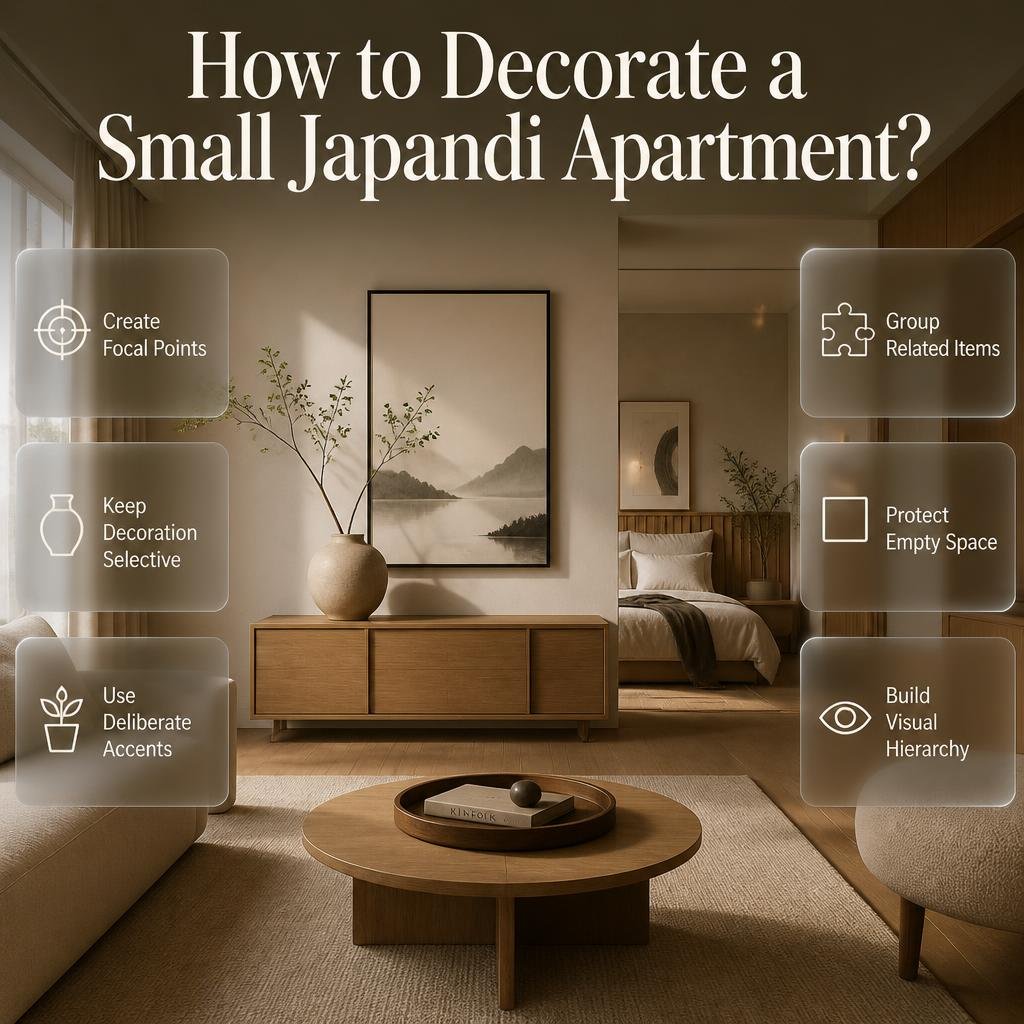
How Do You Decorate a Small Japandi Apartment?
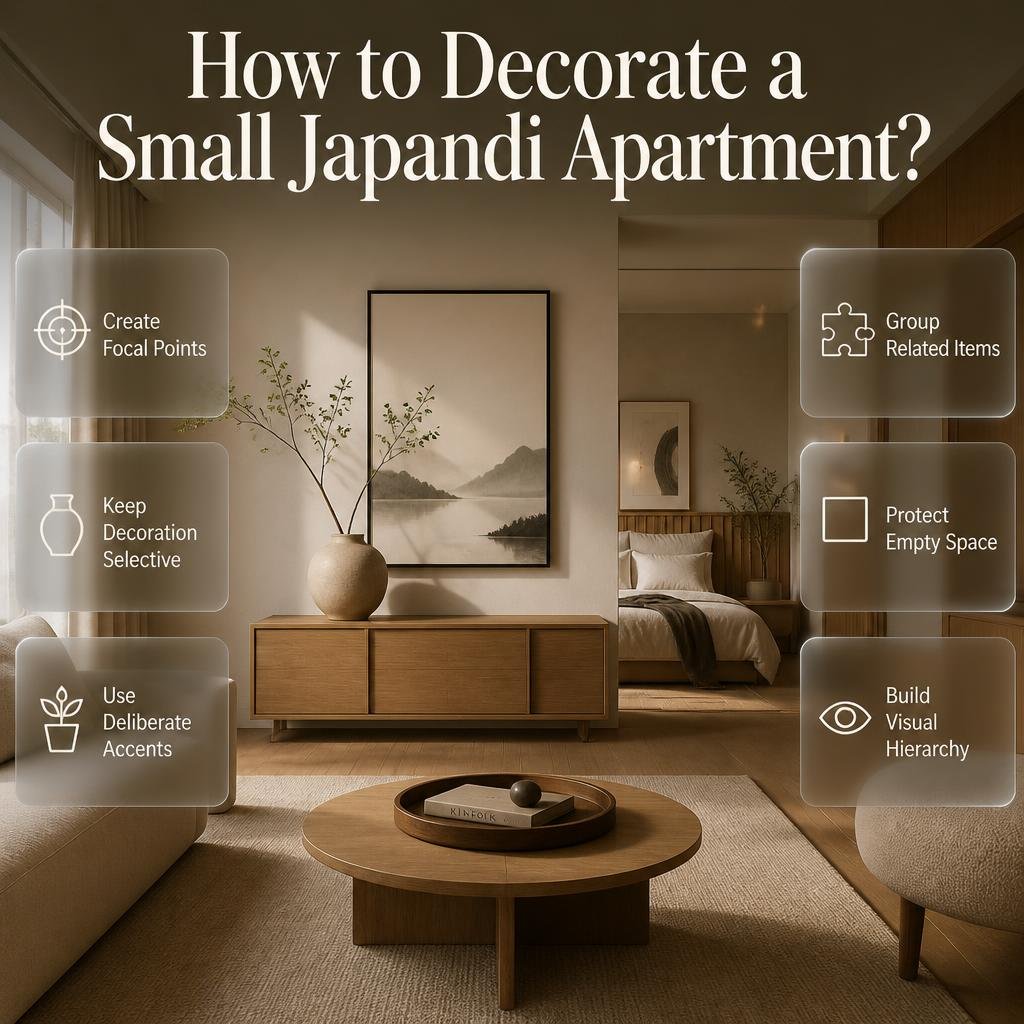
Decoration should be selective.
Instead of placing something on every surface, create a few deliberate focal points.
A console might include:
- One ceramic vase
- One small branch
- One artwork
- Empty space
A coffee table might have:
- One tray
- One book
- One small object
A bedroom might have:
- One artwork
- One plant
- One textile accent
The empty space is important.
Without it, decorative objects lose their impact.
For more ideas about choosing and positioning decorative details, explore Accent Pieces.
Think in Groups
Instead of spreading objects individually across the room, group related items.
For example:
        ARTWORK
           │
     ┌───────────┐
     │           │
     └───────────┘

   Vase       Book
    ╲          ───
     ╲        ────

       EMPTY SPACE
This creates a visual hierarchy.
Should You Add Plants to a Japandi Apartment?
Plants can be extremely effective because they introduce organic shapes and natural color.
However, you don’t need a jungle.
One large plant in a suitable corner can have more impact than six small plants scattered around the apartment.
Consider:
- Snake plants
- ZZ plants
- Small leafy plants
- Olive-style trees where light allows
- Bonsai-inspired arrangements
- Simple branches
Choose plants according to your actual lighting conditions.
Don’t buy a plant simply because it appears frequently in interior photographs.
If your apartment has a balcony or outdoor area, you can also explore Robert MyGardenAndPatio for related garden and outdoor inspiration.
How Can Mirrors Help a Small Japandi Apartment?
Mirrors can make a compact apartment feel more open by reflecting light and extending the visual field.
But placement matters.
A mirror can work well:
- Near a window
- Opposite natural light
- Behind a console
- Near an entrance
- Beside a dining area
Avoid placing it where it reflects clutter.
Before mounting a mirror, stand where it will be installed and look at the reflection.
Ask:
What will this mirror make more visible?
If the answer is a messy storage area, move it.
If it reflects light, greenery, or open space, it can be much more effective.
📌 Quick Tip: In a very small apartment, a large simple mirror can often create more visual impact than several small decorative mirrors.
How Do You Create a Japandi Dining Area in a Small Apartment?
Dining furniture can consume significant floor area, especially when the dining zone is connected to the kitchen or living room.
Choose the table according to the number of people who actually use it daily.
A two-person household doesn’t necessarily need a large six-person dining table permanently occupying the room.
Consider:
- Round tables
- Drop-leaf tables
- Extendable tables
- Narrow rectangular tables
- Wall-mounted dining surfaces
Round tables are especially useful in tight spaces because there are no sharp corners to navigate around.
Keep the chairs visually simple.
Avoid oversized chairs with wide arms unless there is sufficient clearance.
Can Japandi Work in an Open-Plan Small Apartment?
Yes, and the principles become even more important.
In an open-plan apartment, the living, dining, and kitchen areas need to feel connected.
Use repeated elements to create continuity.
For example:
Living room: light oak + cream + charcoal
Dining area: light oak + cream + charcoal
Kitchen: warm white + wood + matte dark hardware
The colors don’t have to be identical.
They simply need to relate.
This prevents the apartment from feeling like several unrelated rooms pushed together.
How Can Wall Design Support Japandi Style?
Walls should generally support the calmness of the interior rather than compete with it.
Instead of highly complicated wall treatments, consider:
- Warm paint
- Minimal artwork
- Natural textures
- Simple wood details
- Subtle paneling
- Carefully positioned shelving
If you want to explore wall-focused ideas, Wall Treatments can provide additional inspiration.
The key is restraint.
One carefully designed wall can establish character.
Every wall doesn’t need to become a feature wall.
How Can You Make a Small Japandi Apartment Look More Elegant?
Elegance isn’t necessarily about expensive furniture.
It often comes from consistency.
A room can look sophisticated when:
- Furniture proportions are correct
- Colors work together
- Materials repeat intentionally
- Lighting is controlled
- Storage is organized
- Accessories are limited
- Walking space is protected
This is why small apartments can still feel luxurious.
The room doesn’t need expensive objects everywhere.
It needs fewer visual mistakes.
For additional inspiration, see Elegant Spaces.
Can Japandi Design Feel Luxurious?
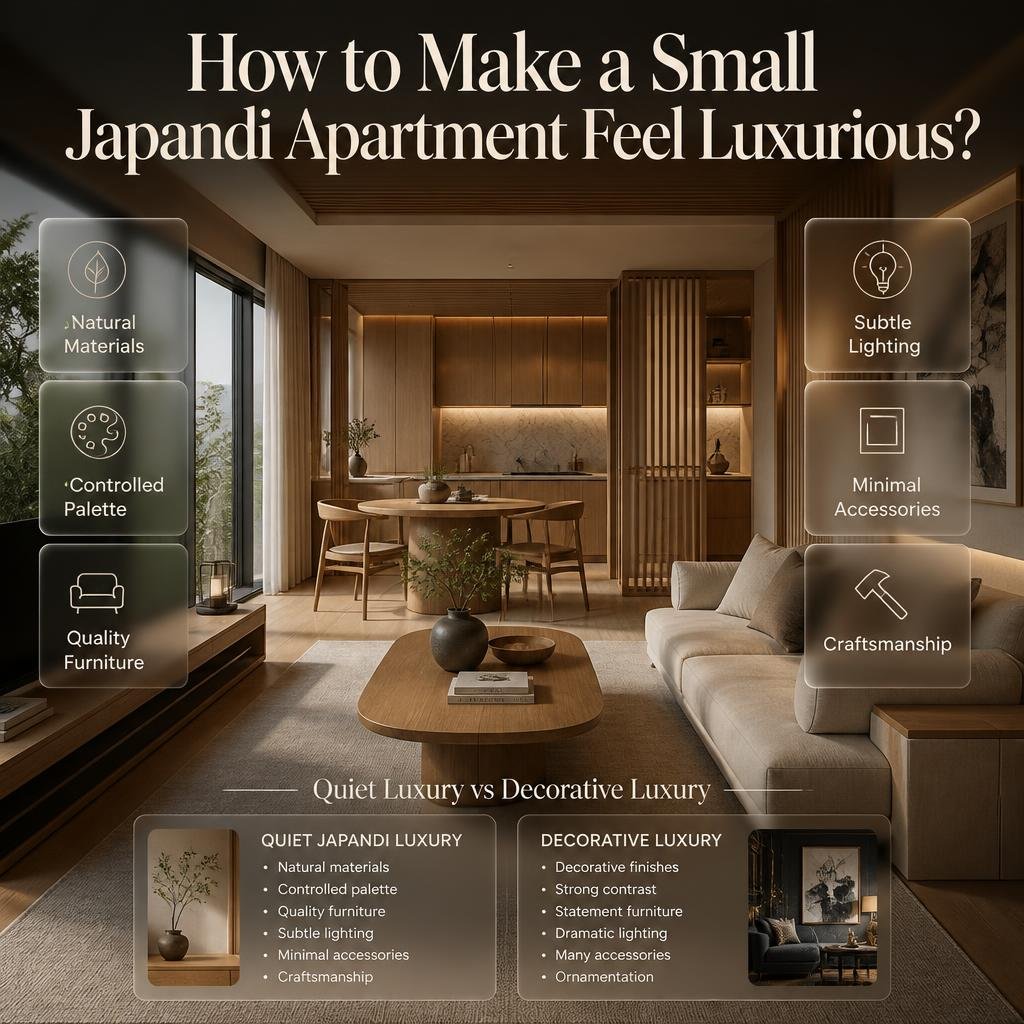
Absolutely.
Japandi luxury is generally quiet rather than flashy.
Instead of obvious ornamentation, focus on:
- High-quality natural materials
- Beautiful wood grain
- Comfortable upholstery
- Soft lighting
- Custom storage
- Clean detailing
- Balanced proportions
- Carefully selected artwork
A small apartment can feel luxurious when every visible element appears intentional.
For more ideas about refined residential environments, explore Luxury Spaces.
Quiet Luxury vs Decorative Luxury
| Quiet Japandi Luxury | Decorative Luxury |
|---|---|
| Natural materials | Decorative finishes |
| Controlled palette | Strong contrast |
| Quality furniture | Statement furniture |
| Subtle lighting | Dramatic lighting |
| Minimal accessories | Many accessories |
| Craftsmanship | Ornamentation |
Neither approach has to be universally right.
For a small apartment, however, quiet luxury often integrates more easily because it doesn’t demand as much visual space.
What Are the Biggest Japandi Mistakes in Small Apartments?
Mistake 1: Thinking Japandi Means an Empty Room
An empty room isn’t automatically a Japandi room.
A good Japandi interior should support real life.
You still need:
- Comfortable seating
- Storage
- Lighting
- Textiles
- Personal belongings
- Practical furniture
The goal is intentional simplicity.
Mistake 2: Using Too Much Beige
A neutral palette still needs variation.
Use:
- Different textures
- Different tonal values
- Natural wood
- Small dark accents
- Greenery
Mistake 3: Choosing Furniture Without Measuring
This is one of the most expensive mistakes.
A sofa can technically fit into a room while still making the room uncomfortable.
Measure before buying.
Mistake 4: Filling Every Wall
A small apartment doesn’t need every wall decorated.
Empty wall space can help the room breathe.
Mistake 5: Buying Too Many “Japandi” Accessories
You don’t need every bamboo basket, ceramic vase, wooden bowl, lantern, plant, and woven object you see online.
Choose what genuinely improves the space.
Mistake 6: Ignoring Storage
If there is no storage strategy, clutter eventually becomes the decoration.
Mistake 7: Using Only One Light Source
One overhead light rarely creates the atmosphere you want.
Mistake 8: Mixing Too Many Wood Finishes
A little variation is fine.
Too many unrelated wood tones can make a small apartment look fragmented.
⚠ Common Mistake: Trying to make the apartment look “Instagram-perfect” instead of making it work for everyday life.
Your apartment should be easy to clean, easy to move through, and comfortable to live in.
How Can You Create Japandi Style on a Budget?
You don’t have to replace everything.
Start with the changes that have the biggest visual impact.
First: Declutter
This costs nothing.
Remove unnecessary objects from:
- Coffee tables
- Kitchen counters
- Open shelves
- Bedside tables
- Entry areas
Second: Improve Lighting
Replace harsh lighting with warmer, more comfortable sources where appropriate.
Third: Improve Textiles
A simple rug, curtains, bedding, or cushions can change the atmosphere significantly.
Fourth: Introduce Natural Materials
Add one or two meaningful wood, ceramic, linen, or woven elements.
Fifth: Rearrange Existing Furniture
Sometimes the biggest improvement is simply changing the layout.
If you enjoy hands-on projects, DIY Home Projects can provide additional ideas for gradual home improvements.
What Should You Spend More Money On?
If your budget is limited, prioritize things you interact with frequently.
Usually:
- Mattress
- Sofa
- Main storage
- Dining table
- Lighting
- Rug
- Decorative accessories
You don’t need expensive accessories to create a convincing Japandi interior.
Quality and comfort matter more where you physically interact with the furniture every day.
How Can a Rental Apartment Use Japandi Design?
Renters can still create a strong Japandi atmosphere without structural renovation.
Focus on reversible changes:
- Furniture
- Rugs
- Curtains
- Artwork
- Plants
- Lighting
- Bedding
- Storage baskets
- Freestanding cabinets
- Removable decorative treatments
If the landlord allows changes, keep them subtle and purposeful.
Don’t fight the architecture.
Work with it.
For example, if the rental has dark flooring, don’t try to pretend it doesn’t exist.
Instead, introduce warm light-colored furniture and textiles that balance it.
Can You Combine Japandi With Other Interior Styles?
Yes, but choose influences carefully.
Japandi can work with:
- Contemporary
- Minimalist
- Scandinavian
- Organic modern
- Wabi-sabi-inspired interiors
- Modern rustic
The danger comes when every room starts following a different visual language.
A good approach is to keep Japandi as the foundation and borrow one or two compatible elements.
For example:
Japandi + contemporary
Use simple furniture with slightly more modern lighting.
Japandi + organic modern
Add more curved furniture and natural stone.
Japandi + Scandinavian
Increase textile warmth and functional comfort.
The result should still feel coherent.
How Can You Use Outdoor Inspiration in a Japandi Apartment?
Japandi interiors benefit from a strong relationship with nature.
Even if you live high above the ground, you can create that feeling through:
- Plants
- Natural wood
- Stone textures
- Natural daylight
- Organic shapes
- Views toward greenery
- Balcony planting
If you’re designing a balcony, terrace, or outdoor extension of the apartment, Can I Design My Own Garden Kdagardenation offers related planning inspiration.
The important concept is continuity.
The outdoor area doesn’t need to copy the living room.
But repeating natural materials and colors can visually connect both spaces.
How Do You Plan a Complete Japandi Apartment Before Buying Anything?
A common mistake is shopping first and planning second.
Reverse the process.
Step 1: Photograph Every Room
Take photographs from different corners.
This helps you see the apartment objectively.
Step 2: Measure Everything
Record room dimensions, openings, windows, doors, and fixed elements.
Step 3: Identify Problems
Write down what isn’t working.
For example:
- Not enough storage
- Poor lighting
- Awkward sofa position
- Cluttered entrance
- Too many colors
- Small dining area
Step 4: Set Priorities
Fix functional problems before decorative problems.
Step 5: Establish a Palette
Choose your primary neutral, wood tone, and accent.
Step 6: Select Major Furniture
Only then choose smaller pieces.
Step 7: Add Storage
Make sure everyday belongings have homes.
Step 8: Add Lighting
Create different lighting layers.
Step 9: Add Texture
Introduce rugs, curtains, cushions, ceramics, and natural materials.
Step 10: Decorate Last
Only after the room works should you add decorative details.
This order prevents you from filling the apartment with objects before solving the fundamentals.
A Practical Japandi Small-Apartment Checklist
Before calling the room finished, check:
Layout
- Can you walk comfortably?
- Do doors open properly?
- Is furniture blocking windows?
- Is the main route clear?
Furniture
- Is each piece appropriately sized?
- Does it serve a purpose?
- Are there unnecessary duplicates?
Color
- Is the palette consistent?
- Are there too many competing colors?
- Does the wood tone work with the flooring?
Storage
- Where do everyday items go?
- Are visible surfaces overloaded?
- Could some items move into closed storage?
Lighting
- Is there more than one light source?
- Is task lighting available?
- Does evening lighting feel comfortable?
Decoration
- Does each object have a reason?
- Is there enough empty space?
- Are personal items included?
Comfort
- Is the sofa comfortable?
- Is the bedroom relaxing?
- Is the dining area practical?
- Does the apartment actually work for your lifestyle?
What Makes a Japandi Apartment Feel Finished?
A room usually feels finished when you stop noticing individual objects and start experiencing the room as a whole.
The colors relate.
The furniture feels proportional.
The lighting feels natural.
The storage works.
The textures complement each other.
Nothing appears randomly placed.
This is the difference between decorating a room and designing it.
Good design isn’t simply about adding attractive objects.
It’s about relationships between objects.
Is Japandi a good style for a small apartment?
Yes. Japandi is particularly practical for compact apartments because it emphasizes functional furniture, restrained colors, natural materials, organized storage, and clear circulation. These principles can help prevent visual clutter and make limited floor space easier to use. The style also allows warmth and personality, so the apartment doesn’t have to feel empty or sterile.
What colors make a small Japandi apartment look bigger?
Warm whites, creams, light beige, greige, soft gray, and pale natural wood can help create a visually continuous environment. Instead of using many contrasting colors, keep the main palette restrained and introduce darker shades through small furniture pieces, artwork, lighting, or accessories.
Does Japandi mean minimal furniture?
Not necessarily. Japandi encourages purposeful furniture rather than extremely limited furniture. You still need comfortable seating, storage, dining furniture, lighting, and bedroom furniture. The important question is whether each piece contributes to the function and balance of the room.
What type of sofa works best in a Japandi apartment?
A sofa with a relatively simple silhouette and appropriate depth usually works well. Avoid choosing a sofa solely because it is small. Measure the room first and make sure the sofa leaves enough space for circulation. Neutral upholstery in cream, beige, taupe, or muted gray can integrate easily with a Japandi palette.
How can I make my apartment look Japandi without renovating?
Start with furniture arrangement, decluttering, lighting, textiles, natural materials, plants, and accessories. Replace visually busy items with simpler alternatives where necessary. Rugs, curtains, warm lamps, wooden furniture, and carefully selected ceramics can create a noticeable transformation without structural renovation.
Final Thoughts
Designing a small apartment in a Japandi style isn’t about making the home look empty, expensive, or perfectly staged.
It’s about making every decision more intentional.
The sofa should fit the room.
The storage should control everyday clutter.
The lighting should support different activities.
The colors should work together.
The materials should add warmth.
The decoration should have meaning.
And the empty spaces should be treated as part of the design rather than as wasted space.
That approach makes Japandi especially useful for modern apartment living.
You don’t need a huge floor plan to create a beautiful home. You need a layout that works, furniture that respects the scale of the room, and enough restraint to let the important details stand out.
Start with function.
Then establish your palette.
Choose your major furniture.
Solve storage.
Layer your lighting.
Add texture.
Finally, bring in the personal details that make the apartment yours.
For additional ideas about improving the overall home environment, DesignMode24 Interior Design provides a broader collection of interior design resources.
The result shouldn’t simply look like Japandi.
It should feel calm, practical, comfortable, and effortless to live in.