
Introduction
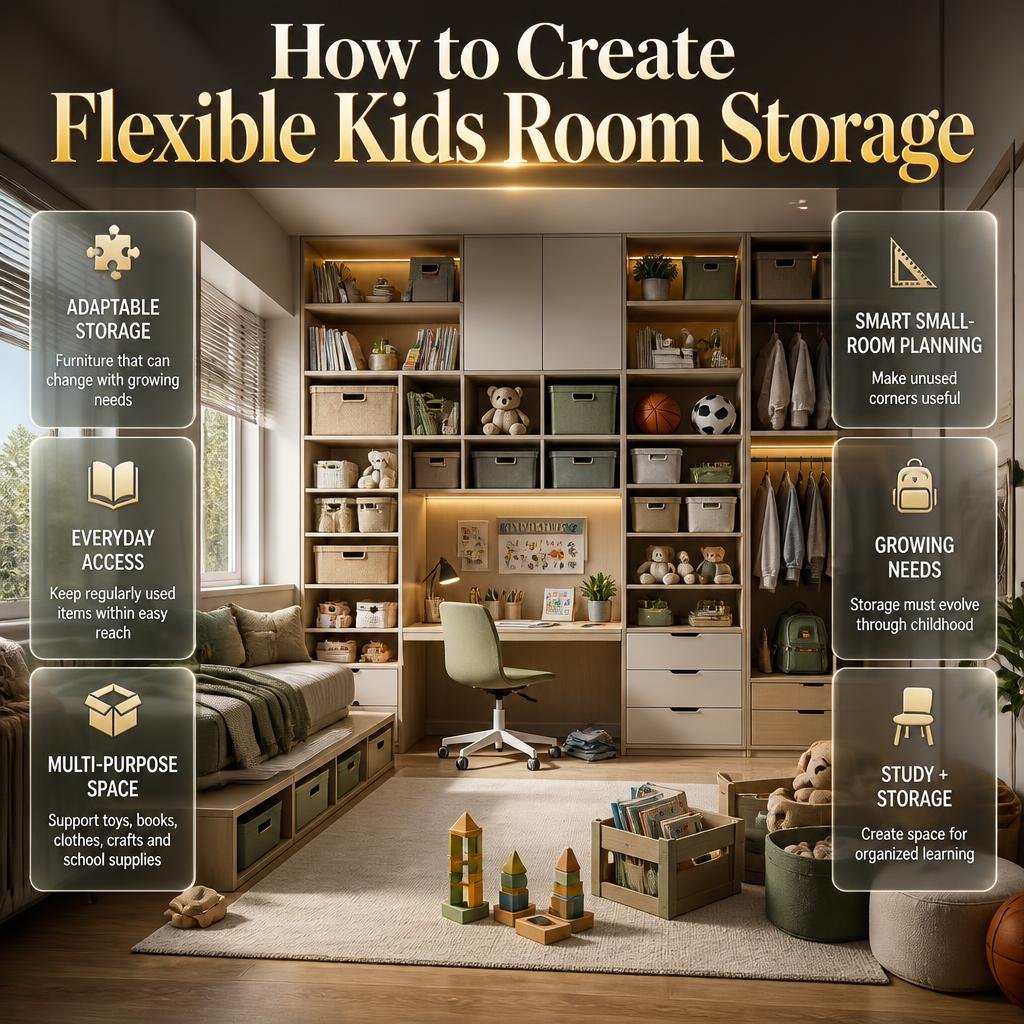
How to Create Flexible Kids Room Storage | A child’s bedroom rarely stays the same for very long. A room that once needed space for soft toys, picture books, and building blocks may soon need school supplies, sports equipment, clothes, craft materials, collections, and a proper study area. The problem isn’t always that the room is too small. Often, the real problem is that the storage was designed for one stage of childhood and has no easy way to change.
That is why knowing how to create flexible kids room storage can make such a difference. Instead of filling the room with furniture that has one permanent purpose, you can create a storage system that adjusts as your child grows.
A flexible approach also makes everyday life easier. Children can reach the things they regularly use, parents don’t have to reorganize the entire bedroom every few months, and unused corners can become useful without making the room feel overcrowded.
If you’re planning the bedroom as part of a wider home project, DesignMode24 Interior Design can also provide broader ideas for creating practical and attractive spaces.
In this guide, we’ll look at how to plan flexible storage from the beginning, which furniture types work best, how to organize small rooms, how to make storage child-friendly, what changes as children get older, and which common mistakes can make an otherwise attractive storage system frustrating to use.
What Does Flexible Kids Room Storage Actually Mean?
Flexible kids room storage is a system that can change when a child’s belongings, activities, routines, or age change. Instead of treating every shelf, cabinet, and drawer as having one permanent purpose, the storage is designed to be rearranged, repurposed, expanded, or simplified when necessary.
For example, a low cube unit might hold toys for a preschooler. A few years later, the same unit could hold school books, art supplies, sports accessories, or hobby equipment.
The furniture hasn’t changed. The child’s needs have.
That is the central idea behind flexible storage.
A useful flexible storage system usually combines several elements:
- Adjustable shelving
- Modular storage cubes
- Removable baskets
- Accessible drawers
- Mobile carts
- Wardrobe organizers
- Under-bed storage
- Wall-mounted hooks
- Open shelving
- Closed cabinets
- Multipurpose furniture
The goal isn’t to use every option. The goal is to choose a combination that suits the room and can adapt over time.
Why Is Flexibility More Important in a Child’s Room?
Children’s possessions change rapidly. Their clothes become larger, their hobbies change, their school requirements increase, and their idea of what they want in their room develops with age.
A fixed storage system can therefore become inefficient surprisingly quickly.
A flexible system gives you the ability to make small changes rather than replacing everything.
For example:
Age 4: toys + picture books
Age 7: toys + school books + craft materials
Age 10: books + hobbies + sports equipment
Age 14: clothing + technology + study materials + personal belongings
The room can remain fundamentally the same while its storage functions evolve.
⭐ Expert Tip: When choosing storage, don’t ask only, “What will this hold today?” Ask, “What could this hold when my child is older?”
How Should You Plan Storage Before Buying Furniture?
The biggest planning mistake is buying storage first and figuring out what to put inside it afterward.
Start with the belongings.
Walk through the room and make broad categories.
Step 1: Make a Storage Inventory
Create groups such as:
- Clothes
- Shoes
- Books
- Toys
- School supplies
- Art materials
- Sports equipment
- Electronics
- Collections
- Keepsakes
- Bedding
- Seasonal items
Don’t create twenty tiny categories. The purpose of the inventory is to understand volume and frequency of use, not to build a complicated filing system.
Step 2: Identify Frequency of Use
Ask how often each category is accessed.
Daily: clothes, books, school supplies, favorite toys
Weekly: hobby equipment, games, sports gear
Occasional: seasonal clothes, keepsakes, special equipment
Daily items should generally receive the easiest-to-access storage.
Occasional items can occupy higher shelves, less convenient drawers, or another suitable storage area.
Step 3: Measure the Room
Measure:
- Wall widths
- Ceiling height
- Door openings
- Window positions
- Bed dimensions
- Walking paths
- Existing furniture
- Available vertical space
Don’t forget doors and drawers need room to open.
A storage unit that technically fits against a wall may still make the room uncomfortable if it blocks circulation.
How Do You Divide a Kids’ Room Into Storage Zones?
A simple zoning system makes flexible storage much easier to manage.
Instead of thinking of storage as one large collection of shelves, divide the room according to use.
The Everyday Zone
This is the easiest area to access.
Use it for things the child reaches for regularly:
- Everyday clothing
- Favorite books
- School bags
- Frequently used toys
- Daily craft supplies
Low shelves and drawers are particularly useful here.
The Occasional Zone
This area can be slightly less accessible.
Use it for:
- Seasonal clothing
- Extra bedding
- Less frequently used toys
- Holiday items
- Special equipment
Higher shelves and upper wardrobe areas can work well.
The Protected Zone
Some belongings should not be freely accessible to young children.
This may include:
- Medicines
- Cleaning products
- Sharp objects
- Fragile valuables
- Certain electronic equipment
These should be secured or stored according to appropriate safety requirements.
⚠ Common Mistake: Assuming that flexible storage means every storage area should be accessible to the child. Flexibility and safety need to work together.
Which Types of Storage Furniture Are Best for Growing Children?
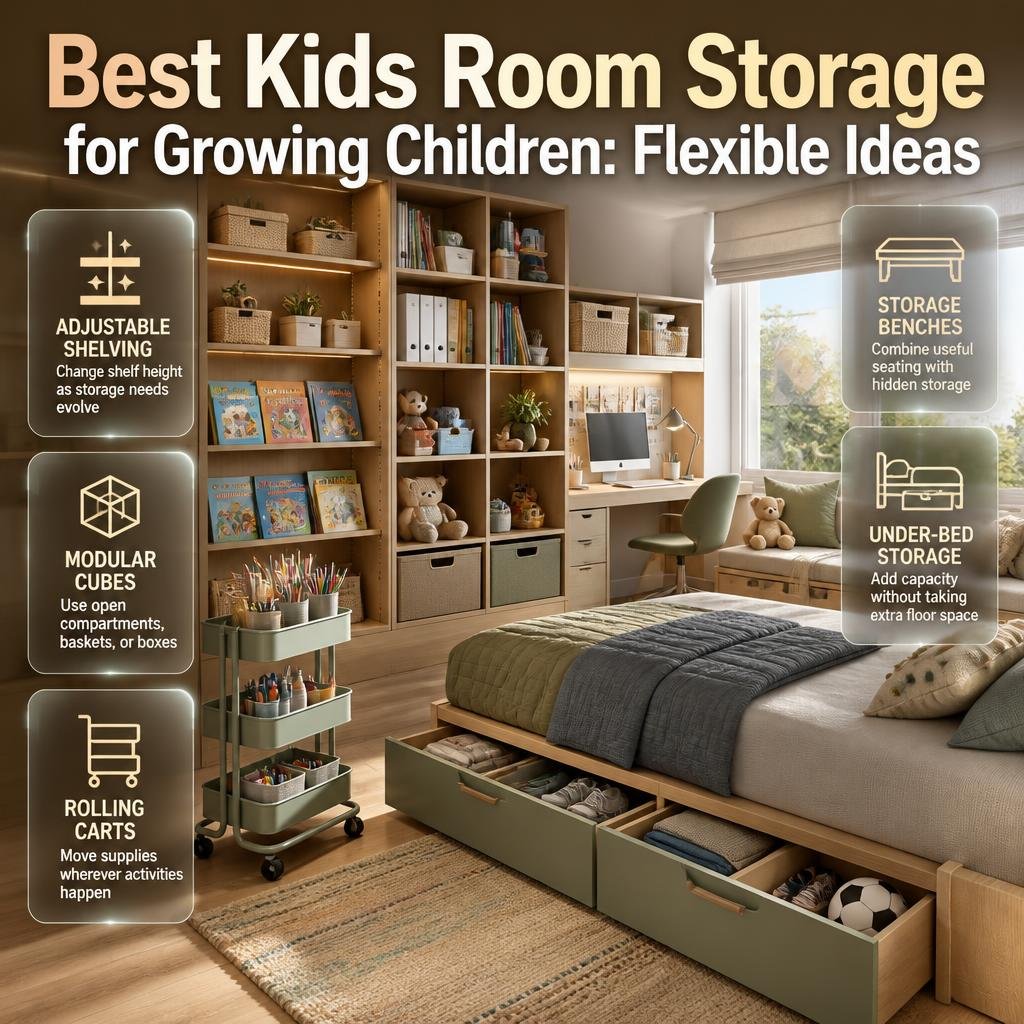
There isn’t one perfect storage product for every child’s room. The strongest approach is usually a combination of furniture that serves different purposes.
Adjustable Shelving
Adjustable shelving is one of the most useful long-term choices.
Shelf positions can be changed when the items being stored become larger or smaller.
For instance, a lower shelf can hold picture books when a child is young. Later, the shelf height can be adjusted for folders, textbooks, or larger hobby materials.
This makes adjustable shelving particularly useful when you don’t know exactly what the room will need several years from now.
Modular Cubes
Modular cube storage offers another form of flexibility.
You can use the compartments as open shelves or add baskets and boxes.
One section might contain toys while another holds books.
Later, the toy basket can be replaced with a school-supply box without replacing the entire furniture unit.
Rolling Carts
A rolling cart can move between areas.
For example, an art cart can sit near a creative corner during an activity and then be moved back to storage afterward.
As the child grows, the same cart could hold:
- Homework materials
- Computer accessories
- Craft supplies
- Musical equipment
- Hobby materials
Storage Benches
A storage bench is useful because it combines seating with storage.
It can work near a window, reading corner, desk, or play area.
Inside the bench, you can store items that don’t need to remain visible.
Under-Bed Storage
The space under the bed is often one of the easiest places to add capacity without taking more floor area.
Suitable items include:
- Seasonal clothes
- Extra bedding
- Shoes
- Toys
- Sports accessories
Choose containers that are easy to pull out and don’t become dangerously heavy.
Should Kids’ Storage Be Open or Closed?
Both have advantages.
The best choice depends on what you’re storing and how often it is used.
| Storage type | Advantages | Best use |
|---|---|---|
| Open shelves | Easy visibility | Books, displays, daily toys |
| Baskets | Easy to move | Toys, soft items, craft supplies |
| Drawers | Keeps items contained | Clothes, school supplies |
| Cabinets | Reduces visual clutter | Less attractive or occasional items |
| Transparent boxes | Easy identification | Small toys, collections, supplies |
Open storage is convenient, but too much of it can make the room visually busy.
Closed storage creates a calmer appearance but can make it harder for younger children to see what they own.
A combination is usually more practical.
For example:
Open: books and favorite toys
Baskets: building toys and craft materials
Drawers: clothes and school supplies
Closed cabinet: occasional-use items
How Can You Make Storage Easy for Children to Use?
A storage system only works when the child can actually use it.
If a child needs an adult every time they want a book, toy, or item of clothing, the storage system isn’t serving its purpose.
Keep commonly used belongings at a suitable height.
For younger children, low shelves and lightweight baskets are particularly useful.
For older children, accessible drawers and wardrobe sections can provide more independence.
Keep Categories Simple
Instead of:
- Red cars
- Blue cars
- Large cars
- Small cars
- Racing cars
use:
Cars
Instead of separating every type of building piece, consider:
Building Toys
The more complicated the sorting system becomes, the less likely children are to maintain it.
📌 Quick Tip: If putting something away requires several decisions, simplify the storage category.
How Can You Design Flexible Toy Storage?
Toy storage presents a special challenge because toys vary dramatically in size and shape.
A useful system should make both taking toys out and putting them away easy.
Use broad categories such as:
- Building toys
- Dolls and figures
- Vehicles
- Games and puzzles
- Soft toys
- Art materials
Use larger baskets for categories with many small pieces.
Labels can help, particularly for older children. For younger children, pictures may be more useful than words.
Don’t fill every basket completely.
A container that’s packed to the top makes tidying difficult because the child has to move other objects before returning one item.
A Better Toy Storage Formula
Think:
Easy access + simple categories + spare capacity = easier cleanup
The storage system should reduce friction rather than create another task.
How Do You Create Flexible Storage in a Small Kids’ Room?
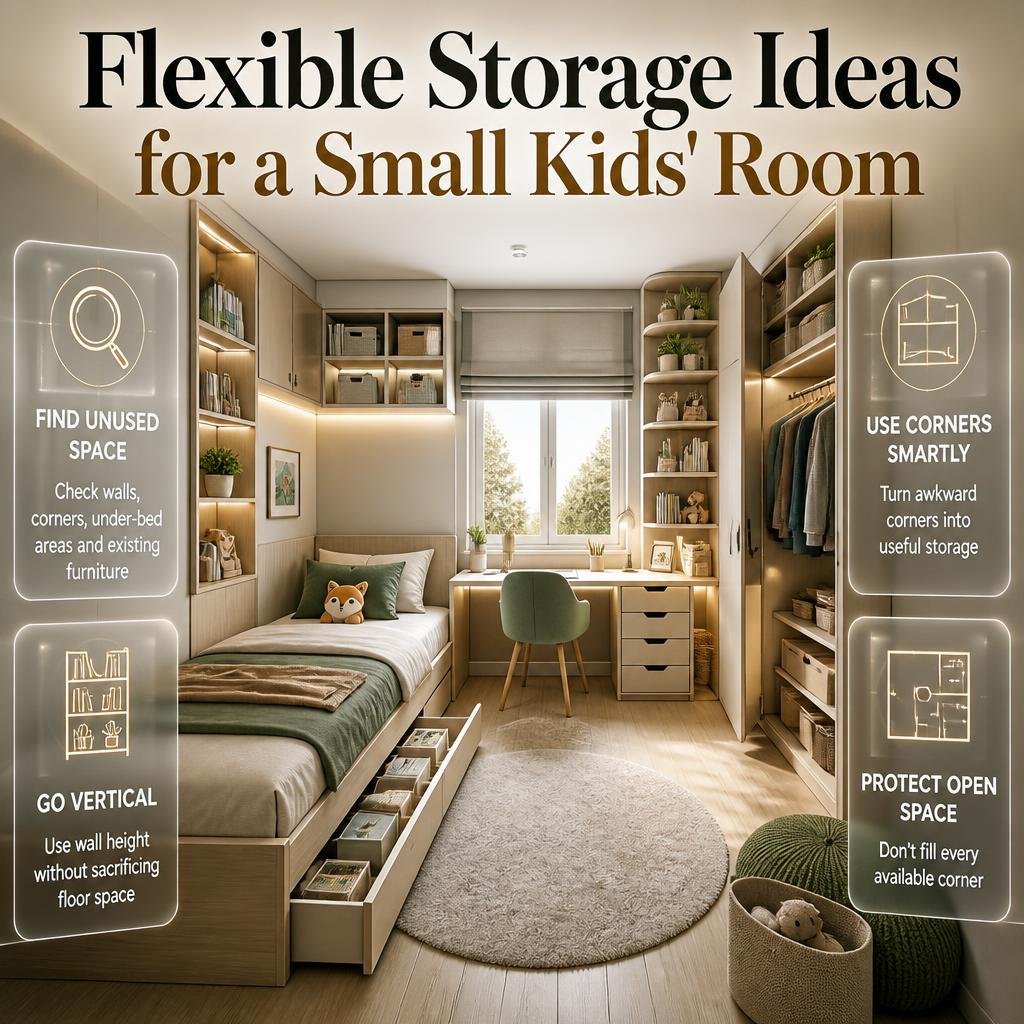
Small bedrooms require more careful planning because every piece of furniture affects circulation.
The first step isn’t buying smaller furniture.
It’s finding unused space.
Look at:
- Walls
- Corners
- Under the bed
- Above the desk
- Wardrobe interiors
- Behind suitable doors
- Space above existing furniture
Vertical storage can significantly increase capacity without taking much additional floor space.
For broader ideas about improving how a home functions, the Home Improvement section can be useful when you’re planning storage as part of a larger room upgrade.
Use Vertical Space Carefully
Tall shelving can make good use of wall height, but heavy objects should generally be stored lower.
Use upper areas for lighter, less frequently used belongings.
Keep frequently used items within comfortable reach.
Use Corners Intelligently
Corners are often wasted.
A narrow corner shelf, small cabinet, or appropriately designed storage unit can turn an awkward area into useful capacity.
However, don’t fill every corner simply because it’s available.
Open space also has value in a child’s room.
How Can Wall Storage Improve Flexibility?
Walls can provide storage without consuming valuable floor space.
Possible solutions include:
- Shelves
- Hooks
- Pegboards
- Display ledges
- Wall-mounted organizers
Wall storage works particularly well for lightweight items.
Hooks can hold bags, hats, jackets, or accessories.
Shelves can hold books or decorative items.
Pegboards can adapt as the child’s interests change because hooks and containers can be moved.
If you’re considering a wider decorative wall strategy, Wall Treatments can provide inspiration for combining useful wall surfaces with the overall room design.
However, wall-mounted furniture should always be installed securely and according to the manufacturer’s requirements.
How Should You Organize a Growing Child’s Wardrobe?
Wardrobe storage needs to change as children grow.
A toddler may have many small folded clothes. An older child may need more hanging space, larger drawers, school uniforms, sportswear, and seasonal clothing.
Adjustable wardrobe systems allow the internal configuration to change.
A useful wardrobe layout might include:
Upper section: seasonal or occasional items
Middle section: regularly used hanging clothes
Lower section: accessible drawers or baskets
As the child grows, the balance can change.
The important point is not to permanently dedicate every section to a single category.
How Can Storage Support a Child’s Study Area?
The transition from play-focused storage to study-focused storage is one of the biggest changes a child’s room experiences.
Fortunately, flexible furniture can make this transition gradual.
A study area might include:
- Desk
- Small drawer unit
- Book storage
- Stationery organizer
- Mobile cart
- Cable-management area
Keep the desk surface relatively clear.
Instead of storing every school item directly on the desk, use nearby drawers or a mobile organizer.
This gives the child a functional work surface without removing access to necessary supplies.
For broader bedroom planning concepts, Bedroom Planning and Layout can be useful when thinking about how furniture, circulation, and functional zones work together.
Can Lighting and Storage Work Together?
Yes. Lighting is especially important when storage areas become part of reading, studying, or creative activities.
A child shouldn’t have to work in a dark corner simply because that’s where the storage happened to fit.
Think about lighting in layers:
- General room lighting
- Desk lighting
- Reading light
- Wardrobe or storage-area lighting where appropriate
As the child grows, the same bedroom can move from primarily play-oriented lighting to more task-oriented lighting.
For ideas about integrating technology and lighting into modern spaces, Intelligent Lighting offers another useful perspective.
How Can Color Make Flexible Storage Easier to Manage?
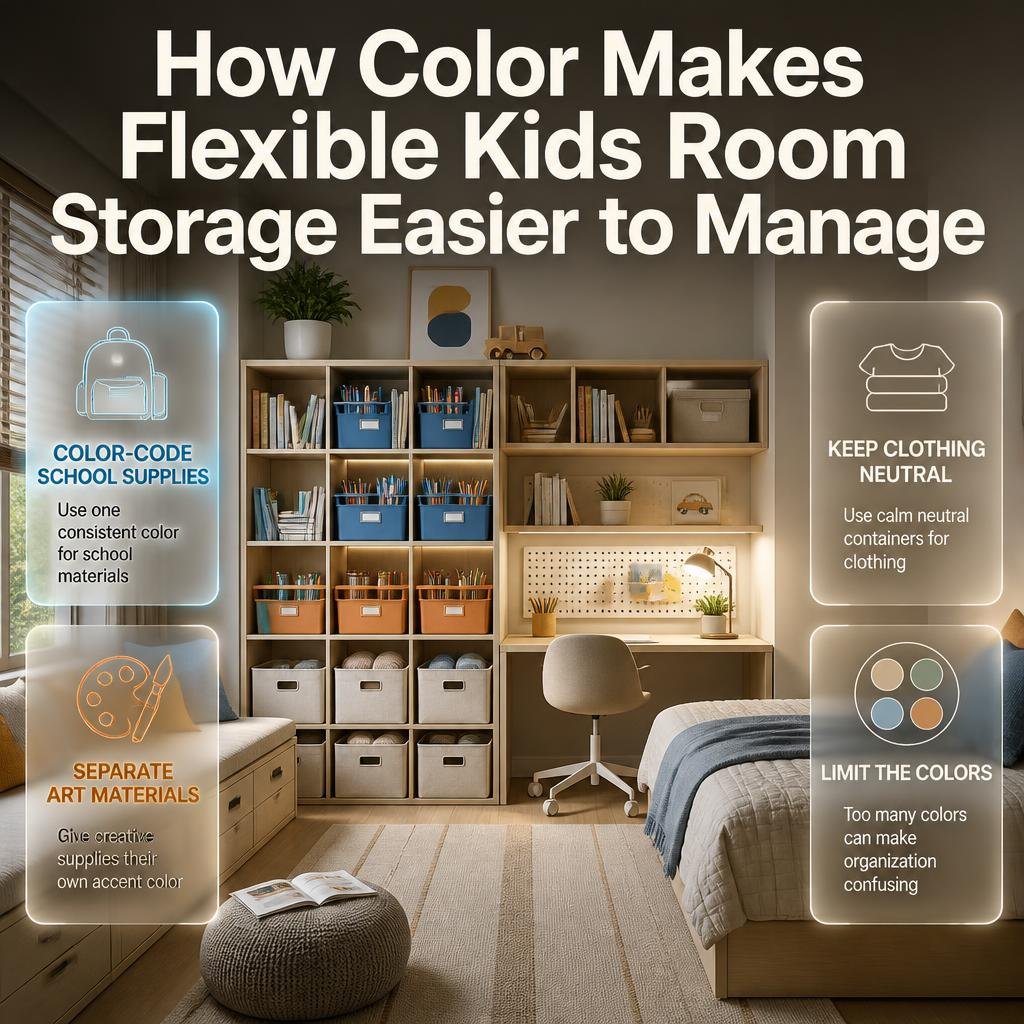
Color can support organization without making the room look overly themed.
For example, you might use:
- One color for school supplies
- Another for art materials
- Neutral containers for clothing
- A consistent finish for larger furniture
But avoid creating so many colors that the system becomes confusing.
Storage can also coordinate with the wider bedroom palette.
If you’re planning wall colors alongside the furniture, Paint Color can help with broader color-planning ideas.
A neutral storage framework can be especially useful because accessories can change as the child grows.
How Can You Make Flexible Storage Part of the Overall Room Design?
Storage shouldn’t feel like a collection of random boxes placed wherever there is space.
It should support the room’s overall function and visual balance.
Consider:
- Furniture scale
- Color
- Materials
- Lighting
- Floor space
- Wall space
- Visual clutter
- Child accessibility
The room should still have space for movement and relaxation.
This is where practical interior design becomes important. Storage isn’t successful simply because it holds a lot. It is successful when it improves how the room works.
For broader design planning, How to Design a Home Using Low-Impact Materials can also be helpful if you’re selecting new materials and want to think beyond appearance.
What Role Do Sustainable Materials Play in Kids’ Storage?
Children’s furniture can have a long useful life if it’s durable and adaptable.
Instead of replacing furniture every few years, consider pieces that can be reused.
For example, a durable modular shelf can move from a playroom to a bedroom and eventually into another part of the home.
Look for:
- Durable construction
- Repairable components
- Replaceable hardware
- Long-lasting finishes
- Adaptable configurations
A cheaper product that needs replacing repeatedly may not provide better long-term value than a durable system that changes with the child.
How Can DIY Projects Add Flexible Storage?
Not every storage improvement requires new furniture.
Simple DIY projects can include:
- Adding hooks
- Installing adjustable shelves
- Creating labeled bins
- Repurposing furniture
- Building simple rolling storage
- Creating a wall organizer
- Adding dividers to drawers
Before beginning a DIY project, think about structural safety, wall strength, weight limits, sharp edges, and whether the finished product is appropriate for children.
For additional practical home-project ideas, DIY Home Projects can be useful.
The best DIY storage project isn’t necessarily the most complicated one. Often, a simple modification to furniture you already own solves the problem.
How Should You Handle Hobby and Outdoor Equipment?
Children’s interests can create unusual storage requirements.
A child who enjoys football may need bulky equipment.
Another may collect art materials.
Another may spend weekends gardening or exploring outdoors.
Not everything needs to be stored inside the bedroom.
Consider where each item is actually used.
If sports equipment is normally used outdoors, another appropriate storage area may be more practical.
Likewise, gardening equipment doesn’t necessarily belong in a child’s bedroom.
For ideas connected with outdoor spaces and garden organization, Robert MyGardenAndPatio can offer useful inspiration when deciding how to distribute storage across the home.
The key principle is simple:
Store things close to where they’re used whenever practical.
How Can Smart Home Features Affect Kids’ Room Storage?
Modern children’s rooms increasingly include technology such as charging stations, smart lights, climate controls, and electronic devices.
Technology should not create another layer of clutter.
Create a dedicated location for charging devices instead of allowing cables to spread across the desk or floor.
Similarly, climate controls and lighting controls should be positioned where they are useful without interfering with storage.
If you’re exploring technology as part of room design, Automated Climate Control for Different Rooms provides relevant ideas about integrating environmental controls into room planning.
The principle remains the same: technology should make the room easier to use, not harder to organize.
How Can You Make Flexible Storage Work in a Shared Bedroom?
Shared bedrooms need another layer of organization because children need both common and personal storage.
Give each child clearly defined personal areas.
For example:
| Shared storage | Individual storage |
|---|---|
| Bookshelf | Personal drawers |
| Toy area | Clothing section |
| Shared games | Individual baskets |
| Art station | Personal keepsake box |
This reduces arguments about ownership.
Each child should know which storage belongs to them and which belongs to everyone.
The system doesn’t need to be perfectly symmetrical. One child may need more clothing storage while another may need more hobby space.
The goal is functional fairness rather than identical furniture.
What Are the Most Common Kids’ Storage Mistakes?
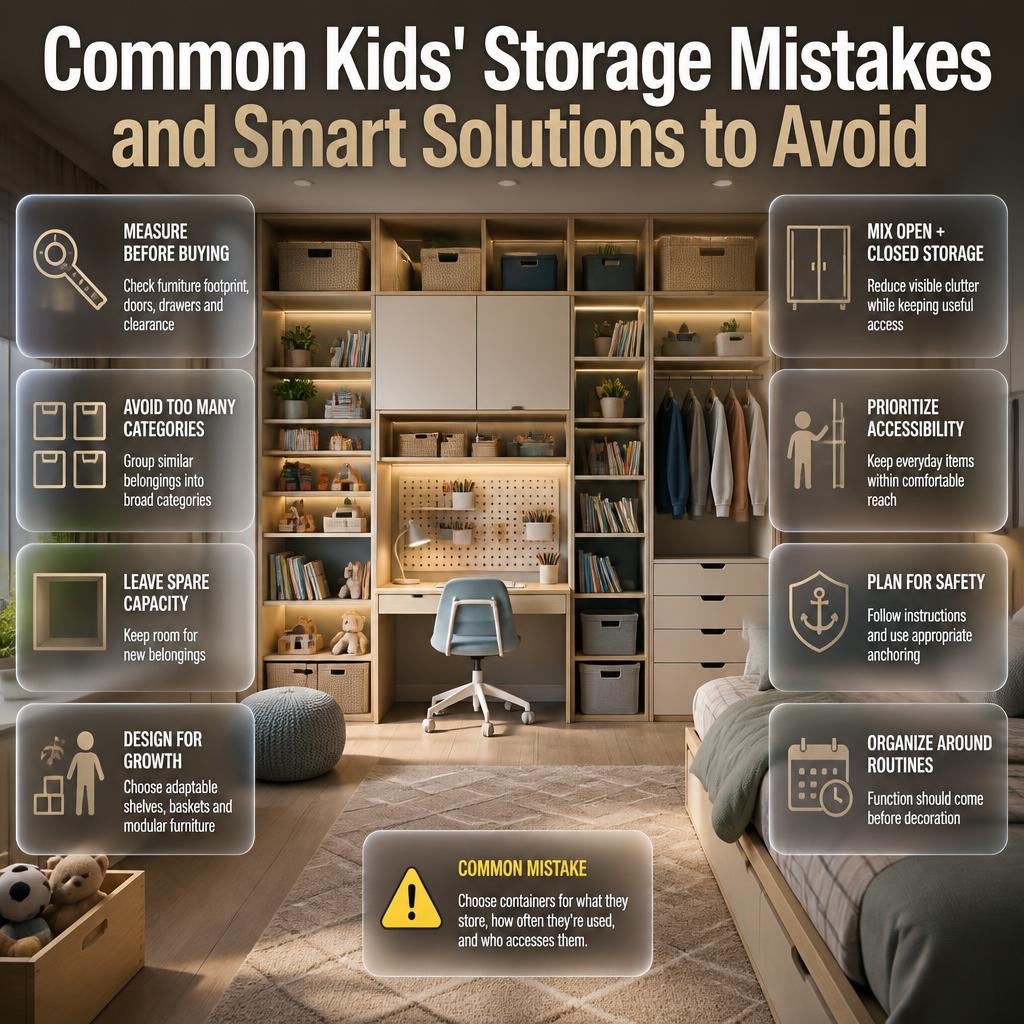
Buying Furniture Before Measuring
A storage unit may technically fit but still make the room difficult to walk through.
Solution: measure the complete furniture footprint, including doors, drawers, and required clearance.
Using Too Many Small Categories
Over-organizing makes tidying complicated.
Solution: combine similar belongings into broad categories.
Filling Every Compartment
A completely full storage system has nowhere to accommodate new belongings.
Solution: deliberately leave spare capacity.
Designing Only for the Current Age
A storage system built entirely around toddler toys may become unsuitable quickly.
Solution: choose adaptable shelves, baskets, and modular furniture.
Making Everything Open
Too many visible items can make a bedroom look permanently messy.
Solution: combine open and closed storage.
Ignoring Accessibility
If daily belongings are too high, children depend on adults.
Solution: place appropriate everyday items within comfortable reach.
Forgetting Safety
Tall furniture, unstable shelves, and unsuitable hardware can create hazards.
Solution: follow manufacturer instructions and use appropriate anchoring and safety measures.
Turning Storage Into Decoration Only
Beautiful baskets don’t automatically create good organization.
Solution: design around actual routines first and appearance second.
⚠ Common Mistake: Buying matching storage containers simply because they look attractive. A container should be chosen according to what it stores, how often it’s used, and who needs to access it.
How Can You Create Flexible Storage Without Spending a Lot?
You don’t need to replace everything.
Start by reorganizing what already exists.
A Budget-Friendly Process
1. Remove unused items.
Don’t buy storage for belongings that no longer need to be there.
2. Group similar things.
This reveals where the actual storage problems are.
3. Reuse existing furniture.
A shelf can often serve another purpose with baskets or dividers.
4. Add inexpensive organizers.
Small bins and drawer dividers can make existing storage much more functional.
5. Use vertical space.
A few properly installed shelves can add capacity without requiring another large floor unit.
6. Buy only what is genuinely missing.
This prevents unnecessary furniture accumulation.
If you’re considering a broader improvement project, Mintpaldecor Home Repair Inspiration can be useful when thinking about practical changes that improve the functionality of a home.
How Should Storage Change as a Child Gets Older?
Flexible storage becomes most valuable when you think about different developmental stages.
Toddlers and Preschoolers
Prioritize:
- Low shelves
- Lightweight baskets
- Picture labels
- Simple toy categories
- Accessible books
The room should make independent cleanup achievable.
Early School Years
Add:
- School storage
- Craft organization
- More books
- Backpack hooks
- Dedicated drawers
The child is beginning to manage more personal belongings.
Older Children
Storage can become more specialized.
Consider:
- Larger book storage
- Hobby equipment
- Sports gear
- Study materials
- Collections
- Personal display areas
Teenagers
Privacy and personal organization become increasingly important.
Storage may need to accommodate:
- More clothing
- Technology
- Schoolwork
- Personal belongings
- Hobbies
- Accessories
The furniture framework can remain, but its internal organization can change.
How Do You Design Storage That Doesn’t Require a Future Renovation?
The easiest strategy is to make permanent decisions carefully and temporary decisions flexible.
Permanent elements might include:
- Flooring
- Main electrical layout
- Built-in framework
- Basic wall finish
- Large furniture footprint
Flexible elements can include:
- Baskets
- Bedding
- Artwork
- Accessories
- Drawer organizers
- Removable shelves
- Small storage units
This allows the room’s personality to change without requiring a complete redesign.
The same principle applies throughout interior design: durable foundations and adaptable details generally provide more flexibility than repeatedly rebuilding the entire space.
If you’re planning improvements across the home, Why Home Improvement Is Important provides useful context for thinking about improvements in terms of long-term function rather than short-term appearance.
A Practical Step-by-Step Flexible Storage Plan
If you’re starting with an empty room or completely reorganizing an existing bedroom, follow this sequence.
Step 1: Measure Everything
Record the room dimensions, doors, windows, bed, and available wall areas.
Step 2: List the Child’s Belongings
Group them into practical categories.
Step 3: Separate Daily and Occasional Items
This determines where each category should live.
Step 4: Create Child-Accessible Zones
Place appropriate everyday belongings within easy reach.
Step 5: Add Adjustable Storage
Prioritize shelves, baskets, drawers, and modular components that can change later.
Step 6: Use Vertical Space
Add useful wall storage where appropriate.
Step 7: Protect Walking Space
Don’t sacrifice circulation simply to gain another shelf.
Step 8: Leave Spare Capacity
A new storage system shouldn’t be completely full immediately.
Step 9: Check Safety
Secure tall furniture and inspect shelves, hardware, and containers.
Step 10: Review the System Regularly
Every few months, ask:
- What isn’t being used?
- What has become difficult to store?
- What has the child outgrown?
- What new activity needs space?
- Which storage area is always messy?
The answers tell you what needs changing.
What Is the Best Flexible Storage Setup for Different Room Sizes?
For a Large Bedroom
You can create separate zones:
- Sleeping
- Playing
- Reading
- Studying
- Clothing
- Hobby storage
The challenge is avoiding unnecessary furniture.
Large rooms don’t need to be filled simply because space is available.
For a Medium Bedroom
Prioritize multifunctional furniture.
A storage bench, modular shelf, under-bed drawers, and compact desk can provide several functions without overcrowding the room.
For a Small Bedroom
Prioritize:
- Vertical storage
- Under-bed storage
- Wardrobe optimization
- Wall hooks
- Multipurpose furniture
Keep the center of the room as open as practical.
How Do You Keep Flexible Storage Looking Attractive?
Function comes first, but appearance still matters.
A visually calm storage system usually has some consistency.
You can coordinate:
- Basket colors
- Furniture finishes
- Hardware
- Labels
- Wall colors
- Textiles
Don’t try to hide every toy or book.
Children’s rooms should still feel like children’s rooms.
The objective is controlled visual variety rather than an adult-style minimalist showroom.
A few favorite books, toys, drawings, or collections can remain visible and contribute personality.
For additional ideas on how practical storage and decorative choices can work together, DesignMode24 Interior Design can serve as a broader starting point for room design inspiration.
How do I create kids’ room storage that grows with my child?
The best approach is to create a storage framework that can change instead of designing every shelf and drawer around your child’s current age. Children move from toys and picture books to school supplies, hobbies, sports equipment, larger clothing, technology, and personal belongings surprisingly quickly. Adjustable shelving, modular cubes, movable baskets, adaptable wardrobes, and rolling carts can continue serving different purposes as those needs change.
For example, a low cube unit can hold toys during the preschool years. Later, the same compartments can store books, school folders, craft supplies, or hobby equipment. This means you aren’t forced to replace the whole storage system whenever your child’s interests change.
Practical points:
Choose adjustable shelves instead of permanently fixed layouts.
Use removable baskets that can be replaced or repurposed.
Leave some empty capacity for future belongings.
Choose furniture that can serve more than one purpose.
Keep major furniture finishes relatively neutral so they remain suitable as the child grows.
The key is to invest in adaptability rather than age-specific storage. A flexible system should change with the child without requiring a complete bedroom renovation.
What is the best storage solution for a small kids’ bedroom?
Small children’s bedrooms benefit most from storage that uses vertical and overlooked areas without taking away too much floor space. Instead of filling the room with several small cabinets, look at the walls, under-bed area, wardrobe interior, corners, and space above existing furniture.
Wall-mounted shelves can store books and lightweight belongings, while hooks can keep backpacks, hats, or frequently used accessories off the floor. Under-bed drawers or rolling containers are particularly useful for seasonal clothing, spare bedding, shoes, or toys that aren’t needed every day.
Practical points:
Use vertical shelving where safe and appropriate.
Maximize wardrobe interiors with adjustable organizers.
Use under-bed storage for occasional items.
Consider storage benches that provide both seating and hidden storage.
Keep the center of the room as open as possible.
Avoid buying furniture simply because it provides more compartments.
A small room shouldn’t be judged by how much furniture it contains. The better measure is how much useful storage it provides while still leaving enough space to move, play, study, and relax comfortably.
How can I organize kids’ toys so the room stays tidy?
Toy organization works best when the system is simple enough for the child to maintain independently. One of the biggest mistakes is creating too many categories. If a child has to decide whether a toy belongs in the “small vehicles,” “racing vehicles,” or “red vehicles” box, tidying quickly becomes frustrating.
Use broad categories based on how the toys are actually used. Building toys, dolls and figures, vehicles, puzzles and games, soft toys, and art materials are usually easier categories to understand. Lightweight baskets or open bins make it easier for children to return items after playing.
Leave some spare space inside each container. A basket that is completely packed may technically hold everything, but putting one toy away can become difficult when the child has to rearrange the entire container.
Practical points:
Keep toy categories broad and obvious.
Use picture labels for younger children.
Choose lightweight containers they can move safely.
Keep frequently used toys at an accessible height.
Don’t fill storage containers completely.
Rotate less-used toys instead of keeping everything permanently accessible.
The goal isn’t a perfectly arranged toy collection. It’s a system that makes taking toys out and putting them away equally easy.
Should kids’ room storage be open or closed?
A combination of open and closed storage is generally the most practical solution because each type solves a different problem. Open shelves make frequently used items visible and accessible, while closed drawers, cabinets, and baskets help control visual clutter.
Open storage works particularly well for books, favorite toys, displays, and belongings children need regularly. Closed storage is more useful for clothing, school supplies, seasonal items, collections, and objects that don’t need to remain visible.
For younger children, accessibility is especially important. However, not every item should be within reach. Items that require adult supervision or need to be kept secure should be stored appropriately.
Practical points:
Use open shelves for everyday books and selected toys.
Use baskets for groups of small or irregular items.
Use drawers for clothing and school supplies.
Use cabinets for visually busy or occasional belongings.
Keep unsuitable items secured or appropriately out of reach.
Avoid making the entire room open shelving.
The strongest storage systems create a balance: open enough to encourage independence, closed enough to keep the room visually calm.
How can I make kids’ room storage flexible without spending a lot of money?
You don’t necessarily need new furniture to make a child’s storage more flexible. Start by reorganizing what you already have and identify the actual problem before buying anything. Many storage problems come from unused belongings, poor categorization, or inaccessible shelves rather than a genuine lack of furniture.
A simple reorganization can make existing storage work much harder. Move frequently used items to accessible areas, place seasonal belongings higher up, add baskets to open shelves, use drawer dividers, and install suitable hooks where they can safely be used.
Only buy additional storage after you’ve identified what is genuinely missing.
Practical points:
Declutter before purchasing storage.
Repurpose existing shelves and cabinets.
Add inexpensive baskets or boxes where useful.
Use drawer dividers for small belongings.
Add suitable wall hooks for bags and accessories.
Use under-bed space before buying another large cabinet.
Choose modular pieces that can serve another purpose later.
A flexible kids’ room doesn’t have to be expensive. The biggest improvement often comes from changing the organization system rather than increasing the amount of furniture.
Conclusion
Creating flexible kids room storage isn’t about filling every empty wall with shelves, boxes, or cabinets. It’s about building a practical system that can change as your child grows, their belongings increase, and their daily routines develop. The right storage should make the room easier to use today while still giving you enough flexibility for tomorrow.
Start with the items your child actually uses, separate everyday belongings from occasional ones, and choose storage that can be adjusted or repurposed. Adjustable shelves, modular units, accessible baskets, under-bed drawers, adaptable wardrobes, and multipurpose furniture can all help the room evolve without requiring a complete redesign.
Most importantly, keep the system simple. Children are more likely to maintain storage when they can easily see where things belong and return them without help. Leave some spare capacity, review the room as their needs change, and don’t be afraid to rearrange existing storage before buying something new.
A well-planned kids’ room doesn’t need to stay perfectly organized all the time. It simply needs a storage system that grows, adapts, and makes everyday life easier. When flexibility becomes part of the design from the beginning, the room can continue working through different stages of childhood without constantly starting over.