

Introduction
Furniture Buying Advice | Buying furniture sounds simple until you actually have to choose something. A sofa can look perfect in a showroom but feel uncomfortable at home. A dining table may fit beautifully in a photograph yet leave almost no walking space around it. Even an expensive bed, wardrobe, or coffee table can become a frustrating purchase when its size, construction, or material doesn’t match the way you live.
That’s why good furniture buying advice is less about following trends and more about making smart decisions before spending money. The right piece should fit your room, support your daily routine, suit your style, and remain useful for years.
If you’re planning a home update, the DesignMode24 Interior Design homepage is also a useful starting point for exploring broader interior ideas.
This guide explains how to choose furniture from the first measurement to the final purchase. You’ll learn how to judge quality, compare materials, set a realistic budget, avoid common buying mistakes, choose furniture for different rooms, and create a home that feels intentional rather than overcrowded.
What Should You Consider Before Buying Furniture?
Before buying furniture, consider the room’s measurements, how the space is used, the furniture’s dimensions, construction quality, material, comfort, maintenance needs, style, budget, and delivery requirements. The best purchase isn’t necessarily the cheapest or most expensive option. It is the piece that performs well for your specific space and lifestyle.
A useful way to think about furniture is:
Room → Function → Size → Quality → Comfort → Style → Budget → Purchase
If you reverse that order and start with appearance or price alone, mistakes become much more likely.
For example, buying a large sectional because it looks luxurious online can create problems in a compact living room. Similarly, choosing the cheapest dining chairs may save money today but cost more when they need replacement after a short period.
Start With the Room, Not the Furniture
Measure the room before visiting a store or browsing online.
Record:
- Wall-to-wall length
- Wall-to-wall width
- Ceiling height
- Door widths
- Window locations
- Radiators or vents
- Electrical outlets
- Built-in storage
- Hallway and stair dimensions
- Available walking space
Don’t measure only the area where you want the furniture to sit. The furniture must also travel through doors, corridors, elevators, staircases, and tight corners.
💡 Pro Tip: Use painter’s tape on the floor to mark the exact footprint of a sofa, bed, dining table, or cabinet. Standing inside the taped outline gives you a much better sense of scale than looking at dimensions on a website.
How Do You Know What Size Furniture to Buy?
The correct furniture size depends on the room’s dimensions, circulation space, ceiling height, and relationship between neighboring pieces. A piece can technically fit inside a room while still being too large because it blocks pathways or overwhelms the visual balance.
This is one of the most important principles in furniture buying.
Don’t Measure in Isolation
Suppose your living room is large enough for a 100-inch sofa. That doesn’t automatically mean you should buy one.
You also need space for:
- Side tables
- Coffee table clearance
- Walking routes
- Doors opening fully
- Access to windows
- Television viewing distance
- Floor lamps
- Other seating
Furniture works as a composition rather than a collection of independent objects.
A useful planning method is to draw the room on paper or use a simple floor-planning application. Mark doors and windows first, then place the largest furniture pieces.
Think About Circulation
A beautiful room can become uncomfortable when people constantly have to walk around furniture.
As a general planning principle, keep major walking routes generous enough for everyday movement. In frequently used areas, avoid creating narrow passages between sofas, tables, cabinets, and walls.
For dining rooms, remember that a chair needs space behind it when someone is sitting down. For bedrooms, make sure wardrobe doors and drawers can open without hitting the bed.
⚠ Common Mistake: Measuring the furniture itself but forgetting the packaging and delivery route. Always ask whether the furniture arrives assembled, partially assembled, or flat-packed.
What Furniture Should You Buy First?
Buy the largest and most functionally important pieces first. In most rooms, this means starting with items such as a sofa, bed, dining table, wardrobe, or primary storage unit before purchasing smaller decorative furniture.
This approach prevents a common problem: buying attractive accessories first and then discovering that there isn’t enough room for essential furniture.
A Practical Priority List
For a living room:
- Sofa or main seating
- Media/storage unit if required
- Coffee table
- Side tables
- Accent chairs
- Lighting and accessories
For a bedroom:
- Bed
- Mattress
- Wardrobe/storage
- Bedside tables
- Dresser
- Bench or decorative pieces
For a dining room:
- Dining table
- Chairs
- Storage
- Lighting
- Accessories
This order helps you spend your budget where it has the greatest impact.
How Do You Judge Furniture Quality?
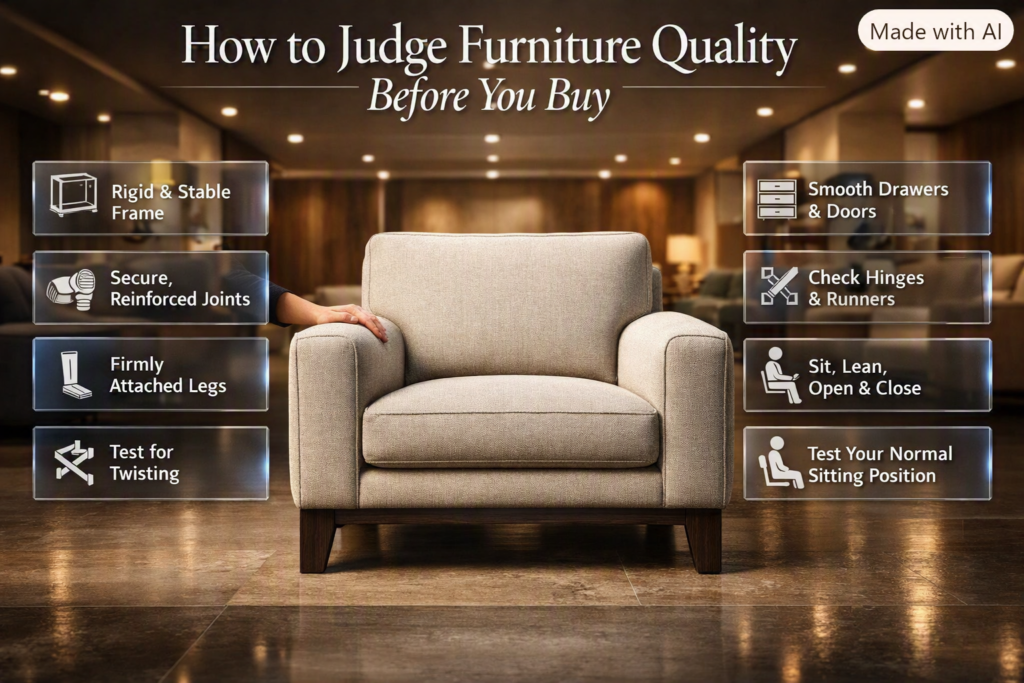
Furniture quality is determined by more than appearance. Look at the frame, joints, hardware, material, finish, weight, stability, upholstery, moving parts, and manufacturer’s specifications. High-quality furniture should feel stable and appropriate for its intended use rather than merely looking attractive.
Inspect the Frame
For upholstered furniture, the frame is particularly important.
Check whether:
- The frame feels rigid
- Corners are properly reinforced
- Joints appear secure
- Legs are firmly attached
- The structure doesn’t twist when pressure is applied
For wooden furniture, inspect the joints rather than focusing only on the surface finish.
Strong joinery generally provides better long-term performance than furniture relying heavily on weak fasteners or poorly assembled connections.
Test Drawers and Doors
Open every drawer you can.
Check whether it:
- Slides smoothly
- Closes evenly
- Feels stable
- Has adequate support
- Makes excessive noise
Do the same with cabinet doors.
Hardware is often overlooked during furniture shopping, yet poor hinges, runners, and handles can make otherwise attractive furniture frustrating to use.
Sit, Lean, Open, Close
Don’t just look at a sofa.
Sit on it.
Don’t just look at a chair.
Use it.
Don’t just inspect a wardrobe.
Open the doors.
Furniture is a functional product. Your body should tell you whether it works.
⭐ Expert Tip: When testing a sofa, sit in the position you normally use at home. If you usually sit upright, test it upright. If you like lounging, test the depth and back angle accordingly. “Comfortable” is personal.
Which Furniture Material Is Best?
There is no single best furniture material. Solid wood, engineered wood, metal, glass, leather, fabric, laminate, veneer, and composite materials can all perform well when appropriately manufactured and maintained. The right material depends on use, budget, climate, maintenance expectations, and desired appearance.
Solid Wood
Solid wood can provide excellent durability and a natural appearance.
Advantages include:
- Long service life
- Repairability
- Natural grain
- Strong construction potential
- Timeless appearance
Potential drawbacks include:
- Higher cost
- Greater weight
- Sensitivity to moisture
- Possible movement or cracking depending on conditions
Solid wood isn’t automatically high quality, however. Poor construction can still produce a disappointing piece.
Engineered Wood
Engineered wood includes products such as plywood, MDF, and particleboard.
Quality varies significantly.
Good engineered wood can be an excellent choice for:
- Storage furniture
- Shelving
- Cabinet interiors
- Budget-conscious projects
- Contemporary furniture
The key is to evaluate thickness, edge treatment, hardware, finish, and construction rather than assuming every engineered-wood product is inferior.
Metal
Metal works particularly well for:
- Dining tables
- Bed frames
- Shelving
- Industrial interiors
- Outdoor furniture
Look closely at welds, coatings, joints, and stability.
Glass
Glass can make a room feel visually lighter, but it requires more care.
Consider:
- Tempered glass where appropriate
- Edge quality
- Stability
- Cleaning requirements
- Household safety
Upholstery
For sofas and chairs, fabric choice should reflect your lifestyle.
Ask:
- Are there children?
- Are pets present?
- Is the furniture used daily?
- Is easy cleaning important?
- Does the room receive strong sunlight?
A delicate fabric may look beautiful but perform poorly in a high-use family room.
For ideas about selecting furniture as part of a larger interior scheme, explore interior design inspiration.
How Much Should You Spend on Furniture?
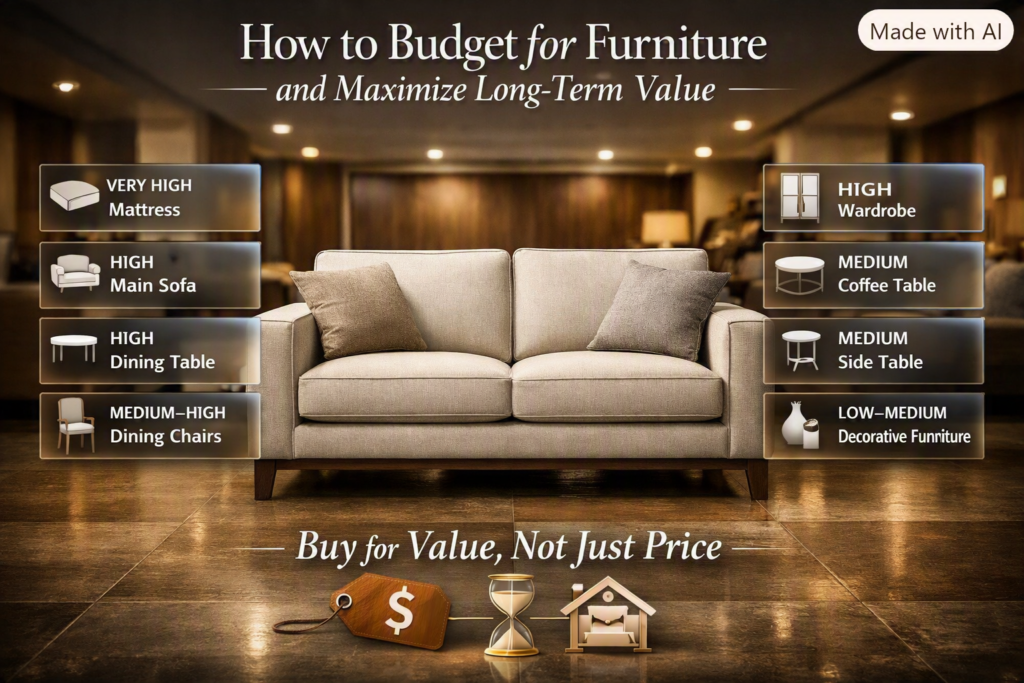
Your furniture budget should reflect frequency of use, expected lifespan, replacement cost, and the importance of the piece to your daily life. Spend more strategically on furniture that receives heavy use, while choosing economical options for pieces that are temporary, decorative, or easily replaceable.
You don’t need to furnish an entire home with premium furniture.
Instead, divide your budget into priorities.
| Furniture Type | Budget Priority | Why |
|---|---|---|
| Mattress | Very High | Directly affects daily comfort |
| Main sofa | High | Heavy everyday use |
| Dining table | High | Frequent functional use |
| Dining chairs | Medium–High | Comfort and durability matter |
| Wardrobe | High | Storage and repeated movement |
| Coffee table | Medium | Important but easier to replace |
| Side table | Medium | Useful but less demanding |
| Decorative furniture | Low–Medium | Style-focused |
This prevents the common mistake of spending most of your money on one visually impressive item while compromising on essentials.
Buy for Value, Not Just Price
A $500 chair that lasts two years may be more expensive over time than a $900 chair that remains comfortable and structurally sound for many years.
The same principle applies to sofas, beds, wardrobes, and dining furniture.
Think about cost per year of useful service, not just purchase price.
How Can You Choose Furniture That Matches Your Interior Style?
Choose furniture by identifying the room’s dominant style, color palette, proportions, materials, and architectural character. Furniture doesn’t need to come from the same collection or brand. It needs to share enough visual qualities to create cohesion.
Don’t Try to Match Everything
A room where every piece looks identical can feel more like a showroom than a home.
Instead, coordinate:
- Wood tones
- Metal finishes
- Colors
- Shapes
- Scale
- Texture
- Design era
For example, a modern sofa can work with a vintage wooden table when the proportions and colors are carefully balanced.
The goal is coordination rather than duplication.
Think About Color Before Buying
Large furniture pieces occupy significant visual space, so their color matters.
Neutral upholstery can provide flexibility, while stronger colors can create a focal point.
If you’re planning a room around a specific palette, your choice of wall color should support rather than fight the furniture. Your paint color resources can help when coordinating furniture with walls and other finishes.
Should You Buy Furniture Online or In-Store?

Online furniture shopping offers convenience, broader selection, and easy price comparison, while in-store shopping lets you test comfort, construction, scale, and finish. The best approach is often to research online first and physically inspect important pieces whenever possible.
Benefits of Buying Online
Online shopping makes it easier to:
- Compare prices
- Read customer reviews
- Check dimensions
- Explore many styles
- Find less common designs
- Review specifications
- Compare delivery options
But photographs can hide important details.
Color may look different on your screen. Upholstery texture can be impossible to judge. A sofa may appear deep and luxurious but feel awkward when you sit on it.
Benefits of Buying In-Store
A showroom allows you to:
- Sit on sofas
- Test chairs
- Touch materials
- Open drawers
- Inspect finishes
- Compare sizes
- See colors under real lighting
The ideal strategy is not “online versus store.”
It’s research online, verify important details, then buy with confidence.
What Should You Check Before Ordering Furniture Online?
Before placing an online furniture order, check exact dimensions, materials, weight capacity, assembly requirements, delivery access, return conditions, warranty coverage, lead time, and customer reviews. Never rely solely on product photographs or a short product title.
Use This Online Furniture Checklist
Before clicking “buy,” confirm:
- Exact width
- Exact depth
- Exact height
- Material
- Finish
- Weight capacity
- Assembly requirements
- Delivery method
- Return policy
- Warranty
- Estimated delivery date
- Doorway clearance
- Customer reviews
📌 Quick Tip: Read reviews specifically for comments about comfort, durability, color accuracy, assembly, and actual size. Reviews mentioning these details are often more useful than general five-star ratings.
How Do You Choose a Comfortable Sofa?
A comfortable sofa should have a seat depth, seat height, cushion firmness, back support, and arm height that suit the people who will use it. Comfort depends on body proportions and sitting habits, so never assume that a highly rated sofa will feel comfortable to everyone.
Consider Seat Depth
Deep sofas are popular for lounging.
Shallower sofas can be easier for upright sitting.
If several people with different preferences will use the sofa, choose a balanced depth rather than an extreme design.
Consider Cushion Construction
Sofa cushions may use:
- Foam
- Fiber
- Feather
- Combination fills
- Different density foams
Softer isn’t always better.
A cushion that feels wonderful for ten minutes may lose support quickly if its construction isn’t suited to heavy use.
Consider the Frame
A strong internal frame provides the foundation for long-term durability. Also check whether the sofa’s legs are properly secured and whether the overall structure feels stable.
How Do You Choose the Right Dining Table?
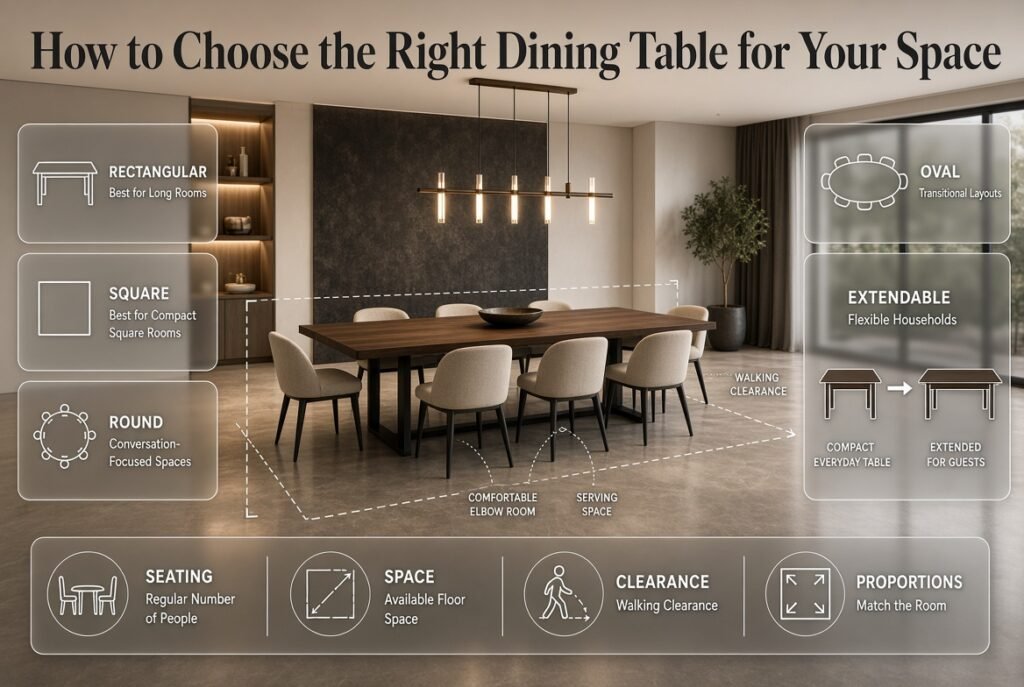
Choose a dining table based on the number of people you regularly seat, available floor space, chair dimensions, walking clearance, and the room’s proportions. Don’t select a table based solely on how many people the manufacturer says it can accommodate.
Think about everyday use.
A table for four people should still allow comfortable elbow room, serving space, and movement.
Round vs. Rectangular Dining Tables
| Shape | Best For | Main Benefit |
|---|---|---|
| Rectangular | Long rooms | Efficient seating |
| Square | Compact square rooms | Balanced proportions |
| Round | Conversation-focused spaces | Easier interaction |
| Oval | Transitional layouts | Softer visual shape |
| Extendable | Flexible households | Adapts to guests |
An extendable table can be especially useful when you don’t want a large table occupying valuable floor space every day.
How Do You Choose a Bed and Bedroom Furniture?
Choose bedroom furniture around the bed and mattress first, then make sure wardrobes, drawers, bedside tables, and other pieces leave enough room for movement. Bedroom furniture should support rest and organization rather than making the room feel crowded.
Your bed is usually the visual and functional anchor.
After selecting it, check:
- Mattress dimensions
- Headboard height
- Bed frame height
- Under-bed storage
- Bedside table height
- Wardrobe clearance
- Drawer opening space
A wardrobe that looks compact can become impractical if its doors open directly into a narrow walking route.
For additional ideas, see room-by-room interior design inspiration.
How Important Is Furniture Storage?
Storage furniture should be selected according to what you actually own rather than what looks attractive in a showroom. Good storage reduces visual clutter, makes daily routines easier, and allows decorative furniture to perform a practical role.
Before buying a cabinet, ask:
What exactly will go inside it?
Measure the objects you need to store.
For example, shelves that are too shallow for books or drawers that cannot accommodate folded clothing aren’t useful simply because the cabinet looks attractive.
For ideas on making better use of limited space, explore smart storage and organization ideas.
How Can You Make Small Rooms Feel Bigger With Furniture?
Small rooms benefit from appropriately scaled furniture, open floor space, visually light designs, multifunctional pieces, and smart storage. The goal isn’t to eliminate furniture but to choose pieces that perform more than one job without overwhelming the room.
Consider:
- Furniture with raised legs
- Nesting tables
- Storage ottomans
- Foldable dining furniture
- Wall-mounted storage
- Slim-profile seating
- Beds with integrated storage
Avoid filling every empty corner.
Empty space is not wasted space. It contributes to movement, light, and visual balance.
How Do You Mix Different Furniture Styles?
Mix furniture styles by connecting them through shared colors, materials, proportions, or shapes. A room doesn’t need to follow one strict design category. The strongest eclectic spaces usually have a clear visual relationship between pieces rather than random combinations.
For example:
Modern sofa + vintage wood table + contemporary lighting
can work beautifully when the colors and proportions are controlled.
The mistake is mixing styles without a unifying element.
A simple rule is to let one style dominate and use another as an accent.
How Can Decorative Objects Work With Furniture?
Decorative objects should support the furniture rather than compete with it. Their scale, color, texture, and placement should reinforce the room’s main visual structure.
For example, a large console may benefit from one substantial decorative arrangement instead of many tiny objects.
If you’re interested in creating a clean decorative layer, white decorative objects can work particularly well in modern, minimalist, Scandinavian, and neutral interiors.
The important point is restraint.
Furniture should remain functional first.
How Does Furniture Work in Children’s Spaces?
Furniture for children should prioritize safety, durability, easy cleaning, appropriate proportions, and flexibility. Avoid sharp corners where possible, unstable tall furniture, unsafe finishes, and pieces that aren’t designed for children’s use.
Children’s furniture also needs to tolerate real life.
That means:
- Spills
- Scratches
- Frequent movement
- Creative activities
- Rapid changes in needs
If you’re designing hospitality or family-oriented spaces, children’s hotel furniture provides a useful reference for thinking about child-friendly furniture design.
What Furniture Mistakes Should Beginners Avoid?
Most furniture-buying mistakes happen because people prioritize appearance, price, or trends before considering measurements, function, quality, and long-term use. The result is often furniture that looks good initially but doesn’t work well in everyday life.
Mistake 1: Buying Without Measuring
This is probably the most expensive simple mistake.
A few minutes with a tape measure can prevent weeks of frustration.
Solution: Measure the room, furniture footprint, delivery route, and surrounding clearance.
Mistake 2: Choosing Style Over Comfort
A fashionable chair isn’t useful if you can’t sit comfortably in it.
Solution: Test furniture whenever possible and consider how your body actually uses it.
Mistake 3: Buying Everything at Once
Furnishing an entire home in one weekend often produces a generic look.
Solution: Buy major pieces first, live with them, and add supporting furniture gradually.
Mistake 4: Ignoring Maintenance
Some materials require more care than others.
Solution: Ask how the furniture should be cleaned before purchasing it.
Mistake 5: Assuming Expensive Means Better
Price can reflect branding, design, materials, labor, shipping, or construction—but high price alone doesn’t guarantee quality.
Solution: Inspect the actual construction and specifications.
Mistake 6: Following Trends Too Closely
A trend can become dated quickly.
Solution: Use expensive, large furniture pieces as long-term foundations and introduce trends through easier-to-replace accessories.
Mistake 7: Ignoring Delivery
Furniture can fit your room perfectly and still fail to enter your home.
Solution: Measure doors, stairs, elevators, hallways, and turns.
How Do Professionals Approach Furniture Selection?
Professionals usually begin with the room’s function, measurements, circulation, and visual hierarchy before selecting individual pieces. They consider how furniture relates to architecture, lighting, materials, color, and human movement instead of evaluating each item separately.
A professional approach often follows this sequence:
- Measure the room.
- Identify its primary function.
- Establish the largest furniture pieces.
- Plan circulation.
- Choose a material direction.
- Establish a color palette.
- Compare furniture proportions.
- Select secondary pieces.
- Add lighting and accessories.
- Review the complete composition.
This approach reduces expensive trial and error.
For broader practical planning, practical home improvement guides can help connect furniture decisions with wider home projects.
How Can You Create a Furniture Buying Plan?
A furniture buying plan helps you avoid impulse purchases and ensures that your budget goes toward the pieces your home actually needs.
Step 1: List the Problems
Don’t start with products.
Start with problems.
Maybe the living room lacks comfortable seating. Perhaps the bedroom has insufficient storage. Maybe the dining area needs flexible seating.
Write those problems down.
Step 2: Measure the Space
Create a simple floor plan.
Mark:
- Doors
- Windows
- Fixed furniture
- Electrical outlets
- Heating/cooling equipment
- Walking routes
Step 3: Set Priorities
Label every desired furniture item:
Essential / Useful / Optional
Buy essentials first.
Step 4: Set a Budget Range
Instead of saying “I want to spend $1,000,” establish a comfortable range.
For example:
Target: $1,000
Acceptable range: $850–$1,200
This makes comparison easier without encouraging unnecessary spending.
Step 5: Compare Construction
Compare similar products based on:
- Materials
- Frame
- Hardware
- Warranty
- Dimensions
- Reviews
- Maintenance
- Delivery
Step 6: Think Long-Term
Ask:
Will I still want this furniture in five years?
You don’t need a perfect prediction. The question simply forces you to distinguish between a durable choice and an impulse purchase.
Step 7: Wait Before Buying
For expensive furniture, give yourself time to reconsider.
If you still like the piece after a few days—and it still fits your measurements and budget—it’s more likely to be a thoughtful purchase.
How Can You Decorate Around New Furniture Without Overspending?
The easiest way to control decorating costs is to treat furniture as the foundation and accessories as flexible layers. You don’t need to replace everything when one major furniture piece changes.
For example, a new sofa can transform a room without requiring new flooring, tables, lamps, and wall décor.
You can refresh the room through:
- Cushions
- Throws
- Artwork
- Rugs
- Plants
- Mirrors
- Decorative objects
- Lighting
For budget-conscious updates, see easy decorating tips for every budget.
For DIY-friendly improvements, DIY home projects can also help you personalize the space without replacing major furniture.
What should I look for when buying furniture?
When buying furniture, don’t judge the piece by its appearance or showroom finish alone. Start by checking the dimensions, construction, materials, comfort, hardware, finish, and how well it suits your everyday lifestyle. A good piece of furniture should fit the room physically and visually while also being strong enough for the amount of use it will receive.
For upholstered furniture, inspect the frame, cushion support, fabric, stitching, and overall stability. For wooden furniture, look at the joints, thickness, finish, drawer construction, and hidden areas. Open every drawer and cabinet door you can, and sit on chairs or sofas rather than making a decision from appearance alone.
Key points to check before buying:
Measure both the room and the furniture.
Confirm the actual material used throughout the piece.
Test comfort and stability.
Inspect joints, hardware, and moving parts.
Ask about maintenance requirements.
Check warranty and return conditions.
Make sure the furniture can enter your home during delivery.
Professional advice: If a seller cannot clearly explain what the furniture is made from or how it is constructed, don’t assume the missing information is positive. Ask specific questions before paying.
How can you tell if furniture is good quality?
You can judge furniture quality by examining its construction rather than relying on weight, price, brand name, or polished appearance. Look at the frame, joints, hardware, surface finish, upholstery, and moving parts. Quality furniture should feel stable, function smoothly, and show consistent workmanship across both visible and less-visible areas.
For example, when checking a dining chair, turn it over and inspect how the legs connect to the frame. With a wardrobe, open the doors and drawers repeatedly to check alignment and movement. With a sofa, sit in different positions and listen for excessive creaking or movement.
A useful rule is:
Visible beauty tells you how furniture looks today. Construction tells you how it may perform tomorrow.
Quality inspection checklist:
Strong and stable frame
Secure joints
Properly fitted hardware
Smooth drawer movement
Even doors and gaps
Consistent finish
Firm, appropriate upholstery support
No unexplained wobbling or excessive movement
Clear material specifications
Written warranty where appropriate
Don’t automatically assume that heavy furniture is better. Weight can provide a clue about materials, but it doesn’t prove good joinery or workmanship. Quality needs to be assessed as a complete package.
Which furniture material is best for long-term use?
The best furniture material depends on where the piece will be used, how heavily it will be used, your budget, and the environment in which it will be kept. Solid wood can be an excellent choice for structural furniture, while quality engineered wood, metal, plywood, and other materials can also perform well when properly selected and manufactured.
For heavily used pieces such as beds, dining tables, and sofa frames, buyers should pay particular attention to structural strength and joinery. For wardrobes and cabinets, engineered boards can be practical when they are appropriately constructed, properly finished, and protected from excessive moisture.
In homes where humidity is a concern, moisture resistance becomes especially important. Poorly protected boards can swell or deteriorate when exposed to moisture, while poorly prepared timber can move as environmental conditions change.
Material decision guide:
Solid wood: Excellent for durable, traditional, and repairable furniture.
Plywood: Strong and versatile, particularly useful for cabinets and structural applications.
MDF: Suitable for many interior applications when kept in appropriate conditions.
Particleboard: Affordable but needs careful consideration of moisture exposure and construction quality.
Metal: Strong and useful for frames, legs, shelving, and contemporary designs.
Glass: Visually light and attractive, but requires appropriate safety and careful handling.
Upholstery fabrics: Choose according to cleaning needs, traffic, sunlight, children, and pets.
Professional advice: Don’t ask only, “Is this solid wood?” Ask which parts are solid wood, which parts are engineered, what the internal frame uses, and what material is used for the backs, drawer bottoms, and hidden panels. That gives you a much more accurate picture of what you’re actually buying.
How much should you spend on furniture?
There is no universal amount you should spend on furniture because the right budget depends on the room, expected lifespan, frequency of use, household needs, and overall financial situation. A smarter approach is to spend more on furniture that receives daily use and choose simpler or less expensive options for occasional-use and decorative pieces.
For example, a mattress, main sofa, dining chairs, and frequently used bed may justify a larger portion of the budget because poor quality in these areas affects everyday comfort. A decorative side table or occasional accent piece doesn’t necessarily require the same level of investment.
Instead of asking whether a piece is “cheap” or “expensive,” compare its value over time.
Consider:
Purchase price ÷ expected useful years = approximate annual cost
A moderately expensive sofa that remains comfortable and structurally sound for many years may offer better value than a cheaper sofa that needs replacement quickly.
Before spending more, ask:
Is the construction actually better?
Are the materials better suited to the intended use?
Is the warranty stronger?
Is the furniture more comfortable?
Will it be easier to repair?
Does it solve a specific problem better?
Is the additional cost buying genuine quality or simply a premium appearance?
Professional advice: Don’t furnish an entire home according to the same quality level. Build a priority list. Invest heavily where durability and comfort matter most, then use your remaining budget for secondary furniture and décor.
How do I choose the right furniture size for my room?
Choosing the right furniture size starts with measuring the room, but the process doesn’t stop there. You also need to measure doors, hallways, stairs, elevators, windows, existing furniture, and the clearance required for walking, opening drawers, reclining, or pulling out dining chairs.
A piece can technically fit inside a room and still be too large for comfortable everyday use. For example, a sofa may fit against a wall but leave an awkwardly narrow route to the doorway. A dining table may technically accommodate six chairs but leave insufficient space behind the chairs when people are seated.
Before buying, create a simple floor plan or mark the furniture footprint on the floor with painter’s tape. This gives you a realistic sense of how much space the furniture will occupy.
Use this size checklist:
Measure the available wall or floor area.
Measure the furniture’s full width, depth, and height.
Check door and hallway measurements.
Consider corners and stair turns.
Allow comfortable walking routes.
Check clearance for drawers and doors.
Consider the size of nearby furniture.
Compare the furniture’s visual scale with the room.
Quick example: A large sectional might be perfect for a spacious family room but overwhelming in a compact apartment. In a smaller room, a moderately sized sofa with slimmer proportions can provide enough seating while preserving valuable circulation space.
Professional advice: Never buy furniture based solely on photographs. A room photographed with a wide-angle lens can make a large sofa look surprisingly compact. Always compare the published dimensions with your own measurements before ordering. Measuring both the room and the furniture is one of the most consistently recommended furniture-buying precautions.
Conclusion
Furniture buying is not simply about finding a beautiful sofa, bed, dining table, or storage unit. It is about choosing pieces that genuinely work with your space, lifestyle, budget, comfort needs, and long-term expectations. The most attractive furniture can become a poor investment when its proportions are wrong, its construction is weak, or it does not suit the way your household actually uses the room.
The smartest approach is to slow down before making a purchase. Measure the room, check doorways and delivery routes, compare dimensions, examine materials and joints, test comfort, and understand exactly what is included in the price. Measuring both the room and the delivery path is especially important because a piece can fit the intended location yet still fail to pass through a doorway, hallway, staircase, or lift.
Quality should also be judged beyond appearance. Look underneath tables, inside drawers, behind cushions, and at the joints. Ask what materials are used in different parts of the furniture rather than accepting vague descriptions such as “wooden furniture.” These small checks can reveal differences that showroom lighting and attractive photography easily hide.
Most importantly, buy for real life rather than an imaginary lifestyle. A family with children needs different upholstery and storage solutions than someone furnishing a formal guest room. A small apartment benefits from appropriately scaled, multifunctional furniture, while a large open-plan home may need larger pieces to establish comfortable zones. Your furniture should make everyday living easier, not create additional problems.
Before paying, ask yourself five final questions:
- Does it fit the room and the delivery route?
- Is the construction appropriate for everyday use?
- Does the material suit my climate and maintenance routine?
- Is the comfort and functionality worth the price?
- Will I still be happy with this piece several years from now?
If the answer to all five is yes, you are no longer buying furniture based purely on appearance—you are making a considered investment in your home.
Good furniture buying advice ultimately comes down to one principle: choose quality, proportion, comfort, and practicality first, then let style complete the decision. When those fundamentals are right, your furniture will not only look better in the room; it will continue to serve you well long after the excitement of the purchase has passed.

Leave a Reply