
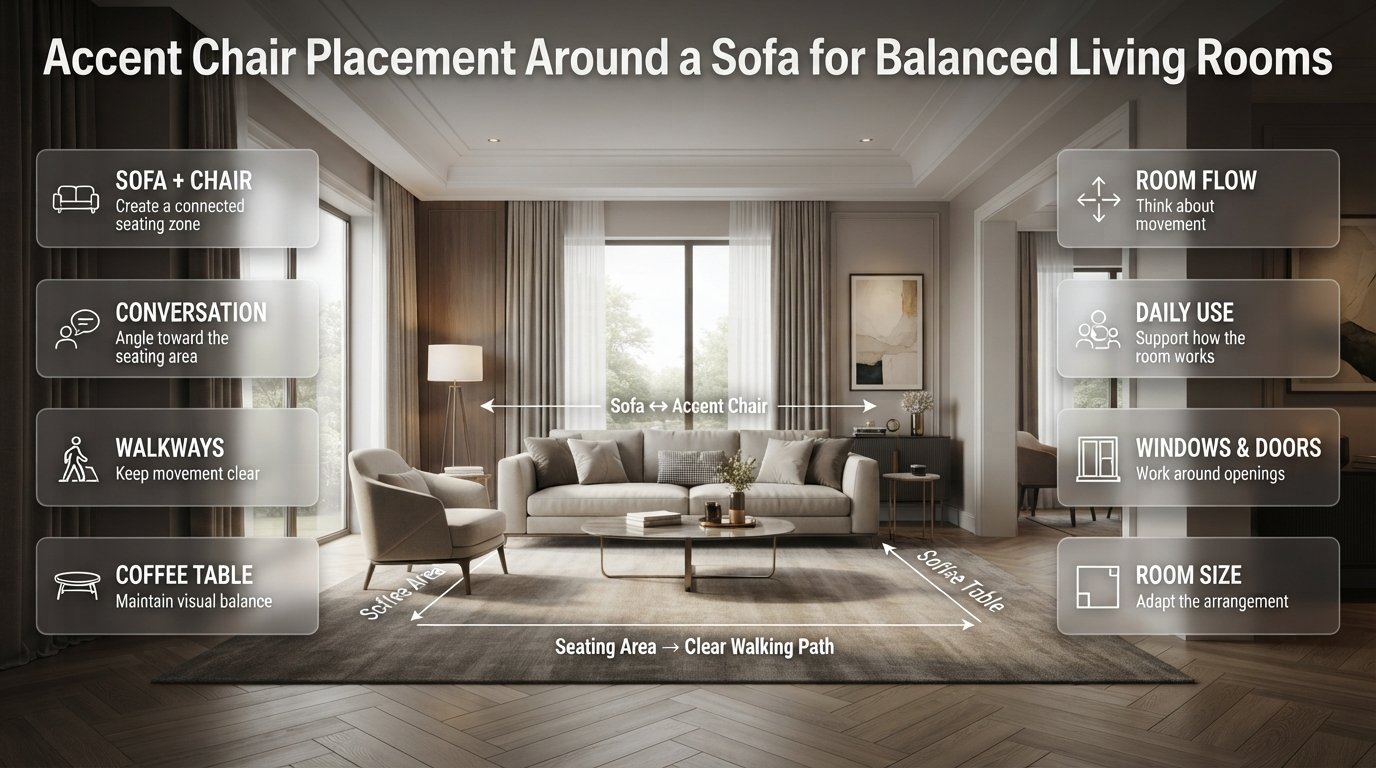
Introduction
Accent Chair Placement Around a Sofa | You can buy a beautiful sofa, choose an expensive accent chair, add a stylish coffee table, and still end up with a living room that feels strangely uncomfortable. The problem is often not the furniture itself. It’s accent chair placement around a sofa.
Maybe the chair feels too far away from the sofa. Perhaps it blocks the walkway, makes the coffee table feel off-center, or sits in a corner without actually becoming part of the room. These small positioning problems can change the entire character of a living room.
The solution isn’t to follow one rigid furniture rule. Good placement comes from understanding how people move, talk, relax, watch television, read, and use the room throughout the day.
This guide explains how to position an accent chair around a sofa, how much space to leave between furniture pieces, when to angle a chair, how to handle small and large living rooms, how to work around windows and doors, and which mistakes can make a carefully decorated room feel awkward.
If you’re planning a new seating arrangement, DesignMode24 Interior Design can also be a useful starting point for broader ideas about creating a functional and visually balanced home.
What Is the Best Accent Chair Placement Around a Sofa?
The best accent chair placement creates a clear relationship between the chair and sofa while preserving comfortable movement through the room. In most living rooms, the chair should face or angle toward the sofa rather than appearing completely disconnected from the main seating area.
Think about the arrangement as one conversation zone instead of several individual furniture pieces.
The sofa establishes the primary seating position. The accent chair then supports that seating area by adding another place to sit, creating visual balance, or giving the room a secondary function such as reading.
A practical starting point is:
- Place the chair approximately 18–30 inches from the sofa when the room allows.
- Angle the chair slightly toward the sofa or coffee table.
- Keep major walkways around 30–36 inches where possible.
- Make sure the chair doesn’t block doors or frequently used routes.
- Check the relationship between the chair, sofa, coffee table, rug, and lighting.
- Consider the chair’s full footprint, not only the legs or seat.
These aren’t absolute rules. Furniture dimensions and room architecture can change the ideal arrangement.
Recent furniture-placement guidance similarly emphasizes that chairs should support conversation while maintaining clear circulation rather than being positioned randomly.
Why Accent Chair Placement Matters More Than You Think
An accent chair is relatively small compared with a sofa, but its position can have an outsized effect on the room.
A chair placed correctly can:
- Complete a conversation area.
- Balance the visual weight of a sofa.
- Fill an awkward corner.
- Create a reading zone.
- Direct attention toward a fireplace or window.
- Add color or texture.
- Improve seating capacity.
- Help divide an open-plan room.
A badly placed chair can do the opposite.
It can interrupt traffic, make a room look crowded, create an uncomfortable distance between people, or make the furniture arrangement appear accidental.
This is why furniture placement should be considered part of the overall interior rather than something you solve after buying the furniture.
How Far Should an Accent Chair Be From a Sofa?
A useful starting range is 18–30 inches between the sofa and accent chair, although the correct distance depends on the furniture’s size and how the space between them will be used.
If the chair is simply positioned near the sofa as part of the same seating group, you can usually work with a relatively compact gap.
If you plan to place a side table between the chair and sofa, you’ll need additional space.
Some contemporary furniture guides suggest wider distances around 24–36 inches for certain layouts, while smaller rooms may need tighter positioning.
Practical spacing guide
| Situation | Starting point |
|---|---|
| Very small room | 12–18 inches |
| Standard conversation grouping | 18–30 inches |
| Larger living room | 24–36 inches |
| Chair with side table | Allow additional table clearance |
| Main walking route | Around 30–36 inches where possible |
Don’t treat these measurements as a mathematical formula.
For example, an 18-inch gap can work beautifully between a sofa and compact chair if nobody needs to walk through it. The same 18-inch gap can feel completely wrong if it forms the home’s main route from the entrance to another room.
Function comes before measurement.
Should an Accent Chair Face the Sofa?
An accent chair can face the sofa directly, but it doesn’t have to.
A slight inward angle often feels more natural because it creates a conversational relationship without making the arrangement look overly formal.
A chair positioned around 20–45 degrees toward the sofa can visually open the seating area toward the center of the room.
Directly facing the sofa
Choose this approach when:
- The room is relatively formal.
- You want a clear conversation area.
- The sofa and chair have enough space between them.
- The coffee table sits comfortably between the seating pieces.
Angled toward the sofa
Choose an angled arrangement when:
- You want a relaxed atmosphere.
- The chair sits beside the sofa.
- The room is open-plan.
- The chair also needs to face a fireplace, window, or television.
- You want softer visual movement.
The goal isn’t perfect symmetry.
The goal is to make the people sitting in the room feel connected.
Should You Place the Accent Chair Beside the Sofa?
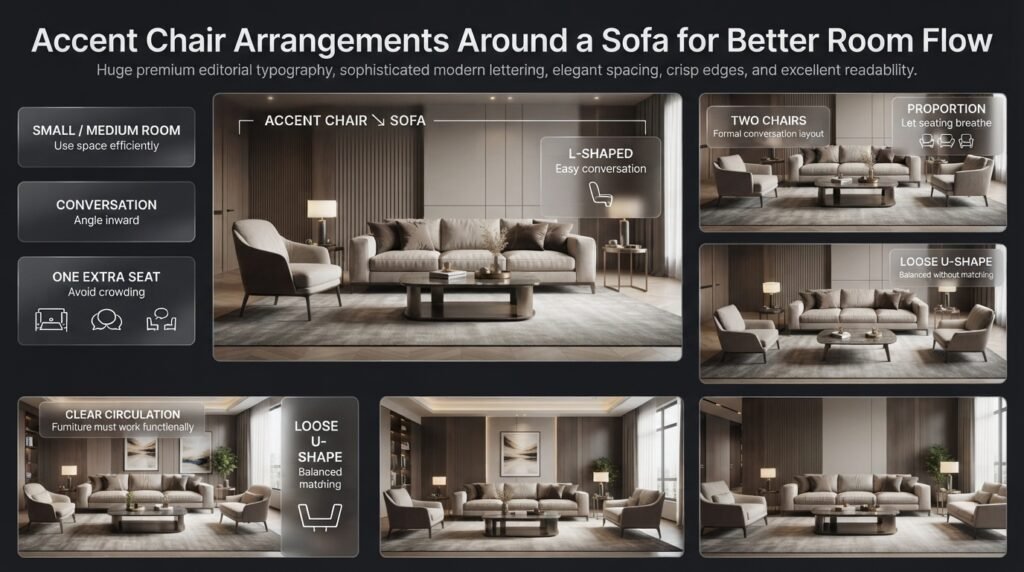
Yes. Placing an accent chair beside the sofa is one of the most flexible arrangements for a living room.
Instead of placing the chair directly parallel to the sofa, rotate it slightly inward.
This creates an L-shaped relationship:
        ACCENT CHAIR
             /
            /
           /
SOFA ───────────────
The arrangement works particularly well when the room has one strong wall for the sofa and open floor space beside it.
It also works well in apartments because you’re adding seating without creating an entirely separate furniture row.
When this arrangement works best
Use it when:
- The room is small or medium-sized.
- You want easy conversation.
- The sofa already establishes the main focal direction.
- You need one additional seat.
- A second chair would make the room feel crowded.
What to watch for
Don’t push the chair so close that the arms touch the sofa.
Also check whether the chair blocks:
- A doorway
- Balcony access
- A hallway
- A floor vent
- A window
- A cabinet
- The main path around the room
A chair can fit physically and still be badly placed functionally.
Two Accent Chairs Opposite a Sofa
Two accent chairs opposite the sofa create a more formal and symmetrical conversation arrangement.
        CHAIR       CHAIR
           \         /
            \       /
          COFFEE TABLE
                |
        ─────────────
             SOFA
This arrangement is particularly effective in larger rooms because it gives the sofa a visual counterpart.
However, don’t automatically use two chairs just because the room is large.
The chairs need enough space to breathe.
If two wide chairs consume the entire width of the room, the result may feel heavier than a single well-proportioned chair.
When to choose two chairs
Two chairs can work well when:
- You regularly entertain guests.
- The room has a conversation-focused layout.
- The sofa is visually substantial.
- The chairs are proportionate to the sofa.
- There is enough circulation space behind and beside them.
A current 2026 furniture-placement guide similarly notes that oversized chairs and excessive seating can disrupt walkways, while proportional seating produces a more balanced composition.
One Accent Chair at Each End of the Sofa
Another option is placing a chair at each end of the sofa.
This creates a loose U-shaped seating arrangement.
        CHAIR       CHAIR
          \           /
           \         /
          ─────────────
              SOFA
The chairs can be angled slightly toward the sofa.
This layout feels particularly natural when the sofa sits in the middle of a large room rather than directly against a wall.
It also allows the room to feel symmetrical without requiring every piece of furniture to match.
Don’t make symmetry too obvious
Perfectly matching chairs can look polished, but they aren’t required.
You could use:
- Two matching chairs.
- Two chairs in different fabrics.
- Two similar silhouettes in different colors.
- One upholstered chair and one lighter-frame chair.
The important thing is that they share enough visual characteristics to feel related.
For broader guidance on creating relationships between different spaces and furniture elements, see Creating Cohesion Between Different Rooms.
Accent Chair Placement in a Small Living Room
Small living rooms require more discipline.
The biggest mistake is trying to reproduce a large-room layout using smaller dimensions.
A compact room may only need one accent chair.
Instead of asking, “Where can I fit another chair?” ask:
“Where can this chair provide useful seating without damaging the room’s circulation?”
That’s a much better question.
Best options for small rooms
Consider:
- A narrow accent chair.
- An armless chair.
- A compact lounge chair.
- A chair with exposed legs.
- A swivel chair with a relatively small footprint.
- A chair positioned beside the sofa.
Visually lightweight furniture can make a small room feel less crowded.
Small-room example
┌─────────────────────────┐
│                         │
│       SOFA              │
│  ─────────────────      │
│                         │
│        COFFEE TABLE     │
│                         │
│                    /    │
│              CHAIR /    │
│                         │
└───────────────DOOR──────┘
The chair shouldn’t occupy the path toward the door.
If you are already dealing with a compact home, broader Home Improvement planning can help you think about the room as a complete system instead of treating the chair as an isolated purchase.
Accent Chair Placement in a Large Living Room
Large rooms create a different problem.
Instead of trying to save space, you need to prevent furniture from looking lost.
A tiny accent chair positioned six feet away from the sofa may technically fit, but it won’t necessarily look connected to the seating area.
Large rooms often benefit from:
- Two accent chairs.
- A larger coffee table.
- A generous rug.
- Side tables.
- Floor lamps.
- A more substantial chair silhouette.
The furniture should occupy enough visual territory to feel intentional.
However, don’t fill every empty section of the floor.
Empty space is useful.
A successful large living room combines occupied areas with breathing room.
How Does the Coffee Table Affect Accent Chair Placement?
The coffee table is the bridge between the sofa and accent chair.
If it is too close to the seating, movement becomes uncomfortable.
If it is too far away, the seating arrangement starts to look disconnected.
A common practical starting point is approximately 14–18 inches between the sofa and coffee table, with adjustments based on furniture depth and room size.
The chair should also have reasonable access to the table.
You don’t want someone sitting in the accent chair to lean awkwardly across the entire seating area to put down a drink.
Think in terms of a triangle
             SOFA
      ─────────────────
              |
              |
        COFFEE TABLE
          /       \
         /         \
      CHAIR       CHAIR
The furniture doesn’t have to form a mathematically perfect triangle.
It simply needs to create a visual and functional connection.
How Much Walking Space Should Be Around an Accent Chair?
Walking clearance is one of the most overlooked parts of furniture planning.
A commonly used starting point is around 30–36 inches for a comfortable main walkway, although exact requirements depend on the room and how heavily the route is used.
Before finalizing your chair, physically walk through the room.
Try:
- Walking normally.
- Carrying a tray.
- Opening a nearby door.
- Pulling the chair out.
- Sitting down.
- Standing up.
- Walking behind another person.
If you have to turn sideways every time you pass the chair, the placement needs to change.
⚠ Common Mistake: Measuring only the distance between furniture pieces.
A room doesn’t become functional simply because the furniture technically fits.
The question is whether people can move naturally.
How to Place an Accent Chair Near a Window
A window can be an excellent location for an accent chair, especially when the chair is intended for reading or relaxing.
But don’t automatically center a large chair directly in front of the window.
Doing so can:
- Block natural light.
- Hide the window.
- Interfere with curtains.
- Restrict access.
- Make the chair look visually heavy.
Instead, consider placing the chair slightly beside the window and turning it toward the room.
Pairing the chair with a floor lamp can create a small reading zone.
If your window treatment is automated, furniture placement should also account for how blinds or shades operate. Your article on Designing Interiors Around Automated Blinds is relevant here because window functionality should be considered before permanently positioning large furniture.
How to Place an Accent Chair Near a Fireplace
If your fireplace is the room’s focal point, the chair should support it rather than compete with it.
One option is to angle the chair toward both the fireplace and sofa.
Another is to position two chairs near the fireplace while keeping the sofa as the primary seating piece.
Avoid placing a large chair so close to the fireplace that it creates a safety or access problem.
The chair should also not block the natural view of the fireplace from the sofa.
The best arrangement allows multiple pieces to acknowledge the same focal point.
How to Arrange an Accent Chair With a Sectional Sofa
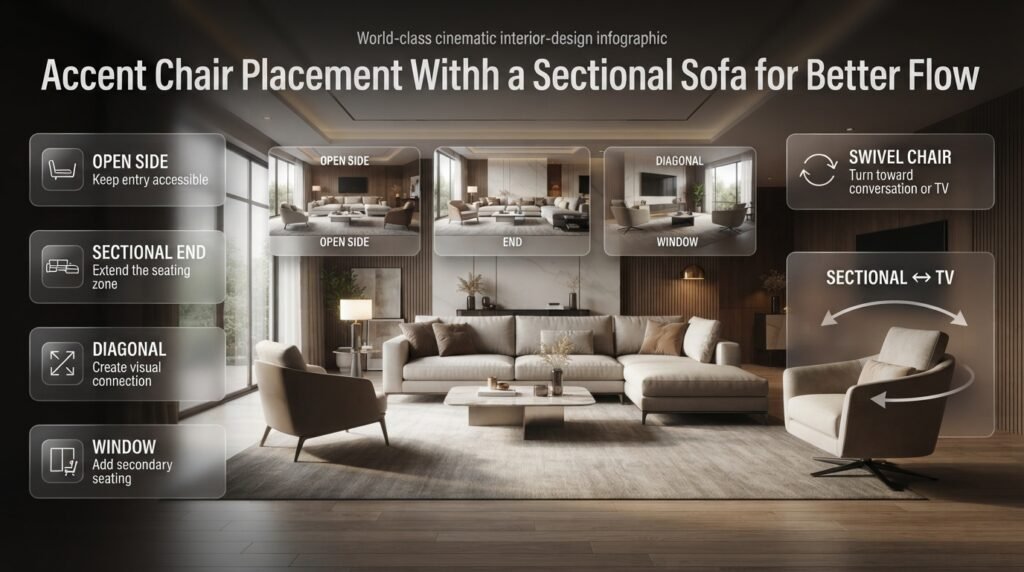
Sectionals already create a strong seating shape, so adding a chair requires restraint.
A chair can work:
- Opposite the open side of the sectional.
- At the end of the sectional.
- Diagonally across from the sectional.
- Near a window as secondary seating.
Avoid putting the chair directly in front of the sectional’s natural entry point.
That makes the seating area harder to enter and can make the room feel smaller.
Sectional example
              ACCENT CHAIR
                   /
                  /
       ┌────────────────
       │
       │    SECTIONAL
       │
       └────────────────
A swivel chair can be especially useful because it can serve more than one direction.
For example, it can face the sectional when guests are talking and rotate toward the television when someone wants to watch a program.
Should an Accent Chair Match the Sofa?
No. An accent chair doesn’t need to be identical to the sofa.
In fact, a completely matching sofa-and-chair set can sometimes make a room feel overly coordinated.
Current design guidance increasingly favors creating cohesion through repeated elements rather than making every furniture piece identical. Designers cited by The Spruce, for example, recommend using selected repeated colors, materials, or finishes while introducing variation in silhouettes and textures.
The chair can connect to the sofa through:
- Color.
- Texture.
- Wood tone.
- Metal finish.
- Pattern.
- Shape.
- Cushion details.
For example, a cream sofa could work with a deep green chair if green appears elsewhere in the room.
A beige sofa could work with a walnut-frame chair.
A gray sofa could work with a warm leather chair.
The relationship matters more than an exact match.
How to Choose the Right Accent Chair Size
Chair dimensions should be considered before placement.
A chair that’s too large may consume the walking space you need.
A chair that’s too small may look visually insignificant next to a large sofa.
Pay attention to:
- Overall width.
- Overall depth.
- Seat width.
- Seat height.
- Arm width.
- Back height.
- Leg design.
A useful design principle is to compare the chair’s visual weight, not only its measurements.
A bulky upholstered chair with thick arms can look much larger than a narrow chair with exposed legs even if both have similar widths.
Check the seat height
Many furniture guides suggest keeping chair and sofa seat heights relatively close, often within around 1–2 inches, so the pieces read as part of one seating arrangement.
This isn’t a hard rule.
Comfort should always come first.
But extremely different seat heights can make the arrangement feel visually disconnected.
How Color Can Connect an Accent Chair to a Sofa
Color is one of the easiest ways to make different furniture pieces feel related.
You don’t need the chair and sofa to share the same color.
Instead, repeat a color elsewhere.
For example:
Sofa: warm beige
Accent chair: muted olive
Rug: beige, olive, and cream
Artwork: olive detail
Cushion: small olive accent
Now the chair doesn’t look random.
It has a visual reason for being there.
If you are developing a larger color palette, the Paint Color section can provide additional inspiration for coordinating colors throughout the home.
How Texture Helps Different Furniture Pieces Work Together
Texture is especially useful when the colors are neutral.
A room containing a beige sofa and cream accent chair can look flat if everything has the same smooth finish.
Instead, introduce differences:
- Linen.
- Bouclé.
- Velvet.
- Leather.
- Woven fabric.
- Natural wood.
- Stone.
- Metal.
The chair can become the textural accent without needing a dramatic color.
This is particularly effective in modern neutral interiors where visual interest comes from material contrast rather than strong colors.
How Lighting Changes Accent Chair Placement
Lighting shouldn’t be treated as an afterthought.
A chair used for reading needs different lighting from a chair used only for occasional conversation.
Consider placing:
- A floor lamp behind the chair.
- A side table with a lamp.
- A wall light nearby.
- Adjustable lighting for reading.
- Ambient lighting that connects the entire seating area.
The lighting source should be positioned so that it illuminates the user without creating uncomfortable glare.
If you want to build a more responsive lighting system, Intelligent Lighting can provide ideas for integrating lighting into modern interior planning.
How an Accent Chair Can Define an Open-Plan Living Room
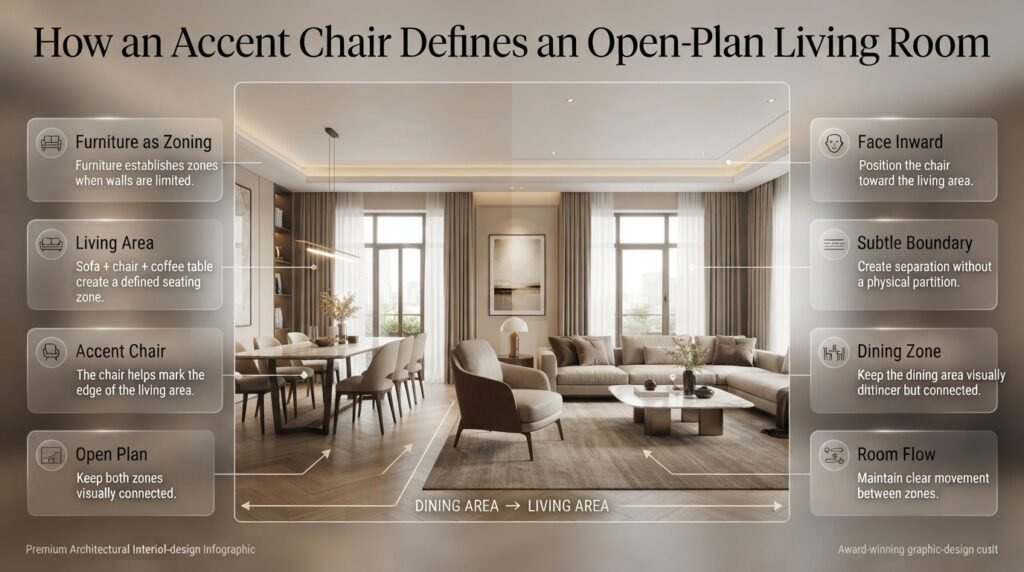
Open-plan rooms can be difficult because there are fewer walls telling you where one zone ends and another begins.
Furniture becomes the zoning tool.
A sofa and accent chair can establish the living area without needing a physical partition.
For example:
DINING AREA       LIVING AREA

TABLE             CHAIR
                   \
                    \
             COFFEE TABLE
                    |
                  SOFA
The chair can help create a boundary between the living room and another zone.
This works especially well when the chair faces inward rather than directly toward the dining area.
The result is a subtle separation without making the room feel divided.
How a Rug Can Improve Accent Chair Placement
A rug can visually group the sofa and chair.
Without a rug, furniture can sometimes appear like individual objects scattered around a large floor.
With a properly sized rug, the seating pieces feel connected.
Ideally, the rug should relate to the primary seating group rather than being so small that it sits only underneath the coffee table.
Depending on the room, you can place:
- The sofa and chairs fully on the rug.
- The front legs of the main seating on the rug.
- The entire conversation zone over one large rug.
The correct option depends on the room dimensions.
What to Do When the Accent Chair Is in a Corner
A corner is tempting because it looks like unused space.
But a chair shouldn’t be placed there simply because there is room.
Ask what the corner contributes.
If it’s a reading corner, add:
- A floor lamp.
- Small table.
- Book storage.
- Footstool if space allows.
If it’s part of the main seating area, angle the chair toward the sofa.
A chair placed completely square against two walls may look like it has been stored there.
Pulling it slightly forward can make the placement feel deliberate.
For broader inspiration on making awkward or overlooked parts of a home more useful, Mintpaldecor Home Repair Inspiration can complement the furniture-planning process.
Should You Put a Side Table Between the Sofa and Accent Chair?
A side table can be extremely useful, but only if the space allows it.
A small table can:
- Create a visual bridge.
- Hold drinks.
- Support a lamp.
- Provide a place for books.
- Make the chair feel anchored.
However, squeezing a table into a narrow gap can create the opposite effect.
If the table forces the sofa and chair too far apart, skip it.
Function should determine whether the table belongs there.
Accent Chair Placement Around a Sofa for Reading
If the chair’s purpose is reading, don’t necessarily place it directly inside the main conversation zone.
Instead, position it near a window, lamp, or quieter corner while maintaining a visual relationship with the sofa.
The chair should still feel like part of the room.
A reading chair can have:
- A floor lamp.
- Small side table.
- Ottoman.
- Soft throw.
- Small bookshelf nearby.
This creates a secondary function without requiring an entirely separate room.
Accent Chair Placement for TV-Focused Living Rooms
If television viewing is the primary function, the chair needs a reasonable viewing angle.
A chair positioned directly sideways from the television can become uncomfortable during long viewing periods.
A swivel chair can solve this problem.
Another option is to angle the chair slightly toward the television while maintaining some orientation toward the sofa.
The important thing is to avoid designing the entire room around the television if the space also needs to support conversation.
Accent Chair Placement in a Formal Living Room
Formal rooms often benefit from symmetry.
You might use:
- A centered sofa.
- Two matching chairs.
- A centered coffee table.
- Matching side tables.
- Balanced lighting.
However, symmetry shouldn’t prevent comfortable movement.
If the symmetrical position blocks a doorway, change the arrangement.
A beautiful floor plan that nobody can comfortably use isn’t a successful design.
Accent Chair Placement in a Casual Family Room
Family rooms generally need more flexibility.
Consider:
- Swivel chairs.
- Durable fabrics.
- Rounded edges.
- Lightweight tables.
- Moveable ottomans.
The chair may need to serve different purposes during the day.
It might face the sofa during conversation and rotate toward the television later.
The furniture should support the way the family actually lives instead of forcing everyone to use the room in one predetermined way.
Common Accent Chair Placement Mistakes
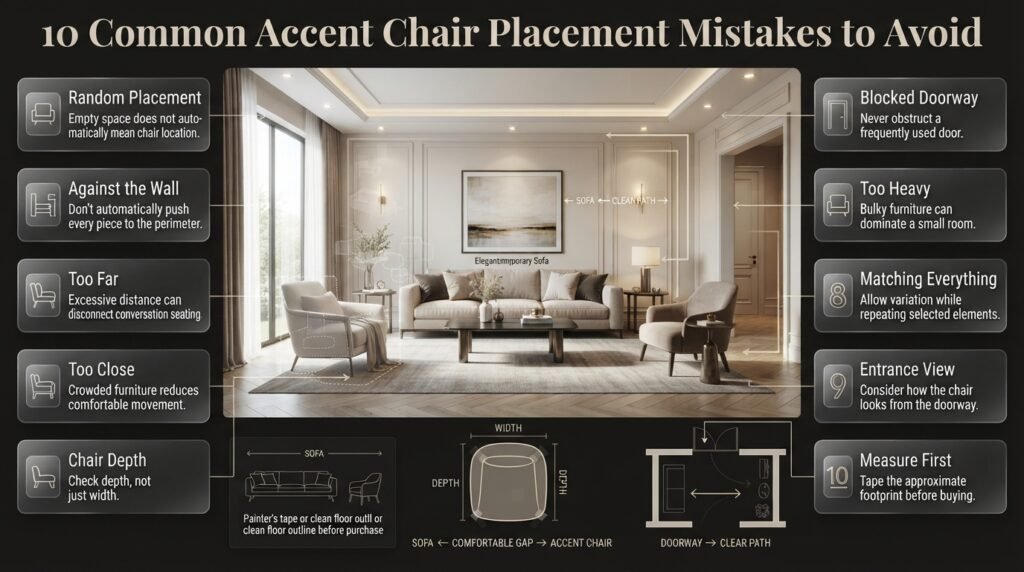
Mistake 1: Putting the Chair Wherever There Is Empty Space
Empty space doesn’t automatically mean “chair location.”
A chair needs a purpose.
Better approach: Identify what the chair contributes before deciding where it goes.
Mistake 2: Pushing Every Piece Against the Wall
This is one of the most common furniture-layout habits.
It may make the center of the room look larger, but it can also disconnect the seating.
Current layout advice frequently recommends allowing furniture to form an intentional group rather than automatically lining every piece against the perimeter.
Mistake 3: Making the Chair Too Far From the Sofa
If the chair is several feet away without a clear reason, it may stop functioning as part of the conversation area.
Better approach: Bring it closer unless you’re intentionally creating a separate zone.
Mistake 4: Making the Chair Too Close
Furniture that touches or nearly touches can look crowded.
People also need room to sit, stand, and move.
Better approach: Start with a comfortable gap and adjust from there.
Mistake 5: Ignoring the Chair’s Depth
A chair may have a reasonable width but extend much farther into the room than expected.
Better approach: Measure width and depth before buying.
Mistake 6: Blocking a Doorway
This is a functional failure rather than a style issue.
A chair should never make a frequently used door difficult to operate.
Mistake 7: Choosing a Chair That Is Too Heavy Visually
Thick arms, deep upholstery, and a low solid base can make a chair dominate a small room.
Better approach: Choose visually lighter furniture when space is limited.
Mistake 8: Matching Everything
A sofa, chair, rug, tables, cushions, and curtains don’t need to come from the same collection.
Better approach: Repeat selected elements while allowing some variation.
Mistake 9: Forgetting the View From the Entrance
People often arrange furniture while standing inside the seating area.
But the first view from the doorway matters.
The back of the accent chair may be the first thing visitors see.
Make sure that view feels intentional.
Mistake 10: Buying the Chair Before Measuring
A chair can look compact online and surprisingly large in person.
Better approach: Tape the chair’s approximate footprint on the floor before buying it.
How to Measure Your Room Before Moving Furniture
Before changing the layout, measure:
- Room length.
- Room width.
- Sofa width and depth.
- Chair width and depth.
- Coffee table size.
- Door openings.
- Window locations.
- Main walkways.
- Fixed furniture.
- Radiators or vents.
- Television position.
- Fireplace location.
Then mark the furniture footprint using painter’s tape.
This gives you a real-world preview before moving heavy furniture.
A Professional Method for Testing the Layout
Don’t move everything repeatedly.
Use this sequence.
Step 1: Find the focal point
Identify the feature that naturally attracts attention.
It might be:
- Television.
- Fireplace.
- Window.
- Artwork.
- Architectural feature.
Step 2: Position the sofa
The sofa establishes the main seating direction.
Step 3: Mark circulation
Walk from every important doorway to every important destination.
Step 4: Place the accent chair
Start beside, opposite, or diagonally from the sofa.
Step 5: Test the angle
Try straight, 20 degrees, and approximately 45 degrees.
Sit in the chair each time.
Step 6: Add the coffee table
Check reach and movement.
Step 7: Add the rug
Use the rug to visually unite the seating.
Step 8: Add lighting
Place lamps based on how the chair will actually be used.
Step 9: Test the room at different times
Look at it during:
- Morning.
- Afternoon.
- Evening.
- When lights are on.
- When curtains or blinds are closed.
Step 10: Make small adjustments
Move furniture a few inches at a time.
You don’t always need a completely different layout.
Sometimes a 4–6 inch adjustment is enough to improve the room.
Accent Chair Placement and Home Organization
Furniture placement is closely connected with storage.
If an accent chair blocks access to a cabinet or storage unit, the seating arrangement may become frustrating over time.
For example, a chair placed near an entryway should not prevent people from reaching shoes, bags, or coats.
If your living room connects directly to an entryway, Entryway Storage Capacity Planning can help you think about the relationship between furniture placement and everyday storage requirements.
The best layout is one that still works when the room is being used normally—not only when everything is perfectly staged.
Accent Chair Placement and DIY Adjustments
You don’t always need a professional furniture installation to improve your room.
Small changes can have a major effect.
You can:
- Move a chair several inches.
- Replace a bulky side table.
- Change the rug position.
- Rotate the chair.
- Replace an oversized lamp.
- Remove an unnecessary ottoman.
- Rearrange cushions.
- Change the lighting direction.
For homeowners who enjoy making gradual changes themselves, DIY Home Projects can provide additional inspiration for improving the surrounding space without redesigning the entire room.
How Materials Affect the Visual Weight of an Accent Chair
Material selection influences how large or small a chair feels.
A dark leather chair with thick arms can look visually heavier than a light fabric chair with exposed wooden legs.
Similarly:
- Glass tables feel visually lighter.
- Solid wood feels heavier.
- Metal frames can look open.
- Thick upholstery feels substantial.
- Woven materials can add texture without excessive visual weight.
When choosing the chair, think about the other materials already present in the room.
If everything is visually heavy, a lighter chair can create balance.
If everything is extremely light, a substantial accent chair can give the room more grounding.
For more detailed thinking around finishes and materials, see Low VOC Finishes for Healthier Interiors.
Accent Chair Placement in a Bedroom Sitting Area
Although the main keyword concerns living rooms, the same principles apply when a sofa or settee is paired with an accent chair in a bedroom.
The chair should not block:
- Wardrobe doors.
- Drawers.
- Bedside circulation.
- Balcony access.
- Curtains.
If your bedroom has sloped ceilings or awkward architectural conditions, furniture scale becomes even more important. Your guide to Wardrobe Design for Sloped Ceilings is useful when considering how furniture, storage, and circulation interact in rooms with unusual geometry.
The key principle remains the same:
Furniture should work with the architecture, not fight it.
How to Make an Accent Chair Look Like It Belongs
The strongest layouts usually have one or two repeated elements.
For example:
- The chair color appears in artwork.
- The chair’s wood tone appears in the side table.
- The rug includes a subtle version of the chair’s color.
- A cushion connects the sofa and chair.
- The same metal finish appears on lighting and furniture.
You don’t need five matching details.
Two or three connections are often enough.
This creates cohesion while preserving individuality.
When Should You Use a Swivel Accent Chair?
A swivel chair is useful when the room has multiple focal points.
For example:
Position A: Face the sofa for conversation.
Position B: Rotate toward the television.
Position C: Rotate toward the window.
Position D: Turn toward another seating zone.
This makes one chair perform several functions.
But remember that the chair needs additional clearance for rotation.
A stationary chair might fit perfectly in a 32-inch space.
A swivel chair may need significantly more usable floor area.
Accent Chair Placement Around a Sofa: Quick Decision Table
| Room situation | Recommended approach |
|---|---|
| Small room | One compact chair beside sofa |
| Narrow room | Chair at sofa end or angled inward |
| Large room | Two chairs can balance sofa |
| Formal room | Symmetrical paired chairs |
| Casual family room | Swivel or flexible chair |
| Open-plan room | Chair can help define living zone |
| Reading area | Chair near window + task lighting |
| Fireplace room | Angle chair toward fireplace and sofa |
| Sectional | Chair on open side |
| TV-focused room | Chair angled toward screen |
| Multi-use room | Swivel chair |
| Tight walkway | Reduce chair size or change location |
Expert Advice for Getting the Proportions Right
One of the most useful professional habits is to stop thinking about furniture pieces individually.
Think about clusters.
Instead of asking:
“Is this chair the right size?”
Ask:
“Is the sofa + chair + coffee table + rug combination balanced?”
The chair may look too small by itself but work perfectly once the rug and side table are added.
Likewise, a beautiful oversized chair may look impressive in a showroom but overwhelm your living room.
The room is the final product.
The furniture pieces are only components.
What If the Sofa and Chair Have Different Styles?
They can still work together.
A contemporary sofa can pair with a vintage chair.
A traditional sofa can work with a modern sculptural chair.
A neutral sofa can support a bold patterned chair.
The key is to establish a connection.
You might repeat:
- Color.
- Wood.
- Metal.
- Texture.
- Shape.
- Scale.
This approach gives the room personality without making every piece identical.
For broader professional inspiration across different room styles and design approaches, Robert MyGardenAndPatio can also complement the planning process when indoor and outdoor living areas need to feel visually connected.
How far should an accent chair be from a sofa?
There isn’t one universal measurement because the right distance depends on whether the chair is beside the sofa, facing it, or separated by a side table. For a chair placed beside the sofa, a small gap can keep the two pieces visually connected. If a side table is going between them, you’ll need considerably more room. For facing arrangements, the important measurement is the overall conversation distance rather than simply the gap between furniture edges.
Professional placement points:
Start with roughly 6–12 inches when a chair sits directly beside a sofa and no table occupies the gap.
Allow around 18–24 inches or more when a side table is placed between the pieces.
For a main walkway, aim for approximately 30–36 inches of clear space where the room permits.
Always measure the chair’s full depth, because a deep lounge chair can reduce circulation much more than its width suggests.
The best test is surprisingly simple: sit on the sofa, sit in the chair, and then walk through the room normally. If the arrangement looks beautiful but forces people to squeeze past the chair, the spacing needs to change.
Should an accent chair face the sofa or be placed at an angle?
An accent chair doesn’t have to face the sofa perfectly straight. In many living rooms, angling the chair slightly toward the sofa creates a more natural conversation area and makes the furniture feel less rigid. A 30–45-degree angle can be particularly useful when the chair sits at the end of a sofa or needs to acknowledge more than one focal point.
Use a straight-facing arrangement when:
The room is large enough for a dedicated conversation zone.
You want a more formal and symmetrical appearance.
The sofa and chairs are arranged around a central coffee table.
Use an angled arrangement when:
The room is smaller.
The chair is beside the sofa.
You want a relaxed, conversational atmosphere.
The television or fireplace creates another important focal point.
The professional trick is not to obsess over the exact angle. Sit in the chair and check whether your body naturally faces the people on the sofa. If you have to twist your shoulders or neck to talk, the chair needs to rotate.
Can you put an accent chair next to a sofa in a small living room?
Yes, and this is often one of the most practical ways to add seating without making a small living room feel overloaded. Instead of creating a second row of furniture opposite the sofa, place one compact chair at the sofa’s end and turn it slightly inward. This creates an L-shaped seating arrangement while keeping more of the central floor available for movement.
For a small room, look for:
A compact overall width.
Moderate seat depth.
Narrow or open arms.
Exposed legs or a visually lighter base.
A swivel design if the room has multiple focal points.
Don’t choose a chair solely because its listed width fits the available space. You also need room for someone to sit down, stand up, and move around it.
Professional tip: Before buying the chair, mark its approximate dimensions on the floor with painter’s tape. Then open doors, walk through the room, and use the sofa normally. This simple floor test often reveals problems that aren’t obvious from measurements alone.
Should an accent chair match the sofa or the rug?
An accent chair doesn’t need to match either one exactly. A more sophisticated approach is to coordinate rather than duplicate. The chair can introduce a different color, fabric, or silhouette while sharing one or two visual characteristics with the sofa or the rest of the room. This prevents the seating arrangement from looking like a perfectly matched furniture set.
For example, a warm beige sofa could work with:
An olive-green upholstered chair.
A cognac leather chair.
A textured cream chair.
A walnut-frame chair with neutral upholstery.
The connection can come from a rug, cushion, artwork, wood finish, or another accessory.
The same principle applies to the rug. Rather than choosing a chair that disappears into the rug, use the rug as a visual bridge between the seating pieces. When the front legs of the sofa and accent chair sit on the same rug, the furniture often reads as one intentional seating group rather than separate objects.
The goal: the chair should look like it belongs in the room, not like it was purchased as part of a matching three-piece set.
How many accent chairs should you place around a sofa?
For most living rooms, one or two accent chairs are enough. One chair works especially well in a compact room or when the sofa already provides substantial seating. Two chairs become useful in a larger room where you want to create a balanced conversation area opposite the sofa. Adding more chairs simply to fill empty floor space can make the room feel crowded and reduce the importance of the sofa as the main anchor.
Choose one chair when:
The room is small or medium-sized.
You need to preserve a clear walkway.
The sofa is already large.
You want a reading or occasional chair.
The room has another major focal point.
Choose two chairs when:
The room has enough depth and width.
You regularly host guests.
You want a formal conversation arrangement.
The sofa needs more visual balance.
Both chairs can maintain comfortable circulation.
Two chairs don’t necessarily need to be identical. They can share a color, material, height, or design detail while remaining individually interesting.
The final test is proportion: if the chairs visually overpower the sofa, there are probably too many or they’re simply too large. If one carefully chosen chair completes the seating group without blocking movement, adding another isn’t necessary just because the room has available space.
Conclusion
Accent chair placement around a sofa is less about following one fixed decorating rule and more about creating a living room that feels balanced, comfortable, and easy to use. The right position should support conversation, maintain clear walking space, and make the chair feel naturally connected to the sofa rather than looking like an extra piece of furniture.
Start by measuring the available space, considering the sofa’s size, and deciding how the chair will be used. A chair placed beside the sofa can create a relaxed reading or conversation spot, while an angled chair can open the room toward the coffee table, television, fireplace, or another focal point. In larger rooms, two chairs can help create a more complete conversation area without making the sofa carry the entire seating arrangement.
Remember that proportion matters just as much as distance. A large chair can overwhelm a compact sofa, while a very small chair may look disconnected in a spacious room. Leave enough room for people to sit comfortably, move around the furniture, and use side tables without constantly bumping into other pieces.
Color, texture, material, and lighting can also help the chair belong to the overall design. It does not need to perfectly match the sofa. Instead, look for one or two visual connections that make the seating arrangement feel intentional.
The best placement is the one that looks balanced, works comfortably, and fits the way your household actually uses the room. Measure first, test the layout before committing, and adjust the chair until the entire seating area feels natural rather than forced.