
Introduction
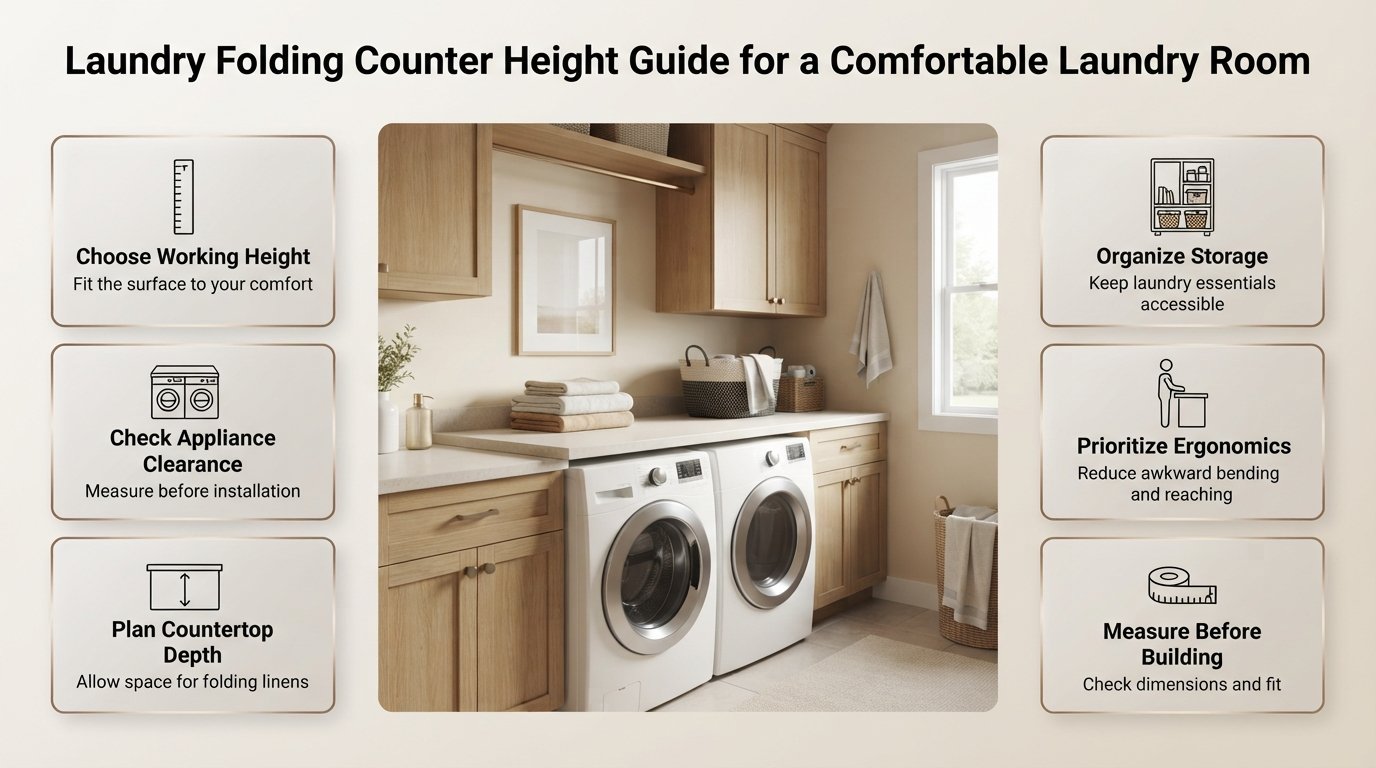
Laundry Folding Counter Height | Have you ever started folding a fresh load of laundry only to find yourself bending over the counter, raising your shoulders, or running out of space when handling bedsheets? These small frustrations can make an ordinary household task feel harder than it needs to be. Often, the problem isn’t the size of your laundry room. It’s the way the workspace has been planned.
Choosing the right laundry folding counter height can make a noticeable difference in comfort, organization, and everyday efficiency. A counter that’s too low may encourage repeated bending, while one that’s too high can make your shoulders and arms uncomfortable. The challenge becomes even more important when the counter needs to fit above a washer and dryer.
For homeowners planning a new laundry room or updating an existing one, DesignMode24 Interior Design offers ideas for making household spaces more practical without losing their visual appeal.
In this guide, you’ll learn the standard laundry folding counter height, how to measure your ideal working surface, how much clearance to leave above appliances, which countertop depth works best, and how to choose materials and storage that suit your household. You’ll also discover common installation mistakes, practical solutions for small laundry rooms, and professional planning tips that help you avoid costly adjustments later.
The goal is simple: create a folding station that fits your body, your appliances, your available space, and the way you actually do laundry.
1. What Is the Standard Laundry Folding Counter Height?
The typical laundry folding counter height is around 36 inches (91.4 cm) from the finished floor to the top of the countertop. This measurement is a useful starting point for many adults who fold laundry while standing. However, it isn’t a universal requirement. Your height, preferred posture, appliance dimensions, and available room may justify a different measurement.
A laundry counter should allow you to spread out clothing without leaning forward excessively or lifting your shoulders. It should also provide enough clearance for the appliances and any supporting structure underneath it.
Common laundry folding counter heights
| Finished counter height | Potential use | Important consideration |
|---|---|---|
| 30–32 inches | Seated folding or certain compact workstations | May feel low for taller standing users |
| 33–35 inches | Shorter users or customized work areas | Test posture before committing |
| 36 inches | General-purpose folding station | A practical starting point for many households |
| 37–39 inches | Some taller users | May be uncomfortable for shorter users |
| 40 inches or more | Specialized or individually tailored work areas | Requires careful ergonomic testing |
These are general planning ranges rather than mandatory building standards. They should not be treated as proof that a particular height will suit every user.
Why 36 inches is a popular starting point
A counter around 36 inches high can offer a comfortable balance between standing posture and practical cabinet dimensions. It also works with many standard cabinetry arrangements, although the actual height of a finished laundry counter may need to change when it sits above appliances.
For example, someone who mainly folds T-shirts and towels may find a 36-inch surface convenient. Another person who is shorter may prefer a lower freestanding table, while a taller homeowner may need a higher surface to avoid leaning forward.
The best approach is to use standard measurements as a starting point and test the proposed height before installation.
Practical tip: Measure from the finished floor, not from an unfinished subfloor. Flooring, cabinet construction, and countertop thickness can all affect the final working height.
2. How Do You Find the Best Folding Counter Height for Your Body?
The best folding counter height is one that allows you to work with relaxed shoulders, comfortable elbows, and minimal bending. Your natural elbow position can help you identify a suitable starting point, but the final decision should be based on how the surface feels during actual folding tasks.
Measure your elbow height
Follow these steps before purchasing cabinets or building a permanent counter.
- Stand upright on the floor where the counter will be installed.
- Relax your shoulders instead of pulling them backward or raising them.
- Bend your elbows naturally, approximately as you would when handling clothes.
- Ask someone to measure from the floor to your elbow.
- Test a temporary surface slightly below that measurement.
- Fold several garments and adjust the height until the movement feels natural.
A working surface below elbow height often works well for light folding. However, the ideal difference varies with body proportions, task requirements, and personal preference.
Test more than one height
Don’t make your decision based on a few seconds of standing at a table. Folding involves reaching, smoothing fabric, stacking garments, and occasionally lifting bulky items.
Try folding a shirt, a pair of trousers, a towel, and a bedsheet. Notice whether you repeatedly bend your back, raise your shoulders, or reach too far across the surface.
If the counter feels uncomfortable after a few minutes, test another height before making a permanent decision.
Consider the primary user
A shared laundry room may be used by adults of different heights. In that situation, choosing a compromise can work, particularly if the difference between users is small.
If one person handles most of the laundry, however, prioritize that person’s everyday comfort. A second folding surface at a different height can be useful when household members have significantly different needs.
Think about seated folding
Some homeowners prefer to sit while folding clothes, especially when handling a large amount of laundry. A lower table may work better for this arrangement, provided there is enough legroom and a suitable chair.
A standard standing counter shouldn’t automatically be used for seated work. Check the relationship between the seat height, tabletop height, knee clearance, and reach before deciding.
3. How High Should a Folding Counter Be Above a Washer and Dryer?
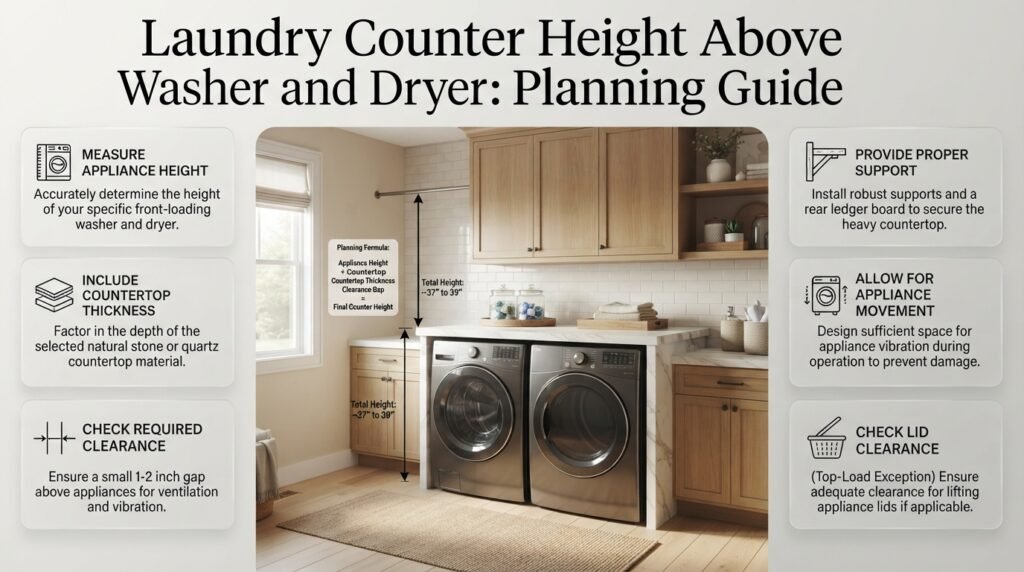
A folding counter installed above front-loading appliances must clear the machines and provide a usable working surface. The correct height depends on the installed appliance height, required clearance, countertop thickness, and support structure. In some installations, a finished height near 36–40 inches may be achievable, but the appliance specifications must determine what is safe and practical.
This is where many laundry room projects become more complicated than expected.
Use the correct height calculation
For a simple installation, use this planning formula:
Finished counter height = installed appliance height + required clearance + countertop thickness
Suppose your washer is 34 inches high, the planned clearance is 1 inch, and the countertop is 1.5 inches thick.
The calculation would be:
34 + 1 + 1.5 = 36.5 inches
This is an illustrative example, not a universal clearance specification. Actual requirements depend on the appliance, its installation instructions, and the way the counter is supported.
Before finalizing the design, check:
- The installed height of both appliances.
- Whether either machine will sit on a pedestal.
- The countertop’s finished thickness.
- Required vibration and ventilation clearances.
- The location of hoses, valves, plugs, and controls.
- Access needed for cleaning, repairs, and appliance replacement.
- Whether the two appliances have different heights.
What if the calculated height is too high?
Suppose the washer and dryer require a counter height that feels uncomfortable for the primary user. Don’t ignore the problem simply to create a continuous countertop.
Consider placing a separate folding table beside the appliances, using a different compatible appliance arrangement, or designing a separate work surface for everyday clothing.
If you’re renovating, decide on the appliance models before ordering the cabinetry. This allows you to coordinate the finished counter height with the equipment rather than trying to make unsuitable dimensions fit later.
Should the counter rest directly on the appliances?
A countertop should generally have an appropriate support structure instead of relying on the washer and dryer to carry its weight.
Washing machines can move and vibrate during spin cycles. Direct contact with the counter may create noise, transmit vibration, or interfere with appliance movement.
Depending on the layout, suitable supports might include properly designed side cabinets, wall brackets, or a dedicated frame. The correct choice depends on the wall construction, countertop material, span, and expected load.
Never assume that drywall alone can support a heavy countertop. Confirm that the fixings and supporting structure are appropriate for the installation.
Don’t forget top-loading machines
Top-loading washers need space above the lid. A fixed countertop directly overhead may prevent the lid from opening fully or make loading uncomfortable.
If you already own a top-loading machine, consider a folding counter beside it or a separate table that can be moved when necessary. A hinged surface may also be possible if it can be designed and supported safely.
The appliance’s opening mechanism should be tested before any fixed counter is installed.
4. What Is the Best Laundry Folding Counter Depth?
A depth of approximately 24 inches is a useful starting point for many laundry folding counters. It provides room for everyday clothing and towels without making the back of the counter excessively difficult to reach. Deeper surfaces can be useful for bulky bedding, while compact laundry rooms may require a shallower design.
The right depth depends on the available space and the type of laundry you handle.
Compare common counter depths
| Counter depth | Suitable situations | Main limitation |
|---|---|---|
| 18–20 inches | Compact laundry rooms and narrow work areas | Limited space for large garments |
| 21–24 inches | Everyday folding and sorting | Bulky bedding may need repositioning |
| 25–30 inches | Larger rooms and frequent bedding tasks | Requires more space and careful reach planning |
| Over 30 inches | Specialized or spacious work areas | The rear may be difficult to access |
These dimensions are general design guidelines. When a counter sits above appliances, its depth must also be compatible with the equipment and the manufacturer’s requirements.
Why an oversized counter can be inconvenient
A deep counter may appear more useful because it offers extra surface area. However, if you need to lean forward to reach the rear, you may end up using only the front portion of the counter.
A shallow counter creates the opposite problem. It may force you to fold larger garments in stages because there isn’t enough room to spread them out.
For many households, a moderate depth works best. If you regularly fold king-size bedsheets, a separate table or occasional pull-out work surface may be more practical than making the permanent counter excessively deep.
Measure the actual folding task
Before choosing the depth, lay a shirt and towel flat on a table and observe how much space you use. Then consider the largest item you fold regularly.
You don’t necessarily need the entire bedsheet to fit completely flat. You need enough space to handle the fabric without dragging it across nearby objects or knocking items onto the floor.
5. How Much Clearance Does a Laundry Folding Counter Need?
A laundry folding station needs enough clearance for people, appliance doors, storage, and maintenance. A counter can have the correct height and depth but still make the room frustrating to use if it blocks the washer door or leaves no space to handle a basket.
Allow for appliance doors
Measure the washer and dryer with their doors fully open. Check whether nearby drawers, cabinet doors, walls, or laundry baskets interfere with that movement.
This is especially important in narrow laundry rooms, where even a small obstruction can make loading and unloading awkward.
Plan standing space
Where the room allows, aim for roughly 36 inches of clear working space in front of the appliances. This is a practical planning target, not a universal building-code requirement.
You may need more space if you use large laundry baskets, open wide appliance doors, or regularly sort clothing in front of the machines.
If the room is too narrow, test the layout with temporary markers on the floor before installing permanent cabinetry.
Keep the working surface accessible
Leave enough open counter space for folding instead of covering the surface with detergent containers, decorative accessories, and storage baskets.
Place everyday supplies in nearby cabinets or shelves. Keep items you use frequently within easy reach, and position heavy containers where they can be lifted without unnecessary stretching.
Protect access to connections
Water shutoff valves, drain connections, electrical outlets, and service panels should remain accessible as required by the appliance and applicable installation rules.
A fixed counter or cabinet arrangement should not make routine repairs unnecessarily difficult. Check access requirements before building around the machines.
6. Which Countertop Material Is Best for a Laundry Room?
The best laundry countertop material is durable, easy to clean, and appropriate for the moisture, heat, and household products found in the room. Laminate, solid-surface materials, quartz, and properly sealed wood are all possible options, but each has different costs, installation requirements, and maintenance needs.
Choose the material according to how you use the counter, not simply according to its appearance.
Laminate countertops
Laminate is often a practical choice for homeowners who want a tidy appearance without the expense of a premium stone surface.
Advantages:
- Available in a wide range of colors and patterns.
- Relatively easy to wipe clean.
- Often lighter and more economical than stone.
- Suitable for many contemporary and traditional designs.
Limitations:
- Exposed edges and seams can be vulnerable to moisture.
- Deep damage may be difficult to repair invisibly.
- Heat resistance varies by product.
Pay particular attention to the edges and seams near sinks, faucets, and walls. A neat finish helps prevent moisture from reaching vulnerable areas.
Solid-surface countertops
Solid-surface materials can provide a smooth, continuous appearance. Some products allow discreet seams and coordinated backsplash details, which can make the folding station easier to clean.
However, resistance to heat, scratching, and cleaning chemicals varies by product. Follow the manufacturer’s maintenance recommendations and confirm that the supporting structure is appropriate.
Quartz and natural stone
Quartz and suitable natural stone can create a premium, durable laundry workspace. They may be attractive when the laundry room forms part of a visible utility area or sits near a kitchen or mudroom.
The main considerations are weight, cost, support requirements, and maintenance. Different stone products have different sensitivities to staining, heat, and cleaning chemicals.
Before installation, confirm that the cabinets or support frame can carry the finished countertop safely.
Sealed wood and butcher block
Wood introduces warmth and natural texture, making it suitable for farmhouse, traditional, and Scandinavian-inspired interiors.
Its main disadvantage is the need for suitable protection and maintenance. Standing water and damp clothing can damage an inadequately sealed surface.
If you choose wood, keep water from collecting around seams, maintain the finish as recommended, and clean up spills promptly.
Which material should you choose?
For a budget-conscious laundry room, laminate may provide the best balance of price and practicality. For a seamless appearance, consider a suitable solid-surface product. For a premium finish, quartz or an appropriate stone may work well. Choose wood when its warmth suits the design and you’re prepared to maintain the finish.
For additional guidance on selecting materials for healthier, thoughtfully designed interiors, explore Low VOC Interior Finishes.
7. How Do You Design a Laundry Folding Counter in a Small Room?
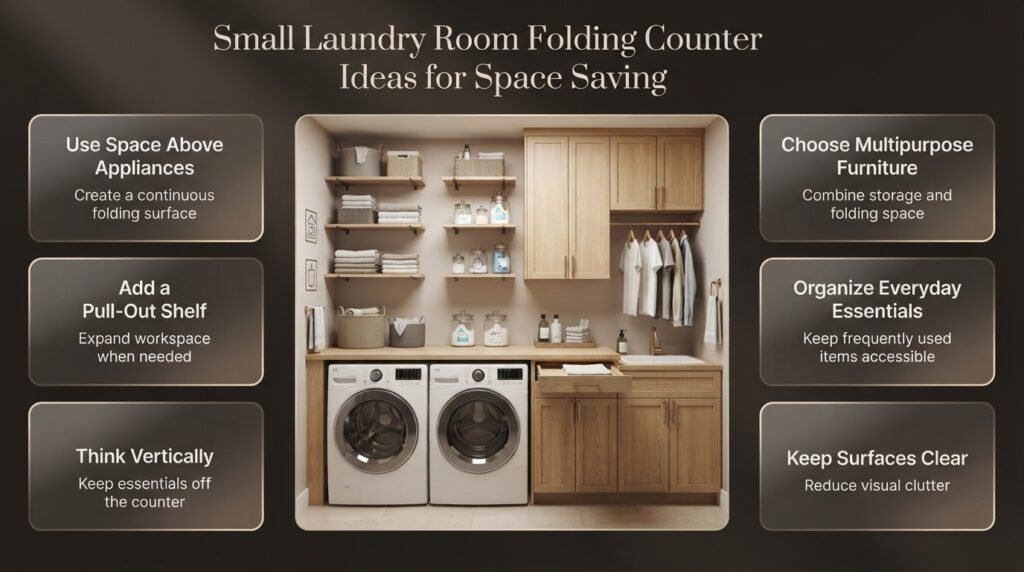
A small laundry room needs a folding station that provides useful workspace without obstructing movement. A compact counter, vertical storage, and a clear route between appliances and cabinets can often deliver better results than installing the largest possible countertop.
The key is to identify the room’s main tasks before deciding how much space each one needs.
Use the space above front-loading machines
If the appliances and installation requirements allow it, a continuous counter over front-loading machines can provide useful folding space without requiring a separate table.
Keep the surface clear enough to handle clothing comfortably. Avoid filling it with containers that could be stored elsewhere.
Install a pull-out folding shelf
A pull-out shelf can provide additional working space when needed and remain tucked away when the laundry room is in use for other purposes.
Choose hardware designed for the intended load, and confirm that the shelf is securely supported when extended. The design should not interfere with appliance doors or walking routes.
Use wall-mounted storage
Shelves and cabinets can keep detergents, towels, and laundry accessories off the counter.
Frequently used supplies should be easy to reach without stretching, while heavy products should be positioned so they can be lifted safely. Cleaning products should also be stored securely away from children.
For ideas about planning vertical storage, read floating shelf load capacity planning.
Consider a multipurpose folding station
A compact cabinet with a usable top may serve as a folding surface and storage unit. A freestanding table might double as a sorting area when needed.
However, multifunctional furniture should simplify your routine. If you must remove several objects before folding a shirt, the arrangement may be creating extra work instead of saving space.
Ideas from foldaway furniture for sleeping spaces can help you think about flexible furniture and the efficient use of limited floor area.
Keep the room visually calm
Small utility spaces can quickly look cluttered when every shelf is filled and every surface is covered. Use a consistent storage approach, limit unnecessary accessories, and reserve the counter for active laundry tasks.
The principles in styling open shelves without clutter can help you balance visible storage with a clean, functional appearance.
8. How Should You Organize Storage Around a Laundry Folding Counter?
Storage should support the folding process instead of competing with it. The most effective laundry room layouts separate dirty clothes, washing supplies, clean clothing, and household linens so that everything has a logical place.
A useful folding counter needs enough open space to work, with storage positioned where it makes the next task easier.
Separate clean and dirty laundry
If your room has enough space, designate separate areas for dirty laundry, freshly dried clothing, and folded items waiting to be put away.
This arrangement reduces unnecessary movement and prevents clean clothes from becoming mixed with laundry that still needs washing.
Use baskets that fit the available shelves or floor space. If several family members share the laundry room, labeled baskets can make sorting easier without adding complicated storage systems.
Store everyday supplies nearby
Keep detergent, stain removers, dryer accessories, and other frequently used items in a dedicated cabinet or shelf.
Avoid storing every household cleaning product on the folding counter. A clear surface makes it easier to spread out clothes and gives you room to sort items before putting them away.
If you need a cabinet near the washer, verify that its doors won’t interfere with appliance access or the counter’s usable area.
Create a linen storage zone
Towels, pillowcases, and bedsheets are often among the bulkiest items handled in a laundry room. A nearby linen cabinet can reduce the number of trips required to put clean items away.
Adjust the shelf spacing to accommodate the actual items you store. A cabinet with excessively tall shelves may waste vertical space, while shelves that are too close together can make it difficult to remove folded towels.
For more ideas, see bathroom linen closet planning.
Use open shelving selectively
Open shelves make frequently used items easy to access, but they also display everything stored on them. Choose baskets or containers that suit the shelf dimensions and group similar supplies together.
Keep the most frequently used items at convenient heights. Reserve higher shelves for lightweight items that you don’t need every day.
The goal is to make storage easy to maintain rather than creating an arrangement that looks organized only immediately after cleaning.
9. What Lighting Works Best Above a Laundry Folding Counter?
Good lighting helps you identify stains, distinguish similar clothing colors, and fold garments accurately. A combination of general room lighting and focused task lighting often works better than relying on a single ceiling fixture, especially when cabinets or appliances cast shadows across the counter.
Choose even, comfortable lighting
A bright ceiling fixture provides general illumination, while under-cabinet lighting can illuminate the folding surface directly.
If the laundry room has little natural light, consider adding task lighting that spreads light evenly across the counter rather than creating a bright spot in one corner.
Look for a color-rendering quality suitable for distinguishing fabric colors. A higher color rendering index can help you see colors more accurately, although the overall light quality and brightness also matter.
Avoid glare and shadows
Glossy countertops can reflect light into your eyes, while poorly positioned fixtures may cast shadows when you stand in front of the counter.
Test the lighting from your normal working position. Make sure your body doesn’t block most of the light when you lean over a garment.
Choose fixtures suitable for the room’s moisture conditions, particularly if the laundry counter is near a sink or other water source.
Plan lighting before installing cabinets
If you intend to install under-cabinet lighting, plan the wiring, power supply, and fixture placement before the cabinets and backsplash are finished.
This can help you avoid visible cables and awkwardly positioned switches later.
Lighting is also part of the room’s overall design. For a broader understanding of how materials, light, and residential spaces work together, explore the history of changing residential interiors.
10. How Can You Make a Laundry Folding Counter Safer and Easier to Maintain?
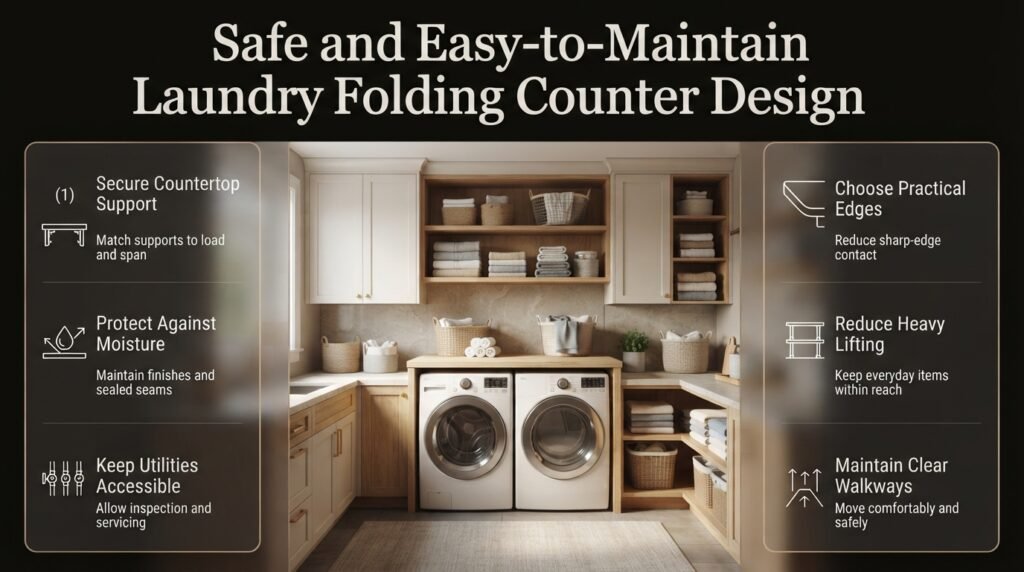
A practical folding station should be stable, easy to clean, and free from unnecessary obstacles. Small design choices, such as rounded edges, secure supports, and accessible storage, can make daily use more convenient.
Check the support structure
The countertop must be supported according to its material, dimensions, and expected load. Heavy stone surfaces may require a different support arrangement from lightweight laminate worktops.
Don’t assume that ordinary shelf brackets will be suitable for a long, heavy counter. Confirm the required load capacity, fixing method, and wall construction before installation.
Protect surfaces from moisture
Even if the counter is mainly used for dry laundry, damp towels, wet garments, and cleaning products can introduce moisture.
Wipe up standing water promptly, protect exposed seams, and follow the manufacturer’s cleaning instructions. Wood surfaces may need periodic maintenance, while other materials may require specific cleaning products.
Keep electrical and plumbing access in mind
Laundry rooms contain water connections and electrical equipment. Keep outlets, hoses, shutoff valves, and service areas accessible as required by the installation instructions and applicable local rules.
Don’t conceal a connection simply to achieve a cleaner appearance if doing so makes it difficult to inspect or service.
For electrical work, plumbing changes, and heavy countertop installation, use an appropriately qualified professional when required.
Reduce unnecessary lifting
Place frequently used baskets and supplies where you can reach them without repeatedly lifting heavy loads above shoulder height.
If you regularly handle large laundry baskets, make sure the route between the machines and the folding surface is unobstructed.
A well-designed room should reduce unnecessary movement instead of merely looking attractive.
11. Common Laundry Folding Counter Height Mistakes to Avoid
The most common laundry counter mistakes occur when homeowners select dimensions before considering the people, appliances, and tasks involved. Correcting these problems during planning is usually easier than modifying a completed countertop or cabinet arrangement.
Mistake 1: Choosing a standard height without testing it
A 36-inch counter may work well for one person but feel uncomfortable for another.
Why it happens: Standard cabinet dimensions are treated as a guarantee of ergonomic comfort.
Why it matters: A surface that’s too high may encourage raised shoulders, while a low surface may encourage repeated bending.
How to avoid it: Test a temporary work surface and fold several garments before finalizing the height.
Mistake 2: Forgetting the finished countertop thickness
The cabinet height isn’t necessarily the final working height.
Why it happens: Measurements are taken to the cabinet top before the countertop is installed.
Why it matters: A thick worktop can raise the surface beyond the intended height.
How to avoid it: Calculate the complete assembly, including the finished floor, supports, required clearances, and countertop.
Mistake 3: Ignoring appliance vibration
A counter that touches a moving washing machine may become noisy or unstable.
Why it happens: The counter is fitted tightly against the appliances without checking installation requirements.
Why it matters: Vibration can cause rattling, movement, or damage to adjoining components.
How to avoid it: Use a properly supported structure and maintain the specified clearances around the machines.
Mistake 4: Making the counter too deep
A large surface may seem useful, but excessive depth can make the rear difficult to reach.
Why it happens: The design prioritizes surface area without considering the user’s reach.
Why it matters: You may lean forward repeatedly or leave the rear portion unused.
How to avoid it: Choose a practical depth based on everyday garments and use an additional folding surface for oversized bedding if necessary.
Mistake 5: Blocking appliance doors
Cabinets, drawers, and nearby walls can interfere with washer and dryer doors.
Why it happens: The design considers only the machines’ closed dimensions.
Why it matters: Loading and unloading become inconvenient, and some doors may not open fully.
How to avoid it: Test door movement and nearby cabinet clearances before installation.
Mistake 6: Choosing a material without considering moisture
A countertop that looks attractive may require more maintenance than expected.
Why it happens: Appearance and initial price receive more attention than the laundry environment.
Why it matters: Unprotected seams, unsuitable finishes, or standing water may cause damage.
How to avoid it: Select a material appropriate for the expected moisture exposure and follow its care instructions.
Mistake 7: Filling the folding surface with accessories
Storage baskets, decorative jars, and cleaning products can quickly reduce usable counter space.
Why it happens: Storage is added without deciding which items actually need to remain on the counter.
Why it matters: You must move objects before every folding session.
How to avoid it: Store most supplies in cabinets and reserve the main surface for active laundry tasks.
Mistake 8: Ignoring future appliance replacement
A counter may fit the current washer and dryer but become unsuitable when one machine needs replacing.
Why it happens: The design is based on today’s appliances without considering their dimensions or removal requirements.
Why it matters: A future replacement may require cabinet alterations or countertop removal.
How to avoid it: Keep the design practical, record the measurements, and make sure the machines can be accessed and removed when necessary.
12. Professional Tips for Planning the Ideal Laundry Folding Counter
A successful laundry counter combines ergonomic comfort, suitable materials, efficient storage, and a layout that supports everyday tasks. Professional planning starts with measurements and workflow rather than choosing a countertop based on appearance alone.
Start with a measured room plan
Measure the room’s length, width, and ceiling height. Record the location of doors, windows, plumbing connections, outlets, and any fixed obstructions.
Then measure the washer and dryer, including their installed heights and door movement.
A simple room plan can help you identify whether a continuous countertop, separate folding table, or compact pull-out shelf is the best solution.
Confirm the working height before ordering
Calculate the expected finished height and compare it with the primary user’s comfortable working position.
If the counter must sit above appliances, check whether the required appliance clearance makes that height practical.
If the dimensions conflict, consider changing the layout rather than forcing an uncomfortable height.
Make a full-size mock-up
A temporary table or securely supported work surface can help you test the design before spending money on permanent cabinetry.
Use the mock-up to fold shirts, towels, trousers, and bedsheets. Check whether you can reach the entire surface comfortably and whether the height encourages a natural posture.
Don’t use loose boards balanced on appliances or unstable objects for this test.
Choose materials according to the room’s use
A family laundry room that handles several loads each day may need a different surface from a compact laundry closet used occasionally.
Consider cleaning frequency, moisture exposure, countertop weight, and maintenance requirements before making a final selection.
Coordinate the counter with storage
Decide where clean towels, everyday clothing, laundry supplies, and baskets will go before finalizing cabinet positions.
Keep the main folding surface open and locate essential supplies within convenient reach. If the room serves several purposes, ensure that laundry tasks don’t interfere with its other uses.
The broader principles of functional layout discussed in multipurpose room planning can help when a laundry area shares space with storage, a mudroom, or another household activity.
Plan for children and household routines
If children use the laundry room, consider how they will reach baskets and supplies safely. Keep detergents and other hazardous products secured, and avoid placing heavy objects where they could fall.
A household that sorts clothing by person may benefit from separate baskets or labeled storage. A smaller household may need only one or two baskets and a simple folding area.
The most effective arrangement is the one that fits your actual routine without adding unnecessary complexity.
Keep the design timeless
Laundry rooms are functional spaces, but that doesn’t mean they should be poorly designed. Neutral finishes, durable surfaces, simple cabinet fronts, and practical lighting can create a room that remains attractive as your needs change.
For inspiration on combining long-lasting design choices with everyday functionality, read characteristics of timeless interiors.
13. How Do You Choose Between a Fixed Counter, Folding Table, and Pull-Out Shelf?
The right type of folding surface depends on how frequently you do laundry, how much permanent space is available, and whether you need the room for other activities.
| Option | Main advantage | Potential drawback | Best suited for |
|---|---|---|---|
| Fixed countertop | Stable, continuous workspace | Less flexible if the layout changes | Dedicated laundry rooms |
| Freestanding table | Can be moved or replaced | Takes up floor space | Flexible or multipurpose rooms |
| Pull-out shelf | Provides temporary workspace | Limited size and load capacity | Compact laundry areas |
| Wall-mounted counter | Can free up floor space | Requires suitable structural support | Carefully planned small rooms |
| Separate folding island | Offers generous workspace and storage | Requires a larger room | Spacious laundry rooms |
When is a fixed counter the best choice?
A fixed counter makes sense when you have a dedicated laundry room, compatible front-loading appliances, and enough space for a permanent work surface.
It can provide a stable place for folding, sorting, and temporarily stacking clean clothing. The main considerations are the installation cost, finished height, and access to the appliances.
When is a folding table more practical?
A folding table is useful when the laundry area must also serve as a storage room or multipurpose space.
You can move it when you need additional floor space, and you may be able to choose a height that better suits your body than a standard cabinet arrangement.
However, check its stability, working height, and storage requirements before purchasing it.
When should you choose a pull-out shelf?
A pull-out shelf is worth considering when there isn’t enough room for a permanent counter.
It can provide a temporary place for folding small garments or sorting clothing. However, the shelf’s dimensions and rated capacity may limit its suitability for large bedding or heavy laundry loads.
Choose hardware and supports designed for the intended use, and never exceed the specified load.
14. Step-by-Step Guide to Planning Your Laundry Folding Counter
Planning the counter in a clear sequence helps you avoid measurement errors and unnecessary spending. Use the following process before ordering materials or hiring an installer.
Step 1: Measure the room
Record the room dimensions, finished floor level, door openings, and any fixed obstacles.
Why it matters: The available floor space determines how much counter depth and standing clearance you can accommodate.
Common mistake: Measuring only the wall where the counter will go and forgetting the space needed to open appliance doors.
Step 2: Confirm the appliances
Record the model dimensions, installed height, door movement, and manufacturer clearance requirements.
Why it matters: Appliances often determine the minimum practical height of an over-machine countertop.
Common mistake: Ordering cabinetry before choosing the washer and dryer.
Step 3: Test your preferred working height
Use a stable temporary surface and fold several everyday items.
Why it matters: A comfortable working height should support natural movement rather than simply match a standard measurement.
Common mistake: Choosing the height based on appearance alone.
Step 4: Select the counter depth
Consider your most common folding tasks, including whether you handle large bedsheets or bulky towels.
Why it matters: The depth affects both usable workspace and how far you need to reach.
Common mistake: Making the counter as deep as possible without testing its accessibility.
Step 5: Choose a suitable material
Compare cost, moisture resistance, maintenance, weight, and support requirements.
Why it matters: A material must suit the room’s daily conditions, not just its visual style.
Common mistake: Selecting a heavy countertop without confirming that the support structure can carry it.
Step 6: Plan storage and lighting
Decide where baskets, detergents, clean towels, and other supplies will be stored. Plan task lighting if the counter sits beneath cabinets.
Why it matters: Storage and lighting determine how practical the counter feels during everyday use.
Common mistake: Filling the work surface with accessories before identifying the storage needs.
Step 7: Verify the complete installation
Check the finished counter height, appliance clearances, door movement, structural support, and service access before finalizing the installation.
Why it matters: The complete setup must function safely as one coordinated workspace.
Common mistake: Assuming that individually correct measurements will automatically create a functional room.
What Is the Ideal Height for a Laundry Folding Counter?
The ideal laundry folding counter height is around 36 inches (91.4 cm) from the finished floor for many standing users. This measurement provides a useful starting point for folding clothes, sorting towels, and organizing clean laundry. However, the most comfortable height depends on your body proportions, preferred working posture, and whether the counter sits above a washer and dryer.
A counter that’s too low may encourage you to bend forward repeatedly, while one that’s too high can cause you to raise your shoulders or work with your arms in an uncomfortable position. Before installing permanent cabinetry, test the proposed height using a stable temporary surface and fold several types of clothing.
Important points to consider:
Measure from the finished floor rather than an unfinished subfloor.
Keep your shoulders relaxed while folding clothes.
Test the height with towels, shirts, and larger garments.
Consider the needs of the person who performs laundry most often.
Include countertop thickness when calculating the final working height.
How High Should a Laundry Folding Counter Be Above a Washer and Dryer?
A laundry folding counter above front-loading appliances must accommodate the machines’ installed height, required clearance, and countertop thickness. The final height may be around 36–40 inches in some installations, but the correct measurement depends on the specific appliances and the installation requirements. There is no single clearance that applies to every washer and dryer.
For example, if an appliance is 34 inches tall, the required clearance is 1 inch, and the countertop is 1.5 inches thick, the finished counter height would be 36.5 inches. This is only an illustrative calculation; always confirm the actual dimensions and clearances in the manufacturer’s instructions.
The counter should also have appropriate structural support rather than relying on the appliances themselves, which can vibrate during operation.
Before installation, check:
The installed height of both appliances.
Whether either machine sits on a pedestal.
Required vibration and ventilation clearances.
The thickness and weight of the countertop.
Access to hoses, valves, electrical connections, and service areas.
Whether appliance doors can open fully without obstruction.
What Is the Best Depth for a Laundry Folding Counter?
A counter approximately 24 inches deep is a practical choice for many laundry rooms because it provides useful space for everyday clothing and towels without making the back of the surface excessively difficult to reach. A deeper counter may be helpful if you regularly fold large bedsheets, blankets, or bulky household linens, while a shallower surface may suit a compact laundry area.
The important consideration is balancing usable folding space with comfortable reach. An excessively deep counter may force you to lean forward to reach clothing near the wall, while a shallow surface may require you to fold larger items in several stages.
Choose your counter depth by considering:
18–20 inches: Useful for compact spaces, although large items may be difficult to handle.
21–24 inches: Suitable for many everyday folding and sorting tasks.
25–30 inches: Helpful for larger garments and bedding when sufficient room is available.
The distance you can comfortably reach without leaning forward.
The space required for appliance doors, laundry baskets, and walking routes.
Which Countertop Material Is Best for a Laundry Folding Station?
The best countertop material depends on your budget, design preferences, moisture exposure, and maintenance expectations. Laminate is often a practical budget-friendly choice, solid-surface materials can provide a smooth appearance, quartz offers a premium finish, and properly sealed wood adds warmth to the room.
However, appearance alone shouldn’t determine your choice. Laundry counters may come into contact with damp towels, cleaning products, and occasional spills. The material should be appropriate for these conditions and supported correctly, particularly if you select a heavy stone countertop.
Compare the main options:
Laminate: Economical, available in many finishes, and easy to wipe clean; protect vulnerable seams and edges from moisture.
Solid surface: Can provide a smooth, coordinated finish; check the product’s resistance to heat and scratching.
Quartz or suitable natural stone: Durable and visually refined, but heavier and potentially more expensive.
Sealed wood: Creates a warm, natural appearance but requires appropriate protection and maintenance.
Before making a decision, consider the material’s cleaning requirements, installation cost, weight, and compatibility with your cabinets or support structure.
How Can I Make a Laundry Folding Counter More Comfortable in a Small Laundry Room?
A small laundry room can still have a comfortable folding station if you prioritize the right working height, a practical counter depth, and accessible storage. Instead of installing the largest possible countertop, choose a surface that accommodates your regular laundry tasks while leaving enough room to open appliances, carry baskets, and move around safely.
For compatible front-loading machines, a properly supported counter above the appliances can create a continuous folding area. If the appliances or room layout don’t allow this arrangement, a freestanding table or pull-out shelf may provide a more flexible alternative.
Use these practical design strategies:
Test the counter height before ordering cabinets.
Choose a depth that provides enough room for everyday clothing without excessive reaching.
Use wall-mounted shelves or cabinets to keep supplies off the folding surface.
Consider a pull-out shelf if permanent counter space is limited.
Keep detergents and cleaning products securely stored.
Maintain access to appliance doors, connections, and service areas.
Add suitable task lighting to reduce shadows while folding clothes.
A successful small laundry room isn’t necessarily the one with the most storage or the largest counter. It’s the one where each feature supports your routine without creating unnecessary obstacles.
Conclusion: Choosing the Right Laundry Folding Counter Height
Choosing the right laundry folding counter height can make a noticeable difference in the comfort, functionality, and organization of your laundry room. A well-planned countertop provides a convenient surface for folding clothes, sorting laundry, preparing garments, and managing everyday household tasks without unnecessary bending or reaching.
For many homes, a height of approximately 36 inches is a practical starting point, but the ideal measurement depends on your height, the placement of your washer and dryer, the available floor space, and the thickness of the countertop. Before installation, measure your appliances carefully and consider how you will use the surface during your daily routine.
Focus on these essential planning principles:
- Prioritize comfort: Choose a height that allows you to fold clothes naturally without straining your back or shoulders.
- Measure before installation: Account for appliance dimensions, countertop thickness, and any required access or ventilation clearances.
- Select durable materials: Choose a surface that suits your budget, moisture exposure, cleaning habits, and preferred interior style.
- Make small spaces work harder: Consider compact countertops, wall-mounted surfaces, or pull-out folding stations when floor space is limited.
- Maintain a coordinated design: Combine practical storage, suitable lighting, and complementary finishes to create a laundry room that feels organized and visually appealing.
A thoughtfully designed laundry folding station does not need to be expensive or complicated. By choosing the right dimensions and making practical decisions from the beginning, you can create a comfortable, efficient workspace that supports your household’s needs for years to come. Explore more practical ideas through DesignMode24 Interior Design and discover ways to make every area of your home more functional, comfortable, and stylish.