
Introduction
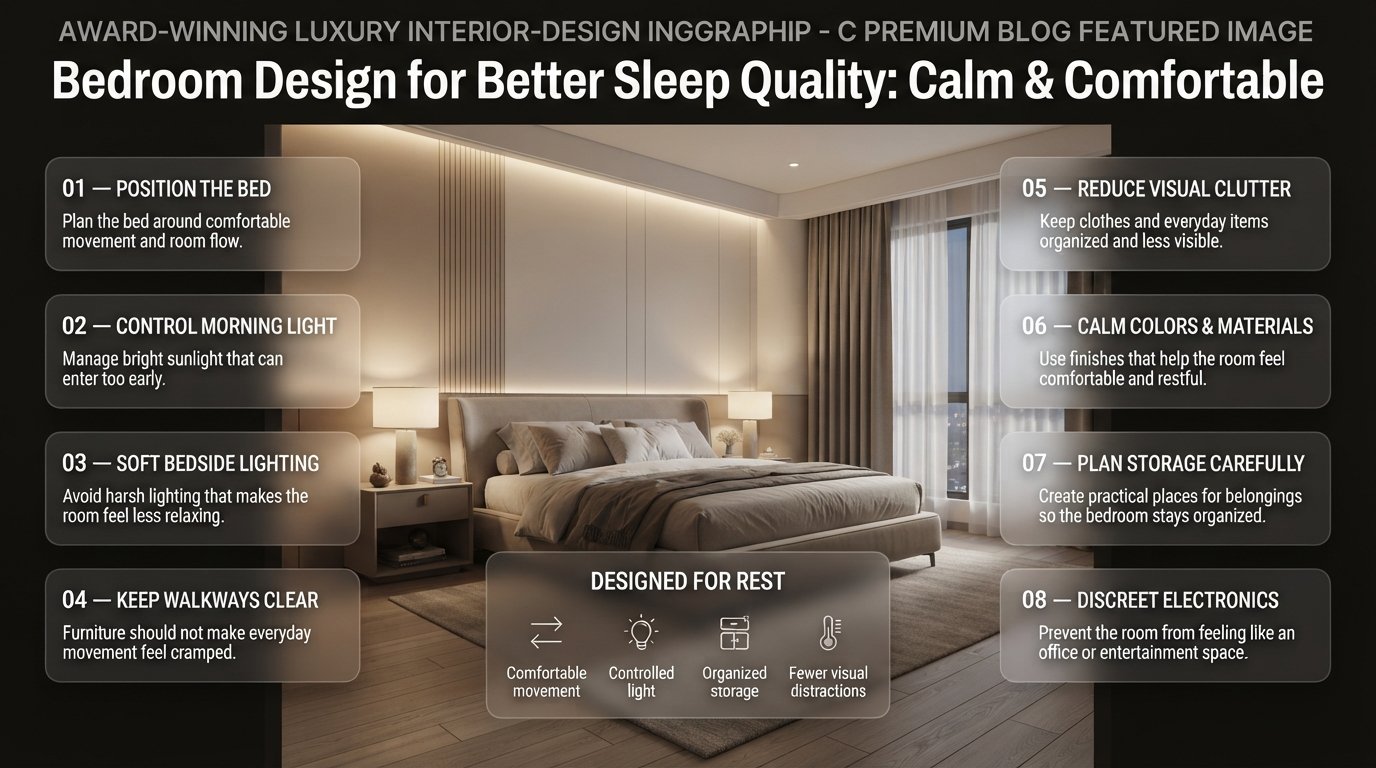
Bedroom Design for Better Sleep Quality | A bedroom can be beautifully decorated and still be a difficult place to sleep.
Maybe the room gets bright sunlight too early in the morning. Perhaps the bedside light is too harsh, the furniture makes the walking space feel cramped, or clothes and electronics are constantly visible. Sometimes the problem isn’t obvious at all—the room simply feels more like a storage area, office, or entertainment space than somewhere designed for rest.
This is why bedroom design for better sleep quality deserves more attention than simply choosing attractive furniture and matching colors.
The way a bedroom is planned can affect how easily you move through the space, how much light enters at night, how relaxing the room feels, how comfortable the temperature is, and whether everyday clutter stays under control. Good design doesn’t guarantee perfect sleep, but it can remove many environmental distractions that make winding down more difficult.
If you’re planning a bedroom refresh, the DesignMode24 Interior Design homepage is also useful for exploring broader room-planning and home-design ideas before making individual design decisions.
In this guide, we’ll look at the bedroom from a practical design perspective. You’ll learn how to position the bed, choose lighting, control visual clutter, select colors and materials, plan storage, improve comfort, avoid common mistakes, and create a bedroom that feels intentionally designed for nighttime relaxation rather than simply decorated for appearance.
What Makes a Bedroom Better for Sleep?
A sleep-friendly bedroom is a space designed to reduce unnecessary stimulation while making everyday nighttime routines comfortable. The most important elements include a practical furniture layout, controllable lighting, suitable temperature, reduced noise, organized storage, comfortable materials, and a visually calm atmosphere.
There isn’t one perfect bedroom style for everyone.
A minimalist bedroom can support relaxation, but so can a traditional, contemporary, Scandinavian, Japandi, or richly layered bedroom. The important factor is how the space functions.
A well-planned bedroom should make it easy to:
- Get into bed without navigating around furniture
- Switch from bright daytime lighting to softer evening lighting
- Keep unnecessary objects out of sight
- Control daylight and nighttime glare
- Adjust bedding according to temperature
- Access frequently used items without creating clutter
- Move around safely in the dark
- Keep work and entertainment visually separate from sleep
- Clean the room without constantly moving furniture
The best starting point is therefore not a shopping list.
It’s understanding what currently prevents the room from feeling comfortable.
Why Does Bedroom Design Matter for Sleep Quality?
Bedroom design matters because the physical environment can influence comfort, relaxation, and nighttime routines. Light, temperature, sound, clutter, furniture placement, and visual stimulation are all environmental factors that can make a bedroom feel more or less suitable for rest.
Consider a typical bedroom.
The bed may be comfortable, but the television is directly opposite it. A bright ceiling light is the only illumination. The wardrobe door opens into the walking path. Clothes accumulate on a chair because the storage system isn’t convenient. Morning sunlight enters through uncovered windows.
None of these issues necessarily requires a major renovation.
Together, however, they can make the room feel less restful.
Good bedroom planning addresses these small problems before adding decorative details.
A Simple Design Principle
Think of the bedroom in this order:
Function → Comfort → Environment → Organization → Appearance
Many people reverse this:
Appearance → Furniture → Accessories → Function
That’s one reason bedrooms can look attractive but work poorly.
⚠ Common Mistake: Choosing furniture because it looks perfect in a showroom without checking whether it fits the actual dimensions, circulation paths, storage requirements, and lighting conditions of your bedroom.
How Should You Plan a Bedroom Layout for Better Sleep?
The bed should normally be the first major furniture item you position because its size and location influence nearly everything else in the room. After placing the bed, plan circulation, bedside furniture, wardrobes, dressers, seating, and decorative elements around the remaining space.
Before moving anything, measure the room.
Record:
- Overall room length and width
- Ceiling height
- Door position and swing
- Window locations
- Wardrobe dimensions
- Electrical outlets
- Air-conditioning units
- Radiators or heaters
- Built-in furniture
- Any structural columns or awkward corners
Then measure the actual furniture rather than estimating from photographs.
Start With the Bed
The bed usually becomes the visual and functional anchor of the room.
A common arrangement is to place the headboard against a substantial wall so the bed feels visually stable. However, this isn’t an absolute rule. Windows, doors, architectural features, ventilation, and room dimensions may make another arrangement more practical.
The important question is:
Does the bed placement make the room easier or harder to use?
You should be able to get into bed comfortably, reach essential items, open nearby storage, and move around the room without constantly squeezing through narrow gaps.
Think About Nighttime Movement
Nighttime circulation deserves special attention.
During the day, you may easily navigate around furniture because the room is fully illuminated. At night, the same route can become awkward.
Think about:
- Walking from the bedroom door to the bed
- Reaching the bathroom
- Getting water
- Opening the wardrobe
- Turning off bedside lights
- Moving around the bed without hitting furniture
A bedroom designed for nighttime use should feel predictable and easy to navigate.
Don’t Waste Space Just for Symmetry
Symmetry can make a bedroom look polished, but perfect symmetry isn’t always necessary.
For example, if one side of the bed has limited wall space because of a window, forcing an identical nightstand arrangement on both sides may make the room less functional.
Design for the room you actually have.
How Much Space Should You Leave Around Bedroom Furniture?
There isn’t one universal clearance number that works for every bedroom because furniture sizes and room layouts vary. Instead, make sure major walking routes remain comfortable and that doors, drawers, wardrobes, and windows can operate without obstruction.
For example, a wardrobe isn’t properly planned simply because it fits against a wall.
You also need to account for:
- Opening doors
- Pulling drawers
- Standing in front of the wardrobe
- Walking past someone using the storage
- Cleaning the floor
- Accessing windows
This is especially important in smaller bedrooms.
Try a Floor-Tape Test
One of the easiest professional planning tricks is to mark furniture footprints on the floor with painter’s tape.
Mark:
- Bed footprint
- Nightstands
- Wardrobe
- Dresser
- Chair or bench
Then walk through the room.
Open imaginary drawers.
Pretend you’re getting dressed.
Walk from the door to the bed at night.
This simple exercise often exposes layout problems before you spend money.
💡 Pro Tip: If a proposed bedroom layout looks perfect on paper but feels awkward when you physically walk through it, trust the physical test. A bedroom is a living space, not a diagram.
What Type of Bedroom Lighting Is Best for Sleep?

Bedroom lighting should be layered and adjustable rather than relying entirely on one bright ceiling fixture. General lighting is useful for cleaning and dressing, while bedside and accent lighting can create a softer atmosphere during the evening.
A practical bedroom lighting system may include:
| Lighting Type | Main Purpose | Best Use |
|---|---|---|
| Ambient lighting | General illumination | Cleaning, dressing, daytime use |
| Bedside lighting | Local illumination | Reading, relaxing |
| Accent lighting | Atmosphere | Decorative features |
| Wardrobe lighting | Visibility | Finding clothing |
| Low-level lighting | Night movement | Getting around safely |
| Smart lighting | Automated control | Scheduled routines |
The goal is flexibility.
You don’t want to turn on an extremely bright ceiling fixture every time you need to read a book.
Why Bedside Lighting Matters
Bedside lighting allows you to reduce the overall brightness of the room while still having enough illumination for practical activities.
A good bedside light should be:
- Easy to reach
- Comfortable to look at
- Suitable for reading
- Independently controlled
- Appropriately scaled to the nightstand
The light doesn’t need to be expensive.
What matters is whether it supports the way you actually use the bedroom.
Can Smart Lighting Help?
Smart lighting can be useful when it simplifies the bedroom routine.
For example, you could have:
Day Mode → brighter general lighting
Evening Mode → softer warm illumination
Night Mode → very low-level lighting
Morning Mode → gradually brighter lighting
This type of planning is more useful than installing smart bulbs simply because they’re fashionable.
For a deeper look at programmable and modern lighting systems, see Modern Bedroom Design.
⭐ Expert Tip: The most useful bedroom lighting isn’t necessarily the most dramatic. It is the lighting you can control easily without disrupting the atmosphere you’re trying to create.
How Can Window Treatments Improve a Bedroom?
Windows have a major effect on bedroom comfort because they influence daylight, privacy, glare, temperature, and the visual character of the room.
Start by observing the window at different times.
Ask:
- Does strong morning sunlight enter directly?
- Are streetlights visible at night?
- Does the room become too warm in the afternoon?
- Is privacy a concern?
- Does the window need to remain partially open?
- Does the current curtain block enough light?
Depending on the situation, you may use:
- Blackout curtains
- Roller blinds
- Roman shades
- Layered curtains
- Solar shades
- Privacy sheers
The correct solution depends on the room.
A bedroom with beautiful daylight may benefit from layered window treatments rather than permanently blocking the windows.
Don’t Ignore Morning Light
Morning light can be pleasant for some people and disruptive for others.
If sunlight enters directly into your eyes before you want to wake, better window control may be more useful than changing the entire room.
This is another reason to observe the room throughout a full day before redesigning it.
Which Bedroom Colors Create a Calmer Atmosphere?
Color doesn’t function as a guaranteed sleep solution, but it strongly affects the visual atmosphere of a room. Softer, less aggressive palettes can make a bedroom feel calmer, while highly saturated or high-contrast combinations can create a more energetic visual effect.
Popular calming directions include:
- Warm white
- Soft beige
- Taupe
- Muted sage
- Dusty blue
- Soft gray
- Warm greige
- Earth-inspired neutrals
But don’t choose colors from a small digital screen alone.
Paint can look dramatically different depending on:
- Natural daylight
- Artificial lighting
- Room orientation
- Flooring
- Furniture
- Curtain color
- Ceiling color
For more detailed guidance on selecting and coordinating colors, explore Paint Color.
Should the Ceiling Match the Walls?
Not necessarily.
A slightly lighter ceiling can maintain visual openness, while a darker ceiling can create a more enclosed, intimate effect.
The correct choice depends on the room’s proportions and the atmosphere you’re trying to create.
How Does Clutter Affect Bedroom Comfort?

Clutter can make a bedroom feel unfinished even when the furniture itself is beautiful. The problem isn’t that every bedroom must be minimalist; it’s that frequently used objects should have logical homes.
Look at the surfaces around your bed.
If you regularly see:
- Chargers
- Books
- Clothing
- Receipts
- Water bottles
- Cosmetics
- Work documents
- Headphones
- Bags
then the problem may not be your cleaning habits.
It may be the storage design.
Design Storage Around Behavior
Good storage reflects what people actually do.
If you throw clothes onto a chair every evening, ask why.
Perhaps the wardrobe is too far away.
Perhaps there isn’t enough hanging space.
Perhaps you need a laundry basket.
Perhaps the chair is effectively functioning as an informal storage system.
The solution isn’t always “be more organized.”
Sometimes the solution is designing the room around real behavior.
How Can Storage Make a Bedroom More Relaxing?
Storage should make frequently used objects easy to put away without requiring excessive effort.
Useful bedroom storage can include:
- Built-in wardrobes
- Freestanding wardrobes
- Under-bed drawers
- Bedside drawers
- Tall cabinets
- Dressers
- Closed shelving
- Laundry storage
- Drawer organizers
Open shelving can look attractive, but closed storage is often more effective when the goal is reducing visual noise.
Think About Storage Zones
Create different storage zones for different categories.
Daily clothing: easiest access
Occasional clothing: less accessible storage
Accessories: small organized drawers
Bed linens: dedicated cabinet or shelf
Laundry: designated basket
Personal items: bedside or drawer storage
This prevents the wardrobe from becoming one large mixed collection.
Although your bedroom is the focus here, the same storage-planning principle appears elsewhere in a home. The article on Entryway Storage Capacity Planning demonstrates why storage works better when capacity is planned around real household behavior rather than simply adding cabinets wherever space remains.
What Materials Work Well in a Bedroom?
Bedroom materials should balance appearance, durability, comfort, maintenance, and indoor-environment considerations.
Common materials include:
- Timber
- Veneer
- Engineered wood
- MDF
- Upholstery
- Natural fabrics
- Carpet
- Hardwood
- Laminate
- Ceramic or porcelain surfaces in suitable applications
The right combination depends on the room and budget.
Consider Maintenance
A beautiful textured wall may look impressive but require more maintenance than a simple painted surface.
A heavily upholstered bed may create a softer appearance but require more careful cleaning.
A rug can add warmth and softness but should be chosen according to how easy it is to vacuum and maintain.
The best bedroom material isn’t simply the most luxurious option.
It’s the one that fits the room’s lifestyle.
Are Low-VOC Finishes Worth Considering in Bedrooms?
When renovating a bedroom, it can be useful to consider products with lower emissions where appropriate, particularly paints, coatings, adhesives, and other materials used extensively indoors.
This doesn’t mean every product labeled “eco-friendly” is automatically better.
Check:
- Manufacturer specifications
- Intended application
- Product certifications
- Ventilation instructions
- Drying and curing requirements
If you’re planning a larger renovation, the guide to Low VOC Finishes for Healthier Interiors can help you think about material selection as part of the overall interior environment.
⚠ Common Mistake: Choosing a finish purely because it says “natural” or “green” without checking what the actual product contains or how it should be installed.
Should You Use Rugs in the Bedroom?
A rug can make a bedroom feel warmer, softer, and more visually finished.
It can also provide a more comfortable surface when getting out of bed.
But rug size matters.
A rug that’s too small may look disconnected from the furniture arrangement. A larger rug can visually connect the bed and bedside tables.
For small bedrooms, even a carefully positioned runner or smaller rug may provide useful softness without overwhelming the floor.
Think about:
- Bed dimensions
- Room dimensions
- Door clearance
- Wardrobe access
- Cleaning requirements
- Rug thickness
Don’t place a thick rug where it interferes with doors.
Can Curtains and Soft Furnishings Improve Bedroom Comfort?
Yes, soft furnishings can influence both the visual and acoustic character of the room.
Curtains, upholstered furniture, rugs, bedding, and fabric accessories can reduce the feeling of excessive hardness created by large areas of glass, bare walls, and hard flooring.
This doesn’t mean covering every surface in fabric.
The goal is balance.
A room with too many hard surfaces can feel visually and acoustically sharp. A room with too many heavy fabrics can feel difficult to maintain.
Choose materials according to the room’s actual conditions.
Should a Bedroom Have a Television?

A television isn’t automatically incompatible with a bedroom.
The better question is whether it supports or interferes with the room’s intended use.
If the television encourages you to stay awake longer, dominates the visual field, or introduces distracting lights, consider changing how it’s positioned or how you use it.
Possible improvements include:
- Concealing cables
- Reducing standby lights
- Using a timer
- Mounting the screen appropriately
- Creating a technology-free period
- Keeping other entertainment equipment outside the bedroom
The same principle applies to computers and gaming equipment.
If the bedroom doubles as an office, create some visual separation between work and rest.
How Should You Design a Bedroom That Also Has a Workspace?
Many modern homes don’t have enough rooms to give every activity its own dedicated space.
If you must place a desk in the bedroom, avoid allowing the workspace to dominate the sleeping area.
Use zoning.
For example:
┌────────────────────────────┐
│                            │
│       SLEEP ZONE           │
│                            │
│        ┌───────┐           │
│        │  BED  │           │
│        └───────┘           │
│                            │
│                  ┌──────┐  │
│    STORAGE       │DESK  │  │
│                  └──────┘  │
└────────────────────────────┘
You can separate zones through:
- Furniture placement
- Lighting
- Rugs
- Color
- Shelving
- Curtains
- Visual screens
The objective is to make it clear that the room contains different functions without making those functions compete visually.
How Does Bedroom Design Fit Into the Rest of the Home?
A bedroom shouldn’t feel completely disconnected from the rest of the house unless that’s an intentional design decision.
Consistent materials, repeated colors, similar hardware, or related lighting finishes can create visual continuity.
However, cohesion doesn’t mean every room should look identical.
A living room may be energetic and social while the bedroom is quieter and more subdued.
The relationship between rooms can be handled through selected repeating elements.
For example:
- Similar wood tones
- Related metal finishes
- Coordinated wall colors
- Repeated textile textures
- Consistent flooring
- Similar lighting language
For a deeper look at this principle, see Creating Cohesion Between Different Rooms.
Can Bedroom Design Support Aging in Place?
Bedroom planning can also become important as mobility needs change.
A future-friendly bedroom should consider whether pathways remain clear, whether furniture is easy to access, whether lighting can be operated without unnecessary movement, and whether storage is positioned at comfortable heights.
Useful considerations may include:
- Clear circulation
- Good nighttime lighting
- Accessible switches
- Easy-to-open drawers
- Stable furniture
- Appropriate bed height
- Reduced trip hazards
- Logical bathroom access
You don’t have to make a bedroom look clinical to incorporate practical accessibility.
Many accessibility principles can be integrated subtly into attractive residential design.
For a broader understanding of age-friendly residential planning, see Bathroom Design for Aging in Place. Although that guide focuses on bathrooms, its emphasis on access, circulation, usability, and long-term planning is relevant when thinking about the bedroom as part of an entire home.
What Can You Learn From Other Areas of Home Design?
Bedroom design doesn’t exist in isolation.
Many of the same principles used in other rooms—storage planning, safe circulation, appropriate materials, lighting, maintenance, and accessibility—also apply here.
For example, bathroom design requires careful consideration of materials and safety because the environment changes when surfaces become wet.
The principles are different from bedroom design, but the broader lesson is similar:
Choose materials according to the conditions in which they’ll actually be used.
If you’re researching surface performance as part of a wider renovation, see Bathroom Tile Slip Resistance Ratings.
This doesn’t mean bathroom tile specifications should be transferred to a bedroom. It means that material selection should always begin with function rather than appearance.
What About Outdoor and Natural Design Influences?
Bedrooms can also benefit from visual connections with natural materials and outdoor spaces.
Wood textures, natural fibers, plants, daylight, organic shapes, and views toward greenery can contribute to a softer visual character.
However, natural design doesn’t require turning a bedroom into a jungle.
One carefully selected plant or natural wood element may be more effective than filling every available surface with accessories.
If you’re exploring broader relationships between interior and outdoor living spaces, Robert MyGardenAndPatio offers another perspective on how residential spaces can connect with outdoor environments.
How Can DIY Changes Improve a Bedroom?
Not every bedroom improvement requires a professional renovation.
Some changes are realistic DIY projects, including:
- Repainting walls
- Installing curtain hardware
- Replacing light fixtures where safely and legally appropriate
- Reorganizing storage
- Adding shelving
- Updating cabinet hardware
- Installing simple wall treatments
- Rearranging furniture
- Creating cable-management solutions
Before starting a DIY project, however, distinguish cosmetic work from electrical, structural, plumbing, or other specialist work.
A paint refresh is very different from modifying electrical wiring.
For practical home projects, explore DIY Home Projects.
💡 Pro Tip: The most effective DIY bedroom upgrade is often the one that solves an existing annoyance rather than simply adding another decorative feature.
Can Home Repair Affect Bedroom Comfort?
Sometimes the bedroom doesn’t need redesigning at all—it needs repair.
A sticking window, damaged flooring, broken blind, loose door, poor seal, malfunctioning light switch, or damaged wardrobe can make a room feel uncomfortable.
Before purchasing new furniture, make a repair checklist.
Ask:
- Is the window functioning properly?
- Does the door close correctly?
- Are there drafts?
- Does the flooring need repair?
- Are the curtains operating properly?
- Is the lighting functioning correctly?
- Is storage hardware damaged?
- Are there wall or ceiling issues?
Fixing these problems can sometimes produce a bigger improvement than adding new décor.
For additional repair and maintenance inspiration, see Mintpaldecor Home Repair Inspiration.
How Do You Design a Small Bedroom for Better Sleep?
Small bedrooms need discipline because every furniture decision consumes valuable space.
Start with the bed.
Then prioritize:
- Clear circulation
- Essential storage
- Lighting
- Window control
- Comfort
- Decoration
Use furniture that performs multiple functions where appropriate.
Examples include:
- Bedside tables with drawers
- Beds with integrated storage
- Wall-mounted lights
- Tall wardrobes
- Slim dressers
- Floating shelves
But don’t fill every available wall.
A small bedroom often feels larger when some surfaces remain visually quiet.
Use Vertical Space Carefully
Tall storage can increase capacity without taking as much floor area.
However, very tall furniture should still be proportionate to the room.
If a large wardrobe visually overwhelms a low-ceilinged room, a slightly lighter design may produce a better result.
How Do You Design a Large Bedroom Without Making It Feel Empty?
Large bedrooms create a different problem.
Instead of trying to fill every corner, create functional zones.
Possible zones include:
- Sleeping
- Reading
- Dressing
- Storage
- Seating
- Relaxation
A chair and small side table can create a reading area.
A bench at the foot of the bed can add function without requiring another major furniture group.
A rug can visually define the sleeping area.
The key is to avoid creating a huge empty floor around an undersized bed.
Furniture should relate to the scale of the room.
What Are the Most Common Bedroom Design Mistakes?
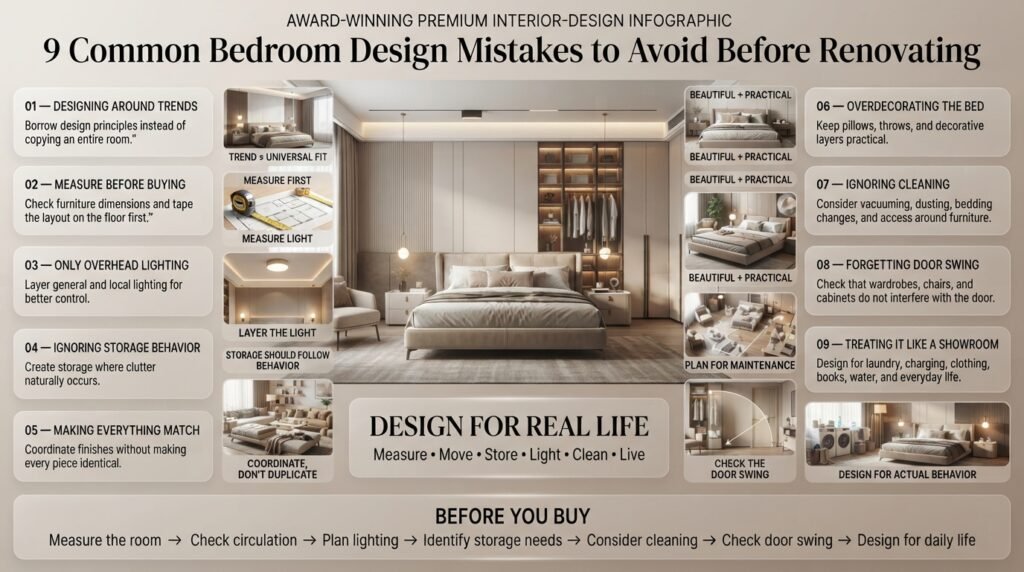
Mistake 1: Designing Around Trends
A bedroom copied directly from a trend may not suit your routine.
Why it happens: Social media makes certain layouts and aesthetics look universally desirable.
Why it’s a problem: Your room dimensions and lifestyle may be completely different.
Better approach: Borrow principles, not entire rooms.
Mistake 2: Buying Furniture Before Measuring
Large furniture can create circulation problems that are expensive to correct.
Better approach: Measure first and tape the layout on the floor.
Mistake 3: Using Only Overhead Lighting
One bright fixture doesn’t provide enough control.
Better approach: Layer general and local lighting.
Mistake 4: Ignoring Storage Behavior
People often blame themselves for clutter when storage is poorly designed.
Better approach: Create storage where clutter naturally occurs.
Mistake 5: Making Everything Match
Matching every item can make the bedroom feel like a furniture showroom.
Better approach: Coordinate finishes without requiring every piece to be identical.
Mistake 6: Overdecorating the Bed
Too many pillows, throws, and accessories may look attractive but become inconvenient every night.
Better approach: Keep decorative layers practical.
Mistake 7: Ignoring Cleaning
Furniture with inaccessible gaps can create maintenance problems.
Better approach: Consider how you’ll vacuum, dust, change bedding, and clean around each item.
Mistake 8: Forgetting the Door Swing
This is one of the simplest planning errors.
A new wardrobe, chair, or cabinet can interfere with a door even when the furniture technically fits.
Mistake 9: Treating the Bedroom Like a Showroom
A real bedroom needs to handle laundry, charging devices, clothing, books, water, and everyday life.
Design for actual behavior.
What Is the Best Order for a Bedroom Redesign?
If you’re redesigning the entire room, use this sequence.
Step 1: Identify the Problems
Write down everything that currently annoys you.
Don’t start shopping yet.
Step 2: Measure Everything
Create a simple floor plan.
Include doors, windows, storage, outlets, and fixed features.
Step 3: Position the Bed
Test at least two possible arrangements if the room allows it.
Step 4: Establish Circulation
Make sure walking paths and furniture openings work.
Step 5: Plan Storage
Solve clothing and everyday-item storage before buying decorative furniture.
Step 6: Plan Lighting
Decide where ambient, task, and low-level lighting will go.
Step 7: Address Windows and Temperature
Choose curtains, blinds, bedding, ventilation, and cooling strategies according to the room.
Step 8: Select Materials and Colors
Now choose paint, flooring, furniture finishes, fabrics, and other visual elements.
Step 9: Add Accessories
Only after the functional foundation works should you add artwork, plants, cushions, decorative objects, and styling pieces.
Step 10: Live With It
A bedroom isn’t finished when the furniture arrives.
Use the room for several days.
Notice what annoys you.
Then make small adjustments.
A Practical Bedroom Sleep-Design Comparison
| Design Element | Less Effective Approach | More Practical Approach |
|---|---|---|
| Lighting | One bright ceiling light | Layered, adjustable lighting |
| Storage | Overflowing open surfaces | Organized closed storage |
| Furniture | Selected by appearance alone | Selected by scale and function |
| Windows | Decorative curtains only | Light and privacy control |
| Colors | Highly stimulating combinations | Comfortable, coordinated palette |
| Electronics | Devices dominate the room | Technology kept controlled |
| Layout | Maximum furniture | Clear circulation |
| Materials | Appearance first | Appearance + performance |
| Accessories | Excessive decoration | Purposeful styling |
| Planning | Buy first, measure later | Measure and test first |
How Can You Refresh a Bedroom Without Renovating?
If your budget is limited, don’t assume a complete makeover is necessary.
Start with changes that affect the environment directly.
Change the Lighting
A new bedside lamp or dimmable lighting can alter the room’s evening atmosphere immediately.
Reposition the Furniture
Try the bed against another suitable wall if the room allows it.
Improve Storage
Remove unused items and reorganize the wardrobe.
Change Window Treatments
If light is a major issue, this can be one of the most practical upgrades.
Simplify the Nightstand
Keep only what you actually use.
Refresh the Color
A new wall color can change the entire character of the room without replacing furniture.
Add Texture Carefully
A rug, curtains, bedding, or upholstered headboard can soften the space.
Remove Rather Than Add
Sometimes the best bedroom makeover is subtraction.
Remove furniture that isn’t earning its floor space.
Expert Advice for Creating a Sleep-Friendly Bedroom
Professional interior planning usually begins with the way people use a room rather than the way they want it to appear in photographs.
Here are several practical principles worth keeping:
1. Design the Nighttime Route
Walk through the room after turning most lights off.
Notice where your feet naturally go.
2. Keep Controls Within Reach
Lights, curtains, fans, and frequently used items should be convenient to operate.
3. Make Storage Easy
If putting something away requires too many steps, people are less likely to do it consistently.
4. Don’t Overfill the Room
Empty space can be functional.
It provides circulation, flexibility, and visual breathing room.
5. Use Lighting as a Tool
Don’t treat lighting as decoration alone.
It should support different activities.
6. Test Colors Under Real Lighting
A color that looks excellent at noon may look completely different at night.
7. Think Long Term
Choose furniture and layouts that can continue working if your needs change.
8. Solve Problems Before Styling
A beautiful chair won’t fix a wardrobe that blocks the doorway.
What is the best bedroom layout for sleeping?
The best bedroom layout is the one that creates a comfortable bed position, clear circulation, practical storage access, and controllable light. Many rooms work well with the bed against a solid wall, but this isn’t a universal requirement. Door placement, windows, wardrobes, ventilation, room proportions, and personal preferences should determine the final layout.
What colors are best for a relaxing bedroom?
Soft, muted colors such as warm neutrals, gentle blues, subdued greens, and earthy tones can create a calmer visual atmosphere. However, there isn’t one universally correct sleep color. Consider natural daylight, artificial lighting, furniture finishes, and your personal response to the color before committing to a full-room paint scheme.
Should a bedroom be completely dark?
Complete darkness isn’t necessary for everyone, but controlling unwanted light can make a bedroom more comfortable. If streetlights, early morning sunlight, hallway lighting, or electronic indicators are distracting, consider blackout curtains, blinds, shades, or removing unnecessary light sources.
Is it better to have a TV in the bedroom or not?
There is no universal interior-design rule that prohibits televisions in bedrooms. The important question is whether the television interferes with the room’s purpose. If it encourages prolonged viewing, dominates the room, or creates unwanted light, changing its position or creating a screen-free nighttime routine may be useful.
How can I make a small bedroom feel peaceful?
Prioritize circulation, reduce visual clutter, select appropriately scaled furniture, and use storage efficiently. Wall-mounted lighting can save floor space, while closed storage can keep everyday objects visually controlled. Avoid adding furniture simply because there is technically enough space for it.
Conclusion
Creating a bedroom that supports better sleep isn’t about making the room look perfect. It’s about making everyday life inside that room feel easier, quieter, and more comfortable. The right layout, controlled lighting, suitable colors, practical storage, comfortable materials, and reduced clutter can all contribute to a more relaxing environment.
Start with the changes that matter most. Position the bed carefully, keep walking paths clear, control unwanted light, use softer evening lighting, manage temperature, and give everyday belongings a proper place. If your bedroom also functions as an office or entertainment space, create clear zones so work and screens don’t completely take over the sleeping area.
You don’t need to renovate everything at once. Sometimes moving a piece of furniture, improving the curtains, changing the lighting, or removing unnecessary clutter can make the room feel completely different.
The most effective bedroom design for better sleep quality is ultimately the one that matches your lifestyle. Instead of copying a bedroom from a showroom or social media, pay attention to what actually helps you feel comfortable at night. Design around your habits, your room’s proportions, and the problems you want to solve.
A beautiful bedroom is a bonus. A bedroom that genuinely feels comfortable, organized, calm, and easy to use is the real goal.