
Introduction
Bathroom Tile Slip Resistance Ratings | A bathroom floor can look perfect in a showroom and still be the wrong choice once water, soap, bare feet, and daily use enter the picture.
This is especially common when homeowners choose tile based mainly on color, pattern, finish, or the latest interior trend. A glossy marble-look porcelain tile may look beautiful in a design photograph, but that doesn’t automatically mean it’s a sensible surface for a shower floor.
That’s where bathroom tile slip resistance ratings become important.
Slip resistance isn’t simply about finding a tile with the highest number. Different testing systems measure different characteristics, and the right product depends on where the tile will be installed, how much water it will encounter, whether people will walk barefoot, how the surface drains, how it is maintained, and what the manufacturer recommends.
If you’re planning a bathroom renovation, start with the DesignMode24 Interior Design resource before choosing finishes. The goal isn’t to make the bathroom look safe after installation. The goal is to choose materials that make sense from the beginning.
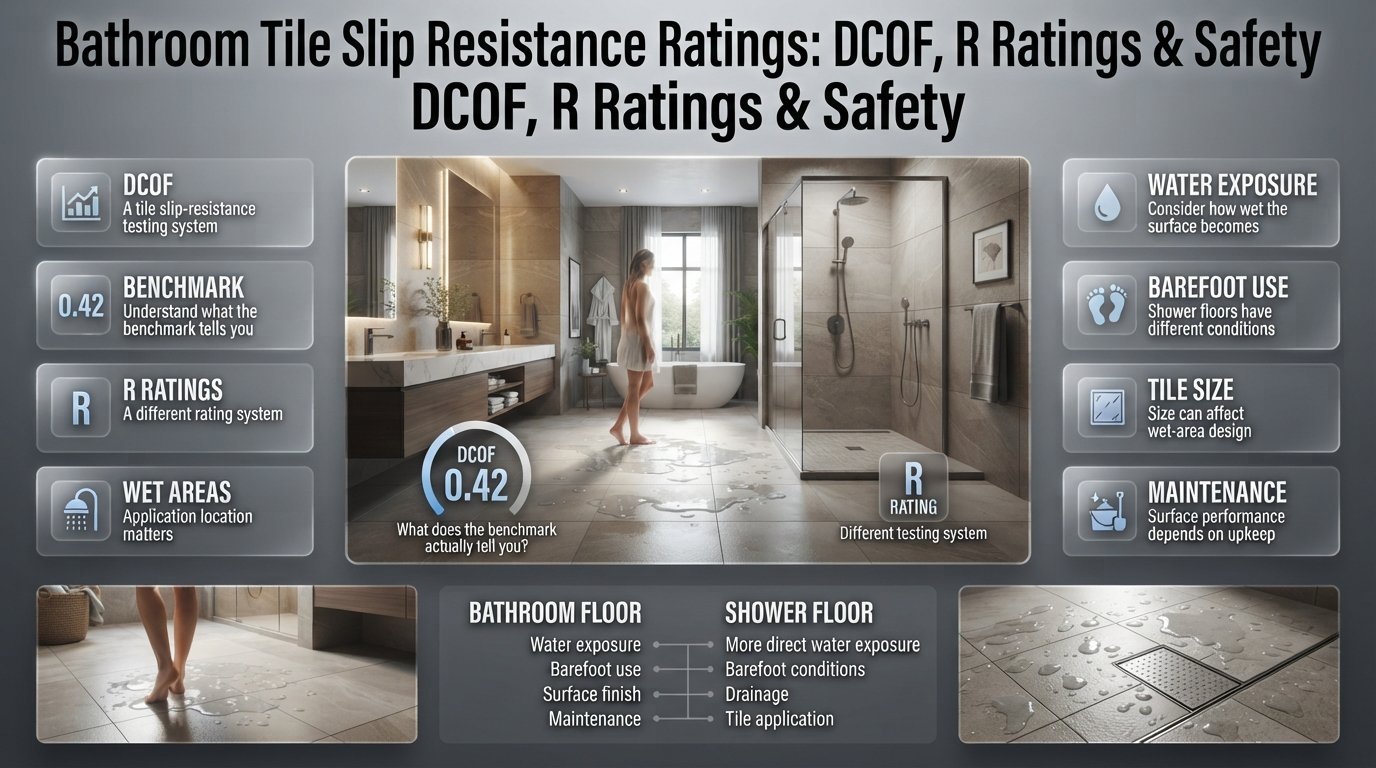
In this guide, you’ll learn what bathroom tile slip resistance ratings mean, how DCOF works, what the 0.42 benchmark actually tells you, how R ratings differ from DCOF, whether polished tiles are appropriate, what changes between a bathroom floor and shower floor, how tile size affects wet areas, and which mistakes can create problems later.
What Are Bathroom Tile Slip Resistance Ratings?
Bathroom tile slip resistance ratings are measurements, classifications, or test results used to describe how a flooring surface performs against sliding under specified conditions.
They help homeowners, designers, contractors, architects, and tile suppliers evaluate whether a particular flooring product is appropriate for a particular environment.
The important word is specified.
A test doesn’t recreate every possible bathroom situation. A laboratory measurement may involve controlled equipment, a particular test foot, a specific contaminant, and a defined testing procedure. Real bathrooms contain changing conditions.
Water may be mixed with soap. A person may be barefoot. The floor may be slightly sloped. A cleaning product may leave residue. Drainage may be excellent or poor.
That’s why a tile rating should be treated as technical evidence for making a flooring decision, not as a promise that slipping is impossible.
ANSI A326.3 is a major reference for measuring the dynamic coefficient of friction of hard-surface flooring materials. The standard also provides product-use classifications based on slip-resistance properties.
Why Bathroom Floors Need Special Attention
Bathrooms are different from many other rooms because moisture is expected.
Common conditions include:
- Water splashing from a shower
- Wet bare feet
- Condensation
- Soap residue
- Shampoo
- Cleaning chemicals
- Standing water
- Sloped shower surfaces
- Frequent mopping
- Wet towels or bathmats
- Poorly maintained drains
A surface that feels secure when completely dry may not behave identically when wet.
That doesn’t mean every bathroom floor needs an extremely rough texture. It means the flooring needs to be selected according to its actual environment.
💡 Pro Tip: When a tile salesperson says “this is an anti-slip tile,” ask for the manufacturer’s technical data. Find out what test was used, what the result means, and where the manufacturer recommends using the product.
Why Is Slip Resistance Important in Bathroom Design?
Slip resistance is important because bathroom flooring is part of the room’s everyday usability, not simply a decorative finish.
Think about the moment immediately after a shower. Your feet are wet, the floor may have a thin film of water, and you may be stepping out while reaching for a towel.
That is a very different situation from walking across a dry tile sample in a showroom.
A good bathroom design therefore combines:
- Appropriate flooring
- Effective drainage
- Correct floor slope
- Suitable tile size
- Proper installation
- Good maintenance
- Sensible cleaning
- Appropriate surface texture
This is also why slip resistance shouldn’t be separated from the rest of the bathroom planning process.
For homeowners working on a broader renovation, the Home Improvement section can help put flooring decisions into the context of the entire project.
What Does DCOF Mean on Bathroom Tiles?
DCOF means Dynamic Coefficient of Friction.
In simple terms, it describes friction measured while one surface is moving against another under a defined testing procedure.
ANSI A326.3 provides a standardized method for measuring DCOF for hard-surface flooring materials in laboratory and field conditions.
For bathroom tile buyers, DCOF matters because it gives you technical information that is more useful than a vague description such as “safe,” “grippy,” or “anti-slip.”
But there’s an important distinction:
DCOF is not the same thing as a guarantee of slip resistance in every real-world situation.
TCNA specifically explains that DCOF and slip resistance aren’t synonymous. Factors such as contaminants, footwear, walking behavior, slope, maintenance, surface structure, and drainage can affect the possibility of slipping.
What Does a 0.42 Wet DCOF Mean?
For level interior hard-surface flooring expected to be walked on when wet, ANSI A326.3 uses a 0.42 wet DCOF criterion for the Interior, Wet classification when the applicable testing conditions are met, although the standard also permits manufacturer-declared classification in specified circumstances.
This number is often mentioned when people research bathroom tile slip resistance.
However, don’t read it as:
0.42 = completely slip-proof.
That’s not what the test means.
The 0.42 value comes from a specific standardized test environment. The standard itself explains that materials meeting the threshold aren’t necessarily suitable for every project; the person specifying the material still needs to consider use, traffic, contaminants, maintenance, wear, and manufacturer recommendations.
That distinction is one of the most important things to understand before buying bathroom flooring.
What Are the ANSI A326.3 Product Use Classifications?
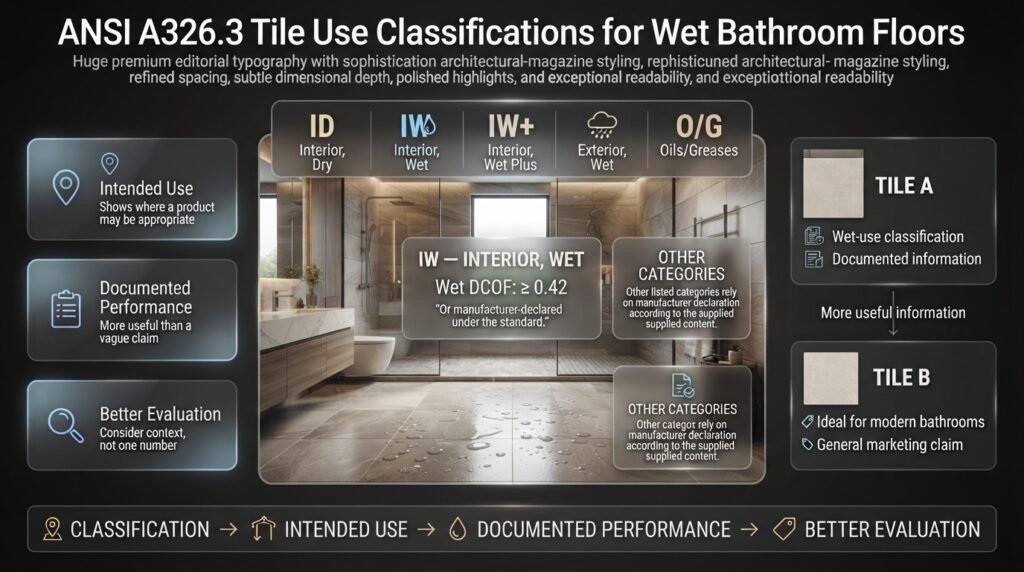
ANSI A326.3 introduced product-use classifications intended to communicate where hard-surface flooring products may be appropriate based on slip-resistance characteristics.
The classifications include:
| Classification | Meaning |
|---|---|
| ID | Interior, Dry |
| IW | Interior, Wet |
| IW+ | Interior, Wet Plus |
| EW | Exterior, Wet |
| O/G | Oils/Greases |
The Interior, Wet category uses a wet DCOF criterion of at least 0.42 or may be manufacturer-declared under the provisions of the standard. Other categories rely on manufacturer declaration.
For homeowners, this classification system can be more useful than looking at an isolated number.
Why Product-Use Classification Helps
Imagine you’re choosing between two tiles.
Tile A has a technical specification showing a suitable wet-use classification.
Tile B simply says “ideal for modern bathrooms.”
Tile A gives you more meaningful information because it tells you something about intended use and documented performance.
This doesn’t mean Tile A is automatically the correct choice for every bathroom. It means you have better information to evaluate it.
Is 0.42 the Best Bathroom Tile Slip Resistance Rating?
There isn’t one universal number that makes every bathroom floor safe.
The 0.42 wet DCOF criterion is important for certain level interior wet applications, but it shouldn’t be turned into a universal “best bathroom rating.”
A shower floor, for example, may involve:
- Bare feet
- Frequent water exposure
- Soap
- Slope
- Drainage
- Small-format tile
- Grout joints
- Different surface textures
Those conditions require more than checking one number.
ANSI A326.3 itself emphasizes that the specifier must determine whether a product is appropriate for the specific project conditions.
A Better Question to Ask
Instead of asking:
“What is the highest slip-resistance rating?”
Ask:
“Is this tile tested and recommended for the exact area where I plan to install it?”
That question leads to a much more useful decision.
What Is the Difference Between DCOF, COF, R Rating and PTV?
Bathroom tile research becomes confusing because manufacturers and suppliers may provide several different types of slip-related information.
These terms shouldn’t automatically be treated as interchangeable.
DCOF
Dynamic Coefficient of Friction measures dynamic friction under a defined test procedure.
It is especially relevant to hard-surface flooring evaluation under ANSI A326.3.
COF
COF means Coefficient of Friction.
It’s a broader technical term describing friction between surfaces. A COF number without knowing the testing method doesn’t give you enough information to compare products reliably.
R Rating
R ratings are associated with ramp-based testing systems, commonly encountered in European tile specifications.
An R10 product isn’t simply “equivalent to” a particular DCOF number.
PTV
PTV generally refers to Pendulum Test Value, associated with pendulum testing methods.
Again, it uses a different testing approach.
Why You Shouldn’t Convert These Numbers Yourself
Suppose one tile has an R classification and another has a DCOF value.
It may be tempting to search for a conversion chart and declare one safer.
That can oversimplify the issue because the tests use different procedures, equipment, conditions, and interpretation.
⚠ Common Mistake: Comparing numbers from different testing systems as if they’re points on the same scale.
Instead, ask what test standard produced the number and what applications the manufacturer supports.
What Is a Good Slip Resistance Rating for a Shower Floor?
A shower floor should be selected specifically for wet, barefoot use.
That doesn’t mean you should automatically choose the roughest tile available.
The better approach is to look for a product that:
- Is intended for flooring
- Is appropriate for wet areas
- Has documented performance information
- Is recommended by the manufacturer for the intended use
- Works with the shower’s drainage design
- Is comfortable enough for bare feet
- Can be maintained properly
The Tile Council of North America notes that tile size can affect wet-area behavior because smaller tiles can provide more grout joints and can make sloping easier. Larger-format surfaces may create planar variations where standing water can become a concern.
Why Shower Floors Are Different From Bathroom Floors
A general bathroom floor may only become wet occasionally.
A shower floor is intentionally designed to become wet.
That’s why shower-floor selection deserves more attention.
For example, a large-format polished tile might work beautifully on a dry bathroom wall, but its suitability for a frequently wet shower floor is a separate question.
Are Small Tiles Better for Shower Floors?
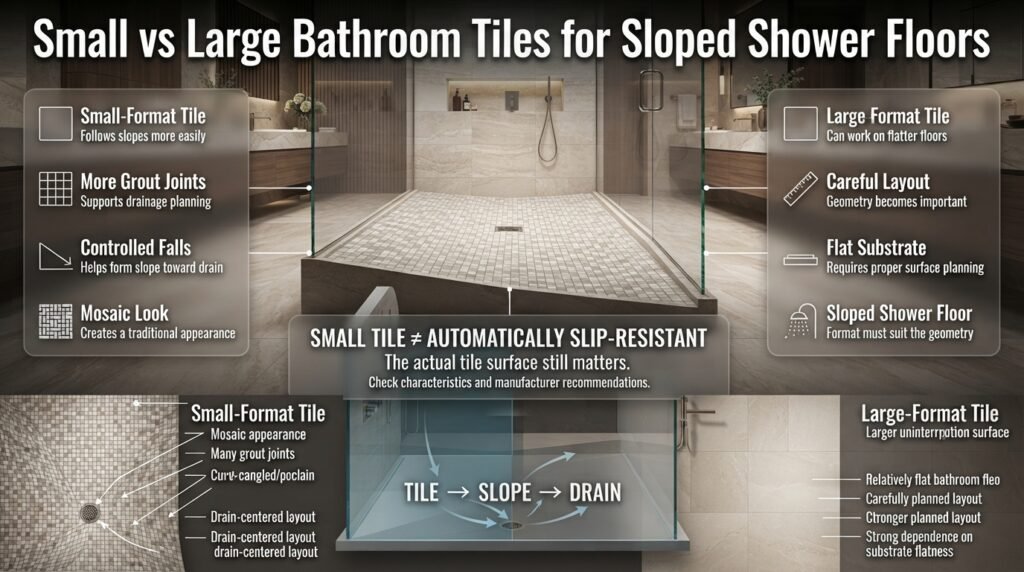
Small-format tiles can be particularly practical in shower floors because they can follow a sloped surface more easily.
They also create more grout joints.
Those joints can contribute to drainage and help installers form a slope toward the drain without forcing large rigid panels into complicated cuts.
However, this doesn’t mean:
Small tile = automatically slip-resistant.
The actual tile surface still matters.
A small polished tile can still be a poor choice for a wet walking surface if its characteristics and manufacturer recommendations don’t support that application.
When Small Tile Makes Sense
Small-format tile can be useful when:
- The shower floor has multiple slopes
- A central drain needs controlled falls
- A linear drain requires a specific layout
- You want more grout joints
- You want a traditional mosaic appearance
- The selected product is appropriate for wet flooring
When Large Tile Can Work
Large-format tile can work in some bathroom floor applications, particularly where the floor is relatively flat and the installation is properly planned.
But the larger the tile, the more important layout and substrate flatness become.
For sloped shower floors, the format needs to work with the geometry of the surface.
Are Polished Bathroom Tiles Slippery?
A polished surface deserves careful evaluation in any bathroom area that may become wet.
TCNA material specifically notes that polished and semi-polished surfaces are very smooth and cites manufacturer guidance advising against polished surfaces in areas subject to water, oil, or grease exposure.
This doesn’t mean every polished product has identical characteristics.
It means you shouldn’t choose a polished tile for a wet floor simply because it looks luxurious.
Polished tile can be excellent for:
- Shower walls
- Vanity walls
- Decorative feature walls
- Backsplashes
- Dry accent surfaces
But a walking surface needs its own performance evaluation.
Matte Doesn’t Automatically Mean Safe
There’s another common misunderstanding.
People sometimes assume:
Glossy = slippery
and
Matte = safe
Reality is more complicated.
A matte tile can have poor wet performance, while a textured tile can have better traction characteristics.
Always check the technical information for the actual product.
How Do You Choose Tiles for Different Bathroom Zones?
A bathroom shouldn’t necessarily use one identical tile everywhere.
Different zones have different functional requirements.
Main Bathroom Floor
The main floor should be evaluated for:
- Wet exposure
- Walking traffic
- Cleaning
- Barefoot use
- Surface texture
- Manufacturer classification
Shower Floor
The shower floor deserves the highest level of attention because water exposure is expected.
Consider:
- Wet-use classification
- Barefoot contact
- Drainage
- Slope
- Tile size
- Grout layout
- Cleaning
- Surface structure
Shower Walls
Slip resistance isn’t normally the primary concern because nobody walks on the wall.
Other factors become more important, including:
- Water resistance
- Cleaning
- Appearance
- Installation method
- Tile weight
- Compatibility with the wet-area system
Vanity Wall and Accent Areas
These surfaces give you much more freedom.
You can often prioritize:
- Pattern
- Color
- Texture
- Large-format appearance
- Decorative finishes
- Visual contrast
This is where interior design becomes important: not every surface needs to solve the same problem.
The Interior Design section provides broader context for coordinating practical materials with the overall design.
How Does Drainage Affect Bathroom Tile Slip Safety?
Tile selection can’t compensate for poor drainage.
If water remains on the surface, the conditions experienced by the person walking across the floor can change.
This is particularly important in showers.
A properly designed shower needs coordinated decisions involving:
- Waterproofing
- Slope
- Drain location
- Tile format
- Grout layout
- Threshold or curbless transition
- Surface drainage
A tile may have appropriate documented performance and still be part of a poorly functioning bathroom if water isn’t being directed efficiently toward the drain.
Why Shower Slope Matters
A shower floor isn’t normally flat.
It needs to direct water toward the drain.
Large-format tile can make this more complicated in some shower layouts because a single rigid tile may not follow multiple slopes cleanly.
Small-format tile can provide more flexibility.
This is a design and installation issue—not simply a tile-rating issue.
⭐ Expert Tip: Choose the shower drain layout and tile format together. Don’t select a beautiful tile first and ask the installer afterward how the shower floor will slope.
How Does Soap Affect Slip Resistance?
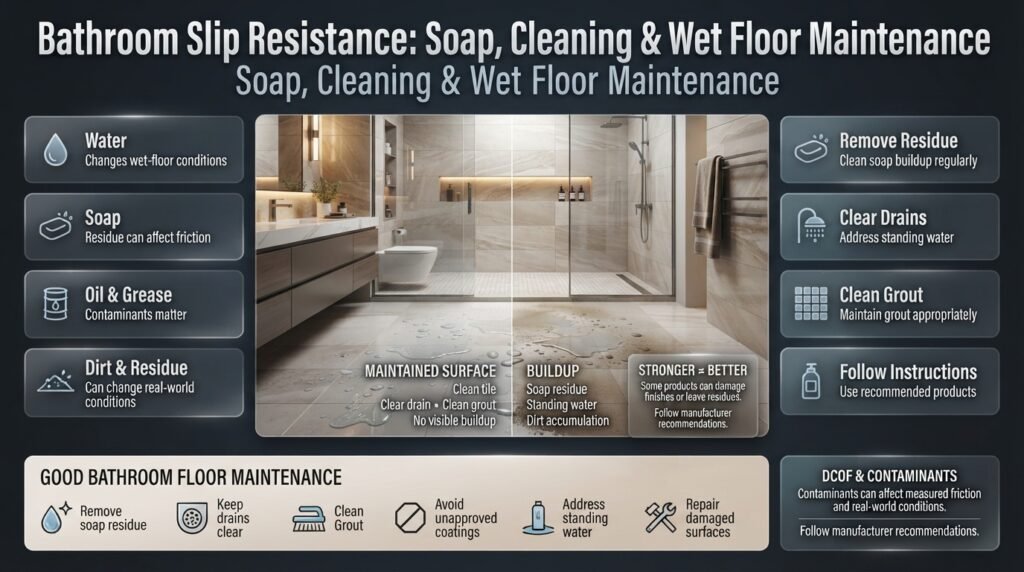
Soap is one of the reasons bathroom floors shouldn’t be evaluated only under dry conditions.
Water, soap, oil, grease, dirt, and other contaminants can change measured friction and real-world conditions. ANSI A326.3 documentation specifically recognizes contaminants as a factor that can affect DCOF.
That means regular cleaning matters.
A floor can be technically suitable for wet use but still become unpleasantly slippery if soap residue builds up.
Good Bathroom Floor Maintenance
Follow the tile manufacturer’s cleaning instructions.
In general:
- Remove soap residue regularly
- Don’t allow buildup to accumulate
- Keep drains clear
- Clean grout appropriately
- Avoid unapproved coatings
- Follow recommended cleaning products
- Address standing water
- Repair damaged surfaces
Don’t assume a stronger cleaning chemical is always better.
Some products can damage finishes or leave residues.
Does Tile Texture Affect Slip Resistance?
Yes, surface structure can influence how a floor behaves.
But “more texture” isn’t automatically better.
A very aggressive texture may:
- Feel uncomfortable barefoot
- Trap dirt
- Make cleaning difficult
- Affect the visual appearance
- Require specialized maintenance
A very smooth finish may create different concerns in wet conditions.
The best result is a surface appropriate for its specific application.
This is another reason why selecting bathroom finishes should involve more than looking at photographs.
For homeowners interested in healthier material choices throughout the home, the Low VOC Finishes for Healthier Interiors guide can also complement the material-selection process.
How Should You Read a Bathroom Tile Specification Sheet?
A technical sheet can tell you much more than the front of a tile box.
Before buying, look for:
- Product name and collection
- Tile material
- Recommended applications
- Floor or wall designation
- Wet-use classification
- DCOF or other test information
- Testing standard
- Manufacturer recommendations
- Cleaning instructions
- Installation limitations
If the product says “anti-slip” but doesn’t provide meaningful supporting information, ask the supplier for clarification.
Questions to Ask the Supplier
You can use this checklist:
Is this tile suitable for floors?
Is it suitable for a shower floor?
What slip-resistance test was used?
What standard was used?
What is the measured result or product-use classification?
Is that result for wet or dry conditions?
Does the manufacturer recommend it for barefoot areas?
Are there restrictions on installation or maintenance?
These questions take only a few minutes and can prevent an expensive mistake.
What Are the Most Common Bathroom Tile Slip-Resistance Mistakes?
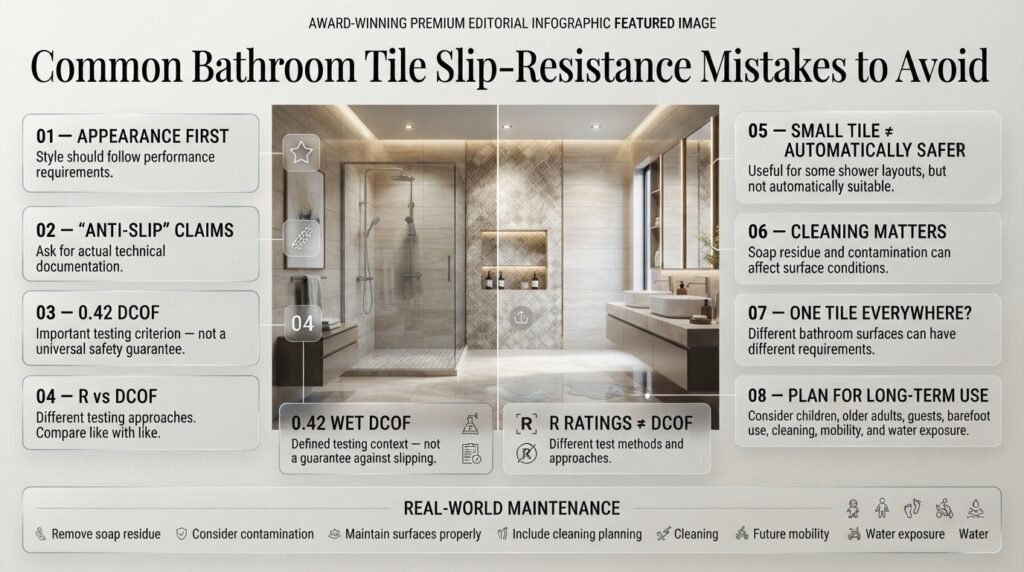
Mistake 1: Choosing Appearance Before Performance
This happens constantly.
A homeowner selects the exact tile they love and then tries to make it work everywhere.
Why it happens: Showrooms and online galleries emphasize visual appeal.
Why it’s a problem: Some decorative finishes aren’t appropriate for wet walking surfaces.
Better approach: Identify the performance requirements first, then choose the style from suitable products.
For broader renovation planning, the DIY Home Projects section can help with projects where material selection and installation planning overlap.
Mistake 2: Trusting “Anti-Slip” Without Testing Information
The phrase sounds reassuring, but it doesn’t tell you enough.
Better approach: Ask for the actual technical documentation.
Mistake 3: Treating 0.42 as a Universal Safety Guarantee
The 0.42 wet DCOF criterion is important within its defined testing and classification context.
It isn’t a guarantee that a person cannot slip.
TCNA explicitly states that DCOF does not predict whether a person will or won’t slip under all conditions.
Mistake 4: Comparing R Ratings and DCOF Directly
They’re based on different testing approaches.
Better approach: Compare products using the same test method whenever possible.
Mistake 5: Assuming Small Tiles Are Automatically Safer
Small format can be useful for shower layout and drainage, but it doesn’t make an unsuitable surface suitable.
Mistake 6: Ignoring Cleaning
Soap residue and contamination can affect surface conditions.
A flooring decision should include a realistic maintenance plan.
Mistake 7: Using One Tile Everywhere
The floor, shower floor, walls, and decorative areas have different requirements.
A coordinated bathroom doesn’t require identical performance characteristics on every surface.
Mistake 8: Forgetting About Long-Term Use
A bathroom may need to work for many years.
Think about:
- Children
- Older family members
- Guests
- Barefoot use
- Cleaning routines
- Future mobility needs
- Water exposure
The Bathroom Design for Aging in Place guide is particularly useful when long-term bathroom usability is part of the design discussion.
How Should You Select Bathroom Tiles Step by Step?
A professional selection process doesn’t start with color.
Step 1: Define the Area
Identify exactly where the tile will go.
Is it:
- Main floor?
- Shower floor?
- Shower wall?
- Tub surround?
- Vanity wall?
- Accent wall?
Step 2: Identify Water Exposure
Estimate how often the surface will be wet.
Occasional → Frequent → Constant
The more frequently the area becomes wet, the more important wet-use performance becomes.
Step 3: Determine Barefoot Use
A shower floor will normally be walked on barefoot.
A decorative wall will not.
This changes the decision.
Step 4: Review Technical Data
Check the test method and manufacturer’s classification.
Don’t stop at marketing terminology.
Step 5: Check Tile Format
Ask whether the tile can accommodate the floor geometry.
This is especially important in showers.
Step 6: Check Drainage
Confirm how water will move toward the drain.
Step 7: Check Maintenance
Make sure the surface can realistically be cleaned by the people using the bathroom.
Step 8: Check Design Compatibility
Only after performance requirements are satisfied should you narrow down:
- Color
- Pattern
- Finish
- Texture
- Size
- Grout color
Step 9: Order a Sample
A physical sample can help you examine:
- Texture
- Visual scale
- Color
- Surface sheen
- Barefoot feel
- Cleaning characteristics
Don’t use an informal wet-foot test as a substitute for standardized testing, but do use the sample to understand how the material feels and looks.
How Does Tile Size Affect Bathroom Floor Performance?
Tile size affects more than appearance.
Large tiles create fewer grout joints and can provide a clean, continuous visual surface.
Small tiles provide more joints and can be easier to shape around slopes.
Large-Format Tiles
Advantages include:
- Modern appearance
- Fewer grout lines
- Visually spacious look
- Potentially easier visual cleaning
Potential challenges include:
- More demanding substrate preparation
- More difficult sloped installations
- Greater sensitivity to uneven surfaces
- Potential standing-water issues if layout isn’t appropriate
Small-Format Tiles
Advantages include:
- Easier slope transitions
- More grout joints
- Flexible shower-floor layouts
- Traditional mosaic appearance
Potential drawbacks include:
- More grout to maintain
- More visual pattern
- More installation labor
- Cleaning may require more attention
TCNA-related guidance notes that smaller tile sizes can help drainage and sloping in wet areas, while larger formats can introduce concerns related to planar variation and standing water.
Can the Same Bathroom Tile Be Used on Floors and Walls?
Sometimes, but never assume it.
Manufacturers may create coordinated collections containing:
- Floor tile
- Wall tile
- Mosaic
- Decorative trim
- Large-format panels
The matching appearance doesn’t necessarily mean identical technical properties.
A wall tile may be designed primarily for vertical installation.
A floor product must handle foot traffic and walking conditions.
A Better Coordination Strategy
Instead of demanding that one product cover the whole room, coordinate the collection visually.
For example:
Shower floor: textured mosaic
Main floor: matching matte porcelain
Shower wall: larger-format coordinated tile
Accent wall: decorative tile
The colors can work together while each surface gets an appropriate material.
What About Bathroom Tile Color and Slip Resistance?
Color doesn’t determine slip resistance.
A dark tile isn’t automatically safer than a light tile.
However, color can affect how easily you see:
- Standing water
- Soap residue
- Dirt
- Grout discoloration
- Surface contamination
This is a visual-maintenance consideration rather than a slip-resistance rating.
For example, a very uniform dark floor may make certain residue less visually obvious than a contrasting surface.
The practical question is:
Can the household easily see and maintain the floor?
That matters over time.
For coordinating bathroom colors with the rest of your home, the Paint Color resources can help when you’re balancing tile undertones with wall finishes.
How Does Lighting Affect Bathroom Floor Safety?
Lighting doesn’t change the tile’s measured DCOF, but it can influence how easily people see the floor.
Good bathroom lighting helps reveal:
- Water
- Changes in floor level
- Grout lines
- Surface contamination
- Transitions
- Steps or thresholds
This is particularly useful in bathrooms designed for long-term accessibility.
Lighting should therefore be considered alongside materials rather than as a completely separate design decision.
The Modern Bedroom Design resource explores intelligent lighting concepts that can also inform broader thinking about controlled lighting throughout the home.
What Role Does the Overall Bathroom Design Play?
A safe and functional bathroom isn’t created by one product.
It comes from a coordinated system.
Think of it as:
Tile + drainage + slope + lighting + layout + maintenance + installation
If one part is ignored, the overall experience can suffer.
For example, excellent tile selection can’t fix:
- Poor shower slope
- Blocked drainage
- Incorrect installation
- Persistent standing water
- Poor lighting
- An awkward bathroom layout
This is why material selection belongs within the larger design process.
The Creating Cohesion Between Different Rooms guide is useful when you want the bathroom to feel connected to the rest of the home’s design without sacrificing its practical requirements.
How Can Bathroom Design Support Long-Term Usability?
A bathroom may be used differently over the years.
A young homeowner might focus on appearance.
Later, the priorities may include:
- Easier cleaning
- Better lighting
- Reduced trip hazards
- Comfortable flooring
- Clear circulation
- Accessible storage
- Stable surfaces
- Convenient shower access
This doesn’t mean every bathroom needs to look institutional.
Modern design can combine practical features with attractive materials.
Slip-resistant flooring is one part of that approach.
Other choices—such as appropriate lighting, storage, seating, grab-bar planning, and accessible circulation—can be considered at the same time.
For homeowners planning a complete home environment rather than a single room, Robert MyGardenAndPatio can also provide broader inspiration for thinking about how indoor and outdoor areas work together.
Can a Bathroom Floor Be Too Rough?
Yes, in practical terms.
Choosing the roughest surface available isn’t necessarily the best decision.
An excessively textured floor may:
- Feel uncomfortable under bare feet
- Hold dirt
- Increase cleaning difficulty
- Create an overly busy appearance
- Require more maintenance
The ideal floor balances traction-related performance with comfort and maintenance.
This is particularly important in a home bathroom where people walk barefoot regularly.
The Goal Is Appropriate Performance
Think about the actual environment.
A commercial industrial space may have very different contamination and footwear conditions from a residential bathroom.
A family bathroom needs to be comfortable, cleanable, visually appealing, and appropriate for wet use.
That’s why “maximum grip” shouldn’t automatically become the design objective.
What Should You Check Before Ordering Bathroom Tile?
Use this final buying checklist.
Technical Checklist
- Is it a floor-rated product?
- Is it appropriate for wet areas?
- Is the test method documented?
- Is wet DCOF information available where applicable?
- Is an ANSI A326.3 product-use classification provided?
- Does the manufacturer recommend it for the intended location?
- Is it appropriate for barefoot use?
- Is it suitable for a shower floor if that’s where you’re installing it?
Installation Checklist
- Does the format work with the floor slope?
- Is the substrate properly prepared?
- Is drainage correctly planned?
- Are grout joints appropriate?
- Is waterproofing being handled correctly?
- Are transitions properly detailed?
Maintenance Checklist
- What cleaner does the manufacturer recommend?
- Can soap residue be removed easily?
- Does the texture trap dirt?
- Are special maintenance products required?
- Can the finish tolerate the planned cleaning routine?
Design Checklist
- Does the tile coordinate with the bathroom?
- Does the finish suit the lighting?
- Does the color work with the wall paint?
- Does the format suit the room size?
- Does it complement other materials?
For additional planning around practical home storage and circulation, the Entryway Storage Capacity Planning resource demonstrates the same principle: good design starts by understanding how a space actually needs to function.
What is a good slip resistance rating for bathroom floor tiles?
For a level bathroom floor that is expected to become wet, wet DCOF information is one of the most useful specifications to check. Under ANSI A326.3, the Interior, Wet classification uses a wet DCOF of 0.42 or greater, or may be manufacturer-declared under the standard’s provisions. However, this number should be treated as a testing criterion—not as a promise that the floor cannot become slippery.
The final choice should also consider how the bathroom is actually used. A frequently wet family bathroom, a guest powder room, and a shower floor don’t experience identical conditions.
When choosing your tile, check:
Wet DCOF or the manufacturer’s wet-use classification
The testing standard used
Whether the product is specifically rated for flooring
Surface texture and finish
Expected water and soap exposure
Manufacturer installation recommendations
The most important point is to compare products within the same testing system rather than choosing a tile simply because its number looks higher.
What DCOF rating is best for a shower floor?
A shower floor shouldn’t be selected using a single DCOF number alone. ANSI A326.3 specifically recognizes that shower-floor suitability depends on factors such as tile size, drainage, grout joints, surface structure or texture, and whether barefoot use is expected. The standard therefore does not provide one universal DCOF limit specifically for shower floors.
This is an important distinction because a shower is different from a normal bathroom floor. Water is expected, the surface is often sloped, and people generally walk barefoot. The installed assembly matters just as much as the tile’s laboratory result.
For a shower floor, evaluate:
Wet-use classification or documented wet performance
Barefoot suitability
Tile size and layout
Number and arrangement of grout joints
Shower slope
Drainage efficiency
Surface texture
Cleaning and maintenance requirements
A small-format, appropriately textured tile may work particularly well in a sloped shower because it can follow the floor geometry more easily. But small tile by itself does not guarantee better slip resistance.
Is a higher DCOF always better for bathroom tiles?
Not necessarily. A higher DCOF value can provide useful information about friction under the specific test conditions, but it shouldn’t be treated as a simple “higher number equals safer bathroom” ranking.
The Tile Council of North America explains that DCOF and slip resistance are not synonymous. Water, soap, dirt, oil, footwear, walking behavior, floor slope, maintenance, drainage, and the structure of the flooring surface can all affect the possibility of a slip.
This is why choosing an extremely aggressive surface isn’t automatically the professional solution. A heavily textured floor may create its own practical problems, including difficult cleaning, dirt accumulation, and discomfort under bare feet.
A better selection approach is to balance:
Wet-floor performance
Actual bathroom conditions
Barefoot comfort
Drainage
Cleaning requirements
Tile texture
Manufacturer recommendations
The goal is appropriate performance for the application, not simply chasing the highest available rating.
Are R10, R11, and DCOF 0.42 the same thing?
No. R ratings and DCOF values come from different testing systems, so they shouldn’t be treated as interchangeable numbers.
DCOF is associated with the ANSI A326.3 method for measuring dynamic coefficient of friction on hard-surface flooring. R classifications come from a different ramp-test approach. Because the test procedures and conditions differ, saying that “R10 equals exactly 0.42 DCOF” would create a false sense of precision.
This is one of the easiest mistakes to make when comparing tiles from different manufacturers or countries.
Before comparing a rating, check:
Which testing standard was used
Whether the test was wet or dry
Whether the test involved footwear or barefoot conditions
What the manufacturer’s classification means
Whether the product is recommended for your specific application
If two tiles use different testing systems, compare their documented intended-use classifications and manufacturer guidance, rather than trying to convert the numbers yourself.
Are matte or textured bathroom tiles safer than glossy tiles?
A matte or textured finish can be a sensible choice for a bathroom floor, particularly in areas exposed to regular moisture, but matte does not automatically mean slip-resistant.
The actual product still needs to be evaluated through its technical specifications and intended use. A visually textured tile can perform differently from what its appearance suggests, while a highly polished surface deserves particular caution in wet walking areas.
For a shower, the finish should be considered together with tile format, drainage, grout joints, slope, barefoot use, and maintenance. ANSI A326.3 guidance specifically recognizes these project conditions when determining the suitability of flooring.
Before choosing between glossy and matte tile, ask:
Is the product designed for floor use?
Does the manufacturer provide wet-use information?
Is it suitable for barefoot areas?
How does the surface handle soap and water?
Will the texture be easy enough to maintain?
Does the tile work with the planned shower slope?
A good bathroom floor should combine performance, comfort, cleanability, and design rather than relying on the word “matte” or “anti-slip” on the product description.
Conclusion
Choosing bathroom tiles based on appearance alone can create avoidable safety problems. Bathroom tile slip resistance ratings give you a more practical way to evaluate flooring, but the rating should always be considered alongside the tile’s texture, size, grout joints, drainage, expected moisture, cleaning routine, and whether the surface will be used barefoot.
For general bathroom floors, look for products specifically identified by the manufacturer as suitable for wet interior applications and review the applicable slip-resistance test data rather than relying on a single number. For shower floors, the decision becomes more detailed because small-format tiles, additional grout joints, surface texture, and effective drainage can all influence how the finished floor performs.
The safest approach is to choose a tile based on the actual conditions of your bathroom, not simply the highest rating available. A product that performs well in one environment may not be the right choice for another.
Before purchasing, check:
- The manufacturer’s intended-use classification and technical data.
- Whether the tile has been tested for wet conditions under the relevant standard.
- Shower-floor suitability, particularly for barefoot use.
- Tile size, grout-joint layout, texture, and drainage.
- Cleaning and maintenance requirements.
- Compatibility with the overall bathroom design and Home Improvement plan.
Ultimately, good bathroom flooring combines slip-resistance performance, practical installation, proper drainage, regular maintenance, and thoughtful design. When these factors are considered together, you can create a bathroom floor that feels comfortable, looks refined, and is better suited to the conditions it will actually experience.