
Introduction
Elegant Spaces | A beautiful home doesn’t always feel elegant. You can have expensive furniture, fashionable colours, decorative walls, and impressive lighting, yet the room may still feel crowded, disconnected, or unfinished. On the other hand, a relatively simple room can feel sophisticated because everything has been chosen with purpose.
That’s the real secret behind Elegant Spaces.
Elegance isn’t about filling a room with luxury products or copying the latest interior trend. It’s about creating a space where furniture, colour, lighting, materials, textures, architecture, and accessories work together naturally. The room should look polished, but it should also feel comfortable enough to live in every day.
Whether you’re refreshing one room, renovating your entire home, or starting with an empty space, the same principle applies: good design is about relationships between elements, not individual products.
In this guide, you’ll learn how to create elegant interiors from the ground up, how to select colours and materials, how to balance furniture and decoration, how lighting changes the atmosphere, how to avoid common mistakes, and how to create a sophisticated look without making your home feel cold or artificial.
What Are Elegant Spaces?
Elegant spaces are interiors that feel refined, balanced, comfortable, and visually intentional. They don’t depend on expensive furniture or excessive decoration. Instead, elegance comes from good proportions, controlled colours, appropriate lighting, quality-looking materials, thoughtful layouts, and carefully selected details.
A successful elegant interior usually has several characteristics working together:
- A clear visual direction
- Comfortable furniture proportions
- A controlled colour palette
- Layered lighting
- A mixture of complementary textures
- Enough empty space
- Carefully selected accessories
- Consistent materials and finishes
- A clear focal point
- Personal details that make the room feel lived-in
The most important point is that elegance isn’t a single interior design style.
A contemporary home can feel elegant. A traditional home can feel elegant. Scandinavian, Japandi, transitional, minimalist, and even eclectic interiors can all achieve elegance when their individual elements are properly balanced.
Elegant describes the feeling and quality of the composition rather than one fixed decorating formula.
💡 Pro Tip: Before adding another decorative item, ask yourself whether the room actually needs it. Sometimes removing one unnecessary object creates more elegance than buying five new ones.
Why Do Some Homes Feel More Elegant Than Others?
The difference often comes down to visual order.
When you enter a well-designed room, your eyes naturally understand where to look first, where to sit, how the furniture relates to the architecture, and which details deserve attention.
In a poorly planned room, everything competes.
You may notice:
- Furniture blocking walkways
- Too many colours
- Several competing focal points
- Tiny rugs under large furniture
- Harsh lighting
- Random accessories
- Different wood tones everywhere
- Artwork hanging at unrelated heights
- Curtains that look too short
- Furniture that is too large or too small
None of these problems necessarily comes from buying a bad product. They come from putting individually attractive elements together without considering the entire room.
This is why elegant interiors often appear effortless.
The work is hidden in the planning.
What Is the Difference Between Elegant and Luxury Interior Design?
Elegant and luxury interiors can overlap, but they aren’t exactly the same.
Luxury design often emphasizes premium materials, dramatic finishes, large statement pieces, sophisticated technology, or high-end craftsmanship.
Elegance is more concerned with balance, proportion, restraint, comfort, and visual harmony.
| Elegant Interior | Luxury Interior |
|---|---|
| Focuses strongly on balance | Often emphasizes premium materials |
| Can work with different budgets | May require a larger investment |
| Uses decoration selectively | Can use dramatic statement pieces |
| Often aims for timelessness | May include more exclusive finishes |
| Prioritizes visual harmony | Can emphasize visual impact |
| Comfortable and refined | Often more elaborate |
A marble surface can look luxurious, but if the room has poor proportions, it won’t automatically look elegant.
Likewise, a simple wooden table can look incredibly sophisticated when it has the right scale, surrounding space, lighting, and supporting materials.
How Should You Plan an Elegant Interior?
The easiest way to avoid expensive mistakes is to work from large decisions toward smaller ones.
Don’t start by buying cushions or decorative objects.
Start with the room itself.
Step 1: Understand the Architecture
Study:
- Room dimensions
- Ceiling height
- Windows
- Doors
- Columns
- Built-in storage
- Flooring
- Wall positions
- Natural light
- Existing architectural details
These elements are already part of the design.
Your furniture and decoration should work with them instead of fighting them.
Step 2: Decide the Mood
Ask what you want the room to communicate.
Do you want it to feel:
- Calm?
- Warm?
- Contemporary?
- Sophisticated?
- Relaxed?
- Dramatic?
- Natural?
- Minimal?
- Comfortable?
This decision makes later choices easier.
For example, a calm elegant bedroom may need softer colours, warm lighting, natural fabrics, and less visual contrast.
A dramatic elegant dining room might use darker walls, sculptural lighting, richer materials, and stronger artwork.
Step 3: Establish the Main Palette
Choose the main colour family before buying multiple decorative pieces.
A simple palette can include:
Dominant colour + supporting neutral + accent colour
For example:
- Warm ivory
- Taupe
- Deep olive
Or:
- Soft white
- Natural oak
- Charcoal
The objective isn’t to make every object the same colour. It’s to create relationships between the colours.
For more inspiration around choosing and combining colours, the Paint Color section can be useful when developing a room palette.
How Do You Choose Colours for Elegant Spaces?
Colour is one of the first things people notice, but elegant colour schemes don’t necessarily need to be complicated.
Some useful foundations include:
- Warm white
- Cream
- Ivory
- Beige
- Taupe
- Greige
- Soft grey
- Natural brown
- Muted green
- Dusty blue
- Charcoal
These colours work well because they can provide a calm foundation for furniture, artwork, lighting, and texture.
However, don’t assume that every elegant room must be neutral.
Deep navy, forest green, burgundy, terracotta, chocolate brown, and other richer colours can look sophisticated when they’re used deliberately.
The real issue is visual competition.
If five different strong colours are fighting for attention, the room can lose its sense of calm.
If one strong colour is supported by quieter surrounding elements, it can become a beautiful focal point.
A Practical Colour Formula
A useful starting point is:
60% main colour
30% secondary colour
10% accent
This isn’t a strict rule. It’s simply a helpful way to prevent random colour distribution.
For example:
- 60% warm cream walls and large surfaces
- 30% natural wood and taupe furniture
- 10% dark green accessories
The result has contrast without becoming visually chaotic.
How Important Is Furniture Proportion?
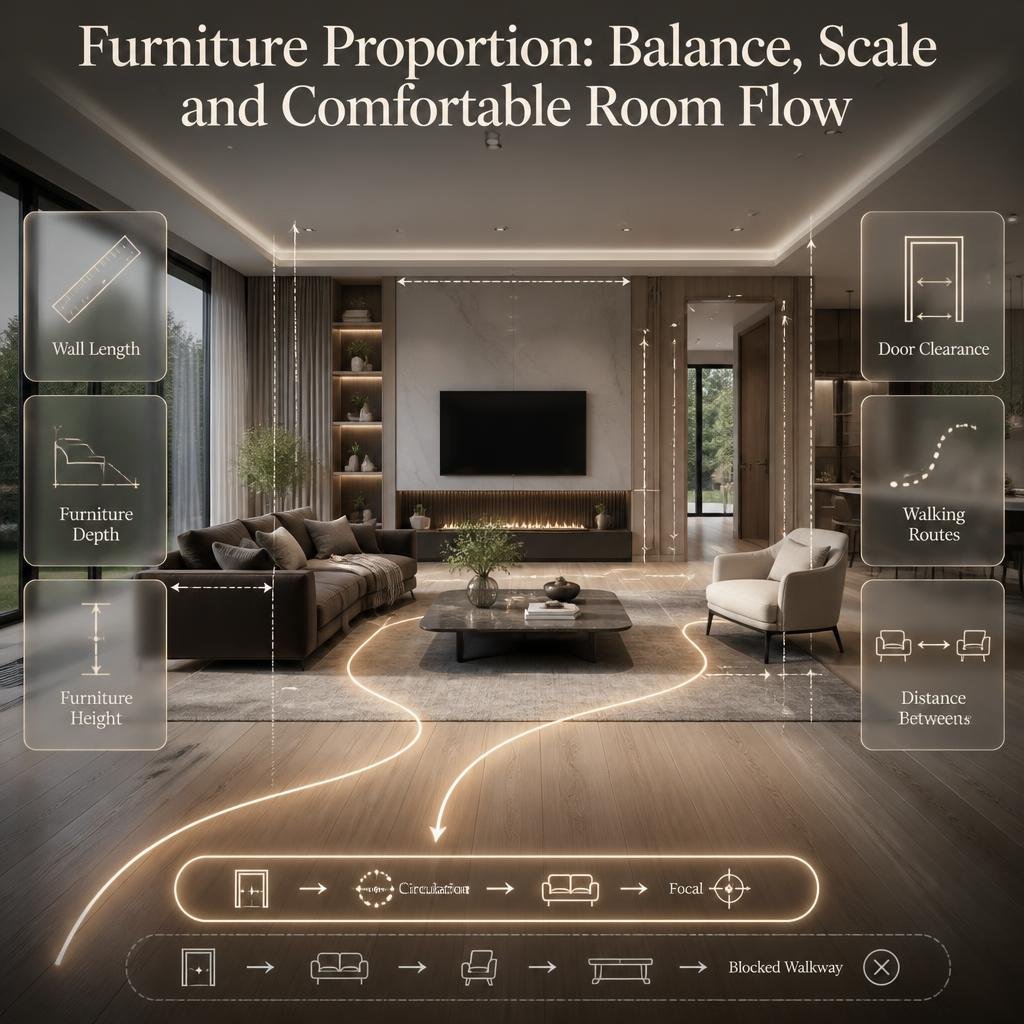
Furniture proportion is one of the most overlooked aspects of elegant interiors.
A sofa can be beautiful but still be wrong for your room.
A dining table can be expensive but still make the dining area uncomfortable.
A bed can look luxurious but dominate a small bedroom.
Before buying furniture, measure:
- Wall length
- Door clearance
- Window positions
- Walking routes
- Furniture depth
- Furniture height
- Distance between pieces
You should also consider visual weight.
A large dark sofa has more visual weight than a small pale chair.
That doesn’t mean dark furniture is bad. It simply means the room needs to balance it.
Think About Circulation
People need to move around furniture comfortably.
A room shouldn’t feel like an obstacle course.
Try to establish:
Entry → circulation → seating → focal point
Rather than:
Entry → furniture → furniture → furniture → blocked walkway
This becomes particularly important in open-plan interiors.
For broader guidance on designing functional spaces and improving your home, explore Home Improvement ideas alongside the aesthetic decisions.
How Should Furniture Be Arranged?
Furniture should support how the room is actually used.
In a living room, for example, don’t automatically push every piece against the wall.
Instead, consider creating a central conversation zone.
A simplified arrangement could look like this:
             FEATURE WALL

       ┌────────────────────┐
       │       SOFA         │
       └────────────────────┘

          COFFEE TABLE

     CHAIR             CHAIR

             OPEN
          CIRCULATION
The exact arrangement depends on the room.
The important idea is to create relationships between furniture rather than treating every item as an independent object.
Consider the Focal Point
Every room benefits from a visual anchor.
It could be:
- Fireplace
- Artwork
- Architectural wall
- Bed
- Statement pendant
- Large window
- Beautiful view
- Feature furniture
The mistake is having too many competing focal points.
If the wall, sofa, ceiling, artwork, rug, and accessories are all demanding attention, the room becomes visually tiring.
How Does Lighting Create Elegant Atmosphere?
Lighting can completely change the way an interior feels.
A beautifully designed room with a single bright ceiling fixture can look flat and uncomfortable at night.
An elegant room usually benefits from layered lighting.
Ambient Lighting
This provides general illumination.
Examples:
- Ceiling fixtures
- Recessed lighting
- Chandeliers
- Pendants
Task Lighting
This supports activities.
Examples:
- Reading lamps
- Desk lamps
- Kitchen lighting
- Bedside lighting
Accent Lighting
This highlights details.
Examples:
- Wall lights
- Artwork lighting
- Shelf lighting
- Cabinet lighting
- Cove lighting
The three layers can work together.
AMBIENT
   ↓
General visibility

TASK
   ↓
Functional activities

ACCENT
   ↓
Mood + focal points
You don’t need all three layers in every corner of the house.
The objective is flexibility.
At night, you may want the main ceiling light turned down while table lamps and wall lighting create a warmer atmosphere.
What Type of Lighting Looks Elegant?
There isn’t one universally elegant fixture.
The correct fixture depends on the room.
For a contemporary room, consider:
- Simple pendants
- Sculptural fixtures
- Recessed lighting
- Minimal wall lights
For traditional interiors:
- Chandeliers
- Decorative sconces
- Classic lamps
For relaxed natural interiors:
- Woven pendants
- Timber details
- Soft-glow lamps
The fixture should connect with the broader design language.
A traditional chandelier in an otherwise ultra-minimal room can work, but it needs a reason to be there.
How Do Materials Add Sophistication?
Materials create depth.
Imagine a room containing only:
- Painted walls
- Smooth synthetic furniture
- Glossy surfaces
It may look clean but could feel visually flat.
Now add:
- Natural timber
- Linen
- Wool
- Stone
- Ceramic
- Brushed metal
- Woven materials
The light interacts with each surface differently.
That’s what creates richness.
Use Material Repetition
Instead of using ten different materials, repeat a few.
For example:
Natural oak + linen + stone + brushed metal
You might use oak in:
- Coffee table
- Cabinet
- Side table
Linen in:
- Curtains
- Cushions
- Upholstery
Stone in:
- Side table
- Fireplace
- Kitchen surface
This repetition creates cohesion.
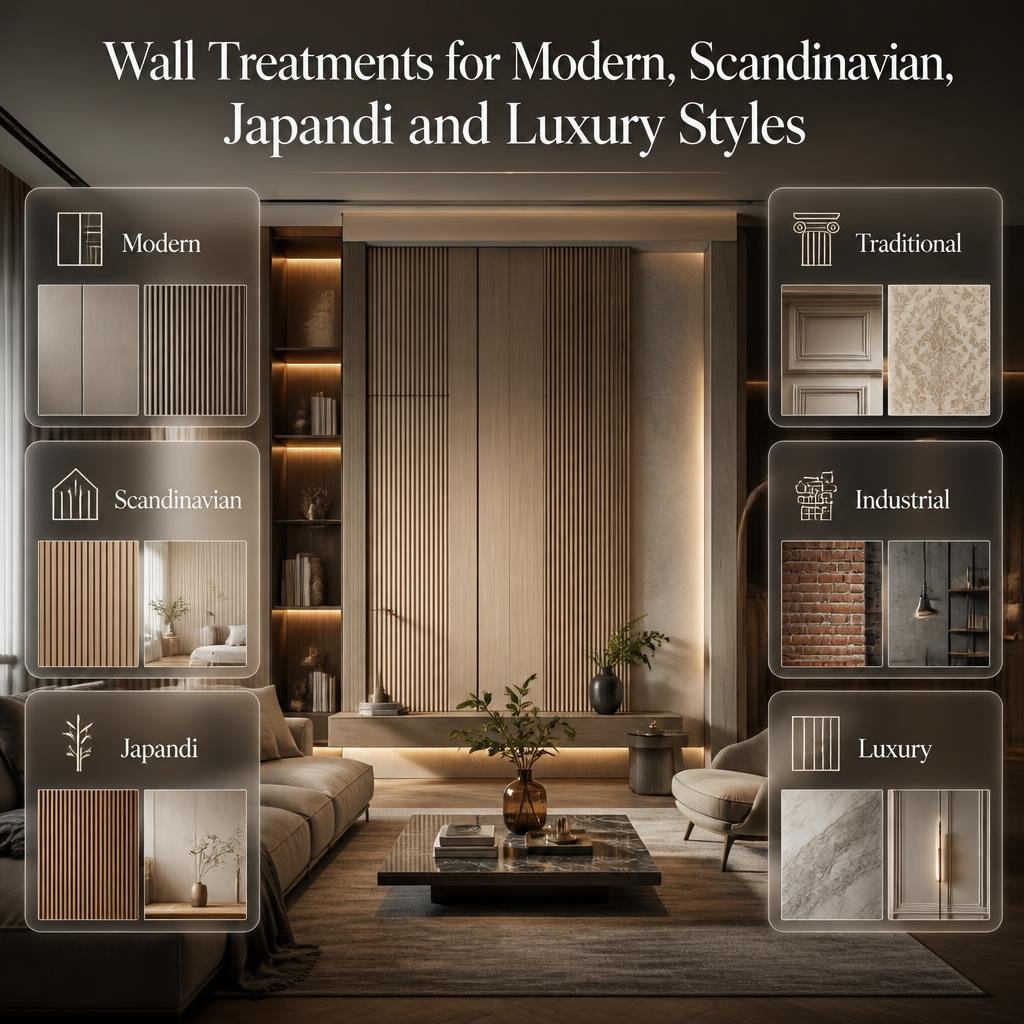
How Can Wall Treatments Improve Elegant Interiors?
Walls represent a huge percentage of the visual area in a room, so they’re extremely important.
A wall doesn’t have to remain a flat painted surface.
You can consider:
- Wall panelling
- Fluted panels
- Decorative moulding
- Textured plaster
- Wallpaper
- Timber slats
- Stone finishes
- Limewash-style effects
- Architectural paint treatments
The right choice depends on the room’s architecture and design direction.
For a modern interior, simple vertical panels or subtle texture may be enough.
For a classic interior, framed moulding may create more appropriate detail.
For a natural interior, timber can add warmth.
If you’re planning a feature or architectural wall upgrade, the Wall Treatments guide can help you explore the possibilities without turning every wall into a statement wall.
Should Every Wall Have a Feature?
No.
One of the biggest mistakes in interior design is assuming every empty wall needs decoration.
Sometimes an empty wall provides visual breathing room.
Use feature walls where they strengthen the room.
Good locations often include:
- Behind the bed
- Behind a sofa
- Fireplace wall
- Entryway
- Dining area
- Main living-room focal wall
If every wall has a different treatment, the room can lose hierarchy.
Elegant design requires knowing where to stop.
How Do Textures Make Neutral Interiors Interesting?
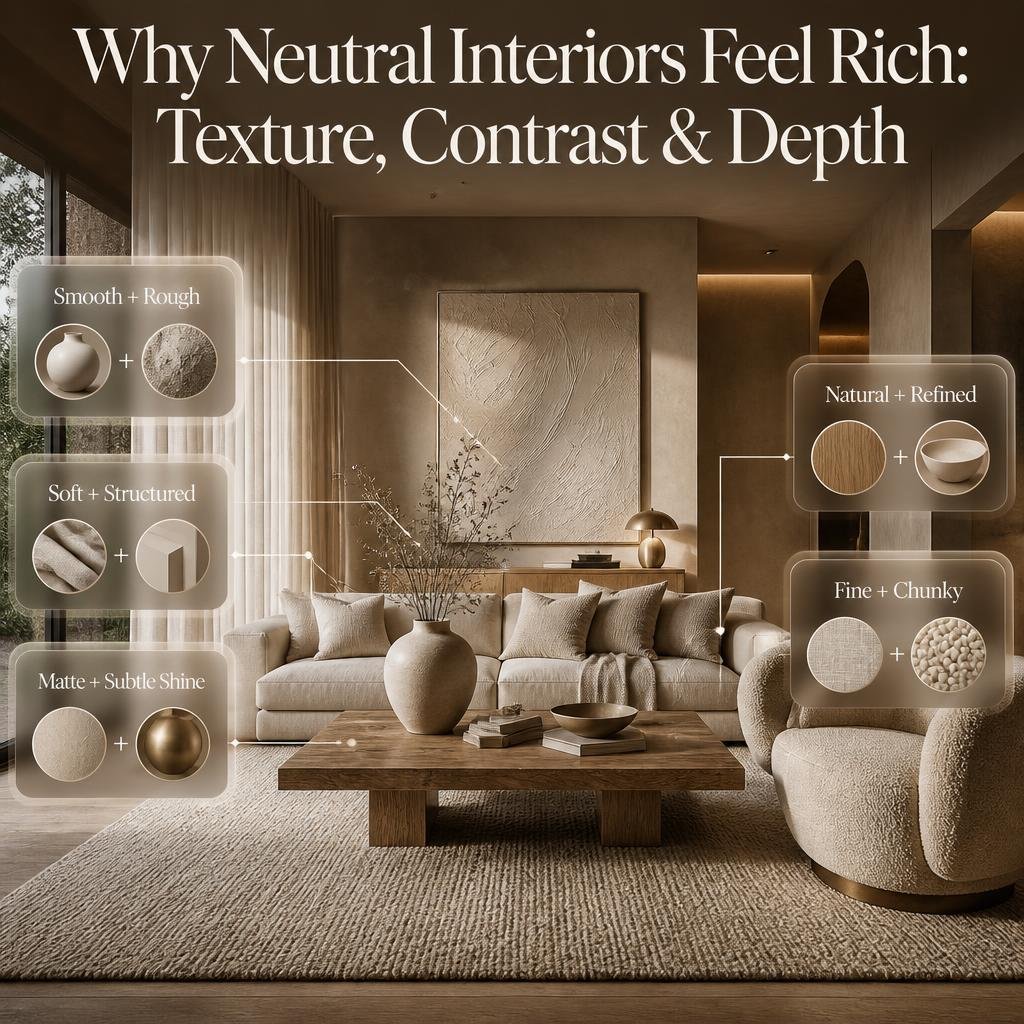
Neutral doesn’t mean boring.
The problem with some neutral rooms is that everything has the same surface quality.
Imagine:
- Beige wall
- Beige sofa
- Beige curtains
- Beige rug
- Beige accessories
If every surface is equally smooth, the room may feel flat.
Now introduce:
- Linen curtains
- Wool rug
- Bouclé chair
- Timber table
- Ceramic vase
- Textured artwork
The colours may remain neutral, but the room becomes much richer.
Mix Texture Types
Try combining:
- Smooth + rough
- Soft + structured
- Matte + subtle shine
- Natural + refined
- Fine + chunky
The contrast gives the eye something to discover.
How Should You Choose Curtains?
Curtains are often underestimated.
Poorly proportioned curtains can make an otherwise beautiful room feel unfinished.
Whenever the architecture allows, consider installing the curtain rod higher and wider than the actual window.
This can make the window feel larger and give the room a more finished appearance.
Material choices include:
Linen
Good for:
- Relaxed elegance
- Natural interiors
- Scandinavian spaces
- Soft contemporary rooms
Velvet
Good for:
- Dramatic rooms
- Formal spaces
- Richer interiors
Cotton Blends
Good for:
- Practical family rooms
- Versatile styling
- Easy maintenance
Sheer Curtains
Good for:
- Softening daylight
- Layering with heavier curtains
- Creating privacy
The colour should relate to the broader room palette.
Why Does Rug Size Matter?
A rug can visually connect furniture.
One of the most common mistakes is choosing a rug that is too small.
If a large sofa sits around a tiny rug, the furniture can appear disconnected.
A properly sized rug can visually group:
- Sofa
- Chairs
- Coffee table
into one composition.
You don’t always need the entire furniture arrangement sitting completely on the rug, but the rug should be large enough to create a meaningful relationship between the pieces.
⭐ Expert Tip: When the budget is limited, prioritize getting the rug size right instead of buying several small decorative rugs.
How Can Accessories Make a Space Elegant?
Accessories should complete the room rather than rescue it.
If the layout, lighting, furniture, and colours aren’t working, adding more accessories won’t solve the underlying problem.
Useful accessories include:
- Artwork
- Books
- Vases
- Ceramic objects
- Sculptures
- Mirrors
- Plants
- Cushions
- Throws
- Decorative bowls
Try grouping objects rather than spreading dozens of items across every surface.
For example, a console can have:
Lamp + books + ceramic object + plant
rather than:
Lamp + five ornaments + three frames + several candles + multiple bowls
The first arrangement gives each item enough visual space.
How Do You Use Art in Elegant Interiors?
Artwork adds personality and creates visual focus.
You don’t need expensive art.
What matters more is:
- Scale
- Colour
- Position
- Subject
- Relationship to furniture
A large piece of artwork above a sofa can often have greater impact than six tiny unrelated prints.
Match the Scale
A tiny artwork above a very large sofa may look lost.
Likewise, an oversized artwork in a narrow hallway can overwhelm the space.
Think about the furniture beneath it and the available wall area.
Artwork should feel connected to the architecture rather than randomly attached to it.
How Can Mirrors Improve a Room?
Mirrors can:
- Reflect natural light
- Add depth
- Increase visual openness
- Create a focal point
- Reflect architectural features
But mirror placement matters.
A mirror reflecting clutter simply makes the clutter more visible.
Instead, try positioning it to reflect:
- A window
- Artwork
- Lighting
- Attractive architecture
- A carefully styled area
The frame should also relate to the room.
How Do You Create Elegant Living Rooms?
A living room needs to balance appearance with daily comfort.
Start with:
- Seating arrangement
- Rug size
- Coffee table
- Lighting
- Curtains
- Artwork
- Accessories
The sofa is often the largest visual element, so its scale matters enormously.
Don’t select a sofa simply because it looks attractive online.
Measure:
- Width
- Depth
- Height
- Door clearance
- Wall space
Then consider how it interacts with chairs, tables, rugs, and walkways.
For more complete interior planning, the Interior Design resource can help you connect the visual side of the room with practical design decisions.
How Do You Create Elegant Bedrooms?
A bedroom should feel peaceful before it feels impressive.
The bed is usually the primary focal point, so begin there.
Consider:
- Headboard scale
- Bedside table proportions
- Layered bedding
- Soft lighting
- Curtains
- Rug placement
- Storage
- Wall treatment
Avoid turning the bedroom into a showroom.
It should feel personal.
For a more detailed bedroom-specific approach, explore Bedroom Interior Design, then consider the practical relationship between furniture, circulation, storage, and lighting.
For layouts specifically, Bedroom Planning and Layout can help you think through the room before purchasing furniture.
If your preference is cleaner and more contemporary, Modern Bedroom Design provides another useful direction for coordinating modern forms, colours, and materials.
How Can Elegant Spaces Still Feel Comfortable?
This is one of the most important design questions.
A room can look beautiful but still fail if nobody wants to use it.
Comfort comes from:
- Correct furniture proportions
- Soft textiles
- Appropriate lighting
- Easy circulation
- Practical storage
- Comfortable temperatures
- Accessible surfaces
- Functional layouts
Don’t sacrifice comfort simply to achieve a photograph-ready room.
A beautiful sofa that nobody can sit comfortably on isn’t a successful design choice.
Likewise, an elegant dining room still needs enough space to pull chairs out and move around the table.
Can Smart Technology Work in Elegant Interiors?
Absolutely.
Technology doesn’t have to dominate the appearance of a home.
Modern solutions can include:
- Smart lighting
- Automated curtains
- Hidden speakers
- Concealed charging
- Integrated televisions
- Smart thermostats
- Motion-sensitive lighting
The main principle is integration.
Technology should support the room rather than become its visual focus.
For ideas around combining technology with interior planning, see Connected Living.
Think about wiring and electrical requirements early.
It’s much easier to plan technology before walls and cabinetry are finished than to hide cables later.
How Do You Create Elegant Spaces on a Budget?
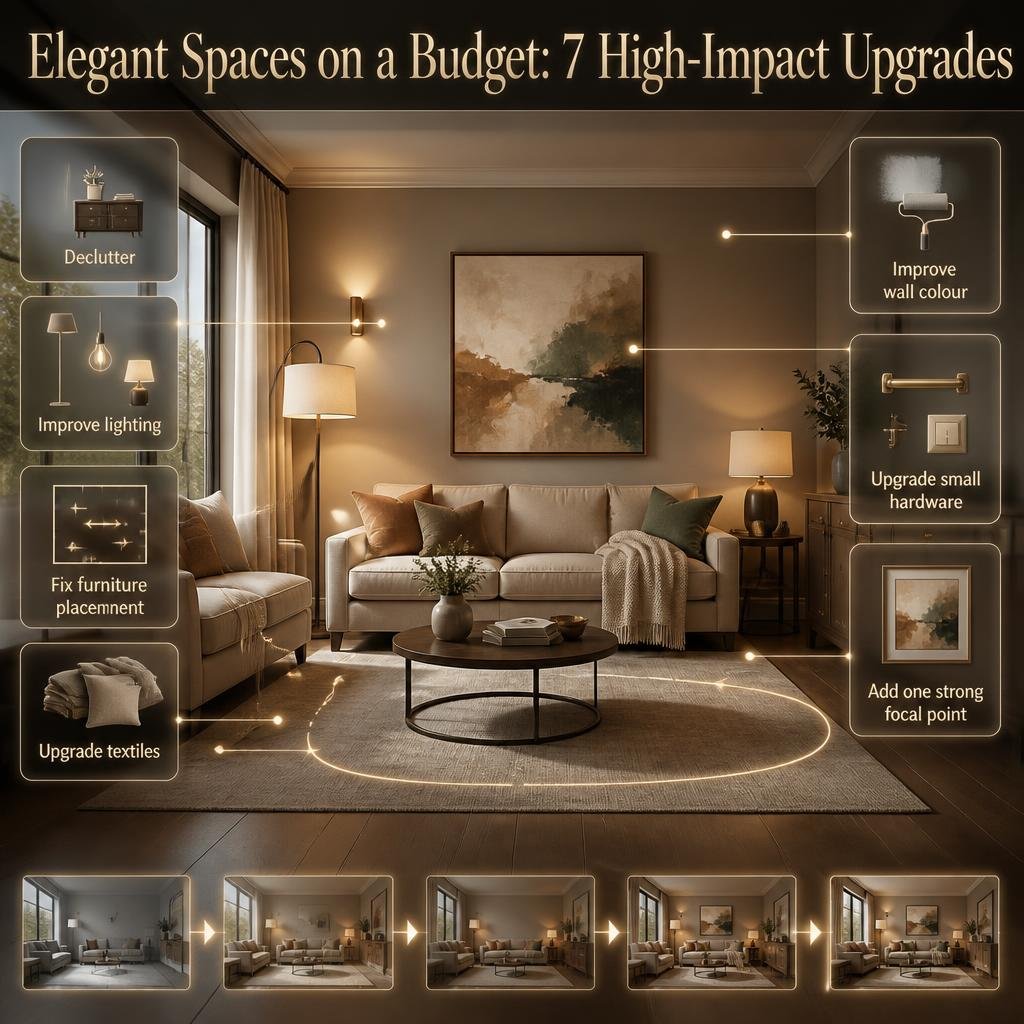
Elegance doesn’t require replacing the entire home.
Start with the elements that create the largest visual impact.
High-Impact Improvements
1. Declutter
Remove things that don’t serve a purpose.
2. Improve lighting
Add floor lamps, table lamps, wall lights, or better bulbs.
3. Fix furniture placement
Create better circulation and visual balance.
4. Upgrade textiles
Curtains, cushions, bedding, and rugs can dramatically change a room.
5. Improve wall colour
A better colour can make existing furniture feel completely different.
6. Upgrade small hardware
Cabinet handles, drawer pulls, curtain rods, and light switches can influence the overall finish.
7. Add one strong focal point
Instead of buying ten decorative objects, choose one meaningful piece.
This approach allows you to improve the room gradually.
How Does Home Improvement Support Elegant Design?
Elegant design isn’t only about decoration.
Sometimes the most important improvement is structural or functional.
For example:
- Better storage
- Improved lighting positions
- Updated flooring
- Better electrical planning
- Improved ventilation
- New doors
- Wall repairs
- Better built-ins
These improvements create a stronger foundation for decoration.
The article Why Home Improvement Is Important provides a broader perspective on why functional improvements can matter just as much as visual changes.
A beautifully decorated room with poor storage may become cluttered quickly.
Good design anticipates real life.
How Can Gardens and Outdoor Areas Extend Elegant Spaces?
Elegance shouldn’t stop at the interior door.
If your home connects to a garden, terrace, patio, or balcony, think about the transition between indoor and outdoor areas.
Repeat elements such as:
- Timber tones
- Stone
- Metal finishes
- Neutral colours
- Planting colours
- Lighting temperatures
The goal isn’t to make indoor and outdoor spaces identical.
Instead, create a visual relationship.
Natural materials can make this transition especially successful.
For outdoor inspiration and garden-related ideas, explore Robert MyGardenAndPatio.
If you’re starting from scratch and wondering how much of your outdoor space you can plan yourself, Can I Design My Own Garden Kdagardenation can provide another useful perspective.
How Do You Mix Different Interior Styles Without Creating Chaos?
Mixing styles can create a highly personal interior, but the styles need something connecting them.
For example:
Modern + Japandi
Use:
- Natural timber
- Neutral colours
- Simple furniture
- Minimal decoration
Traditional + Contemporary
Use:
- Classic architectural details
- Contemporary furniture
- Consistent colour palette
- Controlled ornamentation
Scandinavian + Contemporary
Use:
- Light colours
- Natural materials
- Functional furniture
- Simple forms
The key is finding a bridge.
That bridge could be:
- Colour
- Material
- Shape
- Finish
- Texture
If every item comes from a different visual language, the room can feel random rather than collected.
What Makes an Elegant Space Feel Timeless?
Timeless design doesn’t mean avoiding all modern ideas.
It means choosing permanent elements carefully.
Consider keeping expensive or difficult-to-replace elements relatively adaptable:
- Flooring
- Cabinetry
- Major furniture
- Architectural wall treatments
- Countertops
- Built-ins
You can experiment more freely with:
- Cushions
- Throws
- Artwork
- Small accessories
- Accent colours
- Decorative objects
This creates flexibility.
If a trend changes, you don’t have to renovate the entire room.
What Are the Biggest Mistakes That Make a Room Look Less Elegant?
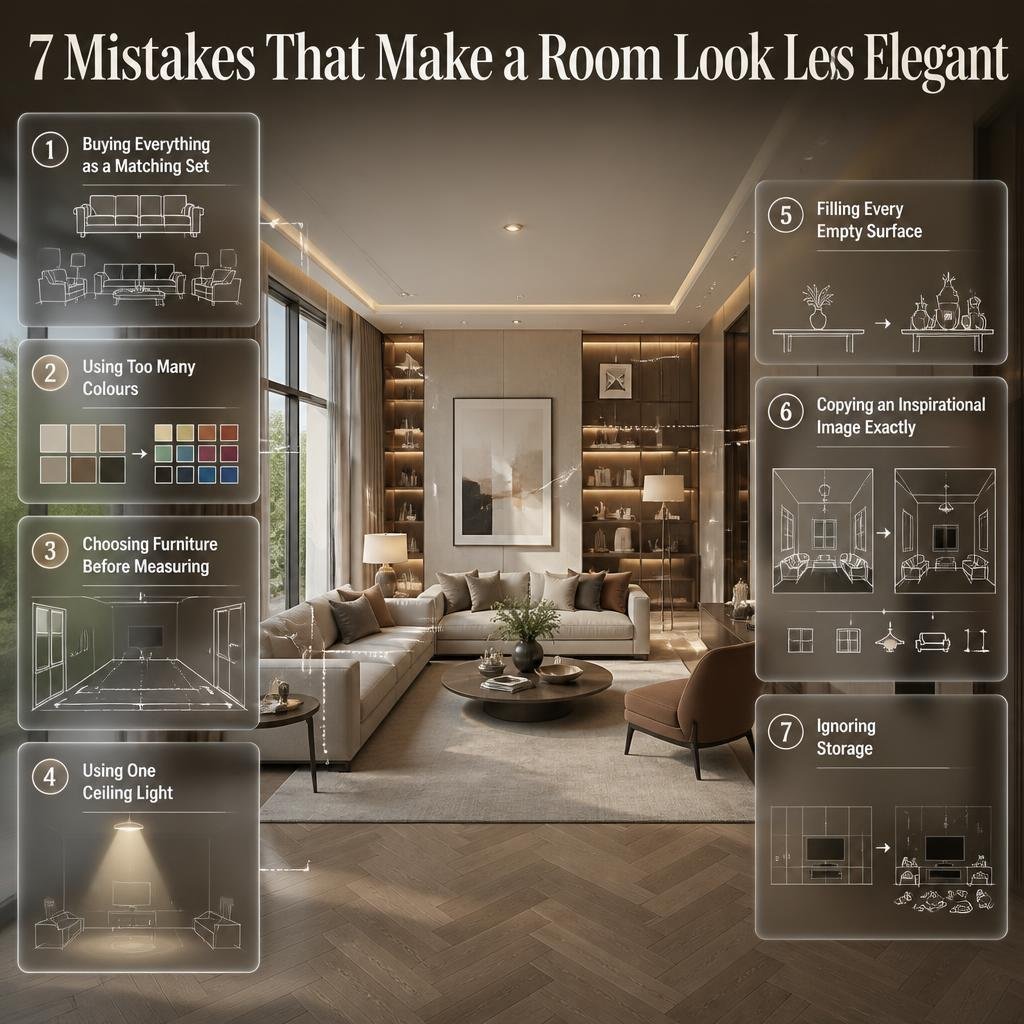
Mistake 1: Buying Everything as a Matching Set
Why it happens: Matching seems safe.
Why it’s harmful: The room can look like a furniture showroom.
Better approach: Coordinate pieces without making them identical.
Mistake 2: Using Too Many Colours
Why it happens: Homeowners want personality.
Why it’s harmful: Every new colour introduces another visual relationship.
Better approach: Keep the base controlled and use stronger colours strategically.
Mistake 3: Choosing Furniture Before Measuring
Why it happens: The furniture looks attractive in the store.
Why it’s harmful: It may overwhelm the actual room.
Better approach: Measure the room, doors, walls, and circulation paths first.
Mistake 4: Using One Ceiling Light
Why it happens: It seems sufficient.
Why it’s harmful: The room becomes flat and harsh at night.
Better approach: Layer ambient, task, and accent lighting.
Mistake 5: Filling Every Empty Surface
Why it happens: Empty areas can feel unfinished.
Why it’s harmful: Visual clutter increases.
Better approach: Treat negative space as part of the design.
Mistake 6: Copying an Inspirational Image Exactly
Why it happens: Online images make design look straightforward.
Why it’s harmful: Your room probably has different dimensions, windows, ceiling height, lighting, and furniture requirements.
Better approach: Copy the design principle rather than the exact room.
Mistake 7: Ignoring Storage
Why it happens: Storage isn’t as visually exciting as furniture.
Why it’s harmful: Everyday items eventually appear everywhere.
Better approach: Plan storage as part of the design.
How Do Professionals Approach Elegant Interiors?
Experienced designers usually think in relationships.
They don’t ask only:
“Is this sofa beautiful?”
They ask:
“Does this sofa work with the room?”
They consider:
- Scale
- Proportion
- Sightlines
- Circulation
- Material repetition
- Lighting
- Colour balance
- Focal points
- Negative space
This is why a simple room can look professionally designed.
The individual products aren’t necessarily extraordinary.
The composition is.
A Professional Design Sequence
A practical order is:
Architecture
↓
Layout
↓
Walls + Flooring
↓
Furniture
↓
Lighting
↓
Curtains + Rugs
↓
Artwork
↓
Accessories
This prevents you from decorating around decisions that haven’t been resolved yet.
How Can You Make Elegant Spaces Feel Personal?
A sophisticated home shouldn’t look like a hotel catalogue.
Personal details are what make the space yours.
Include:
- Books you actually read
- Family photographs
- Travel memories
- Handmade ceramics
- Artwork you genuinely enjoy
- Favourite plants
- Heirlooms
- Objects with personal stories
The key is editing.
You don’t need to display everything you own.
Choose the objects that contribute to the room and rotate others when you want a fresh look.
What Role Does Negative Space Play?
Negative space is the area around and between objects.
It is not wasted space.
It allows important elements to breathe.
Imagine a console table covered completely with accessories.
Now remove half of them.
The remaining objects suddenly become more noticeable.
This is why elegant rooms often have areas that appear intentionally empty.
Negative space creates hierarchy.
It tells your eyes where to rest.
📌 Quick Tip: If you feel that a room looks cluttered but can’t identify the exact problem, remove 20–30% of the decorative items temporarily and reassess the space.
How Can You Tell Whether a Room Is Actually Finished?
Don’t finish a room simply because you have filled every empty area.
Instead, ask:
Layout
- Can people move comfortably?
- Are walking paths clear?
- Does furniture fit the architecture?
Colour
- Is the palette controlled?
- Do the colours work under both daylight and artificial light?
Lighting
- Can you create different moods?
- Is the room comfortable at night?
Materials
- Are textures varied?
- Are key materials repeated?
Furniture
- Is everything appropriately scaled?
- Is the room comfortable?
Decoration
- Are the accessories meaningful?
- Is there enough negative space?
If the answers are mostly yes, the room may already be finished.
Adding more may actually weaken the result.
How Can I Make My Home Look Elegant Without Spending a Lot of Money?
You don’t need an expensive renovation to make a home feel elegant. The biggest improvement usually comes from making the existing space more organised, balanced, and visually consistent. Start with the furniture layout, remove unnecessary clutter, improve the lighting, and establish a simple colour palette before buying anything new. In many homes, these changes have more impact than expensive decorative products.
A practical approach is to spend your budget on elements that occupy a lot of visual space or are used every day. A properly sized rug, attractive curtains, comfortable sofa, good lighting, or a well-chosen piece of artwork can transform the atmosphere without requiring a complete redesign. Current 2026 design discussions are also moving toward warmer, more personal interiors rather than spaces that simply look expensive or overly polished.
What to prioritize:
Declutter before buying new décor.
Improve the furniture arrangement.
Replace harsh lighting with layered sources.
Choose curtains that suit the room’s scale.
Introduce natural-looking textures such as wood, linen, wool, or ceramic.
Use artwork or one strong decorative feature instead of many small objects.
Keep the main colour palette controlled.
Upgrade small details such as cabinet handles, lampshades, and hardware.
⭐ Professional Tip: If your budget is limited, don’t try to make every part of the room luxurious. Choose two or three areas that create the biggest visual impact and make those areas noticeably better. A carefully edited room often looks more sophisticated than a room filled with expensive accessories.
What Colours Make a Home Look Elegant and Timeless?
Elegant interiors don’t depend on one particular colour, but they generally benefit from colours that work comfortably with natural materials, furniture, and changing light. Warm whites, ivory, beige, taupe, greige, muted greens, earthy browns, soft blues, charcoal, and deeper accent shades can all create a sophisticated foundation.
The important part is how the colours are combined. A room with several attractive colours can still look disconnected if they don’t relate to one another. Instead, select one dominant colour, one or two supporting tones, and a smaller accent colour. This gives the eye a clear visual hierarchy.
In 2026, interior design reporting is showing a broader movement away from sterile all-white rooms toward warmer, earthier, more layered palettes. That doesn’t mean white or grey has become unusable; it means designers and homeowners are increasingly looking for warmth, texture, and personality rather than relying on a single neutral formula.
A practical palette could include:
Main colour: warm white or soft ivory
Supporting colour: beige, taupe, or natural wood
Accent: olive, charcoal, navy, terracotta, or another controlled deeper tone
When choosing paint, check:
How much natural light enters the room
Whether the room faces strong morning or afternoon sunlight
The colour of the flooring
The undertones of the furniture
The colour temperature of artificial lighting
How the shade looks during both day and night
📌 Professional Tip: Never select a wall colour from a small screen image alone. Test a sample on the actual wall and observe it at different times of day. A colour that looks warm in a showroom can appear completely different under your home’s lighting.
How Do I Make a Room Look Elegant Without Making It Feel Too Formal or Cold?
The secret is to combine refinement with comfort. An elegant room shouldn’t look as if nobody is allowed to sit on the furniture. Use polished elements such as good proportions, beautiful lighting, artwork, and controlled decoration, then balance them with softer and more personal materials.
Natural wood, linen, wool, woven fabrics, ceramics, plants, books, and comfortable upholstery can prevent a sophisticated room from feeling sterile. Warm, layered lighting is equally important because one bright overhead fixture can make even an expensive interior feel harsh.
This approach is particularly relevant to current interior design. Recent 2026 trend coverage repeatedly points toward warmer materials, tactile surfaces, layered lighting, personal objects, and interiors that feel lived-in rather than staged.
Use this balance:
Refined: clean furniture lines
Warm: natural timber
Soft: linen or textured upholstery
Personal: artwork and meaningful objects
Comfortable: layered cushions and throws
Atmospheric: table lamps, floor lamps, or wall lights
Natural: plants or organic decorative materials
The biggest mistake is trying to make every element look perfect and brand-new. A home becomes more inviting when some objects have character, variation, and a story.
⚠ Common Mistake: Matching every piece of furniture, choosing identical decorative accessories, and using the same finish everywhere may technically look coordinated, but it can make the room feel like a showroom.
A better approach: coordinate the room without making everything identical. Mix complementary furniture, materials, textures, and older or personal pieces so the space feels collected rather than purchased all at once.
What Lighting Is Best for Creating an Elegant Interior?
The best lighting for an elegant interior isn’t one particular lamp or chandelier. It is a layered lighting plan that gives you different levels of illumination for different activities and moods.
Start with ambient lighting for general visibility. Then add task lighting where people read, work, cook, dress, or perform another specific activity. Finally, use accent lighting to highlight artwork, architectural details, shelves, wall treatments, or decorative features.
This layered approach has become especially important in current interior design because lighting is increasingly treated as part of the atmosphere and architecture rather than simply a way to make a room bright. Recent 2026 design coverage highlights warm, diffused illumination, sculptural fixtures, tactile materials, and multiple lighting layers as important directions.
A useful lighting structure is:
Ambient lighting
→ Overall room illumination
Task lighting
→ Reading, working, cooking, dressing
Accent lighting
→ Artwork, shelves, walls, architecture
Decorative lighting
→ Adds character and visual interest
For example, a living room might combine a ceiling fixture with floor lamps, table lamps, and subtle wall or picture lighting. During the day, natural daylight may do most of the work. In the evening, lower-level lamps can create a much softer atmosphere.
For a more sophisticated result:
Avoid relying entirely on one bright ceiling light.
Use warm, comfortable light where appropriate.
Highlight important architectural features.
Use dimmable fixtures when practical.
Consider the room’s function before selecting decorative fixtures.
Hide unnecessary cables wherever possible.
Choose fixtures that complement the room instead of competing with it.
💡 Professional Tip: Design the lighting before the final decoration is installed. If you decide where lights should go only after the furniture and artwork are finished, you may end up with poorly positioned fixtures or visible cables.
What Are the Biggest Mistakes That Stop a Home From Looking Elegant?
The most common mistake is thinking elegance comes from adding more. Homeowners often see an empty wall and immediately think it needs artwork, a feature wall, shelving, or decoration. They see an empty table and add accessories. They see a plain sofa and add cushions. Eventually, every surface is occupied and the room loses the calm quality that made it attractive in the first place.
Another major problem is poor proportion. A small rug under oversized furniture, a tiny artwork above a large sofa, curtains that stop too high above the floor, or a large sectional blocking circulation can make a room look poorly planned even when individual products are attractive.
Current 2026 interior-design coverage is also moving away from overly matched, sterile, showroom-like interiors toward spaces with warmth, character, natural materials, layered textures, and meaningful pieces.
Watch out for these mistakes:
Buying furniture without measuring first
Using too many unrelated colours
Matching every furniture piece
Using only one overhead light
Choosing a rug that’s too small
Hanging artwork too high
Using curtains with poor proportions
Filling every shelf and tabletop
Mixing too many materials
Copying an online room exactly
Ignoring storage
Choosing trend-heavy permanent finishes
Forgetting how the room will actually be used
The professional solution is simple: edit before you add.
Remove unnecessary objects. Correct the furniture layout. Improve the lighting. Establish a clearer colour relationship. Then add only the pieces that genuinely improve the room.
⭐ Expert Tip: Take a photograph of your room from several angles and look at it on your phone. A photograph often reveals clutter, awkward proportions, competing focal points, and empty areas that aren’t obvious when you’re standing inside the room.
The goal isn’t to make the room look perfect. The goal is to make every important element feel intentional.
Conclusion
Creating Elegant Spaces is not about filling your home with expensive furniture, following every new trend, or making every room look like a luxury showroom. True elegance comes from thoughtful choices—balanced proportions, a well-planned colour palette, layered lighting, quality textures, natural materials, meaningful accessories, and enough open space for the room to breathe.
The most successful interiors also feel personal. Current 2026 design direction continues to favour warmer colours, natural materials, layered lighting, tactile textures, and rooms that show personality rather than looking overly coordinated or sterile.
Start with the structure of your room before buying decorative pieces. Decide how the space should function, choose furniture that fits properly, build a cohesive colour scheme, and then add lighting, artwork, textiles, plants, and accessories gradually. You do not need to redesign everything at once. Even small improvements—better lighting, richer textures, a thoughtfully styled wall, or replacing unnecessary clutter—can change how a room feels.
Most importantly, elegance should support everyday living. A beautiful home should still be comfortable, practical, welcoming, and easy to maintain. When design decisions reflect both your lifestyle and your personality, the result becomes more than visually attractive—it becomes a home that feels naturally refined, balanced, and timeless.