
Introduction
Modern Bedroom Design | A bedroom can look beautiful in photographs and still feel completely wrong when you actually live in it. Maybe the bed takes up too much space, the lighting feels harsh at night, storage is never enough, or the room looks modern but doesn’t feel comfortable. These problems usually aren’t caused by a lack of expensive furniture. They’re caused by poor planning.
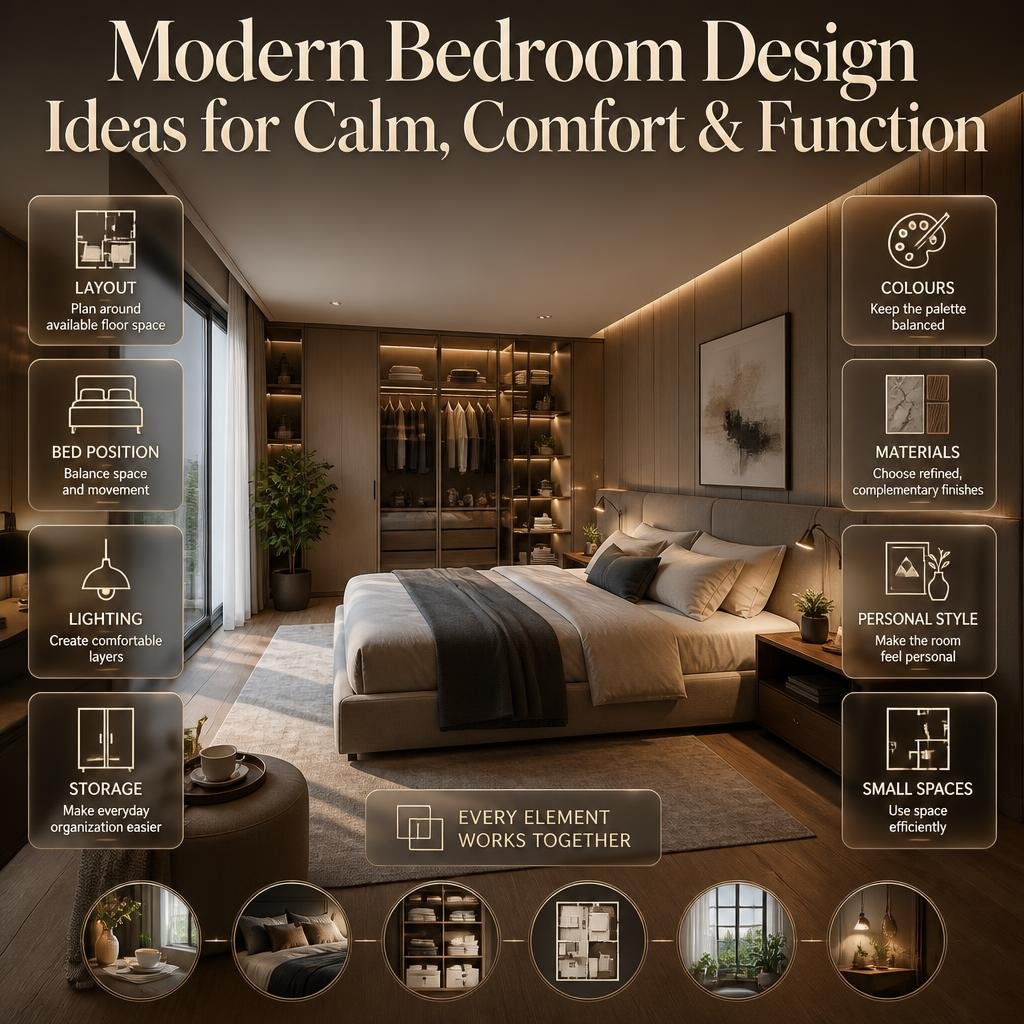
Modern bedroom design is about solving those everyday problems while creating a room that feels calm, polished and personal. It combines clean lines, practical furniture, thoughtful lighting, useful storage, balanced colours and carefully selected materials. The goal isn’t to make the room look empty or overly fashionable. It’s to make every element work together.
If you’re planning a new bedroom or refreshing an existing one, the key is to design the room around the way you actually live. Your morning routine, sleeping habits, storage needs, available floor space, natural light and personal taste should all influence the final design.
For broader inspiration and professional interior ideas, you can also explore DesignMode24 Interior Design before deciding on the direction of your bedroom.
This guide explains how to plan a modern bedroom from the layout and bed position to colours, lighting, wardrobes, textures, accessories, small-space solutions and finishing details.
What Is Modern Bedroom Design?
Modern bedroom design is an approach that combines simple forms, clean lines, practical furniture, controlled colours and carefully selected materials to create a comfortable and visually organised space. It doesn’t mean using only white furniture or removing every decorative item. Instead, modern design focuses on purpose, proportion and visual clarity.
A successful modern bedroom usually has fewer competing elements, but each element has a clear role. The bed becomes an anchor, storage is integrated wherever possible, lighting is layered rather than harsh, and decorative pieces are chosen for their ability to add warmth or personality without creating clutter.
Modern design also values negative space. The empty areas around furniture are part of the composition rather than wasted space.
Why Does Modern Bedroom Design Matter?
A bedroom is used every day, so its design needs to work beyond the first impression. A good layout can make dressing easier, improve movement and make a small room feel more open. Good lighting can make the space comfortable in the evening. Proper storage can prevent clothes, chargers, books and personal items from taking over visible surfaces.
Modern design is therefore less about following a particular trend and more about creating an organised environment that supports everyday life.
What Should You Plan First in a Modern Bedroom?
The first step should be the layout, not the paint colour or decorative accessories.
Before buying anything, measure the room and identify:
- Door position and opening direction
- Window locations
- Built-in cupboards
- Electrical points
- Air-conditioning units
- Ceiling height
- Natural light direction
- Available wall space
- Existing furniture
- Walking routes
- Storage requirements
This prevents one of the most common bedroom design mistakes: purchasing attractive furniture before knowing whether it actually fits.
Start With the Bed
The bed is normally the largest piece of furniture and the visual centre of the bedroom. Its position affects everything else.
A practical arrangement should allow comfortable movement around the bed while leaving enough space for wardrobes, drawers and doors to operate properly.
A useful planning sequence is:
Bed → circulation → storage → bedside furniture → lighting → textiles → decoration
This order keeps aesthetics connected to functionality.
Recent professional bedroom-planning guidance similarly recommends solving bed placement, circulation and storage before moving into decorative decisions.
Professional Planning Tip
Don’t measure only the furniture itself. Measure the usable space around it.
A wardrobe may physically fit on a wall, but if its doors cannot open comfortably because of the bed, the design isn’t functional.
How Do You Choose the Right Modern Bedroom Layout?
The best modern bedroom layout depends on room size, door and window positions, furniture dimensions and daily routines.
There isn’t one layout that works for every bedroom.
Small Bedroom Layout
In a small bedroom, the priority should be preserving floor space.
Consider:
- A low-profile bed
- Wall-mounted bedside lighting
- Built-in wardrobes
- Under-bed storage
- Floating shelves
- Slim bedside tables
- Sliding wardrobe doors
- Furniture with visible legs
Furniture that visually occupies less floor area can make a compact room feel more open. Interior designers also recommend raised or slim furniture forms because seeing more floor can create a stronger sense of space.
Medium Bedroom Layout
A medium bedroom gives you more flexibility.
You may be able to include:
- A larger bed
- Two bedside tables
- Full-height wardrobe
- Dressing table
- Reading chair
- Small bench
- Decorative console
The mistake is assuming that more floor area means you need more furniture.
Leave some empty space. That visual breathing room is part of modern design.
Large Bedroom Layout
A large bedroom can become surprisingly difficult to design because furniture may appear disconnected.
Use zones to create structure:
- Sleeping zone
- Dressing zone
- Reading zone
- Relaxation zone
- Work zone, if necessary
A rug beneath the bed can visually anchor the sleeping zone, while a chair and side table can establish a separate reading area.
The objective isn’t to fill every corner. It’s to give the large room a balanced visual rhythm.
How Should You Position the Bed?
The strongest bed position is usually against the most suitable uninterrupted wall, with enough room for comfortable circulation on both sides.
Ideally:
- The headboard should sit against a stable wall.
- Bedside furniture should be proportionate to the bed.
- The wardrobe should remain accessible.
- Windows shouldn’t be unnecessarily blocked.
- Doors should open without hitting furniture.
- Electrical outlets should remain practical.
The exact position depends on the architecture of the room, so don’t blindly copy a layout from Pinterest.
What About Putting the Bed Under a Window?
It can work, but it isn’t automatically the best option.
Consider:
- Window height
- Curtain placement
- Outside noise
- Natural light
- Temperature
- Access for cleaning
- Headboard height
If the window is low or visually important, placing the bed underneath it may create awkward proportions.
How Do You Choose a Modern Bed?
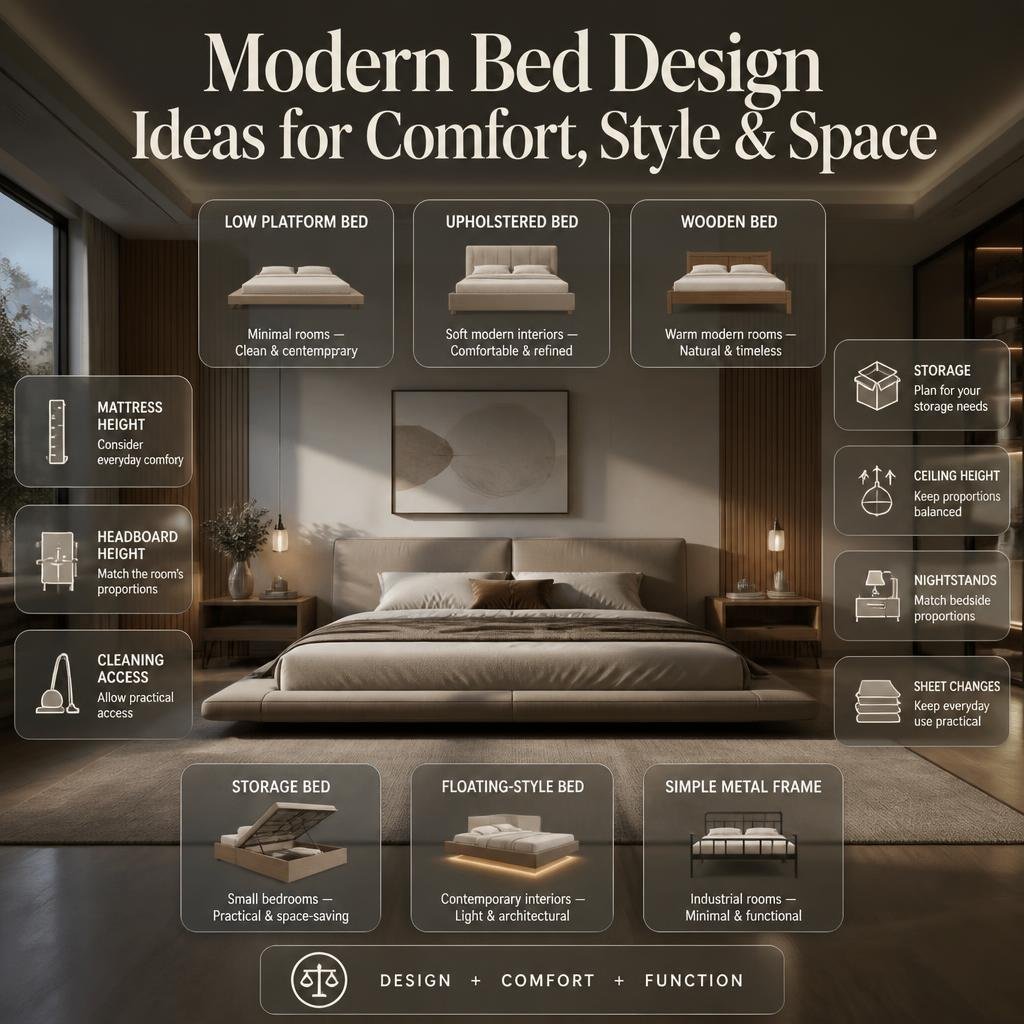
The bed should support both the design and the comfort of the room.
Popular modern options include:
| Bed Style | Best For | Design Effect |
|---|---|---|
| Low platform bed | Minimal rooms | Clean and contemporary |
| Upholstered bed | Soft modern interiors | Comfortable and refined |
| Wooden bed | Warm modern rooms | Natural and timeless |
| Storage bed | Small bedrooms | Practical and space-saving |
| Floating-style bed | Contemporary interiors | Light and architectural |
| Simple metal frame | Industrial rooms | Minimal and functional |
A low-profile bed often reinforces a modern aesthetic because its horizontal shape keeps the visual field clean. Architectural Digest’s recent bedroom guidance also highlights low-profile beds, controlled palettes, tactile materials and proportion as important elements of modern bedroom design.
Don’t Choose a Bed Only Because It Looks Modern
Think about:
- Mattress height
- Headboard height
- Cleaning access
- Storage requirements
- Bedroom ceiling height
- Nightstand proportions
- Ease of changing sheets
A beautiful bed that makes the room difficult to use isn’t a successful design decision.
How Do You Choose Modern Bedroom Colours?
Modern bedrooms generally work well with restrained colour palettes.
Good starting combinations include:
Warm Neutral
- Warm white
- Cream
- Beige
- Taupe
- Light oak
This creates a soft and welcoming atmosphere.
Grey and Wood
- Soft grey
- Charcoal accents
- Natural wood
- Off-white textiles
This works particularly well when you want a sophisticated modern appearance without making the room feel too stark.
Earthy Modern
- Sand
- Olive
- Clay
- Walnut
- Cream
This direction adds warmth while retaining a contemporary feel.
Dark Modern Bedroom
- Charcoal
- Deep brown
- Black accents
- Warm wood
- Soft beige
Dark colours can look luxurious, but they need appropriate lighting and balance.
Should Everything Be the Same Colour?
No.
A completely monochromatic room can become flat if there isn’t enough variation in texture.
Instead, use tonal variation.
For example:
Warm white wall + beige bedding + taupe curtains + oak furniture + textured cream rug
The colours are related, but the materials create visual depth.
How Can You Make a Modern Bedroom Feel Warm?
One of the biggest misunderstandings about modern interiors is that they need to be cold or minimal.
They don’t.
Modern design becomes more comfortable when you introduce texture.
Use:
- Linen bedding
- Wool or textured rugs
- Upholstered headboards
- Natural wood
- Soft curtains
- Bouclé or woven cushions
- Matte ceramics
- Natural stone
- Soft throws
Texture becomes especially important when the colour palette is restrained.
A room with five neutral colours and five different textures can feel much richer than a room with ten colours and little material variation.
What Lighting Works Best in a Modern Bedroom?
Lighting is one of the most important parts of modern bedroom design because the same room needs to support different activities throughout the day.
A bedroom should not depend on one bright ceiling light.
Use three layers:
1. Ambient Lighting
This provides general illumination.
Examples include:
- Recessed lights
- Ceiling fixtures
- Cove lighting
- Soft pendant lighting
2. Task Lighting
This supports specific activities.
Examples:
- Bedside lamps
- Reading sconces
- Dressing-table lighting
- Adjustable wall lights
3. Accent Lighting
This creates atmosphere.
Examples:
- Headboard lighting
- Wall-wash lighting
- Shelf lighting
- Architectural LED strips
Layered lighting allows you to change the mood without changing the entire room.
Professional bedroom guidance increasingly emphasises layered lighting instead of relying on a single overhead source.
💡 Pro Tip: Put bedside lights on separate controls where possible. This is especially useful when two people use the room differently at night.
How Do You Design a Modern Bedroom for Better Comfort?
Comfort is influenced by much more than the mattress.
Consider:
- Temperature
- Lighting
- Noise
- Bedding
- Furniture ergonomics
- Storage
- Airflow
- Privacy
- Visual clutter
A bedroom can look luxurious but still feel uncomfortable if the lighting is too harsh, the mattress is unsuitable or the room becomes cluttered.
Likewise, a simple bedroom can feel excellent when its temperature, lighting, furniture and textiles are properly coordinated.
Comfort Checklist
Before finishing the room, ask:
- Is the bed comfortable?
- Can I walk around easily?
- Can I reach the bedside light?
- Can I store everyday items?
- Can I control daylight?
- Is the room visually calm?
- Is there enough ventilation?
- Does the furniture feel comfortable to use?
If several answers are no, decoration isn’t the problem. The layout or planning needs attention.
How Should You Plan Wardrobe and Bedroom Storage?
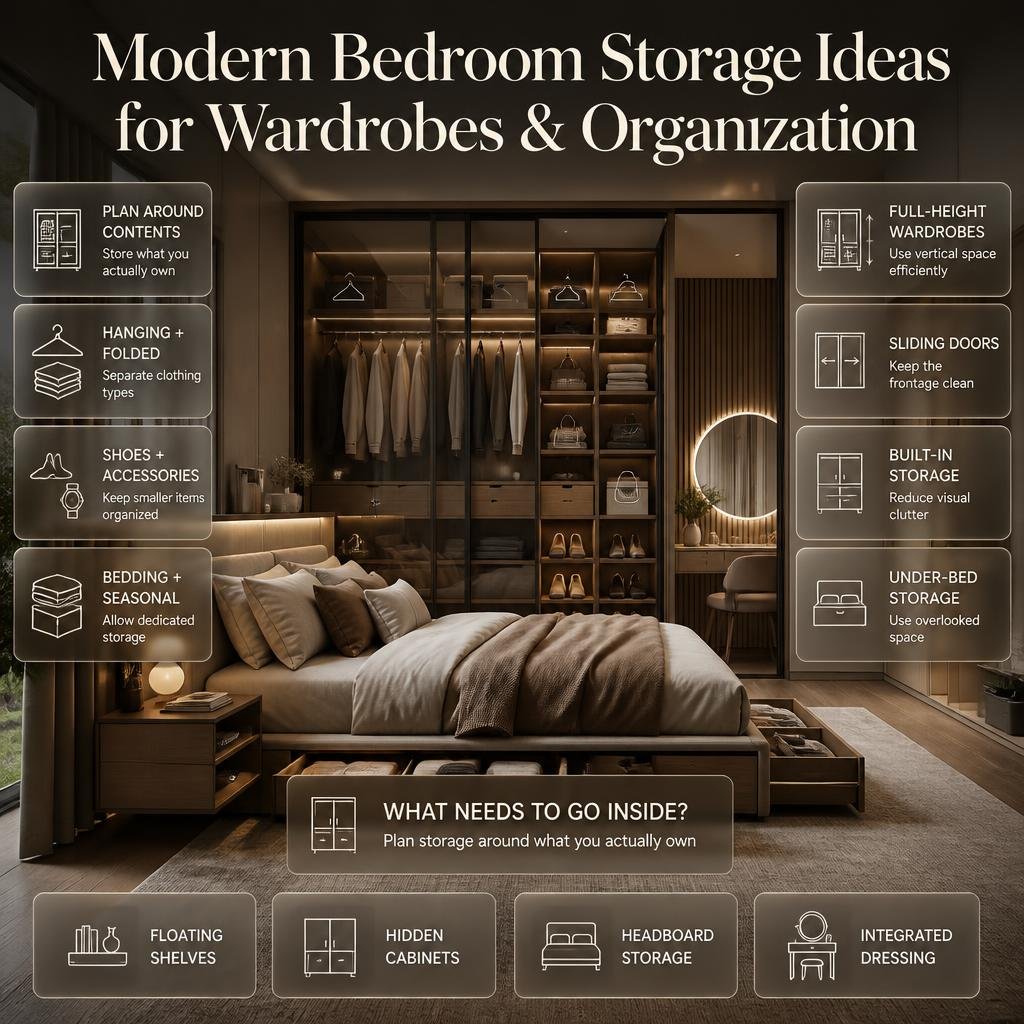
Storage should be planned around what you actually own.
Instead of asking, “How big should my wardrobe be?” ask:
“What needs to go inside it?”
Separate your requirements into:
- Hanging clothes
- Folded clothes
- Shoes
- Accessories
- Bedding
- Seasonal items
- Bags
- Documents
- Personal items
Full-height wardrobes can make efficient use of vertical space, while built-in storage can reduce visual clutter.
Modern Storage Ideas
Consider:
- Full-height wardrobes
- Sliding doors
- Built-in bedside storage
- Under-bed drawers
- Floating shelves
- Hidden cabinets
- Headboard storage
- Integrated dressing areas
Good storage doesn’t just hide things. It prevents the room from becoming visually noisy.
Recent storage-planning guidance recommends designing wardrobes around actual contents rather than simply buying generic units.
For broader home organisation ideas, you can also explore the Home Improvement section.
How Can You Make a Small Modern Bedroom Look Bigger?
You don’t need to physically enlarge the room to make it feel more spacious.
Focus on visual weight.
Use Lighter Furniture
Furniture with slim profiles or visible legs exposes more floor area.
Use Vertical Space
Tall wardrobes and wall-mounted storage keep the floor clearer.
Keep the Palette Connected
When walls, curtains, furniture and large textiles are closely related in colour, the room can feel more cohesive.
Use Mirrors Carefully
A well-positioned mirror can reflect light and create visual depth.
Avoid Oversized Furniture
A huge bed combined with a large wardrobe and bulky nightstands can consume almost every usable area.
⚠ Common Mistake: Choosing furniture based on how impressive it looks in a showroom rather than how it will fit inside your actual room.
How Do You Use Furniture Proportion Correctly?
Modern design depends heavily on proportion.
A king-size bed with tiny bedside tables can look unbalanced.
A small bed with oversized wardrobes can make the room feel dominated by storage.
A practical approach is to consider each piece relative to the others.
Think in Visual Weight
Heavy visual furniture includes:
- Dark wardrobes
- Solid wood cabinets
- Large upholstered headboards
- Thick curtains
- Deep colours
Lighter visual furniture includes:
- Slim metal frames
- Floating shelves
- Glass
- Pale wood
- Furniture with exposed legs
Balance these elements instead of putting all the visual weight on one side.
Architectural Digest’s current bedroom guidance similarly stresses that furniture proportions should relate to one another and to the size of the room.
Should You Add a Feature Wall?
A feature wall can work extremely well in a modern bedroom when it has a clear purpose.
The wall behind the bed is usually the strongest candidate because it naturally acts as the focal point.
Options include:
- Wood slats
- Microcement
- Textured paint
- Wallpaper
- Upholstered panels
- Stone-effect finishes
- Fluted panels
- Architectural moulding
The important thing is restraint.
If the bed wall is already dramatic, you may not need another statement wall opposite it.
For more ideas about intentional interior styling and planning, see Design Concepts.
How Do You Choose Modern Bedroom Materials?
Materials should support the atmosphere you’re trying to create.
Wood
Wood introduces warmth and works well with neutral colours.
Stone
Stone can create a sophisticated, architectural appearance.
Glass
Glass helps maintain visual openness.
Metal
Black, brass, brushed steel and other finishes can provide contrast.
Fabric
Upholstery, curtains, rugs and bedding soften harder surfaces.
The strongest modern bedrooms rarely depend on one material.
Instead, they combine hard and soft surfaces.
Wood + fabric + stone + metal + glass
This creates contrast without visual chaos.
How Do You Style a Modern Bedroom Without Making It Cluttered?

Styling should happen after the functional decisions are complete.
Start with the essentials:
- Bed
- Bedside tables
- Wardrobe
- Lighting
- Curtains
- Rug
- Bedding
- Artwork
- Accessories
Don’t buy accessories simply because an empty surface feels uncomfortable.
Empty space can be intentional.
Use the Three-Layer Styling Method
For a bedside table, for example:
- Functional object: lamp
- Practical object: book or clock
- Decorative object: small ceramic or plant
That’s often enough.
You don’t need ten objects to make a surface look finished.
For additional bedroom-focused inspiration, see Bedroom Interior Design.
How Do Curtains Affect Modern Bedroom Design?
Curtains are often treated as an afterthought, but they can change the entire visual balance of a bedroom.
Consider:
- Privacy
- Daylight control
- Fabric texture
- Curtain length
- Colour
- Blackout requirements
- Relationship with wall colour
Floor-length curtains usually create a more finished appearance than short curtains.
For a calm modern look, neutral linen-look or softly textured fabrics can work well.
If the bedroom receives strong morning or evening sunlight, consider combining decorative curtains with blackout lining or a secondary layer.
How Should You Choose a Modern Bedroom Rug?
A rug can add warmth, texture and visual structure.
The main mistake is choosing one that is too small.
Ideally, the rug should relate to the bed and surrounding furniture rather than appearing like a small island beneath the centre of the room.
Possible approaches include:
- Large rug extending beyond the bed
- Runner-style rugs beside the bed
- Layered rugs for larger bedrooms
- Soft neutral rugs for minimalist rooms
- Textured rugs for plain colour palettes
The rug should support the bed rather than compete with it.
What Modern Bedroom Styles Can You Try?
Modern design is broad enough to accommodate different personalities.
Modern Minimalist
Characteristics:
- Clean lines
- Neutral colours
- Minimal accessories
- Integrated storage
- Simple furniture
Best for people who prefer calm, uncluttered environments.
Warm Modern
Characteristics:
- Natural wood
- Beige and cream
- Soft textiles
- Warm lighting
- Organic textures
This is ideal if you want modern design without a cold atmosphere.
Modern Luxury
Characteristics:
- High-quality materials
- Large-scale headboard
- Controlled metallic accents
- Stone or stone-effect finishes
- Layered lighting
Luxury doesn’t require excessive decoration. It often comes from proportion, material quality and restraint.
For more atmosphere-focused inspiration, explore Luxury Ambience.
Japandi-Inspired Modern
Characteristics:
- Natural wood
- Soft neutrals
- Minimal furniture
- Organic materials
- Low visual clutter
The style combines Japanese restraint with Scandinavian warmth.
Modern Industrial
Characteristics:
- Metal
- Dark colours
- Concrete-inspired finishes
- Exposed details
- Stronger contrast
It works particularly well when balanced with softer bedding and warm lighting.
How Do You Create a Modern Bedroom on a Limited Budget?
You don’t have to replace everything.
Prioritise the elements that have the greatest visual impact.
Spend More On
- Mattress
- Bed frame
- Lighting
- Wardrobe functionality
- Quality curtains
Save On
- Small decorative accessories
- Temporary artwork
- Trend-based cushions
- Minor styling pieces
You can also refresh a room by changing only:
- Bedding
- Wall colour
- Lighting
- Curtains
- Rug
- Hardware
This can create a significant transformation without replacing major furniture.
For additional project ideas, the DIY Home Projects section can help you identify smaller changes you can complete yourself.
What Are the Biggest Modern Bedroom Design Mistakes?

1. Buying Furniture Before Measuring
This causes circulation problems and awkward gaps.
Solution: Measure the room and create a basic floor plan first.
2. Using One Ceiling Light
A single bright source creates harsh shadows and makes the room feel less comfortable.
Solution: Layer ambient, task and accent lighting.
3. Making Everything White
White can be beautiful, but too much of it can make a room feel flat or clinical.
Solution: Add wood, textiles, subtle colour and texture.
4. Choosing Oversized Furniture
Large furniture can dominate a small bedroom.
Solution: Choose pieces according to room scale.
5. Ignoring Storage
Clutter quickly destroys the calm appearance of modern interiors.
Solution: Plan storage before decoration.
6. Copying a Pinterest Room Exactly
A photograph doesn’t show your room dimensions, lifestyle or storage needs.
Solution: Use inspiration as a reference, not a blueprint.
7. Using Too Many Trends
When every element follows a different trend, the room can become visually confused.
Solution: Choose one overall direction and build consistency around it.
8. Forgetting Practical Details
Charging points, curtain access, wardrobe doors and cleaning space matter.
Solution: Design for everyday use rather than photography.
What Do Interior Designers Consider Before Finalising a Bedroom?
Professionals usually look beyond individual furniture pieces.
They consider the entire visual and functional system.
1. Proportion
Does everything fit together?
2. Circulation
Can people move naturally?
3. Lighting
Does the room work during both day and night?
4. Storage
Is everyday clutter controlled?
5. Material Balance
Are there enough soft and hard surfaces?
6. Colour Relationship
Do the colours work together under natural and artificial light?
7. Longevity
Will the design still look good after trends change?
This is why a professional-looking room often feels simple. Many decisions have already been solved behind the scenes.
You can explore Interior Design for broader principles that can also be applied to bedroom planning.
How Can You Add Personality to a Modern Bedroom?
Modern design shouldn’t erase personality.
Add character through carefully selected details:
- Artwork
- Photography
- Books
- Decorative ceramics
- Plants
- Textiles
- Personal objects
- Unique lighting
- One statement chair
The key is editing.
Choose a few things that genuinely represent you rather than filling every surface.
This is where Connected Living can provide useful inspiration if your bedroom also needs to support modern technology and connected-home habits.
Should a Modern Bedroom Include Smart Technology?
It can, but technology should remain visually controlled.
Useful additions include:
- Smart lighting
- Automated curtains
- Bedside charging
- Hidden cable management
- Smart switches
- Temperature control
- Integrated speakers
The best smart bedroom doesn’t look like a technology showroom.
Hide cables where possible and integrate controls into the furniture or wall design.
Technology should make the room easier to use, not create additional visual clutter.
How Do Paint and Wall Finishes Affect Modern Bedrooms?
Wall colour creates the foundation for everything else.
Before committing to a colour, test a sample in the actual bedroom.
Look at it:
- In morning light
- During afternoon light
- At night
- Under warm artificial lighting
- Next to your flooring
- Next to your furniture
A colour can appear completely different under different lighting conditions.
For more colour-focused inspiration, visit Paint Color.
How Can You Create a Timeless Modern Bedroom?
The safest approach is to make permanent elements relatively timeless and use replaceable accessories for trends.
Keep Timeless
- Flooring
- Wardrobe
- Bed frame
- Wall finishes
- Main lighting
- Large furniture
Keep Flexible
- Cushions
- Throws
- Artwork
- Small lamps
- Decorative objects
- Accent colours
This means you can refresh the room later without renovating it.
A timeless modern bedroom doesn’t have to be boring. It simply avoids depending entirely on short-lived trends.
For a wider perspective on lasting design principles, why home improvement is important mintpalhouse offers useful context about the value of thoughtful home improvements.
How Do You Combine Modern Design With Personal Style?
Start with a neutral architectural foundation.
Then introduce personality through selected elements.
For example:
Base: warm white walls + oak flooring + simple upholstered bed
Layer: beige curtains + textured rug + walnut bedside tables
Personality: abstract artwork + sculptural lamp + one dark accent
This approach gives you flexibility.
If you later change your preferred colour or decorative style, the foundation can remain intact.
For additional room-by-room inspiration, the Room-by-Room Design Hub can help you maintain consistency throughout the rest of the home.
How Can You Make a Modern Bedroom Feel More Expensive?
Luxury isn’t simply about spending more money.
A more expensive-looking bedroom usually has:
- Better proportions
- Controlled colours
- Quality-looking textures
- Consistent hardware
- Layered lighting
- Less visual clutter
- Properly fitted curtains
- Well-made bedding
- Thoughtful artwork
For example, a simple oak bedside table can look more sophisticated when paired with a quality lamp, textured bedding and properly scaled artwork.
The room doesn’t need twenty luxury accessories.
It needs fewer, better-coordinated decisions.
Can You Mix Modern Design With Other Styles?
Yes.
Modern design is flexible.
You can combine it with:
- Scandinavian
- Japandi
- Minimalist
- Industrial
- Mid-century
- Contemporary
- Organic modern
The key is to establish a dominant visual language.
For example:
Modern + Japandi: clean lines + natural wood + warm neutral palette
Modern + Industrial: simple furniture + metal + darker tones
Modern + Scandinavian: light wood + soft textiles + bright neutral colours
Modern + Luxury: clean forms + stone + premium textiles + controlled metallic accents
Don’t give every style equal visual importance.
One should lead; the others should support it.
What are the best modern bedroom design ideas for 2026?
The strongest modern bedroom designs in 2026 are moving away from cold, overly minimal rooms and toward spaces that feel warm, comfortable and personal. Designers are increasingly combining clean furniture shapes with richer textures, warm neutral colours, natural materials, layered lighting and practical storage. The idea is not to follow every trend, but to create a bedroom that feels calm while still having character.
A modern bedroom can include:
Warm beige, taupe, cream, clay or muted earthy colours
Natural wood furniture and textured finishes
Upholstered or oversized headboards
Layered bedside and ambient lighting
Full-height or concealed storage
Soft rugs, curtains and bedding
Personal artwork and meaningful accessories
Hidden or carefully integrated technology
One noticeable 2026 direction is the move toward more tactile and personalised bedrooms. Instead of making everything perfectly matched, designers are mixing materials and introducing details that make the room feel lived-in and individual.
Professional advice: Don’t redesign your entire bedroom simply because a trend is popular. Keep expensive, long-term elements such as wardrobes, flooring and the main bed relatively timeless. Use bedding, artwork, lighting and accessories to bring current trends into the room without making the design difficult to update.
What colours are best for a modern bedroom?
A small bedroom can look modern and spacious when the design reduces visual weight and protects the available floor area. The goal isn’t simply to use light paint. Furniture scale, storage, circulation, lighting and the amount of visible clutter all influence how large the room feels.
Start by choosing furniture that fits the room rather than furniture that looks impressive in a showroom. Slim bedside tables, wall-mounted lights, built-in wardrobes and beds with integrated storage can free up valuable floor space. Furniture with visible legs can also expose more flooring and create a lighter visual effect. Interior designers are currently recommending these approaches for compact bedrooms because they improve both openness and functionality.
Useful small-bedroom strategies include:
Use full-height wardrobes instead of short storage units.
Consider sliding wardrobe doors where swing doors restrict movement.
Choose bedside tables that are proportionate to the bed.
Mount lighting on the wall instead of using bulky floor lamps.
Use under-bed storage for less frequently used items.
Keep the colour palette visually connected.
Avoid placing too many decorative objects on open surfaces.
Leave enough clear floor area for comfortable movement.
The important point is that modern doesn’t mean empty. A small room can contain everything you need if storage is planned properly.
Professional advice: Measure the bed, wardrobe and every major furniture piece before purchasing. Then measure the remaining walking space. A beautiful bedroom layout can fail simply because there isn’t enough clearance around doors, wardrobes or the bed.
How do you make a modern bedroom feel luxurious and cosy at the same time?
The secret is to combine clean modern structure with soft sensory layers. A modern bedroom can feel luxurious without becoming flashy, and cosy without becoming cluttered.
Start with the major elements: a well-proportioned bed, restrained colour palette and good-quality-looking materials. Then introduce softness through bedding, curtains, rugs, upholstery and warm lighting. Current bedroom trends are strongly focused on richer textures, warmer palettes and layered materials because these details make contemporary spaces feel more comfortable and personal.
For example, consider this combination:
Warm taupe walls + walnut furniture + upholstered headboard + cream bedding + textured rug + warm bedside lighting
None of these elements needs to be extremely expensive. The luxury comes from how they work together.
You can also create a more sophisticated atmosphere through:
Floor-length curtains
Large-scale artwork
Soft indirect lighting
Natural wood
Stone or stone-effect surfaces
Layered bedding
A restrained number of accessories
Consistent hardware finishes
High-quality textures
Lighting deserves particular attention. Designers are increasingly treating bedroom lighting as part of the atmosphere rather than simply a functional requirement. Bedside lamps, sconces, hidden LEDs and other layered sources can create a softer evening environment than relying entirely on bright overhead lighting.
Professional advice: Don’t try to make every element luxurious. Choose two or three areas to emphasise—perhaps the headboard, lighting and textiles—and keep the remaining elements quiet. This creates sophistication through restraint rather than excess.
How do I design a modern bedroom that looks stylish but still works for everyday life?
Start with function before decoration. A bedroom is used every day, so the layout needs to support real routines: sleeping, dressing, storing clothes, charging devices, reading, relaxing and sometimes working.
Before selecting colours or accessories, identify what the room needs to do. Then plan the bed, wardrobe, storage and circulation around those activities. This approach is increasingly reflected in 2026 bedroom design, where designers are placing more emphasis on comfort, practical storage, personalisation and spaces that genuinely support how people live.
A practical planning order is:
Measure the room — record walls, doors, windows and fixed features.
Position the bed — establish the main focal point and circulation.
Plan storage — determine what clothing and personal items need to be accommodated.
Plan lighting — include ambient, task and mood lighting.
Select major materials — flooring, wardrobe finish, headboard and wall treatment.
Choose textiles — bedding, curtains and rugs.
Add personality — artwork, plants, books and selected decorative objects.
Edit the room — remove anything that doesn’t contribute to comfort or function.
A useful test is to imagine using the bedroom at different times of the day.
Can you reach the wardrobe without squeezing between furniture? Can you switch off the bedside light from the bed? Can you open drawers completely? Is there somewhere to put your phone, book or glasses? Can you control morning sunlight? Does the room still feel comfortable when the lights are off?
Those practical questions often matter more than whether a particular piece of furniture is currently fashionable.
Professional advice: Design the bedroom for your real routine, not for a photograph. A room that looks impressive but has poor storage, uncomfortable circulation or badly positioned lighting will become frustrating surprisingly quickly. The strongest modern bedroom design is the one that looks refined while making everyday life easier.
Conclusion
A well-designed modern bedroom isn’t about filling the room with fashionable furniture or copying a perfect room from a magazine. It’s about creating a space that feels right when you actually use it every day. The strongest designs bring together comfort, practical planning, clean proportions, useful storage, thoughtful lighting and a colour palette that feels natural to the people living there.
Start with the fundamentals. Measure the room, position the bed carefully, protect comfortable walking space and plan storage around your real belongings. Once those decisions are right, introduce warmth through wood, textiles, rugs, curtains and layered lighting. Then add personality through artwork, plants, books or a few meaningful decorative pieces.
Don’t be afraid to keep things simple. Modern design works best when every element has a reason to be there. A calm wall colour, well-proportioned bed, integrated wardrobe and warm bedside lighting can create more impact than a room crowded with expensive accessories.
Most importantly, design the bedroom for real life—not just for photographs. Your bedroom should make mornings easier, evenings more relaxing and everyday routines more comfortable. When functionality and aesthetics are planned together, the result is a modern bedroom that feels sophisticated today while remaining practical and relevant for years to come.

Leave a Reply