

Introduction
Furniture Styling | A room can contain beautiful furniture and still feel uncomfortable, disconnected, or unfinished. The sofa may be attractive, the dining table may be expensive, and the chairs may look perfect individually, yet when everything is placed together, the room somehow doesn’t work.
This is where Furniture Styling becomes important.
Furniture styling isn’t simply about buying attractive furniture or copying a room from a magazine. It’s about understanding how furniture relates to the room, how people move through the space, how different pieces work together, and how color, proportion, texture, lighting, and accessories complete the overall composition.
If you’re planning a new room, refreshing an existing interior, or trying to make your current furniture look more polished, the right styling approach can make a surprisingly large difference without requiring a complete renovation.
For broader interior inspiration and professional design ideas, DesignMode24 Interior Design can also be used as a starting point when developing the overall direction of your home.
This guide explains how to style furniture professionally, how to choose pieces that work together, how to arrange furniture in small and large rooms, how to mix different styles and materials, what mistakes to avoid, and how to create a finished interior that feels comfortable rather than overly decorated.
What Is Furniture Styling?
Furniture styling is the process of selecting, arranging, coordinating, and finishing furniture so that a room becomes functional, comfortable, visually balanced, and connected. It considers furniture size, proportion, placement, color, materials, circulation, focal points, lighting, textiles, and decorative details.
Good furniture styling answers two questions at the same time:
Does this room work well?
Does this room look intentional?
A room that looks beautiful but is difficult to walk through isn’t successfully styled. Likewise, a highly practical room can still feel unfinished if its furniture has no visual relationship.
Professional styling brings both sides together.
Furniture styling can involve:
- Selecting the right sofa or sectional
- Choosing suitable chairs
- Positioning tables
- Planning bedroom furniture
- Coordinating wood finishes
- Combining different upholstery materials
- Selecting appropriate furniture sizes
- Creating conversation areas
- Establishing focal points
- Using rugs to connect furniture
- Introducing complementary colors
- Balancing visual weight
- Adding lighting and accessories
- Editing unnecessary pieces
The important point is that furniture should be considered as part of a complete room rather than as individual products.
Why Does Furniture Styling Matter?
Furniture occupies a large percentage of a room’s visual and physical space, so its arrangement has a major influence on how the room feels.
Poor furniture placement can make a large room feel awkward and a small room feel cramped. Good placement can make the same space feel more organized, comfortable, and purposeful.
Effective furniture styling can help you:
- Improve movement through the room
- Make better use of available space
- Create comfortable conversation areas
- Highlight architectural features
- Make small spaces feel less crowded
- Give large rooms stronger structure
- Connect different colors and materials
- Make existing furniture feel refreshed
- Reduce visual clutter
- Improve everyday comfort
- Create a stronger focal point
- Give the home a more cohesive appearance
The biggest benefit is that furniture styling often doesn’t require replacing everything.
Sometimes the sofa you’ve had for years is perfectly suitable. It may simply be positioned incorrectly, paired with the wrong table, placed on an undersized rug, or surrounded by pieces with completely different visual weight.
A better arrangement can therefore produce a bigger improvement than an expensive shopping trip.
What Should You Consider Before Styling Furniture?
Before moving furniture around, understand the room itself.
Professional-looking furniture arrangements don’t begin with decoration. They begin with observation.
Look at:
- Room dimensions
- Ceiling height
- Door locations
- Window positions
- Natural light
- Electrical outlets
- Heating or cooling equipment
- Built-in storage
- Architectural features
- Existing flooring
- Main views
- Entry and exit points
Then consider how the room is actually used.
A family living room may need comfortable seating and open floor space. A formal sitting room may prioritize conversation and presentation. A bedroom needs relaxation and practical storage. A home office requires an ergonomic work area.
The same furniture layout doesn’t work for every lifestyle.
Ask These Questions First
Before styling, ask yourself:
- What is the main purpose of this room?
- Who uses it most often?
- What activities happen here?
- Where do people naturally walk?
- What should be the main focal point?
- Which furniture pieces must stay?
- Which pieces can be removed?
- Does the existing furniture fit the room?
- What needs to be stored?
- How should the room feel?
These questions prevent one of the most common styling mistakes: designing a room around appearance while ignoring real life.
How Do You Choose the Right Furniture for a Room?
The right furniture isn’t necessarily the most expensive, fashionable, or visually impressive option. It is the furniture that fits the room’s dimensions, supports its function, suits the household, and works with the surrounding design.
Start with the largest piece.
In a living room, this is usually the sofa.
In a bedroom, it’s the bed.
In a dining room, it’s the dining table.
In a home office, it’s usually the desk.
Once the anchor piece is selected, supporting furniture becomes easier to choose.
Consider Furniture Scale
Scale refers to how large a furniture piece appears in relation to the room and surrounding objects.
A huge sectional in a compact room can block movement and dominate the space. On the other hand, a tiny loveseat in a large room may look lost.
Think about:
- Width
- Height
- Depth
- Leg height
- Arm thickness
- Back height
- Visual weight
Furniture doesn’t have to be identical in scale, but extreme differences should be intentional.
Example
Imagine a large deep sofa paired with an extremely small glass coffee table.
The table may be beautiful by itself, but it can look visually weak next to the sofa.
Now imagine the same sofa paired with a substantial wood or stone table.
The relationship feels more balanced.
This is why proportion often matters more than price.
💡 Pro Tip: Before buying large furniture, mark its dimensions on the floor with painter’s tape. Walk around the taped area and check doors, pathways, and sightlines.
How Do You Plan a Furniture Layout?
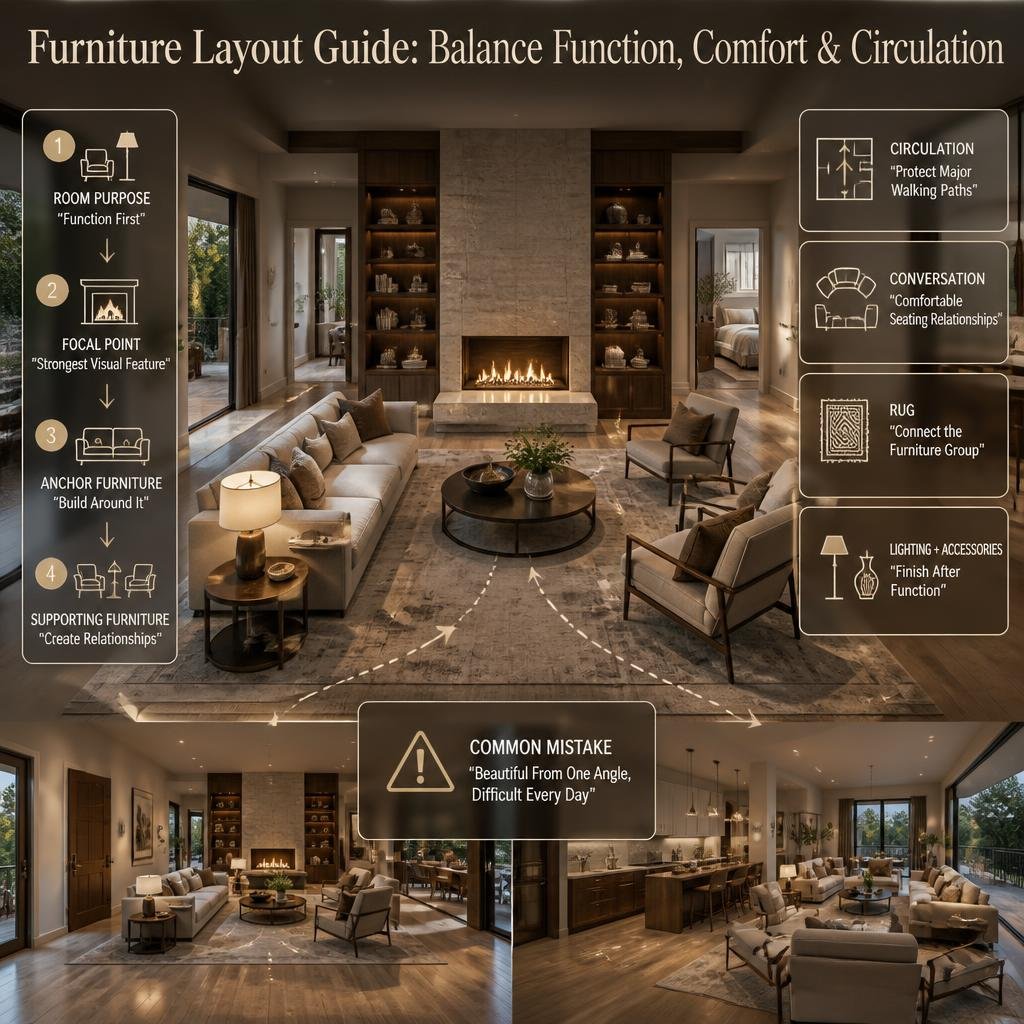
The best furniture layout balances function, circulation, comfort, and visual composition. Start with the room’s anchor piece, then build supporting furniture around it while protecting major walking paths.
A practical sequence is:
Room purpose → focal point → anchor furniture → supporting furniture → circulation → rug → lighting → accessories
This order prevents decorative decisions from interfering with basic functionality.
Start With the Focal Point
Every room benefits from something that naturally attracts attention.
Possible focal points include:
- Fireplace
- Large window
- Artwork
- Media wall
- Architectural feature
- Statement furniture
- Beautiful view
- Feature wall
Furniture should generally support the focal point rather than compete with it.
For example, if a living room has a beautiful fireplace, arranging every seat toward a television on the opposite wall may weaken the fireplace’s importance.
The layout should acknowledge the strongest feature in the room.
Create Conversation Areas
In living rooms, seating should allow people to interact comfortably.
A basic arrangement could look like this:
        FEATURE / WINDOW

       [ ARMCHAIR ]

   [ CHAIR ]     [ CHAIR ]

        [ COFFEE
          TABLE ]

        [  SOFA  ]

          ENTRY
The exact arrangement will change according to the room, but the principle remains the same: furniture should have a clear relationship.
A chair doesn’t necessarily have to face the sofa directly. Angled seating can make a room feel more relaxed and dynamic.
Protect Circulation
A room shouldn’t require people to squeeze around furniture.
Pay particular attention to:
- Entry doors
- Hallways
- Kitchen connections
- Bedroom doors
- Bathroom entrances
- Balcony doors
- Frequently used storage
⚠ Common Mistake: Creating a beautiful furniture arrangement that looks perfect from one photograph but is frustrating to use every day.
A successful room must work from multiple viewpoints.
How Much Space Should You Leave Between Furniture?
There isn’t one universal measurement that works for every room because furniture dimensions and room layouts differ.
Instead, think about comfort.
People should be able to:
- Walk naturally
- Sit down without hitting another piece
- Open drawers
- Open cabinet doors
- Reach tables
- Access storage
- Move between major zones
Coffee tables should be close enough to seating to remain practical but not so close that they interfere with movement.
Dining chairs need enough space to pull away from the table.
Beds need accessible sides when the room layout allows it.
The goal isn’t to follow a rigid formula. The goal is to make movement feel natural.
Should Furniture Match?
No. Furniture doesn’t need to match perfectly to look cohesive.
In fact, using completely matching furniture can sometimes make a room feel predictable or showroom-like.
A more sophisticated approach is coordination.
Furniture can be connected through:
- Similar wood undertones
- Related upholstery colors
- Repeated shapes
- Complementary materials
- Consistent metal finishes
- Similar visual weight
- Shared design characteristics
For example, a contemporary sofa can work with vintage wooden chairs if the finishes and proportions are carefully coordinated.
Matching vs Coordinating Furniture
| Matching Furniture | Coordinated Furniture |
|---|---|
| Same collection | Different collections |
| Very uniform | More individual |
| Easy to combine | Requires more planning |
| Predictable result | More personality |
| Can feel showroom-like | Can feel collected |
📌 Quick Tip: Instead of asking, “Does this furniture match?” ask, “What connects these pieces?”
That question usually produces better styling decisions.
How Do You Mix Different Furniture Styles?
Mixing styles can make a room feel collected rather than purchased all at once.
The trick is to establish a dominant style and then introduce smaller contrasting elements.
For example:
Modern base + vintage accent
A clean-lined sofa can be paired with a vintage side table.
Contemporary base + natural furniture
A modern upholstered sofa can work with warm oak furniture.
Minimalist base + sculptural accent
Simple furniture can provide a background for one unusual chair or table.
The room becomes more interesting when contrast is controlled.
If every piece belongs to a completely different design language, the room may lose cohesion.
For guidance on combining broader design directions, Interior Design Styles can help when deciding which style characteristics should dominate your space.
How Do Color and Furniture Work Together?
Furniture color should be considered alongside walls, flooring, curtains, rugs, lighting, and accessories.
Don’t choose a sofa in isolation.
Imagine a warm beige sofa placed against a cool blue-gray wall with a reddish wood floor and bright white accessories. Each element might look attractive individually, but their undertones may fight each other.
Instead, create a simple color structure.
Example Palette
Base: Warm white
Furniture: Beige and natural oak
Secondary: Soft brown
Accent: Olive green
Contrast: Small amounts of black
The same accent color can appear in:
- Cushion
- Artwork
- Plant pot
- Decorative object
- Small chair detail
This creates rhythm.
You don’t need to repeat a color everywhere. A few intentional repetitions are usually enough.
How Important Are Furniture Materials and Textures?
Texture becomes especially important when a room uses neutral colors.
Without texture, a beige, white, or gray room can feel flat.
Combine materials such as:
- Natural wood
- Linen
- Cotton
- Bouclé
- Leather
- Velvet
- Stone
- Glass
- Metal
- Woven fibers
The objective isn’t to use every material.
Instead, create contrast.
For example:
Smooth leather + rough wood + soft rug + woven basket
The eye immediately notices the differences.
This is one reason well-styled neutral rooms can feel richer than colorful rooms. Their visual interest comes from material variation rather than strong color contrast.
How Can Rugs Improve Furniture Styling?
A rug can visually connect furniture pieces into one composition.
Without a suitable rug, a sofa, chairs, and table can appear like separate objects.
A correctly sized rug helps create a defined zone.
In a living room, the rug can sit under at least the front portions of major seating pieces where the room permits.
Avoid choosing a rug solely because it looks attractive online.
Consider:
- Sofa width
- Chair position
- Coffee table dimensions
- Room size
- Walking paths
- Rug shape
- Pattern scale
⚠ Common Mistake: Using a very small rug simply because it is cheaper.
A tiny rug can make an otherwise well-furnished room feel visually fragmented.
How Should You Style a Living Room?
Living rooms require especially careful furniture styling because they often perform several functions.
A successful living room may need to support:
- Watching television
- Conversation
- Reading
- Entertaining
- Family activities
- Relaxation
- Occasional work
Start with the sofa.
Then position chairs according to the room’s main activity.
Add the coffee table after the seating arrangement has been established.
Then consider:
- Side tables
- Storage
- Floor lamps
- Rugs
- Curtains
- Artwork
- Accessories
For a broader approach to the room as a whole, Living Room Design provides additional context around layout, comfort, lighting, and functionality.
Small Living Room Furniture Styling
Small rooms require discipline.
Every large piece has a visible effect.
Choose furniture according to the room’s actual footprint rather than choosing the largest pieces you can physically fit.
Useful strategies include:
- Select a sofa with appropriate depth
- Use furniture with exposed legs when suitable
- Choose slim occasional tables
- Use multifunctional storage
- Keep pathways clear
- Avoid excessive decorative furniture
- Use vertical storage where practical
- Maintain visual continuity between pieces
A small room doesn’t need to look empty.
It needs to look edited.
Large Living Room Furniture Styling
Large rooms require the opposite approach.
Instead of spreading furniture around the perimeter, create distinct zones.
A large room could contain:
Conversation zone: Sofa + chairs + coffee table
Reading zone: Armchair + floor lamp + side table
Work zone: Desk + chair + storage
Display zone: Console + artwork + lighting
Furniture can define these areas without walls.
This is particularly useful in open-plan homes.
How Do You Style Bedroom Furniture?

Bedroom furniture should support rest, organization, and comfort.
Start with the bed because it normally dominates the room.
Then consider:
- Bedside tables
- Wardrobe
- Dresser
- Bench
- Accent chair
- Lighting
- Rug
Bedside tables should relate to the bed’s height and visual weight.
If the bed is substantial and upholstered, tiny bedside furniture may appear weak.
If the bed is visually light, very heavy bedside cabinets can overpower it.
The bedroom also benefits from repetition.
For example, matching bedside lamps can provide symmetry even when other furniture pieces are different.
How Do You Style Dining Room Furniture?
Dining furniture must balance appearance with practical use.
The dining table should provide enough space for the people who regularly use it without overwhelming the room.
Chairs should be comfortable and proportionate to the table.
Pay attention to:
- Chair width
- Seat height
- Table height
- Leg placement
- Circulation
- Lighting
- Storage
- Cleaning requirements
A dining room also benefits from a clear focal point.
This could be a pendant light above the table, artwork, a sideboard, or a distinctive table itself.
Don’t overcrowd the room with storage furniture simply because empty walls feel unfinished.
How Do You Style Furniture in an Entryway?
The entryway is often the first part of the home visitors see.
A console, bench, narrow cabinet, or small table can establish the home’s design direction.
But entryways need excellent circulation.
Choose furniture that fits the available depth.
Useful additions include:
- Console
- Mirror
- Bench
- Shoe storage
- Small lamp
- Decorative bowl
- Artwork
The entryway is a good place for personality, but avoid blocking the main route into the home.
How Can Furniture Styling Work With Different Interior Styles?
Furniture should communicate the room’s broader design direction.
Modern Furniture Styling
Modern rooms often benefit from:
- Clean lines
- Simple silhouettes
- Controlled colors
- Functional furniture
- Mixed materials
- Minimal decorative clutter
Minimalist Furniture Styling
Minimalism requires particularly careful furniture selection because every piece becomes visually important.
Use:
- Essential furniture
- Simple forms
- Neutral colors
- Quality materials
- Clear surfaces
- Strong negative space
Scandinavian-Inspired Styling
This direction commonly benefits from:
- Light woods
- Comfortable upholstery
- Simple forms
- Soft colors
- Natural textures
- Functional furniture
Japandi-Inspired Styling
Furniture can combine:
- Natural materials
- Low visual clutter
- Simple silhouettes
- Warm neutrals
- Organic forms
- Functional details
The goal isn’t to copy a style literally. Use the characteristics that fit your lifestyle.
How Do You Style Furniture on a Budget?
You don’t need to replace an entire room.
Start by identifying which problems are actually visible.
Maybe the sofa is fine, but:
- The rug is too small
- Lighting is poor
- Furniture is badly positioned
- Accessories are excessive
- Colors aren’t connected
- The room lacks texture
Fix the biggest problem first.
A sensible budget priority can be:
| Priority | Improvement | Potential Impact |
|---|---|---|
| 1 | Furniture arrangement | Very High |
| 2 | Rug size | High |
| 3 | Lighting | High |
| 4 | Curtains/textiles | High |
| 5 | Accent furniture | Medium |
| 6 | Artwork | Medium |
| 7 | Accessories | Medium |
This prevents a common mistake: spending money on small decorative objects while a major layout problem remains.
If you enjoy hands-on improvements, DIY Home Projects can complement a furniture styling plan with practical home updates.
Can Old Furniture Work in a New Interior?

Absolutely.
Old furniture can become one of the strongest elements in a room when it is integrated thoughtfully.
An older wooden cabinet may add warmth to a modern interior.
A vintage chair can provide contrast against contemporary furniture.
An inherited table can become a meaningful focal point.
The key is context.
If an old piece looks disconnected, introduce another element that relates to it.
For example:
Vintage wood table → warm wood frame → natural woven basket
The repeated material creates a bridge.
If a piece is structurally sound but visually tired, Furniture Makeovers can provide ideas for refreshing finishes, hardware, upholstery, and other details.
How Does Lighting Affect Furniture Styling?
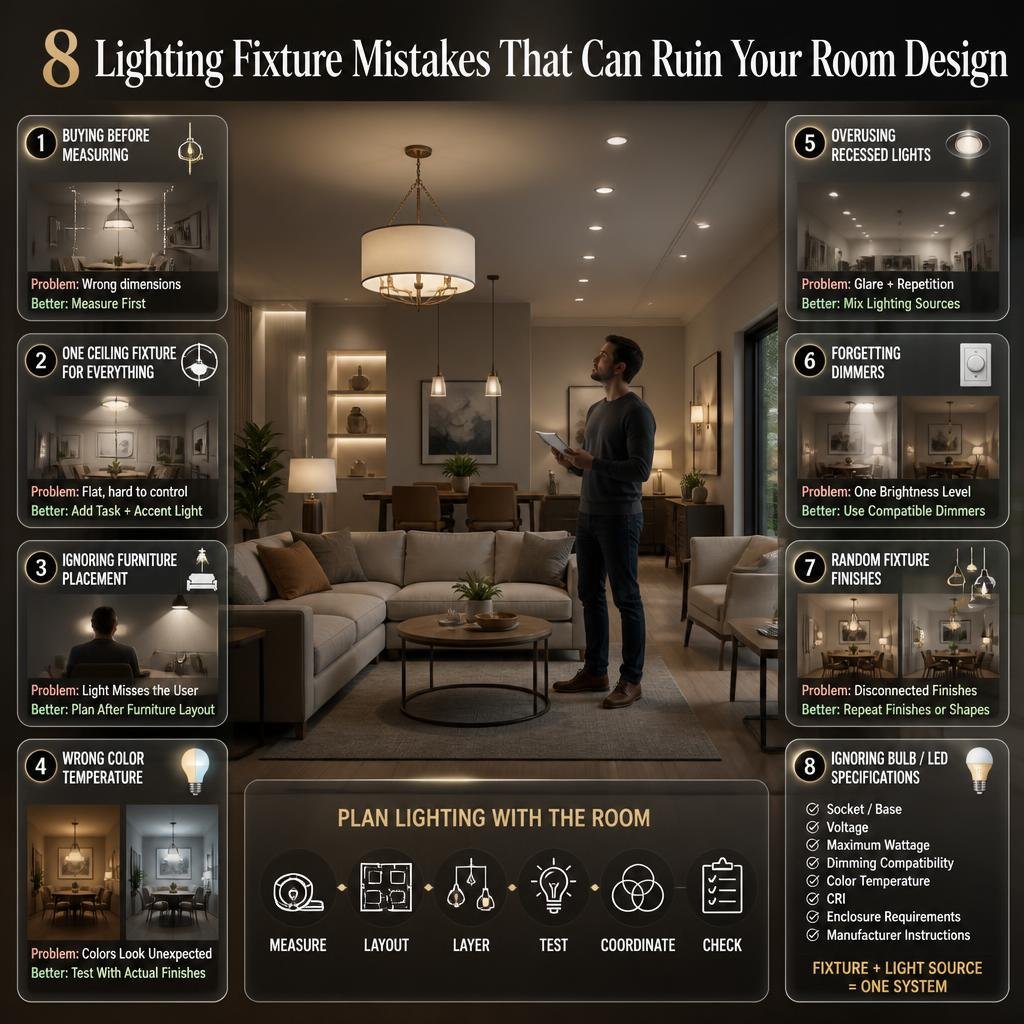
Furniture and lighting should be planned together.
A beautiful furniture arrangement can feel completely different under harsh overhead lighting.
Use layers.
Ambient Lighting
Provides general illumination.
Examples include:
- Ceiling fixtures
- Recessed lights
- Chandeliers
Task Lighting
Supports specific activities.
Examples:
- Reading lamp
- Desk lamp
- Bedside lamp
Accent Lighting
Highlights selected elements.
Examples:
- Artwork lighting
- Shelf lighting
- Architectural lighting
A floor lamp can also help define a reading corner.
A pair of lamps can reinforce symmetry.
A pendant can emphasize a dining table.
Lighting therefore isn’t simply an afterthought. It helps explain and strengthen the furniture arrangement.
How Can Technology Affect Furniture Styling?
Modern interiors increasingly contain televisions, speakers, charging stations, computers, smart controls, and other devices.
If these aren’t considered during furniture planning, cables and equipment can quickly create visual clutter.
Think about technology before finalizing the arrangement.
Ask:
- Where will the television go?
- Where are electrical outlets?
- Where will devices charge?
- Can cables be hidden?
- Is the screen visible from the main seating?
- Is technology competing with the focal point?
For homes where technology is integrated throughout multiple rooms, Connected Living offers a useful related perspective on combining everyday technology with organized interiors.
How Do You Make Furniture Look More Expensive?
A professional appearance doesn’t necessarily come from expensive furniture.
It usually comes from better decisions.
Focus on:
- Correct proportions
- Appropriate spacing
- Coordinated materials
- Controlled color
- Quality-looking finishes
- Good lighting
- Clean arrangement
- Fewer but stronger accessories
One of the simplest tricks is to create breathing space.
When every surface is covered, furniture loses its visual importance.
Luxury often comes from restraint.
A well-proportioned sofa with one beautiful side table may look more sophisticated than a sofa surrounded by ten unrelated accessories.
What Are the Most Common Furniture Styling Mistakes?
Mistake 1: Buying Before Measuring
Why it happens: The furniture looks perfect online.
Why it’s harmful: Product photographs rarely communicate the actual scale of a piece inside your room.
Better approach: Measure both the room and the furniture.
Mistake 2: Choosing Furniture Piece by Piece
Why it happens: People buy whatever catches their attention.
Why it’s harmful: Individual pieces may be attractive but completely unrelated.
Better approach: Develop a basic palette and style direction before purchasing.
Mistake 3: Making Everything Match
Why it happens: Matching feels safe.
Why it’s harmful: The room can lose personality.
Better approach: Coordinate rather than duplicate.
Mistake 4: Ignoring Negative Space
Why it happens: Empty areas can feel unfinished.
Why it’s harmful: Overfilling makes the room feel crowded.
Better approach: Allow important furniture and architectural features to breathe.
Mistake 5: Choosing a Rug That Is Too Small
Why it happens: Smaller rugs are cheaper and easier to fit.
Why it’s harmful: The seating arrangement can look fragmented.
Better approach: Choose the rug according to the furniture grouping.
Mistake 6: Using Furniture Only for Decoration
Why it happens: A piece looks beautiful.
Why it’s harmful: It may interfere with daily activities.
Better approach: Every major furniture piece should have a clear function.
Mistake 7: Ignoring Scale
Why it happens: Individual pieces are judged separately.
Why it’s harmful: The room can feel visually unbalanced.
Better approach: Compare nearby furniture dimensions and visual weight.
Mistake 8: Decorating Before Arranging
Why it happens: Accessories are enjoyable to buy.
Why it’s harmful: Decorative pieces cannot solve an uncomfortable layout.
Better approach: Furniture first, decoration later.
What Do Professional Furniture Stylists Do Differently?
Professional styling isn’t necessarily about spending more money.
It’s about making decisions in the correct order.
A designer typically thinks through:
Function
How will people use the room?
Scale
Does the furniture fit the physical space?
Proportion
Do the pieces relate properly to one another?
Balance
Does the room feel visually stable?
Rhythm
Are colors, shapes, or materials repeated?
Contrast
Is there enough difference to create interest?
Harmony
Do the individual decisions work together?
Editing
What can be removed?
That final question is often underestimated.
Professional-looking rooms usually have fewer unnecessary objects because the important pieces have enough space to be appreciated.
How Do You Create Visual Rhythm With Furniture?
Rhythm is created when the eye notices repeated characteristics throughout a room.
You can repeat:
- Wood tones
- Curved shapes
- Black metal
- Upholstery colors
- Geometric patterns
- Natural materials
- Vertical lines
For example, imagine:
Black chair legs + black floor lamp + black picture frames + black cabinet handles
The repetition creates connection.
You don’t need ten black objects.
Three or four carefully positioned details may be enough.
This is one of the easiest ways to make different furniture pieces feel like they belong together.
How Do You Use Contrast Without Creating Chaos?
Contrast gives a room energy.
You can create contrast through:
- Light vs dark
- Smooth vs textured
- Straight vs curved
- Warm vs cool
- Old vs new
- Matte vs glossy
- Soft vs structured
But contrast should have boundaries.
A useful approach is to let one contrast become dominant while keeping other differences controlled.
For example:
Warm neutral room + dark wood furniture
The dark wood becomes the primary contrast.
You can then keep upholstery, accessories, and artwork relatively restrained.
How Can Furniture Styling Make a Room Feel More Personal?
A professionally styled room shouldn’t feel like a showroom.
It should reveal something about the people who live there.
Personal furniture styling can include:
- Inherited furniture
- Travel pieces
- Favorite books
- Artwork
- Handmade objects
- Family photographs
- Vintage finds
- Meaningful collections
The important thing is editing.
A personal object becomes stronger when it has enough space around it.
Don’t display every possession.
Choose the pieces that actually matter.
How Should You Approach Furniture Styling in an Open-Plan Home?
Open-plan spaces can become visually confusing because several functions share one large area.
Furniture can solve this problem.
Use:
- Sofas
- Rugs
- Console tables
- Dining tables
- Lighting
- Chairs
- Storage
to define separate zones.
For example:
┌─────────────────────────────────┐
│          LIVING ZONE             │
│      Sofa + Chairs + Rug         │
│                                  │
│──────────── VISUAL DIVISION ─────│
│          DINING ZONE             │
│        Table + Chairs             │
│                                  │
│          KITCHEN                  │
└─────────────────────────────────┘
The furniture creates boundaries without physically dividing the room.
This approach is particularly useful in modern apartments and homes where one large area performs multiple functions.
How Can You Refresh Furniture Without Replacing It?
Sometimes the furniture isn’t the problem.
The room simply needs a reset.
Try this sequence:
1. Remove Everything Small
Take away cushions, accessories, lamps, artwork, and decorative objects.
2. Rearrange Major Furniture
Try two or three layouts.
3. Check the Main View
Stand at the entrance and look into the room.
4. Add the Rug
Position it according to the furniture grouping.
5. Reintroduce Lighting
Place lamps where they improve function and atmosphere.
6. Add Textiles
Use cushions, throws, curtains, or upholstery changes.
7. Add Artwork
Choose pieces that connect with the palette.
8. Return Accessories Selectively
Don’t automatically put everything back.
9. Remove One More Thing
This final edit can make the room feel considerably cleaner.
For additional inspiration when refreshing existing rooms, Room Refresh covers the broader process of updating a space without automatically starting from scratch.
How Does Furniture Styling Connect With Overall Home Design?
Furniture should not look completely different from room to room.
That doesn’t mean every room needs the same furniture or colors.
Instead, create continuity through selected elements.
For example:
Living room: Natural oak + cream + black accents
Dining room: Natural oak + warm white + black lighting
Bedroom: Natural oak + soft beige + black hardware
The rooms are different, but the repeated materials create a visual connection.
This is where whole-home thinking becomes useful.
Rather than styling every room independently, choose a few recurring design characteristics.
For additional room-by-room planning, Find Expert Ideas for Every Room in Your Home can support a broader approach to connecting different spaces.
How Can Furniture Styling Support a More Refined Interior?
Refinement isn’t about adding expensive objects.
It often comes from controlling what the eye sees.
A refined furniture arrangement generally has:
- Clear hierarchy
- Consistent proportions
- Limited competing focal points
- Controlled colors
- Intentional materials
- Good lighting
- Comfortable circulation
- Thoughtful negative space
This is particularly important in sophisticated interiors.
For example, if a room already has a sculptural sofa, dramatic artwork, and distinctive lighting, adding another large statement chair may create unnecessary competition.
Instead, use quieter supporting furniture.
For more context around polished materials and finishing decisions, Refined Finishes is a relevant companion topic.
How Can Furniture Styling Work With Home Improvement Projects?
Furniture styling sometimes reveals larger problems.
You may discover:
- Insufficient storage
- Poor lighting
- Damaged flooring
- Inadequate electrical outlets
- Awkward wall placement
- Poor room flow
Don’t automatically blame the furniture.
Sometimes a small home improvement can unlock a much better arrangement.
For example, adding built-in storage may eliminate several freestanding cabinets and create enough space for a better seating layout.
For broader improvement ideas, Home Improvement can be considered alongside furniture planning.
How Can Furniture Styling Support a More Personal Home?
The strongest furniture arrangements aren’t necessarily the most fashionable ones.
They are the ones that make sense for the people using them.
If you love reading, prioritize a comfortable reading chair.
If you entertain frequently, create a generous conversation arrangement.
If you work from home, don’t sacrifice desk ergonomics simply to make the room look symmetrical.
If children use the living room, leave usable floor space.
If storage is a constant problem, integrate storage into the furniture plan.
A beautiful room that doesn’t support your lifestyle will eventually become frustrating.
Good styling should make daily life easier.
How do you style furniture so a room looks professionally designed?
Professional furniture styling starts with layout, scale, and proportion, not accessories. First decide how the room will be used, identify the main focal point, and position the largest furniture piece accordingly. Then add supporting pieces while keeping walking paths clear. Designers also create cohesion by repeating selected colors, materials, shapes, or finishes instead of making every item identical.
A polished result usually comes from editing rather than adding more furniture. Once the main arrangement works, introduce a rug, lighting, cushions, artwork, and a few accessories. The room should feel complete without every surface being occupied.
Professional points:
Start with the largest furniture piece.
Check scale before buying decorative items.
Create a clear focal point.
Keep major traffic routes open.
Repeat a few materials or colors for cohesion.
Leave enough negative space around important pieces.
How do you know if furniture is the right size for a room?
The right furniture size depends on the room dimensions, ceiling height, circulation, and relationship between nearby pieces. A sofa isn’t correctly sized simply because it fits physically; it also needs enough surrounding space to allow comfortable movement and should relate proportionally to chairs, tables, rugs, and other furniture. Current space-planning guidance commonly emphasizes measuring first and protecting clear traffic paths.
For example, a large sectional can technically fit into a living room while still making the room feel cramped. Conversely, very small furniture in a large room can look disconnected and leave the space feeling unfinished.
Before purchasing, check:
Room length and width
Furniture width, depth, and height
Door and window locations
Walking routes
Cabinet and drawer clearance
Coffee-table relationship
Rug dimensions
Visual weight of nearby furniture
Expert approach: Mark the furniture footprint on the floor with painter’s tape before buying. It’s one of the easiest ways to discover a scale problem before spending money.
Should furniture match, or is it better to mix different styles?
Furniture doesn’t have to match exactly. In fact, mixing furniture styles, materials, and periods can create a more personal and layered interior when the differences are controlled. Recent 2026 design coverage highlights growing interest in character, craftsmanship, vintage influences, and mixing styles rather than relying exclusively on uniform furniture sets.
The key is to create visual connections between different pieces. A contemporary sofa can work with a vintage wooden table if they share a compatible color palette, material, scale, or shape.
Good ways to connect mixed furniture:
Repeat one wood tone.
Use related upholstery colors.
Repeat a metal finish.
Balance modern and traditional shapes.
Keep proportions compatible.
Use one dominant style and smaller contrasting elements.
The objective isn’t to make everything look the same. It’s to make the differences look intentional.
How do you style furniture in a small living room without making it feel crowded?
Small living rooms need fewer, better-scaled pieces, rather than simply smaller versions of everything. Start by identifying the furniture required for the room’s actual purpose. Then protect the main walking routes and avoid oversized sofas, deep tables, bulky cabinets, and unnecessary accent furniture. Furniture-layout guidance commonly recommends measuring the room and maintaining clear traffic patterns before finalizing the arrangement.
Don’t automatically push every piece against the wall either. Depending on the room, floating a sofa slightly can create a stronger seating zone and improve the overall composition.
For a small room:
Choose furniture according to actual dimensions.
Prioritize multifunctional pieces.
Avoid oversized coffee tables.
Keep major walkways unobstructed.
Use visually lighter furniture where appropriate.
Choose a rug that connects the seating.
Reduce unnecessary decorative furniture.
Use vertical storage when possible.
The biggest mistake is trying to make a small room feel bigger by filling it with lots of tiny furniture. That can actually make the space look more cluttered.
What furniture styling trends are worth following in 2026?
The strongest 2026 furniture direction is less about one specific “look” and more about comfort, character, craftsmanship, organic forms, richer materials, and personalized interiors. Design coverage is highlighting curved and sculptural furniture, darker woods, artisan-made pieces, layered seating, mixed styles, and furniture that feels more individual rather than mass-produced.
However, a trend should be treated as inspiration rather than a requirement. A curved sofa may look excellent in one room but be impractical in another. Likewise, dark wood can add depth, but it needs to work with the room’s natural light, flooring, and existing colors.
2026-inspired ideas worth considering:
Sculptural or softly curved furniture
Natural and darker wood finishes
Artisan or handcrafted-looking pieces
Comfortable, relaxed seating
Mixed furniture styles
Richer earthy colors
Layered textures
Vintage pieces combined with contemporary furniture
More personalized, less showroom-like interiors
The professional approach is to adapt a trend to your room instead of rebuilding your room around a trend. That keeps the interior current while allowing it to remain practical and personal.
Conclusion
Furniture styling is not simply about choosing beautiful pieces or following the latest decorating trend. It is about creating a room where furniture feels properly proportioned, comfortable to use, visually balanced, and connected to the overall character of the home. When layout, scale, color, texture, lighting, and personal details work together, even a simple furniture collection can create a polished and welcoming interior.
The best approach is to begin with the way you actually use the room. Identify the main purpose, establish a practical furniture layout, check circulation space, and choose an anchor piece before adding supporting furniture. From there, layers of rugs, lighting, cushions, artwork, materials, and accessories can add depth without making the space feel overdecorated.
You also do not need every furniture piece to match. Combining different shapes, finishes, materials, and periods can make an interior feel more personal and thoughtfully collected. The key is creating connections through color, proportion, texture, or repeated finishes so the room feels coordinated rather than random.
Whether you are styling a compact apartment, refreshing a family living room, redesigning a bedroom, or updating your entire home, thoughtful furniture styling can make a noticeable difference. Focus on function first, choose quality and proportion carefully, leave enough breathing room, and allow your personality to guide the final details.
Ultimately, a well-styled home should not look like a showroom. It should feel comfortable, intentional, practical, and genuinely yours. When every furniture choice has a purpose and every element supports the room around it, beautiful design becomes much easier to achieve.

Leave a Reply