
Introduction
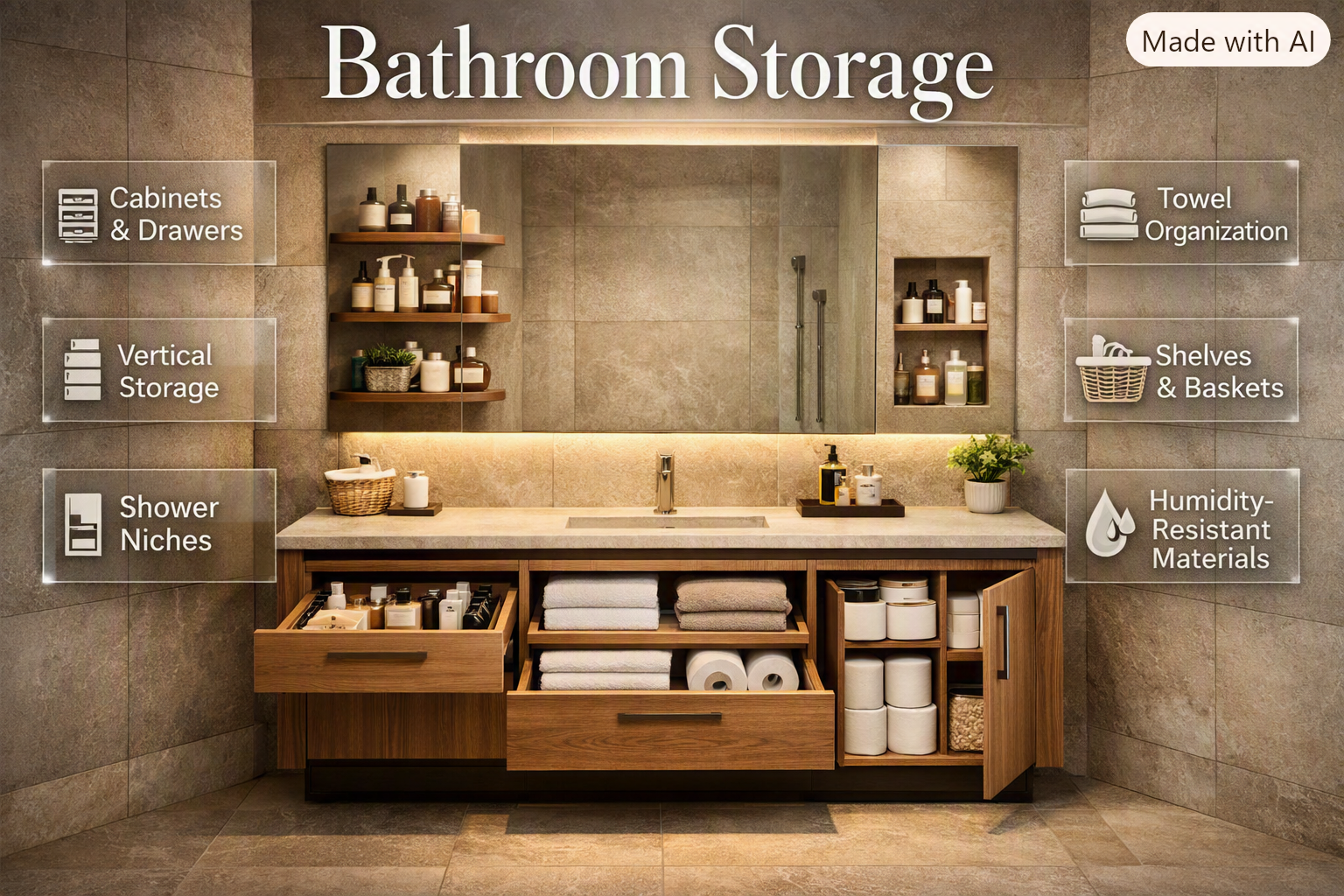
Bathroom Storage | A bathroom can have beautiful tiles, expensive fixtures, and a carefully chosen color scheme and still feel frustrating every morning if there’s nowhere sensible to put anything. Towels end up on hooks, skincare products cover the vanity, shampoo bottles crowd the shower floor, and extra toilet paper somehow becomes a permanent part of the décor.
The good news is that better bathroom storage doesn’t always require a larger bathroom or a complete renovation. With the right combination of cabinets, drawers, shelves, niches, baskets, and vertical solutions, even an awkward bathroom can become easier to use and much calmer visually.
This guide explains how to plan bathroom storage from the ground up, what works best in small and large bathrooms, how to organize toiletries and towels, which materials make sense in humid conditions, and which common storage mistakes are worth avoiding. You’ll also find practical examples, professional planning advice, comparisons, and answers to the questions homeowners commonly ask before upgrading their bathroom.
For more practical ideas covering the way different spaces work together, visit DesignMode24 Interior Design.
What Is the Best Bathroom Storage Solution?
The best bathroom storage solution is one that keeps frequently used items accessible, hides visual clutter, uses available space efficiently, and can withstand the bathroom’s moisture and cleaning routine. For most homes, the most effective approach is a combination of vanity drawers, closed cabinets, open shelving, wall storage, and dedicated shower storage rather than one oversized cabinet.
Storage should be planned around how the bathroom is used, not simply how it looks.
A person who gets ready quickly each morning may need easy access to skincare, grooming tools, and oral-care products. A family bathroom may need separate zones for several people, additional towels, children’s items, cleaning products, and backup toiletries.
A guest bathroom has different requirements again. It may need only a compact vanity, a medicine cabinet, towel storage, and a small amount of concealed backup space.
The right system therefore starts with the people using the room.
What Makes Bathroom Storage Good?
Effective storage usually has five characteristics:
- Accessible: Daily items are easy to reach.
- Organized: Similar products have a defined home.
- Protected: Materials can handle humidity and splashes.
- Flexible: Shelves and compartments can adapt to changing needs.
- Visually balanced: Storage doesn’t make the bathroom feel crowded.
A bathroom can have plenty of storage and still be poorly organized. If every cabinet is deep, every shelf is packed, and frequently used items are hidden behind awkward doors, the room becomes difficult to maintain.
The goal isn’t maximum capacity.
The goal is useful capacity.
How Should You Plan Bathroom Storage Before Buying Anything?
Before buying an organizer, cabinet, shelf, or vanity, take inventory of what you actually need to store. Measure the available space, identify your daily routines, and separate everyday products from backup supplies.
This prevents one of the most expensive bathroom mistakes: buying storage first and trying to make your belongings fit afterward.
Step 1: Measure the Room
Start with the basic dimensions:
- Overall bathroom width and length
- Wall height
- Vanity width and depth
- Cabinet openings
- Available wall space
- Shower dimensions
- Space beside the toilet
- Space above the toilet
- Door swing
- Window locations
- Plumbing locations
Don’t measure only the empty wall.
A cabinet may technically fit against a wall but interfere with a door, drawer, towel, toilet, or shower entrance.
Step 2: Inventory Your Belongings
Take everything currently stored in the bathroom and group it.
For example:
Daily-use products
- Toothbrushes
- Toothpaste
- Face wash
- Moisturizer
- Deodorant
- Hair products
- Shaving products
Shower products
- Shampoo
- Conditioner
- Body wash
- Soap
- Razors
Backup supplies
- Extra toilet paper
- Replacement toiletries
- Tissues
- Spare soap
- Refills
Cleaning supplies
- Bathroom cleaner
- Brushes
- Sponges
- Gloves
- Other maintenance products
Linens
- Bath towels
- Hand towels
- Washcloths
- Guest towels
Once these categories are visible, it becomes much easier to decide what type of storage you need.
Step 3: Separate Visible and Hidden Storage
Not everything needs to be behind a door.
Towels, attractive baskets, neatly arranged containers, and a small amount of décor can work well on open shelves.
Cleaning supplies, backup products, miscellaneous grooming tools, and excess packaging are usually better hidden.
💡 Pro Tip: If an item makes the bathroom look messy but you use it regularly, don’t eliminate the item. Give it a better storage location.
How Can You Maximize Storage in a Small Bathroom?
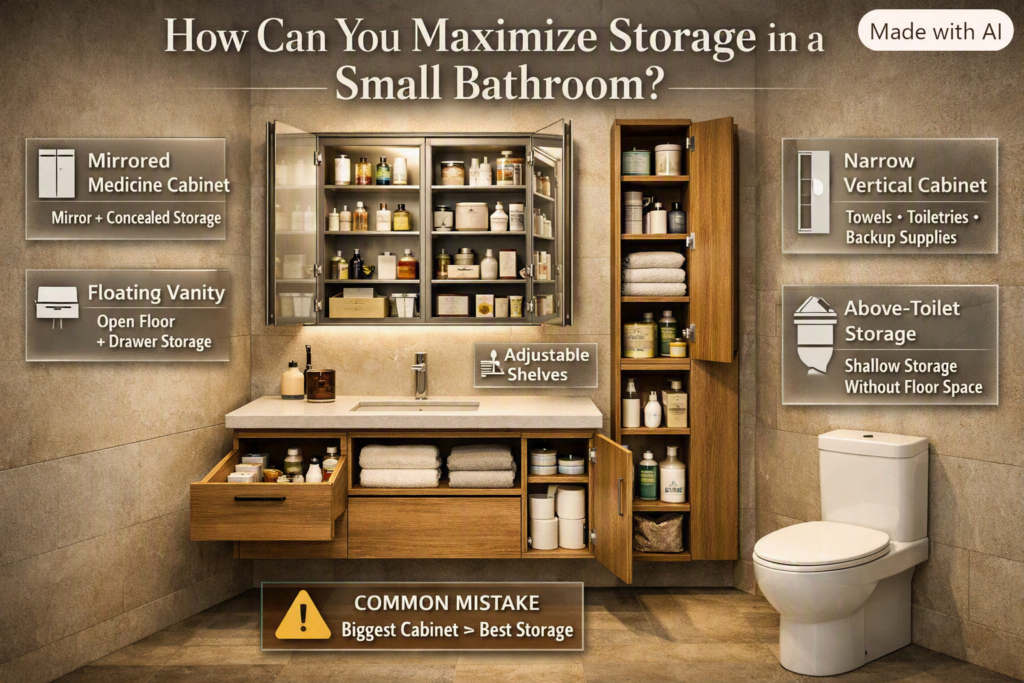
Small bathrooms benefit from vertical storage, recessed solutions, floating furniture, shallow cabinets, and multifunctional fixtures. The objective is to increase storage without filling valuable floor space.
When floor space is limited, look upward.
Walls often provide more unused storage potential than floors.
Use a Mirrored Medicine Cabinet
A mirrored medicine cabinet is one of the most efficient storage upgrades for a compact bathroom because it combines two functions.
Instead of having:
Mirror + wall cabinet
you get:
Mirror + concealed storage
This is especially useful for small toiletries, skincare, shaving products, and other everyday items.
Choose adjustable shelves when possible. Product sizes change, and fixed shelves can quickly become inconvenient.
Install a Floating Vanity
A floating vanity can make a compact bathroom feel more open because the floor remains visible underneath.
It can also provide useful drawer storage without creating the heavy appearance of a floor-to-ceiling cabinet.
However, don’t make the vanity too shallow simply to gain walking space.
If the countertop cannot comfortably accommodate a sink and everyday items, you’ll lose more functionality than you gain.
Use a Narrow Vertical Cabinet
A tall, narrow cabinet can turn a small unused section of wall into meaningful storage.
It can hold:
- Towels
- Toilet paper
- Cleaning products
- Extra toiletries
- Hair accessories
- Backup supplies
Adjustable shelving makes this option much more useful because tall bottles and folded towels don’t require the same shelf height.
Use the Space Above the Toilet
The wall above the toilet is often ignored.
A shallow cabinet or floating shelf can provide additional storage without taking up floor space.
However, keep proportions in mind.
A large, deep cabinet can visually dominate the toilet area and make a small bathroom feel even smaller.
⚠ Common Mistake: Choosing the biggest cabinet that fits above the toilet. Bigger isn’t always better. A shallow cabinet that you can comfortably access is usually more useful than a deep unit that feels intrusive.
How Do You Organize a Bathroom Vanity?
The most effective vanity organization uses drawers and cabinets according to frequency of use. Everyday products should stay near the top and front, while backup supplies and occasional items can be stored lower or farther back.
Use Drawers for Small Items
Drawers are particularly useful for:
- Makeup
- Skincare
- Grooming tools
- Dental accessories
- Hair accessories
- Small personal-care products
The advantage is visibility.
When you open a drawer, you can see the contents from above rather than reaching behind several bottles.
Use Dividers
A large drawer without dividers often becomes a junk drawer within weeks.
Dividers create individual zones.
For example:
┌─────────────────────────────┐
│ Dental │ Skincare │ Grooming│
├─────────────────────────────┤
│ Hair   │ Shaving  │ Extras  │
└─────────────────────────────┘
The exact arrangement isn’t important.
The principle is.
Each category needs a predictable home.
Use Pull-Out Storage Under the Sink
The cabinet beneath a sink can be difficult because plumbing occupies part of the available space.
Pull-out trays make deep cabinets easier to use.
Instead of reaching into the back of the cabinet, you pull the tray toward you.
This works especially well for:
- Cleaning supplies
- Hair products
- Refills
- Larger bottles
- Spare toiletries
⭐ Expert Tip: Measure the cabinet opening as well as the internal width. An organizer can fit inside the cabinet but still be impossible to install if it cannot pass through the door opening.
What Should Be Stored in Bathroom Cabinets?
Closed cabinets are ideal for products that create visual clutter, backup supplies, and items that don’t need to remain visible. The most efficient arrangement places everyday products toward the front and occasional items toward the back or on higher shelves.
A useful cabinet system might look like this:
| Storage Area | Best Use |
|---|---|
| Top shelf | Occasional-use products |
| Eye-level shelf | Daily toiletries |
| Lower shelf | Larger bottles |
| Cabinet floor | Cleaning supplies or backups |
| Door organizers | Small lightweight items |
Don’t place heavy items in locations where they can fall when the door opens.
What Is the Best Way to Store Towels?
Towels can be stored in open shelving, closed cabinets, baskets, linen towers, or wall-mounted racks. The best option depends on the bathroom’s size, ventilation, and number of users.
Small Bathroom Towel Storage
Consider:
- Wall hooks
- Floating shelves
- Narrow towel racks
- Rolled towels in baskets
- Over-door towel storage
- Slim vertical cabinets
Hooks are especially useful for towels that are used daily.
A folded towel stored in a cabinet may look tidier, but a hook can be more practical for everyday use.
Large Bathroom Towel Storage
Larger bathrooms can accommodate:
- Linen cabinets
- Built-in shelving
- Tall storage towers
- Vanity linen drawers
- Open towel shelving
A linen cabinet can separate clean towels from everyday toiletries and cleaning products.
Don’t Store Wet Towels in Closed Cabinets
A damp towel placed into an enclosed cabinet can create an unpleasant environment for the material and the cabinet itself.
Allow towels to dry properly before storing them.
📌 Quick Tip: If your family regularly hangs wet towels over doors or furniture, you probably need more convenient towel hooks rather than more towel shelves.
How Can You Add Storage to a Bathroom Without Remodeling?
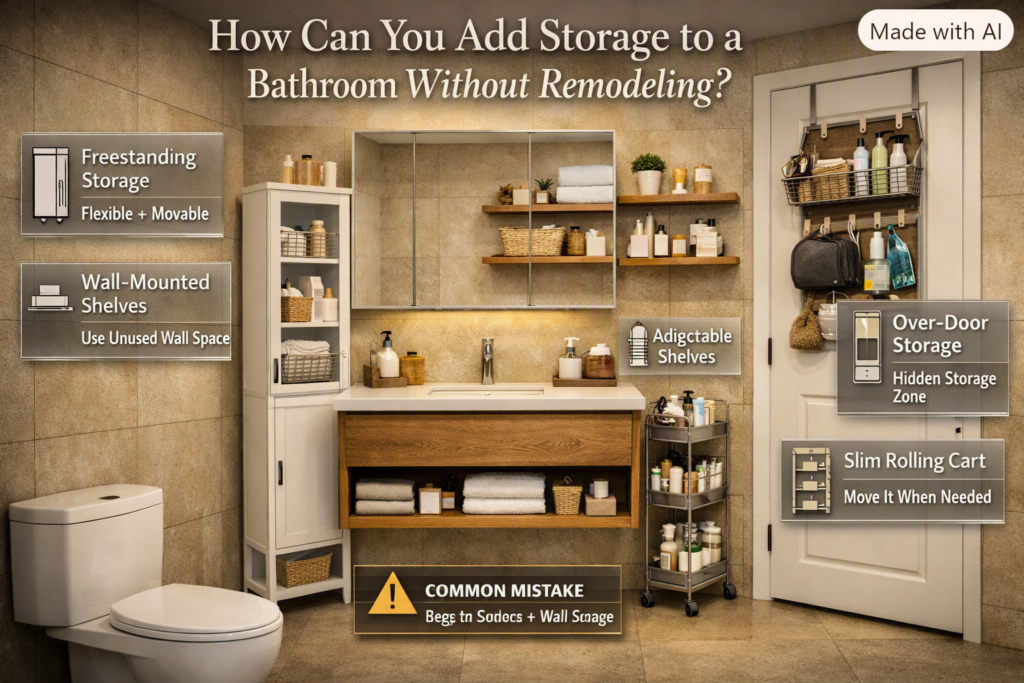
You can add considerable storage without changing the plumbing or removing tiles. Freestanding cabinets, wall-mounted shelves, over-door organizers, baskets, hooks, slim carts, and countertop organizers can all increase capacity.
Freestanding Storage
A narrow freestanding unit can be moved later if your needs change.
This is useful for renters or homeowners who aren’t ready for permanent renovations.
Wall-Mounted Shelves
Floating shelves can turn unused wall space into practical storage.
Use them for:
- Towels
- Baskets
- Decorative items
- Toiletries
- Spare supplies
Avoid filling every inch.
Empty space makes the shelves look more intentional.
Over-Door Storage
The back of the bathroom door can become a hidden storage zone.
Use it for lightweight items such as:
- Hair accessories
- Towels
- Toiletry bags
- Cleaning accessories
Make sure the organizer doesn’t prevent the door from closing correctly.
Slim Rolling Carts
A narrow rolling cart can fit beside a vanity or toilet where a conventional cabinet won’t.
The advantage is flexibility.
You can move the cart when cleaning or rearrange it when your needs change.
What Is the Best Bathroom Storage for a Shower?
Shower storage should keep bottles accessible while keeping the floor clear. Recessed niches, built-in ledges, corner shelves, and properly installed shower organizers are the most practical options.
Recessed Shower Niches
A recessed niche is built into the wall rather than projecting outward.
This gives the shower a cleaner appearance and prevents bottles from sitting on the floor.
However, it should be planned before construction or remodeling is complete.
Important considerations include:
- Waterproofing
- Framing
- Tile layout
- Bottle height
- Shelf height
- Drainage
- Cleaning access
Corner Shelves
Corner shelves are often easier to add during an existing bathroom upgrade.
They work particularly well when creating a recessed niche isn’t practical.
Shower Ledges
A continuous ledge can provide generous storage.
It may be useful for households with many shower products, but it needs careful design so that it doesn’t make the shower look bulky.
⚠ Common Mistake: Designing a niche based on the size of one shampoo bottle. Think about the entire collection of products you use and whether bottle sizes may change.
How Can You Keep Bathroom Countertops Clutter-Free?
The easiest way to keep a countertop clear is to create convenient storage within one or two steps of where the products are used.
If your skincare products are used at the sink, storing them across the room is unlikely to work.
Instead, use:
- Top vanity drawers
- Medicine cabinets
- Small trays
- Divided organizers
- Wall-mounted cabinets
Keep only genuinely useful items visible.
A beautiful countertop doesn’t need to be completely empty.
It needs to look intentional.
For example, a soap dispenser, hand towel, small plant, and one tray can look far more organized than fifteen individual bottles.
How Should You Organize Bathroom Storage for a Family?
Family bathrooms need storage that prevents different people’s belongings from becoming mixed together. Individual drawers, labeled baskets, dedicated shelves, and shared storage zones can make the room much easier to manage.
For example:
Person A: Top-left drawer
Person B: Top-right drawer
Children: Lower drawer or accessible basket
Shared products: Central cabinet
Backups: Higher cabinet
Cleaning supplies: Dedicated lower cabinet
This approach reduces daily arguments and makes cleanup easier.
Children’s storage should also consider accessibility and safety.
Items that children should not access should remain properly secured.
What Materials Are Best for Bathroom Storage?
Bathroom storage materials need to handle humidity, splashes, cleaning products, and repeated use. Moisture-resistant engineered materials, properly finished wood, corrosion-resistant metals, glass, and suitable plastics can all work depending on where they are installed.
Wood
Wood can create warmth and character.
However, bathroom woodwork needs an appropriate finish and careful protection of exposed edges.
Engineered Wood
Quality moisture-resistant engineered materials can be practical for bathroom cabinetry.
Look for good edge sealing and durable finishes.
Metal
Metal can work well for shelves, towel racks, and hardware.
In humid environments, choose finishes designed to resist corrosion.
Glass
Glass shelving creates a visually light appearance and works particularly well in modern bathrooms.
Its main disadvantage is that it shows water spots and requires regular cleaning.
Plastic
Plastic organizers are inexpensive and practical inside cabinets and drawers.
They may not provide the same visual quality as built-in cabinetry, but they’re useful for hidden organization.
Open Shelves vs Closed Cabinets: Which Is Better?
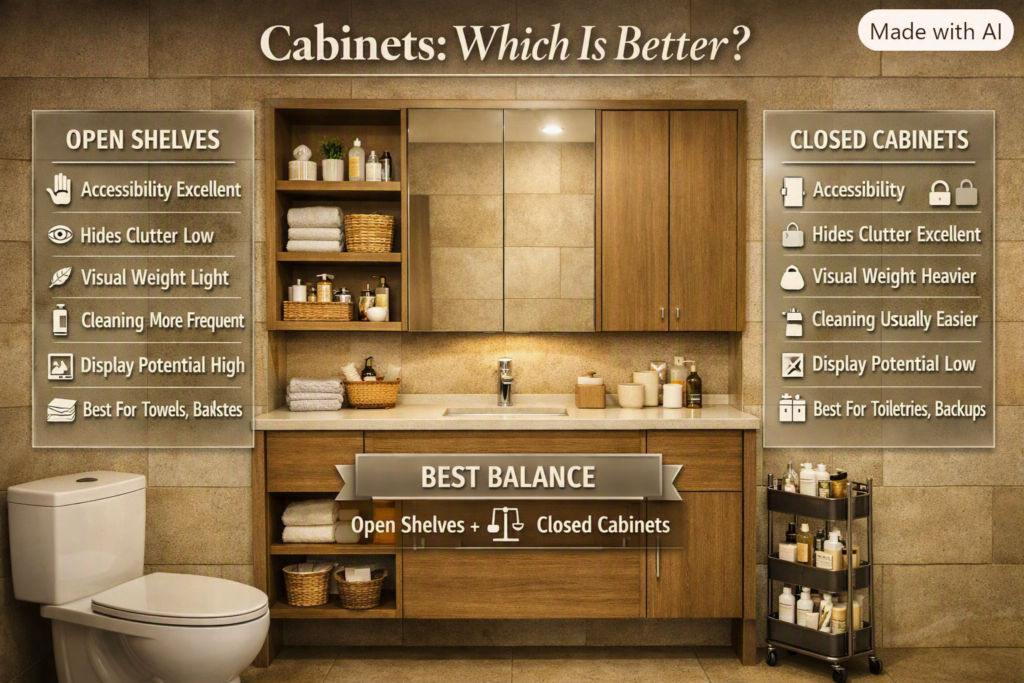
Open shelves are convenient and visually lighter, while closed cabinets are better for hiding clutter. Most bathrooms benefit from a combination of both rather than relying entirely on one.
| Feature | Open Shelves | Closed Cabinets |
| Accessibility | Excellent | Good |
| Hides clutter | Low | Excellent |
| Visual weight | Light | Heavier |
| Cleaning | More frequent | Usually easier |
| Display potential | High | Low |
| Best for | Towels, baskets | Toiletries, backups |
A balanced bathroom might use open shelving for folded towels and closed cabinetry for personal-care products.
This combination creates both accessibility and visual control.
How Do You Make Bathroom Storage Look Stylish?
Stylish storage usually comes from consistency rather than expensive materials. Coordinate finishes, hardware, baskets, containers, and colors with the overall bathroom design.
Modern Bathroom
Use:
- Flat-front cabinetry
- Minimal hardware
- Floating storage
- Concealed organization
- Simple shelving
Traditional Bathroom
Consider:
- Framed cabinets
- Classic hardware
- Warm finishes
- Decorative baskets
- Furniture-style vanities
Minimalist Bathroom
Prioritize:
- Closed storage
- Few visible products
- Clean lines
- Neutral finishes
- Integrated niches
Natural or Japandi-Inspired Bathroom
Use:
- Warm wood
- Natural baskets
- Simple shelves
- Neutral colors
- Limited decorative objects
The storage should support the style instead of becoming the main visual feature.
For additional styling guidance, explore Home Styling and Home Design Ideas.
How Do You Hide Bathroom Clutter?
The most effective approach is to divide storage into visible and concealed zones. Keep attractive, frequently used items visible and place visually messy products, backups, and cleaning supplies behind doors or inside drawers.
A useful hierarchy is:
EYE LEVEL
Daily-use + attractive items

MID LEVEL
Toiletries + grooming products

LOW STORAGE
Larger products + backups

HIDDEN STORAGE
Cleaning supplies + rarely used items
This makes the bathroom easier to navigate while maintaining a calmer appearance.
How Much Bathroom Storage Do You Actually Need?
The amount of storage required depends on the number of people using the bathroom, their routines, and the amount of personal-care products they keep there.
A single-person bathroom may need only a vanity, medicine cabinet, and compact linen solution.
A family bathroom may need significantly more.
Think about:
- Number of users
- Towels per person
- Toiletries
- Hair tools
- Cosmetics
- Cleaning supplies
- Backup products
- Guest supplies
Don’t design storage only around what you own today.
Allow some room for future needs.
What Should You Store Above the Toilet?
The area above the toilet is best used for lightweight, frequently accessible items such as toilet paper, towels, baskets, and spare toiletries. Shallow cabinets or floating shelves generally work better than oversized units because they preserve visual space.
Avoid placing fragile objects where they could easily fall.
Also consider the toilet’s position relative to the storage.
A shelf that’s technically reachable may still be inconvenient if you need to lean over the toilet to use it.
How Can You Use Awkward Bathroom Corners?
Awkward corners can become useful storage when you choose furniture based on their dimensions instead of forcing standard cabinets into them.
Options include:
- Narrow corner shelves
- Tall corner cabinets
- Rolling carts
- Small baskets
- Custom shelving
- Wall-mounted organizers
The goal is not necessarily to fill every awkward corner.
Sometimes leaving an area open creates better circulation.
Good design means knowing which spaces should be used and which should remain visually quiet.
How Can Bathroom Storage Work With the Overall Home Design?
A bathroom shouldn’t feel disconnected from the rest of the home. Materials, colors, hardware, and storage styles can echo the design language used elsewhere.
For example, a home with warm wood and natural textures might use similar tones in the bathroom vanity and shelving.
A contemporary home might continue clean lines and minimal hardware into the bathroom.
This creates visual continuity without making every room identical.
You can explore broader ideas through Interior Design and Home Improvement.
What Bathroom Storage Mistakes Should You Avoid?
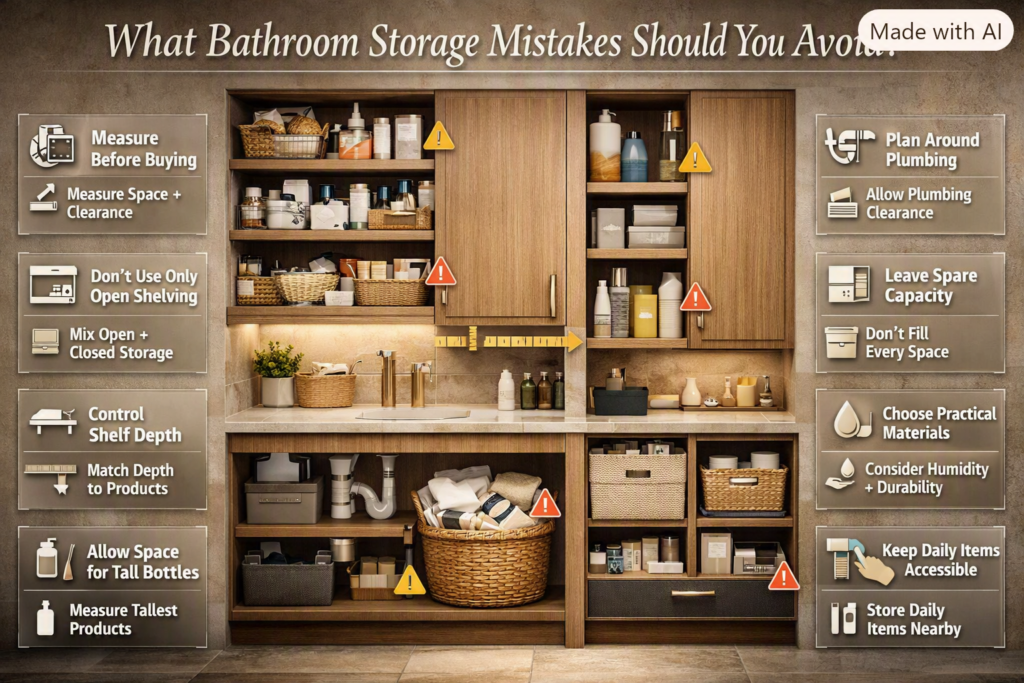
The biggest storage mistakes usually happen when homeowners prioritize appearance, maximum capacity, or trends over daily usability.
Mistake 1: Buying Storage Before Measuring
A cabinet that looks perfect online may block a door or interfere with a fixture.
Solution: Measure the space, opening, depth, and clearance before purchasing.
Mistake 2: Using Only Open Shelving
Open shelves can quickly become visually messy.
Solution: Combine them with closed storage.
Mistake 3: Making Shelves Too Deep
Deep shelves can hide small products at the back.
Solution: Match shelf depth to the objects being stored.
Mistake 4: Forgetting Tall Bottles
A beautifully designed cabinet becomes useless if shampoo bottles don’t fit upright.
Solution: Measure your tallest products.
Mistake 5: Ignoring Plumbing
Under-sink storage needs to work around pipes.
Solution: Use adjustable shelves or pull-out organizers designed for plumbing clearance.
Mistake 6: Filling Every Space
A completely packed bathroom feels stressful.
Solution: Leave some spare capacity.
Mistake 7: Choosing Materials Only for Appearance
Some materials require more maintenance than homeowners expect.
Solution: Consider humidity, cleaning, durability, and hardware quality.
Mistake 8: Putting Daily Items in Difficult Locations
If you have to move three things to reach toothpaste every morning, the system won’t stay organized.
Solution: Store frequently used products in the easiest locations.
How Can You Organize Bathroom Storage Like a Professional?
Professional organization starts with zoning. Instead of thinking about individual products, think about activities.
Create zones for:
Oral care
Toothbrushes, toothpaste, floss, and related products.
Skincare
Cleansers, moisturizers, sunscreen, and daily skincare.
Hair care
Brushes, products, dryers, and accessories.
Shower
Shampoo, conditioner, body wash, and shaving supplies.
Linens
Bath towels, hand towels, and washcloths.
Cleaning
Cleaning products, brushes, gloves, and spare supplies.
Once each category has a home, maintaining the bathroom becomes much easier.
⭐ Expert Tip: The best storage system is the one that requires the least effort to maintain. If putting something away feels inconvenient, you’ll eventually leave it on the counter.
How Can You Create Better Bathroom Storage on a Budget?
You don’t need custom cabinetry to improve storage.
Start with the spaces you already have.
Low-Cost Improvements
- Drawer dividers
- Stackable bins
- Small baskets
- Wall hooks
- Over-door organizers
- Under-sink trays
- Slim rolling carts
- Adhesive organizers where appropriate
Then focus on decluttering.
Removing ten unused products can create more useful space than buying another organizer.
For homeowners working on several areas of the house, practical DIY ideas can also be found under DIY Home Projects.
How Can You Choose Between Built-In and Freestanding Storage?
Built-in storage provides a more integrated appearance and can make excellent use of difficult spaces, while freestanding storage is easier to install, replace, and reposition.
| Option | Best For | Advantages | Drawbacks |
| Built-in | Remodels | Custom fit, integrated look | Higher cost |
| Freestanding | Flexible upgrades | Easy to change | May use more floor space |
| Wall-mounted | Small bathrooms | Saves floor area | Requires secure installation |
| Recessed | New construction/remodels | Very space-efficient | Requires wall planning |
If you’re already remodeling, built-in storage can make sense.
If you simply need more capacity, a well-chosen freestanding or wall-mounted solution may be enough.
How Does Bathroom Storage Affect Remodeling Decisions?
Storage should be considered at the beginning of a bathroom remodel rather than added at the end.
For example, if you want a recessed shower niche, the framing and waterproofing need to accommodate it.
If you want a large vanity, plumbing and electrical locations may affect the final arrangement.
If you want a linen cabinet, the wall layout needs to leave enough room for it.
Planning storage early can prevent expensive changes later.
For broader remodeling and home-planning ideas, Home Improvement can help you think about the project as part of the home’s overall functionality.
How Can Bathroom Storage Stay Organized Long-Term?
A storage system stays organized when it is simple enough to maintain.
Use these habits:
- Return products to their assigned zones.
- Remove empty containers immediately.
- Don’t buy backups before checking existing supplies.
- Review drawers regularly.
- Keep daily products accessible.
- Avoid overcrowding shelves.
- Replace broken organizers.
- Adjust storage when household routines change.
Organization is not a one-time project.
It is a system.
If a particular storage area repeatedly becomes messy, don’t simply reorganize it again. Ask why.
Perhaps the shelf is too far away.
Perhaps the drawer is too shallow.
Perhaps the category is too broad.
Fixing the reason behind the clutter is more effective than repeatedly cleaning the result.
How Can You Use Storage to Make a Bathroom Feel Larger?
Storage can influence the perceived size of a bathroom. Floating furniture, recessed niches, mirrored cabinets, light finishes, and concealed storage can reduce visual bulk.
Three strategies are particularly effective:
Keep the Floor Visible
Floating vanities and wall-mounted cabinets can create a more open appearance.
Reduce Visual Noise
Closed cabinets hide packaging and miscellaneous products.
Use Mirrors Strategically
A mirrored cabinet combines storage and reflection while avoiding the need for a separate bulky cabinet.
This doesn’t physically increase the bathroom’s dimensions, but it can improve how spacious the room feels.
What Are the Best Bathroom Storage Ideas for Different Bathroom Types?
Different bathrooms require different storage strategies.
Powder Room
A powder room generally needs:
- Small vanity
- Mirror cabinet or shelf
- Hand towel storage
- Soap storage
- Small backup cabinet
Focus on visual simplicity.
Family Bathroom
Prioritize:
- Multiple drawers
- Towel storage
- Shower niches
- Separate personal zones
- Cleaning storage
- Backup supplies
Master Bathroom
A primary bathroom can support:
- Large vanity
- Individual drawers
- Linen storage
- Built-in cabinetry
- Dedicated grooming zones
- Larger shower storage
Guest Bathroom
Keep storage simple.
Provide:
- Fresh towels
- Toilet paper
- Hand soap
- Basic toiletries
- Concealed backup supplies
Guests shouldn’t have to search through several cabinets to find what they need.
How Can Bathroom Storage Connect With Other Home Spaces?
Storage planning becomes more effective when you consider the bathroom as part of the whole home rather than an isolated room.
For example, laundry-related supplies may make more sense in a dedicated laundry area instead of taking valuable bathroom cabinet space.
Similarly, children’s belongings can sometimes be divided between bathroom and bedroom storage.
If you’re working on several rooms at once, explore:
- Kitchen Design
- Living Room Design
- Home Office Design
- Dining Room Design
- Laundry Room Design
- Kids’ Room Design
- Entryway & Hallway Ideas
The same principle applies throughout the house: storage works best when it follows the way people actually live.
What Are the Best Bathroom Storage Ideas for a Small Bathroom?
The best small bathroom storage solutions are vertical, recessed, wall-mounted, and multifunctional. Instead of adding bulky furniture to the floor, use the walls, vanity interior, space above the toilet, shower area, and even the back of the door. This keeps essential items accessible while preserving the open floor area that makes a compact bathroom feel larger.
A practical small bathroom setup could include a mirrored medicine cabinet above the vanity, drawers underneath the sink, a narrow vertical cabinet, a recessed shower niche, and a few wall-mounted hooks. You don’t necessarily need all of these; choose the combination that fits your layout and routine.
Useful points:
Use a floating vanity to keep more floor visible.
Choose drawers instead of one large, deep cabinet where possible.
Use the wall above the toilet for secondary storage.
Install a recessed niche if you’re already remodeling the shower.
Keep backup toiletries outside the main daily-use zone.
Use shallow shelves for small products instead of deep shelves where items disappear at the back.
Avoid filling every wall simply because space is available.
One of the biggest mistakes in a small bathroom is thinking that the solution is simply more storage. Often, the real solution is better storage placement. Current small-bathroom planning advice increasingly focuses on dividing storage into zones—vanity, shower, toilet area, walls, and doors—rather than treating the room as one large storage problem.
How Can I Keep My Bathroom Countertop Clutter-Free?
The most effective way to keep a bathroom countertop clear is to give frequently used products a convenient storage location close to where they’re used. If toothpaste, skincare, hair products, and grooming items have to be stored in an inconvenient cabinet, they’ll eventually return to the countertop.
Start by removing anything you don’t use every day. Then divide the remaining products into categories such as oral care, skincare, grooming, hair care, and shared essentials. Store each category in a dedicated drawer, cabinet, tray, or container.
A professional organization approach:
Daily products: Top vanity drawer or medicine cabinet
Occasional products: Lower drawer or cabinet
Backup products: Separate cabinet or linen storage
Decorative items: Keep to one or two intentional pieces
Cleaning products: Dedicated concealed storage
The important point is accessibility. Storage that looks excellent but is difficult to reach will eventually fail.
For example, if you use moisturizer every morning, don’t place it at the back of a deep lower cabinet. Put it in a shallow drawer near the sink. That small change can prevent the countertop from becoming a permanent storage area.
Recent design guidance is increasingly favoring concealed and integrated storage because it helps create the clean, calm appearance homeowners want while keeping everyday essentials available.
Useful points:
Keep only genuine daily essentials on display.
Use drawer dividers instead of allowing products to move freely.
Group products according to routine rather than random product type.
Use matching containers only where they genuinely improve organization.
Don’t buy another organizer before removing products you no longer need.
If clutter repeatedly returns to the counter, reconsider the location of the storage rather than simply reorganizing it.
Professional rule: If putting something away takes more effort than leaving it on the counter, the storage system needs improvement.
Is a Recessed Shower Niche Worth It for Bathroom Storage?
A recessed shower niche is one of the most useful permanent storage solutions when you’re already remodeling a bathroom. It places shampoo, conditioner, body wash, and other shower products inside the wall, keeping the shower floor clear and reducing the need for bulky hanging organizers. Designers are also treating niches as an integrated part of the overall bathroom composition rather than merely an afterthought for bottles.
The biggest advantage is that a niche doesn’t project significantly into the shower area. This makes it particularly valuable in smaller showers where every bit of usable space matters.
However, a shower niche needs to be planned correctly.
It should be considered before framing, waterproofing, and tiling are finalized. Its position should also account for the showerhead, plumbing, user’s reach, bottle sizes, and the overall tile layout.
Before installing a niche, consider:
How many people use the shower?
How many bottles need to be stored?
How tall are the products?
Can everyone comfortably reach the shelves?
Does the location interfere with plumbing?
Will the waterproofing be properly detailed?
Does the niche align with the tile design?
A common mistake is designing a tiny niche around one or two bottles and discovering later that the household needs significantly more storage.
Another mistake is making it unnecessarily deep. More depth doesn’t automatically mean better storage. A niche should be designed around the products and the available wall structure.
For homeowners who aren’t remodeling, a quality corner shelf or properly installed shower organizer may be a more practical option.
Useful points:
Plan the niche before tile installation.
Consider waterproofing as seriously as the storage itself.
Measure your tallest bottles.
Use multiple shelves when the niche is tall enough.
Keep frequently used products at comfortable reach height.
Don’t overcrowd the niche.
Choose materials that are easy to clean.
The current move toward more spa-like bathrooms is also making integrated shower storage more important. As bathrooms increasingly become spaces for relaxation and longer routines, built-in seating, niches, and organized wet-zone storage are being incorporated into the design from the beginning.
Are Bathroom Drawers Better Than Cabinets for Storage?
Bathroom drawers are generally better for small and frequently used items, while cabinets are more practical for tall bottles, towels, cleaning supplies, and larger products. For most bathrooms, the best solution isn’t choosing one over the other—it’s combining drawers and cabinets according to what needs to be stored.
A deep cabinet can technically hold a lot, but much of that space may become difficult to access. Products at the back are forgotten, while the front becomes overcrowded.
Drawers solve part of this problem because the entire contents can be brought into view.
For example, a vanity could be organized like this:
Storage
Best Use
Top drawer
Toothbrushes, skincare, grooming
Middle drawer
Hair products, cosmetics, shaving items
Deep drawer
Larger bottles and accessories
Cabinet
Cleaning supplies and backups
Side tower
Towels and less-used items
This type of zoning is becoming increasingly common in professional bathroom design. Current 2026 bath-industry reporting highlights custom dividers, drawer organizers, built-in hair-tool storage, makeup storage, medication storage, and electrical integration as part of the move toward more personalized bathroom cabinetry.
Useful points:
Use shallow drawers for small products.
Use deep drawers for larger bottles and tools.
Add dividers to prevent drawers becoming junk drawers.
Use pull-outs underneath sinks to improve access.
Keep everyday items near the top.
Store backup products farther away.
Consider built-in outlets or charging areas when planning a new vanity.
One important detail is plumbing. Under-sink drawers require careful planning because the drain and water lines occupy space. In a remodel, this is where professional cabinet planning can make a significant difference.
The goal isn’t to maximize the number of drawers.
It’s to make every drawer easy to understand and easy to maintain.
How Can I Make Bathroom Storage Look Stylish Without Making the Room Feel Cluttered?
The secret to stylish bathroom storage is visual restraint. Good storage should solve practical problems while supporting the bathroom’s overall design. Use a combination of concealed cabinets, carefully selected open shelves, coordinated materials, and enough empty space to prevent the room from looking overloaded.
Open shelving can be attractive, but it exposes everything. If every shelf is filled with bottles, containers, towels, and miscellaneous products, the bathroom can quickly look chaotic.
Closed storage gives you more visual control.
A balanced approach might include a floating vanity with concealed drawers, a mirrored cabinet above the sink, one open shelf for folded towels, and a recessed shower niche for daily shower products.
Useful points:
Use open shelves selectively.
Keep visible products grouped rather than scattered.
Coordinate cabinet finishes with the vanity and other bathroom elements.
Use baskets to contain smaller items.
Avoid excessive decorative accessories.
Leave some empty shelf space.
Choose storage that matches the scale of the room.
Prioritize timeless materials over short-lived trends.
This approach also works with current bathroom design trends. In 2026, designers are increasingly moving away from bathrooms that feel purely clinical and toward warmer, more personalized spaces, including natural materials, warm wood vanities, integrated storage, and more characterful details.
Final Professional Takeaway
The strongest bathroom storage design doesn’t try to make everything visible or everything hidden. It creates a deliberate balance.
Keep everyday essentials convenient.
Hide visual clutter.
Use vertical and recessed space.
Give every category a defined home.
And most importantly, design storage around the way the bathroom is actually used, not simply around what looks good in a photograph.
That approach produces a bathroom that stays organized long after the initial makeover—and that’s what makes storage genuinely successful.
Conclusion
Good bathroom storage isn’t about adding as many cabinets, shelves, and organizers as possible. It’s about creating a practical system that makes everyday routines easier while keeping the room clean, comfortable, and visually balanced.
Start by understanding what you actually need to store, then divide your bathroom into useful zones. Keep daily essentials close to the sink or shower, use drawers for smaller products, cabinets for larger and backup items, and take advantage of vertical and recessed spaces when floor area is limited. In a remodel, plan built-in storage early so niches, vanities, and cabinets work naturally with the plumbing, lighting, and overall layout.
Don’t forget that storage is also part of the bathroom’s design. A combination of concealed cabinets, carefully styled open shelving, coordinated finishes, and uncluttered surfaces can make even a small bathroom feel more spacious and intentional.
The best storage solution is ultimately the one you can maintain without effort. When every item has a logical place and the things you use most are easy to reach, your bathroom stays organized naturally rather than requiring constant tidying.
A well-planned bathroom isn’t simply more attractive—it works better every day. By choosing storage based on your space, lifestyle, and actual habits, you can create a bathroom that feels organized, functional, and comfortable for years to come.
Leave a Reply