
Introduction
Celebrity Home Lighting Design Trends | Have you ever noticed how celebrity homes can look elegant, comfortable, and visually impressive even when their furniture and decorations are relatively simple? The secret often lies in something homeowners overlook during decorating: lighting. A beautifully selected lighting arrangement can change how furniture looks, highlight architectural details, improve the atmosphere, and make an ordinary room feel considerably more sophisticated.
The latest celebrity home lighting design trends demonstrate that luxury is not necessarily about installing the most expensive chandeliers or filling every ceiling with decorative fixtures. It is about understanding how light interacts with space, materials, colours, furniture, and everyday activities. A well-planned combination of architectural illumination, decorative fixtures, concealed LEDs, and natural daylight can create a balanced interior without making it feel overly decorated.
If you want to bring these ideas into your own home, DesignMode24 Interior Design provides additional inspiration for creating practical and attractive residential spaces. The important thing is to adapt luxury-inspired concepts to your actual room dimensions, budget, and lifestyle instead of copying an expensive interior without considering whether it will work.
This guide explores the lighting approaches associated with sophisticated celebrity-inspired interiors, explains where different fixtures work best, and shows how to create similar results without unnecessary renovation expenses. You will also learn how to select lighting temperatures, plan different layers, avoid common installation mistakes, and coordinate fixtures with your existing interior.
What Are Celebrity Home Lighting Design Trends?
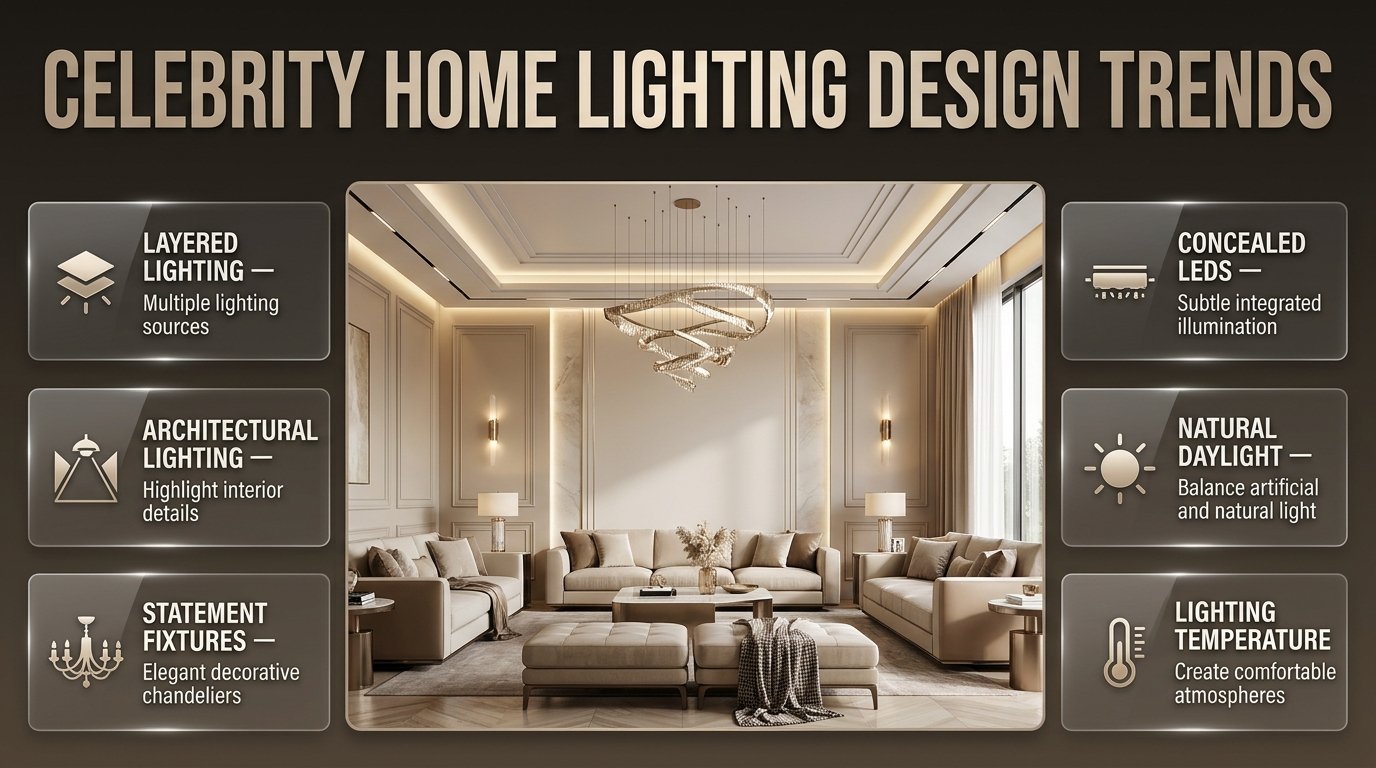
Celebrity home lighting design trends are luxury-inspired approaches to residential illumination that combine architectural lighting, decorative fixtures, natural daylight, and modern lighting controls. Their purpose is to make interiors more functional and visually attractive while creating different atmospheres for relaxation, entertainment, and everyday living.
These design approaches generally focus on:
- Statement chandeliers that establish a focal point.
- Concealed lighting that highlights architectural details.
- Warm illumination for comfortable residential environments.
- Sculptural pendants that combine decoration with functionality.
- Layered lighting for different activities.
- Smart controls that allow brightness adjustments.
- Carefully selected materials and decorative finishes.
- Balanced illumination that avoids harsh shadows and excessive glare.
The most important principle is that lighting should complement the architecture rather than compete with it.
For example, a spacious living room with neutral walls, natural timber flooring, and simple furniture may benefit more from carefully positioned wall lighting and concealed ceiling illumination than from several oversized chandeliers.
This approach makes luxury-inspired lighting practical for different property sizes, including apartments, townhouses, and family homes.
1. Statement Chandeliers That Establish a Luxury Focal Point
Statement chandeliers remain an effective way to introduce character into a residential interior. Their purpose is not simply to illuminate a room. They also create a visual centre that helps organise the surrounding furniture and decorative elements.
In sophisticated interiors, chandeliers are often selected according to the room’s architectural proportions rather than personal preference alone.
A large sculptural fixture may look impressive in a double-height entrance, but the same design could overwhelm a smaller dining room.
Which chandelier styles work best?
Modern sculptural chandeliers
These fixtures feature artistic shapes, curved arms, unusual arrangements, and contemporary materials. They work particularly well in modern living rooms where the furniture and architectural details are relatively simple.
Crystal chandeliers
Crystal fixtures introduce reflections and decorative detail. They can complement traditional, transitional, and contemporary interiors when their proportions are appropriate.
Minimalist metal chandeliers
Brushed brass, black metal, and polished finishes provide a more restrained appearance. These options are suitable for homeowners who prefer understated luxury.
Linear chandeliers
Long fixtures are particularly useful above rectangular dining tables and kitchen islands. Their shape follows the furniture arrangement and distributes illumination across a larger surface.
How to select the correct chandelier size
Start by measuring the room and identifying the furniture beneath the proposed fixture.
Consider:
- Ceiling height.
- Room width and length.
- Furniture dimensions.
- Walking clearance.
- Visual weight of the fixture.
- Light distribution.
- Accessibility for maintenance.
For a dining room, the chandelier should relate to the table rather than simply the room’s geometric centre.
For example, a long dining table may look more balanced with an elongated fixture than with a small circular chandelier.
Professional recommendation: Check the fixture’s dimensions using a cardboard or paper template before installation. This simple exercise helps homeowners understand its actual visual size.
2. Concealed LED Lighting for Architectural Depth
Concealed LED lighting is one of the most useful ways to achieve a refined architectural appearance without introducing too many decorative objects.
It works by hiding the light source inside a recess, channel, cabinet, or architectural feature. The illuminated surface becomes the main visual element rather than the LED strip itself.
This technique is especially effective in contemporary homes where clean lines and uninterrupted surfaces are important.
Where should concealed LED lighting be installed?
Ceiling coves
LED strips positioned inside ceiling recesses create indirect illumination. They can make ceiling details more noticeable and reduce the need for exposed decorative fixtures.
Floating television units
Lighting beneath a floating media cabinet creates a subtle separation between the furniture and floor.
Kitchen cabinets
Under-cabinet lighting improves visibility across worktops while creating a cleaner evening appearance.
Wardrobe interiors
Integrated wardrobe lighting helps homeowners find clothing and accessories without switching on all the bedroom lights.
Decorative wall niches
Concealed illumination inside selected niches can highlight artwork, pottery, books, and other carefully arranged objects.
What should you check before installation?
The quality of concealed lighting depends on more than the LED strip itself.
Check:
- LED density to reduce visible light dots.
- Appropriate aluminium channels.
- Diffuser quality.
- Driver accessibility.
- Colour consistency.
- Dimming compatibility.
- Suitable heat management.
A poorly installed LED strip can create uneven brightness and visible hotspots, making an otherwise attractive ceiling look unfinished.
Expert tip: Plan concealed lighting before completing ceiling and cabinetry work. Retrofitting channels and electrical connections later can increase labour costs.
3. Warm Lighting That Creates a Comfortable Atmosphere

The colour of artificial light can influence how people experience an interior.
Warm lighting generally creates a relaxed and inviting environment, while neutral and cooler lighting can support activities that require clearer visual attention.
Sophisticated residential lighting schemes often use different colour temperatures according to room function instead of choosing one setting for the entire property.
Understanding lighting colour temperatures
Colour temperature is measured in Kelvin (K). A lower Kelvin value produces a warmer appearance, while higher values produce a cooler or more neutral appearance.
| Colour temperature | Visual appearance | Common residential use |
|---|---|---|
| 2200K–2400K | Very warm and amber | Decorative evening lighting |
| 2700K | Warm white | Bedrooms and relaxation areas |
| 3000K | Soft warm white | Living rooms and dining areas |
| 3500K | Neutral white | Kitchens and multifunctional rooms |
| 4000K | Cool-neutral white | Workspaces and utility areas |
These are practical starting points rather than fixed rules.
A room with dark timber, warm stone, and beige upholstery may benefit from warmer illumination. A kitchen with cool-toned surfaces may look better with a carefully selected neutral-white source.
Why does colour consistency matter?
Imagine a living room with one yellowish lamp, several cool-white downlights, and a decorative fixture with a different colour temperature.
Even if every fixture looks attractive individually, the combined result may feel inconsistent.
A more coordinated arrangement creates visual continuity.
Quick tip: Purchase sample bulbs or test the actual fixtures before ordering lighting for the entire property. Surfaces can reflect light differently from what showroom displays suggest.
4. Sculptural Pendant Lighting for Modern Living
Pendant lighting combines functional illumination with decorative character. Unlike traditional ceiling fixtures, pendants can introduce a strong visual element at a more specific height within the room.
They are especially effective above kitchen islands, dining tables, bedside areas, and selected seating arrangements.
Popular pendant lighting designs
Organic glass pendants
Rounded and irregular glass forms create softer visual movement. They complement interiors featuring natural textures and understated furniture.
Geometric pendants
Angular metal and glass arrangements work well in contemporary interiors where architectural lines are prominent.
Oversized dome pendants
These fixtures provide a noticeable decorative feature above kitchen islands and dining areas.
Cluster pendants
Multiple smaller pendants can create an artistic composition when installed at different heights.
Minimal cylindrical pendants
Their simple geometry makes them suitable for modern kitchens, hallways, and selected bedside arrangements.
How should pendant lights be positioned?
Positioning is just as important as fixture selection.
For kitchen islands, distribute pendants evenly according to the island’s length and the size of each fixture.
For dining areas, make sure the pendant illuminates the tabletop without blocking the view between people sitting opposite each other.
In bedrooms, pendant lights can replace bedside table lamps, but their installation height should allow comfortable access and prevent accidental contact.
A common mistake is selecting pendants before finalising the furniture arrangement. This can lead to fixtures being positioned incorrectly once the room is furnished.
5. Layered Lighting for a More Professional Interior
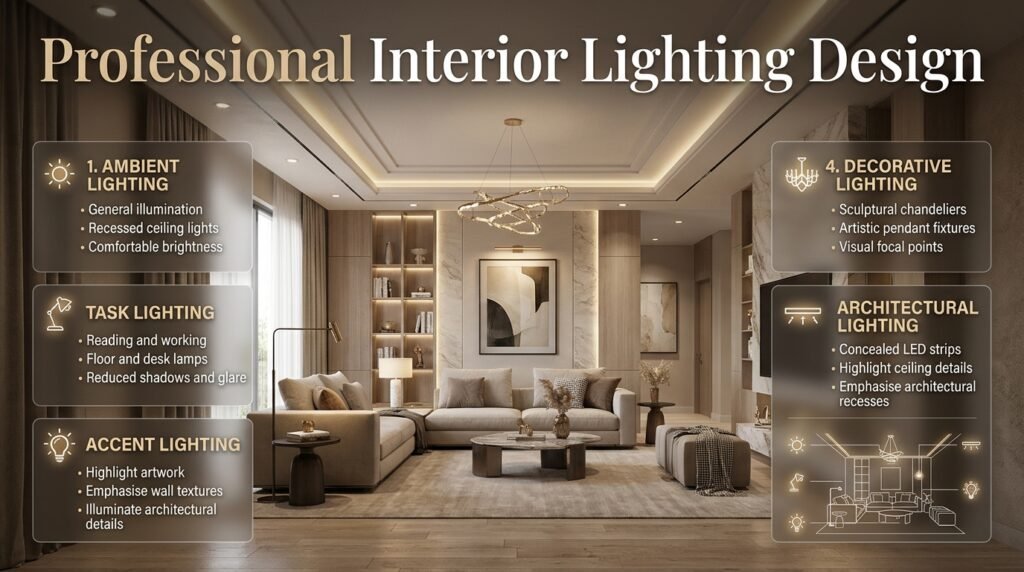
Layered lighting is the practice of combining different lighting sources to meet several visual and practical requirements within one room.
Instead of relying on a single ceiling fixture, the arrangement uses ambient, task, and accent lighting to create a flexible environment.
This is particularly important in living spaces that serve multiple purposes throughout the day.
Ambient lighting
Ambient lighting provides general illumination.
Typical examples include:
- Recessed ceiling lights.
- Flush-mounted ceiling fixtures.
- Chandeliers.
- Indirect ceiling illumination.
- Suitable surface-mounted lights.
Its purpose is to establish a comfortable overall brightness.
Task lighting
Task lighting supports specific activities that require additional visibility.
Examples include:
- Reading lamps.
- Desk lamps.
- Under-cabinet kitchen lighting.
- Bathroom mirror fixtures.
- Dressing-area illumination.
Task lighting should be positioned to minimise shadows and glare.
Accent lighting
Accent lighting highlights selected elements of an interior.
It can be used to emphasise:
- Artwork.
- Decorative wall panels.
- Stone textures.
- Shelving.
- Architectural recesses.
- Selected furniture pieces.
Decorative lighting
Decorative lighting includes fixtures selected partly for their appearance, such as sculptural chandeliers and artistic pendants.
It can contribute to ambient illumination, but its decorative role should be considered separately from its practical light output.
Example: A complete living room arrangement
| Lighting layer | Suitable fixture | Main purpose |
|---|---|---|
| Ambient | Recessed ceiling lights | General visibility |
| Task | Reading floor lamp | Reading comfort |
| Accent | Directional wall lighting | Highlight artwork |
| Decorative | Sculptural chandelier | Establish a focal point |
| Architectural | Concealed LED strip | Highlight ceiling details |
The benefit of this arrangement is flexibility.
During the day, natural daylight may provide most of the illumination. In the evening, homeowners can use the reading lamp and accent lights without switching on every ceiling fixture.
6. Modern Wall Sconces for Elegant Residential Spaces
Wall sconces are useful when homeowners want to introduce additional illumination without filling the ceiling with fixtures.
They can also create visual rhythm along corridors, beside mirrors, and around selected architectural features.
Unlike floor lamps, wall-mounted fixtures do not occupy valuable floor space.
Different types of wall lighting
Up-and-down wall sconces
These distribute light towards the ceiling and floor, producing an architectural effect.
Decorative glass sconces
Glass shades soften the appearance of a fixture and can complement elegant bedroom and living room arrangements.
Adjustable reading sconces
These are useful beside beds and in reading corners because the light direction can be changed.
Picture lights
Picture lights highlight selected artwork and framed decorative pieces.
Recessed wall fixtures
These are often used in corridors and circulation areas where a discreet lighting effect is preferred.
How can wall sconces improve room proportions?
A pair of carefully positioned sconces can create balance around a mirror, artwork, or architectural feature.
In narrow hallways, repeated wall fixtures can also establish a visual rhythm.
However, they should not be installed too close to furniture or at heights that produce uncomfortable glare.
The correct position depends on the fixture design, viewing angle, ceiling height, and intended application.
7. Smart Lighting Systems for Greater Control
Smart lighting introduces convenience by allowing homeowners to adjust selected fixtures through compatible switches, mobile applications, schedules, or voice controls.
It is especially useful in larger properties where several rooms have different lighting requirements.
However, a smart system should simplify everyday life rather than introduce unnecessary complexity.
Useful smart lighting functions
Brightness adjustment
Dimmable lighting allows users to change illumination according to the time of day and activity.
Scheduled operation
Selected lights can operate automatically according to established schedules.
Scene creation
Different fixtures can be grouped into settings for dining, reading, relaxation, and entertainment.
Remote control
Compatible systems allow homeowners to operate lighting when they are away from the property.
Occupancy-based operation
Suitable sensors can switch selected lights on or off according to movement.
Example of a practical lighting schedule
| Situation | Lighting arrangement |
|---|---|
| Early morning | Comfortable general illumination |
| Daytime | Natural daylight with limited artificial lighting |
| Evening relaxation | Warm, reduced brightness |
| Reading | Focused task illumination |
| Dinner | Soft ambient and decorative lighting |
| Night-time movement | Low-level pathway lighting |
What should homeowners consider?
Before installing smart lighting, check compatibility between bulbs, dimmers, switches, hubs, and control platforms.
Also consider whether ordinary manual controls will remain available.
A home should still be easy to operate when a wireless network or mobile application is unavailable.
Common mistake: Purchasing different smart bulbs and switches without checking whether they can work together. Compatibility should be established before buying the equipment.
8. Natural Materials and Refined Lighting Finishes
Lighting fixtures are not only sources of illumination. Their materials and finishes contribute to the interior’s overall design language.
Modern luxury-inspired interiors often combine metal, glass, wood, ceramic, and natural stone to create visual interest without relying on excessive decoration.
Brushed brass
Brushed brass provides warmth and a refined metallic appearance. It works particularly well with timber, cream walls, beige upholstery, and warm neutral palettes.
Matte black
Matte black fixtures create contrast and are suitable for contemporary and minimalist interiors.
Clear and frosted glass
Clear glass keeps fixtures visually light, while frosted glass diffuses illumination and softens the appearance of the light source.
Natural wood
Wooden lighting details can introduce warmth and complement organic interior schemes.
Ceramic and stone
These materials provide texture and a handcrafted appearance. They are particularly suitable for decorative lamps and selected sculptural fixtures.
How should lighting finishes be coordinated?
Matching every metal finish is not essential. However, the overall arrangement should feel intentional.
For example, a living room may combine brushed brass lighting with black furniture hardware if both finishes appear elsewhere in the interior.
The relationship between materials is more important than achieving identical finishes.
For further material coordination ideas, explore organic modern material combinations.
9. Bedroom Lighting Inspired by Luxury Residential Interiors
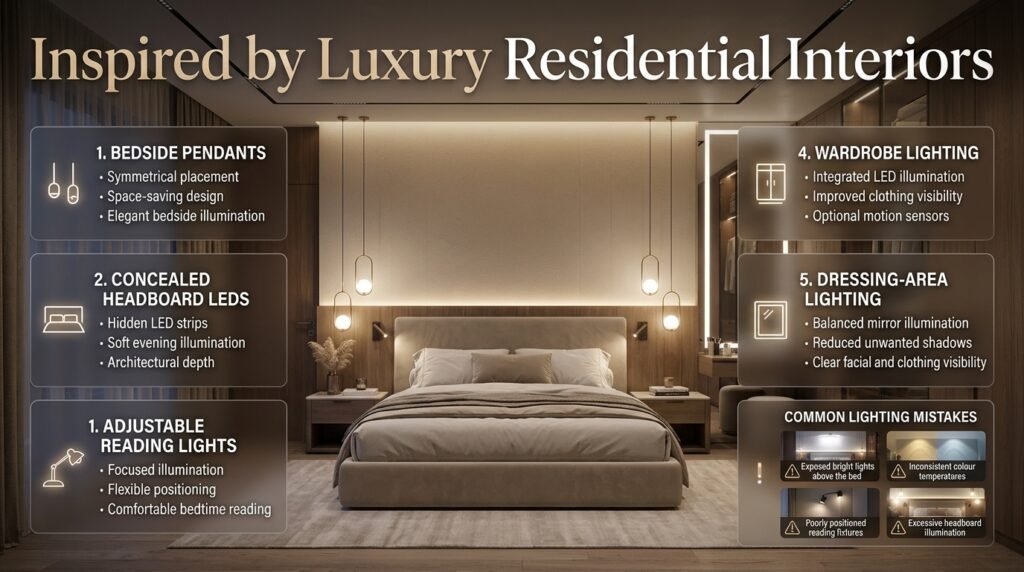
A bedroom should support rest, reading, dressing, and other daily activities.
This makes it important to combine comfortable general illumination with focused lighting where additional visibility is required.
A common mistake is treating bedroom lighting as a decorative ceiling design rather than a complete functional arrangement.
Bedside pendant lighting
Pendant lights can replace traditional table lamps and free up space on bedside tables.
They work especially well when installed symmetrically on both sides of the bed.
Concealed headboard illumination
A concealed LED strip behind a headboard can create depth and provide a subtle evening lighting effect.
The light source should be hidden from direct view to prevent glare.
Adjustable reading lights
Wall-mounted reading lights allow people to read without illuminating the entire room.
Adjustable fixtures are particularly useful when two people have different bedtime routines.
Wardrobe lighting
Integrated lighting inside wardrobes improves visibility and makes clothing selection easier.
Motion sensors can provide additional convenience where suitable.
Dressing-area illumination
A dressing mirror requires balanced light that helps users see clothing and facial details accurately.
Fixtures positioned only above the mirror may produce unwanted shadows.
Bedroom lighting mistakes
Avoid:
- Extremely bright exposed lights directly above the bed.
- Decorative pendants that obstruct movement.
- Inconsistent colour temperatures.
- Poorly positioned reading fixtures.
- Inaccessible LED drivers.
- Excessive lighting around the headboard.
A comfortable bedroom generally benefits from adjustable lighting that can transition from functional morning use to a softer evening environment.
10. Kitchen Lighting That Combines Style and Function
Kitchens require careful lighting because they are both working environments and social spaces.
A decorative pendant may improve the appearance of an island, but it should not create shadows over food preparation surfaces.
A complete arrangement should provide comfortable general illumination, suitable task lighting, and selected decorative features.
Under-cabinet lighting
Under-cabinet lighting is one of the most useful kitchen improvements.
It illuminates worktops and reduces shadows created by upper cabinets.
Continuous LED channels with suitable diffusers generally produce a cleaner appearance than exposed individual light points.
Kitchen island pendants
Pendants help establish a visual focal point and can provide useful illumination above an island.
Choose their dimensions according to island length and ceiling height.
Recessed ceiling lights
Recessed fixtures provide general illumination, but their placement should be coordinated with cabinets and work surfaces.
Installing them directly above the wrong areas can cause shadows from the homeowner’s own body.
Cabinet interior lighting
Integrated cabinet lighting can improve visibility in selected display cabinets and storage areas.
It is particularly useful for deeper cabinets where ordinary ceiling illumination may not reach every shelf.
What colour temperature works best?
Many residential kitchens use warm-neutral or neutral-white lighting, depending on surface finishes and activities.
The important factor is maintaining comfortable visibility while avoiding an overly cool appearance in connected living areas.
For additional practical renovation guidance, visit the Home Improvement section.
11. Bathroom Lighting for a Refined and Functional Environment
Bathroom lighting should make everyday activities easier while supporting a comfortable atmosphere.
The most important area is often the mirror because grooming, shaving, skincare, and makeup application require balanced facial illumination.
Mirror lighting
Fixtures positioned vertically on both sides of a mirror can reduce shadows around the face.
Integrated mirror lighting is another option, provided the light distribution is suitable.
Ceiling illumination
General bathroom lighting should cover the room without creating harsh reflections or dark corners.
Recessed fixtures can work well when they are suitable for the installation location.
Vanity lighting
A floating vanity can benefit from concealed illumination beneath the cabinet.
This produces a subtle visual separation between the furniture and floor.
Shower and wet-area lighting
Lighting in shower areas must be selected according to the relevant moisture exposure and electrical safety requirements.
Never assume that an ordinary decorative ceiling light is suitable for a wet location.
Practical installation considerations
- Use fixtures with suitable moisture protection.
- Follow local electrical regulations.
- Position mirror lights to minimise facial shadows.
- Avoid excessive brightness around reflective surfaces.
- Use suitable dimming controls where permitted.
- Ensure that electrical components remain accessible for maintenance.
Bathroom lighting should look attractive, but safety and visibility must remain the priority.
12. Dining Room Lighting That Creates a Welcoming Atmosphere
Dining rooms benefit from lighting that creates a comfortable environment without making the table excessively bright.
A statement chandelier or pendant is often the main decorative element, but supporting lighting can improve the overall experience.
Choosing the main fixture
The fixture should be proportionate to the dining table.
For rectangular tables, linear chandeliers and coordinated pendant arrangements can distribute light across the surface.
For circular tables, a central pendant or compact chandelier often creates a more balanced composition.
Creating the right brightness
Dimmable lighting is useful because dining rooms serve different purposes.
A family breakfast may require brighter illumination, while an evening dinner may benefit from a softer setting.
Coordinating with dining furniture
Consider the table material, chair finishes, wall colours, and surrounding decorative features.
A brass fixture may complement warm timber furniture, while a black metal pendant may create a more contemporary contrast.
The aim is to establish a connected visual arrangement rather than making the chandelier compete with the furniture.
13. Hallway and Entrance Lighting That Improves First Impressions
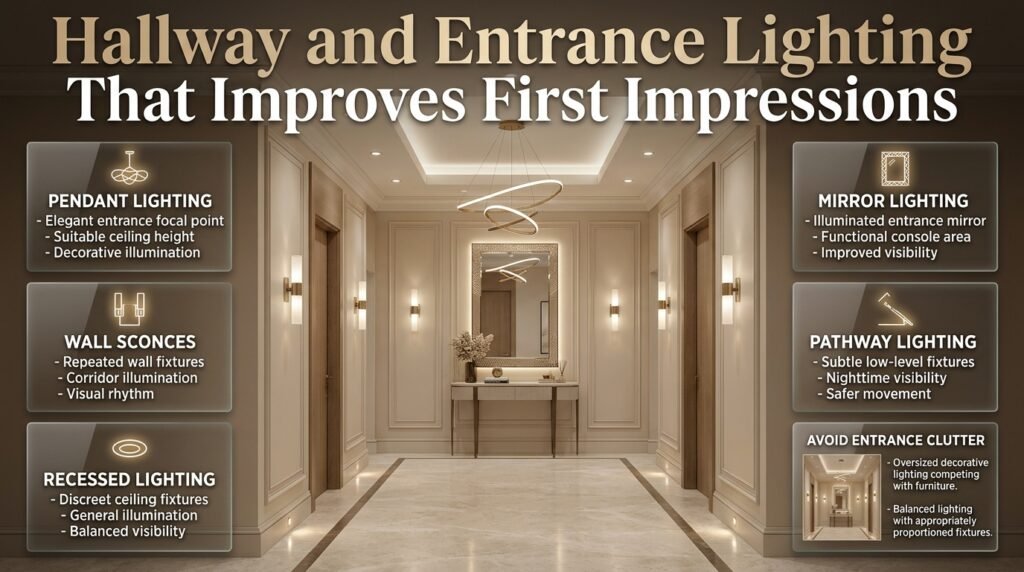
The entrance is often the first interior space visitors experience.
Its lighting should provide clear visibility, establish the home’s atmosphere, and support safe movement.
A common mistake is installing one small ceiling fixture in a long entrance hallway and expecting it to illuminate the entire area.
Effective entrance lighting solutions
Pendant lights
These can create a focal point in entrances with suitable ceiling heights.
Wall sconces
Repeated sconces can introduce rhythm and help illuminate longer corridors.
Recessed ceiling lights
These provide discreet general illumination.
Mirror lighting
A well-positioned illuminated mirror can improve the functionality of an entrance console area.
Low-level pathway lighting
This can help people move safely through selected circulation spaces at night.
How to avoid a crowded entrance
Keep decorative lighting proportional to the available space.
If the entrance already contains a large mirror, console table, artwork, and decorative accessories, a simple ceiling fixture may be more appropriate than another oversized feature.
A useful design principle is to give each element enough visual space to be appreciated.
For more guidance on arranging decorative pieces, explore decorative object grouping principles.
14. Home Office Lighting for Comfort and Productivity
A home office requires a different approach from a living room because lighting directly affects visibility during reading, writing, computer work, and video meetings.
The goal is to reduce eye discomfort caused by glare, reflections, and poorly positioned light sources.
Desk lighting
A desk lamp can provide focused illumination for reading documents and writing.
Choose an adjustable fixture so that the direction of light can be changed.
General room lighting
Ambient illumination should be sufficient to avoid a strong contrast between a bright computer screen and a dark surrounding room.
Window positioning
Natural daylight is valuable, but a computer screen should not face strong direct sunlight that creates reflections.
Position the desk so daylight enters from a suitable direction.
Video meeting lighting
A soft, diffused light positioned in front of the user can improve visibility during video meetings.
Avoid placing a bright window directly behind the seating position because it may create an unwanted silhouette.
Choosing a suitable light source
A neutral-white source can be useful for focused work, although individual preferences and screen conditions matter.
The fixture should offer comfortable brightness without producing excessive glare.
For additional ideas about arranging functional residential spaces, explore LLBlogHome Upgrades by Lovelolablog.
15. Outdoor Lighting for Patios, Gardens, and Exterior Spaces
Outdoor lighting helps homeowners use exterior spaces after sunset while improving visibility around entrances, pathways, and seating areas.
It also creates a visual connection between the house and surrounding landscape.
Entrance lighting
Wall-mounted fixtures near the entrance improve visibility and create a welcoming appearance.
Pathway lighting
Low-level lights can identify changes in ground level and help people navigate outdoor circulation areas.
Garden accent lighting
Directional fixtures can highlight selected trees, planting arrangements, and architectural features.
However, excessive illumination can make a garden feel unnatural and disturb neighbouring properties.
Patio lighting
Covered patios can benefit from wall sconces, ceiling fixtures, and suitable pendant lighting.
The arrangement should support dining, relaxing, and social activities.
Outdoor electrical safety
Always select fixtures suitable for outdoor exposure.
Consider weather resistance, appropriate electrical protection, installation height, drainage, and cable routing.
For more exterior planning inspiration, explore patio shade structure planning.
16. How to Recreate Celebrity-Inspired Lighting Without an Expensive Budget
One of the biggest misconceptions about luxury lighting is that a sophisticated result requires expensive designer products.
In reality, the quality of the overall arrangement often matters more than the individual price of each fixture.
A homeowner can create an attractive lighting scheme by prioritising important improvements and avoiding unnecessary decorative purchases.
Step 1: Identify the main lighting problem
Walk through each room and identify areas that feel too dark, excessively bright, or visually uncomfortable.
For example, a living room may have sufficient general illumination but still feel flat because there is no accent lighting.
In that situation, adding a reading lamp or a suitable wall fixture may be more effective than replacing the chandelier.
Step 2: Establish a realistic budget
Divide the budget according to importance.
A practical priority list might include:
- Electrical safety and necessary wiring.
- Essential general illumination.
- Task lighting for important activities.
- Decorative fixtures.
- Optional smart controls.
This prevents homeowners from spending most of their budget on a decorative chandelier while overlooking basic lighting requirements.
Step 3: Improve the most frequently used room first
A living room, kitchen, or bedroom may provide more everyday benefit than an occasional-use decorative space.
Focus on one area at a time.
Step 4: Select one distinctive fixture
Choose a statement pendant, chandelier, or floor lamp that complements the existing interior.
Avoid purchasing several competing statement fixtures.
Step 5: Introduce affordable lighting layers
Table lamps, floor lamps, compatible LED strips, and selected wall fixtures can improve the lighting arrangement without requiring a complete renovation.
Step 6: Coordinate finishes
Use the existing furniture and architectural details as a reference.
If the room already contains black hardware, timber furniture, and neutral fabrics, choose fixtures that support those materials.
Step 7: Test the arrangement
Observe the room during different lighting conditions.
Check whether:
- Dark corners remain.
- Reflective surfaces create glare.
- Artwork receives suitable illumination.
- Reading areas are comfortable.
- The light colour looks consistent.
- Controls are convenient.
The best improvements are those that solve a genuine problem rather than simply adding another decorative feature.
17. How to Choose the Right Bulbs and Lighting Specifications
Choosing the correct fixture is only one part of a successful lighting scheme. The bulb or integrated light source also affects brightness, colour quality, and energy performance.
Understanding a few technical specifications can prevent expensive purchasing mistakes.
Lumens
Lumens measure the amount of visible light produced by a source.
Higher lumen output generally means more light, although the perceived brightness also depends on room dimensions, surface colours, fixture design, and positioning.
Do not compare bulbs using wattage alone.
Wattage
Wattage measures electrical power consumption rather than brightness.
An efficient LED can produce substantial illumination while using relatively little electricity.
Colour rendering index
The colour rendering index, or CRI, describes how accurately a light source reveals colours compared with a reference source.
A higher CRI is useful where accurate colour appearance matters, such as kitchens, dressing areas, and artwork displays.
Beam angle
Beam angle describes how widely light spreads from a fixture.
A narrow beam can highlight a specific object, while a wider beam can cover a larger surface.
The correct choice depends on whether the light is intended for accent, task, or general illumination.
Dimming compatibility
Not every LED bulb works with every dimmer.
Check the manufacturer’s compatibility information before purchasing.
Incompatible products may flicker, produce noise, or fail to dim correctly.
Energy efficiency
LED technology is generally a practical choice for residential lighting because it offers efficient illumination and a range of colour temperatures.
However, product quality, driver performance, and replacement availability should also be considered.
18. Common Celebrity-Inspired Lighting Mistakes and How to Avoid Them
Copying luxury interiors without understanding their design principles can produce disappointing results.
The following mistakes are particularly common when homeowners focus on appearance rather than the overall lighting experience.
Mistake 1: Choosing fixtures before measuring the room
An attractive chandelier may appear smaller in a showroom than it does in a compact residential room.
Why it happens: Homeowners focus on appearance without checking dimensions.
How to avoid it: Measure the ceiling height, room proportions, and furniture before purchasing.
Mistake 2: Installing too many recessed lights
Adding more downlights does not automatically improve illumination.
Why it happens: People assume that additional fixtures will remove every dark area.
Why it is harmful: The ceiling may look crowded, and excessive brightness can create discomfort.
How to avoid it: Develop a lighting layout based on room activities and supplement it with suitable lamps and accent fixtures.
Mistake 3: Ignoring glare
A beautiful fixture can become uncomfortable when the light source is directly visible from normal seating positions.
Why it happens: Buyers evaluate fixtures mainly from their decorative appearance.
How to avoid it: Check the viewing angle, shielding, diffuser quality, and installation position.
Mistake 4: Mixing incompatible colour temperatures
Different light colours can create a disconnected appearance, particularly in open-plan interiors.
Why it happens: Bulbs are purchased separately without checking their specifications.
How to avoid it: Establish a colour-temperature plan for connected areas.
Mistake 5: Overusing concealed LED strips
Concealed lighting is useful, but installing it in every ceiling recess, shelf, and cabinet can make the interior unnecessarily complicated.
Why it happens: Homeowners confuse the presence of more lighting details with better design.
How to avoid it: Highlight only architectural features that genuinely benefit from illumination.
Mistake 6: Forgetting maintenance access
Integrated lighting may look attractive initially but become difficult to repair if drivers and connections are inaccessible.
Why it happens: Maintenance is considered only after installation.
How to avoid it: Plan accessible drivers, suitable channels, and replaceable components.
Mistake 7: Ignoring furniture placement
A reading light positioned behind a sofa or a pendant that blocks a dining view creates practical problems.
Why it happens: Lighting and furniture are planned separately.
How to avoid it: Finalise the furniture arrangement before confirming fixture positions.
Mistake 8: Treating decorative lighting as the only source of illumination
A chandelier may look beautiful but provide insufficient light for reading, cooking, or cleaning.
Why it happens: Decorative impact is given priority over functionality.
How to avoid it: Combine decorative fixtures with suitable ambient and task lighting.
19. Professional Advice for a More Cohesive Lighting Scheme
Professional lighting planning involves understanding how fixtures, surfaces, furniture, and people interact within a room.
The following recommendations can help homeowners achieve a more considered result.
Coordinate lighting with the ceiling design
Recessed fixtures, chandeliers, and concealed LED channels should be planned alongside ceiling construction.
This is particularly important where a room contains dropped ceilings, bulkheads, or decorative recesses.
Use directional lighting carefully
Directional lighting can reveal the texture of stone, timber, plaster, and decorative panels.
However, the position and angle should be tested because strong grazing light may reveal unwanted surface imperfections.
Consider the reflectance of materials
Light behaves differently on glossy, matte, dark, and light surfaces.
A glossy floor may produce noticeable reflections, while dark walls can absorb more light.
This affects the number and type of fixtures needed.
Avoid unnecessary visual competition
If a room already contains a prominent chandelier, keep nearby wall lights and decorative fixtures relatively simple.
A clear focal hierarchy makes the interior feel more organised.
Plan electrical controls logically
Switches should be positioned according to how people enter, leave, and use a room.
Where practical, separate lighting layers should have independent controls.
This allows homeowners to select the illumination they actually need.
Test before completing installation
Temporary testing can reveal problems that are difficult to identify from drawings alone.
Check furniture positions, glare, brightness, and the visual effect of each lighting layer before finalising the installation.
For more practical home planning guidance, see renovation work order for homeowners.
20. Lighting and Interior Colour Coordination
Lighting and colour should be planned together because artificial illumination can change how paint, flooring, furniture, and decorative finishes appear.
A wall colour that looks balanced during daylight may appear considerably warmer or cooler under artificial lighting.
This is particularly important in rooms with large painted surfaces.
Warm neutral interiors
Cream, beige, warm grey, and earthy colours often work well with warm-white illumination.
However, extremely warm light can make some pale finishes appear yellow.
Cool neutral interiors
Cool grey, white, and selected blue-based finishes may benefit from neutral-white lighting.
The exact result depends on the surface material and its undertones.
Dark interiors
Dark walls and furniture absorb more light than lighter surfaces.
They may require additional ambient illumination and carefully positioned accent lighting.
Colour testing before purchasing fixtures
Place paint samples in the actual room and observe them under daylight and artificial lighting.
Do not rely entirely on showroom displays or digital colour previews.
For additional guidance on selecting and coordinating residential colours, explore the Paint Color category.
21. How Lighting Can Improve Decorative Displays and Artwork
Decorative lighting can make selected objects more noticeable without requiring additional decorations.
This is useful in homes where artwork, sculptures, books, and collected objects contribute to the overall interior character.
Picture lighting
Picture lights highlight framed artwork and create a clear visual focus.
The fixture should provide suitable illumination without damaging sensitive artwork through excessive heat or inappropriate light exposure.
Shelf lighting
Integrated shelf lighting can improve visibility and highlight selected display objects.
It works particularly well when the lighting source is concealed.
Cabinet lighting
Display cabinets may benefit from internal illumination, especially when they contain glassware, ceramics, or carefully selected decorative pieces.
Accent lighting around niches
Recessed niches can be illuminated to create depth and make selected objects more noticeable.
However, the lighting should not compete with the objects themselves.
A useful principle is to illuminate the features that deserve attention and leave surrounding areas relatively calm.
For additional advice on organising accessories, explore decorative object grouping principles.
22. Creating a Whole-Home Lighting Plan Before Renovation
A complete lighting scheme should be developed before major renovation work begins.
This is particularly important when electrical wiring, ceiling construction, cabinetry, and furniture arrangements are changing.
A room-by-room approach helps homeowners identify what is needed without installing unnecessary fixtures.
Start with an activity assessment
List the main activities performed in each room.
For example:
- Living room: relaxation, television, reading, entertaining.
- Bedroom: sleeping, dressing, reading, storage.
- Kitchen: preparation, cooking, dining, cleaning.
- Bathroom: grooming, bathing, cleaning.
- Home office: computer work, reading, video meetings.
- Entrance: arrival, storage, movement.
Prepare a fixture schedule
A fixture schedule records the proposed lighting type, location, quantity, specifications, and control arrangement.
It helps homeowners, designers, and electricians work from the same plan.
Coordinate with electrical drawings
Confirm switch locations, circuit requirements, dimmer compatibility, and wiring routes.
Electrical installations should be completed by appropriately qualified professionals in accordance with applicable regulations.
Establish a maintenance plan
Record product specifications and driver locations.
This makes future repairs and replacements easier.
Review the budget
Allow for fixtures, wiring, controls, installation, accessories, and possible maintenance requirements.
A realistic budget reduces the temptation to compromise on essential electrical work simply to afford decorative products.
For additional inspiration on planning improvements, explore Upgrade Tip LLBlogHome.
What are the biggest celebrity home lighting design trends in 2026?
The biggest celebrity home lighting design trends in 2026 focus on creating a personalised atmosphere rather than simply filling rooms with expensive decorative fixtures. Modern luxury interiors are moving towards layered illumination, sculptural statement lighting, concealed architectural LEDs, adjustable colour temperatures, and integrated smart controls. The objective is to make lighting respond to different activities and times of day while complementing the home’s architecture.
Another noticeable direction is the use of lighting as part of the interior’s overall character. Instead of relying on identical recessed ceiling lights throughout a property, designers are combining decorative pendants, elegant wall sconces, table lamps, and subtle architectural illumination. This creates more visual depth and allows homeowners to change the atmosphere without altering their furniture or decorations.
Important trends to consider:
Layered lighting: Combining ambient, task, and accent illumination for greater flexibility.
Sculptural fixtures: Using artistic chandeliers and pendants as decorative focal points.
Concealed LED systems: Highlighting ceilings, cabinetry, shelves, and architectural details.
Tunable lighting: Adjusting colour temperature and brightness according to activities.
Smart lighting controls: Creating personalised lighting settings through compatible systems.
Natural materials: Introducing glass, stone, brass, ceramic, and textured finishes.
The best approach is to select trends that suit your home’s proportions and everyday requirements rather than copying every luxury design feature.
How can I make my home look like a celebrity mansion with lighting?
Creating a celebrity-inspired interior does not require an expensive mansion or designer lighting collection. The most effective approach is to improve the relationship between lighting, furniture, architectural details, and room proportions. Even a relatively simple living room can achieve a sophisticated appearance when different lighting sources are positioned thoughtfully and provide the right level of illumination.
Start by identifying the main feature you want people to notice when entering the room. This could be a statement chandelier, a textured feature wall, an elegant dining arrangement, or a carefully designed ceiling. Once the focal point is established, introduce supporting lighting that highlights the surrounding space without competing for attention.
For example, a modern living room could combine a sculptural ceiling fixture with warm wall sconces, a decorative floor lamp, and concealed illumination behind a floating media unit. These elements create different levels of light and make the interior feel more complete.
Practical ways to achieve this appearance:
Choose one distinctive chandelier or pendant as the main feature.
Introduce concealed lighting around selected architectural details.
Use coordinated finishes such as brushed brass, matte black, or refined glass.
Add floor or table lamps to create comfortable evening lighting.
Highlight artwork and textured surfaces with carefully positioned accent lights.
Use dimmers to adjust brightness according to different activities.
Keep unnecessary decorative fixtures to a minimum.
The real secret is balance. A carefully coordinated lighting arrangement generally looks more sophisticated than a room filled with expensive but unrelated fixtures.
What type of lighting makes a luxury home look more expensive?
Lighting that creates depth, highlights materials, and establishes a comfortable atmosphere can make a home look considerably more refined. In luxury-inspired interiors, the most effective choices usually include sculptural chandeliers, concealed LED illumination, decorative wall sconces, architectural downlights, and carefully selected table or floor lamps. However, the result depends on how these fixtures work together rather than their individual price.
For example, concealed lighting can make a floating cabinet appear visually lighter, while directional illumination can reveal the texture of a stone feature wall. A statement pendant above a dining table can establish a focal point, and wall sconces can provide additional depth without making the ceiling look crowded.
Material coordination also plays an important role. Lighting finishes should complement the furniture, flooring, wall treatments, and hardware. A beautiful brass fixture may look out of place if the rest of the interior follows a completely different design direction.
Lighting choices that create a premium appearance:
Statement chandeliers: Establish a strong decorative focal point.
Concealed LED channels: Introduce subtle architectural illumination.
Decorative wall sconces: Create depth and improve visual balance.
Sculptural pendants: Add artistic character above dining tables and kitchen islands.
Picture lights: Draw attention to selected artwork and decorative displays.
Integrated cabinet lighting: Improve functionality while highlighting materials.
Dimmable lighting: Provide greater control over the room’s atmosphere.
One important consideration is light quality. A beautiful fixture with harsh brightness or poor colour rendering can make expensive materials look less attractive. Prioritise comfortable illumination, suitable colour temperatures, and controlled glare before spending more on decorative products.
Are smart lighting systems worth installing in modern luxury homes?
Smart lighting systems are becoming an important part of modern luxury residential design because they allow homeowners to control illumination according to their activities, preferences, and daily routines. Instead of operating every light individually, compatible systems can coordinate multiple fixtures through wall controls, applications, schedules, or voice commands.
Their biggest advantage is personalisation. A homeowner can create a comfortable evening setting using warm, dimmed lighting, then switch to brighter illumination when reading, cleaning, or preparing for the day. Some advanced systems also support tunable white lighting, allowing colour temperature to change throughout the day.
However, smart lighting is most valuable when it makes everyday operation easier. A complicated system with incompatible switches, unreliable connections, or unnecessary features can create more problems than benefits.
Before installing a smart lighting system, consider:
Check compatibility between bulbs, switches, dimmers, and control hubs.
Choose adjustable brightness for frequently used residential spaces.
Create separate settings for relaxation, dining, reading, and entertainment.
Consider automated controls for suitable outdoor and circulation lighting.
Retain convenient manual controls where practical.
Check replacement costs and long-term product support.
Plan electrical connections before completing major renovation work.
Smart lighting is particularly useful in larger properties, open-plan homes, and rooms with several functional areas. For smaller homes, a few compatible dimmers and smart bulbs may provide sufficient convenience without requiring a complete automation system.
How do professional designers create a luxurious lighting atmosphere without overcrowding a room?
Professional designers create a luxurious lighting atmosphere by controlling where light appears, how strongly it illuminates a surface, and which elements deserve attention. Rather than installing decorative fixtures everywhere, they establish a visual hierarchy in which one or two features become the main attraction while supporting lights provide comfortable illumination.
The process begins with understanding the room’s purpose. A living room needs different lighting from a kitchen or bedroom. Designers also consider ceiling height, natural daylight, furniture placement, wall finishes, reflective surfaces, and the direction from which people normally view the fixtures.
For example, a compact living room may require only a discreet ceiling fixture, two wall sconces, and a floor lamp beside the seating area. Adding several large chandeliers and numerous recessed lights could make the same room feel crowded and visually uncomfortable.
Professional techniques for achieving balanced lighting:
Establish a focal point: Select one main decorative or architectural feature.
Use different lighting heights: Combine ceiling fixtures, wall lights, and floor or table lamps.
Control brightness: Use compatible dimmers to avoid unnecessary illumination.
Highlight selectively: Direct accent lighting towards artwork, textures, or architectural details.
Maintain visual consistency: Coordinate fixture finishes and colour temperatures.
Respect room proportions: Avoid oversized fixtures in compact spaces.
Plan around furniture: Position lights according to actual seating, dining, and working arrangements.
A successful lighting design should feel natural rather than overly staged. Every fixture should have a clear purpose, whether it improves visibility, supports an activity, or contributes to the room’s character.
Conclusion
Celebrity home lighting design trends show that creating a luxurious interior is not about filling every room with expensive fixtures. It is about choosing the right lighting, understanding how different light sources work together, and creating an atmosphere that complements the home’s architecture and everyday lifestyle.
From statement chandeliers and concealed LED installations to sculptural pendants, elegant wall sconces, and smart lighting systems, each element can contribute something valuable when used thoughtfully. The key is to balance decorative appeal with practical illumination, comfortable brightness, and suitable fixture placement.
You don’t need a celebrity-sized budget to achieve an impressive result. Start with the rooms that need the most improvement, introduce layered lighting, coordinate fixture finishes with your existing interiors, and invest in quality where it matters most.
Ultimately, great home lighting is not about having more fixtures; it’s about making every light serve a purpose. When planned correctly, even a simple residential space can feel more welcoming, sophisticated, and beautifully designed.