
Introduction
Art Hoe Aesthetic Room Ideas | A bedroom can be clean, stylish, and perfectly organized, yet still feel like it belongs to nobody. You may have the right bed, a nice rug, attractive furniture, and even a few decorative pieces, but the room can still lack personality. That’s why art hoe aesthetic room ideas have become so appealing to people who want their bedrooms to feel creative, expressive, natural, and genuinely personal.
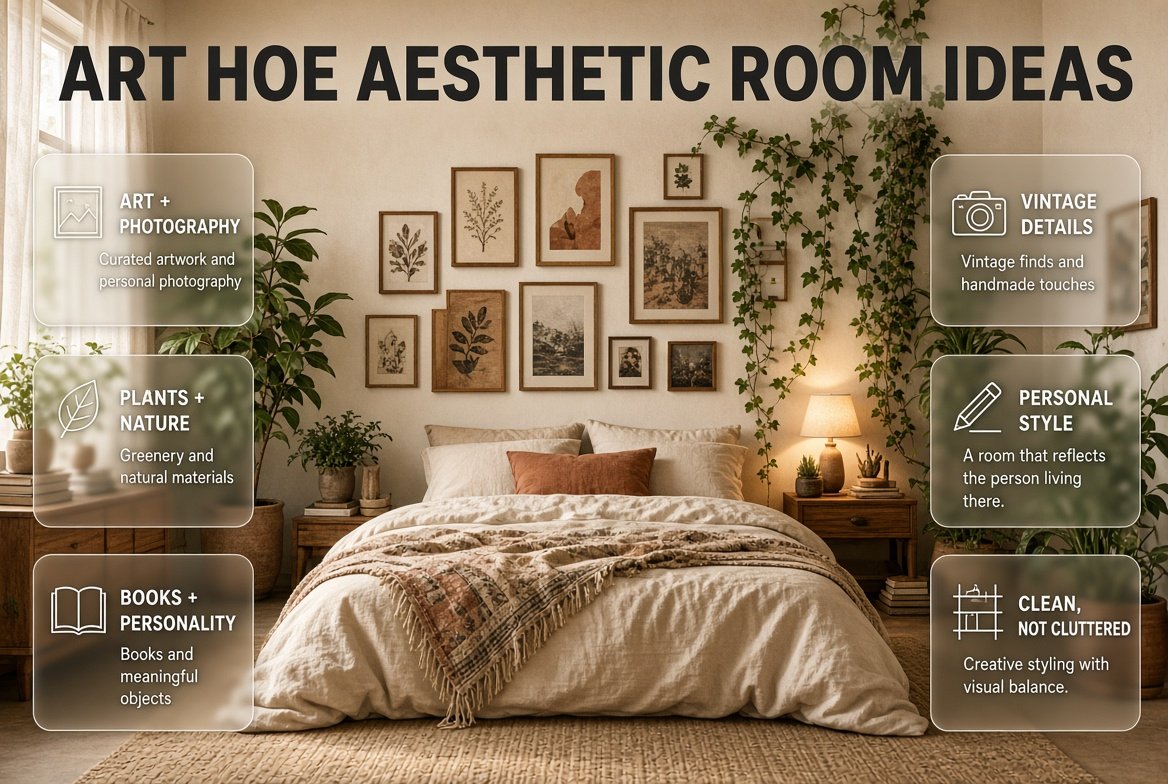
The art hoe aesthetic isn’t about buying a matching collection of decorations or copying one room from Pinterest. It’s about combining art, plants, books, photography, natural materials, vintage finds, handmade details, and personal objects in a way that reflects the person living there.
You can create the look in a large bedroom, a tiny apartment room, a dorm, or even a rented space where you can’t make permanent changes. You can also build it slowly without spending a fortune.
If you’re looking for broader inspiration before starting your makeover, visit DesignMode24 Interior Design. The goal here, however, is much more specific: to show you exactly how to turn an ordinary bedroom into an artistic space without making it feel cluttered or staged.
This guide covers everything from colors and wall art to furniture, plants, lighting, bedding, books, storage, DIY decoration, budget ideas, small-room solutions, layout decisions, mistakes, and practical styling techniques.
What Is an Art Hoe Aesthetic Room?
An art hoe aesthetic room is a personal, creative bedroom that combines artistic expression with elements inspired by nature, photography, literature, vintage design, plants, handmade objects, and relaxed everyday living. Instead of following a rigid design formula, the style focuses on creating a room that feels collected, expressive, and connected to the owner’s interests.
The aesthetic often includes earthy or muted colors, botanical imagery, natural wood, indoor plants, artwork, books, photographs, textured fabrics, warm lighting, and second-hand or handmade objects.
However, there’s an important distinction between an artistic room and a room filled with random decorations.
A successful art hoe bedroom has visual intention.
The objects may look different from one another, but they still work together through color, scale, texture, repetition, or theme.
For example, a room might combine a modern desk, an old wooden nightstand, botanical artwork, a large leafy plant, neutral bedding, and several photography prints. None of these pieces has to match perfectly.
What connects them is the overall atmosphere.
The Main Characteristics of the Style
Most art hoe-inspired bedrooms contain some combination of:
- Artwork and paintings
- Botanical prints
- Photography
- Books and magazines
- Indoor plants
- Natural wood
- Thrifted furniture
- Handmade decorations
- Personal photographs
- Vintage accessories
- Neutral or earthy backgrounds
- Layered bedding
- Warm lighting
- Ceramic and woven objects
- Creative workspaces
- Open shelving
The exact combination depends on your personality.
A person who loves photography might build the room around photographs and cameras. Someone who loves painting might make their desk and artwork the focal point. A book lover might create a reading corner surrounded by books and plants.
That flexibility is what makes the aesthetic work so well.
What Colors Work Best for an Art Hoe Aesthetic Bedroom?
The best colors for an art hoe bedroom are generally warm, natural, muted, or slightly earthy. Cream, warm white, beige, olive, sage, terracotta, brown, rust, mustard, dusty blue, and warm gray all provide excellent foundations for artwork and greenery.
You don’t need to use every color.
In fact, choosing too many colors can make the room feel chaotic.
A better approach is to select a simple base palette and allow artwork and accessories to introduce occasional contrast.
| Base Color | Supporting Color | Accent Color |
|---|---|---|
| Warm white | Olive | Terracotta |
| Cream | Brown | Mustard |
| Beige | Sage | Rust |
| Warm gray | Dusty blue | Ochre |
| Pale green | Natural wood | Burgundy |
Warm White and Cream
Warm white is one of the easiest choices because it creates a clean background without feeling as cold as a stark white wall.
It works especially well if you’re planning a large gallery wall.
Cream is slightly softer and can make natural wood, plants, woven fabrics, and vintage accessories feel more cohesive.
Olive and Sage Green
Green naturally connects the room to plants and botanical artwork.
Sage creates a quieter atmosphere, while olive provides more depth.
Use green on:
- An accent wall
- Bedding
- Curtains
- Plant pots
- Small furniture
- Artwork
- Decorative cushions
Terracotta and Rust
Warm orange-brown tones can prevent a neutral bedroom from feeling flat.
You don’t need much.
A terracotta vase, cushion, blanket, print, or ceramic object can be enough.
Dusty Blue
If earthy greens and browns feel too warm, dusty blue provides a cooler counterbalance without making the room look overly modern.
Should You Paint the Entire Room?
Not necessarily.
If the bedroom is small, keeping the walls light may help maintain a sense of openness.
A single muted green, brown, or blue accent wall can provide enough personality while allowing artwork and furniture to remain the focus.
For more ideas about choosing and using color in interiors, explore the Paint Color section.
How Do You Create an Art Hoe Gallery Wall?
A gallery wall is one of the most recognizable ways to bring an artistic quality into a bedroom.
But don’t assume that a gallery wall means covering every inch of the wall.
The best arrangements usually contain one visual anchor surrounded by smaller pieces.
Start with one larger artwork.
Then introduce smaller pieces around it.
You can combine:
- Botanical illustrations
- Landscape paintings
- Black-and-white photography
- Abstract artwork
- Personal photographs
- Vintage posters
- Handwritten notes
- Magazine cutouts
- Sketches
- Postcards
- Small textile pieces
The variety creates character.
How Should You Arrange the Pieces?
Before hanging anything, put all the artwork on the floor.
Move the pieces around until the composition feels balanced.
A simple arrangement might look like:
       [Small Print]     [Photo]

             [Large Artwork]

 [Sketch]       [Botanical]       [Postcard]

             [Small Photograph]
The exact arrangement doesn’t matter.
What matters is maintaining enough breathing room.
If every piece touches another piece, the wall will feel crowded.
If everything is too far apart, the collection may look disconnected.
Should Gallery Wall Frames Match?
They don’t have to.
In fact, using different frame materials can make the room feel more collected.
You can mix:
- Natural wood
- Black frames
- White frames
- Thin metallic frames
- Vintage frames
- Simple clip frames
The artwork itself should provide some visual connection.
For example, if the frames vary dramatically, keep a few colors repeating across the artwork.
⭐ Expert Tip: Don’t buy artwork just because the seller labels it “art hoe.” Choose pieces you’d actually want to look at every day. Personal taste will make the room feel more authentic.
What Kind of Artwork Should You Use?
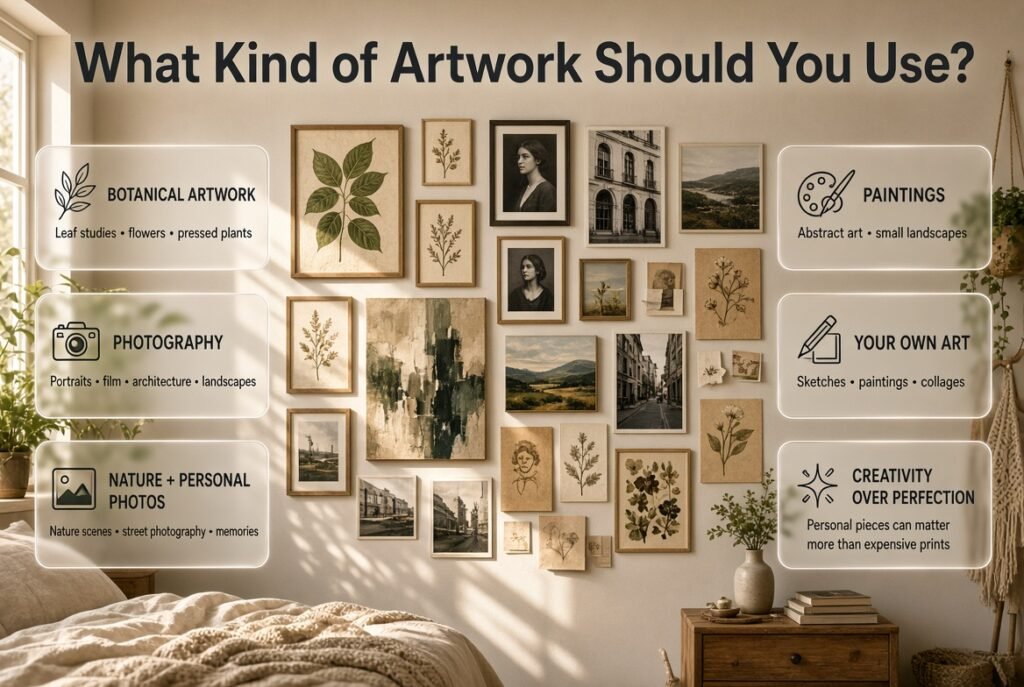
There is no mandatory type of artwork for this aesthetic.
The best choice is artwork that reflects your interests.
Botanical Artwork
Leaf studies, flower illustrations, pressed plants, and botanical drawings bring nature into the room without requiring a large number of decorative objects.
Photography
Photography works particularly well because it can feel personal and editorial at the same time.
Consider:
- Black-and-white portraits
- Film photography
- Architecture
- Landscapes
- Street photography
- Nature photography
- Personal photographs
Paintings
Abstract paintings and small landscapes can introduce color and texture.
You don’t need expensive originals.
A small painting you create yourself may have greater emotional value than an expensive print.
Personal Artwork
Your own sketches, paintings, collages, and experimental pieces are especially valuable.
Don’t worry about perfection.
An art-inspired room should leave space for creativity rather than only displaying professionally produced work.
How Do Plants Fit Into an Art Hoe Bedroom?
Plants are one of the easiest ways to make an art hoe bedroom feel natural and alive.
They add color, organic shapes, texture, and height.
Instead of placing all your plants on one shelf, distribute them throughout the room.
Try:
- A tall plant beside the bed
- A hanging plant near a window
- A small plant on the desk
- A trailing plant on a shelf
- A compact plant on the nightstand
This creates visual layers.
Good Indoor Plants to Consider
Depending on your light and maintenance preferences, options can include:
- Pothos
- Snake plants
- Spider plants
- ZZ plants
- Monstera
- Ferns
- String plants
- Small herbs
The important thing is not to choose a plant only because it looks good.
Check its light and watering requirements first.
A healthy plant will always contribute more to a room than an attractive plant that is struggling in the wrong location.
💡 Pro Tip: If your bedroom has limited floor space, use hanging planters, wall shelves, and narrow plant stands rather than filling the walking area with pots.
What Furniture Works With the Art Hoe Aesthetic?
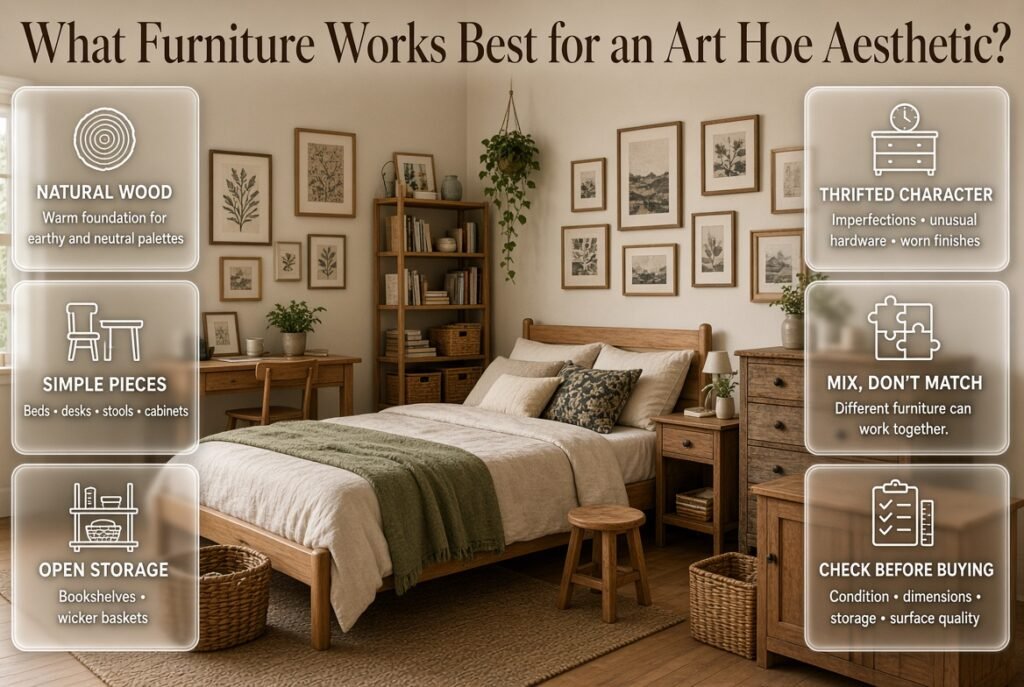
Furniture should provide a calm foundation rather than compete with the artwork.
Natural wood is particularly useful because it adds warmth and works with both earthy and neutral palettes.
Consider:
- Simple wooden bed frames
- Vintage nightstands
- Wooden desks
- Open bookshelves
- Small stools
- Wicker storage baskets
- Second-hand dressers
- Simple cabinets
Matching furniture isn’t required.
A modern desk can sit comfortably beside an older wooden nightstand if their proportions work together.
That mixture can actually make the room feel more authentic.
Why Thrifted Furniture Works So Well
Second-hand furniture often has small imperfections, unusual hardware, worn finishes, and visual character.
Those details can make a room feel collected rather than manufactured.
When buying used furniture, focus on:
- Structural condition
- Useful dimensions
- Storage capacity
- Surface quality
- Compatibility with the room
You can always change the finish later.
You can’t easily fix furniture that is badly constructed or the wrong size.
For practical renovation and improvement advice, explore Practical Home Improvement Guides.
How Should You Style the Bed?
The bed is usually the largest object in a bedroom, so it has a major influence on the overall look.
Instead of creating a perfectly matching bedding set, layer different textures.
A simple combination might include:
- Cream cotton sheets
- Neutral duvet
- Olive throw
- Rust-colored cushion
- Woven blanket
- Two or three differently textured pillows
Natural fabrics such as cotton and linen work particularly well because they look relaxed rather than overly polished.
Should Bedding Be Neutral?
Neutral bedding is the easiest foundation because it allows artwork and accessories to change without forcing you to redesign the whole room.
For example:
Cream walls + white bedding + olive throw + terracotta cushion
creates a cohesive palette with very little effort.
If your artwork is mostly neutral, you can use stronger bedding colors.
If the artwork is already colorful, keep the bedding quieter.
This simple relationship prevents visual competition.
How Important Is Lighting?
Lighting can completely change the mood of an art hoe bedroom.
A room with beautiful furniture and artwork can still feel unpleasant if it’s illuminated only by a harsh overhead light.
Instead, use multiple smaller light sources.
Try:
- Bedside lamps
- Warm table lamps
- Floor lamps
- Paper lanterns
- String lights
- Reading lights
- Small accent lights
The goal is layered lighting.
During the day, natural light can illuminate artwork and plants.
At night, warm lamps can create a softer atmosphere.
Avoid relying on decorative string lights as the room’s only source of functional lighting. They’re useful for ambience, but you still need practical illumination for reading, working, and moving around safely.
How Can You Make an Art Hoe Room on a Small Budget?
You don’t need a large decorating budget.
In fact, buying everything at once can make the room look generic.
Start with what you already own.
Before shopping, walk around your home and look for objects that could be repurposed.
An old frame can hold a new print.
A wooden chair can become a plant stand.
A glass jar can become a simple vase.
An unused shelf can become an artwork display.
Affordable Art Hoe Room Ideas
- Print your own photography
- Frame sketches
- Thrift artwork frames
- Buy second-hand furniture
- Create pressed-flower art
- Paint small canvases
- Reuse glass jars
- Make a photo collage
- Display postcards
- Rearrange books
- Paint old plant pots
- Repurpose fabric as wall art
- Use existing objects in new locations
A room developed slowly often feels more authentic than one decorated in a single shopping trip.
You discover things naturally.
Then the room evolves with you.
For more affordable decorating strategies, see Easy Decorating Tips for Every Budget.
What DIY Decorations Work Best?
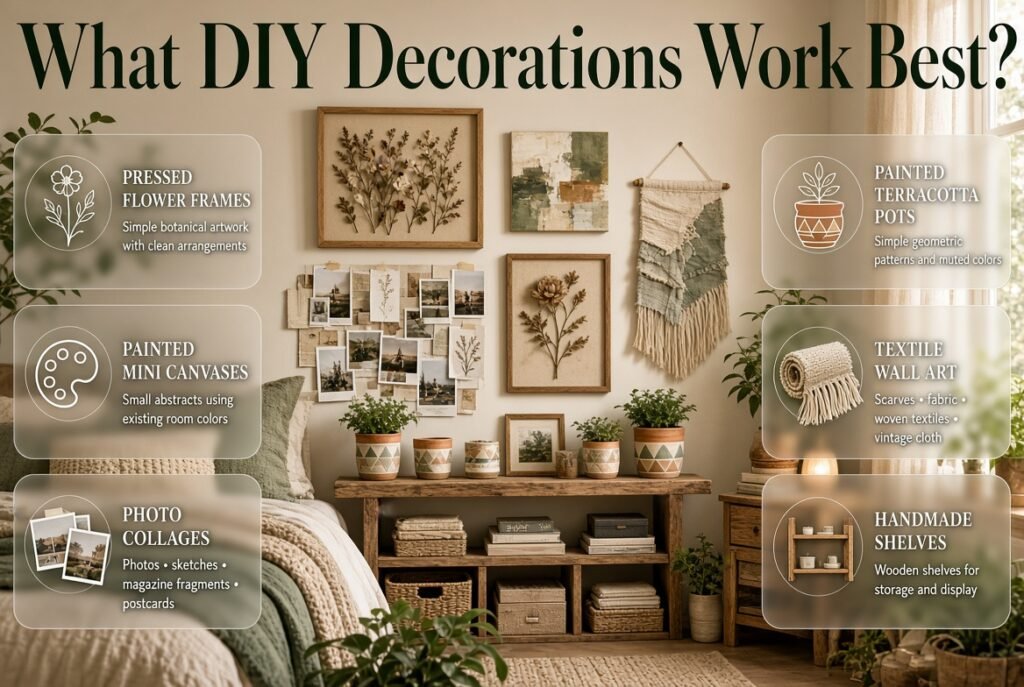
DIY decoration fits the aesthetic particularly well because creativity is more important than perfection.
Pressed Flower Frames
Pressed flowers can become simple botanical artwork.
Use a minimal frame and keep the arrangement clean.
Painted Mini Canvases
Small abstract paintings are easy to create and can repeat the colors already present in your bedroom.
Photo Collages
Combine personal photographs with sketches, magazine fragments, postcards, and handwritten elements.
Painted Terracotta Pots
Plain pots can be customized with simple geometric patterns or muted colors.
Textile Wall Art
A beautiful scarf, fabric sample, woven textile, or vintage cloth can become wall decoration.
Handmade Shelves
If you’re comfortable with basic DIY work, simple wooden shelves can provide both storage and display space.
For additional project inspiration, browse DIY Home Projects.
How Do You Make a Small Bedroom Look Art Hoe?
Small bedrooms need editing, not more decoration.
The goal is to create visual interest without sacrificing floor space.
Use vertical surfaces whenever possible.
Install or use:
- Floating shelves
- Picture ledges
- Wall-mounted storage
- Hanging plants
- Narrow bookcases
- Pegboards
- Vertical artwork
Keep the area around the bed relatively clear.
A small room doesn’t need twenty decorative objects.
Three or four meaningful focal points can be enough.
A Simple Small-Room Formula
LIGHT WALLS
    ↓
ARTWORK
    ↓
VERTICAL STORAGE
    ↓
PLANTS + BOOKS
    ↓
WARM LIGHTING
    ↓
PERSONAL DETAILS
This creates visual depth without consuming too much floor area.
For more ideas about organizing limited spaces, explore Smart Storage and Organization Ideas.
How Do Books Fit Into an Art Hoe Bedroom?
Books can function as both useful objects and visual elements.
Open shelving makes books easy to access and gives the room a lived-in feeling.
Display books that you actually read.
Good categories include:
- Art books
- Photography books
- Poetry
- Literature
- Design books
- Nature books
- Travel books
- Sketchbooks
Don’t buy books only because their covers fit your color scheme.
That can make the room feel staged.
A genuinely personal bookshelf should tell visitors something about you.
You can stack several books horizontally and stand others vertically to create variation.
Add a small plant or ceramic object between groups to prevent the shelf from looking like a solid block.
How Do Personal Objects Make the Room Better?
Personal objects are what separate an art hoe-inspired room from a generic bedroom decorated according to a trend.
Display things connected to your experiences.
For example:
- Travel photographs
- Concert tickets
- Handwritten notes
- Old cameras
- Family objects
- Sketchbooks
- Favorite books
- Handmade ceramics
- Postcards
- Small souvenirs
These objects don’t have to be valuable.
Their importance comes from the story behind them.
A scratched camera from a memorable trip may be more meaningful than an expensive decorative camera purchased purely for appearance.
That’s the kind of imperfection that makes an artistic room feel real.
How Do You Create an Art Hoe Desk Setup?
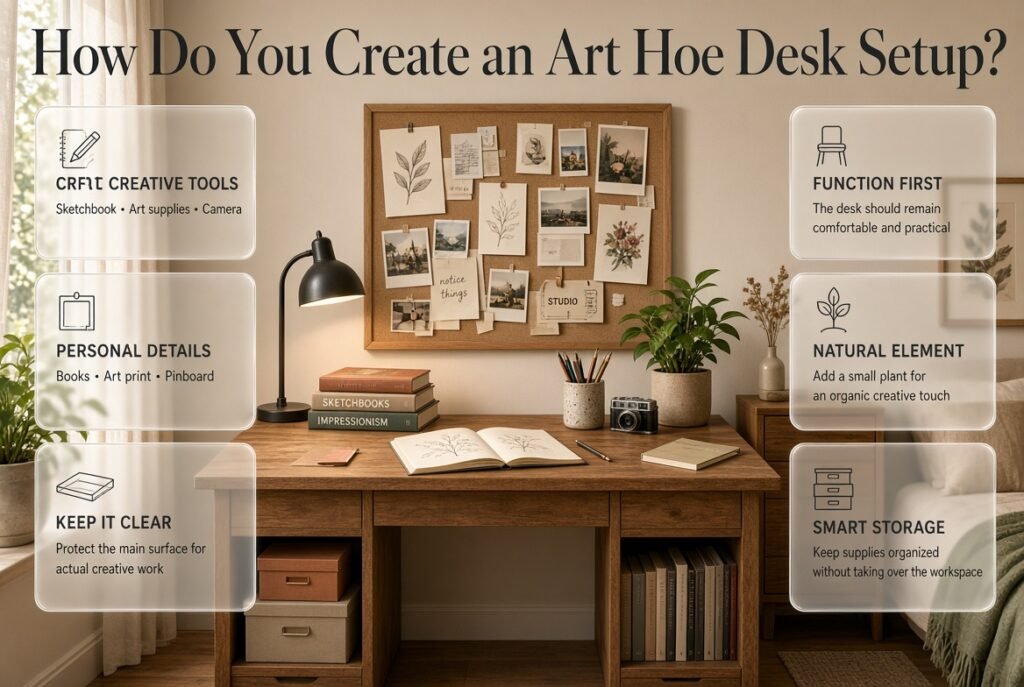
A desk is an important feature if you draw, paint, study, write, photograph, or work creatively.
Keep the functional surface reasonably clear.
Then add a few visual elements.
Consider:
- Small desk lamp
- Plant
- Sketchbook
- Ceramic pencil holder
- Art print
- Books
- Camera
- Organized art supplies
- Pinboard
The desk should support creativity rather than become a decorative display that you can’t actually use.
Practical Desk Layout
[ ART / PINBOARD ]

     [LAMP]
[BOOKS] [CLEAR WORK AREA] [PLANT]

      [STORAGE]
The center should remain available for actual work.
How Can You Use White Decorative Objects?
White decorative objects can be extremely useful when your room already contains strong colors, artwork, and plants.
They create visual breathing space.
For example, a white ceramic vase can sit beside a colorful painting without competing with it.
White sculptures, ceramics, small trays, and minimalist objects can also add shape without introducing another color.
Explore White Decorative Objects if you want to use neutral accessories to balance a more expressive room.
The important thing is moderation.
Too many white accessories can make the room feel like a showroom.
Use them as punctuation rather than filling every surface.
How Do You Make the Room Feel Collected Instead of Cluttered?
This is one of the most important design challenges.
An art hoe room can easily cross the line from creative to chaotic.
The solution is visual hierarchy.
Not every object should demand attention.
Choose:
- One or two major artworks
- One dominant plant
- One main furniture feature
- Several supporting objects
- A few personal details
Then allow empty space around them.
The 60–30–10 Approach
You can loosely think about the room this way:
60% — base colors and major surfaces
30% — secondary furniture, textiles, and supporting colors
10% — stronger accents and personal objects
This isn’t a strict design law.
It’s simply a useful way to prevent every item from competing for attention.
Art Hoe Room Ideas for Different Personalities
One of the biggest advantages of the aesthetic is its flexibility.
For the Nature Lover
Use:
- Botanical prints
- Lots of greenery
- Natural wood
- Woven baskets
- Earthy bedding
- Dried flowers
Keep the color palette close to greens, creams, browns, and muted terracotta.
For the Artist
Make the creative process visible.
Include:
- Easel
- Canvases
- Sketchbooks
- Art supplies
- Paintings
- Creative desk
- Mood board
Don’t hide every unfinished project.
A working studio quality can make the room feel authentic.
For the Book Lover
Prioritize:
- Open shelving
- Reading chair
- Floor lamp
- Stacked books
- Literary artwork
- Comfortable bedding
A dedicated reading corner can become the room’s strongest feature.
For the Photographer
Use:
- Personal photographs
- Film cameras
- Contact sheets
- Black-and-white prints
- Photo books
- Small display shelves
For the Minimal Creative
Use fewer objects.
Choose one large artwork, one large plant, a few books, natural furniture, and carefully selected accessories.
This version proves that an artistic room doesn’t need to be crowded.
How Can You Combine Modern and Vintage Furniture?
Modern and vintage pieces can work together extremely well.
The secret is not matching age.
It’s matching scale and visual weight.
For example:
- Modern white desk + vintage wooden chair
- Contemporary bed + antique nightstand
- Simple bookshelf + vintage ceramic collection
- Modern lamp + old wooden dresser
If one piece is visually heavy, balance it with something simpler nearby.
This keeps the room eclectic without becoming random.
Common Art Hoe Bedroom Mistakes to Avoid
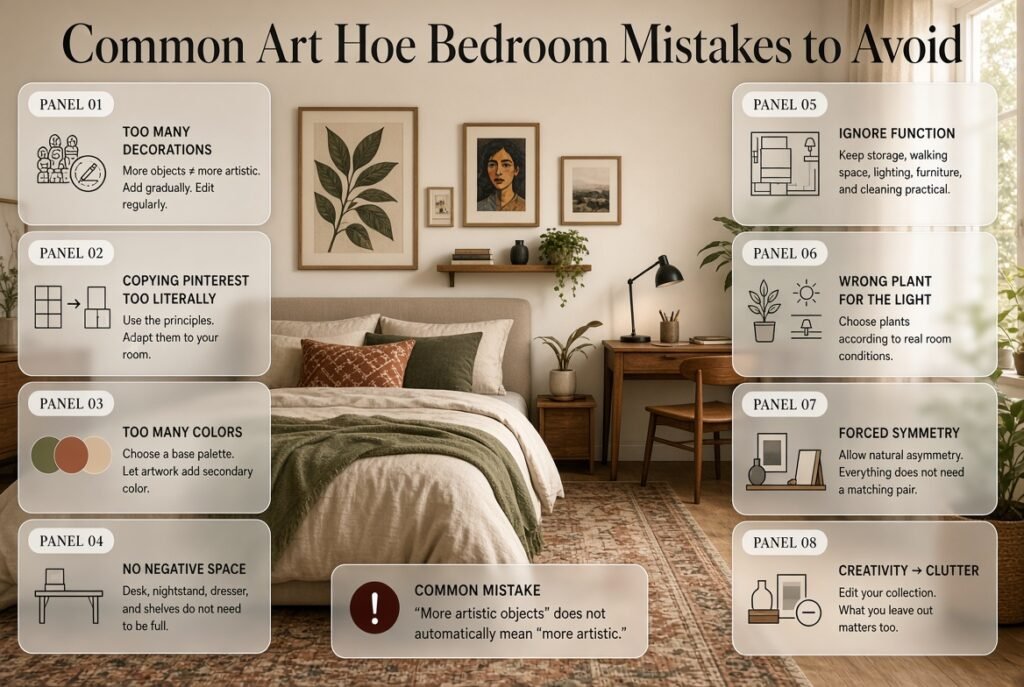
1. Buying Too Many Decorations
People often assume that an artistic room needs lots of objects.
It doesn’t.
Too many accessories make the room difficult to clean and visually exhausting.
Better approach: Add objects gradually and remove anything that no longer contributes.
2. Copying Pinterest Too Literally
An online bedroom photograph is usually designed around one person’s room, lifestyle, lighting, and photography.
Your bedroom has different proportions and needs.
Better approach: Copy the principles, not the exact room.
3. Using Too Many Colors
Eclectic design still needs visual control.
Better approach: Choose a base palette and allow artwork to introduce secondary colors.
4. Making Every Surface Decorative
Your desk, nightstand, dresser, and shelves don’t all need to be full.
Better approach: Leave negative space.
5. Ignoring Function
A beautiful bedroom that is uncomfortable isn’t successful interior design.
You still need:
- Good storage
- Clear walking space
- Comfortable lighting
- Functional furniture
- Easy cleaning
6. Choosing Plants Without Considering Light
A plant that needs bright indirect light won’t thrive in a dark corner simply because it looks good there.
Better approach: Match plants to real room conditions.
7. Making Everything Perfectly Symmetrical
A little asymmetry can make the room feel more natural.
Don’t force every object into a perfect pair.
8. Turning Creativity Into Clutter
This is perhaps the biggest mistake.
A creative room still needs editing.
⚠ Common Mistake: “More artistic objects” doesn’t automatically mean “more artistic.” Strong design depends on what you leave out as much as what you display.
How Do You Improve Storage Without Losing the Aesthetic?
Storage should hide visual clutter while keeping your favorite objects accessible.
Use closed storage for:
- Cables
- Extra clothing
- Documents
- Cleaning supplies
- Everyday miscellaneous items
Use open storage for:
- Books
- Plants
- Artwork
- Ceramics
- Carefully selected personal objects
Woven baskets are particularly useful because they provide practical storage while supporting the natural character of the room.
If your bedroom is very small, prioritize multifunctional furniture.
A bed with drawers, a storage bench, or a desk with integrated shelving can reduce the amount of separate furniture you need.
For more room-by-room organization and design ideas, explore Room-by-Room Interior Design Inspiration.
Can the Art Hoe Aesthetic Work in a Rental?
Yes.
You don’t need to repaint every wall or make permanent alterations.
Use removable and freestanding solutions.
Good rental-friendly options include:
- Removable wall hooks
- Picture ledges
- Leaning artwork
- Freestanding shelves
- Tabletop displays
- Floor plants
- Textiles
- Decorative lamps
Large artwork can also lean against a wall on top of a dresser or shelf.
This creates a relaxed gallery feeling without drilling multiple holes.
Can the Art Hoe Aesthetic Work in a Hotel-Inspired Bedroom?
The style can also influence hospitality-inspired spaces when adapted carefully.
For example, artistic prints, natural wood, soft textiles, plants, and handmade accessories can make a guest bedroom feel warmer and less generic.
If you’re researching furniture concepts for younger guests and hospitality environments, you can also explore Children’s Hotel Furniture.
The key is to adapt the visual language to the actual user.
A personal bedroom can contain fragile artwork and loose decorative objects.
A hotel room requires much greater attention to durability, maintenance, safety, and cleaning.
Expert Advice for a More Sophisticated Art Hoe Bedroom
If you want the room to feel intentional rather than simply decorated, focus on five principles:
1. Scale
Use a mixture of large, medium, and small objects.
A wall covered exclusively with tiny prints often looks busier than one large artwork surrounded by smaller pieces.
2. Repetition
Repeat a color, material, or shape.
If your artwork contains olive green, echo it in one cushion or plant pot.
3. Contrast
Combine different textures.
For example:
wood + linen + ceramic + greenery + paper
The contrast creates depth.
4. Negative Space
Leave some areas visually quiet.
Empty space gives important objects room to breathe.
5. Personal Meaning
Prioritize objects connected to your interests and experiences.
This is the element that can’t be replicated by copying a trend.
A Useful Professional Test
Stand in the doorway and look at the room as a whole.
Ask:
- Where does my eye go first?
- Is anything visually overwhelming?
- Is there enough empty space?
- Can I move comfortably?
- Are the colors balanced?
- Does the room actually feel like me?
If you can’t answer those questions positively, don’t immediately buy more decoration.
Edit first.
A Step-by-Step Art Hoe Bedroom Makeover
Step 1: Remove the Visual Noise
Take out unnecessary objects.
Why it matters: You need a clear starting point.
Step 2: Decide on the Color Foundation
Choose two or three major colors.
Professional advice: Start with walls, flooring, furniture, and bedding before accessories.
Step 3: Establish the Bed
Make the bed comfortable first.
Then layer textures and colors.
Step 4: Select a Focal Wall
Choose the wall that will receive the strongest artwork.
Step 5: Create the Gallery Arrangement
Lay everything on the floor before hanging.
Step 6: Add Greenery
Introduce plants at different heights.
Step 7: Introduce Books
Display your real interests.
Step 8: Add Personal Objects
Use photographs, souvenirs, handmade pieces, and meaningful items.
Step 9: Improve Lighting
Add warm, functional light sources.
Step 10: Organize Storage
Hide everyday clutter while keeping selected objects visible.
Step 11: Step Back and Edit
Remove anything that feels unnecessary.
The last step is often the one people skip.
How Can You Use the Style Without Making the Bedroom Feel Like a Theme?
This is an important distinction.
A theme says:
“I bought objects that represent an aesthetic.”
A well-designed room says:
“This is how I naturally live, and my surroundings reflect it.”
Don’t purchase a fake vintage camera if you don’t care about photography.
Don’t fill shelves with books you won’t read.
Don’t buy plants you can’t maintain.
Don’t display art you don’t actually like.
Instead, let the room develop from your real interests.
If you love drawing, show your drawings.
If you love plants, make greenery prominent.
If you love books, let your shelves become part of the design.
If you love photography, build a gallery around your own photographs.
That approach creates a room that remains meaningful even when the trend changes.
What Makes an Art Hoe Room Look Expensive?
You don’t need expensive products.
A sophisticated appearance usually comes from editing, proportion, consistency, and material contrast.
A room can look much better with:
- Fewer accessories
- Better artwork placement
- Consistent color repetition
- Natural materials
- Proper lighting
- Clean surfaces
- Good furniture proportions
A cheap ceramic vase can look elegant when displayed alone on a clean shelf.
An expensive vase can look ordinary when surrounded by twenty competing objects.
The difference is composition.
This is why thoughtful arrangement is often more valuable than a large decorating budget.
Art Hoe Room Ideas for Different Room Sizes
| Room Type | Best Strategy | Avoid |
|---|---|---|
| Small bedroom | Vertical storage + fewer objects | Large bulky furniture |
| Medium bedroom | Gallery wall + reading corner | Filling every wall |
| Large bedroom | Larger artwork + layered furniture | Tiny objects everywhere |
| Dorm room | Removable décor + textiles | Permanent modifications |
| Rental | Freestanding displays | Excessive wall drilling |
| Creative studio | Open work area + display | Decorative clutter on desk |
The room’s size should influence the quantity and scale of decoration.
Don’t put small furniture into a large room simply because it looks cute in a photograph.
Similarly, don’t put oversized furniture into a tiny bedroom because the style looks good online.
How Do You Keep an Art Hoe Room Clean?
A creative room still needs a cleaning system.
Use simple routines.
Daily
- Make the bed
- Put clothes away
- Clear the desk
- Return books to their place
Weekly
- Dust shelves
- Clean decorative objects
- Water plants according to their needs
- Clean mirrors
- Vacuum or sweep
Monthly
- Review clutter
- Remove unused objects
- Rearrange artwork if needed
- Check plants
- Reorganize storage
A room becomes much easier to maintain when every object has a logical home.
What is an art hoe aesthetic room?
An art hoe aesthetic room is a creative, expressive bedroom built around art, nature, color, personal interests, and a relaxed lived-in atmosphere. Instead of following a perfectly coordinated furniture set, the style encourages a mixture of artwork, plants, books, photographs, handmade pieces, vintage finds, and visible creative supplies. Gallery walls, botanical elements, warm lighting, colorful accents, sketchbooks, and painted or thrifted furniture are particularly common features.
The important thing is that the room should feel like a real creative person’s space, not a showroom designed around one trend. Your own drawings, favorite books, photographs, postcards, collected objects, or unfinished creative projects can make the room much more convincing than expensive decorative pieces.
Key elements to consider:
Artwork and personal photographs
Indoor plants or botanical decorations
Warm, natural-looking lighting
Vintage or secondhand furniture
Books, sketchbooks, and creative supplies
Colorful but intentional accessories
Handmade or DIY decorations
The strongest art hoe rooms usually have personality rather than perfection. A slightly imperfect gallery wall or a desk covered with genuinely used art supplies can actually make the space feel more authentic.
What colors are best for an art hoe aesthetic bedroom?
The best colors for an art hoe aesthetic bedroom are warm, earthy, cheerful, and artistic tones, often balanced against a neutral background. White, cream, beige, soft green, sunflower yellow, muted red, warm blue, ochre, and terracotta can all work well. The goal is not to use every color at once but to create enough contrast for artwork and personal objects to stand out.
A simple approach is to choose one light base color for the walls and introduce stronger colors through bedding, artwork, plants, rugs, cushions, and smaller accessories. This gives you flexibility because you can change the decorative elements later without repainting the entire room.
For example, a warm white wall + natural wood furniture + green plants + sunflower yellow accents + colorful artwork creates a recognizable art hoe atmosphere without making the bedroom feel visually chaotic.
Good palette combinations include:
Cream + sunflower yellow + leaf green
White + cobalt blue + warm wood
Beige + terracotta + olive green
Soft yellow + white + muted red
Warm white + botanical green + colorful artwork
💡 Pro Tip: If your room is already small or receives limited natural light, keep the walls relatively light and introduce stronger colors through removable accessories. This keeps the space bright while still giving you plenty of creative expression.
For more guidance on choosing colors that work together, you can also explore Paint Color Ideas rather than choosing wall colors based solely on what looks attractive in an inspiration photograph.
How do I make my bedroom look art hoe on a budget?
You do not need an expensive renovation to create an art hoe bedroom. In fact, the style naturally works well with DIY decorations, thrifted furniture, inexpensive art prints, plants, secondhand books, postcards, and personal collections. The focus is on creativity and individuality, so thoughtful low-cost pieces can often look better than generic expensive decor.
Start with the things you already own. Print your favorite photographs, frame sketches, display postcards, reuse old jars as plant containers, or turn a simple wooden shelf into a display for books and artwork. You can also rearrange existing furniture before purchasing anything new.
A gallery wall is one of the easiest ways to make a dramatic difference without spending heavily. Instead of buying matching frames, combine inexpensive prints with postcards, photographs, sketches, magazine cutouts, and your own artwork.
Budget-friendly ideas:
Create your own artwork
Thrift or repaint an old side table
Use postcards as wall art
Display books as decoration
Prop artwork against shelves instead of framing everything
Grow inexpensive plants from cuttings
Use washi tape for temporary displays
Repurpose glass jars as small vases
Make a DIY photo or sketch wall
⭐ Expert Tip: Spend your money on one or two visually important pieces rather than filling the room with inexpensive decorations. A beautiful vintage chair, interesting lamp, or large artwork can create more character than twenty random accessories.
You can also find more practical low-cost decorating approaches through Easy Decorating Tips for Every Budget, particularly if you are updating the room gradually rather than completing everything in one weekend.
How can I create an art hoe gallery wall without making my room look cluttered?
The easiest way to create a successful art hoe gallery wall is to mix different types of visual material while maintaining some sense of balance. Combine paintings, sketches, photographs, botanical illustrations, postcards, typography, and personal artwork instead of using identical prints throughout the wall. Gallery walls are a major part of the aesthetic because they allow the room to feel like an evolving personal collection.
The mistake is assuming that an art hoe gallery wall has to be completely random. It can be eclectic without being chaotic. Before attaching anything permanently, place your pieces on the floor and experiment with different arrangements.
Keep larger artwork surrounded by smaller pieces, vary the shapes, and leave enough breathing room between clusters. If several pieces contain strong colors, balance them with simpler photographs or neutral sketches.
A practical gallery-wall formula:
Start with one larger focal piece.
Add two or three medium-sized artworks.
Fill smaller gaps with photographs or postcards.
Introduce one or two botanical elements.
Check the overall color balance.
Leave some negative space rather than covering every inch.
⚠ Common Mistake: Using too many unrelated colors, quotes, posters, and decorative objects simply because they are individually attractive. The room needs a visual connection between pieces.
If you’re renting, use removable hanging methods or lean artwork against furniture rather than permanently attaching everything to the wall. This gives you the freedom to change the collection as your taste develops.
How do you make an art hoe room feel aesthetic but still functional?
The best art hoe room is not simply decorated to look good in photographs; it should support the way you actually live, study, create, relax, and sleep. Keep frequently used objects accessible, give art supplies a designated place, maintain comfortable lighting, and make sure decorative pieces do not interfere with movement or everyday routines.
A creative room can contain plenty of visual interest without becoming difficult to use. For example, a desk can display brushes, sketchbooks, and a small plant while still leaving enough clear surface for studying or drawing. Similarly, books can become part of the decoration when they are arranged on accessible shelves rather than piled randomly across the floor.
Storage is especially important because art supplies, clothing, books, stationery, and decorative objects can quickly create visual clutter.
Make functionality part of the aesthetic:
Use open shelves for attractive books and objects.
Keep everyday art supplies in jars, trays, or containers.
Use under-bed storage for less attractive items.
Keep the desk surface partially clear.
Choose furniture that provides useful storage.
Leave clear walking paths.
Use warm task lighting for creative work.
Rotate artwork instead of continuously adding more.
📌 Quick Tip: Think of your room as a small personal studio. Everything visible should either inspire you, serve a practical purpose, or contribute meaningfully to the atmosphere.
For more organization ideas, Smart Storage and Organization Ideas can help you keep an expressive room from turning into an overcrowded one.
The final goal is a bedroom that feels creative, personal, comfortable, and genuinely lived in. That balance is what separates a thoughtful art hoe aesthetic room from a collection of trend-based decorations.
Conclusion
Creating an art hoe aesthetic room is less about copying a particular Pinterest look and more about building a space that reflects your creativity, interests, and personality. Artwork, plants, books, photographs, vintage furniture, warm lighting, and handmade details can all contribute to the style, but the room becomes truly successful when these elements feel connected to the person living there.
You do not need a large bedroom or an unlimited decorating budget to achieve the look. A carefully arranged gallery wall, a few meaningful objects, natural textures, and a comfortable place to create can completely change the atmosphere. Even inexpensive or secondhand pieces can work beautifully when they are chosen with intention.
The key is to find the right balance between artistic expression and everyday functionality. Keep useful items accessible, give creative supplies a proper home, and avoid filling every empty surface simply because the aesthetic encourages collecting. A room should inspire you without making daily life more difficult.
Most importantly, let the space evolve. Your artwork, books, plants, colors, and personal collections can change as your interests change. That sense of growth is one of the most appealing parts of the art hoe aesthetic.
A well-designed room does not have to look perfect. It should feel personal, creative, comfortable, and genuinely lived in. When your bedroom tells your story instead of simply following a trend, the result will feel far more authentic—and much more likely to remain a space you enjoy for years.

Leave a Reply