
Intoduction
Circular Furniture and Interior Design | A beautiful home can become expensive and wasteful when every change means replacing something that is still perfectly usable. A sofa gets thrown away because its fabric looks dated. A dining table is replaced because its finish is scratched. A wardrobe is removed during a renovation even though its basic structure remains strong. Furniture can end up having a much shorter life than it actually needs.
That is where circular furniture and interior design offers a different way of thinking.
Instead of treating furniture as something you buy, use, and eventually throw away, circular design looks at the complete life of an item. How was it made? How long can it last? Can it be repaired? Can its appearance be updated? Can it adapt when your lifestyle changes? Can another person use it when you no longer need it?
The idea isn’t about making your home look unfinished, old-fashioned, or overly focused on sustainability. Circular interiors can be elegant, contemporary, luxurious, minimalist, traditional, or completely personal.
The difference is in how decisions are made.
This guide explains how circular furniture works, how to apply circular thinking to interior design, which materials and furniture characteristics matter, how to plan each stage of a room, what mistakes to avoid, and how to make an existing home more adaptable without constantly buying new things.
What Is Circular Furniture and Interior Design?
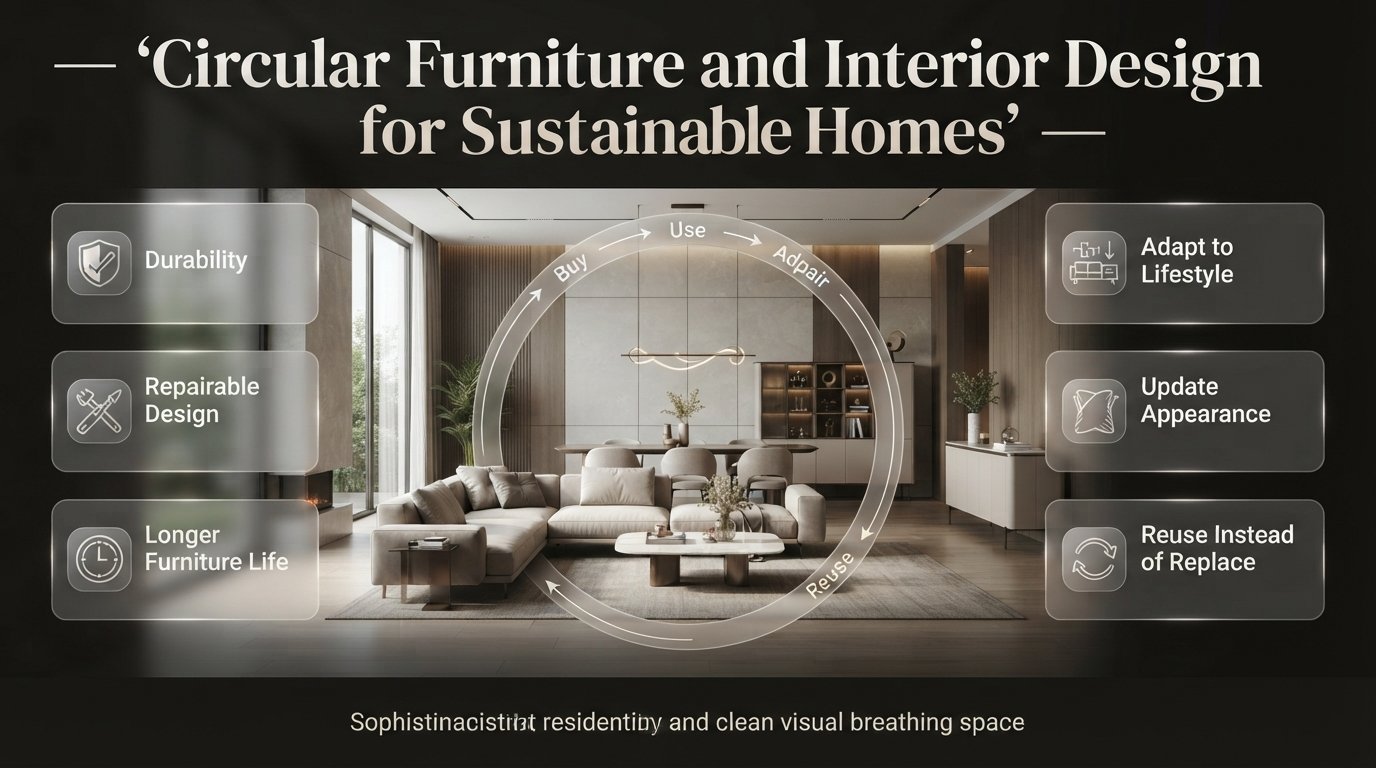
Circular furniture and interior design is an approach that aims to keep furniture, materials, and interior components useful for as long as possible through durability, maintenance, repair, adaptation, reuse, refurbishment, and responsible recovery.
In a traditional linear model, the process often looks like this:
Buy → Use → Replace → Dispose
Circular thinking changes the sequence:
Choose → Use → Maintain → Repair → Adapt → Reuse → Refurbish → Recover
The important difference is that the end of one use doesn’t automatically have to mean the end of the product.
Imagine a solid dining table that develops scratches after several years. In a linear mindset, you might decide that the table is old and buy a new one. In a circular approach, you first ask whether the surface can be sanded or refinished.
The structure remains.
The material remains useful.
Only the part that needs attention is changed.
That simple decision illustrates the central idea behind circular interiors: preserve useful value instead of replacing an entire product unnecessarily.
Circular design also applies to interior elements beyond loose furniture. Cabinets, shelving, lighting, flooring components, hardware, doors, decorative materials, and even some built-in elements can be considered through the same life-cycle perspective.
Why Is Circular Interior Design Becoming More Important?
Furniture decisions affect more than the appearance of a room.
Every new item requires materials, manufacturing, transportation, packaging, installation, and eventually some form of disposal or recovery. When a product is replaced prematurely, all of those resources are effectively used again for something that may have been avoidable.
Circular design tries to slow that cycle.
There is also a practical financial reason to think this way.
A cheap piece that needs to be replaced repeatedly may cost more over time than a durable item that can be maintained for many years. The initial purchase price doesn’t tell you the complete cost of ownership.
For example, consider two sofas.
One costs less but has limited repair options and cannot easily be reupholstered. The other costs more initially but has a strong frame, replaceable components, removable covers, and readily available hardware.
If both are used for many years, the second sofa may offer greater long-term value even though its initial price is higher.
Circular thinking therefore isn’t simply about environmental responsibility. It can also encourage better purchasing decisions.
What Is the Difference Between Sustainable and Circular Furniture?
Sustainable furniture and circular furniture are closely connected, but they aren’t exactly the same.
Sustainable design often considers how responsibly materials are sourced, how products are manufactured, how much energy is used, and how environmental impact can be reduced.
Circular design adds another important question:
What happens to the furniture throughout its entire useful life?
A product may contain recycled material but still have poor repairability. Another product may use conventional materials but have exceptional durability, easy maintenance, replaceable parts, and a long service life.
This is why judging a product from one characteristic alone can be misleading.
| Consideration | Sustainable Thinking | Circular Thinking |
|---|---|---|
| Material sourcing | Important | Important |
| Manufacturing impact | Important | Important |
| Product lifespan | Considered | Central consideration |
| Repairability | Helpful | Highly important |
| Adaptability | Helpful | Highly important |
| Reuse | May be considered | Core principle |
| Refurbishment | May be considered | Core principle |
| End-of-life planning | Sometimes considered | Important from the beginning |
The strongest approach combines both perspectives.
You want furniture that is responsibly selected and useful for a long time.
What Are the Main Principles of Circular Furniture Design?
Circular furniture isn’t defined by one particular shape, material, or style. Several characteristics work together.
Durability Comes First
Furniture cannot be circular if it becomes unusable after a short period.
Durability should therefore be evaluated according to how the product will actually be used.
A decorative side table may not require the same construction as a dining chair used multiple times every day.
When evaluating furniture, look at:
- Frame construction
- Joinery
- Hardware
- Surface protection
- Weight capacity
- Upholstery quality
- Replacement parts
- Maintenance requirements
A durable product doesn’t necessarily have to be expensive. What matters is whether its construction is appropriate for its intended use.
Repairability Extends Useful Life
One damaged component shouldn’t automatically make the entire product obsolete.
Good circular furniture makes it reasonably practical to repair common points of failure.
For example, a chair is more useful over time if its joints can be tightened, its seat can be replaced, and its finish can be restored.
A cabinet with replaceable hinges has a different long-term potential from one where a failed hinge means replacing an entire door.
💡 Pro Tip: Before buying expensive furniture, ask a simple question: “If one part breaks in five years, what exactly can be replaced?” The answer can reveal how seriously the product has been designed for long-term use.
Adaptability Keeps Furniture Relevant
People don’t live exactly the same way for decades.
A spare bedroom may become a home office. Children grow. A family becomes smaller. Someone starts working from home. A living room may need to accommodate guests.
Furniture that can adapt to these changes doesn’t become obsolete as quickly.
Modular sofas, adjustable shelving, extendable tables, movable storage, and flexible desks are examples of furniture that can respond to changing requirements.
Disassembly Makes Future Changes Easier
Furniture that can be separated into components can be easier to move, repair, modify, refurbish, or recover.
This matters especially when a home is renovated or a family moves.
A large assembled piece may be difficult to transport through narrow doors or stairs. A product designed to come apart can be handled much more easily.
Disassembly also helps when individual materials need different future treatments.
How Should You Choose Circular Furniture for Your Home?
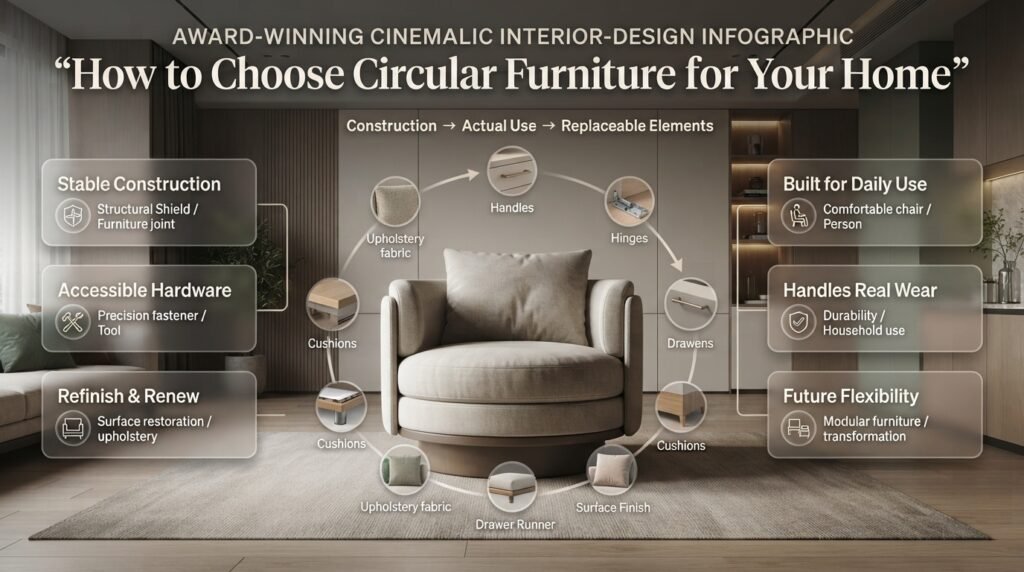
Choosing circular furniture doesn’t mean searching for products labeled “circular” and buying them automatically.
Instead, evaluate the furniture itself.
Check the Construction
Look at how the product is assembled.
Ask:
- Does it feel stable?
- Are joints secure?
- Can hardware be accessed?
- Are important components replaceable?
- Does the manufacturer provide spare parts?
- Can upholstery be renewed?
- Can surfaces be refinished?
These questions are often more useful than simply looking at the product description.
Consider the Furniture’s Actual Job
Don’t buy furniture based only on how attractive it looks in a showroom.
A beautiful chair that is uncomfortable or unsuitable for daily use is unlikely to have a long useful life.
Think about:
- Who will use it?
- How frequently?
- What kind of wear will it receive?
- Does it need to withstand children or pets?
- Will it be moved frequently?
- Does it need storage?
- Can it serve another purpose later?
Furniture should be selected for the life you actually live.
Look for Replaceable Elements
Some parts of furniture naturally wear faster than others.
Examples include:
- Upholstery
- Handles
- Hinges
- Drawer runners
- Feet
- Cushions
- Surface finishes
A product becomes more practical to maintain when these elements can be replaced without discarding the entire item.
Which Materials Work Well for Circular Furniture?
Material selection matters, but construction and maintenance should always be considered alongside the material itself.
Solid Wood
Solid wood can be repaired, sanded, refinished, and sometimes repurposed.
A well-made wooden table can change appearance several times during its useful life while maintaining its basic structure.
That makes wood particularly useful for furniture intended to remain in use for many years.
However, not every wooden product is automatically circular. Weak joinery, poor finishes, or unsuitable construction can still shorten its life.
Metal
Metal can provide strong structural performance for tables, shelving, chairs, cabinets, and other furniture.
It can also be useful when components are mechanically fixed rather than permanently bonded.
A metal frame paired with replaceable panels or upholstery can create a furniture system where individual components can be maintained separately.
Glass
Glass can be useful for tabletops, shelves, doors, and decorative applications.
Its durability depends heavily on correct specification, installation, and use.
Glass also requires careful handling because damage can create safety issues.
Reclaimed Materials
Reclaimed timber and other recovered materials can give interiors distinctive character while keeping existing resources in use.
But reclaimed doesn’t automatically mean suitable for every application.
Check:
- Structural condition
- Previous treatment
- Moisture exposure
- Contamination risks
- Surface condition
- Intended use
The best material is the one that is appropriate, safe, durable, and maintainable for the specific application.
How Do Finishes Affect Circular Interior Design?
Finishes are often overlooked because they seem cosmetic.
In reality, the finish can influence how long a furniture surface remains attractive and usable.
A surface that can be cleaned, repaired, touched up, or refinished offers more future flexibility than one that is difficult to restore.
This is particularly important in busy areas such as:
- Dining rooms
- Kitchens
- Entryways
- Children’s rooms
- Home offices
When selecting finishes, also consider indoor air quality and maintenance requirements. For related material considerations, see Low VOC Finishes for Healthier Interiors.
The goal isn’t simply to choose the most environmentally marketed finish. It is to choose a finish that performs appropriately and supports the intended lifespan of the furniture or interior surface.
How Can Circular Furniture Work in Different Interior Styles?
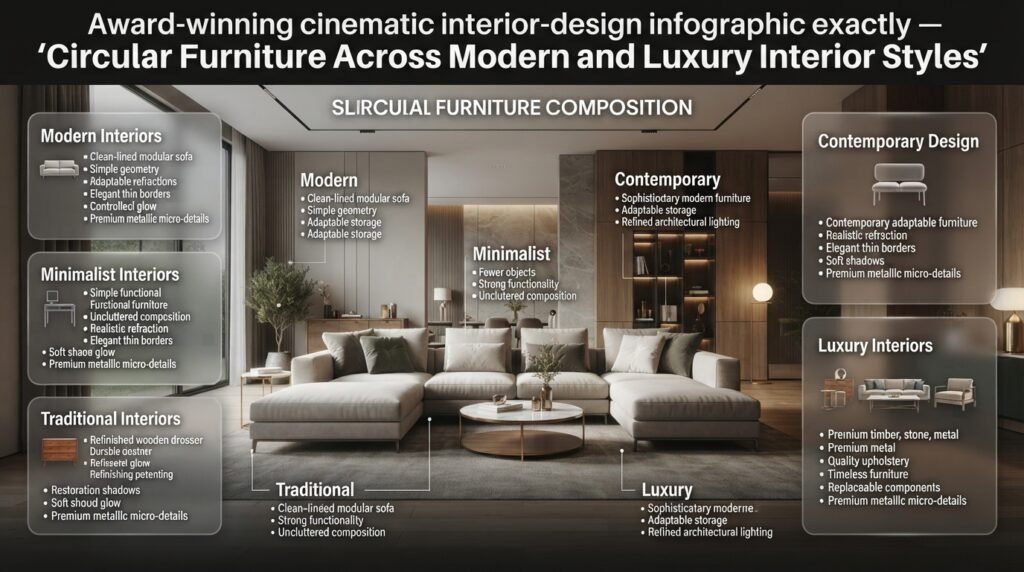
One common misunderstanding is that circular interiors have a specific appearance.
They don’t.
Modern Interiors
Modern spaces can use modular sofas, repairable tables, adaptable storage, durable upholstery, and simple furniture forms.
Clean-lined furniture is often particularly useful because it can remain visually relevant even when smaller decorative elements change.
Minimalist Interiors
Minimalism naturally provides an opportunity to think carefully about every purchase.
Instead of filling a room with temporary pieces, choose fewer items with strong functionality and long-term usefulness.
For wider interior planning ideas, the Interior Design section can help connect furniture decisions with layout, function, and overall room character.
Traditional Interiors
Traditional furniture often works well with circular principles because many classic forms are designed around repair, refinishing, and long service.
A wooden dresser, dining table, or cabinet can sometimes be restored instead of replaced.
Contemporary and Luxury Interiors
Circular design can also work in high-end interiors.
Premium spaces can use:
- High-quality timber
- Durable stone
- Metal
- Quality upholstery
- Timeless furniture
- Replaceable components
- Refined lighting
- Adaptable storage
Luxury doesn’t have to mean constant replacement.
A well-designed room can feel sophisticated while being built around long-term use.
How Can You Create a Circular Living Room?
The living room is one of the best places to introduce circular thinking because it contains several large furniture items.
Start with the pieces you already own.
Before replacing a sofa, inspect its frame, cushions, covers, and hardware.
If the frame is strong but the fabric is worn, reupholstery or replacement covers may solve the problem.
If the sofa is modular, individual sections may be rearranged or replaced rather than replacing the complete unit.
For tables, examine whether scratches or surface damage can be repaired.
For storage, consider whether shelves, doors, or handles can be changed.
A room refresh doesn’t always need to become a furniture replacement project.
How Can You Create a Circular Dining Room?
Dining rooms benefit from furniture that is built for repeated use.
A dining table should be selected according to household size, available space, and expected frequency of use.
Extendable tables can be especially useful because they can remain compact during normal days and expand for guests.
Dining chairs should be evaluated for structural strength and repairability.
If a chair becomes uncomfortable because its upholstery wears out, replacement fabric may be enough to give it another useful life.
A circular dining room also avoids buying excessive furniture for occasional events.
If you host large gatherings only a few times each year, flexible seating may be more practical than permanently filling the room with additional chairs.
How Can You Apply Circular Thinking to Bedrooms?
Bedrooms contain furniture that can remain useful for many years if properly selected.
Beds, wardrobes, dressers, bedside tables, and desks should be evaluated for both current and future needs.
A bed frame that can be dismantled and moved can remain useful through multiple homes.
A dresser with replaceable handles and repairable drawers can be refreshed without replacing its entire structure.
Wardrobes require particular attention because they are often expensive and closely connected to room dimensions.
If the storage system is adaptable, internal shelves and hanging arrangements can change as clothing requirements change.
This becomes even more important in rooms with unusual architecture. For example, the wardrobe design for sloped ceilings approach demonstrates why storage should respond to the room’s geometry rather than forcing a standard solution into an unsuitable space.
What About Furniture for Difficult Rooms?
Circular design doesn’t mean every room needs standard furniture.
In fact, difficult rooms can benefit significantly from adaptable furniture.
Angled walls, awkward corners, narrow passages, sloped ceilings, and unusual room proportions can make standard furniture inefficient.
Instead of repeatedly replacing pieces that don’t fit, measure the space carefully and select furniture that works with the architecture.
This is where Furniture for Rooms With Angled Walls can be useful when considering how furniture dimensions and room geometry interact.
The important principle is simple:
Adapt the furniture to the space where practical, but don’t create a complicated custom solution unless it provides genuine long-term value.
How Does Circular Design Apply to Entryways?
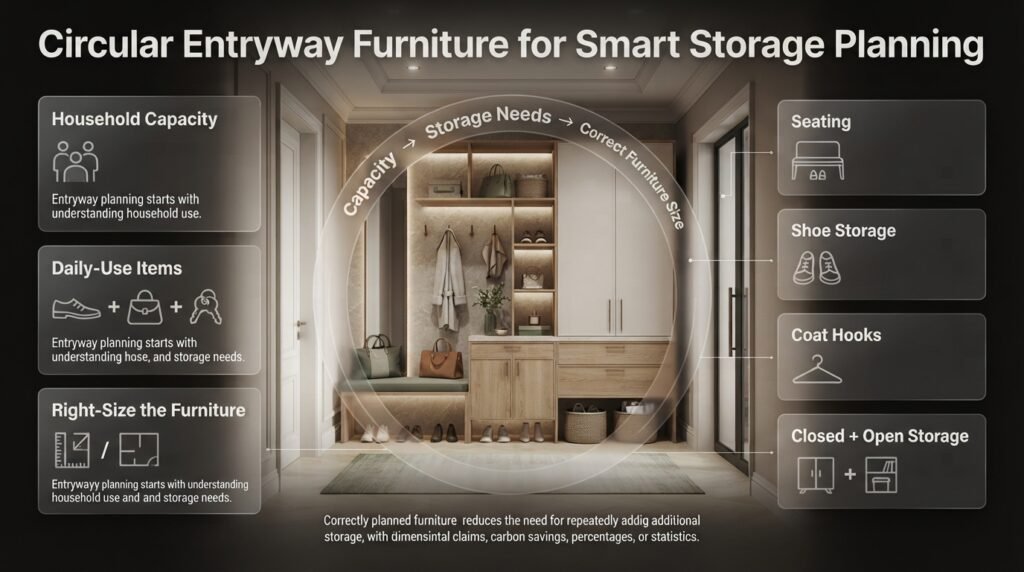
Entryways experience heavy daily use.
Shoes, bags, coats, keys, parcels, and other items constantly move through this area.
Poorly planned entryway furniture often creates another problem: homeowners keep adding storage because the original solution didn’t match their actual needs.
A better approach begins with capacity.
Estimate how many people use the entryway and what they actually need to store.
Then determine whether you need:
- Seating
- Shoe storage
- Coat hooks
- Closed cabinets
- Open shelving
- A console
- Drawers
- Baskets
The entryway storage capacity planning guide is particularly relevant here because circular thinking works best when furniture is correctly sized from the beginning.
The objective is not simply to buy “sustainable storage.” It is to avoid repeatedly buying storage that doesn’t solve the actual problem.
Can Circular Furniture Work With Smart Home Technology?
Yes, but technology should also be evaluated for longevity.
Smart lighting, automated blinds, sensors, switches, and control systems can improve convenience, but a system should ideally be planned so that individual components can be serviced or upgraded without forcing a complete redesign.
For example, automated blinds should be considered alongside window dimensions, furniture placement, electrical access, control methods, and future maintenance.
For a deeper look at coordinating automated window treatments with room planning, see Designing Interiors Around Automated Blinds.
Lighting follows a similar principle.
A good lighting system should support the room’s changing uses rather than being installed only for visual effect.
Task lighting, ambient lighting, controls, and replaceable components can help an interior remain useful as requirements change.
The Modern Bedroom Design resource can provide additional context around integrating lighting into bedroom design.
How Can Renovation Become More Circular?
Renovation is one of the biggest opportunities for circular thinking because it often involves removing large amounts of existing material.
Before demolition begins, ask:
Does this actually need to be removed?
Inspect:
- Cabinets
- Doors
- Hardware
- Flooring
- Lighting
- Furniture
- Wall finishes
- Shelving
- Storage systems
A kitchen, for example, may not require complete replacement.
If the cabinet boxes are structurally sound, you might update doors, handles, lighting, work surfaces, or internal organization.
A bathroom may similarly benefit from targeted improvements instead of unnecessary replacement.
For broader planning around renovation and maintenance decisions, the Home Improvement section can help you approach changes as a sequence of practical improvements rather than one large replacement project.
How Can Color and Décor Support Circular Interiors?
Color can be one of the easiest ways to change a room without replacing furniture.
If your main furniture is durable and relatively neutral, smaller decorative changes can alter the room’s character.
You might change:
- Cushions
- Throws
- Artwork
- Curtains
- Decorative objects
- Rugs
- Small accent pieces
Paint can also change the appearance of a room without changing its furniture.
This is one reason long-lasting furniture paired with flexible decorative elements can be more practical than purchasing a complete matching furniture set every few years.
For related ideas, explore Paint Color, where color choices can be considered separately from major furniture purchases.
The principle is simple:
Keep expensive, structurally sound elements stable and allow smaller, easier-to-change elements to evolve.
Can DIY Help Extend the Life of Furniture?
Yes, provided the project is appropriate for your skill level and the furniture itself is worth restoring.
Simple DIY projects can include:
- Replacing handles
- Tightening hardware
- Sanding suitable wooden surfaces
- Touching up minor finishes
- Replacing drawer hardware
- Cleaning and conditioning appropriate materials
- Updating removable covers
More complex structural repairs may require professional help.
The important point is to avoid DIY work that creates a safety problem or damages a valuable piece.
If you’re considering practical restoration and home projects, the DIY Home Projects section can provide a useful starting point for deciding which improvements are suitable for hands-on work.
What Role Does Reuse Play in Circular Furniture?
Reuse is one of the most direct ways to extend the life of furniture.
A piece doesn’t have to remain in the same room to remain useful.
A console table from an entryway could become a desk.
A bedroom dresser could move into a living room.
A dining chair could become a desk chair.
A shelf from one room could be reused in another space.
This kind of internal reuse is often overlooked because people associate furniture with its original purpose.
Before buying something new, walk through the rest of your home and ask:
“Do I already own something that could perform this job?”
That single question can prevent unnecessary purchases.
What About Reclaimed and Garden Furniture?
Circular thinking also extends outside the main interior.
Outdoor furniture can be selected for durability, repairability, and resistance to its actual environment.
Materials exposed to sun, rain, humidity, or temperature changes need to be selected accordingly.
A piece that works indoors may not be suitable outside simply because it looks attractive.
For broader ideas involving outdoor spaces and material choices, Robert MyGardenAndPatio can provide additional inspiration for thinking about furniture and outdoor living as connected parts of the home.
The same circular principle applies outdoors:
maintain useful items before replacing them, and choose new pieces according to the conditions they will actually face.
How Can You Make Circular Design Work on a Budget?
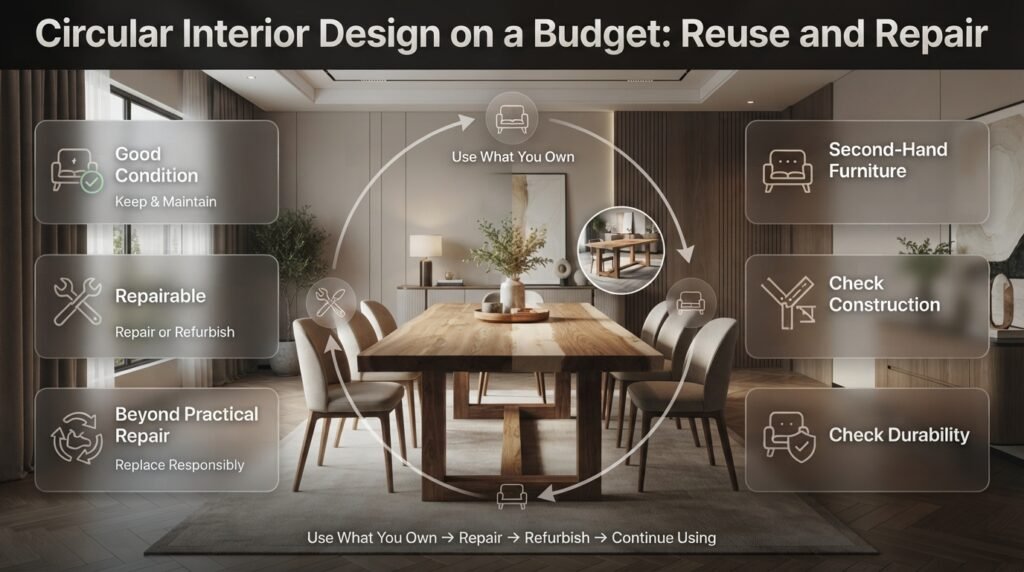
Circular design doesn’t require buying expensive designer furniture.
In fact, one of the most budget-friendly strategies is simply to use what you already own.
Start with a furniture audit.
Create three categories:
| Category | Action |
|---|---|
| Good condition | Keep and maintain |
| Repairable | Repair or refurbish |
| Beyond practical repair | Replace responsibly |
This prevents the common mistake of treating every old item as either “keep forever” or “throw away.”
Second-hand furniture can also be useful when its construction is strong and its condition is suitable.
A used solid-wood table that needs refinishing may offer better long-term potential than a new but poorly constructed replacement.
However, don’t buy used furniture simply because it’s cheap.
The same durability questions still apply.
What Are the Biggest Circular Interior Design Mistakes?
Mistake 1: Treating Sustainability as a Style
Circular design isn’t a color palette.
A room doesn’t become circular simply because it contains plants, natural colors, or reclaimed wood.
Better approach: Focus on lifespan, maintenance, adaptability, repairability, reuse, and material recovery.
Mistake 2: Buying Too Many “Eco” Products
Trying to make a room sustainable by buying more things can defeat the purpose.
If your home doesn’t need another chair, buying a chair made from recycled material doesn’t solve the underlying problem.
Better approach: Start with need, then evaluate the product.
Mistake 3: Ignoring Construction Quality
A beautiful product with weak construction may have a short useful life.
Better approach: Examine joints, frames, hardware, and repair options.
Mistake 4: Designing Only for Current Trends
Highly trend-driven furniture can become visually undesirable quickly.
Better approach: Keep major furniture relatively timeless and use smaller decorative elements for seasonal or trend-based changes.
Mistake 5: Making Everything Permanent
Built-ins can be extremely useful, but excessive fixed construction can make future changes difficult.
Better approach: Use permanent solutions where they genuinely improve space efficiency, while keeping other components flexible where possible.
Mistake 6: Forgetting Maintenance
Even high-quality furniture deteriorates when neglected.
Better approach: Create simple maintenance routines and deal with small problems before they become structural ones.
How Can You Evaluate Furniture Before Buying It?
Use this practical checklist before making a major purchase.
Ask About Lifespan
Don’t focus only on appearance.
Ask how the furniture is expected to perform under normal use.
Ask About Repairs
Find out whether:
- Hardware can be replaced
- Covers can be renewed
- Parts can be ordered
- Surfaces can be refinished
- Components can be repaired
Check Adaptability
Ask whether the furniture can work if:
- You move
- Your family changes
- Your room layout changes
- Your storage needs increase
- Your decorating preferences change
Think About Its Second Life
If you stop using it, could someone else realistically use it?
That question encourages you to choose furniture that has value beyond your own current situation.
How Can Circular Furniture Improve Interior Design Quality?
Circular thinking can actually make a room feel more intentional.
When homeowners stop buying furniture simply to fill empty areas, they often become more selective.
The result can be:
- Better proportions
- Less visual clutter
- More meaningful furniture
- Stronger focal points
- Greater flexibility
- Better use of space
This connects circular design with good interior design practice.
A room doesn’t become better because it contains more furniture.
It becomes better when each major piece has a clear purpose.
What Should You Do Before Replacing Existing Furniture?
Use this five-question test:
- Is the furniture structurally damaged?
- Can the damaged component be repaired?
- Can its appearance be updated?
- Could it serve another room or purpose?
- Could someone else continue using it?
If the answer to one of these questions is yes, replacement may not be your only option.
This is especially important for expensive furniture and built-in components.
How do you choose furniture for a circular interior design?
Choosing furniture for a circular interior isn’t simply about finding something made from recycled or natural materials. The better approach is to evaluate how the furniture will perform throughout its useful life. Look at the frame, joints, hardware, finish, upholstery, replacement parts, maintenance requirements, and whether individual components can be repaired or replaced. Current circular-design guidance emphasizes durability, repairability, adaptability and disassembly rather than relying on one “eco-friendly” feature.
Before buying an expensive piece, consider:
Construction: Is it strong enough for everyday use?
Repairability: Can damaged components be replaced?
Adaptability: Can it work if your room or lifestyle changes?
Maintenance: Can the surface, upholstery, or hardware be maintained?
Disassembly: Can it be taken apart without destroying the furniture?
Future use: Could you sell, donate, refurbish, or repurpose it later?
A professional approach is to think beyond the showroom appearance. A beautiful chair that cannot be repaired may have less long-term value than a simpler chair with a strong frame and replaceable components.
Is modular furniture really better for circular interior design?
Modular furniture can be particularly useful for circular interiors because individual sections can potentially be rearranged, replaced, expanded, reduced, or adapted instead of replacing the entire product. Research and current circular-design guidance identify modularity as an important strategy for extending furniture’s useful life.
However, modular doesn’t automatically mean circular. A modular product still needs good construction and a realistic way to repair or replace its components.
Look for modular furniture with:
Standardized or replaceable components
Strong connectors
Accessible fixing points
Replacement parts
Reconfigurable sections
Clear assembly instructions
Components that can be separated without damage
For example, a modular sofa is more useful when you can replace a damaged cover or one section rather than throwing away the complete sofa.
The professional rule: choose modularity when it solves a real problem. Don’t choose a complicated modular product simply because the word “modular” appears in its marketing.
What makes furniture genuinely circular rather than just sustainable?
The biggest difference is lifecycle thinking. Sustainable furniture may focus on responsible materials, production, or reduced environmental impact, while circular furniture considers what happens to the product throughout its entire life—including repair, reuse, refurbishment, adaptation, disassembly, and eventual material recovery.
For example, a table made from recycled material isn’t automatically circular if its construction is weak and it has to be discarded after a few years. Conversely, a durable table that can be repaired, refinished, reused, and eventually disassembled may have stronger circular characteristics.
When assessing furniture, ask:
How long is it realistically designed to last?
What usually fails first?
Can that component be replaced?
Can the furniture be refurbished?
Can it be disassembled?
Can someone else use it after the first owner?
Can its materials be separated at the end of its useful life?
This is why circular furniture should be judged by the whole system, not by one recycled-material claim or sustainability label.
How can you make an existing home more circular without replacing all the furniture?
You don’t need a complete renovation to introduce circular interior design. In fact, one of the most practical approaches is to extend the life of what you already own before purchasing replacements.
Start with a room-by-room furniture audit. Separate items into three groups: furniture that is still performing well, furniture that can be repaired or updated, and furniture that genuinely needs replacement.
For repairable pieces, consider:
Reupholstering worn seating
Refinishing suitable wooden surfaces
Replacing handles and hinges
Repairing drawer mechanisms
Changing removable covers
Moving furniture to another room
Reconfiguring modular storage
Repurposing furniture for a different function
A scratched dining table, for example, may need refinishing rather than replacement. A strong sofa with damaged upholstery may need new fabric rather than a new frame.
⚠ Common mistake: Don’t assume that an old piece has reached the end of its useful life simply because its appearance has become dated. Appearance and structural condition are two different things.
Circular design becomes especially effective when you separate “I don’t like how this looks anymore” from “this furniture can no longer perform its job.”
What are the biggest mistakes people make when creating circular furniture and interior design?
The most common mistake is treating circular design as a shopping trend instead of a long-term design strategy. People may buy products marketed as sustainable while overlooking durability, repairability, maintenance, adaptability, and what happens to the product after use. Current circular furniture guidance specifically highlights the need to consider these factors together.
The mistakes worth avoiding are:
Choosing recycled material without checking durability
Buying furniture that cannot be repaired
Replacing furniture that only needs refurbishment
Following short-lived trends too closely
Using too many permanently fixed elements
Ignoring replacement-part availability
Buying complicated modular furniture without a practical reason
Assuming expensive furniture is automatically circular
Ignoring maintenance until damage becomes serious
Forgetting what happens to the furniture after you no longer need it
The professional approach is to evaluate every major furniture purchase through three stages:
Before purchase → During ownership → After use
Before purchase, ask whether the item is appropriate and durable. During ownership, maintain and repair it. When you no longer need it, look for resale, donation, refurbishment, reuse, or appropriate material recovery.
Conclusion
Circular furniture and interior design is not simply about buying recycled furniture or choosing environmentally friendly materials. It is about creating interiors where furniture remains useful, adaptable, repairable, and valuable for as long as possible. Durability, modularity, easy maintenance, repair, reuse, and thoughtful disassembly all play an important role in achieving that goal.
The most effective approach is to think beyond the first use of a product. A well-designed sofa should allow parts to be repaired or replaced. A storage system should adapt when your needs change. A dining table should remain useful after a room makeover rather than becoming disposable simply because the style has changed. Designing with these possibilities in mind can help extend furniture life and reduce unnecessary replacement.
For homeowners, adopting circular principles does not mean completely redesigning a home or replacing everything at once. Existing furniture can often be repaired, refinished, reupholstered, rearranged, reused in another room, or combined with newer adaptable pieces. Even small decisions—such as selecting replaceable components or furniture that can be disassembled without damage—can support a more flexible interior.
Ultimately, circular design brings together good design, long-term usability, responsible material choices, and thoughtful planning. The goal is not to make an interior look obviously “sustainable,” but to create a beautiful and functional space that can continue evolving with the people who use it. When furniture is designed and selected with its future in mind, sustainability becomes part of the everyday living experience rather than an afterthought.