Introduction
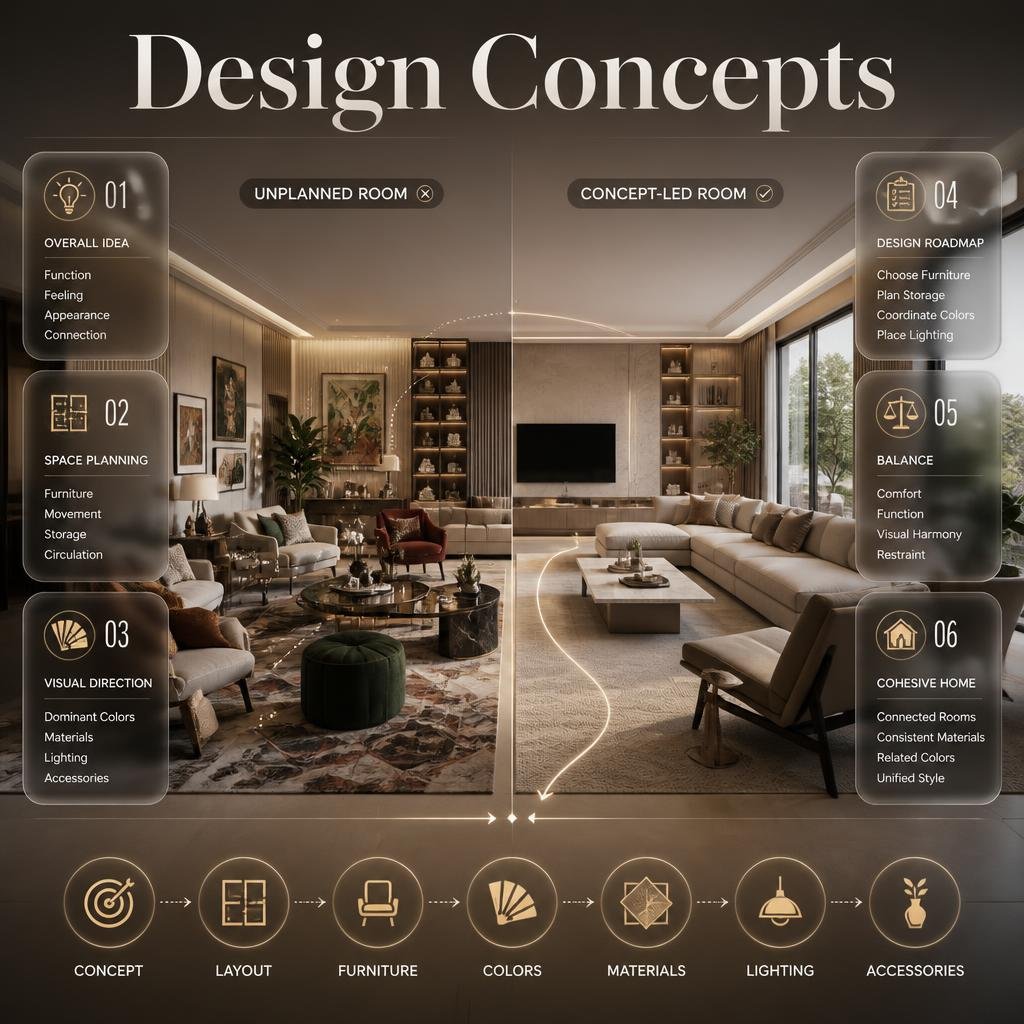
Design Concepts | A room can contain beautiful furniture, expensive finishes, attractive colors, and carefully selected accessories and still feel somehow wrong.
Maybe the furniture makes movement difficult. Maybe the colors don’t connect. Perhaps the room looks good in photographs but doesn’t feel comfortable in everyday life. In other cases, there are simply too many attractive things competing for attention.
This is where design concepts become important.
A successful interior isn’t created by choosing individual products one after another. It starts with an overall idea that determines how the space should function, feel, look, and connect with the rest of the home.
A good design concept acts like a roadmap. It helps you decide which furniture belongs in the room, how much storage is required, which colors should dominate, where lighting should be placed, which materials should be combined, and where decorative details should be restrained.
For homeowners who want to explore broader interior ideas and professional approaches, DesignMode24 Interior Design provides a useful starting point for understanding different aspects of residential design.
In this guide, we’ll look at design concepts from a practical perspective. You’ll learn how concepts are developed, how they influence layout and aesthetics, how to choose the right direction for your lifestyle, which mistakes commonly weaken a room, and how professional designers bring all the individual elements together.
What Are Design Concepts in Interior Design?
Design concepts are the central ideas, principles, and planning decisions that determine how an interior space should look, function, feel, and relate to the people using it. They connect layout, furniture, color, lighting, materials, texture, proportion, and decoration into one intentional design direction.
A design concept is more than a decorating style.
“Modern,” “traditional,” “minimalist,” “Scandinavian,” or “Japandi” describe recognizable visual styles. A concept goes deeper by explaining why particular choices are being made.
For example, imagine two homeowners who both want a contemporary living room.
One may need a durable family environment with generous storage, comfortable seating, and flexible furniture because children use the room every day.
Another may want a sophisticated entertaining space with dramatic lighting, sculptural furniture, and carefully displayed artwork.
Both rooms could be contemporary, but their design concepts would be completely different.
A useful design concept answers questions such as:
- Who uses the room?
- What happens in the space every day?
- What should the room feel like?
- What should immediately attract attention?
- How should people move through the room?
- What needs to be stored?
- Which materials can handle the lifestyle?
- How should natural light be used?
- What level of maintenance is realistic?
- How should the room connect to neighboring spaces?
These questions turn decorating into purposeful design.
Why Are Design Concepts Important?
Without a clear concept, interior design can easily become a collection of unrelated decisions.
A homeowner may purchase a sofa because it looks attractive, choose a rug because it is on sale, select wall paint based on a current trend, add decorative objects from different styles, and then discover that nothing feels connected.
Every individual item may be attractive, but the room lacks a visual and functional relationship.
A design concept prevents this problem by creating a common direction.
It helps establish:
Visual Unity
Furniture, colors, finishes, artwork, and accessories should feel like they belong to the same environment.
Unity doesn’t mean everything has to match. It means the elements have enough visual relationships to feel intentional.
Better Function
The concept begins with the way the room will actually be used.
That makes it easier to choose practical furniture, storage, lighting, and circulation patterns.
Stronger Personalization
Instead of copying a room from a magazine or social-media post, you can adapt design principles to your own lifestyle.
Better Budget Control
A concept helps separate essential purchases from decorative extras.
This is especially important during renovations because spending money on attractive but unnecessary features can leave less budget for things that actually improve everyday living.
Long-Term Flexibility
A thoughtful concept can survive changes in furniture, accessories, technology, and trends.
The foundation remains useful even when smaller details evolve.
💡 Pro Tip: Before purchasing major furniture, write one sentence describing the room’s purpose and atmosphere. If you can’t explain what the room is supposed to achieve, you’re probably making design decisions too early.
What Are the Main Elements of a Strong Design Concept?
A strong interior concept usually combines several design elements rather than relying on one feature.
1. Function Comes First
Function determines what the room needs to accomplish.
A living room may need to support conversation, television viewing, reading, entertaining, children’s activities, or several of these at the same time.
A bedroom needs to support sleep, dressing, storage, relaxation, and sometimes work.
A dining area needs comfortable circulation around the table and enough room for everyday use.
This means the first design question shouldn’t be:
“What looks beautiful?”
It should be:
“What needs to happen here?”
Once that is clear, visual decisions become easier.
Practical Example
Suppose a family spends most evenings in the living room.
The concept should prioritize:
- Comfortable seating
- Easy movement
- Durable fabrics
- Practical storage
- Appropriate television placement
- Flexible lighting
- Surfaces for everyday objects
A visually impressive but uncomfortable seating arrangement wouldn’t support the concept.
2. Space Planning and Layout
Layout determines how the room behaves.
Even beautiful furniture can create problems when it is incorrectly positioned.
Good space planning considers:
- Entry points
- Door swings
- Windows
- Walking paths
- Furniture dimensions
- Focal points
- Natural light
- Storage
- Conversation areas
A useful planning sequence is:
Room purpose → focal point → anchor furniture → supporting furniture → circulation → lighting → accessories
This approach prevents decoration from taking priority over usability.
For homeowners working on broader property improvements, Home Improvement can also support the connection between design planning and practical improvements.
3. Color Strategy
Color is one of the quickest ways to influence the emotional character of a room.
Warm neutrals can create a comfortable atmosphere. Deeper colors may create intimacy and drama. Pale colors can help a room feel lighter, while carefully controlled contrast can add energy.
However, choosing colors individually can create problems.
Instead, develop a palette.
A basic structure can include:
- Dominant color
- Supporting color
- Accent color
- Neutral foundation
- Material-based tones
A room doesn’t need many colors to feel interesting.
Sometimes the most sophisticated interiors use a restrained palette and create variation through texture, lighting, shape, and material.
For homeowners exploring wall and paint decisions, Paint Color offers another relevant area to consider when building a complete color concept.
4. Texture and Layering
Texture is particularly important in rooms with neutral or monochromatic palettes.
Imagine a room containing:
- Smooth painted walls
- Glossy furniture
- Flat flooring
- Plain upholstery
- Minimal decoration
Even if the colors work together, the space can feel visually flat.
Now introduce:
- Natural wood
- Woven textiles
- Linen
- Stone
- Ribbed surfaces
- Matte finishes
- Soft upholstery
- Brushed metal
The color palette may remain almost identical, but the room becomes much richer.
Texture creates depth without requiring excessive decoration.
5. Materials and Finishes
Materials communicate character.
Wood can bring warmth and natural variation.
Stone can introduce weight and permanence.
Glass can create visual openness.
Metal can provide structure and contrast.
Fabric can soften architectural surfaces.
The professional approach isn’t simply to use expensive materials everywhere. It’s to create a material hierarchy.
Choose:
One dominant material + supporting materials + controlled accents
For example, warm oak could be the dominant material, stone could provide contrast, and brushed metal could appear as a smaller accent.
This creates consistency without making every surface identical.
If you want to understand how carefully selected materials influence a polished interior, Refined Finishes fits naturally into this part of the design process.
6. Lighting
Lighting can completely change how a design concept is experienced.
A room may have excellent furniture and beautiful materials but still feel disappointing under poor lighting.
Professional lighting usually combines three layers.
Ambient Lighting
Provides general illumination throughout the room.
Task Lighting
Supports specific activities such as reading, cooking, working, or dressing.
Accent Lighting
Draws attention toward artwork, architectural features, shelves, or decorative objects.
Natural daylight should also be considered.
Window direction, curtains, blinds, reflective surfaces, and furniture placement all influence how daylight moves through a space.
⭐ Expert Tip: Don’t treat lighting as the final decoration. Think about it while planning the room because electrical positions, furniture placement, artwork, and architectural details often depend on lighting decisions.
7. Proportion and Scale
Proportion describes the relationship between elements, while scale considers their size in relation to the room and human use.
This is one of the reasons some rooms feel professionally designed while others feel awkward.
A large sectional with a tiny rug can make the rug look insignificant.
A small pendant above a very large dining table can lose visual impact.
Oversized furniture can make a small room feel crowded.
Very small furniture can make a large room feel empty.
Before purchasing major pieces, measure:
- Room length
- Room width
- Ceiling height
- Door openings
- Window positions
- Furniture dimensions
- Walking paths
⚠ Common Mistake: Never assume furniture will fit because it looks appropriately sized in a showroom photograph. Always check its actual dimensions against your room.
What Are the Different Types of Design Concepts?

There isn’t one universal list because design concepts can be organized in different ways. However, several common directions appear frequently in residential interiors.
| Concept | Main priority | Typical characteristics |
|---|---|---|
| Minimalist | Simplicity | Clean forms, limited objects, controlled palette |
| Contemporary | Modern lifestyle | Flexible layouts, current materials, clean lines |
| Traditional | Classic comfort | Symmetry, familiar forms, layered details |
| Scandinavian | Light and comfort | Natural materials, practical furniture, bright spaces |
| Japandi | Calm simplicity | Natural textures, restrained colors, functional forms |
| Luxury | Refinement | Layered lighting, quality materials, sophisticated details |
| Biophilic | Connection to nature | Plants, daylight, organic materials |
| Eclectic | Personality | Mixed influences controlled through color and scale |
The important point is that these aren’t boxes you must remain inside.
A home can combine contemporary and traditional elements.
A minimalist concept can include natural materials.
A luxury interior can still be warm and comfortable.
The concept should serve the homeowner rather than the other way around.
How Do You Choose the Right Design Concept?
The best starting point isn’t a trend.
It’s your lifestyle.
Ask yourself:
Who Uses the Space?
A couple, a large family, children, pets, guests, or a single professional will all have different requirements.
What Happens Here Every Day?
Think beyond occasional use.
Does the family eat here? Work here? Watch television? Read? Entertain? Store toys?
How Much Maintenance Is Realistic?
A material may look beautiful but become frustrating if it requires constant care.
What Needs to Be Stored?
Storage should be part of the concept rather than an afterthought.
How Do You Want the Space to Feel?
Choose words such as:
- Calm
- Warm
- Elegant
- Natural
- Energetic
- Refined
- Comfortable
- Dramatic
- Relaxed
These words become useful filters for later decisions.
How Do You Create a Design Concept Step by Step?
Step 1: Define the Room’s Purpose
Write down the main activities.
For example:
Living room: relax + socialize + watch television + entertain
Bedroom: sleep + dress + relax + store clothing
Home office: focus + work + video calls + organize equipment
This prevents you from designing around appearance alone.
Step 2: Establish the Desired Mood
Choose two or three words.
For example:
Warm + sophisticated + relaxed
Those words can guide the rest of the design.
If a proposed element doesn’t support the mood, reconsider it.
Step 3: Study Your Existing Architecture
Look at what cannot easily be changed.
Consider:
- Flooring
- Windows
- Ceiling height
- Doors
- Built-ins
- Architectural details
- Natural light
A strong concept works with the architecture rather than constantly fighting it.
Step 4: Build a Visual Direction
Collect a limited number of references.
Don’t simply save hundreds of attractive rooms.
Look for patterns.
Are you repeatedly choosing:
- Warm woods?
- Neutral walls?
- Curved furniture?
- Dark metals?
- Natural stone?
- Minimal accessories?
- Dramatic lighting?
Those repetitions reveal your actual preferences.
Step 5: Plan the Furniture
Start with the largest pieces.
Determine:
- Anchor furniture
- Focal point
- Supporting pieces
- Circulation
- Storage
Don’t fill the room simply because there is empty floor space.
Empty space can improve comfort and visual balance.
Step 6: Create the Color Palette
Choose the dominant background and supporting tones.
A useful guideline is:
Dominant → Supporting → Accent
The exact percentage isn’t important.
Consistency is.
Step 7: Select Materials
Choose materials based on:
Appearance + durability + maintenance + budget
A material that looks beautiful but doesn’t suit the room’s usage may not be a good choice.
Step 8: Plan Lighting
Combine ambient, task, and accent lighting where appropriate.
Consider daylight at different times of day.
Step 9: Add Accessories
Only after the foundation is working should you introduce decorative details.
Artwork, rugs, plants, cushions, mirrors, books, and objects should strengthen the concept.
How Does Visual Balance Work in Interior Design?
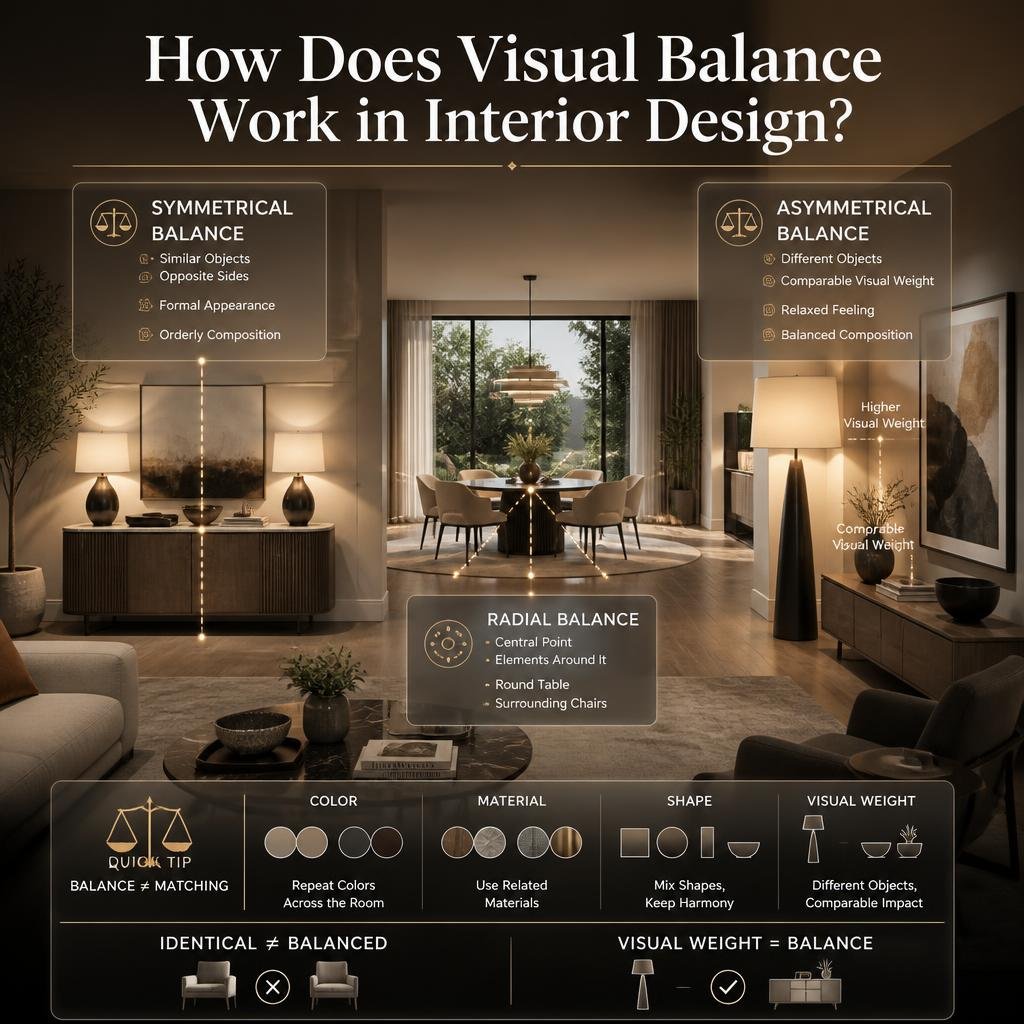
Visual balance distributes attention throughout a room.
Without balance, one area may feel overloaded while another feels empty.
Symmetrical Balance
Similar objects appear on opposite sides.
For example, matching lamps on both sides of a console.
This often creates a formal and orderly appearance.
Asymmetrical Balance
Different objects have comparable visual weight.
A large floor lamp might balance several smaller objects on the opposite side.
This creates a more relaxed feeling.
Radial Balance
Elements are arranged around a central point.
A round dining table with chairs surrounding it is an obvious example.
📌 Quick Tip: Balance doesn’t mean everything must match. Repetition of color, material, shape, or visual weight can create balance without making the room look identical on both sides.
How Does Connected Living Influence Design Concepts?
Modern interiors increasingly include technology.
The challenge is integrating it without allowing technology to dominate the visual environment.
A connected-living concept may include:
- Smart lighting
- Automated curtains
- Wireless charging
- Concealed speakers
- Smart climate control
- Home entertainment
- Organized charging areas
- Integrated controls
Technology should support the lifestyle.
For example, a charging station hidden inside a cabinet may be more successful than a collection of visible cables scattered across a console.
The Connected Living approach is particularly useful when technology, convenience, and automation are important parts of the home’s everyday experience.
How Do Accessories Support a Design Concept?
Accessories provide personality, but they should not carry the entire design.
A common mistake is using accessories to compensate for weak planning.
If a room has poor furniture placement, adding more cushions won’t solve it.
If the lighting is inadequate, another decorative object won’t fix the atmosphere.
Accessories work best after the fundamentals are correct.
Useful choices include:
- Artwork
- Rugs
- Cushions
- Throws
- Plants
- Books
- Mirrors
- Sculptural objects
- Decorative vessels
The Home Accessories section can help with the smaller details that complete an established interior concept.
How Can Luxury Be Included Without Making a Room Feel Overdone?
Luxury isn’t simply a matter of price.
A room often feels sophisticated because of:
- Proportion
- Material quality
- Lighting
- Comfort
- Visual restraint
- Craftsmanship
- Consistency
- Attention to detail
A smaller number of carefully chosen pieces can have more impact than a large number of expensive objects.
For example, one large artwork can create stronger visual focus than ten small decorations.
Likewise, high-quality lighting can improve the appearance of furniture and finishes throughout an entire room.
The Luxury Ambience approach is useful when the goal is to create an atmosphere that feels polished without becoming excessive.
How Do Design Concepts Work in Small Spaces?

Small spaces require more discipline because every decision has a stronger visual impact.
Start by protecting circulation.
Then consider:
- Multifunctional furniture
- Vertical storage
- Appropriate furniture depth
- Light-reflective surfaces
- Controlled colors
- Clear sightlines
- Built-in storage
- Reduced visual clutter
Don’t automatically choose the smallest possible furniture.
Sometimes a properly proportioned larger piece creates a stronger composition than several tiny pieces.
The objective is to make the room feel organized, not merely to make every object small.
For homeowners handling practical improvements themselves, DIY Home Projects can complement the larger design process when carefully selected improvements are appropriate for the space.
How Can a Design Concept Make a Home Feel More Personal?
Personal design doesn’t mean displaying every possession.
Instead, choose meaningful items and give them room to breathe.
Personal elements might include:
- Family photographs
- Travel memories
- Artwork
- Books
- Heirlooms
- Handmade objects
- Collected pieces
- Plants
- Favorite textiles
The best personalized interiors often feel curated rather than crowded.
A home should look like it belongs to its occupants—not like a showroom designed for an imaginary family.
What Is the Difference Between a Design Concept and a Decorating Style?
A design concept describes the broader intention.
A decorating style describes the visual language used to express it.
For example:
Concept: Calm, practical family living.
Style: Contemporary with Scandinavian influences.
The concept establishes priorities.
The style helps communicate them.
This distinction makes mixing styles much easier.
You don’t have to decide that every room must belong to one strict category.
Instead, decide what the home needs to accomplish and choose styles that support that goal.
How Can Different Rooms Have Different Concepts Without Feeling Disconnected?
Each room can have a different function and atmosphere while maintaining a visual relationship with the rest of the home.
For example:
Living room: social and welcoming
Bedroom: calm and private
Home office: focused and organized
Dining area: elegant and flexible
They don’t need identical furniture.
Instead, connect them through repeated elements such as:
- Flooring
- Wood tones
- Hardware
- Accent colors
- Lighting temperature
- Architectural details
- Related materials
This creates continuity without making every room look the same.
The Room-by-Room Design Hub is especially useful for thinking about individual rooms as parts of one complete home.
How Do Outdoor Spaces Fit Into a Larger Design Concept?
A property’s design shouldn’t necessarily stop at the interior walls.
When outdoor spaces are visible from major interior rooms, the two environments can benefit from a visual relationship.
Consider:
- Similar material tones
- Complementary colors
- Natural textures
- Repeated forms
- Coordinated lighting
- Consistent furniture character
For garden and patio planning, Robert MyGardenAndPatio can be considered when extending design thinking beyond the main interior.
Similarly, Can I Design My Own Garden Kdagardenation can be useful when homeowners are considering how much outdoor planning they can handle themselves.
The important point is that outdoor design should support the property rather than look like an unrelated addition.
How Should You Use Design Trends?
Trends can be useful sources of inspiration.
They introduce new:
- Materials
- Colors
- Furniture shapes
- Technology
- Lighting ideas
- Storage solutions
- Decorative approaches
But trends should be filtered through your own design concept.
Before adopting one, ask:
Does this improve the way I live?
Does it work with my existing space?
Will I still like the underlying design if the trend disappears?
Is it affordable to replace later?
For current decorating ideas and broader industry inspiration, Latest News DecoratorAdvice can help you explore ideas without allowing every trend to dictate the entire interior.
A second resource, Latest News DecoratorAdvice 2, can also be used as an additional source of design inspiration when exploring evolving approaches.
What Are the Most Common Design Concept Mistakes?

Understanding mistakes is often more useful than memorizing rules.
Buying Before Planning
This happens because shopping is more exciting than measuring and planning.
The result is often furniture that doesn’t fit the room or doesn’t support its function.
Better approach: Plan the room first.
Copying Inspiration Images
A photograph shows one room under one set of conditions.
It doesn’t automatically account for your architecture, lifestyle, budget, lighting, or storage needs.
Better approach: Copy principles, not entire rooms.
Using Too Many Competing Colors
A large collection of unrelated colors can make the space feel fragmented.
Better approach: Build a controlled palette.
Ignoring Scale
Furniture can overwhelm a room or disappear inside it.
Better approach: Measure before purchasing.
Overdecorating
Many homeowners assume empty space means something is missing.
It doesn’t.
Negative space helps important features stand out.
Better approach: Edit after decorating.
Following Trends Too Closely
A trend may look impressive online but become frustrating when it doesn’t fit your lifestyle.
Better approach: Use trends selectively.
Ignoring Storage
Clutter can destroy a carefully planned concept.
Better approach: Design storage as part of the room from the beginning.
Using Only One Light Source
One ceiling light rarely creates a comfortable atmosphere for every activity.
Better approach: Layer the lighting.
⚠ Common Mistake: Don’t ask, “What else can I add?” every time a room feels incomplete. First ask, “What is actually missing?” Sometimes the answer is better lighting, stronger scale, more texture, or improved layout—not another accessory.
What Do Professional Designers Consider Before Finalizing a Concept?
Experienced designers often look beyond the immediate visual result.
They consider how the room will behave six months or several years later.
Important questions include:
Will the Furniture Still Be Practical?
A beautiful chair that nobody wants to sit in isn’t successful design.
Can the Space Adapt?
Homes change.
Children grow.
Work arrangements change.
Furniture may need to move.
Flexible concepts can accommodate these changes more easily.
Are the Materials Appropriate?
A delicate finish may not work in a heavily used family environment.
Is Maintenance Realistic?
Every surface eventually needs cleaning or maintenance.
A design that requires unrealistic effort may become frustrating.
Does the Concept Work at Different Times of Day?
Natural daylight and artificial lighting can dramatically change the appearance of a room.
Does the Concept Connect With Adjacent Spaces?
A room doesn’t exist in isolation.
Visible transitions between spaces should feel intentional.
How Can You Test a Design Concept Before Spending Money?
You don’t need to purchase everything immediately.
Create a simple concept board containing:
- Room photographs
- Furniture references
- Paint samples
- Flooring samples
- Fabric samples
- Material samples
- Lighting references
- Artwork ideas
Then step back.
Ask:
Do these elements look like they belong together?
If one item seems completely disconnected, identify why.
Maybe its color is wrong.
Maybe the finish is too glossy.
Maybe its scale is inappropriate.
Maybe the style doesn’t support the concept.
This process can save money because it exposes conflicts before they become expensive purchases.
How Does Budget Affect Design Concepts?
A strong concept doesn’t require an unlimited budget.
In fact, a clear concept can make a limited budget work more effectively.
Prioritize spending on elements that are:
- Used frequently
- Difficult to replace
- Structurally important
- Highly visible
- Responsible for comfort or safety
Then save on easily replaceable decorative items.
For example, it can make sense to prioritize a quality sofa used every day over expensive decorative objects that have little practical value.
The concept should determine where money goes.
How Do You Create a Timeless Design Concept?
Timelessness doesn’t mean avoiding every modern idea.
It means creating a foundation that doesn’t depend completely on short-lived trends.
A long-lasting concept often uses:
- Good proportions
- Practical layouts
- Quality materials
- Restrained color
- Functional furniture
- Layered lighting
- Natural textures
- Carefully selected decorative elements
Trends can then be introduced through items that are easier to change.
This approach allows the home to evolve without requiring a complete renovation every time preferences change.
What Makes a Design Concept Feel Cohesive?
Cohesion comes from repetition and relationships.
Repeat selected elements without making everything identical.
For example:
Warm wood + soft neutral + dark metal
can appear in:
- Flooring
- Furniture
- Lighting
- Hardware
- Frames
- Decorative objects
The repetition helps the eye understand the room.
Another method is repeating shapes.
If curved furniture appears in the living room, subtle curved details elsewhere can create continuity.
The goal is not uniformity.
It’s recognition.
How Can You Know When a Room Is Finished?
This is harder than it sounds.
A room isn’t finished simply because every surface contains something.
It’s finished when the major functions work, the visual hierarchy is clear, and the remaining objects contribute rather than compete.
Walk through the room and ask:
- Is movement comfortable?
- Is there a clear focal point?
- Does the furniture feel appropriately scaled?
- Are the colors connected?
- Is there enough texture?
- Does the lighting work at night?
- Is storage sufficient?
- Are decorative pieces meaningful?
- Does the room feel personal?
- Is anything visually unnecessary?
If removing an object improves the room without reducing function or personality, you may have found something that doesn’t belong.
What is the most important design concept for a modern home in 2026?
The most useful design concept for a modern home is one that combines function, comfort, personality, and visual consistency rather than focusing only on a particular decorating style. Current 2026 design discussions increasingly emphasize homes that feel lived-in, personal, comfortable, and connected to the way people actually live.
A practical modern concept should consider:
Comfort: Furniture should support real daily activities.
Functionality: Storage, circulation, lighting, and technology should work naturally.
Personality: The space should reflect the people living there.
Material balance: Natural wood, stone, textiles, metals, and other finishes can create depth.
Visual calm: Clutter should be controlled without making the room feel empty.
Flexibility: Spaces should adapt as family needs and lifestyles change.
The important point is that “modern” doesn’t have to mean cold, minimal, or completely white. Current design direction is showing stronger interest in warmer palettes, natural materials, tactile surfaces, personal objects, and interiors that look genuinely lived in.
Professional advice: Don’t begin by asking, “Which style is trending?” Begin with “How do I want this home to work every day?” The style can then be selected to support that lifestyle.
How do I create a design concept that looks beautiful but still works for everyday life?
Start with function before decoration. A room should be planned around the activities that actually happen there, and then the visual elements should be built around those requirements.
For example, a family living room may need comfortable seating, television viewing, children’s activities, storage, conversation space, and easy circulation. A professional concept would solve those needs first and then introduce color, materials, lighting, artwork, and accessories.
Use this sequence:
Lifestyle → Function → Layout → Furniture → Materials → Color → Lighting → Accessories
This order matters because decorative decisions made too early can create expensive problems later.
A beautiful sofa isn’t useful if it blocks the main walkway. A luxury coffee table isn’t practical if there isn’t enough circulation around it. A dramatic lighting fixture won’t improve the room if the rest of the lighting is inadequate.
What professionals check:
Who uses the room?
What happens there every day?
Where does clutter accumulate?
What needs to be stored?
How many people normally use the space?
Where does natural light enter?
What furniture must remain?
How easily can the room be cleaned and maintained?
This lifestyle-first approach is particularly relevant in 2026, as design professionals increasingly discuss comfort, wellbeing, functionality, and real-life usability alongside aesthetics.
Expert tip: If a design looks impressive but makes everyday activities harder, the concept needs to be reconsidered. Good design should make the room easier to live in, not simply more attractive to look at.
What interior design concepts are trending in 2026?
Several design directions are receiving significant attention in 2026, but the broader movement is toward warmer, more personal, tactile, and lived-in interiors rather than one single dominant style. Current coverage highlights natural materials, richer textures, individual expression, layered spaces, wellbeing, and designs that don’t look overly staged.
Some notable directions include:
Warm minimalism with softer neutrals and natural textures
Lived-in interiors that feel collected rather than showroom-perfect
Personalized spaces containing meaningful artwork and objects
Natural and tactile materials
Layered lighting
Biophilic influences
Flexible multi-use spaces
More expressive color and pattern
Subtle aged or vintage elements
Technology integrated more discreetly into the home
The important distinction is between a trend and a design concept.
A trend might inspire you to use a particular material, color, furniture shape, or decorative technique. A design concept should determine whether that trend actually belongs in your home.
For example, if textured upholstery is popular but you have young children and need extremely easy-to-clean furniture, practicality should influence the final decision. Current expert coverage also highlights that some visually popular materials can create significant maintenance demands.
Professional approach: Take inspiration from trends, but don’t allow trends to dictate the foundation of your home. Your layout, comfort, storage, materials, and lifestyle should have a much longer lifespan than a seasonal decorating trend.
How can I make my design concept feel luxurious without spending a huge amount of money?
Luxury comes less from the number of expensive products in a room and more from proportion, material relationships, lighting, craftsmanship, comfort, and visual restraint.
A room can feel considerably more refined without replacing everything. Start with the elements that have the biggest visual influence.
Focus on:
Better furniture proportions
Layered lighting instead of one harsh ceiling fixture
High-quality-looking textiles
Consistent hardware and finishes
Natural materials where practical
Well-sized artwork
Properly fitted curtains
Fewer but stronger accessories
A controlled color palette
Clear surfaces and intentional negative space
For example, replacing several small decorative objects with one substantial artwork may create stronger visual impact. Improving lighting can also make existing furniture and finishes appear more sophisticated.
Another important factor is editing. Luxury interiors often benefit from restraint. The goal isn’t to show everything you own; it’s to make the important elements noticeable.
Current 2026 design coverage is also moving toward individuality and meaningful pieces rather than interiors that look mass-produced or overly optimized for photographs.
Expert tip: Before buying another decorative item, improve one existing design problem—poor lighting, incorrect scale, weak layout, excessive clutter, or inconsistent materials. Fixing the foundation often produces a bigger improvement than adding more decoration.
How do I create a timeless design concept without making my home look boring or outdated?
A timeless design doesn’t mean avoiding personality or modern ideas. It means building the room around strong fundamentals that can survive changing trends, then using easier-to-change elements to introduce freshness.
Start with long-lasting decisions:
Functional floor plans
Comfortable furniture
Appropriate proportions
Quality materials
Practical storage
Good lighting
Controlled architectural details
A coherent color foundation
Then introduce personality through elements that can be changed more easily:
Cushions
Throws
Artwork
Accessories
Decorative lighting
Smaller furniture
Paint
Seasonal textiles
This gives you flexibility without requiring a complete redesign every few years.
A timeless room can still include current design influences. For example, you might combine classic furniture proportions with contemporary lighting, natural textures, or a modern artwork collection.
The key is balance rather than trend avoidance.
Current 2026 design reporting shows a stronger interest in personal, collected, lived-in interiors, including combinations of periods, materials, finishes, and meaningful objects rather than highly uniform spaces.
Professional recommendation: Design the expensive and difficult-to-change elements for longevity. Let the affordable and replaceable elements carry the trends.
That way, your home can evolve without losing its original design concept.
Conclusion
A successful design concept is not simply about choosing beautiful furniture, fashionable colors, or expensive finishes. It is about creating a clear relationship between function, comfort, layout, materials, lighting, personality, and visual balance. When these elements work together, a home feels intentional rather than randomly decorated.
The strongest design concepts begin with the way people actually live. A family may need durable materials and practical storage, while a professional working from home may prioritize flexible layouts, comfortable furniture, and effective lighting. The concept should respond to these everyday needs while still creating a distinctive visual identity.
Current interior design direction also shows a growing preference for spaces that feel personal, comfortable, natural, and lived-in rather than overly staged. Natural textures, layered lighting, meaningful accessories, flexible spaces, and carefully selected statement pieces can help create an interior that feels sophisticated without becoming impersonal.
Ultimately, the best design concept is one that remains useful after the initial excitement of a renovation or makeover disappears. Start with a strong foundation, make thoughtful material and color decisions, protect good circulation, invest where quality matters, and use decorative elements to express your personality.
A well-developed design concept does more than make a room look attractive—it gives the entire home a sense of purpose, character, comfort, and lasting visual harmony.
Leave a Reply