
Introduction
Styled Space | A room can have expensive furniture, beautiful colors, and carefully chosen accessories and still feel strangely unfinished. You may walk in and feel that something is missing, but you can’t quite explain what it is. Often, the problem isn’t the furniture itself. It’s that the room doesn’t have a clear visual direction.
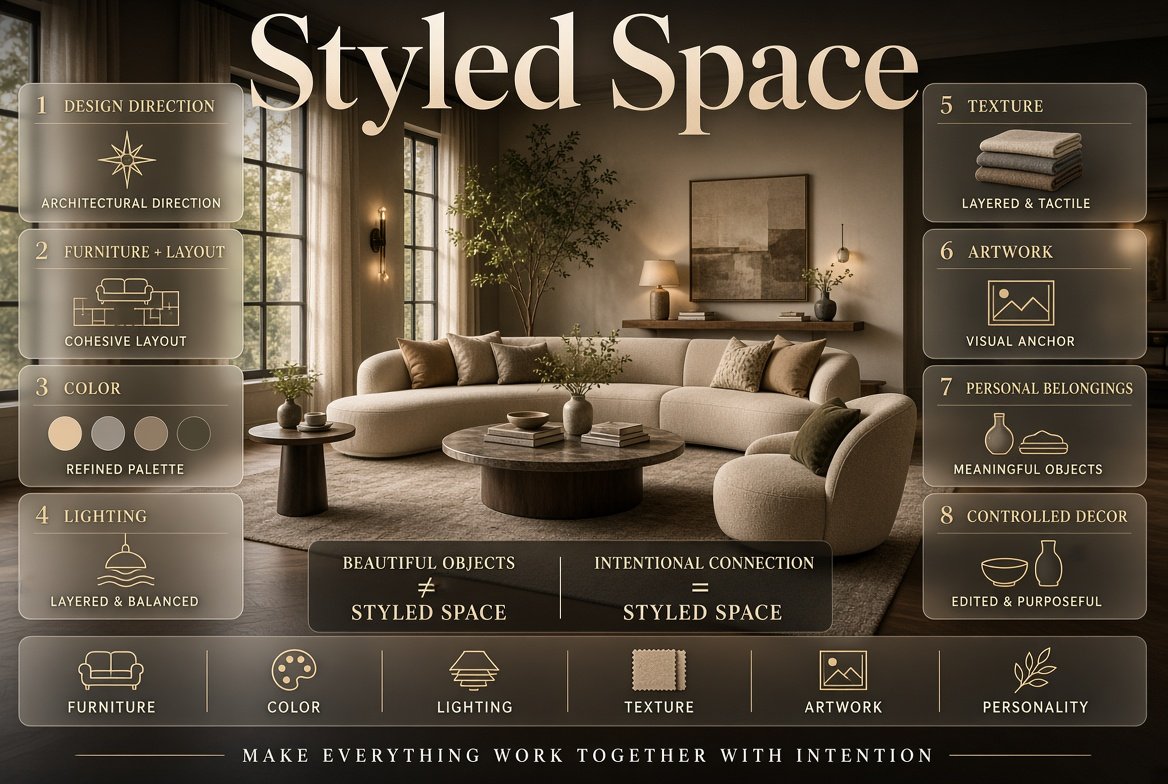
Creating a styled space is about bringing everything together so your home feels intentional, comfortable, and genuinely yours. It doesn’t mean filling every corner with décor or copying the latest interior design trend. It means understanding how furniture, color, lighting, texture, layout, artwork, and personal belongings work together.
For more inspiration and practical design guidance, explore DesignMode24 Interior Design as you plan the overall look of your home.
This guide explains how to create a styled space from the ground up, whether you’re decorating a single room, refreshing an existing interior, or trying to make your entire home feel more cohesive. You’ll learn how to choose a design direction, arrange furniture, layer textures, select colors, improve lighting, decorate without creating clutter, and avoid the mistakes that make a room look less polished.
What Is a Styled Space?
A styled space is an interior where furniture, colors, materials, lighting, accessories, and layout work together to create a deliberate atmosphere. The goal isn’t perfection or expensive décor. A successful styled space feels balanced, functional, personal, and visually connected.
The difference between a decorated room and a genuinely styled room is usually intentionality.
A decorated room may contain attractive objects. A styled room has relationships between those objects.
For example, a living room might have a beige sofa, wooden coffee table, black floor lamp, woven basket, artwork, and cream rug. None of those pieces needs to match perfectly. What makes them work is repetition and balance: warm wood appears more than once, black accents connect the lamp and picture frames, and neutral fabrics soften the harder materials.
Why Does Styling Matter?
Styling matters because a room communicates a feeling before you consciously analyze it.
A well-styled room can feel:
- Calm and welcoming
- Sophisticated without being formal
- Comfortable and lived-in
- Organized rather than crowded
- Personal rather than generic
- Cohesive from one area to another
Good styling also improves functionality. When furniture is positioned around how people actually move and use a room, the space becomes easier to live in.
💡 Pro Tip: Don’t begin styling by buying accessories. Begin by deciding what you want the room to feel like. Your furniture, colors, materials, and décor choices should support that feeling.
How Do You Start Creating a Styled Space?
The best starting point is to evaluate the room you already have. Before purchasing anything, identify what works, what doesn’t, and what the room is missing.
Walk into the room and look at it from several angles. Notice the largest pieces first rather than focusing on small decorative objects.
Ask yourself:
- What is the main purpose of this room?
- Which furniture pieces must stay?
- What feels visually heavy?
- Where does natural light enter?
- Does the room have enough storage?
- Which colors already dominate?
- What do I want to change?
- What do I genuinely like about the space?
This simple assessment prevents unnecessary shopping.
Create a Design Direction
You don’t need to choose a strict style label such as modern, minimalist, traditional, or contemporary. In fact, many attractive homes combine several influences.
Instead, choose three to five words that describe your desired atmosphere.
For example:
Warm + Natural + Relaxed + Modern
or:
Elegant + Soft + Minimal + Sophisticated
Those words become your filter.
If an item doesn’t support the feeling you’re trying to create, you don’t need it simply because it’s attractive in a store.
How Do You Choose a Style Without Making Your Home Look Generic?
The easiest way to avoid a generic interior is to combine design principles with personal details.
A room copied directly from a showroom can look polished but emotionally empty. A home should reveal something about the people who live there.
Use a simple formula:
Design foundation + personal character + practical function = styled space
Your foundation might include neutral walls, simple furniture, good lighting, and consistent materials. Personal character can come from artwork, books, travel objects, photographs, handmade pieces, or collections.
The important part is editing.
If every object has sentimental value, the room may become visually overwhelming. Display your favorite pieces and store the rest.
Should Everything Match?
No. Matching everything can actually make a room look flat.
Instead, aim for coordination.
A room can contain different woods, fabrics, metals, and patterns as long as there is some visual connection between them.
For example:
- Oak furniture can work with walnut accents.
- Brass lighting can work with black hardware.
- Linen can sit beside velvet.
- A patterned rug can support plain cushions.
- Vintage artwork can complement modern furniture.
The room becomes interesting because the pieces aren’t identical.
How Do You Choose a Color Palette for a Styled Space?
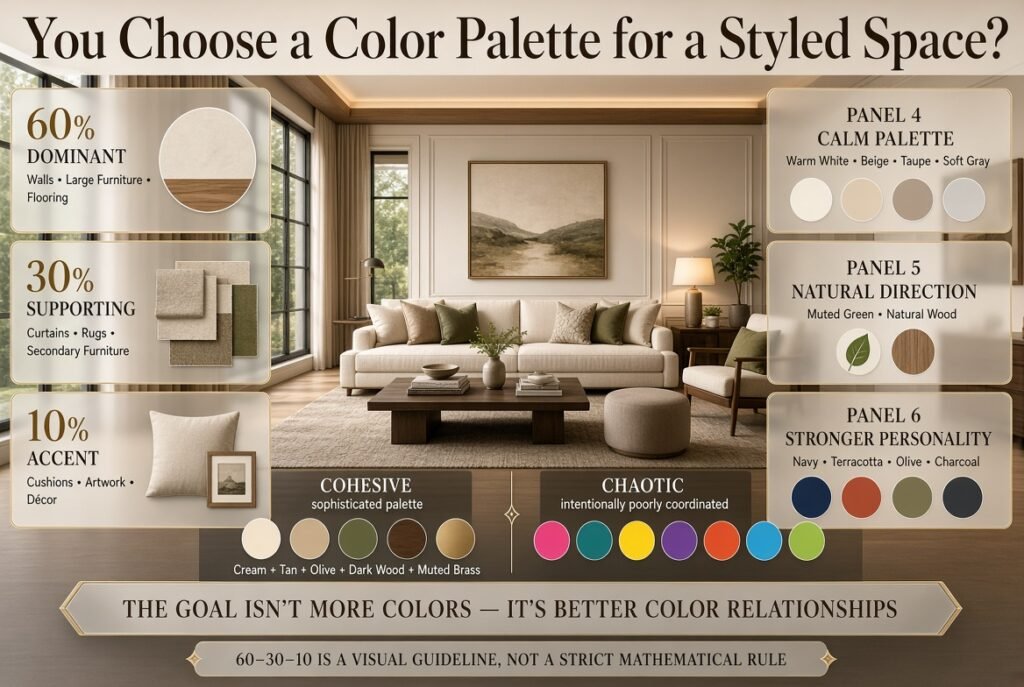
A reliable color palette usually contains a dominant color, one or two supporting colors, and smaller accents.
A simple approach is the 60–30–10 rule:
| Color role | Approximate use | Examples |
|---|---|---|
| Dominant | 60% | Walls, large furniture, flooring |
| Supporting | 30% | Curtains, rugs, secondary furniture |
| Accent | 10% | Cushions, artwork, décor |
This isn’t a strict mathematical rule. It’s a visual guideline.
If you prefer a calm home, start with warm whites, beige, taupe, soft gray, muted green, or natural wood. If you want stronger personality, introduce navy, terracotta, olive, charcoal, deep blue, or another richer accent.
For homes where paint plays a major role, the Paint Color collection can provide additional direction when you’re narrowing down wall and accent colors.
How Many Colors Should a Room Have?
Three to five related colors are usually enough for a comfortable room, although materials and patterns can introduce additional visual variation.
The bigger issue isn’t the number of colors. It’s whether the colors have a relationship.
For example, a room with cream walls, tan furniture, olive cushions, dark wood, and muted brass can feel cohesive because the palette is controlled.
A room with ten unrelated bright colors can feel chaotic even if every individual item looks attractive.
How Do You Add Texture to a Styled Space?
Texture is one of the easiest ways to make a room feel expensive and layered without adding lots of color.
Imagine a neutral living room containing:
- Linen curtains
- A wool rug
- A wooden coffee table
- A ceramic vase
- A woven basket
- Cotton cushions
- A soft upholstered sofa
The colors may remain simple, but the different surfaces create depth.
Which Materials Work Well Together?
Try combining materials with different visual and physical qualities:
- Wood for warmth
- Linen for softness
- Wool for comfort
- Ceramic for handmade character
- Glass for lightness
- Metal for structure
- Stone for natural weight
- Rattan or wicker for organic texture
- Velvet for richness
⭐ Expert Tip: When a neutral room feels boring, don’t automatically add brighter colors. First ask whether it needs more texture.
How Should Furniture Be Arranged in a Styled Space?
Furniture should be arranged around conversation, movement, function, and proportion—not simply pushed against walls.
In a living room, seating should usually relate to the room’s focal point. Depending on the layout, that focal point might be a fireplace, television, large window, artwork, architectural feature, or central table.
Leave enough space for comfortable movement.
A basic layout might look like:
        Artwork / Focal Point

             Sofa
       ┌──────────────┐
       │              │
       └──────────────┘

   Chair          Chair

        ┌─────────┐
        │  Table  │
        └─────────┘
The exact arrangement depends on room size, but the principle remains the same: furniture should encourage interaction rather than create obstacles.
What Is the Biggest Furniture Mistake?
Buying furniture based only on appearance is one of the most common mistakes.
A beautiful sofa can still be wrong if it’s too large for the room. A stylish coffee table can become frustrating if there isn’t enough clearance around it.
Before purchasing, measure:
- Wall width
- Doorways
- Windows
- Furniture dimensions
- Walking paths
- Clearance between major pieces
📌 Quick Tip: Use painter’s tape on the floor to outline the dimensions of a proposed sofa, table, or cabinet. It’s an easy way to understand scale before spending money.
How Can You Make a Small Space Look More Stylish?
Small rooms benefit from visual simplicity, but simplicity doesn’t mean boring.
Choose furniture that fits the scale of the room. Avoid oversized pieces that consume too much floor area.
Use vertical space through:
- Tall shelving
- Curtains hung higher
- Vertical artwork
- Slim cabinets
- Wall-mounted lighting
Mirrors can also help reflect light and create a greater sense of openness.
Multifunctional furniture is particularly useful in compact homes. A storage ottoman can provide seating, a coffee table, and hidden storage. A console can become a work area. A bench can provide seating without visually overwhelming the room.
The key is to make every major piece earn its place.
How Does Lighting Change a Styled Space?
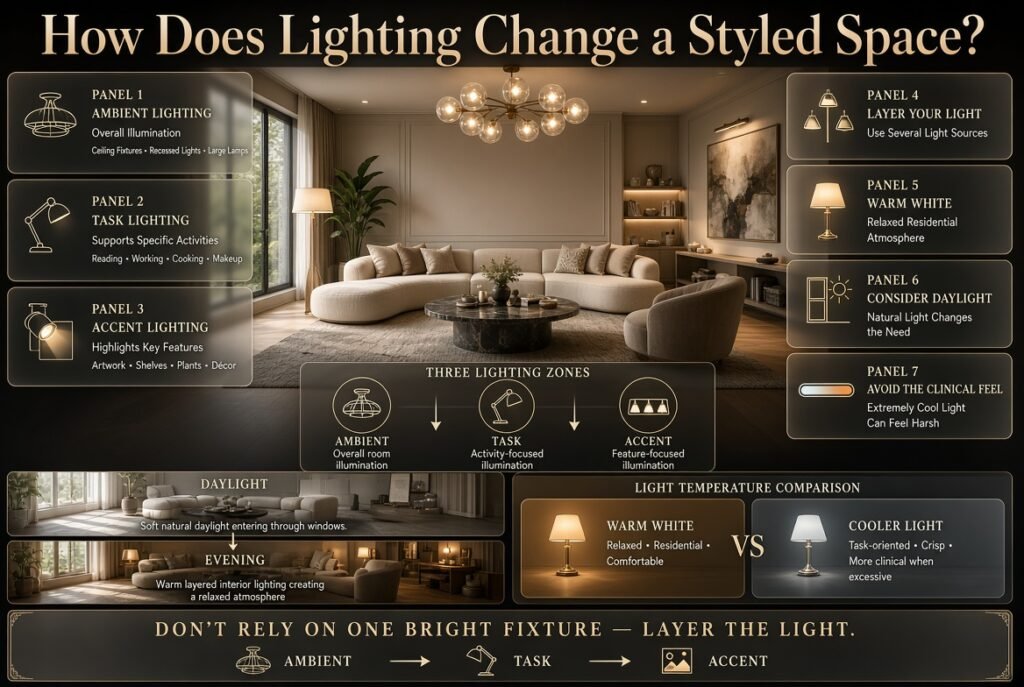
Lighting can completely change how a room looks at different times of day.
A room with one overhead fixture often feels flat because all the light comes from one location. Layered lighting creates depth.
Use three general layers:
Ambient Lighting
This provides overall illumination through ceiling fixtures, recessed lights, or large lamps.
Task Lighting
This supports specific activities such as reading, working, cooking, or applying makeup.
Accent Lighting
This highlights artwork, shelves, architectural features, plants, or decorative objects.
A comfortable room often uses several light sources rather than relying on one bright fixture.
What Light Temperature Should You Use?
Warm white lighting generally creates a more relaxed residential atmosphere. Cooler light can be useful in task-oriented areas, but extremely cool lighting may make a cozy interior feel clinical.
Always consider the room’s natural light before selecting bulbs. A space receiving strong daylight may need different lighting than a dark interior.
How Do You Style Walls Without Creating Clutter?
Walls provide valuable opportunities for personality, but decorating every available surface can make a room feel crowded.
Start with the focal wall.
You might use:
- One large artwork
- A gallery arrangement
- A large mirror
- Architectural shelving
- A statement paint color
- Textured wall treatment
For gallery walls, don’t simply hang pieces randomly. Establish a visual structure by keeping spacing consistent or aligning edges.
If you prefer simplicity, one oversized artwork can often have more impact than a collection of small pieces.
How Do You Style Shelves and Surfaces?
Shelves, coffee tables, consoles, and cabinets are where styling often becomes excessive.
A useful method is to create groups rather than collections of individual objects.
For example, on a console:
- One lamp
- One artwork or mirror above it
- A small stack of books
- A ceramic object
- One plant or branch
Vary heights so the arrangement doesn’t look like a row of identical objects.
The Rule of Editing
After styling a surface, remove one or two items.
If the arrangement looks better, you had too much.
This doesn’t mean every surface should be empty. It means each object should have enough visual space to be appreciated.
How Can You Use Plants in a Styled Space?
Plants add color, organic shape, and life to interiors.
Large plants can soften empty corners, while smaller plants work well on shelves and tables.
Consider the plant’s:
- Light requirements
- Mature size
- Watering needs
- Container style
- Relationship to surrounding furniture
A beautiful plant in the wrong location won’t remain beautiful for long.
If you’re not comfortable caring for living plants, high-quality artificial greenery can work, but avoid placing too many artificial plants throughout the home. One convincing arrangement is usually better than several obviously decorative ones.
How Do You Make a Styled Space Feel Personal?
Personalization is what separates a beautiful home from a showroom.
Use things that have meaning to you:
- Books you actually read
- Artwork you enjoy
- Family photographs
- Travel memories
- Handmade objects
- Vintage finds
- Collections
- Favorite textiles
- Objects connected to hobbies
The goal isn’t to display everything you own.
Instead, choose pieces that tell your story.
This is also why Beautiful Interior inspiration can be useful: it can give you ideas about composition and atmosphere while still leaving room for your own personality.
How Do You Create a Styled Space on a Budget?
You don’t need a complete furniture replacement to transform a room.
Start with the elements that create the biggest visual difference.
Low-Cost Changes With High Impact
- Rearrange existing furniture.
- Remove unnecessary clutter.
- Change cushion covers.
- Add a large mirror.
- Introduce one substantial plant.
- Improve lighting.
- Rearrange artwork.
- Add a textured throw.
- Restyle shelves.
- Repaint one wall if appropriate.
Before buying anything, shop your own home.
A lamp from the bedroom might work better in the living room. A chair from another area might become the missing reading seat. Artwork stored away might finally have the right wall.
For additional practical ideas, Easy Decorating Tips for Every Budget is particularly useful when you want noticeable improvements without committing to a major renovation.
When Should You Refresh Instead of Redecorate?
You don’t always need to redesign an entire room.
Sometimes the room is fundamentally working but feels tired. That’s when a refresh makes more sense.
A refresh might involve:
- New textiles
- Rearranged furniture
- Better lighting
- Decluttering
- Updated artwork
- Fresh plants
- New decorative accents
- A small paint change
If your room already has good furniture and a functional layout, a targeted Room Refresh can often produce a better result than replacing everything.
The advantage is that you’re improving what works instead of starting from zero.
How Do You Transform a Living Room Into a Styled Space?
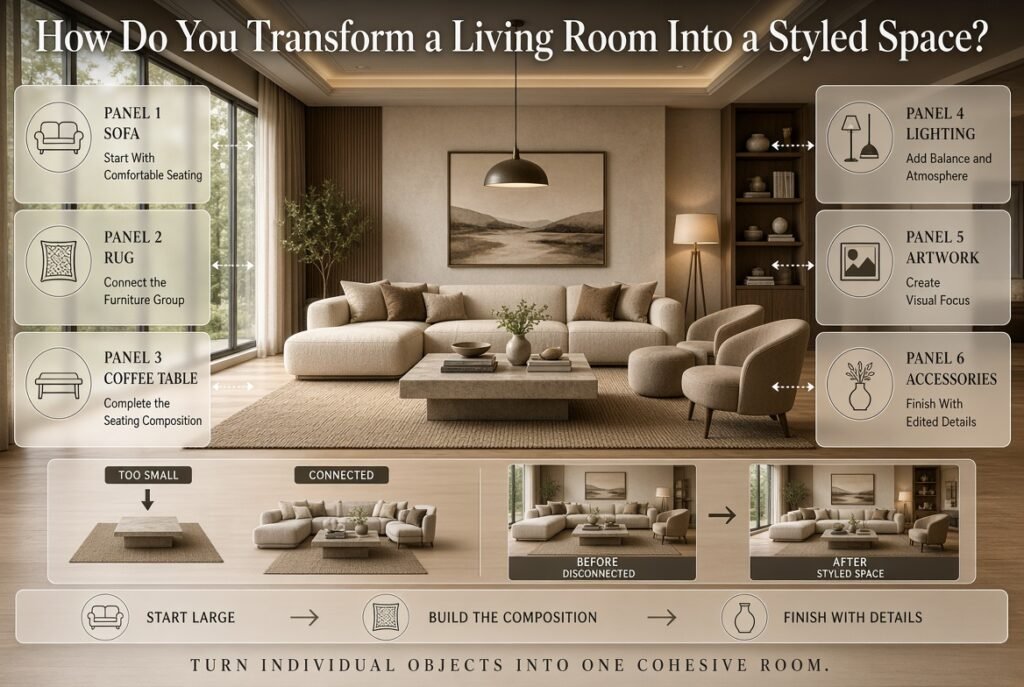
The living room usually benefits from a clear focal point, comfortable seating, balanced lighting, and a strong combination of texture.
Start with the largest elements:
Sofa → Rug → Coffee Table → Lighting → Artwork → Accessories
The rug is particularly important because it can visually connect multiple furniture pieces.
A common mistake is choosing a rug that’s too small. A properly sized rug should usually relate clearly to the seating arrangement rather than appearing like a small island underneath the coffee table.
If your living room already feels disconnected, studying a complete Living Room Transformation approach can help you rethink the room as a complete composition instead of changing isolated objects.
How Do You Set Up Home Décor Room by Room?
A home feels more cohesive when each room has its own identity while still sharing certain design elements.
You might repeat:
- Similar wood tones
- Related wall colors
- Consistent metal finishes
- Similar textile qualities
- Repeated accent colors
But don’t make every room identical.
The bedroom can feel softer, the kitchen more functional, the living room more social, and the office more focused.
For a practical starting framework, use How to Set Up My Home Decor to think about decoration as a complete home system rather than a collection of isolated rooms.
What Design Principles Make a Space Look More Expensive?
Expensive-looking interiors aren’t necessarily filled with expensive products.
They often have:
- Good proportions
- Consistent spacing
- Quality-looking materials
- Controlled color palettes
- Layered lighting
- Minimal visual clutter
- Intentional artwork
- Properly sized rugs
- Balanced furniture arrangements
One of the strongest principles is scale.
A tiny artwork over a large sofa may look accidental. A properly proportioned piece can immediately make the same room feel more intentional.
Another principle is repetition.
Repeat a material, shape, or color at least twice so it feels intentional rather than random.
How Do You Mix Different Interior Design Styles?
Mixing styles works when there is a common thread.
For example, modern furniture can work with vintage artwork because the artwork introduces history while the furniture keeps the room contemporary.
Traditional pieces can work with minimalist architecture when the palette remains controlled.
A good mixed-style room usually has one dominant direction and one or two secondary influences.
Avoid trying to give every object equal visual importance.
Choose a leader.
For example:
70% contemporary + 20% vintage + 10% handcrafted accents
The exact percentages don’t matter. The hierarchy does.
What Can Celebrity Homes Teach Us About Styled Spaces?
Celebrity interiors can be useful sources of inspiration because they often demonstrate how scale, architecture, luxury materials, and personalization interact.
But copying a celebrity home exactly is rarely practical.
The better approach is to identify the underlying principle.
For example, a celebrity interior might use:
- Oversized artwork
- Dramatic lighting
- Custom furniture
- Sculptural objects
- Large-scale architectural details
You don’t need a mansion to borrow those ideas.
A single oversized artwork or sculptural lamp can create a similar sense of confidence at a much smaller scale.
For an interesting case study in celebrity interior design and luxury residential aesthetics, explore Mark Cuban House.
What Is the Best Way to Style Different Rooms?
Every room has a different functional priority.
| Room | Main priority | Styling focus |
|---|---|---|
| Living room | Conversation | Seating, rug, lighting |
| Bedroom | Rest | Soft textures, calm colors |
| Dining room | Gathering | Table, lighting, centerpiece |
| Kitchen | Function | Storage, surfaces, lighting |
| Home office | Productivity | Desk, task lighting, organization |
| Entryway | First impression | Console, mirror, storage |
| Bathroom | Practical comfort | Lighting, materials, accessories |
This room-by-room approach prevents you from applying one design formula everywhere.
For broader guidance, the Room-by-Room Design Hub can help you think through each space according to its purpose.
What Are the Most Common Styled Space Mistakes?
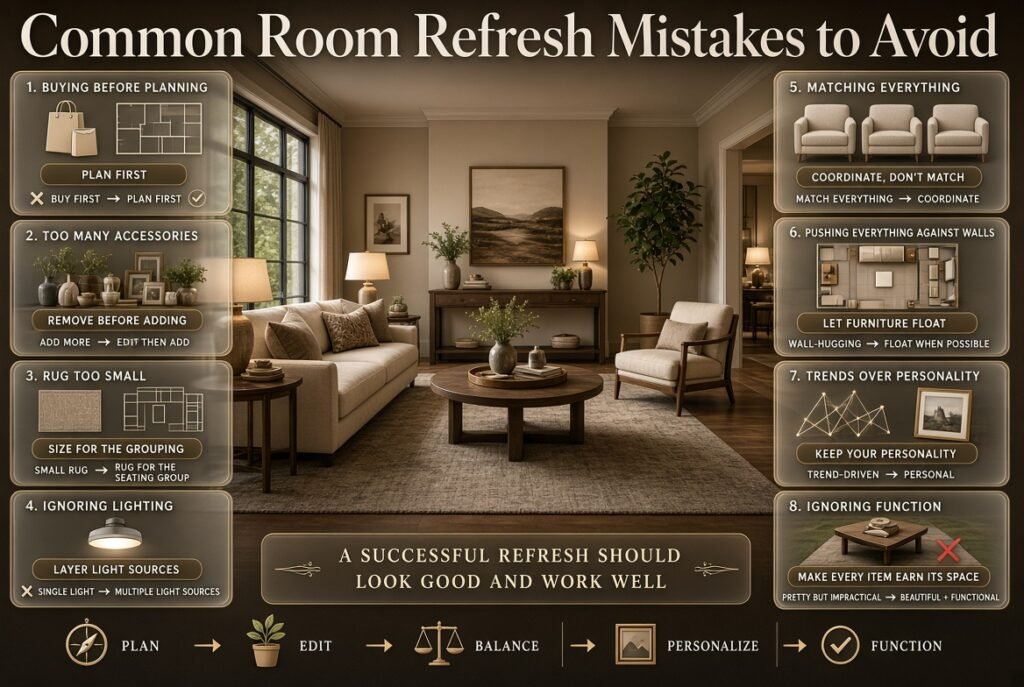
1. Buying Before Planning
Shopping feels productive, so it’s tempting to start there.
But buying a lamp before deciding where the chair will go can create more problems.
Better approach: Plan the room first.
2. Adding Too Many Accessories
People often interpret styling as adding more things.
The result is visual noise.
Better approach: Remove first, then add selectively.
3. Ignoring Scale
A beautiful piece can look wrong if its proportions don’t suit the room.
Better approach: Measure before purchasing.
4. Using Only One Light Source
A single ceiling fixture rarely creates a layered atmosphere.
Better approach: Combine ambient, task, and accent lighting.
5. Choosing Trends Over Personality
A trendy room can quickly feel dated if none of the choices reflect the homeowner.
Better approach: Use trends as accents rather than as the entire design foundation.
6. Pushing Everything Against the Walls
This can create an empty center and make furniture arrangements feel disconnected.
Better approach: Build a functional conversation area.
7. Choosing Rugs That Are Too Small
Small rugs can make otherwise good furniture look disconnected.
Better approach: Choose the rug according to the seating arrangement.
8. Creating a Perfectly Matching Room
Matching furniture sets may be convenient, but they can remove personality.
Better approach: Mix complementary pieces.
How Can You Refresh a Space Without Starting Over?
Start with a three-stage process:
Stage 1: Remove
Take away anything that is:
- Broken
- Unused
- Duplicated
- Visually distracting
- No longer suitable
Stage 2: Rearrange
Experiment with furniture placement before buying anything.
Try moving the sofa, changing chair positions, relocating lamps, and repositioning artwork.
Stage 3: Add
Only after editing and rearranging should you introduce new elements.
This order is important because it prevents you from solving a clutter problem with more objects.
If your project involves broader home upgrades, the Home Improvement section can also help you distinguish between cosmetic changes and improvements that affect how the home actually functions.
When Should You Use DIY Projects?
DIY projects make sense when you want personalization, savings, or a specific result that isn’t easily available commercially.
Good beginner projects include:
- Painting furniture
- Creating simple wall art
- Updating cabinet hardware
- Making decorative shelves
- Refreshing old frames
- Creating textile accents
- Upcycling small furniture
Not every project should be DIY, though.
Electrical work, structural changes, plumbing, and complex installations may require qualified professionals.
For manageable creative projects, browse DIY Home Projects for ideas that can add personality without requiring a complete renovation.
What Are the Best Expert Rules for a Styled Space?
Professional-looking interiors usually come down to a few repeatable principles.
Rule 1: Establish a Focal Point
Every room needs somewhere for the eye to land.
Rule 2: Create Visual Hierarchy
Not every object needs to be the star.
Rule 3: Repeat Key Elements
Repeat colors, materials, shapes, or finishes.
Rule 4: Mix Textures
Contrast smooth, soft, rough, natural, and reflective surfaces.
Rule 5: Leave Breathing Room
Empty space isn’t wasted space. It helps important objects stand out.
Rule 6: Prioritize Function
A beautiful room that is uncomfortable isn’t successful design.
Rule 7: Edit Constantly
Styling is often as much about subtraction as addition.
How Can You Create a More Cohesive Home?
Cohesion doesn’t mean making every room identical.
Instead, establish a visual thread.
For example, you might use warm white walls throughout the home while allowing each room to introduce different accent colors.
Or you could repeat natural wood, black metal, or brushed brass across several spaces.
A cohesive home feels connected because the eye recognizes familiar elements as you move from room to room.
This is especially useful in open-plan homes where several functional areas occupy one large visual field.
How do I create a stylish space without making it look cluttered?
Creating a stylish space isn’t about adding more décor; it’s about choosing the right pieces and giving them enough room to stand out. Start by removing anything that doesn’t serve a purpose or contribute to the room’s atmosphere. Then build the space around a few strong elements, such as a well-proportioned sofa, appropriately sized rug, layered lighting, artwork, and a small number of meaningful accessories.
A professional-looking room usually has visual breathing room. Instead of filling every shelf and tabletop, create small groups of objects with different heights, textures, and shapes. This gives the eye somewhere to rest and makes individual pieces feel more intentional.
Practical points:
Remove unnecessary décor before buying anything new.
Keep the largest furniture pieces visually simple.
Group small accessories instead of spreading them everywhere.
Leave some shelves and surfaces partially empty.
Use texture to create interest instead of relying on excessive decoration.
Current 2026 design guidance is also moving toward more curated, personal interiors, where rooms feel collected over time rather than perfectly staged.
What are the biggest interior design trends for creating a styled space in 2026?
The strongest 2026 direction is toward warmth, personality, texture, natural materials, and layered lighting. Instead of extremely minimal rooms dominated by stark white and identical furniture, designers are increasingly using earthy colors, wood, handmade pieces, vintage accents, tactile fabrics, and carefully selected statement elements.
That doesn’t mean you need to redesign your entire home around every new trend. A better strategy is to borrow the elements that genuinely suit your lifestyle. For example, you can introduce a warmer brown accent, textured cushions, a sculptural lamp, natural wood, or one vintage piece without changing your permanent finishes.
Useful 2026 styling ideas:
Warm whites, beige, brown, olive, and earthy tones
Natural wood and stone
Layered lighting instead of one central light
Handmade or artisan décor
Vintage pieces mixed with contemporary furniture
Curved and softer furniture shapes
Textured fabrics such as linen, wool, and bouclé
Personal artwork and meaningful objects
The common theme is less showroom perfection and more individual character.
How can I make my home look expensive and professionally styled on a budget?
A high-end look comes more from proportion, editing, lighting, and consistency than from the price of every item. Before spending money, improve the things that have the greatest visual impact. Reposition furniture, remove clutter, hang artwork correctly, improve lighting, and make sure rugs and curtains are appropriately sized.
If you do have a budget for upgrades, spend it selectively. One substantial rug, well-designed light fixture, quality curtain, large artwork, or attractive piece of furniture can make more difference than ten inexpensive accessories.
Smart budget priorities:
Fix furniture placement first.
Invest in a properly sized rug.
Use multiple light sources.
Choose fewer, better accessories.
Add natural textures such as wood, linen, ceramic, or woven materials.
Mix affordable pieces with one or two stronger statement pieces.
Avoid buying an entire matching furniture set.
A useful professional principle is to edit before you upgrade. Sometimes removing five unnecessary items improves the room more than purchasing five new ones.
Designers are also emphasizing furniture that works for real lifestyles and recommending a mix of vintage and modern pieces rather than furnishing an entire room from one source.
How do I choose colors, textures, and lighting for a cohesive styled space?
Start with a controlled color foundation, then create depth through texture and lighting. You don’t need every item to match, but the room should have a recognizable visual relationship between its major elements.
A practical palette might include one dominant neutral, one secondary color, and one or two smaller accents. For example, warm white walls could be combined with walnut furniture, olive cushions, natural linen, and muted brass.
Texture prevents that palette from feeling flat. Combine materials that look and feel different, such as:
Wood + linen
Wool + ceramic
Stone + cotton
Glass + woven materials
Metal + natural wood
Velvet + matte finishes
Lighting then completes the composition. Instead of relying entirely on a ceiling fixture, combine ambient, task, and accent lighting. Current design guidance strongly favors layered lighting because it adds atmosphere, depth, and flexibility.
Professional rule: If a neutral room feels boring, don’t immediately add brighter colors. First check whether it needs more texture, better lighting, stronger contrast, or a more interesting focal point.
How do I make my styled space feel personal instead of looking like a showroom?
The easiest way to make a styled space feel authentic is to include things that actually belong to your life. Books you read, artwork you love, family photographs, travel pieces, handmade ceramics, vintage furniture, inherited objects, or items connected to your hobbies can give a room a sense of identity.
The trick is curation rather than accumulation. You don’t have to display everything that has meaning. Select the pieces that contribute to the room and give them enough visual space to be appreciated.
A personal interior might combine a modern sofa with an old wooden side table, contemporary lighting, locally made pottery, and artwork collected over several years. The pieces don’t have to match because the story connecting them is more important than perfect uniformity.
To create a genuinely personal space:
Mix old and new.
Display meaningful objects selectively.
Use original artwork where possible.
Include handmade or locally crafted pieces.
Keep some evidence of real life, such as books and throws.
Don’t copy an entire Pinterest or Instagram room.
Let your preferences influence the final design.
This approach is particularly relevant in 2026, when the design conversation is increasingly centered on collected, personal, lived-in interiors rather than perfectly coordinated spaces.
Conclusion
Creating a Styled Space is not about filling your home with expensive furniture, following every trend, or copying a picture from a design magazine. The most successful interiors are the ones that feel intentional, comfortable, and connected to the people who live in them. A well-styled home should look beautiful, but it should also work naturally for everyday life.
The key is to make thoughtful choices rather than trying to change everything at once. Start with the layout, decide on a practical color palette, introduce different textures, improve the lighting, and then add furniture and accessories that genuinely suit your lifestyle. Even small changes—such as replacing oversized décor, improving curtain placement, adding a layered light source, or styling an empty surface—can completely change how a room feels.
Remember that good styling is also about editing. If a room feels crowded, removing a few unnecessary pieces can have a greater impact than buying something new. Give your favorite objects room to breathe, balance large and small elements, and allow some empty space to remain. That balance is what makes an interior feel sophisticated rather than simply decorated.
Most importantly, let your home develop its own personality. Combine modern pieces with vintage finds, display meaningful objects, use natural materials, and choose colors and textures that make you feel comfortable. Current design trends can provide inspiration, but they should never replace your personal taste or the practical needs of your household.
A beautiful home does not have to happen in one weekend. Style can evolve gradually as you discover what works, what feels right, and what deserves to stay. Whether you are refreshing one corner or redesigning an entire home, focus on creating a space that feels intentional, functional, personal, and genuinely yours.
When every element has a purpose and the room still feels relaxed, you have achieved something more valuable than a fashionable interior—you have created a home that feels right.

Leave a Reply