
Introduction
Interior Decoration Tips Mintpaldecor | A home can have beautiful furniture, expensive finishes, and plenty of decorative accessories and still feel strangely incomplete. One room may look too busy, another may feel empty, and the colors that looked perfect in a store may suddenly feel wrong at home. This usually isn’t because you need more decoration. It’s because the different elements aren’t working together.
That is where practical interior decoration tips mintpaldecor become useful. Good decoration is less about buying everything that looks attractive and more about knowing what your room actually needs, what should stay simple, and where a little detail can make a big difference.
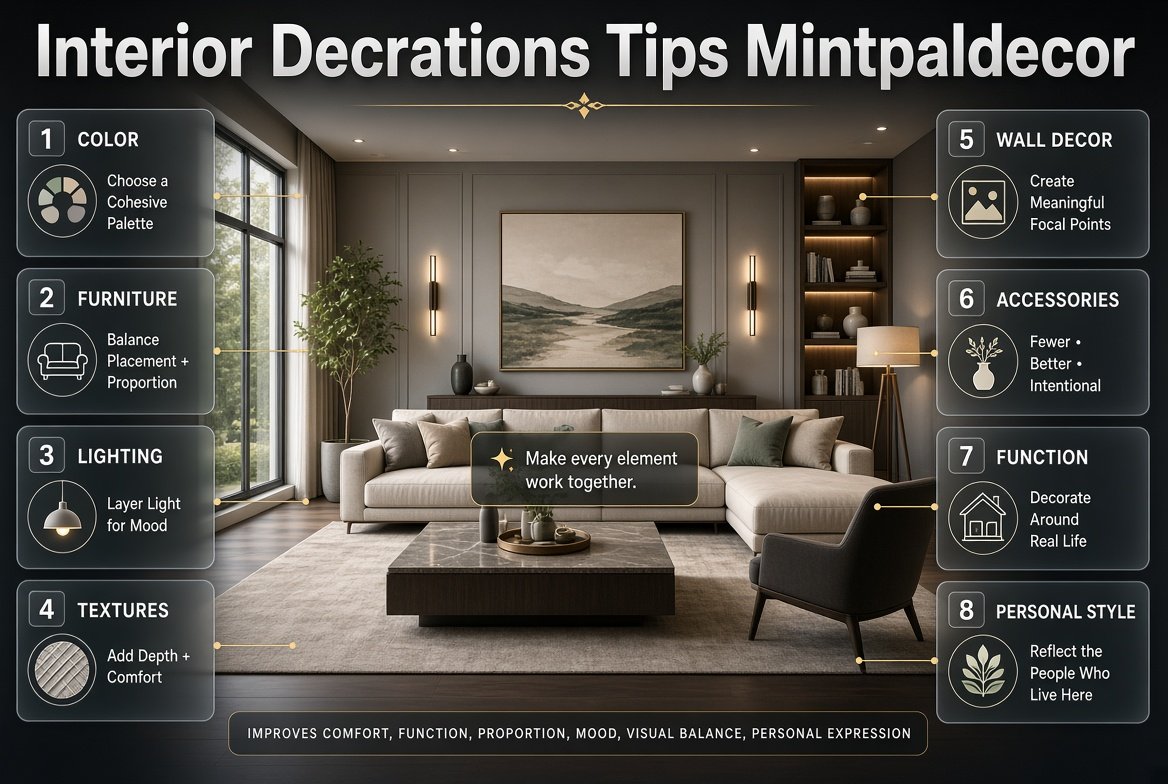
Before choosing new accessories, it’s worth understanding the difference between decorating a room and simply filling it. Decoration should improve comfort, function, proportion, mood, and visual balance. It should also reflect the people who live in the space.
This guide explains how to approach interior decoration from the ground up, including color selection, furniture placement, lighting, wall decor, textures, accessories, room-by-room ideas, budget-friendly improvements, common mistakes, professional styling techniques, and practical questions homeowners often ask. For a broader starting point, explore DesignMode24 Interior Design before planning major changes.
What Is the Best Way to Start Decorating a Home?
The best way to start decorating a home is to understand the space before buying anything. Identify each room’s purpose, measure the available space, assess natural light, note existing furniture, and decide what atmosphere you want to create. Then build the room around function, proportion, color, and texture rather than purchasing accessories at random.
A common decorating mistake is starting with small decorative objects because they’re easy and enjoyable to buy. A vase, candle, cushion, or frame may look attractive in isolation, but none of them can fix a poorly arranged room.
Start with the big decisions first.
Think about:
- How the room is used every day
- Where people naturally walk
- Which furniture needs to remain
- Where natural light enters
- Which architectural features deserve attention
- What should become the focal point
- How much storage is required
- What mood you want the room to create
A practical decorating process looks like this:
Function → Layout → Color → Lighting → Texture → Large decor → Small accessories
That order prevents many expensive mistakes.
Start With the Room’s Real Purpose
A living room may need to support television viewing, conversation, children’s activities, reading, guests, or all of these at once. A bedroom has a different priority: relaxation, storage, and sleep. A dining area should support comfortable seating and movement around the table.
When the function is clear, decoration becomes easier because every choice has a reason.
For a deeper introduction to the subject, you can also explore What Is Interior Design MintPalDecor, especially when you’re trying to understand how decoration connects with the larger idea of interior design.
How Do You Choose an Interior Decorating Style?
Choose a dominant style based on the feeling you want rather than trying to copy one complete room from a magazine or social media post. You can mix styles successfully when one style remains dominant and the supporting styles are introduced through carefully selected furniture, colors, materials, or artwork.
Popular directions include:
- Modern
- Contemporary
- Minimalist
- Traditional
- Transitional
- Scandinavian
- Japandi
- Coastal
- Rustic
- Industrial
- Eclectic
You don’t have to choose one label and follow it perfectly.
For example, a home could use a contemporary foundation with natural wood, vintage artwork, and soft textiles. Another could combine traditional furniture with modern lighting. The goal is not strict stylistic purity. The goal is visual coherence.
Create a Style Vocabulary
A useful technique is to choose three words that describe your ideal interior.
For example:
Warm + Calm + Natural
or
Elegant + Modern + Dramatic
Then evaluate major purchases against those words.
If an item doesn’t support the mood you’re creating, ask whether you genuinely love it enough to break the rule. That small filter can prevent a room from becoming a collection of unrelated objects.
How Do You Create a Cohesive Interior?
A cohesive interior doesn’t mean every room must have the same furniture, color, or style. It means there are visual connections between rooms. Repeating selected colors, wood tones, metals, textures, or shapes helps the home feel connected while still allowing individual rooms to have their own personality.
One of the easiest ways to create cohesion is to establish a small set of recurring elements.
For instance:
- Warm white walls throughout the main areas
- Natural oak or walnut used repeatedly
- A single metal finish in lighting and hardware
- Olive green appearing in different rooms
- Similar curtain textures
- Related artwork styles
You can learn more about the overall concept through interior design mintpaldecor, then apply the same principles to individual decorating decisions.
Use Repetition, Not Exact Matching
Suppose your living room has a deep green cushion. You don’t need green furniture throughout the home. Instead, repeat the color lightly in a bedroom artwork, entryway accessory, or dining room textile.
The repetition creates a visual thread.
This is more sophisticated than buying matching sets.
⭐ Expert Tip: Choose two or three recurring design elements for the entire home, not ten. Too many repeated details can make the space feel overly coordinated.
How Do You Choose the Right Interior Color Palette?
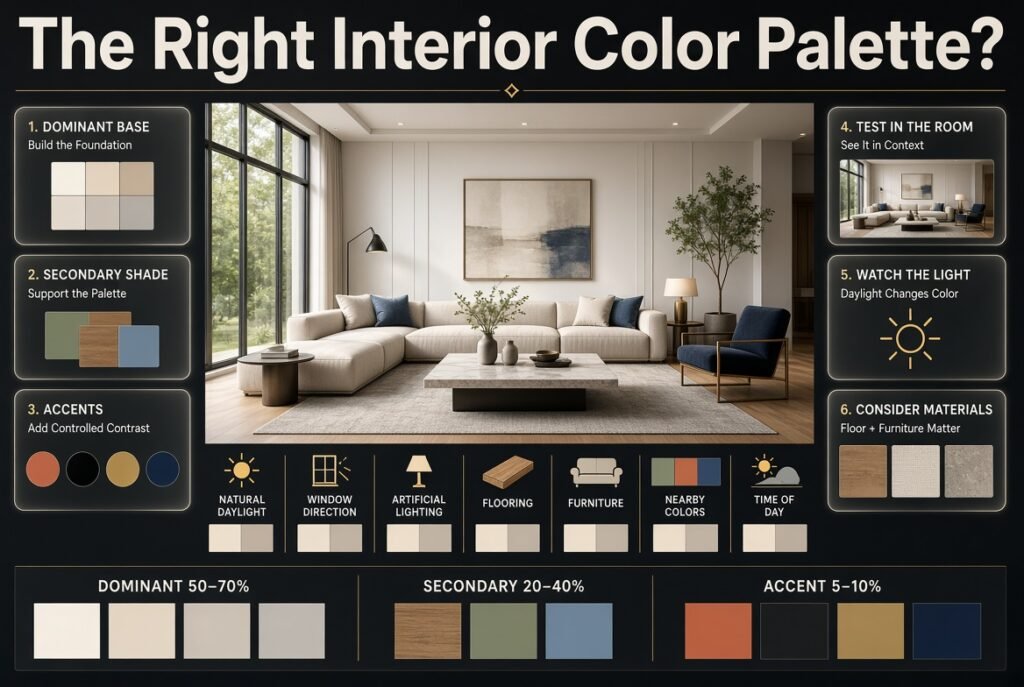
A practical color palette usually contains a dominant neutral or base color, a secondary supporting shade, and one or two accents. The exact percentages don’t need to be mathematical, but the idea is to establish visual hierarchy so the room doesn’t become a competition between too many colors.
A useful starting formula is:
| Color Role | Approximate Use | Examples |
|---|---|---|
| Dominant | 50–70% | Warm white, beige, soft gray |
| Secondary | 20–40% | Wood, muted green, dusty blue |
| Accent | 5–10% | Terracotta, black, brass, deep navy |
The most important point is to test colors in the actual room.
Paint looks different depending on:
- Natural daylight
- Window direction
- Artificial lighting
- Flooring
- Furniture
- Nearby colors
- Time of day
A soft beige can appear creamy in one room and grayish in another.
For more detailed color inspiration, browse the Paint Color section and compare colors in relation to the rest of your room rather than choosing them independently.
How Do You Use Accent Colors?
Accent colors work best when they are intentional.
Instead of placing five different accent colors throughout the room, choose one primary accent and repeat it through different materials.
For example:
Rust-colored cushion + rust artwork detail + ceramic object + subtle curtain pattern
The color doesn’t need to appear everywhere. It simply needs to appear enough to create connection.
⚠ Common Mistake: Choosing a strong accent color first and then forcing every decorative item to match it. This can make the room look staged rather than naturally assembled.
How Important Is Furniture Placement in Interior Decoration?
Furniture placement is one of the most important parts of decorating because it determines how the room functions and how visual weight is distributed. A beautifully decorated room can still feel uncomfortable when furniture blocks movement, sits too far apart, or doesn’t relate properly to the room’s scale.
Start with the largest piece.
In a living room, that is usually the sofa. In a bedroom, it is the bed. In a dining room, it’s the dining table.
Build the rest of the layout around it.
A Simple Furniture Planning Sequence
Step 1: Place the largest item
Position the main piece according to windows, doors, focal points, and traffic flow.
Step 2: Create a functional zone
Make sure seating supports conversation, work, dining, or another clear activity.
Step 3: Add secondary pieces
Bring in chairs, side tables, storage, and other supporting furniture.
Step 4: Check circulation
Walk through the room mentally and physically. Can doors open? Can people pass without squeezing between furniture?
Step 5: Add the visual foundation
Introduce the rug, lighting, and major wall elements.
Step 6: Style the details
Only now should you start adding decorative accessories.
Should Furniture Touch the Walls?
Not necessarily.
In larger rooms, moving furniture away from the wall can create a more intimate seating area and improve circulation. In smaller rooms, keeping furniture closer to the perimeter can preserve usable floor space.
There is no universal rule.
The correct arrangement depends on the room’s dimensions and purpose.
How Do You Choose the Right Size Rug?
Rugs are often underestimated. A correctly sized rug connects furniture and visually defines a space, while an undersized rug can make the same room feel fragmented.
In many living rooms, the rug should be large enough for at least the front legs of the main seating pieces to sit comfortably on it. In larger spaces, the rug may accommodate the full seating arrangement.
Before buying, measure the area rather than relying on appearance alone.
Ask:
- Does the rug connect the main furniture?
- Does it leave an intentional border around the room?
- Can the furniture sit securely on it?
- Does the pattern compete with other elements?
What Rug Style Works Best?
A neutral textured rug is useful when the room already contains strong furniture or artwork.
A patterned rug can work as the starting point of the entire palette when the rest of the room is relatively restrained.
The best choice depends on what the room already contains.
How Can Lighting Transform Interior Decoration?
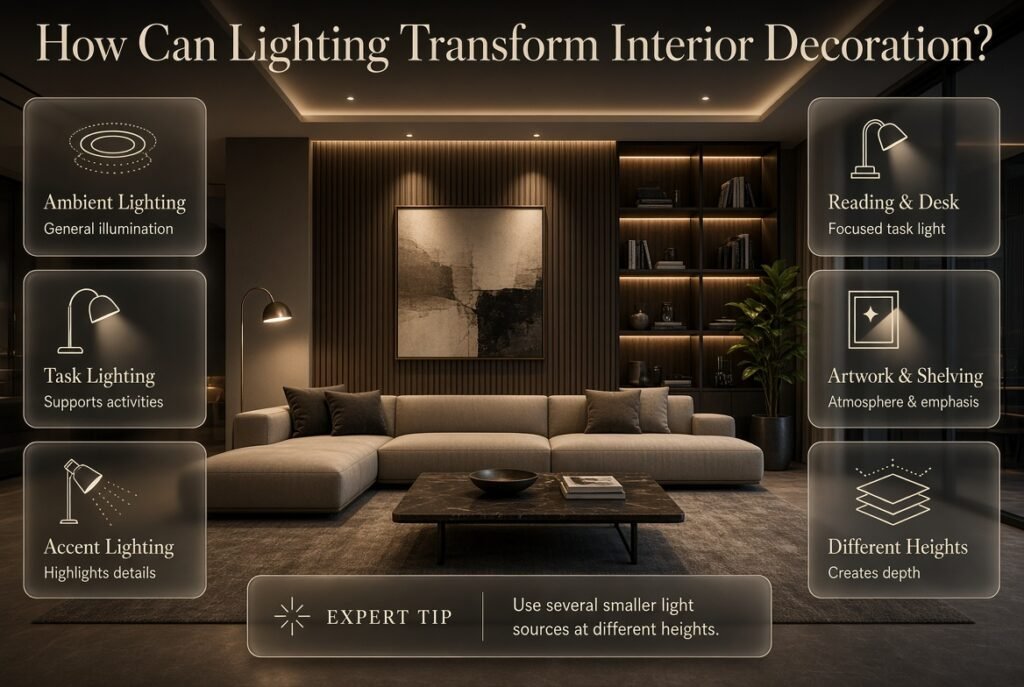
Lighting can completely change how a decorated room feels. It influences color, shadows, texture, depth, and atmosphere. A room with excellent furniture but poor lighting can still feel cold or unfinished.
Think in layers.
Ambient Lighting
General illumination comes from ceiling fixtures, recessed lights, track lighting, or other broad sources.
Task Lighting
Task lighting supports activities.
Examples include:
- Reading lamps
- Desk lamps
- Kitchen work lighting
- Bathroom vanity lights
- Bedside lamps
Accent Lighting
Accent lighting adds atmosphere or highlights specific features.
Use it for:
- Artwork
- Shelving
- Plants
- Architectural details
- Decorative objects
A sophisticated interior rarely depends on one bright ceiling fixture.
⭐ Expert Tip: Use several smaller sources of light at different heights instead of one intense source. This creates depth and allows you to change the atmosphere according to the time of day.
How Do You Decorate With Texture?
Texture gives a room depth even when its color palette is simple.
You can combine:
- Linen
- Wool
- Cotton
- Velvet
- Bouclé
- Wood
- Stone
- Ceramic
- Glass
- Metal
- Woven fibers
- Natural plants
The key is contrast.
Imagine a room using only smooth painted walls, polished furniture, and glossy accessories. It can feel flat.
Now add a woven rug, linen curtains, textured cushions, natural wood, and matte ceramics. The room immediately becomes more interesting.
Combine Hard and Soft Surfaces
A useful decorating principle is to balance visual hardness.
For example:
Glass table + soft rug + upholstered chair + wooden object + ceramic lamp
The materials create variation without requiring many colors.
How Should You Decorate Walls?
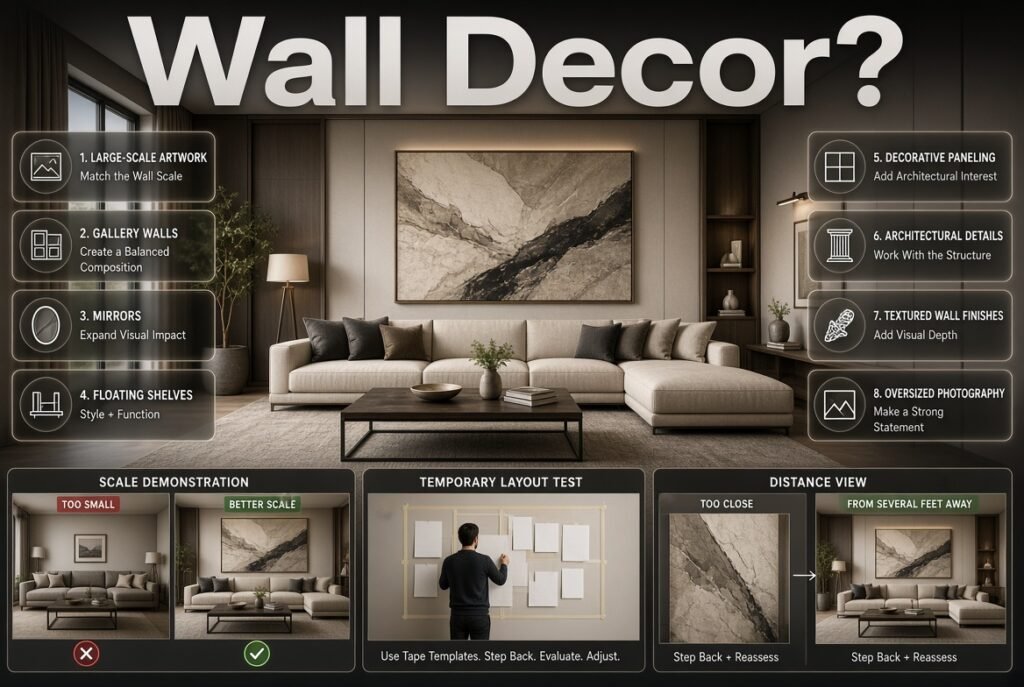
Wall decor should reflect the scale of the wall.
One major problem in many homes is artwork that is too small for the furniture beneath it. A tiny frame above a large sofa often makes both the artwork and the sofa look disconnected.
Strong Wall Decoration Options
Consider:
- Large-scale artwork
- Gallery walls
- Mirrors
- Floating shelves
- Decorative paneling
- Architectural details
- Textured wall finishes
- Oversized photography
Before hanging anything permanently, test the arrangement.
A paper template made with painter’s tape can help you visualize size and spacing.
📌 Quick Tip: Stand at least several feet away from the wall after creating your taped layout. What looks balanced from two feet away can look completely different from across the room.
How Do You Style Shelves Without Creating Clutter?
Shelf styling should have variation and breathing room.
Rather than placing objects wherever there is empty space, think in groups.
Use a combination of:
- Tall objects
- Medium pieces
- Small accents
- Books
- Plants
- Ceramics
- Personal items
Try not to make every shelf symmetrical unless you’re intentionally creating a formal look.
Use Height Variation
A tall vase next to shorter books creates a more dynamic arrangement than several objects of exactly the same height.
Mix Materials
A wooden object next to a ceramic piece and a metal frame creates contrast.
Leave Empty Space
Empty space is part of the design.
A shelf that’s completely full can make even expensive objects feel inexpensive because the eye doesn’t know where to rest.
How Do You Make a Home Look More Expensive?
A polished home is usually the result of good proportions, visual restraint, consistent details, and strong finishing choices rather than expensive purchases.
High-impact improvements include:
- Better lighting
- Properly sized rugs
- Full-length curtains
- Larger artwork
- Coordinated hardware
- Quality-looking textiles
- Organized surfaces
- Thoughtful greenery
- Repeated materials
Curtains Matter More Than People Think
Curtains can influence the perceived height and width of a room.
When appropriate, hanging curtains higher and allowing them to fall toward the floor can create a more elevated appearance.
However, the exact treatment depends on the architecture and window placement.
Hardware Can Change a Room
Cabinet pulls, handles, faucets, and light fixtures occupy relatively small areas but are repeated frequently. Replacing mismatched hardware can make a kitchen or bathroom feel more coherent without changing major components.
This is an excellent example of decoration improving visual consistency rather than adding clutter.
How Can You Decorate a Small Room?
Small rooms benefit from restraint, proportion, and multifunctional choices.
The biggest mistake is assuming that every small room needs tiny furniture.
Several tiny pieces can actually make a room feel more crowded than a few appropriately scaled pieces.
Instead:
- Choose furniture according to the room’s actual dimensions.
- Keep walking paths clear.
- Use vertical storage where useful.
- Keep large surfaces visually calm.
- Select furniture with useful storage.
- Use mirrors selectively.
- Repeat colors to reduce visual fragmentation.
- Avoid excessive small accessories.
A small room often feels larger when it contains fewer but stronger visual elements.
How Do You Decorate a Large Room?
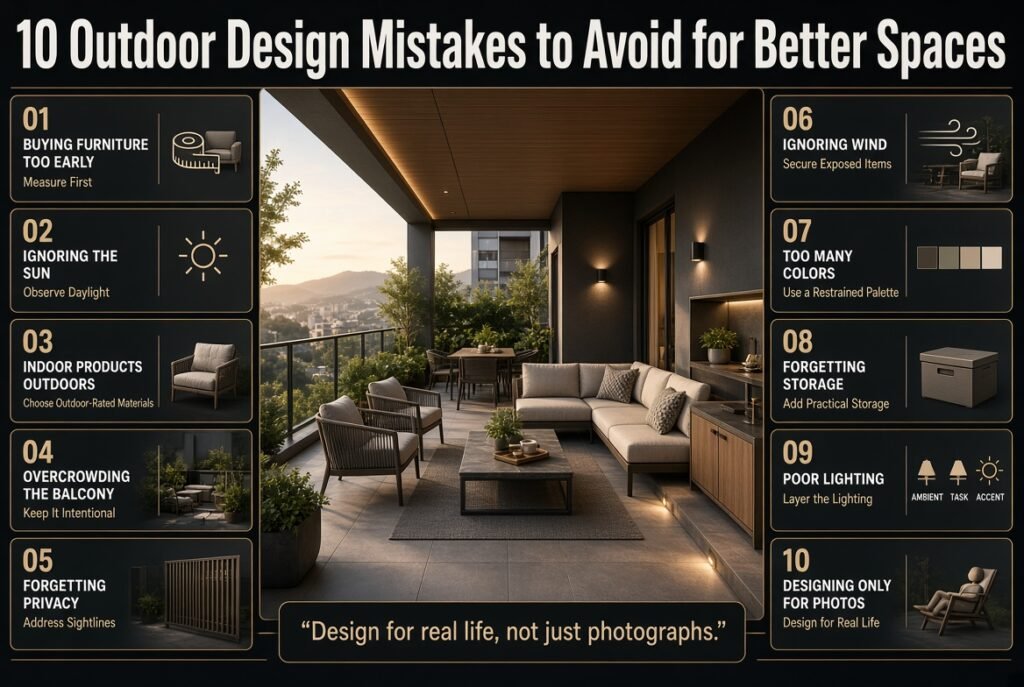
Large rooms have almost the opposite challenge. They can feel empty, disconnected, or cold.
Use zoning to give the space purpose.
For example, one large living room could contain:
Main seating zone + reading corner + side table + floor lamp + plant
Instead of arranging furniture around the perimeter, create smaller areas within the larger room.
Large rooms can also support bigger artwork, larger rugs, heavier curtains, substantial lighting, and more architectural detail.
The key is scale.
A tiny coffee table can disappear in a huge room, while a substantial table gives the room visual weight.
How Do You Decorate a Home Room by Room?
Each room requires a slightly different approach because the purpose changes.
Living Room Decoration
A living room should balance comfort and visual interest.
Focus on:
- Seating layout
- Rug size
- Coffee table proportion
- Layered lighting
- Artwork
- Textures
- Storage
- Focal point
Don’t make the television the only visual focus unless that’s genuinely how the room is used.
A fireplace, large artwork, window view, architectural wall, or substantial lighting fixture can provide an additional focal point.
Bedroom Decoration
Bedrooms benefit from calm, controlled decoration.
Use:
- Soft or muted colors
- Comfortable bedding
- Bedside lighting
- Layered textiles
- Limited clutter
- Appropriate storage
- Artwork that supports the mood
The bed should generally remain the strongest visual element.
Dining Room Decoration
A dining room doesn’t need dozens of decorative pieces.
Focus on:
- Comfortable table proportions
- Correct chair spacing
- Suitable overhead lighting
- A central visual feature
- Useful storage
- Practical circulation
A statement pendant or chandelier can make the table feel intentionally anchored.
Kitchen Decoration
Kitchen decoration should never compromise work surfaces or access.
Useful decorative elements include:
- Plants
- Ceramics
- Artwork
- Carefully styled open shelving
- Countertop accessories that are genuinely useful
- Decorative lighting
Keep everyday appliances organized where possible. Visual clutter is especially noticeable in kitchens because there are already many hard surfaces and functional objects.
Entryway Decoration
The entryway is the first visual impression of the home.
Useful elements include:
- Mirror
- Console
- Small lamp
- Runner
- Artwork
- Basket
- Key storage
- Plant
The entryway doesn’t need to be large to feel intentional.
For additional room-by-room guidance, the Room-by-Room Design Hub can help you apply decorating principles to individual spaces.
How Do You Use Decorative Accessories Correctly?
Accessories should support the room’s story.
Good decorative objects can introduce:
- Color
- Texture
- Scale
- Personality
- Memory
- Contrast
But too many objects create visual noise.
Try grouping objects rather than scattering them across every surface.
A Simple Coffee Table Formula
A useful starting composition could include:
One larger book + one low bowl + one sculptural object
Or:
Tray + candle + greenery
The important thing is variation in height and shape.
Decorate With Personal Items
The strongest homes often contain personal objects rather than only showroom accessories.
Consider displaying:
- Travel finds
- Family photographs
- Books
- Artwork
- Handmade ceramics
- Inherited pieces
- Collections
Personal objects create emotional depth.
How Can You Decorate on a Budget?
Decorating on a budget requires prioritization.
Don’t spread a small budget across twenty low-impact purchases. Focus on the changes that affect the room most.
High-Impact Budget Improvements
- Rearrange furniture.
- Remove clutter.
- Improve lighting.
- Change textiles.
- Repaint strategically.
- Upgrade artwork.
- Add greenery.
- Replace visibly outdated hardware.
- Improve curtain placement.
- Buy fewer but more useful accessories.
This is where DIY Home Projects can be especially useful. Some of the most noticeable improvements don’t require a complete renovation.
Don’t Buy Cheap Just Because It’s Cheap
A low-cost accessory isn’t automatically a good purchase.
Ask:
- Will I still like this next year?
- Does it solve a visual problem?
- Does the scale work?
- Does it coordinate with existing pieces?
- Can I use it in another room later?
Good budgeting is not about spending as little as possible. It’s about avoiding purchases you’ll soon regret.
What Are the Most Common Interior Decoration Mistakes?
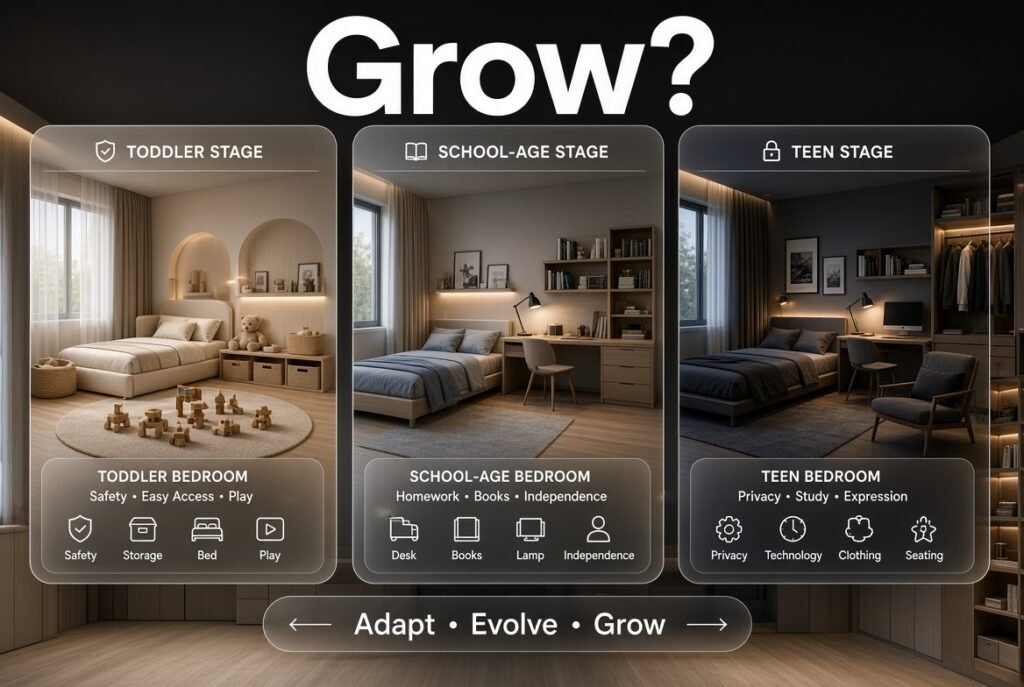
Understanding mistakes can save more money than reading another shopping list.
Choosing Trends Over the Home’s Architecture
A style that looks excellent online may not suit your actual room.
Why it happens: Inspiration photos are often treated as templates.
Why it’s harmful: The result can fight the architecture rather than enhance it.
Better approach: Borrow individual ideas while respecting ceiling height, window positions, flooring, room proportions, and existing features.
Using Too Many Materials
Wood, marble, brass, black metal, colorful tile, patterned upholstery, glass, and multiple competing woods can overwhelm one room.
Better approach: Select a small number of dominant materials and use accents carefully.
Buying Furniture Without Measuring
This is one of the most expensive errors.
Measure:
- Width
- Height
- Depth
- Door openings
- Hallways
- Stair access
- Clearance around furniture
A sofa may fit the room but fail to enter the house.
Hanging Artwork Too High
Artwork should generally relate to human eye level and the furniture beneath it. Exact height varies with composition, ceiling height, and furniture scale, so avoid relying on one universal number.
Ignoring Lighting Temperature
A room can look dramatically different under warm and cool bulbs.
Always consider the relationship between artificial light, paint, textiles, and materials.
Filling Every Empty Corner
An empty corner isn’t automatically a problem.
Sometimes empty space gives the room balance.
⚠ Common Mistake: Treating every unused area as an invitation to add another chair, plant, basket, or side table.
How Do Professionals Make a Room Look More Balanced?
Professionals often work through a process of editing.
They look at:
- Visual weight
- Repetition
- Contrast
- Symmetry
- Asymmetry
- Scale
- Sightlines
- Negative space
- Focal points
One effective technique is to photograph the room from the entrance and from the main seating position.
Photos reveal problems that can become invisible when you see the room every day.
For example, you may discover:
- Artwork is too small.
- One side feels much heavier.
- A corner is overcrowded.
- The coffee table is too small.
- A cable is visually distracting.
- Too many patterns are competing.
- A light source creates an unpleasant shadow.
A photograph turns the room into a composition rather than just a familiar environment.
How Do You Balance Symmetry and Asymmetry?
Symmetry creates order.
Examples include:
Two lamps + two matching side tables + centered artwork
Asymmetry creates energy.
Examples include:
One tall lamp + stacked books + low ceramic object
Neither is always better.
Formal rooms often benefit from more symmetry, while casual or contemporary rooms can feel more natural with asymmetry.
The most successful interiors usually contain both.
What Does Home Styling Add to Interior Decoration?
Interior decoration creates the foundation. Styling provides the finishing layer.
Styling determines what sits on the shelves, coffee table, console, bedside table, and other surfaces.
This is where proportion, grouping, editing, and storytelling become especially important.
The Home Styling section can help when you’re already happy with the room but want to improve the final details.
Styling Is About Editing
A useful exercise is to decorate a surface and then remove 20–30% of what you placed on it.
Often the edited arrangement looks better.
Why?
Because the stronger objects have enough space to be noticed.
How Can Home Improvement Support Better Decoration?
Some decorating problems are actually improvement problems.
For example, a room may feel dark because of poor lighting, not because it needs more accessories.
A wall may feel awkward because of poor proportions, not because it needs another small painting.
A kitchen may look cluttered because there isn’t enough storage.
That is why design and improvement sometimes need to work together.
For practical upgrades beyond decoration, explore Home Improvement.
Good decorating doesn’t hide functional problems. It works with solutions that make the room easier to live in.
How Do You Use Home Design Ideas Without Copying Someone Else?
Inspiration is useful, but copying an entire room rarely produces the same result because your home has different proportions, light, architecture, and daily requirements.
Instead, extract individual principles.
From one room, you might borrow:
the color palette
From another:
the furniture arrangement
From another:
the lighting strategy
From another:
the way artwork is displayed
Then combine the ideas around your own home.
This is a more sustainable approach to inspiration.
You can explore broader Home Design Ideas while keeping your own architecture and lifestyle at the center of the decision.
Expert Interior Decoration Tips That Actually Make a Difference
Start With the Biggest Visual Problem
Don’t begin with the easiest task.
If the sofa is too large, changing cushions won’t solve the problem.
If the lighting is poor, another decorative object won’t solve it.
Identify the issue with the greatest visual and functional impact.
Use a Limited Number of Focal Points
Every room should have hierarchy.
One main focal point should generally lead, with supporting elements creating secondary interest.
If everything is bold, nothing feels special.
Repeat Shapes
Shape repetition creates subtle visual rhythm.
For example:
- Round mirror
- Round coffee table
- Rounded lamp
Or:
- Rectangular artwork
- Rectangular rug
- Rectangular console
The repetition doesn’t have to be exact.
Mix Old and New
An entirely new interior can feel impersonal.
Introduce one or two older pieces with character.
A vintage chair, antique frame, inherited cabinet, or handmade object can make a modern room feel more authentic.
Don’t Underestimate Plants
Plants can add:
- Height
- Color
- Texture
- Softness
- Natural variation
Choose plants based on the available light and maintenance you can realistically provide.
What are the most important interior decoration tips for making a home look stylish?
The most important decorating tip is to focus on balance, proportion, color, lighting, and layout before adding accessories. A room can have beautiful furniture and expensive decorations, but if the furniture is poorly arranged or the colors compete with each other, the space won’t feel polished. Start with the largest elements, create a practical layout, and then build the decorative details around them.
A stylish home doesn’t need to look expensive or perfectly matched. It should feel intentional. Use a controlled color palette, combine different textures, choose artwork that suits the scale of the wall, and leave enough empty space so important pieces can stand out.
Useful points to remember:
Choose furniture according to the room’s size.
Use two or three main colors rather than too many competing shades.
Layer lighting instead of depending on one ceiling fixture.
Add texture through rugs, curtains, cushions, wood, ceramics, or natural materials.
Remove unnecessary accessories before buying new ones.
💡 Professional Tip: Before purchasing anything new, photograph the room from several angles. Photos often reveal layout problems and visual clutter that aren’t obvious when you’re standing inside the space.
How can I make my home look more expensive without spending a lot of money?
A sophisticated interior is usually created through good proportions, thoughtful styling, proper lighting, and consistency, not simply through expensive furniture. Small improvements can have a surprisingly large effect when they are made in the right places.
Start by improving the elements that occupy the most visual space. Properly positioned curtains, a well-sized rug, layered lighting, larger artwork, coordinated hardware, and decluttered surfaces can make a home feel considerably more refined.
Instead of buying ten inexpensive decorative pieces, invest in one or two items that have the right scale and quality for the room.
High-impact budget improvements include:
Rearranging furniture for better flow.
Replacing outdated lampshades or light fixtures.
Using full-length curtains where appropriate.
Upgrading a few key cushions or throws.
Repainting walls when the existing color works against the room.
Replacing mismatched cabinet handles.
Removing unnecessary objects from shelves and countertops.
Adding plants or natural textures.
⭐ Expert Tip: Luxury is often created through restraint. Leave breathing room around important furniture and decorative pieces instead of filling every available surface.
How do I choose the right colors for my interior decoration?
Choose colors based on the natural light, room size, existing furniture, flooring, and atmosphere you want to create rather than selecting a color simply because it’s currently popular. A successful palette normally includes a dominant base color, a secondary supporting shade, and one or two accents.
For example, warm white walls can be combined with natural wood, muted green textiles, and small touches of black or brass. The colors don’t need to match perfectly. They need to relate to one another.
Always test paint in the actual room before committing. A color can look completely different depending on the direction of the windows and the type of artificial lighting used in the evening.
A practical color-planning approach:
Start with the largest permanent elements.
Identify the undertones in your flooring and furniture.
Select a dominant wall or background color.
Add a secondary color through upholstery or larger textiles.
Introduce stronger colors through smaller accents.
Check the palette in daylight and at night.
📌 Quick Tip: If you’re unsure about a bold color, use it first in removable elements such as cushions, artwork, curtains, or accessories. This gives you flexibility without committing the whole room to one trend.
How can I decorate a small room without making it feel crowded?
The key to decorating a small room is editing rather than adding more. A small space can feel comfortable and stylish when furniture is correctly scaled, pathways remain open, and the number of decorative objects is controlled.
Avoid the common assumption that every piece of furniture must be tiny. Several small pieces can make a room feel more crowded because they create visual fragmentation. One appropriately sized sofa, table, or storage unit can sometimes work much better.
Use vertical space when possible, keep larger surfaces relatively calm, and choose multifunctional furniture where it genuinely improves the room.
Practical small-room strategies:
Measure furniture before purchasing it.
Keep walking routes clear.
Use storage to control visible clutter.
Consider furniture with exposed legs for a lighter visual appearance.
Use mirrors where they improve depth or light.
Repeat a limited color palette.
Avoid too many tiny accessories.
Use vertical artwork or shelving to draw the eye upward.
⚠ Common Mistake: Trying to make a small room feel larger by filling it with mirrors, pale colors, and decorative objects. These techniques only work when the layout and clutter are already under control.
How do I make my interior decoration look cohesive instead of mismatched?
A cohesive interior doesn’t mean everything has to match. It means the rooms and individual pieces share visual connections through color, materials, shapes, finishes, or design style. This allows you to mix different furniture and decorative pieces without making the home feel random.
One of the easiest techniques is repetition. Choose a few design elements and allow them to appear naturally in different rooms. You might repeat a warm wood tone, a muted green, a black metal finish, or a particular textile texture.
You can also connect rooms through similar lighting styles, artwork themes, flooring, or neutral background colors.
Ways to create cohesion:
Repeat two or three colors throughout the home.
Use related wood tones rather than too many unrelated finishes.
Keep metal finishes reasonably consistent.
Repeat shapes such as curves, rectangles, or arches.
Choose artwork that shares a common mood.
Coordinate visible rooms without making them identical.
Use textiles to introduce recurring colors and textures.
💡 Professional Tip: When an item looks beautiful by itself but feels wrong in the room, don’t automatically remove it. First ask whether its color, scale, material, or shape connects with anything else. Creating one or two supporting connections can make the piece feel intentional.
Conclusion
Great interior decoration isn’t about filling every corner or following every new trend. It’s about making thoughtful choices that improve how your home looks, feels, and functions. The right furniture scale, balanced color palette, layered lighting, useful storage, varied textures, and carefully selected accessories can completely change the character of a room.
The most effective interior decoration tips mintpaldecor focus on simplicity, proportion, consistency, and personality. Start with the basics, solve layout and lighting issues first, and then add decorative details that genuinely suit your space and lifestyle.
Most importantly, don’t try to make your home look like someone else’s. Use design inspiration as a guide, but let your own preferences, routines, memories, and practical needs shape the final result. A well-decorated home should not only look attractive in photographs—it should feel comfortable and natural every day.
Take one room at a time, make deliberate improvements, remove what doesn’t work, and allow the design to develop gradually. That approach will create a home that feels polished, cohesive, welcoming, and genuinely yours.

Leave a Reply