
Introduction
Balcony, Patio & Outdoor Spaces | A balcony, patio, terrace, or small outdoor corner can completely change the way a home feels. Yet these spaces are often treated as an afterthought. People buy a few chairs, add some plants, hang lights, and hope everything somehow comes together. The result can be attractive, but it may not be comfortable, practical, or easy to maintain.
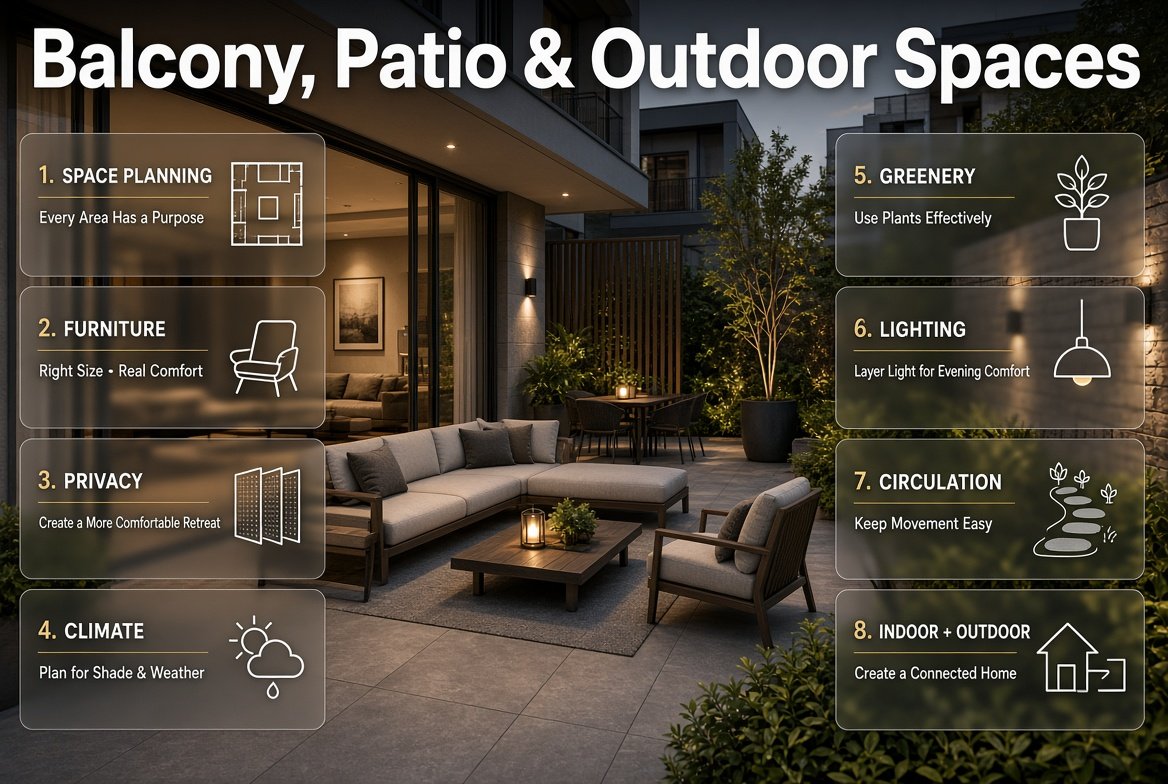
Well-designed Balcony, Patio & Outdoor Spaces work differently. They are planned around real habits, available space, climate, privacy, circulation, furniture proportions, lighting, greenery, and the relationship between indoor and outdoor areas.
Whether you have a tiny apartment balcony, a covered patio, a spacious backyard terrace, or a narrow urban outdoor area, the same principle applies: good outdoor design is less about filling the space and more about making every part of it useful.
For broader ideas on creating a connected and practical home, DesignMode24 Interior Design can also help you explore design approaches that work across different areas of a property.
This guide explains how to plan an outdoor space from the beginning, choose furniture, create privacy, handle shade and weather, use plants effectively, improve lighting, connect outdoor areas with interior rooms, avoid expensive mistakes, and make even a small balcony feel intentional.
What Makes a Good Balcony, Patio & Outdoor Space?
A successful outdoor space combines function, comfort, durability, proportion, privacy, and visual character. It should support the activities you actually want to do outside while remaining easy enough to maintain.
A good design usually answers a few basic questions:
- What will the space be used for?
- How many people will normally use it?
- Does it receive morning or afternoon sun?
- Is it exposed to strong wind or rain?
- How much privacy is needed?
- What level of maintenance is realistic?
- How should it connect with the room beside it?
The answers determine almost everything else.
A small balcony used for morning coffee might need only two comfortable chairs, a narrow table, plants, and soft lighting. A large patio used for family gatherings may need separate dining and lounge zones, shade, storage, and stronger lighting.
The mistake is assuming that every outdoor area needs the same formula.
Start With Function, Not Decoration
Before buying furniture or accessories, decide what the space needs to accomplish.
Possible functions include:
- Morning coffee
- Reading
- Dining
- Entertaining guests
- Gardening
- Relaxing
- Children’s play
- Outdoor work
- Evening conversation
- A private retreat
If you try to accommodate every possible activity, the space can become overcrowded.
Featured answer: The best way to design an outdoor space is to identify its primary purpose first, measure the available area, and then choose furniture, lighting, plants, shade, and accessories around that purpose. This prevents unnecessary purchases and keeps the layout comfortable.
How Do You Plan an Outdoor Space Before Buying Furniture?
The planning stage is where most successful outdoor projects begin.
Measure the space carefully and record:
- Length and width
- Door position
- Window locations
- Railings
- Columns
- Steps
- Drainage points
- Electrical outlets
- Existing shade
- Areas exposed to rain
- Areas exposed to strong wind
Then sketch a simple floor plan.
You don’t need professional design software. A piece of paper is enough.
Mark the furniture footprint before buying anything. This allows you to see whether a sofa, dining table, or lounge chair actually fits.
Think About Circulation
People need space to move between the house and the outdoor area.
If a patio door opens directly into the seating arrangement, don’t block the natural route with a chair or table.
A simple planning concept is:
Interior Door → Clear Path → Main Activity Zone → Secondary Zone
The larger the outdoor area, the more important zoning becomes.
For example, a spacious patio could contain:
Dining Zone + Lounge Zone + Planting Zone + Circulation Zone
These don’t need physical walls. Furniture placement, rugs, plants, lighting, and changes in flooring can visually establish each area.
💡 Pro Tip: Before purchasing large furniture, use masking tape on the floor to mark its approximate dimensions. Walk around the taped layout and open doors normally. If the circulation already feels uncomfortable, the furniture will be even more difficult once installed.
How Do You Design a Small Balcony?
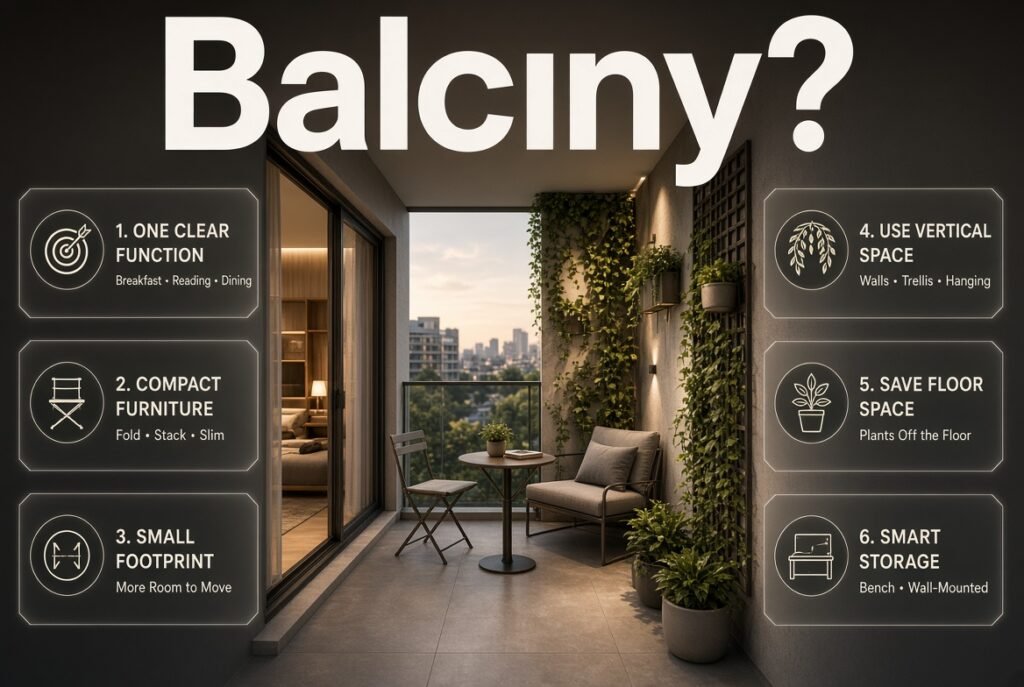
Small balconies require restraint. The biggest design mistake is trying to make a compact balcony behave like a large outdoor living room.
Instead, choose one strong function.
A small balcony can become:
- A breakfast corner
- A reading area
- A plant-filled retreat
- A compact dining space
- A quiet evening seating area
Choose furniture with a small footprint.
Good options include:
- Folding chairs
- Bistro tables
- Slim benches
- Stackable chairs
- Wall-mounted tables
- Folding dining surfaces
- Compact lounge chairs
- Storage benches
Vertical space is equally important.
Instead of covering the floor with plants, use:
- Wall planters
- Trellises
- Hanging containers
- Narrow plant stands
- Vertical garden systems
This creates visual interest without sacrificing valuable floor space.
How Can You Make a Tiny Balcony Look Larger?
Keep the floor as visually open as possible.
Use fewer furniture pieces, lighter visual forms, and consistent colors. Furniture with exposed legs can make the floor easier to see, while oversized solid furniture tends to make the space feel heavier.
Mirrors can sometimes be used in protected outdoor areas, but they need careful placement because strong sunlight and weather exposure can create practical problems.
A simpler approach is often more effective: consistent flooring, vertical greenery, a restrained color palette, and furniture scaled to the balcony.
⚠ Common Mistake: Buying furniture based on how attractive it looks individually rather than how much floor space it consumes.
A chair may look compact in a showroom but become surprisingly bulky once you account for the space needed to pull it out, sit down, and move around it.
How Should You Choose Outdoor Furniture?
Outdoor furniture should be chosen for weather exposure, durability, comfort, maintenance, size, and function.
Appearance matters, but it shouldn’t be the only deciding factor.
| Material | Strengths | Things to Consider |
|---|---|---|
| Aluminum | Lightweight, corrosion-resistant, modern | Very light pieces can move in strong wind |
| Powder-coated metal | Durable and versatile | Can become hot in strong sunlight |
| Teak | Naturally durable and attractive | Requires care if maintaining its original tone |
| Synthetic wicker | Comfortable and decorative | Quality varies |
| Resin | Easy to clean and affordable | Some products may look less premium |
| Outdoor fabric | Comfortable and available in many styles | Requires cleaning and proper storage |
For uncovered spaces, select products specifically designed for outdoor use.
Indoor furniture isn’t automatically suitable outside. Indoor fabrics can fade quickly, untreated wood can deteriorate, and unsuitable metal can corrode.
Comfort Matters More Than Appearance
A chair can look beautiful and still be uncomfortable after ten minutes.
Test seating whenever possible.
Consider:
- Seat depth
- Back support
- Cushion thickness
- Armrest height
- Table height
- Ease of getting in and out
For dining, upright chairs are usually more practical. For relaxing, deeper seating may work better.
⭐ Expert Tip: If your outdoor area is used every day, prioritize the comfort of the main seating before decorative accessories. You will notice an uncomfortable chair much more often than you notice an expensive planter.
What Furniture Works Best for a Patio?
The right patio furniture depends on the size and purpose of the area.
Small Patio
Use:
- Two chairs
- Compact sofa
- Small coffee table
- Bistro dining set
- Narrow storage bench
Medium Patio
Consider:
- Outdoor sofa
- Two lounge chairs
- Coffee table
- Dining table
- Side tables
Large Patio
You can divide the area into separate zones:
- Dining
- Lounge
- Conversation
- Cooking or serving
- Gardening
Don’t automatically fill a large patio with furniture.
Empty space is useful. It allows movement and makes the arrangement feel intentional.
How Do You Create a Comfortable Outdoor Seating Area?
Start by thinking about conversation.
People generally prefer seating arrangements where they can see and hear one another easily.
For two people, two chairs facing each other can create a more intimate setting than a large sofa.
For families, a sofa with individual chairs gives more flexibility.
For entertaining, modular furniture can be rearranged depending on the number of guests.
Create a Focal Point
A seating arrangement benefits from a visual center.
This could be:
- Coffee table
- Fire feature where appropriate and safely installed
- Garden view
- Water feature
- Large planter
- Architectural wall
- Outdoor artwork
- Landscape feature
The focal point helps furniture feel organized rather than randomly positioned.
How Do You Create Privacy on a Balcony or Patio?
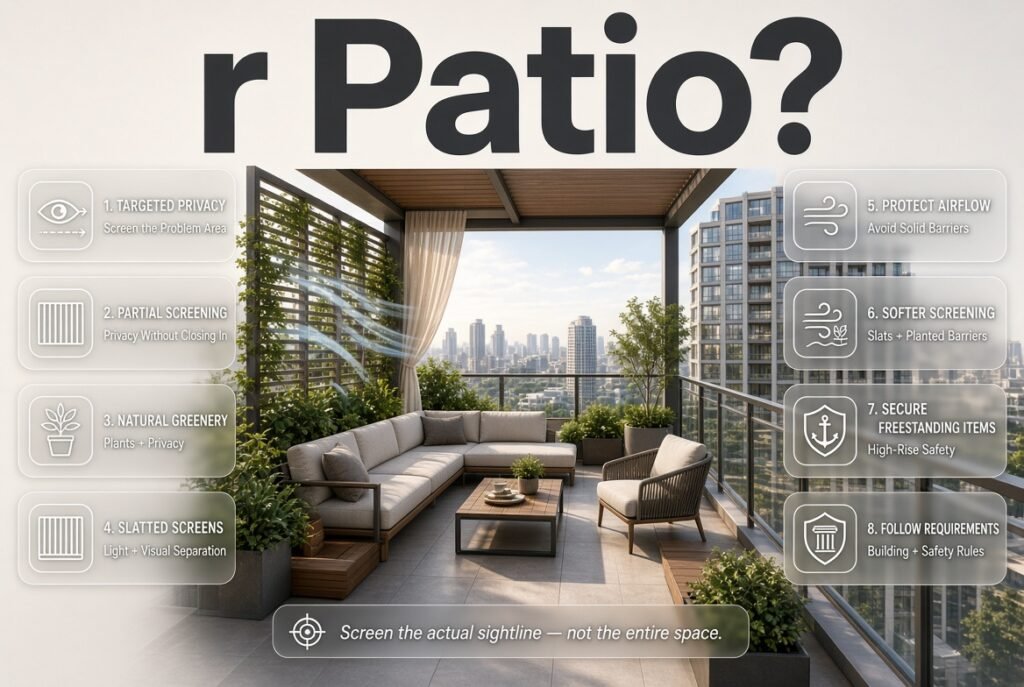
Privacy can make the difference between an outdoor space that looks good and one that actually gets used.
A balcony may be visually attractive but uncomfortable if neighboring buildings overlook it.
Useful privacy solutions include:
- Outdoor curtains
- Slatted screens
- Trellises
- Tall planters
- Dense greenery
- Privacy panels
- Pergola screens
- Climbing plants
Don’t automatically block the entire perimeter.
Identify the actual sightline causing discomfort.
If a neighboring building is visible only from one side, screen that side rather than enclosing the whole space.
This keeps the outdoor area brighter and more open.
📌 Quick Tip: Partial screening often looks more sophisticated than complete screening because it creates privacy without turning the balcony into a closed box.
What About Wind?
Privacy screens can also affect airflow.
A completely solid screen may increase wind pressure in certain exposed locations. Slatted screens and planted barriers can sometimes provide a softer solution.
For high-rise balconies, secure every freestanding item appropriately.
Always follow building regulations and safety requirements before installing permanent screening.
How Important Is Shade in Outdoor Design?
Shade isn’t merely decorative. It can determine whether the space is comfortable enough to use during the hottest part of the day.
Possible shade solutions include:
- Umbrellas
- Retractable awnings
- Pergolas
- Shade sails
- Outdoor curtains
- Adjustable screens
- Louvers
Choose according to the size and structure of the space.
Umbrellas
Good for flexibility and smaller areas.
Retractable Awnings
Useful when you want to switch between sun and shade.
Pergolas
Better suited to larger patios and can become an architectural feature.
Shade Sails
Useful for larger open spaces but require suitable attachment points.
Outdoor Curtains
Can combine shade, privacy, and softness.
Don’t assume the entire space needs permanent shade. A combination of sun and shade can give people more choice.
How Do You Choose Plants for a Balcony or Patio?
Plants should be selected based on actual growing conditions, not simply appearance.
Before buying, determine:
- Hours of direct sunlight
- Wind exposure
- Temperature
- Container size
- Drainage
- Water availability
- Maintenance requirements
A plant that thrives in a sheltered garden may struggle on an exposed balcony.
Use Plants at Different Heights
A layered arrangement feels more natural:
Ground level → Medium plants → Tall plants → Vertical greenery
Use large containers sparingly in small spaces because they consume significant floor area.
For balconies, railing or wall-mounted planters can provide greenery without reducing circulation.
Choose Plants for the Lifestyle
If you travel frequently or don’t want regular maintenance, avoid building an outdoor garden around plants that require constant watering.
If gardening is a hobby, the planting zone can become a major feature.
The best plant design is the one you can realistically maintain.
How Do You Make an Outdoor Space Feel More Luxurious?
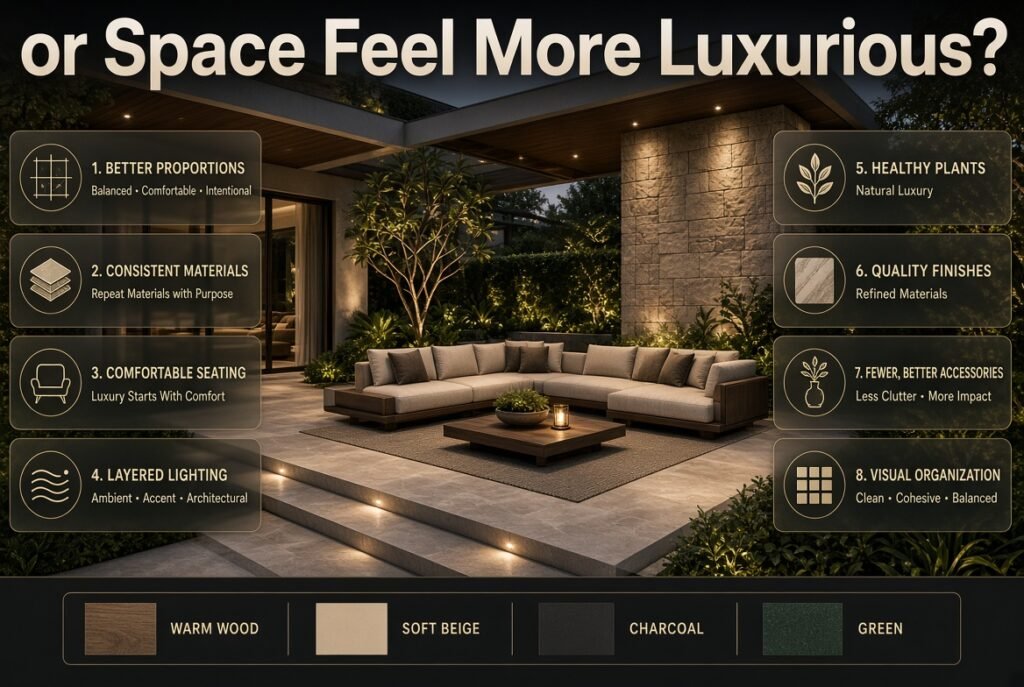
Luxury isn’t necessarily about expensive furniture.
It usually comes from:
- Better proportions
- Consistent materials
- Comfortable seating
- Layered lighting
- Healthy plants
- Quality finishes
- Fewer but better accessories
- Strong visual organization
A simple patio with three excellent design decisions can feel more sophisticated than a large patio filled with unrelated products.
Try to keep the palette controlled.
For example:
Warm wood + soft beige + charcoal + green
or
Natural stone + cream + black + muted blue
The exact colors aren’t important. Consistency is.
If you’re developing a coordinated palette throughout your property, Paint Color ideas can help you think about how color relationships work across connected spaces.
How Can You Connect Outdoor Areas With Interior Design?
An outdoor area should not feel like it belongs to a completely different house.
The easiest way to create continuity is to repeat selected elements.
For example:
- Repeat an interior accent color outside.
- Use similar wood tones.
- Repeat black or brass metal details.
- Continue a texture from inside to outside.
- Match the general design mood.
You don’t need exact matching.
A modern living room might transition into a patio with clean-lined furniture, neutral textiles, dark metal, and simple greenery.
A rustic interior could connect with natural wood, stone, woven textures, and earthy colors outside.
A more traditional home may work well with symmetrical furniture, classic planters, and warm lighting.
The goal is visual conversation, not duplication.
How Does Outdoor Styling Relate to the Rest of the Home?
Outdoor design works best when it considers the spaces immediately connected to it.
For example, if a patio opens from the living room, the two areas should feel related. If an outdoor dining area sits beside the kitchen, serving and circulation should be convenient.
Useful related resources include Living Room Design for indoor-outdoor seating relationships and Kitchen Design when an outdoor area connects directly with a kitchen or entertaining space.
For broader room planning, the Room-by-Room Design Hub can help you maintain a consistent design language across different parts of the home.
How Do You Use Outdoor Lighting Correctly?
Good outdoor lighting has three jobs:
- Provide safe visibility.
- Support specific activities.
- Create atmosphere.
Instead of using one extremely bright fixture, layer several types of light.
Ambient Lighting
Provides general illumination.
Examples include:
- Wall fixtures
- Ceiling fixtures
- Lanterns
- Suitable outdoor-rated general lighting
Task Lighting
Helps with activities such as:
- Dining
- Reading
- Food preparation
- Working
Accent Lighting
Highlights:
- Plants
- Trees
- Architectural walls
- Steps
- Decorative elements
Layered lighting creates depth and prevents the space from looking flat.
⚠ Common Mistake: Using a single bright white light in the center of a patio. It may technically illuminate the space, but it often creates harsh shadows and removes the relaxed atmosphere people want outdoors.
What Outdoor Lighting Temperature Should You Choose?
Warm or warm-neutral lighting is commonly preferred for relaxing outdoor environments because it creates a softer atmosphere.
However, functional areas may need brighter, clearer illumination.
Don’t choose lighting only by brightness. Think about where the light falls.
A softer fixture placed correctly can be more useful than a very powerful fixture that creates glare.
Always use fixtures and electrical components appropriate for outdoor conditions and have permanent electrical work installed safely.
Should You Use an Outdoor Rug?
Outdoor rugs can visually define a seating or dining area.
They are particularly useful on:
- Large patios
- Covered terraces
- Outdoor living rooms
- Dining zones
A rug can make furniture feel connected rather than scattered across a large floor.
However, rugs aren’t always necessary on small balconies.
Choose an outdoor-rated material and make sure water can drain and the rug can dry properly.
How Large Should an Outdoor Rug Be?
Ideally, the rug should visually connect the furniture rather than functioning as a tiny decorative island.
For a seating area, the front legs of major furniture pieces can sit on the rug when the layout allows.
For dining areas, make sure the rug is large enough for chairs to remain on it when pulled away from the table.
How Do You Add Storage to an Outdoor Space?
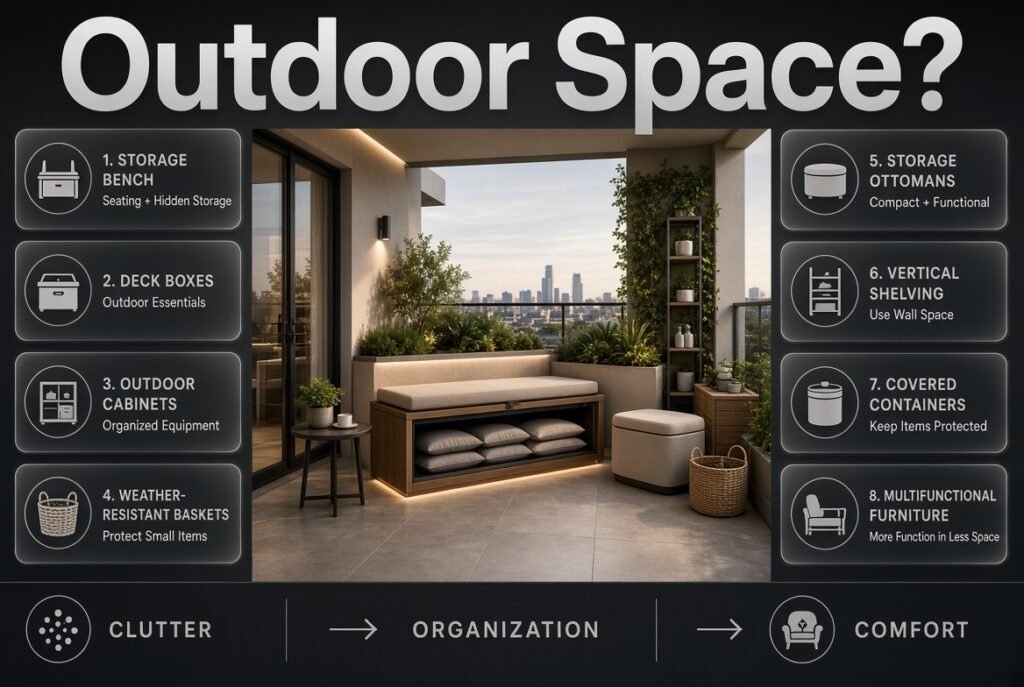
Outdoor storage should be planned before clutter appears.
Useful solutions include:
- Storage benches
- Deck boxes
- Outdoor cabinets
- Weather-resistant baskets
- Storage ottomans
- Vertical shelving
- Covered containers
Store items such as:
- Cushions
- Gardening tools
- Toys
- Cleaning supplies
- Outdoor accessories
- Small entertaining equipment
In small balconies, multifunctional furniture is particularly valuable.
A storage bench can provide seating and hide cushions at the same time.
How Can DIY Projects Improve Outdoor Spaces?
DIY projects can make an outdoor space more personalized without requiring a major renovation.
Useful projects include:
- Simple planter boxes
- Trellis panels
- Small storage units
- Furniture refinishing
- Decorative screens
- Vertical gardens
- Outdoor accessory organizers
However, DIY doesn’t mean ignoring structural or weather considerations.
Anything attached to a balcony railing, wall, ceiling, or structural element should be approached carefully.
For more project-based ideas, explore DIY Home Projects.
The best DIY project isn’t necessarily the most impressive one. It’s the one that solves a real problem.
How Do You Design an Outdoor Dining Area?
Outdoor dining requires more clearance than many homeowners expect.
The table itself isn’t the only thing that needs space.
You also need room for:
- Chairs
- People sitting
- Pulling chairs out
- Walking behind seated guests
- Serving food
- Opening nearby doors
For compact balconies and patios, use:
- Round tables
- Drop-leaf tables
- Folding tables
- Bistro sets
- Narrow rectangular tables
Round tables can be particularly useful in small areas because they eliminate sharp corners and can make circulation easier.
For larger patios, consider separating dining and lounge areas.
How Do You Design an Outdoor Space for Entertaining?
An entertaining patio should support movement.
Don’t arrange all furniture around a single oversized sofa.
Instead, create several places where people can naturally gather.
For example:
Dining Table → Serving Area → Lounge → Secondary Seating
Useful additions include:
- Side tables
- Serving carts
- Portable storage
- Outdoor lighting
- Shade
- Flexible seating
Keep frequently used surfaces close to seating.
If guests constantly have to walk across the patio to place a drink down, the design isn’t supporting the activity properly.
How Do You Make an Outdoor Space Family-Friendly?
Family outdoor areas need durable materials and easy maintenance.
Consider:
- Stable furniture
- Washable fabrics
- Rounded furniture edges where appropriate
- Secure storage
- Non-slip surfaces
- Safe lighting
- Clear circulation
If children will use the balcony, safety becomes even more important.
Check railings, gaps, furniture placement, and anything that could potentially be climbed.
Avoid placing furniture directly against railings when it could create an unsafe climbing opportunity.
Outdoor design should be attractive, but safety always comes first.
For similar principles of accessibility, organization, and durability inside the home, Kids’ Room Design provides useful room-planning ideas that can also influence how you think about family spaces.
How Can You Make an Outdoor Space Feel Like an Extra Room?
Treat the outdoor space as a room without walls.
An indoor room typically has:
- A floor
- Furniture
- Lighting
- Boundaries
- Accessories
- A clear function
Outdoor spaces can use the same principles.
A rug defines the floor.
Plants define boundaries.
A pergola suggests a ceiling.
Lighting establishes atmosphere.
Furniture defines function.
This approach is especially useful for large patios that otherwise feel empty.
For styling principles that help create a finished, lived-in appearance, Home Styling can provide useful ideas.
How Do You Choose Outdoor Flooring?
Outdoor flooring needs to be practical before it is decorative.
Consider:
- Drainage
- Slip resistance
- Heat
- Maintenance
- Durability
- Cleaning
- Installation
- Existing structure
Common choices include:
- Outdoor porcelain tile
- Natural stone
- Concrete
- Pavers
- Composite decking
- Timber decking
Each has different advantages.
Porcelain can provide a clean, modern appearance. Natural stone offers variation and texture. Concrete can be practical and contemporary. Composite decking provides a warmer visual effect with different maintenance requirements from natural wood.
The right choice depends on the location and climate.
Don’t choose flooring solely because it looks good in photographs.
How Do You Maintain a Balcony or Patio?
Maintenance should be part of the design from the beginning.
Weekly
- Remove leaves and debris.
- Wipe furniture.
- Check cushions.
- Water plants according to their requirements.
- Clear visible drainage areas.
Monthly
- Inspect furniture.
- Clean outdoor textiles.
- Check planters.
- Look for rust or damage.
- Clean flooring thoroughly.
Seasonally
- Deep-clean surfaces.
- Inspect screens and shade structures.
- Check fasteners.
- Reassess plant health.
- Store vulnerable accessories.
- Repair damaged finishes.
The easiest outdoor space to maintain is the one that was designed with maintenance in mind.
📌 Quick Tip: If a decorative item needs constant cleaning, special storage, or delicate handling, ask yourself whether you’ll still enjoy maintaining it six months later.
What Are the Biggest Outdoor Design Mistakes?
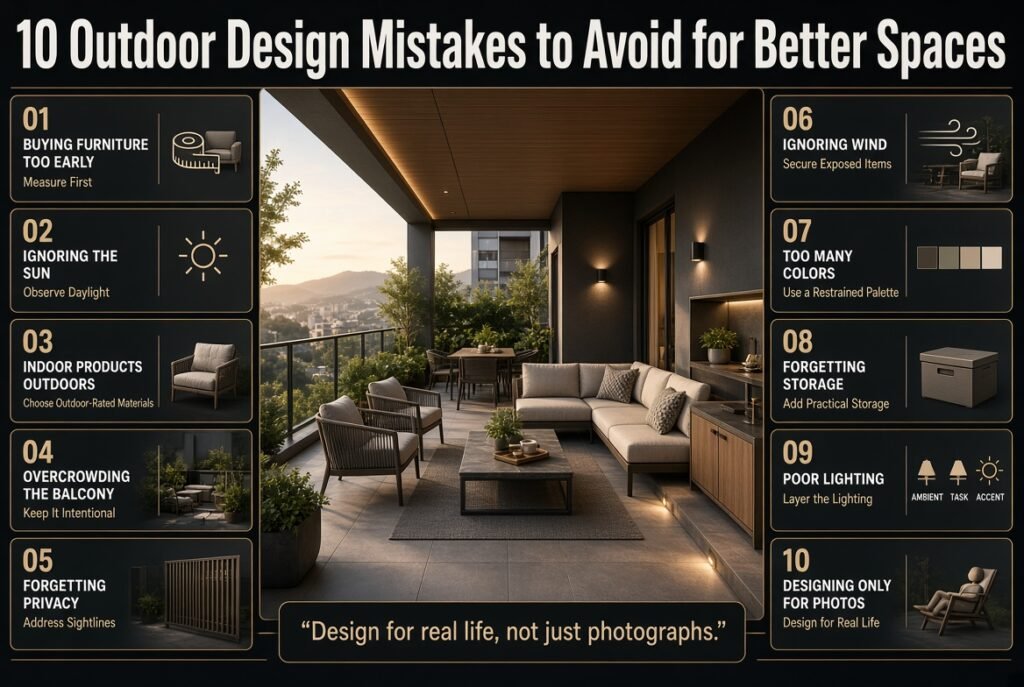
1. Buying Furniture Too Early
People often fall in love with a sofa before measuring the patio.
Why it happens: Furniture shopping feels more exciting than planning.
Why it’s harmful: Oversized furniture reduces circulation.
Better approach: Measure first and mark the footprint.
2. Ignoring the Sun
A seating area may look perfect in the morning and become unusable in the afternoon.
Better approach: Observe sunlight throughout the day before finalizing the layout.
3. Using Indoor Products Outdoors
Indoor materials can fade, absorb moisture, or deteriorate quickly.
Better approach: Choose outdoor-rated materials.
4. Overcrowding the Balcony
Small outdoor spaces don’t need dozens of accessories.
Better approach: Choose a few high-impact elements.
5. Forgetting Privacy
An outdoor area that feels exposed may remain unused.
Better approach: Identify problematic sightlines and address them selectively.
6. Ignoring Wind
Light furniture and decorative objects can become unstable.
Better approach: Choose appropriately weighted furniture and secure exposed accessories.
7. Using Too Many Colors
Multiple bright colors can make a compact outdoor area feel chaotic.
Better approach: Establish a restrained base palette and add one or two accents.
8. Forgetting Storage
Without storage, cushions and accessories end up everywhere.
Better approach: Include at least one practical storage solution.
9. Poor Lighting
One bright fixture rarely creates a comfortable atmosphere.
Better approach: Layer ambient, task, and accent lighting.
10. Designing Only for Photographs
An outdoor space can look impressive online and still be uncomfortable.
Better approach: Prioritize how people sit, walk, eat, relax, and use the area.
How Can You Make a Patio Look Expensive on a Budget?
Start with structure rather than accessories.
Prioritize:
- Comfortable seating
- Appropriate shade
- Good lighting
- Healthy plants
- A cohesive color palette
- Clean and durable flooring
Then add decorative elements.
You don’t need ten lanterns if the seating is uncomfortable.
You don’t need dozens of cushions if the space lacks shade.
You don’t need expensive accessories if the layout is poorly proportioned.
A well-planned inexpensive patio can feel more sophisticated than a poorly planned expensive one.
How Do You Create a Cohesive Outdoor Color Palette?
Choose one dominant neutral, one secondary material or color, and one accent.
For example:
Warm beige + natural wood + olive green
or
Gray + black metal + muted blue
or
Cream + terracotta + natural greenery
Use accessories to introduce accent colors because they can be changed more easily than flooring or permanent finishes.
If your exterior project is part of a larger home update, Home Improvement can help you consider how practical upgrades fit into the overall property.
How Do Balconies Connect With Entryways and Hallways?
When an outdoor area is visible from an entry or hallway, the transition deserves attention.
For example, a balcony visible from an upstairs hallway can act almost like a visual extension of the interior.
Likewise, a patio near an entrance should feel connected to the home’s arrival experience.
Use consistent:
- Colors
- Materials
- Lighting
- Planting style
- Decorative language
For more ideas about transitional spaces inside the home, see Entryway & Hallway Ideas.
How Can Outdoor Design Support a Whole-Home Style?
The strongest homes usually have some consistency between rooms rather than treating every area as a separate design experiment.
A contemporary home might use clean outdoor lines.
A farmhouse-inspired property might use natural materials and relaxed furniture.
A Mediterranean-inspired home might use warm tile, textured surfaces, earthy colors, and plants suited to the environment.
A minimalist home might use fewer furniture pieces, restrained colors, and carefully positioned greenery.
You don’t have to follow a strict style label.
Instead, identify what you already like inside the house and reinterpret those qualities outdoors.
For broader Home Design Ideas, think about the home as one connected experience rather than a collection of isolated rooms.
How Do You Make a Patio Easy to Use Every Day?
Convenience is one of the most underrated parts of outdoor design.
If you need to carry everything outside every time you sit down, you’ll use the patio less.
Keep commonly used items nearby.
For example:
- Side tables near chairs
- Storage near cushions
- Serving surfaces near dining
- Lighting controls in accessible locations
- Gardening tools near plants
If the patio connects to the kitchen, think about the path between them.
If it connects to a living room, consider whether doors can open comfortably with furniture in place.
A beautiful space should also be easy to live with.
How Do You Design a Balcony for Different Times of Day?
An outdoor area may need to support different conditions from morning to evening.
Morning
You may want:
- Coffee table
- Comfortable chair
- Softer sunlight
- Plants
- Quiet seating
Afternoon
You may need:
- Shade
- Ventilation
- Cooler seating
- Reduced glare
Evening
You may prioritize:
- Warm lighting
- Comfortable cushions
- Privacy
- Side tables
- Conversation seating
Designing for different times of day creates a much more useful space.
What Should You Consider for Apartment Balconies?
Apartment balconies have additional limitations.
Before changing anything permanent, check building rules concerning:
- Weight
- Exterior attachments
- Planters
- Privacy screens
- Curtains
- Lighting
- Flooring
- Furniture height
High-rise balconies also need careful consideration of wind.
Large planters can add substantial weight, especially after watering. Lightweight furniture may move in strong wind. Loose decorative objects can become hazardous.
Don’t assume that something is acceptable simply because it fits.
How Do You Handle Outdoor Weather and Climate?
Climate should influence every material decision.
In hot, sunny environments, UV exposure and surface temperature matter.
In rainy areas, drainage and moisture resistance become priorities.
In windy locations, stability matters.
In cold climates, freezing and thawing can affect materials.
Think about the worst realistic conditions rather than only the weather on the day you shop.
This mindset usually produces better long-term results.
How Do You Choose Between a Balcony, Patio, and Larger Outdoor Area Design?
The biggest difference is usually the amount of flexibility available.
| Space | Main Challenge | Best Strategy |
| Tiny balcony | Limited floor area | Multifunctional furniture |
| Large balcony | Wind/privacy | Zoning and screening |
| Small patio | Limited circulation | Compact furniture |
| Medium patio | Multiple functions | Defined zones |
| Large terrace | Can feel empty | Layered zones and focal points |
| Courtyard | Privacy and light | Planting and vertical design |
The same principles apply to every size: define the function, control the layout, and avoid unnecessary clutter.
How Can I Make a Small Balcony or Patio Look Bigger and More Functional?
A small balcony doesn’t need to feel cramped. The most effective approach is to reduce the amount of floor space consumed by furniture while making better use of vertical areas. Start by choosing one primary function—such as relaxing, dining, reading, or gardening—instead of trying to fit an entire outdoor living room into a few square feet.
Use foldable chairs, compact tables, storage benches, wall-mounted planters, vertical greenery, and slim-profile furniture. Keeping the floor visually open is particularly important because too many bulky pieces can make the space feel smaller than it actually is. Current small-balcony design guidance also emphasizes measuring the usable floor area and choosing furniture that earns its footprint.
Practical points to remember:
Measure the balcony before buying furniture.
Keep a clear path from the interior door.
Use vertical space for plants and decoration.
Choose multifunctional or foldable furniture.
Avoid filling every empty corner.
Use one cohesive color palette to reduce visual clutter.
Professional tip: Mark furniture dimensions on the floor with tape before purchasing. If you can’t comfortably walk around the taped layout, the actual furniture will almost certainly feel too large.
What Are the Best Ways to Add Privacy to a Balcony or Patio Without Making It Feel Closed In?
The best privacy solution isn’t necessarily a completely enclosed balcony. In most cases, it’s better to identify the exact sightline causing the problem and block that view selectively. This keeps natural light and airflow while making the outdoor area feel more private.
Options include slatted privacy screens, tall planters, trellises, outdoor curtains, climbing plants, bamboo-style screening, and partial architectural panels. Privacy and microclimate are becoming increasingly important in outdoor design, with 2026 reporting showing continued growth in demand for privacy-focused features and shade or cooling solutions.
For a small balcony, plants can be particularly effective because they provide privacy while adding greenery and softness. A narrow vertical planter or trellis can often achieve more than a bulky solid screen.
Practical points to remember:
Block the problematic sightline rather than the entire perimeter.
Keep enough airflow around the balcony.
Use plants when you want privacy and greenery together.
Choose slatted screens when you want a lighter architectural look.
Check apartment or building regulations before installing permanent screens.
Secure curtains and lightweight items properly in windy locations.
Professional tip: Don’t use privacy as an excuse to cover every surface. A partially screened balcony usually feels more open, comfortable, and expensive-looking than one surrounded by heavy screening.
How Do I Keep My Balcony or Patio Comfortable in Hot Weather?
For a hot outdoor space, shade should come before decoration. A beautiful seating area becomes practically useless if the furniture sits in intense afternoon sun with no protection. Start by studying how sunlight moves across the space and then position seating according to the areas that remain comfortable.
Depending on the space, you can use retractable awnings, umbrellas, pergolas, shade sails, outdoor curtains, adjustable screens, or strategically positioned plants. Shade has become one of the most important outdoor-living improvements in 2026, alongside privacy and cooling features.
Furniture materials matter too. Some dark metal and hard surfaces can become extremely hot in direct sunlight, while suitable outdoor fabrics and shaded seating can make the area much more comfortable.
Practical points to remember:
Observe the space during morning, afternoon, and evening.
Position primary seating away from the harshest sun when possible.
Add adjustable shade if sunlight changes significantly throughout the day.
Choose outdoor fabrics designed for UV exposure.
Maintain airflow instead of completely enclosing the space.
Use plants for additional visual softness and localized shade.
Professional tip: Don’t automatically shade the entire patio. Creating a combination of sunny and shaded areas gives people more choice and often produces a more natural outdoor environment.
What Type of Furniture Is Best for Balcony, Patio & Outdoor Spaces?
The best outdoor furniture is appropriately sized, weather-resistant, comfortable, and suited to the way you actually use the space. There isn’t one universal material or furniture style that works everywhere. A high-rise balcony exposed to wind requires different considerations from a sheltered patio.
For small balconies, foldable bistro furniture, compact lounge chairs, wall-mounted tables, stackable seating, and storage benches are particularly practical. For larger patios, modular sofas, lounge chairs, dining tables, and separate seating zones can provide greater flexibility. Current outdoor design trends are increasingly focused on multifunctional zones rather than single-purpose patios.
Material selection should also reflect exposure. Aluminum and suitable powder-coated metals can be practical choices, while treated or naturally durable woods and outdoor-rated synthetic materials can work well when properly maintained.
Practical points to remember:
Measure furniture before buying it.
Consider the space required to pull chairs out.
Choose outdoor-rated fabrics and finishes.
Consider wind exposure on balconies and rooftops.
Prioritize comfortable seating over decorative furniture.
Include storage if cushions or accessories need protection.
Don’t buy oversized furniture simply because you have unused floor space.
Professional tip: The best furniture piece is the one that earns its footprint. If a large sofa takes up half the patio but doesn’t improve how you actually use the space, a smaller and more flexible arrangement may be the better investment.
How Can I Make My Outdoor Space Feel Like an Extension of My Home?
The easiest way to connect a balcony or patio with the interior is to repeat selected colors, materials, textures, shapes, and design details rather than trying to make both areas identical.
For example, if your living room uses warm wood, neutral upholstery, and black metal accents, those same qualities can appear outdoors through timber tones, neutral outdoor cushions, and dark-framed furniture. This creates a visual transition when the doors are open and makes the outdoor area feel like a natural part of the home.
This indoor-outdoor connection is becoming a major direction in 2026 design, with outdoor areas increasingly being treated as genuine living spaces rather than occasional-use patios.
Practical points to remember:
Repeat one or two interior colors outdoors.
Use related materials rather than exact copies.
Match the overall design mood.
Use outdoor rugs and cushions to echo interior tones.
Coordinate lighting styles where practical.
Let plants provide a natural transition between architecture and landscape.
Keep the outdoor area comfortable enough for everyday use.
Professional tip: Think of the doorway as a transition zone. When the flooring, furniture colors, lighting, and textures feel visually related on both sides, even a modest balcony or patio can make the entire home feel larger and more cohesive.
Conclusion
A well-designed balcony, patio & outdoor space should do more than look attractive—it should make everyday living more comfortable, practical, and enjoyable. Whether you’re working with a narrow apartment balcony or a spacious patio, the strongest results come from planning around how you actually use the space.
Start with the essentials: choose appropriately sized furniture, create comfortable circulation, add shade where needed, solve privacy concerns, and select plants and materials that can handle the conditions. From there, thoughtful lighting, outdoor textiles, storage, and a consistent color palette can turn a basic area into a welcoming extension of your home.
You don’t need a large budget or a complete renovation to make a meaningful difference. A few well-chosen improvements can completely change how an outdoor area feels and functions.
The key is to design for real life rather than decoration alone. When comfort, durability, functionality, and style work together, your balcony or patio becomes more than an unused corner—it becomes a space you’ll genuinely want to spend time in.
Leave a Reply