
Introduction
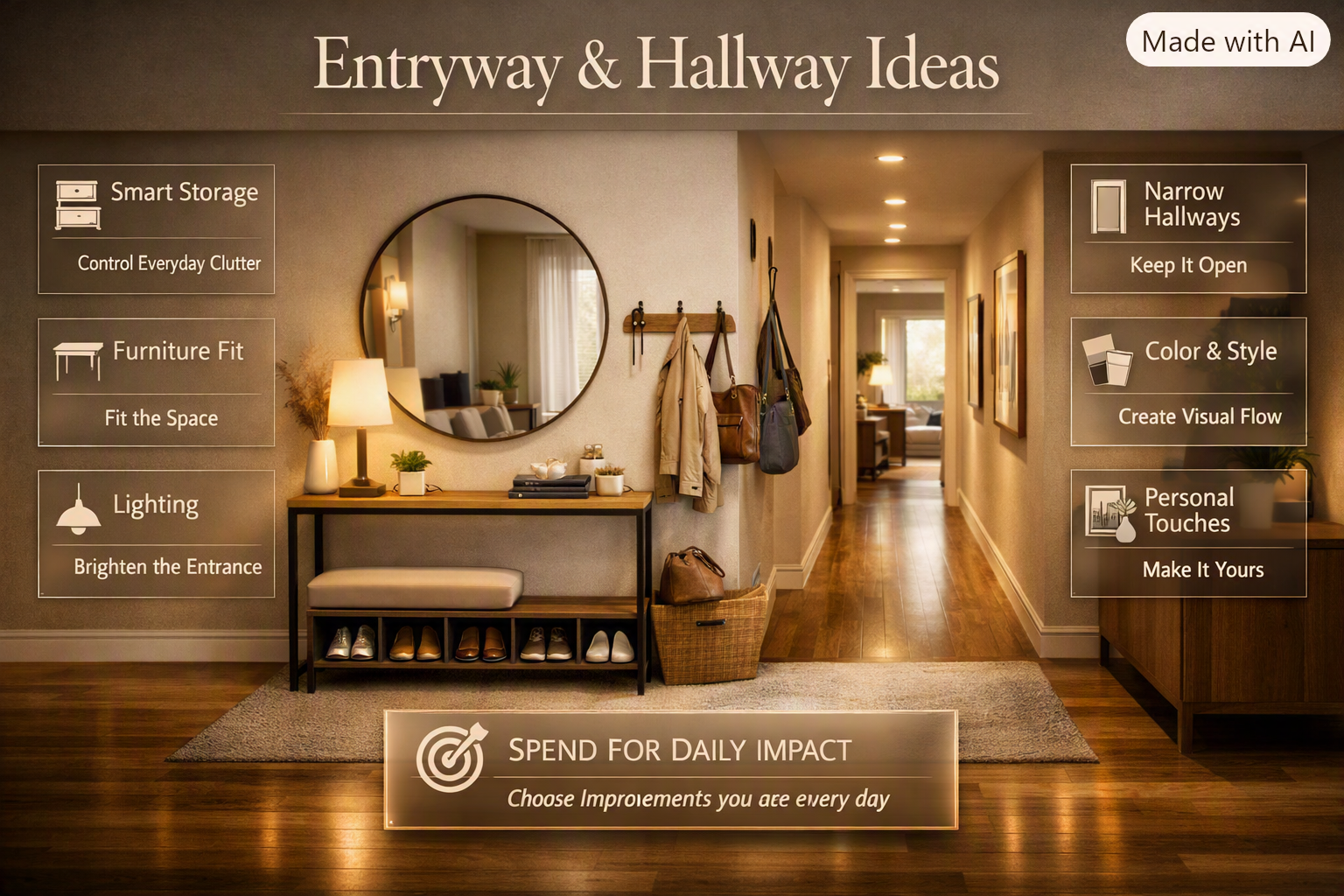
Entryway & Hallway Ideas | Walking through the front door should feel welcoming, not stressful. Yet many homes have entryways where shoes collect in corners, keys disappear under mail, bags end up on the floor, and narrow hallways feel dark and empty. These spaces may be small, but they have a surprisingly large influence on how your home feels.
The right Entryway & Hallway Ideas can solve those everyday problems while making your home look more polished. An entryway doesn’t need expensive furniture or a huge foyer to feel impressive. What matters is choosing pieces that fit the space, organizing items around real habits, using lighting effectively, and creating a visual connection with the rooms beyond.
In this guide, you’ll learn how to plan an entryway from scratch, choose storage and furniture, decorate narrow hallways, select colors and lighting, work with different design styles, avoid common mistakes, and create a practical entrance that still feels personal and stylish.
For broader interior inspiration, you can also explore DesignMode24 Interior Design.
What Makes a Good Entryway and Hallway Design?
A successful entryway or hallway design balances function, proportion, comfort, lighting, storage, and style. The space should be easy to walk through, provide practical places for everyday belongings, and visually connect with the rest of the home. Decoration should support these functions rather than make the area harder to use.
An entrance is not simply a decorative corner. It’s a transition zone between the outside and inside of your home.
People use it to:
- Remove or put on shoes
- Hang coats
- Drop keys
- Store bags
- Check their appearance
- Receive guests
- Move between rooms
- Bring groceries inside
- Leave the house quickly
That means your design should start with how the space is actually used.
A large foyer might comfortably hold a console, bench, cabinet, mirror, artwork, and plant. A small apartment entrance may only need wall hooks, a narrow shoe cabinet, and a mirror.
How Do You Plan an Entryway Before Buying Anything?
Start by measuring the available space and identifying the everyday problems you want to solve. Then determine what storage, lighting, seating, and decoration are genuinely necessary. Only after that should you choose furniture and accessories.
This process prevents a common mistake: purchasing attractive furniture that looks good online but doesn’t work in your home.
Measure the Space
Record:
- Wall width
- Hallway width
- Ceiling height
- Door width
- Door swing
- Distance between doors
- Available floor depth
- Electrical outlets
- Radiators
- Vents
- Staircases
Also consider where people naturally walk.
A console may technically fit against a wall but still make the hallway uncomfortable.
📌 Quick Tip: Use painter’s tape to mark the approximate footprint of furniture on the floor before buying it. Walk through the area normally for a day. If the taped footprint constantly feels like an obstacle, choose a smaller piece.
Identify the Biggest Problem
Don’t automatically start with decoration.
If shoes are always scattered around the entrance, storage should be your first project.
If the space is dark, improve lighting.
If there’s nowhere to put keys, create a drop zone.
If everything works but the area looks plain, then focus on decoration.
This simple priority system saves money because you’re fixing the actual problem rather than adding objects randomly.
How Do You Create a Functional Entryway Drop Zone?
A drop zone gives everyday belongings a designated location near the entrance. It can be a console table, floating shelf, wall-mounted cabinet, small cabinet, or even a simple tray. The goal is to make it easy to put things away immediately after entering.
Use a Console Table
A console is one of the most versatile entryway furniture pieces.
It can provide space for:
- Keys
- A table lamp
- Decorative objects
- Family photographs
- Small baskets
- Everyday accessories
If possible, choose a console with drawers or lower storage. The surface can remain attractive while everyday clutter stays hidden.
Use a Floating Shelf in a Small Space
A floating shelf can provide the same basic function without consuming valuable floor space.
Pair it with:
- A mirror above
- Hooks beside it
- A small tray
- A basket underneath
This creates a compact organization system.
Create a Dedicated Key Spot
Keys are small but create a surprisingly common problem.
A shallow tray, wall hook, or small bowl gives them a predictable home.
The best location is close enough to the door that you naturally use it.
💡 Pro Tip: Organization works best when the storage location matches the natural movement of the person using it. Don’t put everyday keys in a cabinet across the room.
What Are the Best Entryway Shoe Storage Ideas?
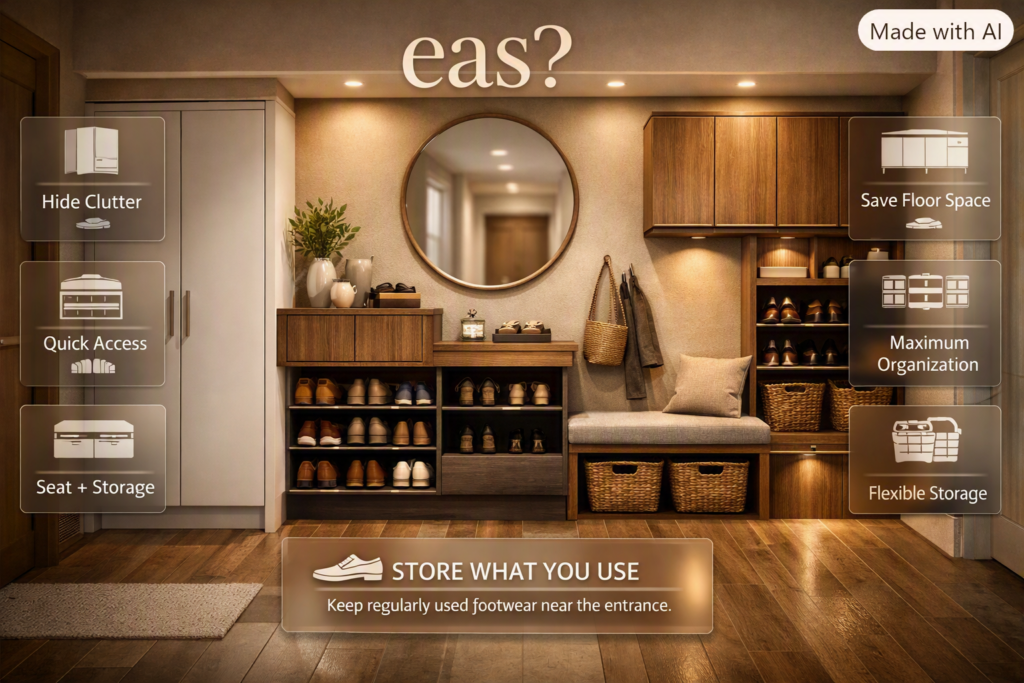
The best shoe storage depends on how many people use the entrance, how much floor space is available, and whether you prefer quick access or a cleaner visual appearance. Closed cabinets hide clutter, open racks are convenient, benches combine seating and storage, and built-in systems offer the most capacity.
| Shoe Storage | Best For | Advantage | Drawback |
|---|---|---|---|
| Closed cabinet | Minimalist homes | Hides clutter | Less visible access |
| Open rack | Everyday footwear | Quick access | Looks busier |
| Storage bench | Families | Seating + storage | Uses more floor space |
| Floating cabinet | Narrow spaces | Saves floor area | Smaller capacity |
| Built-in storage | Large households | Maximum organization | Higher cost |
| Baskets | Small accessories | Flexible | Limited footwear capacity |
Closed Storage vs. Open Storage
Closed storage creates a calmer appearance.
It’s particularly useful when the entrance is visible from the living room or another major area.
Open storage is convenient when people need to grab shoes quickly.
A practical compromise is to keep frequently used shoes accessible and store seasonal footwear elsewhere.
Don’t Store Everything Near the Door
You don’t need every pair of shoes in your home sitting beside the entrance.
Keep only the footwear that is used regularly.
This reduces visual clutter and prevents your storage system from becoming overloaded.
What Are the Best Small Entryway Ideas?
Small entryways work best when they use vertical space, multifunctional furniture, reflective surfaces, and simple organization. Wall-mounted hooks, floating shelves, narrow shoe cabinets, compact benches, and mirrors can provide practical functions without taking over the floor.
Use the Walls
In a small entrance, walls become valuable storage space.
Consider:
- Coat hooks
- Peg rails
- Floating shelves
- Wall-mounted baskets
- Narrow cabinets
- Tall mirrors
- Picture ledges
This approach keeps the floor open.
Choose Multifunctional Pieces
A storage bench provides both seating and shoe storage.
A mirror can provide both decoration and visual depth.
A console with drawers can combine display space with organization.
Multifunctionality is especially useful in apartments and compact homes.
Use One Strong Focal Point
A small entrance doesn’t need lots of decorative objects.
Instead, choose one feature such as:
- Oversized mirror
- Statement artwork
- Sculptural light
- Textured wallpaper
- Decorative molding
- Large plant
⭐ Expert Tip: One well-proportioned statement feature usually looks more intentional than many small accessories competing for attention.
How Can You Make a Narrow Hallway Look Wider?
A narrow hallway can feel more spacious when the floor remains open, furniture is kept shallow, lighting is distributed evenly, and the walls use visually light colors. Mirrors, consistent flooring, and carefully positioned artwork can also create a stronger sense of depth.
Keep the Walking Path Clear
This should always be the first priority.
A hallway exists mainly for movement.
If furniture forces people to walk sideways or constantly avoid objects, the design isn’t working.
When floor furniture is necessary, choose a slim piece.
Use a Hallway Runner
A runner can make a long corridor feel warmer and more finished.
It adds:
- Color
- Texture
- Pattern
- Comfort
- Visual direction
Choose a durable runner if the hallway receives heavy traffic.
A subtle pattern can also hide everyday marks better than a completely plain rug.
Create a Focal Point at the End
A long corridor can feel endless when there is nothing to attract attention.
Place something visually interesting at the end:
- Large artwork
- Mirror
- Decorative table
- Plant
- Feature wall
- Statement light
This creates a destination for the eye.
What Colors Work Best for Entryways and Hallways?
Light and warm neutrals such as cream, beige, soft white, and greige can make compact hallways feel brighter and more open. Muted greens, taupes, earthy colors, and darker shades can create more character when used with suitable lighting.
Light Neutrals
Soft white, cream, beige, and greige work particularly well in spaces with limited daylight.
They provide a flexible backdrop for:
- Wood
- Black metal
- Artwork
- Plants
- Textiles
- Brass accents
Earthy Colors
Warm taupe, muted olive, clay, terracotta, and natural brown can create a welcoming atmosphere.
They pair naturally with wood and organic materials.
Dark Hallways
Dark colors aren’t automatically wrong.
Deep charcoal, navy, forest green, and brown can create a dramatic and sophisticated corridor.
The key is lighting.
A dark hallway with poor lighting may feel cramped, while a dark hallway with layered illumination can look elegant and intentional.
For more guidance on choosing colors for different spaces, see Paint Color.
How Should You Light an Entryway or Hallway?
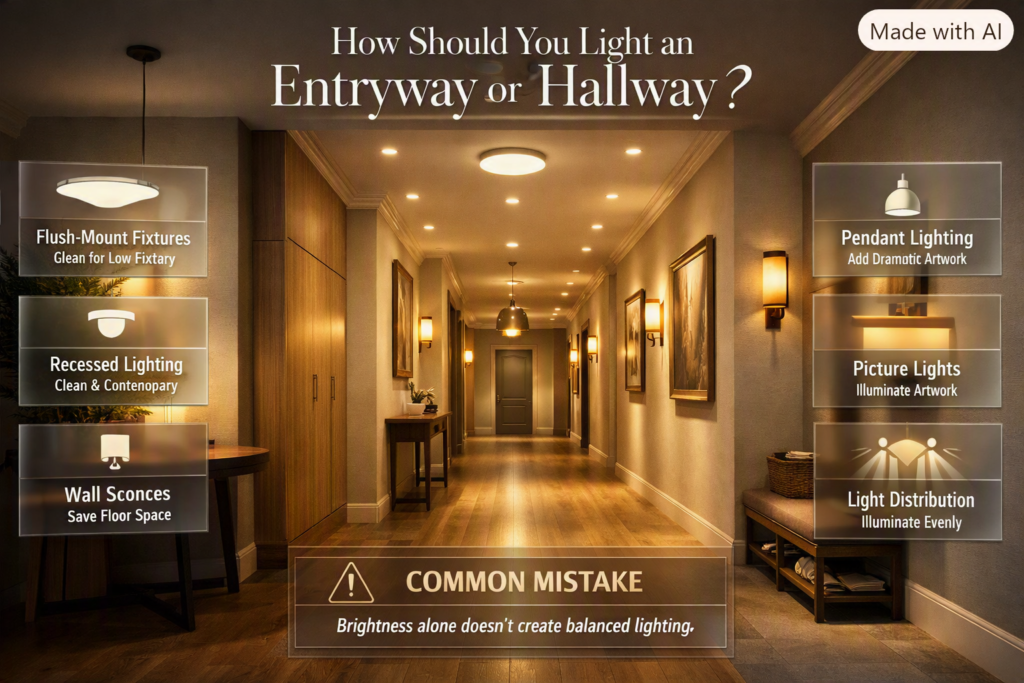
Good hallway lighting should provide sufficient illumination while also creating atmosphere. Instead of relying on one harsh ceiling fixture, consider a combination of ceiling lights, wall sconces, recessed lights, lamps, and accent lighting based on the size and layout of the space.
Flush-Mount Fixtures
These are useful for lower ceilings because they don’t hang into the walking area.
They’re also practical in compact entrances.
Recessed Lighting
Recessed lights can create a clean contemporary appearance.
In long hallways, several appropriately spaced fixtures often work better than one central light.
Wall Sconces
Sconces are particularly useful because they don’t consume floor space.
They can also become part of the hallway’s decorative identity.
Pendant Lighting
A pendant can make a large entrance feel dramatic.
However, it should be proportionate to the ceiling height and room size.
Picture Lights
If artwork is an important part of your hallway, picture lights can emphasize individual pieces and add another layer of illumination.
⚠ Common Mistake: One extremely bright fixture in the center of a long hallway doesn’t necessarily create good lighting. It can leave the ends and corners visually dark. Think about distribution rather than brightness alone.
What Furniture Works Best in an Entryway?
The best entryway furniture depends on the available space and the tasks you need it to perform. Consoles provide surfaces, benches provide seating, cabinets hide clutter, and floating furniture is particularly effective in small spaces.
| Furniture | Main Function | Best Space |
| Console table | Surface + decoration | Medium/Large |
| Storage bench | Seating + storage | Small/Medium |
| Shoe cabinet | Footwear organization | Small/Medium |
| Tall cabinet | Maximum storage | Large |
| Floating shelf | Drop zone | Very Small |
| Built-in storage | Complete organization | Medium/Large |
Measure Before Buying
Never choose entryway furniture based only on appearance.
Consider:
- Furniture depth
- Hallway width
- Door swing
- Walking clearance
- Nearby furniture
- Storage requirements
A beautiful console is still the wrong choice if it makes the entrance uncomfortable.
📌 Quick Tip: Photograph your entrance from several angles before shopping. Looking at the space on your phone can reveal proportions that are easy to miss when you’re standing inside it.
How Can You Decorate a Hallway Without Making It Cluttered?
Hallway decoration works best when it creates visual interest without interfering with movement. Artwork, mirrors, wall molding, runners, sconces, and carefully selected photographs can transform an empty corridor while keeping the floor clear.
Create a Gallery Wall
Hallways are excellent places for:
- Family photographs
- Travel memories
- Botanical prints
- Abstract artwork
- Architecture photography
- Vintage posters
For a polished result, repeat at least one element:
- Frame style
- Frame color
- Artwork palette
- Spacing
- Theme
You don’t need every frame to be identical.
Use One Large Artwork
If a gallery wall feels too busy, choose one oversized piece.
This works especially well in minimalist and contemporary interiors.
Add Wall Molding
Panel molding, board-and-batten, wainscoting, or simple trim can give an ordinary hallway architectural character.
Paint it the same color as the wall for a subtle appearance or use contrast for more impact.
Introduce Natural Materials
Wood, woven baskets, ceramic, stone, and plants can soften a corridor.
Use them selectively.
Too many different materials can make a narrow hallway visually busy.
How Do You Make an Entryway Feel More Welcoming?
A welcoming entryway combines practical organization with warm lighting, comfortable textures, personal details, and a visual connection to the rest of the home. It should feel ready for everyday life rather than designed only to look good in photographs.
A simple formula is:
Warm light + practical storage + mirror + natural texture + personal detail
For example, imagine a small entrance with a warm beige wall, slim oak shelf, round mirror, woven basket, and a small lamp.
It doesn’t require much decoration.
Yet the combination feels complete because every element has a purpose.
Add Something Personal
Consider:
- A family photograph
- A meaningful artwork
- Handmade pottery
- Travel memories
- A vintage object
- A favorite print
The entrance should tell visitors something about the people who live there.
How Do You Connect the Entryway With the Rest of the Home?
Connect the entrance to nearby rooms by repeating selected colors, materials, shapes, or finishes. The spaces don’t need to match exactly. Instead, use subtle repetition to make the home feel cohesive.
For example, if the living room uses natural oak and black metal, you could repeat those materials in the entryway.
If your home has warm neutral walls, continue a related shade through the corridor.
This creates visual flow.
For broader home styling ideas, explore Home Styling.
Entryway Ideas for Different Interior Styles
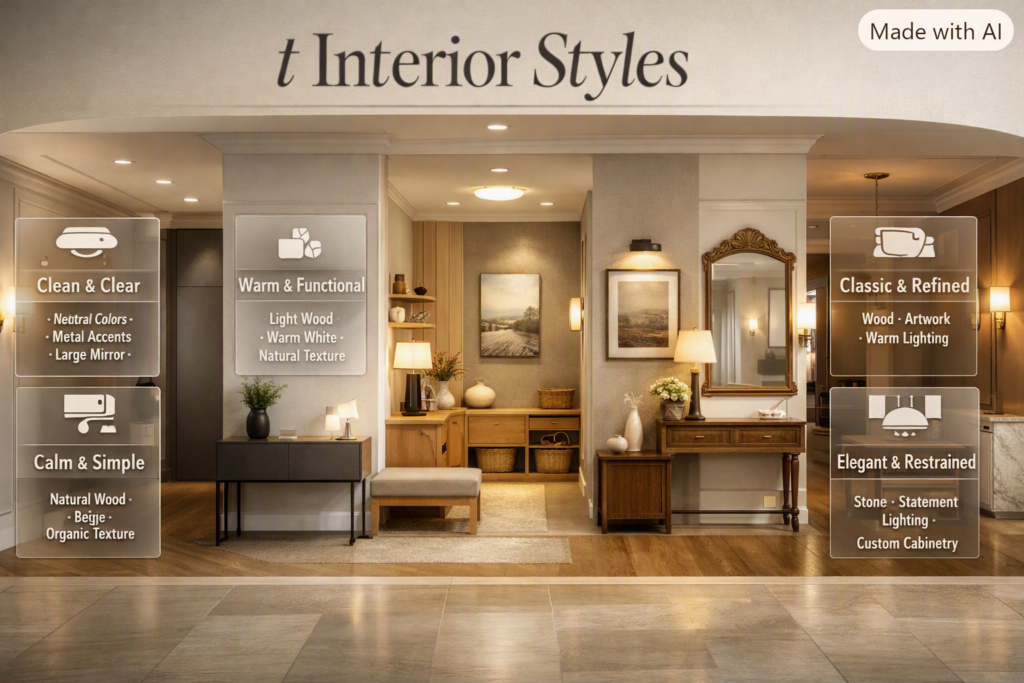
Modern Entryway
A modern entrance usually works best with:
- Clean-lined furniture
- Neutral colors
- Minimal decoration
- Black or metal accents
- Large mirrors
- Simple lighting
The goal is clarity.
Scandinavian Entryway
Scandinavian design emphasizes function without losing warmth.
Use:
- Light wood
- Warm white
- Simple furniture
- Natural textures
- Open storage
- Minimal decoration
This approach works especially well for small entrances.
Japandi Entryway
Japandi combines Japanese simplicity with Scandinavian comfort.
Use:
- Natural wood
- Beige
- Soft gray
- Organic textures
- Simple ceramics
- Low-profile furniture
Keep accessories restrained.
The goal is calm rather than emptiness.
Traditional Entryway
Traditional entrances can feature:
- Decorative molding
- Wood furniture
- Classic mirrors
- Framed artwork
- Warm lighting
- Rich neutral colors
Traditional design benefits from strong proportions.
Luxury Entryway
Luxury doesn’t mean adding more decoration.
A refined entrance can use:
- Stone or marble
- Statement lighting
- Elegant hardware
- Large mirrors
- Quality textiles
- Custom cabinetry
The strongest luxury interiors usually rely on restraint.
How Should the Entryway Connect With the Living Room?
The entryway should relate to the living room through shared colors, materials, finishes, or shapes. It doesn’t need to look identical, but the transition should feel natural, especially when both areas are visible from one another.
If the living room uses walnut furniture, for example, a walnut or similar wood console can create continuity.
If the living room has black metal lighting, repeat black metal in the entryway hardware or mirror frame.
For more ideas on creating a cohesive living space, see Living Room Design.
How Should Hallways Connect Different Rooms?
A hallway often connects several different areas of the home. Instead of designing it as an unrelated space, treat it as a visual bridge.
Connecting to the Kitchen
If your entrance leads toward the kitchen, repeat one material or color.
Black hardware, wood tones, or neutral colors can provide continuity without making the hallway look like a kitchen.
For kitchen-specific inspiration, visit Kitchen Design.
Connecting to Bedrooms
Bedroom hallways can benefit from softer colors, warm lighting, and personal artwork.
The transition should feel calmer than the main entrance.
Connecting to Bathrooms
If a bathroom opens onto the hallway, consider keeping the surrounding palette compatible.
You don’t need matching finishes, but a shared color family can make the spaces feel connected.
For additional bathroom ideas, explore Bathroom Design.
Connecting to a Home Office
If the hallway leads to a home office, subtle organization and clean architectural details can help create a purposeful transition.
For more functional work-space ideas, see Home Office Design.
What Are the Best Entryway Ideas for Families?
Family entryways need organization that everyone can use easily. Hooks should be accessible, footwear should have designated storage, and bags should have a convenient place near the door.
Create Zones
Adults can have higher hooks and dedicated storage.
Children can have lower hooks and baskets.
Seasonal belongings can be stored in closed cabinets or another area of the house.
The important thing is simplicity.
If children need to perform several steps to put something away, the system probably won’t last.
Add a Bench
A bench can be especially useful for families.
It gives children and adults a place to sit while putting on shoes.
Storage underneath can hold frequently used footwear or baskets.
How Can You Design an Entryway for a Rental?
Renters can improve an entrance without permanent construction by using freestanding furniture, removable hooks, mirrors, runners, baskets, artwork, and plug-in lighting.
Try:
- Freestanding shoe storage
- Removable wall hooks
- Leaning mirrors
- Narrow consoles
- Washable runners
- Baskets
- Portable lamps
- Temporary decorative solutions where permitted
The goal is to improve function without making changes that violate the rental agreement.
How Can You Make a Long Hallway More Interesting?
Long hallways benefit from repetition, rhythm, and focal points.
You can repeat:
- Wall sconces
- Artwork
- Architectural molding
- Framed photographs
- Ceiling fixtures
A long corridor should feel structured, not randomly decorated.
Don’t Fill Every Wall
Empty space isn’t necessarily a design problem.
Leaving some sections clear can actually make the hallway feel larger and calmer.
The goal is balance.
What Are the Most Common Entryway and Hallway Mistakes?
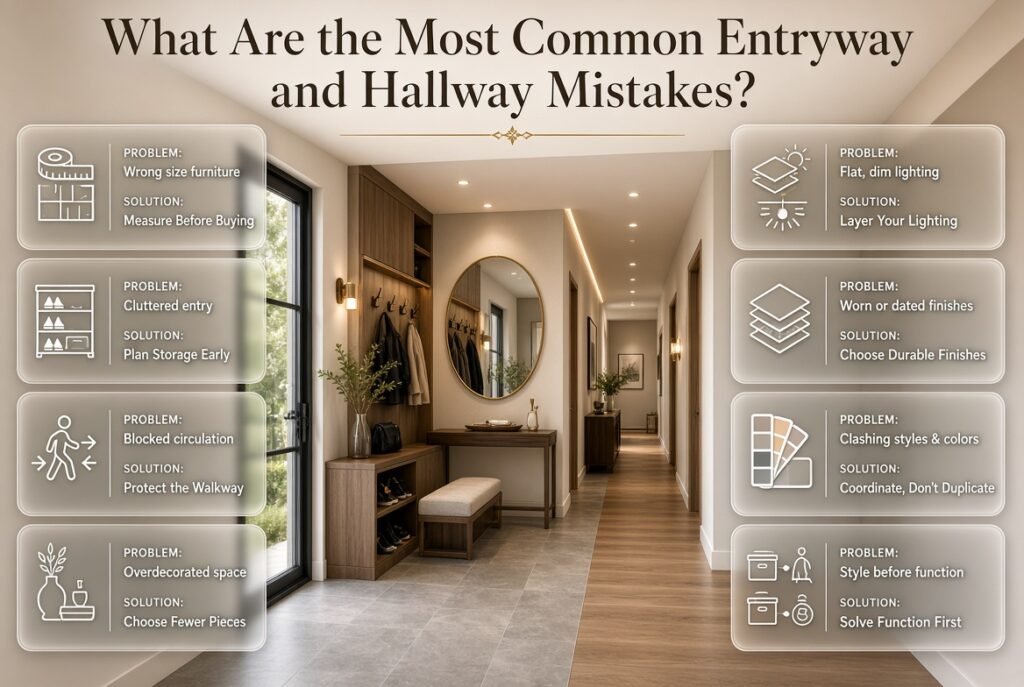
Choosing Furniture Before Measuring
Why it happens: A piece looks attractive.
Why it’s harmful: The proportions may not suit the space.
Solution: Measure first and mark the furniture footprint.
Ignoring Storage
Why it happens: Decoration is more visually exciting.
Why it’s harmful: Shoes, bags, and keys become permanent clutter.
Solution: Build storage into the design from the beginning.
Blocking the Walking Path
Why it happens: People try to use every empty wall.
Why it’s harmful: Hallways become uncomfortable.
Solution: Treat circulation as the first priority.
Using Too Many Accessories
Why it happens: Small objects seem harmless individually.
Why it’s harmful: Together they create visual noise.
Solution: Choose fewer and stronger pieces.
Poor Lighting
Why it happens: One ceiling fixture seems sufficient.
Why it’s harmful: Corners remain dark.
Solution: Use layered lighting.
Choosing Delicate Materials
Why it happens: Some materials look beautiful.
Why it’s harmful: Entryways experience heavy traffic.
Solution: Choose durable finishes appropriate for everyday use.
Making Everything Match
Why it happens: Matching feels safe.
Why it’s harmful: The home can feel staged.
Solution: Coordinate rather than duplicate.
Decorating Before Solving Function
Why it happens: Decoration creates immediate visual improvement.
Why it’s harmful: Everyday problems remain.
Solution: Solve storage, lighting, and circulation first.
What Is the Best Step-by-Step Process for Designing an Entryway?
Step 1: Measure the Space
Record all relevant dimensions and obstacles.
Step 2: Identify Daily Problems
Notice where shoes, keys, bags, and coats currently end up.
Step 3: Decide What Needs Storage
Separate everyday belongings from seasonal items.
Step 4: Choose the Main Functional Piece
Select a console, cabinet, bench, or floating unit.
Step 5: Plan Lighting
Determine where the space is naturally dark.
Step 6: Choose the Color Palette
Consider nearby rooms and available daylight.
Step 7: Add a Focal Point
Choose a mirror, artwork, molding, or statement fixture.
Step 8: Add Texture
Use a runner, wood, baskets, ceramic, or upholstery.
Step 9: Organize Everyday Items
Give each frequently used category a specific home.
Step 10: Edit
Remove anything that doesn’t serve a useful purpose.
⭐ Expert Tip: Live with the basic design for several days before adding more decoration. Real use will show you what the space actually needs.
Entryway vs. Hallway: What Should You Prioritize?
Although entryways and hallways are connected, they have different purposes.
| Area | Main Priority | Useful Features |
| Entryway | Arrival + organization | Storage, mirror, seating |
| Hallway | Movement + connection | Lighting, artwork, runner |
| Stair landing | Safety + transition | Lighting, railing, artwork |
| Mudroom entrance | Heavy-duty organization | Hooks, cabinets, baskets |
The entryway can support more furniture because people stop there.
The hallway generally needs more open space because people move through it.
Understanding this difference makes planning easier.
How Can You Improve an Entryway on a Budget?
You don’t need to replace everything.
Start with inexpensive changes that solve visible problems.
Consider:
- Painting the walls
- Installing simple hooks
- Adding a mirror
- Replacing outdated lighting
- Adding a runner
- Using baskets
- Reorganizing shoes
- Creating DIY artwork
- Moving existing furniture
- Removing unnecessary decoration
Sometimes subtraction makes the biggest difference.
An entrance can feel significantly better simply because the floor has been cleared and everyday items have designated homes.
For practical DIY inspiration, visit DIY Home Projects.
When Should You Use Built-In Entryway Storage?
Built-in storage is useful when you need significant organization and expect the layout to remain stable for years. It can make excellent use of awkward walls, corners, and vertical space.
Built-ins work especially well for:
- Large families
- Homes without adequate closets
- Mudroom-style entrances
- Long empty walls
- High ceilings
- Extensive shoe collections
The major disadvantage is cost and reduced flexibility.
If you’re renting or frequently change your furniture, freestanding storage may be more practical.
How Can You Make an Entryway Look More Expensive?
A sophisticated entrance depends more on proportion, lighting, materials, and restraint than on expensive decoration.
Focus on:
- A properly sized mirror
- Attractive lighting
- Clean storage
- Consistent hardware
- Natural materials
- A controlled color palette
- Minimal clutter
One beautiful focal point can create more impact than a large collection of inexpensive accessories.
How Do You Choose the Right Entryway Mirror?
Choose a mirror according to the wall width, furniture below it, ceiling height, and overall design style.
Round Mirrors
Round mirrors work well when you want to soften angular furniture and architecture.
They’re especially suitable for:
- Japandi
- Scandinavian
- Modern
- Minimalist interiors
Rectangular Mirrors
Rectangular mirrors work well above consoles and on narrow walls.
They can emphasize vertical or horizontal proportions depending on their orientation.
Oversized Mirrors
An oversized mirror can make a compact entrance feel more open and can become the main focal point.
Don’t simply choose the largest mirror possible.
Its proportions should relate to the wall and furniture beneath it.
How Do You Choose Hallway Artwork?
Choose artwork based on wall size, viewing distance, lighting, and the home’s overall style.
A hallway can display:
- Family photographs
- Abstract artwork
- Botanical prints
- Architecture photography
- Vintage posters
- Personal collections
For a narrow corridor, avoid artwork that sticks too far out from the wall.
For a large foyer, oversized artwork can create a strong first impression.
How Do You Use the Room-by-Room Approach?
The entrance should not be designed in isolation.
Look at the spaces it connects.
Ask:
- What colors appear in nearby rooms?
- What wood tones are used?
- Which metal finishes are repeated?
- Is the overall style modern, traditional, minimalist, or eclectic?
- Does the hallway connect public or private areas?
This helps create a home that feels cohesive.
For a complete room-by-room approach, explore the Room-by-Room Design Hub.
How can I make a small entryway look bigger and more spacious?
A small entryway looks more spacious when you reduce visual clutter, keep the walking path open, use appropriately scaled furniture, and make better use of vertical space. A large mirror can reflect light and create a stronger sense of depth, while a slim console or floating shelf gives you a useful surface without making the entrance feel crowded.
The biggest mistake is trying to fill every available corner. In a compact entrance, empty floor space is part of the design. Choose one or two functional pieces instead of several small items that make the area feel busy.
Practical ideas:
Use a slim or wall-mounted console.
Choose a large mirror instead of several small decorations.
Keep shoes and bags inside closed or organized storage.
Use light, warm neutrals if the space has limited daylight.
Keep the main walking route completely clear.
Use wall hooks instead of bulky coat furniture.
💡 Pro Tip: Before buying furniture, mark its size on the floor with painter’s tape. Walk through the entrance normally. If you have to turn sideways or avoid the furniture, it’s too large for the space.
What are the best storage ideas for a narrow hallway?
The best narrow hallway storage uses vertical and shallow space rather than deep floor furniture. Slim shoe cabinets, floating shelves, wall hooks, peg rails, built-in cabinets, and storage benches can organize everyday belongings while preserving the walking path. Current hallway design advice increasingly favors storage that blends into the architecture rather than looking like an additional piece of furniture.
Think about what actually collects in your hallway. If the problem is shoes, prioritize shoe storage. If coats and bags are the issue, install hooks. If keys and mail are constantly left on surfaces, create a small drop zone.
Useful narrow-hallway storage options:
Slim shoe cabinets
Wall-mounted hooks
Floating shelves
Built-in storage
Storage benches
Small baskets
Shallow consoles
Full-height cabinets where the layout allows
⚠ Common Mistake: Don’t buy a deep cabinet simply because it offers more storage. If it reduces the comfortable walking area, you’ll gain storage but lose functionality.
A better approach is to store frequently used items near the entrance and move seasonal or rarely used belongings to another storage area.
How do you make a long, narrow hallway look less cramped?
To make a long, narrow hallway feel less cramped, focus on clear circulation, balanced lighting, reflective surfaces, and visual continuity. A mirror can add depth, while evenly distributed lighting prevents the corridor from becoming a dark tunnel. A runner can also define the passage and make the long shape feel intentional rather than awkward.
Don’t automatically try to hide the hallway’s length. Instead, use it as an advantage.
For example, a long hallway can become a simple gallery with carefully spaced artwork, wall sconces, or family photographs. A focal point at the far end can give the eye somewhere to land.
Try this combination:
Light wall color → slim furniture → clear walkway → large mirror → balanced lighting → simple artwork
If the hallway is especially narrow, wall-mounted elements are usually safer than bulky furniture.
⭐ Expert Tip: A mirror works best when it reflects something attractive or a source of light. Don’t place it where the reflection simply shows a pile of shoes, a blank wall, or clutter. The reflected view becomes part of the design.
What lighting is best for an entryway and hallway?
The best entryway and hallway lighting is layered rather than dependent on a single ceiling fixture. Use ceiling lighting for general visibility, then add wall sconces, picture lights, small lamps, or other accent lighting where appropriate. Multiple light sources can make a hallway feel warmer and prevent dark areas at the ends or corners.
Lighting should do two jobs: help you use the space comfortably and establish the mood when someone enters your home.
For a modern hallway, recessed or flush-mounted ceiling lights can provide a clean foundation. Wall sconces can add character without consuming floor space. In a larger entryway, a pendant or chandelier can become a focal point.
A practical lighting plan might include:
Ceiling fixture for general illumination
Wall sconces for atmosphere
Picture lighting for artwork
Small decorative lamp on a console
Under-shelf or cabinet lighting where useful
Interestingly, small decorative lamps are also becoming a popular way to bring softer, more personal lighting into overlooked areas such as hallways.
📌 Quick Tip: Don’t judge hallway lighting only during the daytime. Turn on every light at night and check whether the floor, doors, storage, artwork, and corners are evenly visible.
How can I make my entryway look stylish without making it cluttered?
The easiest way to create a stylish entryway without clutter is to give every object a purpose and limit the number of competing focal points. Start with functional essentials—storage, lighting, mirror, and a place for everyday items—then add one or two decorative elements that reflect your personal style.
A polished entryway doesn’t need dozens of accessories. In fact, current design thinking is increasingly treating the hallway as a deliberate part of the home’s architecture and atmosphere rather than a leftover passage filled with decoration.
For example, a simple entryway could have:
A slim wooden console
A large round mirror
One table lamp
A small tray for keys
One ceramic vase
A woven basket underneath
A durable runner
That’s enough to make the space feel complete.
For a more modern look: use clean lines, neutral colors, simple hardware, and minimal accessories.
For a warmer look: introduce natural wood, woven textures, plants, and warm lighting.
For a luxury look: focus on proportion, quality-looking materials, statement lighting, and restraint rather than covering the space with metallic decorations.
⚠ Professional Advice: If your entryway repeatedly becomes cluttered, don’t keep buying decorative storage baskets. First identify why the clutter is happening. Storage only works when it’s convenient enough for people to use every day.
Conclusion
The best Entryway & Hallway Ideas are the ones that make your home feel more welcoming while also making everyday life easier. Whether you’re working with a narrow hallway, a compact apartment entrance, or a spacious foyer, focus first on clear movement, practical storage, suitable lighting, and furniture that fits the space. Once those basics are right, mirrors, artwork, runners, color, and personal accessories can add the finishing character without making the area feel crowded.
Remember, you don’t need to fill every empty wall or corner. A well-designed entryway feels balanced because every element has a reason to be there. Keep frequently used items easy to access, hide unnecessary clutter, use lighting to improve the atmosphere, and choose materials that can handle everyday traffic.
For more practical inspiration and professional ideas for creating a beautiful, functional home, explore DesignMode24 Interior Design. From entryways and hallways to complete room transformations, thoughtful design starts with understanding how you actually live in your space.
Leave a Reply