
Introduction
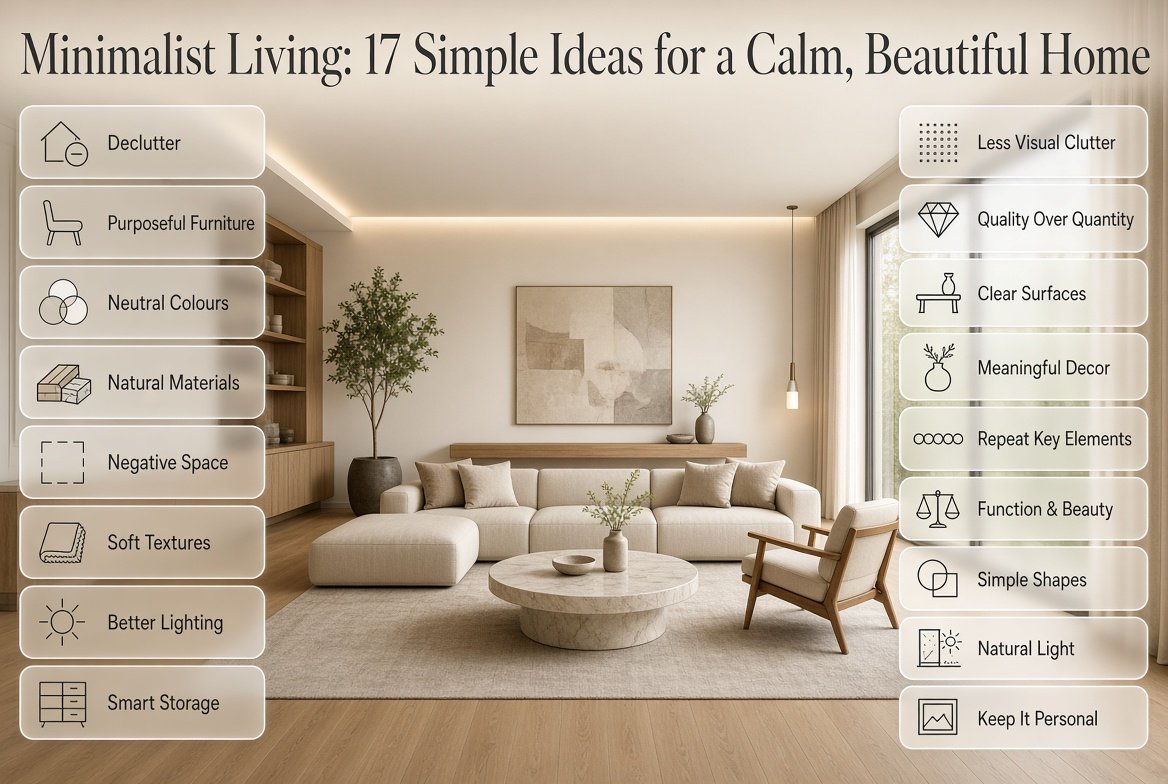
Minimalist Living | A home can look beautiful and still feel exhausting to live in. You may have a stylish sofa, attractive decorations, useful furniture, and plenty of storage, yet somehow the rooms still feel crowded. Surfaces collect things, cupboards become difficult to manage, and every cleaning session seems to take longer than it should.
This is where Minimalist Living becomes useful.
Minimalism isn’t about throwing away everything you own or turning your home into a completely empty white box. It’s about making better decisions about what deserves your space, money, attention, and daily effort.
A well-designed minimalist home can be warm, comfortable, personal, practical, and even luxurious. The difference is that the room isn’t filled simply because there is space available. Furniture has a purpose. Accessories have meaning. Storage supports everyday routines. Empty space is treated as part of the design rather than something that must immediately be filled.
In this guide, you’ll learn how minimalist living actually works, how to declutter without regret, how to create minimalist rooms, how to choose furniture and colors, how to avoid common mistakes, and how to maintain a simpler home without making your lifestyle restrictive.
For readers who want broader professional guidance alongside minimalist principles, DesignMode24 Interior Design provides a wider collection of home and interior design ideas.
What Is Minimalist Living?
Minimalist living is an intentional approach to everyday life that focuses on keeping possessions, spaces, purchases, and routines that genuinely provide value while reducing unnecessary physical and visual clutter.
The important word is intentional.
Minimalism isn’t simply about owning fewer things. Two people can own the same number of possessions while one has a minimalist lifestyle and the other doesn’t. The difference is how deliberately those possessions are chosen and used.
For example, a person who owns 30 books because they read them regularly may be living more intentionally than someone who owns 200 books that they never open but keeps buying more because books are attractive.
Similarly, a living room containing a sofa, two chairs, a coffee table, a lamp, artwork, and plants can still be minimalist if everything has a purpose and the arrangement feels balanced.
Minimalist living usually involves:
- Owning fewer unnecessary possessions
- Avoiding repeated or duplicate items
- Buying more deliberately
- Choosing furniture according to function
- Creating clear walking areas
- Reducing visual clutter
- Keeping surfaces easier to maintain
- Giving meaningful belongings enough space
- Designing storage around actual routines
- Being more thoughtful about future purchases
The objective isn’t to achieve a specific number of possessions.
The objective is to make your environment work better for your life.
Why Does Minimalist Living Matter?
Modern homes can accumulate belongings surprisingly quickly.
Online shopping makes purchasing convenient. Trends change constantly. Promotional offers encourage impulse buying. Social media exposes people to endless home décor inspiration. Even well-intentioned purchases can eventually become clutter when they aren’t used regularly.
The problem isn’t necessarily that individual objects are bad.
The problem is accumulation.
One decorative vase isn’t a problem. Twenty vases that rarely get used can become a maintenance problem.
One kitchen appliance may save time. Five appliances that occupy valuable cabinet space may make the kitchen harder to use.
One chair can provide comfortable seating. A room filled with oversized furniture can make movement difficult.
Minimalist living asks a simple question:
Does this possession improve my life enough to justify the space, money, maintenance, and attention it requires?
That question can change the way you shop, decorate, organize, and even plan rooms.
What Are the Benefits of Minimalist Living?
Minimalist living can improve a home in several practical ways.
Less Visual Clutter
A room with fewer competing objects is often easier to understand visually.
When every shelf contains accessories and every wall has something hanging on it, individual elements lose importance.
Reducing the number of visible objects allows important pieces to become focal points.
For example, one large artwork above a console may create more impact than seven small decorative pieces competing for attention.
Easier Cleaning
Every possession creates some level of maintenance.
Objects need to be moved when surfaces are cleaned. Decorative items collect dust. Furniture needs space around it for vacuuming. Storage becomes harder to manage as it fills.
Reducing unnecessary possessions can therefore make regular cleaning simpler.
Better Movement
Furniture affects how a room feels just as much as decoration does.
A smaller number of appropriately sized furniture pieces can create clearer circulation paths and make a room feel more spacious.
This is especially valuable in apartments and smaller homes.
More Intentional Spending
Minimalism also changes what happens before an object enters the home.
Instead of thinking only:
“Do I like this?”
you begin asking:
“Where will this go?”
Then:
“How often will I actually use it?”
And finally:
“Would I still buy it if it weren’t discounted?”
These questions create a pause between desire and purchase.
More Noticeable Personal Style
When unnecessary objects disappear, meaningful objects become easier to appreciate.
A handmade bowl, family photograph, travel souvenir, inherited chair, or favorite artwork can become more visually important when it isn’t surrounded by unrelated decoration.
That’s one reason minimalist interiors don’t have to feel impersonal.
Is Minimalist Living the Same as Having an Empty Home?
No.
Minimalism and emptiness are not the same thing.
An empty room can still be poorly designed.
If the room lacks comfortable seating, appropriate lighting, storage, texture, or personality, removing more objects won’t necessarily improve it.
A successful minimalist interior usually balances:
Function + Comfort + Personality + Breathing Room
Consider a minimalist living room containing:
- A comfortable sofa
- One coffee table
- A floor lamp
- A textured rug
- One large artwork
- A plant
- A few books
- One meaningful decorative object
There may not be many items, but the room can still feel complete.
⭐ Expert Tip: Don’t ask, “How little can I own?” Ask, “What do I actually need and love?” That small change in thinking prevents minimalism from becoming an uncomfortable competition.
How Do You Start Minimalist Living?
Trying to declutter an entire house in one weekend sounds productive, but it can quickly become overwhelming.
A better approach is to work in controlled stages.
Step 1: Choose One Small Area
Start with a defined space:
- One drawer
- One shelf
- One bedside table
- One kitchen cabinet
- One bathroom cupboard
- One wardrobe section
- One desk
A small area gives you a clear beginning and ending.
Step 2: Remove Everything
Take everything out.
Don’t try to make decisions while objects are hidden behind other objects.
Seeing the entire collection makes duplication and unnecessary belongings easier to identify.
Step 3: Sort the Items
Use four basic categories:
| Category | Action |
|---|---|
| Keep | Useful, meaningful, or regularly used |
| Donate | Useful but no longer needed |
| Recycle/Discard | Broken, expired, damaged, or unusable |
| Decide Later | Requires additional thought |
The final category should remain temporary.
If everything goes into “decide later,” you’ve simply created another storage pile.
Step 4: Clean the Empty Space
Once everything is out, clean the drawer, shelf, cabinet, or surface.
This gives you a psychological reset.
Step 5: Return Only What Belongs
Put frequently used items in the easiest locations.
Less frequently used possessions can go into secondary storage.
Step 6: Live With the Result
Don’t immediately start another huge project.
Use the space for several days.
Notice what became easier.
That experience will tell you what to change next.
⚠ Common Mistake: Decluttering too aggressively because minimalist photographs online make extremely empty homes look attractive. A beautiful photograph doesn’t tell you whether the room works for real everyday life.
What Should You Keep When Decluttering?
Decluttering decisions can become emotional because possessions often represent memories, money, relationships, or past versions of ourselves.
Instead of asking only whether you’ve used an item recently, consider the bigger picture.
Ask:
- Do I use it?
- Does it solve a genuine problem?
- Would I buy it again today?
- Do I own another item that performs the same job?
- Does it have meaningful sentimental value?
- Is the storage space worth what it provides?
- Am I keeping it because I love it or because I feel guilty?
That last question matters.
A gift can have been meaningful when you received it without needing to remain in your home forever.
Likewise, keeping something simply because it was expensive doesn’t recover the money you spent. The purchase has already happened.
The useful question is whether the object still provides enough value today.
How Can You Create a Minimalist Living Room?

The living room is often the most visible part of the home, so it’s a good place to apply minimalist principles.
Start with function.
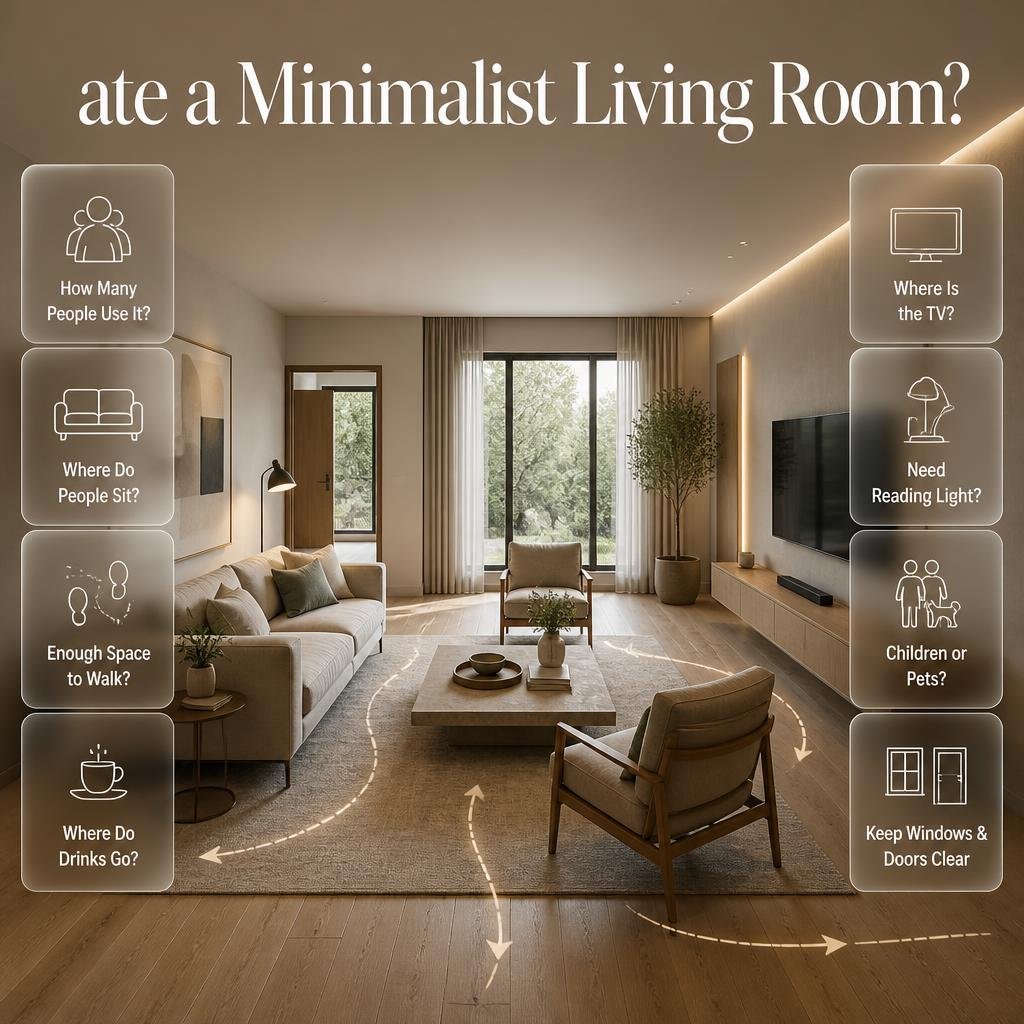
Ask:
- How many people normally use the room?
- Where do people sit?
- Is there enough space to walk?
- Where do people place drinks?
- Where is the television positioned?
- Does the room need reading light?
- Are there children or pets using the space?
- Does furniture block windows or doors?
These questions are more useful than simply asking what looks fashionable.
A practical minimalist living room might include:
- One appropriately sized sofa
- One coffee table
- One or two occasional chairs
- A rug
- Layered lighting
- Limited artwork
- One or two plants
- Carefully selected accessories
The goal is not to remove seating simply to make the room look empty.
The goal is to stop furniture from competing with movement.
For additional design context, Elegant Spaces can help you think about refinement, proportion, and visual balance, while Luxury Spaces explores how sophisticated interiors can rely on quality and restraint rather than visual overload.
Why Is Negative Space Important?
Negative space is the area intentionally left empty around furniture, artwork, and accessories.
It isn’t wasted space.
It helps the eye understand the room.
Imagine a console with one large artwork, a lamp, and a small ceramic object. The empty surface around those pieces makes each item more noticeable.
Now imagine the same console covered from end to end with decorations.
The individual objects become harder to appreciate.
Minimalist design uses empty space as an active part of the composition.
How Can You Create a Minimalist Bedroom?
Bedrooms should support rest, comfort, and easy routines.
The bed is normally the visual anchor, so begin there.
Then consider:
- Bedside tables
- Lighting
- Bedding
- Curtains
- Artwork
- Storage
- Floor space
- Charging points
- Clothing organization
One common problem is allowing bedside tables to become collection points.
A phone, charger, water bottle, receipts, cosmetics, books, medication, cables, and miscellaneous objects can quickly turn a small surface into visual clutter.
A simpler arrangement might be:
Lamp + book + one personal object
That’s often enough.
Before purchasing new bedroom furniture, think about movement.
You should be able to get out of bed comfortably, open wardrobes without obstruction, and move around the room without navigating an obstacle course.
If you’re planning a bedroom from the beginning, the Bedroom Planning and Layout guide is a useful companion for thinking about furniture positioning and circulation.
📌 Quick Tip: Keep the floor visually clear wherever possible. Open floor space can make a bedroom feel calmer without requiring a larger room.
How Should Minimalist Homes Use Color?
Minimalist living doesn’t mean your home has to be completely white.
What matters more is visual consistency.
Popular minimalist palettes include:
- Warm white
- Beige
- Soft gray
- Taupe
- Natural wood
- Warm brown
- Muted green
- Soft blue
- Earthy neutrals
- Controlled black accents
A restrained palette gives furniture, architecture, materials, and artwork more room to stand out.
But minimalism can also include stronger colors.
For example, a room might use warm beige walls, natural wood furniture, and one deep green chair.
Because the surrounding palette is controlled, the green chair becomes an intentional accent rather than visual noise.
The same principle applies to artwork.
One large colorful artwork can work beautifully in a minimalist room when the rest of the environment gives it enough space.
If you’re choosing a broader palette for your home, the Paint Color section can provide additional direction.
What Materials Work Well With Minimalist Interiors?
A minimalist interior doesn’t need to rely on completely plain surfaces.
Texture is essential because it adds depth without requiring large quantities of decoration.
Useful materials include:
- Natural wood
- Linen
- Cotton
- Wool
- Stone
- Ceramic
- Glass
- Metal
- Leather
- Natural fibers
Imagine a room with warm white walls, a wooden dining table, linen curtains, a wool rug, ceramic accessories, and a comfortable upholstered chair.
There may be relatively few decorative objects, yet the room doesn’t feel empty.
That’s because material variation creates visual richness.
This is an important minimalist principle:
You can create richness through texture instead of quantity.
How Do You Make Minimalism Feel Warm?
One of the biggest concerns about minimalist homes is that they can become cold or sterile.
The problem usually isn’t minimalism itself.
It’s a lack of warmth.
Warmth can come from:
- Wood
- Textiles
- Plants
- Soft upholstery
- Natural materials
- Personal artwork
- Warm neutral colors
- Layered lighting
- Handmade objects
Lighting is especially important.
A room with pale walls and minimal furniture can feel completely different under harsh overhead lighting compared with several softer light sources.
Use lighting for different activities instead of expecting one ceiling fixture to do everything.
A reading lamp, ambient light, decorative fixture, and task light can create a much more comfortable environment while keeping the visual design simple.
For a more technology-focused approach to controlled lighting, see Intelligent Lighting.
How Can Wall Treatments Work in a Minimalist Home?
Minimalism doesn’t require completely plain walls.
The key is avoiding unnecessary visual competition.
A single textured wall, subtle paneling, carefully selected artwork, or restrained architectural treatment can add depth while maintaining a clean overall composition.
The important question is:
Does the wall treatment improve the room or simply fill an empty wall?
For example, a subtle textured finish behind a bed can provide enough visual interest that you don’t need several pieces of artwork.
Similarly, one architectural feature wall can become the room’s focal point while the remaining walls stay quiet.
If you’re considering different approaches to architectural and decorative wall surfaces, Wall Treatments provides a useful direction for exploring those possibilities.
What Role Do Accent Pieces Play in Minimalist Living?
Minimalist homes still need personality.
Accent pieces are useful because they can communicate character without requiring large amounts of decoration.
The key is selection.
Instead of placing ten accessories on a shelf, choose two or three that have different heights, shapes, or textures.
For example:
Large artwork + ceramic object + small plant
creates hierarchy.
Or:
Table lamp + book stack + sculptural object
can create a balanced vignette.
The goal isn’t to make every empty surface decorative.
Some surfaces should remain empty.
Thoughtfully chosen Accent Pieces can help create personality while keeping the overall composition controlled.
Minimalist Living vs. Maximalist Living
Minimalism and maximalism approach visual density differently.
| Element | Minimalist Living | Maximalist Living |
|---|---|---|
| Decoration | Selective | Abundant |
| Color | Often restrained | Often expressive |
| Furniture | Carefully edited | Layered and varied |
| Visual density | Lower | Higher |
| Storage | Purposeful | Often extensive |
| Personal objects | Curated | Frequently displayed |
| Main focus | Simplicity and function | Expression and abundance |
Neither approach automatically produces a better home.
A person who loves collections, strong colors, books, artwork, and layered objects may naturally prefer a richer environment.
Someone who values clear surfaces, fewer decisions, and simple routines may prefer minimalism.
The useful lesson is to understand what your household actually needs rather than copying an aesthetic because it looks attractive online.
What Are the Biggest Minimalist Living Mistakes?

Mistake 1: Thinking Minimalism Means Owning Nothing
Minimalism doesn’t require extreme reduction.
If you use something regularly and it improves your life, keeping it is perfectly compatible with intentional living.
Mistake 2: Buying More Things to Organize Existing Things
This is one of the most common contradictions.
A person notices clutter and immediately buys:
- More baskets
- More boxes
- More organizers
- More shelves
- More storage furniture
But if the underlying problem is excessive possessions, additional storage only hides the issue.
Better approach: reduce first, organize second.
Mistake 3: Choosing Appearance Over Comfort
A sofa may photograph beautifully but be uncomfortable.
A dining chair may look elegant but become painful after twenty minutes.
A coffee table may look impressive but block movement.
Minimalism should support real life.
Mistake 4: Removing Everything Personal
A completely impersonal home can feel like a showroom.
Family photographs, books, artwork, handmade pieces, inherited objects, and travel memories can make a minimalist home feel human.
Mistake 5: Creating Too Much Empty Space
Empty space is useful, but excessive emptiness can reduce functionality.
A living room still needs enough seating.
A bedroom still needs practical storage.
A dining room still needs comfortable access around the table.
Mistake 6: Copying Someone Else’s Minimalist Lifestyle
Your home should reflect your routine.
A person who works from home needs a workspace.
A family with children needs storage for toys.
Someone who cooks regularly needs functional kitchen equipment.
Minimalism should adapt to the household rather than forcing the household to adapt to an aesthetic.
How Can Families Practice Minimalist Living?
Family homes require a slightly different approach.
Children naturally accumulate toys, books, clothing, school materials, crafts, and sentimental objects.
Trying to maintain an adult-style minimalist environment can become unrealistic.
Instead, establish practical boundaries.
For example:
- Give each child dedicated storage.
- Keep everyday toys accessible.
- Rotate seasonal or less frequently used items.
- Create a clear location for school supplies.
- Use baskets for quick cleanup.
- Donate toys that are consistently ignored.
- Keep shared areas easier to reset.
The objective isn’t to make children own as little as possible.
It’s to make the home easier for everyone to use.
Children should also have room for creativity and play.
A minimalist family home doesn’t have to look perfect all day.
It simply needs systems that make returning the home to order easier.
How Does Minimalist Living Change Shopping Habits?
Decluttering solves the current problem.
Intentional shopping prevents the same problem from returning.
Before buying something, ask:
Where will it live?
If you don’t have an answer, pause.
What problem does it solve?
If the item doesn’t solve a genuine need or bring meaningful value, you may not need it.
Do I already own something similar?
Duplicate purchases are one of the easiest forms of unnecessary accumulation.
Would I buy it without the discount?
A discount isn’t a saving if you wouldn’t have purchased the product otherwise.
Will I still want it next year?
This question helps separate a temporary trend from a lasting preference.
⭐ Expert Tip: Try a waiting period for non-essential purchases. Waiting 24 hours, several days, or even a few weeks can reveal whether you genuinely want something or simply reacted to the moment.
Can Minimalist Living Work in a Small Home?
Yes.
Small homes can benefit significantly from minimalist principles because every square meter has greater importance.
Focus on:
- Appropriately scaled furniture
- Multi-functional pieces
- Vertical storage
- Clear walking routes
- Hidden storage
- Open floor areas
- Fewer decorative objects
- Furniture that serves more than one purpose
For example, a storage ottoman can provide seating, a footrest, and hidden storage.
A wall-mounted desk can provide a workspace without consuming permanent floor space.
But don’t automatically fill every available wall with cabinets.
Sometimes the best storage solution is owning fewer things.
For readers working on wider home improvements alongside minimalist changes, the Home Improvement section offers additional ideas.
How Can Minimalism Work With DIY Projects?
Minimalism doesn’t mean every design decision needs to involve buying something new.
Simple DIY improvements can sometimes make an existing home more functional.
Examples include:
- Refinishing an existing piece of furniture
- Repainting a tired surface
- Creating simple open shelving
- Improving cable management
- Reorganizing existing storage
- Repurposing furniture
- Creating a simple display ledge
- Repairing instead of replacing useful pieces
The important distinction is between improving what you already own and creating another project that introduces more unnecessary objects.
Before beginning a DIY project, ask whether it solves a genuine problem.
If you’re interested in practical home projects, DIY Home Projects can complement the minimalist approach.
Can Minimalist Living Extend Beyond the Interior?
Yes.
Minimalist thinking can also influence outdoor spaces.
A garden or patio doesn’t need dozens of decorative elements to feel complete.
Instead, consider:
- Clear circulation
- Comfortable seating
- Appropriate planting
- Simple lighting
- Useful shade
- A limited material palette
- Intentional focal points
A small garden can feel sophisticated with a bench, a few carefully selected plants, appropriate paving, and good lighting.
The same principle applies:
Design the space around how you use it.
If you’re thinking about applying intentional design principles outdoors, Can I Design My Own Garden Kdagardenation offers a relevant direction for planning a personal garden.
How Can Outdoor Spaces Support Minimalist Living?
Outdoor minimalism isn’t about removing plants.
In fact, greenery can provide texture, movement, color, and natural character without making a space feel visually crowded.
The goal is to avoid unnecessary repetition.
Instead of purchasing many unrelated garden decorations, focus on:
- Plant structure
- Seating
- Pathways
- Lighting
- Materials
- Privacy
- Shade
A restrained outdoor palette can make plants and natural textures more noticeable.
This approach can also reduce maintenance when plants and materials are selected according to the site’s real conditions.
For additional outdoor inspiration and garden-related design thinking, Robert MyGardenAndPatio can be explored as part of the wider design resource collection.
How Do You Create Minimalist Storage?
Good storage isn’t simply about having more cabinets.
It should make everyday actions easier.
Think about where objects are used.
If shoes are removed at the entrance, shoe storage should be near the entrance.
If cooking utensils are used beside the stove, frequently used tools shouldn’t be stored across the kitchen.
If chargers are constantly left in the living room, create a practical charging location there.
This is behavior-based storage.
Instead of asking:
“Where can I fit this?”
ask:
“Where would I naturally look for this when I need it?”
That small difference can make a minimalist home much easier to maintain.
How Do You Maintain a Minimalist Home Long Term?
Minimalism isn’t a one-time cleaning project.
It works best as a maintenance habit.
The Monthly Reset
Once a month, walk through your home and ask:
- What has accumulated?
- What haven’t we used?
- Which surfaces are becoming cluttered?
- Did we buy anything that hasn’t found a proper place?
- Is any furniture creating unnecessary obstruction?
- Are storage areas becoming difficult to access?
- Are there items that no longer suit our lifestyle?
You don’t need to spend an entire day.
Fifteen to thirty minutes can be enough when the system is already established.
The Seasonal Reset
Every few months, review:
- Clothing
- Seasonal décor
- Children’s items
- Outdoor equipment
- Bedding
- Kitchen equipment
- Hobby materials
Seasonal reviews prevent unused belongings from quietly accumulating.
What Is the Best Way to Keep a Minimalist Home Organized?
Organization should be simple enough to maintain without constant effort.
A good system has three characteristics:
Easy to understand
Everyone in the household knows where things belong.
Easy to access
Frequently used items aren’t hidden behind layers of rarely used possessions.
Easy to reset
Putting something away shouldn’t require a complicated process.
If an organization system takes too much effort, people will eventually stop using it.
That’s why minimalist organization should be designed around human behavior rather than idealized photographs.
How Can You Make a Minimalist Home Feel Personal?
Personalization is essential.
A minimalist home should still tell you something about the people who live there.
Consider:
- Family photographs
- Travel objects
- Books
- Artwork
- Handmade ceramics
- Vintage furniture
- Heirlooms
- Collections
- Plants
- Objects connected to hobbies
The key is editing.
You don’t need to display everything you own.
Select the objects that have genuine meaning.
For example, one handmade ceramic bowl from a memorable trip may communicate more personality than a shelf full of generic decorative objects.
The same principle applies to artwork.
Choose pieces because you connect with them rather than because they simply match a current trend.
Is Minimalist Living Expensive?
It doesn’t have to be.
In fact, minimalist habits can reduce unnecessary spending because they encourage more deliberate purchasing.
You don’t need:
- Designer furniture
- Expensive storage
- A complete home makeover
- Matching décor sets
- Luxury accessories
You can begin by changing how you use what you already own.
Move furniture.
Remove duplicates.
Clear surfaces.
Repair useful items.
Donate things that no longer serve you.
Reconsider future purchases.
If you eventually replace furniture, focus on durability, comfort, scale, and function rather than buying simply to achieve a particular aesthetic.
Can Minimalist Homes Still Look Luxurious?
Absolutely.
Luxury doesn’t require visual abundance.
A sophisticated minimalist interior can use:
- High-quality materials
- Excellent proportions
- Comfortable furniture
- Natural stone
- Fine wood
- Quality textiles
- Thoughtful lighting
- Carefully selected artwork
- Controlled color
- Craftsmanship
The difference is that fewer elements receive more attention.
One beautifully made wooden table may create more impact than several inexpensive decorative tables.
One carefully selected pendant can become more memorable when the rest of the ceiling remains visually quiet.
Minimalist luxury is often about quality, proportion, detail, and restraint.
What Is Minimalist Living and How Do You Start?
Minimalist living is an intentional way of managing your home, possessions, spending, and daily environment so that unnecessary things don’t take up more physical or mental space than they deserve. It doesn’t mean owning almost nothing or creating a completely empty home. The goal is to keep the things that are useful, meaningful, and genuinely supportive of your lifestyle.
The easiest way to begin is to start small rather than trying to declutter the entire house at once. Choose one drawer, shelf, wardrobe section, or room corner. Remove everything, decide what you actually use, and return only the items that deserve the space.
Practical starting points:
Begin with an area that regularly creates frustration.
Remove duplicate and rarely used items first.
Don’t buy storage products before reducing clutter.
Give frequently used belongings easy-to-reach locations.
Review the area again after a few weeks.
The most effective minimalist homes aren’t created through one dramatic decluttering session. They’re built through better decisions repeated over time.
What Should You Get Rid of When Starting a Minimalist Lifestyle?
Start with items that are clearly unnecessary rather than immediately targeting sentimental belongings. Broken objects, duplicates, expired products, unused purchases, clothes that no longer fit your lifestyle, and things you haven’t used for a long time are usually easier decisions.
A useful test is to ask whether you would choose to bring the item into your home today. If you wouldn’t buy it again, don’t use it, and don’t have a meaningful reason for keeping it, it deserves closer consideration.
Good categories to review first:
Duplicate kitchen equipment
Clothes you never wear
Broken or incomplete items
Expired cosmetics and household products
Unused cables and electronic accessories
Decorative items you no longer like
Old paperwork that no longer has a purpose
Storage containers with nothing useful inside
Don’t rush sentimental possessions. Minimalism should reduce unnecessary clutter without forcing you to erase meaningful memories. Keep the objects that genuinely matter and find intentional ways to display or store them.
Can Minimalist Living Work in a Small Home or Apartment?
Yes. Minimalist living can be especially useful in smaller homes because limited space makes unnecessary furniture and possessions more noticeable. The objective isn’t to make a small apartment look empty. It’s to make every part of the available space work harder.
Start by evaluating furniture size and circulation. A large sofa, oversized coffee table, or unnecessary storage cabinet can consume valuable floor space. Multi-functional furniture can also help when it genuinely solves a problem—for example, an ottoman that provides seating while offering hidden storage.
For a small home, focus on:
Appropriately scaled furniture
Clear walking paths
Multi-functional pieces
Vertical storage
Hidden or closed storage where appropriate
Fewer decorative objects
Keeping frequently used items accessible
Protecting open floor space
One of the biggest mistakes is trying to solve every storage problem by adding more cabinets. If the home contains too many possessions, additional storage can simply hide the accumulation rather than solve it.
How Can You Make a Minimalist Home Feel Warm and Cozy?
A minimalist home feels warm when simplicity is combined with texture, comfortable materials, personal details, and appropriate lighting. The mistake is assuming that minimalism requires bare walls, cold colors, hard surfaces, and almost no decoration.
Natural materials are particularly effective because they introduce visual and tactile warmth without creating clutter. Wood, linen, wool, cotton, ceramic, leather, and natural fibers can make a restrained interior feel layered and comfortable.
Use these elements to add warmth:
Warm-toned wood
Soft rugs and textiles
Linen or cotton curtains
Comfortable upholstery
Plants and natural greenery
Warm neutral colors
Personal photographs or artwork
Handmade ceramics
Multiple levels of lighting
Lighting deserves special attention. A minimalist room relying entirely on one bright overhead fixture can feel harsh, while a combination of ambient, task, and accent lighting can create depth and comfort.
The goal is not to add more decoration. It’s to make the fewer elements you already have feel richer and more intentional.
Is Minimalist Living Expensive, or Can You Do It on a Budget?
Minimalist living doesn’t require an expensive home makeover. In fact, one of its practical advantages is that it can encourage more deliberate spending. You don’t need designer furniture, luxury accessories, matching storage systems, or a completely new interior to start.
The first step is usually to work with what you already own. Rearrange furniture, remove unnecessary belongings, repair useful items, simplify surfaces, and improve how storage is used before buying anything new.
A budget-friendly minimalist approach includes:
Decluttering before shopping
Reusing furniture you already own
Repairing useful pieces
Buying fewer but more purposeful items
Avoiding trend-driven purchases
Choosing durable materials when replacement is necessary
Waiting before making non-essential purchases
Measuring furniture before buying it
A helpful question before every purchase is: “What problem will this solve, and where will it live?”
If you can’t answer either question clearly, waiting is often the better choice.
Minimalist living isn’t about spending less at all costs. It’s about making sure the money you do spend contributes to a home that is functional, comfortable, and genuinely suited to your lifestyle.
Conclusion
Minimalist living is not about making your home look empty or getting rid of everything you own. It is about creating a home where the things you keep have a clear purpose, add value, and support the way you actually live. When clutter is reduced and every space is planned intentionally, your home can feel calmer, more functional, and easier to maintain.
A successful minimalist home also does not need to look cold or boring. Warm materials, comfortable furniture, natural textures, thoughtful lighting, meaningful artwork, and a few carefully selected decorative pieces can give a simple interior plenty of character. The goal is to create balance between simplicity, comfort, personality, and practicality.
The most effective approach is to start gradually. Declutter one room or category at a time, avoid unnecessary purchases, improve storage where needed, and pay attention to how each space is being used. Instead of following a strict design rule, build a home around your lifestyle and keep only what genuinely serves you.
Ultimately, minimalist living is less about having fewer possessions and more about having more intention behind the way you live. When your surroundings become easier to manage and more aligned with your priorities, simplicity can make everyday life feel more comfortable, organized, and meaningful.