
Introduction
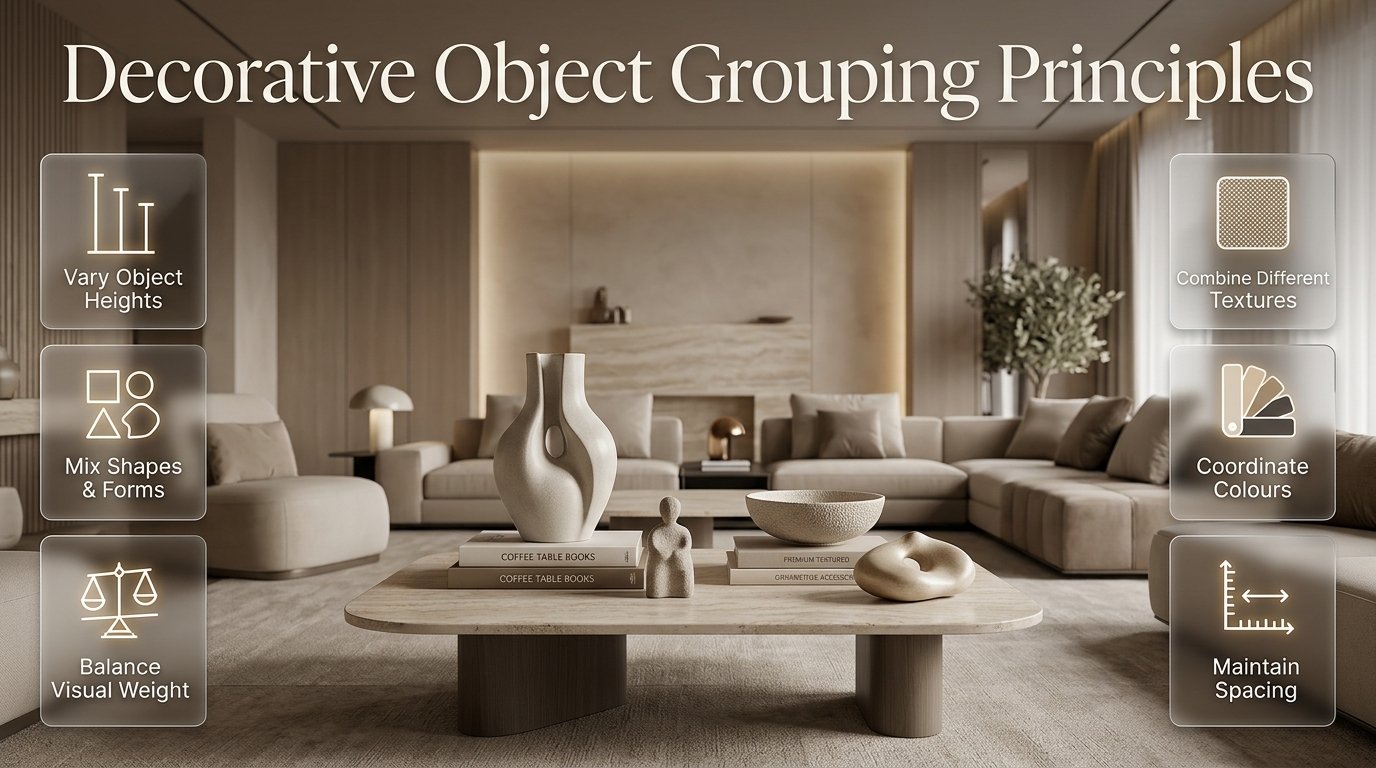
Decorative Object Grouping Principles | A beautifully furnished room can still look unfinished when decorative accessories are placed without a clear arrangement. You might have an attractive ceramic vase, expensive coffee table books, handmade sculptures, decorative bowls, and carefully selected ornaments, yet the overall display may still feel crowded, disconnected, or visually unbalanced. The problem often isn’t the accessories themselves. It’s how they’re arranged.
Understanding decorative object grouping principles helps homeowners create attractive displays by bringing together objects of different heights, shapes, colours, textures, and materials. Instead of placing individual accessories wherever space is available, you learn how to organise them into compositions that look intentional and complement the surrounding furniture.
Professional interior styling doesn’t depend on filling every available surface or purchasing expensive decorative collections. It depends on understanding visual relationships. A small group of carefully selected objects can create more impact than a large collection of unrelated ornaments.
Whether you’re styling a coffee table, arranging a console, decorating open shelves, or refreshing a bedroom, the right approach can make everyday accessories look more considered.
This guide from DesignMode24 Interior Design explains how to choose decorative objects, determine suitable quantities, create balanced arrangements, combine materials, and avoid common styling mistakes. You’ll also learn practical techniques for different furniture surfaces, room layouts, and decorating budgets.
1. What Are Decorative Object Grouping Principles?
Decorative object grouping principles are design guidelines that explain how to arrange multiple accessories into one visually connected composition. They use proportion, scale, height, shape, colour, texture, spacing, and visual balance to make decorative displays look organised rather than randomly assembled.
These principles apply to almost every decorative surface in a home.
For example, placing a tall ceramic vase beside a stack of books and a small sculptural object creates a relationship between three different elements. The vase establishes height, the books introduce a horizontal form, and the sculpture adds detail.
Each object has a separate function, but together they create one arrangement.
The most important principles include:
- Scale: Selecting objects that suit the dimensions of the furniture.
- Proportion: Maintaining a comfortable relationship between accessories and available space.
- Visual balance: Distributing attention so one side doesn’t feel unnecessarily heavy.
- Height variation: Combining tall, medium, and low objects.
- Colour coordination: Connecting decorative pieces through complementary colours.
- Texture contrast: Mixing smooth, rough, reflective, and natural surfaces.
- Negative space: Leaving enough empty space around accessories.
- Visual hierarchy: Establishing a main object and supporting pieces.
- Repetition: Reusing selected shapes, finishes, and colours for continuity.
These principles aren’t rigid decorating laws. They’re practical tools that help you make better decisions when arranging accessories.
2. Why Is Decorative Object Grouping Important?
A decorative object can look beautiful individually but become visually distracting when placed beside unsuitable accessories. Grouping helps establish relationships between objects and makes a room feel more organised.
Think about a living room console with a large vase, several small ornaments, a framed photograph, and a decorative bowl. If everything is positioned at equal distances without considering size or colour, the display can look scattered.
However, arranging the vase as the main feature, positioning the photograph nearby, and placing the smaller bowl within the same visual composition creates a clearer structure.
Good object grouping provides several benefits.
It Creates Visual Organisation
Grouping gives decorative accessories a clear structure. Instead of spreading small objects across an entire surface, you create defined arrangements that are easier to understand visually.
This is especially helpful in rooms with several furniture pieces, open shelving, or multiple decorative collections.
It Makes Focal Points More Noticeable
A focal point is an object or feature that attracts attention first.
A distinctive sculpture or statement vase becomes more noticeable when the surrounding accessories support rather than compete with it.
It Improves the Relationship Between Furniture and Accessories
Decorative objects should complement the furniture supporting them.
A large coffee table can accommodate a substantial arrangement, while a narrow side table generally needs fewer and smaller accessories.
It Helps Prevent Visual Clutter
Not every attractive object deserves a place on every surface.
Grouping encourages homeowners to select accessories according to their purpose and visual contribution.
It Creates a More Personal Interior
Meaningful objects, travel souvenirs, handmade pottery, books, and collected pieces can introduce personality without making the room feel disorganised.
The goal is to create a display that reflects your interests while maintaining a balanced appearance.
3. Start With Furniture Scale and Available Surface Space
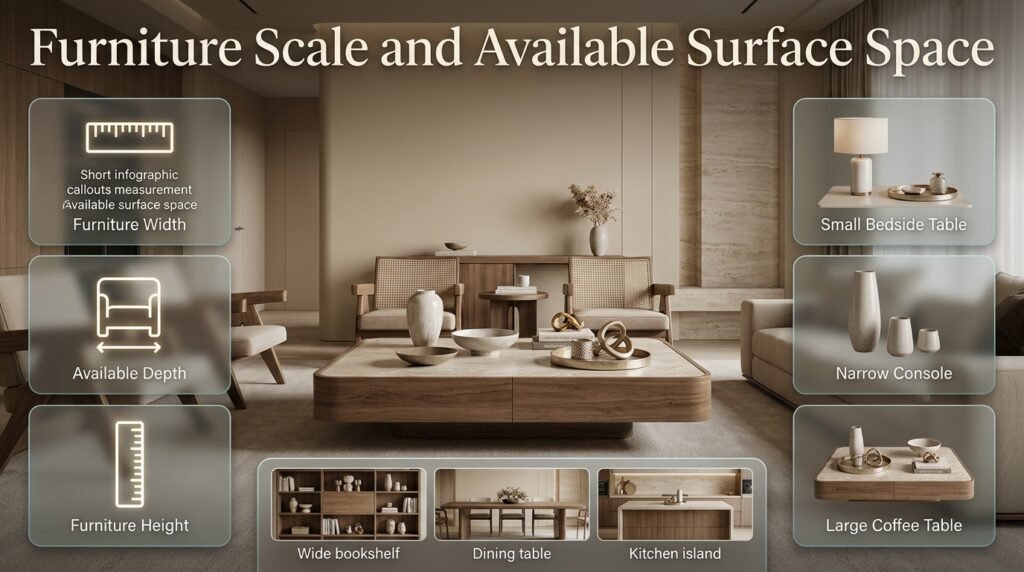
Before choosing decorative accessories, understand the furniture you’re styling.
One of the most common decorating mistakes is purchasing beautiful objects without considering whether their dimensions suit the available surface.
A large decorative bowl may look impressive in a showroom but overwhelm a small bedside table. Similarly, tiny ornaments can disappear on a long console or spacious bookshelf.
Measure the Furniture Before Arranging Accessories
Check three basic dimensions:
Width: Determines how much horizontal space is available for separate groups.
Depth: Determines how far accessories can extend without interfering with everyday use.
Height: Helps you understand the visual relationship between furniture, nearby artwork, mirrors, lamps, and other surrounding elements.
For example, a narrow hallway console may need one taller accessory and a compact supporting arrangement. A large living room coffee table may have enough space for several smaller groups.
Understand Proportion
Proportion describes how different objects relate to one another.
A useful starting point is to select a main accessory that has enough visual presence to anchor the arrangement. Supporting pieces should be smaller or visually lighter.
Consider this example:
| Furniture surface | Suitable decorative approach |
|---|---|
| Small bedside table | Compact lamp, tray, small ornament |
| Narrow console | Tall vase and two supporting accessories |
| Large coffee table | Tray, books, bowl, sculptural piece |
| Wide bookshelf | Several separate decorative groups |
| Dining table | Low centrepiece with supporting details |
| Kitchen island | One restrained decorative arrangement |
These are general starting points rather than fixed measurements.
Professional advice: Always consider the actual object dimensions. Three large ornaments can occupy more space than five smaller pieces.
4. Use the Rule of Three Without Following It Blindly
The rule of three is a familiar interior styling technique that involves grouping three objects to create a natural-looking composition.
It works because three elements can introduce a focal point, a supporting feature, and a finishing detail without making a small arrangement feel overly complicated.
For example, you might combine:
- A medium-height ceramic vase.
- A short stack of decorative books.
- A small sculptural ornament.
The arrangement becomes more interesting because the objects have different heights and shapes.
Why Does the Rule of Three Work?
Three different elements create opportunities for visual variation.
Two matching objects can sometimes look formal or repetitive, while three complementary objects often produce a more relaxed arrangement.
However, the technique works best when each item has a purpose.
When Should You Use It?
The rule of three is particularly useful for:
- Coffee table arrangements.
- Small console displays.
- Bedside tables.
- Kitchen counters.
- Decorative shelves.
- Side tables.
- Small entrance furniture.
When Should You Avoid It?
Don’t force three objects onto a surface that cannot accommodate them.
A small bedside table may look better with a lamp and one decorative tray. A large dining table may require a more substantial arrangement.
Pro Tip: Think in terms of three visual elements rather than three individual products. A book stack can function as one element, while a decorative bowl positioned on top may create another.
5. Create Height Variation for a More Dynamic Arrangement
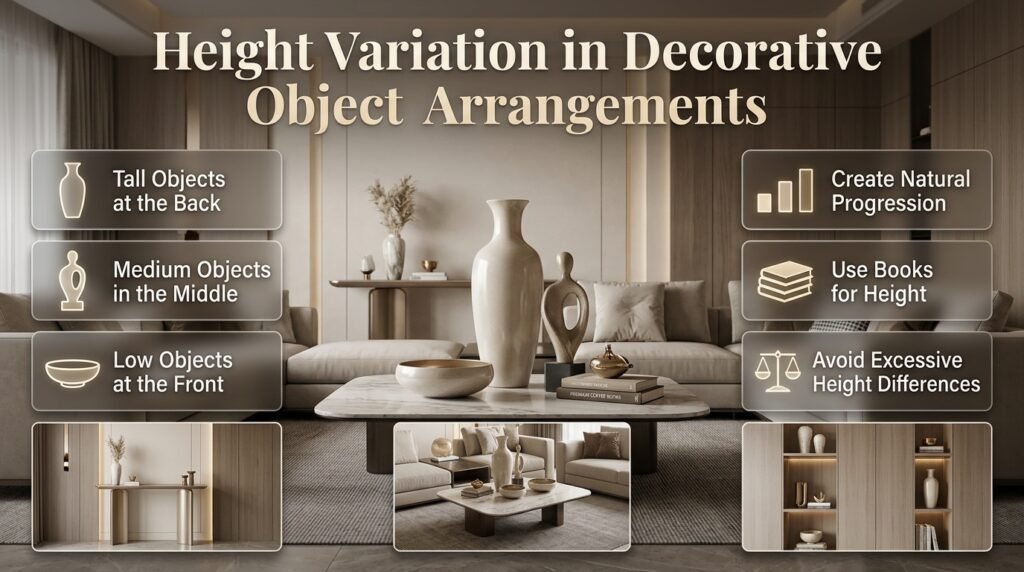
Height variation is one of the most effective ways to make decorative displays look professionally styled.
When every accessory has approximately the same height, the arrangement can appear flat. Different heights create dimension and help the eye move naturally across the composition.
A simple arrangement might include:
- A tall vase at the back.
- A medium decorative sculpture beside it.
- A low bowl or small object toward the front.
This creates a natural visual progression.
How to Arrange Different Heights
Start with the tallest object and decide where it should sit.
On a console table against a wall, the tallest piece can usually sit toward the back or slightly off-centre.
On a coffee table viewed from several directions, distribute height carefully so that one object doesn’t block the entire arrangement.
On open shelving, consider the relationship between objects on the same shelf and those on neighbouring shelves.
Use Books to Introduce Height
Books are practical decorative elements because they can be arranged horizontally or vertically.
A small stack can raise a sculpture or create a platform for a decorative bowl.
Choose books with attractive covers and colours that complement the surrounding interior.
However, don’t use books simply to elevate every accessory. Excessive stacking can make a display feel artificial.
Avoid Excessive Height Differences
Although variation is important, the tallest object shouldn’t dominate every arrangement.
A very tall vase beside several tiny objects can create an unbalanced result.
Use supporting objects with enough visual weight to make the composition feel connected.
6. Balance Visual Weight Instead of Matching Object Sizes
Visual weight describes how strongly an object attracts attention.
It isn’t determined by physical size alone. Dark colours, dense materials, unusual silhouettes, reflective surfaces, and detailed textures can make an object feel visually heavier.
For example, a small black sculpture may attract more attention than a considerably larger transparent glass vase.
How to Distribute Visual Weight
Imagine a coffee table with a large dark ceramic vase on the left.
If the right side contains only a tiny pale ornament, the arrangement may feel uneven.
You could improve the composition by adding a small book stack or a broader decorative bowl to the opposite side.
The objects don’t need to match. They simply need to create a comfortable visual relationship.
| Visually heavier object | Possible balancing element |
|---|---|
| Large dark sculpture | Two smaller light accessories |
| Wide decorative bowl | Tall narrow vase |
| Heavy stone ornament | Books with a lighter finish |
| Large ceramic vase | Several compact decorative pieces |
| Dark wooden box | Light-coloured textured object |
Use Asymmetrical Balance
Perfect symmetry isn’t necessary for attractive styling.
An asymmetrical arrangement can feel more natural when different objects create a similar visual balance.
For example, one large vase can balance two smaller accessories without requiring identical objects on both sides.
Expert Tip: Step away from the furniture and look at the arrangement from a distance. If your attention immediately moves to one side, reconsider the distribution of colour, size, and visual weight.
7. Combine Different Shapes for Visual Interest
Decorative objects become more interesting when their shapes complement rather than duplicate one another.
A collection of round bowls and spherical ornaments may feel repetitive. Introducing rectangular, cylindrical, angular, or organic forms creates variety.
Consider these combinations:
| Shape | Decorative example |
|---|---|
| Round | Bowls and spherical ornaments |
| Rectangular | Books and decorative boxes |
| Cylindrical | Vases and candle holders |
| Organic | Natural sculptures and irregular stone |
| Angular | Geometric ornaments |
| Curved | Decorative vessels and artistic accessories |
Combine Curved and Straight Forms
A rectangular book stack can look attractive beside a rounded ceramic vase.
Similarly, a geometric sculpture can create contrast against an organic wooden accessory.
The aim is to avoid visual repetition while maintaining a common design direction.
Consider Furniture Shapes
The furniture itself should influence accessory selection.
A coffee table with a strong rectangular shape may benefit from curved objects that soften its appearance.
A rounded table may look more interesting with a few angular accessories.
This creates contrast without introducing unnecessary decoration.
8. Coordinate Colours Without Making Every Object Match
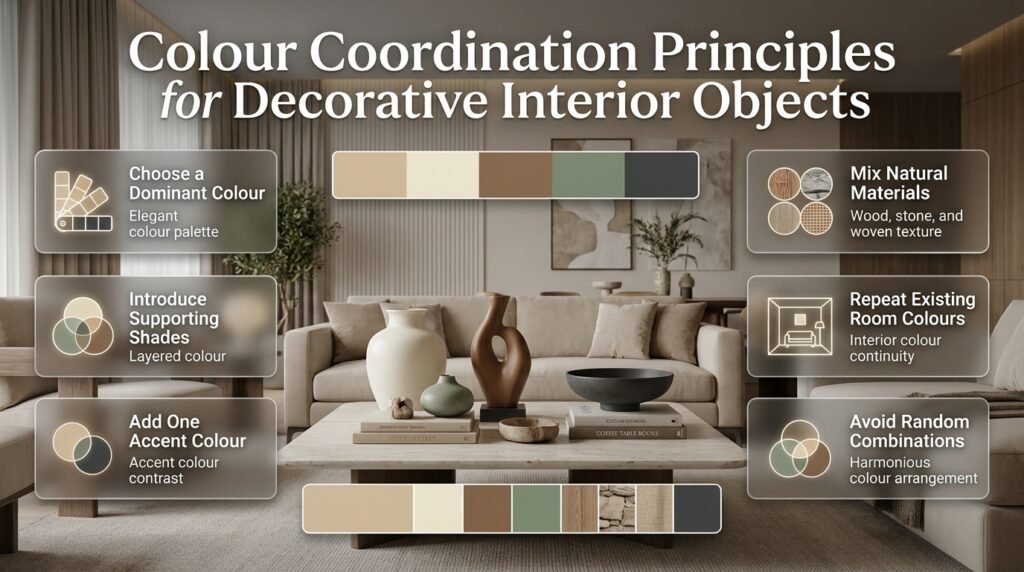
Colour coordination helps decorative objects feel connected to the surrounding interior.
However, using exactly the same colour for every accessory can create a flat appearance.
A more effective approach is to establish a small colour palette and introduce variation through lighter, darker, and complementary tones.
Choose a Dominant Colour
Start with a colour already present in the room.
It could come from the upholstery, curtains, artwork, rug, flooring, or wall finish.
For example, a living room with beige furniture and natural wood finishes could use cream, warm brown, charcoal, and muted green accessories.
Introduce One Accent Colour
An accent colour creates interest without overwhelming the arrangement.
A small dark blue bowl or muted green ornament can provide contrast against a neutral collection.
Use Material to Introduce Colour Variation
Not every colour needs to come from painted or glazed surfaces.
Natural wood, stone, woven materials, and metal finishes can introduce subtle colour differences.
For additional guidance on coordinating room finishes, explore Paint Color.
Avoid Random Colour Combinations
Before introducing a new decorative colour, check whether it already exists somewhere in the room.
Repeated colours help create continuity.
If a colour appears only once and has no relationship with the surrounding finishes, it may feel disconnected.
Quick Tip: Use one dominant colour, one supporting colour, and a smaller accent rather than introducing several unrelated shades into a compact arrangement.
9. Mix Materials and Textures to Create Depth
Texture is an important part of decorative object grouping because it adds visual richness even when the colour palette remains simple.
A display containing only smooth glass accessories can look repetitive. Introducing ceramic, wood, stone, woven materials, or brushed metal creates contrast.
Wood and Ceramic
Wood adds natural warmth, while ceramic introduces a solid and often softer visual finish.
This combination works well in contemporary, organic, Scandinavian, and traditional interiors.
Glass and Metal
Glass introduces transparency, while metal creates reflective highlights.
Together, they can produce a lighter and more contemporary arrangement.
Stone and Natural Fabrics
Stone accessories can look attractive beside linen, cotton, or woven materials.
The contrast between hard and soft textures creates a relaxed appearance.
Brass and Dark Wood
Brass introduces warmth and a reflective finish, while dark wood creates depth.
This combination can work particularly well in sophisticated living rooms and traditional-inspired spaces.
| Material | Character | Suitable pairing |
|---|---|---|
| Ceramic | Solid and refined | Wood or linen |
| Glass | Transparent and light | Metal or stone |
| Natural wood | Warm and organic | Ceramic or woven textures |
| Stone | Substantial and textured | Linen or glass |
| Brass | Warm and reflective | Dark wood or neutral pottery |
| Woven materials | Soft and relaxed | Ceramic or natural wood |
Avoid Mixing Too Many Finishes
More materials don’t automatically produce a better arrangement.
A compact display containing wood, glass, ceramic, brass, stone, woven fibres, and several unrelated finishes may look unnecessarily complicated.
Two or three complementary material types are often enough.
For inspiration on combining natural finishes throughout a room, read Organic Modern Material Combinations.
10. Understand Negative Space and Proper Object Spacing
Negative space is the empty area around and between decorative objects.
It’s not wasted space. It allows accessories to remain visually distinct and gives the overall composition room to breathe.
When every part of a table or shelf is occupied, the arrangement can appear crowded even if the individual accessories are attractive.
Why Does Empty Space Matter?
Negative space helps:
- Separate individual objects.
- Highlight focal accessories.
- Make smaller rooms feel less crowded.
- Create a calmer appearance.
- Improve the visual hierarchy.
- Maintain practical surface space.
How Much Space Should You Leave?
There isn’t one universal spacing measurement.
The appropriate distance depends on the size, shape, and visual weight of the objects.
Small ornaments can sit relatively close together, while large sculptures may need more separation.
The main objective is to prevent unrelated pieces from appearing compressed.
Avoid Uniform Spacing
Placing every accessory exactly the same distance apart can make an arrangement feel mechanical.
Instead, create a few intentional clusters with slightly different gaps.
For example, a book stack and a small bowl can sit relatively close together, while a larger vase occupies a separate position.
Pro Tip: Photograph the arrangement from a normal viewing position. A photograph often makes overcrowded areas and uneven spacing easier to recognise.
11. Establish a Clear Focal Point
A focal point is the main object that attracts attention within a decorative arrangement.
It gives the composition a visual starting point and helps supporting accessories feel organised.
Without a focal point, every object may compete for attention.
How to Select a Focal Object
Choose an accessory with a distinctive characteristic.
It might have:
- An unusual silhouette.
- A contrasting colour.
- A handmade finish.
- A substantial size.
- An interesting material.
- Personal or sentimental value.
A sculptural vase, decorative bowl, or artistic object can become the main feature.
Keep Supporting Objects Subtle
If the focal object is already visually strong, avoid placing another equally dominant piece directly beside it.
Supporting objects should provide contrast, texture, or height without taking over the arrangement.
Use the Focal Point to Guide the Entire Display
Once you’ve selected the main object, choose accessories that complement its colour, shape, or material.
This makes purchasing and arranging decorative pieces easier because every additional object has a clear purpose.
12. Use Repetition to Create Visual Rhythm
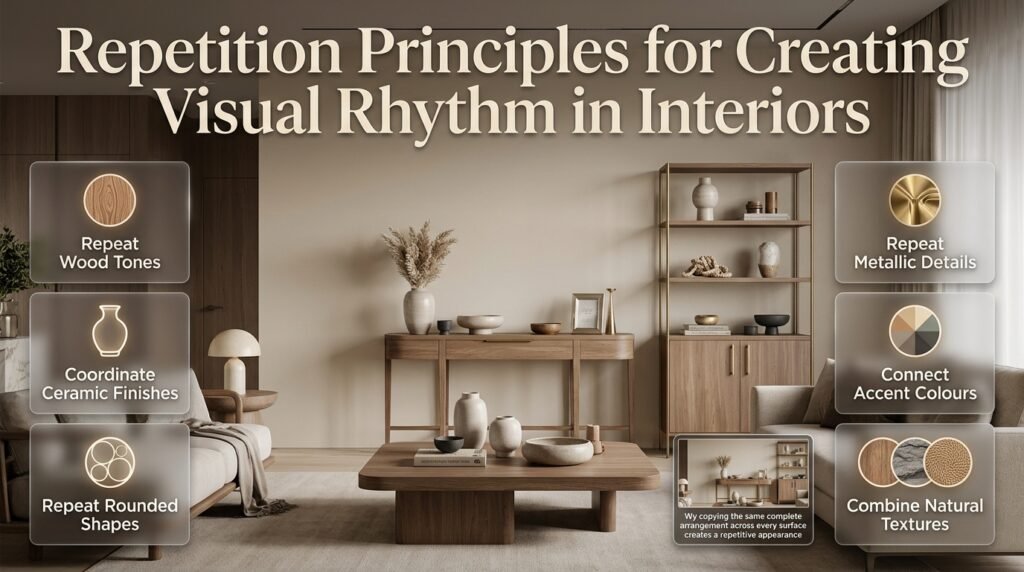
Repetition involves using similar colours, shapes, textures, or materials throughout a room.
It creates visual continuity and helps separate decorative arrangements feel connected.
For example, a brass accessory on a coffee table can relate to brass cabinet handles or a metal picture frame elsewhere in the room.
The accessories don’t need to be identical.
You can repeat:
- Similar wood tones.
- Related ceramic finishes.
- Rounded shapes.
- Metallic details.
- Accent colours.
- Natural textures.
Repetition Across Different Surfaces
Consider a living room with a wooden coffee table, a console, and open shelving.
You might repeat warm wood tones, neutral ceramic finishes, and small dark accents across all three surfaces.
Each arrangement remains different, but the repeated elements create a consistent visual language.
Avoid Excessive Repetition
Using the same vase, bowl, and sculpture throughout every room can make the home feel repetitive.
Repeat visual characteristics rather than copying complete arrangements.
13. How to Arrange Decorative Objects on a Coffee Table
Coffee tables are among the most frequently styled furniture surfaces.
However, they also serve a practical purpose. People use them for drinks, books, remote controls, and everyday activities.
A successful arrangement must balance appearance and functionality.
Start With a Main Decorative Element
A tray is a useful starting point because it gives smaller accessories a defined area.
Alternatively, a decorative book stack or low sculptural bowl can become the main feature.
Add Supporting Accessories
Consider combining:
- Two attractive books.
- One small bowl.
- A candle or compact sculpture.
- A low vase.
- A decorative tray.
You don’t need every item on this list.
Select only those pieces that suit the table dimensions.
Keep the Centrepiece Low Enough
Tall arrangements can obstruct visibility between people sitting opposite one another.
If the coffee table is positioned between sofas or chairs, check the arrangement from seated positions.
Preserve Functional Space
Leave sufficient room for drinks and everyday objects.
If the table is small, choose a simpler composition rather than trying to include every accessory.
14. How to Style a Console Table Without Creating Clutter
Console tables often provide an opportunity for taller decorative arrangements because they’re commonly positioned against a wall.
They may sit in entrances, hallways, living rooms, or behind sofas.
Combine Height and Horizontal Elements
A tall vase can establish the main visual feature.
A decorative bowl or compact sculpture can provide contrast, while a stack of books introduces a horizontal element.
Use the Wall Above the Console
Mirrors, artwork, and framed pieces can contribute to the overall composition.
However, the wall decoration should relate to the console arrangement rather than compete with it.
Consider Lighting
A table lamp can provide practical illumination while becoming part of the decorative grouping.
Make sure the lamp doesn’t overwhelm the available surface.
Keep Entrance Consoles Practical
An entrance table may need space for keys, mail, and everyday essentials.
A decorative tray can help organise small items without sacrificing the overall appearance.
For additional planning ideas around practical home improvements, see Home Improvement.
15. How to Arrange Decorative Objects on Bookshelves
Bookshelves are challenging because they need to accommodate both storage and decoration.
Filling every shelf with books or ornaments can make the unit look visually heavy.
A better approach is to create separate groupings with different visual characteristics.
Combine Vertical and Horizontal Books
Place some books vertically and arrange others in small horizontal stacks.
This creates variety without requiring additional accessories.
Introduce Sculptural Objects
A small sculpture can sit beside a horizontal book stack.
A decorative box can introduce another shape while providing concealed storage.
Leave Some Areas Empty
Empty shelf sections help the overall arrangement feel less crowded.
You don’t need to decorate every available space.
Repeat Materials Across Different Shelves
Use selected wood, ceramic, or metal finishes to establish continuity.
Avoid making every shelf identical.
16. How to Style Bedside Tables and Small Side Tables
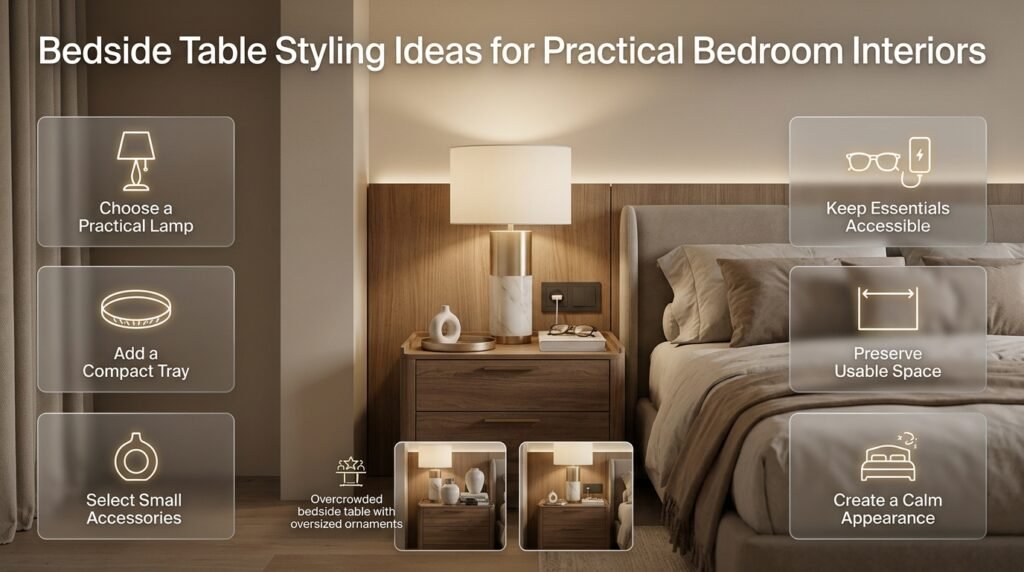
Bedside tables have limited surface space, so decorative choices should remain practical.
A lamp often provides the main visual feature, leaving room for one or two supporting accessories.
A simple arrangement might include:
- A bedside lamp.
- A compact tray.
- One small decorative object.
- A book, if space permits.
Keep Everyday Items Accessible
Don’t place ornaments where they interfere with switches, charging devices, glasses, or other frequently used items.
Choose Smaller Accessories
Small surfaces benefit from carefully scaled objects.
A large decorative bowl or oversized sculpture may dominate the entire table.
Maintain a Relaxed Appearance
Bedrooms generally benefit from arrangements that feel calm rather than visually complicated.
Neutral ceramics, natural materials, and simple shapes can work particularly well.
17. How to Decorate Dining Tables and Kitchen Islands
Dining tables and kitchen islands need different styling approaches because they are frequently used for practical activities.
Dining Table Arrangements
A low centrepiece usually works well because it doesn’t obstruct conversation.
Consider:
- A decorative bowl.
- A low ceramic vessel.
- A compact floral arrangement.
- A simple natural-material centrepiece.
Choose accessories that can be moved easily when the table is being used.
Kitchen Island Styling
Kitchen islands often need space for food preparation.
Avoid placing several decorative accessories across the working surface.
A compact tray or one carefully selected object may be sufficient.
Consider Hygiene and Maintenance
Kitchen accessories should be easy to clean.
Avoid arrangements that collect excessive dust or interfere with food preparation.
18. How to Group Decorative Objects in Small Rooms
Small rooms require careful editing because every decorative accessory occupies a larger proportion of the available visual space.
The solution isn’t necessarily to avoid decoration. It’s to choose fewer, more suitable objects.
Use Compact Accessories
Small ceramic pieces, decorative bowls, and modest book stacks can add character without overwhelming furniture.
Use Vertical Space Carefully
A taller accessory can provide visual interest while occupying a relatively small footprint.
However, avoid using excessively tall objects on narrow surfaces.
Keep Surfaces Flexible
In compact homes, furniture often performs several functions.
A coffee table may need to accommodate drinks, books, and everyday storage.
A bedside table may also serve as a workspace.
Decorative arrangements should support these activities.
For broader ideas about making different areas work together, Decorating Priorities for First Time Homeowners provides a useful starting point.
19. How to Style Decorative Objects in Open-Plan Homes
Open-plan interiors connect several functional areas, so decorative arrangements should establish continuity without making every space look identical.
The living room, dining area, and kitchen may have different furniture requirements, but selected colours and materials can help connect them.
Repeat Selected Materials
For example, repeat natural wood, muted ceramics, or dark metallic details across different surfaces.
Create Separate Visual Groupings
The coffee table can have a relaxed arrangement, while the dining table uses a simpler centrepiece.
The accessories should relate without being copied.
Respect Functional Boundaries
Don’t let decorative objects interfere with movement, seating, or kitchen activities.
Open-plan rooms need clear circulation and usable surfaces.
20. How to Choose Decorative Accessories That Work Together
Before purchasing accessories, consider whether they will complement the objects you already own.
A decorative piece should contribute something useful to the composition.
Evaluate Each Object
Ask yourself:
- Does its size suit the available furniture?
- Does its colour work with the existing palette?
- Does its material introduce useful contrast?
- Does its shape complement the other objects?
- Can it become a focal point or supporting element?
- Does it have a practical or personal purpose?
If an accessory doesn’t contribute to the arrangement, it may not be worth purchasing.
Select Accessories With Different Roles
A useful decorative collection includes objects that perform different visual functions.
| Decorative role | Suitable accessory |
|---|---|
| Height | Tall vase |
| Texture | Handmade ceramic |
| Horizontal form | Books |
| Contrast | Dark sculpture |
| Organisation | Decorative tray |
| Detail | Small bowl |
| Personal character | Collected ornament |
This approach prevents unnecessary duplication.
21. How to Create Professional Decorative Arrangements on a Budget
Creating attractive decorative displays doesn’t require a large shopping budget.
In many homes, the best accessories are already available.
Shop Your Own Home First
Look for unused books, bowls, small sculptures, trays, and decorative vessels.
Objects stored in other rooms may work better in a new arrangement.
Reuse Books Creatively
Books can provide height, introduce colour, and create horizontal forms.
Choose books that suit the room rather than selecting them only for their covers.
Introduce Natural Materials
Suitable natural materials can provide texture and character.
Wood, stone, woven accessories, and simple natural elements can work well in neutral interiors.
Make Small DIY Improvements
You can refresh existing accessories by changing their placement, combining them with different materials, or creating simple decorative platforms.
For practical ideas, explore DIY Home Projects.
Rotate Rather Than Replace
Keep a small collection of accessories and rotate them occasionally.
This creates a refreshed appearance without repeatedly purchasing new items.
22. How Decorative Object Grouping Supports Different Interior Design Styles
The same grouping principles can be adapted to different decorating styles.
The difference comes from the choice of materials, shapes, colours, and overall visual character.
Contemporary Interiors
Contemporary styling often benefits from clean silhouettes, restrained colour palettes, and a small number of statement accessories.
Choose sculptural objects, simple ceramics, and contrasting materials.
Minimalist Interiors
Minimalist arrangements prioritise simplicity.
Use only a few carefully selected accessories and preserve generous negative space.
Scandinavian Interiors
Scandinavian-inspired arrangements often combine natural wood, simple ceramics, muted colours, and functional objects.
Keep the composition relaxed and avoid unnecessary ornamentation.
Traditional Interiors
Traditional arrangements may include decorative vessels, framed objects, books, and more detailed accessories.
Balance is important, but the arrangement doesn’t need to be perfectly symmetrical.
Organic Modern Interiors
Organic modern styling benefits from natural shapes, earthy colours, stone, textured ceramics, and wood.
Choose objects that introduce subtle variation rather than strong visual competition.
23. Common Decorative Object Grouping Mistakes and How to Fix Them
Even attractive accessories can produce disappointing results when their arrangement lacks structure.
Mistake 1: Using Too Many Decorative Objects
Why it happens: Homeowners assume more accessories will make a room look complete.
Why it creates a problem: Individual pieces lose their visual importance and the surface becomes crowded.
How to fix it: Remove unnecessary accessories and retain the objects that contribute the most to the composition.
Mistake 2: Choosing Objects With Identical Heights
Why it happens: Matching decorative sets often contain pieces with similar dimensions.
Why it creates a problem: The arrangement can appear flat and repetitive.
How to fix it: Introduce a combination of tall, medium, and low objects.
Mistake 3: Ignoring the Furniture’s Dimensions
Why it happens: Accessories are selected according to appearance rather than scale.
Why it creates a problem: Large pieces overwhelm small furniture, while small accessories disappear on wide surfaces.
How to fix it: Measure the available area before arranging or purchasing accessories.
Mistake 4: Mixing Too Many Colours
Why it happens: Individual objects are purchased without considering the room’s existing colour palette.
Why it creates a problem: The display looks disconnected from the surrounding interior.
How to fix it: Establish a dominant colour, a supporting tone, and one accent.
Mistake 5: Placing Everything in a Straight Line
Why it happens: Arranging accessories in a row feels simple and organised.
Why it creates a problem: The display may resemble a product shelf instead of a considered decorative arrangement.
How to fix it: Experiment with different positions, heights, and overlapping visual relationships while keeping objects stable and accessible.
Mistake 6: Forgetting Negative Space
Why it happens: Empty areas are treated as unfinished sections that need decoration.
Why it creates a problem: The arrangement becomes visually heavy.
How to fix it: Allow some areas to remain empty.
Mistake 7: Ignoring Practical Use
Why it happens: Decorative appearance becomes more important than everyday function.
Why it creates a problem: Tables and shelves become inconvenient.
How to fix it: Keep frequently used surfaces accessible and leave sufficient functional space.
Mistake 8: Making Every Arrangement Identical
Why it happens: Homeowners repeat the same styling formula across the entire house.
Why it creates a problem: Rooms lose their individual character.
How to fix it: Repeat colours and materials, but adapt each composition to the furniture and purpose of the room.
24. Professional Styling Techniques That Make a Noticeable Difference
Experienced interior stylists often achieve attractive arrangements through careful editing rather than adding more accessories.
These techniques are useful when a display looks almost right but still lacks a finished appearance.
Use a Main, Supporting, and Finishing Element
Think of an arrangement as having three visual roles.
Main element: The most noticeable object.
Supporting element: A piece that introduces contrast or complements the main object.
Finishing element: A smaller detail that completes the arrangement.
This method creates structure without requiring a complicated formula.
Consider Front-to-Back Placement
On deep surfaces, arrange objects at different depths.
A taller vase may sit slightly toward the back, while smaller accessories occupy the front.
This creates depth and helps objects remain visible.
Check the Arrangement From Normal Viewing Positions
Don’t judge an arrangement only while standing directly above it.
Check it from a sofa, doorway, hallway, or nearby seating position.
The most important viewing angle depends on the furniture’s location.
Consider Light and Reflection
Natural light can change how glass, polished metal, and glazed ceramic accessories appear.
Reflective objects may create unwanted glare if positioned directly in strong sunlight.
Consider how lighting changes throughout the day.
Edit Before Adding Anything New
If an arrangement feels wrong, first move or remove existing objects.
Adding another accessory isn’t always the solution.
How do you group decorative objects to create a professionally styled look?
Creating a professionally styled decorative arrangement requires more than placing attractive accessories together. Each object should contribute something to the overall composition, whether through height, shape, colour, texture, or visual weight. Start by selecting one main decorative piece, such as a sculptural vase, handmade ceramic bowl, or distinctive ornament. Then introduce smaller accessories that complement its appearance without competing for attention.
A practical approach is to combine a tall object, a medium-sized accessory, and a low decorative element. For example, a ceramic vase, a horizontal stack of design books, and a small stone sculpture can create an attractive arrangement on a console table. The different proportions give the display depth, while their materials and colours help establish a visual connection.
Professional styling points:
Select one focal object before adding supporting accessories.
Combine different heights and shapes to avoid a flat appearance.
Use complementary materials rather than matching every finish.
Leave sufficient negative space around the arrangement.
Check the display from normal viewing positions before making final adjustments.
The most important consideration is visual harmony. Accessories should look as though they belong together, even when they come from different collections or design styles.
How many decorative objects should you group together on a coffee table or console?
The ideal number of decorative objects depends on the furniture’s dimensions, the size of individual accessories, and how the surface is used. A small coffee table doesn’t need the same quantity of decoration as a large console. Instead of following a fixed number, focus on creating a balanced composition that leaves enough room for everyday activities.
For a compact coffee table, start with three visual elements, such as a decorative tray, a small book stack, and a ceramic bowl. A larger table may accommodate four or five elements arranged into separate visual groups. On a console, a taller vase, a table lamp, and two smaller accessories can create a more substantial display.
Useful styling guidelines:
Small bedside tables: Begin with two or three elements.
Compact coffee tables: Use approximately three visual elements.
Large coffee tables: Consider three to five complementary elements.
Narrow console tables: Prioritise a focal object and a few supporting pieces.
Large bookshelves: Create several smaller arrangements instead of filling every shelf.
Remember that a stack of books can count as one visual element, even if it contains several individual books. Similarly, a decorative tray containing two small accessories may read as one organised grouping.
The best arrangement is one that looks complete without making the furniture difficult to use.
How can you mix different decorative materials without making the arrangement look mismatched?
Mixing decorative materials creates depth and prevents an interior from looking overly coordinated. However, successful combinations require a connection between the objects. Consider how their colours, finishes, shapes, and textures relate to the surrounding furniture before introducing several different materials.
For example, a natural wooden coffee table can look attractive with a textured ceramic vase, a small stone sculpture, and a glass decorative bowl. Wood introduces warmth, ceramic provides a solid textured surface, stone adds visual weight, and glass creates a lighter contrast.
The trick is to create variety without introducing unnecessary competition.
Material combinations worth considering:
Wood and ceramic for a warm, natural appearance.
Glass and brushed metal for a contemporary finish.
Stone and linen for a softer, organic composition.
Brass and dark wood for a richer decorative effect.
Woven accessories and pottery for relaxed interiors.
Expert recommendations:
Start with two or three complementary material types.
Repeat one material or finish elsewhere in the room.
Balance reflective surfaces with matte textures.
Avoid combining several highly decorative finishes in one small grouping.
Consider how natural and artificial lighting affect different materials.
You don’t need every object to match. A successful arrangement often looks more interesting when the accessories have different characteristics but share a consistent design direction.
How do you arrange decorative objects on shelves without making them look cluttered?
Decorative shelves often become overcrowded because homeowners try to use every available section for books, ornaments, photographs, and decorative accessories. A better approach is to treat each shelf as part of a larger composition rather than decorating every space independently.
Start by deciding which objects deserve the most attention. Place larger accessories or meaningful decorative pieces where they can establish visual interest. Then introduce smaller items through carefully arranged groups. Books can be positioned vertically or stacked horizontally to create different heights and provide a visual foundation for smaller ornaments.
For example, a horizontal book stack beside a small sculpture can form one grouping, while a ceramic vase and a decorative box create another. Leaving one section partially empty gives the overall shelving arrangement a more organised appearance.
Practical bookshelf styling points:
Mix vertical and horizontal book arrangements.
Combine books with a few distinctive decorative objects.
Use different heights to create visual movement.
Repeat selected colours and materials across shelves.
Avoid placing small ornaments in front of every book.
Leave some sections open to preserve negative space.
Keep frequently used books and storage areas accessible.
One useful technique is to style the shelves in stages. Arrange the books first, introduce larger decorative pieces second, and add smaller accessories only where the composition needs them.
This prevents unnecessary decoration and allows the bookshelf to remain functional.
What are the latest decorative object styling trends for creating a timeless interior in 2026?
Decorative styling in 2026 is moving towards more personal, collected, and tactile interiors. Rather than relying entirely on matching accessories or perfectly coordinated display sets, homeowners are increasingly interested in combining meaningful objects, handmade pieces, vintage finds, natural materials, and distinctive decorative details.
This approach makes a home feel connected to the people who live in it. A handmade ceramic vessel, an interesting antique, a travel souvenir, or a family keepsake can become a more meaningful focal point than a collection of generic ornaments.
Warm wood tones, textured pottery, natural stone, layered materials, and expressive artwork also provide opportunities to introduce character without changing the entire room.
Decorative styling ideas to consider in 2026:
Collected accessories: Combine vintage and contemporary objects to create a display that feels personal.
Handmade ceramics: Use pottery with distinctive shapes, irregular finishes, and natural textures.
Natural materials: Introduce wood, stone, woven elements, and tactile surfaces.
Warm colour combinations: Experiment with earthy browns, muted greens, burgundy, and warm neutral tones.
Meaningful objects: Display personal collections, travel finds, and decorative pieces with a story.
Layered compositions: Combine different heights, shapes, and materials instead of relying on matching sets.
However, trends should guide your choices rather than dictate every decorating decision. A timeless arrangement should complement your furniture, reflect your personality, and remain practical for everyday living.
Choose accessories you genuinely appreciate, then use proportion, visual balance, and thoughtful spacing to bring them together.
Conclusion
Decorative object grouping is not simply about placing attractive accessories together; it is about creating arrangements that feel balanced, intentional, and connected to the character of a room. The right combination of height, shape, texture, colour, material, and spacing can turn an ordinary coffee table, console, bookshelf, or mantel into a meaningful design feature.
The most successful arrangements follow a few practical principles: establish a visual focal point, combine different heights, balance contrasting shapes, repeat selected colours or materials, and leave enough negative space for every object to stand out. Rather than filling every available surface, choose pieces that contribute something to the overall composition. A meaningful ceramic vase, a stack of books, a sculptural accessory, or a natural element can create more impact than a large collection of unrelated decorations.
It is also important to remember that decorative styling should support everyday living. Keep frequently used surfaces functional, avoid blocking pathways, and adjust arrangements according to the scale and purpose of each room. Experiment with different combinations, step back to assess the overall balance, and remove anything that makes the display feel crowded.
Ultimately, beautiful decorative object grouping comes from thoughtful editing rather than buying more accessories. When each piece has a clear visual purpose and contributes to the wider interior scheme, even a simple arrangement can make a home feel more polished, personal, and welcoming.