
Introduction
Outdoor Rug Sizing Principles | An outdoor rug can make a patio feel like a comfortable extension of your home, but the wrong size can have the opposite effect. A beautiful rug that sits awkwardly beneath a coffee table, leaves dining chairs slipping over its edges, or overwhelms a small balcony can make the entire arrangement feel unfinished.
The secret is understanding outdoor rug sizing principles before choosing a color, pattern, or material. The right dimensions help connect furniture, define functional areas, preserve comfortable walking space, and create a balanced outdoor setting without covering every inch of the floor.
Whether you’re furnishing a compact apartment balcony, a family patio, a wooden deck, or a spacious outdoor dining area, your rug should support the way you use the space. Its dimensions need to work with the furniture footprint, surrounding architecture, and practical requirements such as drainage and cleaning.
In this guide, you’ll learn how to measure an outdoor area, choose between standard rug sizes, calculate dining chair clearance, position rugs beneath different furniture arrangements, and avoid costly purchasing mistakes. You’ll also discover professional styling techniques and practical examples to help you make a confident decision.
What Are the Most Important Outdoor Rug Sizing Principles?
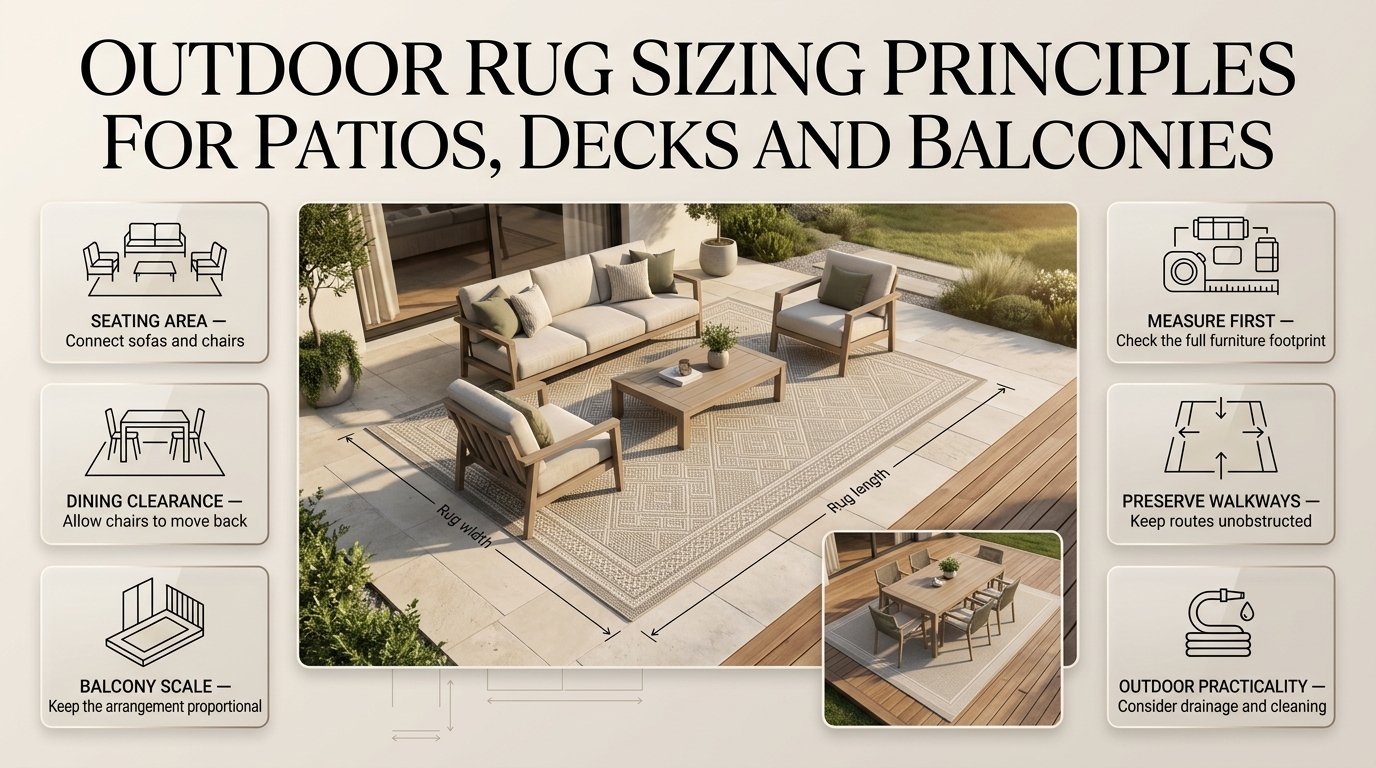
Outdoor rug sizing principles are guidelines for selecting rug dimensions that suit the available floor area, furniture arrangement, circulation requirements, and intended use of an outdoor space. A correctly sized rug connects the furniture visually, leaves enough room for movement, and maintains a comfortable balance between covered and exposed flooring.
The most important principle is to size the rug around the furniture group rather than automatically choosing a rug based on the total patio area.
For example, a large patio with a compact conversation set may need a medium-sized rug that defines the seating area. A smaller patio with a substantial dining table may require more coverage because the chairs need space to move.
Keep these fundamental rules in mind:
- Measure before buying: Record the usable floor dimensions and the complete furniture footprint.
- Connect the furniture: In most lounge areas, place the front legs of the sofa and chairs on the rug.
- Allow chair movement: Dining rugs need additional coverage beyond the tabletop.
- Preserve circulation: Keep doors, steps, and important walking routes clear.
- Consider outdoor conditions: Drainage, sunlight, wind, and cleaning access affect practical placement.
- Choose proportion over maximum coverage: The largest available rug is not necessarily the best one.
A helpful starting point is to outline the proposed rug size with painter’s tape. This lets you see how the rug relates to the furniture before spending money.
How Do You Measure an Outdoor Space for a Rug?
Measure the usable floor area first, then measure the furniture arrangement that the rug will support. Include fixed obstacles, doorways, drainage points, and walking routes in your plan so the final rug fits the space without creating practical problems.
Step 1: Measure the available floor area
Use a tape measure to record the length and width of your patio, balcony, or deck.
For a rectangular area, calculate the floor area using:
Floor area = Length × Width
A patio measuring 12 feet by 10 feet contains 120 square feet of floor space. However, you shouldn’t automatically choose a rug that covers most of those 120 square feet.
The rug needs to fit the functional zone rather than simply fill the available floor.
Measure around permanent features such as:
- Built-in benches and outdoor kitchens.
- Columns, railings, and fixed planters.
- Sliding doors and hinged doorways.
- Steps and changes in floor level.
- Drainage grates and runoff channels.
For an irregular patio, divide the floor into smaller rectangles and measure each section separately.
Step 2: Measure the furniture footprint
Next, measure the complete arrangement of furniture that will sit on or around the rug.
For a seating area, include the sofa, lounge chairs, coffee table, and any additional pieces that form part of the group.
For a dining area, measure the tabletop and consider how much room the chairs require when people sit down or stand up.
Imagine a sofa measuring 84 inches long, with two chairs positioned opposite it. If the entire furniture arrangement spans approximately 100 inches, a 5-foot-wide rug may not provide enough coverage to connect the seating pieces.
The sofa’s length alone doesn’t determine the correct rug size. The distance between furniture pieces and the depth of the entire arrangement matter too.
Step 3: Outline the proposed rug dimensions
Mark the rug’s intended footprint using painter’s tape, string, or another temporary marker suitable for the flooring.
Place the furniture in its planned position and inspect the outline from the doorway and other common viewing angles.
Ask yourself:
- Do the sofa and chairs connect visually?
- Is there enough room to walk around the furniture?
- Can doors open without catching on the rug?
- Are the main walking routes unobstructed?
- Does the rug leave a balanced border of exposed flooring?
This test is especially valuable when ordering a rug online because product photographs can make dimensions difficult to judge.
Step 4: Check the rug’s thickness
Length and width aren’t the only measurements that matter.
A thick rug may interfere with a hinged door, catch beneath furniture, or create an uncomfortable raised edge near a threshold.
Check the available clearance beneath doors and around sliding-door tracks before ordering. Also confirm that the rug and any separate pad are appropriate for the surface on which they’ll sit.
Pro Tip: Measure twice, outline the rug once, and test the arrangement before purchasing. A few minutes of preparation can prevent an expensive sizing mistake.
What Outdoor Rug Size Should You Choose for Your Patio?
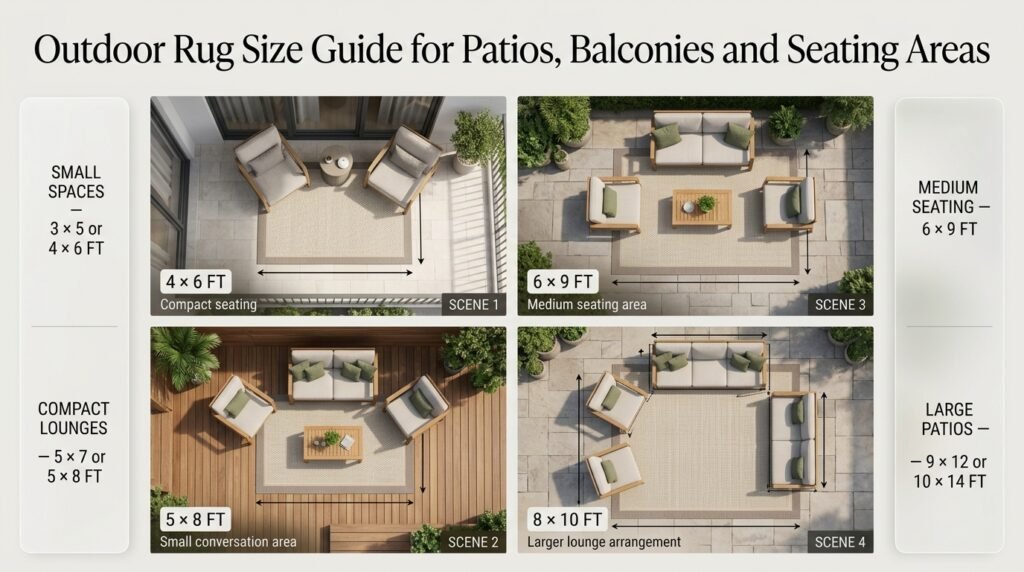
The best outdoor rug size depends on the furniture footprint and the usable space around it. Common starting points include 4 × 6 feet for compact seating, 5 × 8 feet for smaller arrangements, 8 × 10 feet for medium-sized lounge areas, and 9 × 12 feet for larger furniture groups.
These dimensions are planning guidelines, not universal requirements. Furniture design, patio proportions, and clearance needs can change the final choice.
Outdoor rug size comparison chart
| Rug size | Suitable arrangement | Main consideration |
|---|---|---|
| 3 × 5 feet | Small accent area or compact entrance | Limited coverage |
| 4 × 6 feet | Bistro set or small balcony | Check chair placement |
| 5 × 7 feet | Compact lounge arrangement | May be too small for larger sofas |
| 5 × 8 feet | Small sofa or conversation set | Works best with careful furniture positioning |
| 6 × 9 feet | Medium seating arrangement | Provides more generous coverage |
| 8 × 10 feet | Standard patio lounge or some dining sets | Check overall furniture dimensions |
| 9 × 12 feet | Large sectional or spacious dining arrangement | Requires adequate floor clearance |
| 10 × 14 feet | Large outdoor living area | Consider drainage and maintenance |
When is a 4 × 6-foot outdoor rug appropriate?
A 4 × 6-foot rug can work well beneath a compact bistro set, two lightweight lounge chairs, or a small balcony seating arrangement.
It’s particularly useful when you want to introduce texture and define a functional area without covering too much flooring.
However, this size usually won’t accommodate a large sofa and several chairs. If the furniture extends well beyond the rug, consider a larger size or a different arrangement.
When should you choose a 5 × 8-foot rug?
A 5 × 8-foot rug may suit a small patio with a loveseat and a compact coffee table, depending on their dimensions.
It can also work beneath a pair of chairs arranged around a side table.
The important consideration is whether the rug connects the furniture. If the main seating pieces remain completely outside the rug, it may look undersized even when its dimensions technically fit the patio.
Is an 8 × 10-foot rug large enough?
An 8 × 10-foot rug is often a practical starting point for a medium-sized outdoor lounge.
It can accommodate a sofa, coffee table, and additional chairs when their combined footprint and spacing are suitable.
For dining, the same size may work for some tables, but it isn’t automatically large enough for every six-person arrangement. Always calculate the table and chair clearance rather than choosing by seat count alone.
When is a 9 × 12-foot rug worth considering?
A 9 × 12-foot rug can help anchor a substantial sectional, a generous conversation set, or a larger dining arrangement.
It creates a stronger visual foundation when several pieces of furniture need to feel connected.
Before selecting this size, confirm that the rug leaves room around doorways, railings, and other functional areas. Large rugs can become difficult to maintain when placed in exposed or frequently wet locations.
How Should an Outdoor Rug Fit Under Patio Furniture?
For most outdoor seating arrangements, the rug should extend beneath the front legs of the sofa and chairs at a minimum. If the space allows, placing all furniture legs on the rug creates a more complete and unified appearance.
There are three practical placement methods.
Front legs on the rug
This is a useful option when the patio has limited floor space.
The front legs of the sofa and chairs sit on the rug, while the rear legs remain on the surrounding flooring.
The arrangement visually connects the furniture without requiring a rug large enough to accommodate every leg.
This method works particularly well when:
- The patio is relatively narrow.
- The sofa sits against an exterior wall.
- You want to preserve exposed decking or paving.
- A larger rug would interfere with circulation.
Consistency is important. If the sofa sits partly on the rug but the chairs are completely separated from it, the arrangement may look fragmented.
All furniture legs on the rug
Placing every furniture leg on the rug creates a clearly defined outdoor living zone.
This arrangement is particularly effective on large patios, covered terraces, and spacious decks where the rug can extend beyond the furniture without crowding the surrounding floor.
It also helps visually group furniture that might otherwise appear scattered across an open area.
The drawback is that moving furniture for cleaning may be more difficult, especially with heavy sectionals or substantial dining tables.
Coffee table on the rug only
Sometimes, a smaller rug beneath a coffee table is the only practical option, particularly on a narrow balcony.
However, this approach requires careful proportions. A tiny rug beneath a large table can look disconnected from the seating arrangement.
Use this method when the space is genuinely limited and the rug works as a deliberate accent rather than an undersized foundation.
For more guidance on balanced furniture placement, explore Understanding Furniture Proportions.
How Much Bigger Should an Outdoor Rug Be Than the Furniture?
A useful starting point for a lounge arrangement is to allow approximately 6–12 inches of rug beyond the furniture footprint where practical. Larger arrangements may benefit from more generous coverage, while compact balconies may require a smaller border.
The right amount depends on the furniture dimensions and the available floor space.
Consider a seating arrangement measuring 8 feet wide by 6 feet deep.
A 9 × 7-foot rug would provide approximately 6 inches of extra space on each side if the furniture were centered. A 10 × 8-foot rug would provide a more generous border, assuming the patio can accommodate it.
Why does the border matter?
The extra space helps the rug frame the furniture rather than appearing trapped beneath it.
It also provides some flexibility when chairs or tables move slightly during everyday use.
However, the border should never take priority over circulation. A rug that extends too close to a railing, door, or drainage opening can create more problems than it solves.
Expert Tip: Evaluate the furniture footprint and the surrounding floor together. A successful rug should support the arrangement without making the rest of the patio feel crowded.
What Are the Best Outdoor Rug Sizing Principles for Dining Areas?
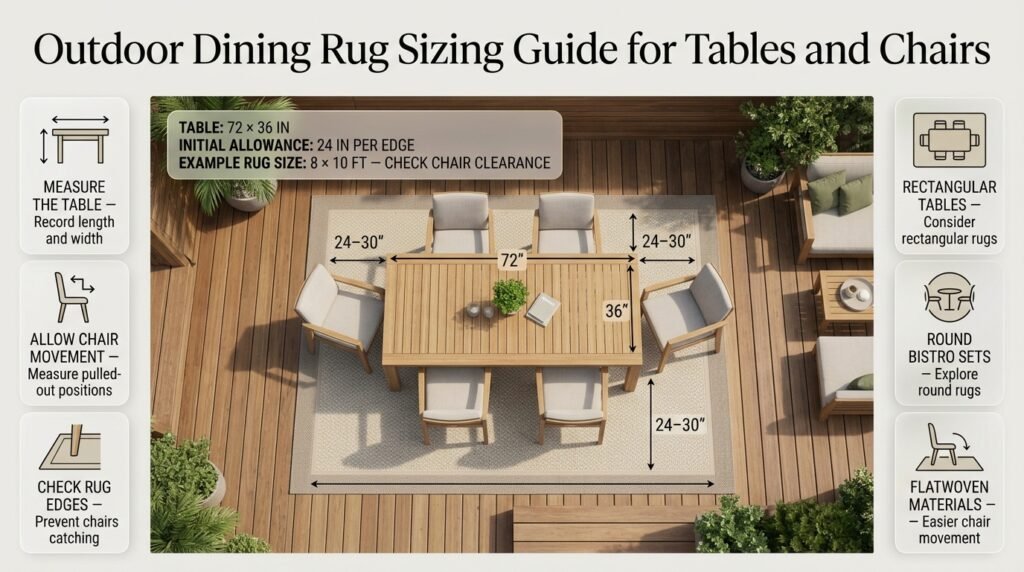
An outdoor dining rug should extend beyond the table far enough for chairs to move backward without catching on the rug edge. A practical initial allowance is approximately 24–30 inches beyond each table edge, although the actual requirement depends on chair dimensions and movement.
Dining areas need more careful measurement than lounge areas because furniture moves every time someone sits down or stands up.
Measure the table and chair clearance
Start by recording the length and width of the tabletop.
Then consider how far the chairs extend when pulled out. The rug should accommodate the chairs in normal use, not just when every chair is pushed neatly beneath the table.
For example, imagine a rectangular dining table measuring 72 inches long by 36 inches wide.
Adding 24 inches beyond each edge gives a preliminary rug size of:
- Length: 72 + 48 = 120 inches, or 10 feet.
- Width: 36 + 48 = 84 inches, or 7 feet.
An 8 × 10-foot rug could be a reasonable option if the furniture arrangement and chair movement fit comfortably within it. The shorter dimension still needs to be checked carefully.
Choose the right rug shape
Rectangular rugs usually complement rectangular dining tables, while round rugs can work well beneath round bistro tables.
Square rugs may suit square tables, particularly in symmetrical outdoor arrangements.
Matching the rug and table shapes can create a cohesive look, but it isn’t essential. A rectangular rug can work beneath a round table when its dimensions and placement remain balanced.
Consider how easily chairs move
Flatwoven outdoor rugs are often practical for dining because their low profile allows chairs to slide more easily than on thick, textured surfaces.
Check the rug’s construction and the manufacturer’s recommendations before placing it under frequently moved furniture.
For additional guidance on coordinating surfaces and finishes, read Decorating Around Existing Flooring.
How Do You Choose an Outdoor Rug for a Small Balcony?
Choose a balcony rug that defines the seating area without blocking doors, reducing essential walking space, or covering the floor unnecessarily. A 3 × 5-foot or 4 × 6-foot rug may suit a compact bistro arrangement, while a narrow runner can work well along a longer balcony.
Small outdoor spaces reward careful planning because every inch has a purpose.
Define the seating zone
If your balcony has two chairs and a small table, position the rug beneath that group rather than placing it randomly in the middle of the floor.
For a narrow balcony with a bench along one wall, a runner can visually lengthen the space.
Check the runner’s width against the bench and any nearby table legs. A very narrow runner may appear disconnected from the furniture.
Preserve the walking route
Don’t sacrifice access to a balcony door just to fit a larger rug.
Measure the route between the entrance and seating area. Ensure that the rug doesn’t interfere with the door or create a raised edge that catches feet.
Leaving some exposed flooring around the rug can help the balcony feel more open.
Account for wind and drainage
Lightweight rugs can move in exposed conditions, while poorly positioned rugs can obstruct drainage.
Choose a product designed for outdoor use and follow its instructions for securing, cleaning, and drying it.
A compatible outdoor rug pad may help with stability, but check that it suits the balcony’s surface and weather exposure.
Quick Tip: Outline two possible rug sizes with tape and photograph the balcony from the doorway. Comparing both layouts makes it easier to judge which size feels balanced.
How Do You Size a Rug for an L-Shaped Sectional?
An L-shaped sectional usually needs a rug large enough to connect the main seating area and coffee table. Measure both arms of the sectional, its overall depth, and the space required for the table before selecting a rug.
Don’t choose the size based only on the sofa’s longest side.
For example, a sectional measuring 8 feet along its longest side may have a return extending 6 feet into the patio. A rug that’s 8 feet long but only 5 feet wide may leave the return visually disconnected.
Measure the complete footprint
Record the length of both sectional sections and the distance from the back of the sofa to the front of the seating arrangement.
Then decide whether the rug will accommodate the front legs or all legs.
A front-leg arrangement may work in a smaller patio. Full coverage creates a more generous effect when there is sufficient room.
Position the rug around the seating zone
The rug should relate to the sectional and coffee table, not automatically to the geometric center of the patio.
If the sectional sits against a wall or railing, position the rug accordingly. The goal is to support the functional layout while preserving comfortable movement around it.
For further planning ideas, explore Interior Design.
Should an Outdoor Rug Be Centered on the Patio?
An outdoor rug should usually be centered beneath the furniture group it serves rather than automatically placed in the center of the entire patio. This helps define a functional zone while leaving room for circulation, planters, and other outdoor activities.
Imagine a rectangular patio with a dining table on one side and a lounge set on the other.
One oversized rug covering the center of the patio may leave furniture sitting awkwardly near its edges. Two appropriately sized rugs could define the dining and lounge areas more effectively, provided there is enough room between them.
When should you use separate rugs?
Separate rugs can distinguish different activities, including:
- Dining beside an outdoor kitchen.
- Relaxing near a sofa and coffee table.
- Creating a conversation area in a larger covered patio.
Each rug should relate clearly to its furniture arrangement.
Avoid placing several small rugs randomly around the patio. That can create visual clutter rather than a coherent layout.
For ideas on maintaining consistency across connected areas, see Creating Cohesion Between Different Rooms.
How Do Rug Shape, Color, and Pattern Affect Sizing?
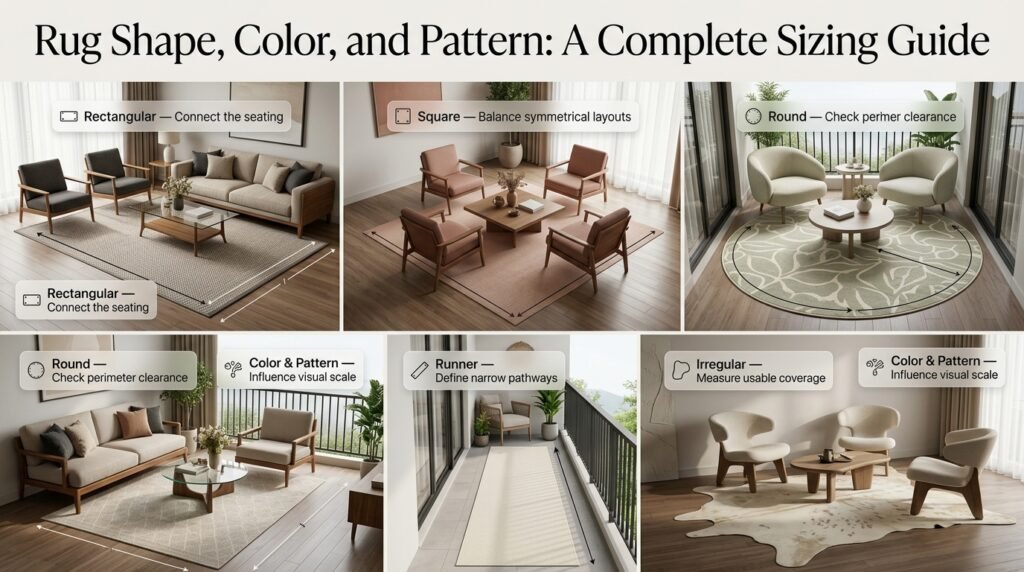
Rug shape, color, and pattern influence how large a rug appears and how effectively it connects the furniture. Rectangular rugs usually suit sofas and rectangular dining tables, while round rugs can soften compact seating areas or complement circular furniture.
The shape should support the function of the space.
| Rug shape | Suitable arrangement | Important consideration |
|---|---|---|
| Rectangular | Sofas, sectionals, rectangular dining tables | Match the dimensions to the furniture |
| Square | Symmetrical seating and square tables | May feel restrictive in narrow spaces |
| Round | Bistro sets and curved seating | Check chair clearance around the perimeter |
| Runner | Long balconies and narrow walkways | Keep the main seating group connected |
| Irregular | Creative lounge arrangements | Confirm usable coverage beneath furniture |
Can a pattern make an outdoor rug look larger?
Large-scale patterns can make a rug visually prominent, while small, busy patterns may draw more attention to the rug’s surface and edges.
Light-colored rugs can sometimes make compact areas feel more open, but color cannot compensate for poor dimensions.
Similarly, a dark rug can anchor a large seating arrangement without needing to cover the entire patio.
If the furniture already has bold patterns or bright colors, a simpler rug can create visual balance. For more decorating guidance, explore Paint Color.
How Do Outdoor Conditions Affect Rug Size Selection?
Outdoor rug sizing must account for rain, drainage, wind, sunlight, and cleaning access. A rug that fits perfectly on paper may be impractical if it covers a drain, traps moisture, or becomes difficult to secure in exposed weather.
Leave drainage points accessible
Rainwater needs a clear route to drains and suitable runoff areas.
Don’t place the rug over drainage openings or arrange it in a way that traps standing water. Follow the rug manufacturer’s guidance and any recommendations for your decking or patio surface.
A rug designed for outdoor use isn’t necessarily suitable for every wet environment.
Consider wind exposure
Large rugs can be difficult to secure, while lightweight rugs may lift during strong winds.
Follow the manufacturer’s instructions for securing the rug and use compatible methods that won’t damage the flooring.
Avoid unsecured rugs near steps, doors, or pool edges where movement could create a safety problem.
Allow access for cleaning
Large rugs can require more effort to lift, dry, and clean.
If your patio receives heavy rain or collects leaves beneath trees, choose dimensions that allow you to maintain the rug and the floor beneath it.
For broader maintenance and renovation guidance, visit Home Improvement.
How Can You Match an Outdoor Rug to Your Existing Furniture and Flooring?
Choose an outdoor rug that complements the furniture’s scale, the flooring’s color, and the overall visual character of the space. Its size should connect the main pieces without hiding important architectural features or overwhelming the surrounding materials.
Work with the existing floor color
If your patio has warm timber decking, a rug with warm neutrals or earthy tones may complement the surface.
Gray paving can work with cooler neutrals, muted blues, or contrasting natural shades. These are design starting points rather than fixed rules.
Before ordering, compare the rug’s color with the flooring in natural daylight because outdoor light can change how colors appear.
Consider furniture proportions
Large furniture often needs a more generous rug to avoid looking disconnected from the floor.
Small furniture can be overwhelmed by a rug that extends too far beyond the arrangement.
Review the full composition rather than choosing the rug in isolation. For more guidance, read Visual Weight in Interior Spaces.
Coordinate without matching everything
The rug doesn’t need to match every cushion, planter, and chair.
A consistent color family, complementary textures, or one repeated accent color can be enough to create a cohesive look.
The aim is to make the outdoor space feel connected without making every element identical.
What Are the Most Common Outdoor Rug Sizing Mistakes?
The most common mistakes are choosing a rug based only on price, measuring the table but not the chairs, ignoring walking space, and assuming every outdoor rug performs equally well in wet conditions.
Mistake 1: Buying a rug that’s too small
Why it happens: Smaller rugs often cost less and seem easier to fit.
Why it’s a problem: The furniture can look scattered, and the rug may seem like an isolated accessory.
How to avoid it: Measure the complete furniture group and check whether the rug can accommodate at least the front legs of the main seating pieces.
Mistake 2: Measuring only the dining table
Why it happens: The tabletop is the most obvious object in the arrangement.
Why it’s a problem: Chairs may slide off the rug when pulled out, causing the legs to catch on its edges.
How to avoid it: Measure the tabletop and allow enough space for chairs to move naturally.
Mistake 3: Ignoring walking routes
Why it happens: The buyer wants the largest rug that will physically fit.
Why it’s a problem: Doors, pathways, and transitions between furniture areas can become awkward.
How to avoid it: Outline the rug before buying and test the walking route.
Mistake 4: Choosing the wrong shape
Why it happens: The rug is selected for its pattern without considering the furniture arrangement.
Why it’s a problem: The rug may fail to connect the seating pieces.
How to avoid it: Select a shape that suits the furniture footprint, then verify the dimensions.
Mistake 5: Forgetting door clearance
Why it happens: Floor dimensions are measured without checking the door’s movement or the rug’s thickness.
Why it’s a problem: The rug can interfere with a hinged door or create a trip hazard near a threshold.
How to avoid it: Check door clearance and rug thickness before placing the order.
Mistake 6: Assuming all outdoor rugs handle rain equally
Why it happens: The label outdoor rug sounds suitable for every weather condition.
Why it’s a problem: Materials and backings differ in their resistance to moisture, fading, and prolonged exposure.
How to avoid it: Confirm the product’s intended use, cleaning requirements, and weather-resistance information.
Mistake 7: Forgetting everyday furniture movement
Why it happens: The layout is measured with every chair neatly pushed into place.
Why it’s a problem: Normal movement can leave chair legs hanging over the rug’s edges.
How to avoid it: Test the layout with chairs pulled out and furniture positioned as it will be used.
What Do Interior Design Professionals Consider Before Finalizing Outdoor Rug Dimensions?
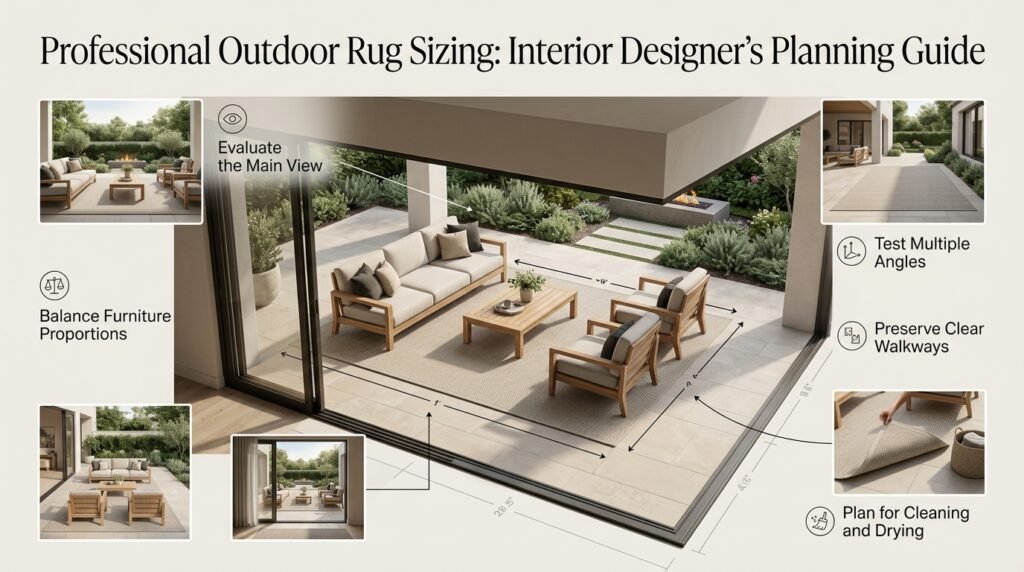
Professional design decisions consider furniture scale, the main viewing angle, circulation, and the intended use of the outdoor area. The goal is to make the rug feel like a natural foundation for the layout rather than a decorative object added at the last moment.
Evaluate the main view
Look at the patio from the house entrance or the doorway leading outside.
Identify the main focal point, such as a sofa, dining table, garden view, or fire feature. The rug should reinforce that arrangement instead of competing with it.
Check the furniture-to-rug relationship
Compare the rug’s width with the total width of the seating arrangement.
If the furniture extends far beyond the rug, the rug may look undersized. If it extends excessively beyond the furniture, it may dominate the space.
There is no universal ideal ratio. The final choice depends on the available floor, furniture proportions, and circulation requirements.
Test the arrangement from multiple angles
A rug can look balanced when viewed from above but appear too small from the house entrance.
Photograph the proposed layout from the doorway, the seating area, and the main walking route.
Check whether the rug connects the furniture and whether its edges look intentional.
Consider maintenance before choosing a large size
A large rug may create an attractive outdoor room, but it can be inconvenient if it needs frequent drying or repositioning.
Choose a size that you can realistically maintain. The best design is one that remains practical after the initial styling is complete.
For additional planning inspiration, visit DIY Home Projects.
How Can You Choose the Right Outdoor Rug Size Step by Step?
The most reliable method begins with the furniture arrangement and ends with a practical floor test. This process works for balconies, decks, dining areas, and larger patios.
- Measure the usable space. Record the floor dimensions and identify doors, drains, steps, and fixed obstacles.
- Measure the furniture. Include the entire seating arrangement or dining table and its chairs.
- Decide on the placement style. Choose between front legs on the rug and all furniture legs on the rug for lounge areas.
- Compare standard dimensions. Shortlist two or three suitable sizes rather than committing immediately to one.
- Mark the rug footprint. Use painter’s tape or string to outline each option.
- Test normal movement. Walk around the furniture, open doors, and pull dining chairs out.
- Check outdoor suitability. Review drainage, wind exposure, rug thickness, and maintenance needs.
- Confirm the product dimensions. Verify the actual measurements before placing your order.
This method reduces guesswork and helps you choose a rug that looks balanced and works comfortably in everyday use.
What Size Outdoor Rug Is Best for a Patio?
The best outdoor rug size depends on the dimensions of your patio, the furniture arrangement, and how you use the space. For a compact seating area, a 5 × 7-foot or 5 × 8-foot rug may be sufficient. Medium-sized patios often work well with an 8 × 10-foot rug, while larger outdoor lounges with sectionals may need a 9 × 12-foot rug or something bigger.
Rather than choosing a rug based on the patio’s total square footage, measure the complete furniture arrangement first. The rug should connect the main seating pieces without restricting walking space or making the patio feel crowded. Before purchasing, outline the proposed dimensions on the floor to see how the rug fits with your furniture and surrounding flooring.
Important sizing tips:
Measure the sofa, chairs, and coffee table as one arrangement.
Choose a rug that accommodates at least the front legs of the main seating pieces where practical.
Leave enough space around doors, railings, and walking routes.
Treat standard rug sizes as starting points rather than fixed rules.
How Much Bigger Should an Outdoor Rug Be Than the Furniture?
An outdoor rug should generally extend beyond the furniture enough to create a balanced, connected appearance. For many seating arrangements, approximately 6–12 inches of extra coverage around the furniture footprint is a useful starting point. However, the ideal border depends on the size of the furniture, the available floor area, and whether the rug is intended for a compact balcony or a spacious patio.
A rug that barely reaches the furniture edges can make the arrangement look cramped, while an excessively large rug may dominate the floor. The goal is to establish a clear visual boundary around the seating area without sacrificing comfortable movement. Dining areas require a different calculation because chairs need additional room to slide backward.
Important sizing tips:
Measure the complete furniture footprint before selecting the rug.
Check whether the sofa and chairs sit comfortably within the proposed dimensions.
Allow additional clearance for dining chairs when they are pulled out.
Use painter’s tape to test the rug’s border before ordering.
Should All Patio Furniture Legs Sit on the Outdoor Rug?
Whether all furniture legs should sit on an outdoor rug depends on the layout and the visual effect you want to achieve. In most seating areas, placing the front legs of the sofa and chairs on the rug is enough to connect the furniture and create a coordinated arrangement. This approach works particularly well on smaller patios where a larger rug would take up too much usable floor space.
For larger outdoor living areas, placing all furniture legs on the rug can create a more defined and generous seating zone. It works best when the rug extends beyond the furniture without crowding nearby walls, railings, or pathways. Whichever method you choose, consistency matters: the furniture should look intentionally arranged rather than disconnected from the rug.
Important sizing tips:
Use the front-leg placement method when floor space is limited.
Consider full furniture coverage when the patio can accommodate a larger rug.
Keep the coffee table positioned comfortably within the seating arrangement.
Avoid leaving individual chairs completely outside the rug if this makes the layout look fragmented.
What Size Outdoor Rug Do You Need Under a Dining Table?
The correct outdoor dining rug size depends on the tabletop dimensions and the space required for chairs to move backward. As a starting point, allow approximately 24–30 inches of additional rug coverage beyond each table edge, then check the actual chair dimensions and movement. This helps keep the chair legs on the rug when people sit down or stand up.
For example, a rectangular dining table measuring 72 inches long by 36 inches wide would need approximately 120 inches of rug length and 84 inches of width if you allow 24 inches on every side. An 8 × 10-foot rug may work for this arrangement, provided the chair clearance is sufficient along both dimensions. Larger chairs or a wider table may require a larger rug.
Important sizing tips:
Measure the tabletop’s length and width.
Pull the chairs away from the table to estimate their full movement range.
Choose a rug with a relatively low profile so chairs can slide easily.
Confirm that the rug doesn’t obstruct nearby doors or outdoor walkways.
How Do You Choose the Right Outdoor Rug Size for a Small Balcony?
The best rug for a small balcony is one that defines the seating area while preserving enough room for comfortable movement. A 3 × 5-foot or 4 × 6-foot rug may work beneath a compact bistro set, while a narrow runner can suit a long balcony with a bench or slim seating arrangement. The right dimensions depend on the furniture footprint and the space available between the doorway, railing, and seating area.
Avoid covering the entire balcony simply because a larger rug is available. Leaving some exposed flooring can make the layout feel less crowded and provide more flexibility when arranging furniture. Outdoor conditions also matter: the rug should not block drainage, interfere with the door, or become difficult to secure in windy weather.
Important sizing tips:
Measure the usable floor area rather than the balcony’s overall dimensions.
Choose a rug that fits beneath the intended seating group.
Keep doorways and essential walking routes clear.
Check the rug’s weather suitability and securing instructions before installation.
Conclusion
Choosing the right outdoor rug size is an essential part of creating a comfortable, balanced, and visually appealing outdoor living space. Whether you are furnishing a small balcony, arranging a patio seating area, or designing an outdoor dining space, the rug should complement the furniture, define the intended zone, and preserve enough room for easy movement.
The most effective approach is to measure your available floor space and complete furniture arrangement before making a purchase. Consider whether the front legs or all legs of your seating should rest on the rug, allow sufficient clearance for dining chairs, and account for doors, walkways, railings, and drainage. Standard rug sizes can help you narrow your options, but your actual measurements should guide the final decision.
Remember that a well-sized outdoor rug does more than improve appearance. It helps connect furniture pieces, adds warmth and texture, and makes outdoor areas feel like intentional extensions of your home. By applying these outdoor rug sizing principles and considering your climate, materials, and daily use, you can choose a rug that looks proportionate, performs reliably, and supports a more inviting outdoor environment.
For more inspiration on creating functional and attractive living spaces, explore DesignMode24 Interior Design and use thoughtful design principles to make every area of your home feel cohesive and comfortable.