
Introduction
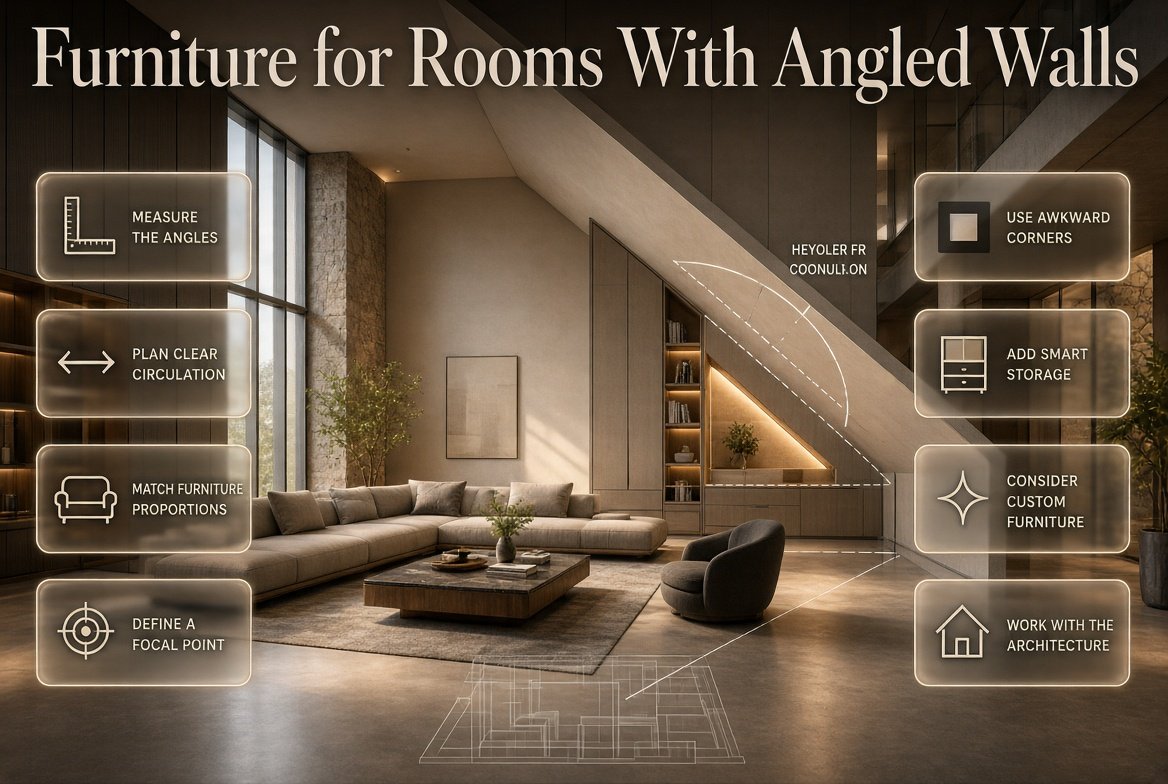
Furniture for Rooms With Angled Walls | A room with an angled wall can look beautiful in photographs and surprisingly difficult when it’s time to furnish it. You may have a sofa that leaves an awkward triangular gap, a wardrobe that can’t sit properly against the wall, or a dining table that makes one side of the room feel cramped. Standard furniture is usually designed around square or rectangular rooms, so unusual geometry requires a different approach.
The good news is that you don’t need to remodel the room just because one or more walls aren’t straight. The right furniture for rooms with angled walls can make the space comfortable, practical, and visually intentional. In many cases, the angle can actually become one of the room’s strongest architectural features.
The key is to stop treating the angled wall as something that furniture must hide. Instead, plan around the room’s measurements, circulation, focal points, furniture proportions, and actual daily use.
This guide explains how to measure an angled room, choose suitable furniture, arrange living rooms and bedrooms, handle awkward corners, decide between standard and custom furniture, use storage effectively, and avoid the mistakes that make irregular rooms feel smaller.
If you’re looking at the bigger picture of how furniture and interior planning work together, DesignMode24 Interior Design can also provide broader room-planning inspiration.
What Is the Best Furniture for Rooms With Angled Walls?
The best furniture for rooms with angled walls is furniture that fits the room’s geometry without restricting movement. Low-profile sofas, modular seating, compact tables, floating furniture, shallow storage, custom shelving, fitted cabinets, and flexible desks are often easier to work with than large rigid pieces.
The most important consideration isn’t whether furniture can technically fit into an angled room. It is whether the furniture leaves enough usable space around it for walking, opening doors, sitting comfortably, and performing everyday activities.
Good choices often include:
- Low-profile sofas
- Modular sectionals
- Armless chairs
- Round or oval tables
- Narrow consoles
- Floating desks
- Custom shelving
- Built-in storage
- Low cabinets
- Storage benches
- Nesting tables
- Compact side tables
- Platform beds
- Made-to-measure wardrobes
The exact choice depends on the type of angle and the room’s purpose.
An angled wall in a living room presents different opportunities from an angled wall in a bedroom. Likewise, a diagonal wall that reaches from floor to ceiling needs a different solution from a sloped wall underneath a roof.
Why Are Rooms With Angled Walls Difficult to Furnish?
Most mass-produced furniture assumes relatively predictable room geometry. Sofas, wardrobes, cabinets, desks, and dining tables are generally designed around straight walls and conventional corners.
An angled room changes those assumptions.
A rectangular cabinet placed against a diagonal wall may leave a wedge-shaped gap. A tall wardrobe beneath a sloped ceiling may not open correctly. A sofa positioned too close to an angled corner can reduce the usable walkway.
There are three main challenges:
1. Furniture Doesn’t Always Follow the Wall
A rectangular piece placed against an angled surface rarely makes full contact with it.
That isn’t necessarily bad.
The mistake is assuming that every gap must be filled. Sometimes the best solution is to leave the gap open or use a shallow piece designed specifically for that area.
2. Circulation Becomes More Important
In a normal rectangular room, people naturally understand where the pathways will be.
Angled walls can change those routes.
A piece of furniture may fit perfectly on paper but make the room uncomfortable to walk through.
3. Furniture Can Compete With the Architecture
An unusual wall already creates visual movement. Adding too many different furniture angles can make the room feel chaotic.
The solution is usually to establish one clear visual direction and allow the architecture to do some of the decorative work.
Current interior-design guidance similarly emphasizes designing around function, circulation, and the room’s geometry instead of simply forcing furniture against every wall.
How Should You Measure a Room With Angled Walls?
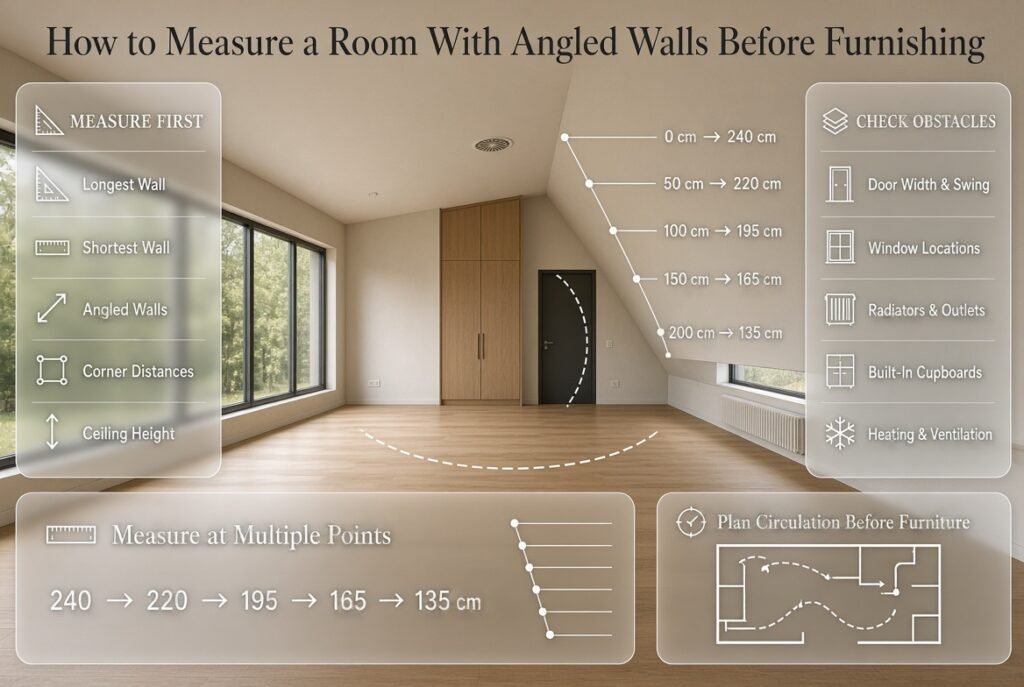
Before buying anything, measure the room at multiple points. Don’t rely on the room’s advertised dimensions or one wall measurement.
Record:
- Longest wall
- Shortest wall
- Every angled wall
- Distance between corners
- Ceiling height
- Lowest ceiling point
- Door widths
- Door swing
- Window locations
- Window sill height
- Radiators
- Electrical outlets
- Built-in cupboards
- Heating and ventilation points
For a sloping wall, take height measurements at several points.
For example:
| Position Along Wall | Available Height |
|---|---|
| 0 cm | 240 cm |
| 50 cm | 220 cm |
| 100 cm | 195 cm |
| 150 cm | 165 cm |
| 200 cm | 135 cm |
This immediately tells you where tall furniture can and cannot go.
A professional approach is to measure first and then determine circulation before deciding where the largest furniture will sit. That sequence is particularly useful in small irregular bedrooms and rooms with limited entry points.
Measure Furniture, Not Just the Room
Furniture dimensions should be measured in three directions:
Width: Does it fit between fixed points?
Depth: Does it interfere with circulation?
Height: Does the ceiling or angled wall restrict it?
Also measure doors, drawers, and reclining mechanisms.
A cabinet may fit when closed but become unusable when its doors are open.
💡 Pro Tip: Use painter’s tape on the floor to mark the exact footprint of a sofa, bed, table, or cabinet before buying it. Walk around the taped shape and test whether the room still feels comfortable.
How Do You Plan the Layout Before Buying Furniture?
Start with the room’s function rather than the furniture.
Ask:
- What will people do here?
- Where will they enter?
- What is the main focal point?
- Where does natural light enter?
- Which areas need storage?
- Which paths must remain open?
- Which wall is the most usable?
Then identify the largest furniture item.
In a living room, this may be the sofa.
In a bedroom, it is usually the bed.
In a dining room, it’s the dining table.
In an office, it’s the desk.
Once that piece is positioned, build the rest of the layout around it.
This is much more effective than buying several attractive pieces individually and hoping they work together.
Furniture Scale Matters More in an Angled Room
A room with unusual geometry can make furniture look larger than it really is because there are fewer clean wall lines to absorb its visual weight.
This is why furniture scale becomes particularly important.
For example, a deep sectional may physically fit but visually dominate the entire room.
A smaller sofa with two lightweight chairs might provide the same number of seats while preserving better circulation.
Before choosing a piece, consider:
- Overall dimensions
- Visual weight
- Leg height
- Back height
- Arm width
- Upholstery thickness
- Relationship to nearby furniture
For a deeper explanation of proportion, use Furniture Scale vs Room Size.
Should Furniture Follow the Angle of the Wall?
Not necessarily.
This is one of the biggest misconceptions about furnishing irregular rooms.
You don’t need every piece of furniture to match the wall angle. In fact, copying every angle can sometimes make the room feel overly complicated.
Instead, use a combination of:
- Straight furniture
- One or two angled elements
- Curved furniture
- Floating pieces
- Rugs that define the main zone
A hybrid approach often works best.
For example:
Angled wall + straight sofa + round coffee table
creates contrast without visual confusion.
Or:
Angled wall + floating desk + curved chair
can make a small office feel intentional.
Research and professional examples of furniture layout also emphasize alignment between furniture pieces, walls, circulation, and visual focal points rather than requiring every piece to follow the exact wall geometry.
Best Furniture for an Angled Living Room
Living rooms with angled walls are often the easiest rooms to make visually interesting because seating doesn’t have to touch the wall.
Low-Profile Sofas
A low sofa works especially well when the angle reduces ceiling height.
It keeps the room visually open and doesn’t compete with the architecture.
A low-back sofa is particularly useful under sloped ceilings because it preserves more of the available visual height.
Modular Sectionals
Modular furniture gives you more control over unusual dimensions.
You can:
- Remove a module
- Change the orientation
- Separate seating
- Create an L-shaped arrangement
- Leave an awkward corner open
This flexibility can be more valuable than having the largest possible sofa.
Armless Chairs
Armless chairs have a smaller visual footprint.
They can be useful near angled walls because they don’t create bulky corners that interfere with movement.
Round Coffee Tables
A round coffee table can soften a room filled with diagonal and rectangular lines.
It can also make movement around the seating group easier because there are no sharp corners projecting into the walkway.
How Should You Arrange a Sofa Against an Angled Wall?
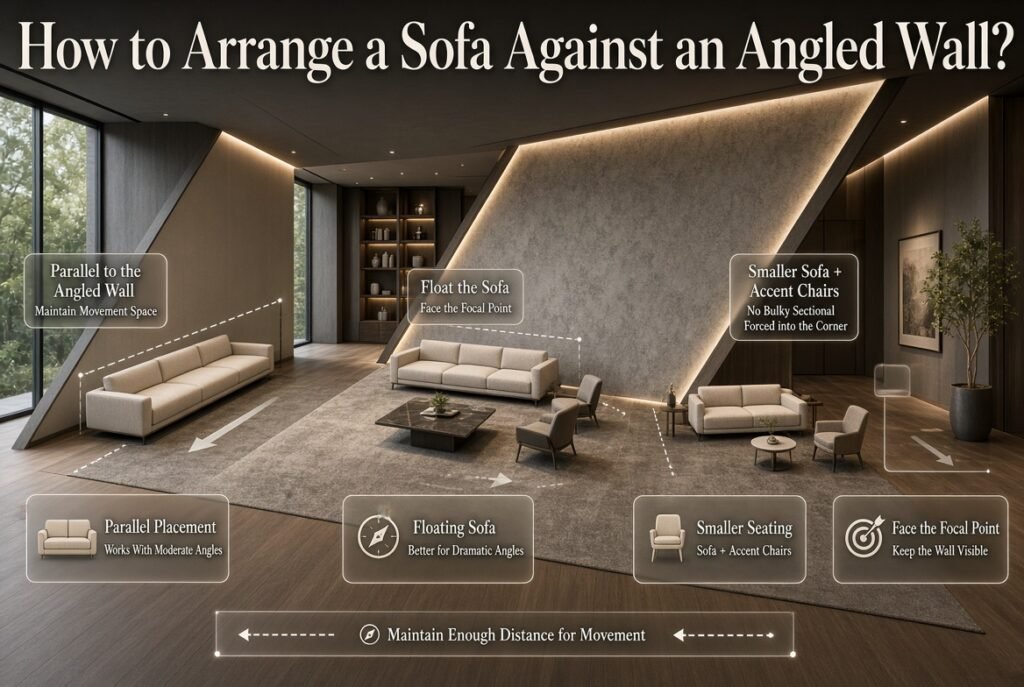
There are several workable approaches.
Option 1: Parallel to the Angled Wall
If the wall has a moderate angle, a sofa can sometimes run parallel to it.
This visually reinforces the architecture.
The important thing is to maintain enough distance for movement.
Option 2: Float the Sofa
Floating the sofa away from the wall is often better when the angle is dramatic.
This allows the sofa to face the room’s focal point while leaving the angled wall visible.
A large rug can then define the seating zone.
Option 3: Use a Smaller Sofa and Accent Chair
Instead of forcing a sectional into an awkward corner, use:
- One sofa
- One or two chairs
- A compact coffee table
- A side table
This gives you more freedom to respond to the room.
Design guidance for awkward living rooms similarly recommends floating seating where necessary and using rugs to visually anchor the arrangement.
⭐ Expert Tip: Don’t measure success by how tightly furniture hugs the wall. Measure it by how naturally people can sit, talk, walk, reach storage, and use the room.
How Can You Use an Awkward Living Room Corner?
An angled corner doesn’t automatically need a cabinet.
Give it a purpose.
Possible uses include:
- Reading chair
- Floor lamp
- Small desk
- Plant
- Open shelving
- Built-in drawers
- Pet area
- Reading nook
- Display shelving
The size of the corner determines the solution.
A narrow corner might support only a lamp and plant.
A wider corner could accommodate a chair and small table.
A deeper area may justify custom storage.
The important thing is to avoid using a large piece merely because the corner feels empty.
Furniture for Bedrooms With Angled Walls
Bedrooms need a different approach because the bed, wardrobes, bedside storage, and circulation all have to work together.
The bed usually becomes the primary anchor.
Low Beds
A low platform bed can work particularly well beneath a sloped wall.
It uses the lower section of the room without requiring standing headroom along the entire wall.
Low Dressers
A low dresser can take advantage of areas where ceiling height is restricted.
Instead of trying to fit a full-height cabinet, use the lower portion for drawers.
Floating Bedside Tables
Floating nightstands can save valuable floor space.
They also allow you to adjust the width more precisely than standard bedside cabinets.
Custom Wardrobes
If the wall or ceiling slopes significantly, fitted storage can make much better use of the available height.
For bedrooms affected by sloping ceilings, see wardrobe design for sloped ceilings.
Can You Put a Bed Against an Angled Wall?
Yes, but only if the angle doesn’t compromise the headboard, access, or usable headroom.
Check:
- Headboard height
- Mattress position
- Side access
- Bedside tables
- Window position
- Door swing
- Ceiling height
- Heating
If the angle is extremely steep, the bed may work better against a straight wall.
The key is not to force the bed into the most unusual part of the room simply because that space appears available.
How Do You Use Angled Walls for Bedroom Storage?
Angled walls can actually create excellent storage opportunities.
Instead of one large wardrobe, consider combining several storage heights:
Tall section → medium section → low drawers
This follows the changing geometry of the room.
For example:
- Tallest point: hanging clothes
- Middle height: shelves
- Lowest point: drawers or shoes
This approach makes the storage feel designed for the architecture rather than squeezed into it.
Furniture for Angled Dining Rooms
Dining rooms require careful attention to chair movement.
The table itself may fit, but the chairs need additional space when people sit down.
This makes curved and rounded furniture particularly useful in some irregular dining areas.
An oblong or oval table can provide some of the seating capacity of a rectangular table while avoiding sharp corners.
Armless chairs can also be practical because they generally have a smaller footprint.
One documented angled-wall dining-room example found that an oblong table and armless chairs created better movement around the furniture than forcing a conventional rectangular arrangement into the available geometry.
Before Buying a Dining Table
Mark the tabletop.
Then mark the approximate chair positions.
Finally, walk around the entire arrangement.
Don’t test only the table footprint.
Furniture for Home Offices With Angled Walls
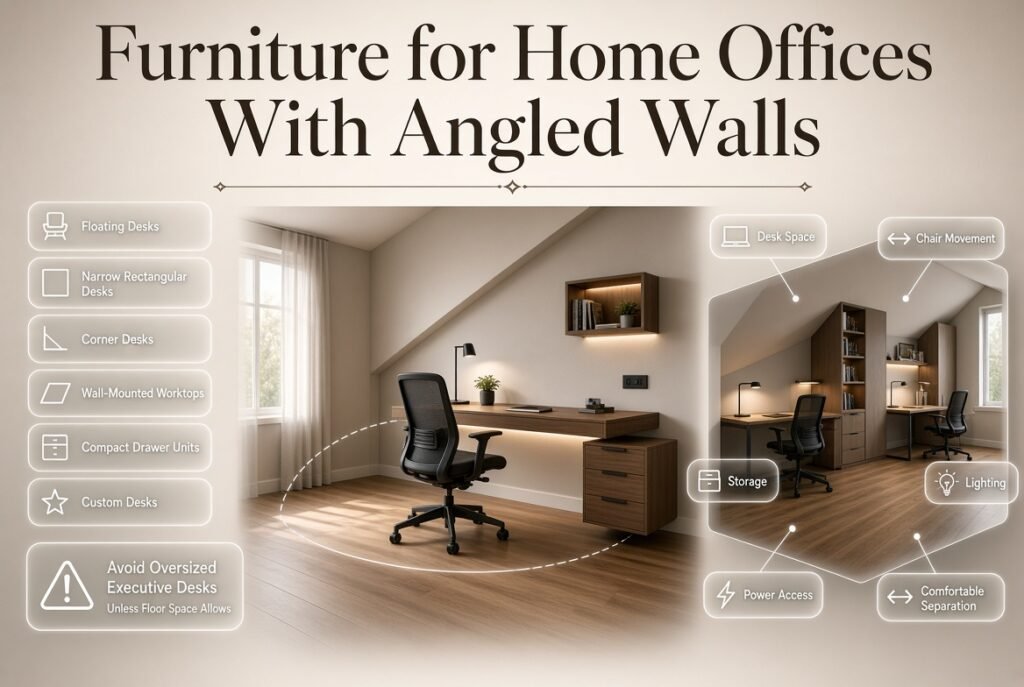
An angled room can become an excellent home office if the desk is scaled correctly.
Useful options include:
- Floating desks
- Narrow rectangular desks
- Corner desks
- Wall-mounted worktops
- Compact drawer units
- Custom desks
Avoid oversized executive desks unless the room has enough open floor space.
The chair also needs enough room to pull away from the desk.
If two people share the room, the challenge becomes even greater because each workstation needs:
- Desk space
- Chair movement
- Storage
- Lighting
- Power access
- Comfortable separation
For this type of arrangement, Home Office Layout for Two People provides useful planning inspiration.
How Do You Use a Small Angled Corner as a Home Office?
A shallow angled corner can sometimes become a compact workstation.
Use:
- A narrow desk
- Wall-mounted shelves
- A compact chair
- Cable management
- A task light
Avoid deep storage cabinets.
The goal is to use the vertical and shallow dimensions without taking over the room.
A floating worktop is often particularly useful because it can be cut to the available width.
Should You Use Custom Furniture?
Custom furniture can be valuable, but it shouldn’t automatically be the first solution.
The decision should be based on how much usable space you gain.
Custom Furniture Is Worth Considering When:
- The angle is significant
- Standard furniture leaves large gaps
- Storage is limited
- The room is small
- The furniture will remain for many years
- You need a specific combination of storage functions
Standard Furniture May Be Better When:
- The angle is minor
- The room is large
- You expect to move
- Flexible furniture works
- Budget is limited
| Furniture Type | Cost | Flexibility | Space Efficiency |
|---|---|---|---|
| Standard furniture | Lower | High | Moderate |
| Modular furniture | Medium | Very High | Good |
| Semi-custom | Medium–High | Medium | Very Good |
| Fully custom | High | Low after installation | Excellent |
Custom furniture shouldn’t be purchased simply because the room looks unusual.
It should solve a measurable problem.
Built-In Storage for Angled Walls
Built-in storage is one of the strongest solutions when an angled wall creates unusable space.
Possible applications include:
- Bookshelves
- Media cabinets
- Wardrobes
- Display units
- Home office storage
- Window seats
- Low cupboards
The advantage is that the furniture can follow the actual wall dimensions.
The disadvantage is that it becomes less flexible.
Think carefully before installing a permanent unit in a room that may later need to function differently.
How Do You Make Angled Walls Look Intentional?
The best way is to visually acknowledge the angle.
Don’t try to pretend the wall is straight.
You can reinforce it through:
- Custom shelving
- Lighting
- Paint
- Artwork
- Furniture alignment
- Repeated shapes
- Architectural details
A slanted wall can become an accent surface rather than a problem.
For more general design planning, Interior Design offers a broader reference point for coordinating furniture with the overall room.
Can Paint Make an Angled Wall Look Better?
Yes.
Paint can change how strongly an angle is perceived.
A lighter color can visually reduce the dominance of a sloped surface, while a contrasting color can deliberately make the architectural feature more noticeable.
Consider:
- Light vs dark
- Matte vs reflective finishes
- Accent colors
- Color continuity
- Ceiling color
- Adjacent wall colors
If the goal is to make the angle a feature, contrast can help.
If the goal is to make it recede, similar tones can create a quieter visual transition.
For more ideas, explore Paint Color.
How Does Lighting Affect Angled Rooms?
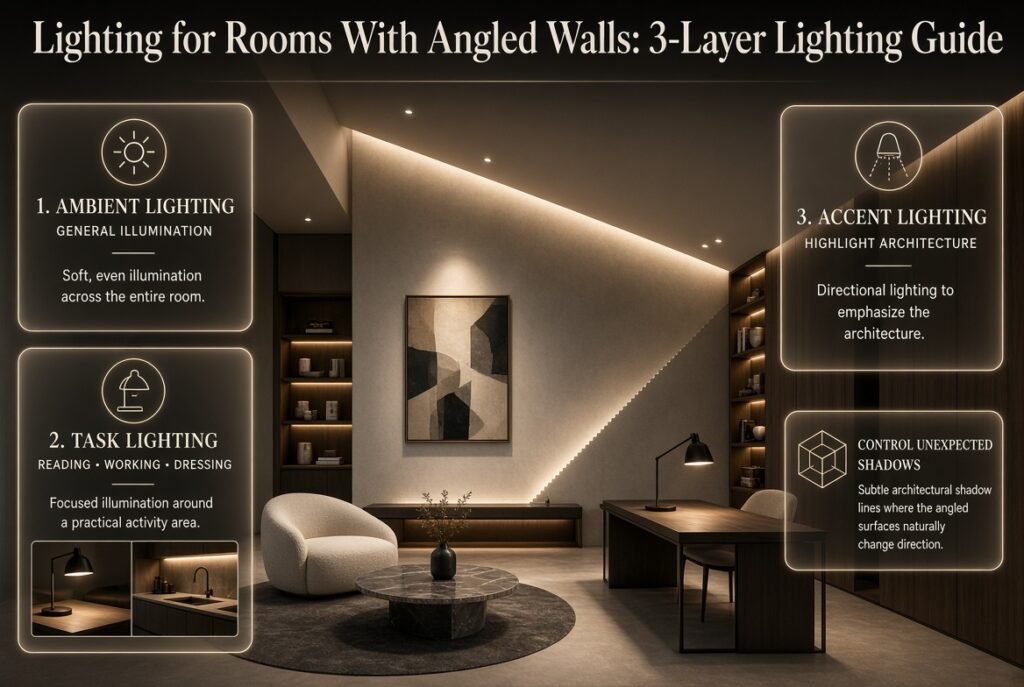
Lighting becomes especially important because angled surfaces can create unexpected shadows.
Use three layers.
Ambient Lighting
Provides general illumination.
Task Lighting
Supports activities such as:
- Reading
- Working
- Dressing
- Cooking
Accent Lighting
Highlights:
- Angled walls
- Shelving
- Artwork
- Architectural details
Wall washing or directional lighting can make the angle feel deliberate instead of visually awkward.
For ideas on using lighting as part of a complete room system, see Intelligent Lighting.
What About Climate Control in Rooms With Unusual Geometry?
Furniture placement shouldn’t block heating or cooling equipment simply because an angled wall seems like the easiest place for a cabinet.
Pay attention to:
- Air vents
- Radiators
- HVAC units
- Thermostats
- Return-air paths
- Curtains
- Smart climate-control sensors
A large cabinet positioned directly in front of a vent can interfere with the room’s comfort and performance.
For broader ideas about managing room conditions, automated climate control for different rooms can be considered as part of a wider smart-home strategy.
The important point is that furniture and environmental systems should be planned together rather than separately.
How Can You Use Rugs in an Angled Room?
A rug can visually establish order when the walls don’t.
Instead of trying to make the rug follow every angle, use it to define the functional zone.
For example:
Sofa + chairs + coffee table + large rectangular rug
creates one clear seating area.
The rug effectively creates an invisible room within the irregular room.
A round rug can also work when the furniture arrangement is centered around a circular table or seating group.
The key is scale.
A tiny rug underneath only the coffee table can make the furniture appear disconnected.
Should Furniture Be Floating or Against the Wall?
Floating furniture is often useful in rooms with angled walls because it allows the room’s usable geometry to determine the layout instead of forcing every piece against an irregular surface.
However, floating furniture isn’t automatically better.
Use it when:
- The wall angle is severe
- The room has enough floor space
- You need a defined zone
- The sofa would otherwise sit awkwardly
- The wall itself is worth highlighting
Against-the-wall placement can still work when:
- The wall is only slightly angled
- The furniture is shallow
- The room is small
- Circulation remains clear
The correct decision depends on the room rather than a universal rule.
What Furniture Shapes Work Best With Angled Walls?
Rectangular Furniture
Best for:
- Sofas
- Beds
- Desks
- Cabinets
Rectangular pieces provide structure but can create triangular gaps.
Round Furniture
Best for:
- Coffee tables
- Dining tables
- Side tables
Round forms soften sharp circulation paths.
Oval Furniture
Useful when you need the length of a rectangular piece with softer corners.
Curved Furniture
Can be effective as an accent, especially when the room already has strong diagonal lines.
Modular Furniture
Best when the room may need multiple configurations.
A combination of shapes usually produces a more natural result than using one shape everywhere.
How Do You Handle an Angled Wall in a Small Room?
Small rooms require discipline.
Don’t try to make every corner functional.
Instead:
- Choose the primary function.
- Select the largest necessary piece.
- Keep secondary furniture compact.
- Protect the main walkway.
- Use storage vertically where possible.
- Leave some negative space.
A small room can feel larger when there are fewer but better-proportioned pieces.
This is especially important in rooms where the angle already breaks up the available floor area.
What Are the Most Common Mistakes?
Mistake 1: Buying Before Measuring
Why it happens: The furniture looks perfect online.
Why it’s harmful: The actual depth or height may make it unusable.
Solution: Measure both room and furniture.
Mistake 2: Filling Every Awkward Corner
Why it happens: Empty space feels wasteful.
Why it’s harmful: A filler cabinet can make circulation worse.
Solution: Give the corner a function before furnishing it.
Mistake 3: Matching Every Angle
Why it happens: People assume furniture should follow the wall.
Why it’s harmful: Too many directions create visual noise.
Solution: Use one dominant alignment and selective contrast.
Mistake 4: Ignoring Doors and Drawers
A cabinet can fit perfectly while its doors cannot open.
Always test the furniture in its open position.
Mistake 5: Choosing Furniture That’s Too Deep
Depth becomes especially problematic in narrow angled rooms.
A 90 cm deep sofa can take up substantially more usable circulation than a 75 cm model.
Mistake 6: Blocking Heating or Cooling
Don’t let a beautiful cabinet interfere with a radiator or ventilation system.
Mistake 7: Overusing Custom Furniture
Custom doesn’t automatically mean better.
If a standard piece already works, save the budget for areas where customization creates real value.
Mistake 8: Ignoring Visual Weight
Two pieces with identical dimensions can look completely different.
A heavy dark cabinet may visually dominate an angled wall, while a raised-leg unit may appear lighter.
What Are the Best Storage Ideas for Angled Rooms?
Storage should follow the room’s changing dimensions.
Consider:
- Low drawers
- Floating shelves
- Built-in cabinets
- Under-bed storage
- Shallow bookcases
- Window benches
- Modular cubes
- Custom wardrobes
If the angle is low, use the space for items that don’t require standing height.
For example:
Lowest zone: shoes and boxes
Middle zone: drawers
Higher zone: shelves
This is more efficient than trying to make one standard cabinet work everywhere.
How Can You Combine Angled Walls With Home Improvement?
Not every angled-wall problem is solved with furniture.
Sometimes the wall itself needs attention.
Before making structural changes, consider whether the problem can be solved through:
- Better furniture placement
- Built-in storage
- Lighting
- Paint
- Flooring
- Shelving
- Minor carpentry
For broader renovation and improvement ideas, see Home Improvement.
For smaller practical projects, DIY Home Projects can also be useful.
The important distinction is between improving the room’s appearance and changing its structure. Structural changes should be considered carefully because they can affect cost, building requirements, utilities, and future flexibility.
When Should You Leave an Angled Corner Empty?
Sometimes an empty corner is the best design decision.
Leave it open when:
- The area is too narrow
- Furniture would block movement
- The corner has very little usable depth
- The space already has enough storage
- The angle itself is attractive
- Adding furniture would make the room visually heavy
Empty space is not wasted if it improves circulation and balance.
This is particularly important in small rooms.
How Can You Use the Angled Wall as a Design Feature?
Instead of hiding the wall, make it the reason the room looks distinctive.
Possible treatments include:
- Built-in bookshelves
- Floating shelves
- Gallery walls
- Accent paint
- Decorative lighting
- Low cabinets
- Reading nooks
- Window seating
You can also repeat the angle subtly in smaller details.
For example:
Angled wall → diagonal artwork → triangular shelving detail
But don’t repeat the shape everywhere.
One or two references are enough.
How Can You Use Outdoor and Garden Inspiration Without Overloading the Room?
An angled room can sometimes benefit from natural materials and visual connections to outdoor spaces.
Think about:
- Natural wood
- Indoor plants
- Stone textures
- Woven materials
- Organic shapes
- Natural daylight
For outdoor-related inspiration and complementary home spaces, Robert MyGardenAndPatio can provide additional ideas.
The important point is to borrow the material or visual principle rather than filling an angled room with unrelated decorative elements.
How Can You Make the Room Feel More Cohesive?
Cohesion comes from repetition.
Choose two or three elements and repeat them.
For example:
- Same wood tone
- Similar metal finish
- Consistent upholstery color
- Repeated lighting style
- Related artwork shapes
The room doesn’t need matching furniture.
It needs relationships between furniture pieces.
What Should You Consider Before Renovating the Room?
Before changing an angled wall or building permanent furniture, consider the home’s longer-term needs.
Ask:
- Will the room have the same purpose in five years?
- Could the furniture need to move?
- Will storage requirements change?
- Is the angle structural?
- Are electrical or HVAC systems affected?
- Will the modification reduce resale flexibility?
- Does the cost create enough functional benefit?
A permanent solution should solve a permanent problem.
What furniture works best in a room with angled walls?
The best furniture for an angled room is usually flexible, appropriately scaled, and easy to position without blocking circulation. Low-profile sofas, modular sectionals, round coffee tables, compact desks, shallow cabinets, floating shelves, and custom storage can work particularly well. The right choice depends on how severe the angle is and how the room will be used.
Instead of trying to find furniture that perfectly follows the wall, focus on pieces that make the available floor area more useful. A sofa, for example, can sit slightly away from an angled wall if that creates a better seating arrangement. Similarly, an awkward corner may work better with a narrow shelf or floor lamp than a large cabinet.
Practical points to consider:
Measure both furniture width and depth before purchasing.
Choose low furniture where ceiling height decreases.
Consider modular pieces if you expect to change the layout.
Use round or oval tables where sharp corners interfere with movement.
Leave unusable corners open rather than forcing furniture into them.
Is custom furniture worth it for rooms with angled walls?
Custom furniture can be worthwhile when an unusual wall creates significant wasted space or makes standard furniture difficult to use. Built-in wardrobes, fitted cabinets, custom shelving, and made-to-measure desks can follow the room’s exact dimensions and turn awkward areas into functional storage.
However, custom furniture isn’t automatically the best choice. If a standard or modular piece fits comfortably and leaves sufficient circulation, it may provide better flexibility at a lower cost. Custom solutions make the most sense when they solve a specific spatial problem that ordinary furniture cannot.
Custom furniture is particularly useful for:
Sloped ceilings and walls
Narrow or triangular corners
Built-in wardrobes
Under-slope storage
Irregular home offices
Small rooms where every centimetre matters
Professional tip: Before ordering custom furniture, compare its cost with the actual amount of usable space it will recover. Customization should solve a problem, not simply make the furniture look more sophisticated.
How can you make an angled room look bigger and less awkward?
The easiest way to make an angled room feel more spacious is to avoid overcrowding it. Choose furniture that matches the room’s scale, maintain clear walking routes, and use the angled wall as part of the design rather than trying to hide it. Floating furniture, lighter visual profiles, appropriate rugs, and layered lighting can also make the room feel more open.
Large, deep furniture can quickly overwhelm an irregular room because the unusual geometry already breaks up the available floor area. A smaller sofa combined with lightweight chairs may provide more flexibility than one oversized sectional.
Try these space-enhancing techniques:
Keep the largest furniture pieces appropriately scaled.
Use furniture with visible legs to create visual openness.
Avoid filling every corner.
Choose a rug large enough to connect the main furniture group.
Use mirrors or reflective surfaces where appropriate.
Keep the color palette visually consistent.
Use lighting to brighten darker angled sections.
The objective isn’t to make the angle disappear. It’s to make the entire room feel organized around it.
What should you do with awkward corners created by angled walls?
An awkward corner doesn’t always need to contain furniture. First determine whether the space can support a useful function without restricting movement. Depending on its size and height, an angled corner can become a reading nook, compact workspace, plant area, display shelf, storage zone, or simply remain open as breathing space.
Forcing a standard cabinet into a triangular or unusually shallow corner is one of the easiest ways to make an irregular room feel cramped. If the area isn’t large enough for practical furniture, leaving it empty can actually improve the overall layout.
Useful ideas for difficult corners:
Install shallow floating shelves.
Add a compact reading chair.
Use a floor lamp to create a small visual zone.
Install custom drawers where depth allows.
Place a plant where natural light is available.
Create a small floating workstation.
Use low storage beneath a sloped section.
Leave the corner open if furniture would interfere with circulation.
Expert tip: Don’t ask, “How can I fill this corner?” Ask, “What useful purpose can this corner serve?” That small change in thinking usually leads to a much better furniture layout.
Conclusion
Designing a room with angled walls is less about finding furniture that perfectly matches every wall and more about creating a layout that works with the room’s natural shape. The right furniture scale, clear circulation, flexible placement, and thoughtful use of awkward corners can turn an unusual room into a comfortable and visually balanced space.
Start with the room’s main purpose, position the largest furniture first, and avoid filling every available corner simply because space is available. Low-profile pieces, rounded furniture, modular designs, floating storage, and custom solutions can all be useful when standard furniture does not fit comfortably.
Most importantly, treat the angled wall as a design feature rather than a problem. When the furniture, lighting, storage, and decorative elements are planned around the room’s actual dimensions, even an irregular space can feel intentional, functional, and welcoming.