
Introduction
Luxury Spaces | A room can have expensive furniture, marble surfaces, designer lighting, and beautiful accessories and still fail to feel luxurious. At the same time, a carefully planned home with simple materials can feel remarkably elegant, comfortable, and refined.
The difference is usually not the price of the individual products. It is how everything works together.
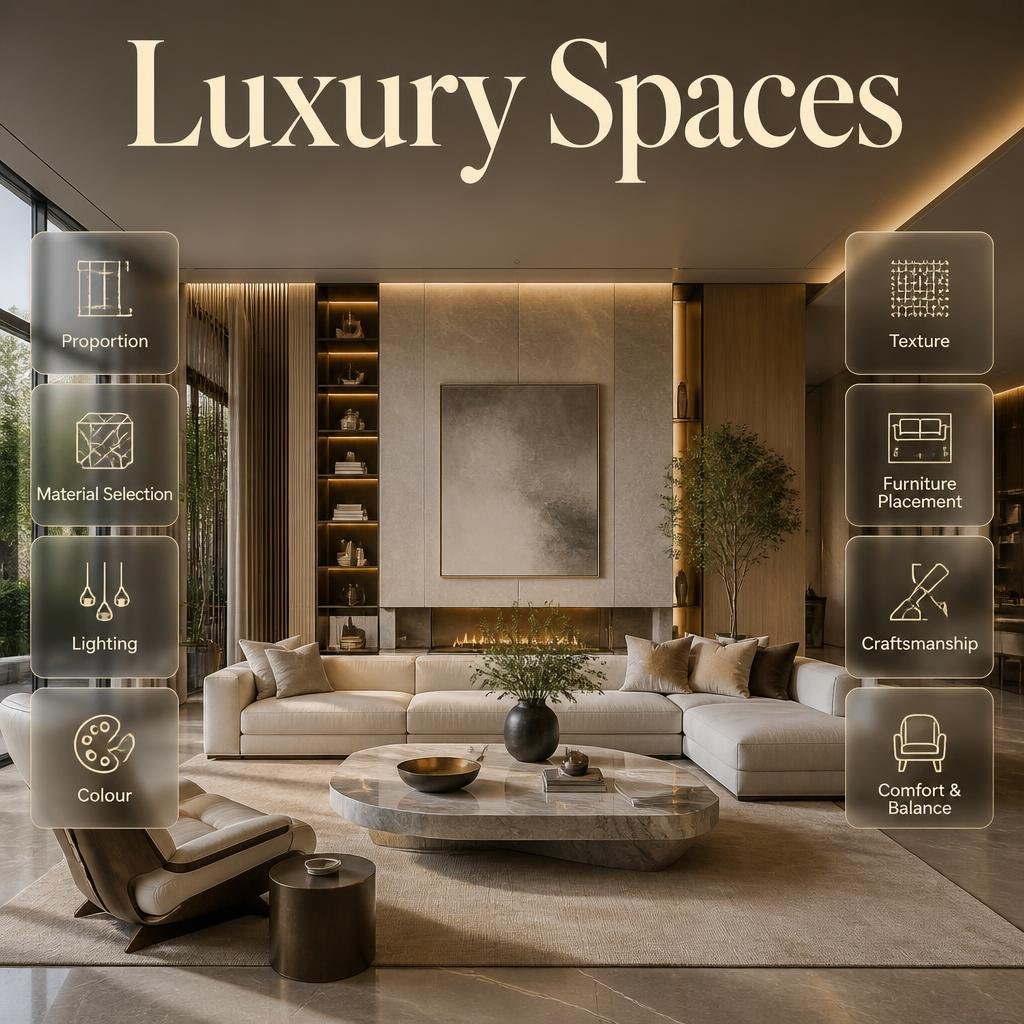
Luxury Spaces are created through proportion, material selection, lighting, colour, texture, furniture placement, craftsmanship, comfort, and visual balance. When these elements support one another, a room begins to feel intentional rather than simply decorated.
This is especially important because modern luxury interior design has moved away from the idea that luxury means adding more. Today’s sophisticated interiors often feel calmer, more personal, and more carefully edited.
A luxurious home should not feel like a showroom that nobody is allowed to touch. It should feel comfortable enough for everyday life while still looking considered and distinctive.
In this guide, you’ll learn how to create luxurious interiors from the ground up, how to choose furniture and materials, how lighting changes atmosphere, how to use colour and texture, how to make smaller rooms feel refined, how to avoid expensive design mistakes, and how to create an elegant home without relying on unnecessary decoration.
What Makes a Space Feel Luxurious?
A space feels luxurious when its major elements appear coordinated, appropriately scaled, comfortable, and carefully selected. Quality materials can help, but proportion, lighting, texture, craftsmanship, cleanliness, and visual restraint often have an even greater effect on the final impression.
Luxury begins with the overall experience of the room.
When you enter a well-designed luxury interior, you may immediately notice that:
- Furniture feels correctly sized for the room.
- Colours work together rather than compete.
- Lighting creates atmosphere instead of simply providing brightness.
- Materials have visual and tactile depth.
- Decorative objects are intentional.
- There is enough empty space around important features.
- Storage is controlled and clutter is limited.
- The room feels comfortable rather than overly formal.
- Different areas of the home feel connected.
- Nothing looks randomly selected.
This is why luxury design is fundamentally different from simply purchasing expensive things.
Imagine a living room with a $10,000 sofa that is too large for the space. The sofa may be beautiful, but the room could still feel cramped.
Now imagine a more affordable sofa that fits perfectly, surrounded by well-selected lighting, a quality rug, natural wood, carefully chosen artwork, and comfortable circulation.
The second room may create a stronger impression of luxury.
💡 Pro Tip: Before buying anything expensive, improve the room’s layout. Good proportion and circulation cost nothing, yet they can completely change how sophisticated a room feels.
Is Luxury Interior Design About Expensive Furniture?
Luxury interior design isn’t simply about expensive furniture. It is about combining quality, comfort, proportion, craftsmanship, material consistency, and thoughtful styling so that the room feels complete rather than overloaded.
Price can contribute to quality, but price alone cannot create good design.
A luxury interior should answer practical questions as well as visual ones.
Can people sit comfortably?
Can they move around easily?
Is there enough storage?
Does the lighting work at night?
Can the furniture survive everyday use?
Are surfaces easy to maintain?
Does the room still look attractive when it isn’t perfectly styled?
These questions separate a beautiful photograph from a successful home.
Expensive Versus Luxurious
| Expensive Approach | Luxury Approach |
|---|---|
| Focuses on individual prices | Focuses on the complete room |
| Uses many statement pieces | Uses selected focal points |
| Can rely heavily on branding | Emphasizes quality and craftsmanship |
| Often adds more decoration | Uses controlled decoration |
| May prioritize appearance | Balances appearance and comfort |
| Can become trend-heavy | Usually considers longevity |
| May ignore proportions | Gives proportion major importance |
The best luxury spaces don’t necessarily announce their price.
Instead, they communicate quality through subtle details.
How Do You Plan a Luxury Interior?
Planning should happen before shopping. Start with the architecture, measurements, natural light, existing features, lifestyle requirements, and movement patterns of the room.
Before selecting furniture, record:
- Room length and width
- Ceiling height
- Door locations
- Window dimensions
- Electrical outlets
- Radiators or air-conditioning units
- Built-in storage
- Main walking routes
- Existing architectural features
- Natural light direction
Then identify what the room needs to accomplish.
A living room may need to support conversation, television viewing, reading, entertaining, and relaxation.
A bedroom needs rest, storage, dressing, and privacy.
A dining room needs comfortable circulation around the table.
Luxury begins when these functions are solved without making the room visually complicated.
For broader inspiration about creating a coherent home rather than treating each room separately, DesignMode24 Interior Design provides a useful starting point.
Why Is Furniture Proportion So Important?
Furniture proportion determines whether a room feels balanced or awkward. Even expensive furniture can look wrong when it is too large, too small, too tall, or too visually heavy for the surrounding architecture.
This is one of the most common problems in residential interiors.
A large sectional may look impressive online, but if it blocks a doorway or leaves only a narrow walking route, it becomes a functional problem.
Likewise, a tiny coffee table placed in front of a large sectional can make the seating arrangement feel disconnected.
Think Beyond Measurements
Physical dimensions matter, but visual weight matters too.
Dark furniture often appears heavier than pale furniture.
A solid wooden cabinet can feel more substantial than a slim metal console.
A large patterned rug may visually dominate a room even when its physical dimensions are appropriate.
Therefore, consider both:
Physical scale + Visual weight = Perceived proportion
A balanced room usually contains a mixture of heavier and lighter elements.
For example:
- Large upholstered sofa
- Slim side tables
- Medium-sized coffee table
- Lightweight curtains
- Large artwork
- Open floor space
The result feels more balanced than placing several bulky pieces next to one another.
⚠ Common Mistake: Pushing every piece of furniture against the wall simply because the room is large. Sometimes bringing furniture slightly inward creates a stronger conversation area and a more intentional layout.
How Should You Choose Furniture for Luxury Spaces?
Choose furniture based on comfort, proportion, construction, material, maintenance, and visual relationship with the rest of the room.
Start with the largest pieces.
For a living room, that might mean:
- Sofa
- Main chairs
- Coffee table
- Rug
- Media or storage unit
- Side tables
- Decorative furniture
Don’t start with accessories.
Accessories should finish the design, not determine it.
What Should You Check Before Buying?
Ask:
- Does the furniture fit the room?
- Can it pass through the doorway?
- Is it comfortable?
- Does its height work with nearby furniture?
- Does the fabric suit the lifestyle?
- Is the colour compatible with the existing palette?
- Is there enough walking space?
- Does it visually compete with another focal point?
These questions can prevent expensive mistakes.
A beautiful chair that nobody wants to sit in isn’t a successful luxury purchase.
How Do Materials Create a Luxury Look?

Materials influence luxury because they create depth, texture, reflection, warmth, and tactile interest.
Commonly used materials include:
- Natural wood
- Marble
- Travertine
- Limestone
- Linen
- Wool
- Leather
- Cotton
- Velvet
- Brushed brass
- Aged metal
- Glass
- Textured plaster
- Natural stone
- Handmade ceramics
The goal isn’t to use all of them.
Too many materials can make a room visually confusing.
Instead, select a primary material family and then introduce complementary textures.
For example:
Natural oak + limestone + linen + aged brass
creates a warm and sophisticated combination.
Another room might use:
Walnut + dark stone + leather + bronze
for a deeper atmosphere.
The materials should reflect the architecture and the lifestyle of the people using the room.
For more detailed guidance on choosing finishes and surfaces, Wall Treatments can be useful when deciding how walls contribute to the overall composition.
Why Does Texture Matter in Luxury Interiors?
Texture prevents a room from feeling flat.
A room containing only smooth painted walls, polished furniture, glass, and glossy surfaces can appear visually cold.
Introduce contrast through:
- Linen curtains
- Wool rugs
- Bouclé upholstery
- Natural wood
- Stone
- Woven baskets
- Textured ceramics
- Matte finishes
- Soft bedding
- Ribbed or fluted surfaces
Texture doesn’t always need to be dramatic.
Sometimes the most luxurious interiors use subtle differences that become noticeable only when light moves across the room.
⭐ Expert Tip: If your room already contains enough furniture but still feels unfinished, examine texture before purchasing more accessories.
Which Colours Work Best for Luxury Spaces?
Luxury interiors can use almost any colour when it is controlled properly. Warm neutrals, earthy shades, muted greens, deep blues, charcoal, cream, taupe, and warm browns are particularly useful because they can create depth without excessive visual noise.
A sophisticated palette often begins with one dominant neutral.
For example:
Warm white → beige → taupe → walnut → muted brass
or:
Soft grey → charcoal → natural oak → cream → black accents
Colour doesn’t need to be complicated.
A useful approach is the 60–30–10 concept:
- Approximately 60% dominant colour
- Approximately 30% secondary colour
- Approximately 10% accent colour
This isn’t a strict mathematical rule. It is simply a useful way to prevent colours from competing.
If you’re working on a larger colour strategy, the Paint Color section can provide additional ideas.
Are Neutral Luxury Spaces Always Better?
No. Neutral colours are popular because they are flexible and timeless, but luxury doesn’t require beige or white walls.
Deep green can create a sophisticated library.
Navy can make a bedroom feel calm and dramatic.
Charcoal can create an architectural atmosphere.
Terracotta can add warmth.
Burgundy can create richness when used selectively.
The important thing is balance.
A strong wall colour usually needs supporting elements that prevent it from dominating the entire room.
For example:
Deep green wall + cream sofa + walnut furniture + warm brass + soft lighting
can feel considerably more balanced than combining the same green with several unrelated strong colours.
How Does Lighting Transform Luxury Spaces?
Lighting is one of the most powerful tools in interior design because it affects colour, texture, proportion, atmosphere, and focal points.
A room that looks beautiful during daylight can feel completely different at night if it relies on one bright ceiling fixture.
A more sophisticated lighting plan uses layers.
Ambient Lighting
Ambient lighting provides general illumination.
Examples include:
- Recessed ceiling lights
- Chandeliers
- Pendant fixtures
- Cove lighting
Task Lighting
Task lighting supports specific activities.
Examples include:
- Reading lamps
- Desk lamps
- Kitchen worktop lighting
- Bedside lighting
Accent Lighting
Accent lighting directs attention toward particular features.
Examples include:
- Artwork
- Architectural walls
- Shelving
- Plants
- Decorative objects
- Stone surfaces
The three layers should complement each other.
Connected Living is particularly relevant when lighting, automation, comfort, and technology are integrated into the home’s wider design.
Can Smart Technology Make a Home Feel More Luxurious?
Technology can contribute to luxury when it improves comfort without visually dominating the interior.
Useful systems include:
- Smart lighting
- Automated curtains
- Climate controls
- Integrated speakers
- Smart switches
- Hidden charging points
- Home automation
- Scene-based lighting
The best technology often becomes almost invisible.
Instead of installing multiple visible devices, design the system so that the technology supports the architecture.
For example, a homeowner might have lighting scenes for:
Morning → Work → Evening → Dinner → Relaxation
The room remains physically unchanged, but its atmosphere can adapt to different activities.
This is a more useful concept of modern luxury than simply filling a room with gadgets.
How Do You Create a Luxury Living Room?

The living room usually acts as one of the main social spaces in a home, so comfort and visual balance should work together.
Start with the seating arrangement.
Decide whether the room is primarily for:
- Conversation
- Television
- Entertaining
- Reading
- Family activities
- A combination of these
Then position the largest furniture accordingly.
Use One Main Focal Point
A luxury living room generally benefits from a clear focal point.
This might be:
- Fireplace
- Artwork
- Architectural wall
- Large window
- Statement light
- Stone feature
- Beautiful view
The other elements should support rather than compete with it.
A common mistake is creating several “statement” areas at once.
If the chandelier, television wall, coffee table, artwork, sofa, and accessories all demand attention, the room becomes visually noisy.
How Should You Style a Coffee Table or Console?
Luxury styling depends on visual hierarchy rather than filling every available surface.
Instead of placing objects at identical intervals, combine different heights and forms.
For example:
Large object → medium object → small object → empty space
This creates rhythm.
A coffee table might include:
- One tray
- Two books
- A sculptural object
- A small bowl
- A low arrangement
A console might include:
- Large artwork
- One lamp
- Tall vase
- Small decorative object
The empty space is intentional.
For additional styling ideas, Accent Pieces can help you think about decorative objects as part of the overall composition rather than isolated purchases.
How Do You Make a Bedroom Feel Luxurious?
A luxurious bedroom should feel calm before it feels impressive.
The bed is normally the largest visual element, so its scale, headboard, bedding, and position matter greatly.
Use:
- Quality bedding
- Soft layered lighting
- Comfortable upholstery
- Coordinated bedside tables
- Curtains with sufficient fullness
- A suitable rug
- Controlled accessories
- Practical storage
Avoid creating a bedroom that looks beautiful but is difficult to use.
The room needs enough clearance around the bed, convenient lighting, charging access, and practical storage.
For detailed planning, Bedroom Planning and Layout can help establish the foundation before you begin styling.
How Can a Luxury Bedroom Remain Comfortable?
Luxury shouldn’t mean excessive decoration.
A bedroom should support sleep and relaxation.
Choose soft textures and reduce visual distractions.
A useful layering sequence is:
Mattress → fitted sheet → main bedding → blanket → throw → pillows
Different materials can provide depth without relying on excessive patterns.
Linen, cotton, wool, velvet, and knitted textures can work together when the colours remain coordinated.
Lighting also matters.
Use bedside lamps or adjustable fixtures rather than depending entirely on bright overhead illumination.
Can Small Rooms Look Luxurious?
Small rooms can absolutely look luxurious. The key is to control scale, clutter, storage, colour, and movement instead of trying to squeeze too many luxury features into limited space.
Start by removing unnecessary objects.
Then check whether the existing furniture is appropriately scaled.
Useful strategies include:
- Slim-profile furniture
- Built-in storage
- Vertical storage
- Light or controlled colour palettes
- Large mirrors where appropriate
- Layered lighting
- Fewer accessories
- Clear walking routes
Don’t automatically choose tiny furniture for a small room.
Sometimes one appropriately sized sofa looks better than several small chairs.
Luxury comes from clarity.
How Important Is Storage in Luxury Design?
Good storage is one of the hidden foundations of luxury.
A room may contain beautiful furniture and materials, but visible clutter immediately reduces the sense of refinement.
Use:
- Built-in cabinets
- Concealed storage
- Drawers
- Storage beds
- Closed shelving
- Multi-purpose furniture
Open shelving should generally contain fewer objects than people initially expect.
The goal isn’t to hide everything.
It’s to decide what deserves to remain visible.
A few beautiful objects become more powerful when surrounded by controlled negative space.
Why Is Negative Space Important?

Negative space is the empty area around furniture, artwork, and decorative objects.
It gives the eye somewhere to rest.
Without negative space, a room can become visually exhausting.
Imagine two console tables.
The first contains:
- Four vases
- Three frames
- Candles
- Books
- Bowls
- Plants
- Decorative boxes
The second contains:
- One large artwork
- One lamp
- One sculptural vase
- Two books
The second arrangement may look more luxurious even though it contains fewer items.
That’s because every object has more visual importance.
📌 Quick Tip: Before buying another decorative object, remove two existing objects and see whether the room improves.
Should Luxury Spaces Use Marble?
Marble can create a strong sense of quality, but it should be used intentionally.
Potential applications include:
- Kitchen islands
- Bathroom vanities
- Fireplace surrounds
- Side tables
- Feature walls
- Decorative surfaces
Marble becomes more effective when balanced with warmer materials.
For example:
Marble + natural wood + linen + warm lighting
creates a different atmosphere from:
Marble + chrome + glass + cool lighting
The first combination introduces softness.
The second emphasizes a more contemporary, polished aesthetic.
Neither approach is automatically correct. The choice depends on the character you want.
What Role Do Wall Treatments Play?
Walls occupy a large percentage of a room’s visual field, so ignoring them can make an otherwise beautiful interior feel unfinished.
Wall treatments may include:
- Paint
- Decorative plaster
- Wood panels
- Fluted panels
- Stone
- Wallpaper
- Moulding
- Architectural detailing
The right treatment depends on the room’s architecture.
A heavily decorated wall may be unnecessary in a room that already has strong architectural features.
Conversely, a simple room may benefit greatly from a textured or architectural wall.
The goal is to support the room’s design language, not add decoration for its own sake.
How Do You Create Luxury Without Overspending?
You don’t have to renovate an entire house to make it feel more refined.
Start with the elements that create the biggest visual impact.
High-Impact Improvements
- Declutter visible surfaces.
- Rearrange furniture.
- Improve lighting.
- Replace poorly fitting curtains.
- Add a properly sized rug.
- Improve bedding.
- Coordinate hardware.
- Introduce natural textures.
- Add one strong artwork.
- Remove unnecessary decoration.
This approach is often more effective than buying ten new decorative objects.
Where Should You Spend More?
| Worth Prioritizing | Can Often Be More Affordable |
|---|---|
| Sofa | Small accessories |
| Mattress | Decorative bowls |
| Lighting | Seasonal décor |
| Curtains | Small ornaments |
| Flooring | Trend accessories |
| Custom storage | Replaceable styling |
| Frequently used furniture | Temporary décor |
Think about how often you touch, sit on, walk across, or look at something.
Spend accordingly.
What Are the Biggest Luxury Interior Design Mistakes?
Luxury design mistakes often happen because homeowners focus on individual objects instead of the complete room.
Mistake 1: Buying Before Measuring
A beautiful piece can become a problem if it doesn’t fit.
Why it happens: Online shopping encourages impulse decisions.
Why it’s harmful: Poor scale affects circulation and balance.
Solution: Measure first and create a basic furniture plan.
Mistake 2: Making Everything Match
Matching furniture sets can make a room look predictable.
Better approach: Coordinate rather than duplicate.
Use related materials and colours while allowing differences in shape, texture, and finish.
Mistake 3: Using Too Many Metallic Finishes
Gold, chrome, silver, bronze, brass, and black metal can quickly become confusing.
Choose a dominant metal.
Then use other finishes sparingly.
Mistake 4: Overusing Gloss
Gloss can reflect light beautifully, but too much creates visual competition.
Balance polished surfaces with:
- Matte finishes
- Wood
- Fabric
- Stone
- Textured plaster
Mistake 5: Ignoring Lighting
Even beautiful materials can look ordinary under poor lighting.
Plan lighting before the final styling stage.
Mistake 6: Decorating Every Corner
Empty space is not wasted space.
It is part of the composition.
Mistake 7: Copying Online Rooms
A photograph doesn’t show everything.
The original room may have different:
- Dimensions
- Ceiling height
- Natural light
- Furniture scale
- Architecture
- Storage
- Lifestyle requirements
Take inspiration from the principle rather than copying the room exactly.
How Can Luxury Spaces Feel More Personal?
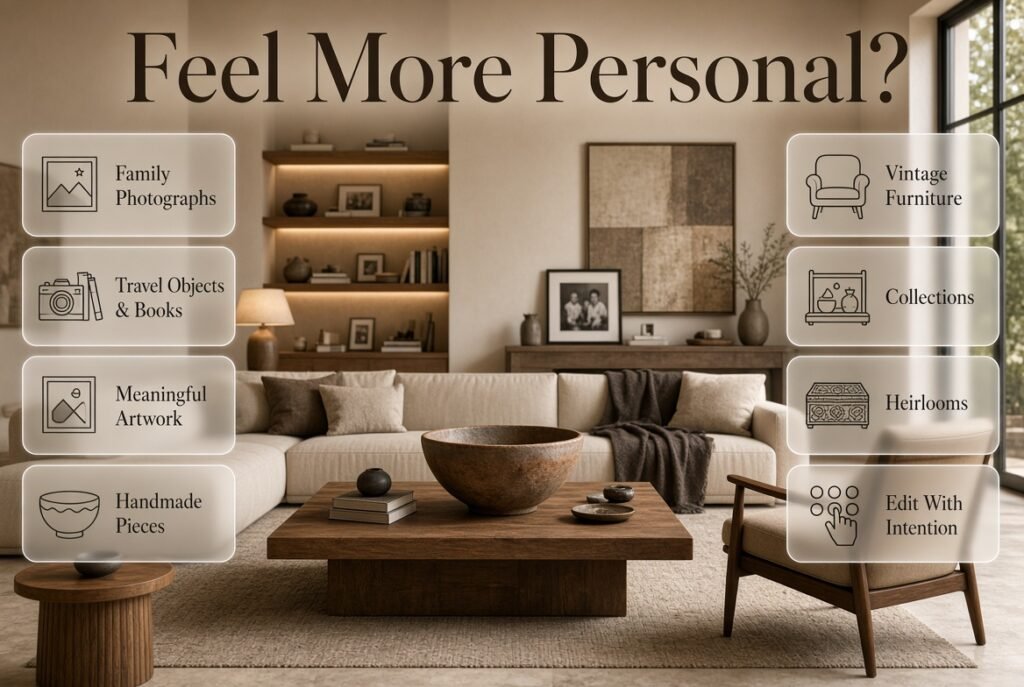
A luxury home shouldn’t look like it belongs to nobody.
Personal elements make the space feel authentic.
Consider incorporating:
- Family photographs
- Travel objects
- Books
- Artwork with personal meaning
- Handmade pieces
- Vintage furniture
- Collections
- Heirlooms
The trick is editing.
You don’t need to display everything you own.
Select pieces that contribute to the room.
A handmade ceramic bowl from a meaningful trip may create more personality than a generic decorative object purchased simply because it is fashionable.
How Can You Create a Luxury Outdoor Space?
Luxury can continue beyond the interior.
Balconies, terraces, patios, courtyards, and gardens can be designed as extensions of the home’s interior.
Consider:
- Comfortable outdoor furniture
- Weather-resistant fabrics
- Natural materials
- Layered lighting
- Greenery
- Privacy
- Defined seating zones
- Outdoor rugs
- Decorative planters
The colour and material language can relate to the interior.
For example, if the interior uses warm wood and neutral fabrics, the outdoor space can repeat those tones through furniture and planters.
For outdoor inspiration, Robert MyGardenAndPatio offers a useful complementary resource, while Can I Design My Own Garden Kdagardenation can help when you’re considering a more hands-on approach to garden planning.
How Do You Connect Different Rooms?
A luxury home doesn’t require every room to look identical.
Instead, create visual continuity.
You can repeat:
- Flooring
- Wood tone
- Hardware
- Accent colour
- Architectural detailing
- Lighting temperature
- Material family
For example:
Living room: walnut + cream + brass
Bedroom: walnut + cream + soft bronze
Dining room: walnut + cream + dark metal
The rooms feel related without becoming copies.
This approach creates a more mature design language.
How Can DIY Work in Luxury Interiors?
DIY projects can work well when they are carefully executed and appropriate to the design.
Suitable projects may include:
- Painting
- Simple wall treatments
- Furniture refinishing
- Decorative styling
- Small storage improvements
- Artwork framing
- Accessory arrangements
However, luxury depends heavily on execution.
Uneven paint, poorly installed panels, cheap-looking hardware, or unfinished edges can undermine the result.
Use professional help for work involving structural changes, major electrical modifications, plumbing, or other specialist requirements.
For inspiration, DIY Home Projects can help identify areas where a personal project may fit naturally into a wider design plan.
How Should You Approach Modern Luxury?
Modern luxury isn’t necessarily about futuristic furniture or glossy surfaces.
It can mean:
- Cleaner lines
- Better technology
- Integrated storage
- High-quality materials
- Comfortable furniture
- Controlled lighting
- Flexible spaces
- Sustainable material choices
- Less visual clutter
The strongest contemporary spaces often combine modern functionality with warm materials.
For example:
Minimal architecture + natural wood + textured fabric + smart lighting
can feel modern without becoming cold.
A Professional Step-by-Step Method for Creating Luxury Spaces
If you’re redesigning a room, use this sequence rather than buying items randomly.
Step 1: Understand the Room
Measure the architecture.
Why it matters: Everything depends on available space.
Professional advice: Photograph the room and mark doors, windows, outlets, and fixed elements.
Step 2: Define the Function
Decide how the room will actually be used.
Why it matters: A room designed only for photographs may fail in everyday life.
Common mistake: Designing for appearance before considering lifestyle.
Step 3: Establish the Focal Point
Choose the feature that should receive the most attention.
Why it matters: It creates hierarchy.
Step 4: Select the Large Furniture
Choose the sofa, bed, dining table, or main storage first.
Why it matters: These pieces determine scale.
Step 5: Build the Material Palette
Choose complementary materials.
Why it matters: Material consistency makes the room feel intentional.
Step 6: Design the Lighting
Create ambient, task, and accent layers.
Why it matters: Lighting determines how the materials and colours are experienced.
Step 7: Add Textiles
Use curtains, rugs, cushions, upholstery, and bedding.
Why it matters: Textiles soften hard architecture and add comfort.
Step 8: Add Artwork
Select pieces that complement the room rather than simply filling empty walls.
Step 9: Style Accessories
Use different heights, shapes, and textures.
Leave negative space.
Step 10: Edit
Remove anything unnecessary.
This final step is often where the room starts to look genuinely refined.
What Should You Avoid When Designing Luxury Spaces?
Avoid designing according to a checklist of expensive products.
A luxury interior doesn’t require:
- A huge chandelier
- Marble everywhere
- Gold everywhere
- Designer furniture in every room
- Oversized artwork
- Excessive mirrors
- Matching furniture
- Dozens of accessories
Instead, ask whether every decision improves the room.
If an item doesn’t improve function, comfort, composition, or personality, question whether it needs to remain.
How Does Architecture Influence Luxury?
Interior design doesn’t exist separately from architecture.
Ceiling height, windows, columns, beams, door proportions, flooring, wall thickness, and natural light all influence how a room should be designed.
A historic home may benefit from respecting original details.
A modern apartment may suit cleaner furniture and stronger geometric forms.
A coastal home may benefit from lighter materials and softer textures.
A dark room may need a different palette and lighting strategy than a bright south-facing space.
This is why copying a design from another house often produces disappointing results.
The architecture is different.
How Can You Make Luxury Feel Timeless?
Timelessness doesn’t mean avoiding all modern ideas.
It means being selective about which trends become permanent.
Use trends in:
- Cushions
- Artwork
- Small accessories
- Paint
- Replaceable lighting
- Decorative objects
Be more cautious with trends when choosing:
- Flooring
- Kitchen cabinetry
- Built-in furniture
- Expensive stone
- Major architectural changes
A timeless room can still feel current because its foundation is strong.
How Does Home Improvement Support Luxury Design?
Luxury isn’t created only through decoration.
Sometimes improving the underlying condition of the home has a greater impact.
This can include:
- Better flooring
- Improved storage
- Updated lighting
- Wall repair
- Better doors
- Improved hardware
- Functional electrical planning
- Better insulation
- Window improvements
A beautifully decorated room with damaged walls or poorly functioning storage will still feel incomplete.
For broader ideas about improving the physical quality of a home, explore Home Improvement.
How Do You Know When a Room Is Finished?
A room is usually finished when removing or adding another item no longer produces a meaningful improvement.
Walk around the space at different times of day.
Check it:
- In morning daylight
- During afternoon light
- At night
- With lights on
- With lights dimmed
- From the entrance
- From the main seating position
Take photographs.
Photography can reveal problems that aren’t obvious while you’re standing in the room.
Look for:
- Crowded corners
- Uneven visual weight
- Competing focal points
- Empty walls that genuinely need attention
- Objects that feel unnecessary
- Furniture blocking movement
Then edit.
What makes a space look luxurious?
A luxurious space is usually defined by proportion, material quality, visual balance, lighting, and attention to detail rather than simply by expensive furniture. A room can feel high-end even with a relatively simple design when every element appears intentional and works well with the overall architecture.
Start with a strong foundation: suitable furniture proportions, a cohesive colour palette, quality-looking finishes, layered lighting, and enough breathing room between major pieces. Natural materials such as wood, stone, linen, wool, metal, and glass can also add depth and sophistication when they are used thoughtfully.
Key points to focus on:
Choose fewer but more purposeful decorative pieces.
Prioritize proportion and scale before adding accessories.
Combine different textures instead of relying on one material.
Use warm, layered lighting to create depth.
Keep visual clutter under control.
The goal is not to make every part of the room look expensive. Luxury comes from creating a space that feels considered, comfortable, balanced, and visually refined.
How can I make my home look luxurious without spending a lot of money?
You don’t necessarily need a large budget to create a luxurious-looking home. Good styling, consistency, proportion, and presentation can have a bigger visual impact than the price of individual items.
Begin by removing unnecessary clutter and arranging the furniture so the room has clear circulation. Then improve the elements that occupy the most visual space, such as curtains, rugs, lighting, wall colour, and upholstery. A well-fitted curtain, properly sized rug, or attractive light fixture can make an ordinary room feel considerably more polished.
You can also create a sophisticated appearance by repeating a small number of finishes or colours throughout the room. For example, subtle brass details, warm wood tones, cream upholstery, and soft neutral walls can create a cohesive visual language without requiring luxury-brand furniture.
Budget-friendly improvements include:
Decluttering surfaces and open shelving.
Upgrading outdated light fixtures.
Using full-length curtains.
Adding one large piece of artwork instead of many small pieces.
Introducing quality-looking cushions and throws.
Improving the arrangement of existing furniture.
Using mirrors strategically to enhance light and space.
The key is editing rather than constantly adding. A carefully styled room with fewer elements often looks more sophisticated than a room filled with expensive accessories.
What colours are best for creating a luxurious interior?
Luxury interiors can work with many different colour schemes, but neutral, earthy, and carefully controlled palettes are particularly effective because they create a calm and cohesive backdrop for furniture, lighting, textures, and architectural details.
Warm whites, cream, beige, taupe, greige, soft brown, charcoal, muted green, and deep blue can all work beautifully when their undertones are compatible. The important factor is not simply choosing a “luxury colour,” but creating relationships between the colours throughout the room.
A sophisticated palette often follows a simple structure: a dominant background colour, a secondary supporting tone, and a smaller accent colour. This creates visual hierarchy without making the room feel chaotic.
Consider these combinations:
Warm white + beige + natural wood
Cream + taupe + brushed metal
Greige + walnut + charcoal
Soft beige + muted green + brass
Deep blue + cream + warm wood
Avoid using too many competing colours simply because each one looks attractive individually. Luxury is often created through restraint and consistency, allowing textures and architectural details to become part of the visual interest.
How do you make a living room look luxurious and elegant?
A luxurious living room starts with layout and proportion, not decoration. The sofa, chairs, coffee table, rug, lighting, and artwork should relate to one another in size and placement. Even expensive furniture can look unrefined when pieces are incorrectly scaled or pushed randomly against the walls.
Begin by establishing a comfortable conversation area and ensuring that people can move naturally around the furniture. A properly sized rug can visually connect the seating arrangement, while a substantial coffee table can give the composition a stronger centre.
Lighting is equally important. Instead of depending on one ceiling fixture, combine ambient, task, and accent lighting. Floor lamps, table lamps, wall lighting, and carefully positioned decorative fixtures can create layers of light and make the room feel more atmospheric in the evening.
For a more polished living room:
Select furniture according to the room’s scale.
Use a properly proportioned area rug.
Add different tactile materials such as wood, linen, leather, stone, or wool.
Keep the coffee table styling intentional.
Use artwork at an appropriate scale.
Create multiple lighting levels.
Leave enough negative space around major furniture.
A luxury living room should ultimately feel comfortable and effortless, rather than like a showroom where every object is competing for attention.
What are the biggest mistakes that make a luxury interior look cheap?
One of the most common mistakes is assuming that luxury means adding more expensive-looking objects. Too many decorative accessories, excessive metallic finishes, oversized furniture, artificial-looking materials, and inconsistent colours can actually reduce the sense of sophistication.
Another frequent problem is poor proportion. A beautiful sofa that is too large for the room, a tiny rug underneath substantial furniture, or artwork that is too small for a large wall can make the entire interior feel visually unbalanced.
Lighting is another overlooked issue. Extremely bright white lighting can flatten textures and make carefully selected materials appear harsh. Luxury interiors generally benefit from a more layered approach where different light sources create depth and atmosphere.
Avoid these common mistakes:
Overusing gold or shiny metallic finishes.
Filling every surface with accessories.
Choosing furniture that is too large for the room.
Using rugs that are too small.
Mixing too many unrelated design styles.
Relying on a single harsh ceiling light.
Copying trends without considering the home’s architecture.
Prioritizing appearance while ignoring comfort.
The most successful luxury spaces usually have restraint, consistency, quality, and intentionality. Instead of asking what else you can add, ask what can be improved, simplified, or removed.
Conclusion
Creating a luxurious space is not simply about choosing expensive furniture, adding decorative accessories, or filling a room with fashionable finishes. True luxury comes from the way every element works together. Proportion, lighting, material selection, colour, texture, comfort, and thoughtful styling all contribute to how a space feels and functions.
A sophisticated interior should feel intentional rather than overloaded. Well-chosen furniture, carefully layered lighting, refined textures, natural materials, and a controlled colour palette can create an elegant atmosphere without making the home feel artificial or excessive. Even small improvements, such as better furniture placement, properly sized rugs, full-length curtains, or more considered accessories, can make a noticeable difference.
The most timeless luxury spaces also reflect the people who live in them. They combine visual elegance with practical comfort, allowing the home to feel beautiful while remaining easy to live in. Instead of following every passing trend, focus on quality, balance, and details that will continue to feel appropriate over time.
Ultimately, luxury interior design is about creating a sense of comfort, character, refinement, and harmony. When these elements are carefully balanced, even a simple home can feel remarkably sophisticated—and that is what makes a luxury space genuinely memorable.