
Introduction
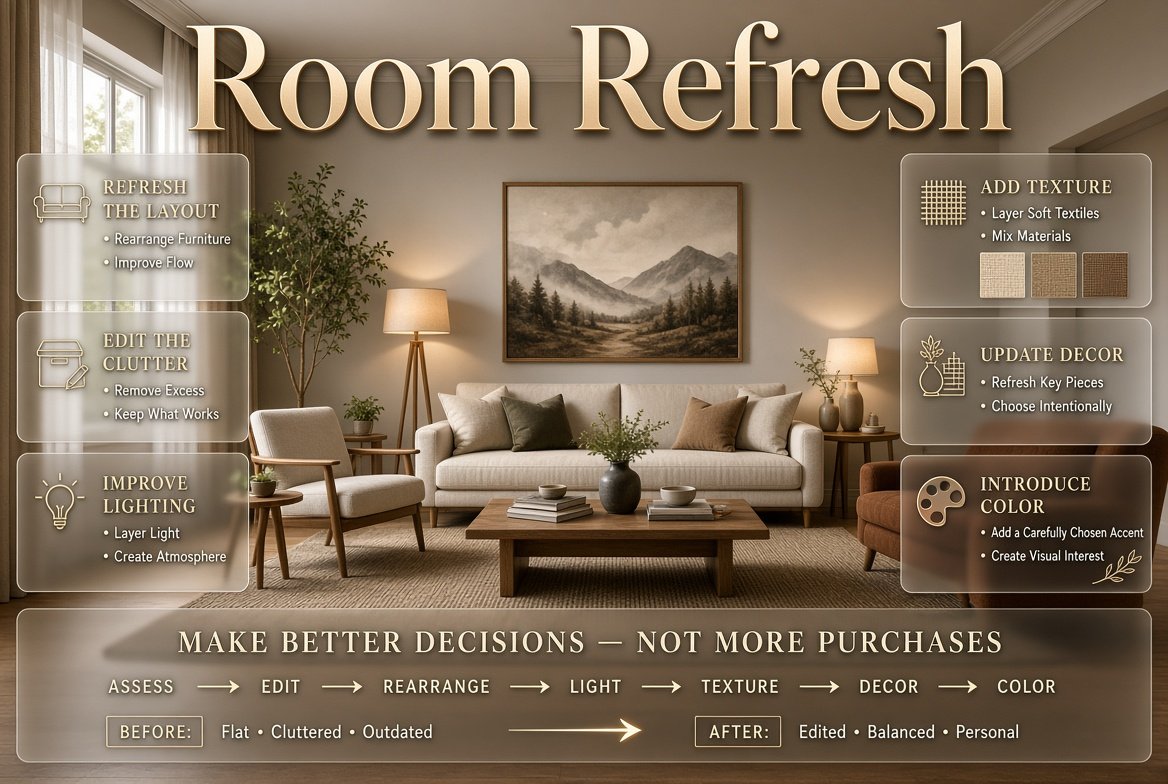
Room Refresh | A room can start feeling tired even when nothing is technically wrong with it. The sofa still works, the walls are still painted, and the furniture is still usable, yet the space somehow feels flat, cluttered, outdated, or simply not like you anymore.
That’s where a room refresh can make a surprisingly big difference.
You don’t always need new furniture, a major renovation, or a large decorating budget. Often, changing the layout, editing clutter, improving lighting, introducing texture, updating a few decorative pieces, or adding a carefully chosen color can completely change how a room feels.
A successful refresh is less about buying more and more about making better decisions with what you already have.
For broader inspiration and practical interior ideas, explore DesignMode24 Interior Design. This guide will show you how to refresh a room step by step, what changes create the biggest visual impact, how to work with different budgets, and which common mistakes can make a refreshed room look more cluttered instead of more polished.
What Is a Room Refresh?
A room refresh is a relatively simple update that improves the appearance, comfort, function, or atmosphere of an existing room without requiring a complete renovation. It can include rearranging furniture, decluttering, changing textiles, updating lighting, introducing artwork, repainting a wall, adding plants, or replacing a few outdated accessories.
The key difference between a refresh and a renovation is the scale.
A renovation may involve construction, new flooring, electrical work, cabinetry, plumbing, or structural changes. A refresh focuses on visible improvements that can usually be completed with less time, disruption, and money.
Why Does a Room Need a Refresh?
Rooms gradually become visually stale because our eyes get used to them.
Furniture stays in the same position for years. Decorative objects accumulate. Fabrics become worn. Lighting may no longer suit the way the room is being used. A once-attractive arrangement can eventually feel predictable.
A refresh gives the room a new visual rhythm.
It can also solve practical problems. Perhaps the sofa blocks movement, the coffee table is too large, the room lacks task lighting, or there isn’t enough storage. In these situations, refreshing the room isn’t just about making it prettier. It’s about making it work better.
How Do You Refresh a Room Without Buying Everything New?
Start by removing clutter, then evaluate the room’s layout, lighting, color balance, textiles, and decorative elements. Rearrange the furniture before purchasing anything. Keep useful pieces, remove items that no longer serve the room, and introduce only a few targeted updates that solve specific visual or functional problems.
This approach prevents one of the biggest decorating mistakes: shopping before understanding what the room actually needs.
Start With a Room Audit
Before moving a single chair, stand at the entrance and look at the room as if you were seeing it for the first time.
Ask yourself:
- What is the first thing I notice?
- Does the room feel crowded?
- Is there a clear focal point?
- Is furniture easy to move around?
- Does the lighting feel warm and comfortable?
- Are there too many small decorative objects?
- Does the color palette feel intentional?
- Are there empty areas that look accidental?
- Are there pieces that feel outdated or unnecessary?
Take a few photographs from different corners.
Photos can reveal problems you don’t notice while standing inside the space. A rug that looks acceptable in person may appear too small in a photograph. A wall may look overly empty. A collection of accessories may suddenly appear visually noisy.
💡 Pro Tip: Photograph the room before making changes. After the refresh, compare the images. This is one of the easiest ways to judge whether your changes actually improved the space.
Step 1: Declutter Before You Decorate
Decluttering is often the cheapest and most powerful room-refresh technique.
A room can have beautiful furniture and expensive décor but still look unfinished when every surface is covered with objects.
Start with visible surfaces:
- Coffee tables
- Side tables
- Shelves
- Console tables
- Media units
- Window areas
- Open storage
Remove everything temporarily.
Don’t decide immediately what should return. Place the objects in another area and look at the room without them.
You may discover that you only need to put back 30–50% of what was originally there.
Use the Keep, Move, Remove Method
Divide accessories into three groups:
Keep: Items that are useful, beautiful, meaningful, or visually important.
Move: Items that belong somewhere else or would work better in another room.
Remove: Broken, duplicated, outdated, or unnecessary pieces.
This simple system prevents emotional attachment from turning into visual clutter.
If you want more practical home-improvement ideas after your initial cleanup, your Home Improvement resources can provide useful direction for larger changes.
Step 2: Rearrange the Furniture
Furniture placement has an enormous effect on how a room feels.
You don’t need new furniture to create a new room. Sometimes moving the sofa away from the wall, rotating a chair, changing the position of the rug, or shifting a coffee table can make the entire space feel more balanced.
Create a Better Conversation Area
In a living room, seating should usually encourage conversation rather than simply point toward a television.
Try arranging:
- Sofa + two chairs
- Sofa + loveseat
- Two sofas facing each other
- Sectional + accent chair
- Sofa + chair + small side table
Leave comfortable pathways between furniture.
A beautiful room that is difficult to walk through is not a successful design.
Test More Than One Layout
Don’t stop at the first arrangement.
Try at least two or three options.
For example:
Layout A
[ Chair ]       [ Chair ]

        [ Coffee Table ]

          [ Sofa ]

             TV
Layout B
[ Sofa ]       [ Chair ]

      [ Coffee Table ]

[ Chair ]       [ Lamp ]

             TV
The best layout depends on the room’s doors, windows, architectural features, traffic patterns, and primary function.
⭐ Expert Tip: Before moving heavy furniture, use painter’s tape to mark the proposed furniture footprint on the floor. It lets you test proportions without repeatedly lifting and dragging furniture.
Step 3: Refresh the Room With Color
Color can change the personality of a room faster than almost any other decorating element.
But a room refresh doesn’t necessarily mean repainting every wall.
You can introduce color through:
- Cushions
- Throws
- Curtains
- Artwork
- Rugs
- Lampshades
- Decorative objects
- Plants
- Accent furniture
- One painted wall
If the room already has a neutral foundation, even one stronger color can create a noticeable change.
How Do You Choose a Color for a Room Refresh?
Start with the colors that already exist in the room. Look at the sofa, flooring, curtains, artwork, and larger furniture pieces. Choose one or two complementary shades rather than introducing several unrelated colors.
For example, a beige room could be refreshed with:
- Olive green
- Terracotta
- Warm brown
- Muted blue
- Charcoal
- Soft black
A white room could use:
- Navy
- Sage
- Rust
- Chocolate brown
- Dusty pink
For more color-specific inspiration, explore the Paint Color section before committing to a new shade.
Don’t Ignore Undertones
Two beige colors aren’t necessarily the same.
One may have yellow undertones while another leans pink, gray, or green.
This matters because a new paint color can clash with existing flooring, furniture, or countertops even when the colors look similar on a store card.
Always test paint samples in the actual room.
Observe them in:
- Morning light
- Afternoon light
- Evening artificial light
- Cloudy conditions
⚠ Common Mistake: Choosing paint solely from a tiny color card. Lighting and surrounding materials can dramatically change how a paint color appears.
Step 4: Improve the Lighting
Many rooms don’t need more décor. They need better lighting.
A single ceiling fixture often creates harsh shadows and makes a room feel less inviting.
A layered lighting scheme is more effective.
Use Three Lighting Layers
Ambient lighting provides general illumination.
Task lighting helps with specific activities such as reading, working, or cooking.
Accent lighting highlights artwork, architectural features, plants, shelves, or decorative objects.
For a living room, you might combine:
- Ceiling light
- Floor lamp
- Table lamp
- Wall lighting
- Accent light
This creates different moods throughout the day.
A bright setting works for cleaning and activities. Softer lamps create a calmer atmosphere in the evening.
📌 Quick Tip: Replace a harsh cool-white bulb with a warmer bulb where appropriate. The right color temperature can make furniture, wood, fabrics, and wall colors feel considerably more comfortable.
Step 5: Add Texture Instead of More Color
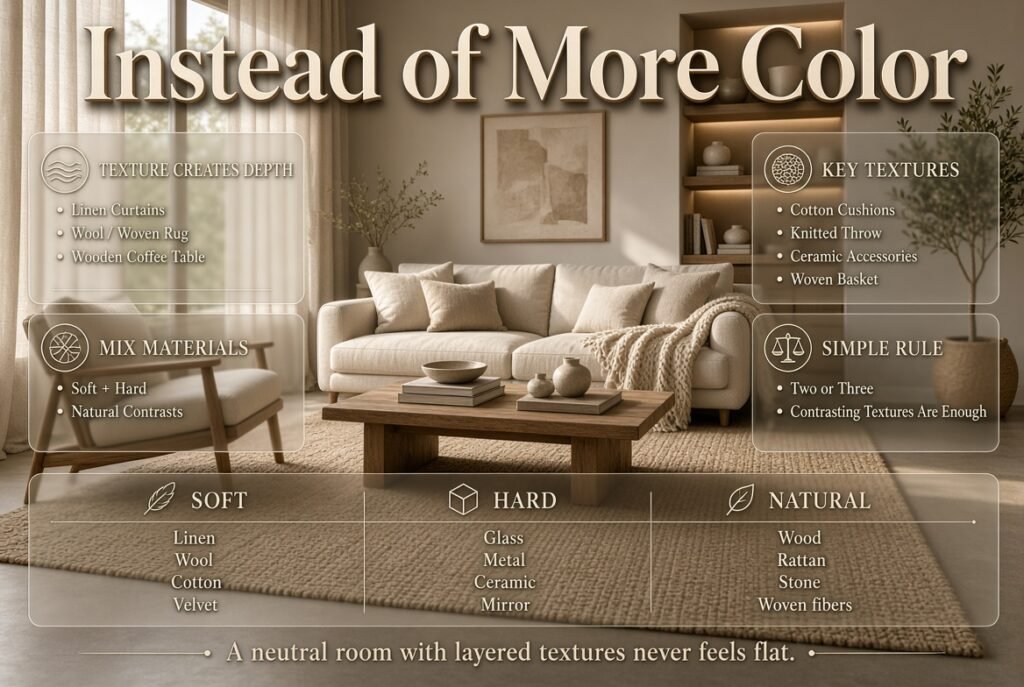
If your room already has a good color palette but still feels boring, the problem may be texture.
Texture creates visual depth.
Imagine a neutral living room containing:
- Linen curtains
- A wool or woven rug
- A wooden coffee table
- Ceramic accessories
- Cotton cushions
- A knitted throw
- A woven basket
The colors may be simple, but the room won’t feel flat because the materials interact visually.
What Textures Work Well Together?
Try mixing contrasting materials:
| Soft | Hard | Natural |
|---|---|---|
| Linen | Glass | Wood |
| Wool | Metal | Rattan |
| Cotton | Ceramic | Stone |
| Velvet | Mirror | Woven fibers |
You don’t need every material in one room. Two or three contrasting textures are often enough.
For broader visual inspiration, the Beautiful Interior collection can help you think about how materials and decorative details work together.
Step 6: Refresh Soft Furnishings
Soft furnishings are ideal for a quick transformation because they’re relatively easy to change.
Consider updating:
- Cushion covers
- Throw blankets
- Curtains
- Bedding
- Area rugs
- Table linens
- Decorative pillows
Instead of replacing an entire sofa, changing its cushions and throw can create a completely different impression.
How Many Cushions Should You Use?
There’s no universal number, but avoid filling every seating surface.
A balanced sofa might use a mixture of:
- Two larger cushions
- Two medium cushions
- One smaller accent cushion
Vary the size and texture.
Instead of five cushions made from identical fabric, combine linen, cotton, boucle, velvet, or woven materials.
Step 7: Give the Rug a Second Look
A rug can either unify a room or make the furniture look disconnected.
One of the most common mistakes is choosing a rug that’s too small.
In a living room, ideally at least the front legs of major seating pieces should relate clearly to the rug.
A rug should visually connect the furniture rather than float like a small island underneath the coffee table.
If the existing rug is still in good condition, try rotating it or changing the furniture arrangement around it before replacing it.
Step 8: Create or Strengthen a Focal Point
Every room benefits from having something that naturally attracts attention.
The focal point might be:
- A fireplace
- Large artwork
- A statement sofa
- A beautiful window
- An accent wall
- A sculptural light fixture
- A distinctive piece of furniture
The mistake is creating too many competing focal points.
If everything demands attention, nothing becomes memorable.
Should You Create an Accent Wall?
An accent wall can work extremely well when the wall has architectural or visual importance.
Good candidates include:
- Behind a bed
- Behind a sofa
- Fireplace wall
- Dining wall
- Media wall
But an accent wall shouldn’t exist simply because one wall is empty.
Choose a wall that naturally deserves emphasis.
Step 9: Refresh the Artwork
Artwork is one of the easiest ways to change a room’s character.
You don’t necessarily need expensive original art.
What matters more is:
- Scale
- Placement
- Color
- Subject
- Relationship to furniture
A tiny picture above a large sofa can look disconnected.
A larger artwork or coordinated gallery arrangement usually creates stronger visual weight.
How High Should Artwork Be Hung?
A common starting point is to position artwork around eye level rather than very close to the ceiling.
When artwork hangs above furniture, consider the relationship between the bottom edge and the furniture below it.
The goal is to make the artwork and furniture feel like one composition rather than separate objects.
Step 10: Bring in Plants and Natural Elements
Plants add life, movement, and organic shape.
They can soften rooms dominated by straight lines and hard surfaces.
Depending on the room, consider:
- Tall floor plants
- Small tabletop plants
- Hanging plants
- Branch arrangements
- Dried grasses
- Fresh flowers
If maintaining live plants is difficult, choose realistic low-maintenance options rather than filling the room with artificial greenery.
Wood, stone, rattan, woven baskets, and natural fabrics can also provide an organic feeling.
How Can You Refresh a Room on a Small Budget?
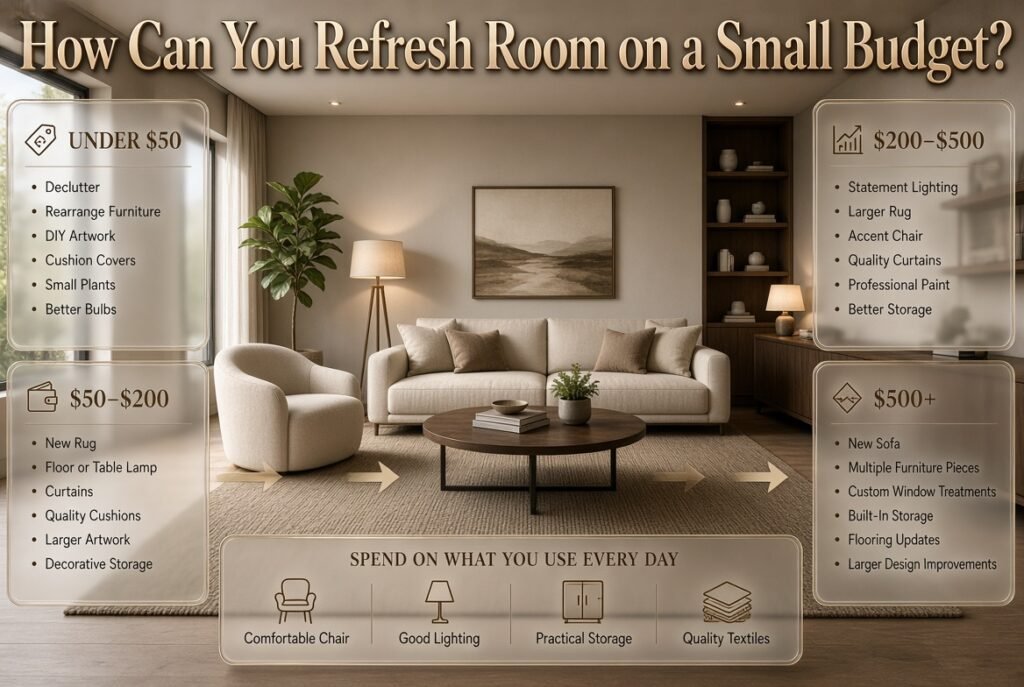
Focus your budget on changes that affect large visual areas. Rearrange furniture first, then prioritize textiles, lighting, paint, and a few carefully selected accessories rather than purchasing many inexpensive decorative objects.
A practical budget strategy is:
Under $50
Focus on:
- Decluttering
- Rearranging furniture
- DIY artwork
- New cushion covers
- Small plants
- Better bulb choices
- Styling existing objects differently
$50–$200
Consider:
- New rug
- Floor or table lamp
- Curtains
- Several quality cushions
- Larger artwork
- Decorative storage
$200–$500
Consider:
- Statement lighting
- Larger rug
- Accent chair
- Quality curtains
- Professional paint
- Better storage
$500+
You can consider:
- New sofa
- Multiple furniture pieces
- Custom window treatments
- Built-in storage
- Flooring updates
- Larger-scale design improvements
💡 Pro Tip: Spend money on the elements you interact with every day. A comfortable chair, good lighting, practical storage, and quality textiles usually provide more long-term value than ten decorative objects.
Room Refresh vs. Full Redecoration
Understanding the difference can stop you from overspending.
| Room Refresh | Full Redecoration |
|---|---|
| Rearranging furniture | Replacing major furniture |
| Updating accessories | New design concept |
| New textiles | New flooring |
| Better lighting | Major electrical work |
| Small paint changes | Complete repainting |
| Decluttering | Extensive storage changes |
| Limited budget | Larger investment |
| Days or weekends | Weeks or longer |
A refresh is usually the right choice when the room’s basic structure and major furniture are still functional.
How Do You Refresh a Living Room?
Start with the seating arrangement, because the living room’s layout determines how the entire space functions. Remove unnecessary décor, reposition the rug and coffee table, improve layered lighting, update cushions and throws, and introduce one strong focal point such as artwork, a plant, or an accent color.
For a more focused transformation, see this Living Room Transformation resource for additional ideas.
A Simple Living Room Refresh
Try this sequence:
- Remove everything from the coffee table.
- Remove unnecessary accessories.
- Move the sofa and chairs.
- Test a new seating arrangement.
- Reposition the rug.
- Improve lighting.
- Add two or three textured cushions.
- Introduce one large artwork.
- Add greenery.
- Style the coffee table with restraint.
The goal isn’t to make the room look full.
The goal is to make it look intentional.
How Do You Refresh a Bedroom?
A bedroom refresh should prioritize comfort and calm. Start by simplifying bedside surfaces, improving bedding, adjusting lighting, introducing softer textures, and creating a more cohesive color palette.
Try:
- Layered bedding
- A textured throw
- Two or three coordinated cushions
- Soft bedside lighting
- A larger piece of artwork
- Better curtains
- A rug beside or beneath the bed
- A small plant
- Closed storage for visual clutter
The bedroom should feel restful rather than overly decorated.
How Do You Refresh a Dining Room?
In a dining room, focus on the table, lighting, chairs, and wall treatment.
A simple refresh could include:
- New table centerpiece
- Updated pendant light
- Fresh chair cushions
- Large artwork
- Table runner
- Natural centerpiece
- Repositioned furniture
Avoid placing a huge centerpiece that blocks conversation.
The best dining-room centerpiece usually looks attractive without becoming the main obstacle between people.
How Do You Refresh a Small Room?
Small rooms benefit most from editing rather than adding. Reduce visual clutter, maintain clear walking paths, use appropriately scaled furniture, introduce mirrors strategically, and choose a limited color palette.
Don’t assume every small room needs tiny furniture.
Too many small pieces can actually make the room feel busier.
One properly scaled sofa, a compact coffee table, and one strong chair may look cleaner than five miniature pieces.
Use Vertical Space
When floor area is limited, look upward.
Consider:
- Tall shelving
- Vertical artwork
- High curtains
- Wall-mounted lighting
- Tall plants
- Narrow storage
This draws the eye upward and helps the room feel taller.
How Can You Make an Old Room Look Modern?
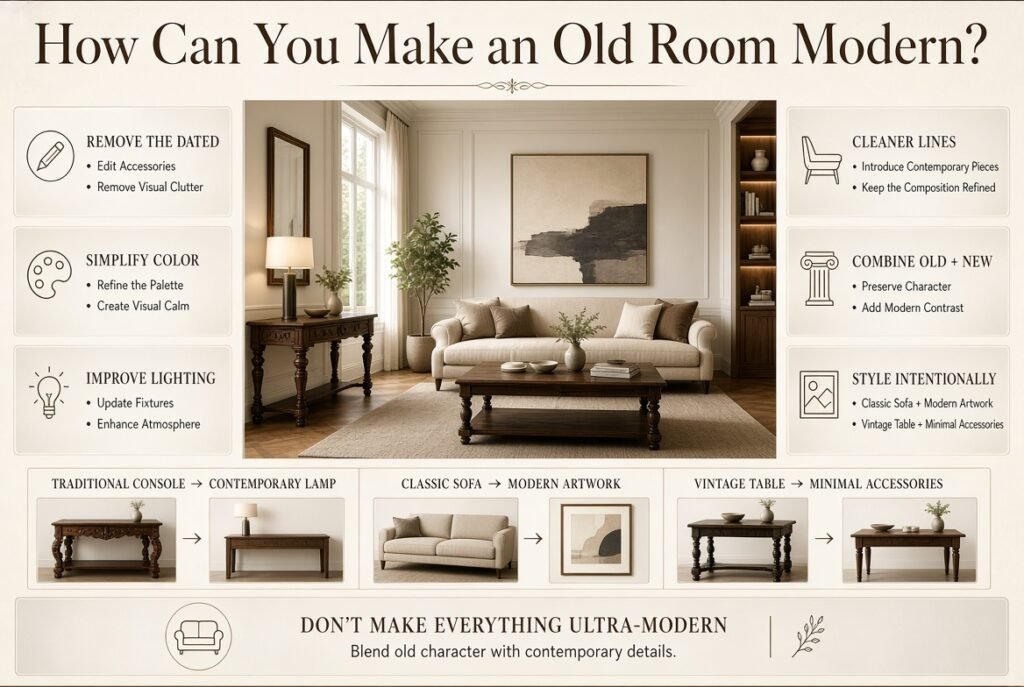
Modernizing a room doesn’t require replacing everything. Remove dated accessories, simplify the color palette, improve lighting, introduce cleaner-lined pieces, reduce visual clutter, and combine contemporary materials with existing furniture.
A common mistake is trying to make every element ultra-modern.
That can make a room feel artificial.
Instead, combine old and new intentionally.
For example:
Existing: Traditional wooden console
New: Contemporary lamp
Existing: Classic sofa
New: Modern artwork
Existing: Vintage table
New: Minimal accessories
The contrast can create character.
Can You Refresh a Room Without Painting?
Yes. A room can look substantially different without changing the walls. Rearranging furniture, replacing textiles, improving lighting, adding artwork, introducing plants, changing the rug, and editing accessories can all create a noticeable transformation.
Painting is useful, but it shouldn’t automatically be the first step.
If your layout is poor, a new wall color won’t fix it.
If your lighting is harsh, paint alone won’t solve the atmosphere.
If the room is cluttered, adding another decorative layer will make the problem worse.
Solve the fundamentals first.
How Can You Make a Room Look More Expensive?
A room tends to look more sophisticated when it has visual restraint, appropriate scale, layered lighting, quality-looking textures, coordinated colors, and fewer but stronger decorative pieces.
You don’t need everything to be expensive.
Instead, pay attention to presentation.
Five Details That Create a Polished Look
1. Consistent color palette
Choose a small group of colors and repeat them intentionally.
2. Correct scale
Large furniture needs appropriately sized artwork and rugs.
3. Layered lighting
Avoid relying entirely on one ceiling fixture.
4. Texture
Combine materials so neutral rooms don’t feel flat.
5. Negative space
Allow some surfaces and walls to breathe.
That final point is especially important.
Luxury often comes from what you don’t add.
How Do You Set Up Home Décor After a Room Refresh?
Once the large decisions are complete, decorate in layers instead of placing every accessory back at once. Start with the largest visual elements, then add medium pieces and finish with only a few small accents.
For a more detailed process, use this How to Set Up My Home Decor guide as a companion resource.
A useful styling formula is:
Large element
      ↓
Medium elements
      ↓
Texture
      ↓
Small accents
      ↓
Final edit
After styling, remove one or two things.
That final edit often improves the room.
Should You Add Smart Storage During a Room Refresh?
If clutter is one of the main problems, yes. Storage should be considered part of the design rather than an afterthought.
Use:
- Baskets
- Storage ottomans
- Closed cabinets
- Floating shelves
- Built-in storage
- Under-bed storage
- Decorative boxes
The best storage is easy to use.
If putting something away requires five steps, people will eventually stop doing it.
What Can Celebrity Homes Teach Us About Room Refreshes?
Celebrity interiors can provide inspiration, but they also demonstrate why scale, restraint, and functionality matter.
Large homes often have generous ceilings, expansive rooms, and custom furniture that ordinary homes don’t have.
Instead of copying the entire look, identify the principle behind it.
For example, the Mark Cuban house can be used as inspiration for thinking about how large-scale interiors use space, furniture, and visual hierarchy.
The lesson isn’t to duplicate a celebrity home.
It’s to understand how professional-looking spaces create a sense of intention.
Common Room Refresh Mistakes to Avoid
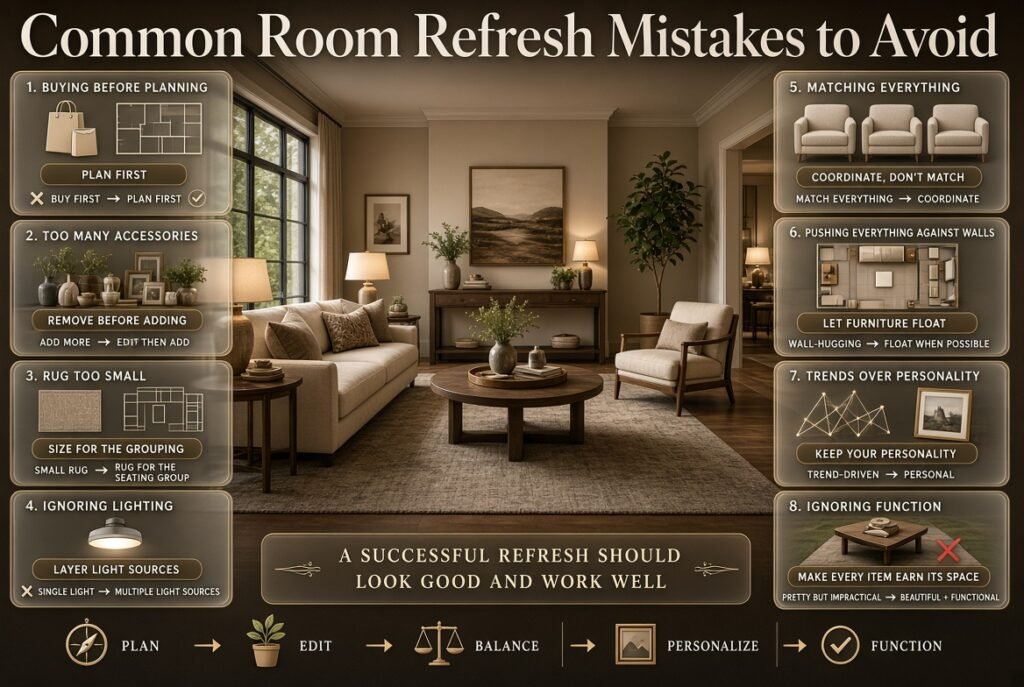
1. Buying Before Planning
This happens because shopping feels productive.
It isn’t always productive.
If you buy a lamp before deciding where the chair will go, the lamp may eventually become another object that doesn’t fit.
Better approach: Plan the room first.
2. Adding Too Many Accessories
People often interpret “refresh” as “add new décor.”
That creates clutter.
Better approach: Remove first, then add selectively.
3. Using a Rug That’s Too Small
A small rug can make a large seating arrangement feel fragmented.
Better approach: Choose the rug based on the furniture grouping, not only the empty floor area.
4. Ignoring Lighting
A beautifully decorated room can still feel unpleasant under poor lighting.
Better approach: Add multiple light sources at different heights.
5. Matching Everything
A perfectly matched room can look like a showroom.
Better approach: Coordinate rather than match.
Use related colors and materials while allowing subtle differences.
6. Pushing Everything Against the Walls
This often creates an empty center and weakens the conversation area.
Better approach: Let furniture “float” when the room allows it.
7. Choosing Trends Over Personality
A room can look fashionable but still feel disconnected from the people who live there.
Better approach: Keep meaningful objects and choose trends selectively.
8. Ignoring Function
A beautiful coffee table that leaves no walking space isn’t a successful design choice.
Better approach: Every major item should earn its space.
A Professional Room Refresh Checklist
Before you finish, walk through this checklist:
Layout
- Is movement easy?
- Does furniture have enough breathing room?
- Is the seating arrangement functional?
- Is the focal point clear?
Color
- Is the palette cohesive?
- Are undertones compatible?
- Is there enough contrast?
Lighting
- Is there general lighting?
- Is there task lighting where needed?
- Is there softer evening lighting?
Texture
- Are there multiple materials?
- Does the room feel visually layered?
- Are textiles comfortable and practical?
Décor
- Are surfaces overly crowded?
- Does every decorative object have a reason?
- Is artwork correctly scaled?
Function
- Is storage sufficient?
- Can people move comfortably?
- Does the room support its intended activities?
What Are the Best DIY Room Refresh Projects?
DIY projects are useful when they solve a real design problem rather than simply creating another decorative object.
Good projects include:
- Painting an accent wall
- Refinishing a small table
- Creating simple artwork
- Updating cabinet hardware
- Making cushion covers
- Building simple shelves
- Refreshing a lampshade
- Creating a gallery wall
- Repurposing old furniture
For additional hands-on ideas, explore DIY Home Projects.
Choose DIY Projects Carefully
A DIY project should be worth the time.
Before starting, ask:
- Will it improve the room?
- Can I complete it properly?
- Do I already have the necessary tools?
- Will the finished result look intentional?
- Is buying the finished product actually more practical?
DIY isn’t automatically cheaper if a project requires expensive materials and several attempts.
How Long Does a Room Refresh Take?
A simple refresh can take a few hours, while a more involved update may take an entire weekend or several weeks if painting, furniture shopping, or DIY projects are included.
One-Day Refresh
Morning: Declutter and clean.
Late morning: Rearrange furniture.
Afternoon: Adjust lighting and textiles.
Evening: Style décor and evaluate.
Weekend Refresh
Friday: Plan and declutter.
Saturday: Furniture, cleaning, painting, and larger changes.
Sunday: Styling, lighting, artwork, plants, and final edits.
The most important thing is not speed.
It’s decision quality.
How Do You Know When the Room Refresh Is Finished?
A room is finished when it functions comfortably, looks intentional, and doesn’t feel as though you’re trying to fill every empty area.
Stand at the doorway and ask:
- Does the room feel balanced?
- Can I move comfortably?
- Is there a clear focal point?
- Does the color palette make sense?
- Are the surfaces calm?
- Does the room reflect my personality?
- Is anything obviously unnecessary?
If the answer is yes across most of these questions, stop.
One of the hardest decorating skills is knowing when to stop.
What is the easiest way to refresh a room without buying new furniture?
The easiest way to refresh a room is to rearrange what you already have before spending money. Start by removing unnecessary décor, then experiment with the sofa, chairs, coffee table, rug, lamps, and artwork. A better layout can change how spacious and comfortable the room feels without replacing a single major item. Designers continue to recommend rearranging the floor plan as one of the most effective low-cost updates.
Once the layout works, make smaller changes that support it:
Replace or rearrange cushion covers and throws.
Move artwork to a more suitable wall.
Add a floor or table lamp.
Introduce one or two plants.
Restyle the coffee table instead of filling it with new accessories.
Move decorative pieces from another room.
Remove anything that feels unnecessary or visually heavy.
Professional approach: Don’t think, “What should I buy?” Think, “What is the room missing?” If the problem is poor layout, buying décor won’t solve it. If the problem is harsh lighting, another cushion won’t make the room feel warmer.
How can I refresh a room on a small budget?
A small-budget room refresh works best when you spend money on high-impact elements rather than lots of inexpensive decorations. Start with free changes such as decluttering, rearranging furniture, cleaning windows and surfaces, and changing the position of artwork. Then use a limited budget for lighting, textiles, paint, or a properly sized rug. Recent designer advice similarly emphasizes layout, lighting, textiles, wall treatment, and selective accessories over major furniture replacement.
A practical spending order is:
Free: Declutter and rearrange.
Low cost: Improve bulbs and add small lighting.
Low to medium cost: Update cushions, throws, or curtains.
Medium cost: Paint an accent wall or replace an undersized rug.
One larger investment: Upgrade the single element that is genuinely holding the room back.
Expert tip: Avoid spending $20 on ten decorative objects when one $100 improvement would solve the room’s biggest problem. A refreshed room should feel edited, not simply more crowded.
What colors are best for a room refresh in 2026?
For a 2026 room refresh, warm and nature-inspired colors are particularly relevant, including creamy whites, earthy browns, muted greens, warm wood tones, and other soft natural shades. Brown is also receiving renewed attention as a warm, versatile decorating color, especially when introduced through furniture, textiles, rugs, or smaller accessories rather than used everywhere at once.
However, the best color isn’t necessarily the trendiest one. It needs to work with your existing flooring, furniture, natural light, and room size.
For example:
Small room: Warm white, soft beige, pale sage
Cozy bedroom: Muted green, warm taupe, dusty blue
Modern living room: Cream, walnut brown, charcoal accents
Warm neutral space: Terracotta, caramel, olive
Dark room: Light warm neutrals with carefully placed contrast
Professional tip: Test the actual paint on the wall before committing. A color that looks beautiful online can appear completely different under your room’s natural and artificial lighting.
How can lighting make a room look refreshed?
Lighting can completely change the atmosphere of a room because it affects how you see the furniture, colors, textures, and architectural features. Instead of relying on one bright ceiling fixture, create layers of light using ambient, task, and accent lighting. This approach is consistently recommended by designers because it gives the room flexibility throughout the day.
For a living room, for example, you could combine:
A ceiling fixture for general lighting
A floor lamp beside a sofa or chair
A table lamp on a console or side table
Accent lighting near artwork or shelving
During the day, natural light can do most of the work. In the evening, the smaller lamps create a softer and more comfortable atmosphere.
Quick tip: Don’t automatically choose the brightest bulb available. A room can be perfectly illuminated while still feeling unpleasant. The goal is comfortable, layered light, not maximum brightness.
Should I replace my furniture during a room refresh?
Not unless the existing furniture is genuinely causing a problem. If your sofa, bed, dining table, or chairs are comfortable and in good condition, a room refresh can often make them feel completely different through better placement, textiles, lighting, artwork, and accessories. Designers currently emphasize keeping functional furniture and making targeted improvements rather than replacing everything simply for the sake of a makeover.
Before replacing a major piece, ask:
Is it uncomfortable?
Is it damaged beyond practical repair?
Is it the wrong size for the room?
Does it prevent good movement?
Does it genuinely conflict with the new design direction?
Could upholstery, cushions, or a new arrangement solve the problem?
If the furniture is functional, refresh around it first.
A new rug, better lighting, updated cushions, and stronger artwork can sometimes make an older sofa look intentional again. And if you eventually decide to replace it, you’ll have a much clearer idea of the size, style, and function you actually need.
Bottom line: A good room refresh isn’t about replacing everything. It’s about identifying what isn’t working, fixing those specific problems, and leaving the good pieces alone.
Conclusion
A successful room refresh does not require a complete makeover, expensive furniture, or a major renovation. The most effective changes are often the simplest ones: clearing visual clutter, improving the furniture layout, introducing better lighting, adding texture, updating soft furnishings, and giving the room a more intentional focal point.
The key is to refresh with purpose rather than changing everything at once. Start by identifying what feels outdated, uncomfortable, or visually unbalanced, then focus your budget and effort on the changes that will make the biggest difference. A new rug can redefine a seating area, layered lighting can completely change the atmosphere, while cushions, curtains, artwork, plants, and accessories can introduce personality without overwhelming the space.
A thoughtful room refresh should also reflect how you actually live. A beautiful room that is difficult to use will never feel truly successful. Prioritize comfortable furniture, practical storage, clear walkways, appropriate lighting, and materials that suit your everyday routine.
Whether you are refreshing a living room, bedroom, dining area, or small space, you do not need to follow every trend. Use current design ideas as inspiration, but choose colors, textures, furniture, and accessories that feel natural to you. The best interiors look collected and personal rather than copied from a showroom.
Ultimately, a room refresh is about making your existing space feel more comfortable, functional, balanced, and personal. With a clear plan and a few high-impact changes, even a tired room can feel noticeably different—without starting from scratch.

Leave a Reply