
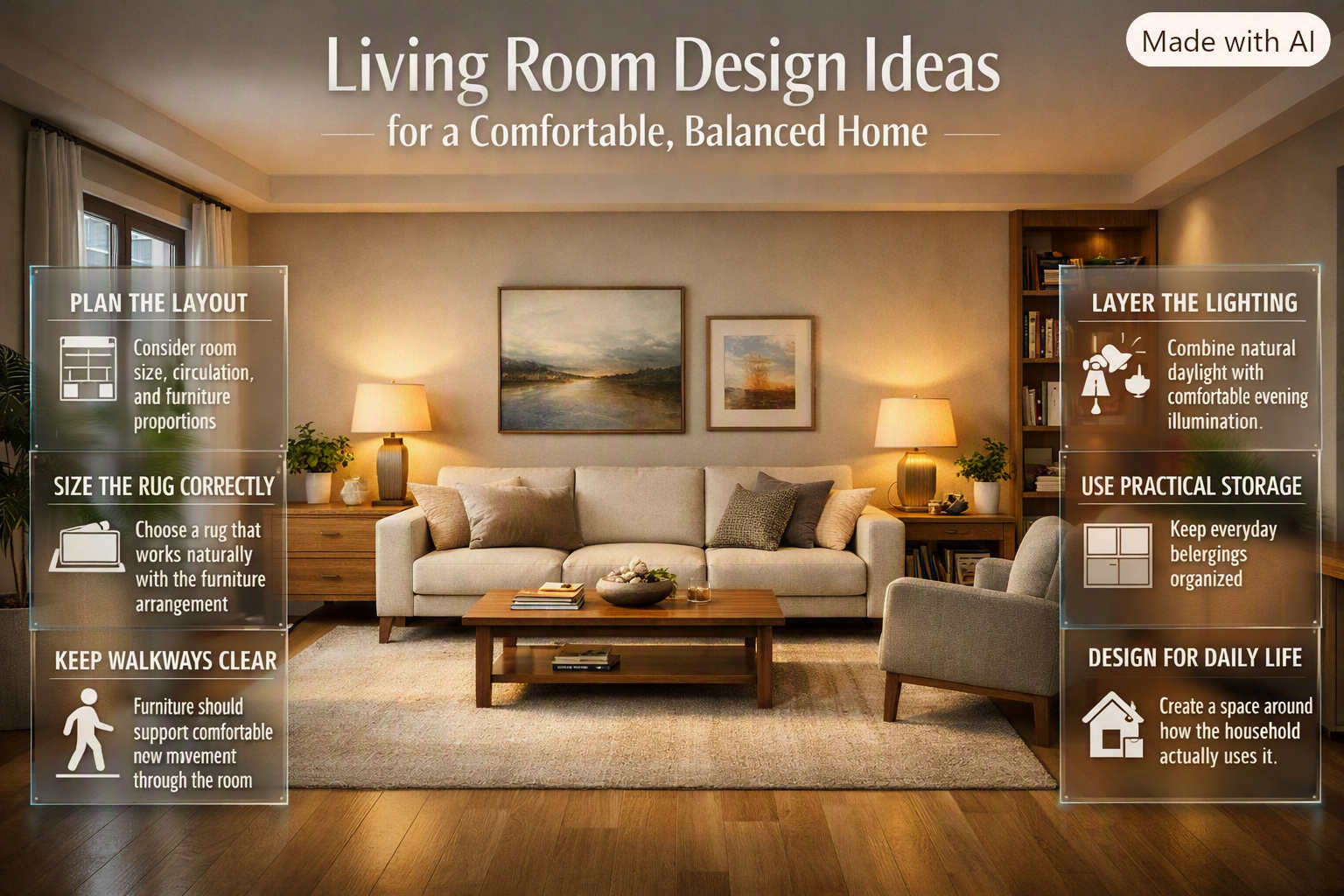
Introduction
Living Room Design | A living room can have beautiful furniture, expensive decorations, and trendy colors, yet still feel uncomfortable or unfinished. Maybe the sofa blocks the walkway, the rug looks too small, the lighting feels harsh at night, or the room simply doesn’t feel connected. These problems are rarely caused by a lack of furniture. They’re usually caused by poor planning.
That is why good Living Room Design starts with understanding how a space actually works. Before choosing a sofa because it looks good online or painting the walls because a color is trending, you need to consider room size, natural light, circulation, furniture proportions, storage, and the way your household uses the space.
For more practical ideas on creating a well-planned home, explore DesignMode24 Interior Design. The goal isn’t to copy a showroom. It’s to create a living room that feels comfortable, personal, balanced, and easy to live in every day.
This complete guide covers everything from furniture layouts and color schemes to lighting, rugs, wall decor, small-space solutions, modern styles, budget improvements, common mistakes, and professional design advice.
What Is Living Room Design?
Living room design is the process of planning the layout, furniture, colors, lighting, materials, storage, and decorative elements of a living space so they work together both visually and practically.
A successful living room isn’t simply attractive. It should support the activities that happen there while maintaining a sense of proportion and visual balance.
For example, a family that spends most evenings watching television may need a comfortable sectional, practical lighting, durable fabrics, and accessible storage. Someone who frequently entertains guests may benefit more from multiple seating areas arranged around conversation.
The important point is that there isn’t one perfect living room layout for everyone.
The right design depends on:
- Room dimensions
- Number of people using the space
- Lifestyle
- Furniture requirements
- Natural light
- Architectural features
- Storage needs
- Personal style
- Budget
- Maintenance requirements
Good design solves practical problems before decoration is added.
Why Does Living Room Design Matter?
The living room is often one of the hardest-working spaces in a home. It may function as a family room, entertainment area, reading space, guest area, home office, or even a temporary playroom.
When the layout is poorly planned, everyday activities become unnecessarily difficult.
A badly positioned sofa can block movement. A small rug can make expensive furniture look disconnected. Insufficient lighting can make the room feel dull after sunset. Too many accessories can create visual clutter.
Thoughtful planning helps the room:
- Feel larger and more organized
- Support natural movement
- Encourage comfortable conversation
- Look visually balanced
- Provide adequate seating
- Create useful storage
- Improve lighting
- Reflect personal taste
- Feel comfortable rather than staged
The best living rooms don’t necessarily contain the most expensive products. They contain decisions that make sense together.
How Do You Start Planning a Living Room?
The first step is to understand the room before buying anything.
Measure the length and width of the room, then record the position of doors, windows, fireplaces, radiators, built-in storage, electrical outlets, and major architectural features.
Next, determine what the room needs to do.
Ask yourself:
- How many people usually use the room?
- Do you watch television here?
- Do you entertain regularly?
- Do children use the space?
- Do you need a reading area?
- Is there a work-from-home requirement?
- Do you need hidden storage?
- Does the room connect directly to another space?
- Which feature should receive the most attention?
These answers provide the foundation for every later decision.
Create a Simple Floor Plan
You don’t need professional software to understand your room.
Draw the walls on paper and mark:
- Doors
- Windows
- Major architectural features
- Existing furniture
- Main walking routes
- Proposed furniture
You can also use painter’s tape to mark the approximate footprint of a sofa, coffee table, or sectional directly on the floor.
This simple exercise often prevents expensive mistakes.
💡 Pro Tip: Measure the entrance route as carefully as the room itself. A sofa can fit perfectly inside the living room but still fail to pass through a narrow doorway or staircase.
How Do You Decide the Main Function of a Living Room?
A living room works better when its primary function is clear.
If television viewing is the main activity, orient seating toward the screen without making the television dominate the entire room.
If conversation is more important, arrange seating so people can comfortably face one another.
If the room serves several purposes, divide it into functional zones.
For example:
Main Seating Zone → Conversation / TV
Reading Corner → Chair + Floor Lamp
Storage Zone → Cabinet + Shelving
Work Zone → Compact Desk
This approach works especially well in large or open-plan rooms.
The room doesn’t need physical walls to create separate functions. Furniture placement, rugs, lighting, and orientation can establish visual boundaries.
How Should You Arrange Living Room Furniture?
Furniture arrangement is one of the most important parts of living room design because it determines how the room feels and functions.
Start with the largest item, usually the sofa or sectional.
Then position the remaining furniture around it.
A useful order is:
- Sofa or sectional
- Additional seating
- Rug
- Coffee table
- Side tables
- Lighting
- Storage
- Accessories
This prevents you from buying decorative pieces before solving the room’s basic structure.
Should Furniture Be Against the Walls?
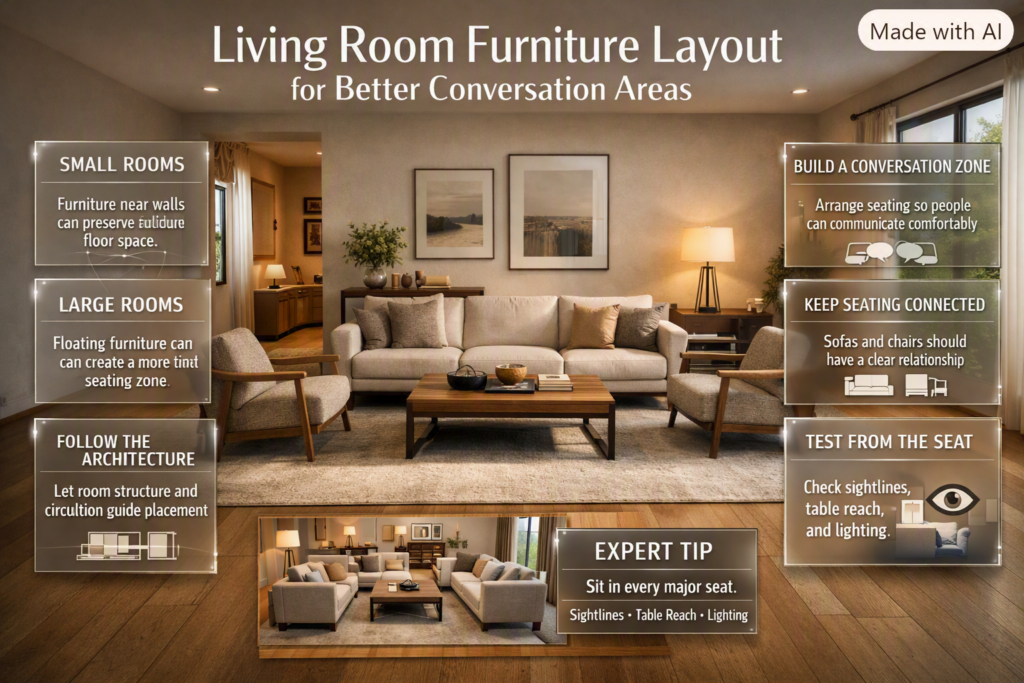
Not necessarily.
In small rooms, placing furniture near walls can preserve valuable floor space. In larger rooms, however, floating furniture away from the walls can create a more intimate seating arrangement.
A sofa positioned slightly away from the wall can define a conversation zone and make a large room feel more intentional.
Don’t move furniture into the middle of the room simply because interior design advice says you should. The architecture and circulation should determine the decision.
Create Comfortable Conversation Areas
People shouldn’t have to twist their bodies or shout across the room to talk.
Arrange seating so that chairs and sofas have a clear relationship.
A simple configuration could include:
- One main sofa
- Two accent chairs
- One central coffee table
- One large area rug
Another option is:
- Two facing sofas
- Central coffee table
- Floor lamp at one end
- Console behind one sofa
The right choice depends on the size and purpose of the room.
⭐ Expert Tip: Sit in every major seat after arranging the furniture. Check what each person can see, whether the coffee table is reachable, and whether the lighting is adequate. Design should be tested from the user’s perspective.
How Do You Choose the Right Sofa?
The sofa is usually the visual and functional anchor of the living room, so choosing the right size matters more than choosing the trendiest style.
Consider:
- Overall width
- Depth
- Seat height
- Arm width
- Cushion construction
- Fabric durability
- Cleaning requirements
- Color
- Leg style
- Room proportions
A deep sofa may look luxurious but can be uncomfortable for shorter users. A very low sofa can look contemporary but may be difficult for some people to stand from.
Think about real use rather than showroom appearance.
Sectional vs Sofa
| Feature | Standard Sofa | Sectional |
|---|---|---|
| Space requirement | Usually easier to fit | Requires more planning |
| Flexibility | Easier to move | More fixed |
| Seating | Moderate | Usually generous |
| Small rooms | Often easier | Compact versions can work |
| Large rooms | May need extra chairs | Excellent for filling zones |
| Relaxing | Comfortable | Excellent for lounging |
A sectional isn’t automatically better for a large family, and a standard sofa isn’t automatically better for a small room. Proportion is what matters.
How Much Space Should Be Left Around Furniture?
There isn’t a single universal measurement that works in every living room.
Instead, think in terms of comfortable movement.
Main walking routes should remain clear. People shouldn’t need to squeeze between the coffee table and sofa or walk directly through the center of a conversation area.
Create a mental walking path from:
Door → Main Seating → Other Rooms
Then test the arrangement physically.
Walk through it several times.
If you naturally bump into corners, move a piece. If you need to turn sideways, the pathway is too tight.
⚠ Common Mistake: Designing the room from a top-down drawing without physically testing movement. A layout can look perfect on paper and feel awkward in real life.
How Do You Choose the Right Coffee Table?
The coffee table should relate to the size and shape of the seating arrangement.
A large sectional may need a substantial rectangular or oval table. A compact sofa may work better with a smaller round table.
Consider the following:
- Sofa length
- Available walking space
- Table height
- Shape of surrounding furniture
- Household safety
- Storage requirements
Round and oval tables can be particularly useful where circulation is tight because they eliminate sharp corners.
If the room has children, a soft-edged or rounded table may also be more practical.
Why Is a Living Room Rug So Important?
A rug does more than add softness underfoot. It visually connects furniture and defines the seating zone.
One of the most common living room design problems is choosing a rug that’s too small.
When the rug sits only underneath the coffee table, the sofa and chairs can appear disconnected.
A larger rug can visually pull the entire arrangement together.
Common Rug Approaches
Small room: Use a rug large enough to connect the primary seating.
Medium room: Place the front legs of major seating pieces on the rug.
Large room: Use a substantial rug that defines the entire conversation area.
Open-plan room: Use the rug to establish the boundaries of the living zone.
The rug should also suit your lifestyle. A delicate high-pile design may not be practical for heavy daily traffic, pets, or children.
How Do You Choose a Living Room Color Scheme?
Color should be planned as a complete system rather than selected one wall at a time.
Start with a dominant color, then introduce supporting shades and smaller accents.
A simple approach is:
60% dominant color
30% supporting color
10% accent color
This doesn’t need to be mathematically exact. It’s simply a useful way to avoid making every color equally strong.
For example, you might use:
- Warm off-white walls
- Beige upholstery
- Medium wood
- Muted green accents
- Black lighting details
The result feels layered without becoming visually chaotic.
For more ideas about selecting and combining wall shades, explore the Paint Color collection.
Should a Small Living Room Use Light Colors?
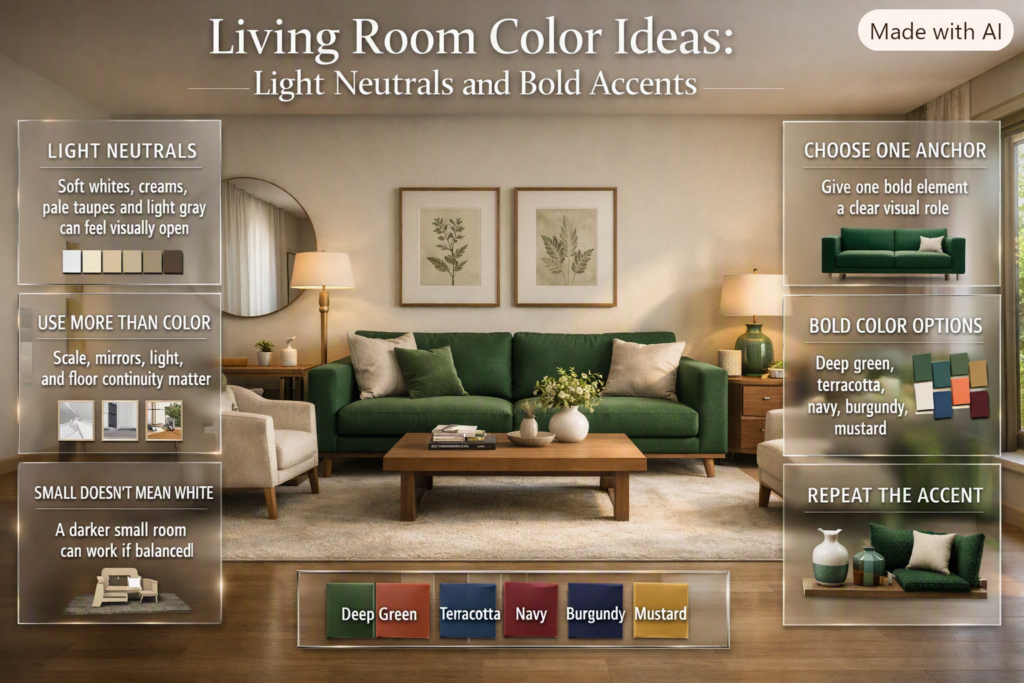
Light colors can make a room feel visually more open, but they aren’t the only solution.
Room proportions, furniture scale, natural light, mirrors, window treatments, and floor continuity can be equally important.
Soft whites, warm creams, pale taupes, light gray, and muted earthy tones can work particularly well.
However, don’t assume every small room needs bright white walls.
A small living room can also look sophisticated with darker colors when lighting and furniture proportions are handled carefully.
How Do You Use Bold Colors?
Bold colors are most effective when they have a clear role.
Instead of using strong colors everywhere, choose one element as the visual anchor.
Examples include:
- Deep green sofa
- Terracotta accent wall
- Navy armchair
- Burgundy artwork
- Mustard cushions
Then repeat smaller versions of the accent elsewhere so it feels intentional.
How Do You Add Texture to a Living Room?
Texture is one of the easiest ways to make a neutral living room feel rich.
A room using only smooth painted walls, polished furniture, and synthetic upholstery can feel flat.
Introduce different surfaces such as:
- Linen
- Wool
- Cotton
- Wood
- Stone
- Woven fibers
- Ceramic
- Bouclé
- Brushed metal
- Natural leather
Texture creates visual depth even when the color palette remains simple.
For example, a beige sofa can look completely different when combined with a chunky woven rug, linen curtains, wooden furniture, ceramic accessories, and soft cushions.
How Important Is Lighting in Living Room Design?
Lighting can completely transform a living room.
A single ceiling fixture may provide enough illumination to see the room, but it rarely creates a comfortable atmosphere.
Professional-looking spaces usually combine multiple lighting layers.
Ambient Lighting
Ambient lighting provides general illumination.
Examples include:
- Ceiling fixtures
- Recessed lights
- Track lighting
- Large central pendants
Task Lighting
Task lighting supports specific activities.
Examples include:
- Reading lamps
- Desk lamps
- Adjustable floor lamps
Accent Lighting
Accent lighting adds visual emphasis.
It can highlight:
- Artwork
- Shelving
- Architectural details
- Plants
- Decorative objects
A layered lighting plan gives you more control over the atmosphere.
During the day, natural light can dominate. In the evening, overhead lighting can be reduced while floor lamps, table lamps, and accent lights create a softer environment.
📌 Quick Tip: Use multiple light sources at different heights. Lighting from the ceiling alone can make a room feel flat, while low-level lamps create depth and warmth.
How Can You Make a Small Living Room Look Bigger?
Small spaces require discipline.
The goal isn’t to remove everything. It’s to choose pieces that perform well without overwhelming the room.
Start with furniture scale.
A massive sectional may consume nearly the entire floor, while a compact sofa with a slim accent chair may provide similar seating with better circulation.
Useful strategies include:
- Choose appropriately scaled furniture
- Use visible furniture legs
- Keep major walkways open
- Avoid excessive small decorations
- Use curtains to emphasize height
- Introduce mirrors strategically
- Maintain visual floor continuity
- Use multifunctional storage
- Keep the color palette controlled
Another useful technique is reducing visual clutter.
Ten small decorative objects can make a room feel busier than one substantial artwork.
Can Mirrors Make a Room Look Bigger?
Mirrors can increase the perception of space by reflecting light and extending visual depth.
Place them where they reflect something useful, such as:
- Natural light
- A window
- Attractive artwork
- An architectural feature
- A visually open part of the room
A mirror facing a cluttered corner simply reflects the clutter, so placement matters.
How Can You Make a Large Living Room Feel Cozy?
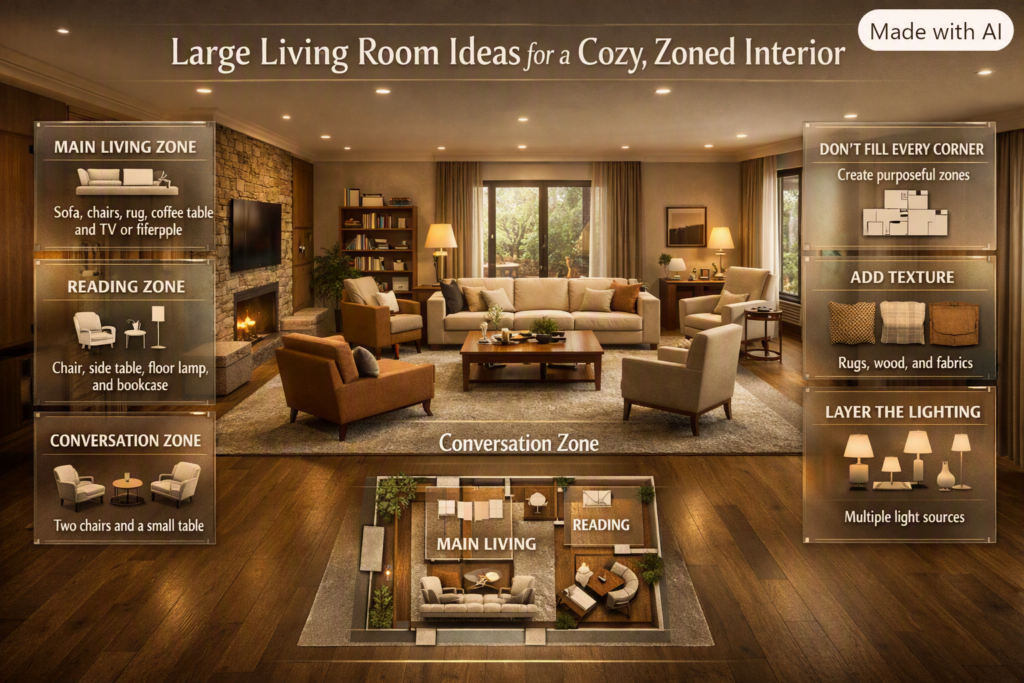
Large rooms need the opposite treatment.
Instead of trying to fill every empty corner, create multiple zones.
For example:
Main Living Zone
Large sofa, chairs, rug, coffee table, and television or fireplace.
Reading Zone
Comfortable chair, side table, floor lamp, and small bookcase.
Conversation Zone
Two chairs and a small table positioned away from the television.
This gives the room purpose without filling it with unnecessary furniture.
Large rugs, curtains, textured upholstery, wood, and layered lighting can also make expansive rooms feel warmer.
What Is the Best Living Room Design for an Open-Plan Home?
Open-plan interiors need visual organization.
Because walls aren’t separating the kitchen, dining area, and living room, furniture and materials need to establish boundaries.
A living room rug can identify the seating area. The sofa can create a subtle boundary between living and dining zones. Lighting can reinforce the distinction.
For broader ideas about coordinating different areas of the home, the Home Design Ideas collection can help you develop a consistent approach.
The key is coordination rather than exact matching.
The living room, kitchen, and dining area should feel related but don’t need to look identical.
Which Living Room Design Style Should You Choose?
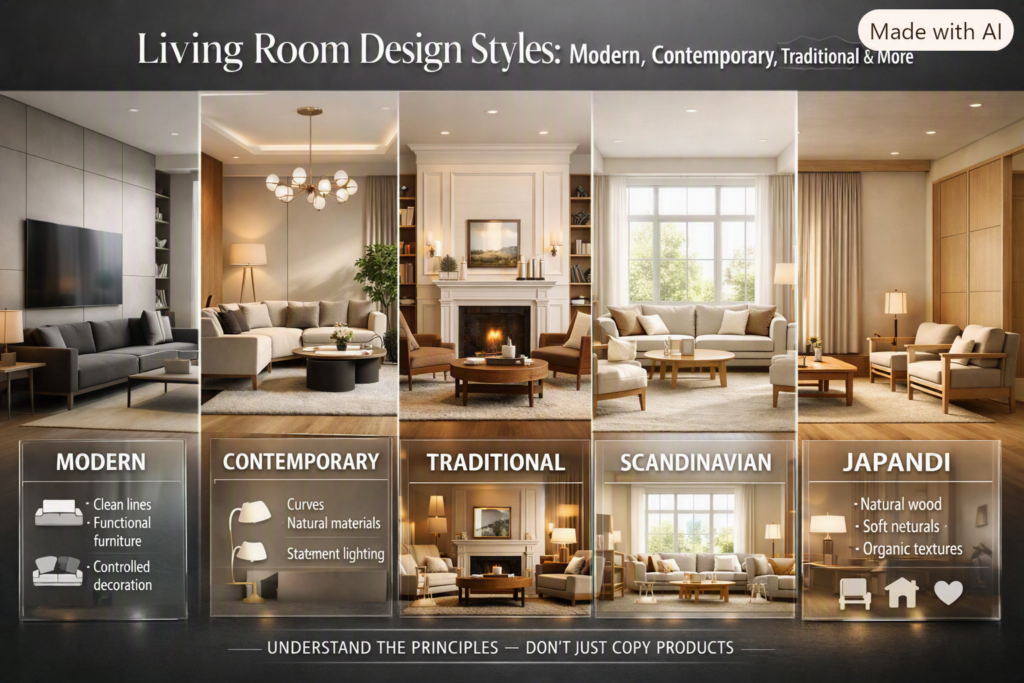
Your preferred style should reflect how you want the room to feel and how much maintenance you’re willing to handle.
Modern Living Room Design
Modern interiors generally focus on clean lines, functional furniture, controlled decoration, and strong simplicity.
Common elements include:
- Streamlined sofas
- Simple cabinetry
- Neutral backgrounds
- Geometric forms
- Integrated storage
- Contemporary lighting
You can explore more ideas in the Modern Interior Design guide.
Modern doesn’t mean empty. The goal is intentional simplicity.
Contemporary Living Room Design
Contemporary interiors are more flexible and can include current furniture shapes, curved forms, natural materials, layered neutrals, and statement lighting.
Because contemporary style evolves, it can be easier to update gradually.
Traditional Living Room Design
Traditional living rooms often feature symmetry, classic furniture, decorative details, richer materials, and timeless architectural references.
This approach works particularly well in homes with fireplaces, molding, built-ins, or other traditional architectural features.
Scandinavian Living Room Design
Scandinavian-inspired rooms usually emphasize practical simplicity, natural materials, soft colors, daylight, and comfortable textiles.
The room should feel clean but welcoming.
Japandi Living Room Design
Japandi combines Scandinavian warmth with Japanese restraint.
Think:
- Natural wood
- Soft neutrals
- Simple furniture
- Minimal decoration
- Organic textures
- Calm visual composition
The important thing is to understand the principles instead of copying a checklist of products.
How Can You Make a Living Room Look Expensive?
A luxury appearance isn’t necessarily about spending more money.
It often comes from proportion, restraint, quality-looking materials, and careful finishing.
Pay particular attention to:
- Curtain length
- Rug size
- Furniture scale
- Lighting quality
- Artwork placement
- Material repetition
- Hardware finishes
- Surface clutter
A poorly sized rug can make expensive furniture look ordinary.
A correctly sized rug can make relatively simple furniture feel much more polished.
Similarly, floor-length curtains, well-positioned artwork, and layered lighting can have a major visual impact without requiring a complete renovation.
How Do Personal Items Fit Into Living Room Design?
Personal objects are essential because they stop a living room from feeling staged.
Consider displaying:
- Family photographs
- Books
- Travel souvenirs
- Paintings
- Handmade ceramics
- Vintage objects
- Plants
- Collections
The trick is editing.
Don’t display everything you own.
Choose pieces that either have emotional meaning or contribute visually to the room.
A shelf with six carefully selected objects can look more sophisticated than a shelf filled with twenty unrelated items.
This is also where home styling becomes important. The Home Styling resource can provide additional ideas for arranging decorative details without overwhelming the room.
How Do You Add Storage Without Making the Room Look Cluttered?
Storage should be planned early, not added as an emergency solution after the room becomes messy.
Think about what needs to be hidden.
Typical living room items include:
- Remote controls
- Games
- Books
- Electronics
- Blankets
- Children’s items
- Chargers
- Magazines
Closed cabinets are useful for visually noisy objects.
Open shelves are better for selected decorative pieces.
A combination often works best.
For example, a media unit can include closed drawers at the bottom and a few open shelves above.
How Can You Decorate a Living Room on a Budget?
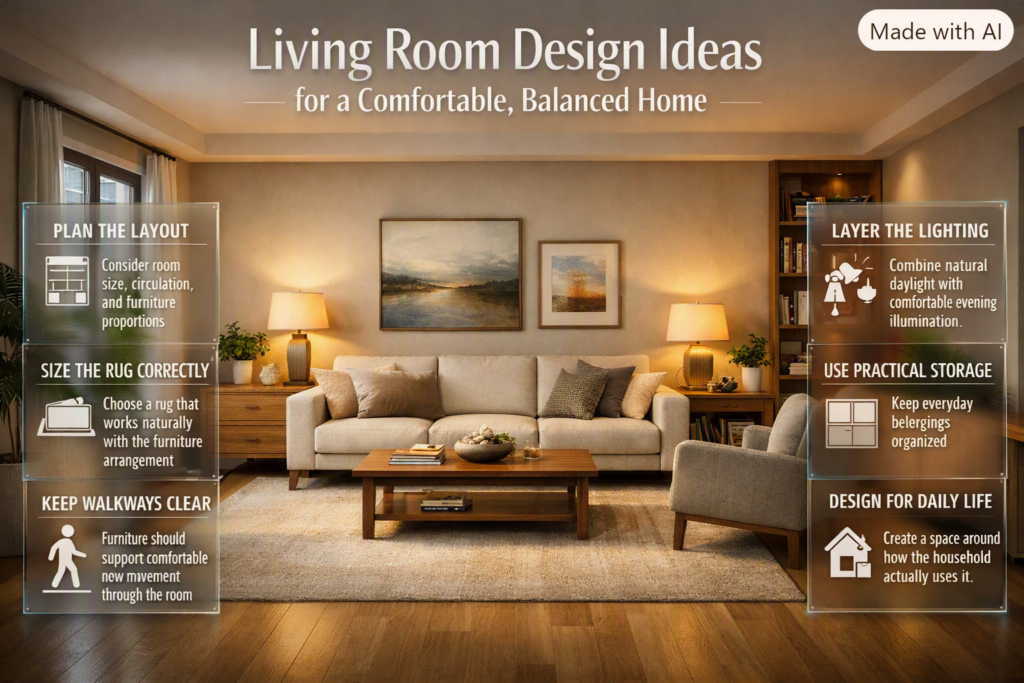
A successful budget update doesn’t require replacing everything.
Start with the elements that create the biggest impact.
1. Rearrange the Furniture
This costs nothing and can completely change circulation.
2. Improve Lighting
Add a floor lamp or table lamp where the room feels visually dark.
3. Update Soft Furnishings
Cushions and throws can introduce a new accent color or texture.
4. Change Artwork
A large piece of artwork can become a new focal point.
5. Repaint
A new wall color can change the atmosphere of the entire room.
6. Declutter
Removing unnecessary objects can make existing furniture look more intentional.
For affordable hands-on improvements, explore DIY Home Projects.
⭐ Expert Tip: Don’t spend your budget evenly across every item. Invest more in pieces you use every day and save money on accessories that can be changed easily.
What Are the Most Common Living Room Design Mistakes?
Buying Furniture Before Measuring
This is one of the most expensive mistakes.
People often choose furniture based on appearance and only think about dimensions afterward.
The result can be:
- Blocked doors
- Poor circulation
- Overcrowding
- Uncomfortable proportions
- Difficult delivery
Always measure first.
Choosing a Rug That’s Too Small
A tiny rug can visually fragment the seating arrangement.
Choose a size that connects the main furniture.
Using Too Many Decorative Items
Decorating every available surface creates visual noise.
Leave breathing room.
Matching Everything Too Closely
A sofa, chair, coffee table, side table, and cabinet from one matching collection can make a room feel generic.
Coordinate instead of duplicating.
Ignoring Lighting
A room may look beautiful during the day but completely different after sunset.
Always test the lighting at night.
Following Trends Too Literally
Trends change quickly.
A living room should be based on your lifestyle first and current trends second.
Choosing Style Over Comfort
An uncomfortable sofa doesn’t become a good sofa because it photographs well.
Furniture should support real use.
⚠ Common Mistake: Buying decorative pieces before solving the sofa, rug, lighting, and storage. Decoration is the final layer, not the foundation.
How Do You Design a Living Room That Works for Families?
Family living rooms need practical materials and flexible layouts.
Choose upholstery according to daily use.
If children or pets regularly use the room, consider fabrics that are:
- Durable
- Easy to clean
- Resistant to visible wear
- Comfortable
- Suitable for frequent use
Storage becomes particularly important.
Use baskets, cabinets, drawers, and closed storage to make everyday cleanup easier.
A family-friendly room doesn’t have to look like a playroom. It simply needs systems that make normal life easier.
How Do You Design a Living Room for Entertaining Guests?
If you frequently host guests, prioritize seating and conversation.
Don’t arrange every chair toward the television.
Instead, create a layout where people can naturally see one another.
Useful additions include:
- Two or more seating types
- Side tables
- Flexible stools
- Good ambient lighting
- Accessible surfaces
- Easy circulation
- A central coffee table
Keep fragile decorations away from high-traffic areas.
The room should feel welcoming rather than precious.
How Do You Choose Living Room Wall Decor?
Wall decor should relate to the room’s scale.
A tiny picture on a large empty wall can look accidental.
Likewise, too many small frames can make a wall feel busy.
Consider:
- One large artwork
- A balanced gallery wall
- Large mirrors
- Sculptural wall objects
- Built-in shelving
- Architectural details
The artwork doesn’t have to match the sofa exactly.
It should contribute to the overall color, texture, or mood of the room.
How Do You Make a Living Room Feel More Personal?
Personality usually comes from variation and meaningful objects.
Mix old and new pieces.
For example:
- Modern sofa
- Vintage side table
- Handmade ceramic
- Contemporary artwork
- Traditional rug
This creates a room that looks collected rather than purchased in one afternoon.
Your home should tell a story.
That’s more valuable than perfectly reproducing a catalog photograph.
How Should You Approach a Living Room Renovation?
If the room needs more than decoration, divide the project into stages.
Stage 1: Planning
Measure the room and identify problems.
Stage 2: Function
Decide the layout and storage.
Stage 3: Fixed Elements
Handle flooring, wall finishes, built-ins, and electrical requirements.
Stage 4: Major Furniture
Purchase the sofa, chairs, rug, and storage.
Stage 5: Lighting
Install or position lighting.
Stage 6: Styling
Add artwork, cushions, plants, books, and accessories.
This sequence prevents you from buying decorative items that later become incompatible with the final layout.
For larger home improvement planning, the Home Improvement category offers additional direction.
What Makes a Living Room Feel Cohesive?
Cohesion comes from repetition.
You don’t need everything to match, but certain elements should appear more than once.
For example:
- Black metal in lighting and furniture
- Wood repeated across several pieces
- One accent color appearing in cushions and artwork
- Similar curved shapes repeated subtly
- Related textures across upholstery and rugs
This creates a visual conversation between objects.
Another important factor is consistency with adjacent rooms.
If your living room is open to the kitchen, the two areas should share some materials, colors, or finishes.
How Can You Create a Timeless Living Room?
A timeless living room isn’t necessarily traditional.
It simply avoids depending too heavily on short-term trends.
Start with:
- Comfortable quality furniture
- Neutral or flexible larger pieces
- Natural materials
- Good lighting
- Proper proportions
- Classic shapes
- Personal artwork
Then introduce trends through easily replaceable elements such as:
- Cushions
- Throws
- Small accessories
- Lamps
- Artwork
This allows the room to evolve without requiring a complete redesign.
When Should You Hire an Interior Designer?
Professional help can be valuable when the room has complicated architecture, structural changes, unusual dimensions, or a large renovation budget.
An experienced designer can help with:
- Space planning
- Furniture scale
- Lighting
- Material selection
- Color coordination
- Custom storage
- Renovation planning
- Budget allocation
However, you don’t need professional help for every small change.
For a simple refresh, careful measuring and a clear plan can take you surprisingly far.
The important thing is knowing when a project has become too complex to manage comfortably yourself.
A Step-by-Step Living Room Design Process
If you’re starting from an empty room, use this sequence.
Step 1: Measure the Room
Record every important dimension.
Step 2: Identify the Focal Point
Choose the fireplace, television, window, artwork, or another architectural feature.
Step 3: Define the Main Function
Decide whether the room is primarily for conversation, television, entertaining, relaxing, or several activities.
Step 4: Place the Main Sofa
Use the focal point and circulation routes to determine its position.
Step 5: Add Supporting Seating
Introduce chairs or additional sofas without blocking movement.
Step 6: Choose the Rug
Select a rug large enough to visually connect the seating area.
Step 7: Add the Coffee Table
Choose an appropriate size and shape.
Step 8: Plan Lighting
Combine ambient, task, and accent lighting.
Step 9: Establish the Color Palette
Select the main color, supporting tones, and accents.
Step 10: Add Curtains and Soft Textiles
Use fabric to introduce softness and visual height.
Step 11: Add Storage
Hide everyday clutter.
Step 12: Finish With Accessories
Add artwork, plants, books, ceramics, and personal objects.
Step 13: Edit
Remove anything that doesn’t improve the room.
The final step is often the most important.
A room usually looks better when you stop adding and start editing.
What Is the Best Living Room Design for a Small Space?
The best small living room design isn’t about squeezing in as much furniture as possible. It’s about choosing the right scale, creating a clear focal point, protecting walking space, and making every major piece serve a purpose. A compact sofa, appropriately sized rug, multifunctional furniture, and layered lighting can make a small room feel comfortable rather than crowded. Current design advice also increasingly favors rooms that feel genuinely livable instead of overly staged.
Practical points to remember:
Measure the room before buying furniture.
Choose furniture according to the room’s actual dimensions.
Keep the main walking route clear.
Use a properly sized rug to connect the seating.
Consider furniture with exposed legs to maintain visual openness.
Use storage that hides everyday clutter.
Add mirrors where they can reflect useful light or depth.
Use multiple smaller light sources instead of relying only on one ceiling fixture.
A common mistake is buying several tiny pieces because the room is small. That can actually make the space feel more cluttered. One appropriately scaled sofa and one or two carefully selected chairs often work better than a collection of undersized furniture.
How Should I Arrange Furniture in My Living Room?
Start with the room’s main function and focal point, then build the furniture arrangement around them. The focal point could be a fireplace, television, large window, architectural feature, or statement artwork. Once that is established, position the primary sofa and arrange additional seating so people can comfortably interact without blocking natural circulation.
Don’t automatically push every piece of furniture against the walls. In larger rooms, floating a sofa or chair can create a defined seating zone and make the room feel more intentional. In smaller rooms, keeping larger pieces close to the walls may preserve valuable floor space. The correct approach depends on the room rather than a fixed decorating rule.
A professional furniture-planning sequence:
Identify the focal point.
Position the main sofa.
Add accent chairs or secondary seating.
Place the rug underneath or around the seating arrangement.
Add the coffee table.
Check walking routes.
Add side tables and lighting.
Test the arrangement by actually walking and sitting in the space.
Expert tip: Don’t judge the layout only from the doorway. Sit on the sofa, sit in every chair, look toward the focal point, and walk through the room as you would during a normal day.
A layout that looks impressive in a photograph can still be frustrating to live with if people have to squeeze between the furniture every time they enter or leave the room.
What Living Room Colors Are Trending in 2026?
Living room colors in 2026 are moving toward warm, earthy, expressive palettes rather than rooms that rely entirely on cool gray or extremely safe neutrals. Warm beige, sand, earthy brown, olive green, terracotta, muted blue, and deeper accent colors are being used to create rooms that feel more personal and atmospheric.
However, the most important trend isn’t simply a particular paint color. It’s the move toward personality and layered comfort. Designers are increasingly combining color, texture, artwork, vintage pieces, and natural materials instead of creating rooms that look perfectly coordinated but impersonal.
A practical 2026-inspired palette could include:
Warm off-white or creamy beige as the base
Natural wood as a grounding element
Olive or muted green for contrast
Terracotta or rust as a warm accent
Deep blue, burgundy, or brown in smaller doses
Linen, wool, ceramic, and woven textures for depth
You don’t need to repaint the entire room to follow this direction. If your walls are already neutral, introduce warmer colors through cushions, artwork, curtains, rugs, chairs, or decorative objects.
The professional approach: Choose your color palette around the things you plan to keep. If you already have a brown sofa, wooden flooring, or colorful artwork, use those elements as starting points rather than choosing a completely new palette and trying to make everything fit afterward.
How Can I Make My Living Room Look More Expensive and Professionally Designed?
A sophisticated living room isn’t necessarily expensive. What makes a room look professionally designed is usually proportion, consistency, lighting, material quality, and editing rather than the price of individual products.
One of the quickest improvements is correcting scale. A tiny rug under a large sofa, an undersized artwork on a huge wall, or a coffee table that’s too small for the seating arrangement can make even expensive furniture look disconnected. Designers are also increasingly emphasizing layered, lived-in interiors rather than rooms that look overly staged.
Focus on these details:
Use a rug large enough to anchor the seating.
Hang curtains at an appropriate height and width.
Combine ceiling, floor, and table lighting.
Choose artwork that suits the wall’s scale.
Repeat materials or colors subtly throughout the room.
Mix textures instead of using one finish everywhere.
Keep coffee tables and shelves edited.
Hide cables and everyday clutter.
Combine newer furniture with vintage or personal pieces.
Leave some empty space around important objects.
Layered comfort is particularly relevant right now. Rather than choosing between an extremely minimalist room and a heavily decorated room, current interiors are finding a middle ground through tactile fabrics, varied materials, meaningful accessories, and softer lighting.
⭐ Professional insight: If a room feels slightly “off,” don’t immediately buy another decoration. First remove one or two unnecessary items, check the rug size, examine the furniture proportions, and improve the lighting. Editing often creates a bigger improvement than adding more things.
What Are the Biggest Living Room Design Mistakes to Avoid?
The biggest mistakes are usually not dramatic decorating failures. They’re small planning decisions that affect the entire room: furniture that’s too large, rugs that are too small, poor lighting, excessive decoration, and layouts that ignore how people actually move through the space.
Small rugs are a particularly common problem because they fail to visually connect the seating area. Designers generally recommend choosing a rug large enough to anchor the major furniture rather than treating it as a small decorative island beneath the coffee table. Rug material should also be selected according to lifestyle and traffic.
Avoid these common mistakes:
Buying furniture before measuring the room
Choosing a rug that’s too small
Pushing every piece against the wall without considering the layout
Using only one overhead light
Filling every shelf and tabletop
Matching every furniture piece perfectly
Choosing trend-driven pieces that don’t suit your lifestyle
Ignoring storage requirements
Hanging artwork that’s too small for the wall
Prioritizing appearance over comfort
Using too many unrelated colors
Forgetting to hide visible cables
Creating a workspace that visually takes over a relaxation area
Current 2026 design thinking also places greater emphasis on comfort, character, natural materials, individuality, and lived-in spaces. That means a successful living room doesn’t have to look like a showroom. It should look intentional while still feeling like people actually live there.
Conclusion
Great Living Room Design isn’t about filling a room with expensive furniture or following every trend that appears online. It’s about creating a space that feels comfortable, functional, balanced, and personal. The strongest results usually come from simple decisions made carefully—choosing furniture that fits the room, creating a practical layout, using the right rug size, layering lighting, and building a color palette that feels natural.
Before buying anything, take time to understand how the room is actually used. Consider your family’s routines, available space, storage needs, natural light, and preferred style. Once the functional foundation is right, decorative elements such as artwork, plants, cushions, curtains, and accessories can add personality without making the room feel cluttered.
Most importantly, don’t design your living room only for photographs. Design it for real life. A beautiful sofa should also be comfortable, a stylish coffee table should allow easy movement, and decorative choices should reflect the people who live there.
If you’re planning more spaces throughout your home, DesignMode24 Interior Design can help you explore practical ideas for creating a cohesive interior. Start with the layout, make thoughtful choices, and allow your living room to develop naturally. When comfort, function, proportion, and personality work together, the result is a space you’ll genuinely enjoy living in.
Leave a Reply