

Introduction
Imagine starting a home renovation with everything carefully planned. Your contractor has confirmed the schedule, the kitchen design is approved, the bathroom layout is finalized, and you’re ready to transform your property. However, a few weeks into the project, you discover that the kitchen cabinets won’t arrive for another two months, the selected flooring is out of stock, and the bathroom fixtures are still waiting for shipment. Suddenly, a renovation that should have been completed on time starts falling behind.
This situation is more common than many homeowners expect. The problem isn’t always poor workmanship or an unrealistic construction schedule. Sometimes, the biggest issue is ordering materials too late or underestimating how long suppliers need to manufacture, prepare, and deliver products.
Understanding home renovation material lead times helps homeowners avoid these unnecessary interruptions. Material lead time refers to the period between placing an order and receiving the required product in a condition suitable for installation. Depending on the material, supplier, customization, and delivery location, this period can range from a few days to several months.
For homeowners planning a kitchen upgrade, bathroom renovation, flooring replacement, or complete property transformation, understanding material availability is just as important as selecting the right design. A beautiful renovation plan cannot move forward smoothly if essential products aren’t available when contractors need them.
At DesignMode24 Interior Design, thoughtful planning, functional spaces, and practical home improvement decisions are important parts of creating better living environments. Material purchasing should follow the same approach: every selection needs to support the design, budget, and construction schedule.
This guide explains how renovation material lead times work, which products should be ordered first, how to compare suppliers, and how to manage unexpected delays. You’ll also learn how to create a realistic purchasing schedule, avoid common ordering mistakes, protect your materials after delivery, and coordinate purchases with contractors without making the renovation unnecessarily complicated.
What Are Home Renovation Material Lead Times?
Home renovation material lead times describe the amount of time required for a renovation product to become available after an order is submitted. This period may include order confirmation, manufacturing, customization, packaging, transportation, warehouse processing, and final delivery.
For example, a homeowner ordering standard interior paint from a local supplier may receive it within a few days. Someone ordering made-to-measure kitchen cabinets may need to wait eight or ten weeks because the manufacturer must approve drawings, prepare materials, manufacture individual components, and arrange transportation.
The difference matters because renovation activities depend on having the correct products available at the right stage.
How Is Material Lead Time Different From Delivery Time?
Material lead time and delivery time are related, but they don’t always mean the same thing.
Delivery time usually refers to the transportation period between dispatch and arrival. Material lead time can include the entire process, beginning when the order is placed and ending when the product becomes available to the buyer.
Consider a custom bathroom vanity:
- Order processing: 3 working days.
- Design approval: 4 working days.
- Manufacturing: 5 weeks.
- Transportation: 1 week.
- Final warehouse handling: 2 working days.
The homeowner may hear that delivery takes one week, but the complete purchasing process takes considerably longer.
Always ask suppliers whether their estimates include manufacturing and transportation. Otherwise, you may plan the renovation around an incomplete delivery estimate.
Why Should Homeowners Understand Material Lead Times?
Material availability affects more than the purchasing process. It influences contractor schedules, installation arrangements, project expenses, and the overall renovation experience.
When an essential product arrives late, workers may be unable to complete their assigned activities. A delayed countertop, for instance, can prevent the final sink installation and plumbing connections from being completed.
Understanding lead times helps homeowners:
- Identify products that need early ordering.
- Schedule contractor activities more accurately.
- Avoid expensive last-minute substitutions.
- Compare suppliers before committing to purchases.
- Arrange suitable storage space.
- Reduce unnecessary construction interruptions.
- Protect the overall renovation budget.
The main objective isn’t to purchase everything as early as possible. It’s to ensure that every material is ordered, delivered, inspected, and ready when the construction schedule requires it.
How Long Do Different Home Renovation Materials Take to Arrive?

Renovation materials have different purchasing requirements. Standard products are often available from local stock, while customized or imported items need additional preparation.
The following table provides general planning estimates. Actual lead times depend on the supplier, product specifications, location, season, and current availability.
| Renovation material | Estimated lead time |
|---|---|
| Standard interior paint | 1–7 days |
| Basic drywall | 1–7 days |
| Insulation materials | 3–14 days |
| Laminate flooring | 1–3 weeks |
| Ceramic floor tiles | 1–3 weeks |
| Hardwood flooring | 2–6 weeks |
| Standard bathroom fixtures | 1–4 weeks |
| Interior doors | 1–4 weeks |
| Custom exterior doors | 4–10 weeks |
| Kitchen cabinets | 4–12 weeks |
| Custom countertops | 2–6 weeks after templating |
| Custom windows | 4–12 weeks |
| Specialty lighting | 3–10 weeks |
| Decorative hardware | 1–6 weeks |
| Bespoke furniture | 6–16 weeks |
These figures are starting points for planning, not guaranteed delivery commitments. A popular flooring product may be available immediately in one location but require several weeks to arrive in another.
Which Materials Usually Require the Most Planning?
Some materials deserve more attention because they involve custom manufacturing, specialist installation, or complicated transportation.
Custom kitchen cabinets: Cabinetry frequently requires detailed measurements, approved drawings, manufacturing, finishing, and delivery arrangements. Changes to dimensions or finishes can extend the schedule.
Windows and exterior doors: Made-to-measure products must match the property’s openings and technical requirements. Specialist glazing, frame finishes, and unusual dimensions can increase production time.
Natural stone countertops: Granite and marble countertops usually require slab selection, final templating, cutting, edge finishing, and polishing. Fabrication often cannot begin until the supporting cabinets are installed and accurately measured.
Imported tiles: Imported ceramics and specialty stone finishes may involve international shipping, customs procedures, and limited batch availability. Reordering the same design later can be difficult.
Custom lighting: Decorative fittings and integrated lighting systems may need specialist components or manufacturing. Some products also require early electrical coordination.
💡 Pro Tip: Identify the three to five products that could stop the renovation if they arrive late. Place these orders at the beginning of the purchasing process rather than treating every material as equally urgent.
What Factors Affect Home Renovation Material Lead Times?
A supplier’s delivery estimate is influenced by several conditions. Understanding these factors helps homeowners recognize potential problems before they become serious project delays.
1. Stock Availability
The fastest materials to obtain are generally standard products that suppliers keep in local warehouses.
Popular paint colors, basic plumbing fittings, common tiles, and standard construction supplies may be available immediately. However, an unusual finish or discontinued product may require a special order.
Before purchasing, confirm:
- Whether the exact product is physically in stock.
- Whether the available quantity covers the entire project.
- Whether stock is reserved for another customer.
- Whether additional quantities are available.
- Whether replacement stock comes from the same production batch.
A product appearing as available in an online catalogue doesn’t necessarily mean the required quantity is ready for collection.
2. Customization and Manufacturing Requirements
Customized products require more preparation than standard stock items.
A made-to-measure wardrobe, for example, may involve site measurements, internal storage planning, material approval, cutting, assembly, finishing, and quality inspection.
If a homeowner changes the design after manufacturing begins, the supplier may need to revise drawings or restart particular production stages.
Best practice: Finalize measurements, finishes, hardware, and technical drawings before approving custom production.
3. International Transportation
Imported materials can involve several stages beyond manufacturing.
The product may need to travel from a factory to an export warehouse, reach a port, complete customs clearance, and then move through local distribution channels.
Possible disruptions include:
- Shipping congestion.
- Customs inspections.
- Incomplete documentation.
- Transportation capacity shortages.
- Weather-related interruptions.
- Local warehouse delays.
When ordering imported products, ask for the estimated arrival date at your property rather than relying only on the factory dispatch date.
4. Seasonal Demand
Material demand can increase during busy renovation periods. When many homeowners begin projects at the same time, popular products and specialist installation services may become harder to schedule.
This can affect cabinetry, flooring, windows, exterior materials, and decorative finishes.
Planning purchases before busy periods can provide more flexibility, although actual availability should always be confirmed with suppliers.
5. Supplier Production Capacity
A supplier may have access to the required materials but still lack immediate manufacturing capacity.
This is particularly relevant for custom furniture, cabinetry, metalwork, and specialist architectural products.
Ask whether the quoted lead time includes the current production backlog. A manufacturer’s normal delivery estimate may not reflect its present workload.
6. Design Changes and Approval Delays
Not every material delay originates with the supplier. Sometimes, homeowners or designers take too long to approve samples, drawings, dimensions, or finishes.
For example, a cabinet manufacturer may be ready to begin production but cannot proceed until the homeowner approves the final door style.
Keep design decisions organized and assign clear approval deadlines to avoid creating unnecessary delays.
Which Renovation Materials Should You Order First?
The most effective purchasing sequence prioritizes materials according to their lead times and their influence on other construction activities.
Products requiring custom manufacturing or technical approval should generally be finalized before standard finishing materials.
Priority 1: Custom and Made-to-Measure Products
These materials should receive early attention because they are difficult to replace quickly.
Examples include:
- Kitchen cabinets.
- Built-in wardrobes.
- Custom windows.
- Bespoke exterior doors.
- Custom bathroom vanities.
- Specialist stair components.
- Architectural metalwork.
Their dimensions may also affect other parts of the renovation.
For example, cabinet dimensions influence countertop measurements, appliance openings, and sometimes the positioning of plumbing and electrical connections.
Priority 2: Structural and Technical Materials
Materials that affect the safety, structure, or essential functioning of a property should be identified early.
These may include structural steel, specialist insulation, ventilation equipment, electrical distribution components, plumbing systems, and waterproofing products.
A missing technical component can prevent several construction activities from proceeding.
Priority 3: Flooring and Wall Finishes
Flooring and wall finishes should be selected early enough to confirm quantities, production batches, and installation requirements.
This is especially important when several rooms use the same material.
A homeowner renovating an entire property may want consistent flooring throughout the hallway, living room, and bedrooms. If the supplier only has enough stock for two rooms, the project could experience an avoidable interruption.
Priority 4: Decorative Products and Accessories
Decorative accessories can often be purchased closer to the finishing stage.
Examples include mirrors, cabinet handles, small decorative objects, cushions, wall art, and nonessential shelving accessories.
However, decorative lighting, wall-mounted furniture, and products requiring special electrical connections may need earlier coordination.
A carefully planned Interior Design scheme helps homeowners identify which finishes and furnishings influence the technical renovation work and which can safely be selected later.
How to Create a Home Renovation Material Ordering Schedule
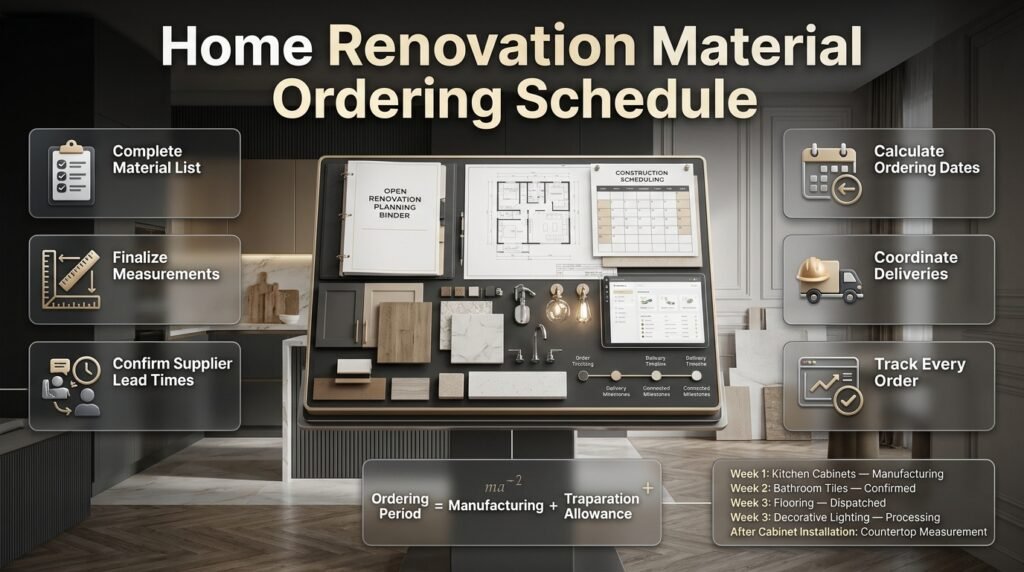
A material ordering schedule connects purchasing decisions with the actual construction timeline. It tells homeowners what needs to be purchased, when orders should be placed, when products are expected to arrive, and which activities depend on those deliveries.
Without a schedule, homeowners often purchase materials based on convenience rather than construction requirements. This can result in missing products, unnecessary storage problems, and contractors waiting for essential supplies.
Step 1: Prepare a Complete Renovation Material List
Start by listing every material, fixture, fitting, and product required for the renovation.
For a kitchen project, your list might include:
- Kitchen cabinets and drawer systems.
- Countertop materials.
- Flooring and wall tiles.
- Sink and kitchen faucet.
- Electrical fittings.
- Ceiling and task lighting.
- Appliances.
- Cabinet handles and accessories.
- Paint and wall finishes.
Organize the list by room and construction stage. This makes it easier to identify products that are shared across different areas.
Why it matters: A complete material list reduces the possibility of forgetting an important product until the contractor needs it.
Professional advice: Separate essential construction products from optional decorative items. This helps you prioritize purchasing decisions without confusing urgent requirements with finishing preferences.
Step 2: Finalize Measurements and Technical Specifications
Before ordering anything customized, confirm the actual site measurements and product requirements.
For example, kitchen cabinets should be designed around the available wall dimensions, appliance sizes, plumbing positions, and electrical arrangements.
Similarly, bathroom fixtures need to match existing connections and the available installation space.
Check the following information:
- Product dimensions.
- Material specifications.
- Color and finish.
- Model numbers.
- Required quantities.
- Installation instructions.
- Compatibility with other products.
- Warranty and maintenance requirements.
⚠ Common Mistake: Ordering custom materials using preliminary measurements. Even a small dimensional difference can make an expensive product unsuitable for the intended location.
Step 3: Request Written Lead-Time Estimates
Contact suppliers before confirming major purchases.
Ask each supplier to explain how long order processing, manufacturing, and transportation will take.
A useful written confirmation should include:
- Product availability.
- Order processing duration.
- Manufacturing completion estimate.
- Dispatch date.
- Expected delivery date.
- Transportation charges.
- Replacement arrangements.
- Any known supply limitations.
Ask whether the estimated date is guaranteed or simply an expected arrival window.
This distinction is particularly important when contractors have already reserved installation dates.
Step 4: Calculate the Ordering Date by Working Backward
Rather than ordering materials when installation is approaching, calculate the purchasing deadline from the planned installation date.
Suppose custom cabinets are scheduled for installation in September.
- Manufacturing: 8 weeks.
- Transportation: 2 weeks.
- Inspection and contingency: 2 weeks.
The total planning requirement is approximately 12 weeks.
Therefore, the order should ideally be placed around twelve weeks before the intended installation date.
Planning formula:
Material ordering period = Manufacturing time + Transportation time + Preparation allowance.
The calculation should be adjusted for the actual supplier and product. Some suppliers already include transportation in their quoted lead times, so avoid counting the same period twice.
Step 5: Coordinate Deliveries With Contractors
Materials should arrive when the property is ready to receive, inspect, and store them.
Early delivery isn’t always an advantage. Flooring delivered before plastering and painting are finished may be exposed to moisture, dust, scratches, and accidental damage.
Discuss the delivery schedule with your contractor and confirm:
- Whether the property is ready for delivery.
- Whether vehicles can access the site.
- Whether sufficient storage space is available.
- Who will receive and inspect the products.
- How materials will be protected.
- Whether installation can begin immediately.
Step 6: Track Every Important Order
Maintain one central purchasing tracker instead of relying on separate messages, receipts, and memory.
| Material | Order timing | Expected arrival | Current status |
|---|---|---|---|
| Kitchen cabinets | Week 1 | Week 11 | Manufacturing |
| Bathroom tiles | Week 2 | Week 5 | Confirmed |
| Flooring | Week 3 | Week 7 | Dispatched |
| Decorative lighting | Week 3 | Week 8 | Processing |
| Countertops | After cabinet installation | Week 13 | Measurement pending |
Update the tracker whenever a supplier changes a delivery estimate.
📌 Quick Tip: Review important orders weekly. A short conversation with a supplier can reveal a manufacturing problem early enough to arrange an alternative.
How Much Extra Time Should You Allow for Material Delays?
A contingency period is additional time built into the purchasing schedule to accommodate unexpected problems.
The correct allowance depends on the product, supplier, shipping distance, and importance of the material to the construction sequence.
| Material category | Suggested additional planning allowance |
|---|---|
| Standard local stock | 2–5 working days |
| Special-order products | 1–2 weeks |
| Custom cabinetry | 1–3 weeks |
| Imported finishes | 2–4 weeks |
| Bespoke architectural products | 2–4+ weeks |
These are practical planning allowances rather than guaranteed industry standards. A supplier’s actual delivery history should influence the final decision.
Why Is a Delivery Buffer Necessary?
A product arriving at the property doesn’t automatically mean it is ready for installation.
It may need inspection, additional measurements, preparation, or replacement if it arrives damaged.
Imagine ordering a bathroom vanity with an integrated basin. When the delivery arrives, you discover that the basin opening is incorrectly manufactured.
Even if the vanity is replaced quickly, the installation team may need to rearrange its schedule.
A suitable contingency allowance gives you time to resolve such problems without immediately affecting every following activity.
⭐ Expert Tip: Give more attention to products that are difficult to replace. A missing standard paint container may be easy to source locally, but an incorrectly manufactured custom window can create a much bigger scheduling problem.
What Should You Do When Renovation Materials Are Delayed?
Even with careful preparation, material delays can happen. Manufacturing problems, transportation interruptions, incorrect specifications, and unexpected stock shortages may affect delivery dates.
The important thing is to respond quickly and understand which construction activities depend on the missing product.
1. Contact the Supplier Immediately
Don’t wait until the scheduled delivery date has passed.
If an order appears to be falling behind, contact the supplier and request a realistic update.
Ask:
- What caused the delay?
- Has manufacturing started?
- Is the product completed?
- Has it been dispatched?
- Is partial delivery possible?
- Can another product meet the same requirements?
- What is the revised delivery date?
Request the updated information in writing.
A clear response helps you decide whether to wait, rearrange work, or investigate another supplier.
2. Identify the Activities Affected by the Delay
A delayed product doesn’t always stop the entire renovation.
For example, if decorative bathroom mirrors haven’t arrived, the contractor may still be able to complete flooring, painting, and other unrelated activities.
However, missing waterproofing materials may prevent bathroom installation from proceeding safely.
Discuss the delay with your contractor and identify which tasks depend directly on the missing product.
3. Rearrange Construction Activities
When practical, contractors can move to other activities while waiting for delayed materials.
Possible options include:
- Completing preparation work in another room.
- Painting unaffected surfaces.
- Finishing electrical work in suitable areas.
- Installing available fixtures.
- Preparing surfaces for upcoming products.
- Completing inspections and corrective work.
However, don’t rearrange activities without considering technical dependencies.
Installing flooring before heavy construction is finished, for example, can create unnecessary damage.
4. Consider an Alternative Product
Sometimes, replacing a delayed material is more practical than waiting several additional weeks.
However, the replacement should meet the original functional and design requirements.
Compare:
- Dimensions.
- Material quality.
- Appearance.
- Color and finish.
- Technical performance.
- Installation requirements.
- Warranty.
- Total cost.
A replacement should be approved by the homeowner and relevant professional before the original order is cancelled.
5. Review the Renovation Schedule
After receiving a revised delivery date, update the construction schedule.
Consider a kitchen renovation in which the countertops are delayed.
The following activities may be affected:
- Countertop templating.
- Fabrication.
- Countertop installation.
- Sink installation.
- Faucet connections.
- Final kitchen testing.
By identifying these dependencies, homeowners can understand the actual effect of a delay instead of assuming that every part of the project must stop.
How Do Material Lead Times Affect Different Types of Home Renovations?

Material purchasing requirements vary according to the type of renovation. A kitchen project has different technical dependencies from a bathroom upgrade, while a complete home renovation requires coordination across several rooms.
Understanding these differences makes purchasing decisions more practical.
Kitchen Renovation Material Planning
Kitchen renovations involve several products that depend on accurate measurements and coordinated installation.
Cabinetry is usually one of the most important early purchases because countertop fabrication often depends on the final cabinet installation.
A practical purchasing sequence includes:
- Finalize the kitchen layout.
- Confirm appliance dimensions.
- Approve cabinet drawings and finishes.
- Place the cabinet order.
- Confirm flooring and wall finishes.
- Order plumbing and electrical products.
- Install cabinets.
- Complete countertop templating.
- Fabricate and install countertops.
- Fit appliances and complete final connections.
Don’t order countertops using assumed cabinet dimensions. The final measurements should be taken at the appropriate stage by the fabricator.
Also consider how material choices affect kitchen functionality. Durable work surfaces, moisture-resistant finishes, and easy-to-clean flooring can be more valuable over time than selecting products based only on appearance.
Bathroom Renovation Material Planning
Bathrooms have specific installation requirements because plumbing, waterproofing, ventilation, and surface finishes must work together.
Important products include:
- Shower systems.
- Bathtubs.
- Toilets.
- Bathroom vanities.
- Waterproofing membranes.
- Wall and floor tiles.
- Drainage components.
- Bathroom lighting.
- Mirrors and ventilation equipment.
Order specialist fixtures early, especially if they have unusual dimensions or require imported components.
Waterproofing products should also be available before the relevant construction stage. Never allow a contractor to substitute an unapproved waterproofing system simply because the specified material is delayed.
Bedroom Renovation Material Planning
Bedroom renovations may appear simpler than kitchen or bathroom projects, but custom wardrobes, fitted furniture, doors, and specialist lighting can still affect the schedule.
A bedroom with built-in storage requires accurate measurements and coordination with wall finishes, electrical outlets, and furniture placement.
For example, ordering a custom wardrobe before finalizing the bedroom layout could result in insufficient clearance around doors or restricted access to other furniture.
Review the Bedroom Layout with Ensuite Access guide when coordinating bedroom circulation, storage, and access requirements.
Whole-Home Renovation Material Planning
Whole-home projects require a broader purchasing strategy because several rooms may depend on the same suppliers and materials.
For example, a homeowner may select the same flooring for the hallway, living room, and bedrooms. Purchasing enough material from the same production batch helps maintain consistent appearance.
A whole-property material schedule should identify:
- Products used in multiple rooms.
- Room-specific finishes.
- Custom-made furniture.
- Structural materials.
- Plumbing and electrical equipment.
- Long-lead products.
- Delivery and storage requirements.
Homeowners can also explore Home Improvement guidance when organizing larger renovation activities and deciding which improvements should be completed together.
How to Compare Renovation Material Suppliers
Choosing a supplier based only on the shortest delivery estimate can be a costly mistake.
A reliable supplier should provide realistic timelines, accurate product specifications, clear communication, and a reasonable process for resolving problems.
Questions to Ask Before Placing an Order
| Supplier question | Why it matters |
|---|---|
| Is the exact product in stock? | Confirms availability |
| Is the delivery date guaranteed? | Clarifies the commitment |
| Does the estimate include manufacturing? | Prevents incomplete planning |
| Are transportation charges included? | Helps calculate the total cost |
| What happens if an item arrives damaged? | Establishes replacement procedures |
| Is the same production batch available? | Helps maintain consistent finishes |
| Can the order be tracked? | Improves purchasing control |
| What is the cancellation policy? | Clarifies financial risks |
Compare Overall Value Instead of Price Alone
A cheaper product may appear attractive, but the purchasing decision should include more than the initial price.
Consider:
- Product quality.
- Supplier reliability.
- Delivery arrangements.
- Warranty coverage.
- Replacement availability.
- Transportation costs.
- Installation compatibility.
- Communication and after-sales support.
For example, purchasing inexpensive tiles from an unreliable supplier may create problems if additional quantities are needed later.
A slightly more expensive product with confirmed availability and dependable replacement arrangements may offer better overall value.
Why Should You Identify a Backup Supplier?
A backup supplier provides another option when the original manufacturer experiences a serious delay.
This is especially useful for standard construction products, common tiles, paint, and frequently used fittings.
For custom products, finding a direct replacement may be more difficult because dimensions, finishes, and technical specifications must match.
You don’t need to place duplicate orders. Simply identify an alternative supplier and understand its availability before a problem occurs.
How to Store Renovation Materials After Delivery
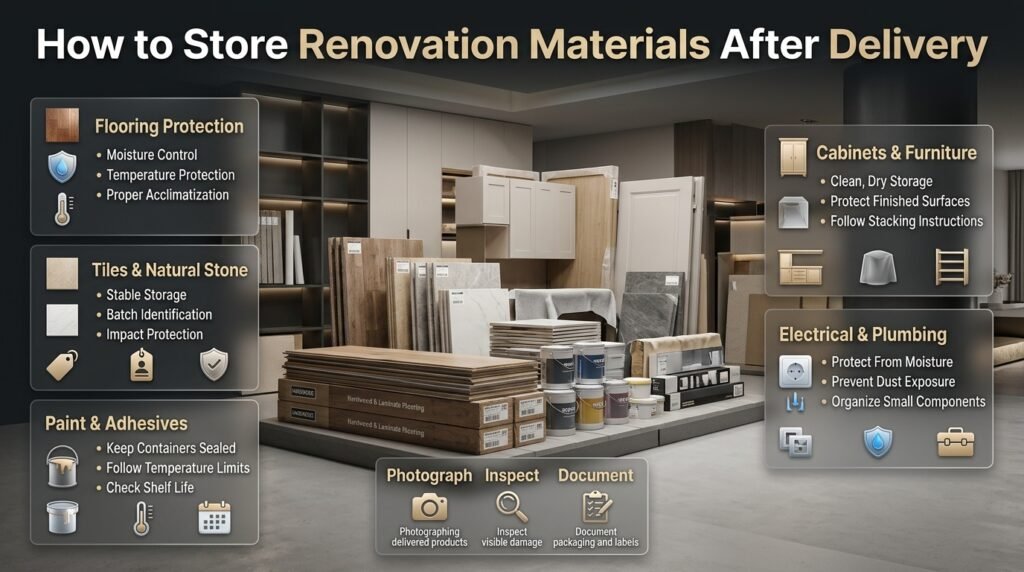
Receiving materials early is useful only when they can be stored safely.
Improper storage may damage expensive products before installation, creating replacement expenses and additional delays.
Flooring Materials
Wood flooring, laminate, and other sensitive products should be stored according to the manufacturer’s instructions.
Protect them from excessive moisture, direct sunlight, and unsuitable temperature conditions.
Some flooring products also require acclimatization before installation. Follow the manufacturer’s recommended procedure rather than assuming immediate installation is appropriate.
Tiles and Natural Stone
Tiles should be stored on stable surfaces where they cannot fall or become damaged.
Keep product labels and batch numbers available. These details help installers identify matching materials and make future replacements easier.
Natural stone should be protected against impact, staining, and unsuitable storage conditions.
Paint, Adhesives, and Sealants
Keep containers sealed and store them within the manufacturer’s recommended temperature range.
Extreme heat, freezing conditions, and moisture exposure may affect product performance.
Check the product’s shelf life before purchasing large quantities, especially if the finishing work is scheduled several months later.
Cabinets, Doors, and Furniture
Store cabinets and doors in a clean, dry, protected area.
Avoid exposing finished surfaces to construction dust, water, and heavy objects.
Where products require special positioning or stacking instructions, follow the supplier’s recommendations.
Electrical and Plumbing Components
Keep electrical products protected from moisture and dust.
Store small plumbing fittings, connectors, and installation accessories together so that contractors can locate the correct components easily.
📌 Quick Tip: Photograph delivered products, packaging, labels, and any visible damage. These records can help resolve disputes with suppliers and confirm that the correct items were received.
How to Coordinate Material Orders With Interior Design Decisions
Material purchasing should not happen separately from interior design planning. A product may have a suitable delivery time and price but still create problems if it doesn’t work with the room’s layout, lighting, storage requirements, or other finishes.
The best approach is to make design decisions before placing major orders.
Finalize Colors and Finishes Before Purchasing
Color selection can affect the entire material schedule, especially when several products need to work together.
For example, a homeowner might choose warm oak flooring, cream-colored cabinetry, and natural stone countertops. If the cabinet finish is changed after manufacturing begins, the revised product may require additional production time.
Before ordering, compare samples under the lighting conditions of the actual room.
Consider:
- Natural and artificial lighting.
- Existing wall and floor colors.
- Furniture finishes.
- Surface textures.
- Cleaning and maintenance requirements.
- The appearance of adjoining rooms.
The Paint Color collection can help homeowners explore color choices and understand how different finishes influence the overall appearance of a renovated space.
Coordinate Lighting With Electrical Requirements
Lighting products should be selected before electrical installation is finalized.
A decorative pendant, recessed ceiling light, or integrated LED system may require particular wiring positions, mounting arrangements, or power requirements.
Changing the lighting selection after electrical work is complete can create additional installation costs.
For example, a homeowner who initially selects standard ceiling lights but later chooses a large decorative pendant may discover that the ceiling support or electrical position needs adjustment.
Review Japandi Lighting Composition for ideas on coordinating lighting arrangements with natural materials, balanced finishes, and comfortable interiors.
Consider Natural Light Before Selecting Materials
Natural light changes how materials and colors appear throughout the day.
A flooring sample that looks warm in a showroom may appear much cooler in a room with limited daylight. Similarly, glossy surfaces can reflect more light than expected in a bright space.
Check the room’s orientation, window placement, and daylight conditions before approving major finishes.
The guide to Natural Light and Floor Plan Orientation provides additional ideas for understanding how daylight and room planning influence interior decisions.
Coordinate Sound-Absorbing Materials in Suitable Spaces
Material selection can also affect indoor comfort.
In open-plan homes, home offices, entertainment rooms, and properties with large hard surfaces, acoustic performance may deserve attention.
Products such as acoustic panels, carpets, soft furnishings, and specialist ceiling materials may need additional sourcing or installation coordination.
For homeowners renovating spaces where sound control matters, Hospitality Interior Acoustic Planning offers useful design considerations that can inform decisions about interior acoustics and material selection.
How to Manage Renovation Material Budgets Without Sacrificing Quality
Material lead times and renovation budgets are closely connected. Ordering too late can increase costs through expedited delivery, alternative purchases, additional labor, and repeated transportation.
However, ordering everything months in advance can also create financial and storage problems.
The objective is to purchase the right products at the right time while keeping enough flexibility for unexpected expenses.
Separate Essential Materials From Optional Upgrades
Start by dividing your material budget into three groups.
| Budget category | Examples | Purchasing priority |
|---|---|---|
| Essential construction materials | Waterproofing, wiring, plumbing, structural products | High |
| Functional finishes | Flooring, cabinetry, doors, bathroom fixtures | High to medium |
| Decorative upgrades | Wall art, accessories, decorative shelving | Lower |
This classification helps homeowners protect essential spending when unexpected costs appear.
For example, if a kitchen cabinet order becomes more expensive than expected, you may decide to postpone decorative accessories rather than compromise on the quality of the cabinetry.
Compare the Total Cost of Material Ownership
The cheapest purchase isn’t always the most economical decision.
A product may have a low initial price but require specialist installation, expensive transportation, frequent maintenance, or difficult replacement procedures.
Before ordering, consider:
- Purchase price.
- Delivery charges.
- Installation costs.
- Maintenance requirements.
- Expected durability.
- Replacement availability.
- Warranty conditions.
A durable flooring product that costs slightly more may be a better long-term choice than a cheaper alternative that needs frequent repairs.
Avoid Paying for Unnecessary Early Deliveries
Ordering a product early and having it delivered immediately may create storage costs or increase the risk of damage.
Ask suppliers whether they can reserve stock and arrange delivery closer to the installation date.
This approach can be particularly helpful for flooring, cabinetry, furniture, and delicate decorative products.
Understand Payment and Cancellation Conditions
Before making a deposit, read the supplier’s payment terms.
Some suppliers require full payment before manufacturing, while others request a deposit and the remaining balance before dispatch.
Custom products may have stricter cancellation and modification conditions because manufacturing materials are prepared specifically for the customer.
Make sure you understand:
- Deposit requirements.
- Payment milestones.
- Cancellation charges.
- Refund conditions.
- Product modification policies.
- Replacement responsibilities.
These details can protect your budget if the renovation design or delivery schedule changes.
What Documents Should Homeowners Keep When Ordering Renovation Materials?
Good purchasing records make it easier to track orders, verify product specifications, and resolve disagreements.
Instead of keeping information in scattered messages, create one organized folder for renovation purchases.
Essential Purchasing Documents
1. Product quotations
Keep supplier quotations showing prices, quantities, specifications, and delivery estimates.
2. Purchase orders
A purchase order confirms exactly what you have agreed to buy. It should identify the product, quantity, model, finish, and relevant terms.
3. Approved drawings and samples
Keep copies of approved cabinet drawings, countertop specifications, tile samples, and other important design decisions.
4. Payment receipts
Save deposit confirmations, invoices, and final payment records.
5. Delivery notes
These documents help verify the products and quantities received at the property.
6. Warranty information
Keep warranty documents and installation instructions for future maintenance or replacement requirements.
Why Is a Written Renovation Work Order Useful?
A renovation work order helps establish what needs to be completed, which materials are required, and who is responsible for different activities.
It can also clarify delivery coordination between homeowners, contractors, and suppliers.
Before work begins, review the Renovation Work Order for Homeowners guide to understand how organized project instructions can support smoother renovation management.
A written work order is especially valuable when several trades are working on the same property. It reduces confusion about responsibilities and helps everyone follow the same project requirements.
Practical Example: Planning Material Lead Times for a Kitchen and Bathroom Renovation

A realistic example makes it easier to understand how material ordering works in an actual renovation.
Imagine a homeowner is renovating a kitchen and bathroom. The project includes custom kitchen cabinets, natural stone countertops, bathroom tiles, a new vanity, plumbing fixtures, flooring, lighting, and fresh paint.
The homeowner wants to avoid unnecessary delays while keeping the construction schedule organized.
Phase 1: Planning and Design
During the initial planning stage, the homeowner finalizes:
- Kitchen and bathroom layouts.
- Cabinet dimensions.
- Appliance specifications.
- Tile designs.
- Countertop selection.
- Bathroom fixture models.
- Flooring materials.
- Lighting requirements.
Samples are checked under the property’s actual lighting conditions.
The contractor confirms which measurements must be verified before custom orders are placed.
Phase 2: Early Purchasing
The homeowner places orders for the longest-lead products.
These include custom kitchen cabinetry, specialist bathroom fixtures, and selected lighting.
Standard tiles and flooring are also reserved after quantities and batch availability are confirmed.
Phase 3: Construction Preparation
While custom products are being manufactured, the contractor completes appropriate preparation activities.
These may include removing existing finishes, checking plumbing and electrical systems, and preparing surfaces.
The homeowner regularly checks supplier updates and adjusts the delivery schedule when necessary.
Phase 4: Installation and Fabrication
The cabinets arrive and are inspected before installation.
After the cabinets are correctly installed, the countertop fabricator completes final measurements.
The bathroom tiles and vanity are installed according to the construction sequence.
Phase 5: Final Fittings
Lighting, plumbing fixtures, cabinet handles, mirrors, and finishing accessories are installed.
The homeowner checks product condition, confirms that all components are present, and keeps the warranty documents.
What Does This Example Teach?
The most important lesson is that material purchasing should follow the construction sequence.
Ordering custom cabinets early doesn’t mean installing them immediately. It means ensuring they are manufactured and available when the property is ready.
Similarly, countertop fabrication should be scheduled around actual cabinet measurements rather than assumptions made during the initial design.
This coordinated approach reduces the chance of waiting for essential materials after contractors have already reached the relevant installation stage.
How to Make Material Purchasing Easier for DIY Home Renovations
Not every renovation requires a professional project manager. Homeowners completing smaller improvements themselves can also benefit from a simple material planning system.
However, DIY projects often involve limited storage, personal work schedules, and smaller purchasing quantities.
These conditions make preparation particularly important.
Start With One Project at a Time
Instead of purchasing products for several unrelated improvements, organize the work into manageable stages.
For example, if you’re renovating a bedroom, complete the necessary measurements, surface preparation, and material selection before purchasing decorative items.
A structured approach reduces the risk of buying products that don’t fit the finished space.
Confirm Tools and Accessories Before Ordering
Some DIY materials require additional accessories.
Installing wall shelves, for example, may require appropriate brackets, fixings, wall anchors, and tools depending on the wall construction and expected load.
A homeowner who orders the shelves but forgets the compatible mounting components may need another purchasing trip.
The DIY Home Projects section provides inspiration for planning manageable improvements and considering the materials needed to complete them.
Plan Storage Before Deliveries Arrive
DIY homeowners may not have a separate storage area.
Before ordering larger products, decide where they will be kept and how they will be protected.
Avoid placing moisture-sensitive materials in unsuitable garages, outdoor areas, or damp storage spaces.
Check Compatibility Before Installing
Don’t assume that every product is suitable for every surface.
Wall fixings, adhesives, paint primers, and installation accessories must match the material and application requirements.
When uncertain, follow the manufacturer’s instructions or consult an appropriate professional.
How Smart Home Products Affect Renovation Material Lead Times
Modern renovations increasingly include smart lighting, connected thermostats, automated blinds, security equipment, and integrated home control systems.
These products introduce additional purchasing and technical coordination requirements.
A homeowner may select a smart lighting system during the finishing stage without realizing that it needs particular wiring, compatible switches, or a suitable control hub.
This can create additional work if the electrical installation has already been completed.
Identify Smart Products During the Design Stage
Make a list of connected products before construction begins.
Examples include:
- Smart switches.
- Motion sensors.
- Automated lighting controls.
- Smart thermostats.
- Motorized window treatments.
- Security cameras.
- Door access systems.
- Home automation hubs.
Check compatibility between devices and confirm whether specialist installation is required.
Confirm Technical Compatibility
A product may look suitable but still be incompatible with the existing electrical system or other connected equipment.
Before ordering, confirm:
- Power requirements.
- Connectivity requirements.
- Supported control systems.
- Installation dimensions.
- Network requirements.
- Required accessories.
- Manufacturer support.
For additional planning ideas, explore How to Set Up My Home Decoradtech.
Don’t Leave Automation Equipment Until the Last Minute
Smart home products may influence electrical positions, ceiling arrangements, wall finishes, and furniture placement.
Ordering important equipment early gives the installer time to confirm technical requirements before walls and ceilings are closed.
This doesn’t mean every smart accessory needs to arrive before construction starts. It means the products that affect permanent installations should be selected and approved early.
How to Manage Furniture, Shelving, and Decorative Finishes
Furniture and decorative products are sometimes treated as the final part of renovation planning. However, certain items have dimensions and installation requirements that should be considered much earlier.
For example, custom shelving may require wall reinforcement, while a large storage unit may affect electrical outlets and room circulation.
Measure Furniture Before Finalizing Room Finishes
Confirm the approximate dimensions of major furniture items before deciding on the final layout.
Consider:
- Sofa and bed dimensions.
- Wardrobe depth.
- Cabinet door clearance.
- Walking space.
- Shelf positioning.
- Access to windows and doors.
- Electrical outlet locations.
This is especially important in smaller rooms where even a small dimensional change can affect usability.
Plan Decorative Shelves With the Wall Structure
Floating shelves and wall-mounted storage systems need suitable support.
The correct fixing method depends on the wall material, shelf design, expected load, and manufacturer’s instructions.
If a shelf will hold books, ceramics, or heavy decorative objects, confirm its load capacity before installation.
The guide to Styling Open Shelves Without Clutter can help homeowners plan shelf arrangements that balance appearance and everyday functionality.
Coordinate Different Materials Across Rooms
A whole-home renovation should feel connected rather than like a collection of unrelated design decisions.
This doesn’t mean every room must use identical colors or materials. It means selecting finishes that work together.
For example, warm timber flooring can connect living and bedroom spaces, while different wall colors provide individuality.
The Styling Principles for Visually Balanced Homes guide offers useful ideas for creating visual consistency across different rooms.
Common Mistakes Homeowners Make When Planning Material Lead Times
Even homeowners who carefully plan their renovation budgets can make purchasing mistakes.
The following problems are particularly worth avoiding.
1. Ordering Materials Too Late
Why it happens: Homeowners assume suppliers can deliver everything within a few days.
Why it’s harmful: Custom products may require several weeks of manufacturing, leaving contractors unable to continue.
How to avoid it: Identify long-lead materials during the design stage and calculate ordering dates from the planned installation schedule.
2. Relying Only on Verbal Promises
Why it happens: A supplier provides an optimistic estimate during the initial conversation.
Why it’s harmful: Without written confirmation, delivery expectations may become unclear.
How to avoid it: Request written confirmation showing production, dispatch, and expected arrival dates.
3. Changing Specifications After Ordering
Why it happens: Homeowners continue comparing colors, finishes, and materials after approving a purchase.
Why it’s harmful: Changes may require revised drawings, additional charges, or replacement manufacturing.
How to avoid it: Finalize important specifications before approving custom production.
4. Ordering Insufficient Quantities
Why it happens: Measurements are incomplete, or cutting waste and spare requirements are overlooked.
Why it’s harmful: Additional quantities may be unavailable from the original production batch.
How to avoid it: Confirm quantities with the installer and account for cutting patterns, layout requirements, and reasonable spare materials.
5. Ignoring Storage Conditions
Why it happens: Homeowners focus on arrival dates rather than how materials will be protected.
Why it’s harmful: Products may become damaged before installation.
How to avoid it: Arrange suitable storage and follow manufacturer instructions.
6. Purchasing Before Confirming Measurements
Why it happens: Buyers want to take advantage of a promotion or secure a product quickly.
Why it’s harmful: Incorrect dimensions can make custom products unusable.
How to avoid it: Confirm final measurements before ordering cabinets, windows, countertops, and fitted furniture.
7. Failing to Inspect Deliveries
Why it happens: Homeowners assume the supplier has checked every item.
Why it’s harmful: Damage or missing components may only become obvious when installation begins.
How to avoid it: Check quantities, model numbers, finishes, and visible condition immediately after delivery.
8. Ordering Products Without Checking Compatibility
Why it happens: Homeowners focus on appearance and overlook technical requirements.
Why it’s harmful: Products may not fit existing plumbing, electrical systems, wall structures, or installation spaces.
How to avoid it: Have technical specifications reviewed before purchasing products that connect to permanent building systems.
9. Ignoring Supplier Communication
Why it happens: Homeowners assume the supplier will contact them if anything changes.
Why it’s harmful: A production delay may remain unnoticed until the expected delivery date.
How to avoid it: Follow up regularly and request updates for critical orders.
10. Delivering Materials Before the Site Is Ready
Why it happens: Homeowners believe early delivery always makes the renovation faster.
Why it’s harmful: Products may become damaged, obstruct construction, or require additional storage.
How to avoid it: Coordinate deliveries with the contractor and arrange arrival close to the actual installation requirement.
Professional Advice for Better Renovation Material Management
Professional renovation planning involves more than finding products and placing orders. It requires understanding how purchasing decisions affect construction activities, installation quality, and the final result.
Homeowners can use several practical strategies to manage the process more effectively.
Maintain a Long-Lead Item Register
Create a separate list of products that could affect the completion date.
Include the following details:
- Product name and specification.
- Supplier contact information.
- Order reference.
- Manufacturing duration.
- Expected delivery date.
- Installation deadline.
- Current order status.
- Alternative supplier or replacement option.
This register makes it easier to identify important orders and follow up before problems develop.
Use a Critical Path Approach
A critical path is the sequence of activities that determines the earliest possible completion date of a project.
For example:
Final kitchen measurements
          |
          v
Cabinet manufacturing
          |
          v
Cabinet delivery
          |
          v
Cabinet installation
          |
          v
Countertop measurements
          |
          v
Countertop fabrication
          |
          v
Countertop installation
          |
          v
Final plumbing and appliances
If cabinet manufacturing is delayed, the following activities may also be affected.
Homeowners should pay particular attention to materials that sit on this critical path because their availability can influence the entire renovation schedule.
Approve Samples Before Ordering Large Quantities
Never rely entirely on a small online product photograph when selecting expensive finishes.
Request physical samples whenever possible.
This is particularly useful for:
- Flooring.
- Wall tiles.
- Paint.
- Natural stone.
- Cabinet finishes.
- Decorative panels.
- Upholstery.
Check samples under different lighting conditions and compare them with adjoining materials.
Arrange Regular Supplier Communication
A supplier relationship should continue after the payment is made.
Maintain communication during manufacturing, dispatch, and delivery.
For critical products, confirm progress before the installation deadline approaches.
If a supplier reports a delay, ask for a revised schedule immediately and inform the contractor.
Keep a Contingency Budget
Even a well-organized renovation can experience unexpected expenses.
Additional transportation, storage, replacement products, or rescheduled labor may increase the overall cost.
Set aside a reasonable contingency amount based on the project’s complexity and financial circumstances.
Avoid spending this reserve on decorative upgrades before essential construction requirements are covered.
Review Reliable Information Before Making Final Decisions
Product availability, design trends, and material specifications can change.
Homeowners should review current product information, manufacturer instructions, and relevant renovation guidance before making major purchases.
The Latest News DecoratorAdvice resource can provide additional design-related reading when researching current home improvement ideas.
The most important principle is to make purchasing decisions based on actual project requirements rather than trends or attractive discounts alone.
How far in advance should you order materials for a home renovation?
The best time to order renovation materials depends on the product, supplier availability, and complexity of the project. Standard materials such as paint, basic fittings, and commonly available tiles can often be purchased shortly before installation. However, custom kitchen cabinets, made-to-measure windows, specialist flooring, and imported finishes require much earlier planning.
Homeowners should identify long-lead materials during the design stage rather than waiting until contractors are ready to install them. A practical approach is to work backward from the planned installation date, including manufacturing, transportation, inspection, and an additional contingency period. This helps prevent situations where workers are ready but essential materials haven’t arrived.
Important points to consider:
Order custom cabinetry and made-to-measure products approximately 8–12 weeks ahead when supplier estimates require it.
Confirm imported materials and specialist finishes as early as possible.
Check actual stock availability before making payments.
Include additional time for unexpected manufacturing or transportation delays.
Coordinate delivery dates with your contractor before confirming orders.
Which home renovation materials have the longest lead times?
Custom-made and specialist renovation products generally have the longest lead times because they require additional manufacturing, technical approvals, or transportation arrangements. Kitchen cabinets, custom windows, bespoke doors, natural stone countertops, and imported decorative materials are common examples.
For instance, kitchen cabinets may require approved measurements, manufacturing drawings, material preparation, assembly, and finishing before delivery. Natural stone countertops involve another process because final measurements are often taken after the supporting cabinets have been installed. This means homeowners should consider not only the product’s individual lead time but also its position within the construction schedule.
Materials that need early planning include:
Custom kitchen cabinets: Require accurate measurements and manufacturing approval.
Made-to-measure windows: Depend on specific dimensions, glazing, and frame specifications.
Natural stone countertops: Need final templating, cutting, polishing, and fabrication.
Imported tiles: May involve international transportation and limited batch availability.
Specialist lighting: Can require custom production and electrical coordination.
How can homeowners prevent renovation delays caused by late material deliveries?
Preventing material-related renovation delays starts with preparing a detailed purchasing schedule before construction begins. Homeowners should identify products that require manufacturing, confirm supplier delivery estimates, and coordinate orders with the contractor’s installation sequence.
One of the most effective methods is maintaining a material tracking sheet. It should include the product name, supplier, order date, expected arrival, installation deadline, and current status. Reviewing this information regularly helps identify problems while there’s still time to arrange alternatives or reorganize construction activities.
It’s also important to avoid relying entirely on verbal delivery promises. Written confirmations provide a clearer record of agreed specifications and expected dates.
Practical ways to reduce delays:
Finalize product measurements before placing custom orders.
Request written manufacturing and delivery estimates.
Place long-lead orders before standard finishing purchases.
Follow up with suppliers at least once a week.
Keep alternative suppliers in mind for essential products.
Arrange deliveries according to site readiness.
Include contingency time in the renovation schedule.
What should you do if renovation materials arrive late or are out of stock?
When renovation materials arrive late or become unavailable, the first step is to contact the supplier and establish the actual reason for the delay. Ask whether the product is still being manufactured, whether dispatch has been arranged, and when delivery can realistically be expected. A revised date should be obtained in writing rather than relying on an uncertain verbal estimate.
Next, discuss the situation with your contractor. Some construction activities may continue while the missing product is being sourced. For example, workers might complete preparation or painting in another room while waiting for specialist bathroom fixtures. However, technical and dependent activities should never be rushed simply to maintain the original schedule.
If the original product cannot arrive within a reasonable period, consider an alternative with matching dimensions, quality, appearance, and technical specifications.
Steps to handle a material delay:
Contact the supplier immediately and request an updated delivery date.
Identify which construction activities depend on the missing material.
Ask whether partial delivery or an alternative product is available.
Get professional approval before changing technical specifications.
Update the contractor’s schedule.
Review any additional transportation, replacement, or labor costs.
Keep written records of supplier communication.
How much extra time should you allow for home renovation material lead times?
Homeowners should include a contingency period in their material ordering schedule to account for unexpected production, transportation, and delivery problems. The appropriate allowance depends on how difficult a product is to source and how much it affects the renovation schedule.
Standard products available locally may only need a few additional working days, while imported finishes and customized products deserve a larger allowance. For example, a delayed decorative accessory may have little impact on the project, but a missing custom window could prevent important installation work from continuing.
A useful approach is to calculate the complete purchasing period rather than relying on the supplier’s manufacturing estimate alone.
Recommended planning considerations:
Standard local materials: Allow approximately 2–5 additional working days.
Special-order products: Consider an additional 1–2 weeks.
Custom cabinetry: Consider an additional 1–3 weeks.
Imported materials: Allow approximately 2–4 additional weeks where appropriate.
Bespoke products: Build in a larger allowance based on the manufacturer’s actual production schedule.
These are planning allowances, not guaranteed delivery periods. Always adjust them according to supplier confirmation, transportation conditions, and project requirements.
Conclusion
Understanding home renovation material lead times is essential for keeping a renovation project organized, affordable, and on schedule. Even a well-planned renovation can experience unnecessary delays when important materials are ordered too late, suppliers provide inaccurate delivery estimates, or products arrive damaged or incomplete. Planning material purchases early gives homeowners greater control over the renovation timeline and helps contractors coordinate each stage of the work more efficiently.
The most effective approach is to identify long-lead items before construction begins, confirm availability with suppliers, and create a realistic delivery schedule. Materials such as custom cabinets, windows, flooring, tiles, sanitary fixtures, and specialist finishes deserve particular attention because their production and delivery can take longer than expected. It is also important to verify measurements, compare supplier timelines, arrange suitable storage, and maintain alternative options in case a preferred product becomes unavailable.
A successful renovation is not simply about choosing attractive materials; it is about making the right decisions at the right time. By allowing extra time for unexpected delays and coordinating material deliveries with the construction schedule, homeowners can reduce disruption, manage their budgets more confidently, and avoid unnecessary pressure during the project.
Whether you are renovating one room or updating an entire property, careful preparation makes a significant difference. Plan ahead, communicate regularly with suppliers and contractors, and treat material lead times as an essential part of your renovation strategy.