
Introduction
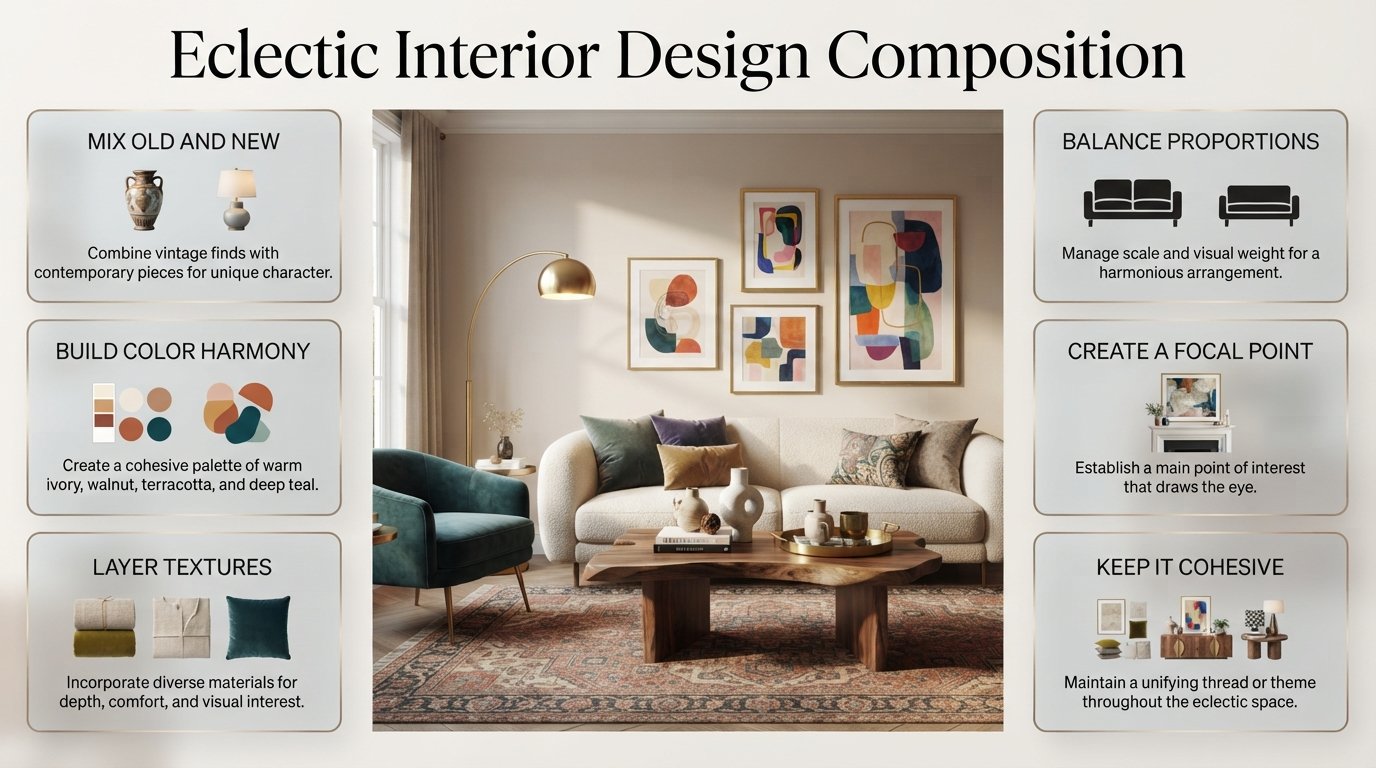
Eclectic Interior Design Composition | Have you ever found a beautiful vintage chair, a modern sofa, colorful artwork, and a traditional rug that you love individually but aren’t sure how to combine? This is a common decorating challenge. The solution is not to make everything match, but to understand how different elements can work together.
Eclectic interior design composition is the art of combining different furniture styles, colors, textures, patterns, and decorative objects to create a home that feels personal, balanced, and visually connected. It allows you to express your taste without following a single design period or decorating trend.
A successful eclectic room doesn’t happen by accident. It requires thoughtful choices about proportions, color relationships, furniture placement, lighting, and the amount of visual detail in each area. When these elements work together, contrasting pieces can feel natural rather than chaotic.
Whether you’re decorating a small apartment, updating a family living room, or furnishing an entire home, this guide explains how to plan an eclectic interior step by step. You’ll learn how to mix old and new furniture, coordinate colors, layer patterns, create focal points, avoid common mistakes, and develop a cohesive design that supports everyday living.
For more ideas and practical decorating guidance, explore DesignMode24 Interior Design.
What Is Eclectic Interior Design Composition?
Eclectic interior design composition is the intentional arrangement of furnishings and decorative elements from different styles, periods, and influences. It uses color, proportion, repetition, texture, and visual balance to connect contrasting pieces, creating an interior that feels collected and individual rather than randomly assembled.
Unlike a strictly minimalist, traditional, or contemporary room, an eclectic interior doesn’t need to follow one established aesthetic. A modern sofa can sit beside an antique cabinet, while contemporary artwork hangs above a vintage console. The design succeeds when these pieces have meaningful visual relationships.
For example, imagine a living room with a mid-century wooden sideboard, a contemporary cream sofa, a traditional patterned rug, and a sculptural metal lamp. The pieces come from different design traditions, but a shared palette of warm neutrals, walnut tones, and muted green can connect them.
Why does composition matter?
Composition determines how people experience a room. It guides the eye, establishes a focal point, distributes visual weight, and creates a sense of order. Without these relationships, even expensive furniture and attractive accessories can make a room feel disorganized.
A successful composition usually includes:
- One main focal point that attracts attention.
- A coordinated color palette connecting different elements.
- Furniture that fits the room and supports its intended use.
- A thoughtful balance of bold and understated details.
- Repeated colors, materials, shapes, or finishes.
- Negative space that allows important pieces to stand out.
The objective isn’t to eliminate contrast. It’s to make contrast feel deliberate.
Is eclectic design the same as maximalism?
No. Eclectic design describes the combination of different styles and influences, while maximalism emphasizes abundance, layering, and expressive decoration.
An eclectic room can be relatively simple, with a few contrasting furniture pieces and carefully selected accessories. A maximalist interior may include extensive artwork, layered textiles, collections, and bold patterns.
The two approaches can overlap, but an eclectic room doesn’t need to be filled with objects to feel complete. A restrained arrangement of well-chosen pieces can express eclectic style just as effectively as a richly decorated room.
1. What Are the Essential Elements of Eclectic Interior Design?
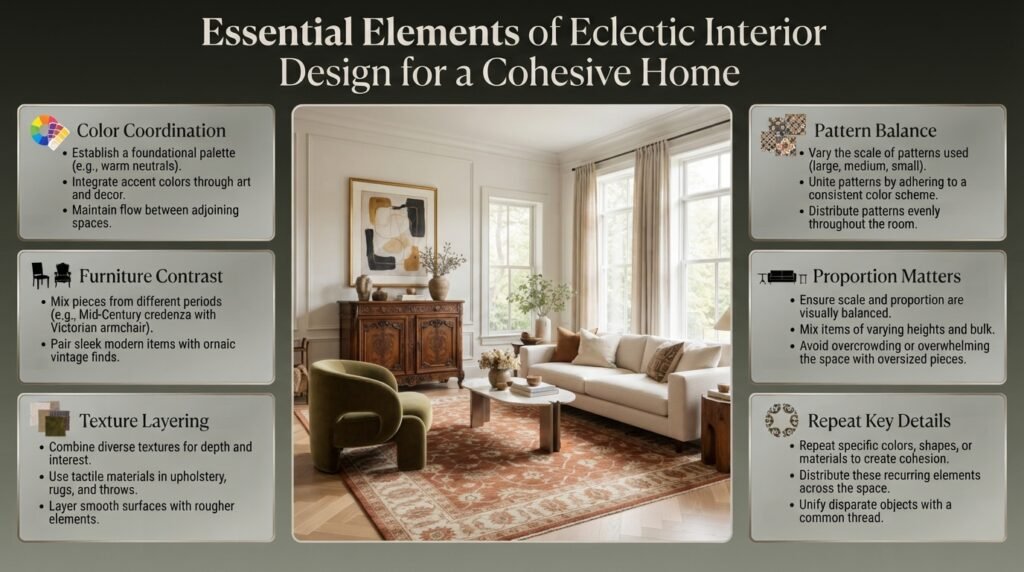
The most important elements are color, furniture, texture, pattern, proportion, and repetition. Each serves a different purpose, but they must work together to establish a clear visual direction.
Understanding these elements makes it easier to evaluate a room before buying additional furniture or accessories.
Color creates continuity
Color is one of the simplest ways to connect objects that otherwise look unrelated. A traditional wooden cabinet and a contemporary chair may have different shapes, but a shared accent color in their upholstery, artwork, or surrounding accessories can make the combination feel intentional.
Start with three color roles:
- Dominant color: The main background shade used on walls, large furniture, or other extensive surfaces.
- Supporting colors: Two or three shades repeated across textiles, artwork, and secondary furnishings.
- Accent colors: Stronger colors introduced through smaller decorative elements.
For example, warm white walls, walnut furniture, olive-green upholstery, and rust-colored cushions can create a welcoming palette that accommodates both vintage and contemporary pieces.
The colors don’t need to appear in equal amounts. A dominant shade provides stability, supporting colors establish relationships, and accents add energy.
If you’re choosing wall finishes or repainting a room, browse the Paint Color section for ideas that can help you develop a coordinated palette.
Furniture establishes structure
Furniture defines the room’s layout and often carries the greatest visual weight. Its size, shape, material, and position influence how the other elements are perceived.
A modern sofa paired with a carved antique coffee table can create an attractive contrast. The sofa provides a relatively simple visual foundation, while the table introduces craftsmanship and historical character.
The combination works best when the furniture has suitable proportions and the room retains enough space for comfortable movement.
| Furniture combination | Why it works | What to consider |
|---|---|---|
| Modern sofa and antique cabinet | Clean lines balance traditional detailing | Check the cabinet’s visual weight |
| Curved armchair and angular table | Contrasting shapes create interest | Keep their proportions compatible |
| Rustic dining table and modern chairs | Different finishes add character | Repeat a color or material |
| Vintage dresser and contemporary mirror | Different periods create contrast | Consider their combined scale |
| Minimalist bed and patterned bedside tables | Simple forms balance decorative details | Keep bedding from becoming too busy |
Furniture doesn’t need to match, but it should fit the room, serve a purpose, and relate to the surrounding pieces.
For a closer look at how proportions affect interior layouts, read Furniture Scale vs Room Size.
Texture adds depth
Texture creates interest through the way surfaces look and feel. It is particularly valuable when you want a room to feel layered without introducing too many colors or patterns.
Consider combining:
- Soft wool rugs and upholstered seating.
- Smooth timber furniture and woven baskets.
- Brushed metal fixtures and glazed ceramics.
- Linen curtains and velvet cushions.
- Stone surfaces and natural wood.
The aim is to create contrast without making the room feel disconnected. A combination of soft and hard materials usually feels more inviting than an arrangement dominated by one surface type.
Professional tip: Give each texture a purpose. A wool rug can soften a seating area, timber can introduce warmth, and a metal lamp can provide a crisp visual contrast.
Pattern introduces personality
Patterns help eclectic interiors feel expressive, but they need a clear relationship with the rest of the room.
A large floral rug, geometric cushions, and striped curtains can work together if their colors connect and their scales differ. A bold pattern is easier to appreciate when nearby surfaces are simpler.
If every textile features a strong print, the eye has little opportunity to rest. Introduce solid upholstery, plain curtains, or quieter wall finishes to balance the arrangement.
Repetition connects contrasting pieces
Repetition means using a selected feature more than once. It might be a color, material, geometric shape, metal finish, or decorative motif.
For example, a black metal floor lamp can relate to black picture frames and a small metal detail on a cabinet. A rounded mirror can echo the curves of a chair and a ceramic vase.
Repetition creates continuity without requiring identical objects. It is one of the most useful techniques for making eclectic interiors feel cohesive.
2. How Do You Create a Balanced Eclectic Interior?
Visual balance is the distribution of attention across a room. Large furniture, dark finishes, strong colors, reflective materials, and bold patterns often carry more visual weight than smaller or lighter elements.
A balanced room distributes these features thoughtfully so that no area feels unnecessarily crowded or empty.
Symmetrical balance
Symmetrical balance uses similar elements on opposite sides of a central point. It is useful when you want an eclectic room to feel orderly without making every object match.
For example, position a sofa beneath a large artwork and place two similar lamps at either end of a console. The arrangement provides structure, while the artwork, sofa, and other furnishings can introduce different styles.
This method works well in bedrooms, formal sitting rooms, and living areas where a calm atmosphere is important.
Asymmetrical balance
Asymmetrical balance uses different objects to achieve a comparable visual effect.
A large floor lamp might balance a leafy plant and a side table on the opposite side of a sofa. The objects don’t match, but their combined size, color, and prominence make the arrangement feel stable.
This technique is particularly suitable for eclectic interiors because it creates a relaxed appearance without relying on matching furniture.
Radial balance
Radial balance organizes elements around a central point. A round dining table surrounded by chairs is a familiar example.
The same principle can be used when arranging seating around a central table or distributing decorative objects around a central feature. The arrangement encourages the eye to move around the group rather than focusing on a single side.
How do you judge visual weight?
Stand at the room’s entrance and identify the first three things that attract your attention. If all three are crowded into one corner, the composition may need adjustment.
A dark cabinet might be balanced by artwork, a floor lamp, or another substantial feature elsewhere. A large patterned rug may need simpler furniture above it so the floor doesn’t dominate the entire room.
Remember that visual weight isn’t determined by size alone. A small bright-red vase can attract more attention than a large beige chair because color and contrast influence perception.
📌 Quick Tip: Photograph the room from the doorway. A photograph often reveals competing focal points, crowded corners, and uneven visual weight more clearly than looking at the room while moving through it.
3. How Do You Choose a Focal Point for Eclectic Interior Design?

A focal point is the feature that naturally attracts attention when someone enters a room. In eclectic interiors, it gives different furniture styles and decorative objects a common direction. A well-chosen focal point helps you decide what deserves attention and which elements should remain visually quiet.
Common focal points include:
- A large painting or gallery wall.
- A fireplace or distinctive architectural feature.
- A vintage cabinet with an interesting finish.
- A colorful sofa or sculptural armchair.
- A statement pendant light above a dining table.
- A patterned rug that anchors the seating arrangement.
Build the room around one main feature
Suppose you own a large abstract painting containing olive green, cream, and terracotta. You could use a neutral sofa, a wooden coffee table, and cushions that repeat two of those colors.
The painting establishes the visual direction. The furniture doesn’t need to match it exactly, but each piece should contribute to the overall arrangement.
For example, a carved wooden cabinet can work beside contemporary artwork if its finish or shape relates to another element in the room.
For more guidance, explore Room Focal Point Planning Principles.
Avoid competing statement pieces
A common mistake is treating every attractive object as a statement piece. A brightly colored sofa, heavily patterned rug, dramatic curtains, and oversized artwork can compete if they’re all equally prominent.
Choose one dominant feature and one or two supporting elements. Let simpler surfaces and furniture provide visual relief.
Practical example: In an eclectic living room, let the artwork be the main attraction, use the sofa to establish the seating arrangement, and keep the coffee table relatively simple. Add personality through a few books, a ceramic bowl, and one sculptural object.
The result feels expressive without forcing the eye to process every detail simultaneously.
4. How Do You Mix Vintage, Modern, and Traditional Furniture?
Mixing design periods is one of the defining characteristics of eclectic interiors. The strongest combinations create contrast between styles while maintaining a relationship through color, material, proportion, or shape.
Instead of asking whether two items belong to the same style, consider whether they work together in the room you have.
Combine old and new furniture
Vintage furniture can contribute craftsmanship, patina, and a sense of history. Contemporary pieces often offer simpler silhouettes and practical features.
A vintage sideboard can become an interesting feature beside a modern dining table. A contemporary sofa can also soften the elaborate detailing of a traditional coffee table.
Before purchasing older furniture, inspect its condition. Check the joints, legs, upholstery, surface damage, and stability. A beautiful piece may require repairs before it is suitable for daily use.
The Furniture Frame Construction Comparison guide can help you understand why construction quality matters when selecting furniture for a long-lasting interior.
Introduce traditional details into contemporary rooms
Traditional objects can add warmth and individuality to an otherwise modern space.
Consider introducing a carved mirror, an antique occasional table, framed botanical artwork, a traditional rug, or decorative ceramics.
Use these pieces selectively. If an antique cabinet has elaborate detailing, surround it with relatively simple furniture so its character remains visible.
Use modern furniture to simplify traditional interiors
A room with ornate furniture, decorative wallpaper, and detailed architectural features may benefit from contemporary additions.
A streamlined sofa, simple floor lamp, or understated coffee table can provide visual breathing room. The contrast makes the traditional pieces easier to appreciate.
The important thing is to establish a connection. A repeated finish, compatible color, or related silhouette can make a modern addition feel intentional rather than out of place.
Understand the story behind your pieces
Eclectic interiors often feel more personal when the objects have meaning. An inherited chair, a contemporary sculpture, and a traditional textile can represent different periods while reflecting the homeowner’s interests and experiences.
Understanding how residential styles have changed can also help you recognize which features you want to preserve. For broader context, explore the History of Changing Residential Interiors.
The aim is not to create a showroom of unrelated objects. It is to bring together pieces that make the room more functional, comfortable, and personal.
5. How Do You Layer Accessories Without Creating Clutter?
Accessories add personality to eclectic interiors through color, texture, memories, and decorative detail. However, too many unrelated objects can make a room feel crowded. The most successful arrangements combine meaningful pieces with enough empty space to let each item remain visible.
Group objects by visual relationship
A group of three objects can look cohesive when the items differ in height, shape, or material but share a visual connection.
For example, a low ceramic bowl, a stack of books, and a taller sculptural vase create a varied arrangement. If their colors complement the surrounding furniture, the grouping feels intentional.
You can group objects according to:
- Color or finish.
- Material or texture.
- Height and shape.
- Subject matter.
- Personal meaning or origin.
Not every grouping needs to follow every rule. One clear relationship is often enough.
Style open shelves thoughtfully
Open shelving provides space for books, ceramics, framed artwork, and collections. The challenge is preventing every shelf from becoming a storage area for unrelated items.
Combine objects of different heights, keep some items in small groups, and leave selected sections partially empty.
For practical inspiration, see Styling Open Shelves Without Clutter.
Preserve negative space
Negative space is the unoccupied area around furniture, artwork, and decorative objects. It allows the eye to distinguish individual features and prevents a room from feeling overloaded.
A shelf doesn’t need something on every level. A wall doesn’t need artwork across its entire surface, and a coffee table can look complete with only two or three carefully selected objects.
Common mistake: Buying decorations simply because a surface looks empty. Empty space is not automatically unfinished decorating. Add something only when it improves the composition or serves a practical purpose.
Rotate accessories instead of displaying everything
If you have a large collection of decorative objects, display a smaller selection and rotate it periodically.
This gives individual pieces more attention and allows you to refresh the room without buying new items. Store unused objects carefully so they remain in good condition.
The approach is especially useful for homeowners who enjoy collecting ceramics, books, artwork, travel souvenirs, or vintage accessories.
6. How Do You Plan an Eclectic Interior Layout?
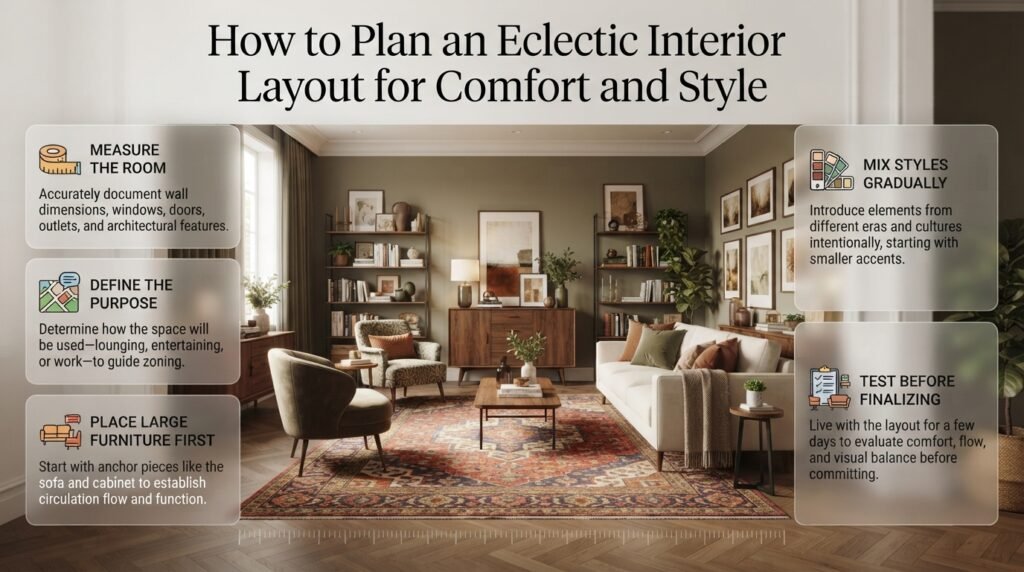
An eclectic layout should support everyday activities before decorative styling begins. Furniture needs to fit the room, walkways must remain accessible, and seating should encourage conversation or relaxation. Once these practical requirements are satisfied, contrasting styles can be introduced without sacrificing comfort.
Step 1: Measure the room accurately
Record the room’s length, width, and ceiling height. Measure doorways, windows, radiators, built-in cabinets, and other features that affect furniture placement.
Mark the positions of electrical outlets and lighting points if they influence the layout.
Draw a simple floor plan on paper. Accurate measurements and rough furniture outlines are enough to reveal potential problems before you spend money.
Step 2: Identify the room’s main purpose
Consider how you use the space during an ordinary day.
A living room might need comfortable seating, a clear television view, and storage for books. A dining room needs enough clearance for people to pull out chairs. A bedroom needs accessible bedside surfaces and a comfortable route between the bed and wardrobe.
Choose furniture according to these requirements rather than selecting pieces solely because they look attractive.
Step 3: Position the largest furniture first
Place the main furniture pieces before adding smaller items. In a living room, this usually means the sofa and primary chairs. In a bedroom, it means the bed and wardrobe.
Then arrange secondary furniture around these anchors.
For a conversational living room, orient seating toward one another or toward a shared focal point. If the room is small, a compact side table may be more practical than an oversized coffee table.
Step 4: Introduce contrasting styles gradually
Once the layout works, introduce one distinctive piece at a time.
A vintage cabinet, sculptural lamp, or patterned rug can establish the room’s character. After each addition, consider whether it improves the composition or creates unnecessary competition.
Gradual decorating makes it easier to identify which elements work and which need to be moved.
Step 5: Test the arrangement before committing
Live with the layout for a few days if possible. Check whether drawers open fully, chairs move easily, and frequently used items remain accessible.
A room can look balanced in a photograph but feel awkward during everyday use.
If your project includes several rooms or larger changes, consult the Interior Design section for additional planning inspiration.
7. How Can Lighting Improve Eclectic Interior Composition?
Lighting connects an eclectic room by highlighting textures, establishing atmosphere, and directing attention toward important features. A combination of ambient, task, and accent lighting is generally more effective than relying on a single overhead fixture.
Different lighting styles can contribute to the design themselves. A contemporary pendant, vintage table lamp, and sculptural floor light can coexist when their proportions, finishes, and placement complement the room.
Use three layers of lighting
| Lighting type | Purpose | Example |
|---|---|---|
| Ambient lighting | General illumination | Ceiling fixture or recessed lights |
| Task lighting | Supports specific activities | Reading lamp or desk light |
| Accent lighting | Highlights features | Picture light or directional spotlight |
You don’t need every layer in every room. Choose lighting according to the activities that take place there.
Match light quality to the atmosphere
Warm light often complements timber, brass, terracotta, and warm neutral fabrics. Cooler light can suit certain contemporary spaces, but the choice should depend on the room’s function and existing finishes.
Consider how lighting affects artwork, wall colors, and patterned textiles. A finish that looks attractive in daylight may appear different under artificial light.
Avoid inconsistent lighting
Combining different lamp designs is not the same as combining incompatible light quality. Bulbs with noticeably different color temperatures can make adjacent areas feel disconnected.
Where practical, choose compatible color temperatures within the same visual zone. Use appropriate brightness for the task and consider dimmable fixtures when you need flexibility.
8. How Do You Make Different Rooms Feel Connected?
A cohesive home doesn’t require every room to use the same furniture style or color scheme. Instead, a few repeated elements can create continuity while allowing each room to express its own personality.
This is particularly valuable in eclectic homes, where the living room, dining area, bedroom, and hallway may have different purposes and visual characteristics.
Establish a whole-home color relationship
Choose a small group of colors that can appear in different proportions throughout the home.
For example:
- The living room might use olive green in upholstery.
- The dining room could repeat it in artwork.
- The bedroom might feature a softer version in bedding.
- The hallway could use the same palette in a rug or framed print.
The rooms don’t need identical wall colors or furnishings. Small repetitions are often enough to establish a connection.
Repeat materials selectively
Timber, black metal, brass, linen, stone, and ceramics can connect separate spaces.
A walnut side table in the living room might relate to walnut chair legs in the dining area. A black metal lamp could echo the frames used in a hallway gallery.
Avoid repeating every material everywhere. The objective is continuity, not uniformity.
Vary visual complexity deliberately
A highly decorated living room can feel connected to a quieter hallway through a repeated finish or accent color.
You might use layered patterns and decorative objects in one space while keeping another relatively simple. This variation gives the home a natural rhythm instead of making every room compete for attention.
For more guidance, explore Styling Principles for Visually Balanced Homes.
Let each room retain its identity
Continuity doesn’t mean every room must look alike.
A dining room can feel formal, a bedroom can be softer, and a home office can be more restrained. Repeated colors, shapes, and materials provide the connection while the furnishings reflect each room’s purpose.
This approach works especially well in family homes where different people have different preferences.
9. How Can You Create Eclectic Interiors in Small Spaces?
Eclectic design can work beautifully in small apartments and compact rooms, provided furniture scale, storage, and visual complexity are carefully controlled. A limited floor area doesn’t prevent you from mixing styles; it simply makes each choice more important.
Choose fewer, more meaningful statement pieces
Instead of filling a small room with numerous decorative items, select a few pieces that make a clear contribution.
A vintage armchair, an interesting mirror, and a patterned rug may provide enough character without crowding the space. Let simpler furniture and neutral surfaces balance those features.
Use vertical space intelligently
Wall-mounted shelves, tall bookcases, and carefully positioned artwork can introduce personality without taking up much floor space.
However, vertical storage should remain practical. Frequently used items should be accessible, and heavy objects need suitable shelving and secure fixings.
Keep circulation clear
Furniture placement matters more in compact rooms because a small obstruction can make the whole space feel awkward.
Measure the available floor area before purchasing a coffee table, sideboard, or accent chair. Consider whether doors can open fully and whether people can move comfortably between furniture pieces.
Use mirrors and lighting thoughtfully
Mirrors can reflect light and create a greater sense of visual depth, particularly when they reflect a window or a well-lit area.
Layered lighting can also prevent a compact room from feeling flat. A floor lamp, wall light, or table lamp may add atmosphere without requiring a large decorative fixture.
The key is to use these features to support the room rather than treating them as substitutes for good planning.
10. How Do You Maintain an Eclectic Interior Over Time?
An eclectic interior should be able to evolve as your needs, interests, and tastes change. The best way to maintain it is to protect the elements that work while allowing smaller details to change.
Invest in a flexible foundation
Choose essential furniture for comfort, quality, and appropriate proportions. Neutral or moderately toned foundational pieces can accommodate changing artwork, cushions, rugs, and accessories.
This doesn’t mean every major item must be neutral. A statement sofa can be a successful long-term choice when its color and style genuinely suit your preferences.
Refresh details instead of replacing everything
If a room begins to feel stale, start by rearranging existing accessories or moving artwork between rooms.
You might introduce a new cushion color, change a lampshade, or display a different group of objects. Small adjustments can change the atmosphere without requiring a full redesign.
Maintain materials properly
Different materials have different care requirements. Wood may need appropriate cleaning and occasional maintenance, upholstered furniture benefits from regular vacuuming, and metal finishes may require specific cleaning methods.
Follow the care instructions for each material instead of using the same product on every surface.
Prioritize long-term usability
Timeless interiors aren’t necessarily plain or trend-free. They are spaces where quality, comfort, and personal meaning remain relevant even as decorative preferences change.
For further ideas, read Characteristics of Timeless Interiors.
If your eclectic makeover includes painting, installing shelves, repairing furniture, or updating smaller features, you can also explore DIY Home Projects for practical inspiration.
11. Practical Details That Make Eclectic Interiors Work Better
Good composition is not limited to colors and decorative arrangements. Everyday measurements, construction quality, storage, and maintenance can determine whether an interior remains comfortable after the initial decorating is complete.
Plan practical surfaces and storage
A decorative room still needs usable surfaces for daily activities. Side tables should be convenient for the seating beside them, and storage should be positioned near the items it holds.
If you’re planning a laundry or utility area as part of a wider home redesign, the Laundry Folding Counter Height guide can help you consider ergonomics alongside appearance.
For display shelves, don’t assume every wall or fixing can support the same weight. Check the wall material, brackets, anchors, installation method, and expected load. The Floating Shelf Load Capacity Planning guide is useful when planning to display heavier decorative objects or books.
Prepare carefully before renovation work
If your project involves new flooring, lighting, built-in storage, or structural changes, establish the scope before work begins.
A written plan can clarify the materials, dimensions, responsibilities, expected sequence, and finish requirements. It also makes it easier to protect existing furniture and coordinate different tasks.
Review Renovation Work Order for Homeowners when planning a more substantial interior update.
Make improvements that support the overall composition
Small DIY changes can make a room feel more cohesive when they address a specific need. Repainting an unsuitable wall color, refinishing a tired side table, or reorganizing a crowded display can be more effective than purchasing additional decorations.
Before starting a project, ask whether it improves function, visual balance, durability, or personal enjoyment. If it doesn’t solve a real problem or enhance the room, it may not be necessary.
12. Expert Recommendations for a More Cohesive Eclectic Home
Professional-quality eclectic interiors usually result from a series of deliberate decisions rather than a single decorating trick. You can apply the same approach at home by following a few practical principles.
Use the 60–30–10 color rule as a guide
A common color-planning guideline suggests using approximately 60% of a dominant color, 30% of a supporting color, and 10% of an accent color.
For example, warm neutrals might dominate the walls and larger furnishings, olive green might appear in upholstery and textiles, and rust could be introduced through smaller accessories.
This is a flexible guideline, not a strict formula. The important lesson is to establish visual hierarchy rather than distributing every color equally.
Choose quality where it matters most
When working with a limited budget, prioritize items that receive heavy daily use.
A practical order might be:
- Essential furniture that fits the room.
- Durable materials and well-constructed pieces.
- Appropriate lighting and window treatments.
- Rugs and textiles that improve comfort.
- Smaller decorative accessories.
Accessories are easy to replace, but an unsuitable sofa or poorly proportioned dining table can be expensive to correct.
For broader ideas on improving your home, visit the Home Improvement section.
Make space for unexpected combinations
Eclectic interiors benefit from experimentation. An unusual artwork, inherited object, or unexpected color pairing can make a room memorable.
However, experimentation works best when the basic layout, palette, and focal point are already established. Introduce one unusual element, observe how it interacts with the room, and make further changes only when they improve the composition.
Evaluate the room as a whole
Don’t judge each piece in isolation. A chair might be beautiful but still make the seating arrangement feel crowded. A rug might be attractive but overpower the furniture. A collection may be meaningful but need better grouping.
Step back, examine the relationships, and be willing to move or remove items.
The strongest eclectic interiors aren’t necessarily the ones with the most expensive furnishings. They’re the ones in which every important element contributes to a comfortable, coherent, and personal space.
How do you create a cohesive eclectic interior without making different styles look mismatched?
Creating a cohesive eclectic interior starts with identifying a few visual elements that can connect furniture, colors, textures, and accessories from different design styles. You don’t need matching furniture or identical finishes. Instead, choose a consistent color palette, establish a focal point, and repeat selected materials or shapes throughout the room. For example, a contemporary sofa, a vintage wooden cabinet, and a traditional patterned rug can work together when their colors and proportions complement one another.
The key is to balance contrast with continuity. If several pieces have bold patterns or intricate details, surround them with simpler furnishings to prevent visual competition. Evaluate the room as a whole rather than judging each item separately.
Practical tips:
Choose one dominant color and two or three supporting shades.
Repeat at least one material, finish, or shape across different furniture pieces.
Establish one main focal point, such as artwork or a statement cabinet.
Leave enough negative space to keep the arrangement visually comfortable.
What colors work best for eclectic interior design composition?
The best color palette depends on the room’s natural light, existing furniture, architectural features, and the atmosphere you want to create. Warm neutrals such as cream, beige, and soft white provide a flexible background for vintage furniture and colorful accessories. Deeper shades, including olive green, navy blue, terracotta, and burgundy, can introduce personality without requiring every item to match.
A practical approach is to select a dominant color, supporting colors, and a small number of accent shades. For example, a living room might feature warm white walls, walnut furniture, olive-green upholstery, and rust-colored cushions. These colors connect different furniture styles while allowing individual pieces to retain their character.
Avoid choosing colors independently without considering how they interact under natural and artificial lighting. Test paint samples and fabric swatches in the actual room before making final decisions.
Practical tips:
Use a neutral or muted shade as the foundation if you prefer a calmer interior.
Repeat accent colors in artwork, cushions, rugs, and decorative objects.
Consider the undertones of wood, stone, and upholstery when selecting paint.
Use bold colors selectively when the room already contains several strong patterns.
How can you mix modern furniture with vintage and traditional pieces?
Mixing modern, vintage, and traditional furniture works best when the pieces offer intentional contrast while sharing a few visual characteristics. Modern furniture often has clean lines, while traditional pieces may feature carved details, decorative legs, or richer finishes. Rather than trying to make these styles identical, use differences in shape and texture to create interest.
For example, a streamlined contemporary sofa can balance a traditional wooden coffee table. A vintage sideboard can become a feature in a dining room with modern chairs, especially when the finishes or colors relate to the surrounding decor.
Scale is particularly important. A large, ornate cabinet may overwhelm a small room, while delicate vintage furniture can appear disconnected beside oversized contemporary pieces. Consider the dimensions, construction, comfort, and placement of each item before combining them.
Practical tips:
Start with one distinctive vintage or traditional piece.
Balance elaborate detailing with simpler modern furniture.
Repeat a wood tone, metal finish, or accent color to establish continuity.
Check the condition and stability of older furniture before everyday use.
Arrange furniture according to function and comfortable movement, not style alone.
How do you combine different patterns and textures without making an eclectic room look cluttered?
Combining patterns and textures successfully requires variation, repetition, and visual breathing room. Patterns create movement, while textures introduce depth through differences in surface and material. When every item is equally bold, however, the room can feel overwhelming because there is no clear hierarchy.
Begin with one prominent pattern, such as a floral rug or geometric upholstery. Introduce a smaller-scale pattern through cushions or curtains, then use solid-colored surfaces to balance the arrangement. A shared color between the patterns helps them feel related even when their designs differ.
Textures can be layered in the same way. Linen, wool, wood, leather, metal, and ceramics offer contrasting qualities, but they should contribute to the room’s overall atmosphere rather than compete for attention.
Practical tips:
Combine large, medium, and small patterns instead of using prints of similar scale everywhere.
Repeat one or two colors across patterned fabrics.
Mix soft materials with harder surfaces to create depth.
Leave some shelves, walls, and tabletops relatively uncluttered.
Remove accessories that distract from the main focal point.
What are the most common mistakes in eclectic interior design, and how can you avoid them?
The most common mistake is confusing variety with random decoration. Eclectic design encourages different styles, but each piece still needs to contribute to the room’s composition. Too many unrelated colors, oversized furniture, competing statement objects, and crowded shelves can make an interior feel disorganized even when the individual items are attractive.
Another frequent problem is prioritizing appearance over practical use. A beautiful chair may obstruct a walkway, or a decorative shelf may be unsuitable for the weight of the objects placed on it. Successful composition considers comfort, durability, storage, and maintenance alongside visual appeal.
The best solution is to make decisions gradually. Establish the layout and focal point first, then add furniture, lighting, textiles, and accessories in stages. This gives you time to understand how each element affects the overall room.
Practical tips:
Measure the room and furniture before purchasing large items.
Limit competing statement pieces and establish a clear focal point.
Use repeated colors and materials to connect contrasting styles.
Avoid filling every available surface with decorations.
Check furniture quality, storage needs, and walkway clearance.
Review the complete room before buying additional accessories.
Conclusion
A successful eclectic interior design composition is about creating a home that reflects your personality while maintaining visual balance, comfort, and functionality. By combining furniture from different periods, mixing colors and patterns thoughtfully, and layering textures with purpose, you can create a space that feels distinctive without appearing chaotic. The key is to give every element a reason to belong in the room rather than adding decorative pieces simply because they look attractive on their own.
Start with a consistent color palette, establish a clear focal point, and balance bold statement pieces with quieter surfaces and practical furniture. Pay attention to scale, lighting, spacing, and the relationship between different materials. Repeating selected colors, shapes, finishes, or design details throughout the room can also create a natural connection between otherwise contrasting styles.
Remember that eclectic interiors do not need to be completed all at once. Take time to collect meaningful artwork, vintage finds, modern accessories, and furniture that suits your everyday needs. Edit the arrangement whenever the room begins to feel overcrowded, and prioritize pieces that contribute to both its appearance and usability.
For more inspiration and practical guidance on creating a home that feels personal, functional, and visually harmonious, explore DesignMode24 Interior Design. With thoughtful choices and a willingness to experiment, you can develop an eclectic interior that feels authentic, welcoming, and timeless rather than simply following a passing design trend.