
Introduction
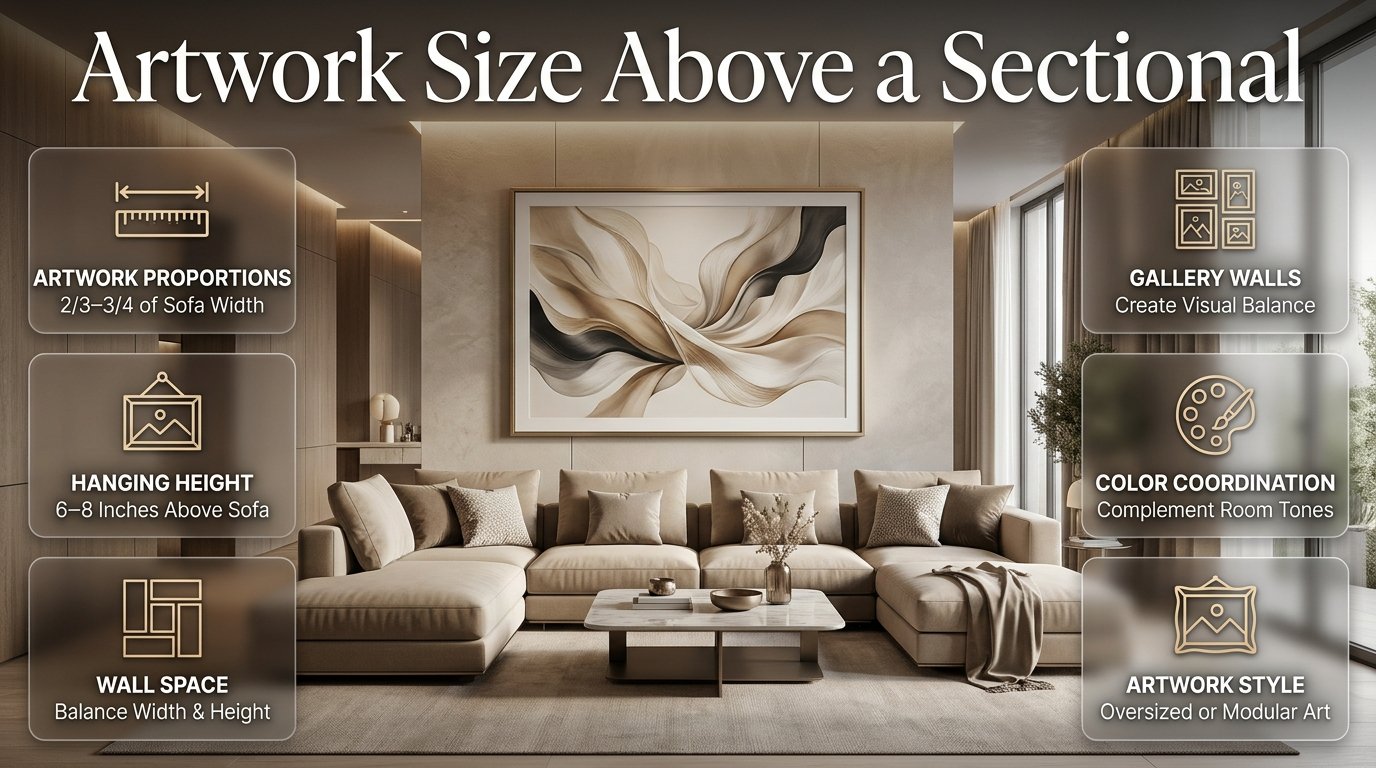
Artwork Size Above a Sectional | A sectional sofa can make a living room feel comfortable, welcoming, and beautifully furnished. However, even a well-decorated seating area can look incomplete when the wall above the sofa is left empty or decorated with artwork that is too small. Many homeowners purchase attractive paintings without considering their relationship with the furniture, only to discover that the finished arrangement looks unbalanced.
Choosing the right artwork size above a sectional is not simply about finding a beautiful painting. It involves understanding proportions, furniture dimensions, wall space, ceiling height, color coordination, and the overall decorating style of the room. The correct artwork can connect different design elements, establish a focal point, and make the entire living room feel more thoughtfully arranged.
Whether you have a compact apartment sectional, a large L-shaped sofa, a U-shaped seating arrangement, or a contemporary modular sectional, the right measurements can make a noticeable difference. Before purchasing artwork, it is worth exploring the design principles explained at DesignMode24 Interior Design, where thoughtful decorating and practical interior planning help homeowners create more attractive spaces.
In this complete guide, you’ll learn how to calculate the ideal artwork dimensions, choose between oversized paintings and gallery walls, determine the correct hanging height, coordinate colors, select suitable materials, and avoid common decorating mistakes. You’ll also find practical measurement examples, professional styling recommendations, and answers to frequently asked questions.
1. What Is the Ideal Artwork Size Above a Sectional?
The ideal artwork size above a sectional is generally around 60% to 75% of the sofa’s overall width. This proportion provides enough visual presence to complement the furniture without allowing the wall decoration to overpower the seating area.
For example, a sectional measuring 120 inches wide can accommodate an artwork arrangement approximately 72 to 90 inches wide. However, this is a starting guideline rather than a strict decorating rule. The available wall space, shape of the sofa, ceiling height, and artwork style should also influence the final decision.
Understanding the 60–75% Artwork Rule
The 60–75% guideline is useful because it creates a visual connection between the artwork and the furniture below it.
A sectional is usually one of the largest objects in a living room. If the artwork is too small, the furniture may visually dominate the wall. If the artwork is excessively wide, the decoration can compete with the sofa and make the entire arrangement feel crowded.
Consider these examples:
- A 90-inch sectional can work with artwork approximately 54–67 inches wide.
- A 100-inch sectional can work with artwork approximately 60–75 inches wide.
- A 120-inch sectional can work with artwork approximately 72–90 inches wide.
- A 140-inch sectional can work with artwork approximately 84–105 inches wide.
- A 160-inch sectional can work with artwork approximately 96–120 inches wide.
The important detail is that these measurements refer to the complete artwork arrangement. If you are hanging three paintings, their combined width and the gaps between them should be included.
Recommended Artwork Dimensions by Sofa Width
| Sectional Width | Recommended Artwork Width | Suitable Arrangement |
|---|---|---|
| 72–84 inches | 43–63 inches | One medium painting |
| 85–100 inches | 51–75 inches | One large canvas or two prints |
| 101–120 inches | 61–90 inches | Oversized canvas or three pieces |
| 121–140 inches | 73–105 inches | Large horizontal artwork |
| 141–160 inches | 85–120 inches | Panoramic artwork or gallery wall |
These ranges should be adjusted when the wall contains windows, doors, shelves, or architectural features.
Why Should Artwork Be Proportional to the Sofa?
Artwork and furniture should look like parts of the same composition. When their dimensions relate naturally, the living room feels organized and visually comfortable.
For instance, imagine a 120-inch sectional with a 30-inch-wide painting above it. Although the painting might be attractive, it is unlikely to provide enough visual weight for such a large seating arrangement.
Replacing it with an 80-inch horizontal artwork can create a much more balanced appearance.
Professional recommendation: Never select artwork based only on the dimensions of the canvas. Consider the frame, surrounding wall space, and furniture arrangement together.
2. How to Measure Your Sectional Before Buying Artwork
Accurate measurements are the foundation of a successful wall decoration project. A painting may look correctly sized in a store or online product photograph, but its proportions can appear completely different when placed above your actual sectional.
Before shopping, measure the sofa and the available wall area.
Measure the Complete Width of the Sectional
Start by measuring from the leftmost visible edge to the rightmost visible edge of the sectional.
For an L-shaped sofa, include the complete seating arrangement when determining its overall visual width. However, pay attention to how the chaise extends into the room because its depth and position may affect where the artwork should be centered.
For example:
- Main sectional width: 112 inches.
- Extended chaise section: 36 inches deep.
- Total visual width across the arrangement: 112 inches.
In this example, the chaise increases the furniture’s depth rather than its horizontal width. Therefore, the artwork calculation should use the actual left-to-right measurement instead of adding the chaise depth.
Measure the Usable Wall Space
The sofa width does not automatically determine how large your artwork can be.
A wall may have only 85 inches of usable space even when the sectional measures 120 inches. This can happen when windows, doors, wall lights, or built-in shelving occupy part of the wall.
Measure the space between these architectural features before choosing artwork.
A useful approach is to identify three measurements:
- Total wall width.
- Width of the sectional.
- Width of the unobstructed wall area available for decoration.
The final artwork should fit comfortably within the usable area.
Calculate the Recommended Artwork Width
Use a simple formula:
Sectional width × 0.60 to 0.75 = recommended artwork width.
For a sectional measuring 120 inches:
- Minimum suggested width: 120 × 0.60 = 72 inches.
- Maximum suggested width: 120 × 0.75 = 90 inches.
This gives you a practical shopping range.
Include the Frame in Your Measurements
One frequently overlooked detail is the difference between canvas dimensions and finished artwork dimensions.
Suppose a painting measures 60 inches wide, but its frame adds 2 inches on each side. The complete installation will measure 64 inches.
For a gallery wall, calculate the outside dimensions of every frame and include all spaces between individual pieces.
💡 Pro Tip: Use painter’s tape to mark the proposed artwork dimensions directly on the wall. This allows you to examine the composition before spending money on a painting or drilling holes.
3. Choosing Artwork for Different Types of Sectional Sofas
Sectional sofas come in different shapes, sizes, and configurations. The most attractive artwork arrangement depends on how the furniture occupies the room.
A solution that works above a small apartment sectional may not look appropriate above a large family-room sectional.
Artwork Above an L-Shaped Sectional
L-shaped sectionals are popular because they provide generous seating while making efficient use of corners.
However, their extended shape can make artwork placement slightly challenging.
The easiest option is often a horizontal painting positioned above the main seating section. Its width should relate to the complete sofa arrangement, while its center should align with the visual center of the seating area.
Suitable options include:
- One large abstract canvas.
- Two coordinated horizontal paintings.
- Three framed prints.
- A balanced gallery wall.
- A wide landscape painting.
Avoid positioning the artwork too far toward the chaise unless the surrounding wall arrangement supports that placement.
Artwork Above a U-Shaped Sectional
U-shaped sectionals create a substantial seating zone and usually become the dominant feature of the living room.
Because these sofas can be especially wide, a small painting may appear disconnected from the furniture.
A panoramic canvas, large multi-panel composition, or carefully arranged gallery wall can provide better visual balance.
For example, a 150-inch U-shaped sectional might accommodate an artwork arrangement approximately 90–112 inches wide, provided the wall has enough space.
Expert Tip: Consider the sectional’s complete seating footprint when planning the artwork. Don’t automatically center the painting over one cushion or one side of the sofa.
Artwork Above a Small Apartment Sectional
Small sectionals require a more restrained approach.
A large, heavily detailed gallery wall can make a compact living room feel crowded, particularly when the space already contains a coffee table, floor lamp, and decorative accessories.
Better options include:
- A medium horizontal canvas.
- Two coordinated framed prints.
- Minimalist line art.
- A small abstract composition.
- A simple landscape painting.
Choose artwork that introduces personality without competing with the room’s limited space.
Artwork Above a Modular Sectional
Modular sofas can be rearranged according to changing needs. Some homeowners move the chaise, add seating sections, or change the sofa’s orientation.
This flexibility makes it important to select artwork that works with the most common furniture configuration.
A wide canvas or coordinated set of prints can provide a flexible decorative solution.
Avoid planning an elaborate gallery wall around a temporary sofa arrangement that may change in the future.
Artwork Above a Curved Sectional
Curved sectionals create a softer and more organic appearance than traditional rectangular sofas.
A rectangular canvas can still work, but the artwork should complement the furniture’s flowing shape.
Consider rounded frames, abstract artwork with organic forms, or a large composition featuring gentle curves.
The objective is to create visual harmony rather than repeat the sofa’s shape too literally.
4. One Large Artwork or Multiple Smaller Pieces: Which Is Better?
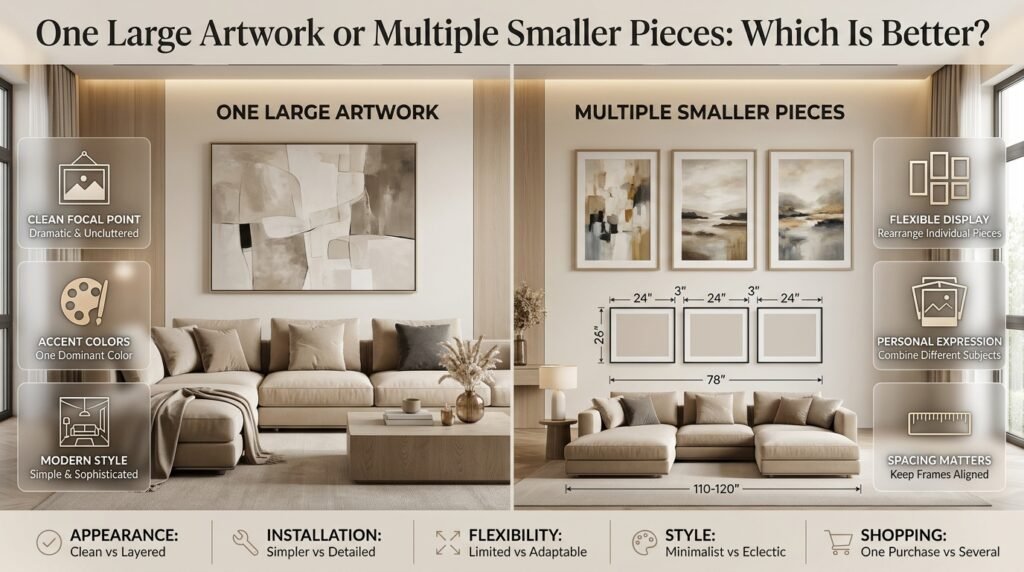
One of the most important decisions when decorating above a sectional is choosing between a single oversized artwork and several smaller pieces.
Both approaches can look attractive, but they create different visual experiences.
| Comparison | One Large Artwork | Multiple Smaller Pieces |
|---|---|---|
| Appearance | Clean and dramatic | Layered and personalized |
| Visual effect | Strong focal point | More decorative detail |
| Installation | Usually simpler | Requires precise spacing |
| Flexibility | Less flexible | Easier to rearrange |
| Best interior style | Modern and minimalist | Eclectic and transitional |
| Maintenance | Fewer frames | More individual pieces |
| Shopping | One main purchase | Several coordinated purchases |
Benefits of One Oversized Canvas
An oversized canvas can make a sectional wall look professionally decorated without introducing unnecessary visual complexity.
It is especially useful in modern living rooms where homeowners prefer simple furniture arrangements and a limited color palette.
A single artwork can:
- Establish a clear focal point.
- Introduce a dominant accent color.
- Reduce visual clutter.
- Connect the sectional with other decorative elements.
- Make an empty wall feel complete.
However, oversized artwork can be more expensive and difficult to transport or install. It may also require specialized hanging hardware.
Benefits of Multiple Smaller Paintings
Multiple pieces offer greater flexibility.
You can combine photographs, illustrations, abstract prints, and other decorative elements to create a more personal arrangement.
For example, three 24-inch-wide paintings with two 3-inch gaps create a total arrangement width of 78 inches.
This can work beautifully above a 110–120-inch sectional.
The main disadvantage is that multiple pieces require careful planning. Uneven spacing or unrelated artwork can make the composition feel disorganized.
When Should You Choose a Gallery Wall?
A gallery wall is particularly useful when:
- You want to display personal photographs.
- The living room has an eclectic design.
- You prefer a collection of smaller artworks.
- You want to incorporate different subjects.
- A single oversized canvas is outside your budget.
Common Mistake: Purchasing several small paintings without calculating their combined dimensions. Always consider the complete arrangement before buying individual pieces.
5. Best Artwork Shapes and Orientations Above a Sectional
The shape of your artwork influences how the entire wall feels. Even when two paintings have identical widths, their different heights and orientations can create completely different visual effects.
Choosing the right orientation helps you balance the long horizontal structure of a sectional with the available wall height.
Horizontal Artwork for Long Sectionals
Horizontal artwork is one of the most practical choices for sectional sofas.
Its elongated shape follows the furniture’s natural direction, creating a comfortable visual connection between the sofa and the wall.
It works especially well in:
- Contemporary living rooms.
- Open-plan interiors.
- Large family rooms.
- Minimalist seating areas.
- Rooms with standard ceiling heights.
A horizontal abstract painting can also make the seating arrangement feel more unified.
Square Artwork for Balanced Interiors
Square artwork provides a symmetrical appearance and can work particularly well above medium-sized sectionals.
A single square painting may be suitable when the sectional is relatively compact or when the wall has limited horizontal space.
For wider sectionals, consider two or three coordinated square pieces arranged horizontally.
Vertical Artwork for Narrow Wall Areas
Vertical paintings are less common above long sectionals, but they can work in rooms with unusual architectural layouts.
For example, a narrow wall between two windows may benefit from a vertical artwork arrangement.
However, a single tall painting should not be expected to visually cover the entire width of a large sofa.
Panoramic Artwork for Spacious Living Rooms
Panoramic artwork features a particularly wide composition.
It is suitable for oversized sectionals, large open-plan spaces, and living rooms with substantial uninterrupted wall areas.
Landscape photography, abstract compositions, and architectural scenes are popular choices.
The wide format creates a natural connection with long seating arrangements.
6. How High Should Artwork Hang Above a Sectional?
Artwork should generally hang approximately 6–10 inches above the back of a sectional sofa. This distance creates enough separation to prevent the painting from feeling crowded while maintaining a visual relationship with the furniture.
However, the appropriate height depends on the sofa’s back height, artwork dimensions, wall proportions, and how the room is used.
Understanding the Sofa-to-Artwork Gap
The space between the top of the sectional and the bottom of the artwork is important.
If the artwork is positioned too close to the sofa, the arrangement may look cramped.
If it is positioned too high, the painting can appear disconnected from the seating area.
For example:
| Measurement | Example |
|---|---|
| Floor to sofa back | 34 inches |
| Gap above sofa | 8 inches |
| Artwork height | 36 inches |
| Bottom of artwork | 42 inches |
| Top of artwork | 78 inches |
In this example, the painting begins 42 inches above the floor and ends at 78 inches.
These dimensions provide a useful planning reference, although the final position should be checked against the room’s proportions.
Should You Follow the 57-Inch Eye-Level Rule?
The 57-inch guideline is a common starting point for hanging artwork in spaces where people view it while standing.
It generally refers to the artwork’s center being approximately 57 inches from the floor.
However, artwork above a sectional is a special situation because the sofa establishes another visual reference point.
If following the eye-level guideline creates a large gap above the sofa, it may not produce the best result.
Instead, prioritize the relationship between the sectional and the artwork while ensuring that the painting remains comfortable to view from different positions.
What If the Sectional Has a High Back?
High-back sectionals require additional consideration.
A tall sofa can reduce the available space between the furniture and the ceiling. Hanging a large painting too low may also make the arrangement feel crowded.
Choose an artwork height that fits the remaining wall space comfortably.
If necessary, select a slightly shorter horizontal composition rather than forcing an oversized canvas into a limited area.
What If the Ceiling Is Very High?
High ceilings create opportunities for taller artwork arrangements, but that doesn’t mean every painting should be positioned close to the ceiling.
The sectional should remain the visual anchor.
You can use a taller canvas, a vertically extended gallery wall, or a layered composition while maintaining a comfortable relationship with the furniture.
Professional recommendation: Always evaluate the artwork from the position where people normally sit. A composition that looks attractive while standing may feel too high when viewed from the sectional.
7. Choosing Artwork Colors That Complement Your Sectional
Artwork can introduce color, contrast, and personality into a living room.
The best selection usually connects with the room’s existing palette rather than attempting to match every decorative item exactly.
Artwork Above a Gray Sectional
Gray is a versatile furniture color, making it easy to experiment with different artwork styles.
For a warmer atmosphere, consider:
- Beige and cream abstract compositions.
- Muted green botanical prints.
- Terracotta landscapes.
- Warm brown photography.
- Soft gold and charcoal artwork.
If your sectional is a cool gray, adding warm artwork can prevent the living room from feeling too cold.
Artwork Above a Beige or Cream Sectional
Beige and cream sectionals provide a neutral background for expressive artwork.
Consider earthy colors such as olive green, rust, brown, muted blue, and charcoal.
A large abstract painting with several complementary shades can create an attractive focal point without making the room feel overly colorful.
Artwork Above a Black Sectional
Black furniture creates a strong visual anchor.
Lighter artwork can provide contrast and prevent the seating area from appearing too heavy.
Suitable options include:
- Ivory abstract paintings.
- White and gray compositions.
- Warm neutral photography.
- Gold-accented artwork.
- Colorful contemporary prints.
Artwork Above a Brown Leather Sectional
Brown leather furniture works naturally with organic and earthy color combinations.
Landscape artwork, textured neutral paintings, and abstract compositions featuring rust or olive tones can complement the warm appearance of leather.
Avoid choosing artwork that is almost identical to the sofa’s color without considering contrast. A little variation can make the arrangement more interesting.
Artwork Above a Blue Sectional
Blue sectionals can work with both neutral and contrasting artwork.
Depending on the shade of blue, consider:
- Cream and beige compositions.
- Muted gold artwork.
- Soft gray abstract prints.
- Warm terracotta paintings.
- Natural landscape photography.
The aim is to create a balanced color relationship rather than introducing too many competing shades.
Use the 60-30-10 Color Principle Carefully
The 60-30-10 principle is a useful decorating guideline.
It divides a room’s color composition into three approximate proportions:
- 60% dominant color.
- 30% secondary color.
- 10% accent color.
For example, a living room might feature warm white walls, a beige sectional, and small amounts of olive green and rust through artwork and accessories.
Artwork can help introduce the accent colors, but it doesn’t need to follow the formula exactly.
💡 Pro Tip: Take a photograph of your living room before shopping for artwork. Compare potential paintings against the actual colors of your sectional, flooring, rug, curtains, and cushions.
For additional inspiration, explore Paint Color ideas to understand how wall finishes and artwork can work together.
8. Best Artwork Styles for Different Interior Design Themes

The size of artwork establishes its relationship with the sectional, but its style determines the atmosphere it creates.
A traditional painting may look out of place in an ultra-modern living room, while an extremely minimal print may feel too plain in a richly decorated interior.
Modern and Contemporary Artwork
Modern interiors often benefit from clean compositions, abstract designs, geometric patterns, and limited color palettes.
A large horizontal canvas can create a strong focal point without introducing excessive detail.
Suitable subjects include:
- Abstract color compositions.
- Minimalist geometric art.
- Contemporary photography.
- Textured neutral paintings.
- Modern architectural prints.
Traditional Artwork
Traditional interiors can accommodate landscape paintings, classical illustrations, decorative portraits, and framed artwork with detailed finishes.
Wooden frames and carefully selected metallic finishes can complement traditional furniture.
For a more balanced appearance, repeat one or two colors from the painting in the room’s cushions or curtains.
Organic Modern Artwork
Organic modern interiors emphasize natural materials, soft forms, subtle textures, and earthy colors.
Artwork featuring botanical subjects, abstract landscapes, natural shapes, and textured surfaces can complement this design direction.
You can also combine artwork with natural wood frames, linen fabrics, and stone-inspired accessories.
For more ideas, explore Organic Modern Material Combinations.
Minimalist Artwork
Minimalist artwork is useful when the living room already contains several visual elements.
A simple line drawing, monochromatic composition, or restrained abstract painting can provide decoration without making the wall feel busy.
The quality of the composition becomes especially important because fewer visual details are available.
Bohemian and Eclectic Artwork
Bohemian and eclectic interiors allow greater freedom with color, pattern, and subject matter.
You can combine:
- Handcrafted artwork.
- Colorful abstract paintings.
- Botanical prints.
- Cultural-inspired patterns.
- Mixed frame finishes.
- Personal photographs.
The key is to establish some repetition through color, subject, or frame material so that the collection feels connected.
Rustic and Farmhouse Artwork
Rustic interiors often look attractive with landscapes, botanical illustrations, countryside photography, and textured artwork.
Natural wood frames and warm neutral colors help reinforce the relaxed atmosphere.
Avoid making every decorative element identical. A combination of subtle textures can make the room feel more natural.
9. Selecting Artwork Materials, Frames, and Finishes
Artwork is not defined by its image alone. Its material, frame, surface finish, and construction also affect how it looks above a sectional.
Choosing suitable materials helps you achieve the desired appearance while considering durability and maintenance.
Canvas Prints
Canvas prints are popular because they offer a relatively lightweight alternative to many framed artworks.
They work well in contemporary and casual living rooms.
Advantages include:
- A clean appearance.
- Numerous size options.
- Less reflective surfaces than many glazed prints.
- Compatibility with modern interiors.
However, canvas quality varies, so examine the material, printing quality, and frame construction before purchasing.
Framed Prints
Framed prints provide a structured and finished appearance.
They are suitable for traditional, contemporary, and transitional living rooms.
You can select black, white, metallic, or wooden frames depending on the surrounding decor.
If the artwork is printed behind glass, consider glare from windows and lighting fixtures.
Textured Artwork
Textured paintings introduce depth and visual interest.
They are especially attractive in neutral interiors where color contrast is limited.
Popular options include raised plaster compositions, textured acrylic paintings, and mixed-media artwork.
Because some textured pieces have delicate surfaces, avoid placing them where people might accidentally touch or damage them.
Metal Wall Art
Metal artwork can create a modern or industrial appearance.
It may be particularly suitable for interiors with metal lighting fixtures, contemporary furniture, or industrial-inspired finishes.
However, consider the material’s weight, reflective surface, and installation requirements before choosing it.
Wooden Frames
Wooden frames add warmth and can connect artwork with flooring, furniture, shelves, and other natural materials.
Light oak can suit Scandinavian and organic modern interiors, while darker wood may complement traditional and classic rooms.
How to Choose the Right Frame Thickness
Frame thickness should be proportional to the artwork.
A very heavy frame can overwhelm a delicate print, while an extremely thin frame may look insignificant around a large canvas.
Consider the visual weight of the painting and the style of the sectional.
A large traditional artwork can accommodate a more substantial frame, while minimalist artwork often looks better with a simpler border.
10. How to Create a Professional Gallery Wall Above a Sectional
A gallery wall allows you to combine different artwork pieces into one organized display.
Although it may look casual, successful gallery walls require careful attention to scale, spacing, alignment, and color.
Choose a Central Artwork
Start with the largest or most visually important piece.
This artwork establishes the direction of the arrangement and gives the smaller frames a reference point.
For example, you might use a 30-by-40-inch central painting and arrange smaller pieces around it.
Decide on the Overall Shape
The complete gallery wall should have a recognizable outer shape.
Common options include:
- A horizontal rectangle.
- A symmetrical grid.
- A balanced asymmetrical arrangement.
- A staggered composition.
For most long sectional sofas, a horizontal or gently rectangular arrangement works particularly well.
Maintain Consistent Spacing
A spacing range of approximately 2–3 inches between frames is a useful starting point.
You can adjust the gaps slightly depending on frame sizes, but consistency is more important than choosing one exact number.
Mix Artwork Sizes Carefully
Combining different frame sizes can make a gallery wall more interesting.
However, avoid placing all the largest frames on one side.
Distribute the visual weight across the arrangement.
Use Repeating Design Elements
A gallery wall doesn’t require identical artwork.
You can create unity through:
- Matching frame finishes.
- Repeated colors.
- Similar subject matter.
- Consistent spacing.
- A shared artistic style.
Example of a Three-Piece Arrangement
Suppose you have a 120-inch sectional and want to create a three-piece artwork installation.
You select three prints, each measuring 24 inches wide, and leave two 3-inch gaps.
The total width becomes:
24 + 24 + 24 + 3 + 3 = 78 inches.
This provides an arrangement that fits comfortably within the recommended range.
Expert Tip: Cut paper templates matching the outside dimensions of your frames. Attach them temporarily to the wall and adjust the layout before installing any hanging hardware.
11. How to Decorate the Wall When There Is Limited Space
Not every sectional is positioned against a large, empty wall.
Some living rooms contain windows, doors, shelves, wall-mounted televisions, fireplaces, or architectural features that reduce the available decorating area.
In these situations, the artwork needs to work with the existing layout rather than compete with it.
When There Is a Window Behind the Sectional
If a window occupies most of the wall, avoid forcing a large painting into a narrow remaining section.
Instead, consider:
- Small framed prints beside the window.
- Artwork on an adjacent wall.
- A decorative mirror in a suitable position.
- Minimalist wall accessories.
- Window treatments that complement the seating area.
Natural light should also be considered when selecting materials and finishes.
When There Is a Fireplace Nearby
A fireplace can create a second focal point in the living room.
If the sectional is positioned beside or opposite the fireplace, artwork should complement the architectural feature.
Avoid creating two competing focal points with unrelated decorative arrangements.
Choose artwork that connects with the room’s colors and visual style.
When There Are Built-In Shelves
Built-in shelving already introduces visual detail.
A simple painting or restrained artwork arrangement may be more appropriate than an elaborate gallery wall.
If the shelves occupy part of the wall above the sectional, measure the remaining usable area carefully.
When the Wall Is Very Narrow
A narrow wall may not accommodate artwork within the typical 60–75% range.
In this situation, use the available space as the main limitation.
A smaller painting can still work when it is properly positioned and supported by the surrounding decor.
The goal is to create the best possible composition for the actual room rather than follow a percentage without considering the architecture.
12. Artwork Placement When the Sectional Is in an Open-Plan Living Room
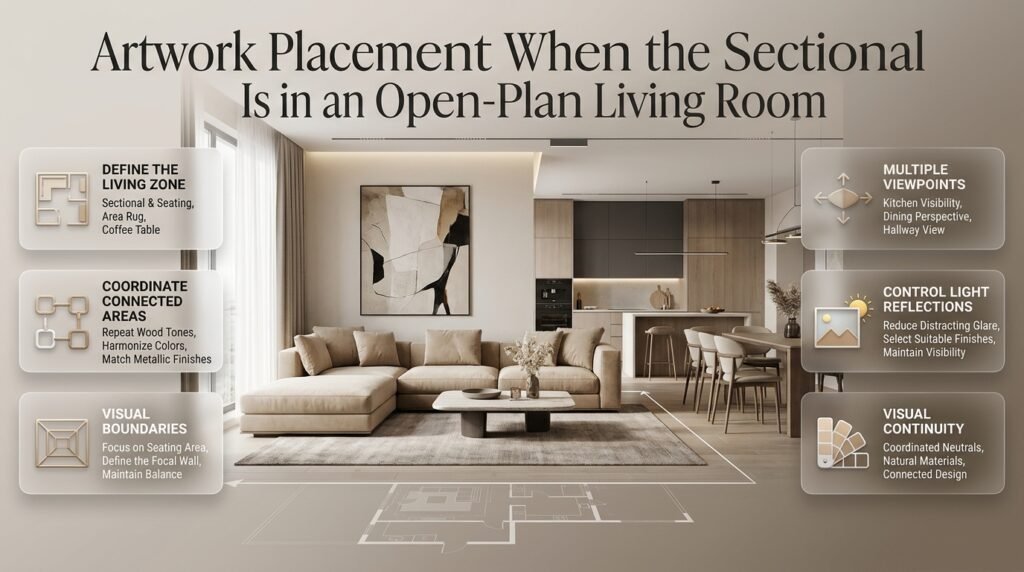
Open-plan homes combine multiple functions within one connected space.
A sectional may define the living room without being positioned directly against a wall. In these layouts, artwork placement requires a slightly different approach.
Identify the Living Room’s Visual Boundary
First, identify the area occupied by the seating arrangement.
The sectional, rug, coffee table, and nearby lighting usually establish the living zone.
Artwork should relate to this area rather than to the entire open-plan room.
Consider the Dining and Kitchen Areas
If the living room connects directly with a dining area or kitchen, maintain some consistency between the different zones.
For example, repeat natural wood tones, neutral colors, or metallic finishes.
The artwork above the sectional can become a visual bridge between these areas.
Choose Artwork That Works From Multiple Angles
In an open-plan room, artwork may be visible from the kitchen, dining table, hallway, and living area.
Select a composition that looks attractive from different viewpoints.
Avoid finishes that create distracting glare when viewed from other parts of the room.
For practical ideas about planning connected home spaces, explore How to Set Up My Home Decoradtech.
13. Common Artwork Sizing and Decorating Mistakes to Avoid
Even a beautiful painting can look wrong when its dimensions, placement, or visual style don’t suit the sectional.
Understanding common mistakes helps you make better decisions before buying artwork.
Mistake 1: Choosing Artwork That Is Too Small
Small artwork can disappear above a large sectional.
This usually happens when buyers focus on the painting’s appearance rather than the furniture’s dimensions.
How to avoid it: Measure the sectional and calculate the recommended artwork width before shopping.
Mistake 2: Hanging Artwork Too High
Artwork placed too close to the ceiling can look disconnected from the sofa.
How to avoid it: Use the sofa back as your starting reference and begin with a gap of approximately 6–10 inches.
Mistake 3: Ignoring the Entire Furniture Arrangement
An L-shaped sectional may have an extended chaise that changes its visual balance.
How to avoid it: Consider the complete seating configuration and locate its visual center before hanging the painting.
Mistake 4: Choosing Too Many Competing Colors
A painting with numerous strong colors may clash with patterned cushions, rugs, and curtains.
How to avoid it: Identify the room’s dominant and secondary colors before selecting artwork.
Mistake 5: Using Inconsistent Gallery Wall Spacing
Uneven gaps make an otherwise attractive gallery wall look unfinished.
How to avoid it: Measure the gaps and use a consistent spacing plan.
Mistake 6: Ignoring Frame Dimensions
A frame can increase the total installation width and height.
How to avoid it: Always measure the finished outside dimensions rather than relying only on the canvas measurements.
Mistake 7: Overcrowding the Wall
Too many decorations can make the sectional area feel visually heavy.
How to avoid it: Allow negative space around the artwork and prioritize one clear focal point.
Mistake 8: Ignoring Lighting Conditions
Strong sunlight can affect sensitive artwork, while reflected light can make framed pieces difficult to view.
How to avoid it: Check the direction of natural light and choose suitable materials and glazing.
Mistake 9: Selecting Artwork Without Considering Furniture Style
A highly traditional painting may not complement a minimalist sectional arrangement.
How to avoid it: Consider the sectional’s shape, upholstery, legs, and overall design before choosing the artwork.
Mistake 10: Using Unsuitable Hanging Hardware
Heavy artwork can become a safety concern when installed with inadequate fasteners.
How to avoid it: Check the artwork’s weight, wall material, and mounting instructions. Use appropriate anchors or secure fixings into studs when required.
⚠️ Important: Never assume that a standard picture hook can support every large canvas or framed painting.
14. Practical Examples: Choosing Artwork for Different Sectional Sizes
The easiest way to understand artwork proportions is to apply them to realistic living room situations.
The following examples demonstrate how measurements, furniture styles, and wall conditions influence the final selection.
Example 1: Artwork Above a 90-Inch Sectional
A 90-inch sectional is suitable for a smaller living room or apartment.
Using the 60–75% guideline:
- Sectional width: 90 inches.
- Minimum artwork width: 54 inches.
- Maximum artwork width: 67.5 inches.
- Recommended starting point: 60 inches.
A 60-inch horizontal abstract painting can provide a balanced focal point.
For a minimalist interior, choose a simple composition with neutral colors and a slim frame.
Example 2: Artwork Above a 110-Inch Sectional
A 110-inch sectional provides more flexibility.
The recommended artwork width is approximately 66–82.5 inches.
A three-piece arrangement can work particularly well.
For example:
- First painting: 24 inches.
- Second painting: 24 inches.
- Third painting: 24 inches.
- Two gaps: 3 inches each.
- Total arrangement: 78 inches.
This arrangement creates a balanced horizontal display without requiring one oversized canvas.
Example 3: Artwork Above a 120-Inch Sectional
A 120-inch sectional is common in larger family living rooms.
A suitable artwork arrangement may measure approximately 72–90 inches wide.
A single 80-inch canvas is a practical choice when the room has a contemporary design.
Alternatively, a coordinated gallery wall can introduce more visual detail.
Example 4: Artwork Above a 140-Inch Sectional
A 140-inch sectional requires a more substantial artwork arrangement.
The recommended width is approximately 84–105 inches.
Consider a panoramic painting, three large coordinated prints, or an asymmetrical gallery wall.
Make sure the artwork does not extend too close to nearby windows, wall corners, or architectural features.
Example 5: Artwork Above a 160-Inch Sectional
An oversized sectional can easily dominate a large living room.
An artwork arrangement measuring approximately 96–120 inches wide may provide suitable visual balance when the wall allows it.
For this type of space, consider a custom canvas or professionally planned gallery wall.
A single enormous painting is not always necessary. Several coordinated pieces can create a similar visual impact while offering greater flexibility.
15. How to Install Artwork Above a Sectional Safely
After choosing the dimensions and style, the next step is installation.
Proper installation protects the artwork, prevents wall damage, and reduces the risk of accidents.
Check the Wall Construction
Different wall materials require different hanging systems.
Common residential wall types include:
- Drywall.
- Plaster.
- Brick.
- Concrete.
- Wooden wall panels.
A fastener suitable for drywall may not be appropriate for masonry or plaster.
Identify the wall material before purchasing hardware.
Understand the Artwork Weight
A lightweight canvas may need only a basic picture-hanging system.
A large framed painting, heavy mirror, or substantial decorative panel requires more secure support.
Check the manufacturer’s mounting recommendations and the rated capacity of the hardware.
For particularly heavy installations, professional assistance may be appropriate.
Use a Level
A level helps ensure that the artwork remains straight.
This is especially important for multiple-piece arrangements because even small alignment differences can become noticeable across a long gallery wall.
Measure Before Drilling
Mark the hanging points carefully.
For framed artwork, remember that the hanging wire or brackets may not be positioned directly at the top edge.
Measure the distance between the hanging hardware and the top of the frame before deciding where to drill.
Protect the Wall and Furniture
Move the sectional slightly away from the wall during installation.
Cover the seating area if drilling could produce dust.
After installation, return the furniture to its normal position and check the overall composition.
For more practical home improvement guidance, explore DIY Home Projects.
16. Budget Planning: How Much Should You Spend on Artwork?
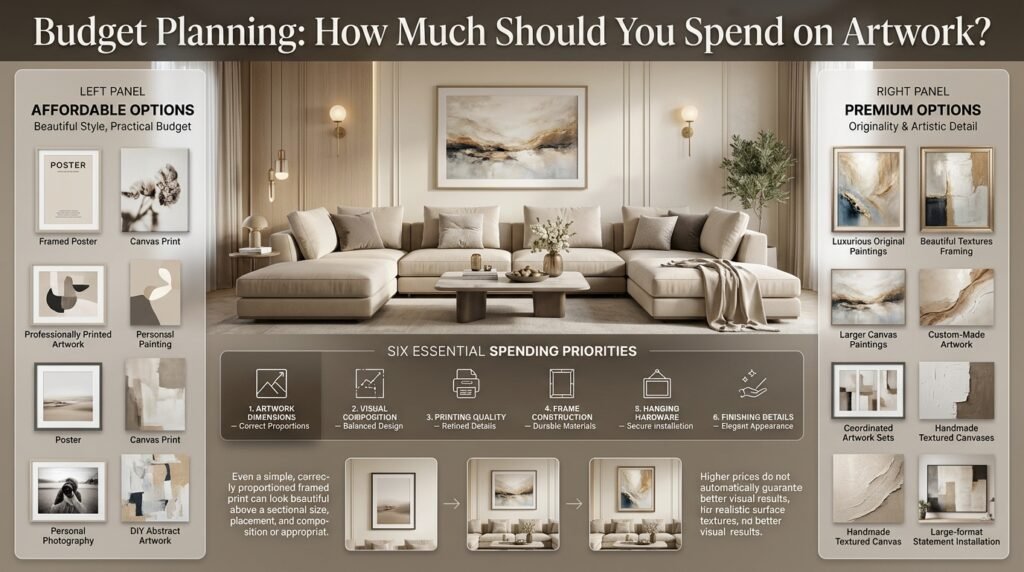
The right artwork doesn’t have to be expensive.
A well-proportioned print with a suitable frame can sometimes look more attractive than a costly painting that is incorrectly sized.
Instead of focusing only on price, consider the overall value, quality, and suitability of the artwork.
Affordable Artwork Options
Homeowners working with a limited budget can consider:
- Professionally printed artwork.
- Framed posters.
- Affordable canvas prints.
- Reproduction landscape paintings.
- Carefully selected personal photographs.
- DIY abstract artwork.
These options can provide attractive results without requiring a large investment.
Mid-Range Artwork Options
A mid-range budget may allow you to purchase higher-quality framed prints, larger canvases, or coordinated artwork sets.
Look for:
- Better printing quality.
- Durable frame construction.
- Suitable hanging hardware.
- More refined surface finishes.
- Consistent dimensions.
Premium Artwork Options
Premium options include original paintings, custom artwork, handmade textured pieces, and large-format installations.
These can be particularly suitable when the sectional wall is a major focal point in a spacious living room.
Before making a substantial purchase, confirm the final dimensions and installation requirements.
Where Should You Spend More?
If your budget is limited, prioritize the aspects that have the greatest visual and practical impact.
| Priority | What to Consider |
|---|---|
| 1 | Correct artwork dimensions |
| 2 | Suitable visual composition |
| 3 | Good printing or material quality |
| 4 | Appropriate frame construction |
| 5 | Secure hanging hardware |
| 6 | Decorative finishing details |
A correctly sized artwork with a simple frame can create a better result than an expensive painting that does not fit the space.
17. Expert Interior Design Recommendations for a More Polished Result
Creating a professional-looking arrangement involves more than following measurements.
Interior designers consider the relationship between furniture, architecture, lighting, color, and decorative accessories.
The following recommendations can help you make more confident decisions.
Treat the Sectional and Artwork as One Composition
The sectional should not feel disconnected from the artwork.
Think of the sofa and wall decoration as a combined visual arrangement.
Their width, position, color, and overall style should support one another.
Consider Negative Space
Negative space is the empty area surrounding decorative objects.
It is an important part of interior design because it gives individual elements room to stand out.
Avoid filling every available section of the wall.
A carefully positioned painting can be more effective than several unnecessary decorations.
Repeat Materials and Colors
Repetition creates visual consistency.
If the artwork includes natural wood tones, consider repeating those tones through a side table or shelving.
If it features muted green, introduce that shade through cushions or indoor plants.
This doesn’t mean every decorative object must match. A small amount of repetition is enough to establish a connection.
Consider the View From Different Positions
Examine the artwork while standing, sitting, and entering the room.
This helps you identify problems that may not be obvious during installation.
For example, a large framed painting may reflect a nearby window when viewed from the sectional.
Adjusting the lighting or selecting a different finish may improve the experience.
Avoid Following Trends Without Considering the Room
Popular artwork styles can provide inspiration, but they should not determine every decorating decision.
A trendy oversized abstract canvas may not suit a traditional living room.
Choose artwork that complements your furniture and will remain attractive as other accessories change.
Plan the Entire Room Before Making Major Purchases
Artwork should be considered alongside the sectional, rug, lighting, wall color, and other major decorative elements.
If you are planning a complete room update, it can be helpful to review Interior Design ideas before purchasing expensive furniture or accessories.
You can also explore LLBlogHome Upgrades by Lovelolablog for additional home improvement inspiration.
18. Additional Decorating Details That Improve the Artwork Arrangement
Small details can make a noticeable difference in how artwork looks above a sectional.
Although they may not determine the overall dimensions, they help create a more complete and comfortable living room.
Coordinate the Artwork With Cushions
Cushions are an easy way to repeat colors from the painting.
For example, if the artwork contains muted green and beige, adding one or two cushions in similar tones can connect the wall decoration with the sofa.
Avoid using too many competing patterns.
Use a Suitable Area Rug
An area rug helps define the seating zone.
Its color and texture can support the artwork without matching it exactly.
For example, a neutral rug can balance a colorful abstract painting, while a patterned rug may work better with simpler wall decoration.
Consider Side Tables and Lamps
Side tables and lamps can balance the visual weight of a sectional.
If the artwork is particularly bold, simpler furniture accessories may prevent the room from feeling crowded.
A table lamp with a similar finish to the artwork frame can also create a subtle connection.
Add Natural Elements
Indoor plants, wooden furniture, and natural textiles can soften a living room.
They work particularly well with landscape artwork, botanical prints, and organic abstract compositions.
For more inspiration on coordinating outdoor and indoor design elements, explore Decoradhouse Garden Tips by DecoratorAdvice.
Maintain a Consistent Design Direction
A room feels more complete when its decorative elements follow a recognizable design direction.
This doesn’t mean every piece must belong to the same collection.
Instead, use consistent materials, colors, shapes, and textures to create a natural connection.
You can also find additional inspiration through Upgrade Tip LLBlogHome.
19. Planning a Complete Living Room Update Around Your Artwork
Sometimes, selecting artwork reveals other issues in the living room.
The wall may need repainting, the sectional may need repositioning, or the lighting may not be suitable for the desired arrangement.
Rather than treating artwork as an isolated purchase, consider whether the complete seating area needs improvement.
Evaluate the Existing Furniture Layout
Check whether the sectional is positioned correctly in relation to doors, windows, and walkways.
Artwork cannot correct an uncomfortable furniture layout.
If the sofa blocks natural movement, consider adjusting its position before planning the wall decoration.
Review Wall Condition and Finishes
Inspect the wall for uneven paint, cracks, stains, and damaged surfaces.
These issues can become more noticeable when a large painting is installed.
For larger renovation projects, a clear work plan can help organize measurements, materials, installation tasks, and finishing work.
See Renovation Work Order for Homeowners for related planning ideas.
Consider the Entrance and Surrounding Spaces
The living room should feel connected with the entrance and nearby areas.
When a sectional wall is visible from the main entrance, artwork may influence the first impression of the entire home.
Its colors and proportions should work with the surrounding architectural features.
For additional ideas, explore Outdoor Entrance Design Proportions.
Follow Relevant Decorating Inspiration
Homeowners often benefit from reviewing different decorating approaches before committing to one style.
However, inspiration should always be adapted to the actual room.
You can explore Latest News DecoratorAdvice for additional decorating ideas and home-related inspiration.
For further home improvement guidance and practical decorating information, visit DesignMode24 Interior Design.
What Is the Best Artwork Size Above a Sectional Sofa?
The best artwork size above a sectional sofa is generally between 60% and 75% of the sofa’s total width. This proportion creates a balanced relationship between the furniture and wall decoration. For example, if your sectional measures 120 inches wide, an artwork arrangement measuring approximately 72–90 inches wide can create an attractive focal point without making the wall look overcrowded.
However, the final dimensions should also depend on the available wall space, ceiling height, and overall living room layout. A large horizontal painting is often an excellent choice for a spacious sectional, while a coordinated set of smaller prints can work better in a room where flexibility is important.
Important points to consider:
Measure the complete width of your sectional before purchasing artwork.
Include frame dimensions when calculating the overall artwork size.
Leave enough empty wall space around the arrangement.
Consider a horizontal canvas for long sectional sofas.
Adjust the dimensions according to windows, doors, and other architectural features.
How High Should You Hang Artwork Above a Sectional?
Artwork should generally be positioned approximately 6–10 inches above the back of a sectional sofa. This distance creates a comfortable visual connection between the furniture and wall decoration. Hanging artwork too high can make the living room feel disconnected, while positioning it too close to the sofa can make the arrangement look cramped.
The correct height also depends on the artwork’s dimensions and the sectional’s back height. Rather than following a standard wall-hanging measurement without considering the furniture, use the sofa as your primary reference point. The artwork should feel like part of the seating arrangement, not an unrelated decoration.
Professional placement tips:
Measure from the top of the sofa back to the bottom edge of the artwork.
Use a level to maintain straight alignment.
Consider the view from the normal sitting position.
Avoid placing heavy frames where they could interfere with comfortable seating.
Use painter’s tape to preview the hanging position before drilling.
Is One Large Painting Better Than Multiple Smaller Pictures Above a Sectional?
Both options can create beautiful results, but the best choice depends on your decorating preferences and the available wall space. One large painting creates a strong focal point and works particularly well in modern, contemporary, and minimalist living rooms. Multiple smaller pictures provide more flexibility and allow you to introduce different subjects, colors, and artistic styles.
For example, a homeowner with a 120-inch sectional might choose one 80-inch abstract canvas or three coordinated 24-inch prints with consistent spacing. Both arrangements can achieve attractive proportions when planned correctly.
Choose according to your interior style:
One large canvas: Best for a clean, sophisticated appearance.
Two matching prints: Suitable for symmetrical arrangements.
Three coordinated pictures: Excellent for long sectional sofas.
Gallery wall: Ideal for personalized and eclectic interiors.
Panoramic artwork: Suitable for spacious living rooms with wide walls.
What Type of Artwork Looks Best Above a Gray, Beige, or Brown Sectional?
The best artwork depends on the sofa’s color, surrounding furniture, and overall interior design theme. Gray sectionals pair beautifully with muted green, cream, charcoal, and warm beige artwork. Beige sofas provide a neutral background for earthy abstract paintings, botanical prints, and soft landscape compositions. Brown leather sectionals often look attractive with terracotta, olive green, cream, and natural landscape artwork.
Instead of trying to match the painting exactly with the sofa, look for colors that complement the existing room palette. Repeating one or two shades through cushions, rugs, curtains, or decorative accessories can make the complete seating area feel more connected.
Color coordination recommendations:
Gray sectional: Try cream, muted green, charcoal, and soft blue.
Beige sectional: Consider olive, brown, terracotta, and warm white.
Brown sectional: Choose earthy landscapes and neutral abstract artwork.
Black sectional: Use ivory, gold accents, and contrasting light compositions.
Blue sectional: Consider beige, cream, muted gold, and warm neutral artwork.
How Do You Create a Balanced Gallery Wall Above an L-Shaped Sectional?
A balanced gallery wall above an L-shaped sectional requires careful planning of artwork dimensions, spacing, alignment, and visual weight. Start by identifying the visual center of the complete seating arrangement. Then select one larger artwork as the central feature and position smaller frames around it. The complete gallery wall should follow a horizontal direction that complements the sectional without extending unnecessarily toward nearby windows or corners.
Consistency is particularly important when combining different frame sizes and artistic subjects. You don’t need identical pictures, but repeating colors, frame finishes, or decorative themes helps the arrangement look professionally coordinated.
Steps for creating an attractive gallery wall:
Measure the complete available wall area.
Select one central artwork to establish the arrangement.
Combine different frame sizes without overcrowding the composition.
Maintain approximately 2–3 inches of spacing between frames.
Repeat a few colors or materials to create visual consistency.
Arrange paper templates on the wall before installing the actual frames.
Use appropriate mounting hardware according to the weight of each piece.
Conclusion
Choosing the right artwork size above a sectional is essential for creating a balanced, welcoming, and visually appealing living room. The artwork should complement the sofa’s overall width, relate naturally to the surrounding furniture, and maintain enough space above the backrest to feel properly positioned. Whether you choose one oversized canvas, a coordinated pair, or a carefully arranged gallery wall, the goal is to create a focal point that enhances the room rather than overwhelming it.
Before purchasing artwork, measure your sectional and consider the wall’s available space, ceiling height, furniture proportions, and existing color palette. As a general guideline, artwork measuring approximately 60–75% of the sectional’s width often creates a pleasing visual relationship. Hanging it around 6–10 inches above the sofa back can also help establish a comfortable connection between the furniture and the wall.
Most importantly, treat artwork as part of the complete interior design rather than an isolated decoration. When its size, placement, colors, and style work together with the sectional and surrounding elements, the entire living area feels more intentional, comfortable, and professionally designed.