

Introduction
Characteristics of Timeless Interiors | Have you ever decorated a room according to the latest trend, only to find that it looks outdated a few years later? Perhaps you bought furniture that looked impressive in a showroom but felt too large at home, selected fashionable finishes that were difficult to maintain, or painted every wall white only to discover that the room lacked warmth. These problems often arise when decorating decisions focus more on appearance than on how a home should function over time.
Understanding the characteristics of timeless interiors can help you avoid these mistakes. Timeless design isn’t about creating a home that never changes. It’s about building a practical, attractive foundation that continues to work as your preferences, household needs, and decorating trends evolve.
At DesignMode24 Interior Design, homeowners can explore ideas for creating spaces that combine visual appeal with everyday functionality. The same principle applies to timeless interiors: good design should make your home easier to live in, not simply make it look impressive in photographs.
Whether you’re decorating a small apartment, renovating a family home, or updating a single bedroom, the right decisions can help you achieve a more lasting result without spending unnecessarily.
This guide explains the defining characteristics of timeless interiors, including balanced proportions, functional layouts, durable materials, harmonious colors, furniture selection, lighting, architectural details, and personal decoration. You’ll also learn how to plan your budget, avoid common mistakes, and make improvements that deliver practical value for years.
1. What Are the Defining Characteristics of Timeless Interiors?
Timeless interiors are spaces designed around enduring principles rather than temporary decorating trends. They combine practical layouts, balanced proportions, suitable materials, comfortable furniture, harmonious colors, and thoughtful decoration to create rooms that remain attractive and useful as circumstances change.
A timeless room doesn’t need to look traditional or minimalist. It can be contemporary, classic, transitional, or eclectic. Its lasting appeal comes from the quality of its decisions and how successfully the elements work together.
The essential characteristics include:
- Balance and proportion: Furniture and decorative features suit the dimensions of the room.
- Functional planning: People can move around comfortably and perform everyday activities without difficulty.
- Appropriate materials: Finishes are selected according to durability, appearance, maintenance, and budget.
- Harmonious colors: Walls, flooring, furnishings, and accessories form a coherent palette.
- Comfortable furniture: Seating, beds, tables, and storage support real household needs.
- Thoughtful lighting: Natural daylight and artificial lighting work together.
- Visual restraint: Decoration adds meaning without overwhelming the room.
- Personal character: Artwork, books, collected objects, and textiles reflect the people who live there.
- Adaptability: Smaller elements can change without requiring an expensive redesign.
These characteristics work together. Neutral paint cannot compensate for an awkward layout, and expensive furniture won’t make a room timeless if it is uncomfortable or poorly proportioned.
The most successful interiors consider the whole room before concentrating on individual decorative objects.
2. Why Are Balance and Proportion Important in Timeless Interior Design?
Balance and proportion determine whether a room feels comfortable, organized, and visually convincing. When furniture relates appropriately to the room’s dimensions, the space feels intentional rather than crowded or empty. Good proportions also help a room remain attractive even when its colors, accessories, or decorative style change.
Choose furniture according to room size
Measure the room before purchasing large furniture. Include doorways, windows, radiators, built-in cupboards, and the space needed to open drawers or cabinet doors.
Consider a small living room with a large sectional sofa, a wide coffee table, and several bulky side tables. Even if every item is attractive, the arrangement may leave little space for movement.
Replacing the arrangement with a suitably sized sofa, a compact table, and one useful side table can improve the room without requiring additional floor space.
In a larger room, the opposite problem can occur. A small sofa and tiny rug may appear disconnected because they don’t provide enough visual weight.
Balance visual weight
Visual weight refers to how substantial an object appears. A dark, solid cabinet may feel heavier than a pale wooden console of similar dimensions. Large patterns, strong colors, and dense materials can also attract more attention.
To create balance, consider the relationship between major elements.
For example, a large sofa can be balanced by a substantial artwork, a floor lamp, or a pair of appropriately sized side tables. Exact symmetry isn’t necessary; the objective is to prevent one part of the room from feeling unintentionally dominant.
Plan comfortable clearances
Use these measurements as starting points rather than rigid rules:
| Area | Practical starting point |
|---|---|
| Main walking route | Around 30–36 inches where space permits |
| Sofa to coffee table | Around 14–18 inches |
| Dining chair access | Enough room to pull out the chair and sit comfortably |
| Bedroom circulation | Enough clearance to enter, dress, and access storage |
| Cabinet access | Space for doors and drawers to open fully |
The appropriate dimensions depend on the furniture, household members, and available floor area.
Professional advice: Mark furniture footprints on the floor with painter’s tape before purchasing large items. This reveals circulation problems early and helps you compare different layouts.
For additional guidance, explore furniture scale versus room size.
3. How Can Neutral Colors Create a Timeless Interior?
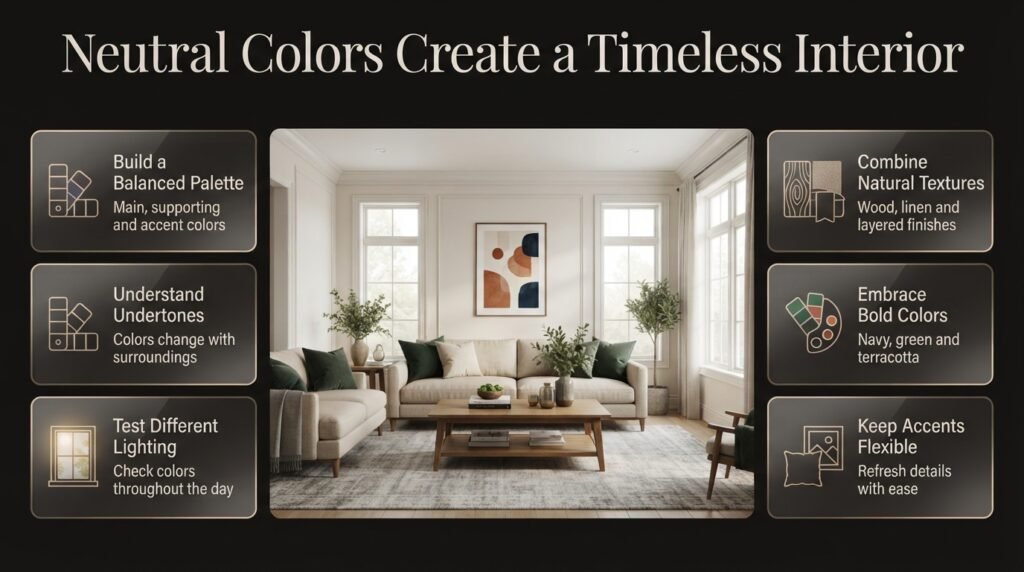
Neutral colors create a versatile background for furniture, artwork, textiles, and architectural details. Warm white, beige, taupe, soft gray, and earthy shades can complement many decorating styles, making it easier to refresh a room without changing every major finish.
However, timeless color selection involves more than choosing a neutral shade. Undertones, lighting, contrast, and the surrounding materials all influence the final result.
Build a coordinated color palette
Begin with a dominant color, add one or two supporting colors, and introduce a smaller accent.
For example, a living room might use warm white walls, medium-toned wood furniture, beige upholstery, and deep green accessories. Black or bronze details can provide contrast without dominating the space.
This arrangement gives the room a clear visual direction while allowing smaller elements to change over time.
A practical palette usually includes:
- One main color for walls or another dominant surface.
- One or two supporting colors for furniture and larger textiles.
- A contrasting shade for selected details.
- Several related textures to add depth.
The colors don’t need to match exactly. They need to work together under the lighting conditions of the room.
Understand undertones and lighting
White paint can appear creamy, yellowish, gray, or cool depending on its undertone and the surrounding surfaces. Natural daylight also changes throughout the day, while artificial lighting affects how colors look at night.
Before committing to a paint color, test samples on different walls and observe them at different times.
Don’t rely entirely on online photographs. Screen settings and image editing can make the same color appear very different from its actual finish.
Can timeless interiors include bold colors?
Yes. Timeless interiors can include navy blue, forest green, terracotta, burgundy, or other distinctive colors.
The key is to choose shades deliberately and consider how difficult they would be to change later. A colorful cushion or artwork is easier to replace than a fully fitted kitchen or extensive wall treatment.
If you love a strong color, there’s no need to avoid it. Simply consider where it will have the greatest impact without restricting future choices.
For more ideas, visit the Paint & Color category.
4. Why Do Natural Materials Contribute to Lasting Interior Appeal?
Natural materials contribute warmth, texture, and individuality to interior spaces. Wood, stone, linen, wool, cotton, and ceramic surfaces can complement a wide range of styles. Some also develop an attractive patina through everyday use, giving the home character rather than making it look unnecessarily worn.
Select materials according to their purpose
Different materials suit different environments.
| Material | Suitable applications | What to consider |
|---|---|---|
| Wood | Furniture, flooring, cabinetry | Finish, moisture exposure, repairability |
| Natural stone | Countertops, floors, feature surfaces | Porosity, sealing, cleaning |
| Linen | Curtains, cushions, selected upholstery | Wrinkling, cleaning requirements |
| Wool | Rugs, throws, upholstery | Traffic, staining, maintenance |
| Ceramic tile | Bathrooms, kitchens, floors | Installation, grout, slip resistance |
| Metal | Lighting, hardware, furniture details | Corrosion, scratches, finish durability |
Natural materials aren’t automatically the best choice for every household. Engineered surfaces, washable textiles, and quality laminates may be more practical where budgets are limited or maintenance needs are demanding.
The right choice is the one that performs well in the environment where it will be used.
Combine textures to create depth
A room dominated by smooth surfaces can feel flat. Introducing different textures creates interest without requiring numerous decorative patterns.
Imagine a bedroom with a simple timber bed, cotton bedding, linen curtains, a textured rug, and a ceramic bedside lamp. Each material contributes something different, yet the room remains visually coherent.
Texture is particularly useful when working with a restrained color palette. It allows subtle differences in surface, weave, and finish to provide richness.
Common mistake: Buying a material because it looks luxurious without checking how it will age. A delicate surface that stains easily may be unsuitable for a busy family kitchen, regardless of its appearance.
Request samples, review maintenance instructions, and consider how the material will look after several years of normal use.
5. How Should You Choose Furniture for Timeless Interiors?
Timeless furniture combines comfort, suitable proportions, dependable construction, and a design that works with different decorating choices. You don’t need to purchase the most expensive pieces. Instead, choose furniture according to how frequently it will be used, how well it fits the room, and whether it can be maintained or repaired.
Prioritize comfort and construction
A sofa may look attractive in a showroom but feel uncomfortable after an hour. A dining table may have a beautiful finish but leave insufficient room for chairs.
Evaluate furniture according to its intended use.
Look for:
- Stable frames and reliable joints.
- Comfortable seating and appropriate support.
- Upholstery suited to your household’s activity level.
- Drawers and doors that operate smoothly.
- Finishes that can be cleaned using practical methods.
- Dimensions that fit the room and delivery access.
For upholstered furniture, examine fabric durability and cleaning requirements. For wooden furniture, check construction and finish quality rather than judging it by appearance alone.
Invest in frequently used pieces
A comfortable mattress, supportive sofa, and dependable dining table often deserve more attention than decorative accessories.
If your budget is limited, keep serviceable furniture and improve the room around it. Reupholstering a chair, refinishing a wooden table, or replacing damaged hardware may be more economical than purchasing a complete set.
This approach also allows your home to develop gradually rather than looking as though every item was purchased in one shopping trip.
Mix furniture styles thoughtfully
A timeless interior doesn’t require identical furniture throughout the home. Traditional pieces can work alongside contemporary furniture when their proportions, colors, or materials create a connection.
For example, a vintage wooden cabinet may complement a simple modern sofa if the room uses related wood tones and a coordinated palette.
The objective is visual compatibility, not perfect matching.
6. Why Is Functional Space Planning Essential?
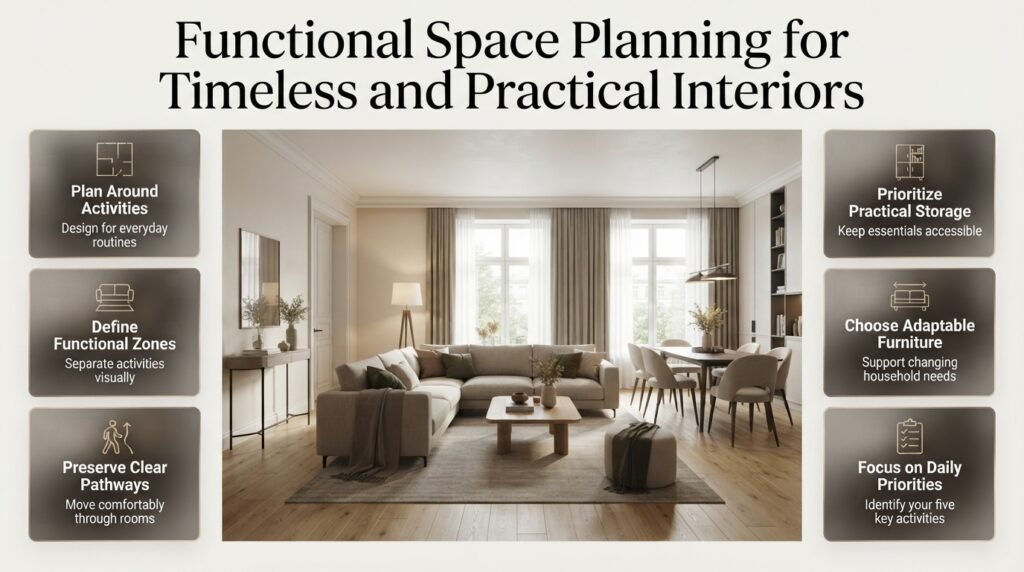
Functional space planning ensures that a room supports everyday activities without unnecessary obstacles. It considers movement, storage, furniture placement, lighting, and the relationship between different areas. A well-planned room remains useful even when its decorative style changes.
Begin with the way you use the room
Before moving furniture, list the main activities that take place in the space.
A living room may need to support conversation, television viewing, reading, and children’s play. A bedroom may require clothing storage, comfortable movement around the bed, and space for occasional work.
Arrange the room around those needs rather than simply copying a furniture layout from a photograph.
Define zones in open-plan homes
Open-plan living areas can feel disorganized when cooking, dining, working, and relaxing activities overlap without a clear arrangement.
Use furniture placement, rugs, lighting, and storage to establish visual zones.
For example, a rug can anchor the seating area, a dining pendant can identify the eating space, and a console table can create a subtle boundary near the entrance.
These features help organize the room without making it feel closed off.
Plan for changing household needs
A spare room may eventually become a home office. A child’s bedroom will need to accommodate changing interests and storage requirements. A dining area may occasionally serve as a workspace.
Adaptable furniture can make these changes easier.
Explore multipurpose room planning for ideas on balancing several activities within one space.
For compact sleeping areas, foldaway furniture for sleeping spaces can help preserve valuable floor space.
Practical tip: Identify the five activities you perform most frequently in a room. Use this list to decide which furniture and storage features deserve priority.
7. How Does Layered Lighting Make an Interior More Timeless?
Layered lighting makes rooms more functional and comfortable by combining general illumination, task lighting, and accent lighting. Instead of relying on a single ceiling fixture, a thoughtful lighting plan provides appropriate brightness for different activities while adding depth and atmosphere.
Ambient lighting
Ambient lighting provides general illumination. Depending on the room, it may come from ceiling fixtures, recessed lights, wall fixtures, or indirect lighting.
The objective is to make the room comfortably usable without producing harsh glare or distracting shadows.
Task lighting
Task lighting supports specific activities such as reading, cooking, studying, or working.
Examples include desk lamps, bedside reading lights, and under-cabinet lighting in kitchens.
Place task lighting where it supports the activity. A decorative lamp is not particularly useful if it leaves the reading area too dark.
Accent lighting
Accent lighting draws attention to selected features, such as artwork, shelving, architectural details, or textured walls.
It can also help create a relaxed atmosphere in the evening when bright general lighting is unnecessary.
Use daylight effectively
Natural daylight can make a room feel more open and welcoming. Avoid placing bulky furniture directly in front of useful windows unless the layout requires it.
Choose window treatments according to privacy, light control, insulation, and the room’s appearance. Sheer curtains may work well in some spaces, while lined curtains or blinds may be necessary elsewhere.
Bulb color also matters. Warm-white lighting often suits relaxed living areas, while more neutral lighting may be useful for detailed work. The best choice depends on the activity and surrounding materials.
For more practical ideas, explore intelligent lighting.
8. How Can Simplicity and Visual Balance Prevent a Room from Looking Dated?
Simplicity helps an interior remain adaptable by allowing its strongest features to stand out. It doesn’t require empty rooms or strict minimalism. Instead, it means choosing decoration deliberately, avoiding unnecessary clutter, and allowing enough visual space around furniture and accessories.
Give decorative objects a purpose
A meaningful artwork, favorite book collection, family photograph, or handmade ceramic piece can contribute more personality than numerous unrelated ornaments.
When arranging accessories, vary their heights and shapes while maintaining a relationship between colors or materials.
For example, a shelf might contain a short stack of books, a small ceramic object, and one framed photograph, with some empty space remaining. This arrangement feels more deliberate than filling every available gap.
Avoid decorating every surface
Empty space is part of a room’s composition. A clear console, uncluttered bedside table, or partially empty bookshelf can make the objects that remain feel more important.
This also makes cleaning easier and provides flexibility when you want to introduce something new.
Keep open shelving manageable
Open shelves work best when their contents are easy to organize and maintain.
Combine books, useful objects, and selected decorative pieces rather than treating every shelf as a display area.
If you don’t enjoy frequent dusting or arranging objects, closed cabinets may be a better choice. A timeless interior should suit your habits rather than create additional chores.
For practical styling advice, read styling open shelves without clutter.
9. Why Should Timeless Interiors Reflect Personal Style?
Personal details make a home feel meaningful rather than generic. Artwork, books, inherited furniture, travel souvenirs, handmade objects, and favorite textiles can express a household’s identity without relying on a particular decorating trend.
Create a foundation for personal expression
Start with practical foundational elements, then add items that reflect your interests and preferences.
A simple bedroom, for instance, can accommodate colorful bedding, distinctive artwork, a vintage bedside table, or a sculptural lamp. If your taste changes, these elements can be rearranged or replaced without renovating the room.
Personal style doesn’t need to follow a strict design category. You can appreciate traditional craftsmanship while preferring modern lighting, or combine contemporary furniture with meaningful inherited pieces.
The important consideration is how these items relate to the room’s overall proportions and atmosphere.
Mix old and new pieces
Vintage furniture can introduce history and individuality, while contemporary pieces may provide simpler lines or more convenient functionality.
To make the combination work, look for shared characteristics such as related wood tones, complementary colors, similar proportions, or a common material.
Don’t purchase an antique simply because it’s old, and don’t reject a modern piece because it lacks historical character. Choose items that serve your needs and contribute to the overall composition.
10. How Can Architectural Details Improve Long-Term Interior Appeal?
Architectural details give rooms structure and character beyond their decorative accessories. Window proportions, doorways, trim, flooring transitions, ceiling details, and built-in cabinetry all influence how a space feels. When these features suit the building and its occupants, they can remain attractive through many decorating changes.
Work with the home’s existing character
Before adding new architectural features, examine what already exists.
A traditional home may have original woodwork, decorative molding, or distinctive flooring worth preserving. A newer apartment may have simpler architectural lines that suit restrained furniture and textured materials.
The objective is not to force every home into the same style. It’s to select improvements that complement the building’s existing character.
Use wall treatments with restraint
Wall paneling, textured finishes, and decorative trim can add depth, but they should suit the room’s proportions and maintenance requirements.
A carefully planned feature wall may be more effective than installing elaborate details on every surface.
Before starting a project, consider whether the treatment will complement existing furniture, whether it can be repaired, and how difficult it would be to remove if your needs change.
Explore interior design ideas for further inspiration.
11. How Can You Make Timeless Interiors Work on a Budget?
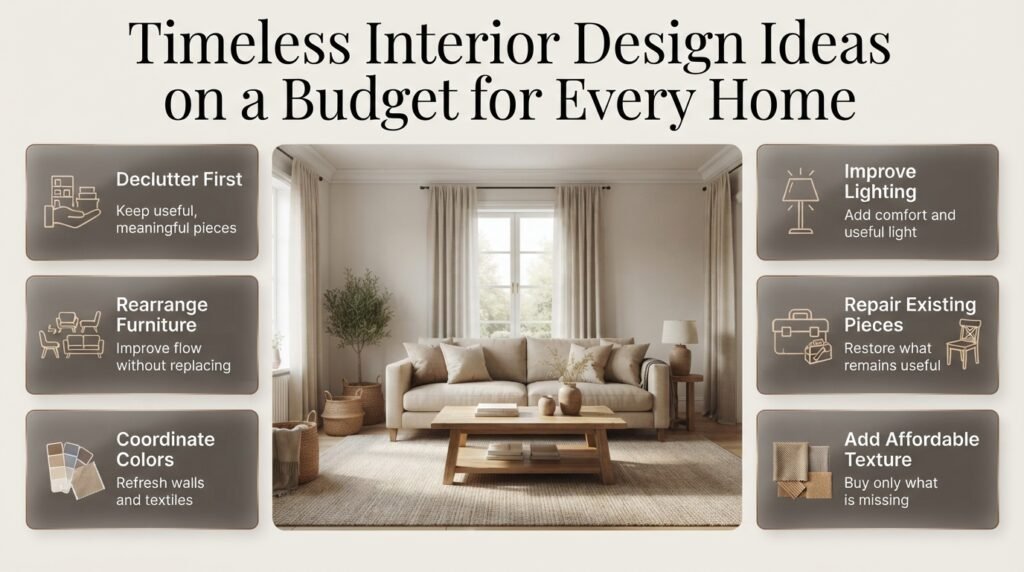
Timeless design doesn’t require luxury materials or a complete renovation. You can achieve meaningful improvements by using existing furniture effectively, correcting layout problems, choosing coordinated colors, and prioritizing upgrades that improve comfort or functionality.
Follow a practical decorating sequence
Step 1: Declutter the room. Remove objects that no longer serve a purpose or contribute to its character.
Step 2: Rearrange existing furniture. Improve walking routes and seating arrangements before purchasing replacements.
Step 3: Review the color palette. Identify finishes that clash and decide whether paint or textiles could improve continuity.
Step 4: Improve the lighting. Add useful lamps or adjust lighting placement where the room feels uncomfortable.
Step 5: Repair existing items. Consider refinishing wooden furniture, fixing loose handles, or replacing worn components.
Step 6: Add texture selectively. Use rugs, curtains, cushions, or throws to improve comfort and visual depth.
Step 7: Purchase only what is missing. Once the room is organized, you’ll have a clearer understanding of which additions will genuinely help.
Decide which upgrades provide the most value
| Improvement | Best reason to choose it |
|---|---|
| Fresh paint | Existing walls are worn or colors feel disconnected |
| New lighting | The room lacks suitable brightness or task illumination |
| Furniture repair | Existing pieces remain useful but need attention |
| A new rug | The furniture arrangement lacks visual cohesion |
| Better storage | Everyday clutter repeatedly returns |
| New accessories | The room needs a small amount of color or personality |
Compare costs before beginning a project. A repair may be more economical than replacement, but extensive repairs aren’t always worthwhile if the item is structurally unsound.
For manageable renovation ideas, explore DIY home projects.
12. How Can Timeless Design Improve Storage and Everyday Organization?
Good storage helps timeless interiors remain attractive because it makes everyday objects easier to manage. A room may have beautiful furniture and colors, but if essential belongings have nowhere convenient to go, clutter can quickly undermine the overall design.
Match storage to the items being stored
Start by identifying what needs to be stored and how often it is used.
Frequently used items should be easy to access. Seasonal belongings can be placed in less accessible areas, provided they remain protected and identifiable.
In a bedroom, for example, everyday clothing should be convenient to reach, while spare bedding may fit better on a higher shelf or in a separate linen cupboard.
Consider built-in and flexible storage
Built-in storage can use available space efficiently, especially in awkward corners or narrow rooms. However, it requires more planning and may be expensive to change later.
Freestanding cabinets, modular shelving, and movable storage units can provide greater flexibility.
Choose according to your budget, room dimensions, and the likelihood that your needs will change.
For practical planning, see floating shelf load capacity planning and bathroom linen closet planning.
Remember that storage must also be safe. Shelves and cabinets should be appropriately installed, and heavy objects should be placed according to the manufacturer’s guidance and the furniture’s load capacity.
13. How Do Timeless Principles Apply to Different Rooms?
Timeless design principles remain consistent throughout a home, but their application changes according to the purpose of each room. A living room prioritizes comfort and conversation, while a bathroom requires moisture-resistant finishes and convenient storage.
Living room
Choose seating that suits the room’s dimensions and arrange it to support conversation or other common activities.
Use a rug to connect the furniture, layered lighting to create different atmospheres, and a restrained selection of accessories to prevent clutter.
If the room also serves as a play area, provide accessible storage and preserve clear floor space.
Bedroom
A bedroom should support rest, storage, and comfortable movement.
Choose a bed that fits the available space, position bedside lighting where it is useful, and avoid filling every wall with furniture.
Textiles can introduce warmth and personality without requiring expensive permanent finishes.
Kitchen
Prioritize practical work surfaces, convenient storage, suitable lighting, and materials that can withstand the room’s conditions.
Cabinet finishes and worktops should be chosen for both appearance and maintenance. A beautiful surface is less useful if it is unsuitable for frequent cooking or difficult to clean.
Bathroom
Moisture resistance, slip resistance, ventilation, and accessible storage should guide the design.
Neutral tiles and simple fixtures can provide a flexible foundation, while towels, accessories, and selected finishes introduce personality.
For additional storage ideas, explore bathroom linen closet planning.
Dining room
Choose a table that accommodates your household without obstructing circulation. Check chair clearance, lighting placement, and access to nearby doors.
A dining room should feel welcoming during everyday meals rather than working only when arranged for special occasions.
See dining room circulation clearance for more planning guidance.
14. What Are the Most Common Mistakes to Avoid?
Even well-intentioned decorating decisions can make a room less practical or less adaptable. Recognizing these mistakes early can save money and prevent unnecessary redesigns.
Following every new trend
Trends can provide inspiration, but using several fashionable finishes at once may make the room feel inconsistent.
Better approach: Keep the main elements coordinated and experiment with trends through smaller accessories.
Choosing neutral colors without considering texture
An all-neutral room can feel flat when every surface has a similar finish.
Better approach: Introduce different textures, wood tones, subtle patterns, and carefully selected contrasts.
Buying furniture without measuring
Furniture that looks suitable in a showroom may overwhelm the room or block doorways at home.
Better approach: Measure the room, mark furniture footprints, and plan circulation before ordering.
Matching everything too closely
Buying an identical furniture set can produce a coordinated appearance but may leave the space feeling impersonal.
Better approach: Connect furniture through complementary colors, proportions, and materials instead of exact matching.
Ignoring maintenance
Delicate fabrics and demanding finishes may not suit a busy household.
Better approach: Evaluate cleaning requirements, moisture exposure, daily traffic, and repair options before committing.
Overdecorating
Too many accessories can compete for attention and make cleaning more difficult.
Better approach: Keep meaningful objects, edit unnecessary items, and allow some surfaces to remain clear.
Choosing appearance over comfort
Furniture that looks attractive but fails to support everyday use can become a source of frustration.
Better approach: Test seating, check dimensions, and prioritize ergonomics alongside appearance.
Spending the entire budget immediately
Buying everything at once makes it difficult to identify what the room genuinely needs.
Better approach: Complete the essential layout first, live with it when practical, and purchase additional items only when a clear need emerges.
15. What Practical Advice Helps Create a More Timeless Home?
The most useful professional approach is to plan the room as a whole before choosing individual finishes. Proportion, light, movement, material relationships, and household needs should guide the process. Once these foundations are established, decorative choices become easier and less likely to conflict with one another.
Establish a clear design direction
Collect a small selection of reference images and identify the features they share.
You might prefer warm wood, simple furniture, muted colors, and natural textiles. Or perhaps you prefer stronger colors, traditional furniture, and distinctive artwork.
The purpose is to identify your preferences, not to copy a complete room without considering your own space.
Test materials together
Paint, fabric, flooring, and furniture samples can look different when placed beside one another.
Create a small sample board and observe it in the actual room, under both daylight and artificial lighting. This can reveal color clashes before you commit to expensive finishes.
Repeat selected details
Repeating a few materials or colors helps connect different rooms.
For example, related wood tones may appear in a living room console and dining chairs, while a dark metal finish connects cabinet handles and lighting fixtures.
The repetition should be subtle enough that every room retains its own character.
Plan for repair and maintenance
Consider whether a finish can be cleaned, repaired, refinished, or replaced without disrupting the entire room.
Standard hardware sizes, accessible storage components, and replaceable upholstery covers may make future maintenance easier.
For renovations, think carefully about permanent finishes before spending heavily on accessories.
Allow the home to develop gradually
Not every room needs to be completed immediately. Buying slowly gives you time to understand how the space works and helps prevent unnecessary purchases.
A home often becomes more personal when furnishings and decorative objects are selected over time rather than purchased as one matching collection.
For more ideas on making design choices that support long-term comfort, explore low-VOC interior finishes and the Home Improvement category
What Are the Most Important Characteristics of Timeless Interiors?
The most important characteristics of timeless interiors are balanced proportions, functional layouts, durable materials, harmonious colors, comfortable furniture, and thoughtful lighting. These elements work together to create a home that remains attractive and practical even when decorating trends change. Timeless design also reflects personal taste, allowing homeowners to create spaces that feel distinctive rather than copied from a showroom.
A successful timeless interior doesn’t have to be expensive or completely neutral. The real difference comes from choosing furniture and finishes that suit the room, support everyday activities, and can adapt to changing needs.
Key elements to prioritize:
Balanced proportions: Choose furniture that fits the room without blocking movement.
Harmonious colors: Combine complementary shades with suitable contrast and texture.
Durable materials: Consider maintenance, construction quality, and long-term usability.
Functional layouts: Make everyday activities comfortable and convenient.
Personal details: Use artwork, textiles, and meaningful objects to give the home character.
Which Colors and Materials Make an Interior Look Timeless?
Colors such as warm white, beige, taupe, soft gray, and earthy green are popular choices for timeless interiors because they work with different furniture styles and decorative finishes. However, timeless design doesn’t mean avoiding bold colors. Deep blue, forest green, terracotta, and burgundy can also create lasting appeal when they’re used thoughtfully and complement the surrounding materials.
Natural wood, stone, linen, wool, cotton, and ceramic finishes can add depth and texture. The best material depends on where it will be used, how much maintenance it requires, and whether it suits your household’s daily activities.
Practical recommendations:
Test paint samples under natural and artificial lighting before choosing a final color.
Combine different textures to prevent neutral rooms from looking flat.
Choose flooring and countertops according to durability and cleaning requirements.
Introduce trend-driven colors through cushions, artwork, and accessories that are easy to replace.
Compare the long-term maintenance costs of materials before investing.
How Can You Create a Timeless Interior on a Limited Budget?
Creating a timeless interior on a limited budget starts with improving what you already own. Replacing all the furniture isn’t necessary to achieve a more coordinated and attractive room. Rearranging furniture, removing clutter, improving lighting, repairing damaged finishes, and introducing a consistent color palette can make a noticeable difference without a major renovation.
Focus your spending on improvements that solve genuine problems. For example, a comfortable sofa that fits the room may be a better investment than several decorative accessories, while refinishing a useful wooden table may cost less than replacing it.
Budget-friendly ways to improve your home:
Rearrange existing furniture to improve circulation and make better use of natural light.
Repaint worn walls using a color that complements your current furnishings.
Repair or refinish furniture before considering replacement.
Add affordable texture through curtains, cushions, rugs, or throws.
Purchase essential items gradually instead of buying everything at once.
How Do You Choose Furniture That Will Remain Stylish for Years?
Furniture is more likely to remain useful and visually appealing when it combines comfortable construction, appropriate proportions, durable materials, and a design that works with different decorating styles. Instead of choosing pieces solely because they’re fashionable, consider how they will function in your home and whether they can be repaired, refinished, or reupholstered.
For example, a well-made sofa in a versatile fabric can work with different wall colors and accessories over time. Similarly, a sturdy wooden dining table can be updated with different chairs, table linens, or lighting without replacing the entire dining area.
Before purchasing furniture, consider:
Measure the room, doorways, and walking routes to confirm that the piece will fit.
Test comfort and support wherever possible.
Check construction quality, fabric durability, and cleaning instructions.
Choose finishes that coordinate with your existing flooring and architectural details.
Prioritize frequently used furniture and avoid buying matching sets simply for convenience.
How Can You Make a Modern Home Feel Timeless Without Making It Look Boring?
A modern home can feel timeless when clean lines and practical layouts are balanced with warmth, texture, comfortable furniture, and personal details. The goal isn’t to remove character or avoid decoration. It’s to create a coherent foundation that allows individual elements to stand out without competing for attention.
For example, a contemporary living room with warm white walls can feel more inviting through natural wood furniture, textured upholstery, layered lighting, and meaningful artwork. A bold accent color or distinctive decorative piece can add personality without requiring the entire room to follow a particular trend.
Ways to create a more welcoming modern interior:
Combine smooth surfaces with natural textures such as wood, linen, or wool.
Introduce warm lighting alongside practical task lighting.
Mix contemporary furniture with selected vintage or personal pieces.
Use artwork, books, and accessories to reflect your interests.
Leave enough uncluttered space for the main furniture and architectural features to stand out.
Ultimately, timeless modern design is about balancing simplicity with personality. When a room is comfortable, functional, and connected to your lifestyle, it can remain appealing without constant decorating changes.
Conclusion
Creating a timeless interior is about making thoughtful design choices that remain beautiful, comfortable, and practical as trends change. From balanced furniture arrangements and harmonious color palettes to durable materials, natural textures, and effective lighting, every element should contribute to a home that feels welcoming and well planned. Rather than following every new decorating trend, focus on quality, functionality, proportion, and details that reflect your personal style.
The best timeless interiors are not necessarily expensive or traditional. They can be modern, minimal, classic, or a combination of different styles, provided the overall design feels cohesive and works for everyday living. Start with versatile furniture, choose finishes that are easy to maintain, and introduce personality through artwork, accessories, plants, and textiles that can be updated over time. With the right balance of lasting design principles and personal expression, you can create a home that continues to feel relevant, comfortable, and beautiful for years to come.