

Introduction
Floating Shelf Load Capacity Planning | A floating shelf can transform an empty wall into useful storage, but choosing the wrong support system can turn a simple home improvement project into an expensive repair. A shelf that looks sturdy may still bend under heavy books, loosen around its fasteners, or pull away from the wall when its weight is poorly distributed.
Floating shelf load capacity planning helps you determine how much weight a shelf needs to support, which materials and brackets are suitable, and how to create a secure installation that works for everyday use. Instead of relying on appearance or a product’s advertised weight limit, you can make decisions based on the shelf dimensions, wall construction, fasteners, and intended contents.
Whether you’re planning a decorative display in your living room, additional storage in a bedroom, or a practical shelf for your home office, understanding these factors makes the project easier to manage.
At DesignMode24 Interior Design, thoughtful home planning starts with balancing appearance, functionality, and durability. The same principle applies to floating shelves: the best design is one that looks good while providing dependable support for its intended purpose.
This guide explains how to estimate shelf loads, compare construction materials, select suitable mounting systems, reduce sagging, and avoid common installation mistakes. You’ll also learn how to plan shelves for different rooms, recognize warning signs, and decide when a project needs professional assessment.
1. What Is Floating Shelf Load Capacity Planning?
Floating shelf load capacity planning is the process of assessing how much weight a shelf installation can safely carry under its specified conditions. It involves evaluating the shelf board, brackets, fasteners, wall structure, dimensions, and distribution of the objects being stored.
The purpose isn’t simply to find a large weight number on a product listing. It’s to make sure every component can handle the demands of the intended installation.
For example, a narrow shelf displaying a few picture frames places different demands on its supports than a deep shelf holding a row of textbooks. Both may look similar, but their weight distribution and leverage can differ considerably.
A useful plan answers five questions:
- How much will the shelf and its contents weigh?
- Where will that weight act on the shelf?
- What type of support will transfer the load into the wall?
- Is the wall suitable for the proposed mounting system?
- What manufacturer-rated limits and installation requirements apply?
These questions should be answered before drilling holes or purchasing hardware.
Why does load planning matter?
A floating shelf transfers its load through a concealed support system. Unlike a shelf resting on the floor, it depends on brackets, rods, mounting plates, fasteners, and the wall itself to remain secure.
If one component is unsuitable, the entire installation can become unreliable. A strong wooden board cannot compensate for an anchor that pulls out of the wall, and a heavy-duty bracket cannot prevent a weak board from splitting.
Proper planning helps you:
- Reduce the likelihood of sagging and loose fixings.
- Choose hardware that matches the shelf dimensions.
- Avoid unnecessary purchases and installation changes.
- Protect valuable objects from falling.
- Maintain a clean appearance without sacrificing practicality.
Expert tip: Treat the shelf, its mounting hardware, and the supporting wall as one connected system. The usable capacity depends on the limitations of that system, not simply the strongest individual component.
2. How Much Weight Can a Floating Shelf Hold?

A floating shelf can support different amounts of weight depending on its construction and installation. Some products are intended for lightweight decorative objects, while other systems are designed for heavier storage. No single weight limit applies to all floating shelves.
The manufacturer’s documented rating is the starting point. That rating must match the actual shelf dimensions, support arrangement, wall material, fasteners, and specified loading conditions.
The following table helps distinguish common applications without assigning unsupported universal weight limits.
| Shelf application | Common contents | Main capacity concern |
|---|---|---|
| Decorative display | Picture frames, ornaments | Secure fixing and lightweight construction |
| Bedroom storage | Books, accessories, small lamps | Combined load and shelf depth |
| Living room display | Books, ceramics, collectibles | Uneven weight distribution |
| Kitchen storage | Dishes, jars, cookware | Substantial loads and moisture exposure |
| Home office | Textbooks, files, equipment | Sustained weight and long-term deflection |
| Utility area | Tools, supplies, containers | Structural support and verified ratings |
These are application categories, not engineering ratings. Two shelves used in the same room may have very different capacities.
What does a manufacturer’s weight rating actually mean?
A published rating may apply to a single bracket, a complete pair of brackets, or a fully installed shelf system. It may also depend on a specific test arrangement.
Before relying on a rating, establish whether it refers to:
- One support or the entire assembly.
- A particular shelf length and depth.
- Installation into timber, concrete, masonry, or another substrate.
- A uniform load or a concentrated load.
- A recommended working load or a test-to-failure result.
This distinction matters because a maximum test load shouldn’t automatically be treated as an appropriate everyday load.
For example, a bracket tested under controlled conditions may not perform the same way when installed with different screws in damaged masonry. The test conditions and actual installation are not equivalent.
⚠️ Common mistake: Assuming that two brackets rated for a certain load can always be combined to double the shelf’s capacity. Unequal load sharing, board flexibility, mounting geometry, and wall limitations can prevent that simple calculation from being valid.
3. Which Factors Affect Floating Shelf Weight Capacity?
The weight capacity of a floating shelf is influenced by several related factors. Evaluating them together provides a more realistic picture than judging the shelf by material or thickness alone.
Shelf material and structural quality
The board must resist bending while holding its contents and transferring forces to the mounting system.
Different materials have different characteristics, and the performance of each depends on its grade, dimensions, construction, and condition.
| Material | Potential advantages | Important considerations |
|---|---|---|
| Solid hardwood | Can provide good stiffness and durable construction | Species, grain direction, defects, and moisture matter |
| Softwood | Easy to work with and widely available | Strength and stiffness vary by species and grade |
| Plywood | Layered construction can offer useful stability | Thickness, veneer quality, and edge attachment matter |
| MDF | Smooth, consistent finish for interior applications | Moisture sensitivity and fastener retention require attention |
| Particleboard | Often economical for light-duty shelving | Edges and fastener connections may be vulnerable |
| Metal | Can provide high stiffness in a well-designed section | Section geometry, thickness, joints, and corrosion protection matter |
There is no universal rule that one material always holds more weight than another. A well-designed plywood shelf may suit a particular installation better than a poorly constructed solid-wood board.
The key is to select a material that matches the expected load and support arrangement.
Shelf length and unsupported span
Shelf length influences how far the board must span between supports. As the unsupported span increases, bending can become more significant when other conditions remain comparable.
This is particularly relevant for long display shelves, where the middle section may carry considerable weight.
A practical example is a long home office shelf holding books across its entire length. Even if the brackets remain secure, the board may gradually bend if its stiffness and support spacing are unsuitable.
The solution may involve a different shelf construction, a shorter span, or a support system specifically designed for the required length.
Shelf depth and leverage
Depth affects how far the contents sit from the wall. A deeper shelf can create greater leverage on the concealed brackets and fasteners, especially when heavy objects are placed near the front edge.
Imagine two shelves with the same length and total load. If the second shelf is substantially deeper, the load may act farther from the wall attachment and create greater turning forces.
This is why increasing shelf depth should be treated as a structural decision rather than merely a way to gain more storage space.
Bracket design and positioning
Floating shelves may use concealed rods, mounting plates, internal brackets, or other proprietary systems. Each transfers forces differently.
Bracket spacing influences the unsupported sections of the shelf, but adding more brackets does not automatically create a safe installation. Their positions must suit the shelf design, and each bracket must attach securely to the intended substrate.
Use the mounting arrangement specified by the manufacturer instead of improvising a combination of unrelated components.
Wall condition
A sound wall can provide reliable support when paired with appropriate hardware. A cracked, deteriorating, or moisture-damaged wall may not.
Before installation, examine the mounting area for loose plaster, crumbling masonry, water damage, and other signs of weakness. Identify the wall construction rather than assuming that every interior wall contains the same framing or backing.
Fastener compatibility
Screws and anchors must suit both the bracket and the wall. Their performance depends on the fastener type, diameter, embedment, substrate condition, installation method, and loading conditions.
Using a longer screw does not necessarily solve a problem if the underlying wall material is unsuitable. Likewise, a strong anchor cannot compensate for a bracket that is incompatible with the shelf.
Pro tip: When evaluating a proposed installation, identify its weakest likely connection first. This often reveals the most important question to resolve before buying materials.
4. How Do You Calculate the Required Floating Shelf Capacity?
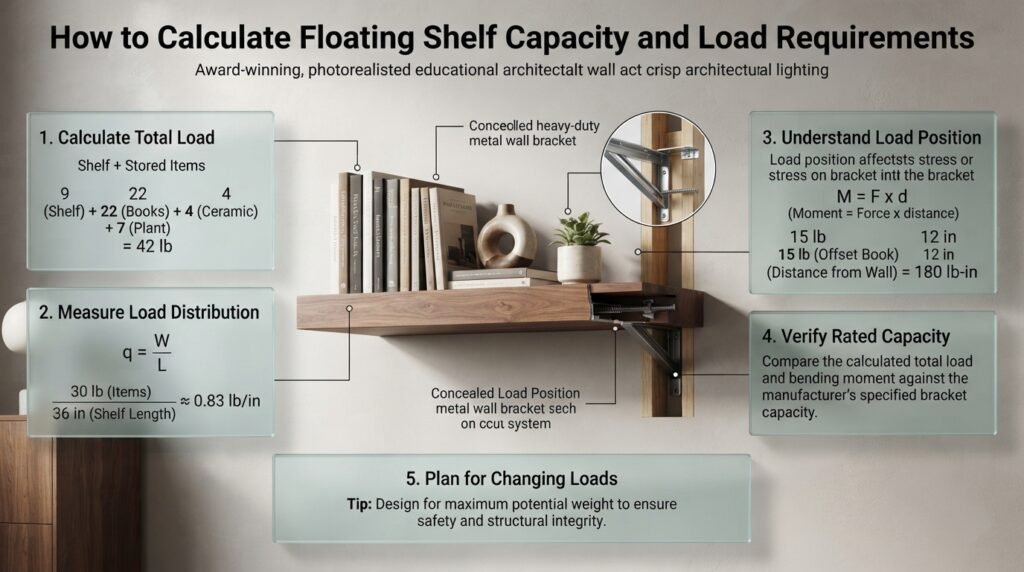
Calculating the expected load helps you select a suitable system, but it does not independently establish a safe structural rating. The calculation must be compared with the manufacturer’s specifications and the limitations of the actual installation.
Step 1: List everything the shelf will support
Start by writing down the objects you intend to store. Use measured weights when possible, particularly for heavy equipment, books, cookware, and collections.
Consider this example:
| Component | Estimated weight |
|---|---|
| Shelf board | 9 lb |
| Books | 22 lb |
| Decorative objects | 4 lb |
| Planter and container | 7 lb |
| Total estimated load | 42 lb |
The installation must account for the board itself as well as its contents. Other hardware weights should be included where relevant to the manufacturer’s rating method.
This simple inventory also reveals whether your intended arrangement is likely to change. A shelf that initially holds a few decorations might later be used for books or storage containers.
Step 2: Distinguish total load from distributed load
Total load describes the combined weight. Distributed load describes how that weight is spread across the shelf.
If 30 lb of objects are evenly distributed across a 36-inch shelf, the average load per inch is:
\[ q=\frac{W}{L} \]
\[ q=\frac{30}{36}\approx0.83\text{ lb/in} \]
Here, \(W\) represents the distributed weight and \(L\) represents the shelf length.
This calculation is useful for understanding the arrangement, but it does not tell you whether the board or mounting hardware is strong enough.
A shelf carrying one heavy object near its front edge may experience different forces from a shelf carrying the same weight evenly across its surface.
Step 3: Understand the effect of load position
A load positioned farther from the wall can increase the turning moment acting on a cantilevered support.
For a simplified force acting at a perpendicular distance from a reference point:
\[ M=F\times d \]
Where:
- \(M\) is the moment.
- \(F\) is the applied force.
- \(d\) is the perpendicular distance from the reference point.
For example, a 15 lb force acting 12 inches from a reference point produces a simplified moment of 180 lb-in.
This example explains why shelf depth matters. However, the actual forces in a concealed bracket and its fasteners depend on the mounting geometry, the support’s resisting forces, and the position of the load. The simplified calculation is not a bracket-design formula.
Step 4: Compare the load with documented capacity
Once you know the intended load, check the product documentation.
Confirm that the rated configuration matches the actual installation in terms of:
- Shelf dimensions and construction.
- Number and position of brackets.
- Wall material and condition.
- Approved fasteners and installation method.
- Type and distribution of load.
- Any restrictions on shelf projection or concentrated weight.
If the documentation covers a different configuration, do not assume the same rating applies to your project.
Step 5: Account for changing use
Avoid designing around an unrealistically light arrangement when heavier contents are likely in the future.
For instance, if a bedroom shelf will eventually hold several large books, plan for that intended use from the beginning. If the load changes substantially after installation, reassess the system before adding the extra weight.
Do not apply an arbitrary safety percentage to an unknown capacity. Use the manufacturer’s allowable working-load guidance, and consult a qualified professional when the required capacity cannot be established.
5. How Should You Choose Floating Shelf Brackets?
The best floating shelf bracket is one designed for your shelf’s dimensions, mounting conditions, and intended use. Concealed hardware is attractive because it keeps the support out of sight, but its installation requirements can be more demanding than those of a visible bracket.
Compare common bracket systems
| Bracket system | Potential application | What to verify |
|---|---|---|
| Concealed steel rods | Shelves designed with compatible internal holes | Rod dimensions, embedment, spacing, and wall fixing |
| Concealed mounting plates | Shelves manufactured for a specific plate | Plate attachment, fastener arrangement, and shelf compatibility |
| Purpose-designed heavy-duty brackets | Applications within the documented product rating | Actual rated load, dimensions, and approved substrate |
| Visible L-shaped brackets | Shelves where visible support is acceptable | Projection, attachment, and compatibility with the board |
| Engineered custom supports | Unusual dimensions or demanding installations | Professional design, material specifications, and installation requirements |
No bracket style is automatically the strongest in every situation. A well-designed visible bracket may suit a particular load better than a concealed system, while a purpose-designed floating shelf assembly may provide the appearance and performance required for another project.
What should you measure before buying?
Record the shelf’s length, depth, and thickness. Identify its material and estimate the weight of the finished board.
Then check the bracket manufacturer’s instructions for the maximum supported dimensions, required spacing, mounting-hole locations, compatible fasteners, and approved wall types.
Pay particular attention to shelf thickness when using concealed rods or internal mounting plates. The shelf must accommodate the support as designed without splitting, excessive drilling, or leaving insufficient material around the fixing.
When should you avoid generic hardware?
Avoid unverified combinations when a shelf will carry substantial weight, extend far from the wall, or be installed above a bed, sofa, or frequently occupied area.
A product marketed as heavy-duty may still have limitations that make it unsuitable for a particular installation.
⭐ Expert recommendation: Choose the support system and shelf board together. Buying a board first and trying to find brackets that fit afterward can lead to unnecessary compromises in both appearance and structural performance.
For additional ideas on balancing material performance with interior appearance, explore Interior Design.
6. How Does Wall Type Change the Installation Method?
The wall is an essential part of the shelf’s load-bearing system. The appropriate fixing method depends on the actual substrate, its condition, and the design of the bracket.
Timber-stud walls
Sound structural timber can provide a dependable fixing point when the shelf system and fasteners are designed for it.
Before drilling, locate the framing and confirm that the bracket’s mounting holes align with suitable fixing positions. Use the fastener type and dimensions specified by the manufacturer.
Do not assume that a detected stud is sound or that every wall follows standard spacing. Older buildings, unusual framing, and previous water damage may require closer inspection.
Concrete walls
Concrete requires fasteners specifically approved for the relevant substrate and loading conditions.
The installation must account for the concrete’s condition, the required embedment, edge distances, fastener spacing, and any restrictions provided by the manufacturer. Drilling should also avoid concealed services.
Where the shelf will carry substantial weight or the fixing arrangement is unusual, obtain professional guidance rather than selecting anchors based solely on their advertised strength.
Brick and other masonry
Brick, mortar joints, concrete blocks, and hollow masonry units have different fixing characteristics.
A fastener suitable for solid concrete should not automatically be assumed suitable for hollow blocks or deteriorating brickwork. The correct solution depends on the substrate and the manufacturer’s approval for that application.
Inspect the intended fixing locations and avoid relying on damaged material.
Drywall and plasterboard
Drywall requires particular care because a floating shelf can exert outward forces on its wall attachment.
Some anchors are designed for specific light-duty applications, but their ratings and installation requirements vary. An anchor suitable for a picture frame is not automatically suitable for a deep shelf.
For heavier storage, use a support arrangement designed for the wall and intended load, with structural framing or suitable backing where required.
Plaster walls
Older plaster walls may have timber lath, masonry, or another construction behind the finished surface. The visible plaster does not tell you which fixing method is appropriate.
Identify what lies behind the finish before selecting hardware. If the wall is brittle, cracked, or deteriorating, investigate the condition before proceeding.
Safety note: Check for concealed electrical wiring and plumbing before drilling into any wall. If the wall type or structural condition remains uncertain, consult a qualified installer.
For projects involving structural limitations, Designing Around Structural Walls provides related planning context.
7. How Can You Prevent Floating Shelves From Sagging?

Sagging occurs when a shelf bends under the forces acting on it. It may be noticeable immediately under a heavy load or develop gradually during prolonged use.
The amount of deflection depends on the material’s stiffness, shelf dimensions, unsupported span, load distribution, and support arrangement.
Select an appropriate shelf thickness
Thickness affects stiffness, but it is only one part of the design.
A thicker board may reduce bending when other conditions are comparable. However, the result also depends on the material, shelf length, support spacing, and how the board connects to its brackets.
Choose a board and support system designed to work together rather than assuming a thick board will automatically solve every problem.
Reduce unsupported spans
A long shelf with insufficient support may bend in the middle even when its wall fixings remain secure.
Follow the manufacturer’s support-spacing recommendations. If the required span exceeds the documented configuration, consider a different system or obtain a suitable design assessment.
Do not add brackets randomly. Extra supports must be positioned and attached in a way that actually improves the load path.
Avoid concentrated loads
Heavy objects placed together can create local stresses and increase bending in a particular section.
Distribute contents sensibly within the shelf’s intended loading arrangement. This is especially important for large books, ceramic objects, and equipment with a small footprint.
Remember that redistribution does not make an overloaded shelf safe. The total load must still remain within the documented limits.
Monitor long-term changes
A shelf that looks level immediately after installation may change over time.
Inspect it periodically for bending, cracks, loose fixings, movement, and gaps between the shelf and wall. If the shelf becomes visibly deformed, remove the contents and investigate before using it again.
For shelves made from moisture-sensitive materials, keep exposure within the manufacturer’s recommended conditions. Moisture-related changes can affect both the board and the wall attachment.
8. How Should You Distribute Weight on a Floating Shelf?
Weight distribution affects how the shelf and its mounting system respond to the objects placed on them. Good organization reduces avoidable concentration of load, but it cannot compensate for inadequate structural capacity.
Begin by identifying the heaviest items and the areas where they will sit. Compare this arrangement with the manufacturer’s instructions, especially if the product specifies limits for concentrated loads or requires a particular loading pattern.
Practical load-distribution habits
- Place heavy books across the intended supported area rather than stacking them in one small section.
- Avoid positioning heavy objects at the far front edge unless the system is designed for that arrangement.
- Include containers, trays, planters, and accessories when calculating total weight.
- Keep objects within the shelf’s usable surface rather than allowing heavy items to overhang.
- Avoid using the shelf as a handhold or support for climbing.
- Reassess the load when changing from lightweight decorations to heavier storage.
Consider a shelf displaying a row of ceramic pots. Although the arrangement may appear balanced, each pot can concentrate weight over a relatively small area. The shelf must be suitable for the total weight and the way the objects are positioned.
Similarly, a shelf full of books can create a substantial sustained load even when the books are spread evenly.
The goal is to combine sensible organization with an adequately designed support system.
9. How Do You Plan Floating Shelves for Different Rooms?

A shelf’s purpose should guide its dimensions, construction, mounting method, and location. Planning each installation around how the room is actually used helps prevent a decorative feature from becoming an impractical storage solution.
Living room: Balance display and storage
Living room shelves often hold framed photographs, books, ceramics, and decorative accessories. Their appearance matters, but the objects can have very different weights.
Before installing a long display shelf, decide whether it will primarily hold lightweight decorations or substantial books. This distinction affects the support system you need.
For a visually balanced arrangement, group smaller objects without concentrating all the heavy items in one section. Leave enough space between the shelf and nearby furniture to avoid an overcrowded appearance.
Also consider the consequences of a shelf becoming loose. Where people regularly sit or walk beneath it, secure mounting deserves particular attention.
Bedroom: Prioritize accessibility and safety
Bedroom shelves may hold books, small lamps, alarm clocks, or personal accessories. These items should be easy to reach without requiring awkward stretching.
A shelf above a bed needs careful placement and secure installation. Avoid treating the headboard area as a convenient location without considering the mounting system and the risk of falling objects.
If you want a shelf beside the bed, compare its dimensions with the bedside table, bed frame, and available walking space. A smaller, appropriately supported shelf may be more practical than a deep shelf that projects unnecessarily into the room.
For a more flexible small-bedroom layout, consider how shelving can work alongside foldaway furniture for sleeping spaces.
Home office: Plan for sustained loads
Home offices often require shelves for textbooks, reference materials, files, and equipment. Unlike decorative objects, these items can remain in place for months or years.
Estimate the weight of the books and equipment individually where possible. A printer or other heavy device should not be placed on a shelf unless the manufacturer confirms that the complete installation is suitable for that use.
Consider how the shelf will be used in the future. A shelf that initially holds a few notebooks may eventually carry full storage boxes, so planning around realistic requirements can prevent an unnecessary replacement.
Kitchen: Account for cookware and moisture
Kitchen shelving requires attention to both load and environmental conditions.
Dishes, jars, and cookware can be considerably heavier than decorative accessories. Containers may also become heavier as they are filled, so calculate the contents rather than considering only the empty container.
Moisture and temperature changes can affect some shelf materials and finishes. Choose products suitable for the kitchen environment and follow their care instructions.
Keep heavy items easy to access, and avoid placing frequently used cookware in a position where reaching for it could cause a person to pull or push against the shelf.
Entryway: Avoid accidental pulling
An entryway shelf may appear to be a light-duty feature for keys, mail, and small accessories. However, people often reach toward shelves while putting on coats or collecting bags.
Position the shelf where it won’t obstruct the door, interfere with movement, or invite people to use it for balance.
If you need space for shoes, bags, and everyday belongings, combine decorative shelving with a broader storage plan. Entryway Storage Capacity Planning offers relevant guidance for organizing these items.
Utility room or garage: Choose function first
Utility spaces often contain tools, cleaning supplies, and containers with changing contents. These loads can be heavier and less predictable than those in a living room.
Use a shelving system explicitly suitable for the intended application. Check the weight of stored items, environmental conditions, and the structural capacity of the wall.
For heavy-duty storage, a floor-supported shelving unit may be more appropriate than a floating shelf. Choosing another storage method is often the most sensible way to meet the requirement.
10. How Should You Measure and Plan a Floating Shelf Before Installation?
Accurate measurements help ensure that the shelf fits the room and that its mounting system can be installed as intended.
Step 1: Measure the available wall space
Record the usable wall width and height. Include nearby doors, windows, furniture, electrical outlets, and other features that may affect placement.
A shelf should not obstruct access or interfere with doors and cabinets. If you are planning several shelves, measure the entire arrangement rather than assessing each shelf independently.
Step 2: Decide the intended shelf dimensions
Choose a length, depth, and thickness appropriate for the objects you want to store.
Avoid selecting an unnecessarily deep shelf simply because it offers more surface area. Extra depth affects the leverage acting on the supports and may make the shelf less convenient in a narrow room.
Step 3: Identify the wall construction
Determine whether the mounting area consists of timber framing, concrete, brick, hollow masonry, drywall, or another material.
Locate the proposed fixing points and check for concealed services. If the construction is uncertain, investigate it before purchasing the mounting hardware.
Step 4: Confirm bracket compatibility
Check that the brackets fit the shelf dimensions and that the mounting holes align with appropriate fixing locations.
Review the required fasteners, support spacing, installation depth, and any restrictions on the intended load.
Step 5: Check the layout before drilling
Use a level and suitable measuring tools to mark the intended position. Confirm the shelf height and alignment from the main viewing angle.
A simple layout check can prevent unnecessary holes and reduce the risk of discovering that the shelf interferes with nearby furniture.
Step 6: Review the final plan
Before installation, confirm that the board, brackets, fasteners, and wall are suitable for the expected load.
If a key specification is missing, resolve the uncertainty before proceeding. Guessing at a structural rating is not a substitute for manufacturer guidance.
📌 Quick checklist: Measure the shelf, weigh the intended contents, identify the wall, verify the support system, check the installation instructions, and inspect the mounting area.
11. What Are the Most Common Floating Shelf Planning Mistakes?
Avoiding preventable mistakes is often more valuable than buying more expensive materials. The following issues frequently arise when a shelf is chosen for appearance before its intended use is understood.
Mistake 1: Choosing a shelf before deciding what it will hold
Why it happens: Decorative shelves are often purchased because they match a room’s style.
Why it matters: The finished shelf may not suit the weight or dimensions of the intended objects.
How to avoid it: Make a list of the planned contents and their approximate weights before choosing the shelf system.
Mistake 2: Trusting a single advertised weight figure
Why it happens: A simple number seems like an easy way to compare products.
Why it matters: The rating may apply to a bracket rather than the complete installation, or it may depend on specific test conditions.
How to avoid it: Read the full product documentation and confirm that the rating matches your shelf and wall.
Mistake 3: Ignoring the weight of the shelf itself
Why it happens: People focus on the objects because the board is already part of the design.
Why it matters: The mounting system must support the board as well as its contents.
How to avoid it: Include the shelf’s weight in the load estimate and follow the manufacturer’s rating method.
Mistake 4: Using unsuitable wall anchors
Why it happens: A readily available anchor may appear strong enough for the job.
Why it matters: Different anchors are designed for different substrates and loading conditions.
How to avoid it: Select approved hardware for the actual wall construction and intended load.
Mistake 5: Making a shelf deeper without reviewing its supports
Why it happens: A deeper shelf offers more room for storage.
Why it matters: Objects positioned farther from the wall can create greater leverage.
How to avoid it: Recheck the bracket system’s approved shelf depth and loading conditions whenever dimensions change.
Mistake 6: Assuming extra brackets solve every problem
Why it happens: More supports appear to provide more strength.
Why it matters: Poorly positioned brackets may not distribute forces effectively, and the board or wall may remain the limiting component.
How to avoid it: Follow a compatible support design rather than adding unrelated hardware.
Mistake 7: Forgetting about future use
Why it happens: The shelf is planned around the contents available on installation day.
Why it matters: New books, equipment, or storage containers can change the load substantially.
How to avoid it: Plan for realistic future use and reassess the installation before adding heavier items.
Mistake 8: Ignoring signs of damage
Why it happens: Concealed supports are difficult to inspect once the shelf is in place.
Why it matters: Loose fixings, cracks, or visible bending can indicate a developing problem.
How to avoid it: Inspect the shelf periodically and remove its contents if warning signs appear.
12. What Do Professionals Recommend for Better Floating Shelf Planning?
Professional planning focuses on how forces travel through the installation and whether the selected system is appropriate for the actual conditions.
Rather than relying on one measurement or product label, assess the complete arrangement.
Begin with the intended load
Identify the objects the shelf must carry and estimate their combined weight. Consider their positions and whether the arrangement is likely to change.
This establishes the requirements for selecting the board and support system.
Verify the manufacturer’s specifications
Use documentation for the exact shelf or bracket model. Confirm the maximum dimensions, fixing requirements, approved wall types, and loading restrictions.
If a product listing does not explain its rating adequately, ask the manufacturer for clarification.
Consider the wall before selecting the hardware
Wall construction often determines which mounting methods are practical. A bracket that fits the shelf may still be unsuitable for the wall.
Check the substrate, locate structural supports where appropriate, and identify concealed services before drilling.
Avoid improvising structural connections
Mixing brackets, screws, and anchors from unrelated systems can introduce uncertainty. Each component may have a different set of limitations.
Use a compatible assembly that has clear installation instructions. Where the arrangement falls outside the documented configuration, seek professional assessment.
Prioritize safety over a completely concealed finish
A minimalist appearance is valuable, but it should not dictate an unsuitable mounting choice.
If a visible bracket or a floor-supported unit provides a more appropriate solution, consider it rather than forcing a concealed design to meet requirements it wasn’t designed for.
Document unusual installations
For a substantial or custom shelf, keep the product specifications, installation details, and any professional recommendations. This information can help if the shelf needs maintenance or its intended use changes.
For more general project-planning guidance, see Interior Designer Contract Essentials.
13. How Can You Maintain Floating Shelves Over Time?
A shelf installation should be checked occasionally, especially when it supports heavy objects or is installed in a room with changing temperature or humidity.
Maintenance doesn’t increase the original load rating, but it can help identify developing problems before they become more serious.
Establish a simple inspection routine
Check the shelf periodically and whenever you change its contents substantially.
Look for:
- Visible bending along the front edge or middle of the board.
- New gaps between the shelf and wall.
- Loose or moving mounting points.
- Cracks around fasteners or bracket connections.
- Swelling, soft spots, or surface deterioration.
- Changes in level or unusual movement when objects are placed on the shelf.
If you notice a structural warning sign, remove the contents carefully and investigate the cause before using the shelf again. Don’t tighten random screws or add extra weight to test whether the installation remains secure.
Protect the shelf material
Follow the manufacturer’s cleaning and maintenance recommendations. Avoid exposing materials to moisture beyond their intended environmental conditions.
For wooden shelves, changes in humidity can affect dimensions and stability. Engineered boards may be especially vulnerable when their edges or surfaces are exposed to moisture. Metal components also require suitable protection against corrosion where relevant.
If you’re planning a wider home renovation, material durability should be considered alongside appearance. Related guidance on Low VOC Interior Finishes can help you evaluate another important aspect of healthier interior material selection.
14. How Do Floating Shelves Fit Into a Complete Interior Design Plan?
Floating shelves work best when they serve a clear purpose within the room. They can provide storage, display personal objects, and make use of wall space without introducing the visual bulk of a large cabinet.
However, an attractive shelf arrangement must still respect the practical needs of the room.
Coordinate shelf proportions with the room
A shelf should look appropriate in relation to the wall, nearby furniture, and other architectural features.
A very long shelf on a narrow wall may look unbalanced, while several short shelves may create unnecessary visual clutter. Measure the available space and consider the overall composition before choosing the final dimensions.
Coordinate finishes and materials
Shelf finishes can complement flooring, furniture, wall colors, and decorative accessories.
For example, a natural wood shelf may work well with warm neutral walls, while a painted shelf can blend into the background or create contrast.
When choosing a finish, consider maintenance requirements and the room’s conditions as well as appearance. A visually appealing finish should not distract from the structural requirements of the shelf.
For ideas on selecting a coordinated palette, explore Paint & Color.
Avoid overcrowding
A shelf can become less functional when too many objects compete for space. Leave room for practical access and avoid stacking items in a way that makes the shelf difficult to use.
A well-organized arrangement often works better than filling every available inch.
If you enjoy hands-on decorating, DIY Home Projects offers a relevant starting point for planning improvements that combine functionality with personal style.
Consider the surrounding furniture
Floating shelves should complement the furniture layout rather than obstruct it.
In a dining area, for example, a shelf must not interfere with chairs, movement, or access to the table. Review the surrounding layout and circulation requirements before finalizing its position.
The guide to Dining Room Circulation Clearance provides related guidance for keeping dining spaces practical and comfortable.
Plan lighting and smart-home features carefully
Integrated lighting can make floating shelves more visually interesting, but wiring, transformers, and lighting components introduce additional planning considerations.
Use electrical products designed for the intended installation and follow applicable electrical safety requirements. Don’t drill or route wiring without checking for concealed services and confirming that the proposed arrangement is suitable.
If you are coordinating shelving with a broader technology plan, Whole Home Automation Planning explores related considerations for integrating home systems.
Shelving can also be part of a wider improvement project that includes repairs, finish upgrades, and maintenance. The Home Improvement category provides a relevant place to explore those topics.
Think about nearby heat sources
If a shelf is planned near a fireplace or another heat-producing appliance, check the appliance manufacturer’s clearance requirements and applicable safety guidance.
Don’t assume that a shelf is safe simply because the material is noncombustible. Nearby objects, heat exposure, and appliance-specific requirements all matter.
For more information on furniture placement around fireplaces, see Fireplace Furniture Clearance.
How much weight can a floating shelf hold safely?
The weight a floating shelf can safely support depends on its material, length, depth, bracket design, fasteners, and wall construction. A lightweight decorative shelf has different requirements from a shelf designed to hold heavy books, kitchenware, or office equipment. The manufacturer’s specified load rating is the best starting point, but it must match the actual installation conditions.
Before loading the shelf, calculate the combined weight of the shelf board and its contents. Check whether the published rating applies to the complete shelf system or only to individual brackets. A rating based on installation into solid timber, for example, should not automatically be applied to a shelf mounted using drywall anchors.
Important points to consider:
Include the shelf’s own weight when calculating the load.
Check the manufacturer’s approved shelf dimensions and mounting requirements.
Avoid exceeding the specified working-load limit.
Reassess the installation if you plan to add heavier objects later.
How do I calculate the weight capacity required for a floating shelf?
Start by identifying everything the shelf will hold and estimating the weight of each item. Add these figures together, including the shelf board itself, to establish the expected total load. Next, consider how the weight will be distributed because a concentrated load near the front edge can create different forces from objects spread evenly across the shelf.
For example, a shelf holding books, a planter, and decorative accessories must support the combined weight of all those items. If you later replace lightweight decorations with heavier storage boxes, your original load estimate may no longer be suitable. Compare the calculated load with the manufacturer’s documented capacity for the exact shelf and mounting arrangement.
A practical calculation checklist:
Record the approximate weight of every item.
Add the shelf board’s weight.
Identify heavy objects that may concentrate the load.
Verify the complete system’s rated capacity and installation conditions.
Seek professional advice if the required capacity cannot be confirmed.
Are floating shelves stronger when mounted into wall studs?
Mounting an appropriately designed floating shelf into sound structural timber can provide a reliable support arrangement. Studs offer a structural fixing point, but the strength of the finished installation still depends on the bracket design, fasteners, shelf dimensions, and condition of the wall framing.
The key is to ensure that the mounting hardware is suitable for the actual wall construction. A screw that works well in timber may not be appropriate for metal framing or masonry. Likewise, attaching a bracket to a stud does not guarantee that a deep shelf carrying a heavy load will perform safely.
Before installing a shelf:
Locate the framing accurately and confirm its condition.
Use fasteners specified for the bracket and substrate.
Check that the shelf’s depth and length suit the support system.
Avoid relying on drywall alone for substantial cantilevered loads unless the complete system is specifically designed and approved for that application.
Why do floating shelves sag over time, and how can I prevent it?
Floating shelves may sag when the board is too flexible for its unsupported span or sustained load. The problem can also be influenced by material quality, shelf dimensions, bracket spacing, moisture exposure, and the concentration of heavy objects in one area.
For example, a long shelf holding textbooks may gradually bend in the middle if the board and support arrangement aren’t designed for the load. The brackets might remain firmly attached while the shelf itself develops excessive deflection. This is why checking the mounting hardware alone isn’t enough.
Ways to reduce the risk of sagging:
Select a shelf material and thickness appropriate for the intended load.
Follow the manufacturer’s support-spacing requirements.
Avoid placing heavy objects in unsupported sections.
Protect moisture-sensitive materials from unsuitable conditions.
Inspect periodically for bending, cracks, loose fixings, or gaps near the wall.
If visible sagging develops, remove the load and investigate the cause before using the shelf again.
What is the best way to choose floating shelf brackets for heavy items?
The best brackets are those designed for the shelf’s dimensions, expected load, and wall construction. Concealed metal rods and mounting plates can provide a clean appearance, while visible brackets may be appropriate when their design and installation better suit the application. Neither style should be selected on appearance alone.
Before purchasing brackets for heavy books, cookware, or equipment, check the manufacturer’s rated capacity and the conditions under which it applies. Confirm the required fasteners, bracket spacing, shelf thickness, mounting depth, and approved wall types. A bracket’s advertised rating is not necessarily the capacity of the complete shelf installation.
Professional selection tips:
Match the brackets to the exact shelf length and depth.
Confirm compatibility with the shelf material and thickness.
Choose fasteners approved for the supporting wall.
Follow the manufacturer’s installation and loading instructions.
Consider a professionally assessed or purpose-designed system for unusually heavy or deep shelves.
Final recommendation: Safe floating shelf load capacity planning requires the shelf board, mounting hardware, fasteners, and wall to work together. Verifying the complete installation before adding weight is more reliable than choosing brackets based on a single advertised number.
Conclusion
Floating shelf load capacity planning is an essential part of creating storage that is both attractive and reliable. Although floating shelves offer a clean, modern appearance, their performance depends on more than the thickness or strength of the shelf board. Wall construction, bracket design, fastener selection, installation quality, shelf depth, and the total weight of stored items all influence how much weight a shelf can safely support.
Before installing a floating shelf, calculate the expected load, consider how that weight will be distributed, and choose a mounting system designed for the specific wall type. Always check the manufacturer’s stated load limits and installation instructions rather than relying on general weight estimates. Heavy objects, deep shelves, and items that concentrate weight near the front edge require particular attention because they can increase stress on the brackets and wall connections.
A well-planned shelf should remain level, stable, and suitable for everyday use without visible sagging or movement. Regularly inspect the mounting points, avoid exceeding the recommended capacity, and adjust the stored items if you notice loosening or changes in the shelf’s position.
For homeowners planning practical storage improvements, combining sound installation methods with thoughtful interior design creates a better long-term result. Explore more ideas through DesignMode24 Interior Design and its home improvement resources to make informed decisions about storage, functionality, and the overall appearance of your living space.
Ultimately, the safest floating shelf is one whose board, brackets, fasteners, and supporting wall work together as a properly planned system. Taking time to evaluate these factors before installation helps protect your belongings, reduce the risk of shelf failure, and create storage that remains dependable and visually appealing for years.