

Introduction
Concealed Technology in Luxury Interiors | Imagine walking into a luxury living room where everything feels perfectly balanced. The walls are finished with beautiful stone or refined wood, the furniture has been carefully proportioned, the lighting is warm and architectural, and nothing appears visually out of place.
Yet the room is highly intelligent.
The curtains open automatically. The lighting adjusts without a bank of switches. Music fills the space without visible speakers. A television appears only when it’s needed. Phones can be charged without cables covering the furniture. Climate control works quietly in the background.
This is the idea behind concealed technology in luxury interiors.
The goal isn’t to remove technology from the home. It’s to remove unnecessary visual evidence of the technology.
In 2026, luxury residential design is increasingly moving toward this quieter approach. Designers and technology specialists are integrating speakers, displays, controls, lighting, sensors, shades, and equipment into walls, ceilings, cabinetry, and architectural details instead of allowing technology to dominate the room.
This guide explains how concealed technology works, what can be hidden, where it makes the most sense, how to plan it before construction, which mistakes to avoid, and how to create a smart home that feels sophisticated rather than overloaded with gadgets.
What Is Concealed Technology in Luxury Interiors?
Concealed technology in luxury interiors is the practice of integrating smart-home, entertainment, lighting, security, climate, networking, and electrical systems into the architecture or furniture so that the technology remains visually discreet while still being easy to use.
Instead of treating technology as something that must be placed on top of an interior, designers treat it as part of the interior itself.
A television might disappear behind custom millwork.
A speaker might sit behind a finished wall or ceiling.
A charging station might be built into a bedside table.
Motorized curtains can disappear into a ceiling pocket.
Lighting controls can be reduced to a small, carefully selected keypad.
The important point is that concealment isn’t the same as simply hiding something inside a cupboard.
Good concealed technology considers appearance, performance, ventilation, wiring, maintenance, accessibility, and future upgrades at the same time.
A router placed inside a sealed cabinet may technically be hidden, but it isn’t necessarily well integrated.
A dedicated technical cabinet with ventilation, organized wiring, service access, network infrastructure, and room for future equipment is a much more professional solution.
That distinction becomes increasingly important as homes become more connected.
Why Is Concealed Technology Important in Luxury Interior Design?
Luxury interiors depend on visual harmony.
When a room contains high-quality materials, custom furniture, architectural lighting, artwork, and carefully planned proportions, even small pieces of visual clutter can become noticeable.
Technology can create a surprising amount of clutter.
Think about:
- Television screens
- Speaker boxes
- Charging cables
- Routers
- Game consoles
- Streaming devices
- Thermostats
- Switch panels
- Security sensors
- Remote controls
- Power adapters
None of these objects is necessarily unattractive on its own.
The problem appears when too many of them compete with the architecture.
Recent 2026 design discussions increasingly describe the luxury smart home as one where technology supports the environment without becoming its visual focus.
The Main Principle: Technology Should Support the Room
A luxury interior should not feel like an electronics showroom.
The room should remain the primary experience.
Technology should quietly improve:
- Comfort
- Convenience
- Entertainment
- Lighting
- Security
- Privacy
- Energy management
- Daily routines
This is why concealed technology is particularly effective in spaces where architectural finishes are important.
For example, a marble wall can remain a marble wall rather than becoming a permanent television display.
A beautifully finished ceiling can contain speakers and lighting without becoming visually crowded.
A bedroom can offer automated curtains and integrated charging without feeling like a technology laboratory.
For broader interior design inspiration and professional room planning, DesignMode24 Interior Design provides a useful starting point.
What Technologies Can Be Concealed?
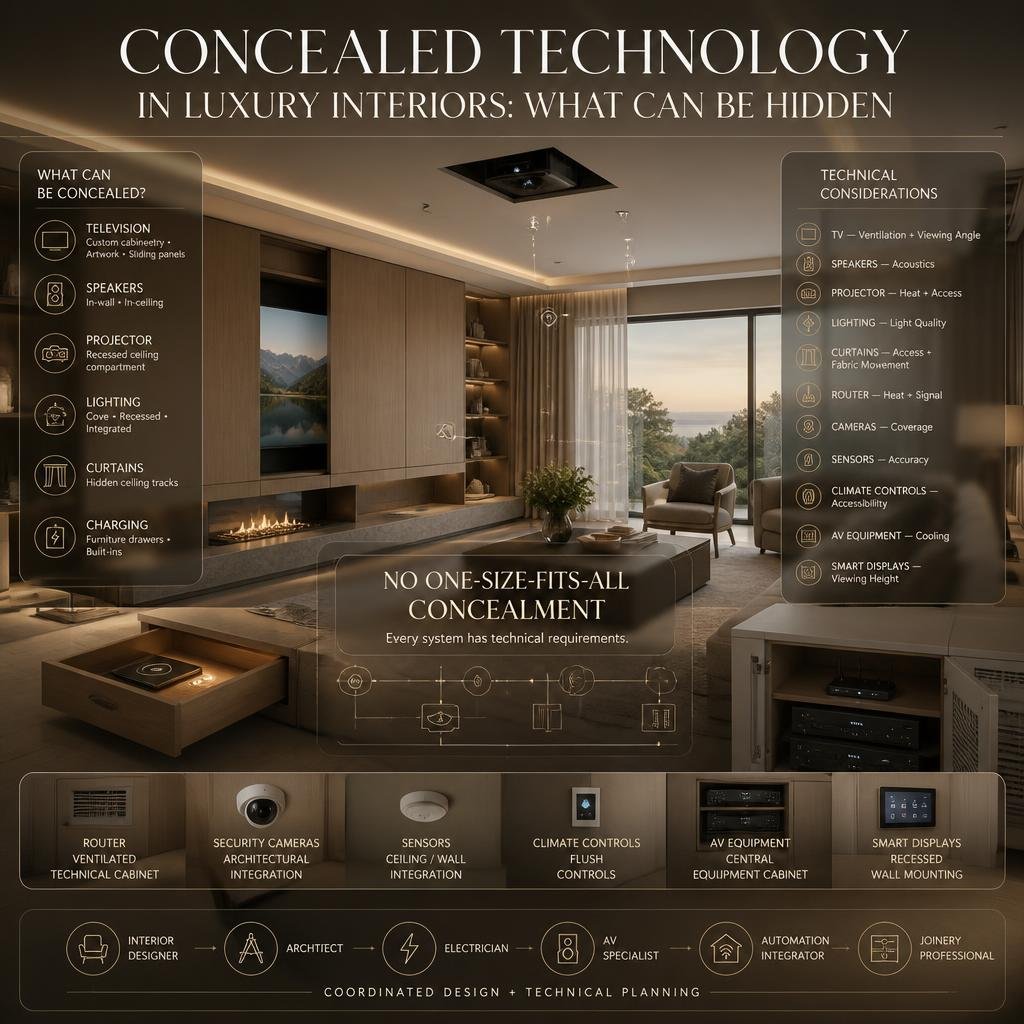
Many modern home technologies can be integrated into architecture or furniture.
| Technology | Common Concealment Method | Main Consideration |
|---|---|---|
| Television | Custom cabinetry, artwork, sliding panels | Ventilation and viewing angle |
| Speakers | In-wall or in-ceiling installation | Acoustics |
| Projector | Recessed ceiling compartment | Heat and access |
| Lighting | Cove, recessed or integrated lighting | Light quality |
| Curtains | Hidden ceiling tracks | Access and fabric movement |
| Charging | Furniture drawers and built-ins | Power access |
| Router | Ventilated technical cabinet | Heat and signal |
| Security cameras | Architectural integration | Coverage |
| Sensors | Ceiling or wall integration | Sensor accuracy |
| Climate controls | Flush controls | Accessibility |
| AV equipment | Central equipment cabinet | Cooling |
| Smart displays | Recessed wall mounting | Viewing height |
Not every technology should be concealed in exactly the same way.
Each system has technical requirements that need to be respected.
That is why the best results come from collaboration between interior designers, architects, electricians, AV specialists, automation integrators, and joinery professionals.
How Do You Hide a TV in a Luxury Interior?
A television can be one of the most visually difficult technologies to integrate because its screen is large, dark, and usually rectangular.
There are several approaches.
Hidden TV Behind Artwork
One popular solution is to place a television behind a decorative artwork panel.
When the television isn’t being used, the artwork becomes the visual focus.
When entertainment is required, the panel moves or opens.
This approach works particularly well in formal living rooms where the television isn’t intended to dominate the architecture.
TV Inside Custom Cabinetry
Another option is to integrate the screen into a custom media wall.
The television can be surrounded by:
- Wood veneer
- Stone
- Shelving
- Decorative panels
- Lighting
- Storage
- Artwork
The result is usually more balanced than mounting a large screen on an otherwise empty wall.
Motorized TV Lift
A motorized lift can allow the television to disappear into furniture or rise from a concealed compartment.
This can be useful in:
- Bedrooms
- Kitchen islands
- Living rooms
- Multi-purpose rooms
Mirror TV
In suitable environments, a display can be integrated behind a specialty mirror surface.
When the display is off, the mirror performs its normal visual function.
When switched on, the display becomes visible.
The Technical Problem: Heat
A television and its associated equipment generate heat.
Therefore, a beautifully concealed cabinet still needs suitable airflow.
This is one of the most common mistakes in hidden technology projects.
⚠ Common Mistake: Creating a perfectly sealed media cabinet because it looks cleaner.
A better approach is to design ventilation into the cabinet from the beginning while keeping vents as visually discreet as possible.
How Are Speakers Hidden in Luxury Homes?
Speakers are among the easiest technologies to integrate visually because audio can be delivered without requiring a conventional speaker box in every room.
Common solutions include:
- In-ceiling speakers
- In-wall speakers
- Invisible speakers
- Speakers integrated into cabinetry
- Architectural audio systems
Invisible audio is becoming an increasingly important part of luxury smart-home design because it allows homeowners to experience high-quality sound without allowing the equipment to dominate the interior.
In-Ceiling Speakers
These are useful for whole-home audio.
They can work particularly well in:
- Kitchens
- Dining rooms
- Bedrooms
- Bathrooms
- Hallways
- Living spaces
In-Wall Speakers
These can be integrated into media walls or other architectural surfaces.
They are particularly useful when conventional floor-standing or bookshelf speakers would interfere with the room’s composition.
Invisible Speakers
Some specialized speakers are designed to sit behind wall or ceiling finishes.
The sound is produced through the surface while the hardware becomes extremely difficult to notice.
However, installation quality matters.
The wall construction, finish thickness, acoustic treatment, speaker placement, and amplification all influence the result.
⭐ Expert Tip: Don’t let the interior designer finish a wall and then ask an audio installer to add invisible speakers. The speaker system should be coordinated before the wall assembly is finalized.
Can Lighting Technology Be Completely Hidden?
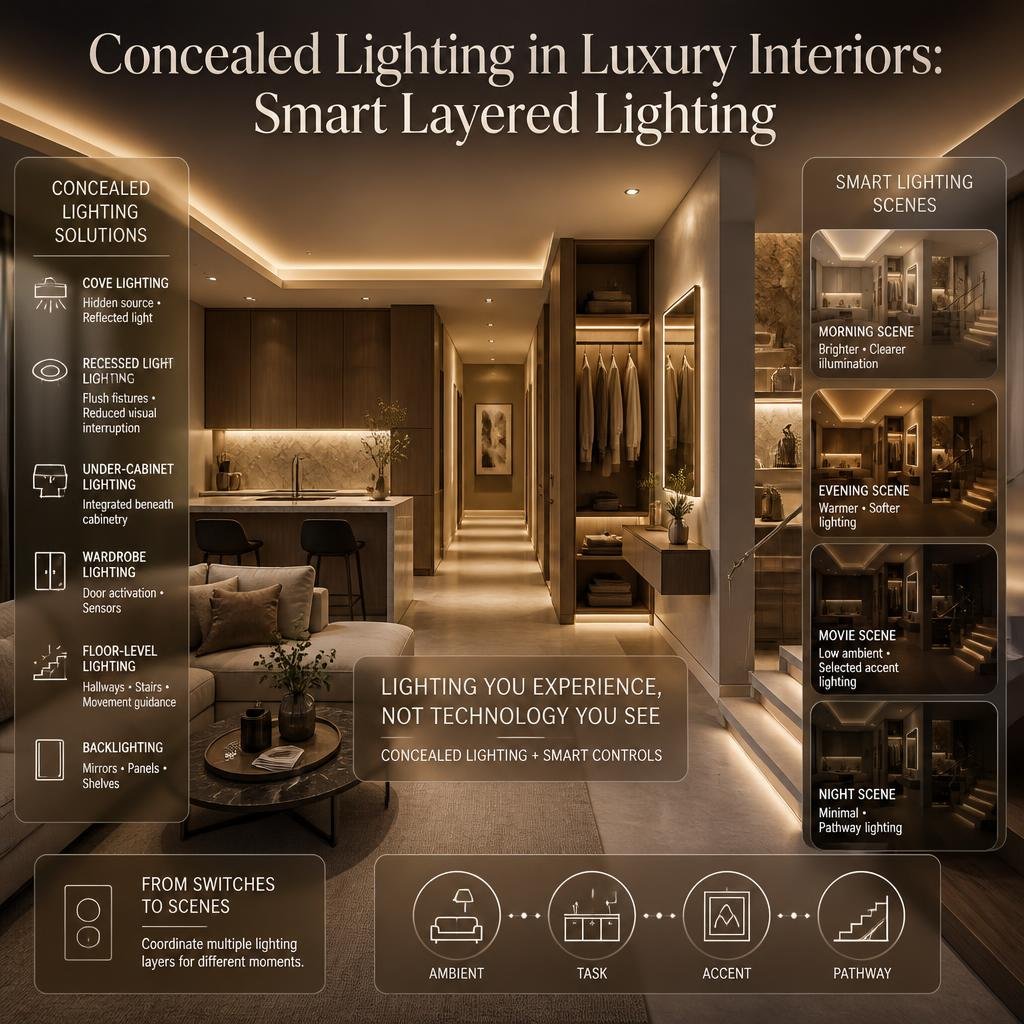
Lighting is one of the strongest examples of concealed technology because people experience the light rather than the equipment.
Instead of seeing the technology, you see:
- A softly illuminated wall
- A glowing ceiling recess
- A highlighted artwork
- A warm wardrobe
- A softly lit staircase
- An illuminated kitchen worktop
This is why architectural lighting and smart lighting can work so well together.
Common Concealed Lighting Solutions
Cove Lighting
LED strips can be placed inside ceiling recesses or architectural details.
The light source itself remains hidden while the reflected light becomes visible.
Recessed Lighting
Fixtures can sit flush within ceilings, reducing visual interruption.
Under-Cabinet Lighting
Kitchen and bathroom lighting can be integrated beneath cabinetry.
Wardrobe Lighting
Lights can activate when doors open or through sensors.
Floor-Level Lighting
Subtle lighting can guide movement through hallways and stairs.
Backlighting
Mirrors, wall panels, shelves, and architectural features can use concealed illumination.
Smart controls can then coordinate these layers into different scenes.
For example:
Morning Scene: brighter, clearer illumination.
Evening Scene: warmer and softer lighting.
Movie Scene: low ambient light with selected accent lighting.
Night Scene: minimal pathway lighting.
This creates a more sophisticated experience than simply switching every light on or off.
For more information about integrated lighting concepts, see Intelligent Lighting.
How Should Smart Lighting Be Used in Luxury Interiors?
The best smart lighting system doesn’t make the homeowner think about the technology every time they enter a room.
Instead, it should respond naturally to routines.
A hallway can illuminate automatically when someone enters.
Bedroom lighting can gradually reduce intensity in the evening.
Curtains can open in the morning while selected lights switch off.
A living room can move into an entertainment scene with one command.
However, automation should not become complicated for its own sake.
Recent 2026 interior design coverage also points to a broader preference for intentional, comfortable spaces and warns that excessive automation can become a burden when it complicates daily life.
💡 Pro Tip: Automate repetitive actions, not every possible action.
If a feature saves time every day, automation makes sense.
If it requires an app every time you want to perform a basic task, reconsider the design.
How Can Smart Controls Be Concealed?
A wall covered with switches and control panels can undermine an otherwise beautiful interior.
This is sometimes called visual “wall clutter” or “wall acne.”
The solution isn’t necessarily to remove all controls.
Instead, combine functions.
A single elegant keypad can potentially control:
- Lighting scenes
- Curtains
- Selected shades
- Room modes
- Audio
- Other automation functions
The exact setup depends on the chosen smart-home platform.
The important thing is consistency.
Controls should feel like part of the architecture.
They can be selected to complement:
- Metal finishes
- Wood
- Stone
- Plaster
- Paint
- Other hardware
A control interface shouldn’t look like it was added after the room was finished.
Concealed Technology in Luxury Living Rooms
The living room usually has the highest concentration of entertainment technology.
It may contain:
- Television
- Speakers
- Streaming equipment
- Gaming devices
- Lighting
- Curtains
- Climate controls
- Wi-Fi
- Charging
- Security interfaces
This makes the living room an ideal candidate for concealed technology.
Start With the Furniture Layout
Before choosing the television, speakers, or automation system, determine:
- Where the sofa goes
- Where people will sit
- Main viewing direction
- Window positions
- Walking paths
- Artwork locations
- Storage requirements
Furniture scale is important here.
A huge television with tiny furniture can make the room feel unbalanced even if every cable is perfectly hidden.
Likewise, an oversized media cabinet can dominate the room.
For detailed guidance on proportion, see Furniture Scale vs Room Size.
Example: A Concealed Living Room
Imagine a large living room with a natural-stone feature wall.
Instead of attaching a television directly to the stone, the designer could create:
- A recessed television
- Concealed speakers
- A ventilated equipment compartment
- Hidden cable pathways
- Integrated accent lighting
- Motorized curtains
- One discreet control interface
During the day, the wall reads primarily as architecture.
At night, it can transform into an entertainment environment.
That’s the real advantage of concealed technology.
Concealed Technology in Bedrooms
Bedrooms require a different approach because comfort and rest should remain the priority.
Technology can be integrated without making the bedroom feel overly digital.
Useful examples include:
- Bedside charging
- Automated curtains
- Integrated reading lights
- Hidden television
- Concealed speakers
- Wardrobe lighting
- Climate control
- Lighting scenes
A bedside table can contain a dedicated charging drawer.
A wardrobe can illuminate automatically when opened.
Curtains can operate according to morning and evening routines.
But there is an important point here.
More technology isn’t automatically better.
In 2026, some luxury bedroom design is actually moving toward intentionally low-tech environments, with designers creating bedrooms that reduce screens and digital distractions rather than adding more smart devices.
That means concealed technology should be used selectively.
If the goal of the bedroom is relaxation, the best technology may be the technology you barely notice.
Concealed Technology in Wardrobe Design
Wardrobes provide excellent opportunities for discreet technology because they already contain enclosed storage and electrical requirements.
Possible integrations include:
- Automatic wardrobe lighting
- Integrated mirrors
- Charging points
- Smart controls
- Sensor lighting
- Power outlets
- Audio
- Device storage
The challenge becomes more interesting when the room has an unusual ceiling or wall geometry.
A wardrobe designed beneath a sloped ceiling may already require careful dimensional planning. Adding technology means the designer also needs to think about wiring routes, access points, lighting positions, and equipment clearance.
For related guidance, see Wardrobe Design for Sloped Ceilings.
Similarly, rooms with angled walls can require furniture to follow unusual geometry rather than standard rectangular dimensions. See Furniture for Rooms With Angled Walls for related planning considerations.
Concealed Technology in Kitchens
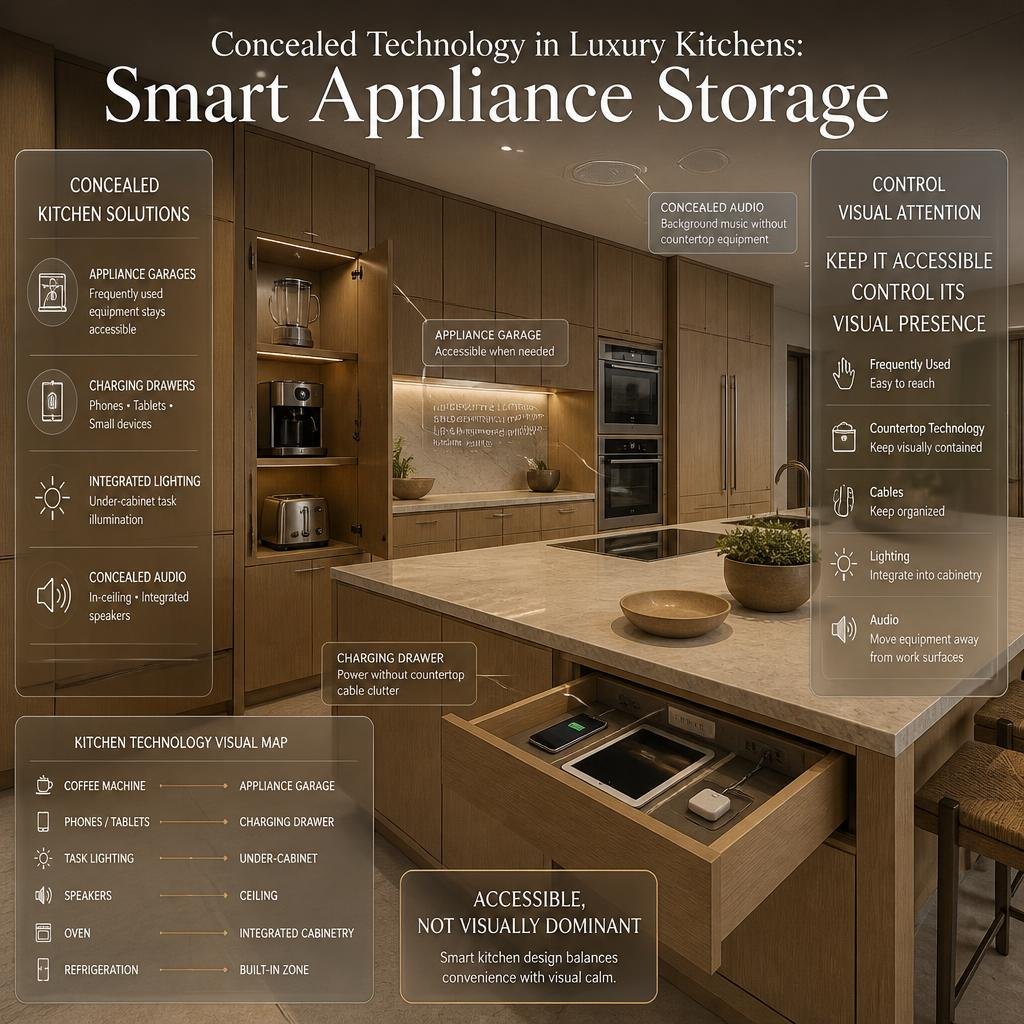
Modern kitchens often contain more technology than homeowners realize.
There are:
- Coffee machines
- Blenders
- Ovens
- Refrigeration systems
- Charging devices
- Displays
- Speakers
- Lighting controls
- Small appliances
If every appliance stays on the countertop, the kitchen can quickly feel crowded.
Appliance Garages
An appliance garage can hide frequently used equipment behind a coordinated cabinet door.
This keeps the appliance accessible without making it permanently visible.
Charging Drawers
A dedicated drawer can provide power for:
- Phones
- Tablets
- Small devices
The cables stay contained instead of spreading across the counter.
Integrated Lighting
Under-cabinet lighting can provide task illumination without requiring additional lamps or visible fixtures.
Concealed Audio
In-ceiling or integrated speakers can provide background music without taking up countertop space.
The principle is simple:
Keep frequently used things accessible, but control how much visual attention they receive.
Concealed Technology in Bathrooms
Bathrooms need more technical care because water and electricity must be handled responsibly.
Potential technology includes:
- Heated mirrors
- Integrated mirror lighting
- Concealed speakers
- Automated ventilation
- Smart controls
- Automated blinds
- Discreet displays
The design should always follow applicable electrical and building safety requirements.
Concealment should never compromise waterproofing, service access, ventilation, or electrical safety.
A hidden device that requires removing expensive stone to repair is not a successful luxury installation.
Concealed Technology in Home Offices
Home offices require a different balance because technology is part of the work environment.
A designer may want to hide cables and equipment without hiding the functionality.
Useful solutions include:
- Integrated desk power
- Cable channels
- Concealed charging
- Built-in monitor storage
- Hidden printers
- Equipment cabinets
- Integrated task lighting
- In-wall networking
The goal is to reduce visual clutter while maintaining quick access.
A professional workspace should not force the user to open three cabinets every time a device needs to be connected.
Can Technology Be Hidden in Furniture?
Absolutely.
Furniture is one of the most practical places to integrate technology because it can provide storage, power, ventilation, and access.
Examples include:
Bedside Tables
Can include charging drawers and discreet power.
Media Consoles
Can hide receivers, streaming equipment, gaming systems, and cables.
Desks
Can include pop-up power and cable management.
Kitchen Islands
Can include integrated outlets and charging.
Benches
Can provide concealed device storage.
Wardrobes
Can include lighting and power.
However, furniture dimensions need to be considered carefully.
A hidden component should remain accessible.
A power outlet placed too far inside a cabinet may technically be concealed but practically useless.
For broader home project and practical improvement ideas, see DIY Home Projects.
How Should Climate Control Be Integrated?
Climate control is another area where technology can disappear visually.
Thermostats, sensors, vents, and controls can be selected to minimize their visual impact.
However, this system requires technical discipline.
A temperature sensor should be positioned where it can accurately measure the room.
An air vent should be positioned based on airflow requirements rather than simply where it looks best.
A thermostat shouldn’t be hidden behind curtains or furniture.
The same principle applies to ventilation grilles.
A luxury interior is successful only when visual design and mechanical performance work together.
How Can Security Technology Be Concealed?
Security systems often create visual clutter because they require cameras, sensors, intercoms, access controls, and alarms.
Some of these components can be integrated into:
- Door frames
- Ceiling details
- Joinery
- Entry architecture
- Lighting structures
But security is one area where appearance must never compromise performance.
A camera should have a useful field of view.
A sensor should detect what it needs to detect.
A door access system should remain reliable.
A concealed security device that cannot perform its job isn’t successful design.
What Role Does Material Selection Play?
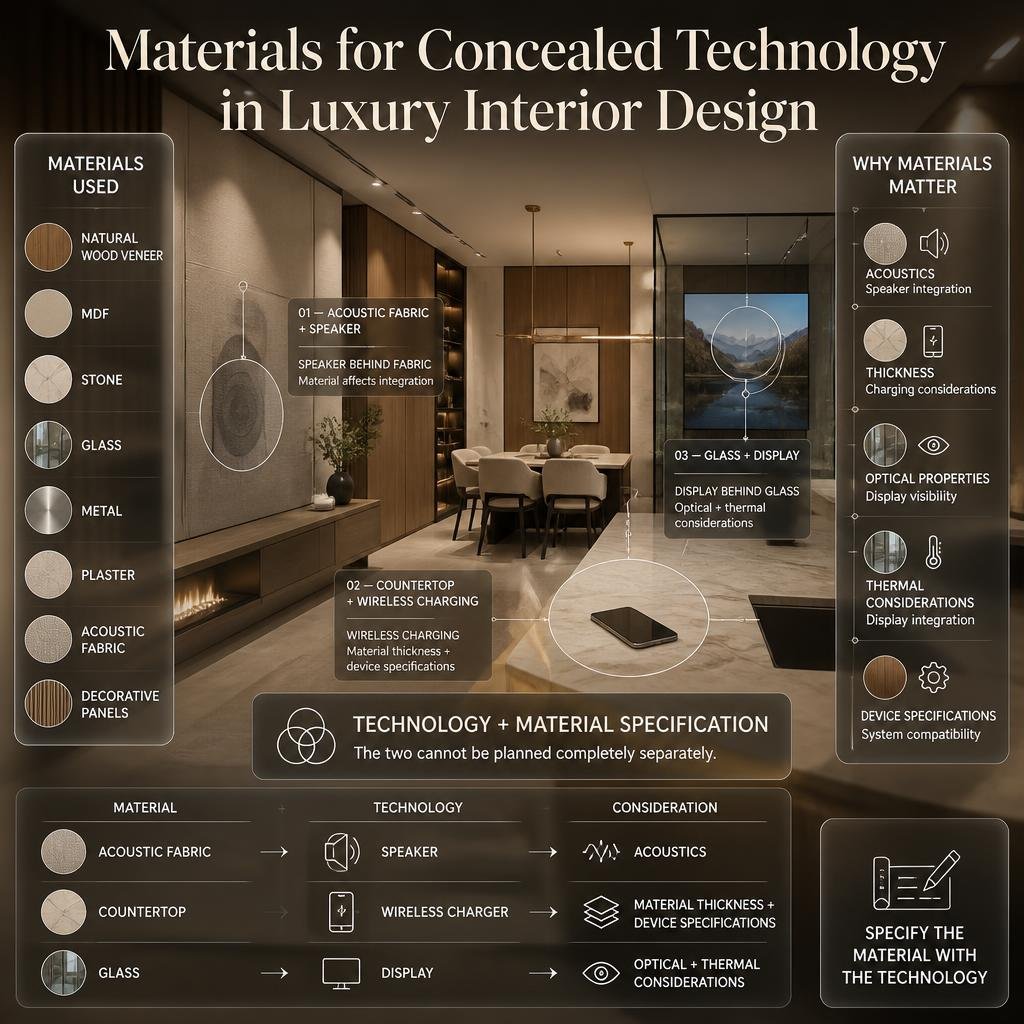
The materials surrounding concealed technology can determine whether the final result looks professional.
Common materials include:
- Natural wood
- Veneer
- MDF
- Stone
- Glass
- Metal
- Plaster
- Acoustic fabric
- Decorative panels
Each material behaves differently.
A speaker behind fabric is different from a speaker behind plaster.
A wireless charger under a countertop requires different considerations depending on the material thickness and device specifications.
A display hidden behind glass requires appropriate optical and thermal considerations.
This is why technology cannot be separated completely from material specification.
For a broader look at choosing appropriate materials for interiors, see Material Selection.
Can Concealed Technology Work With Traditional Interiors?
Yes.
Concealed technology isn’t limited to minimalist or futuristic homes.
Traditional interiors can use:
- Custom millwork
- Decorative cabinetry
- Paneling
- Built-in furniture
- Concealed speakers
- Hidden screens
For example, a classic living room can contain a modern entertainment system behind traditional-style cabinetry.
The room doesn’t have to look futuristic simply because the technology is modern.
The technology should adapt to the architectural language.
Can Concealed Technology Work With Japandi Interiors?
Japandi interiors emphasize calmness, natural materials, functional simplicity, and visual restraint.
These characteristics make discreet technology particularly suitable.
Instead of multiple visible devices, the design can use:
- Warm integrated lighting
- Minimal controls
- Concealed speakers
- Hidden charging
- Natural-material cabinetry
- Automated curtains
The technology remains useful without interrupting the calm character of the space.
How Does Technology Fit Into Home Improvement and Renovation?
Technology planning should be part of renovation planning rather than something considered after the finishes are complete.
If walls are already closed, installing new wiring can require additional work.
If custom cabinetry is already manufactured, changing equipment dimensions can become expensive.
If the ceiling is finished, adding recessed speakers or motorized curtain pockets can become complicated.
For renovation projects, it is therefore useful to coordinate technology with:
- Electrical work
- Ceiling work
- Joinery
- Flooring
- Wall finishes
- Furniture
- Lighting
- Painting
For additional home improvement guidance, explore Home Improvement.
You can also review Mintpaldecor Home Repair Inspiration for related repair and improvement considerations.
How Should Concealed Technology Be Planned Before Construction?
This is probably the most important part of the entire process.
The earlier the technology is planned, the easier it becomes to integrate it properly.
Current 2026 smart-home design guidance consistently emphasizes planning infrastructure during the architectural stage rather than trying to retrofit invisible technology after finishes are installed.
Step 1: Understand the Room
Start with:
- Room dimensions
- Windows
- Doors
- Furniture
- Circulation
- Architectural features
- Natural light
- Main focal points
Don’t start with the gadgets.
Start with the room.
Step 2: List the Technology
Write down every system you expect to use.
For example:
- TV
- Audio
- Lighting
- Curtains
- Climate
- Security
- Charging
- Networking
- Automation
Step 3: Decide What Needs to Disappear
Not everything needs to be hidden.
Some technology may actually contribute to the design.
The objective is to conceal what creates unnecessary visual noise.
Step 4: Plan Power
Determine where power outlets and dedicated circuits are required.
Step 5: Plan Data and Network Infrastructure
Identify where wired networking, AV connections, and control systems will be located.
Step 6: Plan Equipment Locations
Centralize equipment where practical.
A dedicated technical cabinet or equipment room can prevent individual devices from spreading throughout the home.
Step 7: Plan Ventilation
Any enclosed electronics need appropriate airflow.
Step 8: Plan Service Access
Ask:
“If this device fails five years from now, how will someone reach it?”
If the answer is “we’ll probably have to break the wall,” the design needs improvement.
Step 9: Coordinate With Joinery
Cabinetmakers need technical dimensions before fabrication.
Step 10: Test Before Closing Walls
Test:
- Speakers
- Screens
- Wiring
- Lighting
- Controls
- Network
- Sensors
- Automation
Step 11: Document Everything
Photograph concealed wiring and record important locations.
This documentation can become extremely valuable during future renovation.
📌 Quick Tip: Create a simple digital technology plan showing cable routes, equipment locations, service panels, and hidden connections before the walls are closed.
Why Early Planning Saves Problems Later
Concealed technology is primarily a coordination challenge.
A recent 2026 design guide describes quiet automation as an architectural decision because wall build-ups, ceiling assemblies, wiring pathways, equipment locations, and controls need to be coordinated before finishing work.
If technology is planned too late, you may have to:
- Open finished walls
- Cut ceilings
- Modify cabinetry
- Move electrical outlets
- Drill expensive stone
- Change lighting
- Repaint surfaces
- Rebuild joinery
Planning early doesn’t necessarily eliminate cost.
It eliminates unnecessary rework.
What Is the Difference Between Hidden and Integrated Technology?
The two terms sound similar but have an important difference.
Hidden technology is technology that has been placed out of sight.
Integrated technology is technology that has been considered as part of the architecture or furniture from the beginning.
For example:
A router hidden in a cupboard is hidden.
A dedicated technical cabinet designed with ventilation, power, network connections, and service access is integrated.
A television behind a cabinet door is hidden.
A media wall designed around the television, speakers, lighting, storage, ventilation, and viewing distance is integrated.
Integration usually produces a more professional result.
Concealed Technology vs Visible Technology
| Consideration | Concealed Technology | Visible Technology |
|---|---|---|
| Visual clutter | Low | Potentially higher |
| Planning | Requires more | Usually simpler |
| Maintenance | Must be planned | Often easier |
| Installation | More complex | Usually easier |
| Architectural integration | High | Variable |
| Future upgrades | Need planning | Often straightforward |
| Best for | Refined interiors | Utility/tech-focused spaces |
There isn’t one correct answer for every room.
A dedicated home office may benefit from visible monitors and equipment.
A formal living room may benefit from concealed entertainment.
A bedroom may benefit from minimal technology.
The room’s function should determine the approach.
What Are the Most Common Mistakes?
Mistake 1: Hiding Everything
The assumption is that luxury means nothing should be visible.
That isn’t necessarily true.
Some technology is useful when accessible.
Better approach: Hide unnecessary visual clutter while keeping important controls easy to use.
Mistake 2: Forgetting Maintenance
A hidden device still needs servicing.
Why it happens: The finished appearance receives more attention than future access.
Why it’s harmful: Repairs can become expensive.
Solution: Include access panels and service routes.
Mistake 3: Ignoring Heat
Electronic equipment produces heat.
Solution: Follow manufacturer requirements for ventilation and equipment spacing.
Mistake 4: Planning Too Late
Why it happens: Technology is purchased after interior design decisions are finalized.
Solution: Coordinate technology before walls and ceilings are closed.
Mistake 5: Installing Too Many Controls
Why it happens: Every system is installed independently.
Solution: Consolidate controls.
Mistake 6: Forgetting Future Technology
A screen or device installed today may be replaced later.
Solution: Create flexible infrastructure.
Mistake 7: Sacrificing Performance for Appearance
A speaker that looks invisible but sounds poor isn’t a successful installation.
A hidden sensor that doesn’t detect movement accurately isn’t useful.
Solution: Performance comes before concealment.
Mistake 8: Poor Furniture Planning
A concealed device can still make furniture look oversized or awkward.
Solution: Coordinate technology with furniture proportions.
Mistake 9: Ignoring Manual Controls
If everything depends on an app, basic tasks can become frustrating.
Solution: Keep essential functions accessible manually.
How Can Concealed Technology Be Future-Proofed?
Technology changes quickly.
The interior itself may last for decades.
Therefore, future-proofing should focus on infrastructure.
Useful strategies include:
- Spare conduits
- Accessible cable pathways
- Extra power capacity
- Structured networking
- Modular cabinetry
- Service panels
- Replaceable mounting systems
- Documented wiring
- Accessible equipment locations
The goal isn’t to predict exactly which devices will exist ten years from now.
The goal is to make future changes easier.
A flexible conduit may prove more valuable than an expensive current device because it allows the next generation of equipment to be installed without destroying finished surfaces.
How Can Concealed Technology Support Sustainable Interior Design?
Smart technology can help manage lighting, shading, climate, and other systems more intelligently.
But technology alone doesn’t make an interior sustainable.
The quality and durability of materials matter.
So does the lifespan of the technology.
A system that must be completely replaced every few years can create unnecessary waste.
A better strategy is to choose durable infrastructure and systems that can be repaired or upgraded.
This is also where healthier material selection becomes relevant.
When integrating technology into cabinetry, wall systems, and furniture, designers should consider material emissions, durability, repairability, and long-term use.
For more information about healthier interior finishes, see Low VOC Finishes for Healthier Interiors.
Can Concealed Technology Be Used Outdoors?
Yes, but outdoor applications require additional protection.
Outdoor technology can include:
- Landscape lighting
- Outdoor audio
- Security
- Automated shading
- Irrigation
- Pool systems
- Outdoor entertainment
Equipment needs to be suitable for the environmental conditions.
Technology should also be positioned so that maintenance remains practical.
For broader garden and patio planning ideas, see Robert MyGardenAndPatio.
How Should a Designer Balance Technology and Decoration?
This is where experience becomes important.
A room shouldn’t become empty simply because the designer wants to hide technology.
Artwork, furniture, lighting, accessories, materials, and architecture still need to create a strong composition.
Technology should occupy the background.
A useful design hierarchy is:
Architecture → Materials → Furniture → Lighting → Art → Technology
This doesn’t mean technology is unimportant.
It means the technology should support the experience created by everything else.
What Should You Ask a Smart-Home Installer?
Before approving a concealed technology system, ask practical questions.
Installation
- Where will equipment be installed?
- What needs wiring?
- What needs ventilation?
- Which surfaces need modification?
Maintenance
- How will equipment be accessed?
- Can components be replaced without damaging finishes?
- Where are service panels?
Control
- Can important functions be operated manually?
- What happens if the internet fails?
- What happens if the controller fails?
Future Upgrades
- Are spare conduits available?
- Can future devices use existing wiring?
- Is there enough equipment capacity?
Design
- Which parts remain visible?
- Can controls match the interior?
- Will speaker grilles be noticeable?
These questions can prevent expensive mistakes.
Room-by-Room Concealed Technology Checklist
Entryway
- Smart access
- Security integration
- Lighting automation
- Intercom
- Charging where useful
Living Room
- TV integration
- Concealed speakers
- Equipment ventilation
- Cable pathways
- Lighting scenes
- Curtain automation
Bedroom
- Charging
- Lighting controls
- Curtain automation
- Optional hidden TV
- Wardrobe lighting
- Simple manual controls
Kitchen
- Appliance storage
- Integrated power
- Charging
- Lighting
- Audio
- Smart controls
Bathroom
- Mirror lighting
- Ventilation
- Appropriate technology
- Moisture-safe installation
- Service access
Whole Home
- Network infrastructure
- Equipment location
- Security
- Climate control
- Lighting control
- Future pathways
- Documentation
What is concealed technology in luxury interiors?
Concealed technology refers to smart-home and electronic systems that are deliberately integrated into the architecture, furniture, ceilings, walls, or joinery so they remain visually discreet. Instead of making technology a dominant feature, the design hides or minimizes visible screens, speakers, wiring, switches, sensors, charging points, and control equipment.
The goal is not simply to hide every device. Good concealed technology makes the technology easy to use while allowing the interior itself to remain the visual focus. A television may disappear behind custom cabinetry, speakers can be built into ceilings or walls, and lighting controls can be integrated into carefully selected switch plates or automated through sensors and scenes.
This approach is particularly valuable in luxury interiors because expensive materials, carefully planned proportions, and architectural details can lose their impact when surrounded by visible cables, bulky equipment, or too many digital devices.
Important considerations:
Plan concealed wiring before walls and ceilings are closed.
Coordinate technology with joinery, lighting, and furniture layouts.
Leave suitable access points for maintenance and upgrades.
Hide equipment without making it impossible to service.
Choose technology based on how the room will actually be used.
The best result is technology that feels almost effortless: residents experience the benefits of automation without feeling as though the room has been designed around gadgets.
How can you hide technology without making a luxury interior difficult to use?
The key is to conceal the hardware, not the experience. Technology becomes frustrating when important controls are hidden so effectively that residents cannot understand how to operate them. A luxury interior should therefore combine discreet installation with simple, intuitive access.
For example, a concealed television can be controlled normally even though the screen is hidden inside cabinetry. Similarly, built-in speakers may disappear visually while still providing straightforward volume and playback controls. Lighting can be organized into scenes such as “Relax,” “Entertain,” or “Night” instead of requiring users to operate numerous individual switches.
Good planning also considers visitors, children, guests, and anyone who is not familiar with the home’s automation system. There should always be a clear and convenient way to perform basic functions manually when appropriate.
Practical ways to maintain usability:
Use clearly understood lighting scenes instead of excessive controls.
Keep essential switches accessible.
Provide manual alternatives for critical systems.
Group related functions together.
Avoid requiring a phone or app for every basic action.
Make frequently used controls available from convenient locations.
The most successful concealed technology does not make residents think about where the equipment is hidden. They simply interact with the room naturally, while the technology works quietly in the background.
What technology can be concealed in a luxury interior?
Almost any technology that can be planned into the architecture or furniture can potentially be made more discreet. However, the exact solution depends on the equipment, room layout, ventilation requirements, maintenance access, and construction method.
Common examples include entertainment systems, lighting controls, speakers, displays, sensors, charging points, networking equipment, and climate-control components. Some solutions are completely hidden, while others are designed to blend into the surrounding material rather than disappear entirely.
For instance, a home theater may use in-wall speakers and a projector concealed within the ceiling. A bedroom may use integrated charging points and automated curtains without adding visible equipment to bedside furniture. In a kitchen, appliances and controls can be coordinated with cabinetry to create a cleaner visual composition.
Technology commonly considered for concealment includes:
In-wall and in-ceiling speakers
Hidden or motorized television systems
Automated blinds and curtains
Lighting control systems
Occupancy and environmental sensors
Concealed charging stations
Network and equipment cabinets
Security cameras designed for discreet installation
Climate-control interfaces
Home automation hubs and control equipment
Not every device should be completely invisible. Some equipment needs ventilation, wireless access, maintenance clearance, or direct interaction. The professional approach is to decide what should disappear, what should blend in, and what should remain intentionally accessible.
Is concealed smart-home technology expensive to install in a luxury interior?
The cost varies considerably because concealed technology is not a single product or installation. Expenses depend on the number of systems, level of automation, equipment quality, wiring requirements, cabinetry, architectural modifications, programming, and whether the technology is being incorporated during a new build or added to an existing interior.
Installing technology during the early design and construction stages can also make the process more straightforward because wiring routes, equipment spaces, ceiling voids, wall cavities, and joinery can be planned in advance. Retrofitting the same systems after construction may require additional work to walls, ceilings, flooring, or cabinetry.
Luxury projects can also involve custom fabrication. A hidden display, motorized mechanism, bespoke speaker integration, or specialized equipment cabinet may require coordination between an interior designer, electrician, technology specialist, joiner, and other contractors.
Factors that can affect the overall budget:
Number of rooms being automated
Type and quantity of smart devices
Custom cabinetry and concealment mechanisms
Electrical and network infrastructure
Installation and programming
Structural or architectural modifications
Audio-visual requirements
Maintenance and future upgrade provisions
Rather than focusing only on the purchase price of individual devices, the project should be considered as a complete system. A relatively inexpensive device can still become costly if it requires major construction changes later.
How do you future-proof concealed technology in a luxury interior?
Future-proofing is one of the most important parts of concealed technology because hidden systems can be more difficult to replace than visible plug-in devices. A beautiful installation should not become a problem simply because a component needs to be upgraded several years later.
The best strategy is to create flexibility in the infrastructure rather than trying to predict exactly which technology will exist in the future. Accessible equipment locations, spare conduits, adequate cable pathways, replaceable components, and properly planned network infrastructure can make future upgrades much easier.
This is particularly important when technology is integrated into walls, ceilings, custom furniture, or expensive architectural finishes. Opening those areas later can be disruptive and expensive.
Useful future-proofing measures include:
Install accessible conduits where practical.
Leave spare capacity for future cabling.
Keep network and control equipment serviceable.
Avoid permanently sealing critical components behind finishes.
Document cable routes and equipment locations.
Provide ventilation around equipment that generates heat.
Use modular systems where possible.
Coordinate technology infrastructure with future renovation plans.
Future-proofing does not mean installing every possible technology today. It means creating an interior that can adapt when devices, connectivity standards, control systems, or household requirements change.
For luxury interiors, that flexibility is especially valuable because the architectural finishes may be expected to last much longer than the technology installed inside them.
Conclusion
Concealed technology has changed the way luxury interiors can balance comfort, convenience, and visual refinement. The purpose is not to fill a home with the latest devices, but to integrate useful technology in a way that supports the architecture rather than competing with it. Hidden displays, integrated speakers, discreet controls, automated lighting, concealed charging, smart climate systems, and carefully positioned sensors can all contribute to a more comfortable and visually organized environment.
The most successful approach begins during the design stage. Technology should be considered alongside furniture layouts, lighting, materials, cabinetry, electrical planning, and architectural details rather than added as an afterthought. At the same time, concealed does not have to mean inaccessible. Equipment still needs proper ventilation, maintenance access, and a practical route for future replacement or upgrades.
Ultimately, luxury is increasingly about how naturally a space works. When technology is thoughtfully concealed, the room can remain calm, sophisticated, and focused on the people using it. The result is an interior where advanced functionality is present when needed but visually quiet when it is not—creating a more seamless relationship between technology, architecture, and everyday living.
For more practical ideas on creating thoughtful, functional, and refined interiors, explore DesignMode24 Interior Design.