
Introduction
Low VOC Finishes for Healthier Interiors | A freshly renovated room can look perfect while the air inside still carries the strong smell of paint, varnish, sealers, or newly installed materials. That familiar renovation smell is often treated as normal, but it can be a reason to pay closer attention to what you’re bringing into your home.
This is where low VOC finishes for healthier interiors become important.
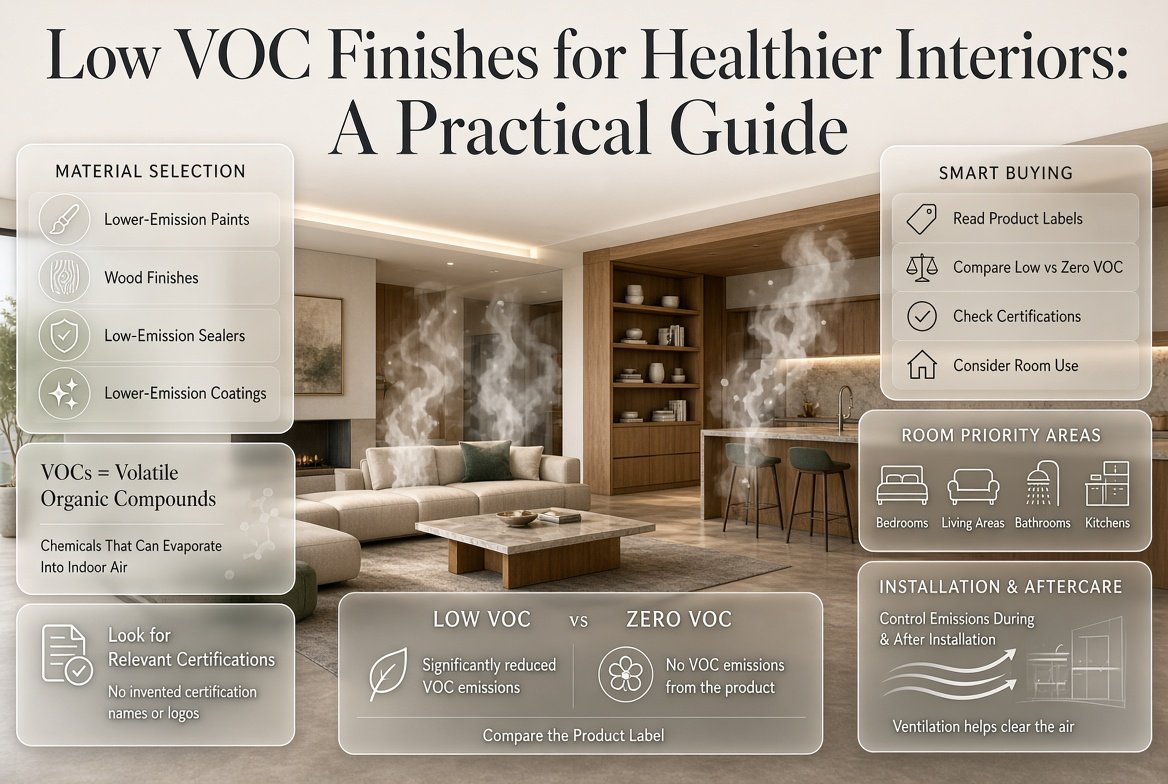
Volatile organic compounds, commonly called VOCs, are chemicals that can evaporate into indoor air from many products and materials. Paints, coatings, varnishes, adhesives, sealers, and some furniture and building products can contribute to indoor VOC emissions. EPA notes that indoor VOC concentrations can be higher than outdoor concentrations and that the potential health effects vary significantly depending on the individual chemical, exposure level, and duration.
The good news is that healthier material selection doesn’t require turning your home into a laboratory.
You simply need to understand what you’re buying, what the labels actually mean, how the finish will be used, and how to control emissions during and after installation.
This guide explains how to choose lower-emission paints, wood finishes, sealers, and coatings, how to compare low-VOC and zero-VOC products, what certifications can tell you, which rooms deserve extra attention, and what mistakes homeowners commonly make.
If you’re planning a wider renovation, you can also explore DesignMode24 Interior Design for practical ideas on creating a more thoughtful and functional home.
What Are Low VOC Finishes?
Low-VOC finishes are paints, coatings, stains, sealers, varnishes, and related surface treatments designed to contain or emit relatively low levels of volatile organic compounds compared with higher-emitting alternatives. They can be useful when improving indoor air quality, but the phrase “low VOC” shouldn’t be treated as a complete safety guarantee.
VOCs are not one single chemical.
They’re a broad category of organic compounds with different properties and different potential effects. Some evaporate quickly, while others are released more slowly. Some have noticeable odors, while others may have little or no obvious smell.
That’s why simply walking into a showroom and choosing the paint with the weakest smell isn’t a reliable way to compare products.
Why Do VOCs Matter Inside a Home?
Indoor VOCs can come from many sources, including:
- Paints
- Primers
- Varnishes
- Wood stains
- Sealers
- Adhesives
- Flooring products
- Composite wood
- Furniture
- Cleaning products
- Caulks and sealants
- Certain coatings and finishes
EPA explains that organic chemicals are widely used in building materials and household products and that remodeling activities can introduce VOC-emitting paints, varnishes, sealants, and adhesives into the home.
The important point is not that every VOC-containing product should be avoided.
Instead, the goal is source control.
If you can choose a product that performs just as well while producing fewer unwanted emissions, that’s a sensible material-selection decision.
💡 Pro Tip: Think about VOC reduction as one part of healthier interior design—not as a single product feature. Ventilation, material selection, installation methods, curing time, and overall room use all matter.
Why Are Low VOC Finishes Important for Healthier Interiors?
The reason homeowners increasingly look for lower-emission finishes is simple: interior surfaces cover a lot of area.
Think about a typical bedroom.
You may have:
- Four painted walls
- A painted ceiling
- Painted doors
- Trim
- A wardrobe
- A wooden bed
- Flooring
- Furniture
- Adhesives
- Decorative panels
If several of those materials release chemicals into indoor air, the combined effect can be more important than any individual product.
EPA’s indoor-air guidance recommends selecting low-emission products and emphasizes that paints and coatings should be evaluated for VOC content, composition, durability, and intended use rather than relying on a single label.
Lower Emissions Can Mean a More Considered Material Palette
Using lower-emission products can reduce one source of indoor pollutants.
It can also encourage better renovation habits.
Instead of asking only:
“Which paint has the lowest VOC?”
you’re asking:
“Which finish gives me the performance I need with the lowest practical emissions, and how can I install it correctly?”
That second question leads to better decisions.
Healthier Doesn’t Mean Chemical-Free
This distinction is important.
A modern home contains many materials that are manufactured using chemicals. Trying to remove every synthetic substance isn’t realistic.
The more practical goal is to:
- Reduce unnecessary emissions.
- Select appropriate materials.
- Avoid excessive exposure during installation.
- Ventilate properly.
- Follow curing instructions.
- Choose products based on documented performance.
That is a much more useful approach than chasing marketing terms.
Low VOC vs. Zero VOC: What’s the Difference?
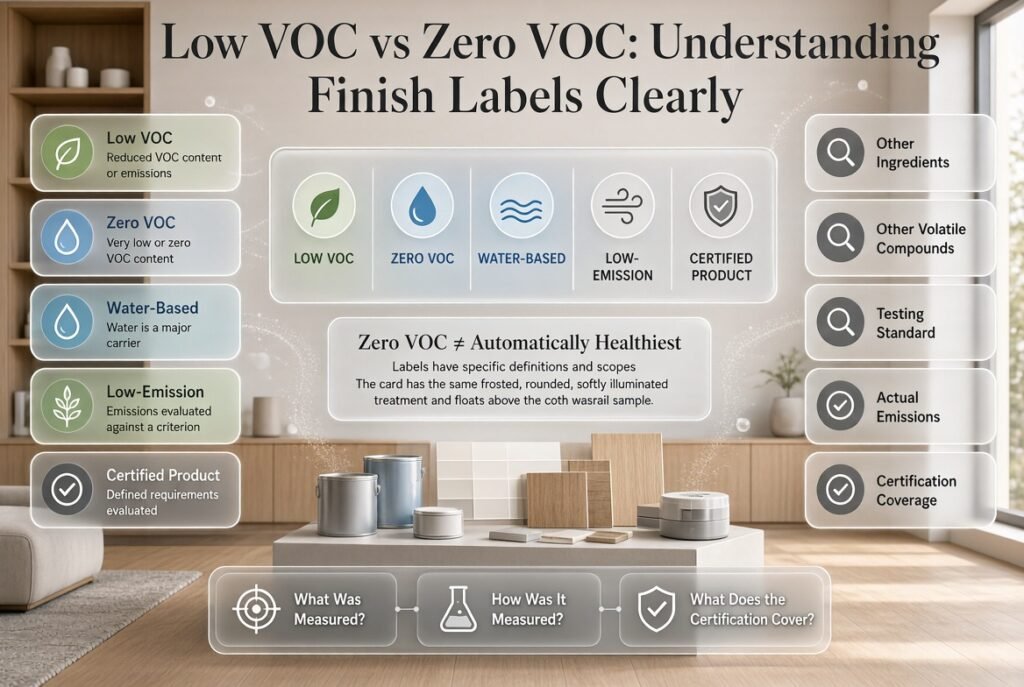
Low-VOC and zero-VOC are not interchangeable terms. A low-VOC product contains or emits less VOC under a particular definition or standard, while “zero VOC” generally refers to a defined VOC-content threshold. Neither label automatically proves that a product contains no other chemicals of concern or that it will have no indoor emissions.
EPA specifically warns that products labeled “low VOC” or “no VOC” can still contain volatile organic chemicals that may be relevant to indoor air quality. It also explains that reducing total VOC doesn’t necessarily guarantee a safer product because individual VOCs can have very different properties.
| Label | What it can indicate | What you should still investigate |
|---|---|---|
| Low VOC | Reduced VOC content or emissions under a particular standard | Other ingredients and emissions |
| Zero VOC | Very low or zero VOC content under a defined threshold | Other volatile compounds |
| Water-based | Water is a major carrier | Additives and actual emissions |
| Low-emission | Emissions have been evaluated against a criterion | The exact testing standard |
| Certified product | A third party has evaluated defined requirements | What the certification actually covers |
This is why “zero VOC” shouldn’t automatically be treated as synonymous with “healthiest possible finish.”
The better question is:
What was measured, how was it measured, and what does the certification or label actually cover?
What Types of Low VOC Finishes Can You Use Indoors?
There isn’t one universally best low-VOC finish.
Different surfaces have different requirements.
A bedroom wall, kitchen cabinet, hardwood floor, and bathroom ceiling shouldn’t automatically receive the same coating.
Low VOC Wall Paint
For most interior walls, water-based acrylic or latex paint is a practical option.
EPA notes that water-based acrylic latex paints are generally lower in VOCs than solvent-based paints.
They’re commonly suitable for:
- Bedrooms
- Living rooms
- Hallways
- Home offices
- Children’s rooms
- Ceilings
- General interior walls
However, you still need to compare washability, coverage, durability, emissions, and application requirements.
A low-VOC wall paint that marks easily may not be the best choice for a busy family hallway.
Low VOC Primers
Primer is often overlooked when homeowners think about healthier finishes.
That’s a mistake.
The primer can contribute to the overall material system just like the topcoat.
You may need primer when:
- Covering stains
- Painting new drywall
- Sealing porous surfaces
- Changing from a dark color to a lighter one
- Improving adhesion
- Preparing certain wood surfaces
If you’re using a lower-emission topcoat but pairing it with a high-emission primer, you’re not really evaluating the entire finish system.
Low VOC Wood Finishes
Wood requires a different approach.
Cabinetry, doors, furniture, wall paneling, and built-ins often need a protective finish that can tolerate handling and cleaning.
Lower-emission water-based wood coatings can be useful when they provide the required performance.
But don’t sacrifice durability just to achieve a lower number on the label.
A cabinet finish that scratches easily may require premature refinishing, creating more material use and additional exposure.
Low VOC Sealers
Sealers can be particularly important for porous materials.
They may be used on:
- Wood
- Masonry
- Concrete
- Decorative surfaces
- Certain flooring systems
- Composite materials
The product needs to be compatible with the surface and the final finish.
Low VOC Floor Finishes
Flooring deserves special consideration because the finished surface can cover a very large area.
A floor finish may need to withstand:
- Foot traffic
- Cleaning
- Moisture
- Abrasion
- Furniture movement
A lower-emission finish is useful only if it can perform under those conditions.
EPA’s indoor-air guidance similarly emphasizes that low-VOC or low-toxicity materials still need to satisfy durability and performance requirements.
How Do You Choose the Right Low VOC Finish?
Choosing a healthier finish becomes much easier when you follow a logical process.
Step 1: Identify the Surface
Start with the substrate.
Is it:
- Drywall?
- Plaster?
- Solid wood?
- Veneer?
- MDF?
- Existing paint?
- Concrete?
- Flooring?
- Cabinetry?
Never assume that a finish suitable for one material will automatically work on another.
Step 2: Understand How the Surface Will Be Used
Ask what the room demands.
A decorative bedroom wall has very different requirements from a kitchen cabinet.
Consider:
- Moisture
- Cleaning
- Touch
- Scratching
- Heat
- Traffic
- Humidity
- Sunlight
Step 3: Compare More Than VOC Content
Check:
- VOC information
- Emissions information
- Product data sheet
- Safety information
- Certifications
- Coverage
- Durability
- Drying time
- Cure time
- Application conditions
This gives you a much more complete picture.
Step 4: Look for Third-Party Testing
Third-party certification can be helpful because it gives you something more concrete than a marketing phrase.
EPA’s Indoor airPLUS requirements for site-applied paints, finishes, and coatings reference indoor-emissions testing based on the California Department of Public Health’s Standard Method. EPA’s current materials also list recognized certification programs for qualifying products.
This is an important distinction.
VOC content testing and emissions testing aren’t exactly the same thing.
One examines what’s in the product under a defined method; the other can examine what the material releases into indoor air.
Step 5: Match the Finish to the Room
Don’t choose the same product for every room simply because you like its appearance.
For example:
| Room | Main concern | Finish priority |
|---|---|---|
| Bedroom | Long occupancy | Low emissions + low odor |
| Nursery | Sensitive occupancy | Low-emission materials + ventilation |
| Kitchen | Cleaning + moisture | Durability + lower emissions |
| Bathroom | Humidity | Moisture resistance + emissions |
| Home office | Long occupancy | Low emissions + easy maintenance |
| Hallway | Frequent contact | Washability + durability |
| Living room | General use | Appearance + durability + emissions |
The healthiest choice is usually the one that balances all three:
Emissions + performance + correct installation.
How Important Is Water-Based Paint?
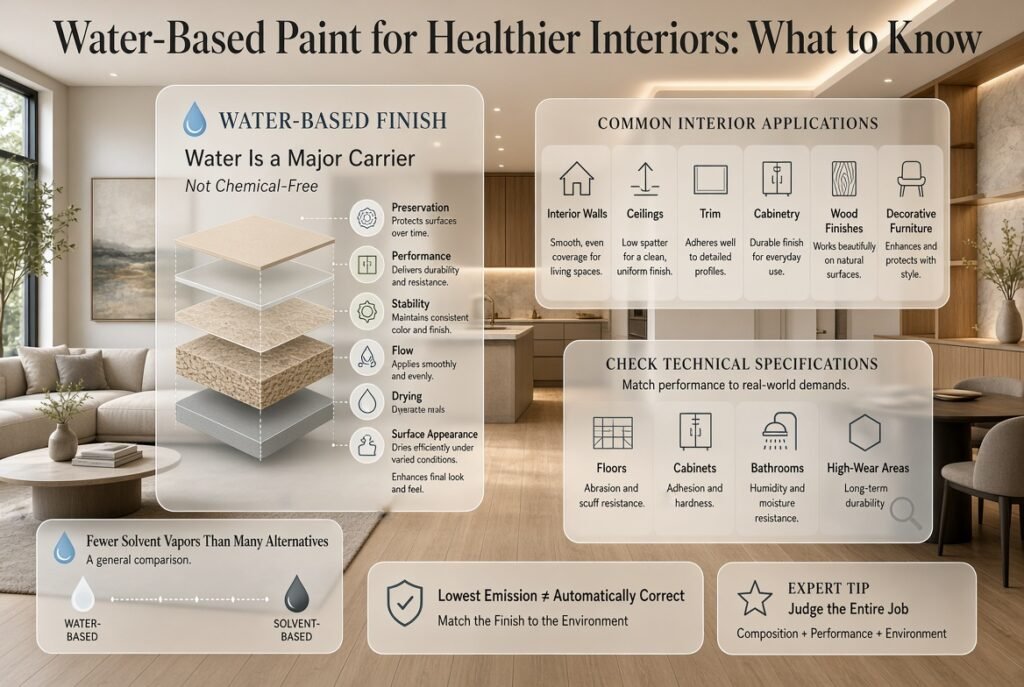
Water-based finishes are often a practical choice for healthier interiors.
They generally produce fewer solvent vapors than many solvent-based alternatives, and they are often easier to clean up.
But water-based doesn’t mean chemical-free.
A water-based coating can still contain additives needed for:
- Preservation
- Performance
- Stability
- Flow
- Drying
- Surface appearance
EPA’s guidance makes the same broader point: even low- or no-VOC paints can contain or emit other undesirable compounds, so product selection should consider composition and performance rather than VOC content alone.
When Water-Based Finishes Make Sense
They’re often particularly practical for:
- Interior walls
- Ceilings
- Trim
- Many cabinetry applications
- Certain wood finishes
- Decorative furniture
When You Need Extra Care
For floors, cabinets, bathrooms, and high-wear areas, check the technical specifications carefully.
The lowest-emission product isn’t automatically the correct product.
⭐ Expert Tip: A finish should be judged by the entire job, not just what’s written on the front of the container. If it can’t survive the environment where you’re using it, you’ve created another problem.
How Can You Verify a Low VOC Product?
Marketing language can be confusing.
One manufacturer may say “eco-friendly.”
Another may say “zero VOC.”
Another may say “low odor.”
Another may display a certification logo.
These terms don’t necessarily mean the same thing.
Read the Product Data Sheet
Look for information such as:
- VOC content
- Application method
- Recommended substrate
- Drying time
- Cure time
- Coverage
- Temperature requirements
- Humidity requirements
- Cleanup
- Ventilation
- Safety precautions
Look for Emissions Certification
Some programs evaluate emissions using controlled environmental chamber testing.
EPA’s Indoor airPLUS documentation identifies emissions requirements for site-applied interior paints, finishes, and coatings and references CDPH Standard Method testing. It also identifies certification programs that can demonstrate compliance.
This gives homeowners a stronger basis for comparison than a vague “green” claim.
Don’t Confuse Odor With Safety
A product with a strong smell isn’t automatically the most dangerous.
A product with almost no smell isn’t automatically harmless.
Odor perception depends on the chemicals involved and the person’s sensitivity.
Therefore, smell should be treated as one practical observation—not a scientific safety test.
What Does “Low Emission” Actually Mean?
Low-emission products are evaluated based on what they release into indoor air rather than simply the amount of regulated VOC in the wet product.
That distinction is particularly useful for interior design.
A coating can contain relatively little regulated VOC but still release other compounds.
EPA explains that indoor VOC labeling is complicated because definitions used for outdoor-air regulation don’t necessarily capture every chemical relevant to indoor air quality.
This is why emissions testing can add useful information.
A Simple Way to Think About It
Imagine two products.
Product A
- Very low advertised VOC
- No emissions certification
- Limited technical information
Product B
- Low VOC
- Published technical data
- Independent emissions certification
- Clear application and curing requirements
The second product gives you more information on which to base a decision.
That’s the real value of certification.
How Should You Apply Low VOC Finishes Indoors?
Good product selection can be undermined by poor application.
During renovation, the room itself becomes part of the material system.
Paint is being applied.
Dust may be generated.
Furniture can absorb odors.
Airflow can carry contaminants into adjacent rooms.
So installation strategy matters.
Step 1: Prepare the Area
Remove unnecessary furniture and belongings.
Protect porous materials that could absorb vapors or dust.
If you’re renovating a larger area, isolate the work zone from occupied rooms where practical.
Step 2: Create Outdoor Ventilation
Ventilation should move contaminated air outside rather than simply moving it from one room to another.
EPA recommends plenty of ventilation during and after remodeling activities that can release pollutants.
Step 3: Follow the Product Instructions
Don’t assume two paints behave the same way.
Check:
- Application temperature
- Humidity
- Number of coats
- Recoat time
- Drying time
- Cure time
- Ventilation instructions
Step 4: Allow Proper Curing
Drying and curing aren’t necessarily the same thing.
A surface can feel dry while the coating continues changing and releasing compounds.
Don’t rush furniture, bedding, children, or pets back into a freshly finished space simply because the wall feels dry.
Step 5: Keep Containers Closed
When you’re finished using the product, keep containers closed according to manufacturer instructions.
EPA’s guidance specifically recommends keeping paint containers covered as much as possible during and after use to limit VOC release.
📌 Quick Tip: If a cabinet door, furniture component, or other removable item can be finished in a properly ventilated area outside the occupied home, that can reduce the amount of wet finishing work happening inside the living space.
Which Rooms Should Prioritize Low VOC Finishes?

Every room can benefit from thoughtful material selection, but certain rooms deserve particular attention.
Bedrooms
Bedrooms are occupied for long periods.
That makes them a logical place to avoid unnecessary emissions.
For bedroom renovations, think beyond wall paint.
Consider:
- Paint
- Primer
- Flooring
- Wardrobes
- Furniture
- Adhesives
- Decorative panels
If you’re working on bedroom planning as well as materials, our Modern Bedroom Design resource can help you think about the room as a complete system.
Nurseries and Children’s Rooms
Children’s rooms deserve careful material selection because children may spend many hours in them.
Choose products appropriate for indoor use and follow ventilation and curing instructions carefully.
Don’t assume that a “child-safe” marketing phrase tells you everything you need to know.
Home Offices
Home offices can have long daily occupancy.
That makes lower-emission materials useful as part of the overall design.
If two people share the same workspace, spatial planning becomes important too. You can see our Home Office Layout for Two People guide for layout considerations without confusing those design decisions with material selection.
Kitchens
Kitchens need finishes that survive real life.
Cabinet surfaces may face:
- Grease
- Steam
- Water
- Cleaning products
- Frequent touching
- Heat
Therefore, durability matters just as much as VOC content.
Bathrooms
Bathrooms create a different challenge.
Humidity can damage inappropriate coatings and contribute to material deterioration.
Choose products specifically designed for the surface and environment.
A low-VOC product that isn’t suitable for a humid room isn’t a good choice.
How Do Low VOC Finishes Fit Into a Complete Interior Design?
Healthy material selection shouldn’t make your home look clinical.
You can still create:
- Warm interiors
- Elegant spaces
- Minimalist rooms
- Contemporary homes
- Natural wood interiors
- Colorful children’s rooms
- Comfortable living rooms
The goal is simply to make the material palette more intentional.
For example, if you’re designing a room around natural wood, you can investigate lower-emission wood finishes rather than abandoning the material completely.
If you’re choosing a color scheme, you can explore Paint Color ideas while separately checking the formulation of the paint you select.
This is the difference between design style and material performance.
You can have both.
What Other Materials Should You Consider?
One of the biggest mistakes homeowners make is focusing only on paint.
A healthier renovation considers the complete material package.
Flooring
Flooring may involve:
- Adhesives
- Underlayments
- Sealers
- Coatings
- Composite materials
EPA notes that flooring materials and their adhesives can contribute to VOC emissions after installation.
Furniture
Furniture may contain:
- Wood finishes
- Adhesives
- Composite wood
- Foam
- Coatings
Cabinetry
Cabinets can include composite wood and finishing materials.
Decorative Panels
Wall panels and other decorative surfaces may involve adhesives and coatings.
Sealants
Caulks and sealants can also contribute to indoor emissions.
This is why source control should be considered at the project level.
For practical repair and renovation planning, Mintpaldecor Home Repair Inspiration can be useful when you’re working through the wider home-improvement side of a project.
Common Mistakes When Choosing Low VOC Finishes
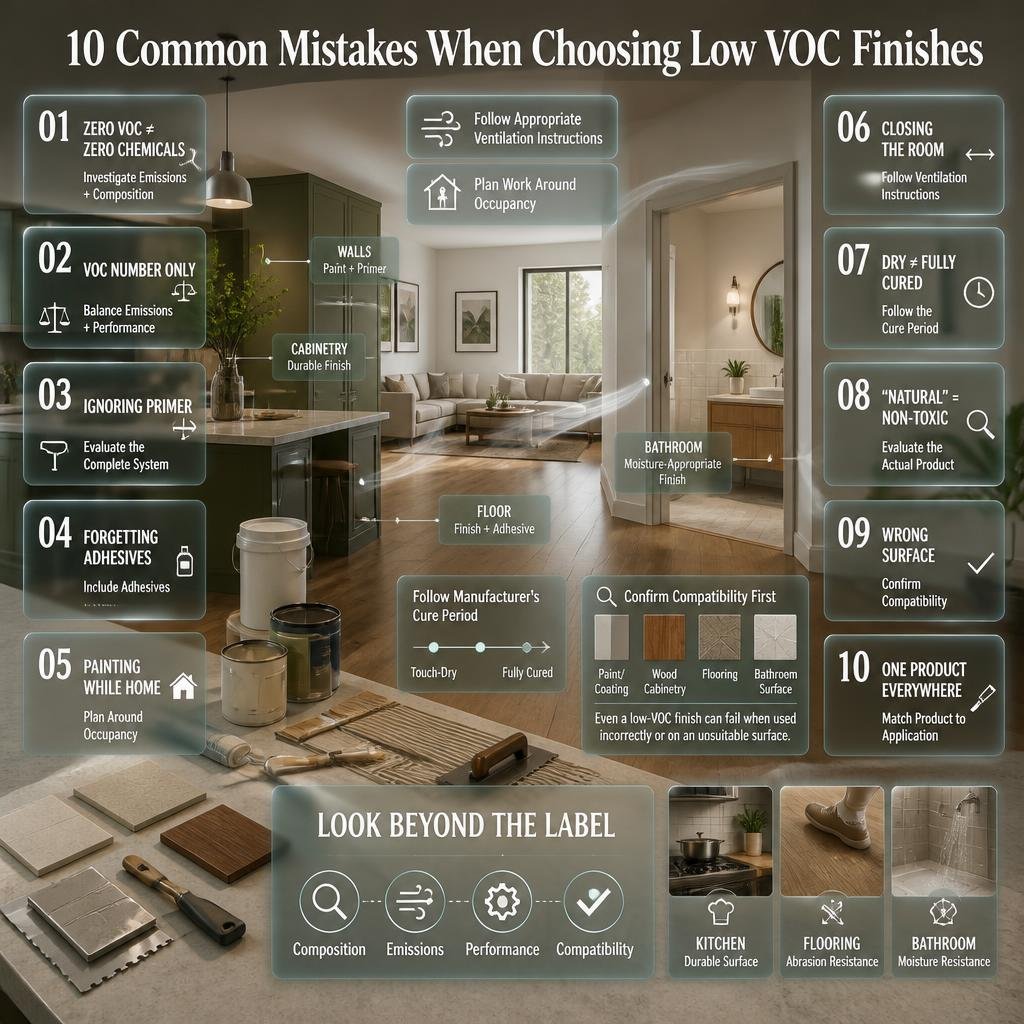
Mistake 1: Assuming Zero VOC Means Zero Chemicals
This is one of the biggest misunderstandings.
“Zero VOC” is a defined technical or regulatory claim, not a universal statement that a product contains absolutely nothing capable of affecting indoor air.
EPA specifically cautions that no-VOC and low-VOC labels can still leave other volatile organic chemicals unaccounted for.
Better approach: Investigate emissions, composition, and certification.
Mistake 2: Choosing Only by VOC Number
A lower number isn’t useful if the finish doesn’t work.
A kitchen cabinet needs a durable surface.
A floor needs abrasion resistance.
A bathroom needs moisture resistance.
Better approach: Balance emissions and performance.
Mistake 3: Ignoring Primer
The topcoat might be low-emission while the primer isn’t.
Better approach: Evaluate the complete coating system.
Mistake 4: Forgetting Adhesives
Flooring, panels, countertops, and other materials may require adhesives.
Better approach: Include adhesives in your material-selection checklist.
Mistake 5: Painting While Everyone Is Home
People sometimes start a large painting project on a normal family day.
That can increase unnecessary exposure.
EPA recommends scheduling indoor painting when the home is unoccupied when possible.
Better approach: Plan the work around occupancy.
Mistake 6: Closing the Room Completely
Some people think keeping windows and doors closed will make the paint cure faster.
It can instead reduce ventilation.
Better approach: Follow appropriate ventilation instructions.
Mistake 7: Confusing Dry With Fully Cured
Touch-dry doesn’t necessarily mean fully cured.
Better approach: Follow the manufacturer’s stated cure period.
Mistake 8: Assuming Natural Means Non-Toxic
“Natural” isn’t a universal safety certification.
Better approach: Evaluate the actual product.
Mistake 9: Choosing the Wrong Finish for the Surface
A beautiful low-VOC coating can still peel, stain, or fail if the substrate wasn’t prepared correctly.
Better approach: Confirm compatibility first.
Mistake 10: Using One Product Everywhere
A wall finish isn’t necessarily appropriate for cabinetry or flooring.
Better approach: Match the product to the application.
What Should You Ask a Paint or Finish Supplier?
Don’t hesitate to ask technical questions.
A professional supplier should be able to help you understand:
- What surface is this designed for?
- What is the VOC content?
- Is emissions testing available?
- Which certification does it have?
- What primer should be used?
- How long should the room be ventilated?
- When can the room be occupied?
- How long does the finish take to cure?
- Is it suitable for bedrooms?
- Is it suitable for cabinetry?
- Is it moisture resistant?
- What cleaning products can be used?
If the answers aren’t available, that’s useful information in itself.
A product with transparent technical documentation is easier to evaluate.
How Can You Reduce VOC Exposure During Renovation?
Product choice is only half of the solution.
Schedule Work Strategically
If possible, carry out painting and finishing while the room is unoccupied.
For larger renovations, consider whether the work can be divided into stages.
Isolate the Work Area
Plastic barriers or other appropriate isolation methods can help prevent dust and pollutants from moving into finished areas.
EPA’s remodeling guidance recommends isolation strategies during renovation to reduce cross-contamination.
Ventilate During and After Work
Fresh outdoor air can help reduce indoor pollutant concentrations.
EPA’s Indoor airPLUS specifications specifically recommend ventilating with outdoor air at the highest practical rate and duration during installation of known contaminant sources and between finishing and occupancy.
Keep Porous Items Protected
Fabric furniture, curtains, rugs, mattresses, and other porous items can absorb pollutants and odors.
Where possible, remove them from the work zone.
Finish Removable Components Elsewhere
Cabinet doors, furniture pieces, and similar components can sometimes be finished outside the occupied living space.
This can significantly simplify indoor air management.
Can Low VOC Finishes Improve a Minimalist Interior?
Yes, but the connection is more subtle than simply choosing pale paint.
Minimalist interiors often use fewer materials, but those materials become visually important.
A wall may have:
- One simple color
- A clean finish
- Natural wood
- Minimal decoration
When there are fewer elements, surface quality matters more.
That makes it worthwhile to choose finishes based on both appearance and performance.
If you’re developing a minimalist space, you can also explore Furniture Scale vs Room Size to make sure the material decisions work with the room’s overall proportions rather than treating finishes as an isolated choice.
Can Low VOC Finishes Work With Rooms With Angled Walls?
Absolutely.
The presence of angled walls doesn’t change the basic principles of choosing low-emission finishes.
The main challenge is usually preparation and application.
Irregular surfaces can require:
- More careful masking
- Additional preparation
- Different application angles
- More detailed cutting
- Careful lighting during inspection
For furniture planning around these surfaces, see Furniture for Rooms With Angled Walls.
The key point is that the geometry of the room and the emissions profile of the finish are two separate design considerations.
You can solve both.
What About Sloped Ceilings and Built-In Storage?
Sloped ceilings often require custom cabinetry or wardrobes.
If a built-in wardrobe is painted or finished on-site, the coating becomes part of the indoor material system.
For the spatial side of that problem, see Wardrobe Design for Sloped Ceilings.
From a healthier-material perspective, consider:
- The substrate
- Adhesives
- Primer
- Topcoat
- Factory finishing
- On-site finishing
- Ventilation
- Cure time
Whenever practical, factory-applied finishes can reduce the amount of wet finishing work performed inside an occupied home. EPA’s remodeling guidance recommends considering pre-finished materials or finishing materials outside the living space when possible.
Can Lighting Affect How You Judge a Finish?
Lighting doesn’t change VOC emissions, but it changes how accurately you see the finished surface.
A wall that looks smooth under soft ambient lighting may reveal:
- Roller marks
- Uneven sheen
- Brush strokes
- Surface imperfections
- Patchiness
This becomes particularly important with low-sheen and matte finishes.
If you’re designing a complete room, you can explore Robert MyGardenAndPatio for broader home-design inspiration while keeping the technical material-selection decisions separate.
What About Automated Climate Control?
Temperature and humidity can influence how coatings dry and cure.
This doesn’t mean that automated climate control is a substitute for ventilation.
Instead, the indoor environment should remain within the manufacturer’s recommended application conditions.
For broader room-by-room environmental planning, see automated climate control for different rooms.
During finishing work, avoid changing temperature or humidity dramatically just to force a coating to dry faster.
Follow the product instructions.
How Can You Build a Low VOC Material Checklist?
A simple checklist can prevent expensive mistakes.
Before Buying
Check:
- Surface type
- Product application
- VOC information
- Emissions certification
- Durability
- Moisture resistance
- Cleaning requirements
- Primer compatibility
- Drying time
- Cure time
Before Application
Check:
- Ventilation
- Weather/indoor conditions
- Occupancy
- Furniture protection
- Work-area isolation
- Required equipment
- Safety instructions
After Application
Check:
- Surface condition
- Recoat timing
- Continued ventilation
- Manufacturer cure period
- Occupancy guidance
- Proper storage or disposal
This small process is more valuable than simply choosing a product because it has a green label.
A Practical Room-by-Room Material Strategy
Let’s make the process more realistic.
Imagine you’re renovating a three-bedroom home.
Bedroom
Choose a low-emission wall coating.
Use appropriate primer.
Ventilate the room.
Allow sufficient curing time.
Avoid moving bedding and soft furnishings back immediately.
Living Room
Because this space may receive more traffic, choose a washable finish that still meets your emissions requirements.
If you’re updating the room’s furniture as well, don’t forget that furniture finishes and composite materials contribute to the overall material picture.
Kitchen
Prioritize cabinet durability.
Check the coating’s resistance to cleaning and moisture.
Evaluate adhesives and sealers as part of the same project.
Bathroom
Use moisture-appropriate coatings.
Don’t compromise moisture resistance simply to achieve a lower VOC figure.
Home Office
Choose low-emission wall and furniture finishes where practical.
Because the room may be occupied for many hours, source control and ventilation are worthwhile considerations.
This approach shows why “one healthiest paint” isn’t really the right question.
The better question is:
Which lower-emission finish is appropriate for each surface and room?
What Makes a Finish a Better Long-Term Choice?
A good finish should solve today’s problem without creating another one six months later.
Consider durability.
If a low-emission finish needs to be replaced quickly because it cannot handle normal use, the project may require additional materials and labor.
Consider maintenance.
A washable surface can be easier to keep clean without repeated repainting.
Consider compatibility.
The correct product reduces the risk of peeling, cracking, or premature failure.
Consider repairability.
A finish that can be repaired locally may be more practical than one requiring complete replacement.
Healthier interiors are therefore not only about VOC numbers.
They’re also about durable, appropriate, thoughtfully installed materials.
Expert Recommendations for Healthier Interior Finishes
A professional approach usually follows a few simple principles.
1. Start With Source Control
Don’t bring unnecessary pollutants into the home and then rely entirely on ventilation to remove them.
Reduce the source where practical.
2. Choose Performance First, Then Optimize Emissions
A finish must work.
Once you’ve established the performance requirements, compare lower-emission options that meet those requirements.
3. Prefer Transparent Documentation
Technical documentation is more useful than vague marketing language.
4. Consider the Complete System
Primer + finish + sealer + adhesive may all matter.
5. Plan Installation
Good scheduling can reduce exposure without changing the product itself.
6. Ventilate Properly
Ventilation is especially important during and after wet finishing work.
7. Give the Material Time
Don’t rush occupancy.
8. Think Room by Room
Different environments need different finishes.
⚠ Common Mistake: Choosing the same “eco paint” for walls, cabinets, furniture, and flooring simply because the label looks appealing. Different surfaces need different performance characteristics.
Are low VOC finishes actually better for healthier interiors?
Low VOC finishes can be a useful choice because they can reduce one potential source of chemical emissions inside a home. However, the term low VOC doesn’t mean completely chemical-free or automatically healthier in every respect. Different products can contain different chemicals, and those chemicals don’t all have the same properties. EPA specifically cautions that even products marketed as “low VOC” or “no VOC” may contain other volatile organic chemicals that aren’t captured by the particular VOC definition being used.
For a healthier interior, look at the complete product rather than one number on the label:
Check VOC information and available emissions data.
Look for credible third-party certification where appropriate.
Consider the product’s ingredients and intended application.
Choose a finish that provides the durability the room requires.
Ventilate properly during and after installation.
Allow the finish enough time to dry and cure before normal occupancy.
The goal isn’t to eliminate every chemical from your home. It’s to reduce unnecessary emissions while choosing materials that perform properly and are suitable for the space.
Is zero VOC paint better than low VOC paint?
“Zero VOC” shouldn’t automatically be treated as a guarantee that a paint is healthier than every low-VOC alternative. The terms describe specific measurements or regulatory definitions, and they don’t necessarily tell you everything about what a finished product can emit indoors. EPA explains that total VOC levels alone don’t always indicate the relative safety of a product because individual VOCs can vary considerably in their potential effects.
When comparing two paints, don’t stop at “0 VOC” versus “low VOC.” Instead, check:
What standard was used?
Is there independent emissions testing?
Does the product have a recognized certification?
What other ingredients are present?
Is it suitable for your specific room?
How durable is the finish?
What ventilation and curing period does the manufacturer recommend?
For example, a well-documented low-VOC paint with independent low-emission testing can provide more useful information than a product that simply promotes a “zero VOC” claim without explaining its broader emissions profile.
Professional takeaway: Treat the VOC number as one piece of the decision—not the entire decision.
Are water-based finishes a good choice for healthier interiors?
Water-based finishes are often a practical option for healthier interior projects because many water-based paints and coatings generally contain lower VOC levels than comparable solvent-based products. EPA specifically notes that water-based acrylic latex paints are generally lower in VOCs than solvent-based paints.
They’re particularly useful for applications such as:
Interior walls
Ceilings
Bedrooms
Living rooms
Home offices
Many cabinetry applications
Certain wood surfaces
But there’s an important detail: water-based doesn’t mean VOC-free or chemical-free. Water-based coatings can still contain additives, preservatives and other ingredients needed for performance and product stability.
That’s why the best approach is to combine the advantages of a water-based formulation with proper product research.
For a healthier interior, look for a product that offers:
Low emissions
Suitable surface compatibility
Good durability
Appropriate washability
Reliable technical documentation
Credible third-party testing where available
This gives you a finish that isn’t just lower-emission on paper but also makes sense for the actual room.
How do I choose the best low VOC finish for each room?
The best low-VOC finish depends on what the surface has to withstand, not simply which product has the lowest advertised VOC number. A bedroom wall, kitchen cabinet, bathroom surface and hardwood floor have completely different performance requirements.
For a bedroom, you may prioritize a low-emission wall coating because the room is occupied for long periods. A kitchen cabinet, however, needs resistance to cleaning, grease, moisture and frequent handling. A bathroom finish needs appropriate moisture resistance, while a floor coating must withstand repeated foot traffic and abrasion.
A practical room-by-room approach is:
Bedroom: Low emissions, low odor, suitable wall durability
Nursery: Low-emission materials, careful ventilation and curing
Living room: Low emissions plus washability and durability
Kitchen: Low emissions plus moisture, grease and cleaning resistance
Bathroom: Moisture performance plus suitable emissions profile
Home office: Low emissions and easy maintenance
EPA recommends selecting low-VOC or low-toxicity finishes while also considering durability and other performance characteristics.
So rather than asking, “What is the healthiest paint?”, ask:
“Which lower-emission finish is appropriate for this particular surface, room and level of use?”
That question leads to a much more professional material decision.
How can I reduce VOC exposure when applying finishes indoors?
Choosing a low-VOC finish is only part of the process. How you apply and cure the product can make a major difference to indoor exposure. EPA recommends using low-emitting products where practical, following manufacturer instructions, and providing plenty of ventilation during and after application. It also recommends considering pre-finished materials or finishing removable components outside the living space when possible.
A practical approach is:
Remove unnecessary furniture from the work area.
Isolate the renovation zone from occupied rooms where possible.
Provide outdoor ventilation rather than simply circulating indoor air.
Keep paint and finish containers closed when they’re not being used.
Follow the manufacturer’s drying and curing instructions.
Don’t move furniture and soft furnishings back too quickly.
Keep the area ventilated during the initial curing period.
Finish removable components outside the occupied area when practical.
EPA’s Indoor airPLUS guidance also recommends ventilating with outdoor air at the highest practical rate and duration during installation of known contaminant sources and between finishing work and occupancy.
Conclusion
Choosing low VOC finishes for healthier interiors is not simply about selecting a product with the lowest number on the label. A better approach is to consider the complete picture: the product’s ingredients, emissions, intended use, durability, ventilation requirements, and the people who will use the space.
Low VOC paints, sealers, adhesives, stains, and other finishing materials can help reduce unnecessary exposure to airborne chemicals during interior projects. However, labels such as “low VOC” or “zero VOC” should not be treated as automatic guarantees of a healthier product. Looking for credible emissions information and understanding how a finish performs in real conditions can lead to more informed decisions.
The best results come from combining thoughtful material selection with good installation practices. Adequate ventilation during and after application, following the manufacturer’s instructions, and allowing finishes to cure properly can make a meaningful difference to indoor air quality.
Ultimately, healthier interiors are created through many small decisions rather than one single material choice. When finishes are selected carefully and applied responsibly, you can create spaces that feel comfortable, look refined, perform well, and support a healthier indoor environment for everyday living.