
Introduction
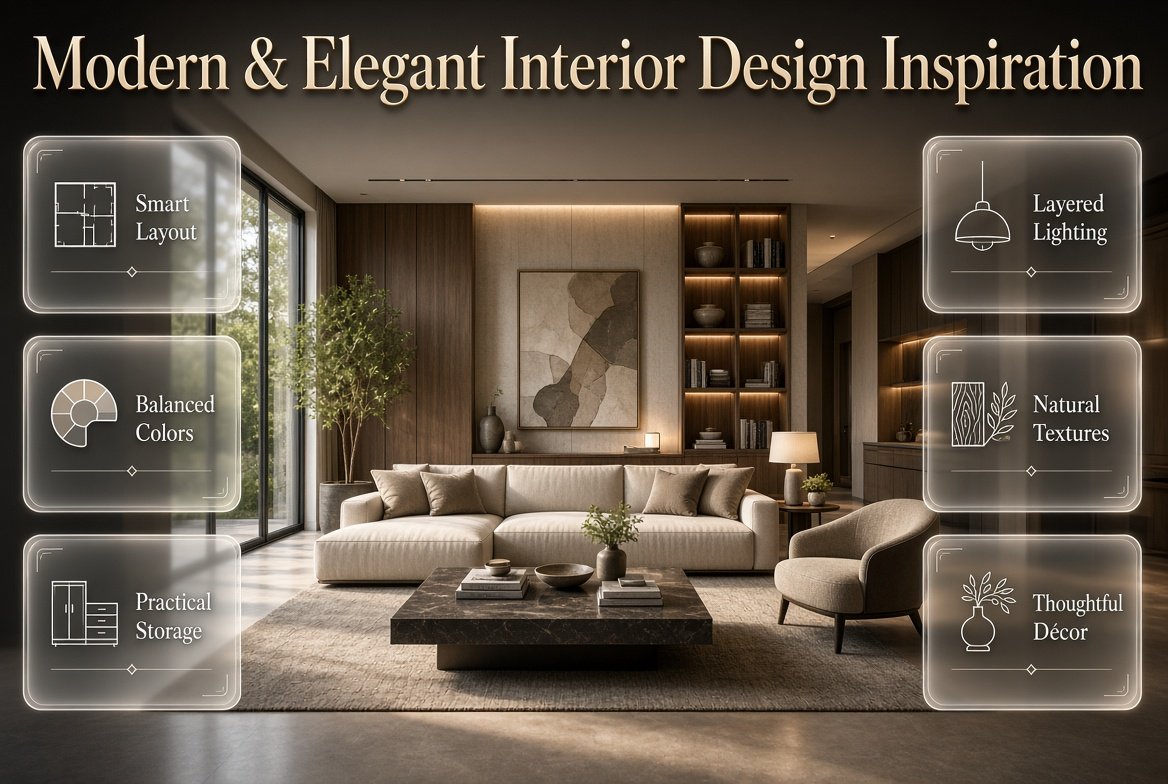
Modern & Elegant Interior Design Inspiration | A home can have beautiful furniture and still feel unfinished. You may have chosen a nice sofa, painted the walls in a fashionable color, and added decorative accessories, yet something still doesn’t feel quite right. The room may look too plain, too crowded, too cold, or simply disconnected.
That’s where Modern & Elegant Interior Design Inspiration becomes useful.
Modern elegance isn’t about filling a home with expensive furniture or copying the latest showroom. It’s about making thoughtful choices that work together: the right layout, a controlled color palette, comfortable furniture, layered lighting, natural textures, practical storage, and carefully selected décor.
The best interiors also work for real life. They give you somewhere comfortable to relax, enough storage to keep clutter under control, and layouts that make everyday movement easier.
If you’re planning a complete home refresh or simply want better ideas for one room, DesignMode24 Interior Design offers a useful starting point for exploring different design directions.
This guide explains how to create a modern and elegant interior from the ground up, how to choose colors and furniture, how to make rooms feel more expensive without overspending, which mistakes to avoid, and how to bring everything together without making your home feel like a furniture showroom.
What Is Modern and Elegant Interior Design?
Modern and elegant interior design combines clean contemporary forms with sophisticated colors, comfortable furnishings, quality-looking materials, thoughtful lighting, and restrained decoration. The style feels polished but not formal, minimal but not empty, and luxurious without depending entirely on expensive products.
The important distinction is between modern and cold.
A modern room can have warm wood, soft fabrics, plants, books, artwork, vintage objects, and personal belongings. What makes it modern is the way those elements are organized.
Elegance comes from restraint.
Instead of decorating every wall and filling every surface, you create visual hierarchy. Some pieces attract attention while others support them. Colors relate to one another. Furniture has enough space around it. Lighting changes according to the time of day.
A useful formula is:
Function + Proportion + Color + Texture + Lighting + Personality = Elegant Modern Interior
If one of these elements is completely ignored, the room can feel unbalanced.
Why Does Modern Design Feel Elegant?
Modern design feels elegant when there is visual order without excessive decoration. Clean lines create structure, neutral or controlled colors provide calmness, quality textures add depth, and carefully chosen statement pieces create character without overwhelming the room.
Elegance isn’t necessarily visible in one particular object.
It often comes from the relationship between objects.
A simple beige sofa can look ordinary by itself. Put it in a room with a properly sized textured rug, warm wood coffee table, balanced artwork, soft curtains, and carefully layered lighting, and the same sofa can suddenly look much more sophisticated.
💡 Pro Tip: Before buying another decorative item, look at the entire room from the doorway. If the room already has several competing focal points, editing may improve it more than shopping.
How Do You Start Designing a Modern Elegant Home?
The best approach is to design in stages rather than purchasing everything at once. Begin with the purpose and layout of each room, then establish the color palette, choose major furniture, plan lighting, introduce textures, and finish with artwork and accessories.
Use this sequence:
- Define the room’s purpose.
- Measure the space.
- Plan furniture placement.
- Choose the main color palette.
- Select large furniture pieces.
- Plan lighting layers.
- Introduce materials and textures.
- Add storage.
- Choose artwork and accessories.
- Edit anything that doesn’t contribute to the design.
This process prevents a common problem: buying attractive pieces individually without knowing whether they will work together.
For broader interior planning, you can also explore Interior Design for additional inspiration.
How Important Is the Layout in Modern Interior Design?
Layout is one of the most important parts of interior design because furniture placement affects movement, comfort, conversation, sightlines, and how large or small a room feels. Even expensive furniture can look wrong when it blocks circulation or is incorrectly scaled for the space.
Before decorating, identify the room’s natural movement patterns.
Ask yourself:
- Where does someone enter the room?
- Where do they walk?
- Where should people sit?
- What is the main focal point?
- Which windows provide natural light?
- Which furniture needs to be close to electrical outlets?
- Where will everyday items be stored?
Create Furniture Relationships
Furniture shouldn’t simply be placed against walls because that’s what feels easiest.
For example, a living room can be arranged around conversation rather than just television viewing.
             FEATURE WALL
                  ↓

       ┌──────────────────┐
       │       SOFA       │
       └──────────────────┘

          ┌──────────┐
          │  TABLE   │
          └──────────┘

       CHAIR        CHAIR

              ↓
          WALKWAY
The exact distances will depend on the room, but the principle is universal: furniture should create relationships.
A sofa should relate to the coffee table. Chairs should relate to the sofa. Lighting should serve the seating area. Rugs should visually connect the furniture.
For more detailed room planning, explore Room-by-Room Interior Design Inspiration.
How Do You Choose an Elegant Modern Color Palette?
Choose a dominant neutral, a secondary supporting shade, and one or two accent colors. Warm whites, beige, greige, taupe, muted greens, navy, charcoal, natural wood, and controlled black accents can create sophisticated modern interiors without making the palette visually chaotic.
A simple starting framework is:
| Design Role | Approximate Share | Examples |
|---|---|---|
| Dominant color | 60% | Warm white, cream, beige |
| Secondary color | 30% | Taupe, greige, wood |
| Accent color | 10% | Navy, olive, black, brass |
This isn’t a strict rule. It simply helps prevent a room from becoming overloaded with unrelated colors.
Modern Elegant Color Combinations
Warm white + beige + natural oak
This combination creates a soft, welcoming atmosphere and works particularly well in living rooms and bedrooms.
Greige + charcoal + brass
A stronger option for people who want a sophisticated contemporary appearance.
Cream + olive + walnut
This combination introduces natural warmth and works beautifully with plants and organic materials.
Soft white + navy + light wood
A good choice when you want contrast without making the room too dramatic.
Taupe + black + warm metallics
This creates a more dramatic and upscale atmosphere.
For additional color inspiration, explore Paint Color Ideas.
Should You Use Neutral Colors Everywhere?
Not necessarily.
Neutral colors are useful because they create flexibility, but a room made entirely from similar beige shades can become flat.
The solution is tonal variation and texture.
For example:
- Cream wall
- Warm beige sofa
- Light oak table
- Taupe curtains
- Darker wood accent
- Textured rug
- Black lighting fixture
The palette remains neutral, but the differences between materials keep it interesting.
How Can You Make a Neutral Interior Look Interesting?
A neutral interior becomes visually interesting when you introduce texture, material contrast, different shades, artwork, plants, and carefully selected patterns. The goal isn’t to add more colors but to give the existing palette enough variation to create depth.
Imagine a beige living room containing only smooth walls, a plain sofa, a polished table, and flat curtains.
It may feel unfinished.
Now introduce:
- Linen curtains
- A wool or textured rug
- Natural wood
- Stone accessories
- Woven baskets
- Ceramic objects
- Indoor plants
- Soft cushions
The color palette hasn’t changed dramatically, but the room feels much richer.
⭐ Expert Tip: When working with neutral interiors, think about texture before adding more color. Texture can solve a “boring” room without destroying its calm atmosphere.
How Do You Choose Furniture for a Modern Elegant Interior?
Choose furniture according to the room’s size, function, proportions, comfort, and visual weight rather than selecting pieces simply because they look attractive. Furniture should leave enough circulation space while creating a coherent relationship between seating, tables, storage, and focal points.
Before buying large furniture, measure:
- Room width
- Room length
- Door openings
- Hallways
- Staircases
- Window positions
- Existing furniture
- Walking routes
A sectional that looks perfect online can overwhelm a small living room.
Likewise, placing tiny furniture in a large open-plan room can make the space feel unfinished.
Should Modern Furniture Match?
No.
In fact, an entire matching furniture set can sometimes make a room look predictable.
Instead, coordinate pieces through:
- Color
- Material
- Shape
- Scale
- Finish
- Design era
For example, a modern sofa can work with a vintage wooden side table if both pieces share warm tones.
This creates a more collected interior.
How Does Lighting Make a Home Look More Elegant?
Lighting creates atmosphere, highlights architectural features, improves functionality, and changes how colors and materials appear. An elegant interior should usually use several lighting layers rather than depending on one bright ceiling fixture.
The Three Lighting Layers
Ambient lighting provides general illumination.
Task lighting supports activities such as reading, cooking, grooming, or working.
Accent lighting highlights artwork, shelving, plants, architectural details, or decorative objects.
A living room might combine:
- Ceiling fixture
- Floor lamp
- Table lamps
- Wall sconces
- Accent lighting
- Hidden LED lighting
This allows the room to change throughout the day.
During cleaning, you may want stronger illumination. During dinner or evening relaxation, softer lighting usually feels better.
For more lighting and ceiling ideas, visit Lighting and Ceiling Ideas.
⚠ Common Mistake: Using one very bright overhead light for every situation. It can flatten the room and make expensive materials look harsh.
How Do Materials Create an Elegant Interior?
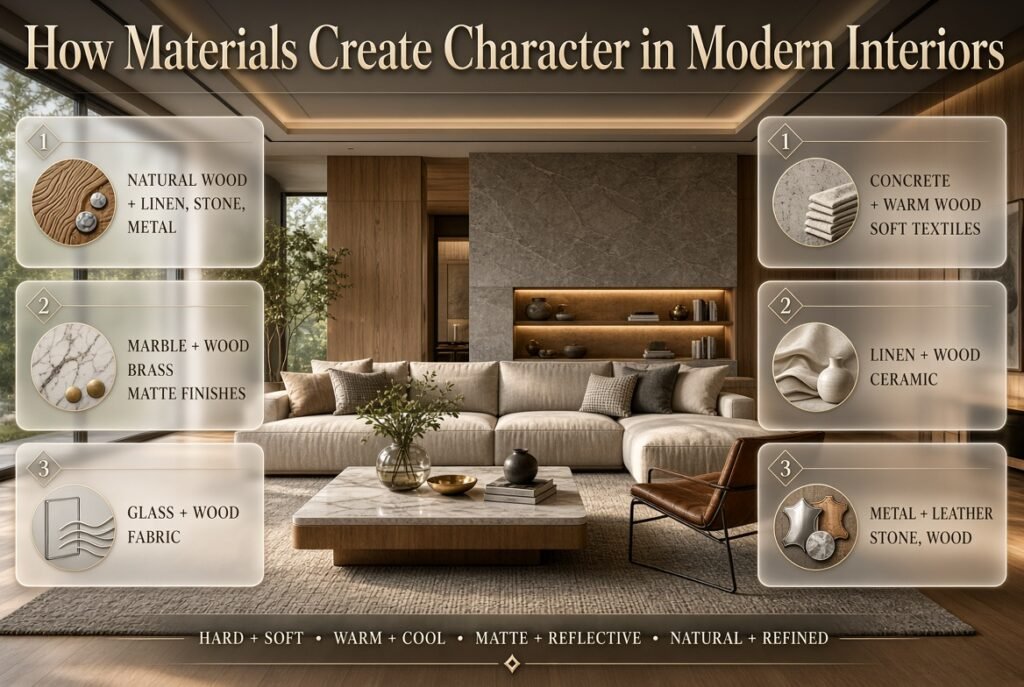
Materials create character through contrast, texture, reflectivity, and warmth. Natural wood, stone, linen, wool, glass, ceramic, leather, and carefully selected metals can all work in modern interiors when their finishes are balanced.
Consider these combinations:
| Main Material | Complementary Materials |
|---|---|
| Natural wood | Linen, stone, metal |
| Marble | Wood, brass, matte finishes |
| Glass | Wood, fabric |
| Concrete | Warm wood, soft textiles |
| Linen | Wood, ceramic |
| Metal | Leather, stone, wood |
The best modern interiors rarely use one material everywhere.
Instead, they combine opposites.
Hard + soft
Warm + cool
Matte + reflective
Natural + refined
This contrast creates depth without requiring excessive decoration.
For ideas covering surfaces, walls, and floors, explore Flooring and Wall Design Inspiration.
How Do You Add Luxury Without Making the Home Look Overdone?
The easiest way to create a luxurious appearance is through restraint. Focus on proportion, lighting, materials, consistency, and quality in the pieces that matter most instead of covering the room with expensive-looking decorations.
Consider where your money has the greatest visual and practical impact.
Worth Spending More On
- Sofa
- Mattress
- Dining table
- Lighting
- Curtains
- Flooring
- Frequently used hardware
- Durable countertops
Areas Where You Can Save
- Small accessories
- Seasonal decorations
- Temporary artwork
- Decorative trays
- Trend-based objects
- Replaceable cushions
A carefully planned room with affordable furniture can feel more expensive than a poorly planned room filled with luxury products.
How Can You Make a Small Home Look Elegant?
Small homes benefit from visual simplicity, appropriate furniture scale, multifunctional pieces, concealed storage, light-reflective surfaces, and carefully controlled decoration. The objective isn’t to make everything tiny; it’s to eliminate unnecessary visual and physical obstacles.
Try:
- Furniture with exposed legs
- Built-in storage
- Floating cabinets
- Large mirrors where appropriate
- Light-colored walls
- Multi-purpose furniture
- Full-height curtains
- Consistent flooring
- Fewer but larger decorative statements
Avoid filling every corner.
Empty space has value.
A small room often looks bigger when the eye can move through it without encountering dozens of objects.
How Important Is Storage in Elegant Interior Design?
Storage is essential because clutter quickly destroys visual calm. Modern interiors work best when everyday objects have dedicated places, allowing surfaces to remain relatively clear while keeping frequently used items accessible.
Useful solutions include:
- Built-in wardrobes
- Closed shelving
- Storage ottomans
- Under-bed drawers
- Entryway consoles
- Floating cabinets
- Hidden kitchen storage
- Multi-purpose benches
Think about storage before buying décor.
If the room constantly accumulates books, chargers, toys, paperwork, shoes, or other everyday items, the solution is usually better organization rather than more decorative baskets.
For practical organization strategies, explore Smart Storage and Organization Ideas.
How Do You Create an Elegant Living Room?
An elegant living room starts with a comfortable seating arrangement, a clear focal point, a properly sized rug, layered lighting, and a controlled color palette. Artwork, cushions, plants, and accessories should support the main design rather than compete with it.
A strong modern living room might include:
- Comfortable neutral sofa
- Large textured rug
- Natural wood coffee table
- Accent chair
- Floor lamp
- Oversized artwork
- Closed storage
- One or two plants
- Coordinated cushions
Choose the Rug Carefully
A common mistake is buying a rug that’s too small.
A tiny rug floating underneath a coffee table can visually separate the furniture rather than connect it.
A larger rug that extends beneath the main seating pieces usually creates a more unified composition.
How Do You Design a Modern Elegant Bedroom?
A bedroom should feel calmer and softer than social areas of the home. Use a restrained color palette, comfortable bedding, layered textiles, warm lighting, appropriate storage, and minimal but meaningful decoration.
Consider:
- Upholstered headboard
- Layered bedding
- Soft rug
- Bedside lamps
- Full-length curtains
- Natural wood
- Simple artwork
- Closed storage
- Warm neutral colors
Don’t turn the bedroom into a showroom.
Comfort matters more here than visual drama.
A beautiful bedroom that doesn’t support good rest isn’t successful design.
How Do You Make a Kitchen Look Modern and Elegant?
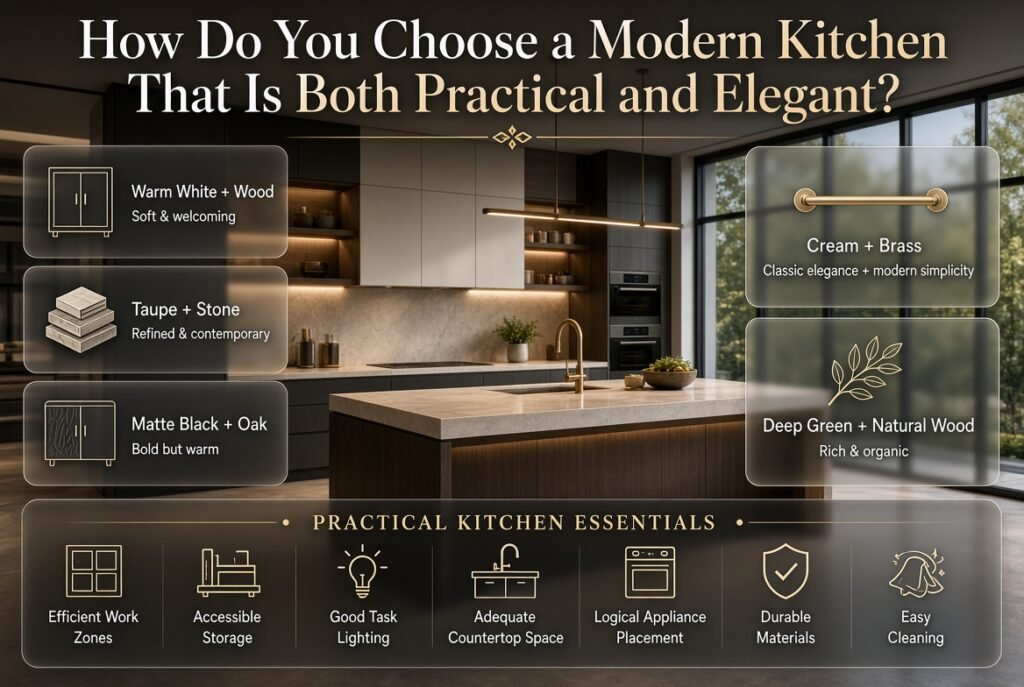
Modern kitchens look sophisticated when cabinets, countertops, backsplash, lighting, appliances, hardware, and flooring share a coherent visual language. Practical circulation and storage should be planned alongside appearance so the kitchen remains efficient.
Popular combinations include:
Warm White + Wood
Soft and welcoming.
Taupe + Stone
Refined and contemporary.
Matte Black + Oak
Bold but warm.
Cream + Brass
Classic elegance with modern simplicity.
Deep Green + Natural Wood
Rich and organic.
However, appearance should never compromise function.
A practical kitchen needs:
- Efficient work zones
- Accessible storage
- Good task lighting
- Adequate countertop space
- Logical appliance placement
- Durable materials
- Easy cleaning
For broader home improvement projects and practical renovation advice, visit Home Improvement.
How Can You Create a Modern Elegant Bathroom?
A modern elegant bathroom usually benefits from fewer visual elements, consistent finishes, good lighting, practical storage, and durable materials. Instead of decorating heavily, create sophistication through surfaces, fixtures, proportions, and lighting.
Consider:
- Large-format tiles
- Stone or stone-look surfaces
- Wall-mounted vanity
- Simple mirror
- Coordinated hardware
- Soft lighting
- Closed storage
- Minimal countertop accessories
A floating vanity can make the floor feel more open while also simplifying cleaning.
The bathroom doesn’t need dozens of decorative objects.
Good materials and thoughtful lighting often do enough.
How Do You Mix Modern and Traditional Interior Design?
Modern and traditional elements can work together when they share a connection through color, material, proportion, or shape. A contemporary sofa can sit beside an antique table, while traditional artwork can be paired with modern lighting and clean-lined cabinetry.
For example:
Modern sofa + vintage wooden table + contemporary artwork
creates contrast while maintaining sophistication.
Another combination might be:
Classic molding + minimalist furniture + modern lighting
The goal isn’t to make every item belong to one design period.
The goal is to make the room feel intentional.
How Do You Choose Artwork for a Modern Home?
Choose artwork based on scale, placement, emotional appeal, and the room’s overall composition rather than simply trying to match it to your furniture. Artwork should either complement the existing palette or provide controlled contrast.
Large walls often benefit from:
- One oversized artwork
- A carefully arranged gallery wall
- Two or three coordinated pieces
- A sculptural wall feature
Avoid placing several tiny frames randomly across a large wall.
Scale matters.
Artwork should relate to the furniture underneath it and the wall around it.
How Do Plants Improve Modern Interior Design?
Plants soften architectural lines, introduce organic shapes, add natural color, and make modern interiors feel more welcoming. They are especially useful in neutral spaces where natural greenery provides a controlled visual accent.
Use plants where they have enough light and where their maintenance fits your lifestyle.
Good placements include:
- Beside sofas
- Near windows
- Empty corners
- Entryways
- Open shelves
- Kitchen corners
- Bedroom dressers
Don’t use plants simply to fill every empty space.
One large, healthy plant can often have more impact than several small ones.
How Do You Make an Interior Feel Personal?
A sophisticated home should still look like someone’s home.
Include:
- Books you actually read
- Artwork you genuinely like
- Travel objects
- Family pieces
- Handmade ceramics
- Plants
- Photographs
- Meaningful collections
The mistake is removing all personality in an attempt to create a “perfect” modern room.
Elegance comes from editing—not erasing.
If you need inspiration for approachable projects you can complete gradually, explore DIY Home Projects.
What Are the Biggest Modern Interior Design Mistakes?
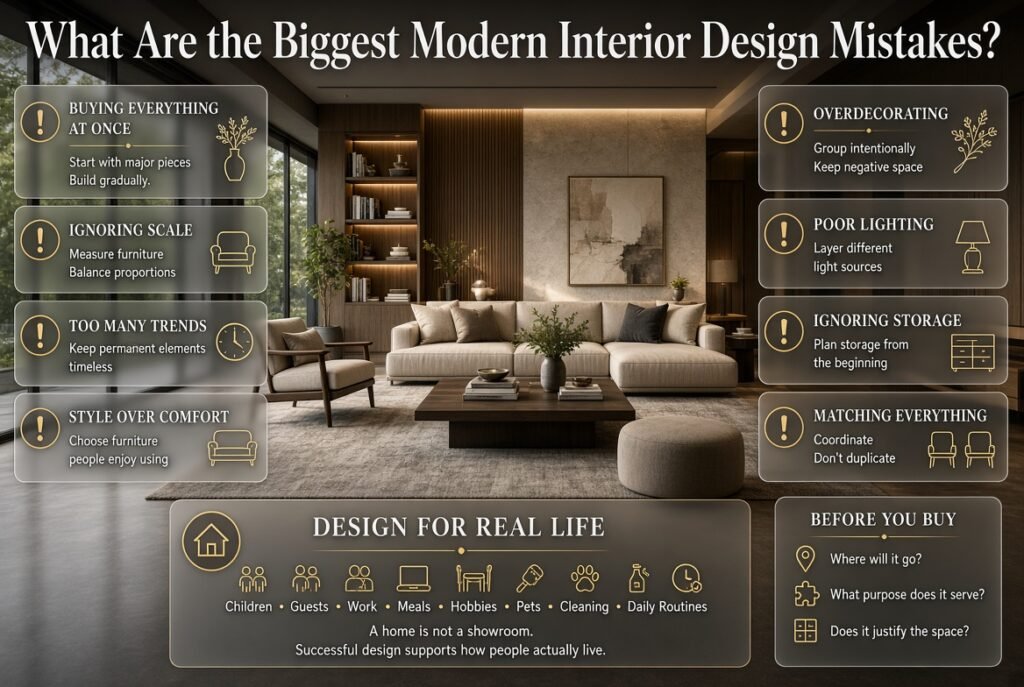
1. Buying Everything at Once
When everything is purchased from the same store or collection, the room can feel artificial.
Better approach: Start with the major pieces and build gradually.
2. Ignoring Scale
A huge sofa in a small room or a tiny rug beneath oversized furniture can make the space feel uncomfortable.
Better approach: Measure everything.
3. Using Too Many Trends
Trendy furniture and colors can become dated.
Better approach: Keep expensive permanent elements relatively timeless and use trends in accessories.
4. Choosing Style Over Comfort
A beautiful chair that nobody wants to sit in isn’t a successful purchase.
Better approach: Test furniture before buying whenever possible.
5. Overdecorating
More accessories don’t automatically create more sophistication.
Better approach: Group objects intentionally and leave negative space.
6. Using Poor Lighting
Even beautiful materials can look cheap under harsh lighting.
Better approach: Layer different light sources.
7. Ignoring Storage
Visible clutter quickly overwhelms clean modern lines.
Better approach: Design storage into the room from the beginning.
8. Matching Everything
Perfectly matching furniture can make the room feel generic.
Better approach: Coordinate rather than duplicate.
9. Designing Only for Photographs
A home isn’t a showroom.
Real homes need space for children, guests, work, meals, hobbies, pets, cleaning, and daily routines.
Better approach: Design for the way you actually live.
📌 Quick Tip: Before buying anything, ask three questions: Where will it go? What purpose does it serve? Does it improve the room enough to justify the space it occupies?
How Can You Make an Elegant Home Family-Friendly?
Family-friendly design doesn’t require sacrificing style. Choose durable upholstery, washable textiles, rounded or softened furniture edges where appropriate, practical storage, easy-clean surfaces, and layouts that support movement and shared activities.
A family room might use:
- Performance fabrics
- Washable rugs
- Closed toy storage
- Durable flooring
- Rounded coffee tables
- Storage benches
- Easy-clean finishes
Children’s spaces also need their own design considerations. When planning furniture for hospitality or child-focused environments, Children’s Hotel Furniture offers a more specialized reference point for thinking about children’s furniture, safety, durability, and usability.
The broader lesson is important: beautiful design has to survive real use.
How Can You Make Your Home Look Elegant on a Budget?
You don’t need to renovate the entire house to make a noticeable improvement. Decluttering, rearranging furniture, improving lighting, changing textiles, updating hardware, adding artwork, and choosing a more cohesive color palette can dramatically change a room.
Low-cost improvements can include:
- New cabinet handles
- Better lamps
- Full-length curtains
- Coordinated cushions
- A properly sized rug
- Fresh paint
- Wall art
- Indoor plants
- Decluttered shelves
- Improved furniture placement
The biggest mistake is spending money before identifying the actual problem.
Sometimes the room doesn’t need new furniture.
It needs better editing.
For additional budget-conscious ideas, explore Easy Decorating Tips for Every Budget.
What Interior Details Make the Biggest Difference?
Small details become powerful when they are repeated consistently throughout a room. Matching or coordinated hardware, curtain finishes, lighting metals, wood tones, and textile colors can make separate purchases feel like part of one design.
Consider repeating:
- Brass accents
- Black hardware
- One wood tone
- Similar fabric colors
- Consistent curtain style
- Related artwork colors
This doesn’t mean everything has to match exactly.
It means the eye should discover relationships.
How Do You Balance Minimalism and Comfort?
The best modern interiors usually use selective minimalism rather than extreme minimalism. Keep unnecessary objects under control while retaining the furniture, textiles, artwork, books, and personal items that make the room comfortable and meaningful.
A useful test is:
Keep it if it is useful, beautiful, meaningful, or necessary.
If an object serves none of these purposes, consider removing it.
This creates a room that feels organized without becoming empty.
How Should You Approach Seasonal Decorating?
Seasonal decorating can refresh an interior without requiring permanent changes. The safest approach is to keep the foundation neutral and introduce seasonal colors and textures through removable accessories.
You can change:
- Cushion covers
- Throws
- Table settings
- Small artwork
- Decorative objects
- Flowers
- Plants
- Entryway décor
For more seasonal styling ideas, visit Seasonal Decorating Ideas.
This keeps the main interior stable while allowing the atmosphere to change throughout the year.
How Can Outdoor Areas Continue the Interior Design?
Modern interior design shouldn’t necessarily stop at the back door.
When a home has a terrace, balcony, garden, or outdoor dining area, use related colors, materials, and visual principles to create continuity.
Think about:
- Seating
- Shade
- Lighting
- Privacy
- Storage
- Weather-resistant materials
- Planting
- Outdoor dining
- Circulation
For a broader approach to extending your home’s design outdoors, explore Garden and Outdoor Living Guides.
The objective isn’t to make the outdoor area identical to the living room.
Instead, repeat selected materials, colors, or forms.
What Is the Best Step-by-Step Process for Designing a Room?
A structured process makes interior design easier because each decision supports the next one.
Step 1: Define the Purpose
What to do: Write down how the room will actually be used.
Why it matters: A room designed around its real function will remain useful.
Professional advice: Consider both daily and occasional activities.
Common mistake: Designing only for appearance.
Quick example: A living room may need to support television viewing, conversation, reading, children’s play, and guests.
Step 2: Measure Everything
What to do: Record room dimensions, doors, windows, outlets, and fixed features.
Why it matters: Furniture needs to fit physically and visually.
Professional advice: Measure entry routes too.
Common mistake: Measuring only the room.
Quick example: A sofa may fit the living room but fail to pass through the front door.
Step 3: Establish the Palette
What to do: Select your dominant, secondary, and accent colors.
Why it matters: A controlled palette creates cohesion.
Professional advice: Test colors in actual lighting.
Common mistake: Choosing paint from a tiny sample.
Quick example: Warm white walls + oak + beige + black accents.
Step 4: Choose the Hero Piece
What to do: Identify the room’s main visual or functional investment.
Why it matters: Other decisions can build around it.
Professional advice: The hero piece doesn’t always have to be the most expensive item.
Common mistake: Buying accessories first.
Step 5: Plan Lighting
What to do: Combine ambient, task, and accent lighting.
Why it matters: One light source rarely creates enough flexibility.
Professional advice: Plan lighting before furniture blocks access to outlets.
Step 6: Add Texture
What to do: Combine different tactile surfaces.
Why it matters: Texture creates depth.
Common mistake: Using one fabric or finish everywhere.
Step 7: Add Storage
What to do: Decide where everyday objects will live.
Why it matters: Organization protects the design.
Step 8: Add Personality
What to do: Introduce artwork, books, plants, and meaningful objects.
Why it matters: Personal details prevent the room from feeling generic.
Step 9: Edit
What to do: Remove objects that don’t contribute.
Why it matters: Editing creates visual clarity.
Professional advice: Step back and review the room from different angles.
Modern Elegant Interior Design: Quick Decision Table
| If Your Room Feels… | Try This |
|---|---|
| Too plain | Add texture and artwork |
| Too crowded | Remove unnecessary furniture |
| Too cold | Add wood, textiles, and warm lighting |
| Too dark | Improve layered lighting and reflective surfaces |
| Too colorful | Reduce the palette |
| Too generic | Add personal objects |
| Too expensive-looking in a bad way | Remove excessive metallics and décor |
| Too small | Improve circulation and storage |
| Unfinished | Add a properly scaled rug and artwork |
| Disconnected | Repeat colors and materials |
What makes an interior design look modern and elegant?
A modern and elegant interior is not simply a room filled with expensive furniture or fashionable décor. The real difference comes from proportion, simplicity, quality materials, balanced colours, thoughtful lighting, and controlled decoration. Modern design keeps the room visually clean, while elegance comes from the way each element is selected and combined.
A strong modern-elegant room usually has a restrained colour palette, comfortable but refined furniture, layered lighting, natural textures, and enough empty space for important pieces to stand out. In 2026, designers are increasingly favouring warmth, character and personal expression instead of perfectly coordinated showroom-style rooms.
Key elements to focus on:
Use warm neutrals such as cream, beige, taupe or soft greige as a foundation.
Add natural materials such as wood, stone, linen, ceramic or textured plaster.
Choose furniture with clean silhouettes rather than excessive ornamentation.
Keep decorative accessories intentional instead of filling every surface.
Use layered lighting instead of depending entirely on one ceiling fixture.
Introduce artwork, plants or personal objects that give the room character.
Professional tip:
Elegance is often created through restraint. One beautiful statement chair, artwork or sculptural light can have more impact than a dozen inexpensive decorative objects competing for attention.
What colours are best for a modern and elegant home?
The safest approach is to build the room around a warm, sophisticated base colour and then introduce one or two deeper accent shades. Creamy whites, warm beige, mushroom, taupe, soft brown and muted greige provide an elegant foundation without making the room feel cold.
For contrast, consider olive green, muted sage, terracotta, caramel, deep brown, charcoal, navy or another carefully selected accent. Current 2026 design trends are moving strongly toward earthy, warmer palettes and away from interiors dominated by stark white and cool grey.
A simple colour formula:
60%: dominant wall/floor/background colour
30%: furniture and larger textiles
10%: accent colour through artwork, cushions, lighting or accessories
Useful colour combinations:
Warm white + walnut + olive
Cream + beige + brass
Taupe + dark brown + soft green
Mushroom + natural wood + black accents
Warm grey + cream + muted navy
Expert advice:
Don’t choose paint colour in isolation. Flooring, natural light, curtains, furniture and artificial lighting can all change how a colour appears. Always assess the complete palette together before committing to a major renovation.
How can I make my home look elegant without spending too much money?
You don’t need a luxury renovation budget to create an elegant interior. The smartest approach is to improve the elements that have the greatest visual impact first rather than buying expensive décor simply because it looks luxurious.
Start by decluttering the room, improving the furniture arrangement and correcting obvious visual problems. Then concentrate your budget on a few high-impact upgrades such as better lighting, curtains, rugs, hardware, artwork or one strong piece of furniture.
High-impact budget improvements include:
Repainting tired walls with a sophisticated neutral.
Replacing outdated light fixtures.
Upgrading cabinet and door hardware.
Using full-length curtains to create a more finished appearance.
Adding one appropriately sized rug.
Replacing several small decorative pieces with one larger statement item.
Introducing natural plants and textured accessories.
Hiding visible cables and unnecessary clutter.
Rearranging furniture to improve circulation.
The important principle is quality over quantity. A room can look considerably more expensive when it contains fewer, better-chosen elements.
Common mistake:
Buying lots of inexpensive accessories to make a room feel “luxurious” often produces the opposite result. Too many objects create visual noise, while carefully selected pieces create sophistication.
How do I make a small room look modern, spacious and elegant?
A small room does not need to feel crowded simply because it has limited square footage. The key is to make every piece of furniture work harder while maintaining clear visual space around the most important elements.
Start with the layout before purchasing anything. Furniture that is too large can make even a well-designed room feel cramped. Choose appropriately scaled pieces, keep pathways clear and avoid placing unnecessary furniture against every available wall.
Practical ways to make a small room feel larger:
Use lighter warm colours on major surfaces.
Maximise natural light wherever possible.
Choose furniture with visible legs or lighter visual profiles.
Use mirrors strategically rather than covering every wall.
Select multifunctional furniture where appropriate.
Use built-in or concealed storage to reduce clutter.
Keep flooring visually continuous when possible.
Use curtains that extend higher and wider around windows.
Limit the number of competing patterns.
Maintain some empty wall and floor space.
Designer-level tip:
Don’t try to make every corner “useful.” A small amount of negative space can actually make the entire room feel more sophisticated and spacious.
For small homes, elegance comes from editing. Every item should have a purpose, contribute to the aesthetic, or ideally do both.
How can I keep my interior modern and elegant without making it look too trendy?
The best long-term interiors use trends as accents rather than foundations. A home can incorporate current colours, shapes and materials without becoming visually outdated after a few years.
Build the permanent parts of the room—flooring, major furniture, cabinetry and architectural finishes—around timeless proportions and materials. Then use easier-to-change elements such as cushions, artwork, rugs, accessories and smaller furniture pieces to experiment with current trends.
This approach is especially valuable because 2026 interiors are increasingly moving toward personality, craftsmanship, natural materials and a “collected over time” appearance rather than perfectly coordinated trend-driven rooms.
Use this strategy:
Long-Term Choices
Easy-to-Change Choices
Flooring
Cushions
Main sofa
Artwork
Kitchen cabinetry
Decorative objects
Built-in storage
Rugs
Bathroom finishes
Curtains
Architectural details
Accent chairs
Major lighting
Plants and accessories
Professional rule:
If you love a trend, don’t automatically reject it—but ask whether you would still enjoy seeing it every day five years from now.
Conclusion
Modern and elegant interior design is ultimately about creating a home that feels beautiful, comfortable, intentional, and genuinely yours. You do not need an oversized budget, designer furniture, or a perfectly styled showroom to achieve that look. What matters more is understanding how colour, proportion, lighting, materials, furniture, storage, and personal details work together.
The strongest interiors usually begin with a clear plan. Choose a practical layout, establish a cohesive colour palette, invest in pieces that suit the scale of the room, and use texture and lighting to add depth. From there, carefully selected artwork, greenery, accessories, and meaningful objects can give the space personality without creating unnecessary clutter.
It is also worth remembering that elegance does not mean making every room formal or untouchable. A successful modern home should support real life. There should be comfortable places to sit, practical storage for everyday belongings, durable surfaces where needed, and enough flexibility for the way your household actually lives.
Whether you are refreshing a single bedroom, redesigning your living room, updating a kitchen, or planning an entire home, focus on quality, balance, functionality, and timeless character rather than chasing every new trend. Trends can provide inspiration, but thoughtful design is what gives a home lasting appeal.
The best result is an interior that looks sophisticated when you walk through the door but still feels relaxed when you sit down at the end of a long day. That balance—modern without feeling cold, elegant without feeling excessive, and stylish without sacrificing comfort—is what makes an interior truly successful.

Leave a Reply