

Introduction
Cozy Bedroom Makeover | A bedroom can be clean, stylish, and beautifully furnished yet still feel strangely cold. Maybe the lighting is too harsh, the bed looks flat, the walls feel empty, or there are too many hard surfaces competing for attention. This is exactly where a cozy bedroom makeover can make a noticeable difference.
The good news is that creating a cozy bedroom doesn’t require replacing every piece of furniture or spending a fortune on décor. Often, the biggest improvements come from simple changes: better lighting, softer bedding, warmer colors, layered textures, improved furniture placement, and less visual clutter.
Whether you’re refreshing a small apartment bedroom, updating a master bedroom, decorating a guest room, or simply trying to make your current space more relaxing, the right approach is to work from the foundation upward. Start with comfort and function, then build atmosphere around them.
In this guide, you’ll learn how to plan a cozy bedroom makeover from start to finish, choose colors and materials, style the bed, improve lighting, work with small spaces, decorate on a budget, avoid common mistakes, and create a room that feels genuinely comfortable rather than simply attractive in photographs.
If you’re also improving other areas of your home, DesignMode24 Interior Design offers additional ideas for creating practical and visually balanced interiors.
What Is a Cozy Bedroom Makeover?
A cozy bedroom makeover is the process of improving a bedroom’s comfort, atmosphere, appearance, and functionality through thoughtful changes to elements such as lighting, bedding, colors, furniture, textiles, storage, and décor. The goal is to create a room that feels warm, calm, personal, and comfortable without making it cluttered.
Cozy design isn’t a specific decorating style. You can create a cozy modern bedroom, cozy minimalist bedroom, cozy farmhouse bedroom, cozy boho bedroom, or cozy traditional bedroom.
The common thread is the feeling.
A successful cozy bedroom usually has:
- Comfortable bedding
- Soft or natural textures
- Warm, layered lighting
- A calming color palette
- Practical furniture placement
- Comfortable flooring
- Appropriate window treatments
- Controlled visual clutter
- Personal decorative elements
- Enough empty space to let the room breathe
The important distinction is that cozy doesn’t mean crowded.
Many beginners assume that adding more pillows, blankets, baskets, plants, candles, and artwork automatically makes a room cozy. In reality, too many objects can make the room stressful rather than relaxing.
The strongest cozy bedrooms feel intentional. Everything has a reason to be there.
How Do You Start a Cozy Bedroom Makeover?
Start by identifying what’s wrong with the room before buying anything. Look at the bedroom during the day and again after sunset. Notice whether the room feels too dark, too bright, cluttered, empty, uncomfortable, cold, or poorly arranged.
Then divide the makeover into four areas:
Function → Comfort → Atmosphere → Personality
Function means furniture placement and storage.
Comfort includes the mattress, bedding, temperature, lighting, and materials you interact with every day.
Atmosphere comes from colors, textures, curtains, rugs, and lighting.
Personality comes from artwork, photographs, books, plants, and meaningful objects.
This order matters because decorative accessories can’t compensate for a bad layout or uncomfortable bed.
A Simple Bedroom Assessment
Before beginning, ask yourself:
- Can I walk comfortably around the room?
- Does the bed feel inviting?
- Is there enough storage?
- Can I read comfortably in bed?
- Is the lighting too harsh?
- Does the room have too many colors?
- Are the windows too bare?
- Does the floor feel cold or empty?
- Are surfaces covered with unnecessary items?
- Does the bedroom actually reflect my personality?
Write down the three biggest problems.
Those should become your first makeover priorities.
💡 Pro Tip: Take photographs of the bedroom from each corner before you begin. A photograph often reveals problems with furniture scale, clutter, and visual balance that are difficult to notice when you’re standing inside the room.
What Colors Make a Bedroom Feel Cozy?
Warm neutrals, muted greens, earthy browns, soft creams, dusty blues, warm whites, taupe, beige, and gentle terracotta are among the easiest colors to use when creating a cozy bedroom.
However, there isn’t one universally perfect cozy bedroom color.
The right shade depends on natural light, flooring, furniture, room size, and the mood you want.
Warm Neutrals
Cream, beige, oatmeal, taupe, and warm greige create a calm foundation.
They’re especially useful when you want flexibility because you can introduce stronger colors through bedding, artwork, cushions, or curtains without repainting the entire room.
Soft Green
Sage, olive, eucalyptus, and muted green shades bring a natural feeling into the bedroom.
They work beautifully with:
- Light oak
- Dark wood
- Cream
- Linen
- Rattan
- Natural stone
Dusty Blue
Muted blue can create a peaceful atmosphere, especially when balanced with warmer materials.
Avoid pairing a very icy blue with lots of cool white if your goal is warmth. Instead, introduce beige, wood, tan, or cream.
Earthy Colors
Terracotta, rust, caramel, clay, chocolate brown, and muted mustard can add depth.
You don’t have to paint the walls in these shades. A throw blanket, cushion, artwork, or bedside accessory may be enough.
A Simple Color Formula
For beginners, try:
60% dominant color + 30% supporting color + 10% accent
For example:
- 60% warm cream
- 30% natural wood and beige
- 10% muted green
This creates enough variation without making the room visually chaotic.
| Bedroom Mood | Main Colors | Supporting Materials |
|---|---|---|
| Soft and calm | Cream, beige, taupe | Linen, oak |
| Natural | Sage, olive, cream | Rattan, wood |
| Modern cozy | Greige, brown, warm white | Boucle, wool |
| Romantic | Dusty rose, cream | Velvet, cotton |
| Moody | Deep green, brown, charcoal | Dark wood, brass |
| Minimalist | Warm white, oatmeal | Light wood, linen |
⚠ Common Mistake: Never choose bedroom paint solely from a small online color image. Natural and artificial lighting can change how a shade appears. Test samples on your actual wall and observe them at different times of day.
For more color inspiration, the Paint Color section can help when you’re deciding how to build a cohesive palette.
How Can Bedding Transform a Bedroom?
Bedding is one of the most powerful elements in a cozy bedroom because the bed is usually the room’s visual and functional center.
A flat mattress with a thin sheet can make an otherwise beautiful room feel unfinished. Layered bedding creates softness, depth, and an immediate invitation to relax.
A simple layered bed can include:
- Fitted sheet
- Top sheet, if you prefer one
- Duvet or comforter
- Folded quilt or blanket
- Sleeping pillows
- Two or three decorative cushions
- Textured throw
The key is not quantity.
You don’t need a mountain of pillows.
Instead, use a few layers with different textures.
For example, combine smooth cotton sheets with a slightly textured duvet, a knitted throw, and linen cushion covers.
This creates visual depth without making the bed look overloaded.
Should Your Bedding Match the Walls?
Not exactly.
Your bedding should coordinate with the wall color, but matching everything perfectly can make the bedroom feel flat.
If your walls are beige, you might use:
- Cream bedding
- Warm brown throw
- Olive cushions
- Natural wood furniture
If your walls are sage green:
- Warm white bedding
- Oatmeal throw
- Tan cushions
- Oak furniture
The goal is coordination rather than duplication.
⭐ Expert Tip: If your bed still looks unfinished after changing the bedding, add one substantial throw across the lower third of the bed. This creates a strong visual layer without requiring lots of decorative pillows.
What Lighting Is Best for a Cozy Bedroom?
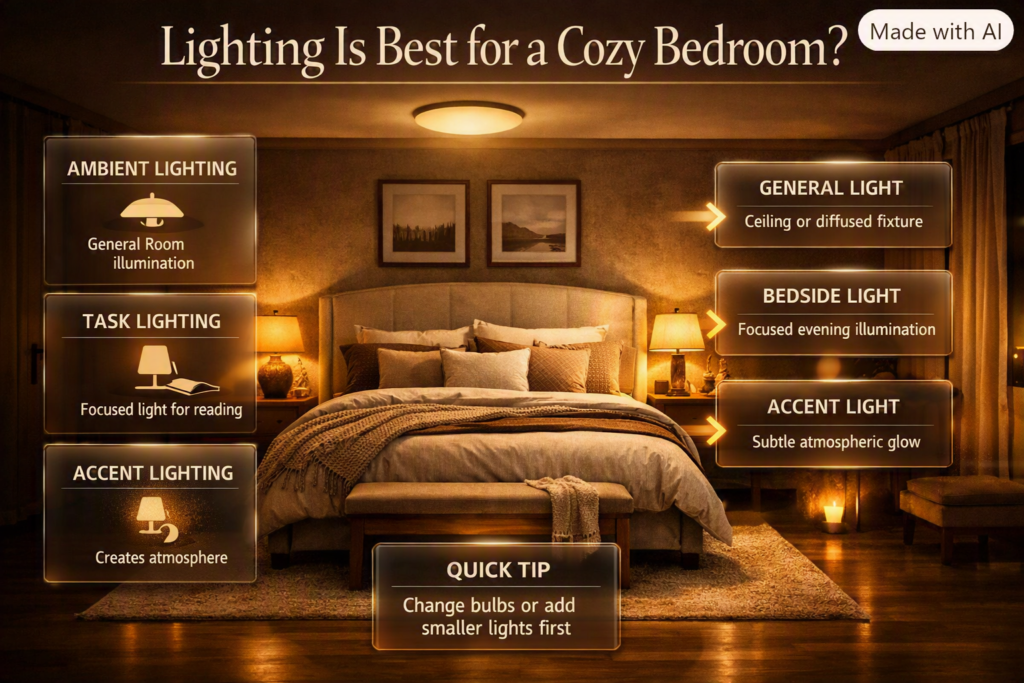
Lighting can completely change the personality of a bedroom.
A room may look beautiful during daylight but feel uncomfortable at night if its only light source is a bright ceiling fixture.
A cozy bedroom benefits from layered lighting.
Ambient Lighting
This is the general light used to illuminate the room.
It can come from:
- Ceiling fixtures
- Pendants
- Flush mounts
- Recessed lighting
- Diffused fixtures
Task Lighting
Task lighting provides focused illumination for specific activities.
The most common bedroom example is a bedside lamp for reading.
Accent Lighting
Accent lighting creates atmosphere and highlights specific areas.
Examples include:
- Wall sconces
- Picture lights
- Small table lamps
- Decorative lamps
- Subtle LED lighting
A simple lighting structure is:
General light → bedside light → accent light
You don’t have to use all of them simultaneously.
During the evening, you might turn off the ceiling fixture and rely mainly on bedside and accent lighting.
📌 Quick Tip: If your bedroom feels harsh after dark, don’t immediately change the décor. Try changing the bulbs and adding one or two smaller light sources first. Lighting is often the hidden reason a room doesn’t feel cozy.
What Color Temperature Should Bedroom Lights Have?
For a relaxing bedroom, warmer light is usually more comfortable than extremely cool white light.
Very cool lighting can make cream walls look gray and natural wood look less warm.
Warm lighting works particularly well with:
- Beige
- Cream
- Brown
- Terracotta
- Natural wood
- Warm gray
- Muted green
If you need bright task lighting for reading, choose a fixture that gives enough focused illumination without turning the entire bedroom into a brightly lit workspace.
How Do Rugs Make a Bedroom Cozier?
A rug introduces softness, warmth, texture, and visual definition.
It’s particularly helpful in bedrooms with:
- Hardwood floors
- Tile
- Laminate
- Large open floor areas
Ideally, the rug should relate to the bed rather than appear as a tiny island underneath it.
For a larger bedroom, a rug can extend beyond both sides of the bed.
In a smaller room, you can use:
- A medium rug beneath the lower part of the bed
- Two small rugs beside the bed
- One runner along the side of the bed
Which Rug Material Works Best?
Wool is warm and durable.
Cotton is lightweight and relatively easy to maintain.
Jute and other natural fibers provide texture but may feel less soft under bare feet.
Low-pile rugs can be practical in bedrooms where easy cleaning matters.
The best choice depends on your lifestyle, budget, climate, and maintenance preferences.
⚠ Common Mistake: Buying a rug that’s too small. A tiny rug can make the furniture arrangement look disconnected and visually reduce the sense of scale in the room.
How Can Curtains Make a Bedroom Feel Warmer?
Windows often contain large areas of hard glass and bare frames. Curtains soften that visual hardness.
They also help control:
- Privacy
- Morning sunlight
- Evening light
- Temperature perception
- Noise
- Overall visual softness
Floor-length curtains generally create a more polished appearance.
If appropriate for your room, mount the curtain rod slightly higher and wider than the window to create a taller and more spacious visual effect.
Should You Use Sheer Curtains?
Sheers can be excellent during the daytime because they filter sunlight while maintaining a lighter appearance.
A layered arrangement can combine:
Sheer curtain + heavier curtain
This gives you flexibility throughout the day.
Keep the curtain color relatively simple if the room already has strong patterns.
If the rest of the room is plain, a textured curtain can become an attractive design feature.
Which Textures Make a Bedroom Feel Cozy?

Color creates mood, but texture creates physical and visual comfort.
Imagine two bedrooms with exactly the same beige walls.
One has:
- Smooth furniture
- Bare floor
- Thin bedding
- No curtains
- Bright overhead light
The other has:
- Linen bedding
- Knitted throw
- Wool rug
- Wood furniture
- Soft curtains
- Warm lamps
The second room will almost certainly feel warmer even though the wall color is identical.
Useful bedroom textures include:
- Linen
- Cotton
- Wool
- Knits
- Boucle
- Velvet
- Woven baskets
- Rattan
- Wood
- Upholstered furniture
Don’t use every texture at once.
A better approach is to combine three or four materials and repeat them throughout the room.
How Should You Arrange Furniture in a Cozy Bedroom?
A cozy bedroom needs to feel comfortable to move through.
The bed is usually the main focal point, so begin there.
Then position the remaining furniture around it.
Basic Furniture Priorities
- Bed
- Bedside tables
- Wardrobe or dresser
- Seating, if space allows
- Storage
- Decorative furniture
Avoid filling every available corner.
A bedroom needs circulation space.
If you constantly bump into a dresser or squeeze between the bed and wall, the room isn’t functioning well no matter how attractive it looks.
How Should You Arrange a Small Bedroom?
For a small bedroom:
- Prioritize walking space.
- Use vertical storage.
- Consider wall-mounted lighting.
- Choose furniture with hidden storage.
- Avoid oversized bedside tables.
- Keep decorative pieces limited.
How Should You Arrange a Large Bedroom?
Large bedrooms present the opposite problem.
They can feel empty and disconnected.
You can create zones with:
- A reading chair
- Bench
- Small side table
- Rug
- Console
- Artwork
- Floor lamp
The objective isn’t to fill the room. It’s to give the large space visual structure.
How Can You Make a Small Bedroom Cozy Without Making It Cluttered?
Small bedrooms benefit from restraint.
Instead of adding more décor, create warmth through materials and lighting.
Try:
- One large artwork instead of several tiny frames
- Wall-mounted bedside lights
- Under-bed storage
- A narrow bedside table
- Light-colored curtains
- Soft bedding
- One appropriately sized rug
- A mirror positioned to reflect useful light
- Closed storage for everyday items
The floor should remain as open as practical.
This makes the room easier to clean and gives the impression of more space.
📌 Quick Tip: In a small bedroom, use decoration vertically. Artwork, wall lights, shelves, and tall curtains can add personality without consuming valuable floor space.
How Do You Make a Cozy Bedroom on a Budget?
A beautiful bedroom doesn’t have to be expensive.
Start with changes that have a high visual impact.
Free Changes
- Rearrange furniture
- Remove clutter
- Restyle existing shelves
- Move artwork
- Change lamp positions
- Fold blankets differently
- Remove unnecessary furniture
Low-Cost Changes
- New pillow covers
- Warm bulbs
- A throw blanket
- Curtains
- Secondhand furniture
- Affordable artwork
- Storage baskets
- Small plants
Bigger Investments
- Mattress
- Bed frame
- Quality bedding
- Rug
- Lighting fixtures
- Built-in storage
Spend more money on things that affect your comfort every day.
There’s little value in buying an expensive decorative vase if your mattress is uncomfortable or the lighting gives you a headache.
For people who enjoy making their own upgrades, DIY Home Projects offers additional ideas for practical home improvements.
What Should You Buy First for a Cozy Bedroom?

If you’re working with a limited budget, use this priority order:
| Priority | Item | Why It Matters |
| 1 | Mattress | Directly affects sleep |
| 2 | Bedding | Major comfort and visual impact |
| 3 | Lighting | Changes nighttime atmosphere |
| 4 | Curtains | Adds softness and privacy |
| 5 | Rug | Adds warmth and texture |
| 6 | Storage | Controls clutter |
| 7 | Décor | Adds personality |
This order keeps the makeover practical.
How Do You Add Natural Elements to a Bedroom?
Natural materials make a bedroom feel grounded.
Wood is one of the easiest materials to introduce.
You can use it through:
- Bedside tables
- Bed frames
- Picture frames
- Benches
- Shelving
- Decorative trays
Plants can introduce natural color, but choose them based on the light conditions and how much care you’re willing to provide.
Woven materials such as rattan, cane, jute, and seagrass can add texture through baskets, lampshades, and small furniture pieces.
Natural materials don’t have to dominate the room.
A few repeated elements are enough.
If you’re thinking about materials and long-term choices throughout the home, Sustainable Home Design can also be useful when considering more thoughtful design approaches.
How Can Wall Décor Improve a Cozy Bedroom?
Bare walls can make a bedroom feel unfinished, but covering every wall can create visual noise.
Instead, select one or two focal areas.
Possible options include:
- Large artwork above the bed
- Gallery wall
- Textile wall hanging
- Framed photographs
- Decorative mirror
- Simple floating shelves
Artwork Above the Bed
A large horizontal artwork often works well because it relates to the width of the bed.
Keep the colors connected to the existing palette.
You don’t need artwork that literally depicts bedrooms, flowers, or landscapes. Abstract art, photography, typography, or personal pieces can all work.
The most important factor is whether the artwork contributes to the atmosphere you want.
Should You Add Plants to a Cozy Bedroom?
Plants can add softness and natural color, but they aren’t mandatory.
If your room has good natural light, consider plants that suit those conditions.
If maintenance is difficult, use one or two easy-care varieties rather than turning the bedroom into an indoor garden.
Artificial greenery can also work decoratively, although it won’t provide the same benefits as a living plant.
A plant beside a window, on a dresser, or in a corner can soften hard furniture lines.
How Do You Keep a Cozy Bedroom Organized?
Organization is part of cozy design.
A room can have beautiful bedding and lighting but still feel stressful if clothes, cables, packaging, books, and personal items are constantly scattered around.
Create specific homes for frequently used objects.
For example:
- Books → bedside shelf
- Chargers → drawer
- Blankets → basket or storage bench
- Laundry → hamper
- Jewelry → small organizer
- Extra bedding → closet
The goal isn’t perfection.
The goal is to make tidying easy.
⭐ Expert Tip: The best storage system is the one you’ll actually use. A beautiful storage box is useless if it takes five steps to access the things you need every morning.
How Can You Make a Bedroom Feel More Personal?

A bedroom shouldn’t look like a hotel showroom.
Personal details create emotional warmth.
Consider displaying:
- Family photographs
- Travel memories
- Favorite books
- Handmade objects
- Artwork you genuinely like
- Meaningful souvenirs
- Collections in controlled quantities
The important word is meaningful.
Don’t buy generic décor just to fill empty shelves.
One personal photograph can contribute more character than ten random accessories.
What Is the Difference Between Cozy and Cluttered?
This is one of the most important design distinctions.
Cozy: layered, soft, warm, intentional.
Cluttered: excessive, difficult to clean, visually noisy, poorly organized.
A cozy bedroom can have several blankets, books, artwork, plants, and cushions—but they should have visual relationships.
Use repetition.
For example, repeat a warm brown tone in:
- Throw
- Picture frame
- Lamp base
This creates cohesion.
The Three-Layer Rule
When styling a surface, think about:
Function + Height + Texture
For example, a bedside table might contain:
- A functional lamp
- A small book stack
- A textured ceramic object
That’s enough.
How Can You Make a Modern Bedroom Feel Cozy?
Modern bedrooms often contain clean lines, minimal furniture, and smooth finishes.
Those qualities can sometimes make the space feel cold.
Balance them with:
- Warm wood
- Soft bedding
- Textured rugs
- Linen curtains
- Warm lighting
- Rounded accessories
- Natural colors
Don’t abandon modern design.
Instead, soften it.
A modern bed can remain the centerpiece while the rest of the room introduces warmer materials.
How Can You Make a Bedroom Feel Cozy in Winter?
Winter is an ideal time to emphasize tactile materials.
Add:
- Chunkier blankets
- Knitted throws
- Flannel or warmer bedding
- Wool rugs
- Heavier curtains
- Warm lighting
- Deeper accent colors
You don’t need to redesign the room every winter.
Change smaller textile elements instead.
A cream summer bedroom can become a warmer winter bedroom simply by adding a rust-colored throw, heavier blanket, and deeper cushions.
How Can You Make a Bedroom Cozy in Summer?
Cozy doesn’t have to mean heavy.
For warmer months, use:
- Breathable cotton
- Linen
- Lightweight blankets
- Pale neutral colors
- Sheer curtains
- Natural textures
- Less visual layering
The room can still feel inviting without becoming physically hot.
This is particularly important in warm climates, where excessive textiles can reduce comfort.
What Are the Biggest Cozy Bedroom Makeover Mistakes?
Using Too Many Colors
Too many competing colors make a bedroom visually busy.
Better approach: Choose a controlled palette and repeat key shades.
Relying on One Ceiling Light
A single bright source creates little atmosphere.
Better approach: Add bedside or accent lighting.
Choosing Furniture Without Measuring
Furniture that is too large can make a room feel cramped.
Better approach: Measure the room, doorways, walking paths, and furniture before purchasing.
Buying Décor Before Fixing Function
Decorative accessories can’t solve poor storage or uncomfortable furniture.
Better approach: Fix layout and comfort first.
Overloading the Bed
A bed that requires ten minutes of pillow removal every night isn’t practical.
Better approach: Use fewer, better layers.
Ignoring the Floor
Bare flooring can make a bedroom feel visually cold.
Better approach: Introduce an appropriately sized rug where practical.
Making Everything Match
A complete matching furniture set can feel generic.
Better approach: Coordinate materials and colors without requiring identical pieces.
Copying an Online Bedroom Exactly
A photograph represents a particular room, lighting condition, camera angle, and lifestyle.
Better approach: Borrow principles rather than copying the entire design.
Creating Too Much Visual Noise
Too many patterns and small objects reduce the feeling of calm.
Better approach: Give statement pieces enough empty space around them.
What Do Professional Designers Prioritize?
Professional designers usually start with the fundamentals.
They think about:
- Function
- Scale
- Proportion
- Circulation
- Color
- Lighting
- Materials
- Storage
- Accessories
This prevents a common beginner problem: buying beautiful objects that don’t work together.
Scale Matters
A small lamp on a huge bedside table can look lost.
A massive lamp on a tiny table can look overwhelming.
A tiny rug beneath a large bed can make the entire room feel awkward.
Good design isn’t only about individual objects. It’s about relationships between objects.
Repetition Creates Cohesion
If you use warm wood on one bedside table, repeat a similar wood tone elsewhere.
If you use sage green in the bedding, echo it in artwork or a plant pot.
This subtle repetition makes the room feel intentionally designed.
What If You Work From Your Bedroom?
Some bedrooms also function as workspaces.
If you regularly work in the bedroom, keep the work zone visually controlled so it doesn’t dominate the relaxing atmosphere.
Choose a compact desk if necessary, use cable management, and keep work materials organized.
When possible, separate the work area from the bed visually.
For readers who need a dedicated workspace elsewhere in the home, the Functional Home Office guide provides additional ideas for creating a practical work environment.
How Can You Create a Cozy Guest Bedroom?
A guest bedroom should feel welcoming without becoming overly personalized.
Prioritize:
- Comfortable bedding
- Clear storage space
- Bedside lighting
- Curtains
- Extra blanket
- Accessible outlets
- Simple décor
- A clean surface for personal belongings
Don’t fill every drawer with your own possessions.
Leave some space for guests.
A small chair or bench can also give visitors somewhere to put clothing or bags.
How Can You Make a Luxury Bedroom Feel Cozy?
Luxury isn’t simply expensive furniture.
A luxury bedroom feels considered.
Focus on:
- High-quality textiles
- Strong proportions
- Good lighting
- Restrained colors
- Natural materials
- Comfortable furniture
- Consistent hardware
- Clean surfaces
One well-made piece can have more impact than several inexpensive decorative objects.
Think about what your eyes and hands experience.
Soft bedding, a substantial rug, quality curtains, and comfortable lighting often communicate luxury more effectively than excessive ornamentation.
How Do You Know When the Makeover Is Finished?
This sounds obvious, but it’s an important question.
Stop when:
- The room feels comfortable
- Furniture is easy to move around
- Lighting works at night
- Surfaces aren’t unnecessarily cluttered
- The bed looks inviting
- Colors feel balanced
- Storage is practical
- The room reflects your personality
Don’t keep buying things because one empty corner exists.
Empty space can be intentional.
How can I make my bedroom feel cozy without spending a lot of money?
You don’t need a complete renovation to make a bedroom feel warmer and more inviting. The most effective budget-friendly approach is to focus on the elements that have the biggest visual and practical impact: lighting, bedding, clutter, color, and texture. Current 2026 bedroom trends are also moving toward warmer palettes, layered lighting, richer textures, and more personalized spaces rather than overly sterile interiors.
Start by rearranging the furniture and removing anything that makes the room feel crowded. Then switch harsh lighting to warmer bulbs, add a soft throw or textured cushions, and improve the way your bed is styled. If your budget allows, curtains or a properly sized rug can make another noticeable difference.
Practical upgrades to prioritize:
Rearrange furniture before buying anything.
Replace harsh bulbs with warmer lighting.
Add one quality throw or blanket.
Use matching or complementary pillow covers.
Remove unnecessary décor and visible clutter.
Add curtains or a rug when your budget permits.
Reuse artwork and accessories from other rooms.
The professional approach is to edit first and purchase second. A room that is well arranged and uncluttered often looks more expensive than a room filled with inexpensive decorations.
What colors are best for a cozy bedroom in 2026?
For a cozy bedroom in 2026, designers are increasingly favoring warm neutrals, earthy greens, muted blues, warm browns, clay tones, soft mauves, and deeper cocooning shades rather than relying exclusively on cool gray or stark white. Current bedroom trends show a stronger interest in warmth, richer color, and more immersive schemes.
The best color still depends on your room’s natural light and existing furniture. A dark bedroom with limited daylight may benefit from a warm cream or muted earthy shade, while a bright room can handle deeper olive, smoky blue, brown, or even burgundy.
For a balanced result, think beyond a single paint color. Build a complete palette around the room.
A simple cozy color palette could include:
Main: warm cream or beige
Secondary: natural wood or taupe
Accent: olive green, rust, dusty blue, or muted brown
You can also use a tone-on-tone approach, where several shades of one color appear throughout the room. This creates depth without making the bedroom feel visually chaotic.
Professional tip: Always test paint samples in your actual bedroom. Look at them in morning daylight, afternoon light, and under your bedroom’s artificial lighting before making the final decision.
How can I make my bedroom look cozy and luxurious at the same time?
The secret to a cozy luxury bedroom isn’t filling the room with expensive furniture. It’s creating quality, proportion, layering, and restraint. A luxurious bedroom usually feels intentional because the bedding, lighting, curtains, furniture, colors, and accessories work together instead of competing for attention.
Start with the bed because it is usually the largest visual feature. Use high-quality-looking bedding with two or three complementary textures rather than covering the bed with excessive cushions. Add a substantial throw, upholstered headboard, or carefully selected accent pillows to create depth.
Lighting is equally important. Designers are increasingly treating bedroom lighting as part of the design rather than relying entirely on one overhead fixture. Layered lamps, sconces, and softer accent lighting can create a more atmospheric evening environment.
To create a luxury-cozy appearance:
Use layered, coordinated bedding.
Choose full-length curtains where appropriate.
Add a properly scaled rug.
Use warm, layered lighting.
Keep surfaces relatively uncluttered.
Mix natural materials such as wood and linen.
Choose fewer but more substantial decorative pieces.
Repeat colors and materials throughout the room.
The biggest mistake is confusing luxury with excess. A calm bedroom with excellent proportions, beautiful textures, and controlled lighting will usually feel more sophisticated than one overloaded with decorative accessories.
How do you make a small bedroom cozy without making it look cluttered?
A small bedroom becomes cozy when you add softness and warmth without sacrificing movement or storage. The biggest mistake is trying to compensate for limited space by adding more furniture and decoration. Instead, make every major item earn its place.
Start with the bed and establish a clear walking path around it. If floor space is limited, consider wall-mounted bedside lighting, narrow nightstands, under-bed storage, and taller storage solutions. Keep the floor as visually open as possible.
Color and lighting can also change how the room feels. Warm whites, creamy neutrals, soft taupes, and muted colors can create a calm backdrop, while layered lighting prevents the room from feeling flat.
Small-bedroom priorities:
Choose appropriately scaled furniture.
Keep unnecessary furniture out.
Use vertical storage.
Keep surfaces clear.
Use curtains to add softness without consuming floor space.
Select a rug that relates properly to the bed.
Use one strong artwork instead of many small pieces.
Choose multifunctional furniture where possible.
Don’t assume every empty wall or corner needs decoration. Negative space is useful in a small bedroom because it gives the eye somewhere to rest and makes the room feel more organized.
What are the biggest mistakes to avoid during a cozy bedroom makeover?
The most common mistake is trying to make a bedroom cozy by simply adding more things. Too many cushions, blankets, colors, accessories, patterns, and furniture can create visual clutter rather than comfort. A successful makeover should improve the room’s function and atmosphere together.
Another frequent mistake is depending on a single overhead light. Current 2026 bedroom design guidance strongly emphasizes layered lighting because multiple softer sources create more control over the mood and make bedrooms feel warmer in the evening.
Poor furniture scale is another problem. A huge bed, oversized nightstands, or a tiny rug can make even an expensive bedroom feel awkward.
Avoid these common mistakes:
Using too many unrelated colors.
Buying furniture without measuring first.
Relying only on ceiling lighting.
Choosing a rug that’s too small.
Overloading the bed with decorative pillows.
Matching every furniture piece too perfectly.
Decorating every empty surface.
Following trends without considering your lifestyle.
Ignoring storage and everyday clutter.
Buying décor before fixing comfort and layout.
A useful rule is simple: fix function first, atmosphere second, decoration last. If the bedroom is comfortable, well-lit, organized, and properly proportioned, the decorative details become much easier to get right.
Conclusion
A cozy bedroom makeover is less about buying new furniture and more about creating a space that feels comfortable, calm, and genuinely yours. The right combination of warm colors, soft bedding, layered lighting, natural textures, practical storage, and thoughtful décor can completely change how your bedroom feels without requiring a major renovation.
Start with the basics: remove unnecessary clutter, improve the furniture layout, choose a soothing color palette, and make your bed more inviting. Then add warmth through curtains, rugs, throws, artwork, plants, and personal touches. Most importantly, don’t feel pressured to fill every corner. A well-designed bedroom needs breathing room as much as it needs decoration.
The best makeover is one that works for your everyday life. Prioritize comfort over trends, quality over quantity, and function over unnecessary décor. When your bedroom feels relaxing the moment you enter it—and remains practical enough to enjoy every day—you’ve created more than a beautiful room; you’ve created a space you’ll actually want to come home to.
Leave a Reply