
Introduction
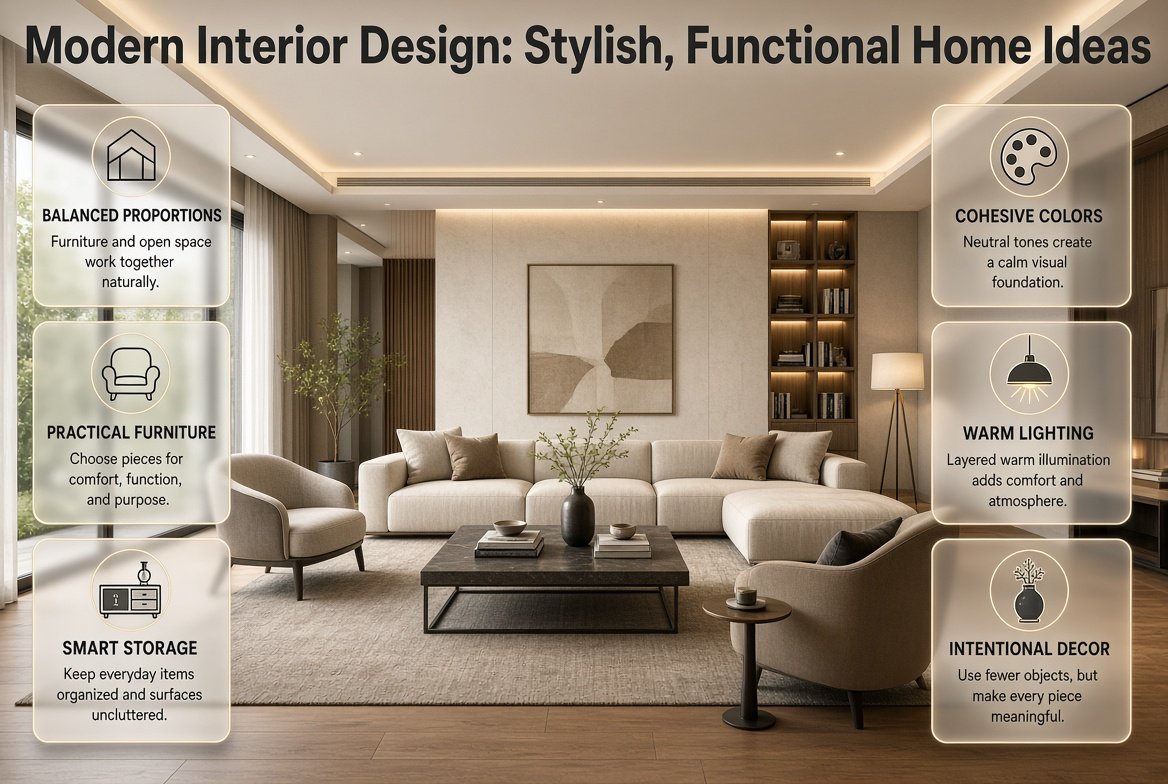
Modern interior design is often associated with white walls, expensive furniture, open spaces, and perfectly organized rooms. But that picture only tells part of the story. A genuinely modern home isn’t about making everything look cold or empty. It’s about creating a space that feels organized, comfortable, practical, and visually balanced.
Imagine walking into your living room after a long day. Instead of seeing furniture packed against every wall, tangled cables, mismatched colors, and surfaces covered with unnecessary objects, you see a calm arrangement where everything has a purpose. The lighting feels warm, the furniture is comfortable, storage is easy to access, and the colors work together naturally.
That’s the real strength of modern interior design.
Whether you’re furnishing a new house, updating an older apartment, redesigning one room, or simply trying to make your existing space feel more polished, modern design gives you a useful framework. You don’t necessarily need a large renovation budget. In many cases, better proportions, smarter furniture placement, improved lighting, and fewer unnecessary items can make a bigger difference than expensive decoration.
This guide explains how modern interior design works, which colors and materials to choose, how to plan each room, how to mix modern elements with your existing furniture, how to create a modern home on a budget, and which common mistakes can make a modern room look unfinished or artificial.
For additional inspiration and ideas across different areas of home design, you can also explore DesignMode24 Interior Design.
What Is Modern Interior Design?
Modern interior design is an approach to decorating and organizing a home around clean lines, practical layouts, functional furniture, controlled colors, natural materials, and uncluttered spaces. The style focuses on making rooms visually simple while maintaining comfort, personality, and everyday usability.
The word “modern” can be confusing because people sometimes use it to describe anything new. In interior design, however, modern design has a more recognizable visual language.
Typical characteristics include:
- Clean architectural lines
- Simple furniture profiles
- Open and practical layouts
- Neutral color foundations
- Natural wood and stone
- Glass and metal accents
- Functional storage
- Layered lighting
- Limited but meaningful decoration
- A strong relationship between form and function
The most important principle is intentionality.
A modern room shouldn’t contain furniture or accessories simply because there was an empty space available. Each element should contribute to comfort, function, balance, texture, or visual interest.
For example, a large empty wall doesn’t automatically need five small decorations. One appropriately sized artwork may look more sophisticated because it gives the wall enough visual breathing room.
Likewise, a modern bedroom doesn’t need expensive designer furniture. A comfortable bed, well-planned storage, simple lighting, quality bedding, and a calm color palette can create a much stronger result.
Why Modern Interior Design Remains Popular
Modern design has remained popular because it adapts easily to different lifestyles.
A family home may use modern principles to improve storage and circulation. A small apartment can use the same approach to make limited space feel larger. A home office can benefit from simple furniture and organized technology. Even a traditional house can incorporate modern lighting, furniture, and colors without losing its original character.
The style is also flexible.
You can create:
- Warm modern interiors
- Minimal modern interiors
- Modern luxury interiors
- Modern Scandinavian interiors
- Modern industrial interiors
- Modern rustic interiors
- Modern coastal interiors
- Modern organic interiors
The foundation stays relatively simple while materials, colors, textures, and decorative choices change.
Modern vs. Contemporary Interior Design: What’s the Difference?
Modern and contemporary interior design are often treated as the same thing, but they have different meanings.
Modern design is connected to a particular design philosophy that emphasizes simplicity, function, clean forms, and a reduction of unnecessary ornamentation. Contemporary design, on the other hand, generally refers to what is being designed and used today.
This means contemporary style can change as trends evolve.
| Feature | Modern Interior Design | Contemporary Interior Design |
|---|---|---|
| Main focus | Function and clean design | Current design trends |
| Shapes | Clean and structured | Can include curves and unusual forms |
| Colors | Often neutral | Flexible and trend-driven |
| Materials | Wood, glass, metal, stone | Broad mix of current materials |
| Decoration | Controlled | Can be more experimental |
| Longevity | Often more timeless | Can change with trends |
| Overall character | Calm and structured | Fresh and evolving |
The two styles can also be combined.
For example, you might use a modern foundation with a contemporary curved sofa, sculptural light fixture, or fashionable accent color. This creates a home that feels current without requiring you to redesign everything whenever trends change.
What Are the Main Characteristics of Modern Interior Design?
A successful modern interior usually depends on several elements working together. No single sofa, paint color, or light fixture can create the entire style.
Clean Lines and Simple Forms
Clean lines are one of the easiest ways to recognize modern design.
Furniture often has simple silhouettes rather than excessive decoration. Cabinets may have flat fronts, tables may have straightforward geometric shapes, and lighting fixtures may feature clean metal or glass forms.
However, modern design doesn’t mean every object must have sharp corners.
Rounded chairs, curved sofas, circular mirrors, and organic accessories can create useful contrast. The important thing is that curves should feel intentional rather than randomly mixed with unrelated shapes.
Functional Furniture
Modern design considers how people actually live.
A beautiful coffee table that blocks the walking path isn’t a good design decision. A huge sectional that prevents comfortable movement isn’t automatically better because it’s stylish.
Before buying furniture, consider:
- How many people use the room?
- Where do people normally walk?
- Where does natural light enter?
- How much storage is needed?
- Does the furniture fit through the doorway?
- Is there enough space around each piece?
- Does the arrangement support conversation?
Function should come before appearance.
Visual Breathing Room
Modern interiors often have more negative space than heavily decorated rooms.
Negative space is simply the area around and between objects.
It gives the eye a place to rest and makes important elements more noticeable.
This doesn’t mean leaving half your room empty. It means avoiding the temptation to fill every surface.
A modern console might need only a lamp, one decorative object, and a piece of artwork above it.
How Do You Choose a Modern Color Palette?
Color is one of the easiest ways to establish a modern atmosphere.
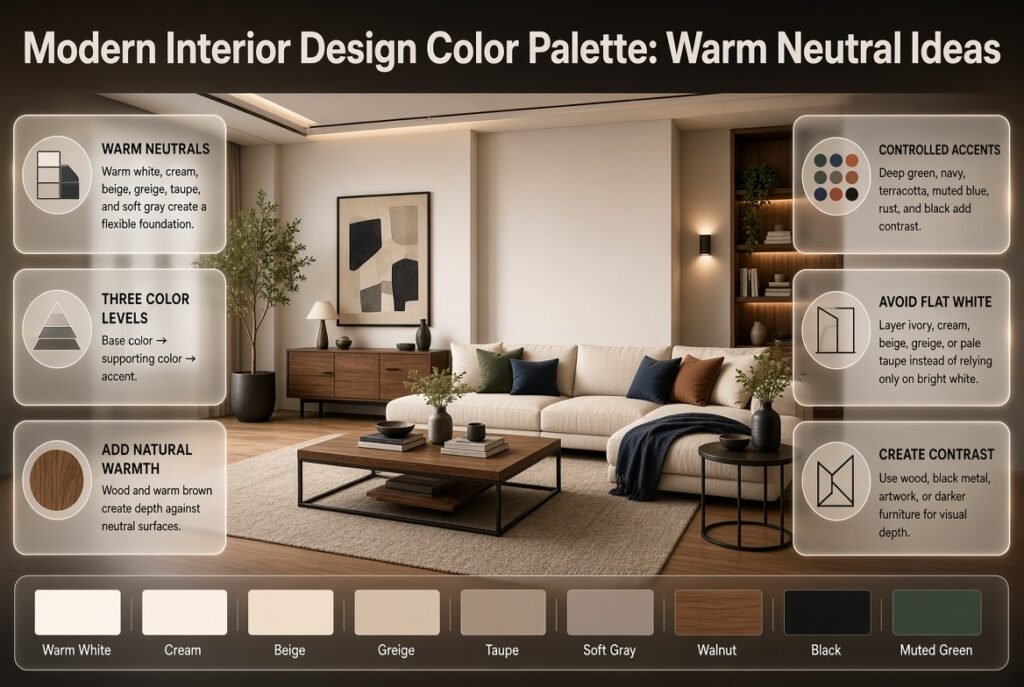
Many modern interiors begin with a neutral foundation because neutrals provide flexibility. But neutral doesn’t have to mean boring.
Common modern base colors include:
- Warm white
- Cream
- Beige
- Greige
- Taupe
- Soft gray
- Charcoal
- Light brown
These can then be combined with accent colors such as:
- Deep green
- Navy
- Terracotta
- Muted blue
- Rust
- Black
- Warm brown
A simple approach is to select three visual levels:
Base color → supporting color → accent
For example:
Warm white walls → walnut furniture → black accents
Or:
Soft beige → cream textiles → muted green accessories
This creates cohesion without making every object the same color.
Should Modern Interiors Be All White?
No.
An all-white room can look beautiful, particularly when architectural details, lighting, and textures are strong. But many homeowners discover that too much white makes a room feel flat, sterile, or difficult to maintain.
Warm neutrals are often easier to live with.
Instead of bright white everywhere, consider:
- Ivory
- Soft cream
- Warm beige
- Light greige
- Pale taupe
Then introduce contrast through wood, black metal, artwork, or darker furniture.
For homeowners experimenting with different wall colors, the Paint Color section can provide a useful starting point when thinking about how color affects the overall room.
How Do You Use Accent Colors Without Making a Room Busy?
Accent colors are most effective when they’re repeated.
Suppose you choose muted green as your accent.
You might use it in:
- One cushion
- A piece of artwork
- A plant
- A small decorative object
The color doesn’t need to dominate the room.
A common mistake is choosing too many accent colors. When every object has a different strong color, the room loses visual direction.
Modern design generally benefits from restraint.
Warm vs. Cool Modern Color Schemes
Warm palettes often use:
- Beige
- Cream
- Brown
- Terracotta
- Warm gray
- Natural wood
They create a comfortable and inviting atmosphere.
Cool palettes may use:
- White
- Blue-gray
- Charcoal
- Cool gray
- Black
- Silver
They can create a crisp and sophisticated appearance.
Neither approach is automatically better. Your choice should depend on natural light, flooring, furniture, climate, and the mood you want.
How Important Are Materials in Modern Interior Design?
Materials give modern interiors their character.
If you use only smooth surfaces, the room can feel flat. If you combine too many competing materials, it can feel chaotic.
The goal is balance.
Popular materials include:
- Natural wood
- Engineered wood
- Stone
- Marble
- Glass
- Metal
- Concrete
- Linen
- Wool
- Leather
- Ceramic
- Textured fabrics
Natural Wood
Wood is one of the easiest ways to make modern design feel warm.
Oak creates a lighter and more relaxed appearance, while walnut creates a richer and more sophisticated feel.
Wood can appear in:
- Flooring
- Cabinets
- Coffee tables
- Dining tables
- Shelving
- Wall panels
- Bed frames
Glass
Glass helps maintain visual openness.
It can be useful for:
- Coffee tables
- Shower screens
- Doors
- Shelving
- Partitions
In smaller rooms, transparent surfaces can help reduce the visual weight of furniture.
Metal
Black metal is particularly popular in modern interiors because it creates definition.
It can appear in:
- Lighting
- Table legs
- Cabinet hardware
- Shelving
- Window frames
The important thing is moderation.
How Do You Choose Modern Furniture?
Furniture should be selected according to scale, comfort, function, and proportion.
Don’t start with the question, “Does this piece look modern?”
Start with:
“Does this piece work in my room?”
Measure the space before shopping.
Pay attention to:
- Sofa width
- Coffee table size
- Walking clearance
- Ceiling height
- Door swing
- Window placement
- Rug dimensions
- Storage requirements
A modern room can look worse when furniture is too large than when it is slightly less fashionable.
Best Furniture Choices for Modern Interiors
Common options include:
- Low-profile sofas
- Simple armchairs
- Platform beds
- Floating cabinets
- Minimal dining tables
- Modular storage
- Streamlined consoles
- Simple shelving
- Upholstered beds
But comfort should never be sacrificed simply for appearance.
A sofa may have the perfect silhouette, but if it isn’t comfortable enough for your household, it isn’t the right choice.
⭐ Expert Tip: Instead of buying a complete matching furniture set, choose pieces that share one or two characteristics, such as similar wood tones, metal finishes, or proportions. Coordinated furniture usually looks more natural than perfectly matched furniture.
How Should You Arrange Furniture in a Modern Living Room?
Start with the largest piece, usually the sofa.
Position it according to the room’s main function.
If the room is primarily for conversation, orient seating toward one another.
If television viewing is important, create a comfortable relationship between the seating and screen.
Then add:
- Coffee table
- Side tables
- Rug
- Lighting
- Storage
- Artwork
- Decorative elements
Avoid placing everything against the wall simply because the center of the room looks empty.
Sometimes bringing furniture slightly away from the walls creates a stronger layout.
The Importance of the Rug
A rug can connect an entire modern living room.
A common mistake is choosing a rug that’s too small.
Ideally, the rug should visually connect the major seating pieces rather than appear like a small island underneath the coffee table.
For a more polished result, make sure at least the front legs of major seating pieces sit on the rug when the room allows it.
How Do You Create a Modern Bedroom?
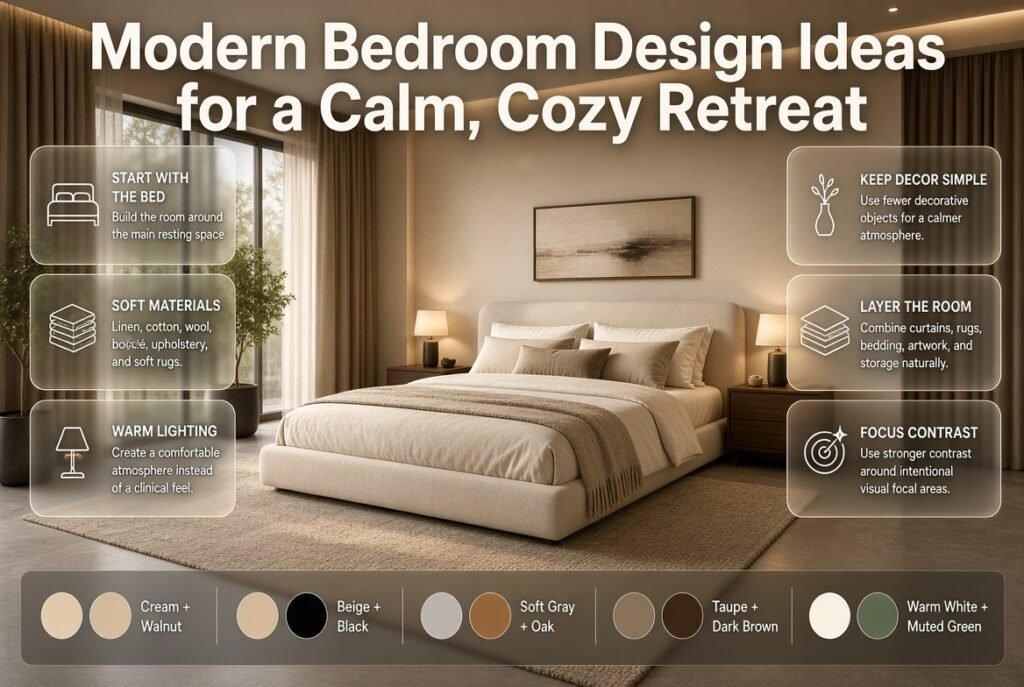
A modern bedroom should feel calmer than a living room because its main purpose is rest.
Start with the bed.
Then build the design around:
- Bedside tables
- Lighting
- Curtains
- Rug
- Storage
- Artwork
- Bedding
Use fewer decorative objects than you might use in a living room.
Soft materials are especially important.
Consider:
- Linen
- Cotton
- Wool
- Bouclé
- Upholstered furniture
- Soft rugs
Warm lighting also helps prevent a modern bedroom from feeling too clinical.
Modern Bedroom Color Ideas
Good combinations include:
- Cream + walnut
- Beige + black
- Soft gray + oak
- Taupe + dark brown
- Warm white + muted green
Keep the strongest contrast around areas where you want visual focus.
What Makes a Modern Kitchen Look Good?
Modern kitchens typically emphasize clean cabinetry, practical storage, integrated appliances, simple hardware, and durable surfaces.
But a modern kitchen must be functional.
Before choosing cabinets or finishes, think about workflow.
The refrigerator, sink, and cooking area should be arranged so everyday tasks feel natural.
Modern Kitchen Materials
Popular choices include:
- Quartz
- Natural stone
- Wood
- Matte cabinetry
- Glass
- Stainless steel
- Porcelain surfaces
Flat-panel cabinets create a clean appearance, while concealed or minimal hardware reduces visual noise.
Open shelving can work in moderation, but don’t use it everywhere if you struggle with clutter.
Closed storage is often the better choice for everyday household items.
How Can You Design a Modern Bathroom?
Modern bathrooms often use simple surfaces, floating vanities, frameless glass, large-format tiles, and clean fixtures.
The advantage of this approach is that fewer visual interruptions can make the bathroom feel larger.
Useful features include:
- Floating vanity
- Wall-mounted fixtures
- Large mirror
- Frameless shower glass
- Simple lighting
- Large-format tile
- Concealed storage
However, appearance shouldn’t come at the expense of maintenance.
A beautiful textured surface that constantly collects dirt may become frustrating.
Always consider how easily a material can be cleaned before choosing it.
How Do You Design a Modern Home Office?
A modern home office should be visually clean while supporting concentration.
Start with the desk and chair.
Then manage:
- Computer cables
- Lighting
- Storage
- Documents
- Background clutter
- Screen position
Use closed storage for items that don’t need to remain visible.
If you attend video meetings, consider the background as part of the design.
A simple wall, artwork, plant, or shelving arrangement can create a professional appearance without looking staged.
How Does Lighting Transform Modern Interior Design?
Lighting is one of the most underestimated parts of interior design.
A room can have excellent furniture and colors but still feel disappointing because the lighting is too harsh, too dim, or poorly positioned.
Modern interiors benefit from layered lighting.
Ambient Lighting
This provides general illumination.
Examples include:
- Ceiling lights
- Recessed lights
- Track lighting
- Large pendants
Task Lighting
This supports specific activities.
Examples include:
- Reading lamps
- Desk lamps
- Under-cabinet lights
- Vanity lights
Accent Lighting
This creates atmosphere and highlights specific features.
Examples include:
- Artwork lighting
- Shelf lighting
- Wall washers
- Cove lighting
- Decorative lamps
Instead of relying on one bright ceiling fixture, combine several sources.
This makes the room more flexible throughout the day.
How Do You Make a Modern Interior Feel Warm?
This is one of the most important questions for anyone choosing modern design.
A room can become cold when it contains too many hard, reflective surfaces without enough texture.
The solution isn’t to abandon modern design.
Instead, balance hard and soft materials.
Try combining:
Glass + wood
Metal + fabric
Stone + wool
Smooth surfaces + textured surfaces
Clean furniture + organic plants
For example, a black metal coffee table can feel much softer when placed over a textured wool rug beside a warm wood cabinet.
📌 Quick Tip: If your modern room feels cold, don’t immediately buy more decorations. First look at your lighting, textiles, wood tones, and seating comfort. Those four elements often solve the problem more effectively.
How Can You Use Plants in Modern Interiors?
Plants are particularly useful in modern homes because they introduce natural shapes into rooms dominated by straight lines.
A large plant can become a focal point.
Smaller plants can sit on:
- Shelves
- Side tables
- Kitchen counters
- Bathroom ledges
- Home office desks
Choose plants according to the actual light available.
Don’t select a plant simply because it looks good in a photograph.
The healthiest plant will always look better than a struggling plant chosen purely for decoration.
How Do You Add Personality to a Modern Home?
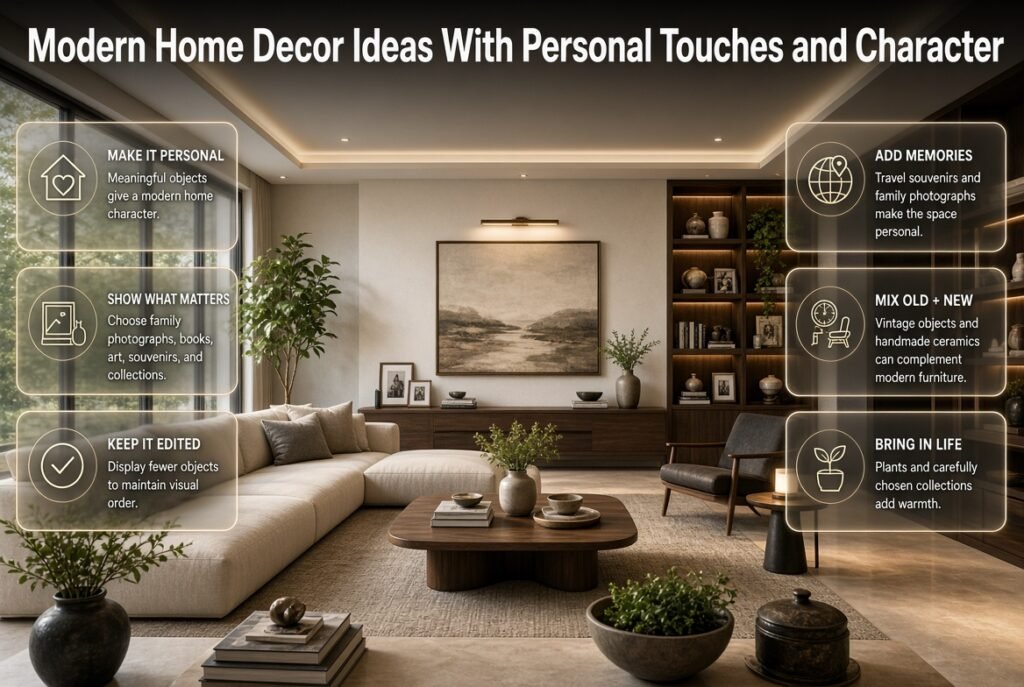
Modern design shouldn’t make your home look like a furniture showroom.
Personal objects are important.
You can include:
- Family photographs
- Travel souvenirs
- Books
- Paintings
- Handmade ceramics
- Vintage objects
- Plants
- Collections
The key is editing.
Instead of displaying everything, choose the items that matter most.
This keeps the room organized while still making it feel like someone’s home.
How Can You Modernize an Existing Home Without Renovating?
You don’t have to demolish walls to create a modern interior.
Some of the most effective updates are relatively simple.
Step 1: Declutter
Remove objects that you don’t use or don’t genuinely enjoy.
This immediately creates more visual space.
Step 2: Reconsider Furniture Placement
Before buying anything, experiment with the existing layout.
Sometimes the problem is arrangement rather than furniture.
Step 3: Simplify Colors
If too many colors compete, choose one dominant palette.
Step 4: Upgrade Lighting
Replace outdated fixtures and add lamps where necessary.
Step 5: Improve Storage
Use cabinets, baskets, drawers, and concealed organizers.
Step 6: Add Texture
Introduce wood, rugs, curtains, cushions, and natural materials.
Step 7: Add One Strong Focal Point
This could be:
- Artwork
- A sofa
- Lighting
- Accent wall
- Large plant
- Architectural feature
This approach is usually more effective than buying dozens of small decorations.
For homeowners who enjoy practical upgrades, DIY Home Projects can also provide ideas for making useful changes without relying entirely on expensive replacements.
How Can You Use Accent Walls in Modern Design?
An accent wall can add depth, but it should have a reason to exist.
Good locations include:
- Behind the bed
- Behind the television
- Dining area
- Fireplace wall
- Entryway
Possible treatments include:
- Paint
- Wood slats
- Stone
- Wallpaper
- Textured plaster
- Decorative panels
The best accent wall usually reinforces an existing focal point.
If the room already has several competing features, adding another strong wall can make the space feel busy.
How Do You Use Wall Color Strategically?
Wall color isn’t only about choosing something you like.
It also affects how large, bright, warm, or intimate a room feels.
Light colors can help smaller spaces feel more open.
Darker colors can create depth and drama.
Warm colors can make a room feel more inviting.
Cooler tones can create a calmer appearance.
Before painting, observe the room at different times of day.
Morning sunlight, afternoon light, and artificial evening lighting can make the same color appear very different.
What Paint Finish Works Best for Modern Interiors?
The finish matters as much as the color.
Different surfaces may require different finishes based on durability, moisture, and cleaning requirements.
For example:
- Matte finishes can create a sophisticated low-reflective appearance.
- Eggshell finishes offer a subtle sheen and practical durability.
- Satin finishes are useful in areas requiring easier cleaning.
- Higher-sheen finishes can work well for selected trim or functional surfaces.
Don’t choose a finish solely because it looks attractive in a sample.
Think about how the surface will be touched, cleaned, exposed to moisture, and illuminated.
How Can Home Improvement Support Modern Interior Design?
Modern interior design works best when appearance and function are improved together.
For example, replacing an outdated storage unit with built-in cabinetry can simultaneously improve organization and visual simplicity.
Similarly, improving flooring, lighting, doors, or wall finishes can create a stronger foundation for furniture and decoration.
If you’re planning several upgrades rather than simply decorating, the Home Improvement section can help you approach the project from a broader perspective.
The goal is not to modernize every surface simply because you can.
Prioritize improvements that solve actual problems.
Modern Interior Design on a Budget
Modern style can work surprisingly well on a limited budget because the design depends more on editing and coordination than on decoration quantity.
Start by investing in the elements that dominate the room.
These might include:
- Sofa
- Bed
- Dining table
- Lighting
- Curtains
- Rug
- Storage
You can save money on:
- Small accessories
- Frames
- Decorative objects
- Cushions
- Simple shelving
- DIY artwork
A Practical Budget Strategy
Instead of spending $100 on ten small decorations, you might get better results spending that money on one well-sized rug, a quality lamp, or materials for improving an existing piece of furniture.
The principle is simple:
Buy fewer things, but make each choice count.
Common Modern Interior Design Mistakes
Making Everything White
White is useful, but an all-white room can become visually flat.
Add wood, texture, artwork, greenery, and controlled contrast.
Choosing Furniture That Is Too Large
Large furniture can quickly destroy circulation.
Always measure before buying.
Using Too Many Small Accessories
Small objects create visual noise when there are too many of them.
Group accessories intentionally.
Ignoring Lighting
One bright ceiling light rarely creates a sophisticated atmosphere.
Use multiple layers.
Matching Everything
Perfectly matching furniture often looks less natural than coordinated pieces.
Mix materials carefully.
Copying a Showroom
A showroom isn’t designed around your family’s lifestyle.
Your home needs to support real activities.
Choosing Style Over Practicality
A beautiful chair that nobody wants to sit in isn’t a successful purchase.
Comfort matters.
Ignoring Maintenance
Some finishes look impressive but require constant care.
Consider cleaning and durability before choosing materials.
⚠ Common Mistake: Designing the room entirely around photographs. A room may look impressive in a picture while being uncomfortable to live in. Prioritize movement, seating, storage, lighting, and maintenance before decorative details.
How Do Professionals Make Modern Interiors Look More Expensive?
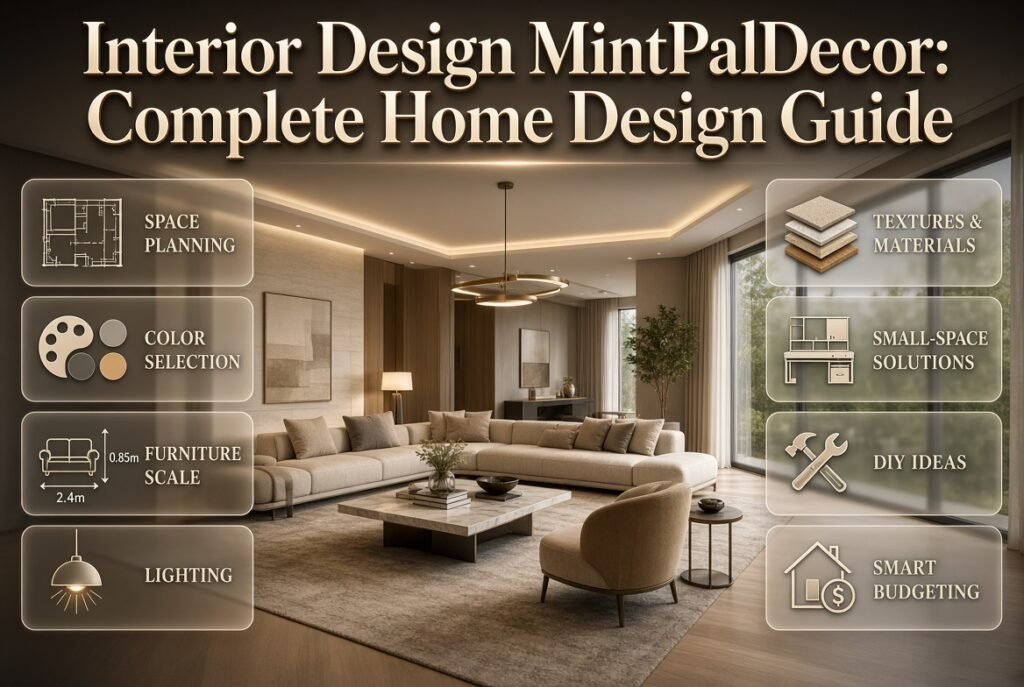
Professional-looking interiors usually rely on proportion and consistency rather than excessive spending.
Repeat Finishes
If black metal appears in your lighting, repeat a small amount elsewhere.
If you use walnut furniture, introduce related warm wood tones.
Pay Attention to Curtain Height
Curtains that are properly positioned can visually improve ceiling height.
Use Appropriate-Size Artwork
Tiny artwork on a huge wall often looks disconnected.
Choose artwork according to the wall and surrounding furniture.
Hide Technology
Cable clutter can instantly make an otherwise polished room feel unfinished.
Use cable management and concealed storage.
Create Focal Points
Every room should have one or two clear areas that attract attention.
Too many focal points compete with each other.
Leave Some Space Empty
Negative space creates visual breathing room.
A professional interior doesn’t need every surface filled.
How Can Home Styling Complete a Modern Interior?
Once the major elements are correct, styling brings the room together.
This is where you add:
- Cushions
- Throws
- Artwork
- Books
- Plants
- Ceramics
- Mirrors
- Decorative objects
But styling should come last.
If your furniture layout is wrong, adding accessories won’t solve the underlying problem.
If your lighting is poor, more decorations won’t make the room feel comfortable.
If your storage is insufficient, baskets alone may not solve the issue.
That’s why Home Styling works best after the functional foundation is established.
Modern Interior Design for Small Spaces
Small rooms require greater discipline because every piece of furniture has a visual and physical impact.
Choose pieces that serve more than one function when possible.
Examples include:
- Storage ottomans
- Extendable dining tables
- Beds with drawers
- Floating shelves
- Wall-mounted desks
- Nesting tables
- Built-in cabinets
Use Vertical Space
When floor space is limited, look upward.
Tall storage can provide useful capacity without taking up excessive floor area.
Choose Furniture Carefully
Bulky arms, oversized backs, and deep furniture can make small rooms feel crowded.
Slimmer profiles can create more usable space.
Use Light and Reflection
Mirrors and reflective surfaces can help distribute light, although they should be used intentionally rather than covering every wall.
Modern Interior Design for Large Homes
Large rooms create a different challenge.
Instead of trying to fill every corner, create zones.
A large living area might include:
- Main conversation zone
- Reading corner
- Small work area
- Display area
Use rugs, furniture placement, lighting, and ceiling fixtures to define each zone.
Large rooms can look unfinished when furniture is too small.
Scale becomes especially important.
How Do You Mix Modern and Traditional Elements?
You don’t have to remove every traditional item to create a modern home.
A traditional wooden cabinet can work with a modern sofa.
A vintage chair can add character to a contemporary dining area.
An older painting can become a focal point against a clean wall.
The trick is to establish visual relationships.
Repeat colors or materials so the traditional object feels connected to the modern environment.
This creates a more layered and personal home than using one style exclusively.
Modern Organic Interior Design
Modern organic design has become particularly appealing because it combines clean modern architecture with natural materials and softer forms.
Typical features include:
- Warm neutrals
- Natural wood
- Stone
- Linen
- Organic shapes
- Indoor plants
- Textured walls
- Soft lighting
It is especially useful for homeowners who like modern design but don’t want a hard or industrial appearance.
The result can feel calm, comfortable, and sophisticated.
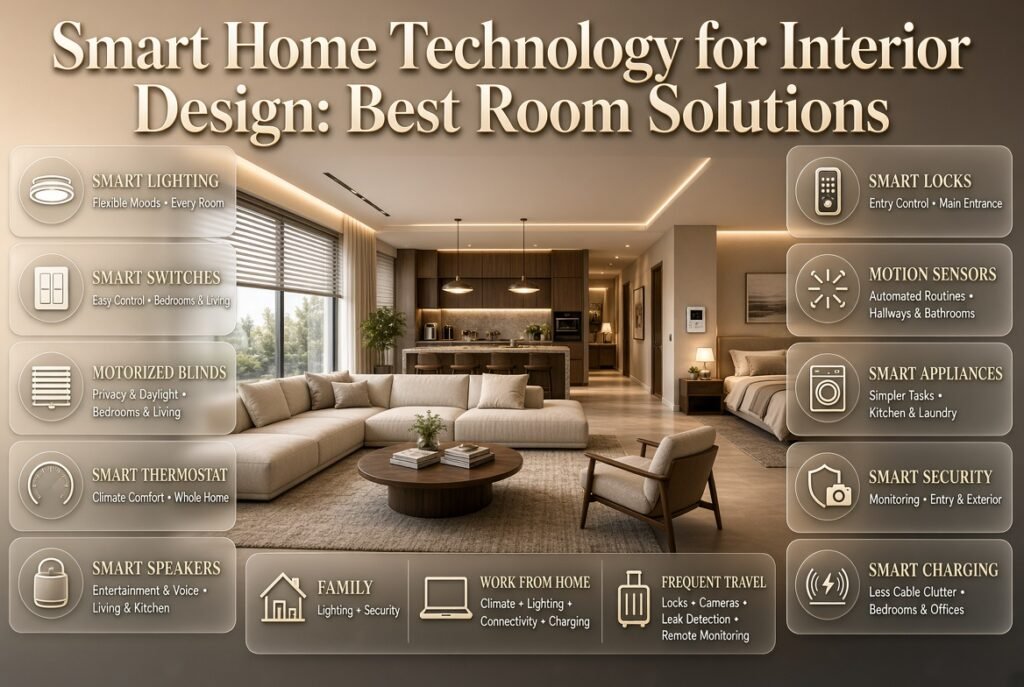
Modern Interior Design and Smart Home Technology
Technology should support the design rather than dominate it.
Modern interiors can integrate:
- Smart lighting
- Automated blinds
- Hidden speakers
- Concealed charging points
- Smart thermostats
- Integrated media systems
- Motion-controlled lighting
Whenever possible, hide cables and bulky equipment.
A wall-mounted television, for example, can look much cleaner when wires are properly concealed and the surrounding media storage is minimal.
Technology becomes most successful when it feels like part of the architecture rather than an object added afterward.
How Do You Plan a Modern Interior Design Project?
A simple planning sequence can prevent expensive mistakes.
Step 1: Identify the Problem
Write down what isn’t working.
Step 2: Measure the Room
Record walls, doors, windows, ceiling height, and fixed features.
Step 3: Set the Budget
Separate essential spending from optional upgrades.
Step 4: Choose the Design Direction
Decide whether you prefer warm modern, minimalist modern, modern organic, industrial modern, or another variation.
Step 5: Select the Base Palette
Choose wall, floor, and major furniture colors first.
Step 6: Choose Major Furniture
Start with pieces that determine the room’s layout.
Step 7: Plan Lighting
Use ambient, task, and accent layers.
Step 8: Add Texture
Introduce wood, rugs, curtains, cushions, plants, and ceramics.
Step 9: Add Personality
Bring in artwork and meaningful objects.
Step 10: Edit
Remove anything that feels unnecessary.
That last step is often where the room becomes truly polished.
What are the main elements of modern interior design?
Modern interior design is built around clean lines, functional furniture, uncluttered layouts, controlled colors, natural materials, and thoughtful lighting. The goal isn’t to make a room look empty; it’s to make every element feel intentional. A modern space should have enough open area for movement while still feeling comfortable and personal.
In 2026, modern interiors are also moving away from the overly cold, sterile look that was once associated with minimalism. Designers are increasingly combining simple forms with warm wood, earthy colors, tactile fabrics, curved furniture, and layered lighting.
Key points to remember:
Choose furniture for function as well as appearance.
Keep the main color palette controlled.
Use natural materials to add warmth.
Avoid filling every surface with decoration.
Create visual balance through proportion and negative space.
Use lighting to create atmosphere rather than relying on one bright ceiling fixture.
The strongest modern rooms don’t look modern because they contain expensive products. They look modern because the layout, materials, colors, furniture, and lighting work together.
What colors are best for modern interior design in 2026?
The most versatile modern color palettes in 2026 are moving toward warm neutrals and earthy shades rather than relying heavily on cool gray or stark white. Warm beige, cream, taupe, soft brown, muted green, terracotta, clay, and natural wood tones can create a modern room that feels sophisticated without becoming cold.
That doesn’t mean white and gray are no longer useful. They can still provide excellent foundations, particularly when balanced with wood, stone, textured fabrics, or darker accents.
A practical modern palette can follow this structure:
60% base color → 30% supporting color/material → 10% accent
For example:
Warm white walls
Beige or cream upholstery
Walnut furniture
Small black accents
Or:
Soft taupe walls
Natural oak furniture
Linen textiles
Muted olive accessories
For a more successful result:
Test paint colors in natural and artificial light.
Consider your existing flooring before choosing wall colors.
Don’t use several strong accent colors at once.
Repeat your accent color in small areas throughout the room.
Use wood and textiles to prevent neutral interiors from feeling flat.
The important shift isn’t simply from one trendy color to another. It’s toward warmer, more livable interiors that can remain attractive even after current trends change.
How can I make a modern interior feel warm and cozy instead of cold?
The easiest way to make a modern interior feel cozy is to balance clean architectural lines with warm materials, tactile textures, softer lighting, and personal details. A room becomes cold when it contains too many hard surfaces and too little texture, not simply because the design is modern.
This is why warm minimalism has become such an important direction in 2026. It keeps the simplicity and organization of modern design but introduces wood, linen, wool, earthy colors, organic shapes, plants, and meaningful decoration.
Try combining:
Natural wood with stone
Linen curtains with clean-lined furniture
Wool rugs with smooth flooring
Soft upholstery with metal accents
Warm lamps with neutral walls
Plants with geometric furniture
Personal artwork with simple architecture
Lighting deserves special attention. Instead of using one powerful overhead fixture, combine ambient, task, and accent lighting. This gives you more control over how the room feels at different times of day. Current designer guidance is also moving toward zoned and layered lighting instead of excessive reliance on uniform recessed lighting.
A useful professional rule: if your modern room feels cold, don’t immediately add more decorations. First check the lighting, texture, wood tones, upholstery, and color temperature.
How can I make my house look modern without a major renovation?
You can make a home look significantly more modern without changing its structure. Start with the elements that have the biggest visual impact: decluttering, furniture arrangement, wall color, lighting, storage, textiles, and one or two carefully selected focal points.
Many homeowners make the mistake of assuming that modernizing means replacing everything. That’s rarely necessary. An older room can look dramatically different after removing unnecessary furniture, changing the lighting, repainting the walls, updating curtains, adding a properly sized rug, and improving storage.
A practical upgrade sequence is:
Remove unnecessary clutter.
Rearrange existing furniture.
Simplify the color palette.
Replace outdated lighting.
Improve visible storage.
Add natural textures.
Introduce one strong artwork or focal feature.
Replace only the furniture that genuinely looks or functions poorly.
For a budget-conscious project, DIY improvements can also make a noticeable difference. Refinishing a wooden cabinet, updating handles, creating simple wall art, or building useful shelving can modernize a room without requiring a complete makeover.
The important point is to solve the room’s biggest problem first. If the layout is poor, buying decorative accessories won’t fix it. If storage is inadequate, adding more decoration will usually make the problem worse.
What are the biggest modern interior design trends to follow in 2026?
The strongest 2026 direction isn’t one specific furniture shape or paint color. It’s a broader movement toward warmer, more personal, tactile, and livable modern interiors. Warm minimalism, natural materials, earthy palettes, curved forms, layered lighting, biophilic elements, and flexible multifunctional spaces are among the themes appearing repeatedly in current design coverage.
Some of the most useful trends to consider are:
Warm minimalism: Clean layouts softened with warm neutrals, wood, textiles, and personal objects.
Natural materials: Wood, stone, linen, wool, clay, and other tactile finishes.
Earth-inspired colors: Terracotta, olive, ochre, warm beige, brown, and muted natural tones.
Curved furniture: Rounded sofas, circular tables, arches, and softer silhouettes that balance strict geometric lines.
Layered lighting: Multiple light sources rather than one harsh overhead fixture.
Biophilic design: Plants and natural materials that introduce an organic quality.
Multifunctional spaces: Furniture and rooms that can adapt to work, relaxation, storage, and entertaining.
Personal interiors: More vintage, handmade, meaningful, and collected pieces rather than rooms that look like identical showrooms.
Conclusion
Modern interior design is not about creating a home that looks cold, empty, or overly perfect. It’s about making thoughtful choices that improve the way your space looks, feels, and functions. Clean lines, balanced colors, practical furniture, natural materials, layered lighting, and controlled decoration provide the foundation, while textures, plants, artwork, and personal pieces give the room warmth and character.
The best approach is to design around real life rather than trends alone. Before buying new furniture or starting a renovation, consider how you use each room, where clutter builds up, how much storage you need, and what atmosphere you want to create. Even simple changes such as repainting walls, improving lighting, rearranging furniture, or adding natural textures can make an older space feel noticeably more modern.
If you’re planning a complete home transformation or simply looking for practical inspiration, DesignMode24 Interior Design can help you explore more ideas for creating a stylish and functional home.
Ultimately, successful modern interior design comes down to balance. Keep the space clean but not empty, stylish but not impractical, simple but not boring, and modern without losing your personality. When every element has a purpose and the room still feels comfortable to live in, you’ve created something much more valuable than a trendy interior—you’ve created a home that works.
Leave a Reply