
Introduction
Small Space DIY Hacks | Living in a small home can be surprisingly frustrating. You may have enough belongings to live comfortably, but somehow there never seems to be enough room for them. The kitchen counter becomes a storage area, the bedroom chair turns into a permanent clothes pile, and the entryway collects shoes, bags, keys, and everything else you don’t know where to put.
The problem isn’t always that your home is too small. Often, the problem is that the available space isn’t being used efficiently.
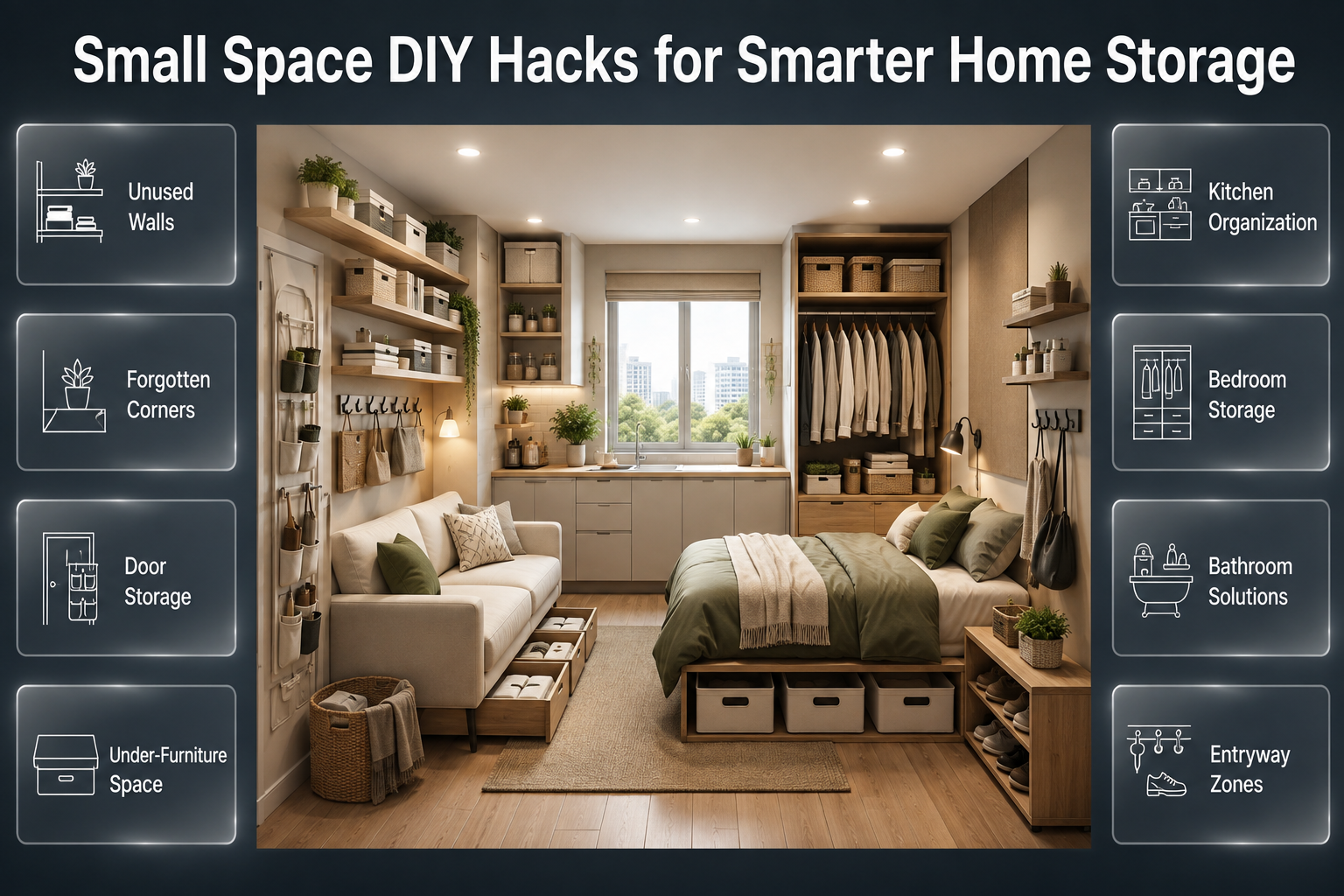
That’s where small space DIY hacks can make a real difference. Instead of buying another bulky cabinet or spending a fortune on custom furniture, you can transform forgotten corners, empty walls, doors, awkward gaps, and unused areas under furniture into practical storage and functional zones.
For more ideas on making your home both attractive and functional, explore DesignMode24 Interior Design.
This guide covers practical DIY solutions for bedrooms, kitchens, bathrooms, living rooms, entryways, home offices, and awkward spaces. You’ll learn how to choose the right project, avoid common mistakes, make DIY storage look intentional, and create a home that feels more spacious without actually adding square footage.
What Are the Best Small Space DIY Hacks?
The best small space DIY hacks use areas that are normally overlooked, especially vertical walls, the backs of doors, spaces underneath furniture, corners, and narrow gaps. They should improve storage or functionality without making the room harder to move through or visually heavier.
A successful small-space project usually does one or more of these things:
- Uses vertical space instead of floor space
- Creates hidden storage
- Gives furniture multiple purposes
- Uses an awkward or forgotten area
- Reduces visible clutter
- Makes frequently used items easier to access
- Allows a space to serve more than one function
The important thing is not to add storage simply because an empty area exists. Every project should solve a genuine problem.
For example, if your entryway is constantly cluttered with shoes, building a small shoe bench with hidden compartments makes sense. Installing three decorative shelves there simply because you have an empty wall may create more visual clutter without solving the actual problem.
Why Small Spaces Need a Different Approach
Large rooms can absorb inefficient furniture arrangements. Small rooms can’t.
A large cabinet might look perfectly reasonable in a spacious bedroom but make a compact bedroom feel crowded. A conventional desk may work well in a home office but become an obstacle in a studio apartment.
Small-space design is therefore about efficiency rather than quantity.
You want every piece to earn its place.
A shelf should provide storage. A bench might provide seating and storage. A wall-mounted desk can create a workspace that disappears when you’re finished. Even a simple hook can replace a much larger storage solution when it’s used in the right location.
How Can DIY Projects Make a Small Room Feel Bigger?
DIY projects can make a small room feel larger by reducing floor-level clutter, improving organization, using vertical surfaces, and keeping furniture proportional to the room. The objective isn’t to physically increase the room’s size but to make the available space easier to use and visually calmer.
This distinction matters.
Many people try to make small rooms feel larger by adding mirrors, light colors, or decorative tricks. Those can help, but organization often has a bigger practical impact.
A room filled with objects feels crowded regardless of its paint color.
Start by identifying the things that are taking up valuable floor space. Then ask whether those items can be:
- Mounted on a wall
- Stored underneath furniture
- Folded away
- Hung behind a door
- Combined into one multi-purpose piece
- Moved into a less frequently used area
This approach creates more breathing room without requiring construction work.
1. Install Simple Floating Shelves
Floating shelves are among the most useful small space DIY hacks because they provide storage without taking up floor area.
A narrow shelf above a desk can hold books and office supplies. A shelf above a bathroom sink can store toiletries. A few shelves beside the kitchen counter can hold spices or jars.
You can build them from inexpensive wood or reclaimed boards.
Before installation, decide what the shelf will actually hold. A shelf intended for lightweight decoration doesn’t need the same construction as one expected to support heavy books or cookware.
Keep the depth appropriate for the location. In narrow rooms, a shallow shelf is often more useful than a deep one because it doesn’t interfere with movement.
💡 Pro Tip: Use painter’s tape to mark the shelf dimensions on the wall before drilling. Leave the tape in place for a few hours and walk around the room normally. You’ll quickly notice if the shelf feels too large.
For more practical ways to use vertical wall space, see Floating Shelf Ideas.
2. Turn the Back of a Door Into Storage
The back of a door is one of the most commonly ignored storage areas in a home.
A slim organizer can transform it into a useful zone for shoes, cleaning supplies, accessories, toiletries, craft materials, or small kitchen items.
You don’t necessarily need a complicated system.
Depending on the room, you can use:
- Adhesive hooks for lightweight items
- Over-door baskets
- Slim wire racks
- Wooden rails
- Pegboard panels
- Fabric organizers
The important consideration is clearance.
Measure the space between the door and the wall or nearby furniture. A bulky organizer can prevent the door from opening properly or make a narrow hallway even tighter.
⚠ Common Mistake: Don’t install heavy storage on a lightweight interior door without checking whether the hinges and door structure can handle the additional weight.
3. Build Under-Bed Storage
The area beneath a bed is valuable hidden space, particularly in small bedrooms.
Instead of allowing that space to become a collection point for random boxes, create a simple storage system using rolling bins, shallow containers, repurposed drawers, or custom wooden boxes.
Under-bed storage is best for items that aren’t needed every day.
Good examples include:
- Seasonal clothing
- Extra blankets
- Shoes
- Travel luggage
- Holiday decorations
- Spare linens
Label containers clearly.
There’s little benefit in having excellent hidden storage if you have to empty the entire bedroom to find one winter sweater.
⭐ Expert Tip: Place frequently accessed containers closest to the foot of the bed and rarely used seasonal items farther underneath.
4. Create a DIY Pegboard Wall
Pegboards are particularly useful when your storage needs change frequently.
A pegboard allows you to move hooks, baskets, shelves, and holders without rebuilding the entire system. This makes it useful in kitchens, home offices, craft rooms, garages, and entryways.
In a kitchen, for example, you could organize:
- Measuring cups
- Wooden spoons
- Scissors
- Small pans
- Utensils
- Cutting tools
In a home office, the same concept can hold:
- Stationery
- Headphones
- Charging cables
- Notebooks
- Small baskets
The major advantage is flexibility.
Instead of creating permanent storage for a fixed collection of objects, you’re creating a system that can adapt.
5. Use the Side of a Cabinet
Cabinet sides are often invisible storage opportunities.
A narrow rack attached to the side of a kitchen cabinet can hold spices, towels, cutting boards, or cooking tools.
In a bathroom, the side of a vanity can sometimes hold a slim organizer for hair tools or toiletries.
This works particularly well when the cabinet is located beside an otherwise unused wall or gap.
📌 Quick Tip: Make sure the added storage doesn’t interfere with cabinet doors, drawers, electrical outlets, or walking paths.
How Can You Maximize a Small Kitchen With DIY Storage?
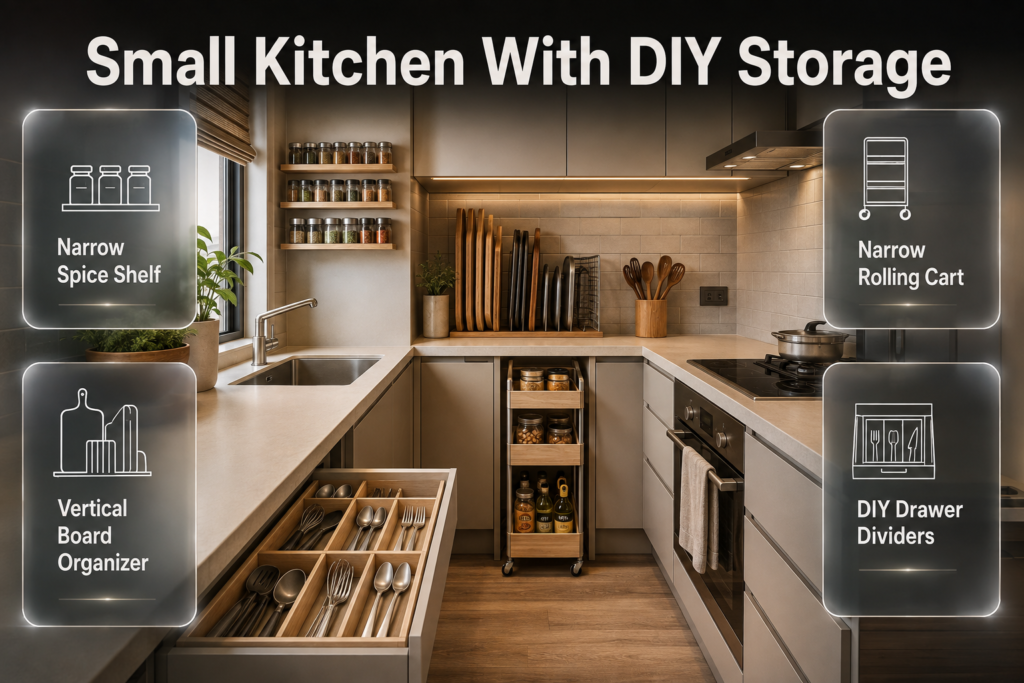
A small kitchen benefits from storage that moves items away from the countertop while keeping everyday tools accessible. Wall-mounted organizers, vertical racks, cabinet-side storage, drawer dividers, and narrow rolling carts are particularly useful because they increase capacity without consuming much floor space.
6. Create a Narrow Spice Shelf
Spice jars don’t need an entire cabinet.
A shallow wall-mounted shelf can keep frequently used spices organized and visible.
Place it somewhere convenient but away from direct heat and excessive moisture.
You can also create multiple narrow shelves vertically instead of one deep shelf.
This prevents jars from becoming stacked behind one another, which is one of the main reasons small kitchen storage becomes frustrating.
7. Build a Vertical Cutting Board Organizer
Cutting boards and baking trays often consume more cabinet space than expected.
A simple vertical divider can turn an unused section of a cabinet into dedicated storage.
Instead of stacking boards horizontally, store them upright.
This makes each item easier to remove without disturbing everything else.
The same principle works for:
- Baking trays
- Serving boards
- Cooling racks
- Pan lids
- Thin chopping boards
The project doesn’t need to be elaborate. Even simple wooden dividers can dramatically improve accessibility.
8. Make a Narrow Rolling Cart
If you have a gap between a refrigerator and cabinet, washing machine and wall, or counter and appliance, measure it carefully.
A slim rolling cart can fit into that space and provide hidden storage.
Use it for:
- Pantry items
- Cleaning supplies
- Spices
- Bathroom products
- Craft materials
- Laundry supplies
The cart should be narrow enough to move easily but wide enough to remain stable.
If you have only a few centimeters of usable space, don’t force a project into it. Sometimes the gap is better left empty for ventilation, cleaning, or appliance access.
9. Improve Kitchen Drawers With DIY Dividers
A small kitchen drawer can become surprisingly inefficient when everything is mixed together.
DIY dividers made from thin wood strips can create dedicated sections for utensils.
Instead of searching through one large drawer, you immediately know where everything belongs.
This is a simple project, but it has a major everyday benefit: less friction.
Good organization isn’t just about appearance. It saves time.
How Can You Organize a Small Bedroom Without Adding Large Furniture?
The best bedroom solutions use walls, hidden areas, and multi-purpose furniture rather than adding another large wardrobe or dresser. Under-bed storage, wall shelves, hooks, slim clothing racks, and storage headboards can increase capacity while preserving walking space.
10. Replace a Bulky Nightstand With a Wall Shelf
A traditional nightstand can occupy more floor space than you actually need.
If all you keep beside your bed is a phone, lamp, book, and glass of water, a compact wall shelf may be enough.
You can even add a small drawer underneath the shelf for personal items.
This creates a cleaner sleeping area and makes vacuuming easier.
11. Build a Storage Headboard
A DIY headboard can become much more than a decorative background.
A wooden headboard with narrow compartments can provide storage for books, glasses, charging cables, and small personal items.
However, don’t make the headboard unnecessarily deep.
The goal is to gain storage without making the bed area feel enclosed.
If your bedroom already has a lot of furniture, consider using the headboard as the primary decorative feature and keep the storage visually simple.
12. Create a Slim Clothing Rack
A narrow clothing rack can supplement a full wardrobe when closet space is limited.
You can create one using wooden dowels, metal pipe, brackets, or reclaimed materials.
Keep the rack organized rather than overcrowded.
Open clothing storage can actually make a small room look messier if every garment is visible. Use a consistent arrangement and keep seasonal clothing elsewhere.
If you want a broader approach to clean, uncluttered interiors, explore Minimalist Interior Design.
13. Create a Fold-Down Wall Desk
A permanent desk can consume valuable floor space in a bedroom, hallway, or studio apartment.
A fold-down wall desk solves that problem by creating a workspace only when you need it.
A basic design can include:
- A wall-mounted frame
- A hinged desktop
- Folding support brackets
- Optional shelves above the surface
- A cable-management solution
Before installation, determine what type of wall you’re working with and select suitable anchors and hardware.
Don’t assume a decorative wall bracket can support a laptop, monitor, books, and other equipment.
A fold-down desk is particularly useful for people who need a temporary home office but don’t want their work area permanently occupying the room.
⭐ Expert Tip: Add a narrow shelf above the desk for stationery and charging accessories. This keeps the desktop available for actual work.
14. Turn an Ottoman Into Hidden Storage
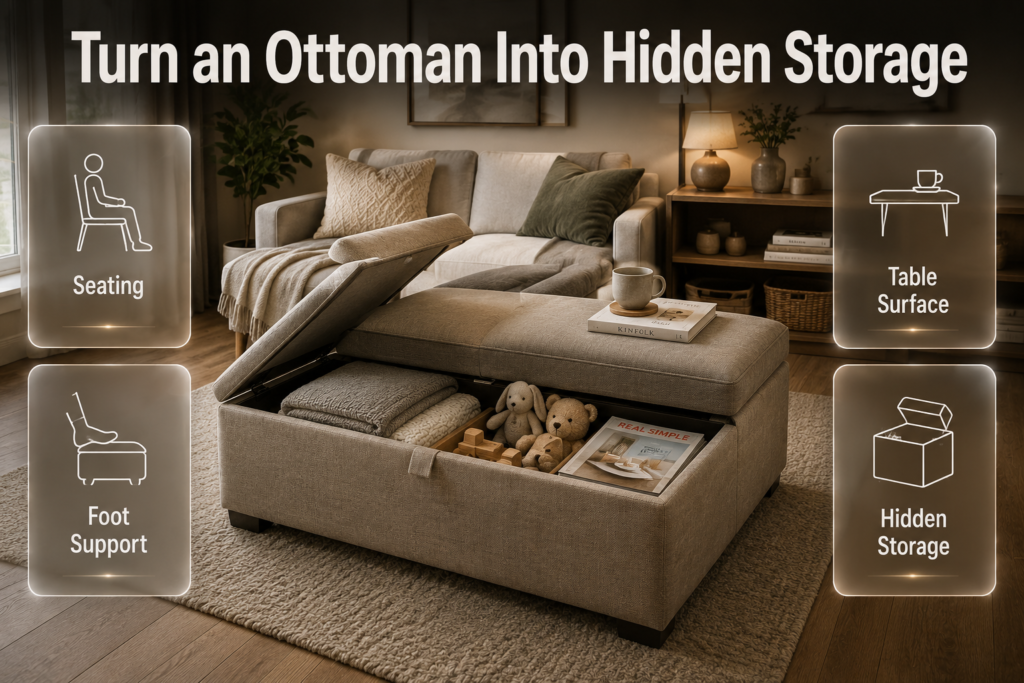
An ottoman can perform several jobs at once.
It can provide:
- Seating
- Foot support
- A temporary table surface
- Blanket storage
- Toy storage
- Magazine storage
You can create a simple storage ottoman from a sturdy wooden box, hinged lid, and appropriate upholstery materials.
The advantage is flexibility.
When guests arrive, it becomes additional seating. When you want to relax, it becomes a footrest. When the room needs to look tidy, its interior hides everyday clutter.
This is exactly the kind of multi-functional thinking that small homes benefit from.
15. Build a Narrow Console Behind the Sofa
If your sofa sits slightly away from the wall, that gap can sometimes become useful storage.
A slim console behind the sofa can hold:
- Lamps
- Books
- Plants
- Charging stations
- Decorative objects
Keep the console narrow enough that it doesn’t reduce the walking path.
This is also a useful way to hide cables from floor-level view.
For more ways to coordinate practical organization with your interior, explore Home Styling.
How Can You Make a Small Bathroom More Functional?
Small bathrooms benefit from vertical storage, door-mounted organization, hooks, narrow shelves, and hidden compartments. Because bathroom floor space is often limited, the best DIY projects keep products off the floor while making frequently used items easy to reach.
16. Install a Narrow Bathroom Shelf
A shallow shelf above the toilet or beside the vanity can provide storage for toiletries, towels, or decorative items.
Choose materials suitable for humid environments.
If you’re using wood, protect it with an appropriate moisture-resistant finish.
Avoid filling every centimeter of the shelf. A few organized containers usually look better than a crowded collection of bottles.
17. Use Hooks Instead of a Traditional Towel Bar
Individual hooks can sometimes provide more flexible storage than one long towel bar.
Install several vertically if wall width is limited.
You can also use hooks behind the bathroom door for robes and extra towels.
Leave enough space between wet towels so they can dry properly.
18. Add Magnetic Storage
A magnetic strip can hold small metal grooming tools such as tweezers, nail tools, and small scissors.
The same concept can be used in kitchens or craft areas.
Because the storage is vertical and extremely shallow, it takes almost no floor space.
What Can You Do With Awkward Corners?
Awkward corners can become useful through narrow shelves, corner cabinets, plant stands, storage benches, or custom-built furniture. The best solution follows the shape of the space instead of forcing standard furniture into an area where it doesn’t fit.
19. Build a Corner Shelf
Corner shelves can turn an unused junction between two walls into functional storage.
Use them for:
- Small plants
- Books
- Decorative objects
- Toiletries
- Kitchen jars
- Collectibles
A tiered corner shelf is particularly effective because it uses vertical space.
If you’re working with an unusual corner, cardboard can be used to create a temporary template before cutting wood.
This simple step can prevent expensive measurement mistakes.
20. Use the Space Above a Door
The wall above a door is useful for items that you don’t need frequently.
A shallow shelf can store:
- Seasonal bedding
- Travel bags
- Decorative items
- Extra towels
- Storage boxes
Because the shelf is high, don’t use it for heavy objects that are difficult to lift safely.
It should be treated as long-term or occasional storage rather than everyday storage.
21. Create an Entryway Drop Zone
Small entryways become messy because there is often no dedicated place for everyday items.
A simple DIY drop zone can solve that.
Install a narrow shelf with hooks underneath.
The shelf can hold:
- Keys
- Wallets
- Small bags
- Sunglasses
The hooks can hold:
- Coats
- Hats
- Umbrellas
- Everyday bags
This combination uses vertical space and gives every item a home.
If your entryway is extremely narrow, use a shelf that’s shallow enough to preserve the walking path.
22. Turn an Old Frame Into an Organizer
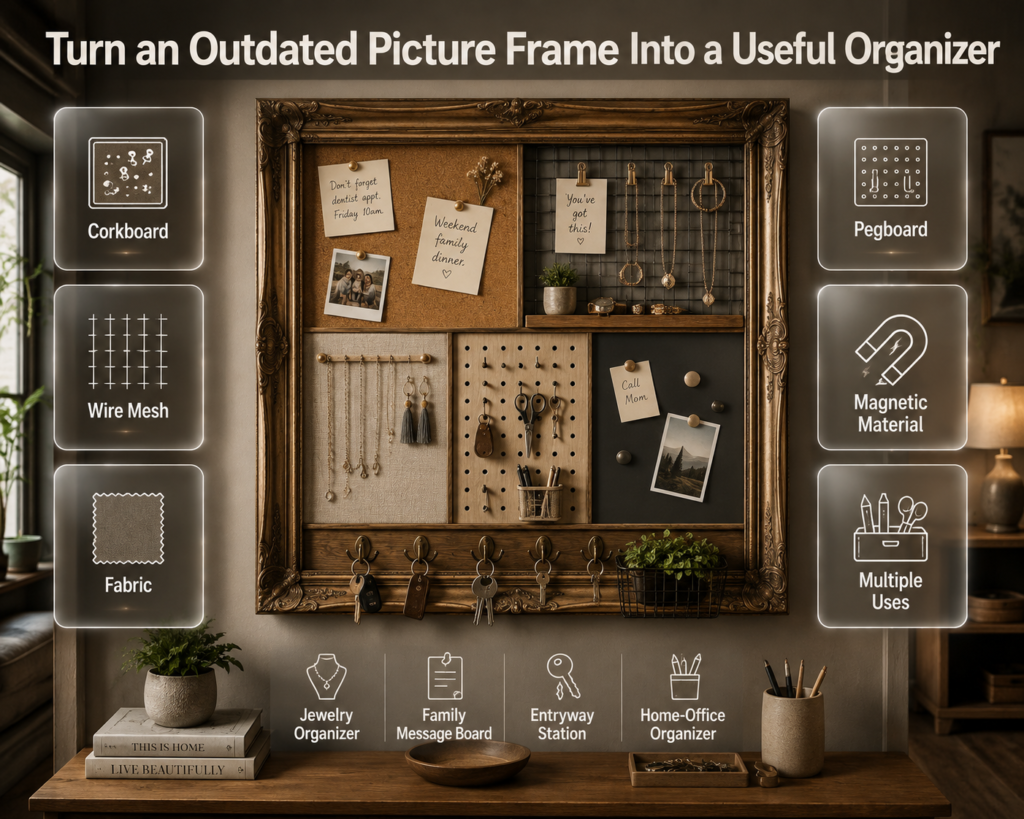
An outdated picture frame can become much more useful than its original purpose.
Remove the old artwork and glass if necessary, then place:
- Corkboard
- Wire mesh
- Fabric
- Pegboard
- Magnetic material
inside the frame.
The finished piece can become a jewelry organizer, family message board, entryway station, or small home-office organizer.
The existing frame gives the project a finished border, which makes the DIY look more intentional.
This is also a good example of how upcycling can solve a storage problem without buying new furniture.
For more creative projects using materials you may already have, explore DIY Home Decor Crafts.
23. Make a Multi-Purpose Bench
A bench can serve as seating, storage, and sometimes even a temporary surface.
In an entryway, build a bench with compartments underneath for shoes.
In a bedroom, use it at the foot of the bed for blankets.
In a living room, it can provide additional seating when guests arrive.
Choose the size according to the room rather than building the largest bench possible.
Small-space furniture should feel proportional.
24. Create a Wall-Mounted Charging Station
Charging cables can make even an organized room look messy.
A simple wall-mounted charging station can gather phones, tablets, watches, and other devices into one location.
You can create one using:
- A small wooden box
- Cable clips
- Charging holes
- A shelf
- A hidden power strip
The result is especially useful near a desk, kitchen counter, or entryway.
Keep electrical components safely installed and don’t overload outlets.
25. Create a Foldable Dining Surface
A small apartment doesn’t always need a permanent dining table.
A wall-mounted foldable table can provide a proper eating or working surface when needed and fold away afterward.
This works particularly well in:
- Studio apartments
- Small kitchens
- Compact balconies
- Multipurpose rooms
You can also pair it with folding chairs that hang on wall hooks when not in use.
The important consideration is structural support. A fold-down surface should be securely mounted and designed for its intended load.
How Do You Make DIY Storage Look Like Part of the Design?
DIY storage looks intentional when its materials, colors, proportions, and hardware complement the rest of the room. The goal is to make storage feel like part of the interior rather than something added after the room became cluttered.
A few simple principles help.
Repeat Materials
If your room already has natural wood furniture, wooden shelves will feel more integrated.
If the room uses black metal details, matching brackets can create visual consistency.
Limit Colors
A small room can become visually noisy when every organizer is a different color.
Choose one or two storage colors that work with the existing palette.
For ideas about choosing coordinated colors, explore Paint Color.
Use Baskets and Containers
Open shelves can quickly become messy.
Matching baskets help hide miscellaneous items while making the overall arrangement look calmer.
Leave Empty Space
Don’t fill every shelf.
Negative space is especially important in small rooms because it reduces visual pressure.
Open Storage vs Closed Storage: Which Is Better?
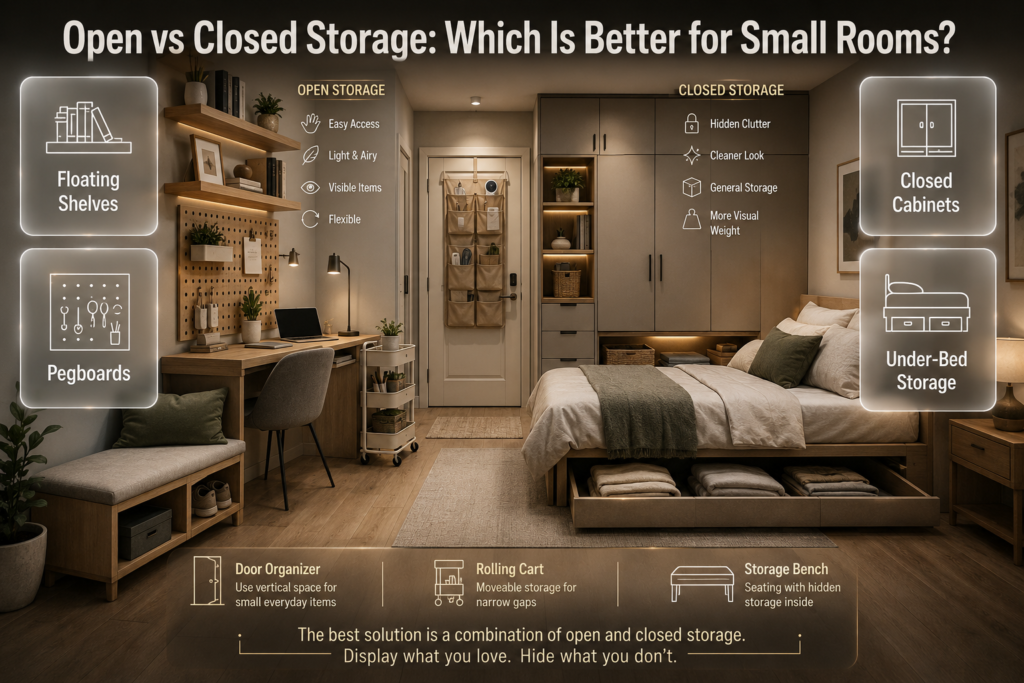
Neither option is universally better. Open storage is convenient and visually light, while closed storage hides clutter and creates a cleaner appearance. Small rooms usually benefit from a combination of both, with attractive or frequently used items displayed openly and miscellaneous belongings stored behind doors or inside baskets.
| Storage Type | Best Use | Benefits | Drawbacks |
|---|---|---|---|
| Floating shelves | Books and decor | Light visual appearance | Shows clutter |
| Closed cabinets | General storage | Hides mess | Can feel bulky |
| Pegboards | Flexible organization | Easy to rearrange | Everything remains visible |
| Under-bed storage | Seasonal items | Hidden | Less accessible |
| Door organizers | Small items | Saves floor space | Adds door weight |
| Rolling carts | Narrow gaps | Flexible and mobile | Can look cluttered |
| Storage benches | Entryways | Seating + storage | Requires floor space |
The right combination depends on what you’re storing and how often you need it.
How Do You Choose the Right Small Space DIY Project?
Choose the project based on the problem you need to solve rather than choosing a project simply because it looks attractive online.
Start with one question:
What is making this room difficult to use?
Then match the problem to the solution.
| Problem | Better DIY Solution |
| No floor space | Wall-mounted storage |
| Messy entryway | Hooks + narrow shelf |
| Full bedroom | Under-bed storage |
| Limited kitchen counter | Vertical organizers |
| No home office | Fold-down desk |
| Tiny bathroom | Door storage + shelves |
| Awkward corner | Corner shelving |
| Narrow gap | Rolling cart |
| Cable clutter | Charging station |
| Too many visible objects | Closed baskets or cabinets |
This prevents wasted effort.
You don’t need ten DIY projects if two carefully chosen ones solve the main problems in your home.
Common Small Space DIY Mistakes You Should Avoid
Even a well-intentioned DIY project can make a small room worse.
Mistake 1: Filling Every Empty Wall
An empty wall isn’t automatically wasted space.
If you cover every wall with shelves, frames, hooks, and storage, the room can feel visually crowded.
Better approach: Choose specific walls for storage and leave other areas quiet.
Mistake 2: Ignoring Measurements
This is one of the most common DIY problems.
People measure the shelf but forget to measure the door swing, furniture clearance, walking path, electrical outlets, or window opening.
Before building, measure:
- Width
- Height
- Depth
- Door clearance
- Furniture clearance
- Walking space
- Outlet locations
Mistake 3: Making Shelves Too Deep
Deep shelves seem useful but often create problems in narrow rooms.
You may lose valuable walking space, hit your shoulder while passing, or end up with objects hidden behind one another.
Mistake 4: Buying Storage Before Decluttering
More containers don’t automatically mean better organization.
If you have 30 things you never use, putting them into three storage boxes doesn’t solve the underlying problem.
Declutter first.
Then design storage around what remains.
Mistake 5: Making Everything Open
Open storage can look attractive in photographs but becomes difficult to maintain in everyday life.
If every object is visible, small amounts of clutter become highly noticeable.
Use a mixture of open shelves and concealed storage.
Mistake 6: Ignoring Safety
DIY storage needs to be secure.
Use suitable anchors, brackets, screws, and mounting systems for the wall type and expected load.
Heavy shelves, fold-down desks, overhead cabinets, and wall-mounted furniture deserve particular attention.
Don’t rely on appearance alone when judging whether a mounting system is strong enough.
How Can You Combine DIY Storage With Different Interior Styles?
DIY doesn’t have to mean rustic or unfinished. The same storage idea can be adapted to contemporary, Japandi, minimalist, traditional, industrial, or eclectic interiors.
For example, a floating shelf can look:
- Minimalist with clean white or natural wood
- Industrial with dark metal brackets
- Japandi with light wood and simple forms
- Contemporary with concealed hardware
- Rustic with reclaimed timber
The construction concept stays similar; the material and finish change.
If you’re developing a specific design direction, explore Interior Design Styles and Japandi Interior Design for additional inspiration.
For a cleaner modern aesthetic, Contemporary Interior Design can also help you think about proportions, materials, and visual balance.
How Can Decorative Finishes Improve DIY Projects?
A DIY storage piece doesn’t need expensive materials to look polished.
The finish often makes the biggest difference.
You can use:
- Paint
- Stain
- Matte finishes
- Decorative hardware
- Matching handles
- Edge banding
- Wallpaper
- Textured surfaces
The trick is to match the finish to the surrounding room.
For example, a simple plywood shelf can look much more refined with carefully sanded edges, a consistent finish, and appropriate brackets.
For projects where surface treatment matters, explore Decorative Finishes.
How Can You Make a Small Home Feel Less Cluttered?
A small home feels less cluttered when possessions have defined locations and frequently used items are easy to put away. The goal is not to hide everything but to prevent surfaces and walkways from becoming permanent storage zones.
A simple daily system can help.
The Five-Minute Reset
At the end of the day:
- Return loose items to their designated locations.
- Clear kitchen counters.
- Put clothing into the closet or laundry.
- Return shoes to the entryway storage.
- Hide remote controls and small electronics.
- Remove obvious trash.
- Reset one frequently used surface.
This takes only a few minutes but prevents small problems from becoming major clutter.
The best DIY storage system is one that’s easy enough to maintain.
How Can You Use Small Space DIY Hacks Without Overspending?
The cheapest approach is to identify what you already own and determine whether it can be repurposed before buying new materials.
Useful materials may include:
- Leftover wood
- Old drawers
- Unused frames
- Metal brackets
- Storage boxes
- Pegboards
- Hooks
- Fabric
- Baskets
An old drawer can become an under-bed container.
An old frame can become a wall organizer.
A spare shelf can become a bedside table.
A wooden crate can become a small storage unit.
The point isn’t to turn everything into a DIY project. Sometimes buying an inexpensive, well-designed organizer is more practical than spending several hours constructing one.
The best decision considers cost, time, durability, safety, and usefulness.
Professional Tips for Better Small-Space DIY Results
Good small-space projects often follow a few principles that professional designers use repeatedly.
Think Vertically First
Before adding floor furniture, look at the walls.
Vertical storage generally has less impact on circulation.
Keep Everyday Items Accessible
Don’t put things you use every morning in an overhead cabinet.
Convenience matters.
Hide Random Clutter
Baskets, drawers, and cabinets are useful for items that don’t need to be displayed.
Use Multi-Purpose Furniture
A storage bench is better than a bench and separate storage box when space is limited.
Design Around Real Habits
If your family always drops keys near the entrance, put the key storage there.
If everyone leaves chargers beside the sofa, create a charging station there.
Good organization follows behavior instead of fighting it.
For more practical home improvement ideas, explore Home Improvement.
How Can Small Space DIY Hacks Support Energy Efficiency?
Organization can indirectly support energy-efficient living by helping you keep windows, vents, radiators, and HVAC equipment unobstructed.
Avoid building shelves or cabinets directly in front of ventilation openings.
Keep air-conditioning units accessible for maintenance.
Don’t use storage as a reason to block natural light.
A well-organized room can also make it easier to notice problems such as blocked vents, inefficient lighting, or appliances that are consuming unnecessary space and energy.
For broader ideas about practical efficiency at home, explore Energy-Efficient Homes.
When Should You DIY and When Should You Hire a Professional?
DIY is a good option for simple projects that match your skill level and don’t involve significant structural, electrical, or plumbing risks.
Good DIY candidates include:
- Simple shelves
- Hooks
- Drawer dividers
- Decorative organizers
- Basic storage boxes
- Non-structural furniture
- Simple pegboards
Professional help may be more appropriate for:
- Major wall alterations
- Structural work
- Complex electrical changes
- Plumbing modifications
- Heavy built-in cabinets
- Projects involving uncertain wall structure
Knowing when not to DIY is part of being a good DIYer.
A project isn’t successful simply because you built it yourself. It is successful when the finished result is safe, useful, durable, and appropriate for the space.
What are the best DIY hacks for maximizing space in a small room?
The most effective DIY hacks are the ones that add function without taking away valuable floor space. Instead of bringing in another bulky cabinet, use walls, doors, corners, and hidden areas that are already available. Floating shelves, pegboards, over-the-door organizers, under-bed storage, fold-down desks, and narrow rolling carts are practical examples.
The key is to think vertically and use storage according to how you actually live. Current small-space design advice consistently highlights vertical storage and multifunctional furniture because they increase usefulness without expanding the room’s footprint.
Practical ideas:
Install floating shelves above desks or furniture.
Use the back of doors for lightweight storage.
Store seasonal belongings under the bed.
Choose furniture that performs two jobs.
Turn awkward corners into narrow storage zones.
The best hack isn’t necessarily the most creative one. It’s the solution that removes a specific daily frustration while keeping the room comfortable.
How can I create more storage in a small home without making it look cluttered?
The secret is to combine open storage with concealed storage rather than displaying everything. Open shelves are useful for books, plants, and attractive objects, while baskets, drawers, cabinets, and boxes are better for miscellaneous items that would otherwise create visual noise.
This matters because small rooms show clutter much faster than large rooms. Even when everything technically has a place, too many visible objects can make the space feel busy.
A better storage balance:
Keep frequently used items accessible.
Hide miscellaneous belongings inside baskets or cabinets.
Use matching containers where possible.
Leave empty space between displayed objects.
Avoid filling every available wall.
A professional-looking small room isn’t one where every inch is occupied. It’s one where storage is organized enough that the room still has visual breathing space.
What is the cheapest DIY way to maximize space in a small apartment?
The cheapest approach is to use what you already have before buying new storage. Repurposing old drawers, unused frames, leftover wood, baskets, crates, and existing shelves can solve surprisingly many organization problems.
Before spending money, walk through your home and identify objects that could serve a different purpose. An old drawer can become an under-bed storage box, a picture frame can become a wall organizer, and a spare shelf can become a compact bedside table.
Try this before buying anything:
Declutter one room.
Identify unused materials.
Measure awkward gaps.
Reuse existing furniture where possible.
Buy only the hardware or materials you genuinely need.
This approach also prevents a common mistake: buying attractive storage containers before deciding what actually needs to be stored.
How do I use vertical space in a small room?
Start by looking at the empty wall area above furniture, doors, desks, and other functional zones. Vertical storage can include floating shelves, pegboards, wall-mounted cabinets, hooks, tall shelving, and narrow organizers.
The advantage is simple: you’re using height rather than expanding into the walking area. That’s why vertical storage remains one of the most frequently recommended strategies for compact homes in 2026.
Good places to use vertical space:
Above a desk
Beside a bed
Above a toilet
Behind an entryway door
Above a kitchen counter
Around unused wall corners
Above existing cabinets
Don’t automatically cover an entire wall, though. Too much open shelving can make a small room look visually crowded. Use the wall strategically and keep less attractive clutter concealed.
What DIY furniture works best for a very small apartment?
Furniture that performs more than one function is usually the smartest choice for a very small apartment. A storage ottoman, fold-down desk, storage bench, bed with drawers, nesting table, or coffee table with concealed storage can provide multiple functions without requiring several separate pieces.
This approach is especially useful when every square foot has to work hard. Current small-space design recommendations increasingly focus on multifunctional furniture because it reduces the amount of furniture needed in the first place.
Consider furniture that provides:
Seating + storage
Desk + shelving
Bed + clothing storage
Table + workspace
Bench + shoe storage
Before building anything, ask yourself whether the piece can solve two problems instead of one. That’s usually a better investment of limited space.
Conclusion
Small spaces don’t need more furniture—they need smarter solutions. The most effective small space DIY hacks focus on using overlooked areas, reducing visible clutter, and giving everyday items a clear place to live. A floating shelf, under-bed storage system, fold-down desk, narrow rolling cart, or simple wall organizer can make a surprisingly big difference without requiring an expensive renovation.
The key is to avoid trying to use every available inch. Leave enough open space for comfortable movement and choose DIY projects based on your actual needs. Start with the area that causes the most frustration, measure carefully, and build a solution that is practical, durable, and easy to maintain.
When storage becomes part of the overall design rather than an afterthought, even a compact apartment can feel organized, comfortable, and intentional. Use your walls, corners, doors, and hidden spaces wisely, and let every piece in your home serve a genuine purpose.
Leave a Reply