

When commercial real estate acquisition teams evaluate multifamily properties, they generate investment models that determine not just whether to buy, but what improvements will maximize returns. These underwriting analyses increasingly influence interior design choices before construction crews arrive. As artificial intelligence transforms how quickly teams can model renovation scenarios and capital expenditure outcomes, the connection between financial analysis and physical design has become more immediate and granular than ever.
Understanding this relationship helps interior designers, property developers, and investment professionals communicate more effectively about value-add strategies. The numbers that drive acquisition decisions also define the budget, timeline, and scope for every design element from unit finishes to common area amenities.
The Underwriting Foundation of Design Budgets
Commercial real estate underwriting builds a financial model that forecasts property performance over a hold period, typically five to ten years for multifamily assets. The model incorporates current rents, operating expenses, capital improvement costs, financing terms, and eventual sale proceeds. Every design decision that requires capital flows through this framework as either a renovation cost that reduces returns or a rent-growth catalyst that enhances them.
Acquisition teams test multiple scenarios during diligence. A Class B property might be underwritten with three interior upgrade packages: a light refresh at $3,000 per unit, a moderate renovation at $8,000 per unit, or a full gut rehabilitation at $18,000 per unit. Each scenario produces different pro forma rents, absorption timelines, and internal rates of return. The winning strategy emerges from modeling, not intuition.
This process determines which design elements receive funding. Quartz countertops might be approved if market comps support a $150 monthly rent premium, but rejected if the return falls below the acquisition hurdle rate. The underwriting model quantifies the financial impact of every finish selection, amenity addition, and spatial reconfiguration.
Real-Time Analysis During the Design Phase

Traditional underwriting required days or weeks to rebuild models when design specifications changed. This lag separated financial analysis from design development, often leading to budget overruns when teams discovered that approved concepts exceeded pro forma assumptions. The iteration cycle between designers and acquisition analysts created friction and delayed decisions.
Modern commercial real estate platforms have compressed this timeline substantially. Noal exemplifies how AI automation transforms deal documents into investment models in minutes, allowing teams to test design scenarios during active project discussions rather than afterward. When underwriting becomes fast enough to match the pace of design meetings, financial constraints shape creative decisions in real time instead of vetoing them later.
This shift enables a more collaborative workflow. Interior designers can propose finish upgrades and immediately see their impact on projected returns. If luxury vinyl plank flooring costs $4 per square foot but only supports $75 additional monthly rent, while engineered hardwood at $7 per square foot justifies $140 more, the team can make an informed choice during the design session rather than waiting for revised pro formas.
Capital Stack Implications for Renovation Scope
The financing structure of a multifamily acquisition directly constrains design ambitions. A deal with 70% senior debt, 20% preferred equity, and 10% common equity has different renovation capacity than one with 60% debt and 40% all-equity. Preferred equity typically requires priority returns of 12% to 15%, which means renovation costs must generate enough incremental net operating income to satisfy all capital providers in their waterfall sequence.
Designers working on value-add multifamily projects must understand these capital dynamics. A property acquired with bridge financing often includes a renovation budget embedded in the initial loan, but that budget is fixed at closing based on underwritten costs. Design changes that exceed the allocated renovation dollars either reduce developer profit or require additional equity contributions that dilute returns.
Bridge lenders also impose renovation timelines, frequently requiring unit turns within 18 to 24 months to refinance into permanent financing. This schedule affects design complexity. Intricate custom millwork that extends installation time by three weeks per unit might jeopardize the refinancing deadline, triggering extension fees or default scenarios regardless of aesthetic merit.
Matching Design Standards to Market Positioning
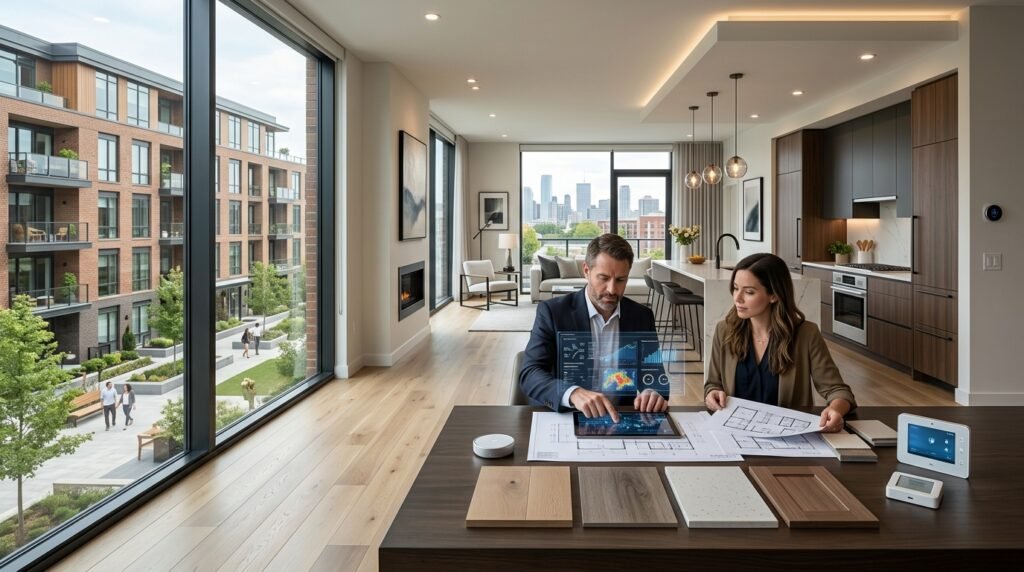
Underwriting models incorporate market rent comparables that define the target tenant profile. A property positioned to compete with Class A new construction requires different interior specifications than one targeting workforce housing. The financial model reveals whether the submarket can absorb premium finishes or whether simpler, durable materials optimize returns.
Recent research on machine learning applications in real estate valuation demonstrates how algorithms can identify rent-driving amenities with greater precision than traditional comparable analysis. These tools help acquisition teams predict which design features tenants will pay for versus which represent cost without corresponding revenue benefit.
Smart building technologies present a specific challenge in this regard. The integration of connected devices for lighting, climate control, and security adds both upfront installation costs and ongoing operational complexity. Underwriting must account for the incremental rent premium these systems generate, the maintenance expenses they create, and their impact on tenant retention rates. Many institutional investors now require detailed technology specifications during the diligence phase specifically because these systems affect long-term asset value.
Common Area Investments and NOI Impact
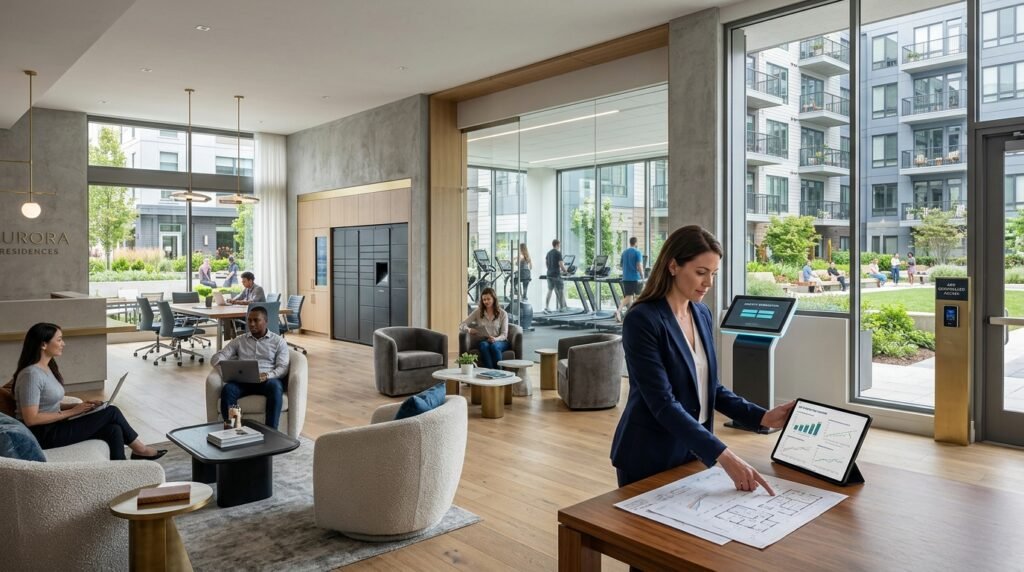
While unit interiors directly affect rent revenue, common area renovations influence net operating income through both retention and attraction. A renovated fitness center or co-working lounge does not command per-square-foot rent, but it reduces turnover costs and shortens lease-up periods. Underwriting models must estimate these softer benefits, which introduces more uncertainty than unit upgrade analysis.
Acquisition teams typically allocate 15% to 25% of total renovation budgets to common areas, with the percentage varying based on property age and competitive set. The underwriting assumption for common area impact usually appears as a reduction in vacancy loss or an acceleration in absorption rather than direct rent growth. Designers proposing elaborate amenity spaces must articulate their business case in these terms to align with how analysts model the investment.
The relationship between smart home interior design principles and commercial property common areas has evolved as residents expect residential-quality technology in shared spaces. Package lockers with digital access, reservation systems for amenities, and app-controlled guest entry represent intersection points where design decisions require both capital budgeting and operational planning.
Performance Tracking After Acquisition
Once renovation work begins, actual costs and realized rents must be tracked against underwriting assumptions. Variance reporting identifies whether design choices perform as modeled. If quartz countertops were underwritten to support $125 premium rents but market data shows only $95 premiums after six months, the investment thesis requires adjustment for future phases or properties.
Asset management teams use this feedback to refine design standards across portfolios. A multifamily operator with 20 properties can test different finish packages in each and measure results systematically. This empirical approach replaces aesthetic preference with performance data, creating design standards that optimize returns rather than reflect personal taste.
The sophistication of this tracking varies widely. Some operators maintain detailed unit-level databases linking finish specifications to lease terms, tenant demographics, and renewal rates. Others rely on property-level aggregates that obscure which specific design elements drive results. The quality of post-acquisition data collection determines how well teams can improve underwriting accuracy for subsequent deals.
Bridging Financial Analysis and Physical Design
The most effective multifamily renovation projects emerge from genuine collaboration between acquisition analysts and design professionals. When financial teams understand how material selections affect installation complexity and timeline, they build more realistic budgets. When designers understand how their choices flow through waterfall structures and return calculations, they propose options that advance rather than obstruct business objectives.
This integration requires shared vocabulary and mutual respect for each discipline’s constraints. Designers must accept that beautiful concepts without financial justification will be rejected. Analysts must recognize that cost-cutting beyond a certain threshold degrades the product in ways that depress rents more than anticipated. The partnership works when both sides contribute expertise to the decision rather than defending predetermined positions. Thoughtful home decor planning, for example, demonstrates how aesthetic choices can be balanced with practical requirements. Similarly, incorporating DIY storage solutions and functional wall shelves can help design teams explore space-efficient options while considering renovation budgets and residents’ everyday needs.
As artificial intelligence continues to accelerate underwriting workflows and expand scenario testing capabilities, the opportunity for this collaboration deepens. Faster financial modeling means more design iterations can be evaluated, and more creative solutions can be tested against market realities before committing capital. The result is multifamily properties where design excellence and investment performance reinforce rather than compete with each other.