
Introduction
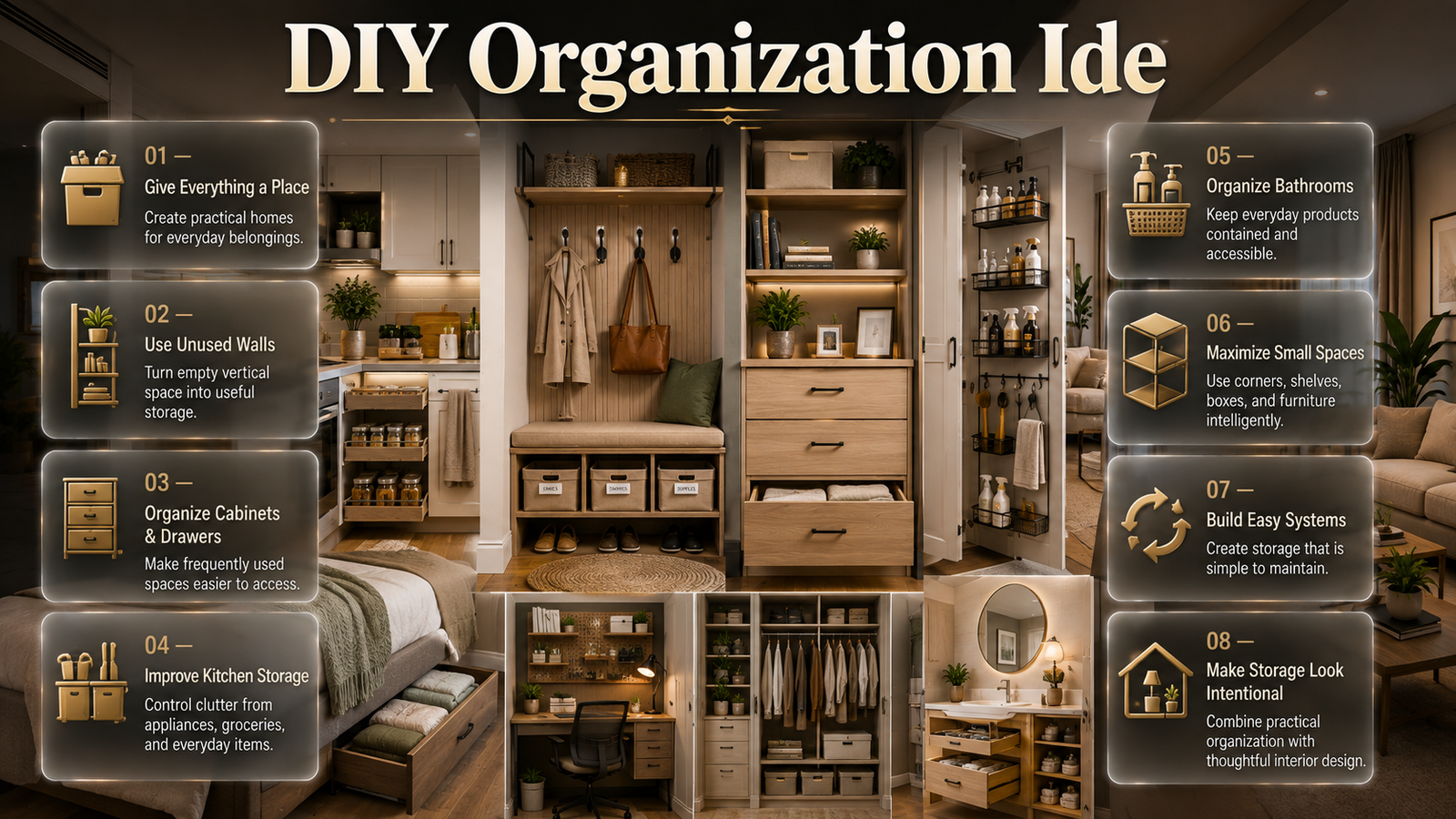
DIY Organization Ide | A home can feel messy even when you don’t actually own too many things. The real problem is often that everyday belongings don’t have a practical place to go. Shoes collect beside the entrance, kitchen counters disappear under appliances and groceries, bathroom products spread across the sink, and drawers become impossible to open without moving everything inside them.
That is exactly why DIY organization ideas can make such a noticeable difference. You don’t always need expensive storage furniture, a professional renovation, or a large budget. With a little planning, you can turn unused walls, cabinet doors, empty corners, old furniture, shelves, boxes, and drawers into useful storage.
The important part is not simply creating more places to put things. Good organization makes your home easier to use. You should be able to find what you need quickly, return it without effort, and maintain the system without constantly reorganizing everything.
In this guide, you’ll find practical DIY organization ideas for kitchens, bedrooms, bathrooms, entryways, home offices, closets, small homes, and other everyday spaces. You’ll also learn how to decide which storage projects are worth doing, which mistakes to avoid, and how to make homemade organization look intentional rather than improvised.
If you’re also improving the overall function and appearance of your home, DesignMode24 Interior Design can provide additional inspiration for combining practical storage with thoughtful interior design.
What Are the Best DIY Organization Ideas for a Home?
The best DIY organization ideas solve a specific storage problem without making the room harder to use. They usually rely on vertical space, existing furniture, containers, hooks, shelves, dividers, or hidden areas rather than simply adding more bulky furniture.
Before starting any organization project, identify the actual problem.
Ask yourself:
- What area becomes messy most often?
- Which belongings are constantly left out?
- What do I use every day?
- What do I rarely use?
- Which spaces are currently wasted?
- Could I store something vertically?
- Can an existing item be reused?
- Would a simpler storage solution work better?
This small assessment can save you money and prevent unnecessary DIY projects.
For example, if shoes always end up around your front door, you probably don’t need a complete entryway renovation. A narrow shoe rack, a few hooks, and a small tray may solve the problem.
If your kitchen counters are crowded, the answer may not be another cabinet. Moving a few frequently used items onto a wall-mounted shelf or using cabinet-door storage could free valuable workspace.
The Basic Rule of Effective Organization
A good organization system should make three things easier:
- Finding an item
- Using an item
- Putting the item away
If your storage solution looks beautiful but makes these three actions difficult, it isn’t really an effective system.
💡 Pro Tip: Before building anything, observe where clutter naturally collects for several days. Those clutter zones reveal exactly where your home needs better organization.
1. Turn Empty Walls Into Vertical Storage
One of the easiest ways to increase storage without sacrificing floor space is to use your walls.
Many homes have completely empty wall areas that could hold lightweight everyday belongings. Floating shelves, pegboards, rails, hooks, and narrow wall-mounted cabinets can turn those spaces into useful storage.
This is particularly valuable in:
- Small apartments
- Narrow hallways
- Kitchens
- Bathrooms
- Home offices
- Laundry rooms
- Craft rooms
- Bedrooms
For example, an empty wall beside a desk could hold stationery, books, files, and small baskets. A kitchen wall could hold utensils, cutting boards, or frequently used ingredients.
Floating shelves are especially useful because they provide storage while keeping the floor visually open. For more ideas, explore Floating Shelf Ideas.
How to Make Wall Storage Look Better
Avoid filling every available inch.
Leave some breathing room between objects, group similar items together, and combine functional storage with a few decorative elements.
You could use:
- One shelf for books
- One basket for small items
- Hooks underneath for frequently used accessories
- A small decorative object to break up the arrangement
⚠ Common Mistake: Installing shelves without checking the wall structure, hardware requirements, or expected weight. Heavy books and dishes require much stronger support than lightweight decorations.
2. Create a DIY Entryway Organization Station
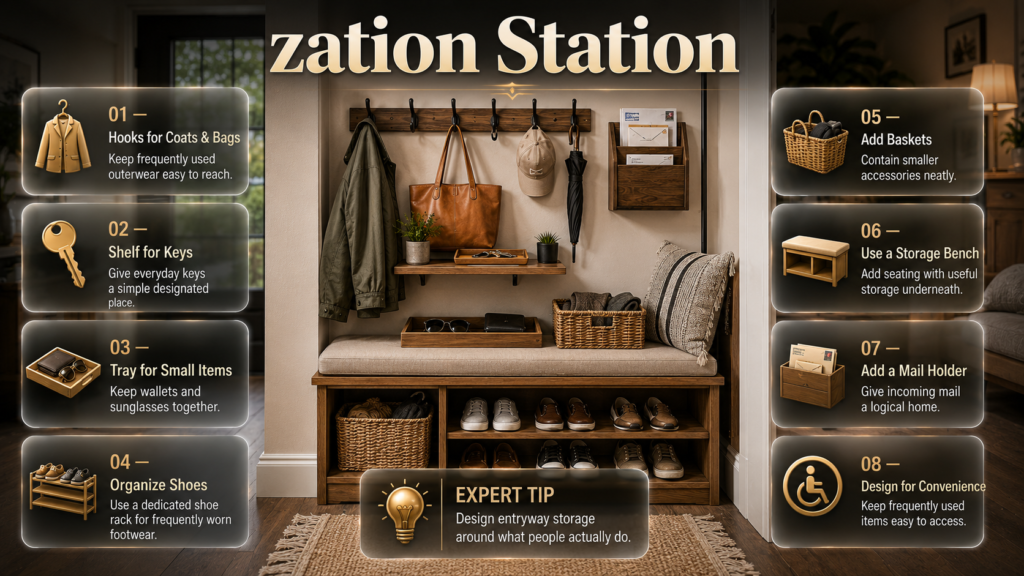
The entryway is one of the easiest places for clutter to accumulate because everyone naturally drops things when coming home.
Keys, shoes, bags, jackets, mail, umbrellas, sunglasses, and other small items can quickly take over a hallway.
A simple DIY entryway station can give each category a logical home.
Consider combining:
- Wall hooks for coats and bags
- A small shelf for keys
- A tray for wallets and sunglasses
- A shoe rack
- Baskets for accessories
- A narrow bench with storage underneath
- A mail holder
You don’t need a large hallway to create an effective system.
A narrow wall can often support hooks and a shallow shelf without making the area feel crowded.
Make the Entryway Easy to Maintain
The most important items should be the easiest to access.
If you use your keys every day, don’t put them inside a difficult-to-open box. If shoes are worn constantly, don’t store them in a container that requires several steps to access.
⭐ Expert Tip: Design entryway storage around what people actually do, not what you wish they would do. Convenience makes organization much easier to maintain.
3. Build DIY Drawer Dividers
A drawer without compartments can become messy surprisingly quickly.
DIY drawer dividers divide a large open space into smaller sections so similar objects remain together.
You can create simple dividers from:
- Thin wood strips
- Foam board
- Strong cardboard
- Acrylic pieces
- Repurposed containers
- Suitable leftover materials
Use them for:
- Socks
- Underwear
- Kitchen utensils
- Stationery
- Makeup
- Craft supplies
- Cables
- Small tools
Measure the inside of the drawer carefully before cutting materials.
The dividers should fit securely enough that they don’t slide around whenever the drawer opens.
Don’t Over-Divide
More compartments don’t automatically mean better organization.
If a drawer contains six types of small objects, six separate compartments might make sense. But if you create fifteen tiny sections for everyday belongings, returning items can become frustrating.
📌 Quick Tip: Create broad categories first. You can always divide a section further later if you discover that you genuinely need it.
4. Use Cabinet Doors for Hidden Storage
The inside of a cabinet door is often completely unused.
With the right lightweight organizer, hooks, racks, or slim containers, this forgotten space can become useful storage.
In the kitchen, cabinet doors can hold:
- Measuring spoons
- Kitchen towels
- Small brushes
- Food wraps
- Cleaning cloths
- Lightweight utensils
In a bathroom cabinet, the same concept can work for:
- Hair accessories
- Small grooming tools
- Brushes
- Lightweight toiletries
Always check the door’s clearance before installing anything.
An organizer that is too deep can prevent the door from closing or interfere with shelves inside the cabinet.
5. Make a DIY Pegboard Organization Wall
Pegboards are popular because they can change as your storage needs change.
Unlike permanently fixed shelves, a pegboard lets you reposition hooks, baskets, holders, and small shelves.
That makes it useful for:
- Home offices
- Craft areas
- Garages
- Workshops
- Laundry rooms
- Kitchens
- Hobby spaces
A home office pegboard could hold scissors, headphones, notebooks, cables, and stationery.
A craft-room pegboard could organize scissors, ribbons, brushes, thread, and tools.
A garage pegboard can keep frequently used hand tools visible and accessible.
The key is to create zones instead of randomly covering the board.
For example:
Left side: frequently used tools
Middle: small containers
Right side: occasional tools
This makes the system easier to understand.
6. Create Under-Bed Storage
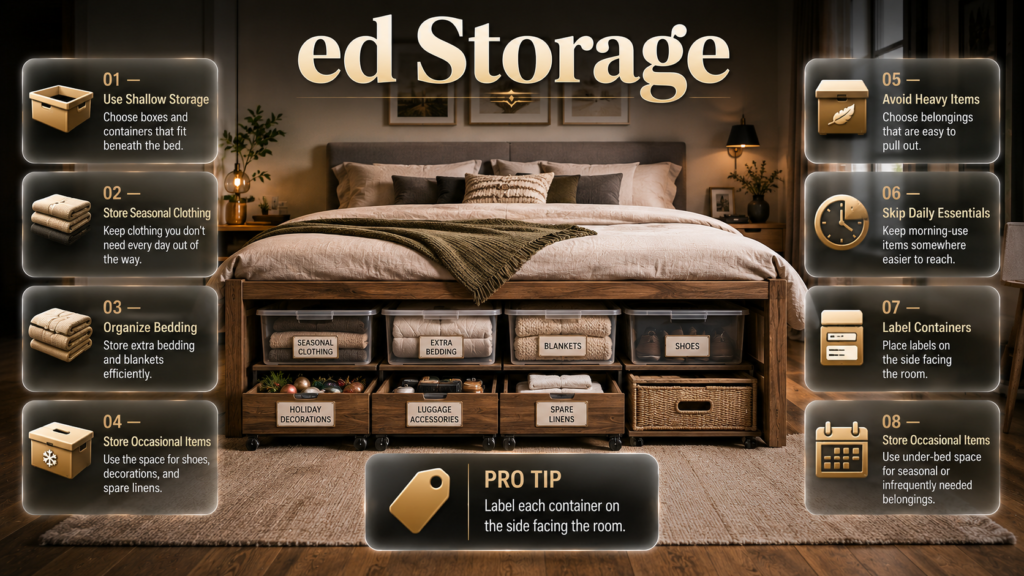
The space beneath your bed is often valuable storage that costs nothing to create.
Use suitable shallow boxes, rolling containers, or repurposed drawers to store things you don’t need every day.
Good choices include:
- Seasonal clothing
- Extra bedding
- Blankets
- Shoes
- Holiday decorations
- Luggage accessories
- Spare linens
Avoid storing heavy items that are difficult to pull out.
Also avoid using the area for belongings you need every morning. Under-bed storage is best for occasional or seasonal items.
💡 Pro Tip: Label each container on the side facing the room. You should know what’s inside without pulling every box out.
7. Repurpose Old Furniture Into Storage
One of the smartest DIY organization approaches is to look at old furniture differently.
An outdated piece doesn’t necessarily need to be thrown away. With cleaning, repairs, paint, new hardware, or a small structural adjustment, it may become useful storage.
Examples include:
- An old dresser becoming craft storage
- A narrow cabinet becoming a cleaning station
- A ladder becoming a blanket rack
- Wooden crates becoming modular shelves
- An old side table becoming a plant-storage stand
- A small cabinet becoming an entryway organizer
This approach is especially useful when you want storage that feels unique rather than mass-produced.
If you’re interested in giving existing furniture a new purpose, Furniture Makeovers can provide additional inspiration.
Why Repurposing Works
Repurposing saves resources and can reduce the amount of new furniture you need.
It also lets you create storage around an existing space.
Instead of asking, “What storage unit should I buy?” you can ask, “What can this piece already do?”
That change in thinking often leads to more creative solutions.
8. Organize Your Bathroom With Small Storage Zones
Bathrooms usually contain many small products but often have limited storage.
Instead of allowing toiletries to cover every surface, create separate zones based on frequency of use.
For example:
Daily-use zone: toothbrush, skincare, soap, everyday products
Occasional-use zone: styling tools, special treatments
Backup zone: unopened products and replacements
Possible storage solutions include:
- Drawer dividers
- Small shelves
- Baskets
- Wall hooks
- Slim rolling carts
- Cabinet-door organizers
- Small containers
Keep everyday items easy to reach.
Store backup products somewhere else so the countertop doesn’t become a warehouse.
Don’t Store Everything in the Bathroom
Bathrooms are humid environments, so not every product or material is ideal for long-term bathroom storage.
Check product instructions when necessary, especially for items affected by heat, moisture, or hygiene requirements.
9. Create a DIY Cable Organization Station
Cables are small, but they create disproportionate visual clutter.
A desk can look messy simply because chargers and cords are tangled together.
A basic cable organization station can use:
- Small labeled bags
- Cable clips
- Velcro ties
- Divided boxes
- Small containers
- A dedicated charging drawer
Separate cables according to use.
For example:
- Phone chargers
- Laptop accessories
- Camera equipment
- Audio cables
- Backup cables
Labeling is particularly useful if several cables look almost identical.
⚠ Common Mistake: Keeping every cable you’ve ever owned. If you don’t know what a cable belongs to and haven’t used it for a long time, check whether it is genuinely worth keeping.
10. Build a Vertical Home Office Organizer
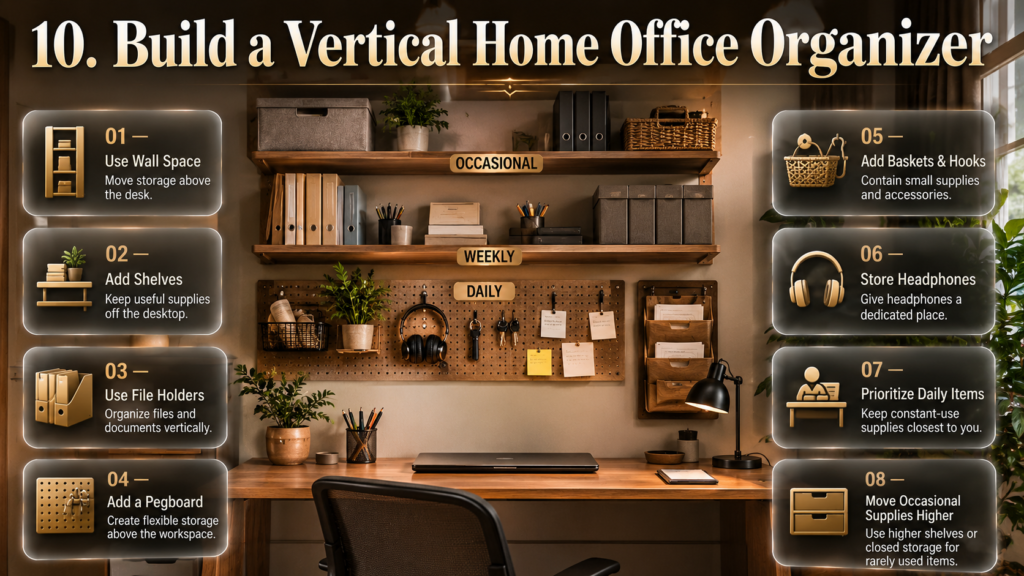
A small desk can become much more functional when you stop expecting the desktop to store everything.
Use the wall above the desk for:
- Shelves
- File holders
- Pegboards
- Small baskets
- Hooks
- Notes
- Headphone storage
Divide office supplies into three simple categories:
| Category | Examples |
|---|---|
| Daily | Notebook, pens, charger |
| Weekly | Files, stationery, documents |
| Occasional | Extra paper, equipment, supplies |
The items you use constantly should be closest to you.
Rarely used supplies can move to higher shelves or closed storage.
This approach keeps your work surface clear without hiding everything away.
11. Use Baskets to Control Visual Clutter
Baskets are useful because they can contain many small objects without displaying every individual item.
They work well for:
- Blankets
- Toys
- Magazines
- Towels
- Pet supplies
- Cables
- Accessories
- Cleaning cloths
But there is one important warning: a basket can easily become a dumping zone.
If everything gets thrown into one large basket, you’ve technically contained the clutter without actually organizing it.
How to Use Baskets Properly
Assign each basket a purpose.
For example:
- “Remote Controls”
- “Extra Cables”
- “Winter Accessories”
- “Living Room Throws”
Use labels when the contents aren’t immediately obvious.
A good basket system should make finding things easier, not harder.
12. Organize Your Closet Around Your Routine
Closets become difficult to maintain when everything is treated as equally important.
Instead, arrange clothing according to how often you use it.
Keep everyday clothing in the easiest-to-reach areas.
Place:
- Seasonal clothing higher up
- Formalwear in less frequently accessed sections
- Shoes in dedicated lower storage
- Accessories in smaller containers
- Everyday items within comfortable reach
Use shelf dividers, hooks, baskets, and suitable organizers to prevent categories from mixing.
Measure Before Buying Closet Storage
Don’t purchase storage products based only on appearance.
Measure:
- Shelf width
- Shelf depth
- Vertical clearance
- Hanging space
- Door clearance
A beautiful organizer that doesn’t fit is simply wasted money.
13. Create a DIY Cleaning Supply Station
Cleaning products often become scattered because different items are stored in different rooms.
Where practical, create one dedicated cleaning station.
A sturdy basket, cabinet, shelf, or rolling cart can hold related supplies together.
Divide items into groups such as:
- General cleaning
- Bathroom cleaning
- Kitchen cleaning
- Cloths and sponges
- Replacement supplies
This also makes it easier to notice when something needs replacing.
For safety, household cleaning chemicals should be stored securely and according to their labels, particularly in homes with children or pets.
14. Use Labels to Make Storage Easier for Everyone
Labels become particularly valuable when several people share the same home.
A label eliminates uncertainty.
Instead of wondering where something belongs, everyone can see its intended location.
Labels are useful for:
- Pantry containers
- Storage boxes
- Craft supplies
- Seasonal decorations
- Documents
- Cleaning supplies
- Children’s belongings
Don’t label every single object.
Use labels where they actually reduce confusion.
⭐ Expert Tip: Keep category names simple. “Baking Supplies” is easier to maintain than a complicated classification system containing several narrow subcategories.
15. Organize the Pantry for Visibility
A pantry becomes easier to manage when you can see what you already own.
Useful DIY or low-cost storage additions include:
- Shelf risers
- Baskets
- Dividers
- Stackable containers
- Labels
- Pull-out bins
Group food by how you use it.
For example:
- Breakfast foods
- Baking ingredients
- Snacks
- Pasta and grains
- Canned goods
- Spices
- Backup supplies
The objective isn’t to create a social-media-perfect pantry.
The objective is to prevent forgotten products, duplicate purchases, and difficult-to-reach food.
If you transfer food into containers, use suitable food-safe storage and retain relevant product information such as expiry dates and allergen details.
16. Make a Small-Space Organization Plan
Small homes need a slightly different approach because storage can easily make the room feel even smaller.
The most effective strategy is to use storage that takes advantage of unused areas.
Prioritize:
- Vertical walls
- Under-bed areas
- Cabinet doors
- Narrow gaps
- Corners
- Multi-purpose furniture
- Hidden compartments
For example, a narrow rolling cart may fit between a refrigerator and cabinet where a traditional storage unit would never work.
A bench with hidden storage can provide seating and organization simultaneously.
A wall-mounted shelf can replace a floor-standing cabinet.
For additional ideas about creating a coordinated home, explore Home Design Ideas.
What Should You Organize First?
Start with the area that causes the most repeated frustration. If your entryway is constantly messy, organize that first. If your kitchen counters are unusable, start there. Fixing the most disruptive clutter creates a noticeable improvement and gives you momentum for the next project.
A useful priority system is:
| Priority | Area | Why |
| High | Entryway | Clutter appears daily |
| High | Kitchen | Affects everyday tasks |
| High | Bedroom | Directly affects routine |
| Medium | Bathroom | Small items accumulate |
| Medium | Home office | Impacts productivity |
| Low | Seasonal storage | Usually used less often |
Don’t attempt to reorganize the entire home simultaneously.
One successful space is more valuable than five unfinished projects.
How Do You Make DIY Storage Look Expensive?
DIY storage looks more polished when the materials, colors, proportions, and finishes feel intentional. Clean edges, consistent containers, coordinated hardware, limited colors, and uncluttered shelves can make inexpensive organization look considerably more sophisticated.
You don’t need every storage item to match perfectly.
Instead, create visual consistency.
Try:
- Using one or two container styles
- Matching visible hardware
- Keeping labels consistent
- Choosing a limited color palette
- Avoiding overcrowded shelves
- Painting repurposed furniture carefully
- Hiding unattractive packaging when practical
If you’re working on a broader interior scheme, Paint Color can also help when choosing colors for storage furniture, shelves, or accent areas.
DIY Organization Ideas vs. Buying Storage
DIY isn’t automatically better than buying a finished product.
The right choice depends on the problem.
| DIY is better when… | Buying is better when… |
| You need a custom size | You need precise dimensions |
| You already have materials | Materials would cost more than a product |
| You enjoy the project | You need the solution immediately |
| The design is simple | Safety requirements are more demanding |
| You are repurposing furniture | You need specialized storage |
The purpose of DIY is to create a better solution, not simply to make every household item yourself.
If a ready-made product is safer, stronger, or more practical, buying it may be the smarter choice.
How Do You Start a DIY Organization Project?
The easiest way to start is to choose one problem, remove unnecessary belongings, measure the available space, select a simple storage method, and test the system before making it permanent.
Step 1: Identify the problem
Don’t begin with:
“I need a storage shelf.”
Begin with:
“Mail keeps collecting on my kitchen counter.”
Now you know what you’re actually trying to solve.
Step 2: Declutter
Remove:
- Broken items
- Duplicates
- Unused belongings
- Things that belong elsewhere
- Items you no longer need
Step 3: Group similar items
Put similar belongings together so you can see how much storage you actually require.
Step 4: Measure the space
Record:
- Width
- Height
- Depth
- Door clearance
- Drawer clearance
Step 5: Choose the simplest solution
If three hooks solve the problem, don’t build a cabinet.
If a basket works, don’t create a complicated compartment system.
Step 6: Test it
Use the system for several days.
If items repeatedly end up somewhere else, pay attention.
That behavior is useful information.
Step 7: Improve the appearance
Once the system works, improve its visual finish with consistent containers, labels, colors, hardware, or decorative details.
For additional practical project inspiration, explore DIY Home Projects.
What Are the Most Common DIY Organization Mistakes?
Organization projects usually fail because people focus too much on appearance and not enough on daily behavior.
Mistake 1: Buying Storage Before Decluttering
More containers cannot solve the problem of owning too many unnecessary things.
Declutter first.
Mistake 2: Buying Containers Without Measuring
A container that doesn’t fit properly can waste valuable shelf space.
Measure first.
Mistake 3: Creating Too Many Categories
If every small item needs a separate compartment, maintaining the system becomes exhausting.
Keep categories broad and practical.
Mistake 4: Ignoring Accessibility
Everyday belongings should be easy to reach.
Don’t put daily-use objects on a high shelf simply because the arrangement looks cleaner.
Mistake 5: Overloading Shelves
Always consider weight, mounting method, shelf material, and hardware.
Mistake 6: Organizing for Appearance Only
A system should work in real life.
If everyone in the house ignores it, the problem may be the system rather than the people.
⚠ Common Mistake: Don’t copy a storage system simply because it looks impressive online. A beautiful setup designed for someone else’s lifestyle may be completely impractical for yours.
How Can You Organize a Home Without Spending Much Money?
You can organize a home cheaply by decluttering first and then repurposing containers, boxes, jars, old furniture, shelves, baskets, and unused materials. The biggest savings often come from using existing storage more efficiently rather than purchasing an entirely new system.
Try these low-cost options:
- Reuse sturdy boxes
- Repurpose old drawers
- Turn jars into small-item containers
- Use existing baskets
- Add inexpensive hooks
- Reconfigure existing shelves
- Repurpose furniture
- Use cardboard dividers temporarily
- Create labels from leftover materials
A low-cost solution can still look attractive if it is clean, consistent, and thoughtfully arranged.
Which DIY Organization Ideas Are Best for Renters?
Renters should focus on removable and low-impact storage solutions. Freestanding shelves, baskets, rolling carts, over-door organizers, furniture with built-in storage, and suitable removable hooks can provide organization without requiring permanent modifications.
Useful renter-friendly options include:
- Freestanding shelving
- Storage benches
- Rolling carts
- Baskets
- Drawer dividers
- Over-door organizers
- Under-bed containers
- Removable hooks designed for the intended load
Always check your lease before drilling, mounting, or making permanent changes.
How Can DIY Organization Fit Different Interior Styles?
Storage doesn’t have to look separate from the rest of the room.
If your home has a minimalist style, choose simple storage with limited visual clutter. For a contemporary room, clean lines and consistent finishes can work well. If your space has a warmer, more relaxed character, natural materials and woven baskets may feel more appropriate.
For inspiration, explore:
- Minimalist Interior Design
- Contemporary Interior Design
- Japandi Interior Design
- Interior Design Styles
The best organization system should feel like part of the room rather than an object added afterward.
Can DIY Organization Also Improve Home Decor?
Yes. Practical storage can contribute to the overall appearance of a room when it is designed with proportion, color, material, and placement in mind.
A well-finished shelf can display books and decorative objects.
A repainted cabinet can become a focal point.
A pegboard can become a functional design feature.
A coordinated set of baskets can reduce visual noise.
You can also combine organization with decorative upgrades such as Decorative Finishes when a furniture or storage piece needs a more finished appearance.
The important distinction is that decoration should support organization rather than cover up a storage problem.
What Are the Best DIY Organization Ideas for Small Spaces?
Small spaces need organization that increases storage without taking away the little floor area you already have. The most effective approach is to use vertical walls, cabinet doors, under-bed areas, narrow gaps, and multi-purpose furniture before adding bulky storage units. The goal isn’t to fit more possessions into the room; it’s to make existing space work harder.
Start by identifying your biggest clutter zone. If shoes are taking over the entryway, use a narrow shoe rack or wall-mounted solution. If your kitchen counter is crowded, consider a wall shelf, cabinet-door organizer, or vertical rack. In a bedroom, under-bed containers and closet dividers can provide additional capacity without making the room feel smaller.
Practical ideas to try:
Use floating shelves on empty walls.
Install hooks behind suitable doors.
Use under-bed boxes for seasonal belongings.
Choose furniture with built-in storage.
Add narrow rolling carts to unused gaps.
Use stackable containers where vertical space allows.
Keep everyday items at easy-to-reach heights.
Professional tip: Don’t automatically fill every empty space with storage. A successful small-space system should create organization without making the room visually crowded. Current small-space design guidance continues to emphasize vertical storage and multi-purpose solutions for exactly this reason.
How Do You Start Organizing Your Home With DIY Projects?
The smartest way to start is not by buying storage containers. Begin by identifying one area that causes repeated frustration, remove things you don’t need, group the remaining belongings, and only then decide what type of storage will solve the problem.
For example, if your kitchen drawer is constantly overflowing, empty the drawer completely. Remove duplicates and broken utensils, group similar items together, measure the drawer, and then decide whether dividers or smaller containers are actually necessary.
A simple process is:
Identify: Find the area causing the most trouble.
Clear: Remove everything from that space.
Sort: Group similar belongings together.
Declutter: Remove duplicates, broken items, and things you no longer use.
Measure: Check the available dimensions.
Organize: Choose the simplest storage solution.
Test: Use the system for several days.
Adjust: Change anything that feels inconvenient.
This approach is more sustainable than buying attractive organizers first and trying to make your belongings fit them. Recent professional organizing advice is increasingly focused on organizing around real habits and behavior, rather than simply creating visually pleasing storage.
Professional tip: If the same items keep appearing outside their designated storage area, don’t immediately blame yourself or your family. The storage location may simply be inconvenient.
How Can I Organize My Home on a Budget?
You can organize a home on a budget by decluttering first and repurposing materials you already own. Boxes, jars, old drawers, baskets, unused furniture, shelves, crates, and leftover materials can often become effective storage without requiring a large investment.
One of the biggest mistakes is assuming that organization requires expensive matching containers. In reality, the most important part is having a clear system. A simple labeled box that fits perfectly inside a cabinet can be more useful than an expensive organizer that wastes space.
Try these low-cost solutions:
Repurpose sturdy cardboard boxes as temporary drawer dividers.
Use jars for small craft or hardware supplies.
Reuse baskets for towels, blankets, or accessories.
Convert old drawers into under-bed storage.
Add inexpensive hooks to appropriate surfaces.
Refinish an old cabinet instead of buying a new one.
Use existing shelves more efficiently.
Label containers you already own.
Professional tip: Spend money on the parts that affect safety, durability, or fit, such as suitable mounting hardware for shelves. Save money on decorative storage where a simple repurposed item can perform the same job.
The real financial advantage of organization is that you can also stop buying duplicate items simply because you can’t find what you already own.
How Do I Keep My DIY Organization System From Getting Messy Again?
A DIY organization system stays effective when it is designed around your normal daily habits, not an idealized version of how you think you should live. Every frequently used item needs a location that is easy to reach and easy to return to.
If shoes always end up beside the front door, putting them inside a complicated cabinet may not work. A low shoe rack or open storage near the entrance could be more practical. If mail constantly lands on the kitchen counter, create a small mail station there instead of forcing everyone to walk to another room.
Use these habits to maintain the system:
Give frequently used items convenient storage.
Don’t create too many categories.
Return items immediately after use when practical.
Review overflowing containers instead of adding more.
Remove duplicates periodically.
Do a quick weekly reset of high-traffic areas.
Adjust storage when your household routine changes.
A useful rule is “make the right action the easiest action.”
If putting something away requires opening a cabinet, moving another container, and reaching to the back of a shelf, people will naturally leave it out.
Current professional organizing advice increasingly treats organization as a habit and behavior problem, with storage designed around where clutter naturally appears and how people actually use their homes.
What DIY Storage Ideas Make a Home Look Organized and Stylish?
The best-looking DIY storage doesn’t necessarily use expensive materials. It looks intentional because the colors, proportions, containers, finishes, and placement are consistent. The key is to avoid turning every available surface into storage.
For open shelving, leave some empty space instead of filling every shelf. Combine practical objects with a few decorative pieces. In cabinets and drawers, use containers that fit properly rather than buying several different sizes that leave awkward gaps.
For a more polished appearance:
Choose one or two coordinated container styles.
Keep visible labels simple and consistent.
Avoid overcrowding shelves.
Use matching or complementary hardware.
Refinish old furniture before putting it on display.
Keep frequently used objects accessible but visually controlled.
Combine open storage with closed storage.
Use colors that complement the existing room.
You can also make organization part of the interior design rather than treating it as an afterthought. A well-finished cabinet, floating shelf, pegboard, or storage bench can contribute to the room’s overall aesthetic while solving a practical problem.
Professional tip: Don’t copy an organization setup simply because it looks beautiful online. A system should first work for your household, then look good. Google’s current people-first guidance similarly emphasizes genuinely useful, complete content over material created primarily to attract search traffic.
Conclusion
The most effective DIY organization ideas aren’t necessarily the most complicated projects. They are the solutions that make everyday life easier.
A few well-placed hooks can stop an entryway from becoming a pile of bags and jackets. Drawer dividers can transform a frustrating drawer into a useful one. A floating shelf can reclaim an empty wall. Under-bed containers can create storage without taking up additional floor space. An old cabinet can become more useful than a brand-new piece of furniture.
The most important principle is simple: organize around the way you actually live.
Don’t build storage just because an idea looks impressive. Identify where clutter appears, understand why it appears there, and create a solution that makes the correct behavior easy.
Once one area works well, move to the next.
And when practical organization is combined with thoughtful styling, coordinated finishes, and suitable furniture choices, storage doesn’t have to look like an afterthought. It can become part of what makes your home comfortable, functional, and visually balanced.
For more ideas that connect organization, DIY projects, styling, and interior design, DesignMode24 Interior Design can be a useful place to continue exploring home improvement and design inspiration.
Leave a Reply