

Introduction
Characteristics of Timeless Interiors | A home can look beautiful when you first decorate it, yet feel outdated after a few years. A fashionable sofa may lose its appeal, a popular wall color may become difficult to coordinate with new furniture, or a carefully decorated room may stop working when your family’s needs change. The answer isn’t to avoid modern design. It’s to understand the characteristics of timeless interiors and use them to create a home that remains comfortable, attractive, and practical for years.
Timeless interior design focuses on choices that continue to make sense beyond a particular season or trend. Balanced proportions, versatile colors, durable materials, useful layouts, thoughtful lighting, and meaningful decoration work together to create spaces that feel considered rather than temporary.
At DesignMode24 Interior Design, the goal is to help homeowners make informed design decisions that balance appearance, comfort, and everyday usability.
In this guide, you’ll learn what makes an interior timeless, how to select furniture and finishes, which decorating mistakes to avoid, and how to achieve a lasting look without spending money on a complete renovation. Whether you’re furnishing your first apartment or updating an established family home, these principles can help you make better decisions.
What Are the Main Characteristics of Timeless Interiors?
The characteristics of timeless interiors are the design principles that help a home remain visually appealing and functional as decorating trends change. These principles include balanced proportions, adaptable colors, durable materials, comfortable furniture, practical layouts, layered lighting, natural textures, and carefully chosen accessories.
Timelessness isn’t a single decorating style. A traditional home, a contemporary apartment, and a warm minimalist living room can all feel timeless when their elements work together and suit the people who use them.
The most important characteristics are:
- Balanced proportions: Furniture and decorative elements suit the room’s dimensions.
- Versatile colors: The main palette works with different furniture styles and accessories.
- Durable materials: Surfaces and furnishings are appropriate for their expected use.
- Functional layouts: People can move around and use the room comfortably.
- Natural textures: Wood, textiles, stone, and ceramics add depth and warmth.
- Thoughtful lighting: Daylight and artificial illumination support different activities.
- Meaningful decoration: Personal objects add character without overcrowding the space.
- Adaptability: The room can evolve without requiring expensive structural changes.
- Consistent design language: Materials, colors, and shapes relate to one another.
- Practical maintenance: Finishes and furnishings match the household’s everyday routine.
These qualities are valuable because they reduce the need for frequent, expensive updates. Instead of replacing an entire room whenever a trend changes, you can refresh smaller details while keeping the essential design intact.
1. Why Is Simplicity Important in Timeless Interior Design?
Simplicity is one of the most recognizable characteristics of timeless interiors because it allows the architecture, materials, and furniture to receive appropriate attention. It doesn’t mean removing everything that makes a room interesting. It means avoiding unnecessary elements that compete with the room’s main purpose.
Imagine a living room with patterned wallpaper, a brightly colored sofa, several statement chairs, decorative ceiling lights, and numerous accessories. Every item may look attractive on its own, but together they can make the room feel visually busy.
Now imagine a room with comfortable seating, a well-sized coffee table, warm lighting, textured curtains, and a few carefully selected objects. The second room may feel more relaxed because its elements work together rather than competing for attention.
How can you create a simple but welcoming interior?
Begin by identifying the most important elements in the room. In a living room, these might include the sofa, seating arrangement, lighting, and rug. In a bedroom, the bed, bedside lighting, storage, and window treatments usually deserve greater attention.
Then remove or reconsider items that don’t contribute to the room’s function or appearance.
- Keep the main furniture arrangement clear.
- Limit the number of competing patterns on large surfaces.
- Give decorative objects enough space to stand out.
- Avoid filling every shelf, corner, and tabletop.
- Introduce interest through contrasting textures rather than excessive decoration.
Professional tip: Before buying a new accessory, ask yourself whether it improves comfort, adds a useful material contrast, or has personal meaning. If it does none of these things, it may not be necessary.
Simplicity also improves flexibility. A room with a clear foundation is easier to update when you change your artwork, cushions, curtains, or personal preferences.
For example, a living room with neutral walls and a balanced furniture arrangement can accommodate colorful artwork today and more subdued accessories later without requiring a complete redesign.
2. Which Colors Help Create Timeless Interiors?
Timeless interiors often use colors that remain easy to coordinate with different furnishings and finishes. Warm white, cream, taupe, soft gray, muted green, earthy brown, and natural wood tones are popular choices because they provide a flexible foundation.
However, timeless design doesn’t require every wall to be beige. Deep blue, forest green, terracotta, burgundy, and other rich colors can also work beautifully when they’re chosen in relation to the room’s architecture and materials.
The important consideration is how the colors work together, not whether each shade is currently fashionable.
How should you build a timeless color palette?
A practical starting point is to assign colors different roles.
| Color role | Suitable choices | Typical applications |
|---|---|---|
| Foundation | Warm white, cream, soft gray, greige | Walls and large surfaces |
| Supporting colors | Olive, muted blue, taupe, earthy brown | Upholstery, curtains, rugs |
| Accent colors | Terracotta, burgundy, forest green, black | Artwork, cushions, accessories |
| Natural tones | Oak, walnut, stone, woven fibers | Furniture and decorative details |
This is a flexible framework rather than a strict formula. The right combination depends on the amount of daylight, room size, existing finishes, and personal taste.
Why do neutral colors remain useful?
Neutral colors allow furniture and decorative elements to change without making the entire room feel disconnected. A warm-white wall, for example, can work with a traditional wooden dining table, a contemporary sofa, or colorful artwork.
This flexibility can also reduce future costs. If the main finishes coordinate well, you may be able to refresh a room with a new rug or a different set of cushions instead of repainting and replacing furniture.
However, choosing a neutral color without testing it can create problems. Some whites appear yellow under warm artificial lighting, while certain grays can look cold in rooms with limited daylight.
Quick tip: Test paint samples on different walls and observe them in morning, afternoon, and evening light. Compare them with your flooring and furniture before making a final decision.
For more guidance on selecting coordinated shades and finishes, explore the Paint & Color category.
Can bold colors still look timeless?
Absolutely. The key is to use bold colors deliberately rather than spreading unrelated shades throughout the room.
A dark green armchair, for instance, can become a lasting feature when paired with warm wood, cream walls, and simple accessories. The chair adds personality without forcing every other element to follow the same color trend.
If you’re uncertain about a strong color, introduce it through a smaller item first. You can assess how it looks in your home before committing to painted cabinetry, expensive upholstery, or other permanent finishes.
3. How Do Quality Materials Make an Interior Last Longer?
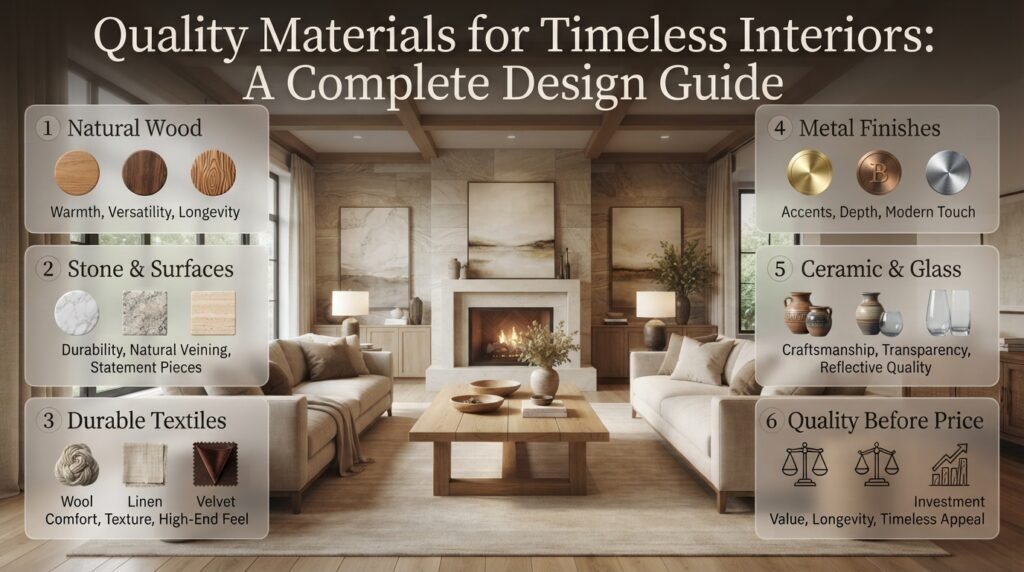
Quality materials help a home maintain its appearance while supporting the demands of everyday use. Wood, stone, durable upholstery, well-made metal hardware, and suitable flooring can contribute to a timeless interior when they’re selected according to their environment and maintenance requirements.
The most expensive material isn’t always the best choice. A moderately priced, well-constructed dining table may offer better long-term value than a costly surface that scratches easily or requires constant specialist care.
Which materials are worth considering?
Natural wood: Oak, walnut, ash, and other suitable wood species provide grain variation and warmth. They can work in traditional, transitional, and contemporary rooms. Their durability depends on construction, finish, moisture exposure, and care.
Stone and stone-look surfaces: Natural stone offers distinctive patterns, while porcelain and engineered alternatives provide different combinations of appearance, maintenance, and performance. The best option depends on whether the surface will be exposed to spills, heat, scratches, or heavy use.
Textiles: Linen, cotton, wool, and suitable performance fabrics introduce softness and texture. Before buying upholstery, check cleaning instructions, abrasion resistance, fading, and suitability for children or pets.
Metal finishes: Brass, stainless steel, chrome, and black metal can all work in lasting interiors. Consistency across nearby fixtures can help the room feel coordinated, but every finish doesn’t need to match exactly.
Ceramic and glass: These materials can introduce subtle variation and visual contrast through lamps, vases, tableware, and decorative objects.
How can you assess material quality before buying?
Look beyond the appearance of a product in a showroom. Inspect the construction and consider how the item will perform in your actual home.
Check the following:
- Are joints, seams, and edges finished properly?
- Does furniture feel stable during normal use?
- Can surfaces be cleaned with products you already use?
- Will sunlight, humidity, or frequent handling affect the finish?
- Are replacement parts or repair services available?
- Does the manufacturer provide clear maintenance instructions?
Common mistake: Choosing a material because it looks luxurious without considering its maintenance. A delicate surface may be unsuitable for a busy kitchen, while high-maintenance upholstery may frustrate a household with young children.
Long-term value comes from choosing materials that continue to perform well under realistic conditions.
For renovation projects, review Low VOC Interior Finishes to understand how finish selection can also contribute to indoor air quality considerations.
4. Why Do Balanced Proportions Matter in a Timeless Home?
Balanced proportions help furniture, lighting, and decorative objects relate naturally to the dimensions of a room. A space can contain beautiful individual pieces yet feel uncomfortable when a sofa is oversized, a rug is too small, or a chandelier overwhelms the dining table.
Timeless design pays attention to the relationships between objects rather than treating each purchase as an isolated decision.
How can you get furniture proportions right?
Start with the dimensions of the room and identify the main furniture pieces. Then consider how much space each item occupies and how it relates to the other elements.
For a living room, the sofa should suit the room’s width and leave enough space for movement. A coffee table should be easy to reach without making it difficult to get in and out of the seating area.
As practical starting points:
- Keep the coffee table approximately 14–18 inches from the sofa when that distance allows comfortable movement and reach.
- Choose a rug large enough to connect the main seating arrangement visually.
- Relate artwork to the furniture beneath it rather than selecting its size independently.
- Ensure dining chairs can be pulled back without blocking essential circulation routes.
- Choose light fixtures that suit both the room’s dimensions and its lighting needs.
These measurements are guidelines, not universal rules. Furniture design, household mobility needs, room geometry, and accessibility requirements may call for different clearances.
Why should you measure before purchasing?
A sofa that looks compact online can feel enormous in a small apartment. A dining table that fits between two walls may still leave insufficient space for chairs.
Before placing an order, measure the room, doorways, entrances, and furniture footprint. Mark the proposed arrangement on the floor with painter’s tape or cardboard.
Then check whether people can move between the furniture comfortably and whether doors, drawers, and windows remain accessible.
This is especially important in unusual rooms where conventional furniture arrangements don’t work well. The guide to furniture for rooms with angled walls offers useful ideas for working with challenging layouts.
5. Why Are Functional Layouts a Core Characteristic of Timeless Interiors?
A timeless interior supports everyday activities without requiring residents to work around the design. Furniture placement, storage, circulation, and room purpose should be resolved before decorative details are finalized.
A living room may need to support conversation, television viewing, reading, and occasional entertaining. A successful layout accommodates these activities without making the room feel crowded or forcing people to rearrange furniture repeatedly.
How should you plan a practical room layout?
First, identify the room’s primary purpose. Then list its secondary uses and determine which activities need dedicated space.
For a home office, this might include a comfortable desk, task lighting, storage, and convenient access to power outlets. For a dining room, it might mean enough seating, accessible serving space, and clear routes around the table.
Next, consider how people move through the room. Frequently used routes should remain easy to follow, particularly near entrances and between connected spaces.
Storage should also reflect actual behavior. Shoes belong near the entrance, frequently used kitchen items should be accessible, and work supplies should be close to the desk.
Professional advice: Observe how your household uses a room before investing in major changes. Everyday habits often reveal practical requirements that aren’t obvious from a floor plan alone.
How can you make an open-plan home feel organized?
Open-plan layouts connect activities that would otherwise take place in separate rooms. Their main challenge is creating distinct areas without making the overall space feel fragmented.
Use rugs, furniture placement, lighting, and subtle changes in material to define different zones. A sofa can separate a sitting area from a dining space, while pendant lighting can visually identify the dining table.
Keep the main palette coordinated across the connected areas. The furniture doesn’t need to match, but the rooms should share some colors, materials, or shapes.
If your design involves structural restrictions, designing around structural walls can help you think through the relationship between layout decisions and existing architecture.
6. How Does Natural Light Improve Timeless Interior Design?
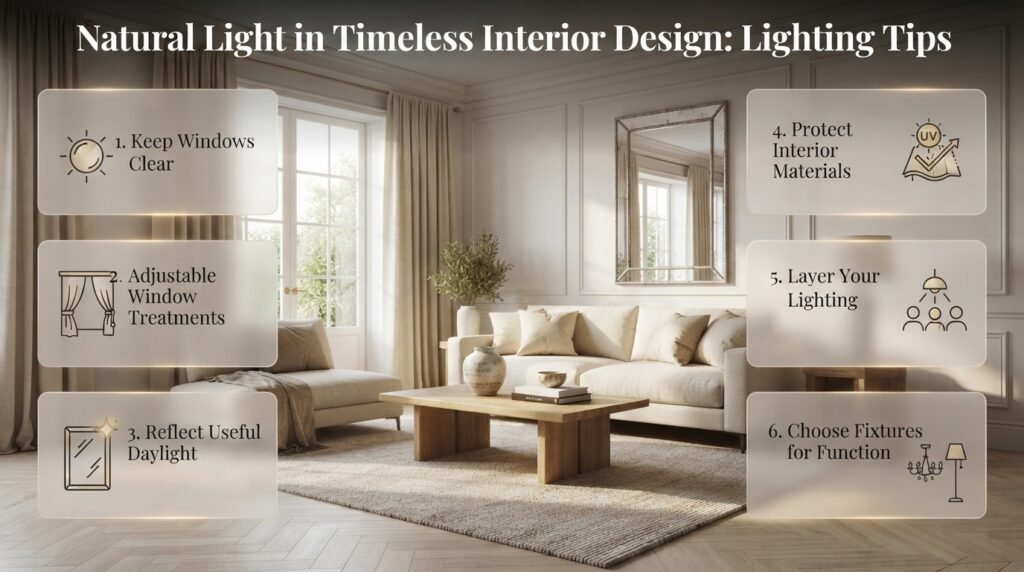
Natural light reveals the colors, textures, and details of a room. It can make a compact space feel more open and help materials appear richer and more varied throughout the day.
A timeless interior takes advantage of daylight without ignoring privacy, glare, temperature, or fading. Large windows aren’t essential; even a modest window can contribute significantly when furniture and window treatments are planned thoughtfully.
How can you make better use of natural light?
- Keep the areas immediately around windows relatively clear.
- Choose curtains that allow you to adjust light and privacy.
- Position mirrors where they reflect useful daylight without creating distracting glare.
- Consider the direction of sunlight when selecting flooring and upholstery.
- Avoid placing sensitive materials in locations where intense sunlight may damage them.
- Use artificial lighting to support the room when daylight is limited.
Mirrors can help distribute the impression of brightness, but their placement matters. A mirror reflecting a dark corner won’t provide the same effect as one positioned to reflect a bright window or a well-lit part of the room.
Window treatments should also suit the room’s purpose. Bedrooms may need stronger light control, while living areas might benefit from adjustable curtains or blinds.
What role does artificial lighting play?
A timeless room rarely depends entirely on one central ceiling light. Different activities require different kinds of illumination.
Ambient lighting provides general visibility. Task lighting supports activities such as reading, cooking, and working. Accent lighting draws attention to artwork, architectural details, or selected objects.
Layering these types of light makes a room more adaptable. A living room can be bright enough for cleaning and still offer softer illumination for relaxing in the evening.
Common mistake: Buying decorative light fixtures without checking their light output, placement, or compatibility with the room’s electrical setup.
A beautiful pendant can become a frustrating choice if it produces glare or leaves essential areas poorly lit. Plan the lighting effect first and select fixtures that achieve it.
7. Why Do Natural Textures Make Interiors Feel Timeless?
Natural textures create depth without relying on elaborate patterns or fashionable colors. Wood grain, woven fabrics, wool rugs, stone surfaces, ceramic objects, and linen curtains bring subtle differences that help a room feel layered and welcoming.
A room filled with identical smooth surfaces can look flat even when its colors are attractive. Introducing contrasting textures creates interest while allowing the overall palette to remain calm.
How should you combine different textures?
Start with two or three dominant materials. For example, a wooden coffee table, woven sofa upholstery, and a wool rug can establish a warm foundation. Ceramic accessories or a stone side table can introduce another texture without overwhelming the arrangement.
The goal is to create contrast rather than collect as many materials as possible.
| Interior element | Texture | Main benefit |
|---|---|---|
| Upholstered sofa | Woven fabric | Comfort and softness |
| Coffee table | Natural wood | Warmth and visual structure |
| Area rug | Wool or suitable blend | Texture and acoustic comfort |
| Curtains | Linen or linen-look fabric | Softness and filtered light |
| Accessories | Ceramic or stone | Subtle visual contrast |
Consider practical requirements when selecting each material. A deep-pile rug may be unsuitable for someone who needs a smooth surface for mobility, while a delicate woven fabric may require more care than a busy household can provide.
Texture also depends on how light falls across a surface. A matte wall finish, for example, creates a different effect from a glossy one, even when both use the same color.
8. Can You Combine Modern Trends With Timeless Interior Design?
Yes. Timeless interiors can include contemporary trends as long as the room doesn’t depend entirely on a particular fashionable look. The most practical approach is to maintain a versatile foundation and introduce current interests through elements that are easier to replace.
This strategy allows a home to feel fresh without requiring frequent renovation.
Which trends are easier to change?
Decorative cushions, artwork, lampshades, smaller occasional tables, and accessories are generally easier to update than flooring, fitted cabinetry, or extensive tiled surfaces.
Consider how different decisions affect future flexibility:
| Design element | A practical long-term approach |
|---|---|
| Wall paint | Choose a color that works with permanent finishes |
| Sofa | Prioritize comfort, construction, and adaptable upholstery |
| Flooring | Consider durability, cleaning, and adjoining rooms |
| Decorative cushions | Experiment with colors and patterns |
| Artwork | Choose pieces that reflect personal taste |
| Cabinet hardware | Use replaceable hardware for affordable updates |
| Statement lighting | Balance visual interest with useful illumination |
A sculptural lamp, curved chair, or fashionable pattern can still belong in a timeless room. What matters is whether the item suits the overall design and whether you’ll continue to appreciate its function and appearance.
How do you decide whether a trend is worth following?
Ask three questions before committing to a trend.
First, does it solve a practical problem or simply look attractive in photographs? Second, does it work with the materials and furniture you already own? Third, how difficult and expensive would it be to change if your preferences shifted?
If the decision is inexpensive and reversible, experimenting may be worthwhile. If it involves major construction or a large financial commitment, take more time to assess its long-term value.
For affordable ways to improve your home without committing to a full makeover, explore DIY home projects.
9. How Can Personal Style Fit Into a Timeless Interior?
A timeless home should reflect the people who live in it. Without personal details, even a carefully coordinated room can feel generic or resemble a furniture showroom.
Personal character comes from meaningful choices rather than the quantity of decoration. Family photographs, books, collected ceramics, handmade objects, original artwork, and travel souvenirs can give a home an individual identity.
How can you display personal objects without creating clutter?
Start with a small selection of objects that genuinely matter to you. Group related items when it creates a coherent arrangement, and give important pieces enough space to be appreciated.
For example, a shelf might contain a few books, a framed photograph, and a handmade ceramic bowl. The objects have different purposes, but their scale and arrangement help them work together.
Avoid buying decorative items simply because a surface looks empty. Empty space can make meaningful objects more noticeable.
Expert tip: Look for a visual connection between personal objects and the rest of the room. A wooden picture frame may relate naturally to a nearby side table, while a colored ceramic vase may repeat a shade found in the rug or artwork.
Personal style can also evolve. You might display family photographs prominently today and later prefer a larger art collection. A versatile interior makes these changes possible without losing its overall identity.
The goal is not to create a home that never changes. It’s to create one that can change naturally.
10. What Makes Furniture a Good Long-Term Investment?
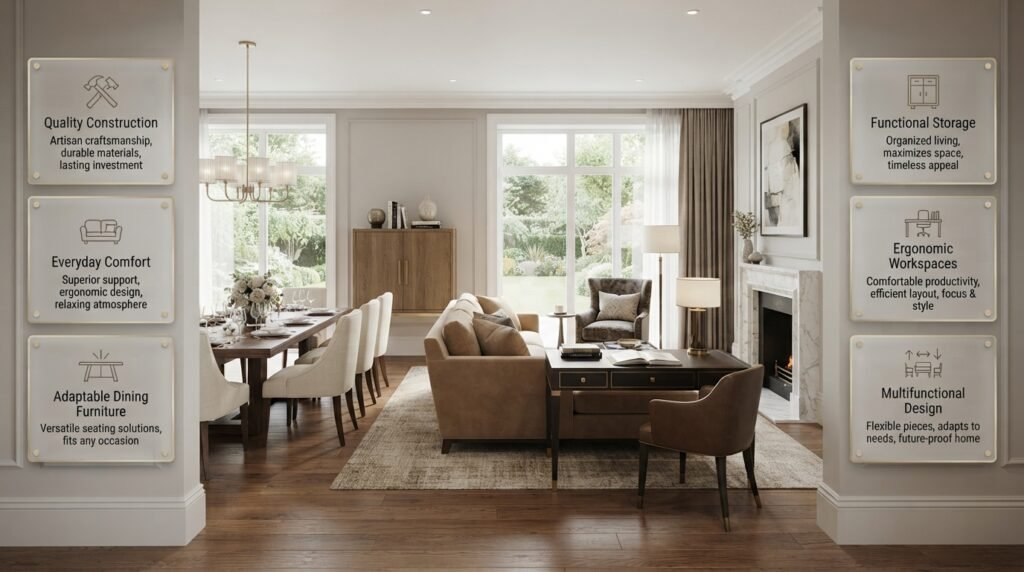
Timeless furniture combines comfort, appropriate proportions, reliable construction, and a design that works with different decorative styles. It doesn’t have to be antique, expensive, or completely neutral.
A well-made wooden dining table, for example, may work with traditional chairs today and contemporary seating after a future update. Its long-term value comes from its construction, usability, and adaptability.
Which furniture pieces deserve the most attention?
Prioritize furniture that is used frequently or costly to replace.
Sofas and armchairs: Consider seating depth, back support, upholstery durability, and whether the dimensions suit the room.
Beds and mattresses: Prioritize comfort, suitable dimensions, stable construction, and your household’s sleeping needs.
Dining tables: Consider the number of regular users, room clearance, surface maintenance, and whether the table can accommodate occasional guests.
Storage furniture: Check capacity, drawer operation, shelf strength, and access to frequently used items.
Desks and office chairs: Choose suitable dimensions, comfortable support, and a configuration that accommodates the tasks performed there.
For smaller accent pieces, you can experiment more freely with unusual shapes, colors, and finishes.
Is multifunctional furniture a good choice?
Multifunctional furniture can be especially useful in small apartments, guest rooms, and homes where space serves several purposes.
However, a multifunctional item should be comfortable and easy to use for every activity it supports. A sofa bed that is difficult to open or a storage bench that offers insufficient seating may create more frustration than convenience.
Check the operating mechanism, storage capacity, dimensions, and construction before purchasing.
For more space-saving ideas, read foldaway furniture for sleeping spaces.
How can you avoid furniture that becomes outdated quickly?
Instead of choosing furniture solely because it is currently fashionable, consider whether its shape, scale, and function will work in different room arrangements.
A distinctive accent chair can be a good purchase when it complements the room and serves a real purpose. A complete set of oversized statement furniture may be harder to adapt if you later change your layout or color palette.
Before buying a major piece, also consider how it will fit through entrances, how it can be cleaned, and whether upholstery or hardware can be repaired.
11. How Does Storage Help Maintain a Timeless Appearance?
Good storage makes a room easier to use and helps maintain its visual order. Even beautifully furnished interiors can feel chaotic when shoes, cables, paperwork, toys, and household supplies have no designated place.
Storage should therefore be part of the original design rather than something added only after clutter becomes a problem.
Which storage solutions work best?
Closed cabinets conceal belongings that don’t need to remain visible.
Open shelves display books, ceramics, and selected decorative objects while keeping frequently used items accessible.
Baskets and boxes provide flexible storage for smaller belongings, provided they’re appropriately sized and easy to access.
Entryway storage keeps shoes, coats, bags, and everyday essentials near the entrance.
Built-in cupboards can use wall space efficiently when their cost, depth, and permanence are justified.
The right balance depends on what you own and how you use it. Too much open shelving can create visual clutter, while too many closed cabinets may make frequently used items inconvenient to reach.
How can you plan storage capacity realistically?
Begin by identifying the belongings that need a permanent home. Estimate how much space they occupy and consider whether their quantity is likely to change.
For example, an entryway may need separate space for everyday shoes, seasonal footwear, bags, keys, and outdoor clothing. Planning only for the number of items currently visible can leave the storage system inadequate within a few months.
Keep frequently used belongings within comfortable reach and reserve less accessible areas for seasonal or occasional items.
For practical planning ideas, explore entryway storage capacity planning.
12. How Can You Make Different Rooms Feel Connected?
A timeless home usually feels coherent from one room to another. This doesn’t mean every room must use the same wall color, flooring, or furniture style. It means the spaces share enough visual relationships to feel as though they belong to the same home.
Consistency can come from related wood tones, repeated metal finishes, complementary colors, similar proportions, or a shared approach to lighting.
What creates visual continuity?
Start by identifying a small group of materials and colors that can appear in different rooms. For example, warm wood might connect the living room, dining room, and hallway, while a consistent metal finish can relate door hardware to selected light fixtures.
You can still introduce variety. A bedroom might use softer colors and fabrics, while the kitchen uses harder surfaces and stronger contrast. The relationship between the spaces matters more than making them identical.
Should every room follow the same style?
Not necessarily. A family room, bedroom, and home office have different practical requirements.
The living room may need flexible seating, the bedroom may prioritize restful lighting, and the office may need task-oriented furniture. Each can have its own character while sharing a coordinated material palette.
The most useful approach is to repeat a few elements deliberately rather than copying the same arrangement everywhere.
For example, a home with oak furniture in several rooms may feel connected even if one room is traditional and another is contemporary.
This principle becomes especially important in open-plan homes, where several functional areas remain visible at once.
13. What Are the Most Common Mistakes That Make Interiors Look Dated?
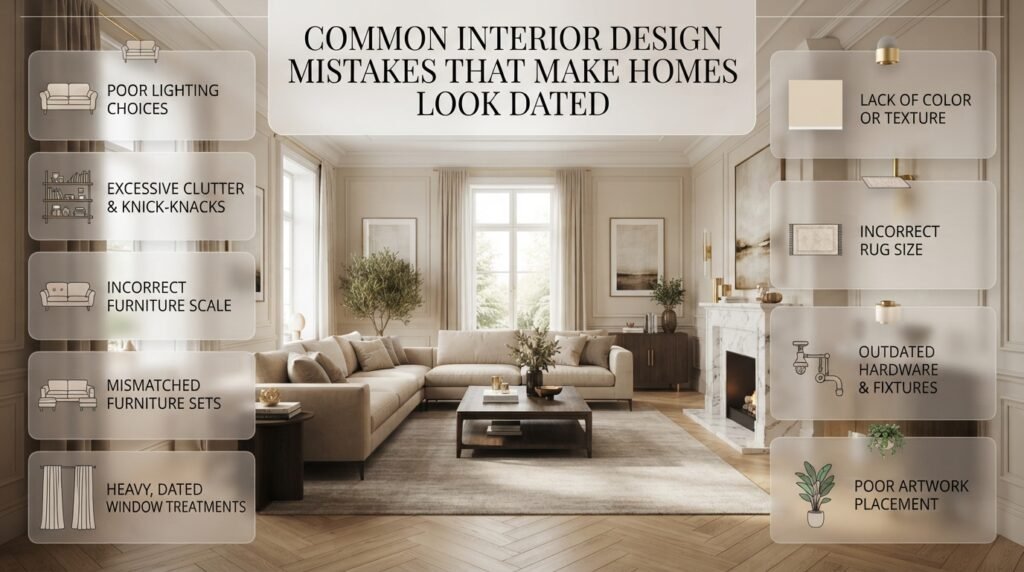
Many interiors become difficult to maintain because homeowners make isolated decisions without considering how those decisions affect the rest of the room. Recognizing these mistakes early can prevent unnecessary spending and help preserve a cohesive design.
Mistake 1: Following every new trend
Why it happens: Trend-focused photographs make complete transformations look appealing and effortless.
Why it’s harmful: Several fashionable features can compete with one another and become expensive to replace.
How to avoid it: Use trends selectively, particularly in accessories and other replaceable elements.
Mistake 2: Buying furniture without measuring
Why it happens: A product looks appropriately sized online or in a showroom.
Why it’s harmful: It may block doorways, restrict circulation, or overwhelm the room.
How to avoid it: Measure the room, entrances, and furniture footprint. Mark the proposed arrangement on the floor before ordering.
Mistake 3: Choosing colors independently
Why it happens: Each color looks attractive when considered on its own.
Why it’s harmful: The finished room lacks continuity, making future purchases harder to coordinate.
How to avoid it: Test colors alongside flooring, furniture, and other permanent finishes.
Mistake 4: Prioritizing appearance over comfort
Why it happens: Dramatic furniture looks impressive in photographs.
Why it’s harmful: Uncomfortable seating or impractical furniture can become frustrating during daily use.
How to avoid it: Test furniture where possible and evaluate dimensions, support, and intended use.
Mistake 5: Ignoring maintenance requirements
Why it happens: Materials are selected for their showroom appearance rather than their everyday performance.
Why it’s harmful: Stains, fading, scratches, and difficult cleaning can reduce satisfaction.
How to avoid it: Match finishes and fabrics to the household’s routine, sunlight exposure, and cleaning preferences.
Mistake 6: Decorating every empty surface
Why it happens: Empty shelves and walls may appear unfinished.
Why it’s harmful: Too many accessories weaken visual hierarchy and make cleaning more difficult.
How to avoid it: Leave some areas unoccupied and add objects gradually.
Mistake 7: Replacing everything at once
Why it happens: A complete makeover appears easier than making gradual improvements.
Why it’s harmful: It increases costs and can lead to rushed purchases that haven’t been properly assessed.
How to avoid it: Retain suitable existing pieces, improve the layout first, and replace items according to their condition and usefulness.
Mistake 8: Ignoring transitions between materials
Why it happens: Flooring, wall finishes, cabinetry, and decorative materials are selected at different times.
Why it’s harmful: Abrupt changes can make connected rooms feel disjointed.
How to avoid it: Review samples together and plan how materials meet at doorways, corners, and changes in floor level.
Mistake 9: Choosing lighting too late
Why it happens: Lighting is treated as a finishing touch rather than part of the room’s design.
Why it’s harmful: Electrical points, furniture placement, and task requirements may no longer align.
How to avoid it: Plan general, task, and accent lighting before finalizing the layout and decorative details.
14. What Do Interior Design Professionals Consider When Creating Timeless Spaces?
Professionals generally evaluate a room as a connected system. Architecture, furniture proportions, circulation, lighting, materials, and household needs all influence the final design.
This approach reduces the likelihood of choosing attractive elements that fail to work together.
Begin with permanent features
Identify elements that are expensive or difficult to change, including flooring, structural walls, windows, fitted cabinetry, and major electrical or plumbing locations.
These features should guide decisions about furniture, colors, and finishes.
For example, if the flooring has a strong warm undertone, choosing every other finish without considering that undertone can make the room feel disconnected. Reviewing the samples together helps establish a compatible palette.
Create a clear visual hierarchy
Every room benefits from a few elements that establish its character. In a living room, that might be a fireplace, a seating arrangement, a large artwork, or a distinctive architectural feature.
Other objects should support these features rather than competing for equal attention.
A visual hierarchy also helps with budgeting. Once the most important elements are identified, you can prioritize spending on them and simplify less significant details.
Repeat materials selectively
Repeating a wood tone, metal finish, or accent color can help create continuity. However, every finish doesn’t need to match exactly.
Related wood tones and complementary textures often look more natural than an attempt to make all materials identical.
Test decisions in real conditions
View paint samples in the actual room, assess furniture at its intended scale, and examine materials under both daylight and artificial lighting.
A finish that looks perfect in a showroom may appear very different at home. Testing reduces the risk of expensive mistakes.
Plan for future changes
Ask whether the room can accommodate new artwork, a different rug, or a change in accent colors without requiring major alterations.
A timeless foundation should support reasonable changes in taste and household needs.
When hiring a professional, clarify the project’s scope, budget, materials, responsibilities, and payment schedule. The guide to Interior Designer Contract Essentials can help you understand the issues worth discussing before work begins.
15. How Can You Create a Timeless Interior Step by Step?
You don’t need to redesign your entire home at once. A staged approach helps you identify the most important improvements, control spending, and evaluate each decision before moving to the next.
Step 1: Assess the existing room
Identify what works, what causes frustration, and which elements are worn or visually disconnected.
Why it matters: You may be able to retain valuable furniture or architectural details rather than replacing them unnecessarily.
Example: If the living room feels crowded, moving the sofa and removing an unnecessary side table may improve the space more than buying new furniture.
Step 2: Define the room’s main purpose
List the activities the room must support.
A family living room might need space for conversation, television viewing, children’s activities, and occasional entertaining. A guest bedroom might need comfortable sleeping arrangements and flexible storage.
Professional advice: Design around your actual routine rather than an idealized version of how you imagine using the space.
Step 3: Measure and plan the layout
Record the room dimensions, door openings, window positions, and fixed obstacles. Sketch the proposed furniture arrangement and test the main circulation routes.
Common mistake: Choosing the largest sofa that fits along a wall without checking whether people can move comfortably around it.
Step 4: Establish the color and material palette
Select the main wall colors, flooring relationship, and major furniture finishes. Test samples together to see whether they work under different lighting conditions.
Why it matters: These choices create the visual foundation for everything that follows.
Step 5: Choose essential furniture
Prioritize comfort, construction, scale, and function. Buy fewer suitable pieces rather than filling the room with furniture that serves no clear purpose.
Step 6: Plan lighting and storage
Address task lighting, general illumination, cable management, and everyday storage before completing the decoration.
Step 7: Introduce texture and personality
Add curtains, rugs, artwork, cushions, plants, and personal objects. Use these details to make the room feel complete without overcrowding it.
Step 8: Review the room after using it
Live with the arrangement for a few weeks. Notice whether the walking routes work, whether lighting is sufficient, and whether frequently used items are accessible.
Make small adjustments before committing to additional purchases.
16. Timeless Interior Design vs. Trend-Driven Design
Both timeless and trend-driven approaches can produce attractive interiors, but they prioritize different things. Timeless design emphasizes long-term suitability and adaptability, while trend-driven design emphasizes a particular look that is currently popular.
| Feature | Timeless interior design | Trend-driven interior design |
|---|---|---|
| Main objective | Lasting function and visual appeal | Current aesthetic impact |
| Color selection | Flexible and coordinated | May emphasize fashionable shades |
| Furniture | Chosen for comfort and versatility | May prioritize a specific silhouette |
| Materials | Selected for performance and suitability | May prioritize novelty or appearance |
| Decoration | Personal, selective, adaptable | Often reflects current styling trends |
| Updating | Usually involves smaller details | May involve replacing several elements |
| Best application | Long-term foundations | Accent pieces and creative experiments |
Neither approach is automatically right or wrong. A home can have a timeless foundation and still feature distinctive contemporary elements.
The practical strategy is to invest carefully in items that are expensive or difficult to replace, then experiment with details that can be changed more easily.
17. How Can You Create Timeless Interiors on a Budget?
Timeless design doesn’t require a luxury budget. In many cases, thoughtful planning and selective improvements matter more than the price of individual products.
The key is to distinguish between changes that improve the room’s function and changes that merely introduce something new.
Reuse what still works
Before replacing furniture, assess its construction, comfort, and suitability for the room. A solid wooden table may need only cleaning or refinishing, while a structurally sound chair may benefit from new upholstery.
Retaining suitable furniture also reduces waste and frees up money for items that genuinely need replacement.
Improve the layout first
Rearranging furniture can improve circulation, reveal more floor space, and make existing pieces feel more appropriate.
Test different arrangements before spending money. You may discover that the main problem is the location of a sofa or the lack of a clear walking route rather than the furniture itself.
Refresh smaller details
Consider repainting, changing cabinet hardware, updating lampshades, or introducing a well-chosen rug. These improvements can change the atmosphere of a room without requiring extensive construction.
Prioritize spending according to use
Allocate more of your budget to heavily used items, such as a sofa, mattress, or dining table. Decorative accessories can often be purchased gradually.
Avoid buying everything at once
A staged approach gives you time to evaluate each purchase and reduces the risk of choosing items that don’t work together.
For instance, buy the main furniture first, assess how it looks in the room, and then select a rug and artwork that complement the finished arrangement.
The best budget strategy isn’t simply buying the cheapest products. It’s making decisions that reduce unnecessary replacements and provide lasting practical value.
18. How Can Timeless Interiors Adapt to Changing Household Needs?
A home that works well today may need to serve different purposes in the future. A spare room might become a home office, a dining area may need to accommodate a growing family, or a living room may require more flexible seating.
Timeless interiors account for reasonable change without trying to predict every possible future need.
Choose flexible furniture arrangements
Furniture that can be moved or rearranged makes it easier to adjust a room when circumstances change.
For example, two smaller side tables may be more flexible than one large fixed arrangement. A lightweight accent chair can move between the living room and bedroom when additional seating is needed.
Avoid unnecessary permanent commitments
Built-in furniture can be useful, but it should solve a genuine problem. Before installing extensive cabinetry, consider whether the storage needs are likely to remain stable and whether the design will work with future room uses.
Plan electrical and lighting needs carefully
If a room may serve as an office or guest bedroom, consider the locations of outlets, task lighting, and other essential services before completing a renovation.
Changes to electrical systems should be planned and completed by appropriately qualified professionals.
Make accessibility part of the design
A useful room should remain comfortable for the people who use it as their needs change. Clear circulation, accessible storage, appropriate lighting, and manageable furniture arrangements can make everyday activities easier.
Adaptability isn’t about making every room multifunctional. It’s about avoiding unnecessary limitations when practical flexibility is possible.
19. How Do You Maintain a Timeless Interior Over the Years?
A timeless interior still needs maintenance. Materials age, upholstery wears, finishes become damaged, and household requirements change. The difference is that a well-planned room can often be maintained through targeted improvements rather than complete replacement.
Follow a simple maintenance routine
Inspect heavily used furniture, clean surfaces according to manufacturer instructions, and address small problems before they become expensive repairs.
Check upholstery for wear, maintain wood finishes where needed, and clean lighting fixtures so they continue to provide suitable illumination.
Refresh accessories selectively
Artwork, cushions, lampshades, and small decorative pieces can be changed when your preferences evolve.
You don’t need to preserve every original choice forever. The purpose of timeless design is to make changes easier, not to prevent them.
Reassess function before appearance
If a room no longer feels comfortable, identify the cause before buying new decorative items.
The issue may be insufficient lighting, an awkward walking route, inadequate storage, or furniture that no longer suits the household.
Solving the practical problem usually creates a more meaningful improvement than simply introducing a new trend.
Keep records of important finishes
When possible, retain paint names, material specifications, furniture details, and care instructions. These records make it easier to repair or replace an item later without having to guess which finish was originally used.
A modest amount of planning can help preserve a room’s coherence even when individual components eventually need replacement.
What Are the Most Important Characteristics of Timeless Interiors?
The most important characteristics of timeless interiors are balanced proportions, versatile colors, quality materials, functional layouts, thoughtful lighting, and carefully selected furniture. These elements create a home that remains attractive and comfortable even when decorating trends change. A timeless interior isn’t defined by one particular style; it depends on how well the design choices work together and support everyday living.
For example, a living room with comfortable seating, warm wooden furniture, a coordinated color palette, and layered lighting can remain appealing for years without requiring a complete makeover. Instead of filling the space with fashionable accessories, the design focuses on comfort, visual balance, and long-term usefulness.
Important characteristics to prioritize:
Balanced proportions: Choose furniture that fits the room and allows comfortable movement.
Versatile colors: Select shades that coordinate with different materials and decorative accents.
Durable materials: Consider construction quality, maintenance, and expected daily use.
Functional layouts: Arrange furniture around the activities that take place in the room.
Personal details: Use artwork, books, and meaningful accessories to create character without clutter.
Which Colors Are Best for Creating a Timeless Interior?
The best colors for timeless interiors are those that work naturally with the room’s lighting, architecture, furniture, and materials. Warm whites, cream, taupe, soft gray, muted green, and earthy tones are popular choices because they provide a flexible foundation. However, timeless design doesn’t require an entirely neutral home. Deep blue, forest green, terracotta, and burgundy can also create lasting visual appeal when used thoughtfully.
A practical approach is to use adaptable colors on larger surfaces and introduce stronger shades through furniture, artwork, cushions, or other replaceable details. This makes it easier to refresh the room without repainting every wall or replacing expensive furnishings.
Before choosing a paint color, test samples in different lighting conditions. A shade that looks warm in a showroom may appear cooler or darker in your home.
Practical color-selection tips:
Choose wall colors that complement existing flooring and permanent finishes.
Compare paint samples in natural daylight and artificial light.
Use accent colors to introduce personality without overwhelming the room.
Consider how new furniture or artwork will work with the existing palette.
Avoid selecting colors solely because they are currently fashionable.
How Can I Make My Home Look Timeless Without Spending Too Much Money?
Creating a timeless interior doesn’t require expensive furniture or a complete renovation. The most effective approach is to improve the elements that affect the room’s comfort, function, and overall appearance before spending money on decorative upgrades. Rearranging furniture, improving lighting, reducing clutter, and refreshing selected surfaces can make a noticeable difference without placing unnecessary pressure on your budget.
Start by assessing what you already own. A sturdy wooden table, a comfortable chair, or a well-made cabinet may only need refinishing, repositioning, or updated hardware. Once the room’s layout is working properly, you can introduce affordable improvements such as curtains, cushions, lampshades, or artwork.
The goal is to invest in items that provide lasting value rather than repeatedly replacing products that follow short-lived trends.
Budget-friendly improvements to consider:
Rearrange existing furniture to improve circulation and make better use of space.
Repaint walls when the current color no longer complements the room.
Replace worn cabinet handles or outdated lampshades.
Add a suitable rug or curtains to introduce warmth and texture.
Prioritize frequently used furniture over decorative accessories.
Make purchases gradually instead of furnishing the entire room at once.
What Materials and Furniture Should I Choose for a Timeless Interior?
The best materials and furniture for a timeless interior combine durability, comfort, practical maintenance, and adaptable design. Natural wood, stone, quality upholstery, ceramics, and well-made metal finishes can work across many decorating styles. However, the right choice depends on the room’s purpose, household needs, budget, and expected wear.
For example, a dining table should have a suitable surface and stable construction for regular use, while a living room sofa should provide comfortable support and upholstery that can withstand everyday activity. Materials that require constant maintenance may be unsuitable for busy households, even when they look attractive.
When selecting furniture, consider how easily each piece can work with different colors, rugs, and accessories in the future. A versatile foundation allows you to update the room without replacing all its major elements.
What to look for when choosing materials and furniture:
Construction: Inspect joints, frames, seams, and moving components.
Comfort: Test seating and consider the furniture’s intended use.
Durability: Match the material to expected wear, sunlight, and moisture exposure.
Maintenance: Check cleaning instructions and repair options before buying.
Versatility: Choose shapes, finishes, and colors that work with more than one decorating scheme.
Proportion: Measure the room and furniture to avoid overcrowding.
How Do I Keep a Timeless Interior Looking Fresh Without Following Every Trend?
The best way to keep a timeless interior looking fresh is to maintain its functional foundation while updating smaller decorative elements when your preferences change. You don’t need to renovate every few years or follow every popular design trend. Instead, focus on the condition of your materials, the usefulness of your furniture arrangement, and the details that have the greatest effect on the room’s appearance.
For example, a living room with well-maintained flooring, a comfortable sofa, and a coordinated color palette can feel different simply by introducing new artwork, changing cushion covers, or updating a lampshade. These relatively small adjustments allow you to experiment without committing to expensive permanent changes.
It’s also worth reassessing how you use the room. A space may need a better lighting arrangement or additional storage rather than a new decorative style.
Simple ways to keep your interior feeling current:
Replace worn or damaged items before they affect the whole room.
Update cushions, artwork, and accessories to reflect changing preferences.
Maintain wood, upholstery, flooring, and other frequently used materials.
Improve lighting when the room feels dark or uncomfortable.
Remove unnecessary accessories when surfaces begin to feel crowded.
Choose trends that complement your existing design rather than dictate every decision.
A timeless interior isn’t a room that never changes. It’s a home with a strong foundation that allows practical improvements and personal expression without requiring a complete redesign.
Conclusion
The characteristics of timeless interiors go beyond attractive furniture, neutral colors, or a carefully styled room. They come from thoughtful planning, balanced proportions, durable materials, comfortable layouts, and design choices that continue to feel relevant as personal tastes and lifestyles change. A timeless home does not need to look traditional or avoid modern influences; it simply prioritizes lasting quality and everyday functionality over short-lived trends.
The most effective way to create this kind of interior is to start with the essentials. Choose a practical layout, invest in well-made furniture, establish a cohesive color palette, and introduce natural textures that bring warmth and depth to each room. Pay attention to lighting, storage, circulation, and the relationship between different spaces. These decisions help create an environment that looks appealing while remaining comfortable and easy to maintain.
You also do not need to redesign your entire home at once. Small, considered improvements—such as updating lighting, replacing low-quality accessories, refining furniture placement, or introducing timeless materials—can make a meaningful difference without stretching your budget. Keep your permanent design elements relatively adaptable, then express your personality through artwork, cushions, decorative objects, and other details that can be changed easily.
Ultimately, a timeless interior reflects how you want to live rather than what happens to be fashionable. By combining quality, simplicity, practicality, and personal character, you can create a home that feels welcoming today and remains beautiful, functional, and meaningful for years to come.