
Introduction
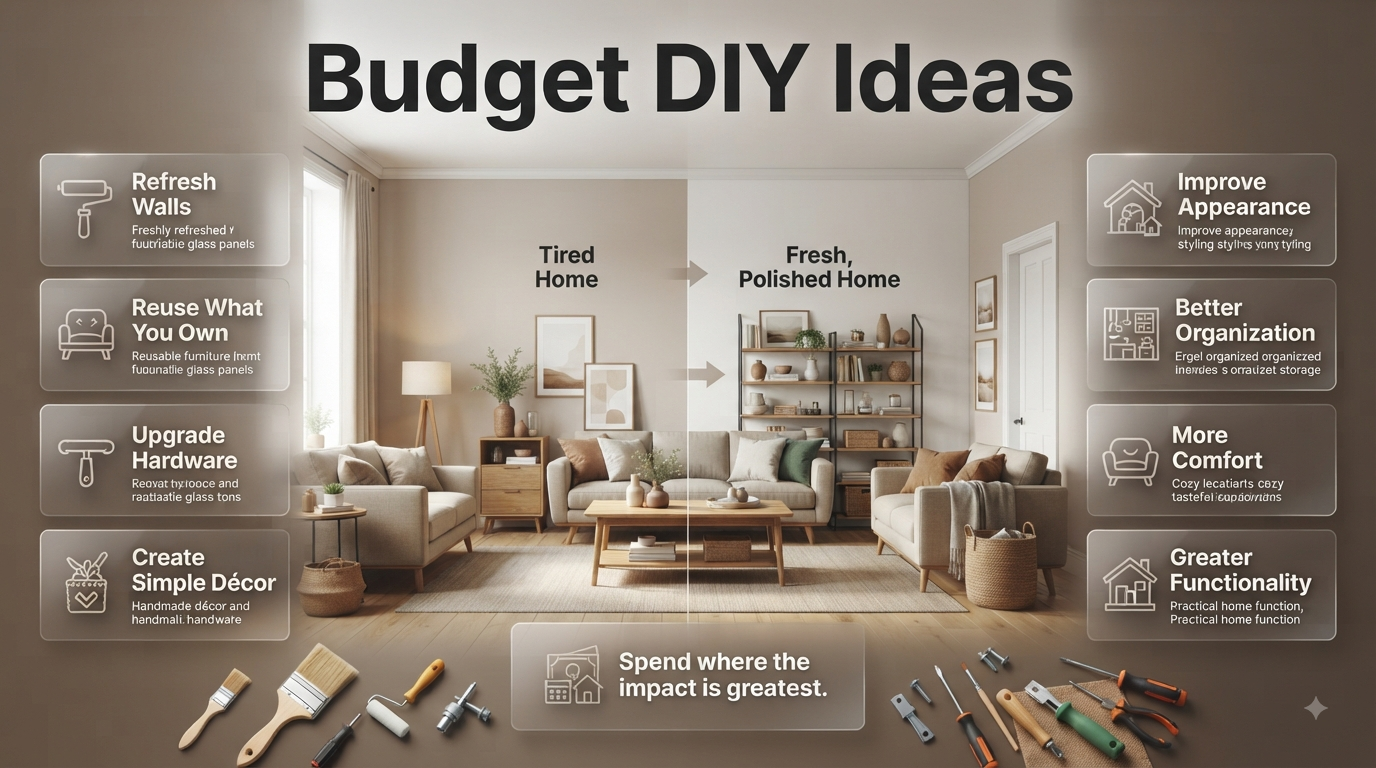
Budget DIY Ideas | Have you ever looked around your home and felt that it needs a refresh, but your budget simply doesn’t allow for a full renovation? Maybe the walls look tired, an old table has lost its appeal, the entryway is always cluttered, or your living room feels unfinished. The good news is that you don’t need a huge budget to make your home look better. The right Budget DIY Ideas can help you improve appearance, organization, comfort, and functionality while keeping spending under control.
The key is knowing where your money will have the biggest impact. Instead of buying dozens of decorative items, you can repaint something you already own, reorganize an awkward space, upgrade inexpensive hardware, create simple décor, or give an old piece of furniture a completely different look.
For homeowners looking for broader inspiration, DesignMode24 Interior Design offers additional ideas for approaching home improvements, styling, and interior projects from a practical perspective.
This guide covers affordable DIY projects for different rooms, ways to reuse what you already have, beginner-friendly improvements, furniture upgrades, budget decorating techniques, common mistakes, and professional tips for making inexpensive projects look polished.
What Are Budget DIY Ideas?
Budget DIY ideas are affordable projects that allow homeowners or renters to improve, decorate, organize, repair, or personalize a space without spending heavily on professional labor or expensive products. They can include painting, furniture makeovers, handmade décor, storage improvements, repurposing old items, simple styling changes, and selected home upgrades.
The important word is useful.
A budget project shouldn’t simply be cheap. It should solve a problem, improve the appearance of your home, increase functionality, or make better use of something you already own.
For example, painting an old bedside table may cost very little but completely change its appearance. Adding inexpensive hooks to an entryway may cost less than replacing a storage unit while making everyday organization much easier.
That is what makes DIY valuable: you can spend a small amount strategically instead of spending a large amount reactively.
Why Are Budget DIY Projects Worth Doing?
Budget DIY projects are worthwhile because small improvements can have a surprisingly large effect on how a room looks and functions.
You don’t always need new furniture, expensive artwork, or a professional renovation. Sometimes the problem is simply that a room needs better color, organization, proportion, lighting, or finishing.
The main benefits include:
- Lower project costs
- Greater creative control
- Personalization
- Better use of existing furniture
- Less household waste
- Improved organization
- Ability to update one area at a time
- Opportunity to learn useful practical skills
- More flexibility than a complete renovation
A DIY approach is especially useful when your home is generally in good condition but certain areas feel outdated or incomplete.
💡 Pro Tip: Don’t begin by asking, “What can I make?” Start by asking, “What is bothering me about this room?” The answer will usually lead you toward a more useful project.
How Do You Choose the Right Budget DIY Project?
The best project depends on the problem you’re trying to solve, your available budget, your skill level, and the amount of time you can realistically spend.
Before starting, evaluate the space using four simple questions:
- What looks outdated?
- What doesn’t function properly?
- What do I already own that could be reused?
- What improvement would make the biggest difference?
For example, if your living room feels boring, painting an accent wall may be more effective than buying five small decorations.
If your bedroom feels cluttered, improving storage may be more useful than purchasing new artwork.
If your dining table looks old but is structurally sound, a furniture makeover may make more sense than buying another table.
This problem-first approach keeps your budget focused.
What Are the Cheapest DIY Home Improvements?
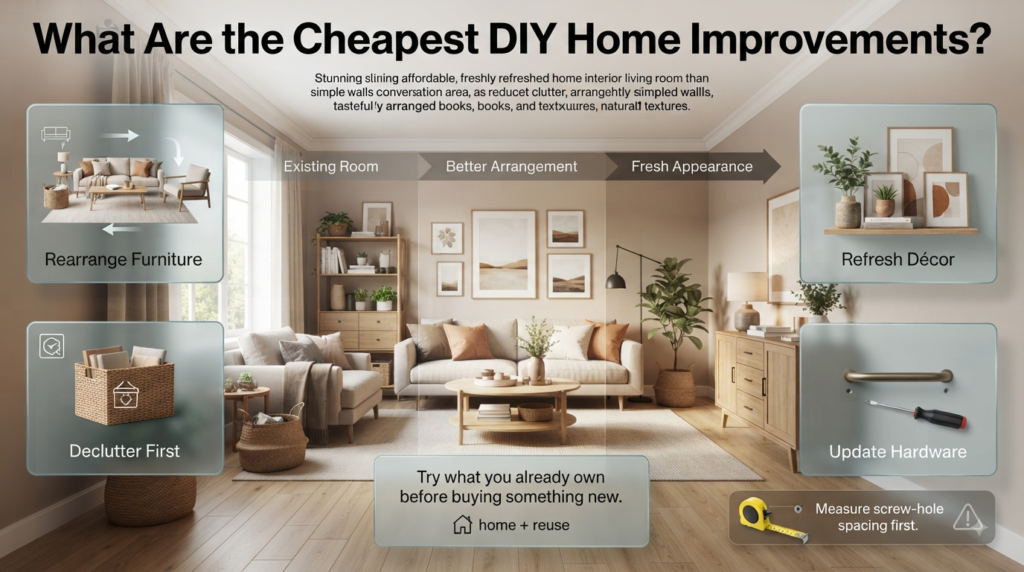
Some of the most affordable improvements require very few materials. They focus on appearance, organization, or using existing items differently.
Rearrange Your Furniture
Furniture placement can completely change how a room feels without costing anything.
Try moving furniture away from walls, creating a clearer conversation area, improving walking space, or changing the room’s focal point.
Before buying anything new, spend 20 or 30 minutes experimenting with the layout.
A room that feels cramped may simply have furniture positioned inefficiently.
Declutter Before Decorating
Decorating a cluttered room can actually make it feel more crowded.
Remove items that don’t belong, group similar objects together, and keep frequently used items accessible.
Once unnecessary clutter is removed, existing furniture and décor often look better immediately.
Change Small Decorative Arrangements
Move books, plants, artwork, lamps, baskets, and accessories between rooms.
An object that looks ordinary in one location can look much better when placed somewhere with the right scale, lighting, or background.
Update Cabinet Hardware
New knobs and handles can make old cabinets, drawers, wardrobes, and furniture look significantly newer.
This is one of the easiest projects for beginners because it generally requires basic measuring and a screwdriver.
⚠ Common Mistake: Buying attractive hardware without checking the distance between existing screw holes. Measure first, then shop.
How Can Paint Transform a Home on a Small Budget?
Paint is one of the most powerful low-cost tools available for home improvement. It can change the mood, visual depth, focal points, and perceived cleanliness of a room without replacing major furniture.
You don’t have to paint every wall.
A single accent wall can create a strong visual change while using less paint and reducing preparation time.
Before choosing a color, consider:
- Natural light
- Artificial lighting
- Existing furniture
- Flooring
- Room size
- Ceiling height
- Adjacent rooms
- Desired atmosphere
For additional color inspiration, explore Paint Color ideas before deciding on your final shade.
How to Choose a Budget-Friendly Paint Color
Don’t choose a color simply because it looks attractive in a photograph.
The same color can appear dramatically different under warm bulbs, cool daylight, or limited natural light.
Get a small sample first and observe it at different times of the day.
For a calm atmosphere, soft neutrals and muted tones can work well.
For a stronger focal point, deeper shades can create contrast.
For a small room, lighter colors can help maintain an open visual feeling, although a carefully selected dark accent wall can also create depth.
How to Paint Like a Professional Without Spending a Lot
Professional-looking painting is mostly about preparation rather than expensive equipment.
Before applying paint:
- Clean the surface.
- Fill holes and cracks.
- Sand rough areas.
- Remove dust.
- Protect floors.
- Tape areas that need protection.
- Use primer when necessary.
- Apply controlled coats.
- Allow proper drying time.
A cheap project can look expensive when the edges are straight and the surface is smooth.
A premium paint can still look poor if applied over dirt, dust, grease, or damaged surfaces.
What Are Easy DIY Accent Wall Ideas?
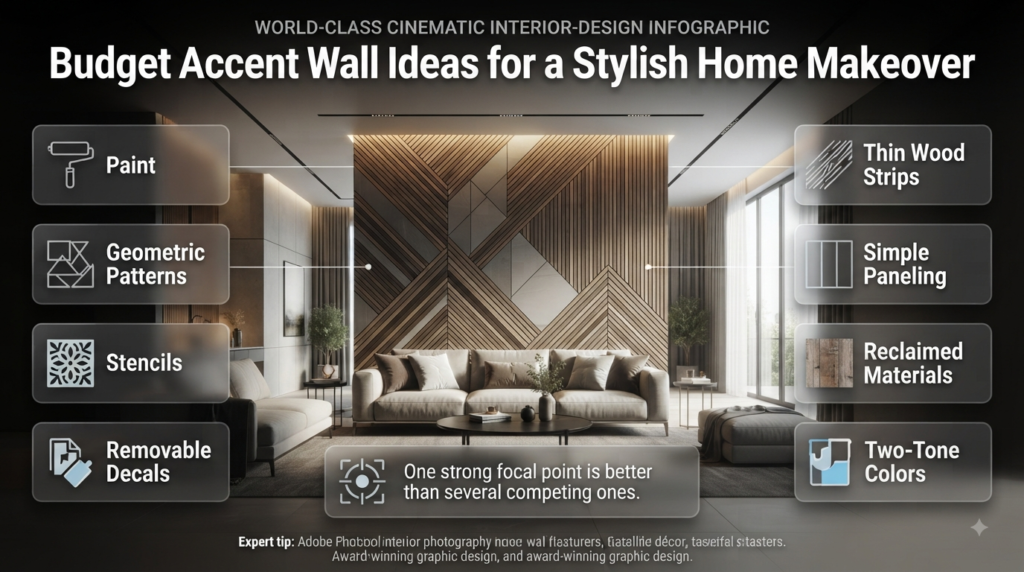
An accent wall gives you an opportunity to create a focal point without changing the entire room.
You can make one using:
- Paint
- Geometric patterns
- Stencils
- Removable decals
- Thin wood strips
- Simple paneling
- Reclaimed materials
- Two-tone color combinations
The best accent wall is usually connected to something important in the room.
For example, a wall behind a bed, sofa, dining table, or desk can naturally become the visual focus.
Avoid placing too many competing features around it.
⭐ Expert Tip: If an accent wall is already visually strong, keep nearby décor relatively simple. The goal is to create a focal point, not several competing focal points.
How Can You Make Old Furniture Look New?
Replacing furniture is often one of the most expensive parts of decorating. If a piece is structurally sound, a makeover can be a much better budget decision.
Furniture makeover options include:
- Painting
- Staining
- Sanding
- Replacing handles
- Replacing legs
- Adding trim
- Changing drawer fronts
- Updating hardware
- Replacing damaged fabric
- Adding protective finishes
For more ideas specifically focused on giving existing pieces a new appearance, see Furniture Makeovers.
Which Furniture Should You Make Over?
Look for pieces with:
- Solid construction
- Minor cosmetic damage
- Good proportions
- Useful storage
- Quality materials
- A shape you still like
Avoid spending hours and money restoring a piece that has serious structural problems.
Simple Furniture Makeover Process
Step 1: Inspect it
Check joints, drawers, hinges, legs, and surfaces.
Step 2: Clean it
Remove grease, dirt, dust, and residue.
Step 3: Repair it
Tighten screws and fix loose or damaged areas.
Step 4: Prepare the surface
Sand or otherwise prepare it according to the finish you’re applying.
Step 5: Apply the new finish
Use appropriate paint, stain, or another suitable finish.
Step 6: Finish properly
Allow adequate drying and curing time before heavy use.
📌 Quick Tip: Keep the original hardware if it’s attractive and functional. Sometimes cleaning existing handles is enough to make them look new.
What Are the Best Budget DIY Ideas for the Living Room?
The living room is usually one of the best places to start because small changes can have a large visual impact.
Create a Simple Gallery Wall
Use inexpensive prints, family photographs, children’s artwork, or your own drawings.
You don’t need identical artwork. Consistency can come from:
- Similar frames
- One color family
- Repeated shapes
- A consistent spacing system
Measure the arrangement on the floor before putting holes in the wall.
Refresh Cushions and Throws
Instead of replacing a sofa, update its surrounding textiles.
Choose two or three complementary colors rather than buying unrelated patterns.
Texture is also important. A combination of smooth, woven, knitted, or natural fabrics can add depth without requiring expensive décor.
Build a Simple Decorative Corner
A neglected corner can become useful with a small plant, floor lamp, chair, basket, or narrow shelf.
Don’t feel pressure to fill every empty space. Empty space can make a room feel calmer and more intentional.
For more styling approaches, explore Home Styling.
How Can You Improve a Bedroom on a Small Budget?
A bedroom doesn’t need many decorative items. Comfort, color, lighting, storage, and visual calm usually matter more.
Create a Simple DIY Headboard
A headboard can become the room’s focal point.
Affordable options include:
- Painted plywood
- Fabric-covered panels
- Reclaimed wood
- Simple upholstered boards
- Wall-mounted decorative panels
Make sure the material is safely secured and appropriate for the installation.
Upgrade a Bedside Area
A small table can look completely different after repainting and replacing its hardware.
You can also use a stool, narrow shelf, or compact cabinet where appropriate.
Improve Bedroom Lighting
A harsh overhead light can make a bedroom feel less comfortable.
Add softer task or accent lighting where practical.
Instead of buying an expensive lighting system, focus first on creating the right lighting layers with safe, suitable fixtures.
What Are Budget DIY Ideas for the Kitchen?
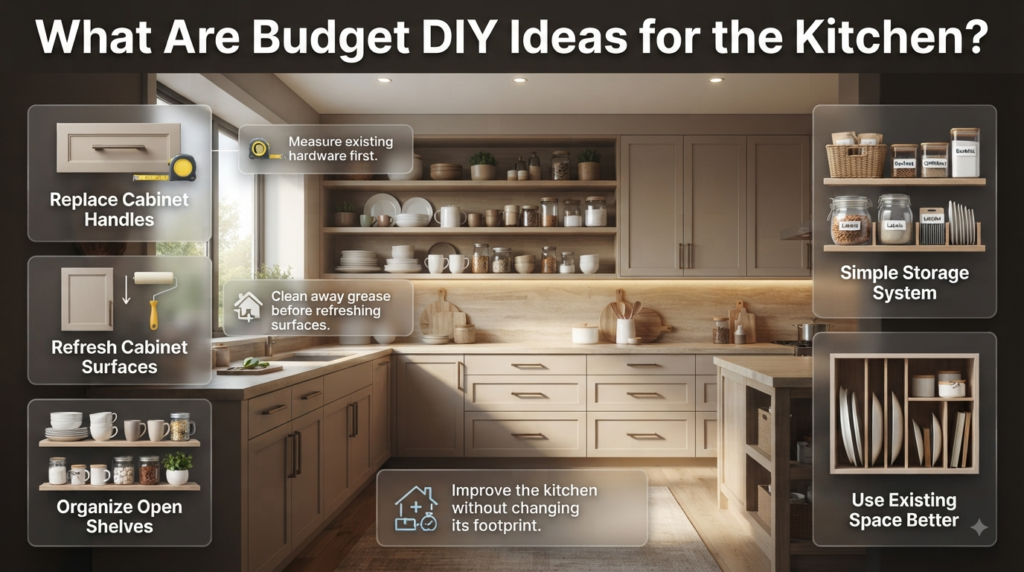
A kitchen can become expensive quickly, so prioritize cosmetic and organizational improvements that don’t require major construction.
Replace Cabinet Handles
This is one of the fastest visual upgrades.
Measure existing hardware carefully before ordering replacements.
Organize Open Shelves
Remove unnecessary objects and group remaining items by function or visual relationship.
For example:
Everyday dishes → mugs → jars → decorative pieces
Don’t overcrowd shelves.
Refresh Cabinet Surfaces
If the cabinets are suitable for painting, preparation becomes extremely important.
Clean away grease thoroughly and use products compatible with the existing surface.
Create a Simple Storage System
Use containers, baskets, labels, dividers, or vertical organizers to make cabinets easier to use.
Good organization is a DIY improvement because it can make an existing kitchen feel substantially better without changing its footprint.
More general renovation and improvement inspiration is available through Home Improvement.
What Are Affordable DIY Ideas for the Bathroom?
Bathrooms don’t necessarily need a complete remodel to feel cleaner and more updated.
Consider:
- Better storage
- New cabinet hardware
- A refreshed mirror frame
- Organized countertop storage
- New textiles
- Repainted suitable furniture
- Simple decorative improvements
- Improved lighting where safely possible
Avoid DIY electrical or plumbing work if you don’t have the necessary expertise.
A bathroom also requires materials that can tolerate humidity. Don’t assume every decorative material is suitable for a wet environment.
How Can You Improve an Entryway With DIY?
The entryway creates the first impression of your home, but it is also one of the easiest areas to improve.
A practical entryway can include:
- Wall hooks
- A shoe basket
- Small storage tray
- Mirror
- Bench
- Key organizer
- Narrow shelf
The objective isn’t to create a decorative display that becomes another source of clutter.
Instead, every item should have a purpose.
For broader planning and room ideas, explore Home Design Ideas.
What Are the Best Budget DIY Ideas for Small Spaces?
Small spaces require careful decisions because every object occupies valuable visual or physical space.
The most effective DIY projects usually combine storage and decoration.
Use Vertical Space
Wall-mounted shelves, hooks, pegboards, and narrow organizers can take advantage of unused vertical areas.
Use Hidden Storage
Boxes beneath beds, baskets inside cabinets, and storage ottomans can reduce visible clutter.
Use Mirrors Carefully
A strategically placed mirror can reflect light and make a room feel more open.
Reduce Visual Noise
A small room often feels larger when surfaces are clear and décor is controlled.
This is where Minimalist Interior Design provides a useful design direction.
How Can DIY Décor Look Expensive Without Being Expensive?
The biggest difference between cheap-looking and polished DIY décor is often execution.
A simple object can look sophisticated when:
- Its proportions suit the room.
- The colors work together.
- Edges are clean.
- Materials are properly finished.
- The object isn’t surrounded by clutter.
- The design has a clear purpose.
Avoid trying to imitate luxury through excessive decoration.
Instead, use fewer elements and finish them well.
Use a Controlled Color Palette
Choose a primary color, supporting neutral, and one accent.
For example:
Warm white + natural wood + muted green
or
Soft beige + charcoal + brass accents
You don’t need to use these exact combinations. The principle is consistency.
Pay Attention to Scale
A small frame over a large sofa can feel insignificant.
A huge decorative object in a tiny room can feel overwhelming.
Before making anything, compare its size with nearby furniture.
How Can Decorative Finishes Improve Budget Projects?
Decorative finishes can add texture, depth, or character to relatively simple surfaces.
Depending on the material and project, you might consider:
- Textured paint
- Lime-style finishes
- Stenciling
- Wood effects
- Distressed finishes
- Layered paint techniques
The finish should suit the room rather than simply being applied because it’s fashionable.
For inspiration around surface treatments, see Decorative Finishes.
How Can You Use Natural Wood in Budget DIY Projects?
Natural wood can add warmth and texture to a home, and small amounts can have a strong visual effect.
You can use suitable wood for:
- Shelves
- Small tables
- Frames
- Planters
- Wall accents
- Storage boxes
- Decorative trays
Reclaimed or leftover wood can sometimes reduce material costs, but inspect it carefully for damage, pests, contamination, nails, and suitability for the intended use.
A natural-material approach works particularly well with calm, uncluttered interiors.
For more inspiration, explore Natural Wood Interior.
Can Budget DIY Ideas Create a Scandinavian Look?
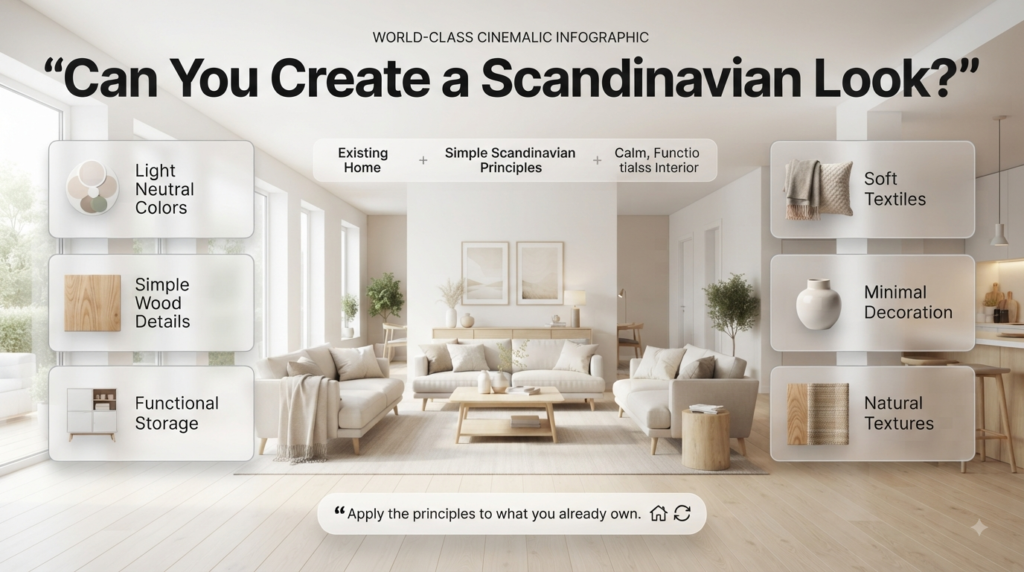
Yes. Scandinavian-inspired interiors often emphasize simplicity, natural materials, useful furniture, light colors, and uncluttered spaces, making the general aesthetic compatible with budget-conscious DIY.
You can create a similar feeling by focusing on:
- Light neutral colors
- Simple wood details
- Functional storage
- Soft textiles
- Minimal decoration
- Natural textures
You don’t need to buy a complete Scandinavian furniture collection.
Instead, apply the underlying principles to pieces you already own.
For more inspiration, see Scandinavian Interior Design.
What About Japandi-Inspired Budget DIY?
Japandi combines Japanese-inspired simplicity with Scandinavian warmth. It can work particularly well for budget DIY because the style values restraint, natural materials, useful objects, and calm spaces.
Try:
- Natural wood
- Soft neutrals
- Simple handmade décor
- Low visual clutter
- Textured fabrics
- Functional storage
Avoid overdecorating. Japandi-inspired spaces depend heavily on balance and simplicity.
For more design direction, explore Japandi Interior Design.
How Can You Create a Contemporary Look on a Budget?
Contemporary design doesn’t require expensive furniture.
You can move a room toward a contemporary appearance by emphasizing:
- Clean lines
- Simple forms
- Controlled colors
- Minimal clutter
- Modern hardware
- Functional furniture
- Strong but limited accents
An old cabinet can sometimes look contemporary after a carefully selected finish and modern hardware.
The key is to avoid mixing too many unrelated decorative elements.
For more inspiration, see Contemporary Interior Design.
How Can DIY Create a Statement Interior?
A statement interior doesn’t mean every element needs to be dramatic.
Choose one feature that deserves attention.
It could be:
- A bold wall
- Large artwork
- A dramatic furniture makeover
- A colorful cabinet
- A handmade focal piece
- A strong lighting feature
- A distinctive arrangement of objects
Then allow the rest of the room to support it.
For more inspiration on creating memorable focal points, explore Statement Interiors.
⭐ Expert Tip: If everything is a statement, nothing is a statement. Give your strongest DIY feature enough surrounding space to be noticed.
What DIY Crafts Can You Make With Cheap Materials?
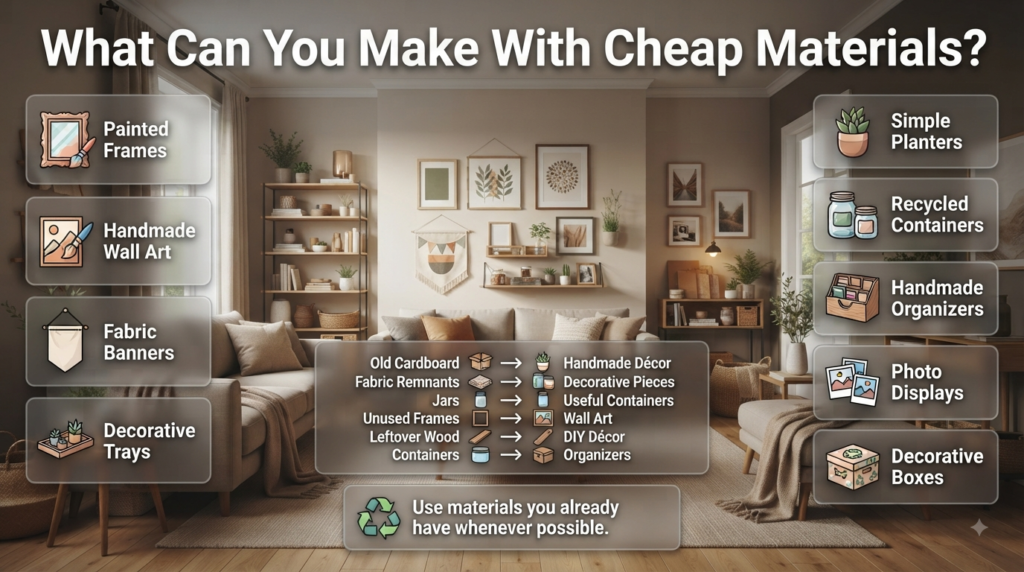
DIY crafts are especially useful when you want decorative details without purchasing expensive accessories.
Ideas include:
- Painted frames
- Handmade wall art
- Fabric banners
- Decorative trays
- Simple planters
- Recycled containers
- Handmade organizers
- Photo displays
- Decorative boxes
Use materials that are already available whenever possible.
Old cardboard, fabric remnants, jars, unused frames, leftover wood, and containers can become useful materials when approached creatively.
For more craft inspiration, explore DIY Home Decor Crafts.
How Can DIY Projects Make a Home More Energy Efficient?
Not every budget DIY project has to focus on appearance. Some small improvements can reduce energy waste or improve everyday comfort.
Examples include:
- Sealing obvious drafts where appropriate
- Improving curtain use
- Adding suitable thermal window treatments
- Reducing unnecessary lighting
- Using timers or controls where appropriate
- Improving natural-light use
- Organizing spaces around efficient heating or cooling
However, don’t assume that every inexpensive product will produce meaningful energy savings.
For larger ideas and principles, explore Energy-Efficient Homes.
The most effective approach is to identify where your home actually loses energy rather than buying products simply because they are marketed as efficient.
Can Smart Home DIY Projects Be Budget-Friendly?
Technology can be included in a budget home improvement strategy, but it should solve a real problem.
Useful examples can include:
- Smart bulbs
- Timers
- Basic smart plugs
- Simple automation
- Energy monitoring
- Automated routines
Before buying a smart device, check compatibility with your existing ecosystem, Wi-Fi reliability, privacy settings, subscription requirements, and long-term support.
If you’re interested in combining technology with home design, see Techoelite Smart Homes.
The best smart-home investment is usually the device that eliminates a repeated inconvenience rather than the device with the longest feature list.
What Materials Should You Buy for Budget DIY Projects?
A small collection of quality basic tools can support many future projects.
Useful items include:
- Measuring tape
- Screwdriver set
- Utility knife
- Sandpaper
- Paintbrushes
- Small roller
- Painter’s tape
- Level
- Drill
- Appropriate screws
- Safety glasses
- Work gloves
- Drop cloth
You don’t need to purchase everything at once.
Buy tools based on actual projects.
A cheap tool that fails repeatedly can cost more than a reasonably durable tool over time.
What Materials Should You Not Cheap Out On?
Be particularly careful with materials that affect:
- Structural stability
- Safety
- Electrical connections
- Load-bearing capacity
- Moisture resistance
- High-use surfaces
Saving a few dollars isn’t worth creating a dangerous or short-lived installation.
How Do You Calculate the Real Cost of a DIY Project?
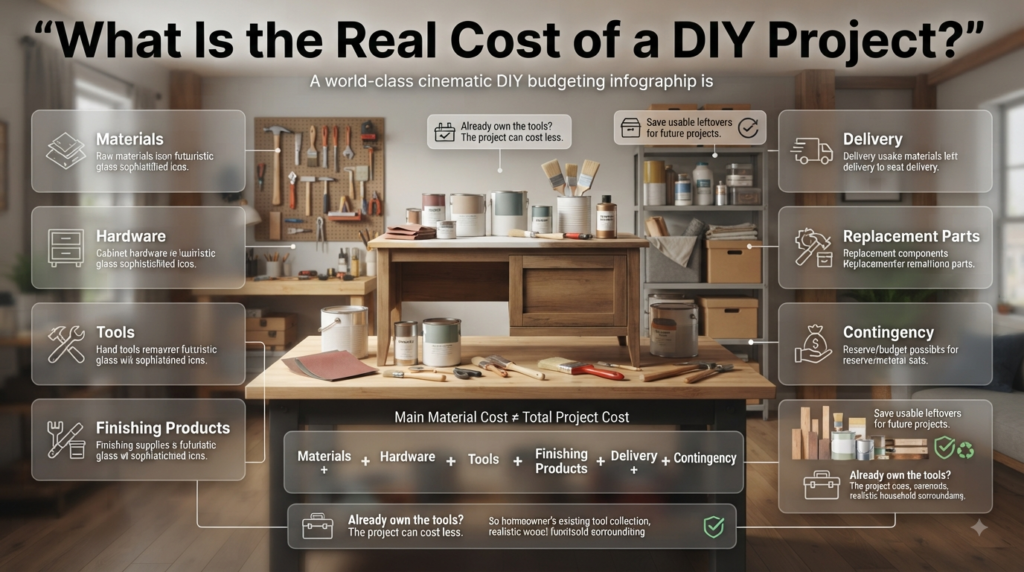
Many beginners calculate only the main material.
That’s rarely the full cost.
A realistic budget should include:
Materials + hardware + tools + finishing products + delivery + replacement parts + contingency
For example, a furniture makeover may appear inexpensive until you add:
- Sandpaper
- Primer
- Paint
- Brushes
- New hardware
- Protective finish
If you already own the tools, the project becomes considerably cheaper.
📌 Quick Tip: Keep leftover usable materials organized. Future DIY projects can often reuse them, reducing the effective cost of your next project.
How Can You Save More Money on DIY?
The easiest way to reduce costs is to use what you already own.
Before shopping:
- Check storage areas.
- Look for leftover paint.
- Inspect unused hardware.
- Identify old furniture.
- Look for spare wood.
- Check containers and baskets.
- Reuse frames and décor.
- Measure everything before purchasing.
You can also combine projects.
For example, leftover paint from a furniture makeover can potentially be used for a small decorative frame or accent detail.
Common Budget DIY Mistakes Beginners Make
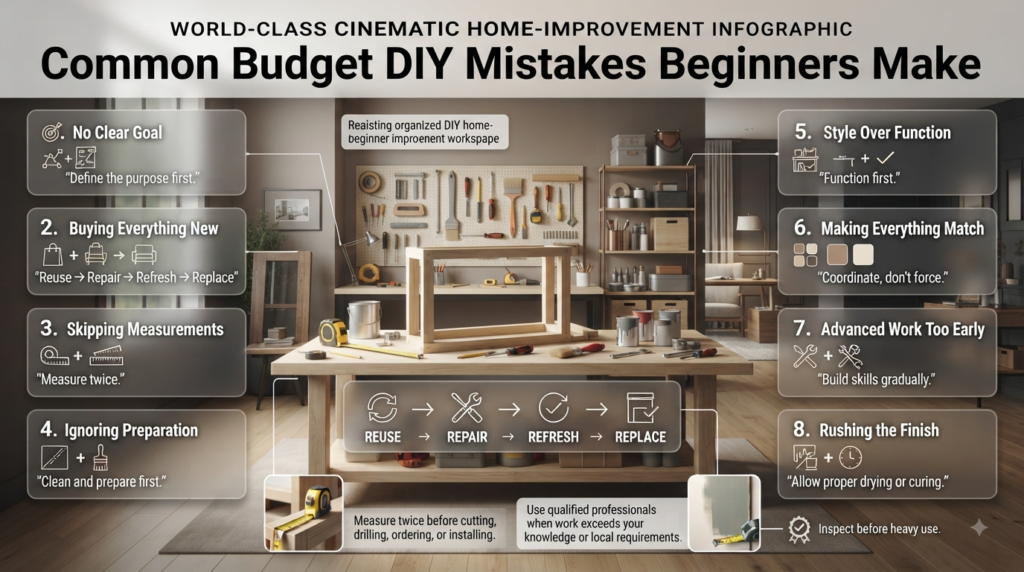
1. Starting Without a Clear Goal
A project without a purpose can quickly become a collection of unnecessary purchases.
Why it happens: Inspiration encourages people to start before identifying the actual problem.
How to avoid it: Write one sentence explaining what the project should improve.
2. Buying Everything New
Replacing everything defeats the main advantage of DIY.
Why it happens: New products appear easier than repairing or repurposing old ones.
How to avoid it: Follow the rule:
Reuse → Repair → Refresh → Replace
Only replace something when the first three options aren’t practical.
3. Skipping Measurements
Incorrect measurements can lead to wasted materials and expensive returns.
How to avoid it: Measure twice before cutting, drilling, ordering, or installing.
4. Ignoring Preparation
Paint, adhesive, and finishes cannot hide every surface problem.
How to avoid it: Clean and prepare properly before finishing.
5. Choosing Style Over Function
A beautiful storage system that is difficult to use isn’t a successful project.
How to avoid it: Make functionality the starting point and appearance the finishing layer.
6. Making Everything Match
Perfect matching can make a home feel artificial.
How to avoid it: Coordinate colors and materials without forcing every object to be identical.
7. Taking on Advanced Work Too Early
Some DIY projects involve serious safety risks.
How to avoid it: Build skills gradually and use qualified professionals when the work exceeds your knowledge or local requirements.
8. Rushing the Finish
A project can be technically complete but still look unfinished.
How to avoid it: Allow paint and finishes to dry or cure properly and inspect the final result before using the item heavily.
How Can You Make Budget DIY Projects Look More Professional?
Professional-looking DIY usually comes from attention to details that are easy to overlook.
Keep Edges Clean
Straight paint lines and properly finished edges immediately improve the result.
Hide Unnecessary Hardware
Where appropriate and safe, conceal cables, mounting hardware, and messy connections.
Use Consistent Finishes
If you use several wood tones or metal finishes in one small space, make sure they look intentional.
Don’t Overfill
A room with fewer well-placed items can look more expensive than one packed with decorations.
Match the Project to the Room
A rustic wooden shelf may look wonderful in one room but disconnected in another.
The finished project should feel like it belongs there.
When Should You DIY and When Should You Hire a Professional?
DIY is ideal when the task is safe, manageable, and within your current ability.
Good DIY candidates include:
- Painting
- Furniture refinishing
- Basic organization
- Decorative crafts
- Simple styling
- Non-structural improvements
- Some basic hardware replacements
Professional help is generally more appropriate when work involves significant:
- Electrical systems
- Gas
- Structural changes
- Major plumbing
- Roofing
- Load-bearing elements
- Safety-critical installations
The purpose of DIY is to save money intelligently, not to avoid professional help at any cost.
How Can You Make DIY More Sustainable?
Budget-conscious DIY and sustainability often work naturally together.
Instead of automatically replacing something, ask whether you can:
- Repair it
- Refinish it
- Repaint it
- Repurpose it
- Donate it
- Reuse its components
Furniture restoration is particularly useful because it extends the life of existing products.
However, sustainability doesn’t mean keeping everything forever. If an object is unsafe, badly damaged, unusable, or inefficient, replacement may still be the better decision.
How Do Different Interior Styles Affect Budget DIY Choices?
Your design style should influence what you make and buy.
A minimalist home may benefit from simple storage and fewer decorative objects.
A contemporary interior may benefit from clean lines, modern hardware, and controlled colors.
A Scandinavian-inspired room may emphasize light tones, wood, and practical furnishings.
Japandi-inspired spaces may prioritize natural materials and restraint.
A statement-focused interior may use one dramatic DIY feature as the room’s focal point.
Understanding Interior Design Styles can help you avoid buying random items that don’t work together.
What are the best Budget DIY Ideas that make a home look expensive?
The best budget projects are the ones that create a visible change without requiring a complete renovation. Instead of filling a room with inexpensive decorations, focus on a few high-impact improvements such as painting an accent wall, updating furniture hardware, refinishing an old piece, improving storage, creating simple wall décor, or changing the arrangement of existing furniture.
The secret is not how much you spend; it’s how intentionally you use what you have. A freshly painted wall, properly finished furniture, coordinated textiles, and uncluttered surfaces can make a room feel considerably more polished.
Practical ideas to prioritize:
Paint a tired wall or furniture piece.
Replace outdated cabinet or drawer hardware.
Create one well-designed focal wall.
Refinish furniture that is still structurally sound.
Improve lighting and remove unnecessary clutter.
Use a consistent color palette.
Add simple natural textures such as wood or fabric.
Display fewer decorative items, but arrange them carefully.
A common mistake is assuming that an expensive-looking room needs expensive objects. In reality, clean finishing, good proportions, consistency, and thoughtful placement often have a greater visual effect than price.
What is the cheapest DIY home improvement with the biggest impact?
Painting is usually one of the strongest low-cost options because it can change a large visual surface without replacing major furniture. You don’t even need to paint an entire room. A single accent wall, ceiling treatment, furniture makeover, or small architectural feature can create a noticeable transformation while keeping material requirements manageable. Current home-improvement guidance also continues to highlight paint, furniture updates, wall décor, and similar small-scale projects as practical budget improvements.
However, the cheapest project isn’t necessarily the best project for every home. If your biggest problem is clutter, better organization may create a larger improvement than painting. If your furniture looks dated, new hardware or refinishing may deliver more value.
Consider these low-cost options:
Rearranging furniture — often free
Decluttering and reorganizing — often free
Creating DIY wall art — very low cost
Painting an accent wall — low cost
Replacing cabinet hardware — low cost
Refreshing old furniture — low to moderate cost
Adding simple shelves or hooks — low to moderate cost
Repurposing existing household items — potentially free
The professional approach is to identify the largest visible or functional problem first. Don’t spend $50 decorating a room when a free furniture rearrangement would solve the main issue.
What are the easiest Budget DIY Ideas for beginners?
Beginners should start with projects that are inexpensive, relatively low-risk, and easy to correct if something doesn’t go exactly as planned. Painting, basic furniture refreshes, hardware replacement, simple wall art, storage organization, and decorative projects are excellent starting points because they help develop practical skills without immediately requiring advanced construction knowledge.
A good beginner project should teach you something useful while still giving you a realistic chance of achieving a clean result.
Good beginner projects include:
Painting a small wall
Updating furniture knobs and handles
Creating a simple gallery wall
Refinishing a small table
Organizing a closet or cabinet
Making decorative trays
Creating simple planters
Installing suitable lightweight storage
Refreshing cushions or other soft décor
Start with a small project rather than trying to renovate an entire room over one weekend.
For example, instead of repainting every cabinet in the kitchen as your first painting project, test your technique on one smaller piece. You’ll learn how the surface reacts, how much preparation is required, and whether you actually like the finish.
⚠ Most important beginner rule: Don’t confuse a DIY tutorial being easy to watch with the project being easy to perform. Electrical, structural, gas, major plumbing, and other safety-sensitive work can require specialized knowledge, appropriate precautions, and sometimes permits or qualified professionals.
How can I make Budget DIY Ideas look professional instead of cheap?
Professional-looking DIY is mostly about preparation, proportion, consistency, and finishing quality. You can use inexpensive materials and still achieve an attractive result when the project is carefully planned and properly finished.
The biggest difference is often visible in the small details. Uneven paint edges, poorly measured shelves, excessive decoration, exposed clutter, mismatched colors, and unfinished surfaces can make an inexpensive project look rushed.
Use these professional-style principles:
Measure before cutting or installing anything.
Prepare surfaces before painting or refinishing.
Keep paint edges clean and consistent.
Choose colors that work with your existing room.
Pay attention to the scale of furniture and décor.
Avoid filling every shelf and wall.
Repeat a few colors or materials throughout the room.
Finish visible edges properly.
Use fewer decorative pieces with stronger visual purpose.
Allow paint, adhesives, and finishes to dry or cure properly.
Another important point is restraint. If you create a dramatic accent wall, you don’t necessarily need dramatic artwork, bold furniture, and numerous decorative objects around it.
One strong feature surrounded by simpler elements often looks more sophisticated than five competing DIY projects.
Current design coverage also continues to emphasize intentional, cohesive choices over excessive or mismatched décor when creating a polished home.
Is DIY really cheaper than hiring a professional?
DIY can be significantly cheaper for suitable cosmetic and straightforward projects, but it isn’t automatically the cheaper option. The real cost includes materials, tools, wasted supplies, mistakes, repairs, your time, and the possibility of having to pay someone later to correct the work.
For simple projects such as painting, furniture refinishing, organizing, decorative work, and some basic hardware changes, doing the work yourself can make excellent financial sense—especially when you already own the necessary tools.
The calculation becomes different when a project involves specialized skills or serious safety risks.
Before starting, consider:
What will all materials cost?
Do I already have the required tools?
How much time will the project take?
What happens if I make a mistake?
Can I safely complete the work?
Will a professional finish provide substantially better results?
Could an error cause expensive property damage?
A useful rule is:
DIY the work you can confidently do well. Hire help when a mistake could cost more than the professional service.
This is particularly important for electrical, structural, gas, major plumbing, roofing, or other high-risk work. Professional guidance on DIY mistakes similarly warns that seemingly simple projects can create costly damage or safety problems when specialized knowledge is required.
The smartest DIYer isn’t the person who does everything themselves. It’s the person who knows what is worth doing personally, what should be planned carefully, and what should be left to a qualified professional.
Conclusion
The best Budget DIY Ideas aren’t about spending as little money as possible—they’re about making smart improvements that create real value. A fresh coat of paint, updated furniture hardware, a simple storage solution, or a carefully planned décor project can completely change how a room looks and feels without requiring a major renovation budget.
The key is to start with the biggest problem in your space, set a realistic budget, and use what you already have before buying something new. Good preparation, accurate measurements, suitable materials, and careful finishing can make an inexpensive DIY project look polished and intentional.
You also don’t need to transform your entire home at once. Start with one wall, one piece of furniture, one cluttered corner, or one room. As your skills and confidence grow, you can take on larger projects while continuing to keep costs under control.
Most importantly, know your limits. DIY is excellent for suitable decorating, organization, painting, furniture updates, and creative projects, but safety-sensitive work should be handled by someone with the right expertise.
With a little planning and creativity, a limited budget doesn’t have to limit what your home can become. The right project can make your space more attractive, functional, personal, and comfortable—without unnecessary spending.
Leave a Reply