

Introduction
Lighting Fixtures | Walk into a beautifully decorated room at night and switch on the wrong light. Suddenly, the paint looks different, furniture loses its warmth, corners become too dark, and the entire space feels less inviting. The problem isn’t always the furniture or the décor. Very often, it’s the lighting fixtures.
Lighting is one of those design elements people notice most when it’s wrong but often overlook when planning a room. A pendant that’s too large can dominate a dining area. A ceiling light that’s too bright can make a bedroom uncomfortable. A kitchen with beautiful cabinets can still be difficult to use if the countertops are covered in shadows.
The good news is that choosing lighting doesn’t have to be complicated.
The right approach is to think about what each light needs to accomplish, where it should be positioned, how much illumination the room needs, and how the fixture should work with the existing interior.
In this guide, you’ll learn how to choose lighting fixtures for different rooms, understand ambient, task, and accent lighting, select the right size and style, avoid common mistakes, coordinate different fixtures, and create a lighting plan that feels practical as well as beautiful.
If you’re planning a complete interior rather than choosing lights separately, DesignMode24 Interior Design can also help you connect lighting choices with furniture, color, materials, layout, and the overall character of your home.
What Are Lighting Fixtures?
Lighting fixtures are devices designed to hold, distribute, direct, or control artificial light within a space. They include ceiling lights, pendant lights, chandeliers, recessed lights, wall sconces, track lights, floor lamps, table lamps, under-cabinet lights, and decorative accent fixtures.
A fixture has two jobs.
The first is functional: it needs to provide the right type and amount of illumination.
The second is visual: it becomes part of the room’s design.
This distinction is important because a fixture can look beautiful while performing badly. A dramatic pendant may be perfect above a dining table but completely inappropriate in a low-ceiling hallway. A minimalist recessed light may provide excellent general illumination but won’t necessarily create the visual character of a traditional living room.
Good lighting design brings both jobs together.
Why Are Lighting Fixtures Important in Interior Design?
Lighting affects how people see almost everything else in a room.
It can change the perceived warmth of wall colors, emphasize the texture of natural materials, make artwork stand out, define furniture zones, and influence how spacious or intimate a room feels.
A room doesn’t necessarily need more light to look better. It needs the right light in the right place.
For example, a living room may need softer ambient lighting combined with floor lamps and accent lighting. A kitchen needs stronger illumination where food is prepared. A bedroom may need low-level warm light for relaxing but brighter task lighting for dressing or reading.
This is why professional lighting planning starts with room function rather than fixture appearance.
What Are the Main Types of Lighting Fixtures?
There are many fixture styles, but most residential lighting can be understood through a few major categories.
| Lighting Fixture | Best Used For | Main Benefit | Main Consideration |
|---|---|---|---|
| Chandeliers | Dining rooms, foyers, large living rooms | Creates a focal point | Requires suitable ceiling height |
| Pendant lights | Islands, tables, counters | Focused and decorative | Height and spacing matter |
| Flush mounts | Low ceilings, bedrooms, hallways | Saves vertical space | Can have less visual drama |
| Semi-flush lights | Bedrooms, hallways, living areas | Decorative with moderate projection | Needs ceiling clearance |
| Recessed lights | General and task lighting | Clean, minimal appearance | Poor placement can cause glare |
| Wall sconces | Bedrooms, hallways, bathrooms | Adds light without floor space | Positioning is important |
| Track lighting | Art, kitchens, flexible areas | Adjustable direction | Too many heads can look cluttered |
| Floor lamps | Seating areas | Flexible and movable | Uses floor space |
| Table lamps | Desks, nightstands, consoles | Adds localized light | Limited coverage |
| Under-cabinet lighting | Kitchens and work areas | Reduces countertop shadows | Requires careful installation |
The best lighting plan often combines several of these rather than asking one fixture to do everything.
What Are the Three Layers of Lighting?
A well-planned room commonly combines ambient lighting, task lighting, and accent lighting. Each layer performs a different job, so the room becomes more comfortable and flexible instead of simply brighter.
Ambient Lighting
Ambient lighting is the general illumination that allows you to move through and use the room comfortably.
Common examples include:
- Ceiling fixtures
- Chandeliers
- Flush mounts
- Recessed downlights
- Large pendants
- Cove lighting
- Uplighting
Ambient lighting establishes the basic brightness of the room.
Task Lighting
Task lighting is more focused.
It helps you perform activities that require clearer visibility, such as:
- Reading
- Cooking
- Working
- Studying
- Applying makeup
- Shaving
- Sewing
- Preparing food
Examples include desk lamps, reading lamps, vanity lights, and under-cabinet lighting.
Accent Lighting
Accent lighting is used to draw attention.
It can highlight:
- Artwork
- Shelving
- Architectural details
- Plants
- Textured walls
- Decorative objects
- Display cabinets
Think of ambient lighting as the foundation, task lighting as the working layer, and accent lighting as the visual finishing layer.
Why Should You Layer Lighting?
A room illuminated from one central ceiling fixture may technically be bright enough, but it can still feel flat.
Layering gives you control.
You can use general illumination while cleaning, task lighting while working, and softer accent lighting while relaxing.
This approach also allows different parts of an open-plan room to perform different functions without making the entire space equally bright.
💡 Pro Tip: Before adding another fixture, ask what job it will perform. If it doesn’t improve visibility, atmosphere, focal emphasis, or flexibility, you may not need it.
How Do You Choose the Right Lighting Fixture?
Start with the room, not the product.
Before shopping, consider:
- Room dimensions
- Ceiling height
- Natural daylight
- Furniture arrangement
- Activities performed there
- Existing electrical points
- Desired atmosphere
- Interior design style
- Maintenance requirements
- Fixture scale
This prevents one of the most common lighting mistakes: buying an attractive fixture first and trying to make the room work around it.
For example, if you’re choosing a dining pendant, you should already know the dining table’s dimensions and position. If you’re choosing bedside sconces, you should know the bed height and nightstand arrangement.
Lighting should respond to the room’s layout.
How Do You Choose the Correct Fixture Size?
Scale is one of the most important parts of lighting design.
A fixture that’s too small may disappear visually. One that’s too large can make the room feel crowded.
For a central ceiling fixture, one commonly used starting point is to add the room’s length and width in feet and use that number as an approximate fixture diameter in inches.
For example:
10-foot room + 12-foot room = approximately 22-inch fixture
This is only a starting point.
Furniture, ceiling height, fixture style, and visual weight can change the appropriate size.
A delicate glass pendant and a solid metal pendant measuring the same diameter won’t necessarily appear equally large.
How Do You Size a Dining Room Chandelier?
Dining fixtures should be sized in relation to the dining table rather than the room alone.
A large table in a spacious room can support a more substantial fixture. A compact table generally needs something more restrained.
Before buying, check:
- Table width
- Table length
- Ceiling height
- Fixture diameter
- Fixture height
- Seating arrangement
- Sightlines
You don’t want diners to have to look around a large shade to see one another.
⭐ Expert Tip: Use cardboard, paper, or painter’s tape to create a temporary outline of the proposed fixture. Stand back from several angles. This simple test can reveal scale problems before installation.
How High Should Pendant Lights Hang?
Pendant height depends on where the fixture is being used.
Over a kitchen island or dining table, the light should provide useful illumination without obstructing conversation or normal movement.
A commonly used starting point is approximately 30–36 inches between the bottom of the fixture and the surface below, but the exact position should be adjusted according to ceiling height, fixture size, visual clearance, and household needs.
For multiple pendants, consider the relationship between:
- Pendant diameter
- Island length
- Seating positions
- Cabinet doors
- Work zones
- Sightlines
Don’t space fixtures mechanically if doing so makes the useful lighting uneven.
What Is the Difference Between Pendant Lights and Chandeliers?
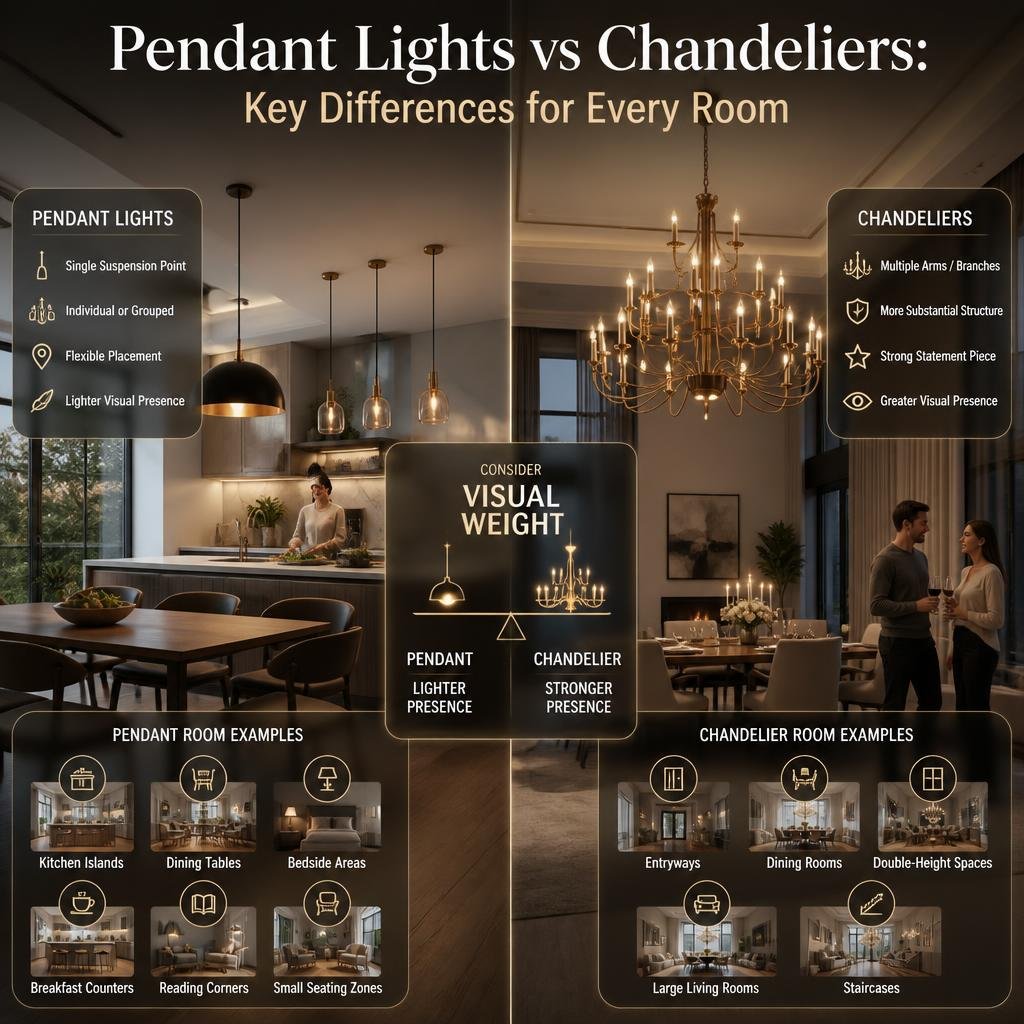
Both can become decorative focal points, but they have different visual characteristics.
Pendant Lights
Pendant lights generally hang from one suspension point and are often used individually or in groups.
They’re excellent for:
- Kitchen islands
- Dining tables
- Bedside areas
- Breakfast counters
- Reading corners
- Small seating zones
Chandeliers
Chandeliers usually have multiple arms, branches, bulbs, or a more substantial structure.
They’re often used where the fixture itself needs to make a strong statement.
Common locations include:
- Entryways
- Dining rooms
- Double-height spaces
- Large living rooms
- Staircases
The choice isn’t simply about style. Think about how much visual weight the room can comfortably handle.
What Are Flush-Mount and Semi-Flush Lighting Fixtures?
Flush-mount fixtures sit close to the ceiling, making them useful where vertical clearance is limited.
They’re particularly practical for:
- Low-ceiling bedrooms
- Hallways
- Small living rooms
- Utility rooms
- Compact entrances
Semi-flush fixtures extend slightly from the ceiling and can provide more decorative presence.
They’re a useful middle ground when you want more character than a basic flush mount but don’t have enough height for a hanging chandelier.
📌 Quick Tip: In a low-ceiling room, look for visual lightness as well as physical height. A compact fixture with a transparent or open design can sometimes feel less heavy than a solid fixture of similar dimensions.
Are Recessed Lights Still a Good Choice?
Recessed lighting can provide clean, low-profile illumination and works well in many contemporary interiors.
However, recessed lighting shouldn’t automatically become the default solution for every ceiling.
Too many downlights can create:
- Glare
- Harsh shadows
- A repetitive ceiling pattern
- Excessive brightness
- Poor visual hierarchy
The fixture location should relate to furniture and activities.
A downlight centered in an empty part of the ceiling isn’t necessarily useful if the actual task occurs several feet away.
This is why the ceiling plan should be developed alongside the furniture plan.
How Do Wall Sconces Improve a Room?
Wall sconces add light without occupying floor or table space.
They’re especially useful beside:
- Beds
- Bathroom mirrors
- Hallways
- Artwork
- Consoles
- Reading chairs
- Staircases
They also introduce light at eye level, which can make a room feel more layered.
In bedrooms, sconces can replace bedside lamps and free valuable nightstand space.
In corridors, they can break up long blank walls and create a more intentional visual rhythm.
How Do You Choose the Right Color Temperature?
Color temperature affects the appearance and atmosphere of artificial light.
It is measured in Kelvin (K).
| Approximate Temperature | Appearance | Typical Residential Use |
|---|---|---|
| 2200–2700K | Very warm | Relaxed and intimate spaces |
| 2700–3000K | Warm white | Living rooms and bedrooms |
| 3000–3500K | Neutral-warm | Kitchens and multipurpose areas |
| 3500–4100K | Neutral/cooler | Work-focused areas |
| 5000K+ | Cool daylight appearance | Specialized applications |
For many residential interiors, warm white light creates a comfortable atmosphere. Recent interior lighting guidance also commonly recommends warm residential color temperatures around 2700K–3000K, particularly for living spaces.
However, the right choice depends on the room and finishes.
Warm light can emphasize natural wood, cream, beige, terracotta, and warm stone.
A cooler light can change how white, blue, gray, and certain green finishes appear.
Should Every Room Use the Same Color Temperature?
Not necessarily.
A home can use slightly different lighting temperatures for different functions, but abrupt changes between connected spaces can feel distracting.
If several fixtures are visible at the same time, keeping their color temperature reasonably consistent usually creates a more cohesive appearance.
What Is CRI and Why Does It Matter?
CRI stands for Color Rendering Index.
It describes how accurately a light source reveals colors compared with a reference source.
This matters when color accuracy is important.
Examples include:
- Kitchens
- Bathrooms
- Dressing areas
- Art displays
- Retail-style wardrobes
- Material sample areas
A higher-quality light source can make fabrics, finishes, food, artwork, and skin tones appear more natural.
Don’t choose a bulb or integrated LED only by brightness. Consider its color quality as well.
How Does Lighting Affect Wall Colors?
Lighting and paint should never be treated as completely separate decisions.
The same wall can appear different under daylight, warm LEDs, and cooler artificial lighting.
For example, a neutral gray can look warmer under warm illumination and cooler under daylight or higher color temperatures.
This is why paint samples should ideally be tested at different times of day.
If you’re working on a broader color scheme, the Paint Color section can help you think about wall colors as part of the complete interior rather than isolated selections.
What Lighting Fixtures Work Best in the Living Room?
Living rooms usually need flexibility because they serve multiple purposes.
You might read, watch television, entertain guests, work on a laptop, talk with family, or simply relax.
A useful combination could include:
- Central ambient fixture
- Floor lamp
- Table lamp
- Wall sconces
- Accent lighting
- Adjustable spotlights
A living room doesn’t need every fixture turned on at once.
During the day, natural light may do most of the work.
In the evening, moderate ambient light can combine with lamps.
For movie time, the ceiling light can be dimmed while softer side lighting remains active.
Recent interior-design guidance similarly emphasizes layered fixtures rather than relying entirely on a single overhead source.
What Lighting Is Best for a Bedroom?
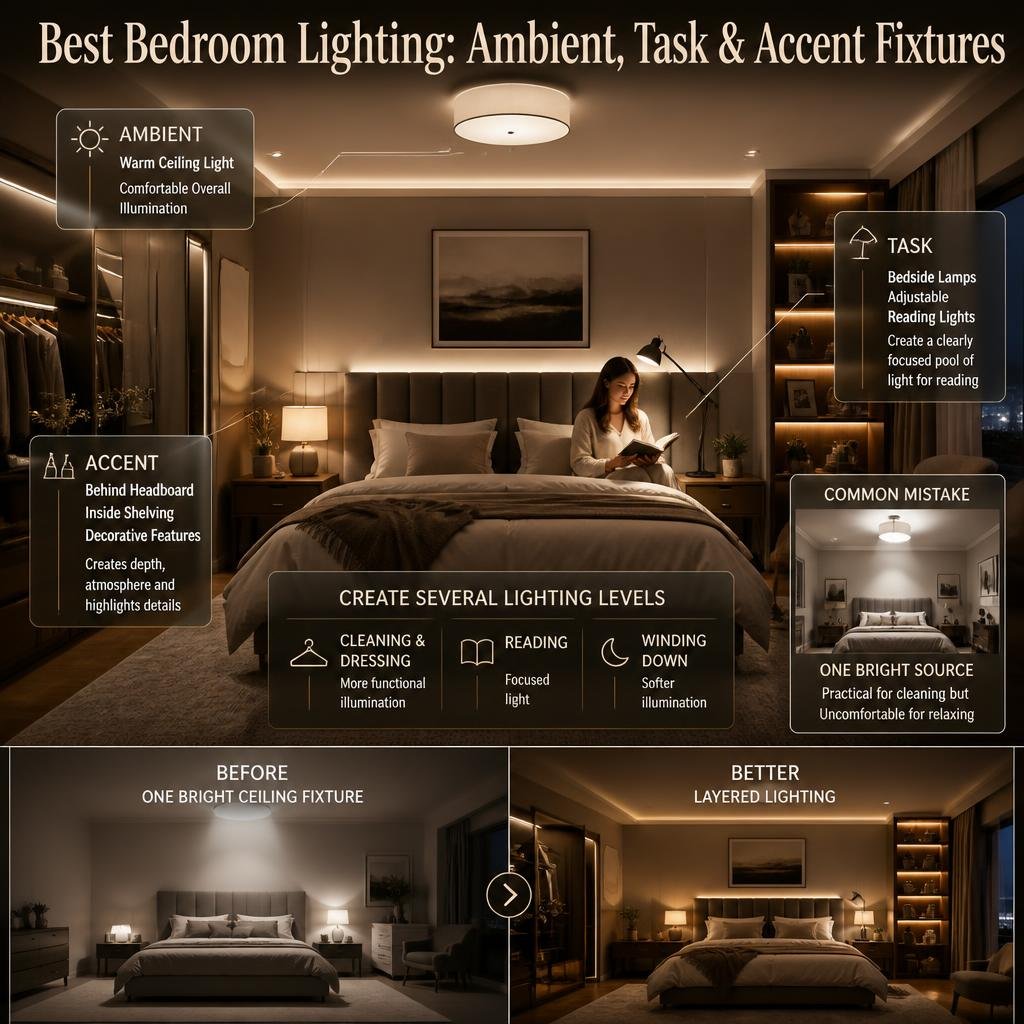
Bedrooms generally benefit from softer, controllable illumination.
A practical setup might include:
Ambient
A warm ceiling fixture or concealed ceiling illumination.
Task
Bedside lamps or adjustable wall-mounted reading lights.
Accent
Subtle lighting behind a headboard, inside shelving, or around a decorative feature.
The goal isn’t to make the bedroom bright at all times.
Instead, create several lighting levels.
You need enough light for cleaning and dressing, focused light for reading, and softer illumination for winding down.
⚠ Common Mistake: Installing a very bright central ceiling fixture directly over the bed and using it as the only source. It may be practical for cleaning but uncomfortable when you’re trying to relax.
What Lighting Fixtures Are Best for the Kitchen?
The kitchen is one of the rooms where lighting quality directly affects usability.
You need general illumination, but you also need focused light on work surfaces.
A practical layered kitchen can include:
- Ceiling downlights
- Pendant lights
- Under-cabinet lighting
- Cabinet interior lighting
- Pantry lighting
- Accent lighting
Why Is Under-Cabinet Lighting Important?
When an overhead fixture sits behind you while you’re working at the countertop, your body can cast shadows across the work surface.
Under-cabinet lighting places illumination closer to the actual work area.
It can improve visibility while chopping, preparing food, reading recipes, or cleaning.
If you’re also planning storage, cabinetry, and other upgrades, Home Improvement provides a useful broader context for coordinating those decisions.
How Should Bathroom Lighting Be Planned?
Bathroom lighting needs to combine function with comfortable illumination.
The vanity deserves particular attention because poor positioning can create shadows on the face.
Useful options include:
- Mirror-integrated lighting
- Vertical sconces
- Vanity fixtures
- Ceiling lighting
- Shower-area lighting where appropriate
Avoid relying only on a bright light directly above the head.
For bathrooms, fixture selection must also account for moisture exposure, installation zones, applicable electrical requirements, and the appropriate protection rating.
When electrical work is involved, use qualified professionals where required.
What Lighting Works Best in a Home Office?
A home office needs comfortable task lighting without excessive glare.
The desk lamp should illuminate your working surface without reflecting directly into your screen.
Consider:
- Adjustable desk lamps
- Indirect ambient lighting
- Wall lighting
- Dimmable ceiling fixtures
- Window position
- Monitor placement
The position of the light matters as much as its brightness.
If the lamp is directly behind your screen, it may create reflections. If it’s directly behind you, your body may cast shadows across your desk.
What Lighting Fixtures Work in Hallways?
Hallways are often overlooked because they’re not primary living spaces.
But lighting can dramatically improve their appearance.
Useful choices include:
- Flush mounts
- Semi-flush fixtures
- Wall sconces
- Recessed lights
- Picture lights
- Low-level accent lighting
A long hallway doesn’t necessarily need a continuous row of bright downlights.
A combination of ceiling and wall illumination can create rhythm while making artwork or architectural details more visible.
How Can Lighting Make a Small Room Feel Larger?
Lighting can influence perceived space by controlling where the eye travels.
Try illuminating:
- Dark corners
- Vertical walls
- Shelving
- Mirrors
- Architectural details
Wall-directed light can make vertical surfaces more visually prominent.
Wall sconces can also reduce dependence on floor lamps, which can help preserve floor space.
The goal isn’t to make every surface equally bright.
It’s to create enough visual depth that the room doesn’t feel like one compressed box.
For additional ideas around practical decorating and space improvement, DIY Home Projects can complement a lighting upgrade when you’re making smaller changes yourself.
How Do Lighting Fixtures Work With Different Interior Styles?
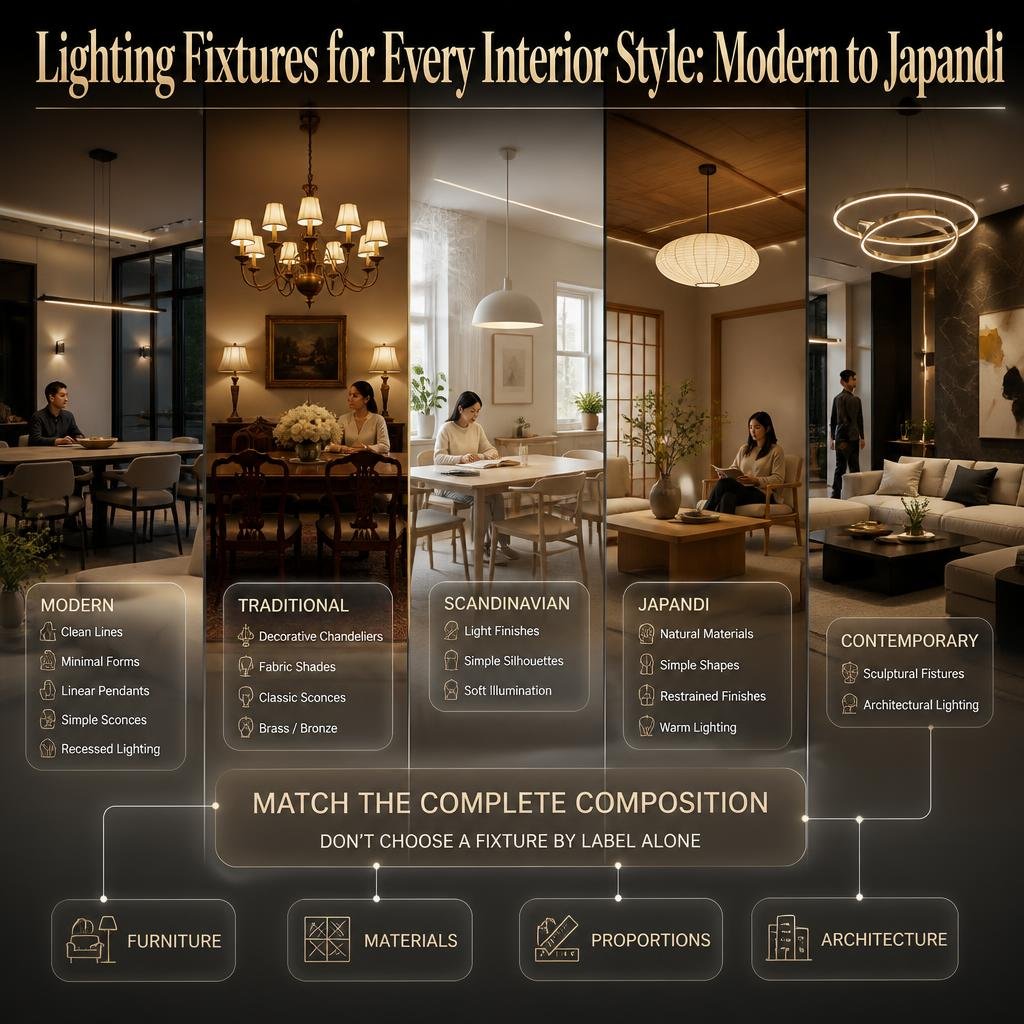
Lighting should support the design language of the room.
Modern Interiors
Look for:
- Clean lines
- Minimal forms
- Linear pendants
- Simple sconces
- Architectural recessed lighting
Traditional Interiors
Consider:
- Decorative chandeliers
- Fabric shades
- Classic sconces
- Brass or bronze finishes
Scandinavian Interiors
Light-colored finishes, simple silhouettes, and soft illumination generally work well with the restrained character of Scandinavian spaces.
Japandi Interiors
Natural materials, simple shapes, restrained finishes, and warm lighting can support the calm visual language of Japandi rooms.
Contemporary Interiors
Contemporary rooms can combine sculptural fixtures with clean architectural lighting.
The key isn’t buying a fixture that is labelled “modern” or “traditional.”
Look at the room’s furniture, materials, proportions, and architectural features as a complete composition.
How Can Lighting Create a More Cohesive Home?
Connected rooms don’t need identical fixtures.
Instead, repeat selected elements.
For example, you might use:
- Similar metal finishes
- Related glass details
- Repeated geometric forms
- Similar color temperature
- Consistent control systems
A brass pendant in the dining area doesn’t require a matching brass fixture in every bedroom.
One or two repeated design elements can be enough to establish continuity.
For broader inspiration on coordinating rooms, you can explore Home Hacks Decoradtech for practical home ideas while keeping the lighting scheme connected to the rest of the space.
How Do You Mix Different Lighting Fixtures Without Creating Chaos?
The biggest mistake is trying to match everything exactly.
Instead, coordinate.
Suppose your living room has a black metal floor lamp.
You don’t necessarily need a black chandelier, black table lamps, and black wall sconces.
You could repeat the black finish subtly while introducing brass, glass, or natural materials elsewhere.
Think about three elements:
Finish + Shape + Scale
If two fixtures share one of these characteristics, they can often work together even when their designs aren’t identical.
Example
A room could have:
- A sculptural pendant
- A simple black floor lamp
- Brass wall sconces
- Glass table lamps
This can work because the fixtures have a controlled visual relationship rather than being random purchases.
How Do Lighting Fixtures Work With Decorative Themes?
Lighting becomes much more effective when it reinforces the room’s broader decorative theme.
For example, a natural interior may benefit from:
- Wood
- Linen
- Matte finishes
- Warm illumination
A more dramatic interior might use:
- Sculptural metal
- Glass
- Dark finishes
- Directional accent lighting
If you’re developing a complete decorative direction, Garden Tips Decoradhouse can also be useful when extending the same design thinking into outdoor spaces, where fixture durability and placement become equally important.
What About Outdoor Lighting Fixtures?
Outdoor lighting has different requirements from indoor lighting.
Exterior fixtures need to deal with:
- Moisture
- Dust
- Temperature changes
- UV exposure
- Insects
- Maintenance
- Weather conditions
Common outdoor fixture types include:
- Wall lanterns
- Path lights
- Step lights
- Spotlights
- Garden lights
- Pendant fixtures
- String lighting
Don’t choose outdoor fixtures solely by appearance.
Check their suitability for the installation location and environmental conditions.
For garden lighting, planning in layers can also create depth rather than simply illuminating everything equally. Recent design guidance recommends thinking about foreground, middle ground, and background lighting while considering durability and controls.
How Do You Choose Lighting for a Garden or Patio?
Outdoor lighting should support both usability and atmosphere.
Start by identifying:
- Paths
- Seating areas
- Steps
- Entry points
- Plants
- Architectural features
- Outdoor dining zones
Then decide what deserves emphasis.
A garden doesn’t need every plant illuminated.
Selective lighting usually creates more depth than covering the entire landscape in equal brightness.
For a complete outdoor design project, the Robert MyGardenAndPatio resource can be considered alongside the indoor lighting plan.
What Are the Most Common Lighting Fixture Mistakes?
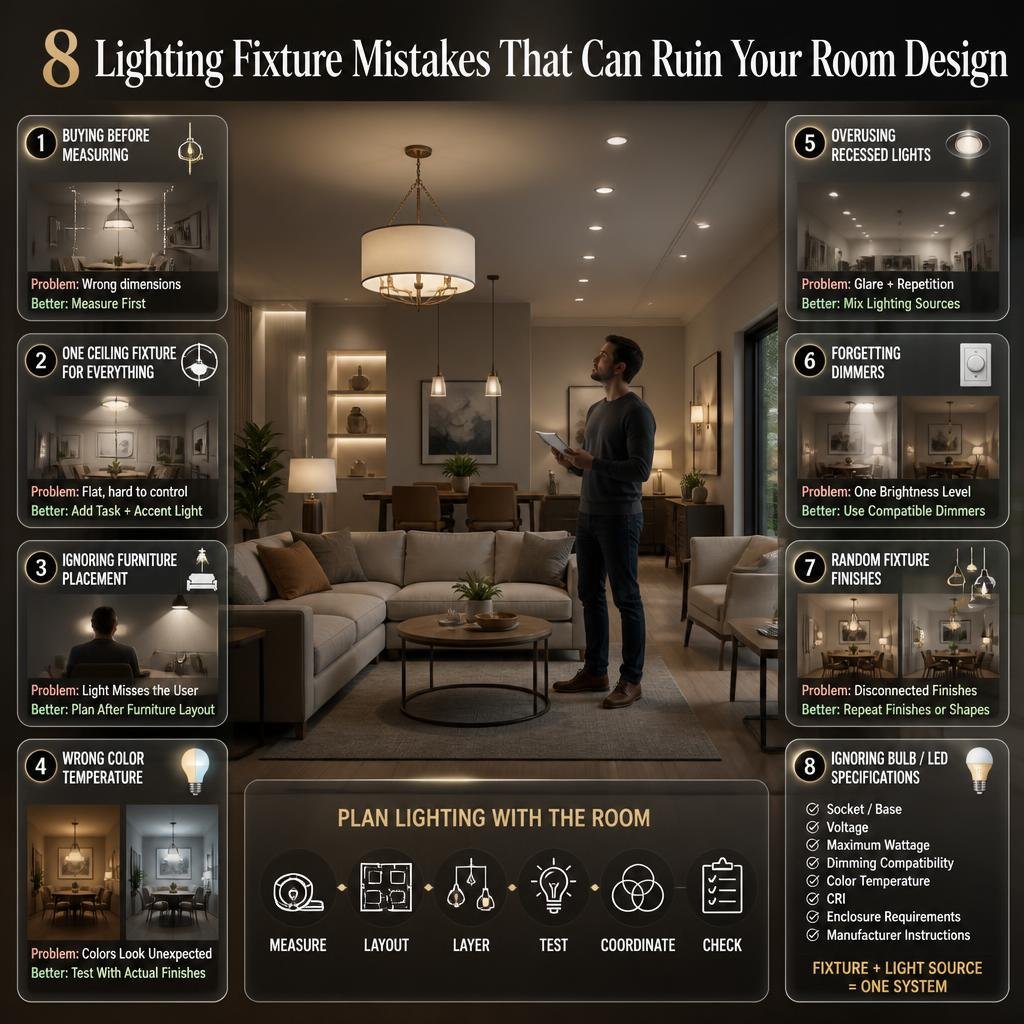
Mistake 1: Buying Fixtures Before Measuring
Why it happens: The fixture looks perfect online or in a showroom.
Why it’s harmful: The dimensions may be wrong for the actual room.
Better approach: Measure the room, ceiling, furniture, and installation area first.
Mistake 2: Using One Ceiling Fixture for Everything
Why it happens: It’s simple.
Why it’s harmful: The room can become flat and difficult to control.
Better approach: Add task and accent sources where they solve real problems.
Mistake 3: Ignoring Furniture Placement
Why it happens: Lighting is planned independently from the layout.
Why it’s harmful: A light may land behind the user or illuminate an empty area.
Better approach: Place lighting after determining how the furniture will be used.
Mistake 4: Choosing the Wrong Color Temperature
Why it happens: People choose bulbs based on brightness alone.
Why it’s harmful: Colors and materials can appear different from what was expected.
Better approach: Test color temperature with the actual finishes in the room.
Mistake 5: Overusing Recessed Lights
Why it happens: Downlights look clean and modern.
Why it’s harmful: Too many can create glare and visual repetition.
Better approach: Combine recessed lighting with lamps, pendants, sconces, or indirect lighting.
Mistake 6: Forgetting Dimmers
Why it happens: Standard switches are familiar.
Why it’s harmful: One brightness level cannot serve every activity.
Better approach: Use compatible dimmers where practical.
Mistake 7: Mixing Random Fixture Finishes
Why it happens: Fixtures are purchased individually over time.
Why it’s harmful: The room can look assembled rather than designed.
Better approach: Repeat selected finishes or shapes.
Mistake 8: Ignoring the Bulb or LED Specifications
Check:
- Socket/base
- Voltage
- Maximum wattage
- Dimming compatibility
- Color temperature
- CRI
- Fixture enclosure requirements
- Manufacturer instructions
The fixture and light source need to work as one system.
What Should You Check Before Installing Lighting Fixtures?
Use this simple checklist.
Room
- What is the room used for?
- How much daylight does it receive?
- Where are the main activity zones?
Fixture
- Is the scale appropriate?
- Is the style compatible?
- Is the finish suitable?
- Is the fixture rated for the location?
Light Source
- What is the lumen output?
- What color temperature is appropriate?
- What is the CRI?
- Is it dimmable?
- Is the bulb replaceable?
Installation
- Where is the electrical point?
- Is the ceiling strong enough for the fixture?
- Is there adequate clearance?
- Does the installation meet applicable electrical requirements?
Controls
- Can different layers operate separately?
- Would a dimmer be useful?
- Would smart control genuinely improve the room?
How Can Smart Lighting Improve Lighting Fixtures?
Smart lighting can make a well-planned lighting system easier to control.
Depending on the system, you may be able to adjust:
- Brightness
- Color temperature
- Scheduling
- Individual zones
- Lighting scenes
- Remote controls
For example, a living room could have a “Relax” setting that lowers the ambient light while leaving selected accent fixtures active.
A “Cleaning” setting could provide brighter general illumination.
But technology shouldn’t be added simply because it’s available.
A basic dimmer may be all you need in a bedroom.
What Role Does Home Automation Play in Lighting?
Automation becomes most useful when it simplifies repeated actions.
Examples include:
- Hallway lights activating automatically
- Exterior lights following a schedule
- Bedroom lights gradually reducing at night
- Kitchen task lights operating independently
- Vacation schedules for selected exterior fixtures
If you’re interested in broader technology-based home solutions, Home Upgrading Mintpalment can be considered alongside lighting when planning larger home upgrades.
How Can Lighting Support Modern Home Concepts?
Modern interiors often emphasize flexible spaces rather than rooms with only one purpose.
A dining area may become a workspace.
A kitchen island may become a homework station.
A living room may function as a reading area, entertainment zone, and social space.
Lighting needs to support these changes.
This is where independent controls and layered fixtures become particularly useful.
For additional ideas related to contemporary home planning, Blog Home Ideas TheHomeTrotters can provide a broader design context around how lighting interacts with furniture, layout, and everyday living.
How Should You Plan Lighting During a Renovation?
The earlier lighting is considered, the easier it is to achieve a clean result.
Before walls and ceilings are finished, determine:
- Fixture positions
- Switch locations
- Dimming requirements
- Wiring routes
- Ceiling cutouts
- Pendant suspension points
- Under-cabinet connections
- Smart controls
- Furniture arrangement
This is particularly important for recessed lights and hardwired sconces.
Moving a decorative lamp is easy.
Moving a hardwired fixture after construction is considerably more disruptive.
For renovation inspiration, Latest News DecoratorAdvice can be used alongside the broader interior planning process.
What Are the Best Lighting Fixtures for Different Rooms?
| Room | Useful Fixtures | Main Goal |
|---|---|---|
| Living Room | Ceiling light, floor lamps, sconces | Flexible atmosphere |
| Bedroom | Warm ceiling light, bedside lamps | Relaxation and reading |
| Kitchen | Downlights, pendants, under-cabinet lights | Safe task visibility |
| Dining Room | Chandelier or pendant | Focus and atmosphere |
| Bathroom | Vanity light, ceiling fixture | Balanced visibility |
| Home Office | Desk lamp, ceiling light | Comfortable task lighting |
| Hallway | Flush mount, sconces | Safe movement and visual rhythm |
| Entryway | Pendant, chandelier, wall light | First impression |
| Closet | Ceiling and internal lighting | Visibility |
| Patio | Wall lights, pendants, path lights | Safety and atmosphere |
The exact combination depends on the room’s dimensions and activities.
How Can Lighting Improve a Home’s First Impression?
The entryway often determines how the rest of the home initially feels.
A suitable pendant or chandelier can establish a focal point in a larger entrance.
Wall sconces can create a softer effect in narrow spaces.
Accent lighting can highlight artwork or a console.
But the entryway shouldn’t be so bright that it feels disconnected from the rooms beyond it.
A smooth transition between spaces generally feels more intentional.
For additional home-focused ideas, Latest News DecoratorAdvice can complement the broader planning process.
How Does Lighting Connect With Room-by-Room Interior Design?
Lighting shouldn’t be considered independently from:
- Furniture
- Flooring
- Wall treatments
- Paint
- Storage
- Decorative objects
- Window treatments
- Architectural details
For example, a heavily textured wall may benefit from grazing light that emphasizes its surface.
A minimalist room may benefit from a simple architectural fixture.
A decorative ceiling may need lighting that highlights the ceiling rather than competing with it.
This room-by-room approach is especially useful when the goal is a cohesive home rather than a collection of individually decorated rooms.
What are the best lighting fixtures for a living room?
The best living room lighting isn’t usually one large ceiling fixture. A more practical approach is to combine different lighting fixtures so the room can support relaxing, reading, entertaining, watching TV, and everyday movement. Interior lighting guidance increasingly recommends combining ambient, task, and accent lighting instead of depending entirely on one overhead source.
For example, a living room might use a central ceiling fixture or recessed lights for general illumination, a floor lamp beside a reading chair for focused light, and wall or picture lights to highlight artwork or architectural details.
Professional points to consider:
Use ambient lighting to establish comfortable overall illumination.
Add floor or table lamps around seating areas where people actually read or work.
Use accent lighting to highlight artwork, shelves, plants, or textured walls.
Choose dimmable fixtures where possible so brightness can change throughout the day.
Keep the color temperature reasonably consistent between fixtures that operate together.
Don’t automatically fill the ceiling with downlights just because the room is large.
The biggest improvement often comes from placing light at different heights. Ceiling lighting handles the upper layer, lamps introduce light closer to furniture, and wall or accent fixtures bring attention toward vertical surfaces. This makes the room feel more comfortable and visually balanced rather than simply brighter.
How do I choose the right size lighting fixture for my room?
Choosing the correct fixture size requires looking at the room dimensions, ceiling height, furniture size, and visual weight of the fixture together. A fixture that looks perfectly proportioned in a showroom can look surprisingly small or oversized once it’s installed in an actual room.
For a central ceiling fixture, a commonly used starting point is to add the room’s length and width in feet and use the resulting number as an approximate fixture diameter in inches.
For example:
10 ft + 12 ft = 22 inches
That gives you a starting point for a fixture around 22 inches wide. It isn’t a strict rule because furniture, ceiling height, fixture shape, and the overall design can change the appropriate size.
For a dining room, the table becomes especially important. A chandelier or pendant should relate visually to the dining table rather than simply being sized according to the room.
Before buying, check:
Room length and width
Ceiling height
Dining table or island dimensions
Fixture diameter
Fixture height
Walking clearance
Sightlines
Visual weight
Existing furniture
A large sculptural fixture may work beautifully in a spacious room but overwhelm a compact one. Conversely, an extremely small fixture can disappear above a large dining table.
Expert approach: If you’re uncertain about scale, create a temporary cardboard outline of the fixture’s approximate dimensions and hold it in the intended location. Seeing the proposed size in the actual room is often more useful than judging a product from a website photograph.
What color temperature is best for lighting fixtures in a home?
For most residential interiors, warm white lighting around 2700K–3000K is a popular choice because it creates a comfortable, relaxed appearance. However, there isn’t one color temperature that works perfectly for every room. The right choice depends on the room’s purpose, finishes, natural daylight, and the atmosphere you want to create. Current interior-design guidance commonly recommends warmer residential lighting, particularly around 2700K–3000K, while more task-focused areas can use different temperatures when appropriate.
Bedrooms and living rooms often work well with warmer light because these spaces are primarily associated with relaxation.
Kitchens, bathrooms, home offices, and utility areas may benefit from a more neutral appearance when clear visibility is important.
A practical starting point:
2200K–2700K: Very warm and intimate
2700K–3000K: Warm residential lighting
3000K–3500K: Neutral-warm appearance
3500K–4100K: Cooler, more functional appearance
5000K+: Cool daylight-style appearance
The important thing isn’t simply choosing a number. It’s considering how that light interacts with your interior.
Warm lighting can make natural wood, beige, cream, terracotta, and warm stone appear richer. Cooler lighting can make whites and certain gray or blue finishes appear noticeably different.
Professional tip: Don’t judge a bulb only from its packaging. Test the lighting in the actual room with your paint, flooring, furniture, and curtains. A color temperature that looks attractive in a store may look completely different once it’s illuminating your home.
Also pay attention to CRI (Color Rendering Index) when accurate color appearance matters. For areas displaying artwork, materials, clothing, food, or skin tones, better color rendering can make the room look considerably more natural.
Is layered lighting better than using one ceiling light?
For most rooms, layered lighting provides considerably more flexibility than relying on one ceiling fixture. The idea is to combine ambient, task, and accent lighting so that each source has a specific purpose. Current professional lighting guidance strongly emphasizes this approach because a room can have enough total light and still feel poorly illuminated if all the light comes from one location.
Think about the three layers this way:
Ambient lighting:
Provides general illumination so you can move through and use the room comfortably.
Task lighting:
Provides focused light where an activity takes place, such as a kitchen counter, desk, reading chair, or bathroom mirror.
Accent lighting:
Adds visual emphasis to artwork, shelving, architectural details, plants, or decorative features.
For example, a bedroom could have a warm ceiling fixture for general illumination, bedside lamps for reading, and subtle accent lighting behind a headboard.
A kitchen could combine ceiling lighting, under-cabinet LEDs, and pendant lights over the island.
A living room might use recessed or ceiling lighting with floor lamps and accent lighting.
Why layered lighting works better:
It reduces dependence on one harsh light source.
It allows different brightness levels for different activities.
It creates more visual depth.
It can make furniture and architectural features more noticeable.
It gives you better control in the evening.
It prevents the entire room from needing to be equally bright.
The important point is that layering doesn’t mean adding lights everywhere.
Expert advice: Add a fixture only when it has a clear job. If a new light doesn’t improve visibility, atmosphere, flexibility, or visual emphasis, you may be adding complexity rather than improving the room.
What are the biggest mistakes people make when choosing lighting fixtures?
The most common mistake is choosing a fixture because it looks attractive on its own without considering how it will function inside the room. A beautiful chandelier can still be wrong for a low ceiling, and an expensive pendant can still provide poor illumination if it’s positioned incorrectly.
Another frequent problem is relying on a single bright ceiling fixture. This may make the room technically bright, but it can create harsh shadows and a flat appearance. Modern lighting guidance increasingly favors multiple layers and independent control rather than treating the ceiling fixture as the entire lighting system.
The mistakes worth avoiding are:
Ignoring fixture scale: A fixture should relate to the room and furniture dimensions.
Installing lights before planning furniture: The light may end up illuminating the wrong location.
Using too many recessed lights: Excessive downlighting can create glare and a repetitive ceiling.
Choosing bulbs only by wattage: Lumens, color temperature, and color rendering also matter.
Mixing incompatible color temperatures: Adjacent warm and cool lights can make a room feel visually inconsistent.
Forgetting dimmers: One brightness level rarely suits every activity.
Ignoring task lighting: A bright room can still have poorly illuminated work surfaces.
Matching every fixture exactly: Coordination usually looks more sophisticated than identical fixtures everywhere.
Ignoring installation requirements: Weight, wiring, voltage, moisture exposure, and fixture specifications need to be checked before installation.
Choosing style before function: The fixture should solve the room’s lighting requirement first and provide the desired aesthetic second.
A professional lighting plan starts by asking how the room will actually be used. Once the activities, furniture positions, and problem areas are clear, selecting the right fixture becomes much easier.
The best lighting isn’t necessarily the brightest lighting or the most expensive lighting. It’s the lighting that makes the room comfortable, functional, visually balanced, and easy to control.
Conclusion
Choosing the right lighting fixtures is not simply about finding a beautiful chandelier, pendant, ceiling light, or wall sconce. The real goal is to create lighting that works with the way your home is used while also supporting the room’s style, proportions, colors, furniture, and overall atmosphere.
A well-designed space rarely depends on one bright ceiling fixture. Instead, combining ambient, task, and accent lighting creates more depth, flexibility, comfort, and visual balance.
Before buying any fixture, think about what the room needs first. Consider the room size, ceiling height, furniture arrangement, daily activities, desired mood, fixture scale, light color, and the surfaces or architectural details you want to highlight. A beautiful fixture can still feel wrong if it is too large, too small, too bright, or positioned without considering the rest of the room.
The best lighting design is also flexible. Dimmers, multiple light sources, and separate lighting layers allow the same room to change from bright and functional during the day to warm and relaxing in the evening. Current interior-design guidance continues to emphasize layered lighting rather than relying entirely on one overhead source.
Most importantly, choose lighting fixtures as part of the complete interior design, not as an isolated purchase. When lighting, furniture, wall colors, materials, textures, and decorative elements work together, the result feels intentional rather than simply decorated.
If you are planning a complete home transformation or want professional inspiration for different rooms, explore DesignMode24 Interior Design for more practical interior design ideas and room-by-room guidance.
The right lighting does not just make a room brighter — it changes how the room feels, functions, and is experienced.

Leave a Reply